Factual Writing
Factual writing is used to inform people of events or raise awareness of their company or cause. It can also be used to 
instruct people on how to do a certain thing. There are many different formats in which factual writing can be presented. 
Magazines, newspapers, leaflets, packaging and instruction manuals are all ways in which factual writing is used. 
Magazines and Newspapers- 
Magazines and newspapers write to inform people of events that have happened. Journalists are bound by the editors code 
of practice. These are strict regulations that control what can and cannot be written. Its rules have been put in place in 
order to protect people from any damage that could be done by a journalist. In order to make their writing as factual as 
possible, journalists must make sure that all their information is as accurate as possible. This means checking that all of the 
information used is completely correct. Another thing that newspapers 
have to consider is typography. This is the colour, font, font size and 
effects that they use for their text. It is important to chose the right text 
style for the purpose of your writing. For example, if you want to draw 
attention to a particular part of your writing you could put 
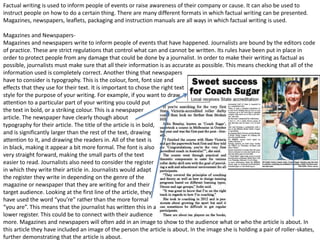
the text in bold, or a striking colour. This is a newspaper 
article. The newspaper have clearly though about 
typography for their article. The title of the article is in bold, 
and is significantly larger than the rest of the text, drawing 
attention to it, and drawing the readers in. All of the text is 
in black, making it appear a bit more formal. The font is also 
very straight forward, making the small parts of the text 
easier to read. Journalists also need to consider the register 
in which they write their article in. Journalists would adapt 
the register they write in depending on the genre of the 
magazine or newspaper that they are writing for and their 
target audience. Looking at the first line of the article, they 
have used the word “you’re” rather than the more formal 
“you are”. This means that the journalist has written this in a 
lower register. This could be to connect with their audience 
more. Magazines and newspapers will often add in an image to show to the audience what or who the article is about. In 
this article they have included an image of the person the article is about. In the image she is holding a pair of roller-skates, 
further demonstrating that the article is about.
Below the image they have anchored it. They give a short summery 
of the article to show what they are looking at in the image. They 
have also given credit to the photographer who took the picture. 
When writing a magazine or newspaper article, the journalist has to take the law into consideration. Newspapers in 
particular cover lots of stories to do with crime. Journalists can face restrictions from things such as gagging orders, which 
legally prevent certain information from becoming public for the safety of an individual or group of people. Some magazines 
or newspapers can come across slightly bias politically, or on a certain story. Journalists need to ensure that they are not 
bias by putting across both sides of the story equally. In order to make sure that they avoid ambiguity, they must put 
evidence for their arguments as well, and source all information. This makes their facts more legitimate.
This is a magazine article from Dazed and Confused 
magazine. For the magazine article, the image is 
larger than the amount of text used. I think that this 
is due to the genre of the magazine. They have 
clearly thought more about typography than with 
the newspaper article. The font used for the title is 
fairly square and simple, however with small 
interesting details. For example, the O’s link in the 
word “shoot”. They have also continued this same 
font into their first line that summarizes the article. 
This line is also significantly larger than the rest of 
the article. This has been done to draw the reader 
into the article. They have also put the artists name 
in a slightly more bold font to draw attention to it. 
To keep the article as concise as possible the 
journalist will have had to have stuck to writing the 
key information. I can image that for a magazine 
article such as this one the language wouldn’t be 
too high register. It isn't a formal document of 
information, the article is more meant for pleasure 
purposes. They also have to take into consideration 
the audience of their writing, which can determine 
the way an article is written. Dazed and Confused is 
meant for a younger audience, so I think that the 
language they would use would be quite low 
register so that their audience can relate to the 
article.
Leaflets- 
Leaflets are often used by companies to inform people of their services, to raise awareness, or to advertise. Due to the size 
of a leaflet, it doesn’t allow that much text so all of their information needs to be condensed down. Writers need to make 
sure that their writing is as concise as possible, to allow they to use a few words in an effective way to save space, and to 
make the text easier to read. Writers also need to make sure that all of their facts are accurate. If the facts they have 
provided are found to be untrue then it could damage the cause. It is also important for writers to refer to sources where 
they obtained facts. This gives makes the facts seem more legitimate. (2) is a leaflet raising awareness of puppy farming. For 
this type of leaflet the writers will need to be careful to not appear bias. Like with the news article, they have thought about 
typology. They have used red boarders 
around the text that they wanted to draw 
attention to. The colour red often has 
connotations of danger, or death. This could 
Have been the reason why it was used for 
this particular article. They have also used 
the colour green for their subtitles to draw 
attention to them. Green and red are 
contrasting colours, so using them together 
makes them stand out from each other. 
Green is also associated with goodness, so it 
may have been used to balance out the red 
and also make people thing of the cause as 
good. They have also put a black boarder 
around one particular fact to show how 
shocking and important it is. The fact that has 
been placed in the black box is quite 
ambiguous, and isn’t backed up with a 
source. Writers must avoid being too 
Ambiguous. All of their facts must be solid, as 
this will make them seem more legitimate. For the leaflet, a lot of imagery has been used. These images have been used to 
back up the claims made in the leaflet. There is a danger that their bias could have affected the images used for the leaflet. 
They could be showing images of the dogs found in the most extreme cases, rather than the typical, in order for the images 
to impact the audience more. They have anchored the images, explaining what the audience is looking at.
This is the other side to the leaflet. It gives you 
the important contact information inside the red 
boxes. This makes them easy to find, and 
encourages you to get in contact, or to look on 
their website. They have used an image on the 
front cover of their leaflet. This will be the first 
thing that the reader sees. It will show them what 
the leaflet is about. I think it is also quite a 
shocking image, and may encourage people to 
take notice and read the leaflet. In one of the 
paragraphs they used the work “you’ll” instead of 
“you will”. This shows that they are speaking to 
the audience in a low register. By doing this, they 
could be trying to connect with the audience. 
Throughout the leaflet, their company name is 
always written in red. I feel that this has been 
done to make it stand out from the rest of the 
text, perhaps making it more memorable. The 
font that they have used is pretty standard and 
readable, though throughout they have put 
certain parts of the text in bold. This has been 
done to draw attention to those parts of the text. 
For example right at the start of the leaflet there 
is a little introduction that they have put in bold. 
This is to draw the reader in.
Leaflets are often used by charities to raise awareness. They are a good way of giving out information to the public on their 
campaign as they are quick to produce, enabling them to mass produce them and hand lots out to the public. Charities 
often do not consider both sides of the argument. They are often in danger of appearing bias. The producers of the leaflets 
are bound by Advertising Standards Agency (ASA) guidelines. The ASA ensures that all advertising and promotion is suitable 
for the public and legal. Anything advertising that could cause offence, or be damaging to people is prevented by the ASA. 
Like with magazines and newspapers, they are also bound by the law. This could mean that charities are prevented from 
referring to specific people in their leaflets who are protected with a gagging order, and could be harmed in doing so. In 
order to back up their argument in their leaflet they have have needed to have sourced all of their facts too.
Instructional Writing- 
Instructional writing is used for instructions, or how to guides. It 
gives advice on how to use their product best, or on how best to 
deal with a particular situation. 
This is an example of an instruction manual. They have made sure 
to use short sentences in order to keep things clear and concise. 
They have used a lot of images to demonstrate what is being 
written, which takes away some of the need for text allowing them 
to write as few words as possible. The images that they have used 
appear to be illustrations, as apposed to photographs. I think that 
the different buttons and options on screen may have appeared 
unclear on a photograph. Doing an illustration of the camera 
enables you to make everything as clear as possible. On their 
images they have included a little hand that points directly to 
where the reader is meant to be looking, making it completely 
accurate. Like with the other instruction manual they have used 
bullet points. This gives the writing a clear structure. It breaks up 
what seems to be the largest piece of text. The font they have used 
is very simple and readable, as it needs to be for the audience to 
clearly understand what they are supposed to do. All of the text is 
in black. Using other colours may have made the text slightly less 
readable. They have used block capitals for the text showing you 
what will be written on screen. In order to make their information 
accurate, the writers will have had to have made sure that 
everything that is written truly reflects what the user will see 
when they use the camera. All of the fingers and lines used to label 
and point to the area that they are talking about in the text must 
be in the exact right place so that it is accurate, and the reader 
knows clearly what they are supposed to do. I think that the text 
will have to be written in quite a high register for an instruction 
manual so that the instructions are very clear, and everybody can 
understand what is written. 
In this particular instruction manual they have used 
“do not” instead of the shortened version “don’t”, 
showing it is in fact written in a higher register. In 
order to make the information given in the 
instruction manual useful, writers must avoid 
ambiguity. This means they must be specific about 
everything they are saying.
This image shows a how to guide. Like the instruction manual they 
have used a lot of imagery. They were made to demonstrate a few 
key points in the guide, and perhaps make the article more 
interesting to look at. I think the little images breaks up the text 
nicely, making it seem more readable. This how to guide features 
much more interesting typography than the instruction manual. The 
titles font is reflective of the title itself I think. The title is “Rock your 
Finals”, perhaps referring to the music genre. The edges of the text 
are square and are angled at a point, and I think the font reflects the 
genre of music that they are referring to. I think that the typography 
that they have used is reflective of their audience. Instead of using 
bullet points, they have used lines separating each bit of 
information. Like with bullet points, they are used to separate the 
text, allowing they to write more concisely. They also use coloured 
circular boxes to put certain bits of text. In these boxes they only use 
a small amount of text that sums up a certain section of the guide. 
They have also put certain bits of text in bold to draw attention to 
them. They have put the subtitles over each bit of information. They 
have put all of the subtitles in red to draw the reader in. I think that 
for a how to guide the writer will have had to have though more 
about sourcing their facts in order to back them up. They will need 
to make sure that their information is not ambiguous in order to 
make their point stronger too. I think that how to guides can be 
made slightly less formal than an instruction manual. Instruction 
manuals need to give the clearest instructions possible and in order 
to do so need to write extremely clearly, in a way that everyone will 
understand. How to guides could perhaps be slightly less formal 
depending on its purpose of course. This particular how to guide is 
trying to appeal specifically to students, and in order to do so have 
perhaps written it in a low register. They have made references to 
things that young people may understand, such as “groupies”.

Task 1- Factual Writing

  • 1.
  • 2.
    Factual writing isused to inform people of events or raise awareness of their company or cause. It can also be used to instruct people on how to do a certain thing. There are many different formats in which factual writing can be presented. Magazines, newspapers, leaflets, packaging and instruction manuals are all ways in which factual writing is used. Magazines and Newspapers- Magazines and newspapers write to inform people of events that have happened. Journalists are bound by the editors code of practice. These are strict regulations that control what can and cannot be written. Its rules have been put in place in order to protect people from any damage that could be done by a journalist. In order to make their writing as factual as possible, journalists must make sure that all their information is as accurate as possible. This means checking that all of the information used is completely correct. Another thing that newspapers have to consider is typography. This is the colour, font, font size and effects that they use for their text. It is important to chose the right text style for the purpose of your writing. For example, if you want to draw attention to a particular part of your writing you could put the text in bold, or a striking colour. This is a newspaper article. The newspaper have clearly though about typography for their article. The title of the article is in bold, and is significantly larger than the rest of the text, drawing attention to it, and drawing the readers in. All of the text is in black, making it appear a bit more formal. The font is also very straight forward, making the small parts of the text easier to read. Journalists also need to consider the register in which they write their article in. Journalists would adapt the register they write in depending on the genre of the magazine or newspaper that they are writing for and their target audience. Looking at the first line of the article, they have used the word “you’re” rather than the more formal “you are”. This means that the journalist has written this in a lower register. This could be to connect with their audience more. Magazines and newspapers will often add in an image to show to the audience what or who the article is about. In this article they have included an image of the person the article is about. In the image she is holding a pair of roller-skates, further demonstrating that the article is about.
  • 3.
    Below the imagethey have anchored it. They give a short summery of the article to show what they are looking at in the image. They have also given credit to the photographer who took the picture. When writing a magazine or newspaper article, the journalist has to take the law into consideration. Newspapers in particular cover lots of stories to do with crime. Journalists can face restrictions from things such as gagging orders, which legally prevent certain information from becoming public for the safety of an individual or group of people. Some magazines or newspapers can come across slightly bias politically, or on a certain story. Journalists need to ensure that they are not bias by putting across both sides of the story equally. In order to make sure that they avoid ambiguity, they must put evidence for their arguments as well, and source all information. This makes their facts more legitimate.
  • 4.
    This is amagazine article from Dazed and Confused magazine. For the magazine article, the image is larger than the amount of text used. I think that this is due to the genre of the magazine. They have clearly thought more about typography than with the newspaper article. The font used for the title is fairly square and simple, however with small interesting details. For example, the O’s link in the word “shoot”. They have also continued this same font into their first line that summarizes the article. This line is also significantly larger than the rest of the article. This has been done to draw the reader into the article. They have also put the artists name in a slightly more bold font to draw attention to it. To keep the article as concise as possible the journalist will have had to have stuck to writing the key information. I can image that for a magazine article such as this one the language wouldn’t be too high register. It isn't a formal document of information, the article is more meant for pleasure purposes. They also have to take into consideration the audience of their writing, which can determine the way an article is written. Dazed and Confused is meant for a younger audience, so I think that the language they would use would be quite low register so that their audience can relate to the article.
  • 5.
    Leaflets- Leaflets areoften used by companies to inform people of their services, to raise awareness, or to advertise. Due to the size of a leaflet, it doesn’t allow that much text so all of their information needs to be condensed down. Writers need to make sure that their writing is as concise as possible, to allow they to use a few words in an effective way to save space, and to make the text easier to read. Writers also need to make sure that all of their facts are accurate. If the facts they have provided are found to be untrue then it could damage the cause. It is also important for writers to refer to sources where they obtained facts. This gives makes the facts seem more legitimate. (2) is a leaflet raising awareness of puppy farming. For this type of leaflet the writers will need to be careful to not appear bias. Like with the news article, they have thought about typology. They have used red boarders around the text that they wanted to draw attention to. The colour red often has connotations of danger, or death. This could Have been the reason why it was used for this particular article. They have also used the colour green for their subtitles to draw attention to them. Green and red are contrasting colours, so using them together makes them stand out from each other. Green is also associated with goodness, so it may have been used to balance out the red and also make people thing of the cause as good. They have also put a black boarder around one particular fact to show how shocking and important it is. The fact that has been placed in the black box is quite ambiguous, and isn’t backed up with a source. Writers must avoid being too Ambiguous. All of their facts must be solid, as this will make them seem more legitimate. For the leaflet, a lot of imagery has been used. These images have been used to back up the claims made in the leaflet. There is a danger that their bias could have affected the images used for the leaflet. They could be showing images of the dogs found in the most extreme cases, rather than the typical, in order for the images to impact the audience more. They have anchored the images, explaining what the audience is looking at.
  • 6.
    This is theother side to the leaflet. It gives you the important contact information inside the red boxes. This makes them easy to find, and encourages you to get in contact, or to look on their website. They have used an image on the front cover of their leaflet. This will be the first thing that the reader sees. It will show them what the leaflet is about. I think it is also quite a shocking image, and may encourage people to take notice and read the leaflet. In one of the paragraphs they used the work “you’ll” instead of “you will”. This shows that they are speaking to the audience in a low register. By doing this, they could be trying to connect with the audience. Throughout the leaflet, their company name is always written in red. I feel that this has been done to make it stand out from the rest of the text, perhaps making it more memorable. The font that they have used is pretty standard and readable, though throughout they have put certain parts of the text in bold. This has been done to draw attention to those parts of the text. For example right at the start of the leaflet there is a little introduction that they have put in bold. This is to draw the reader in.
  • 7.
    Leaflets are oftenused by charities to raise awareness. They are a good way of giving out information to the public on their campaign as they are quick to produce, enabling them to mass produce them and hand lots out to the public. Charities often do not consider both sides of the argument. They are often in danger of appearing bias. The producers of the leaflets are bound by Advertising Standards Agency (ASA) guidelines. The ASA ensures that all advertising and promotion is suitable for the public and legal. Anything advertising that could cause offence, or be damaging to people is prevented by the ASA. Like with magazines and newspapers, they are also bound by the law. This could mean that charities are prevented from referring to specific people in their leaflets who are protected with a gagging order, and could be harmed in doing so. In order to back up their argument in their leaflet they have have needed to have sourced all of their facts too.
  • 8.
    Instructional Writing- Instructionalwriting is used for instructions, or how to guides. It gives advice on how to use their product best, or on how best to deal with a particular situation. This is an example of an instruction manual. They have made sure to use short sentences in order to keep things clear and concise. They have used a lot of images to demonstrate what is being written, which takes away some of the need for text allowing them to write as few words as possible. The images that they have used appear to be illustrations, as apposed to photographs. I think that the different buttons and options on screen may have appeared unclear on a photograph. Doing an illustration of the camera enables you to make everything as clear as possible. On their images they have included a little hand that points directly to where the reader is meant to be looking, making it completely accurate. Like with the other instruction manual they have used bullet points. This gives the writing a clear structure. It breaks up what seems to be the largest piece of text. The font they have used is very simple and readable, as it needs to be for the audience to clearly understand what they are supposed to do. All of the text is in black. Using other colours may have made the text slightly less readable. They have used block capitals for the text showing you what will be written on screen. In order to make their information accurate, the writers will have had to have made sure that everything that is written truly reflects what the user will see when they use the camera. All of the fingers and lines used to label and point to the area that they are talking about in the text must be in the exact right place so that it is accurate, and the reader knows clearly what they are supposed to do. I think that the text will have to be written in quite a high register for an instruction manual so that the instructions are very clear, and everybody can understand what is written. In this particular instruction manual they have used “do not” instead of the shortened version “don’t”, showing it is in fact written in a higher register. In order to make the information given in the instruction manual useful, writers must avoid ambiguity. This means they must be specific about everything they are saying.
  • 9.
    This image showsa how to guide. Like the instruction manual they have used a lot of imagery. They were made to demonstrate a few key points in the guide, and perhaps make the article more interesting to look at. I think the little images breaks up the text nicely, making it seem more readable. This how to guide features much more interesting typography than the instruction manual. The titles font is reflective of the title itself I think. The title is “Rock your Finals”, perhaps referring to the music genre. The edges of the text are square and are angled at a point, and I think the font reflects the genre of music that they are referring to. I think that the typography that they have used is reflective of their audience. Instead of using bullet points, they have used lines separating each bit of information. Like with bullet points, they are used to separate the text, allowing they to write more concisely. They also use coloured circular boxes to put certain bits of text. In these boxes they only use a small amount of text that sums up a certain section of the guide. They have also put certain bits of text in bold to draw attention to them. They have put the subtitles over each bit of information. They have put all of the subtitles in red to draw the reader in. I think that for a how to guide the writer will have had to have though more about sourcing their facts in order to back them up. They will need to make sure that their information is not ambiguous in order to make their point stronger too. I think that how to guides can be made slightly less formal than an instruction manual. Instruction manuals need to give the clearest instructions possible and in order to do so need to write extremely clearly, in a way that everyone will understand. How to guides could perhaps be slightly less formal depending on its purpose of course. This particular how to guide is trying to appeal specifically to students, and in order to do so have perhaps written it in a low register. They have made references to things that young people may understand, such as “groupies”.