Factual Writing
Emily Shaw
Leaflets
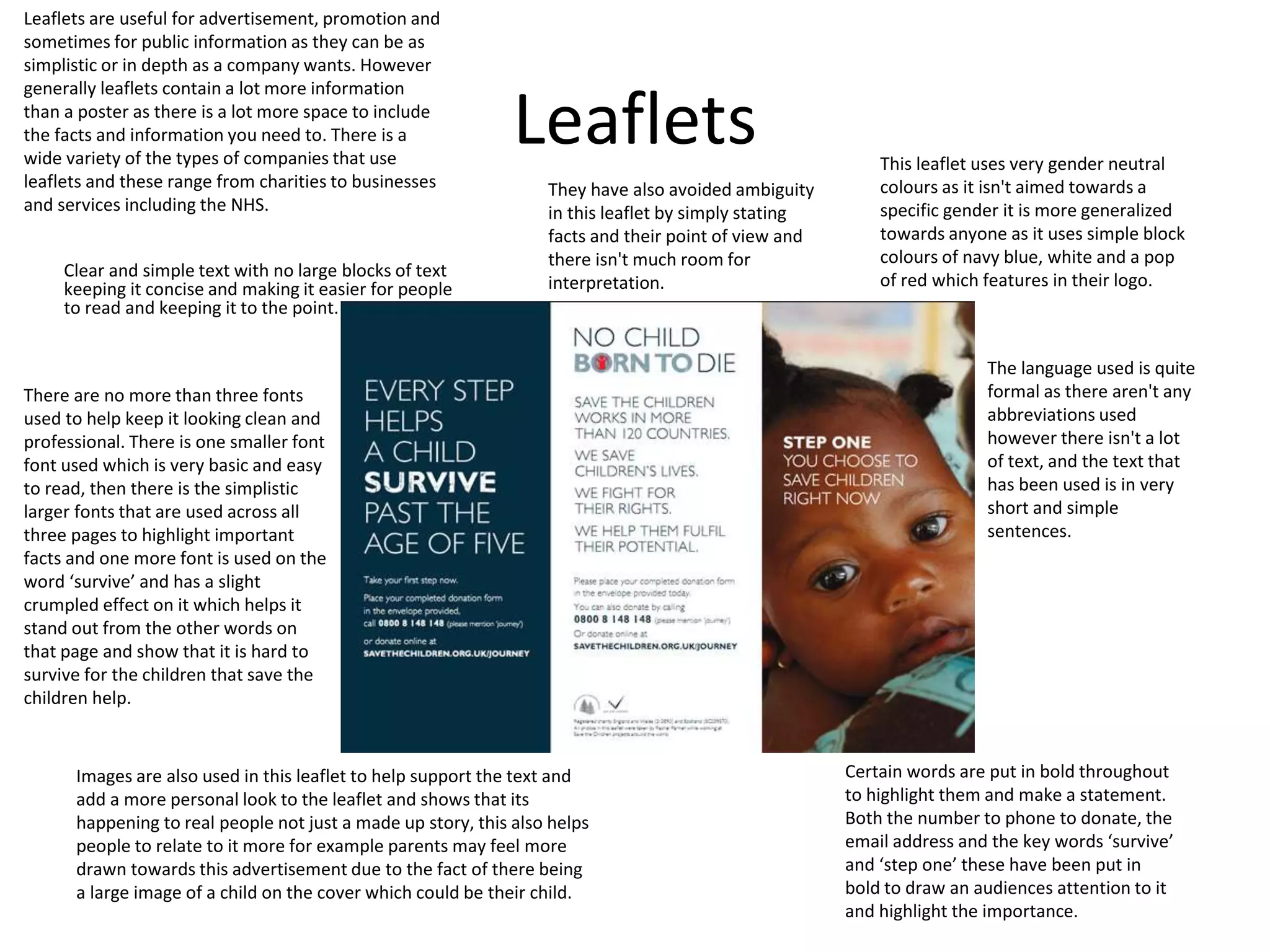
Clear and simple text with no large blocks of text
keeping it concise and making it easier for people
to read and keeping it to the point.
Certain words are put in bold throughout
to highlight them and make a statement.
Both the number to phone to donate, the
email address and the key words ‘survive’
and ‘step one’ these have been put in
bold to draw an audiences attention to it
and highlight the importance.
This leaflet uses very gender neutral
colours as it isn't aimed towards a
specific gender it is more generalized
towards anyone as it uses simple block
colours of navy blue, white and a pop
of red which features in their logo.
There are no more than three fonts
used to help keep it looking clean and
professional. There is one smaller font
font used which is very basic and easy
to read, then there is the simplistic
larger fonts that are used across all
three pages to highlight important
facts and one more font is used on the
word ‘survive’ and has a slight
crumpled effect on it which helps it
stand out from the other words on
that page and show that it is hard to
survive for the children that save the
children help.
The language used is quite
formal as there aren't any
abbreviations used
however there isn't a lot
of text, and the text that
has been used is in very
short and simple
sentences.
Leaflets are useful for advertisement, promotion and
sometimes for public information as they can be as
simplistic or in depth as a company wants. However
generally leaflets contain a lot more information
than a poster as there is a lot more space to include
the facts and information you need to. There is a
wide variety of the types of companies that use
leaflets and these range from charities to businesses
and services including the NHS.
Images are also used in this leaflet to help support the text and
add a more personal look to the leaflet and shows that its
happening to real people not just a made up story, this also helps
people to relate to it more for example parents may feel more
drawn towards this advertisement due to the fact of there being
a large image of a child on the cover which could be their child.
They have also avoided ambiguity
in this leaflet by simply stating
facts and their point of view and
there isn't much room for
interpretation.
Instruction Manual
Instruction manuals should be simple and
factual, as well as this instruction manuals usually
contain images to help make and step by steps
and instructions easier to carry out. There are
instruction manuals for a wide variety of things
for example there are instruction manuals for
anything from building furniture to how to use a
phone. There will usually be a simple step by
step layout with clear instructions.
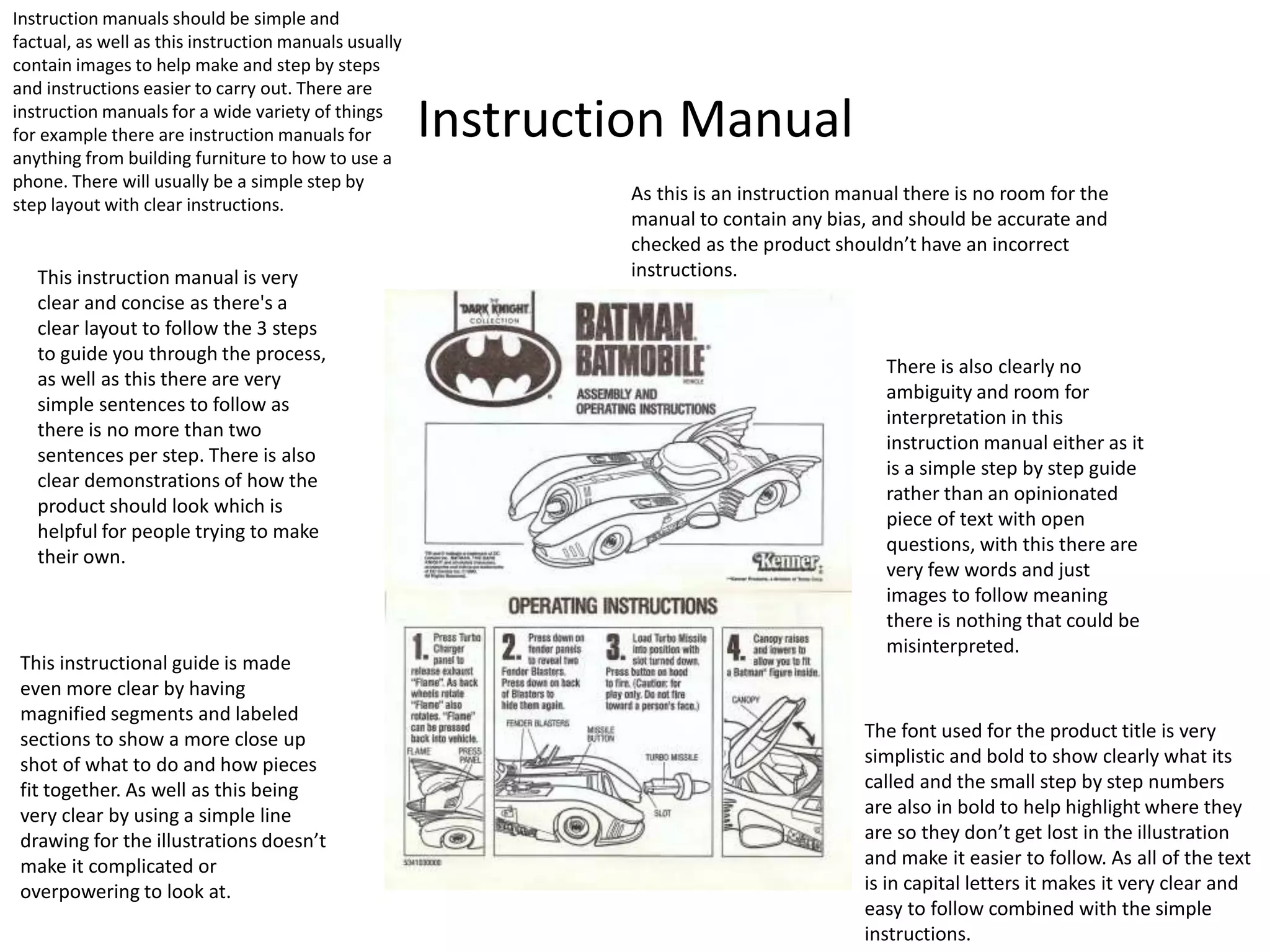
This instruction manual is very
clear and concise as there's a
clear layout to follow the 3 steps
to guide you through the process,
as well as this there are very
simple sentences to follow as
there is no more than two
sentences per step. There is also
clear demonstrations of how the
product should look which is
helpful for people trying to make
their own.
As this is an instruction manual there is no room for the
manual to contain any bias, and should be accurate and
checked as the product shouldn’t have an incorrect
instructions.
This instructional guide is made
even more clear by having
magnified segments and labeled
sections to show a more close up
shot of what to do and how pieces
fit together. As well as this being
very clear by using a simple line
drawing for the illustrations doesn’t
make it complicated or
overpowering to look at.
The font used for the product title is very
simplistic and bold to show clearly what its
called and the small step by step numbers
are also in bold to help highlight where they
are so they don’t get lost in the illustration
and make it easier to follow. As all of the text
is in capital letters it makes it very clear and
easy to follow combined with the simple
instructions.
There is also clearly no
ambiguity and room for
interpretation in this
instruction manual either as it
is a simple step by step guide
rather than an opinionated
piece of text with open
questions, with this there are
very few words and just
images to follow meaning
there is nothing that could be
misinterpreted.
How to Guides
How to guides are more likely to contain
advice and tips rather than factual
instructions. As well as this show to guide
generally will contain steps to go through
to a achieve a certain goal. How to guides
can be helpful to receive other peoples
advice as its more opinionated than in an
instruction manual where that is more to
the point on how to put something
together as apposed to how to use it.
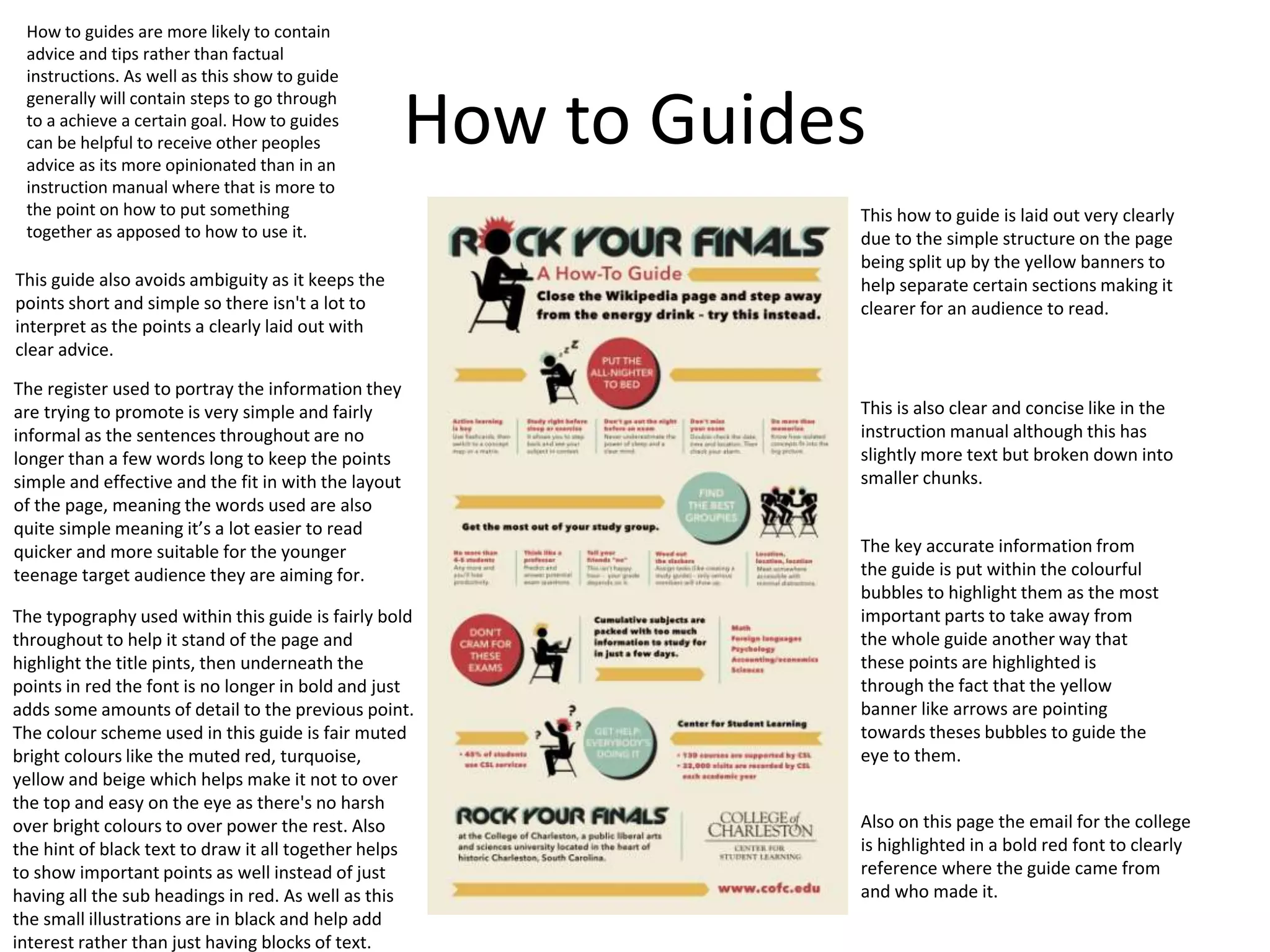
This how to guide is laid out very clearly
due to the simple structure on the page
being split up by the yellow banners to
help separate certain sections making it
clearer for an audience to read.
This is also clear and concise like in the
instruction manual although this has
slightly more text but broken down into
smaller chunks.
The key accurate information from
the guide is put within the colourful
bubbles to highlight them as the most
important parts to take away from
the whole guide another way that
these points are highlighted is
through the fact that the yellow
banner like arrows are pointing
towards theses bubbles to guide the
eye to them.
This guide also avoids ambiguity as it keeps the
points short and simple so there isn't a lot to
interpret as the points a clearly laid out with
clear advice.
The register used to portray the information they
are trying to promote is very simple and fairly
informal as the sentences throughout are no
longer than a few words long to keep the points
simple and effective and the fit in with the layout
of the page, meaning the words used are also
quite simple meaning it’s a lot easier to read
quicker and more suitable for the younger
teenage target audience they are aiming for.
The typography used within this guide is fairly bold
throughout to help it stand of the page and
highlight the title pints, then underneath the
points in red the font is no longer in bold and just
adds some amounts of detail to the previous point.
The colour scheme used in this guide is fair muted
bright colours like the muted red, turquoise,
yellow and beige which helps make it not to over
the top and easy on the eye as there's no harsh
over bright colours to over power the rest. Also
the hint of black text to draw it all together helps
to show important points as well instead of just
having all the sub headings in red. As well as this
the small illustrations are in black and help add
interest rather than just having blocks of text.
Also on this page the email for the college
is highlighted in a bold red font to clearly
reference where the guide came from
and who made it.
Factual Journalism
Factual journalism informs audiences
on events that have happened or are
happening, this form of factual writing
can appear in many places for
example magazines, newspapers and
websites. Factual journalism should
aim not to be biased but majority of
the time come across that way.
This form of factual
writing isn't as concise
as the other forms as
there is a lot more text
and more to be written
about whereas the
other simply contained
clear and easy
sentences with less text
to a page.
The clear images in this large
pieces of text helps to break
up the blocks of text, and help
the audience engage with the
article more as there's a face
that fits the name so they can
understand why the articles
about if they don’t know the
name. Also the images helps
fit with the colour scheme of
the pages as there are a lot of
red undertones in the image
from his burgundy shoes to
the red brick wall behind him,
and in the image in the
bottom right corner she is
wearing red lipstick which
also helps to fit to the black,
white and red colour scheme
that Q magazine has, this also
helps to draw both the text
and images together.
As most of the information from this text is taken
from an interview meaning that text is fairly
accurate as they are relying on the artists words to
form most of the article and they are pulling bits
out from the things he’s said. However this does
mean that the article will be fairly biased as its only
that artists opinion and there's no opposition in this
article.
There's also no vagueness or
uncertainty to avoid ambiguity
so that readers don’t
misinterpret what he artist has
said as the article makes
summary's from it.
As much as magazines can try to be a
little biased as possible it is difficult
for it to be fully avoided as this article
will be biased towards George Ezra as
there article is about him so there
wont be a contrasting point of view.
This article is written with
amore formal tone as it is
aimed at a slightly older
target audience and the
text isn't made of of
abbreviations like it would
be if it was aimed towards
a young teens.
The sources are clearly
referenced in this article
as most of the quotes are
from George Ezra and this
clearly stated.

Factual writting 2

  • 1.
  • 2.
    Leaflets Clear and simpletext with no large blocks of text keeping it concise and making it easier for people to read and keeping it to the point. Certain words are put in bold throughout to highlight them and make a statement. Both the number to phone to donate, the email address and the key words ‘survive’ and ‘step one’ these have been put in bold to draw an audiences attention to it and highlight the importance. This leaflet uses very gender neutral colours as it isn't aimed towards a specific gender it is more generalized towards anyone as it uses simple block colours of navy blue, white and a pop of red which features in their logo. There are no more than three fonts used to help keep it looking clean and professional. There is one smaller font font used which is very basic and easy to read, then there is the simplistic larger fonts that are used across all three pages to highlight important facts and one more font is used on the word ‘survive’ and has a slight crumpled effect on it which helps it stand out from the other words on that page and show that it is hard to survive for the children that save the children help. The language used is quite formal as there aren't any abbreviations used however there isn't a lot of text, and the text that has been used is in very short and simple sentences. Leaflets are useful for advertisement, promotion and sometimes for public information as they can be as simplistic or in depth as a company wants. However generally leaflets contain a lot more information than a poster as there is a lot more space to include the facts and information you need to. There is a wide variety of the types of companies that use leaflets and these range from charities to businesses and services including the NHS. Images are also used in this leaflet to help support the text and add a more personal look to the leaflet and shows that its happening to real people not just a made up story, this also helps people to relate to it more for example parents may feel more drawn towards this advertisement due to the fact of there being a large image of a child on the cover which could be their child. They have also avoided ambiguity in this leaflet by simply stating facts and their point of view and there isn't much room for interpretation.
  • 3.
    Instruction Manual Instruction manualsshould be simple and factual, as well as this instruction manuals usually contain images to help make and step by steps and instructions easier to carry out. There are instruction manuals for a wide variety of things for example there are instruction manuals for anything from building furniture to how to use a phone. There will usually be a simple step by step layout with clear instructions. This instruction manual is very clear and concise as there's a clear layout to follow the 3 steps to guide you through the process, as well as this there are very simple sentences to follow as there is no more than two sentences per step. There is also clear demonstrations of how the product should look which is helpful for people trying to make their own. As this is an instruction manual there is no room for the manual to contain any bias, and should be accurate and checked as the product shouldn’t have an incorrect instructions. This instructional guide is made even more clear by having magnified segments and labeled sections to show a more close up shot of what to do and how pieces fit together. As well as this being very clear by using a simple line drawing for the illustrations doesn’t make it complicated or overpowering to look at. The font used for the product title is very simplistic and bold to show clearly what its called and the small step by step numbers are also in bold to help highlight where they are so they don’t get lost in the illustration and make it easier to follow. As all of the text is in capital letters it makes it very clear and easy to follow combined with the simple instructions. There is also clearly no ambiguity and room for interpretation in this instruction manual either as it is a simple step by step guide rather than an opinionated piece of text with open questions, with this there are very few words and just images to follow meaning there is nothing that could be misinterpreted.
  • 4.
    How to Guides Howto guides are more likely to contain advice and tips rather than factual instructions. As well as this show to guide generally will contain steps to go through to a achieve a certain goal. How to guides can be helpful to receive other peoples advice as its more opinionated than in an instruction manual where that is more to the point on how to put something together as apposed to how to use it. This how to guide is laid out very clearly due to the simple structure on the page being split up by the yellow banners to help separate certain sections making it clearer for an audience to read. This is also clear and concise like in the instruction manual although this has slightly more text but broken down into smaller chunks. The key accurate information from the guide is put within the colourful bubbles to highlight them as the most important parts to take away from the whole guide another way that these points are highlighted is through the fact that the yellow banner like arrows are pointing towards theses bubbles to guide the eye to them. This guide also avoids ambiguity as it keeps the points short and simple so there isn't a lot to interpret as the points a clearly laid out with clear advice. The register used to portray the information they are trying to promote is very simple and fairly informal as the sentences throughout are no longer than a few words long to keep the points simple and effective and the fit in with the layout of the page, meaning the words used are also quite simple meaning it’s a lot easier to read quicker and more suitable for the younger teenage target audience they are aiming for. The typography used within this guide is fairly bold throughout to help it stand of the page and highlight the title pints, then underneath the points in red the font is no longer in bold and just adds some amounts of detail to the previous point. The colour scheme used in this guide is fair muted bright colours like the muted red, turquoise, yellow and beige which helps make it not to over the top and easy on the eye as there's no harsh over bright colours to over power the rest. Also the hint of black text to draw it all together helps to show important points as well instead of just having all the sub headings in red. As well as this the small illustrations are in black and help add interest rather than just having blocks of text. Also on this page the email for the college is highlighted in a bold red font to clearly reference where the guide came from and who made it.
  • 5.
    Factual Journalism Factual journalisminforms audiences on events that have happened or are happening, this form of factual writing can appear in many places for example magazines, newspapers and websites. Factual journalism should aim not to be biased but majority of the time come across that way. This form of factual writing isn't as concise as the other forms as there is a lot more text and more to be written about whereas the other simply contained clear and easy sentences with less text to a page. The clear images in this large pieces of text helps to break up the blocks of text, and help the audience engage with the article more as there's a face that fits the name so they can understand why the articles about if they don’t know the name. Also the images helps fit with the colour scheme of the pages as there are a lot of red undertones in the image from his burgundy shoes to the red brick wall behind him, and in the image in the bottom right corner she is wearing red lipstick which also helps to fit to the black, white and red colour scheme that Q magazine has, this also helps to draw both the text and images together. As most of the information from this text is taken from an interview meaning that text is fairly accurate as they are relying on the artists words to form most of the article and they are pulling bits out from the things he’s said. However this does mean that the article will be fairly biased as its only that artists opinion and there's no opposition in this article. There's also no vagueness or uncertainty to avoid ambiguity so that readers don’t misinterpret what he artist has said as the article makes summary's from it. As much as magazines can try to be a little biased as possible it is difficult for it to be fully avoided as this article will be biased towards George Ezra as there article is about him so there wont be a contrasting point of view. This article is written with amore formal tone as it is aimed at a slightly older target audience and the text isn't made of of abbreviations like it would be if it was aimed towards a young teens. The sources are clearly referenced in this article as most of the quotes are from George Ezra and this clearly stated.