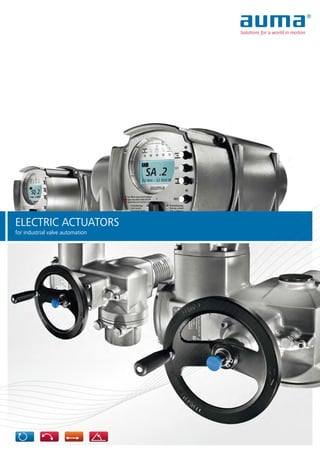
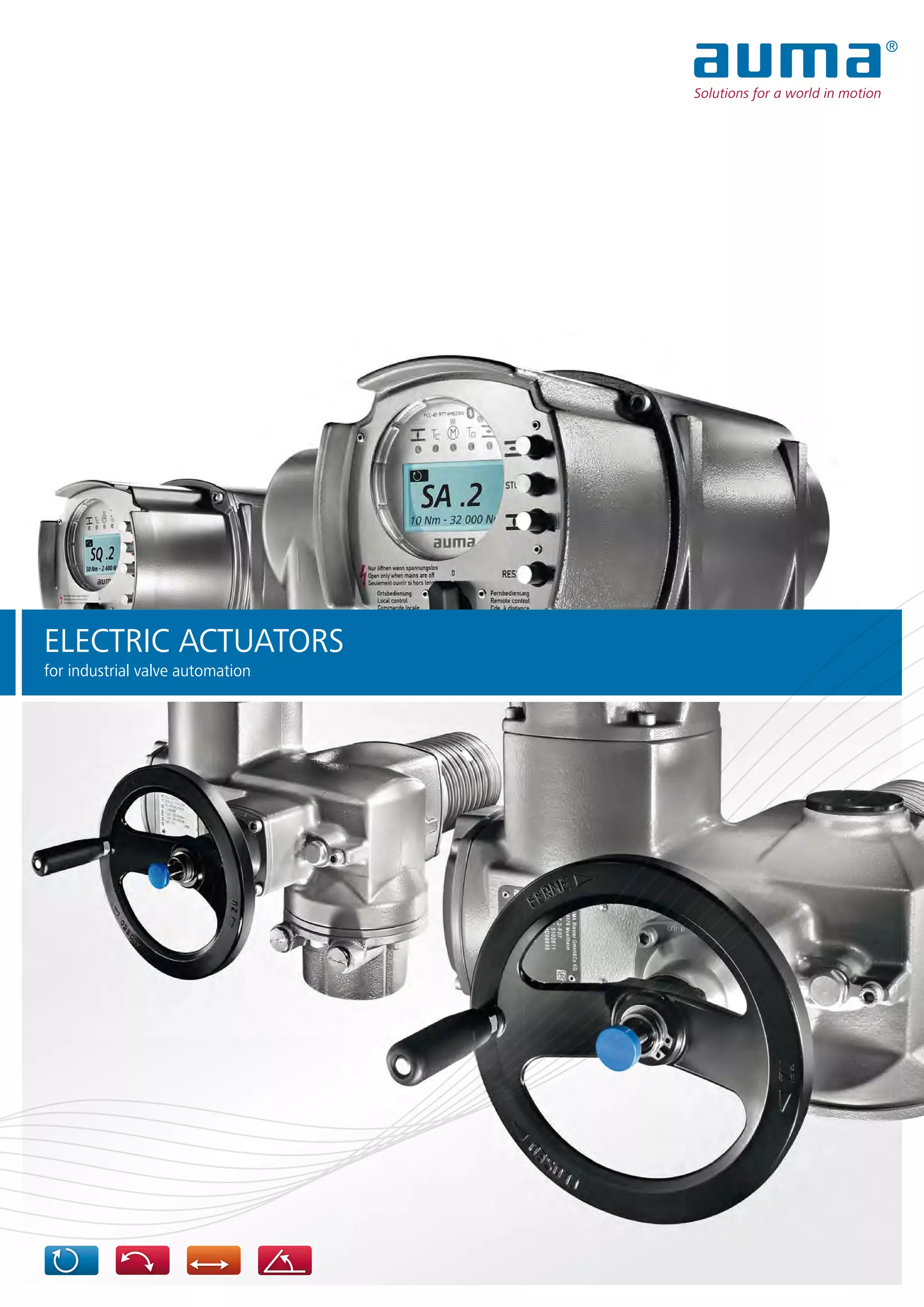
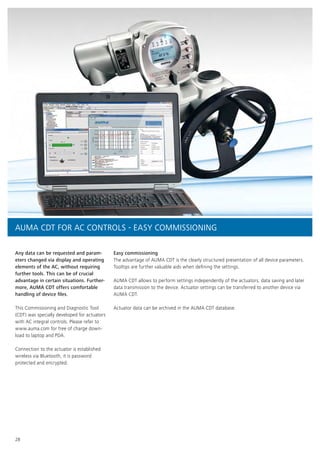
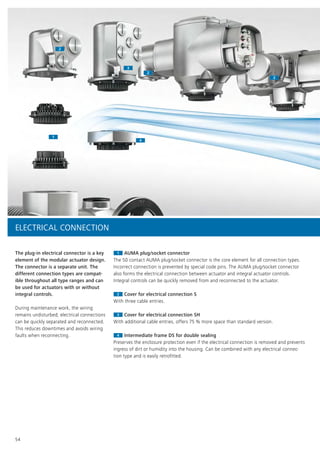
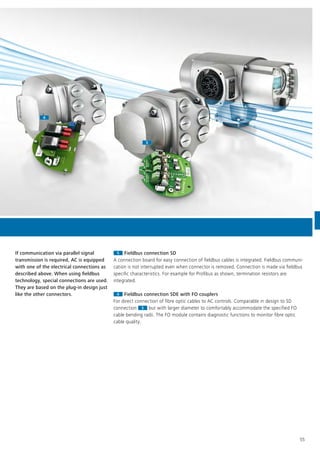
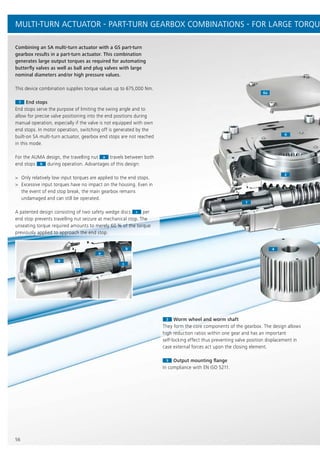
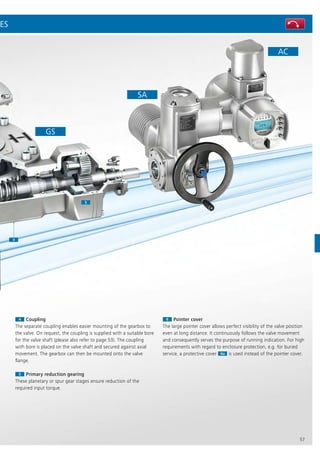
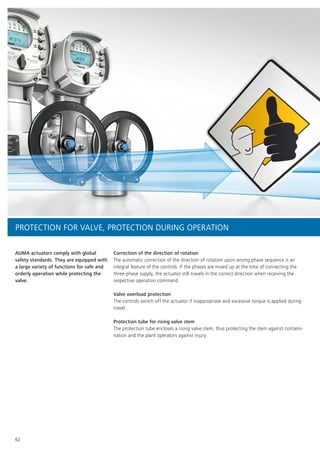
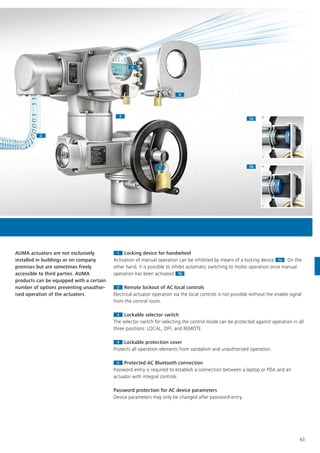
ELECTRIC ACTUATORS
for industrial valve automation
2
ABOUT THIS BROCHURE
This brochure intends to describe functions and possible applications for electric
actuators, actuator controls and gearboxes. The document offers an introduction into
the topic, an overview on products and founded explanations regarding design and
function of electric AUMA actuators.
On the rear pages of this brochure, you will find a chapter with detailed technical data
for swift product selection. For device selection, further information can be obtained
from our separate specific data sheets. It will be our pleasure to assist you and provide
any further details that might be needed.
The latest information on AUMA products can be found on the Internet at www.auma.
com. All documents, including dimensional drawings, wiring diagrams, technical and
electrical data sheets, as well as inspection certificates are available on the Internet in
digital form.
2016.03.11
3
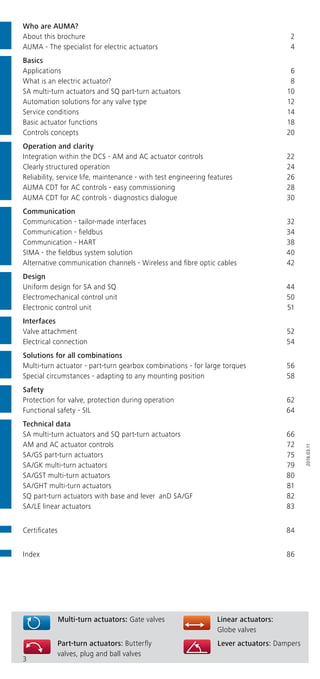
Multi-turn actuators: Gate valves
Part-turn actuators: Butterfly
valves, plug and ball valves
Linear actuators:
Globe valves
Lever actuators: Dampers
Who are AUMA?
About this brochure 2
AUMA - The specialist for electric actuators 4
Basics
Applications 6
What is an electric actuator? 8
SA multi-turn actuators and SQ part-turn actuators 10
Automation solutions for any valve type 12
Service conditions 14
Basic actuator functions 18
Controls concepts 20
Operation and clarity
Integration within the DCS - AM and AC actuator controls 22
Clearly structured operation 24
Reliability, service life, maintenance - with test engineering features 26
AUMA CDT for AC controls - easy commissioning 28
AUMA CDT for AC controls - diagnostics dialogue 30
Communication
Communication - tailor-made interfaces 32
Communication - fieldbus 34
Communication - HART 38
SIMA - the fieldbus system solution 40
Alternative communication channels - Wireless and fibre optic cables 42
Design
Uniform design for SA and SQ 44
Electromechanical control unit 50
Electronic control unit 51
Interfaces
Valve attachment 52
Electrical connection 54
Solutions for all combinations
Multi-turn actuator - part-turn gearbox combinations - for large torques 56
Special circumstances - adapting to any mounting position 58
Safety
Protection for valve, protection during operation 62
Functional safety - SIL 64
Technical data
SA multi-turn actuators and SQ part-turn actuators 66
AM and AC actuator controls 72
SA/GS part-turn actuators 75
SA/GK multi-turn actuators 79
SA/GST multi-turn actuators 80
SA/GHT multi-turn actuators 81
SQ part-turn actuators with base and lever anD SA/GF 82
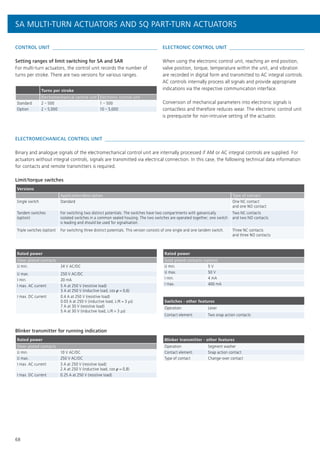
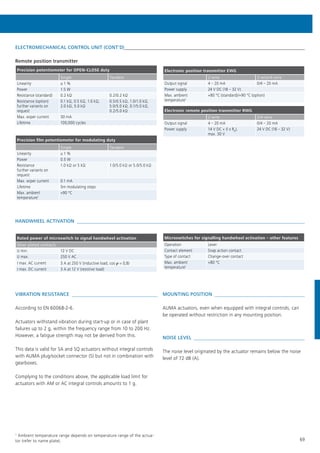
SA/LE linear actuators 83
Certificates 84
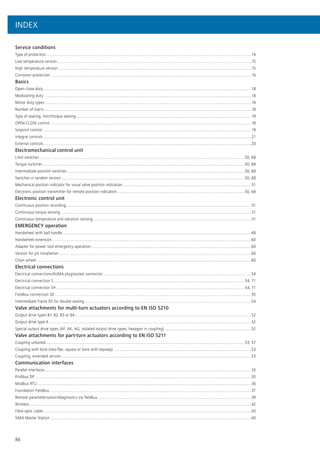
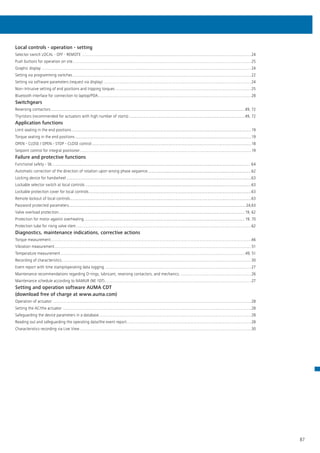
Index 86
44
Armaturen- Und MaschinenAntriebe - AUMA - are leading
manufacturers of actuators for automating industrial valves. Since
1964, the founding year of the company, AUMA have focussed on
development, manufacture, sales and service of electric actuators.
The brand name AUMA is synonymous with long-standing experi-
ence and knowledge. AUMA are specialised in electric actuators for
the energy, water, oil & gas, as well as industrial sectors.
As an independent partner of the international valve industry,
AUMA supply customer-specific products for electric automation of
all industrial valves.
Modular concept
AUMA are entirely devoted to pursue their modular product
concept. A comprehensive range of sub-assemblies allows for
configuration of customer-specific actuators accommodating the
required application. The range of variants is only possible due to
clear interfaces between components while placing the highest
demands on product quality as well as easy and straightforward
maintenance of AUMA actuators.
Innovation on a day-to-day-business
As specialist for electric actuators, AUMA set the market standard
for innovation and sustainability. Within the framework of continual
improvement, their own in-house vertical range of manufacture
guarantee prompt implementation on both product or sub-assembly
level. This applies to all areas relating to device function - mechani-
cal, electrical, electronic, and software engineering.
AUMA - THE SPECIALIST FOR ELECTRIC ACTUATORS
5
Success is reflected by growth - worldwide
Since the foundation in 1964, AUMA have evolved into a company
with 2,300 members of staff around the globe. AUMA proudly
possess a global sales and service network with more than 70 sales
organisations and representative offices. According to our custom-
ers, AUMA staff are very competent in product consultation and
efficient in after-sales service.
Selecting AUMA:
>> provides valve automation in compliance with submitted
specifications
>> assures safety for design and implementation for plant
engineering on the basis of certified interfaces
>> guarantees the operator global on site service including
commissioning, comprehensive support, and product training.
6
APPLICATIONS
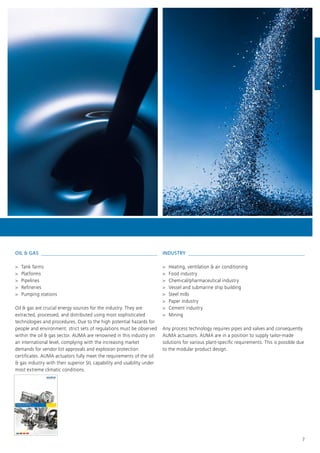
ENERGY 
>> Fossil power plants (coal, gas, oil)
>> Nuclear power plants
>> Cogeneration power plants
>> District heating
>> Hydroelectric power plants
>> Geothermal power plants
>> Solar thermal power plants
>> Biogas power plants
Power plants consisting of systems such as water and steam circuits,
flue gas purification, cooling tower, boiler systems, and turbines.
The control system regulates the processes within these systems to
be visualised within the control room. Electric actuators mounted to
valves control water and steam flows within piping systems. AUMA
actuators offer an interface for all automated valves adapted to the
power plant control systems. When used in power plants, AUMA
actuators are characterised by their superior tolerance with regard
to voltage, vibration, and temperature and can be adapted to any
mounting position required.
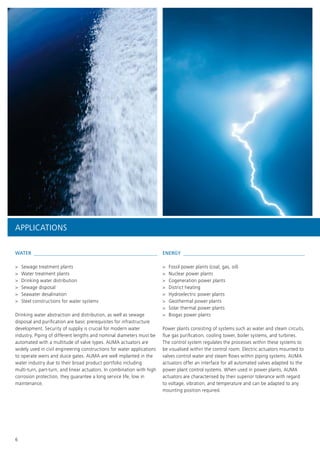
WATER 
>> Sewage treatment plants
>> Water treatment plants
>> Drinking water distribution
>> Sewage disposal
>> Seawater desalination
>> Steel constructions for water systems
Drinking water abstraction and distribution, as well as sewage
disposal and purification are basic prerequisites for infrastructure
development. Security of suppliy is crucial for modern water
industry. Piping of different lengths and nominal diameters must be
automated with a multitude of valve types. AUMA actuators are
widely used in civil engineering constructions for water applications
to operate weirs and sluice gates. AUMA are well implanted in the
water industry due to their broad product portfolio including
multi-turn, part-turn, and linear actuators. In combination with high
corrosion protection, they guarantee a long service life, low in
maintenance.
7
OIL & GAS 
>> Tank farms
>> Platforms
>> Pipelines
>> Refineries
>> Pumping stations
Oil & gas are crucial energy sources for the industry. They are
extracted, processed, and distributed using most sophisticated
technologies and procedures. Due to the high potential hazards for
people and environment, strict sets of regulations must be observed
within the oil & gas sector. AUMA are renowned in this industry on
an international level, complying with the increasing market
demands for vendor list approvals and explosion protection
certificates. AUMA actuators fully meet the requirements of the oil
& gas industry with their superior SIL capability and usability under
most extreme climatic conditions.
INDUSTRY 
>> Heating, ventilation & air conditioning
>> Food industry
>> Chemical/pharmaceutical industry
>> Vessel and submarine ship building
>> Steel mills
>> Paper industry
>> Cement industry
>> Mining
Any process technology requires pipes and valves and consequently
AUMA actuators. AUMA are in a position to supply tailor-made
solutions for various plant-specific requirements. This is possible due
to the modular product design.
8
In process technology plants, liquids,
gases, vapours, and granulate need to
pass through pipelines. Industrial valves
are used to inhibit or release medium
flow as well as to control the resulting
flow rate by opening or closing the
valves. AUMA actuators are remotely
controlled from the control room to
operate valves.
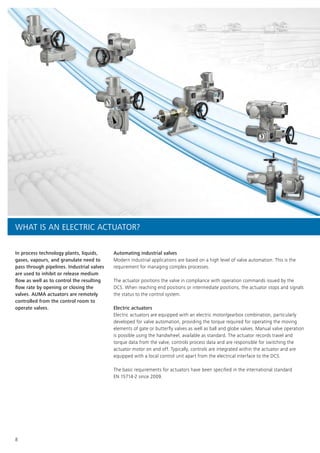
Automating industrial valves
Modern industrial applications are based on a high level of valve automation. This is the
requirement for managing complex processes.
The actuator positions the valve in compliance with operation commands issued by the
DCS. When reaching end positions or intermediate positions, the actuator stops and signals
the status to the control system.
Electric actuators
Electric actuators are equipped with an electric motor/gearbox combination, particularly
developed for valve automation, providing the torque required for operating the moving
elements of gate or butterfly valves as well as ball and globe valves. Manual valve operation
is possible using the handwheel, available as standard. The actuator records travel and
torque data from the valve, controls process data and are responsible for switching the
actuator motor on and off. Typically, controls are integrated within the actuator and are
equipped with a local control unit apart from the electrical interface to the DCS.
The basic requirements for actuators have been specified in the international standard
EN 15714-2 since 2009.
WHAT IS AN ELECTRIC ACTUATOR?
9
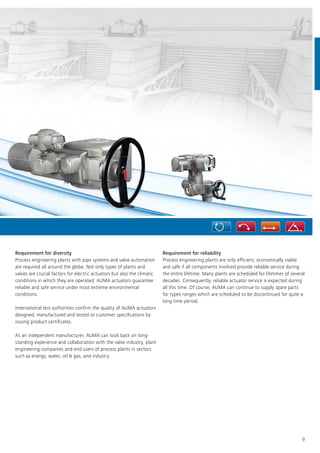
Requirement for diversity
Process engineering plants with pipe systems and valve automation
are required all around the globe. Not only types of plants and
valves are crucial factors for electric actuators but also the climatic
conditions in which they are operated. AUMA actuators guarantee
reliable and safe service under most extreme environmental
conditions.
International test authorities confirm the quality of AUMA actuators
designed, manufactured and tested to customer specifications by
issuing product certificates.
As an independent manufacturer, AUMA can look back on long-
standing experience and collaboration with the valve industry, plant
engineering companies and end users of process plants in sectors
such as energy, water, oil & gas, and industry.
Requirement for reliability
Process engineering plants are only efficient, economically viable
and safe if all components involved provide reliable service during
the entire lifetime. Many plants are scheduled for lifetimes of several
decades. Consequently, reliable actuator service is expected during
all this time. Of course, AUMA can continue to supply spare parts
for types ranges which are scheduled to be discontinued for quite a
long time period.
10
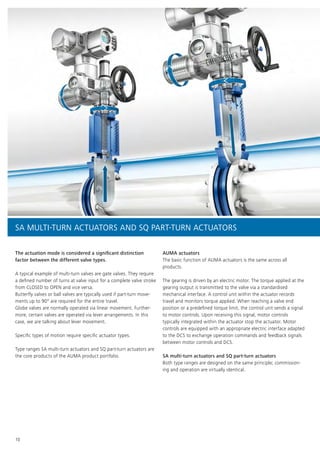
The actuation mode is considered a significant distinction
factor between the different valve types.
A typical example of multi-turn valves are gate valves. They require
a defined number of turns at valve input for a complete valve stroke
from CLOSED to OPEN and vice versa.
Butterfly valves or ball valves are typically used if part-turn move-
ments up to 90° are required for the entire travel.
Globe valves are normally operated via linear movement. Further-
more, certain valves are operated via lever arrangements. In this
case, we are talking about lever movement.
Specific types of motion require specific actuator types.
Type ranges SA multi-turn actuators and SQ part-turn actuators are
the core products of the AUMA product portfolio.
AUMA actuators
The basic function of AUMA actuators is the same across all
products.
The gearing is driven by an electric motor. The torque applied at the
gearing output is transmitted to the valve via a standardised
mechanical interface. A control unit within the actuator records
travel and monitors torque applied. When reaching a valve end
position or a predefined torque limit, the control unit sends a signal
to motor controls. Upon receiving this signal, motor controls
typically integrated within the actuator stop the actuator. Motor
controls are equipped with an appropriate electric interface adapted
to the DCS to exchange operation commands and feedback signals
between motor controls and DCS.
SA multi-turn actuators and SQ part-turn actuators
Both type ranges are designed on the same principle; commission-
ing and operation are virtually identical.
SA MULTI-TURN ACTUATORS AND SQ PART-TURN ACTUATORS
11
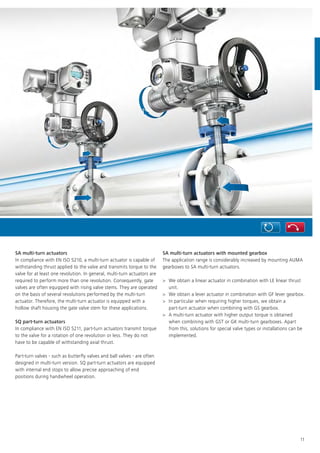
SA multi-turn actuators
In compliance with EN ISO 5210, a multi-turn actuator is capable of
withstanding thrust applied to the valve and transmits torque to the
valve for at least one revolution. In general, multi-turn actuators are
required to perform more than one revolution. Consequently, gate
valves are often equipped with rising valve stems. They are operated
on the basis of several revolutions performed by the multi-turn
actuator. Therefore, the multi-turn actuator is equipped with a
hollow shaft housing the gate valve stem for these applications.
SQ part-turn actuators
In compliance with EN ISO 5211, part-turn actuators transmit torque
to the valve for a rotation of one revolution or less. They do not
have to be capable of withstanding axial thrust.
Part-turn valves - such as butterfly valves and ball valves - are often
designed in multi-turn version. SQ part-turn actuators are equipped
with internal end stops to allow precise approaching of end
positions during handwheel operation.
SA multi-turn actuators with mounted gearbox
The application range is considerably increased by mounting AUMA
gearboxes to SA multi-turn actuators.
> We obtain a linear actuator in combination with LE linear thrust
unit.
> We obtain a lever actuator in combination with GF lever gearbox.
> In particular when requiring higher torques, we obtain a
part-turn actuator when combining with GS gearbox.
> A multi-turn actuator with higher output torque is obtained
when combining with GST or GK multi-turn gearboxes. Apart
from this, solutions for special valve types or installations can be
implemented.
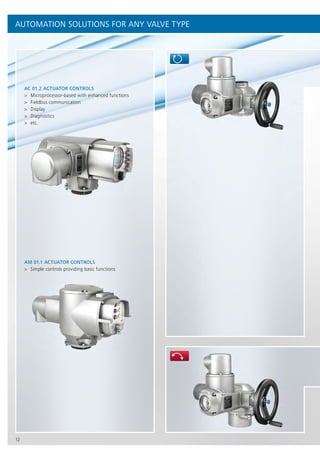
AC 01.2 ACTUATOR CONTROLS
> Microprocessor-based with enhanced functions
> Fieldbus communication
> Display
> Diagnostics
> etc.
12
AM 01.1 ACTUATOR CONTROLS
> Simple controls providing basic functions
AUTOMATION SOLUTIONS FOR ANY VALVE TYPE
13
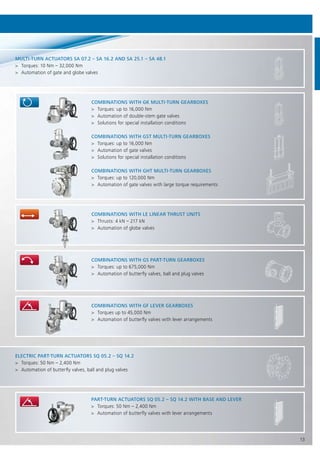
MULTI-TURN ACTUATORS SA 07.2 – SA 16.2 AND SA 25.1 – SA 48.1
> Torques: 10 Nm – 32,000 Nm
> Automation of gate and globe valves
COMBINATIONS WITH GK MULTI-TURN GEARBOXES
> Torques: up to 16,000 Nm
> Automation of double-stem gate valves
> Solutions for special installation conditions
COMBINATIONS WITH LE LINEAR THRUST UNITS
> Thrusts: 4 kN – 217 kN
> Automation of globe valves
COMBINATIONS WITH GS PART-TURN GEARBOXES
> Torques: up to 675,000 Nm
> Automation of butterfly valves, ball and plug valves
COMBINATIONS WITH GF LEVER GEARBOXES
> Torques up to 45,000 Nm
> Automation of butterfly valves with lever arrangements
ELECTRIC PART-TURN ACTUATORS SQ 05.2 – SQ 14.2
> Torques: 50 Nm – 2,400 Nm
> Automation of butterfly valves, ball and plug valves
PART-TURN ACTUATORS SQ 05.2 – SQ 14.2 WITH BASE AND LEVER
> Torques: 50 Nm – 2,400 Nm
> Automation of butterfly valves with lever arrangements
COMBINATIONS WITH GST MULTI-TURN GEARBOXES
> Torques: up to 16,000 Nm
> Automation of gate valves
> Solutions for special installation conditions
COMBINATIONS WITH GHT MULTI-TURN GEARBOXES
> Torques: up to 120,000 Nm
> Automation of gate valves with large torque requirements
14
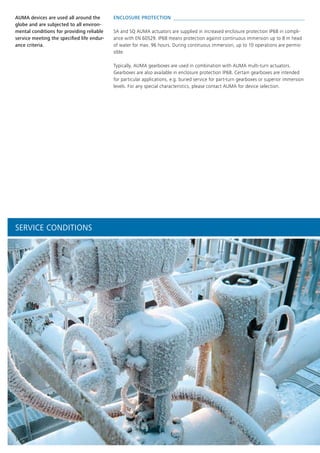
ENCLOSURE PROTECTION 
SA and SQ AUMA actuators are supplied in increased enclosure protection IP68 in compli-
ance with EN 60529. IP68 means protection against continuous immersion up to 8 m head
of water for max. 96 hours. During continuous immersion, up to 10 operations are permis-
sible.
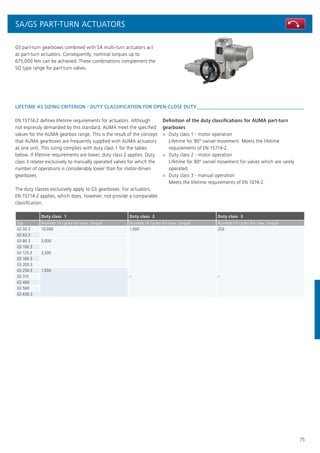
Typically, AUMA gearboxes are used in combination with AUMA multi-turn actuators.
Gearboxes are also available in enclosure protection IP68. Certain gearboxes are intended
for particular applications, e.g. buried service for part-turn gearboxes or superior immersion
levels. For any special characteristics, please contact AUMA for device selection.
AUMA devices are used all around the
globe and are subjected to all environ-
mental conditions for providing reliable
service meeting the specified life endur-
ance criteria.
SERVICE CONDITIONS
15
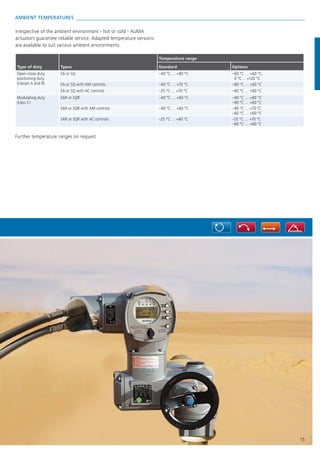
AMBIENT TEMPERATURES
Irrespective of the ambient environment - hot or cold - AUMA
actuators guarantee reliable service. Adapted temperature versions
are available to suit various ambient environments.
Type of duty Types
Temperature range
Standard Options
Open-close duty,
positioning duty
(classes A and B)
SA or SQ –40 °C … +80 °C –60 °C … +60 °C;
0 °C ... +120 °C
SA or SQ with AM controls –40 °C … +70 °C –60 °C … +60 °C
SA or SQ with AC controls –25 °C … +70 °C –60 °C … +60 °C
Modulating duty
(class C)
SAR or SQR –40 °C … +60 °C –40 °C … +80 °C
–60 °C … +60 °C
SAR or SQR with AM controls –40 °C … +60 °C –40 °C … +70 °C
–60 °C … +60 °C
SAR or SQR with AC controls –25 °C … +60 °C –25 °C … +70 °C
–60 °C … +60 °C
Further temperature ranges on request
POWDER COATING - COATING
STRUCTURE
Housing
Conversion layer
Functional coating to increase paint
adherence to the housing surface.
First powder layer
Powder layer based on epoxy resin. The
layer ensures optimal adherence between
housing surface and finish coating.
Second powder layer
Powder layer based on polyurethane. The
layer is a resistance barrier against chemicals
and weathering. The optimal degree of
cross-linking of the cured powder results in
a significant mechanical resistance. The
standard colour is AUMA silver-grey, similar
to RAL 7037.
16
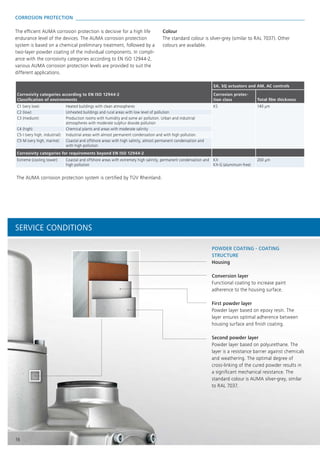
CORROSION PROTECTION
The efficient AUMA corrosion protection is decisive for a high life
endurance level of the devices. The AUMA corrosion protection
system is based on a chemical preliminary treatment, followed by a
two-layer powder coating of the individual components. In compli-
ance with the corrosivity categories according to EN ISO 12944-2,
various AUMA corrosion protection levels are provided to suit the
different applications.
Corrosivity categories according to EN ISO 12944-2
Classification of environments
SA, SQ actuators and AM, AC controls
Corrosion protec-
tion class Total film thickness
C1 (very low): Heated buildings with clean atmospheres KS 140 µm
C2 (low): Unheated buildings and rural areas with low level of pollution
C3 (medium): Production rooms with humidity and some air pollution. Urban and industrial
atmospheres with moderate sulphur dioxide pollution
C4 (high): Chemical plants and areas with moderate salinity
C5-I (very high, industrial): Industrial areas with almost permanent condensation and with high pollution.
C5-M (very high, marine): Coastal and offshore areas with high salinity, almost permanent condensation and
with high pollution.
Corrosivity categories for requirements beyond EN ISO 12944-2
Extreme (cooling tower): Coastal and offshore areas with extremely high salinity, permanent condensation and
high pollution
KX
KX-G (aluminium-free)
200 µm
The AUMA corrosion protection system is certified by TÜV Rheinland.
Colour
The standard colour is silver-grey (similar to RAL 7037). Other
colours are available.
SERVICE CONDITIONS
17
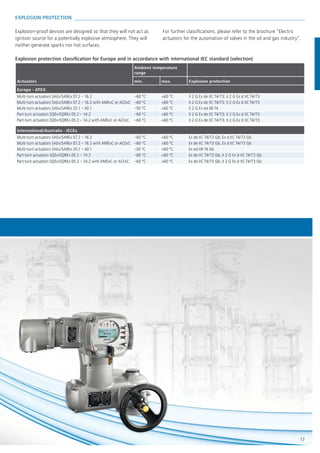
EXPLOSION PROTECTION 
Explosion-proof devices are designed so that they will not act as
ignition source for a potentially explosive atmosphere. They will
neither generate sparks nor hot surfaces.
For further classifications, please refer to the brochure “Electric
actuators for the automation of valves in the oil and gas industry“.
Explosion protection classification for Europe and in accordance with international IEC standard (selection)
Actuators
Ambient temperature
range
min. max. Explosion protection
Europe - ATEX
Multi-turn actuators SAEx/SAREx 07.2 – 16.2 –60 °C +60 °C II 2 G Ex de IIC T4/T3; II 2 G Ex d IIC T4/T3
Multi-turn actuators SAEx/SAREx 07.2 – 16.2 with AMExC or ACExC –60 °C +60 °C II 2 G Ex de IIC T4/T3; II 2 G Ex d IIC T4/T3
Multi-turn actuators SAEx/SAREx 25.1 – 40.1 –50 °C +60 °C II 2 G Ex ed IIB T4
Part-turn actuators SQEx/SQREx 05.2 – 14.2 –60 °C +60 °C II 2 G Ex de IIC T4/T3; II 2 G Ex d IIC T4/T3
Part-turn actuators SQEx/SQREx 05.2 – 14.2 with AMExC or ACExC –60 °C +60 °C II 2 G Ex de IIC T4/T3; II 2 G Ex d IIC T4/T3
International/Australia - IECEx
Multi-turn actuators SAEx/SAREx 07.2 – 16.2 –60 °C +60 °C Ex de IIC T4/T3 Gb; Ex d IIC T4/T3 Gb
Multi-turn actuators SAEx/SAREx 07.2 – 16.2 with AMExC or ACExC –60 °C +60 °C Ex de IIC T4/T3 Gb; Ex d IIC T4/T3 Gb
Multi-turn actuators SAEx/SAREx 25.1 – 40.1 –20 °C +60 °C Ex ed IIB T4 Gb
Part-turn actuators SQEx/SQREx 05.2 – 14.2 –60 °C +60 °C Ex de IIC T4/T3 Gb; II 2 G Ex d IIC T4/T3 Gb
Part-turn actuators SQEx/SQREx 05.2 – 14.2 with AMExC or ACExC –60 °C +60 °C Ex de IIC T4/T3 Gb; II 2 G Ex d IIC T4/T3 Gb
18
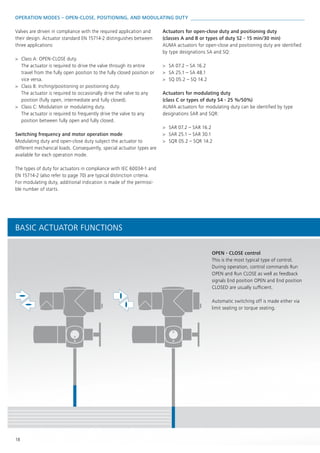
OPERATION MODES – OPEN-CLOSE, POSITIONING, AND MODULATING DUTY 
Valves are driven in compliance with the required application and
their design. Actuator standard EN 15714-2 distinguishes between
three applications:
>> Class A: OPEN-CLOSE duty.
The actuator is required to drive the valve through its entire
travel from the fully open position to the fully closed position or
vice versa.
>> Class B: Inching/positioning or positioning duty.
The actuator is required to occasionally drive the valve to any
position (fully open, intermediate and fully closed).
>> Class C: Modulation or modulating duty.
The actuator is required to frequently drive the valve to any
position between fully open and fully closed.
Switching frequency and motor operation mode
Modulating duty and open-close duty subject the actuator to
different mechanical loads. Consequently, special actuator types are
available for each operation mode.
The types of duty for actuators in compliance with IEC 60034-1 and
EN 15714-2 (also refer to page 70) are typical distinction criteria.
For modulating duty, additional indication is made of the permissi-
ble number of starts.
OPEN - CLOSE control
This is the most typical type of control.
During operation, control commands Run
OPEN and Run CLOSE as well as feedback
signals End position OPEN and End position
CLOSED are usually sufficient.
Automatic switching off is made either via
limit seating or torque seating.
Actuators for open-close duty and positioning duty
(classes A and B or types of duty S2 - 15 min/30 min)
AUMA actuators for open-close and positioning duty are identified
by type designations SA and SQ:
>> SA 07.2 – SA 16.2
>> SA 25.1 – SA 48.1
>> SQ 05.2 – SQ 14.2
Actuators for modulating duty
(class C or types of duty S4 - 25 %/50%)
AUMA actuators for modulating duty can be identified by type
designations SAR and SQR:
>> SAR 07.2 – SAR 16.2
>> SAR 25.1 – SAR 30.1
>> SQR 05.2 – SQR 14.2
BASIC ACTUATOR FUNCTIONS
19
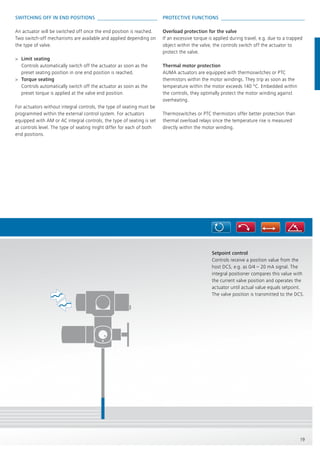
Setpoint control
Controls receive a position value from the
host DCS, e.g. as 0/4 – 20 mA signal. The
integral positioner compares this value with
the current valve position and operates the
actuator until actual value equals setpoint.
The valve position is transmitted to the DCS.
SWITCHING OFF IN END POSITIONS
An actuator will be switched off once the end position is reached.
Two switch-off mechanisms are available and applied depending on
the type of valve.
> Limit seating
Controls automatically switch off the actuator as soon as the
preset seating position in one end position is reached.
> Torque seating
Controls automatically switch off the actuator as soon as the
preset torque is applied at the valve end position.
For actuators without integral controls, the type of seating must be
programmed within the external control system. For actuators
equipped with AM or AC integral controls, the type of seating is set
at controls level. The type of seating might differ for each of both
end positions.
PROTECTIVE FUNCTIONS
Overload protection for the valve
If an excessive torque is applied during travel, e.g. due to a trapped
object within the valve, the controls switch off the actuator to
protect the valve.
Thermal motor protection
AUMA actuators are equipped with thermoswitches or PTC
thermistors within the motor windings. They trip as soon as the
temperature within the motor exceeds 140 °C. Embedded within
the controls, they optimally protect the motor winding against
overheating.
Thermoswitches or PTC thermistors offer better protection than
thermal overload relays since the temperature rise is measured
directly within the motor winding.
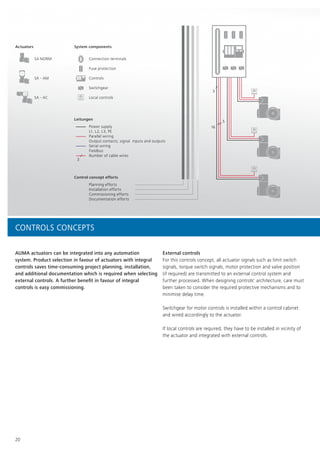
16
3
5
SA NORM
SA - AM
SA - AC
3
Actuators
Leitungen
Connection terminals
Fuse protection
Controls
Switchgear
Local controls
System components
Power supply
L1, L2, L3, PE
Parallel wiring
Output contacts, signal inputs and outputs
Serial wiring
Fieldbus
Number of cable wires
Planning efforts
Installation efforts
Commissioning efforts
Documentation efforts
Control concept efforts
20
AUMA actuators can be integrated into any automation
system. Product selection in favour of actuators with integral
controls saves time-consuming project planning, installation,
and additional documentation which is required when selecting
external controls. A further benefit in favour of integral
controls is easy commissioning.
External controls
For this controls concept, all actuator signals such as limit switch
signals, torque switch signals, motor protection and valve position
(if required) are transmitted to an external control system and
further processed. When designing controls' architecture, care must
been taken to consider the required protective mechanisms and to
minimise delay time.
Switchgear for motor controls is installed within a control cabinet
and wired accordingly to the actuator.
If local controls are required, they have to be installed in vicinity of
the actuator and integrated with external controls.
CONTROLS CONCEPTS
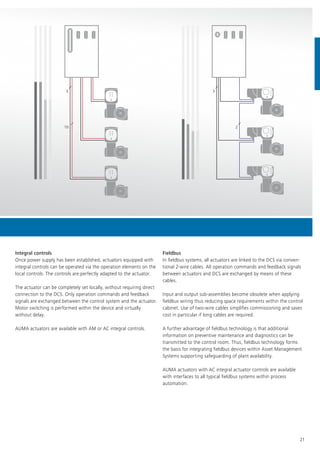
10
3 3
2
21
Integral controls
Once power supply has been established, actuators equipped with
integral controls can be operated via the operation elements on the
local controls. The controls are perfectly adapted to the actuator.
The actuator can be completely set locally, without requiring direct
connection to the DCS. Only operation commands and feedback
signals are exchanged between the control system and the actuator.
Motor switching is performed within the device and virtually
without delay.
AUMA actuators are available with AM or AC integral controls.
Fieldbus
In fieldbus systems, all actuators are linked to the DCS via conven-
tional 2-wire cables. All operation commands and feedback signals
between actuators and DCS are exchanged by means of these
cables.
Input and output sub-assemblies become obsolete when applying
fieldbus wiring thus reducing space requirements within the control
cabinet. Use of two-wire cables simplifies commissioning and saves
cost in particular if long cables are required.
A further advantage of fieldbus technology is that additional
information on preventive maintenance and diagnostics can be
transmitted to the control room. Thus, fieldbus technology forms
the basis for integrating fieldbus devices within Asset Management
Systems supporting safeguarding of plant availability.
AUMA actuators with AC integral actuator controls are available
with interfaces to all typical fieldbus systems within process
automation.
22
Integral controls evaluate actuator signals and operation
commands and switch the motor on and off without delay,
using the installed reversing contactors or thyristors.
After analysis, the controls supply the actuator signals as feedback
signals to the host level.
The integral local controls allow for local actuator operation.
AM and AC controls can be combined with both SA and SQ
actuators. This creates a homogeneous picture for the DCS.
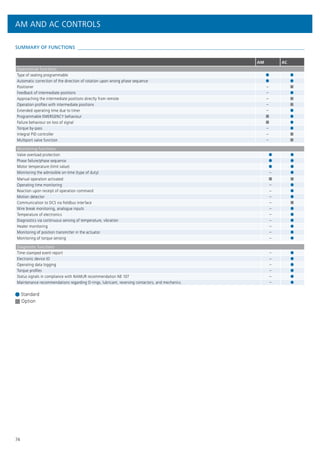
Please refer to page 74 for a detailed overview of the controls’
functions.
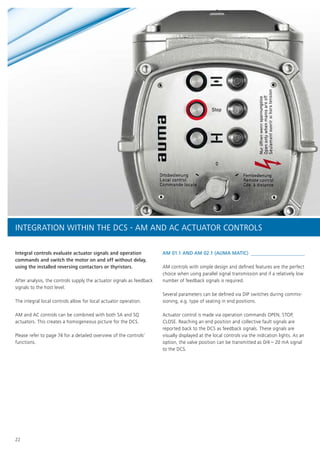
AM 01.1 AND AM 02.1 (AUMA MATIC) 
AM controls with simple design and defined features are the perfect
choice when using parallel signal transmission and if a relatively low
number of feedback signals is required.
Several parameters can be defined via DIP switches during commis-
sioning, e.g. type of seating in end positions.
Actuator control is made via operation commands OPEN, STOP,
CLOSE. Reaching an end position and collective fault signals are
reported back to the DCS as feedback signals. These signals are
visually displayed at the local controls via the indication lights. As an
option, the valve position can be transmitted as 0/4 – 20 mA signal
to the DCS.
INTEGRATION WITHIN THE DCS - AM AND AC ACTUATOR CONTROLS
43,7 %
Position
S0001Remote
23
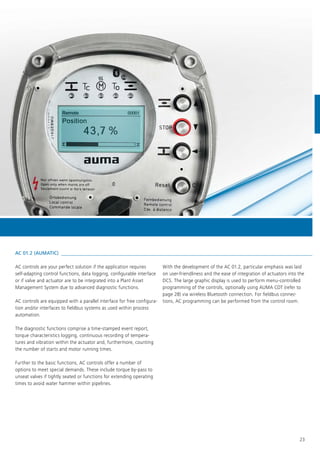
AC controls are your perfect solution if the application requires
self-adapting control functions, data logging, configurable interface
or if valve and actuator are to be integrated into a Plant Asset
Management System due to advanced diagnostic functions.
AC controls are equipped with a parallel interface for free configura-
tion and/or interfaces to fieldbus systems as used within process
automation.
The diagnostic functions comprise a time-stamped event report,
torque characteristics logging, continuous recording of tempera-
tures and vibration within the actuator and, furthermore, counting
the number of starts and motor running times.
Further to the basic functions, AC controls offer a number of
options to meet special demands. These include torque by-pass to
unseat valves if tightly seated or functions for extending operating
times to avoid water hammer within pipelines.
With the development of the AC 01.2, particular emphasis was laid
on user-friendliness and the ease of integration of actuators into the
DCS. The large graphic display is used to perform menu-controlled
programming of the controls, optionally using AUMA CDT (refer to
page 28) via wireless Bluetooth connection. For fieldbus connec-
tions, AC programming can be performed from the control room.
AC 01.2 (AUMATIC)
1
2
4
3
1
2
4
3
Off
Up ▲ Down ▼ Ok Esc
Device ID
Device configuration
Settings
1 M0021
24
Modern actuators can be adapted to special application
requirements by a multitude of parameters. Monitoring and
diagnostic functions generate signals and collect operating
parameters.
For AC controls, accessing the considerably more detailed data is
facilitated by a clearly structured and intuitive user interface.
All device settings can be performed without requiring any addi-
tional parameterisation tool.
The display structure is user-friendly, in plain text and available in a
large number of languages.
Password protection
The AC password protection is an important safety function. This
feature prevents non-authorised persons from modifying defined
settings.
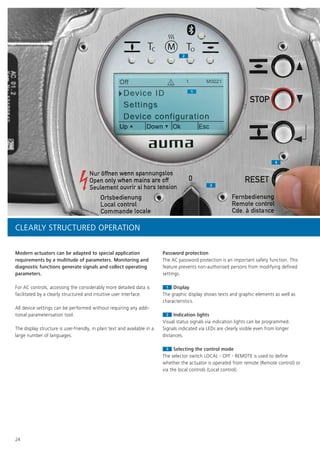
11 Display
The graphic display shows texts and graphic elements as well as
characteristics.
22 Indication lights
Visual status signals via indication lights can be programmed.
Signals indicated via LEDs are clearly visible even from longer
distances.
33 Selecting the control mode
The selector switch LOCAL - OFF - REMOTE is used to define
whether the actuator is operated from remote (Remote control) or
via the local controls (Local control).
CLEARLY STRUCTURED OPERATION
1
1
Remote
Position
47,3 %47,3 %
S0001 Off
Go to Down ▼ Ok Esc
Display...
Device ID
Settings
M00091
Remote
Active op. command
S0003
E1 47,9 %
E2 47,3 %
Down ▼ Ok Esc
Off
End position CLOSED
End position OPEN
M00861
Off
Warnings: 2
S0008
Torque wrn CLOSE
Op. time warning
Off
Fault: 1
S0011
Torque fault CLOSE
25
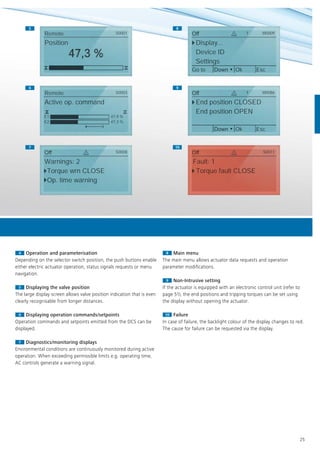
44 Operation and parameterisation
Depending on the selector switch position, the push buttons enable
either electric actuator operation, status signals requests or menu
navigation.
55 Displaying the valve position
The large display screen allows valve position indication that is even
clearly recognisable from longer distances.
66 Displaying operation commands/setpoints
Operation commands and setpoints emitted from the DCS can be
displayed.
77 Diagnostics/monitoring displays
Environmental conditions are continuously monitored during active
operation. When exceeding permissible limits e.g. operating time,
AC controls generate a warning signal.
88 Main menu
The main menu allows actuator data requests and operation
parameter modifications.
99 Non-Intrusive setting
If the actuator is equipped with an electronic control unit (refer to
page 51), the end positions and tripping torques can be set using
the display without opening the actuator.
1010 Failure
In case of failure, the backlight colour of the display changes to red.
The cause for failure can be requested via the display.
55 88
99
1010
66
77
OffOff
Maintenance informat.
1 CMD0079
26
Actuators are expected to offer long
service life, long maintenance intervals
and straightforward maintenance
procedures. These factors are important
in contributing to reducing plant opera-
tion costs.
Consequently, emphasis was laid on
integrating advanced diagnostic abilities for
development enhancements of AUMA
devices.
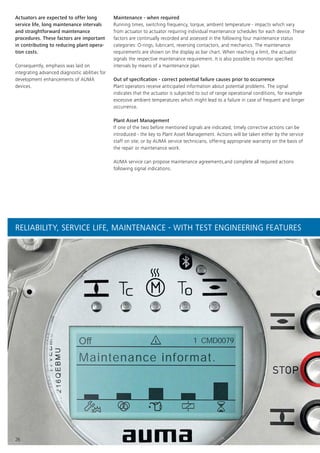
Maintenance - when required
Running times, switching frequency, torque, ambient temperature - impacts which vary
from actuator to actuator requiring individual maintenance schedules for each device. These
factors are continually recorded and assessed in the following four maintenance status
categories: O-rings, lubricant, reversing contactors, and mechanics. The maintenance
requirements are shown on the display as bar chart. When reaching a limit, the actuator
signals the respective maintenance requirement. It is also possible to monitor specified
intervals by means of a maintenance plan.
Out of specification - correct potential failure causes prior to occurrence
Plant operators receive anticipated information about potential problems. The signal
indicates that the actuator is subjected to out of range operational conditions, for example
excessive ambient temperatures which might lead to a failure in case of frequent and longer
occurrence.
Plant Asset Management
If one of the two before mentioned signals are indicated, timely corrective actions can be
introduced - the key to Plant Asset Management. Actions will be taken either by the service
staff on site, or by AUMA service technicians, offering appropriate warranty on the basis of
the repair or maintenance work.
AUMA service can propose maintenance agreements,and complete all required actions
following signal indications.
RELIABILITY, SERVICE LIFE, MAINTENANCE - WITH TEST ENGINEERING FEATURES
27
Time-stamped event report/
operating data logging
Setting procedures, switching procedures, warning signals, failures,
and running times are recorded in the time-stamped event report.
The event report is a distinct component of the diagnostic features
of the AC.
Valve diagnostics
AC controls are capable of recording torque characteristics at
different times. The comparison of data sets allows assessment of
any changes in valve characteristics.
Assessment - easy to handle
NAMUR NE 107 with the easy and clear diagnostic classification
supply valuable support for plant operators. Data relating to
diagnostics can be requested via device display, via fieldbus or
AUMA CDT (refer to page 30).
AUMA actuators with fieldbus interface also support standardised
concepts for remote diagnostics from the control room (refer to
page 39).
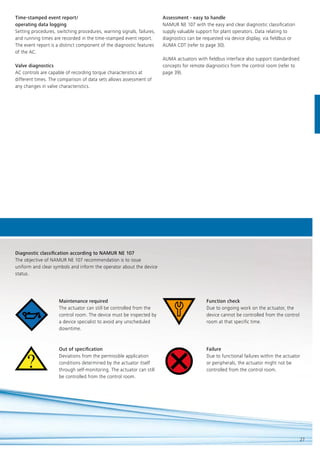
Diagnostic classification according to NAMUR NE 107
The objective of NAMUR NE 107 recommendation is to issue
uniform and clear symbols and inform the operator about the device
status.
Maintenance required
The actuator can still be controlled from the
control room. The device must be inspected by
a device specialist to avoid any unscheduled
downtime.
Out of specification
Deviations from the permissible application
conditions determined by the actuator itself
through self-monitoring. The actuator can still
be controlled from the control room.
Function check
Due to ongoing work on the actuator, the
device cannot be controlled from the control
room at that specific time.
Failure
Due to functional failures within the actuator
or peripherals, the actuator might not be
controlled from the control room.
28
Any data can be requested and param-
eters changed via display and operating
elements of the AC, without requiring
further tools. This can be of crucial
advantage in certain situations. Further-
more, AUMA CDT offers comfortable
handling of device files.
This Commissioning and Diagnostic Tool
(CDT) was specially developed for actuators
with AC integral controls. Please refer to
www.auma.com for free of charge down-
load to laptop and PDA.
Connection to the actuator is established
wireless via Bluetooth, it is password
protected and encrypted.
Easy commissioning
The advantage of AUMA CDT is the clearly structured presentation of all device parameters.
Tooltips are further valuable aids when defining the settings.
AUMA CDT allows to perform settings independently of the actuators, data saving and later
data transmission to the device. Actuator settings can be transferred to another device via
AUMA CDT.
Actuator data can be archived in the AUMA CDT database.
AUMA CDT FOR AC CONTROLS - EASY COMMISSIONING
11
44
33
22
29
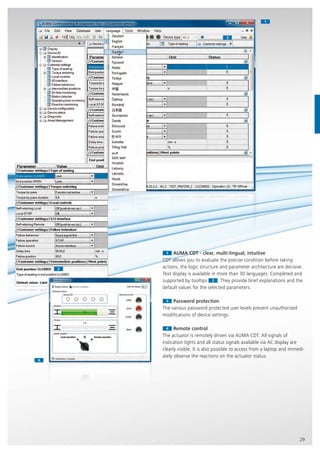
11 AUMA CDT - clear, multi-lingual, intuitive
CDT allows you to evaluate the precise condition before taking
actions, the logic structure and parameter architecture are decisive.
Text display is available in more than 30 languages. Completed and
supported by tooltips 2
Text display is available in more than 30 languages. Completed and
supported by tooltips
Text display is available in more than 30 languages. Completed and
2 . They provide brief explanations and the
default values for the selected parameters.
33 Password protection
The various password protected user levels prevent unauthorised
modifications of device settings.
44 Remote control
The actuator is remotely driven via AUMA CDT. All signals of
indication lights and all status signals available via AC display are
clearly visible. It is also possible to access from a laptop and immedi-
ately observe the reactions on the actuator status.
30
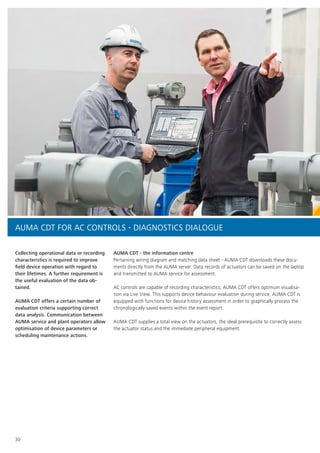
Collecting operational data or recording
characteristics is required to improve
field device operation with regard to
their lifetimes. A further requirement is
the useful evaluation of the data ob-
tained.
AUMA CDT offers a certain number of
evaluation criteria supporting correct
data analysis. Communication between
AUMA service and plant operators allow
optimisation of device parameters or
scheduling maintenance actions.
AUMA CDT - the information centre
Pertaining wiring diagram and matching data sheet - AUMA CDT downloads these docu-
ments directly from the AUMA server. Data records of actuators can be saved on the laptop
and transmitted to AUMA service for assessment.
AC controls are capable of recording characteristics; AUMA CDT offers optimum visualisa-
tion via Live View. This supports device behaviour evaluation during service. AUMA CDT is
equipped with functions for device history assessment in order to graphically process the
chronologically saved events within the event report.
AUMA CDT supplies a total view on the actuators, the ideal prerequisite to correctly assess
the actuator status and the immediate peripheral equipment.
AUMA CDT FOR AC CONTROLS - DIAGNOSTICS DIALOGUE
11
33
31
AUMA CDT as fieldbus master
Actuator function failure can be caused by a faulty communication
with the control station. For parallel communication, signal paths
between control room and actuator can be verified by means of a
measuring device. Functional tests are also recommended for
fieldbus applications.
AUMA CDT can be used as temporary fieldbus master. It can be
used to verify whether the actuator correctly receives, processes,
and responds to the fieldbus telegrams. If this is the case, the failure
is not caused by the actuator.
Further use of AUMA CDT fieldbus master: The actuator can even be
commissioned if communication to the DCS is not established or not
possible, e.g. in an assembly workshop.
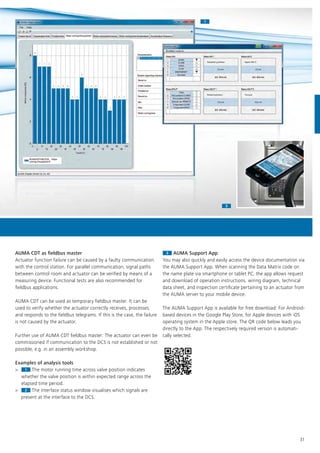
Examples of analysis tools
> 1
Examples of analysis tools
>
Examples of analysis tools
1 The motor running time across valve position indicates
whether the valve position is within expected range across the
elapsed time period.
> 2
elapsed time period.
>
elapsed time period.
2 The interface status window visualises which signals are
present at the interface to the DCS.
33 AUMA Support App
You may also quickly and easily access the device documentation via
the AUMA Support App. When scanning the Data Matrix code on
the name plate via smartphone or tablet PC, the app allows request
and download of operation instructions, wiring diagram, technical
data sheet, and inspection certificate pertaining to an actuator from
the AUMA server to your mobile device.
The AUMA Support App is available for free download: For Android-
based devices in the Google Play Store, for Apple devices with iOS
operating system in the Apple store. The QR code below leads you
directly to the App. The respectively required version is automati-
cally selected.
32
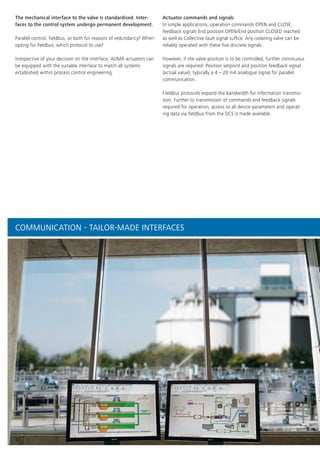
The mechanical interface to the valve is standardised. Inter-
faces to the control system undergo permanent development.
Parallel control, fieldbus, or both for reasons of redundancy? When
opting for fieldbus, which protocol to use?
Irrespective of your decision on the interface, AUMA actuators can
be equipped with the suitable interface to match all systems
established within process control engineering.
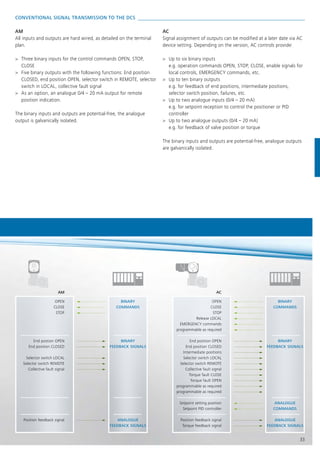
Actuator commands and signals
In simple applications, operation commands OPEN and CLOSE,
feedback signals End position OPEN/End position CLOSED reached
as well as Collective fault signal suffice. Any isolating valve can be
reliably operated with these five discrete signals.
However, if the valve position is to be controlled, further continuous
signals are required: Position setpoint and position feedback signal
(actual value), typically a 4 – 20 mA analogue signal for parallel
communication.
Fieldbus protocols expand the bandwidth for information transmis-
sion. Further to transmission of commands and feedback signals
required for operation, access to all device parameters and operat-
ing data via fieldbus from the DCS is made available.
COMMUNICATION - TAILOR-MADE INTERFACES
OPEN
CLOSE
STOP
End postion OPEN
End position CLOSED
Selector switch LOCAL
Selector switch REMOTE
Collective fault signal
Position feedback signal
OPEN
CLOSE
STOP
Release LOCAL
EMERGENCY commands
programmable as required
End position OPEN
End position CLOSED
Intermediate positions
Selector switch LOCAL
Selector switch REMOTE
Collective fault signal
Torque fault CLOSE
Torque fault OPEN
programmable as required
Setpoint setting position
Setpoint PID controller
Position feedback signal
Torque feedback signal
BINARY
COMMANDS
AM AC
BINARY
FEEDBACK SIGNALS
ANALOGUE
FEEDBACK SIGNALS
BINARY
FEEDBACK SIGNALS
ANALOGUE
COMMANDS
ANALOGUE
FEEDBACK SIGNALS
BINARY
COMMANDS
33
CONVENTIONAL SIGNAL TRANSMISSION TO THE DCS
AM
All inputs and outputs are hard wired, as detailed on the terminal
plan.
> Three binary inputs for the control commands OPEN, STOP,
CLOSE
> Five binary outputs with the following functions: End position
CLOSED, end position OPEN, selector switch in REMOTE, selector
switch in LOCAL, collective fault signal
> As an option, an analogue 0/4 – 20 mA output for remote
position indication.
The binary inputs and outputs are potential-free, the analogue
output is galvanically isolated.
AC
Signal assignment of outputs can be modified at a later date via AC
device setting. Depending on the version, AC controls provide:
> Up to six binary inputs
e.g. operation commands OPEN, STOP, CLOSE, enable signals for
local controls, EMERGENCY commands, etc.
> Up to ten binary outputs
e.g. for feedback of end positions, intermediate positions,
selector switch position, failures, etc.
> Up to two analogue inputs (0/4 – 20 mA)
e.g. for setpoint reception to control the positioner or PID
controller
> Up to two analogue outputs (0/4 – 20 mA)
e.g. for feedback of valve position or torque
The binary inputs and outputs are potential-free, analogue outputs
are galvanically isolated.
34
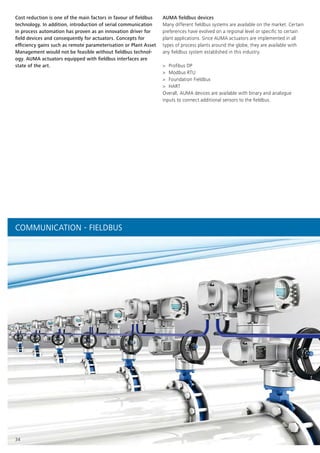
AUMA fieldbus devices
Many different fieldbus systems are available on the market. Certain
preferences have evolved on a regional level or specific to certain
plant applications. Since AUMA actuators are implemented in all
types of process plants around the globe, they are available with
any fieldbus system established in this industry.
>> Profibus DP
>> Modbus RTU
>> Foundation Fieldbus
>> HART
Overall, AUMA devices are available with binary and analogue
inputs to connect additional sensors to the fieldbus.
Cost reduction is one of the main factors in favour of fieldbus
technology. In addition, introduction of serial communication
in process automation has proven as an innovation driver for
field devices and consequently for actuators. Concepts for
efficiency gains such as remote parameterisation or Plant Asset
Management would not be feasible without fieldbus technol-
ogy. AUMA actuators equipped with fieldbus interfaces are
state of the art.
COMMUNICATION - FIELDBUS
Bus cycle with 5 actuators
1
Acyclic diagnostic or parameter data transmission
Cyclic process data feedback from slave
Cyclic process data request from master
2 3 4 5
Redundant channel
Standard channel
1 2 3 4 5
Modbus
Profibus
Foundation Fieldbus
Comparison of bus cycle times
35
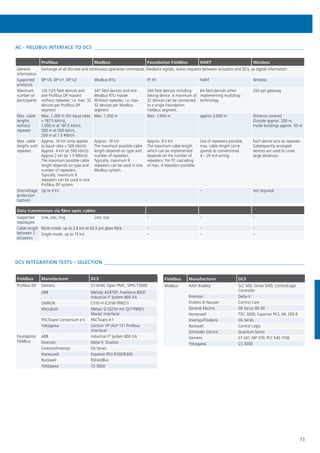
PROFIBUS
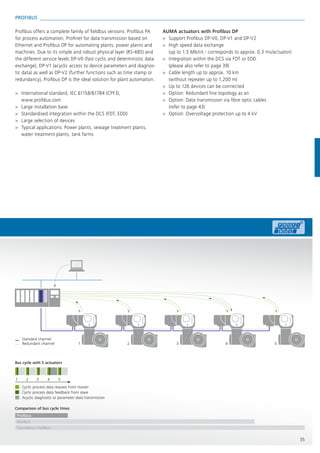
AUMA actuators with Profibus DP
> Support Profibus DP-V0, DP-V1 and DP-V2
> High speed data exchange
(up to 1.5 Mbit/s - corresponds to approx. 0.3 ms/actuator)
> Integration within the DCS via FDT or EDD
(please also refer to page 39)
> Cable length up to approx. 10 km
(without repeater up to 1,200 m)
> Up to 126 devices can be connected
> Option: Redundant line topology as an
> Option: Data transmission via fibre optic cables
(refer to page 43)
> Option: Overvoltage protection up to 4 kV
Profibus offers a complete family of fieldbus versions: Profibus PA
for process automation, Profinet for data transmission based on
Ethernet and Profibus DP for automating plants, power plants and
machines. Due to its simple and robust physical layer (RS-485) and
the different service levels DP-V0 (fast cyclic and deterministic data
exchange), DP-V1 (acyclic access to device parameters and diagnos-
tic data) as well as DP-V2 (further functions such as time stamp or
redundancy), Profibus DP is the ideal solution for plant automation.
> International standard, IEC 61158/61784 (CPF3),
www.profibus.com
> Large installation base
> Standardised integration within the DCS (FDT, EDD)
> Large selection of devices
> Typical applications: Power plants, sewage treatment plants,
water treatment plants, tank farms
Comparison of bus cycle times
1
Acyclic diagnostic or parameter data transmission
Cyclic process data feedback from slave
Cyclic process data request from master
2 3 4 4
Modbus
Profibus
Foundation Fieldbus
Bus cycle with 5 actuators
1 2 3 4 5Redundant channel
Standard channel
36
MODBUS
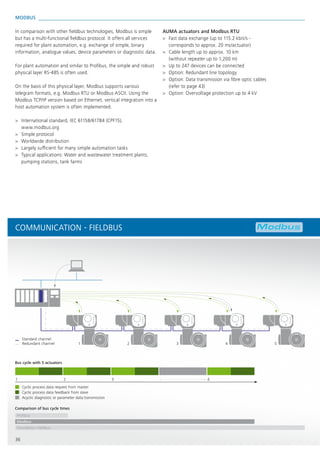
In comparison with other fieldbus technologies, Modbus is simple
but has a multi-functional fieldbus protocol. It offers all services
required for plant automation, e.g. exchange of simple, binary
information, analogue values, device parameters or diagnostic data.
For plant automation and similar to Profibus, the simple and robust
physical layer RS-485 is often used.
On the basis of this physical layer, Modbus supports various
telegram formats, e.g. Modbus RTU or Modbus ASCII. Using the
Modbus TCP/IP version based on Ethernet, vertical integration into a
host automation system is often implemented.
> International standard, IEC 61158/61784 (CPF15),
www.modbus.org
> Simple protocol
> Worldwide distribution
> Largely sufficient for many simple automation tasks
> Typical applications: Water and wastewater treatment plants,
pumping stations, tank farms
AUMA actuators and Modbus RTU
> Fast data exchange (up to 115.2 kbit/s -
corresponds to approx. 20 ms/actuator)
> Cable length up to approx. 10 km
(without repeater up to 1,200 m)
> Up to 247 devices can be connected
> Option: Redundant line topology
> Option: Data transmission via fibre optic cables
(refer to page 43)
> Option: Overvoltage protection up to 4 kV
COMMUNICATION - FIELDBUS
Comparison of bus cycle times
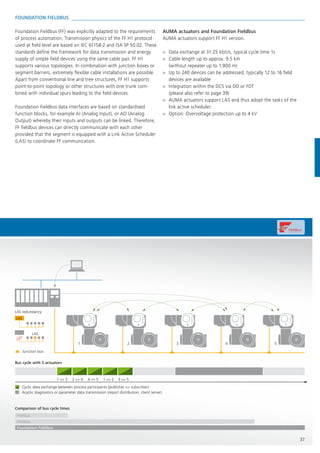
Acyclic diagnostics or parameter data transmission (report distribution, client server)
Cyclic data exchange between process participants (publisher <> subscriber)
Modbus
Profibus
Foundation Fieldbus
Bus cycle with 5 actuators
LAS
LAS
LAS redundancy
Junction box
1 2 3 4 5
1 <> 3 2 <> 4 4 <> 5 1 <> 2 3 <> 5
37
FOUNDATION FIELDBUS
Foundation Fieldbus (FF) was explicitly adapted to the requirements
of process automation. Transmission physics of the FF H1 protocol
used at field level are based on IEC 61158-2 and ISA SP 50.02. These
standards define the framework for data transmission and energy
supply of simple field devices using the same cable pair. FF H1
supports various topologies. In combination with junction boxes or
segment barriers, extremely flexible cable installations are possible.
Apart from conventional line and tree structures, FF H1 supports
point-to-point topology or other structures with one trunk com-
bined with individual spurs leading to the field devices.
Foundation Fieldbus data interfaces are based on standardised
function blocks, for example AI (Analog Input), or AO (Analog
Output) whereby their inputs and outputs can be linked. Therefore,
FF fieldbus devices can directly communicate with each other
provided that the segment is equipped with a Link Active Scheduler
(LAS) to coordinate FF communication.
AUMA actuators and Foundation Fieldbus
AUMA actuators support FF H1 version.
> Data exchange at 31.25 kbit/s, typical cycle time 1s
> Cable length up to approx. 9.5 km
(without repeater up to 1,900 m)
> Up to 240 devices can be addressed, typically 12 to 16 field
devices are available
> Integration within the DCS via DD or FDT
(please also refer to page 39)
> AUMA actuators support LAS and thus adopt the tasks of the
link active scheduler.
> Option: Overvoltage protection up to 4 kV
5421 3
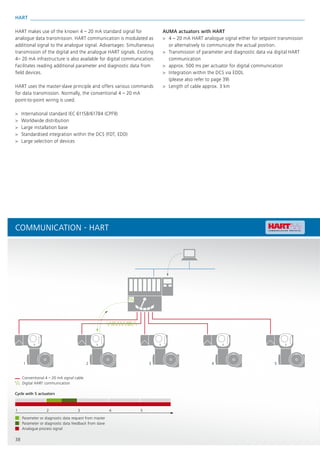
Conventional 4 – 20 mA signal cable
Digital HART communication
1
Analogue process signal
Parameter or diagnostic data feedback from slave
Parameter or diagnostic data request from master
2 3 4 5
Cycle with 5 actuators
38
HART
HART makes use of the known 4 – 20 mA standard signal for
analogue data transmission. HART communication is modulated as
additional signal to the analogue signal. Advantages: Simultaneous
transmission of the digital and the analogue HART signals. Existing
4– 20 mA infrastructure is also available for digital communication.
Facilitates reading additional parameter and diagnostic data from
field devices.
HART uses the master-slave principle and offers various commands
for data transmission. Normally, the conventional 4 – 20 mA
point-to-point wiring is used.
> International standard IEC 61158/61784 (CPF9)
> Worldwide distribution
> Large installation base
> Standardised integration within the DCS (FDT, EDD)
> Large selection of devices
AUMA actuators with HART
> 4 – 20 mA HART analogue signal either for setpoint transmission
or alternatively to communicate the actual position.
> Transmission of parameter and diagnostic data via digital HART
communication
> approx. 500 ms per actuator for digital communication
> Integration within the DCS via EDDL
(please also refer to page 39)
> Length of cable approx. 3 km
COMMUNICATION - HART
DTM
Diagnostics
Analysis
Maintenance
Configuration
Docum
en
tation
EDD 1 21 2 EDD
DTM
DTM
1 2 1 2
FDT interface
ASCII text files Software modules
EDD FDT/DTM
EDDL interpreter FDT frame application
EDD
FDT/DTM
Comparison of functional scope
EDD
FDT
DTM
39
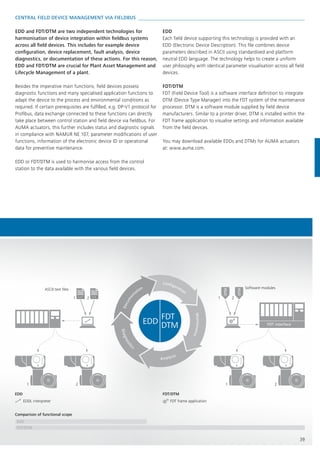
CENTRAL FIELD DEVICE MANAGEMENT VIA FIELDBUS 
EDD and FDT/DTM are two independent technologies for
harmonisation of device integration within fieldbus systems
across all field devices. This includes for example device
configuration, device replacement, fault analysis, device
diagnostics, or documentation of these actions. For this reason,
EDD and FDT/DTM are crucial for Plant Asset Management and
Lifecycle Management of a plant.
Besides the imperative main functions, field devices possess
diagnostic functions and many specialised application functions to
adapt the device to the process and environmental conditions as
required. If certain prerequisites are fulfilled, e.g. DP-V1 protocol for
Profibus, data exchange connected to these functions can directly
take place between control station and field device via fieldbus. For
AUMA actuators, this further includes status and diagnostic signals
in compliance with NAMUR NE 107, parameter modifications of user
functions, information of the electronic device ID or operational
data for preventive maintenance.
EDD or FDT/DTM is used to harmonise access from the control
station to the data available with the various field devices.
EDD
Each field device supporting this technology is provided with an
EDD (Electronic Device Description). This file combines device
parameters described in ASCII using standardised and platform
neutral EDD language. The technology helps to create a uniform
user philosophy with identical parameter visualisation across all field
devices.
FDT/DTM
FDT (Field Device Tool) is a software interface definition to integrate
DTM (Device Type Manager) into the FDT system of the maintenance
processor. DTM is a software module supplied by field device
manufacturers. Similar to a printer driver, DTM is installed within the
FDT frame application to visualise settings and information available
from the field devices.
You may download available EDDs and DTMs for AUMA actuators
at: www.auma.com.
40
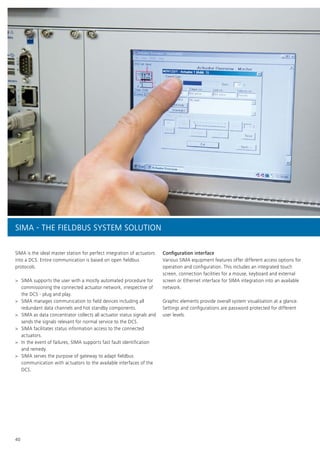
SIMA is the ideal master station for perfect integration of actuators
into a DCS. Entire communication is based on open fieldbus
protocols.
>> SIMA supports the user with a mostly automated procedure for
commissioning the connected actuator network, irrespective of
the DCS - plug and play.
>> SIMA manages communication to field devices including all
redundant data channels and hot standby components.
>> SIMA as data concentrator collects all actuator status signals and
sends the signals relevant for normal service to the DCS.
>> SIMA facilitates status information access to the connected
actuators.
>> In the event of failures, SIMA supports fast fault identification
and remedy.
>> SIMA serves the purpose of gateway to adapt fieldbus
communication with actuators to the available interfaces of the
DCS.
Configuration interface
Various SIMA equipment features offer different access options for
operation and configuration. This includes an integrated touch
screen, connection facilities for a mouse, keyboard and external
screen or Ethernet interface for SIMA integration into an available
network.
Graphic elements provide overall system visualisation at a glance.
Settings and configurations are password protected for different
user levels.
SIMA - THE FIELDBUS SYSTEM SOLUTION
without SIMA10 km
with SIMA 296 km
Comparison of max. cable lengths of fieldbus systems
Redundancy within loop
Communication without fault Communication in the event of fault
22
11
33
44
1a1a
41
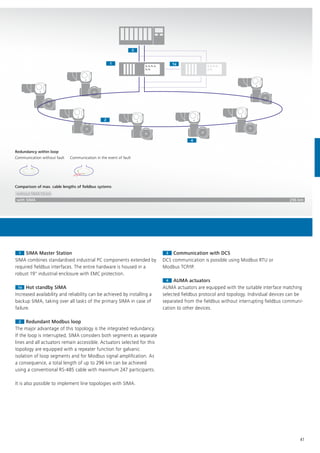
11 SIMA Master Station
SIMA combines standardised industrial PC components extended by
required fieldbus interfaces. The entire hardware is housed in a
robust 19" industrial enclosure with EMC protection.
1a1a Hot standby SIMA
Increased availability and reliability can be achieved by installing a
backup SIMA, taking over all tasks of the primary SIMA in case of
failure.
22 Redundant Modbus loop
The major advantage of this topology is the integrated redundancy.
If the loop is interrupted, SIMA considers both segments as separate
lines and all actuators remain accessible. Actuators selected for this
topology are equipped with a repeater function for galvanic
isolation of loop segments and for Modbus signal amplification. As
a consequence, a total length of up to 296 km can be achieved
using a conventional RS-485 cable with maximum 247 participants.
It is also possible to implement line topologies with SIMA.
33 Communication with DCS
DCS communication is possible using Modbus RTU or
Modbus TCP/IP.
44 AUMA actuators
AUMA actuators are equipped with the suitable interface matching
selected fieldbus protocol and topology. Individual devices can be
separated from the fieldbus without interrupting fieldbus communi-
cation to other devices.
33
22
11
42
The use of copper cables can be unsatis-
factory for certain applications. Here, it
is possible to switch to fibre optic cables.
When selecting Wireless, communication
is made without cables.
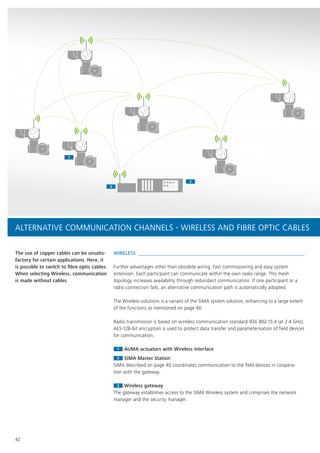
WIRELESS
Further advantages other than obsolete wiring: Fast commissioning and easy system
extension. Each participant can communicate within the own radio range. This mesh
topology increases availability through redundant communication. If one participant or a
radio connection fails, an alternative communication path is automatically adopted.
The Wireless solutions is a variant of the SIMA system solution, enhancing to a large extent
of the functions as mentioned on page 40.
Radio transmission is based on wireless communication standard IEEE 802.15.4 (at 2.4 GHz).
AES-128-bit encryption is used to protect data transfer and parameterisation of field devices
for communication.
11 AUMA actuators with Wireless interface
22 SIMA Master Station
SIMA described on page 40 coordinates communication to the field devices in coopera-
tion with the gateway.
33 Wireless gateway
The gateway establishes access to the SIMA Wireless system and comprises the network
manager and the security manager.
ALTERNATIVE COMMUNICATION CHANNELS - WIRELESS AND FIBRE OPTIC CABLES
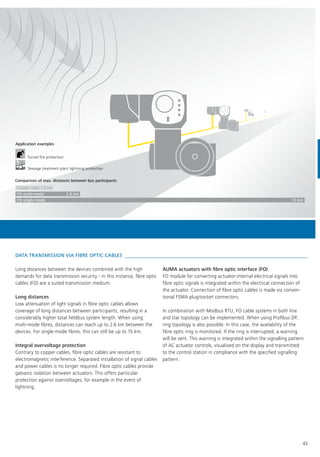
FO multi-mode 2.6 km
Copper cable 1.2 km
FO single-mode
Comparison of max. distances between bus participants
Application examples
Sewage treatment plant lightning protection
Tunnel fire protection
15 km
43
DATA TRANSMISSION VIA FIBRE OPTIC CABLES
Long distances between the devices combined with the high
demands for data transmission security - in this instance, fibre optic
cables (FO) are a suited transmission medium.
Long distances
Low attenuation of light signals in fibre optic cables allows
coverage of long distances between participants, resulting in a
considerably higher total fieldbus system length. When using
multi-mode fibres, distances can reach up to 2.6 km between the
devices. For single-mode fibres, this can still be up to 15 km.
Integral overvoltage protection
Contrary to copper cables, fibre optic cables are resistant to
electromagnetic interference. Separated installation of signal cables
and power cables is no longer required. Fibre optic cables provide
galvanic isolation between actuators. This offers particular
protection against overvoltages, for example in the event of
lightning.
AUMA actuators with fibre optic interface (FO)
FO module for converting actuator-internal electrical signals into
fibre optic signals is integrated within the electrical connection of
the actuator. Connection of fibre optic cables is made via conven-
tional FSMA plug/socket connectors.
In combination with Modbus RTU, FO cable systems in both line
and star topology can be implemented. When using Profibus DP,
ring topology is also possible. In this case, the availability of the
fibre optic ring is monitored. If the ring is interrupted, a warning
will be sent. This warning is integrated within the signalling pattern
of AC actuator controls, visualised on the display and transmitted
to the control station in compliance with the specified signalling
pattern.
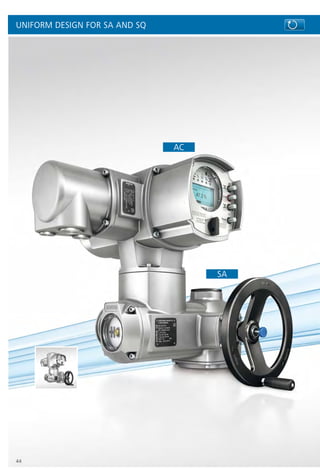
SA
AC
44
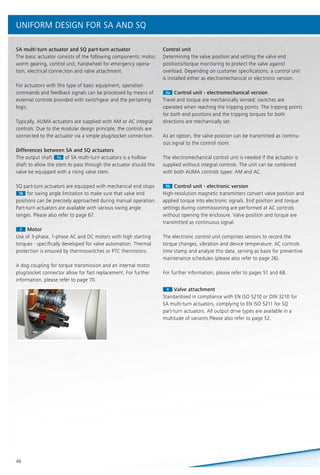
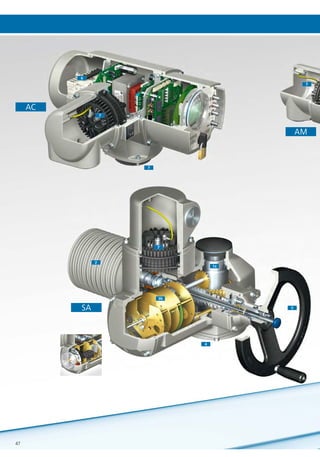
UNIFORM DESIGN FOR SA AND SQ
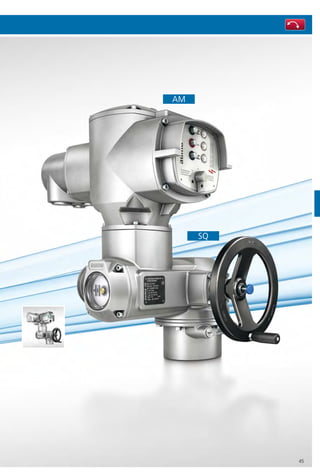
SQ
AM
45
46
44 Valve attachment
Standardised in compliance with EN ISO 5210 or DIN 3210 for
SA multi-turn actuators, complying to EN ISO 5211 for SQ
part-turn actuators. All output drive types are available in a
multitude of variants.Please also refer to page 52.
22 Motor
Use of 3-phase, 1-phase AC and DC motors with high starting
torques - specifically developed for valve automation. Thermal
protection is ensured by thermoswitches or PTC thermistors.
A dog coupling for torque transmission and an internal motor
plug/socket connector allow for fast replacement. For further
information, please refer to page 70.
Control unit
Determining the valve position and setting the valve end
positions/torque monitoring to protect the valve against
overload. Depending on customer specifications, a control unit
is installed either as electromechanical or electronic version.
3a3a Control unit - electromechanical version
Travel and torque are mechanically sensed; switches are
operated when reaching the tripping points. The tripping points
for both end positions and the tripping torques for both
directions are mechanically set.
As an option, the valve position can be transmitted as continu-
ous signal to the control room.
The electromechanical control unit is needed if the actuator is
supplied without integral controls. The unit can be combined
with both AUMA controls types: AM and AC.
3b3b Control unit - electronic version
High-resolution magnetic transmitters convert valve position and
applied torque into electronic signals. End position and torque
settings during commissioning are performed at AC controls
without opening the enclosure. Valve position and torque are
transmitted as continuous signal.
The electronic control unit comprises sensors to record the
torque changes, vibration and device temperature. AC controls
time stamp and analyse this data, serving as basis for preventive
maintenance schedules (please also refer to page 26).
For further information, please refer to pages 51 and 68.
SA multi-turn actuator and SQ part-turn actuator
The basic actuator consists of the following components: motor,
worm gearing, control unit, handwheel for emergency opera-
tion, electrical connection and valve attachment.
For actuators with this type of basic equipment, operation
commands and feedback signals can be processed by means of
external controls provided with switchgear and the pertaining
logic.
Typically, AUMA actuators are supplied with AM or AC integral
controls. Due to the modular design principle, the controls are
connected to the actuator via a simple plug/socket connection.
Differences between SA and SQ actuators
The output shaft 1a
Differences between SA and SQ actuators
The output shaft 1a of SA multi-turn actuators is a hollow
shaft to allow the stem to pass through the actuator should the
valve be equipped with a rising valve stem.
SQ part-turn actuators are equipped with mechanical end stops
1b
SQ part-turn actuators are equipped with mechanical end stopsSQ part-turn actuators are equipped with mechanical end stops
1b for swing angle limitation to make sure that valve end
positions can be precisely approached during manual operation.
Part-turn actuators are available with various swing angle
ranges. Please also refer to page 67.
UNIFORM DESIGN FOR SA AND SQ
66
3b3b
77
77
77
77
55SA
44
1a1a
22
AM
AC
47
66
3a3a
77
77
55
22
44
1b1b
SQ
48
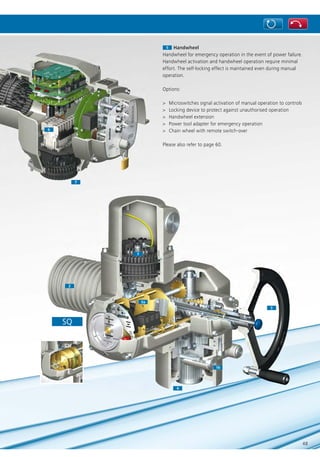
55 Handwheel
Handwheel for emergency operation in the event of power failure.
Handwheel activation and handwheel operation require minimal
effort. The self-locking effect is maintained even during manual
operation.
Options:
> Microswitches signal activation of manual operation to controls
> Locking device to protect against unauthorised operation
> Handwheel extension
> Power tool adapter for emergency operation
> Chain wheel with remote switch-over
Please also refer to page 60.
49
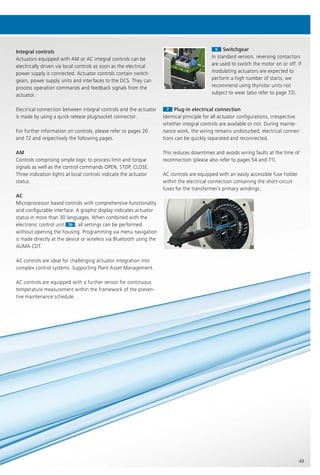
66 Switchgear
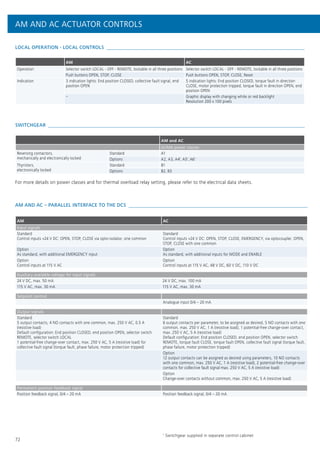
In standard version, reversing contactors
are used to switch the motor on or off. If
modulating actuators are expected to
perform a high number of starts, we
recommend using thyristor units not
subject to wear (also refer to page 72).
77 Plug-in electrical connection
Identical principle for all actuator configurations, irrespective
whether integral controls are available or not. During mainte-
nance work, the wiring remains undisturbed; electrical connec-
tions can be quickly separated and reconnected.
This reduces downtimes and avoids wiring faults at the time of
reconnection (please also refer to pages 54 and 71).
AC controls are equipped with an easily accessible fuse holder
within the electrical connection containing the short-circuit
fuses for the transformer’s primary windings.
Integral controls
Actuators equipped with AM or AC integral controls can be
electrically driven via local controls as soon as the electrical
power supply is connected. Actuator controls contain switch-
gears, power supply units and interfaces to the DCS. They can
process operation commands and feedback signals from the
actuator.
Electrical connection between integral controls and the actuator
is made by using a quick release plug/socket connector.
For further information on controls, please refer to pages 20
and 72 and respectively the following pages.
AM
Controls comprising simple logic to process limit and torque
signals as well as the control commands OPEN, STOP, CLOSE.
Three indication lights at local controls indicate the actuator
status.
AC
Microprocessor based controls with comprehensive functionality
and configurable interface. A graphic display indicates actuator
status in more than 30 languages. When combined with the
electronic control unit 3b
status in more than 30 languages. When combined with the
electronic control unit
status in more than 30 languages. When combined with the
3b , all settings can be performed
without opening the housing. Programming via menu navigation
is made directly at the device or wireless via Bluetooth using the
AUMA CDT.
AC controls are ideal for challenging actuator integration into
complex control systems. Supporting Plant Asset Management.
AC controls are equipped with a further sensor for continuous
temperature measurement within the framework of the preven-
tive maintenance schedule.
11
2a2a
33
44
66
55
2b2b
50
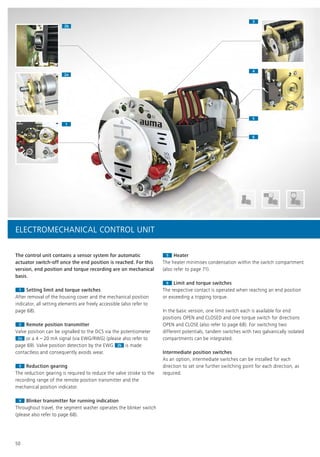
The control unit contains a sensor system for automatic
actuator switch-off once the end position is reached. For this
version, end position and torque recording are on mechanical
basis.
11 Setting limit and torque switches
After removal of the housing cover and the mechanical position
indicator, all setting elements are freely accessible (also refer to
page 68).
22 Remote position transmitter
Valve position can be signalled to the DCS via the potentiometer
2a
Valve position can be signalled to the DCS via the potentiometerValve position can be signalled to the DCS via the potentiometer
2a or a 4 – 20 mA signal (via EWG/RWG) (please also refer to
page 69). Valve position detection by the EWG 2b
or a 4 – 20 mA signal (via EWG/RWG) (please also refer to
page 69). Valve position detection by the EWG
or a 4 – 20 mA signal (via EWG/RWG) (please also refer to
2b is made
contactless and consequently avoids wear.
33 Reduction gearing
The reduction gearing is required to reduce the valve stroke to the
recording range of the remote position transmitter and the
mechanical position indicator.
44 Blinker transmitter for running indication
Throughout travel, the segment washer operates the blinker switch
(please also refer to page 68).
55 Heater
The heater minimises condensation within the switch compartment
(also refer to page 71).
66 Limit and torque switches
The respective contact is operated when reaching an end position
or exceeding a tripping torque.
In the basic version, one limit switch each is available for end
positions OPEN and CLOSED and one torque switch for directions
OPEN and CLOSE (also refer to page 68). For switching two
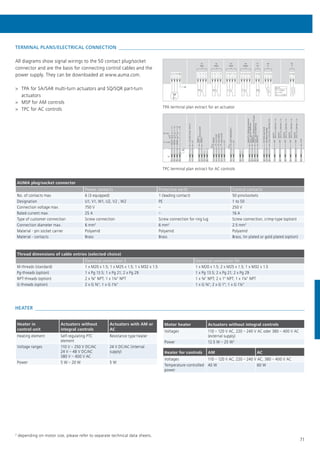
different potentials, tandem switches with two galvanically isolated
compartments can be integrated.
Intermediate position switches
As an option, intermediate switches can be installed for each
direction to set one further switching point for each direction, as
required.
ELECTROMECHANICAL CONTROL UNIT
77
88
1212
99
1111
1010
51
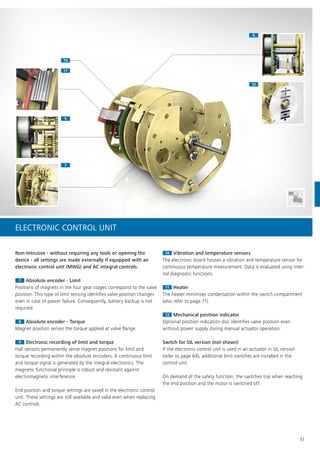
1010 Vibration and temperature sensors
The electronic board houses a vibration and temperature sensor for
continuous temperature measurement. Data is evaluated using inter-
nal diagnostic functions.
1111 Heater
The heater minimises condensation within the switch compartment
(also refer to page 71).
1212 Mechanical position indicator
Optional position indication disc identifies valve position even
without power supply during manual actuator operation.
Switch for SIL version (not shown)
If the electronic control unit is used in an actuator in SIL version
(refer to page 64), additional limit switches are installed in the
control unit.
On demand of the safety function, the switches trip when reaching
the end position and the motor is switched off.
Non-Intrusive - without requiring any tools or opening the
device - all settings are made externally if equipped with an
electronic control unit (MWG) and AC integral controls.
77 Absolute encoder - Limit
Positions of magnets in the four gear stages correspond to the valve
position. This type of limit sensing identifies valve position changes
even in case of power failure. Consequently, battery backup is not
required.
88 Absolute encoder - Torque
Magnet position senses the torque applied at valve flange.
99 Electronic recording of limit and torque
Hall sensors permanently sense magnet positions for limit and
torque recording within the absolute encoders. A continuous limit
and torque signal is generated by the integral electronics. The
magnetic functional principle is robust and resistant against
electromagnetic interference.
End position and torque settings are saved in the electronic control
unit. These settings are still available and valid even when replacing
AC controls.
ELECTRONIC CONTROL UNIT
1a1a
1c1c
1d1d
1b1b
22
SA11
11
52
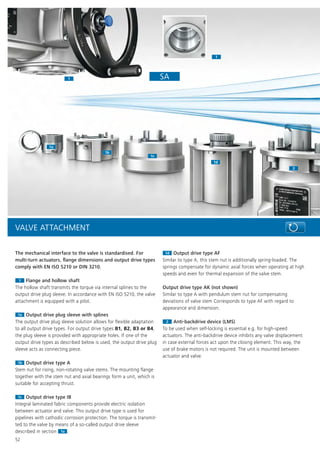
The mechanical interface to the valve is standardised. For
multi-turn actuators, flange dimensions and output drive types
comply with EN ISO 5210 or DIN 3210.
11 Flange and hollow shaft
The hollow shaft transmits the torque via internal splines to the
output drive plug sleeve. In accordance with EN ISO 5210, the valve
attachment is equipped with a pilot.
1a1a Output drive plug sleeve with splines
The output drive plug sleeve solution allows for flexible adaptation
to all output drive types. For output drive types B1, B2, B3 or B4,
the plug sleeve is provided with appropriate holes. If one of the
output drive types as described below is used, the output drive plug
sleeve acts as connecting piece.
1b1b Output drive type A
Stem nut for rising, non-rotating valve stems. The mounting flange
together with the stem nut and axial bearings form a unit, which is
suitable for accepting thrust.
1c1c Output drive type IB
Integral laminated fabric components provide electric isolation
between actuator and valve. This output drive type is used for
pipelines with cathodic corrosion protection. The torque is transmit-
ted to the valve by means of a so-called output drive sleeve
described in section 1a
ted to the valve by means of a so-called output drive sleeve
described in section
ted to the valve by means of a so-called output drive sleeve
1a .
1d1d Output drive type AF
Similar to type A, this stem nut is additionally spring-loaded. The
springs compensate for dynamic axial forces when operating at high
speeds and even for thermal expansion of the valve stem.
Output drive type AK (not shown)
Similar to type A with pendulum stem nut for compensating
deviations of valve stem Corresponds to type AF with regard to
appearance and dimension.
22 Anti-backdrive device (LMS)
To be used when self-locking is essential e.g. for high-speed
actuators. The anti-backdrive device inhibits any valve displacement
in case external forces act upon the closing element. This way, the
use of brake motors is not required. The unit is mounted between
actuator and valve.
VALVE ATTACHMENT
3c3c
3d3d
3b3b
3a3a
SQ
33
33
53
For part-turn actuators, connection to the valve has to comply
with EN ISO 5211. Like for the output drive plug sleeve for SA
multi-turn actuators, SQ actuators provide a splined coupling
for torque transmission.
33 Flange and output shaft
The output shaft transmits the torque via internal splines to the
coupling. The flange can be equipped with a spigot in accordance
with EN ISO 5211.
3a3a Coupling unbored
Standard version. Finish machining is made at the valve manufac-
turer’s or on site.
3b3b Square bore
In compliance with EN ISO 5211. For special dimensions, please
contact AUMA.
3c3c Bore with two-flats
In compliance with EN ISO 5211. For special dimensions, please
contact AUMA.
3d3d Bore with keyway
The bore according to EN ISO 5211 can be supplied with one, two,
three, or four keyways. The keyways conform to DIN 6885 Part 1.
For keyways with other dimensions, please contact AUMA.
Extended coupling (not shown)
For special valve designs, e.g. recessed stem or if an intermediate
flange is required between gearbox and valve.
22
22
22
11
44
33
54
The plug-in electrical connector is a key
element of the modular actuator design.
The connector is a separate unit. The
different connection types are compat-
ible throughout all type ranges and can
be used for actuators with or without
integral controls.
During maintenance work, the wiring
remains undisturbed; electrical connections
can be quickly separated and reconnected.
This reduces downtimes and avoids wiring
faults when reconnecting.
11 AUMA plug/socket connector
The 50 contact AUMA plug/socket connector is the core element for all connection types.
Incorrect connection is prevented by special code pins. The AUMA plug/socket connector
also forms the electrical connection between actuator and integral actuator controls.
Integral controls can be quickly removed from and reconnected to the actuator.
22 Cover for electrical connection S
With three cable entries.
33 Cover for electrical connection SH
With additional cable entries, offers 75 % more space than standard version.
44 Intermediate frame DS for double sealing
Preserves the enclosure protection even if the electrical connection is removed and prevents
ingress of dirt or humidity into the housing. Can be combined with any electrical connec-
tion type and is easily retrofitted.
ELECTRICAL CONNECTION
66
55
55
If communication via parallel signal
transmission is required, AC is equipped
with one of the electrical connections as
described above. When using fieldbus
technology, special connections are used.
They are based on the plug-in design just
like the other connectors.
55 Fieldbus connection SD
A connection board for easy connection of fieldbus cables is integrated. Fieldbus communi-
cation is not interrupted even when connector is removed. Connection is made via fieldbus
specific characteristics. For example for Profibus as shown, termination resistors are
integrated.
66 Fieldbus connection SDE with FO couplers
For direct connection of fibre optic cables to AC controls. Comparable in design to SD
connection 5
For direct connection of fibre optic cables to AC controls. Comparable in design to SD
connection
For direct connection of fibre optic cables to AC controls. Comparable in design to SD
5 but with larger diameter to comfortably accommodate the specified FO
cable bending radii. The FO module contains diagnostic functions to monitor fibre optic
cable quality.
6a6a
11
22
66
44
56
Combining an SA multi-turn actuator with a GS part-turn
gearbox results in a part-turn actuator. This combination
generates large output torques as required for automating
butterfly valves as well as ball and plug valves with large
nominal diameters and/or high pressure values.
This device combination supplies torque values up to 675,000 Nm.
22 Worm wheel and worm shaft
They form the core components of the gearbox. The design allows
high reduction ratios within one gear and has an important
self-locking effect thus preventing valve position displacement in
case external forces act upon the closing element.
11 End stops
End stops serve the purpose of limiting the swing angle and to
allow for precise valve positioning into the end positions during
manual operation, especially if the valve is not equipped with own
end stops. In motor operation, switching off is generated by the
built-on SA multi-turn actuator, gearbox end stops are not reached
in this mode.
For the AUMA design, the travelling nut aFor the AUMA design, the travelling nut a travels between both
end stops b
For the AUMA design, the travelling nut
end stops
For the AUMA design, the travelling nut
b during operation. Advantages of this design:
> Only relatively low input torques are applied to the end stops.
> Excessive input torques have no impact on the housing. Even in
the event of end stop break, the main gearbox remains
undamaged and can still be operated.
A patented design consisting of two safety wedge discs cA patented design consisting of two safety wedge discs c per
end stop prevents travelling nut seizure at mechanical stop. The
unseating torque required amounts to merely 60 % of the torque
previously applied to approach the end stop.
bb
bb
cc
cc
aa
33 Output mounting flange
In compliance with EN ISO 5211.
MULTI-TURN ACTUATOR - PART-TURN GEARBOX COMBINATIONS - FOR LARGE TORQUE
55
33
GS
SA
AC
57
44 Coupling
The separate coupling enables easier mounting of the gearbox to
the valve. On request, the coupling is supplied with a suitable bore
for the valve shaft (please also refer to page 53). The coupling
with bore is placed on the valve shaft and secured against axial
movement. The gearbox can then be mounted onto the valve
flange.
55 Primary reduction gearing
These planetary or spur gear stages ensure reduction of the
required input torque.
66 Pointer cover
The large pointer cover allows perfect visibility of the valve position
even at long distance. It continuously follows the valve movement
and consequently serves the purpose of running indication. For high
requirements with regard to enclosure protection, e.g. for buried
service, a protective cover 6a
requirements with regard to enclosure protection, e.g. for buried
service, a protective cover
requirements with regard to enclosure protection, e.g. for buried
6a is used instead of the pointer cover.
ES
up to 100 m
11
22
58
One of the many advantages of a
modular design is the ease at which
device configuration upgrade on site can
be achieved.
11 Wall bracket
If the actuator is difficult to access or in case of extreme vibration or high ambient tempera-
tures at the place of valve installation, controls with operating elements can be mounted
separately from the actuator on a wall bracket. The cable length between actuator and
controls may be up to 100 m. The wall bracket may easily be retrofitted at a later date.
22 Customisation of device positioning
The optimum positioning is easily adjustable thus avoiding the display being upside down,
inaccessible operating elements, awkward cable gland alignments, etc. The correct position
can easily be chosen.
The following positioning adjustments at 90° increments are possible: controls to actuator,
local controls to controls as well as the electrical plug/socket connector. The plug/socket
connections allow easy on-site adjustment of the mounting position.
SPECIAL CIRCUMSTANCES - ADAPTING TO ANY MOUNTING POSITION
L L R
R
L
L R R
A
B
C
D
A
B
C
D
GS part-turn gearbox variants
Rotary direction at output drive
Worm shaft position
Mounting positions between actuator and gearbox
GS LL / LR GS RL / RR
Rotary position at gearbox
3 GS part-turn gearbox variants3
4 Mounting positions between actuator and gearbox
GS LL
4
59
44 Mounting positions of actuator and gearbox
Customising of device positioning as described in 2
Mounting positions of actuator and gearbox
Customising of device positioning as described in
Mounting positions of actuator and gearbox
2 is not limited
to the actuator position. If AUMA actuators are ordered in combina-
tion with gearboxes, both devices can be mounted in four different
positions, each rotated by 90°. Positions are marked with the letters
A – D, the desired position can be indicated on the order.
Later adaptation on site is also possible. This applies to all AUMA
multi-turn, part-turn, and lever gearboxes.
This document shows examples of the SA multi-turn actuator
combined with GS part-turn gearbox variants. Separate documents
describing the mounting positions are available for all gearbox
types.
33 GS part-turn gearbox variants
The four variants expand the adaptation options with regard to the
mounting position. This is due to the arrangement between worm
shaft and worm wheel and the direction of rotation at output drive,
with reference to a clockwise rotating input shaft.
> LL: Worm shaft on left of worm wheel, counterclockwise
rotation at output drive
> LR: Worm shaft on left of worm wheel, clockwise rotation at
output drive
> RL: Worm shaft on right of worm wheel, counterclockwise
rotation at output drive
> RR: Worm shaft on right of worm wheel, clockwise rotation at
output drive
2a2a
2b2b
60
Actuators cannot always be accessed easily. Special applica-
tions demand special challenges.
Some application examples with the AUMA solutions are described
below.
11 Operation elements for manual operation
1a1a Handwheel extension
For separate mounting of the handwheel
1b1b Adapter for power tool emergency operation
For manual emergency operation using a power tool.
1c1c Pit application with square head for power tool operation
Activation via square head for power tool
1d1d Chain wheel with remote switch-over
Activation via pull rope, scope of delivery without chain.
SPECIAL CIRCUMSTANCES - ADAPTING TO ANY MOUNTING POSITION
3a3a
3b3b
3b3b
3c3c
44
61
33 Synchronous operation - double-stem gate valves
In this application, it is of utmost importance to operate both stems
simultaneously to avoid jamming the plate. The solution: Each stem
is equipped with one GK bevel gearbox 3b
simultaneously to avoid jamming the plate. The solution: Each stem
is equipped with one GK bevel gearbox
simultaneously to avoid jamming the plate. The solution: Each stem
3b , both driven by an SA
multi-turn actuator 3a
is equipped with one GK bevel gearbox
multi-turn actuator
is equipped with one GK bevel gearbox
3a . In our example, the actuator is directly
mounted to a gearbox, torque transmission to the second gearbox
is performed via a shaft. Handwheel extensions 3c
mounted to a gearbox, torque transmission to the second gearbox
is performed via a shaft. Handwheel extensions
mounted to a gearbox, torque transmission to the second gearbox
3c make manual
emergency operations much easier.
44 Emergency manual operation at a weir
Typically, weirs require adaptations to the special installation
conditions. Actuators might be difficult to access. The chain wheel
solutions including the switch-over function is a perfect solution for
emergency manual operation, even in these difficult environments.
All examples illustrate how to use the items shown.
22 Installation in pits
Flooding and accessibility of the operation elements - depending on
the importance of these factors - result in different installation
requirements.
2a2a Floor pedestal
GS worm gearbox is mounted to valve, the multi-turn actuator is
easily accessible due to the AUMA floor pedestal. Power transmis-
sion between actuator and gearbox is made via a cardan shaft.
2b2b Extension for pit installation with adapter for power tool
operation
GS part-turn gearbox is mounted to valve, the multi-turn actuator is
mounted separately from the gearbox. To make sure that actuator
and gearbox flanges are aligned, a GK bevel gearbox is used.
Emergency operation is performed from the pit cover. For this
purpose, the actuator is equipped with an extension for pit installa-
tion. The end is made as square head to allow power tool opera-
tion. The manual emergency operation is activated by applying
pressure on the power tool square head.
62
AUMA actuators comply with global
safety standards. They are equipped with
a large variety of functions for safe and
orderly operation while protecting the
valve.
Correction of the direction of rotation
The automatic correction of the direction of rotation upon wrong phase sequence is an
integral feature of the controls. If the phases are mixed up at the time of connecting the
three-phase supply, the actuator still travels in the correct direction when receiving the
respective operation command.
Valve overload protection
The controls switch off the actuator if inappropriate and excessive torque is applied during
travel.
Protection tube for rising valve stem
The protection tube encloses a rising valve stem, thus protecting the stem against contami-
nation and the plant operators against injury.
PROTECTION FOR VALVE, PROTECTION DURING OPERATION
11
1a1a
1b1b
22
33
44
55
63
11 Locking device for handwheel
Activation of manual operation can be inhibited by means of a locking device 1aActivation of manual operation can be inhibited by means of a locking device 1a . On the
other hand, it is possible to inhibit automatic switching to motor operation once manual
operation has been activated 1b
other hand, it is possible to inhibit automatic switching to motor operation once manual
operation has been activated
other hand, it is possible to inhibit automatic switching to motor operation once manual
1b .
22 Remote lockout of AC local controls
Electrical actuator operation via the local controls is not possible without the enable signal
from the control room.
33 Lockable selector switch
The selector switch for selecting the control mode can be protected against operation in all
three positions: LOCAL, OFF, and REMOTE.
44 Lockable protection cover
Protects all operation elements from vandalism and unauthorised operation.
55 Protected AC Bluetooth connection
Password entry is required to establish a connection between a laptop or PDA and an
actuator with integral controls.
Password protection for AC device parameters
Device parameters may only be changed after password entry.
AUMA actuators are not exclusively
installed in buildings or on company
premises but are sometimes freely
accessible to third parties. AUMA
products can be equipped with a certain
number of options preventing unauthor-
ised operation of the actuators.
11
22
33
44
64
Safety Integrity Level (SIL)
IEC 61508 defines 4 safety integrity levels. Depending
on the risk, one of the four safety integrity levels is
required for the safety-related system. A maximum
permissible failure rate is assigned to each level. SIL 4
represents the highest level, SIL 1 the lowest level and
thus the highest failure probability.
It has to be considered that the safety integrity level is a
feature of a safety instrumented system (SIS) and not
the characteristic of one single component. In general, a
safety instrumented system includes the following
components:
> Sensor 1Sensor 1
> Controls (safety PLC) 2Controls (safety PLC) 2
> Actuator 3
Controls (safety PLC)
Actuator
Controls (safety PLC)
3
> Valve 4
ActuatorActuator 3
Valve 4
Functional safety and SIL are terms frequently used in combina-
tion with safety of technical systems - promoted by the issue of
new international standards.
AUMA actuators are frequently used in safety critical applica-
tions and therefore contribute to safe operation of technical
systems. For this reason, functional safety is an important issue
for us.
Certification
AUMA actuators in combination with AC actuator controls in SIL
version are equipped with the safety functions "Emergency Shut
Down (ESD)" and "Safe Stop" for safety-related applications, suitable
up to SIL 3.
FUNCTIONAL SAFETY - SIL
AC SIL
65
ACTUATORS WITH AC .2 SIL - SIL 2/SIL 3
AC .2 controls are ideal for sophisticated modulating tasks if
communication via fieldbus is required or if the actuator must
provide diagnostic information for operating parameter optimisa-
tion.
AUMA have developed a special SIL module for the AC .2 to utilise
these functions in SIL 2 and SIL 3 applications.
The SIL module
The SIL module consists in an additional electronic unit, responsible
for executing the safety functions. This SIL module is installed in
integral AC .2 controls.
If a safety function is requested in the event of an emergency, the
standard logic of AC .2 is by-passed and the safety function is
performed via the SIL module.
The SIL modules integrate comparatively simple components such as
transistors, resistors and capacitors for which the failure rates are
completely known. Determined safety figures allow implementation
in SIL 2 applications and, in redundant version (1oo2 - one out of
two), in SIL 3 applications.
Priority of the safety function
Systems equipped with AC .2 in SIL version combine the functions
of two controls. On the one hand, standard AC .2 functions can be
used for "normal operation". On the other hand, the integral SIL
module is used to perform the safety functions which always
overrule normal operation This is ensured due to the fact that the
standard controls logic is by-passed when a safety function is
requested.
Further information
For detailed information relating to the SIL topic, please refer to our
separate brochure: "Functional Safety - SIL".
66
SA MULTI-TURN ACTUATORS FOR OPEN-CLOSE DUTY 
The following data applies to actuators with 3-phase motors, operated in type of duty S2 - 15 min/classes A and B in compliance with
EN 15714-2. For further information on other motor types and types of duty, refer to separate technical and electrical data sheets.
Type
Output
speeds at
50 Hz1
Setting range for tripping torque
Number of starts
Starts max. Valve mounting flange
[rpm] [Nm] [1/h] EN ISO 5210 DIN 3210
SA 07.2 4 – 180 10 – 30 60 F07 or F10 G0
SA 07.6 4 – 180 20 – 60 60 F07 or F10 G0
SA 10.2 4 – 180 40 – 120 60 F10 G0
SA 14.2 4 – 180 100 – 250 60 F14 G1/2
SA 14.6 4 – 180 200 – 500 60 F14 G1/2
SA 16.2 4 – 180 400 – 1,000 60 F16 G3
SA 25.1 4 – 90 630 – 2,000 40 F25 G4
SA 30.1 4 – 90 1,250 – 4,000 40 F30 G5
SA 35.1 4 – 45 2,500 – 8,000 30 F35 G6
SA 40.1 4 – 32 5,000 – 16,000 20 F40 G7
SA 48.1 4 – 16 10,000 – 32,000 20 F48 –
SA MULTI-TURN ACTUATORS AND SQ PART-TURN ACTUATORS
SAR MULTI-TURN ACTUATORS FOR MODULATING DUTY 
The following data applies to actuators with 3-phase motors, operated in type of duty S4 - 25 %/class C in compliance with EN 15714-2.
For further information on other motor types and types of duty, please refer to separate technical and electrical data sheets.
Type
Output
speeds at
50 Hz1
Setting range for
tripping torque
Maximum torque
for modulating duty
Number of starts
Starts max.2
Valve mounting flange
[rpm] [Nm] [Nm] [1/h] EN ISO 5210 DIN 3210
SAR 07.2 4 – 90 15 – 30 15 1,500 F07 or F10 G0
SAR 07.6 4 – 90 30 – 60 30 1,500 F07 or F10 G0
SAR 10.2 4 – 90 60 – 120 60 1,500 F10 G0
SAR 14.2 4 – 90 120 – 250 120 1,200 F14 G1/2
SAR 14.6 4 – 90 250 – 500 200 1,200 F14 G1/2
SAR 16.2 4 – 90 500 – 1,000 400 900 F16 G3
SAR 25.1 4 – 11 1,000 – 2,000 800 300 F25 G4
SAR 30.1 4 – 11 2,000 – 4,000 1,600 300 F30 G5
67
LIFETIME OF MULTI-TURN AND PART-TURN ACTUATORS 
AUMA multi-turn and part-turn actuators of SA and SQ type ranges
exceed the lifetime demands of EN 15714-2. Detailed information
can be provided on request.
SQ PART-TURN ACTUATORS FOR OPEN-CLOSE DUTY 
The following data applies to actuators with 3-phase motors, operated in type of duty S2 - 15 min/classes A and B in compliance with
EN 15714-2. For further information on other motor types and types of duty, please refer to separate technical and electrical data sheets.
Type
Operating
times at
50 Hz1
Setting range for tripping torque
Number of starts
Starts max. Valve mounting flange
[s] [Nm] [1/h] Standard (ISO 5211) Option (EN ISO 5211)
SQ 05.2 4 – 32 50 – 150 60 F05/F07 F07, F10
SQ 07.2 4 – 32 100 – 300 60 F05/F07 F07, F10
SQ 10.2 8 – 63 200 – 600 60 F10 F12
SQ 12.2 16 – 63 400 – 1,200 60 F12 F10, F14, F16
SQ 14.2 24 – 100 800 – 2,400 60 F14 F16
SWING ANGLE RANGES 
Within the indicated swing angle ranges, the swing angle is freely
adjustable.
Swing angle range
Standard 75° – 105°
Option 15° – 45°; 45° – 75°; 105° – 135°; 135 °  – 165°;
165° – 195°; 195° – 225°
1
fixed output speeds or operating times applying factor 1.4
2
for the indicated higher output speeds, the maximum number of permissible starts
is low, refer to technical data sheets.
SQR PART-TURN ACTUATORS FOR MODULATING DUTY 
The following data applies to actuators with 3-phase motors, operated in type of duty S4 - 25 %/class C in compliance with EN 15714-2.
For further information on other motor types and types of duty, please refer to separate technical and electrical data sheets.
Type
Operating
times at
50 Hz1
Setting range for
tripping torque
Maximum torque for
modulating duty
Number of starts
Starts max. Valve mounting flange
[s] [Nm] [Nm] [1/h] Standard (ISO 5211)  Option (EN ISO 5211)
SQR 05.2 8 – 32 75 – 150 75 1,500 F05/F07 F07, F10
SQR 07.2 8 – 32 150 – 300 150 1,500 F05/F07 F07, F10
SQR 10.2 11 – 63 300 – 600 300 1,500 F10 F12
SQR 12.2 16 – 63 600 – 1 200 600 1,500 F12 F10, F14, F16
SQR 14.2 36 – 100 1,200 – 2,400 1,200 1,500 F14 F16
68
ELECTROMECHANICAL CONTROL UNIT 
Binary and analogue signals of the electromechanical control unit are internally processed if AM or AC integral controls are supplied. For
actuators without integral controls, signals are transmitted via electrical connection. In this case, the following technical data information
for contacts and remote transmitters is required.
Limit/torque switches
Versions
Application/description Type of contact
Single switch Standard One NC contact
and one NO contact
Tandem switches
(option)
For switching two distinct potentials. The switches have two compartments with galvanically
isolated switches in a common sealed housing. The two switches are operated together; one switch
is leading and should be used for signalisation.
Two NC contacts
and two NO contacts
Triple switches (option) For switching three distinct potentials. This version consists of one single and one tandem switch. Three NC contacts
and three NO contacts
Rated power
Silver plated contacts
U min. 24 V AC/DC
U max. 250 V AC/DC
I min. 20 mA
I max. AC current 5 A at 250 V (resistive load)
3 A at 250 V (inductive load, cos j = 0,6)
I max. DC current 0.4 A at 250 V (resistive load)
0.03 A at 250 V (inductive load, L/R = 3 µs)
7 A at 30 V (resistive load)
5 A at 30 V (inductive load, L/R = 3 µs)
Rated power
Gold plated contacts (option)
U min. 5 V
U max. 50 V
I min. 4 mA
I max. 400 mA
Switches - other features
Operation Lever
Contact element Two snap action contacts
ELECTRONIC CONTROL UNIT 
When using the electronic control unit, reaching an end position,
valve position, torque, temperature within the unit, and vibration
are recorded in digital form and transmitted to AC integral controls.
AC controls internally process all signals and provide appropriate
indications via the respective communication interface.
Conversion of mechanical parameters into electronic signals is
contactless and therefore reduces wear. The electronic control unit
is prerequisite for non-intrusive setting of the actuator.
CONTROL UNIT 
Setting ranges of limit switching for SA and SAR
For multi-turn actuators, the control unit records the number of
turns per stroke. There are two versions for various ranges.
Turns per stroke
Electromechanical control unit Electronic control unit
Standard 2 – 500 1 – 500
Option 2 – 5,000 10 – 5,000
Blinker transmitter for running indication
Rated power
Silver plated contacts
U min. 10 V AC/DC
U max. 250 V AC/DC
I max. AC current 3 A at 250 V (resistive load)
2 A at 250 V (inductive load, cos j ≈ 0,8)
I max. DC current 0.25 A at 250 V (resistive load)
Blinker transmitter - other features
Operation Segment washer
Contact element Snap action contact
Type of contact Change-over contact
SA MULTI-TURN ACTUATORS AND SQ PART-TURN ACTUATORS
69
HANDWHEEL ACTIVATION 
Rated power of microswitch to signal handwheel activation
Silver plated contacts
U min. 12 V DC
U max. 250 V AC
I max. AC current 3 A at 250 V (inductive load, cos j = 0,8)
I max. DC current 3 A at 12 V (resistive load)
Microswitches for signalling handwheel activation – other features
Operation Lever
Contact element Snap action contact
Type of contact Change-over contact
Max. ambient
temperature1
+80 °C
VIBRATION RESISTANCE 
According to EN 60068-2-6.
Actuators withstand vibration during start-up or in case of plant
failures up to 2 g, within the frequency range from 10 to 200 Hz.
However, a fatigue strength may not be derived from this.
This data is valid for SA and SQ actuators without integral controls
with AUMA plug/socket connector (S) but not in combination with
gearboxes.
Complying to the conditions above, the applicable load limit for
actuators with AM or AC integral controls amounts to 1 g.
MOUNTING POSITION 
AUMA actuators, even when equipped with integral controls, can
be operated without restriction in any mounting position.
NOISE LEVEL 
The noise level originated by the actuator remains below the noise
level of 72 dB (A).
ELECTROMECHANICAL CONTROL UNIT (CONT'D) 
Remote position transmitter
Precision potentiometer for OPEN-CLOSE duty
Single Tandem
Linearity ≤ 1 %
Power 1.5 W
Resistance (standard) 0.2 kΩ 0.2/0.2 kΩ
Resistance (option)
further variants on
request
0.1 kΩ, 0.5 kΩ, 1.0 kΩ,
2.0 kΩ, 5.0 kΩ
0.5/0.5 kΩ, 1.0/1.0 kΩ,
5.0/5.0 kΩ, 0.1/5.0 kΩ,
0.2/5.0 kΩ
Max. wiper current 30 mA
Lifetime 100,000 cycles
Precision film potentiometer for modulating duty
Single Tandem
Linearity ≤ 1 %
Power 0.5 W
Resistance
further variants on
request
1.0 kΩ or 5 kΩ 1.0/5.0 kΩ or 5.0/5.0 kΩ
Max. wiper current 0.1 mA
Lifetime 5m modulating steps
Max. ambient
temperature1
+90 °C
Electronic position transmitter EWG
2-wire 3-wire/4-wire
Output signal 4 – 20 mA 0/4 – 20 mA
Power supply 24 V DC (18 – 32 V)
Max. ambient
temperature1
+80 °C (standard)/+90 °C (option)
Electronic remote position transmitter RWG
2-wire 3/4-wire
Output signal 4 – 20 mA 0/4 – 20 mA
Power supply 14 V DC + (I x RB
),
max. 30 V
24 V DC (18 – 32 V)
1
Ambient temperature range depends on temperature range of the actua-
tor (refer to name plate).
70
MOTOR 
Rated values for motor protection
Thermoswitches are used as motor protection as standard. When
using integral controls, motor protection signals are internally
processed. This also applies for the optional PTC thermistors. For
actuators without integral controls, signals must be processed in
external controls.
Rating of the thermoswitches
1-phase AC voltage
(250 V AC) Switch rating Imax
cos j = 1 2.5 A
cos j = 0.6 1.6 A
DC voltage Switch rating Imax
60 V 1 A
42 V 1.2 A
24 V 1.5 A
Special motors
For special requirements, the actuators can be equipped with
special motors, e.g. brake motors or two-speed motors.
Type of duty according to IEC 60034-1/EN 15714-2
Type
3-phase AC
current
1-phase AC
current DC current
SA 07.2 – SA 16.2 S2 - 15 min,
S2 - 30 min/
classes A,B
S2 - 15 min1
/
classes A,B1
S2 - 15 min/
classes A,B
SA 25.1 – SA 48.1 S2 - 15 min,
S2 - 30 min/
classes A,B
– –
SAR 07.2 – SAR 16.2 S4 - 25 %,
S4 - 50 %/
class C
S4 - 25 %1
/
class C1
–
SAR 25.1 – SAR 30.1 S4 - 25 %,
S4 - 50 %/
class C
– –
SQ 05.2 – SQ 14.2 S2 - 15 min,
S2 - 30 min/
classes A,B
S2 - 10 min/
classes A,B1
–
SQR 05.2 – SQR 14.2 S4 - 25 %,
S4 - 50 %/
class C
S4 - 20 %/
class C1
–
Indications on type of duty refer to the following conditions:
Nominal voltage, 40 °C ambient temperature, average load of
approx. 35 % of maximum torque
Motor insulation classes
Insulation classes
3-phase AC motors F, H
1-phase AC motors F
DC motors F, H
SUPPLY VOLTAGES/MAINS FREQUENCIES 
Hereafter, please find the standard supply voltages (other voltages
upon request). Some actuator versions or sizes are not available
with the stipulated motor types or voltages/frequencies. For
detailed information, please refer to the separate electrical data
sheets.
3-phase AC current
Voltages Frequency
[V] [Hz]
220; 230; 240; 380; 400; 415; 500; 525; 660; 690 50
440; 460; 480; 575; 600 60
1-phase AC current
Voltages Frequency
[V] [Hz]
230 50
115; 230 60
DC current
Voltages
[V]
24; 48; 60; 110; 220
Permissible fluctuations of mains voltage and frequency
>> Standard for SA, SQ, AM, and AC
Mains voltage: ±10 %
Frequency: ±5 %
>> Option for AC
Mains voltage: –30 %
Requires special sizing when selecting the actuator.
1
not available for all sizes
SA MULTI-TURN ACTUATORS AND SQ PART-TURN ACTUATORS
71
AUMA plug/socket connector
Power contacts Protective earth Control contacts
No. of contacts max. 6 (3 equipped) 1 (leading contact) 50 pins/sockets
Designation U1, V1, W1, U2, V2 , W2 PE 1 to 50
Connection voltage max. 750 V – 250 V
Rated current max. 25 A – 16 A
Type of customer connection Screw connection Screw connection for ring lug Screw connection, crimp-type (option)
Connection diameter max. 6 mm2
6 mm2
2.5 mm2
Material - pin socket carrier Polyamid Polyamid Polyamid
Material - contacts Brass Brass Brass, tin plated or gold plated (option)
Thread dimensions of cable entries (selected choice)
Electrical connection S Electrical connection SH
M-threads (standard) 1 x M20 x 1.5; 1 x M25 x 1.5; 1 x M32 x 1.5 1 x M20 x 1.5; 2 x M25 x 1.5; 1 x M32 x 1.5
Pg-threads (option) 1 x Pg 13.5; 1 x Pg 21; 2 x Pg 29 1 x Pg 13.5; 2 x Pg 21; 2 x Pg 29
NPT-threads (option) 2 x ¾" NPT; 1 x 1¼" NPT 1 x ¾" NPT; 2 x 1" NPT; 1 x 1¼" NPT
G-threads (option) 2 x G ¾"; 1 x G 1¼" 1 x G ¾"; 2 x G 1"; 1 x G 1¼"
HEATER 
2
depending on motor size, please refer to separate technical data sheets.
Heater in
control unit
Actuators without
integral controls
Actuators with AM or
AC
Heating element Self-regulating PTC
element
Resistance type heater
Voltage ranges 110 V – 250 V DC/AC
24 V – 48 V DC/AC
380 V – 400 V AC
24 V DC/AC (internal
supply)
Power 5 W – 20 W 5 W
Motor heater Actuators without integral controls
Voltages 110 – 120 V AC, 220 – 240 V AC oder 380 – 400 V AC
(external supply)
Power 12.5 W – 25 W2
Heater for controls AM AC
Voltages 110 – 120 V AC, 220 – 240 V AC, 380 – 400 V AC
Temperature-controlled
power
40 W 60 W
TERMINAL PLANS/ELECTRICAL CONNECTION 
All diagrams show signal wirings to the 50 contact plug/socket
connector and are the basis for connecting control cables and the
power supply. They can be downloaded at www.auma.com.
>> TPA for SA/SAR multi-turn actuators and SQ/SQR part-turn
actuators
>> MSP for AM controls
>> TPC for AC controls
S1
DSR
S2
DOEL
S3
WSR
S4
WOEL
F1
TH
R2
f1
R2 / f1
21 = E2out
22 = 0 V
23 = + 5 VDC
R1
H
U1 V1 W1
M
3~
T T ϑ
1 2 3 4 5 6 7 8 9 10 11 12 13 14 15 16 19 20 21 22 23 47 48
TPA terminal plan extract for an actuator
DOUT1
24V/1A,250VAC/1A
DOUT2
24V/1A,250VAC/1A
DOUT3
24V/1A,250VAC/1A
DOUT4
24V/1A,250VAC/1A
DOUT5
24V/1A,250VAC/1A
Com.
NO
NO
NO
NO
NO
Com.24V/5A,250VAC/5A
NO(Bereit/Ready)
NC(Störung/Fault)
ANOUT2-
ANOUT2+(Drehmoment/Torque)
0/4–20mA/500Rmax
ANOUT1-
ANOUT1+(Stellung/Position)
0/4–20mA/500Rmax
ANIN1-
ANIN1+
0/4–20mA/243R
0V
NOT/EMERGENCY
0V
HALT/STOP
AUF/OPEN
ZU/CLOSE
MODE
L3
L2
L1
0V
+24VDC/lmax=50mA
PE
22212019181716151430292410 119876543
0,1 0,1
W1V1U1
531
6
PE
420,1
XK
Q1 ext.
F1-3 ext.
28271312 2321
TPC terminal plan extract for AC controls
72
1
Switchgear supplied in separate control cabinet
AM AND AC – PARALLEL INTERFACE TO THE DCS 
AM AC
Input signals
Standard
Control inputs +24 V DC: OPEN, STOP, CLOSE via opto-isolator, one common
Standard
Control inputs +24 V DC: OPEN, STOP, CLOSE, EMERGENCY, via optocoupler, OPEN,
STOP, CLOSE with one common
Option
As standard, with additional EMERGENCY input
Option
As standard, with additional inputs for MODE and ENABLE
Option
Control inputs at 115 V AC
Option
Control inputs at 115 V AC, 48 V DC, 60 V DC, 110 V DC
Auxiliary available voltage for input signals
24 V DC, max. 50 mA 24 V DC, max. 100 mA
115 V AC, max. 30 mA 115 V AC, max. 30 mA
Setpoint control
Analogue input 0/4 – 20 mA
Output signals
Standard
5 output contacts, 4 NO contacts with one common, max. 250 V AC, 0.5 A
(resistive load)
Default configuration: End position CLOSED, end position OPEN, selector switch
REMOTE, selector switch LOCAL
1 potential-free change-over contact, max. 250 V AC, 5 A (resistive load) for
collective fault signal (torque fault, phase failure, motor protection tripped)
Standard
6 output contacts per parameter, to be assigned as desired, 5 NO contacts with one
common, max. 250 V AC, 1 A (resistive load), 1 potential-free change-over contact,
max. 250 V AC, 5 A (resistive load)
Default configuration: End position CLOSED, end position OPEN, selector switch
REMOTE, torque fault CLOSE, torque fault OPEN, collective fault signal (torque fault,
phase failure, motor protection tripped)
Option
12 output contacts can be assigned as desired using parameters, 10 NO contacts
with one common, max. 250 V AC, 1 A (resistive load), 2 potential-free change-over
contacts for collective fault signal max. 250 V AC, 5 A (resistive load)
Option
Change-over contacts without common, max. 250 V AC, 5 A (resistive load)
Permanent position feedback signal
Position feedback signal, 0/4 – 20 mA Position feedback signal, 0/4 – 20 mA
LOCAL OPERATION - LOCAL CONTROLS 
AM AC
Operation Selector switch LOCAL - OFF - REMOTE, lockable in all three positions Selector switch LOCAL - OFF - REMOTE, lockable in all three positions
Push buttons OPEN, STOP, CLOSE Push buttons OPEN, STOP, CLOSE, Reset
Indication 3 indication lights: End position CLOSED, collective fault signal, end
position OPEN
5 indication lights: End position CLOSED, torque fault in direction
CLOSE, motor protection tripped, torque fault in direction OPEN, end
position OPEN
– Graphic display with changing white or red backlight
Resolution 200 x 100 pixels
SWITCHGEAR 
AM and AC
AUMA power classes
Reversing contactors,
mechanically and electronically locked
Standard A1
Options A2, A3, A41
, A51
, A61
Thyristors,
electronically locked
Standard B1
Options B2, B3
For more details on power classes and for thermal overload relay setting, please refer to the electrical data sheets.
AM AND AC ACTUATOR CONTROLS
73
AC - FIELDBUS INTERFACE TO DCS 
Profibus Modbus Foundation Fieldbus HART Wireless
General
information
Exchange of all discrete and continuous operation commands, feedback signals, status requests between actuators and DCS, as digital information
Supported
protocols
DP-V0, DP-V1, DP-V2 Modbus RTU FF H1 HART Wireless
Maximum
number of
participants
126 (125 field devices and
one Profibus DP master)
without repeater; i.e. max. 32
devices per Profibus DP
segment
247 field devices and one
Modbus RTU master
Without repeater, i.e. max.
32 devices per Modbus
segment
240 field devices including
linking device. A maximum of
32 devices can be connected
to a single Foundation
Fieldbus segment.
64 field devices when
implementing multidrop
technology
250 per gateway
Max. cable
lengths
without
repeater
Max. 1,200 m (for baud rates
< 187.5 kbit/s),
1,000 m at 187.5 kbit/s,
500 m at 500 kbit/s,
200 m at 1.5 Mbit/s
Max. 1,200 m Max. 1,900 m approx 3,000 m Distance covered
Outside approx. 200 m,
Inside buildings approx. 50 m
Max. cable
lengths with
repeater
Approx. 10 km (only applies
to baud rates < 500 kbit/s),
Approx. 4 km (at 500 kbit/s)
Approx 2 km (at 1.5 Mbit/s)
The maximum possible cable
length depends on type and
number of repeaters.
Typically, maximum 9
repeaters can be used in one
Profibus DP system.
Approx. 10 km
The maximum possible cable
length depends on type and
number of repeaters.
Typically, maximum 9
repeaters can be used in one
Modbus system.
Approx. 9.5 km
The maximum cable length
which can be implemented
depends on the number of
repeaters. For FF, cascading
of max. 4 repeaters possible.
Use of repeaters possible,
max. cable length corre-
sponds to conventional
4 – 20 mA wiring.
Each device acts as repeater.
Subsequently arranged
devices are used to cover
large distances.
Overvoltage
protection
(option)
Up to 4 kV – not required
Data transmission via fibre optic cables
Supported
topologies
Line, star, ring Line, star – – –
Cable length
between 2
actuators
Multi-mode: up to 2.6 km at 62.5 µm glass fibre – – –
Single-mode: up to 15 km – – –
DCS INTEGRATION TESTS – SELECTION 
Fieldbus Manufacturer DCS
Profibus DP Siemens S7-414H; Open PMC, SPPA T3000
ABB Melody AC870P; Freelance 800F;
Industrial IT System 800 XA
OMRON CS1G-H (CS1W-PRN21)
Mitsubishi Melsec Q (Q25H mit QJ71PB92V
Master Interface)
PACTware Consortium e.V. PACTware 4.1
Yokogawa Centum VP (ALP 121 Profibus
Interface)
Foundation
Fieldbus
ABB Industrial IT System 800 XA
Emerson Delta-V; Ovation
Foxboro/Invensys I/A Series
Honeywell Experion PKS R100/R300
Rockwell RSFieldBus
Yokogawa CS 3000
Fieldbus Manufacturer DCS
Modbus Allen Bradley SLC 500; Series 5/40; ControlLogix
Controller
Emerson Delta-V
Endress & Hausser Control Care
General Electric GE Fanuc 90-30
Honeywell TDC 3000; Experion PKS; ML 200 R
Invensys/Foxboro I/A Series
Rockwell Control Logix
Schneider Electric Quantum Series
Siemens S7-341; MP 370; PLC 545-1106
Yokogawa CS 3000
74
SUMMARY OF FUNCTIONS 
AM AC
Operational functions
Type of seating programmable ● ●
Automatic correction of the direction of rotation upon wrong phase sequence ● ●
Positioner – ■
Feedback of intermediate positions – ●
Approaching the intermediate positions directly from remote – ■
Operation profiles with intermediate positions – ■
Extended operating time due to timer – ●
Programmable EMERGENCY behaviour ■ ●
Failure behaviour on loss of signal ■ ●
Torque by-pass – ●
Integral PID controller – ■
Multiport valve function – ■
Monitoring functions
Valve overload protection ● ●
Phase failure/phase sequence ● ●
Motor temperature (limit value) ● ●
Monitoring the admissible on-time (type of duty) – ●
Manual operation activated ■ ■
Operating time monitoring – ●
Reaction upon receipt of operation command – ●
Motion detector – ●
Communication to DCS via fieldbus interface – ■
Wire break monitoring, analogue inputs – ●
Temperature of electronics – ●
Diagnostics via continuous sensing of temperature, vibration – ●
Heater monitoring – ●
Monitoring of position transmitter in the actuator – ●
Monitoring of torque sensing – ●
Diagnostic functions
Time-stamped event report – ●
Electronic device ID – ●
Operating data logging – ●
Torque profiles – ●
Status signals in compliance with NAMUR recommendation NE 107 – ●
Maintenance recommendations regarding O-rings, lubricant, reversing contactors, and mechanics. – ●
Standard
Option
AM AND AC CONTROLS
75
GS part-turn gearboxes combined with SA multi-turn actuators act
as part-turn actuators. Consequently, nominal torques up to
675,000 Nm can be achieved. These combinations complement the
SQ type range for part-turn valves.
SA/GS PART-TURN ACTUATORS
LIFETIME AS SIZING CRITERION - DUTY CLASSIFICATION FOR OPEN-CLOSE DUTY
EN 15714-2 defines lifetime requirements for actuators. Although
not expressly demanded by this standard, AUMA meet the specified
values for the AUMA gearbox range. This is the result of the concept
that AUMA gearboxes are frequently supplied with AUMA actuators
as one unit. This sizing complies with duty class 1 for the tables
below. If lifetime requirements are lower, duty class 2 applies. Duty
class 3 relates exclusively to manually operated valves for which the
number of operations is considerably lower than for motor-driven
gearboxes.
The duty classes exclusively apply to GS gearboxes. For actuators,
EN 15714-2 applies, which does, however, not provide a comparable
classification.
Duty class 1 Duty class 2 Duty class 3
Typ Number of cycles for max. torque Number of cycles for max. torque Number of cycles for max. torque
GS 50.3 10,000 1,000 250
GS 63.3
GS 80.3 5,000
GS 100.3
GS 125.3 2,500
GS 160.3
GS 200.3
GS 250.3 1,000
GS 315 – –
GS 400
GS 500
GS 630.3
Definition of the duty classifications for AUMA part-turn
gearboxes
> Duty class 1 - motor operation
Lifetime for 90° swivel movement. Meets the lifetime
requirements of EN 15714-2.
> Duty class 2 - motor operation
Lifetime for 90° swivel movement for valves which are rarely
operated.
> Duty class 3 - manual operation
Meets the lifetime requirements of EN 1074-2.
76
PART-TURN GEARBOXES AND PRIMARY REDUCTION GEARINGS - OPEN-CLOSE DUTY 
SA/GS PART-TURN ACTUATORS
The suggested, suitable multi-turn actuators have been selected as to achieve the maximum output torque. For less demanding torque
requirements, smaller multi-turn actuators can be provided. Please refer to the separate technical data sheets for more detailed informa-
tion.
Duty class 1 - motor operation with lifetime requirements according to EN 15714-2
Type Max. output torque Valve mounting flange
Total
reduction
ratio Factor1
Input torque at
max. output
torque
Suitable multi-
turn actuator for
max. input torque
Operating time
range for 50 Hz
and 90° swing
angle
[Nm] EN ISO 5211 [Nm] [s]
GS 50.3 500 F07; F10 51:1 16.7 30 SA 07.2 9 – 191
GS 63.3 1,000 F10; F12 51:1 16.7 60 SA 07.6 9 – 191
GS 80.3 2,000 F12; F14 53:1 18.2 110 SA 10.2 9 – 199
GS 100.3 4,000 F14; F16 52:1 18.7 214 SA 14.2 9 – 195
126:1 42.8 93 SA 10.2 11 – 473
160:1 54 74 SA 10.2 13 – 600
208:1 70.7 57 SA 07.6 17 – 780
GS 125.3 8,000 F16; F25; F30 52:1 19.2 417 SA 14.6 9 – 195
126:1 44 182 SA 14.2 11 – 473
160:1 56 143 SA 14.2 13 – 600
208:1 72.7 110 SA 10.2 17 – 780
GS 160.3 14,000 F25; F30; F35 54:1 21 667 SA 16.2 9 – 203
218:1 76 184 SA 14.2 18 – 818
442:1 155 90 SA 10.2 37 – 1,658
GS 200.3 28,000 F30; F35; F40 53:1 20.7 1,353 SA 25.1 9 – 199
214:1 75 373 SA 14.6 18 – 803
434:1 152 184 SA 14.2 36 – 1,628
864:1 268 104 SA 10.2 72  – 1,6202
GS 250.3 56,000 F35; F40 52:1 20.3 2,759 SA 30.1 9 – 195
210:1 74 757 SA 16.2 35 – 788
411:1 144 389 SA 14.6 34 – 1,541
848:1 263 213 SA 14.2 71 – 1,5902
GS 315 90,000 F40; F48 53:1 23.9 3,766 SA 30.1 9 – 199
424:1 162 556 SA 14.6 35 – 1,590
848:1 325 277 SA 14.2 71 – 1,5902
1,696:1 650 138 SA 10.2 141 – 1,5902
GS 400 180,000 F48; F60 54:1 24.3 7,404 SA 35.1 9 – 203
432:1 165 1,091 SA 16.2 69 – 1,5602
864:1 331 544 SA 14.6 72 – 1,6202
1,728:1 661 272 SA 14.2 144 – 1,6202
GS 500 360,000 F60 52:1 23.4 15,385 SA 40.1 9 – 195
832:1 318 1,132 SA 16.2 69 – 1,5602
1,664:1 636 566 SA 14.6 139 – 1,5602
3,328:1 1,147 314 SA 14.2 277 – 1,5602
GS 630.3 675,000 F90/AUMA 52:1 19.8 34,160 SA 48.1 49 – 195
210:1 71.9 9,395 SA 40.1 98 – 788
425:1 145.5 4,640 SA 35.1 142 – 1,594
848:1 261.2 2,585 SA 30.1 141 – 1,5902
1,718:1 528.8 1,275 SA 25.1 286 – 1,6112
3,429:1 951.2 710 SA 16.2 286 – 1,6072
6,939:1 1,924.8 350 SA 16.2 578 – 1,6522
77
Duty class 2 - motor operation if rarely operated
Type Max. output torque Valve mounting flange
Total
reduction
ratio Factor1
Input torque at
max. output
torque
Suitable multi-
turn actuator for
max. input torque
Operating time
range for 50 Hz
and 90° swing
angle
[Nm] EN ISO 5211 [Nm] [s]
GS 50.3 625 F07; F10 51:1 16.7 37 SA 07.6 9 – 191
GS 63.3 1,250 F10; F12 51:1 16.7 75 SA 10.2 9 – 191
GS 80.3 2,200 F12; F14 53:1 18.2 120 SA 10.2 9 – 199
GS 100.3 5,000 F14; F16 52:1 18.7 267 SA 14.6 9 – 195
126:1 42.8 117 SA 10.2 11 – 473
160:1 54 93 SA 10.2 13 – 600
208:1 70.7 71 SA 10.2 17 – 780
GS 125.3 10,000 F16; F25; F30 52:1 19.2 521 SA 16.2 9 – 195
126:1 44 227 SA 14.2 11 – 473
160:1 56 179 SA 14.2 13 – 600
208:1 72.7 138 SA 14.2 17 – 780
GS 160.3 17,500 F25; F30; F35 54:1 21 833 SA 16.2 9 – 203
218:1 76 230 SA 14.2 18 – 818
442:1 155 113 SA 10.2 37 – 1,658
880:1 276 63 SA 10.2 73 – 1,6502
GS 200.3 35,000 F30; F35; F40 53:1 21.0 1,691 SA 25.1 9 – 199
214:1 75.0 467 SA 14.6 18 – 803
434:1 152 230 SA 14.2 36 – 1,628
864:1 268 131 SA 14.2 72 – 1,6202
1,752:1 552 63 SA 10.2 146 – 1,6432
GS 250.3 70,000 F35; F40; F48 52:1 20.3 3,448 SA 30.1 9 – 195
210:1 74.0 946 SA 16.2 18 – 788
411:1 144 486 SA 14.6 34 – 1,541
848:1 263 266 SA 14.6 71 – 1,5902
1,718:1 533 131 SA 14.2 143 – 1,6112
Duty class 3 - manual operation
Type Max. output torque Valve mounting flange
Total
reduction
ratio Factor
Input torque at
max. output
torque
[Nm] EN ISO 5211 [Nm]
GS 50.3 750 F07; F10 51:1 16.7 45
GS 63.3 1,500 F10; F12 51:1 16.7 90
GS 80.3 3,000 F12; F14 53:1 18.2 165
GS 100.3 6,000 F14; F16 52:1 18.7 321
126:1 42.8 140
160:1 54 111
208:1 70.7 85
GS 125.3 12,000 F16; F25; F30 126:1 44 273
160:1 56 214
208:1 72.7 165
GS 160.3 17,500 F25; F30; F35 54:1 21 833
218:1 76 230
442:1 155 113
880:1 276 63
GS 200.3 35,000 F30; F35; F40 434:1 152 230
864:1 268 131
1,752:1 552 63
GS 250.3 70,000 F35; F40; F48 848:1 263 266
1,718:1 533 131
1
Conversion factor from output torque to input torque to determine the multi-turn actuator size
2
Limited by operation mode class B (S2 - 30 min)
78
PART-TURN GEARBOXES AND PRIMARY REDUCTION GEARINGS - MODULATING DUTY
The specified torques apply for modulating duty requiring a worm wheel made of bronze. Separate specification documents are available
for other application requirements.
The suggested, suitable multi-turn actuators have been selected as to achieve the maximum output torque. For less demanding torque
requirements, smaller multi-turn actuators can be provided. Please refer to the separate technical data sheets for more detailed informa-
tion.
Type
Max. output
torque
Modulating
torque
Valve
mounting
flange
Total reduction
ratio Factor1
Input torque
at max. output
torque
Suitable
multi-turn
actuator for
max. input
torque
Operating
time range for
50 Hz and 90°
swing angle
[Nm] [Nm] EN ISO 5211 [Nm] [s]
GS 50.3 350 125 F05; F07; F10 51:1 17.9 20 SAR 07.2 9 – 191
GS 63.3 700 250 F10; F12 51:1 17.3 42 SAR 07.6 9 – 191
GS 80.3 1,400 500 F12; F14 53:1 19.3 73 SAR 10.2 9 – 199
GS 100.3 2,800 1,000 F14; F16 52:1 20.2 139 SAR 14.2 9 – 195
126:1 44.4 63 SAR 10.2 21 – 473
160:1 55.5 50 SAR 07.6 13 – 600
208:1 77 37 SAR 07.6 35 – 780
GS 125.3 5,600 2,000 F16; F25 52:1 20.8 269 SAR 14.6 9 – 195
126:1 45.4 123 SAR 14.2 21 – 473
160:1 57.9 97 SAR 10.2 27 – 600
208:1 77 73 SAR 10.2 35 – 780
GS 160.3 11,250 4,000 F25; F30 54:1 22.7 496 SAR 14.6 9 – 203
218:1 83 136 SAR 14.2 36 – 818
442:1 167 68 SAR 10.2 74 – 1,658
GS 200.3 22,500 8,000 F30; F35 53:1 22.3 1,009 SAR 25.1 72 – 199
214:1 81.3 277 SAR 14.6 36 – 803
434:1 165 137 SAR 14.2 72 – 1,628
864:1 308 73 SAR 10.2 144 – 1,6202
GS 250.3 45,000 16,000 F35; F40 52:1 21.9 2,060 SAR 30.1 71 – 195
210:1 80 563 SAR 16.2 35 – 788
411:1 156 289 SAR 14.6 69 – 1,541
848:1 305 148 SAR 14.2 141 – 1,5902
GS 315 63,000 30,000 F40; F48 53:1 26 2,432 SAR 30.1 72 – 199
424:1 178 354 SAR 14.6 71 – 1,590
848:1 356 177 SAR 14.2 141 – 1,5902
1,696:1 716 88 SAR 10.2 283 – 1,5902
GS 400 125,000 35,000 F48; F60 54:1 26.5 4,717 SAR 30.1 74 – 203
60,000 432:1 181 691 SAR 16.2 72 – 1,620
864:1 363 344 SAR 14.6 144 – 1,6202
1,728:1 726 172 SAR 14.2 288 – 1,6202
GS 500 250,000 35,000 F60 52:1 25.5 9,804 SAR 30.1 71 – 195
120,000 832:1 350 714 SAR 16.2 139 – 1,5602
1,664:1 416 358 SAR 14.6 277 – 1,5602
SWING ANGLE RANGES
Like for SQ part-turn actuators, various swing angle ranges are
available for SA/GS combinations. The ranges are independent of
gearbox sizes. Please refer to the separate data sheets for more
detailed information.
SA/GS PART-TURN ACTUATORS
1
Conversion factor from output torque to input torque to determine the
multi-turn actuator size
2
Limited by operation mode class C (S4 - 50 %)
79
SA MULTI-TURN ACTUATORS WITH GK MULTI-TURN GEARBOXES
GK bevel gearboxes in combination with SA multi-turn actuators act
as multi-turn actuators with higher output torques. Drive shaft and
output shaft are perpendicular. Thus, this combination is particularly
appropriate for implementing special automation solutions. These
include among others particular mounting positions or simultaneous
operation of two valve stems using two GK gearboxes and a central
actuator.
The following indications serve the purpose of a rough outline. Separate data sheets are available for GK gearboxes comprising detailed
information. For further reduction ratios, please contact us.
Type
Max.
output
torque
Modulat-
ing torque Valve mounting flange
Reduction
ratios Factor Suitable multi-turn actuator
[Nm] [Nm]
EN ISO
5211 DIN 3210 Open-close duty Modulating duty
GK 10.2 120 60 F10 G0 1:1 0.9 SA 07.6; SA 10.2; SA 14.2 SAR 07.6; SAR 10.2; SAR 14.2
2:1 1.8
GK 14.2 250 120 F14 G1/2 2:1 1.8 SA 10.2; SA 14.2 SAR 10.2; SAR 14.2
2.8:1 2.5
GK 14.6 500 200 F14 G1/2 2.8:1 2.5 SA 10.2; SA 14.2 SAR 10.2; SAR 14.2
4:1 3.6
GK 16.2 1,000 400 F16 G3 4:1 3.6 SA 14.2; SA 14.6 SAR 14.2
5.6:1 5.0
GK 25.2 2,000 800 F25 G4 5.6:1 5.0 SA 14.2; SA 14.6 SAR 14.2; SAR 14.6
8:1 7.2
GK 30.2 4,000 1,600 F30 G5 8:1 7.2 SA 14.6; SA 16.2 SAR 14.6; SAR 16.2
11:1 9.9
GK 35.2 8,000 – F35 G6 11:1 9.9 SA 14.6; SA 16.2 –
16:1 14.4
GK 40.2 16,000 – F40 G7 16:1 14.4 SA 16.2; SA 25.1 –
22:1 19.8
SA/GK MULTI-TURN ACTUATORS
80
SA MULTI-TURN ACTUATORS WITH GST MULTI-TURN GEARBOXES
GST spur gearboxes in combination with SA multi-turn actuators act
as multi-turn actuators with higher output torques. Drive shaft and
and output shaft are arranged in axial offset position. Thus, this
combination is particularly appropriate for implementing special
automation solutions. This includes among others particular
installation conditions.
The following indications serve the purpose of a rough outline. Separate data sheets are available for GST gearboxes comprising detailed
information. For further reduction ratios, please contact us.
Type
Max.
output
torque
Modulat-
ing torque Valve mounting flange
Reduction
ratios Factor Suitable multi-turn actuator
[Nm] [Nm]
EN ISO
5211 DIN 3210 Open-close duty Modulating duty
GST 10.1 120 60 F10 G0 1:1 0.9 SA 07.6; SA 10.2; SA 14.2 SAR 07.6; SAR 10.2; SAR 14.2
1.4:1 1.3
2:1 1.8
GST 14.1 250 120 F14 G1/2 1.4:1 1.3 SA 10.2; SA 14.2 SAR 10.2; SAR 14.2
2:1 1.8
2.8:1 2.5
GST 14.5 500 200 F14 G1/2 2:1 1.8 SA 10.2; SA 14.2 SAR 10.2; SAR 14.2
2.8:1 2.5
4:1 3.6
GST 16.1 1,000 400 F16 G3 2.8:1 2.5 SA 14.2; SA 14.6 SAR 14.2
4:1 3.6
5.6:1 5.0
GST 25.1 2,000 800 F25 G4 4:1 3.6 SA 14.2; SA 14.6 SAR 14.2; SAR 14.6
5.6:1 5.0
8:1 7.2
GST 30.1 4,000 1,600 F30 G5 5.6:1 5.0 SA 14.6; SA 16.2 SAR 14.6; SAR 16.2
8:1 7.2
11:1 9.9
GST 35.1 8,000 – F35 G6 8:1 7.2 SA 14.6; SA 16.2 –
11:1 9.9
16:1 14.4
GST 40.1 16,000 – F40 G7 11:1 9.9 SA 16.2; SA 25.1 –
16:1 14.4
22:1 19.8
SA/GST MULTI-TURN ACTUATORS
81
SA MULTI-TURN ACTUATORS WITH GHT MULTI-TURN GEARBOXES
GHT worm gearboxes in combination with SA multi-turn actuators
act as multi-turn actuators with high output torques. The torque
range increases nearly fourfold when combining GHT gearboxes
with SA actuators. This type of torque requirements occurs e.g. for
large gate valves, weir penstocks or dampers.
The following indications serve the purpose of a rough outline. Separate data sheets are available for GHT gearboxes comprising detailed
information. For further reduction ratios, please contact us
Type Output torque Valve mounting flange
Reduction
ratios Factor Suitable multi-turn actuator
[Nm] EN ISO 5211
GHT 320.3 32,000 F48 10:1 8 SA 30.1
15.5:1 12.4 SA 25.1
20:1 16 SA 25.1
GHT 500.3 50,000 F60 10.25:1 8.2 SA 35.1
15:1 12 SA 30.1
20.5:1 16.4 SA 30.1
GHT 800.3 80,000 F60 12:1 9.6 SA 35.1
15:1 12 SA 35.1
GHT 1200.3 120,000 F60 10.25:1 8.2 SA 40.1
20.5:1 16.4 SA 35.1
SA/GHT MULTI-TURN ACTUATORS
82
SA MULTI-TURN ACTUATORS WITH GF LEVER GEARBOXES
SA multi-turn actuators combined with GF gearboxes act as lever
actuators.
Lever gearboxes are derived from GS part-turn gearboxes with
regard to design. Various reduction ratios are achieved by integrat-
ing primary reduction gearings.
The following indications serve the purpose of a rough outline.
Please refer to the separate data sheets for more detailed informa-
tion. Gearboxes provided for modulating applications are equipped
with a worm wheel made of bronze. The nominal torque is reduced
for this version.
Type
Max.
output
torque
Modulat-
ing torque
Total
reduction
ratio
Suitable multi-turn
actuator
[Nm] [Nm]
Open-
close duty
Modulat-
ing duty
GF 50.3 500 125 51:1 SA 07.2 SAR 07.2
GF 63.3 1,000 250 51:1 SA 07.6 SAR 07.6
GF 80.3 2,000 500 53:1 SA 10.2 SAR 10.2
GF 100.3 4,000 1,000 52:1 SA 14.2 SAR 14.2
126:1 SA 10.2 SAR 10.2
160:1 SA 10.2 SAR 07.6
208:1 SA 07.6 SAR 07.6
GF 125.3 8,000 2,000 52:1 SA 14.6 SAR 14.6
126:1 SA 14.2 SAR 14.2
160:1 SA 14.2 SAR 10.2
208:1 SA 10.2 SAR 10.2
GF 160.3 11,250 4,000 54:1 SA 16.2 SAR 14.6
218:1 SA 14.2 SAR 14.2
442:1 SA 10.2 SAR 10.2
GF 200.3 22,500 8,000 53:1 SA 25.1 SAR 25.1
214:1 SA 14.6 SAR 14.6
434:1 SA 14.2 SAR 14.2
864:1 SA 10.2 SAR 10.2
GF 250.3 45,000 16,000 52:1 SA 30.1 SAR 30.1
210:1 SA 16.2 SAR 16.2
411:1 SA 14.6 SAR 14.6
848:1 SA 14.2 SAR 14.2
SQ PART-TURN ACTUATORS WITH BASE AND LEVER
By mounting a lever and a base, the SQ actuator turns into a lever
actuator. The technical data of these lever actuators is identical to
that of the part-turn actuators, including, for example, the
maximum permissible number of starts. On the right, please find the
data for lever actuators equipped with 3-phase AC motors. Operat-
ing times apply for 90° swing angle.
SQ - open-close duty
Type
Operating
times at
50 Hz Setting range for tripping torque
[s] [Nm]
SQ 05.2 4 – 32 50 – 150
SQ 07.2 4 – 32 100 – 300
SQ 10.2 8 – 63 200 – 600
SQ 12.2 16 – 63 400 – 1,200
SQ 14.2 24 – 100 800 – 2,400
SQR - modulating duty
Type
Operating
times at
50 Hz
Setting range for
tripping torque
Permissible average
torque for modulat-
ing duty
[s] [Nm] [Nm]
SQR 05.2 8 – 32 75 – 150 75
SQR 07.2 8 – 32 150 – 300 150
SQR 10.2 11 – 63 300 – 600 300
SQR 12.2 16 – 63 600 – 1,200 600
SQR 14.2 36 – 100 1,200 – 2,400 1,200
SQ PART-TURN ACTUATORS WITH BASE AND LEVER AND SA/GF
83
SA MULTI-TURN ACTUATORS WITH LE LINEAR THRUST UNITS
When mounting LE linear thrust units to SA multi-turn actuators,
they act as linear actuators, also referred to as linear thrust units.
The following indications serve the purpose of a rough outline.
Please refer to the separate data sheets for more detailed informa-
tion.
Type
Stroke
ranges Thrust
Suitable multi-turn
actuator
max. [mm] max. [kN]
for
modulat-
ing torque
[kN]
Open-close
duty
Modulating
duty
LE 12.1 50 11.5 6 SA 07.2 SAR 07.2
100
200
400
500
LE 25.1 50 23 12 SA 07.6 SAR 07.6
100
200
400
500
LE 50.1 63 37.5 20 SA 10.2 SAR 10.2
125
250
400
LE 70.1 63 64 30 SA 14.2 SAR 14.2
125
250
400
LE 100.1 63 128 52 SA 14.6 SAR 14.6
125
250
400
LE 200.1 63 217 87 SA 16.2 SAR 16.2
125
250
400
SA/LE LINEAR ACTUATORS
CERTIFICATE
The Certification Body
of TÜV SÜD Management Service GmbH
certifies that
AUMA Riester GmbH & Co. KG
Aumastr. 1, 79379 Müllheim
Germany
has established and applies a
Quality, Environmental,
Occupational Health and Safety Management System
for the following scope of application:
Design and development, manufacture, sales and service of
electric actuators, integral controls and gearboxes for
valve automation as well as components for
general actuation technology.
Performance of audits (Report-No. 70009378)
has furnished proof that the requirements under:
ISO 9001:2008
ISO 14001:2004
OHSAS 18001:2007
are fulfilled. The certificate is valid in conjunction
with the main certificate from 2015-06-09 until 2018-06-08.
Certificate Registration No. 12 100/104/116 4269/01 TMS
Product Compliance Management
Munich, 2015-06-09
84
QUALITY IS NOT JUST A MATTER OF TRUST
Actuators must be reliable and dependable. They determine the
cycle of precisely defined work processes. Reliability does not begin
during commissioning.
For AUMA, this commences with a well-thought out design, careful
selection of material used and conscientious production using
state-of-the-art machinery. With clearly controlled and supervised
production steps we pay close attention to the environment.
The importance of environmentally sound production is reflected in
our certifications according to ISO 9001 and ISO 14001.
However, quality management is no one-time or static matter. It has
to be proven day by day. Numerous audits by our customers and
independent institutes confirm these high standards.
CERTIFICATES
85
EU DIRECTIVES 
Declaration of Incorporation in compliance with the Machinery
Directive and Declaration of Conformity according to the Low
Voltage and EMC Directives.
According to the Machinery Directive, AUMA actuators and
actuator controls are considered as partly completed machinery. By
means of the Declaration of Incorporation, AUMA certify that
during the design stage of the devices, the fundamental safety
requirements stipulated in the Machinery Directive were applied.
AUMA actuators fulfil the requirements of the Low Voltage and
EMC Directives. This has been proved in various exams and exten-
sive tests. Consequently, AUMA issue a Declaration of Conformity in
compliance with the Low Voltage and EMC Directives.
Declarations of Incorporation and of Conformity are combined in a
single certificate.
According to the Low Voltage and EMC directives, the devices are
labelled with the CE mark.
INSPECTION CERTIFICATE 
After assembly, all actuators are thoroughly tested and torque
switches are calibrated. This process is recorded in the inspection
certificate.
CERTIFICATES 
Notified bodies perform type tests on the actuators to prove
whether the devices are suitable for specifically defined applica-
tions. One example are the tests to prove electrical safety for the
North American market. For all devices mentioned in this brochure,
relevant certificates are available.
Where can I get the certificates?
All confirmations, records and certificates are filed at AUMA and
provided as printed or digital version on request.
The documents can be downloaded from the AUMA website at any
time; some of them are password protected.
>> www.auma.com
86
Service conditions	
Type of protection...........................................................................................................................................................................................14
Low temperature version.................................................................................................................................................................................15
High temperature version................................................................................................................................................................................15
Corrosion protection.......................................................................................................................................................................................16
Basics	
Open-close duty..............................................................................................................................................................................................18
Modulating duty.............................................................................................................................................................................................18
Motor duty types............................................................................................................................................................................................18
Number of starts.............................................................................................................................................................................................18
Type of seating, limit/torque seating................................................................................................................................................................19
OPEN-CLOSE control.......................................................................................................................................................................................18
Setpoint control..............................................................................................................................................................................................19
Integral controls..............................................................................................................................................................................................21
External controls.............................................................................................................................................................................................20
Electromechanical control unit	
Limit switches...........................................................................................................................................................................................50, 68
Torque switches........................................................................................................................................................................................50, 68
Intermediate position switches..................................................................................................................................................................50, 68
Switches in tandem version.......................................................................................................................................................................50, 68
Mechanical position indicator for visual valve position indication.....................................................................................................................51
Electronic position transmitter for remote position indication.....................................................................................................................50, 68
Electronic control unit	
Continuous position recording.........................................................................................................................................................................51
Continuous torque sensing..............................................................................................................................................................................51
Continuous temperature and vibration sensing................................................................................................................................................51
EMERGENCY operation	
Handwheel with ball handle............................................................................................................................................................................48
Handwheel extension......................................................................................................................................................................................60
Adapter for power tool emergency operation..................................................................................................................................................60
Version for pit installation...............................................................................................................................................................................60
Chain wheel....................................................................................................................................................................................................60
Electrical connections	
Electrical connections/AUMA plug/socket connector:......................................................................................................................................54
Electrical connection S..............................................................................................................................................................................54, 71
Electrical connection SH............................................................................................................................................................................54, 71
Fieldbus connection SD...................................................................................................................................................................................55
Intermediate frame DS for double sealing........................................................................................................................................................54
Valve attachments for multi-turn actuators according to EN ISO 5210	
Output drive types B1, B2, B3 or B4.................................................................................................................................................................52
Output drive type A........................................................................................................................................................................................52
Special output drive types (AF, AK, AG, isolated output drive types, hexagon in coupling)................................................................................52
Valve attachments for part-turn actuators according to EN ISO 5211	
Coupling unbored.....................................................................................................................................................................................53, 57
Coupling with bore (two-flat, square or bore with keyway)..............................................................................................................................53
Coupling, extended version.............................................................................................................................................................................53
Communication interfaces	
Parallel interfaces............................................................................................................................................................................................33
Profibus DP.....................................................................................................................................................................................................35
Modbus RTU...................................................................................................................................................................................................36
Foundation Fieldbus........................................................................................................................................................................................37
Remote parameterisation/diagnostics via fieldbus............................................................................................................................................39
Wireless..........................................................................................................................................................................................................42
Fibre optic cable..............................................................................................................................................................................................43
SIMA Master Station.......................................................................................................................................................................................40
INDEX
87
Local controls - operation - setting	
Selector switch LOCAL - OFF - REMOTE ..........................................................................................................................................................24
Push buttons for operation on site...................................................................................................................................................................25
Graphic display...............................................................................................................................................................................................24
Setting via programming switches...................................................................................................................................................................22
Setting via software parameters (request via display).......................................................................................................................................24
Non–Intrusive setting of end positions and tripping torques............................................................................................................................25
Bluetooth interface for connection to laptop/PDA............................................................................................................................................28
Switchgears	
Reversing contactors...............................................................................................................................................................................49, 72
Thyristors (recommended for actuators with high number of starts).........................................................................................................49, 72
Application functions	
Limit seating in the end positions..................................................................................................................................................................19
Torque seating in the end positions...............................................................................................................................................................19
OPEN - CLOSE / OPEN - STOP - CLOSE control................................................................................................................................................18
Setpoint control for integral positioner............................................................................................................................................................19
Failure and protective functions
Functional safety - SIL.................................................................................................................................................................................. 64
Automatic correction of the direction of rotation upon wrong phase sequence..............................................................................................62
Locking device for handwheel.......................................................................................................................................................................63
Lockable selector switch at local controls......................................................................................................................................................63
Lockable protection cover for local controls...................................................................................................................................................63
Remote lockout of local controls...................................................................................................................................................................63
Password protected parameters...............................................................................................................................................................24,63
Valve overload protection........................................................................................................................................................................19, 62
Protection for motor against overheating................................................................................................................................................. 19, 70
Protection tube for rising valve stem................................................................................................................................................................62
Diagnostics, maintenance indications, corrective actions	
Torque measurement.......................................................................................................................................................................................46
Vibration measurement...................................................................................................................................................................................51
Temperature measurement........................................................................................................................................................................ 49, 51
Recording of characteristics.............................................................................................................................................................................30
Event report with time stamp/operating data logging .....................................................................................................................................27
Maintenance recommendations regarding O-rings, lubricant, reversing contactors, and mechanics..................................................................26
Maintenance schedule according to NAMUR (NE 107)......................................................................................................................................27
Setting and operation software AUMA CDT
(download free of charge at www.auma.com)	
Operation of actuator.....................................................................................................................................................................................28
Setting the AC/the actuator............................................................................................................................................................................28
Safeguarding the device parameters in a database...........................................................................................................................................28
Reading out and safeguarding the operating data/the event report..................................................................................................................28
Characteristics recording via Live View............................................................................................................................................................30
Certificate Registration No.
12 100/104 4269
AUMA Riester GmbH & Co. KG
Aumastr. 1
D-79379 Muellheim
Tel +49 7631-809-0
Fax +49 7631-809-1250
info@auma.com
AUMA subsidiaries or representatives
are implanted in more than 70 countries. For
detailed contact information, please refer to
www.auma.com
Subject to changes without notice. The product features and technical data provided do not express or imply any warranty.
Y006.065/003/en/2.15

Electric Actuators for Industrial Valve Automation

  • 1.
  • 2.
    2 ABOUT THIS BROCHURE Thisbrochure intends to describe functions and possible applications for electric actuators, actuator controls and gearboxes. The document offers an introduction into the topic, an overview on products and founded explanations regarding design and function of electric AUMA actuators. On the rear pages of this brochure, you will find a chapter with detailed technical data for swift product selection. For device selection, further information can be obtained from our separate specific data sheets. It will be our pleasure to assist you and provide any further details that might be needed. The latest information on AUMA products can be found on the Internet at www.auma. com. All documents, including dimensional drawings, wiring diagrams, technical and electrical data sheets, as well as inspection certificates are available on the Internet in digital form.
  • 3.
    2016.03.11 3 Multi-turn actuators: Gatevalves Part-turn actuators: Butterfly valves, plug and ball valves Linear actuators: Globe valves Lever actuators: Dampers Who are AUMA? About this brochure 2 AUMA - The specialist for electric actuators 4 Basics Applications 6 What is an electric actuator? 8 SA multi-turn actuators and SQ part-turn actuators 10 Automation solutions for any valve type 12 Service conditions 14 Basic actuator functions 18 Controls concepts 20 Operation and clarity Integration within the DCS - AM and AC actuator controls 22 Clearly structured operation 24 Reliability, service life, maintenance - with test engineering features 26 AUMA CDT for AC controls - easy commissioning 28 AUMA CDT for AC controls - diagnostics dialogue 30 Communication Communication - tailor-made interfaces 32 Communication - fieldbus 34 Communication - HART 38 SIMA - the fieldbus system solution 40 Alternative communication channels - Wireless and fibre optic cables 42 Design Uniform design for SA and SQ 44 Electromechanical control unit 50 Electronic control unit 51 Interfaces Valve attachment 52 Electrical connection 54 Solutions for all combinations Multi-turn actuator - part-turn gearbox combinations - for large torques 56 Special circumstances - adapting to any mounting position 58 Safety Protection for valve, protection during operation 62 Functional safety - SIL 64 Technical data SA multi-turn actuators and SQ part-turn actuators 66 AM and AC actuator controls 72 SA/GS part-turn actuators 75 SA/GK multi-turn actuators 79 SA/GST multi-turn actuators 80 SA/GHT multi-turn actuators 81 SQ part-turn actuators with base and lever anD SA/GF 82 SA/LE linear actuators 83 Certificates 84 Index 86
  • 4.
    44 Armaturen- Und MaschinenAntriebe- AUMA - are leading manufacturers of actuators for automating industrial valves. Since 1964, the founding year of the company, AUMA have focussed on development, manufacture, sales and service of electric actuators. The brand name AUMA is synonymous with long-standing experi- ence and knowledge. AUMA are specialised in electric actuators for the energy, water, oil & gas, as well as industrial sectors. As an independent partner of the international valve industry, AUMA supply customer-specific products for electric automation of all industrial valves. Modular concept AUMA are entirely devoted to pursue their modular product concept. A comprehensive range of sub-assemblies allows for configuration of customer-specific actuators accommodating the required application. The range of variants is only possible due to clear interfaces between components while placing the highest demands on product quality as well as easy and straightforward maintenance of AUMA actuators. Innovation on a day-to-day-business As specialist for electric actuators, AUMA set the market standard for innovation and sustainability. Within the framework of continual improvement, their own in-house vertical range of manufacture guarantee prompt implementation on both product or sub-assembly level. This applies to all areas relating to device function - mechani- cal, electrical, electronic, and software engineering. AUMA - THE SPECIALIST FOR ELECTRIC ACTUATORS
  • 5.
    5 Success is reflectedby growth - worldwide Since the foundation in 1964, AUMA have evolved into a company with 2,300 members of staff around the globe. AUMA proudly possess a global sales and service network with more than 70 sales organisations and representative offices. According to our custom- ers, AUMA staff are very competent in product consultation and efficient in after-sales service. Selecting AUMA: >> provides valve automation in compliance with submitted specifications >> assures safety for design and implementation for plant engineering on the basis of certified interfaces >> guarantees the operator global on site service including commissioning, comprehensive support, and product training.
  • 6.
    6 APPLICATIONS ENERGY  >> Fossil powerplants (coal, gas, oil) >> Nuclear power plants >> Cogeneration power plants >> District heating >> Hydroelectric power plants >> Geothermal power plants >> Solar thermal power plants >> Biogas power plants Power plants consisting of systems such as water and steam circuits, flue gas purification, cooling tower, boiler systems, and turbines. The control system regulates the processes within these systems to be visualised within the control room. Electric actuators mounted to valves control water and steam flows within piping systems. AUMA actuators offer an interface for all automated valves adapted to the power plant control systems. When used in power plants, AUMA actuators are characterised by their superior tolerance with regard to voltage, vibration, and temperature and can be adapted to any mounting position required. WATER  >> Sewage treatment plants >> Water treatment plants >> Drinking water distribution >> Sewage disposal >> Seawater desalination >> Steel constructions for water systems Drinking water abstraction and distribution, as well as sewage disposal and purification are basic prerequisites for infrastructure development. Security of suppliy is crucial for modern water industry. Piping of different lengths and nominal diameters must be automated with a multitude of valve types. AUMA actuators are widely used in civil engineering constructions for water applications to operate weirs and sluice gates. AUMA are well implanted in the water industry due to their broad product portfolio including multi-turn, part-turn, and linear actuators. In combination with high corrosion protection, they guarantee a long service life, low in maintenance.
  • 7.
    7 OIL & GAS  >>Tank farms >> Platforms >> Pipelines >> Refineries >> Pumping stations Oil & gas are crucial energy sources for the industry. They are extracted, processed, and distributed using most sophisticated technologies and procedures. Due to the high potential hazards for people and environment, strict sets of regulations must be observed within the oil & gas sector. AUMA are renowned in this industry on an international level, complying with the increasing market demands for vendor list approvals and explosion protection certificates. AUMA actuators fully meet the requirements of the oil & gas industry with their superior SIL capability and usability under most extreme climatic conditions. INDUSTRY  >> Heating, ventilation & air conditioning >> Food industry >> Chemical/pharmaceutical industry >> Vessel and submarine ship building >> Steel mills >> Paper industry >> Cement industry >> Mining Any process technology requires pipes and valves and consequently AUMA actuators. AUMA are in a position to supply tailor-made solutions for various plant-specific requirements. This is possible due to the modular product design.
  • 8.
    8 In process technologyplants, liquids, gases, vapours, and granulate need to pass through pipelines. Industrial valves are used to inhibit or release medium flow as well as to control the resulting flow rate by opening or closing the valves. AUMA actuators are remotely controlled from the control room to operate valves. Automating industrial valves Modern industrial applications are based on a high level of valve automation. This is the requirement for managing complex processes. The actuator positions the valve in compliance with operation commands issued by the DCS. When reaching end positions or intermediate positions, the actuator stops and signals the status to the control system. Electric actuators Electric actuators are equipped with an electric motor/gearbox combination, particularly developed for valve automation, providing the torque required for operating the moving elements of gate or butterfly valves as well as ball and globe valves. Manual valve operation is possible using the handwheel, available as standard. The actuator records travel and torque data from the valve, controls process data and are responsible for switching the actuator motor on and off. Typically, controls are integrated within the actuator and are equipped with a local control unit apart from the electrical interface to the DCS. The basic requirements for actuators have been specified in the international standard EN 15714-2 since 2009. WHAT IS AN ELECTRIC ACTUATOR?
  • 9.
    9 Requirement for diversity Processengineering plants with pipe systems and valve automation are required all around the globe. Not only types of plants and valves are crucial factors for electric actuators but also the climatic conditions in which they are operated. AUMA actuators guarantee reliable and safe service under most extreme environmental conditions. International test authorities confirm the quality of AUMA actuators designed, manufactured and tested to customer specifications by issuing product certificates. As an independent manufacturer, AUMA can look back on long- standing experience and collaboration with the valve industry, plant engineering companies and end users of process plants in sectors such as energy, water, oil & gas, and industry. Requirement for reliability Process engineering plants are only efficient, economically viable and safe if all components involved provide reliable service during the entire lifetime. Many plants are scheduled for lifetimes of several decades. Consequently, reliable actuator service is expected during all this time. Of course, AUMA can continue to supply spare parts for types ranges which are scheduled to be discontinued for quite a long time period.
  • 10.
    10 The actuation modeis considered a significant distinction factor between the different valve types. A typical example of multi-turn valves are gate valves. They require a defined number of turns at valve input for a complete valve stroke from CLOSED to OPEN and vice versa. Butterfly valves or ball valves are typically used if part-turn move- ments up to 90° are required for the entire travel. Globe valves are normally operated via linear movement. Further- more, certain valves are operated via lever arrangements. In this case, we are talking about lever movement. Specific types of motion require specific actuator types. Type ranges SA multi-turn actuators and SQ part-turn actuators are the core products of the AUMA product portfolio. AUMA actuators The basic function of AUMA actuators is the same across all products. The gearing is driven by an electric motor. The torque applied at the gearing output is transmitted to the valve via a standardised mechanical interface. A control unit within the actuator records travel and monitors torque applied. When reaching a valve end position or a predefined torque limit, the control unit sends a signal to motor controls. Upon receiving this signal, motor controls typically integrated within the actuator stop the actuator. Motor controls are equipped with an appropriate electric interface adapted to the DCS to exchange operation commands and feedback signals between motor controls and DCS. SA multi-turn actuators and SQ part-turn actuators Both type ranges are designed on the same principle; commission- ing and operation are virtually identical. SA MULTI-TURN ACTUATORS AND SQ PART-TURN ACTUATORS
  • 11.
    11 SA multi-turn actuators Incompliance with EN ISO 5210, a multi-turn actuator is capable of withstanding thrust applied to the valve and transmits torque to the valve for at least one revolution. In general, multi-turn actuators are required to perform more than one revolution. Consequently, gate valves are often equipped with rising valve stems. They are operated on the basis of several revolutions performed by the multi-turn actuator. Therefore, the multi-turn actuator is equipped with a hollow shaft housing the gate valve stem for these applications. SQ part-turn actuators In compliance with EN ISO 5211, part-turn actuators transmit torque to the valve for a rotation of one revolution or less. They do not have to be capable of withstanding axial thrust. Part-turn valves - such as butterfly valves and ball valves - are often designed in multi-turn version. SQ part-turn actuators are equipped with internal end stops to allow precise approaching of end positions during handwheel operation. SA multi-turn actuators with mounted gearbox The application range is considerably increased by mounting AUMA gearboxes to SA multi-turn actuators. > We obtain a linear actuator in combination with LE linear thrust unit. > We obtain a lever actuator in combination with GF lever gearbox. > In particular when requiring higher torques, we obtain a part-turn actuator when combining with GS gearbox. > A multi-turn actuator with higher output torque is obtained when combining with GST or GK multi-turn gearboxes. Apart from this, solutions for special valve types or installations can be implemented.
  • 12.
    AC 01.2 ACTUATORCONTROLS > Microprocessor-based with enhanced functions > Fieldbus communication > Display > Diagnostics > etc. 12 AM 01.1 ACTUATOR CONTROLS > Simple controls providing basic functions AUTOMATION SOLUTIONS FOR ANY VALVE TYPE
  • 13.
    13 MULTI-TURN ACTUATORS SA07.2 – SA 16.2 AND SA 25.1 – SA 48.1 > Torques: 10 Nm – 32,000 Nm > Automation of gate and globe valves COMBINATIONS WITH GK MULTI-TURN GEARBOXES > Torques: up to 16,000 Nm > Automation of double-stem gate valves > Solutions for special installation conditions COMBINATIONS WITH LE LINEAR THRUST UNITS > Thrusts: 4 kN – 217 kN > Automation of globe valves COMBINATIONS WITH GS PART-TURN GEARBOXES > Torques: up to 675,000 Nm > Automation of butterfly valves, ball and plug valves COMBINATIONS WITH GF LEVER GEARBOXES > Torques up to 45,000 Nm > Automation of butterfly valves with lever arrangements ELECTRIC PART-TURN ACTUATORS SQ 05.2 – SQ 14.2 > Torques: 50 Nm – 2,400 Nm > Automation of butterfly valves, ball and plug valves PART-TURN ACTUATORS SQ 05.2 – SQ 14.2 WITH BASE AND LEVER > Torques: 50 Nm – 2,400 Nm > Automation of butterfly valves with lever arrangements COMBINATIONS WITH GST MULTI-TURN GEARBOXES > Torques: up to 16,000 Nm > Automation of gate valves > Solutions for special installation conditions COMBINATIONS WITH GHT MULTI-TURN GEARBOXES > Torques: up to 120,000 Nm > Automation of gate valves with large torque requirements
  • 14.
    14 ENCLOSURE PROTECTION  SA andSQ AUMA actuators are supplied in increased enclosure protection IP68 in compli- ance with EN 60529. IP68 means protection against continuous immersion up to 8 m head of water for max. 96 hours. During continuous immersion, up to 10 operations are permis- sible. Typically, AUMA gearboxes are used in combination with AUMA multi-turn actuators. Gearboxes are also available in enclosure protection IP68. Certain gearboxes are intended for particular applications, e.g. buried service for part-turn gearboxes or superior immersion levels. For any special characteristics, please contact AUMA for device selection. AUMA devices are used all around the globe and are subjected to all environ- mental conditions for providing reliable service meeting the specified life endur- ance criteria. SERVICE CONDITIONS
  • 15.
    15 AMBIENT TEMPERATURES Irrespective ofthe ambient environment - hot or cold - AUMA actuators guarantee reliable service. Adapted temperature versions are available to suit various ambient environments. Type of duty Types Temperature range Standard Options Open-close duty, positioning duty (classes A and B) SA or SQ –40 °C … +80 °C –60 °C … +60 °C; 0 °C ... +120 °C SA or SQ with AM controls –40 °C … +70 °C –60 °C … +60 °C SA or SQ with AC controls –25 °C … +70 °C –60 °C … +60 °C Modulating duty (class C) SAR or SQR –40 °C … +60 °C –40 °C … +80 °C –60 °C … +60 °C SAR or SQR with AM controls –40 °C … +60 °C –40 °C … +70 °C –60 °C … +60 °C SAR or SQR with AC controls –25 °C … +60 °C –25 °C … +70 °C –60 °C … +60 °C Further temperature ranges on request
  • 16.
    POWDER COATING -COATING STRUCTURE Housing Conversion layer Functional coating to increase paint adherence to the housing surface. First powder layer Powder layer based on epoxy resin. The layer ensures optimal adherence between housing surface and finish coating. Second powder layer Powder layer based on polyurethane. The layer is a resistance barrier against chemicals and weathering. The optimal degree of cross-linking of the cured powder results in a significant mechanical resistance. The standard colour is AUMA silver-grey, similar to RAL 7037. 16 CORROSION PROTECTION The efficient AUMA corrosion protection is decisive for a high life endurance level of the devices. The AUMA corrosion protection system is based on a chemical preliminary treatment, followed by a two-layer powder coating of the individual components. In compli- ance with the corrosivity categories according to EN ISO 12944-2, various AUMA corrosion protection levels are provided to suit the different applications. Corrosivity categories according to EN ISO 12944-2 Classification of environments SA, SQ actuators and AM, AC controls Corrosion protec- tion class Total film thickness C1 (very low): Heated buildings with clean atmospheres KS 140 µm C2 (low): Unheated buildings and rural areas with low level of pollution C3 (medium): Production rooms with humidity and some air pollution. Urban and industrial atmospheres with moderate sulphur dioxide pollution C4 (high): Chemical plants and areas with moderate salinity C5-I (very high, industrial): Industrial areas with almost permanent condensation and with high pollution. C5-M (very high, marine): Coastal and offshore areas with high salinity, almost permanent condensation and with high pollution. Corrosivity categories for requirements beyond EN ISO 12944-2 Extreme (cooling tower): Coastal and offshore areas with extremely high salinity, permanent condensation and high pollution KX KX-G (aluminium-free) 200 µm The AUMA corrosion protection system is certified by TÜV Rheinland. Colour The standard colour is silver-grey (similar to RAL 7037). Other colours are available. SERVICE CONDITIONS
  • 17.
    17 EXPLOSION PROTECTION  Explosion-proof devicesare designed so that they will not act as ignition source for a potentially explosive atmosphere. They will neither generate sparks nor hot surfaces. For further classifications, please refer to the brochure “Electric actuators for the automation of valves in the oil and gas industry“. Explosion protection classification for Europe and in accordance with international IEC standard (selection) Actuators Ambient temperature range min. max. Explosion protection Europe - ATEX Multi-turn actuators SAEx/SAREx 07.2 – 16.2 –60 °C +60 °C II 2 G Ex de IIC T4/T3; II 2 G Ex d IIC T4/T3 Multi-turn actuators SAEx/SAREx 07.2 – 16.2 with AMExC or ACExC –60 °C +60 °C II 2 G Ex de IIC T4/T3; II 2 G Ex d IIC T4/T3 Multi-turn actuators SAEx/SAREx 25.1 – 40.1 –50 °C +60 °C II 2 G Ex ed IIB T4 Part-turn actuators SQEx/SQREx 05.2 – 14.2 –60 °C +60 °C II 2 G Ex de IIC T4/T3; II 2 G Ex d IIC T4/T3 Part-turn actuators SQEx/SQREx 05.2 – 14.2 with AMExC or ACExC –60 °C +60 °C II 2 G Ex de IIC T4/T3; II 2 G Ex d IIC T4/T3 International/Australia - IECEx Multi-turn actuators SAEx/SAREx 07.2 – 16.2 –60 °C +60 °C Ex de IIC T4/T3 Gb; Ex d IIC T4/T3 Gb Multi-turn actuators SAEx/SAREx 07.2 – 16.2 with AMExC or ACExC –60 °C +60 °C Ex de IIC T4/T3 Gb; Ex d IIC T4/T3 Gb Multi-turn actuators SAEx/SAREx 25.1 – 40.1 –20 °C +60 °C Ex ed IIB T4 Gb Part-turn actuators SQEx/SQREx 05.2 – 14.2 –60 °C +60 °C Ex de IIC T4/T3 Gb; II 2 G Ex d IIC T4/T3 Gb Part-turn actuators SQEx/SQREx 05.2 – 14.2 with AMExC or ACExC –60 °C +60 °C Ex de IIC T4/T3 Gb; II 2 G Ex d IIC T4/T3 Gb
  • 18.
    18 OPERATION MODES – OPEN-CLOSE, POSITIONING,AND MODULATING DUTY  Valves are driven in compliance with the required application and their design. Actuator standard EN 15714-2 distinguishes between three applications: >> Class A: OPEN-CLOSE duty. The actuator is required to drive the valve through its entire travel from the fully open position to the fully closed position or vice versa. >> Class B: Inching/positioning or positioning duty. The actuator is required to occasionally drive the valve to any position (fully open, intermediate and fully closed). >> Class C: Modulation or modulating duty. The actuator is required to frequently drive the valve to any position between fully open and fully closed. Switching frequency and motor operation mode Modulating duty and open-close duty subject the actuator to different mechanical loads. Consequently, special actuator types are available for each operation mode. The types of duty for actuators in compliance with IEC 60034-1 and EN 15714-2 (also refer to page 70) are typical distinction criteria. For modulating duty, additional indication is made of the permissi- ble number of starts. OPEN - CLOSE control This is the most typical type of control. During operation, control commands Run OPEN and Run CLOSE as well as feedback signals End position OPEN and End position CLOSED are usually sufficient. Automatic switching off is made either via limit seating or torque seating. Actuators for open-close duty and positioning duty (classes A and B or types of duty S2 - 15 min/30 min) AUMA actuators for open-close and positioning duty are identified by type designations SA and SQ: >> SA 07.2 – SA 16.2 >> SA 25.1 – SA 48.1 >> SQ 05.2 – SQ 14.2 Actuators for modulating duty (class C or types of duty S4 - 25 %/50%) AUMA actuators for modulating duty can be identified by type designations SAR and SQR: >> SAR 07.2 – SAR 16.2 >> SAR 25.1 – SAR 30.1 >> SQR 05.2 – SQR 14.2 BASIC ACTUATOR FUNCTIONS
  • 19.
    19 Setpoint control Controls receivea position value from the host DCS, e.g. as 0/4 – 20 mA signal. The integral positioner compares this value with the current valve position and operates the actuator until actual value equals setpoint. The valve position is transmitted to the DCS. SWITCHING OFF IN END POSITIONS An actuator will be switched off once the end position is reached. Two switch-off mechanisms are available and applied depending on the type of valve. > Limit seating Controls automatically switch off the actuator as soon as the preset seating position in one end position is reached. > Torque seating Controls automatically switch off the actuator as soon as the preset torque is applied at the valve end position. For actuators without integral controls, the type of seating must be programmed within the external control system. For actuators equipped with AM or AC integral controls, the type of seating is set at controls level. The type of seating might differ for each of both end positions. PROTECTIVE FUNCTIONS Overload protection for the valve If an excessive torque is applied during travel, e.g. due to a trapped object within the valve, the controls switch off the actuator to protect the valve. Thermal motor protection AUMA actuators are equipped with thermoswitches or PTC thermistors within the motor windings. They trip as soon as the temperature within the motor exceeds 140 °C. Embedded within the controls, they optimally protect the motor winding against overheating. Thermoswitches or PTC thermistors offer better protection than thermal overload relays since the temperature rise is measured directly within the motor winding.
  • 20.
    16 3 5 SA NORM SA -AM SA - AC 3 Actuators Leitungen Connection terminals Fuse protection Controls Switchgear Local controls System components Power supply L1, L2, L3, PE Parallel wiring Output contacts, signal inputs and outputs Serial wiring Fieldbus Number of cable wires Planning efforts Installation efforts Commissioning efforts Documentation efforts Control concept efforts 20 AUMA actuators can be integrated into any automation system. Product selection in favour of actuators with integral controls saves time-consuming project planning, installation, and additional documentation which is required when selecting external controls. A further benefit in favour of integral controls is easy commissioning. External controls For this controls concept, all actuator signals such as limit switch signals, torque switch signals, motor protection and valve position (if required) are transmitted to an external control system and further processed. When designing controls' architecture, care must been taken to consider the required protective mechanisms and to minimise delay time. Switchgear for motor controls is installed within a control cabinet and wired accordingly to the actuator. If local controls are required, they have to be installed in vicinity of the actuator and integrated with external controls. CONTROLS CONCEPTS
  • 21.
    10 3 3 2 21 Integral controls Oncepower supply has been established, actuators equipped with integral controls can be operated via the operation elements on the local controls. The controls are perfectly adapted to the actuator. The actuator can be completely set locally, without requiring direct connection to the DCS. Only operation commands and feedback signals are exchanged between the control system and the actuator. Motor switching is performed within the device and virtually without delay. AUMA actuators are available with AM or AC integral controls. Fieldbus In fieldbus systems, all actuators are linked to the DCS via conven- tional 2-wire cables. All operation commands and feedback signals between actuators and DCS are exchanged by means of these cables. Input and output sub-assemblies become obsolete when applying fieldbus wiring thus reducing space requirements within the control cabinet. Use of two-wire cables simplifies commissioning and saves cost in particular if long cables are required. A further advantage of fieldbus technology is that additional information on preventive maintenance and diagnostics can be transmitted to the control room. Thus, fieldbus technology forms the basis for integrating fieldbus devices within Asset Management Systems supporting safeguarding of plant availability. AUMA actuators with AC integral actuator controls are available with interfaces to all typical fieldbus systems within process automation.
  • 22.
    22 Integral controls evaluateactuator signals and operation commands and switch the motor on and off without delay, using the installed reversing contactors or thyristors. After analysis, the controls supply the actuator signals as feedback signals to the host level. The integral local controls allow for local actuator operation. AM and AC controls can be combined with both SA and SQ actuators. This creates a homogeneous picture for the DCS. Please refer to page 74 for a detailed overview of the controls’ functions. AM 01.1 AND AM 02.1 (AUMA MATIC)  AM controls with simple design and defined features are the perfect choice when using parallel signal transmission and if a relatively low number of feedback signals is required. Several parameters can be defined via DIP switches during commis- sioning, e.g. type of seating in end positions. Actuator control is made via operation commands OPEN, STOP, CLOSE. Reaching an end position and collective fault signals are reported back to the DCS as feedback signals. These signals are visually displayed at the local controls via the indication lights. As an option, the valve position can be transmitted as 0/4 – 20 mA signal to the DCS. INTEGRATION WITHIN THE DCS - AM AND AC ACTUATOR CONTROLS
  • 23.
    43,7 % Position S0001Remote 23 AC controlsare your perfect solution if the application requires self-adapting control functions, data logging, configurable interface or if valve and actuator are to be integrated into a Plant Asset Management System due to advanced diagnostic functions. AC controls are equipped with a parallel interface for free configura- tion and/or interfaces to fieldbus systems as used within process automation. The diagnostic functions comprise a time-stamped event report, torque characteristics logging, continuous recording of tempera- tures and vibration within the actuator and, furthermore, counting the number of starts and motor running times. Further to the basic functions, AC controls offer a number of options to meet special demands. These include torque by-pass to unseat valves if tightly seated or functions for extending operating times to avoid water hammer within pipelines. With the development of the AC 01.2, particular emphasis was laid on user-friendliness and the ease of integration of actuators into the DCS. The large graphic display is used to perform menu-controlled programming of the controls, optionally using AUMA CDT (refer to page 28) via wireless Bluetooth connection. For fieldbus connec- tions, AC programming can be performed from the control room. AC 01.2 (AUMATIC)
  • 24.
    1 2 4 3 1 2 4 3 Off Up ▲ Down▼ Ok Esc Device ID Device configuration Settings 1 M0021 24 Modern actuators can be adapted to special application requirements by a multitude of parameters. Monitoring and diagnostic functions generate signals and collect operating parameters. For AC controls, accessing the considerably more detailed data is facilitated by a clearly structured and intuitive user interface. All device settings can be performed without requiring any addi- tional parameterisation tool. The display structure is user-friendly, in plain text and available in a large number of languages. Password protection The AC password protection is an important safety function. This feature prevents non-authorised persons from modifying defined settings. 11 Display The graphic display shows texts and graphic elements as well as characteristics. 22 Indication lights Visual status signals via indication lights can be programmed. Signals indicated via LEDs are clearly visible even from longer distances. 33 Selecting the control mode The selector switch LOCAL - OFF - REMOTE is used to define whether the actuator is operated from remote (Remote control) or via the local controls (Local control). CLEARLY STRUCTURED OPERATION
  • 25.
    1 1 Remote Position 47,3 %47,3 % S0001Off Go to Down ▼ Ok Esc Display... Device ID Settings M00091 Remote Active op. command S0003 E1 47,9 % E2 47,3 % Down ▼ Ok Esc Off End position CLOSED End position OPEN M00861 Off Warnings: 2 S0008 Torque wrn CLOSE Op. time warning Off Fault: 1 S0011 Torque fault CLOSE 25 44 Operation and parameterisation Depending on the selector switch position, the push buttons enable either electric actuator operation, status signals requests or menu navigation. 55 Displaying the valve position The large display screen allows valve position indication that is even clearly recognisable from longer distances. 66 Displaying operation commands/setpoints Operation commands and setpoints emitted from the DCS can be displayed. 77 Diagnostics/monitoring displays Environmental conditions are continuously monitored during active operation. When exceeding permissible limits e.g. operating time, AC controls generate a warning signal. 88 Main menu The main menu allows actuator data requests and operation parameter modifications. 99 Non-Intrusive setting If the actuator is equipped with an electronic control unit (refer to page 51), the end positions and tripping torques can be set using the display without opening the actuator. 1010 Failure In case of failure, the backlight colour of the display changes to red. The cause for failure can be requested via the display. 55 88 99 1010 66 77
  • 26.
    OffOff Maintenance informat. 1 CMD0079 26 Actuatorsare expected to offer long service life, long maintenance intervals and straightforward maintenance procedures. These factors are important in contributing to reducing plant opera- tion costs. Consequently, emphasis was laid on integrating advanced diagnostic abilities for development enhancements of AUMA devices. Maintenance - when required Running times, switching frequency, torque, ambient temperature - impacts which vary from actuator to actuator requiring individual maintenance schedules for each device. These factors are continually recorded and assessed in the following four maintenance status categories: O-rings, lubricant, reversing contactors, and mechanics. The maintenance requirements are shown on the display as bar chart. When reaching a limit, the actuator signals the respective maintenance requirement. It is also possible to monitor specified intervals by means of a maintenance plan. Out of specification - correct potential failure causes prior to occurrence Plant operators receive anticipated information about potential problems. The signal indicates that the actuator is subjected to out of range operational conditions, for example excessive ambient temperatures which might lead to a failure in case of frequent and longer occurrence. Plant Asset Management If one of the two before mentioned signals are indicated, timely corrective actions can be introduced - the key to Plant Asset Management. Actions will be taken either by the service staff on site, or by AUMA service technicians, offering appropriate warranty on the basis of the repair or maintenance work. AUMA service can propose maintenance agreements,and complete all required actions following signal indications. RELIABILITY, SERVICE LIFE, MAINTENANCE - WITH TEST ENGINEERING FEATURES
  • 27.
    27 Time-stamped event report/ operatingdata logging Setting procedures, switching procedures, warning signals, failures, and running times are recorded in the time-stamped event report. The event report is a distinct component of the diagnostic features of the AC. Valve diagnostics AC controls are capable of recording torque characteristics at different times. The comparison of data sets allows assessment of any changes in valve characteristics. Assessment - easy to handle NAMUR NE 107 with the easy and clear diagnostic classification supply valuable support for plant operators. Data relating to diagnostics can be requested via device display, via fieldbus or AUMA CDT (refer to page 30). AUMA actuators with fieldbus interface also support standardised concepts for remote diagnostics from the control room (refer to page 39). Diagnostic classification according to NAMUR NE 107 The objective of NAMUR NE 107 recommendation is to issue uniform and clear symbols and inform the operator about the device status. Maintenance required The actuator can still be controlled from the control room. The device must be inspected by a device specialist to avoid any unscheduled downtime. Out of specification Deviations from the permissible application conditions determined by the actuator itself through self-monitoring. The actuator can still be controlled from the control room. Function check Due to ongoing work on the actuator, the device cannot be controlled from the control room at that specific time. Failure Due to functional failures within the actuator or peripherals, the actuator might not be controlled from the control room.
  • 28.
    28 Any data canbe requested and param- eters changed via display and operating elements of the AC, without requiring further tools. This can be of crucial advantage in certain situations. Further- more, AUMA CDT offers comfortable handling of device files. This Commissioning and Diagnostic Tool (CDT) was specially developed for actuators with AC integral controls. Please refer to www.auma.com for free of charge down- load to laptop and PDA. Connection to the actuator is established wireless via Bluetooth, it is password protected and encrypted. Easy commissioning The advantage of AUMA CDT is the clearly structured presentation of all device parameters. Tooltips are further valuable aids when defining the settings. AUMA CDT allows to perform settings independently of the actuators, data saving and later data transmission to the device. Actuator settings can be transferred to another device via AUMA CDT. Actuator data can be archived in the AUMA CDT database. AUMA CDT FOR AC CONTROLS - EASY COMMISSIONING
  • 29.
    11 44 33 22 29 11 AUMA CDT- clear, multi-lingual, intuitive CDT allows you to evaluate the precise condition before taking actions, the logic structure and parameter architecture are decisive. Text display is available in more than 30 languages. Completed and supported by tooltips 2 Text display is available in more than 30 languages. Completed and supported by tooltips Text display is available in more than 30 languages. Completed and 2 . They provide brief explanations and the default values for the selected parameters. 33 Password protection The various password protected user levels prevent unauthorised modifications of device settings. 44 Remote control The actuator is remotely driven via AUMA CDT. All signals of indication lights and all status signals available via AC display are clearly visible. It is also possible to access from a laptop and immedi- ately observe the reactions on the actuator status.
  • 30.
    30 Collecting operational dataor recording characteristics is required to improve field device operation with regard to their lifetimes. A further requirement is the useful evaluation of the data ob- tained. AUMA CDT offers a certain number of evaluation criteria supporting correct data analysis. Communication between AUMA service and plant operators allow optimisation of device parameters or scheduling maintenance actions. AUMA CDT - the information centre Pertaining wiring diagram and matching data sheet - AUMA CDT downloads these docu- ments directly from the AUMA server. Data records of actuators can be saved on the laptop and transmitted to AUMA service for assessment. AC controls are capable of recording characteristics; AUMA CDT offers optimum visualisa- tion via Live View. This supports device behaviour evaluation during service. AUMA CDT is equipped with functions for device history assessment in order to graphically process the chronologically saved events within the event report. AUMA CDT supplies a total view on the actuators, the ideal prerequisite to correctly assess the actuator status and the immediate peripheral equipment. AUMA CDT FOR AC CONTROLS - DIAGNOSTICS DIALOGUE
  • 31.
    11 33 31 AUMA CDT asfieldbus master Actuator function failure can be caused by a faulty communication with the control station. For parallel communication, signal paths between control room and actuator can be verified by means of a measuring device. Functional tests are also recommended for fieldbus applications. AUMA CDT can be used as temporary fieldbus master. It can be used to verify whether the actuator correctly receives, processes, and responds to the fieldbus telegrams. If this is the case, the failure is not caused by the actuator. Further use of AUMA CDT fieldbus master: The actuator can even be commissioned if communication to the DCS is not established or not possible, e.g. in an assembly workshop. Examples of analysis tools > 1 Examples of analysis tools > Examples of analysis tools 1 The motor running time across valve position indicates whether the valve position is within expected range across the elapsed time period. > 2 elapsed time period. > elapsed time period. 2 The interface status window visualises which signals are present at the interface to the DCS. 33 AUMA Support App You may also quickly and easily access the device documentation via the AUMA Support App. When scanning the Data Matrix code on the name plate via smartphone or tablet PC, the app allows request and download of operation instructions, wiring diagram, technical data sheet, and inspection certificate pertaining to an actuator from the AUMA server to your mobile device. The AUMA Support App is available for free download: For Android- based devices in the Google Play Store, for Apple devices with iOS operating system in the Apple store. The QR code below leads you directly to the App. The respectively required version is automati- cally selected.
  • 32.
    32 The mechanical interfaceto the valve is standardised. Inter- faces to the control system undergo permanent development. Parallel control, fieldbus, or both for reasons of redundancy? When opting for fieldbus, which protocol to use? Irrespective of your decision on the interface, AUMA actuators can be equipped with the suitable interface to match all systems established within process control engineering. Actuator commands and signals In simple applications, operation commands OPEN and CLOSE, feedback signals End position OPEN/End position CLOSED reached as well as Collective fault signal suffice. Any isolating valve can be reliably operated with these five discrete signals. However, if the valve position is to be controlled, further continuous signals are required: Position setpoint and position feedback signal (actual value), typically a 4 – 20 mA analogue signal for parallel communication. Fieldbus protocols expand the bandwidth for information transmis- sion. Further to transmission of commands and feedback signals required for operation, access to all device parameters and operat- ing data via fieldbus from the DCS is made available. COMMUNICATION - TAILOR-MADE INTERFACES
  • 33.
    OPEN CLOSE STOP End postion OPEN Endposition CLOSED Selector switch LOCAL Selector switch REMOTE Collective fault signal Position feedback signal OPEN CLOSE STOP Release LOCAL EMERGENCY commands programmable as required End position OPEN End position CLOSED Intermediate positions Selector switch LOCAL Selector switch REMOTE Collective fault signal Torque fault CLOSE Torque fault OPEN programmable as required programmable as required Setpoint setting position Setpoint PID controller Position feedback signal Torque feedback signal BINARY COMMANDS AM AC BINARY FEEDBACK SIGNALS ANALOGUE FEEDBACK SIGNALS BINARY FEEDBACK SIGNALS ANALOGUE COMMANDS ANALOGUE FEEDBACK SIGNALS BINARY COMMANDS 33 CONVENTIONAL SIGNAL TRANSMISSION TO THE DCS AM All inputs and outputs are hard wired, as detailed on the terminal plan. > Three binary inputs for the control commands OPEN, STOP, CLOSE > Five binary outputs with the following functions: End position CLOSED, end position OPEN, selector switch in REMOTE, selector switch in LOCAL, collective fault signal > As an option, an analogue 0/4 – 20 mA output for remote position indication. The binary inputs and outputs are potential-free, the analogue output is galvanically isolated. AC Signal assignment of outputs can be modified at a later date via AC device setting. Depending on the version, AC controls provide: > Up to six binary inputs e.g. operation commands OPEN, STOP, CLOSE, enable signals for local controls, EMERGENCY commands, etc. > Up to ten binary outputs e.g. for feedback of end positions, intermediate positions, selector switch position, failures, etc. > Up to two analogue inputs (0/4 – 20 mA) e.g. for setpoint reception to control the positioner or PID controller > Up to two analogue outputs (0/4 – 20 mA) e.g. for feedback of valve position or torque The binary inputs and outputs are potential-free, analogue outputs are galvanically isolated.
  • 34.
    34 AUMA fieldbus devices Manydifferent fieldbus systems are available on the market. Certain preferences have evolved on a regional level or specific to certain plant applications. Since AUMA actuators are implemented in all types of process plants around the globe, they are available with any fieldbus system established in this industry. >> Profibus DP >> Modbus RTU >> Foundation Fieldbus >> HART Overall, AUMA devices are available with binary and analogue inputs to connect additional sensors to the fieldbus. Cost reduction is one of the main factors in favour of fieldbus technology. In addition, introduction of serial communication in process automation has proven as an innovation driver for field devices and consequently for actuators. Concepts for efficiency gains such as remote parameterisation or Plant Asset Management would not be feasible without fieldbus technol- ogy. AUMA actuators equipped with fieldbus interfaces are state of the art. COMMUNICATION - FIELDBUS
  • 35.
    Bus cycle with5 actuators 1 Acyclic diagnostic or parameter data transmission Cyclic process data feedback from slave Cyclic process data request from master 2 3 4 5 Redundant channel Standard channel 1 2 3 4 5 Modbus Profibus Foundation Fieldbus Comparison of bus cycle times 35 PROFIBUS AUMA actuators with Profibus DP > Support Profibus DP-V0, DP-V1 and DP-V2 > High speed data exchange (up to 1.5 Mbit/s - corresponds to approx. 0.3 ms/actuator) > Integration within the DCS via FDT or EDD (please also refer to page 39) > Cable length up to approx. 10 km (without repeater up to 1,200 m) > Up to 126 devices can be connected > Option: Redundant line topology as an > Option: Data transmission via fibre optic cables (refer to page 43) > Option: Overvoltage protection up to 4 kV Profibus offers a complete family of fieldbus versions: Profibus PA for process automation, Profinet for data transmission based on Ethernet and Profibus DP for automating plants, power plants and machines. Due to its simple and robust physical layer (RS-485) and the different service levels DP-V0 (fast cyclic and deterministic data exchange), DP-V1 (acyclic access to device parameters and diagnos- tic data) as well as DP-V2 (further functions such as time stamp or redundancy), Profibus DP is the ideal solution for plant automation. > International standard, IEC 61158/61784 (CPF3), www.profibus.com > Large installation base > Standardised integration within the DCS (FDT, EDD) > Large selection of devices > Typical applications: Power plants, sewage treatment plants, water treatment plants, tank farms
  • 36.
    Comparison of buscycle times 1 Acyclic diagnostic or parameter data transmission Cyclic process data feedback from slave Cyclic process data request from master 2 3 4 4 Modbus Profibus Foundation Fieldbus Bus cycle with 5 actuators 1 2 3 4 5Redundant channel Standard channel 36 MODBUS In comparison with other fieldbus technologies, Modbus is simple but has a multi-functional fieldbus protocol. It offers all services required for plant automation, e.g. exchange of simple, binary information, analogue values, device parameters or diagnostic data. For plant automation and similar to Profibus, the simple and robust physical layer RS-485 is often used. On the basis of this physical layer, Modbus supports various telegram formats, e.g. Modbus RTU or Modbus ASCII. Using the Modbus TCP/IP version based on Ethernet, vertical integration into a host automation system is often implemented. > International standard, IEC 61158/61784 (CPF15), www.modbus.org > Simple protocol > Worldwide distribution > Largely sufficient for many simple automation tasks > Typical applications: Water and wastewater treatment plants, pumping stations, tank farms AUMA actuators and Modbus RTU > Fast data exchange (up to 115.2 kbit/s - corresponds to approx. 20 ms/actuator) > Cable length up to approx. 10 km (without repeater up to 1,200 m) > Up to 247 devices can be connected > Option: Redundant line topology > Option: Data transmission via fibre optic cables (refer to page 43) > Option: Overvoltage protection up to 4 kV COMMUNICATION - FIELDBUS
  • 37.
    Comparison of buscycle times Acyclic diagnostics or parameter data transmission (report distribution, client server) Cyclic data exchange between process participants (publisher <> subscriber) Modbus Profibus Foundation Fieldbus Bus cycle with 5 actuators LAS LAS LAS redundancy Junction box 1 2 3 4 5 1 <> 3 2 <> 4 4 <> 5 1 <> 2 3 <> 5 37 FOUNDATION FIELDBUS Foundation Fieldbus (FF) was explicitly adapted to the requirements of process automation. Transmission physics of the FF H1 protocol used at field level are based on IEC 61158-2 and ISA SP 50.02. These standards define the framework for data transmission and energy supply of simple field devices using the same cable pair. FF H1 supports various topologies. In combination with junction boxes or segment barriers, extremely flexible cable installations are possible. Apart from conventional line and tree structures, FF H1 supports point-to-point topology or other structures with one trunk com- bined with individual spurs leading to the field devices. Foundation Fieldbus data interfaces are based on standardised function blocks, for example AI (Analog Input), or AO (Analog Output) whereby their inputs and outputs can be linked. Therefore, FF fieldbus devices can directly communicate with each other provided that the segment is equipped with a Link Active Scheduler (LAS) to coordinate FF communication. AUMA actuators and Foundation Fieldbus AUMA actuators support FF H1 version. > Data exchange at 31.25 kbit/s, typical cycle time 1s > Cable length up to approx. 9.5 km (without repeater up to 1,900 m) > Up to 240 devices can be addressed, typically 12 to 16 field devices are available > Integration within the DCS via DD or FDT (please also refer to page 39) > AUMA actuators support LAS and thus adopt the tasks of the link active scheduler. > Option: Overvoltage protection up to 4 kV
  • 38.
    5421 3 Conventional 4– 20 mA signal cable Digital HART communication 1 Analogue process signal Parameter or diagnostic data feedback from slave Parameter or diagnostic data request from master 2 3 4 5 Cycle with 5 actuators 38 HART HART makes use of the known 4 – 20 mA standard signal for analogue data transmission. HART communication is modulated as additional signal to the analogue signal. Advantages: Simultaneous transmission of the digital and the analogue HART signals. Existing 4– 20 mA infrastructure is also available for digital communication. Facilitates reading additional parameter and diagnostic data from field devices. HART uses the master-slave principle and offers various commands for data transmission. Normally, the conventional 4 – 20 mA point-to-point wiring is used. > International standard IEC 61158/61784 (CPF9) > Worldwide distribution > Large installation base > Standardised integration within the DCS (FDT, EDD) > Large selection of devices AUMA actuators with HART > 4 – 20 mA HART analogue signal either for setpoint transmission or alternatively to communicate the actual position. > Transmission of parameter and diagnostic data via digital HART communication > approx. 500 ms per actuator for digital communication > Integration within the DCS via EDDL (please also refer to page 39) > Length of cable approx. 3 km COMMUNICATION - HART
  • 39.
    DTM Diagnostics Analysis Maintenance Configuration Docum en tation EDD 1 212 EDD DTM DTM 1 2 1 2 FDT interface ASCII text files Software modules EDD FDT/DTM EDDL interpreter FDT frame application EDD FDT/DTM Comparison of functional scope EDD FDT DTM 39 CENTRAL FIELD DEVICE MANAGEMENT VIA FIELDBUS  EDD and FDT/DTM are two independent technologies for harmonisation of device integration within fieldbus systems across all field devices. This includes for example device configuration, device replacement, fault analysis, device diagnostics, or documentation of these actions. For this reason, EDD and FDT/DTM are crucial for Plant Asset Management and Lifecycle Management of a plant. Besides the imperative main functions, field devices possess diagnostic functions and many specialised application functions to adapt the device to the process and environmental conditions as required. If certain prerequisites are fulfilled, e.g. DP-V1 protocol for Profibus, data exchange connected to these functions can directly take place between control station and field device via fieldbus. For AUMA actuators, this further includes status and diagnostic signals in compliance with NAMUR NE 107, parameter modifications of user functions, information of the electronic device ID or operational data for preventive maintenance. EDD or FDT/DTM is used to harmonise access from the control station to the data available with the various field devices. EDD Each field device supporting this technology is provided with an EDD (Electronic Device Description). This file combines device parameters described in ASCII using standardised and platform neutral EDD language. The technology helps to create a uniform user philosophy with identical parameter visualisation across all field devices. FDT/DTM FDT (Field Device Tool) is a software interface definition to integrate DTM (Device Type Manager) into the FDT system of the maintenance processor. DTM is a software module supplied by field device manufacturers. Similar to a printer driver, DTM is installed within the FDT frame application to visualise settings and information available from the field devices. You may download available EDDs and DTMs for AUMA actuators at: www.auma.com.
  • 40.
    40 SIMA is theideal master station for perfect integration of actuators into a DCS. Entire communication is based on open fieldbus protocols. >> SIMA supports the user with a mostly automated procedure for commissioning the connected actuator network, irrespective of the DCS - plug and play. >> SIMA manages communication to field devices including all redundant data channels and hot standby components. >> SIMA as data concentrator collects all actuator status signals and sends the signals relevant for normal service to the DCS. >> SIMA facilitates status information access to the connected actuators. >> In the event of failures, SIMA supports fast fault identification and remedy. >> SIMA serves the purpose of gateway to adapt fieldbus communication with actuators to the available interfaces of the DCS. Configuration interface Various SIMA equipment features offer different access options for operation and configuration. This includes an integrated touch screen, connection facilities for a mouse, keyboard and external screen or Ethernet interface for SIMA integration into an available network. Graphic elements provide overall system visualisation at a glance. Settings and configurations are password protected for different user levels. SIMA - THE FIELDBUS SYSTEM SOLUTION
  • 41.
    without SIMA10 km withSIMA 296 km Comparison of max. cable lengths of fieldbus systems Redundancy within loop Communication without fault Communication in the event of fault 22 11 33 44 1a1a 41 11 SIMA Master Station SIMA combines standardised industrial PC components extended by required fieldbus interfaces. The entire hardware is housed in a robust 19" industrial enclosure with EMC protection. 1a1a Hot standby SIMA Increased availability and reliability can be achieved by installing a backup SIMA, taking over all tasks of the primary SIMA in case of failure. 22 Redundant Modbus loop The major advantage of this topology is the integrated redundancy. If the loop is interrupted, SIMA considers both segments as separate lines and all actuators remain accessible. Actuators selected for this topology are equipped with a repeater function for galvanic isolation of loop segments and for Modbus signal amplification. As a consequence, a total length of up to 296 km can be achieved using a conventional RS-485 cable with maximum 247 participants. It is also possible to implement line topologies with SIMA. 33 Communication with DCS DCS communication is possible using Modbus RTU or Modbus TCP/IP. 44 AUMA actuators AUMA actuators are equipped with the suitable interface matching selected fieldbus protocol and topology. Individual devices can be separated from the fieldbus without interrupting fieldbus communi- cation to other devices.
  • 42.
    33 22 11 42 The use ofcopper cables can be unsatis- factory for certain applications. Here, it is possible to switch to fibre optic cables. When selecting Wireless, communication is made without cables. WIRELESS Further advantages other than obsolete wiring: Fast commissioning and easy system extension. Each participant can communicate within the own radio range. This mesh topology increases availability through redundant communication. If one participant or a radio connection fails, an alternative communication path is automatically adopted. The Wireless solutions is a variant of the SIMA system solution, enhancing to a large extent of the functions as mentioned on page 40. Radio transmission is based on wireless communication standard IEEE 802.15.4 (at 2.4 GHz). AES-128-bit encryption is used to protect data transfer and parameterisation of field devices for communication. 11 AUMA actuators with Wireless interface 22 SIMA Master Station SIMA described on page 40 coordinates communication to the field devices in coopera- tion with the gateway. 33 Wireless gateway The gateway establishes access to the SIMA Wireless system and comprises the network manager and the security manager. ALTERNATIVE COMMUNICATION CHANNELS - WIRELESS AND FIBRE OPTIC CABLES
  • 43.
    FO multi-mode 2.6km Copper cable 1.2 km FO single-mode Comparison of max. distances between bus participants Application examples Sewage treatment plant lightning protection Tunnel fire protection 15 km 43 DATA TRANSMISSION VIA FIBRE OPTIC CABLES Long distances between the devices combined with the high demands for data transmission security - in this instance, fibre optic cables (FO) are a suited transmission medium. Long distances Low attenuation of light signals in fibre optic cables allows coverage of long distances between participants, resulting in a considerably higher total fieldbus system length. When using multi-mode fibres, distances can reach up to 2.6 km between the devices. For single-mode fibres, this can still be up to 15 km. Integral overvoltage protection Contrary to copper cables, fibre optic cables are resistant to electromagnetic interference. Separated installation of signal cables and power cables is no longer required. Fibre optic cables provide galvanic isolation between actuators. This offers particular protection against overvoltages, for example in the event of lightning. AUMA actuators with fibre optic interface (FO) FO module for converting actuator-internal electrical signals into fibre optic signals is integrated within the electrical connection of the actuator. Connection of fibre optic cables is made via conven- tional FSMA plug/socket connectors. In combination with Modbus RTU, FO cable systems in both line and star topology can be implemented. When using Profibus DP, ring topology is also possible. In this case, the availability of the fibre optic ring is monitored. If the ring is interrupted, a warning will be sent. This warning is integrated within the signalling pattern of AC actuator controls, visualised on the display and transmitted to the control station in compliance with the specified signalling pattern.
  • 44.
  • 45.
  • 46.
    46 44 Valve attachment Standardisedin compliance with EN ISO 5210 or DIN 3210 for SA multi-turn actuators, complying to EN ISO 5211 for SQ part-turn actuators. All output drive types are available in a multitude of variants.Please also refer to page 52. 22 Motor Use of 3-phase, 1-phase AC and DC motors with high starting torques - specifically developed for valve automation. Thermal protection is ensured by thermoswitches or PTC thermistors. A dog coupling for torque transmission and an internal motor plug/socket connector allow for fast replacement. For further information, please refer to page 70. Control unit Determining the valve position and setting the valve end positions/torque monitoring to protect the valve against overload. Depending on customer specifications, a control unit is installed either as electromechanical or electronic version. 3a3a Control unit - electromechanical version Travel and torque are mechanically sensed; switches are operated when reaching the tripping points. The tripping points for both end positions and the tripping torques for both directions are mechanically set. As an option, the valve position can be transmitted as continu- ous signal to the control room. The electromechanical control unit is needed if the actuator is supplied without integral controls. The unit can be combined with both AUMA controls types: AM and AC. 3b3b Control unit - electronic version High-resolution magnetic transmitters convert valve position and applied torque into electronic signals. End position and torque settings during commissioning are performed at AC controls without opening the enclosure. Valve position and torque are transmitted as continuous signal. The electronic control unit comprises sensors to record the torque changes, vibration and device temperature. AC controls time stamp and analyse this data, serving as basis for preventive maintenance schedules (please also refer to page 26). For further information, please refer to pages 51 and 68. SA multi-turn actuator and SQ part-turn actuator The basic actuator consists of the following components: motor, worm gearing, control unit, handwheel for emergency opera- tion, electrical connection and valve attachment. For actuators with this type of basic equipment, operation commands and feedback signals can be processed by means of external controls provided with switchgear and the pertaining logic. Typically, AUMA actuators are supplied with AM or AC integral controls. Due to the modular design principle, the controls are connected to the actuator via a simple plug/socket connection. Differences between SA and SQ actuators The output shaft 1a Differences between SA and SQ actuators The output shaft 1a of SA multi-turn actuators is a hollow shaft to allow the stem to pass through the actuator should the valve be equipped with a rising valve stem. SQ part-turn actuators are equipped with mechanical end stops 1b SQ part-turn actuators are equipped with mechanical end stopsSQ part-turn actuators are equipped with mechanical end stops 1b for swing angle limitation to make sure that valve end positions can be precisely approached during manual operation. Part-turn actuators are available with various swing angle ranges. Please also refer to page 67. UNIFORM DESIGN FOR SA AND SQ
  • 47.
  • 48.
    66 3a3a 77 77 55 22 44 1b1b SQ 48 55 Handwheel Handwheel foremergency operation in the event of power failure. Handwheel activation and handwheel operation require minimal effort. The self-locking effect is maintained even during manual operation. Options: > Microswitches signal activation of manual operation to controls > Locking device to protect against unauthorised operation > Handwheel extension > Power tool adapter for emergency operation > Chain wheel with remote switch-over Please also refer to page 60.
  • 49.
    49 66 Switchgear In standardversion, reversing contactors are used to switch the motor on or off. If modulating actuators are expected to perform a high number of starts, we recommend using thyristor units not subject to wear (also refer to page 72). 77 Plug-in electrical connection Identical principle for all actuator configurations, irrespective whether integral controls are available or not. During mainte- nance work, the wiring remains undisturbed; electrical connec- tions can be quickly separated and reconnected. This reduces downtimes and avoids wiring faults at the time of reconnection (please also refer to pages 54 and 71). AC controls are equipped with an easily accessible fuse holder within the electrical connection containing the short-circuit fuses for the transformer’s primary windings. Integral controls Actuators equipped with AM or AC integral controls can be electrically driven via local controls as soon as the electrical power supply is connected. Actuator controls contain switch- gears, power supply units and interfaces to the DCS. They can process operation commands and feedback signals from the actuator. Electrical connection between integral controls and the actuator is made by using a quick release plug/socket connector. For further information on controls, please refer to pages 20 and 72 and respectively the following pages. AM Controls comprising simple logic to process limit and torque signals as well as the control commands OPEN, STOP, CLOSE. Three indication lights at local controls indicate the actuator status. AC Microprocessor based controls with comprehensive functionality and configurable interface. A graphic display indicates actuator status in more than 30 languages. When combined with the electronic control unit 3b status in more than 30 languages. When combined with the electronic control unit status in more than 30 languages. When combined with the 3b , all settings can be performed without opening the housing. Programming via menu navigation is made directly at the device or wireless via Bluetooth using the AUMA CDT. AC controls are ideal for challenging actuator integration into complex control systems. Supporting Plant Asset Management. AC controls are equipped with a further sensor for continuous temperature measurement within the framework of the preven- tive maintenance schedule.
  • 50.
    11 2a2a 33 44 66 55 2b2b 50 The control unitcontains a sensor system for automatic actuator switch-off once the end position is reached. For this version, end position and torque recording are on mechanical basis. 11 Setting limit and torque switches After removal of the housing cover and the mechanical position indicator, all setting elements are freely accessible (also refer to page 68). 22 Remote position transmitter Valve position can be signalled to the DCS via the potentiometer 2a Valve position can be signalled to the DCS via the potentiometerValve position can be signalled to the DCS via the potentiometer 2a or a 4 – 20 mA signal (via EWG/RWG) (please also refer to page 69). Valve position detection by the EWG 2b or a 4 – 20 mA signal (via EWG/RWG) (please also refer to page 69). Valve position detection by the EWG or a 4 – 20 mA signal (via EWG/RWG) (please also refer to 2b is made contactless and consequently avoids wear. 33 Reduction gearing The reduction gearing is required to reduce the valve stroke to the recording range of the remote position transmitter and the mechanical position indicator. 44 Blinker transmitter for running indication Throughout travel, the segment washer operates the blinker switch (please also refer to page 68). 55 Heater The heater minimises condensation within the switch compartment (also refer to page 71). 66 Limit and torque switches The respective contact is operated when reaching an end position or exceeding a tripping torque. In the basic version, one limit switch each is available for end positions OPEN and CLOSED and one torque switch for directions OPEN and CLOSE (also refer to page 68). For switching two different potentials, tandem switches with two galvanically isolated compartments can be integrated. Intermediate position switches As an option, intermediate switches can be installed for each direction to set one further switching point for each direction, as required. ELECTROMECHANICAL CONTROL UNIT
  • 51.
    77 88 1212 99 1111 1010 51 1010 Vibration andtemperature sensors The electronic board houses a vibration and temperature sensor for continuous temperature measurement. Data is evaluated using inter- nal diagnostic functions. 1111 Heater The heater minimises condensation within the switch compartment (also refer to page 71). 1212 Mechanical position indicator Optional position indication disc identifies valve position even without power supply during manual actuator operation. Switch for SIL version (not shown) If the electronic control unit is used in an actuator in SIL version (refer to page 64), additional limit switches are installed in the control unit. On demand of the safety function, the switches trip when reaching the end position and the motor is switched off. Non-Intrusive - without requiring any tools or opening the device - all settings are made externally if equipped with an electronic control unit (MWG) and AC integral controls. 77 Absolute encoder - Limit Positions of magnets in the four gear stages correspond to the valve position. This type of limit sensing identifies valve position changes even in case of power failure. Consequently, battery backup is not required. 88 Absolute encoder - Torque Magnet position senses the torque applied at valve flange. 99 Electronic recording of limit and torque Hall sensors permanently sense magnet positions for limit and torque recording within the absolute encoders. A continuous limit and torque signal is generated by the integral electronics. The magnetic functional principle is robust and resistant against electromagnetic interference. End position and torque settings are saved in the electronic control unit. These settings are still available and valid even when replacing AC controls. ELECTRONIC CONTROL UNIT
  • 52.
    1a1a 1c1c 1d1d 1b1b 22 SA11 11 52 The mechanical interfaceto the valve is standardised. For multi-turn actuators, flange dimensions and output drive types comply with EN ISO 5210 or DIN 3210. 11 Flange and hollow shaft The hollow shaft transmits the torque via internal splines to the output drive plug sleeve. In accordance with EN ISO 5210, the valve attachment is equipped with a pilot. 1a1a Output drive plug sleeve with splines The output drive plug sleeve solution allows for flexible adaptation to all output drive types. For output drive types B1, B2, B3 or B4, the plug sleeve is provided with appropriate holes. If one of the output drive types as described below is used, the output drive plug sleeve acts as connecting piece. 1b1b Output drive type A Stem nut for rising, non-rotating valve stems. The mounting flange together with the stem nut and axial bearings form a unit, which is suitable for accepting thrust. 1c1c Output drive type IB Integral laminated fabric components provide electric isolation between actuator and valve. This output drive type is used for pipelines with cathodic corrosion protection. The torque is transmit- ted to the valve by means of a so-called output drive sleeve described in section 1a ted to the valve by means of a so-called output drive sleeve described in section ted to the valve by means of a so-called output drive sleeve 1a . 1d1d Output drive type AF Similar to type A, this stem nut is additionally spring-loaded. The springs compensate for dynamic axial forces when operating at high speeds and even for thermal expansion of the valve stem. Output drive type AK (not shown) Similar to type A with pendulum stem nut for compensating deviations of valve stem Corresponds to type AF with regard to appearance and dimension. 22 Anti-backdrive device (LMS) To be used when self-locking is essential e.g. for high-speed actuators. The anti-backdrive device inhibits any valve displacement in case external forces act upon the closing element. This way, the use of brake motors is not required. The unit is mounted between actuator and valve. VALVE ATTACHMENT
  • 53.
    3c3c 3d3d 3b3b 3a3a SQ 33 33 53 For part-turn actuators,connection to the valve has to comply with EN ISO 5211. Like for the output drive plug sleeve for SA multi-turn actuators, SQ actuators provide a splined coupling for torque transmission. 33 Flange and output shaft The output shaft transmits the torque via internal splines to the coupling. The flange can be equipped with a spigot in accordance with EN ISO 5211. 3a3a Coupling unbored Standard version. Finish machining is made at the valve manufac- turer’s or on site. 3b3b Square bore In compliance with EN ISO 5211. For special dimensions, please contact AUMA. 3c3c Bore with two-flats In compliance with EN ISO 5211. For special dimensions, please contact AUMA. 3d3d Bore with keyway The bore according to EN ISO 5211 can be supplied with one, two, three, or four keyways. The keyways conform to DIN 6885 Part 1. For keyways with other dimensions, please contact AUMA. Extended coupling (not shown) For special valve designs, e.g. recessed stem or if an intermediate flange is required between gearbox and valve.
  • 54.
    22 22 22 11 44 33 54 The plug-in electricalconnector is a key element of the modular actuator design. The connector is a separate unit. The different connection types are compat- ible throughout all type ranges and can be used for actuators with or without integral controls. During maintenance work, the wiring remains undisturbed; electrical connections can be quickly separated and reconnected. This reduces downtimes and avoids wiring faults when reconnecting. 11 AUMA plug/socket connector The 50 contact AUMA plug/socket connector is the core element for all connection types. Incorrect connection is prevented by special code pins. The AUMA plug/socket connector also forms the electrical connection between actuator and integral actuator controls. Integral controls can be quickly removed from and reconnected to the actuator. 22 Cover for electrical connection S With three cable entries. 33 Cover for electrical connection SH With additional cable entries, offers 75 % more space than standard version. 44 Intermediate frame DS for double sealing Preserves the enclosure protection even if the electrical connection is removed and prevents ingress of dirt or humidity into the housing. Can be combined with any electrical connec- tion type and is easily retrofitted. ELECTRICAL CONNECTION
  • 55.
    66 55 55 If communication viaparallel signal transmission is required, AC is equipped with one of the electrical connections as described above. When using fieldbus technology, special connections are used. They are based on the plug-in design just like the other connectors. 55 Fieldbus connection SD A connection board for easy connection of fieldbus cables is integrated. Fieldbus communi- cation is not interrupted even when connector is removed. Connection is made via fieldbus specific characteristics. For example for Profibus as shown, termination resistors are integrated. 66 Fieldbus connection SDE with FO couplers For direct connection of fibre optic cables to AC controls. Comparable in design to SD connection 5 For direct connection of fibre optic cables to AC controls. Comparable in design to SD connection For direct connection of fibre optic cables to AC controls. Comparable in design to SD 5 but with larger diameter to comfortably accommodate the specified FO cable bending radii. The FO module contains diagnostic functions to monitor fibre optic cable quality.
  • 56.
    6a6a 11 22 66 44 56 Combining an SAmulti-turn actuator with a GS part-turn gearbox results in a part-turn actuator. This combination generates large output torques as required for automating butterfly valves as well as ball and plug valves with large nominal diameters and/or high pressure values. This device combination supplies torque values up to 675,000 Nm. 22 Worm wheel and worm shaft They form the core components of the gearbox. The design allows high reduction ratios within one gear and has an important self-locking effect thus preventing valve position displacement in case external forces act upon the closing element. 11 End stops End stops serve the purpose of limiting the swing angle and to allow for precise valve positioning into the end positions during manual operation, especially if the valve is not equipped with own end stops. In motor operation, switching off is generated by the built-on SA multi-turn actuator, gearbox end stops are not reached in this mode. For the AUMA design, the travelling nut aFor the AUMA design, the travelling nut a travels between both end stops b For the AUMA design, the travelling nut end stops For the AUMA design, the travelling nut b during operation. Advantages of this design: > Only relatively low input torques are applied to the end stops. > Excessive input torques have no impact on the housing. Even in the event of end stop break, the main gearbox remains undamaged and can still be operated. A patented design consisting of two safety wedge discs cA patented design consisting of two safety wedge discs c per end stop prevents travelling nut seizure at mechanical stop. The unseating torque required amounts to merely 60 % of the torque previously applied to approach the end stop. bb bb cc cc aa 33 Output mounting flange In compliance with EN ISO 5211. MULTI-TURN ACTUATOR - PART-TURN GEARBOX COMBINATIONS - FOR LARGE TORQUE
  • 57.
    55 33 GS SA AC 57 44 Coupling The separatecoupling enables easier mounting of the gearbox to the valve. On request, the coupling is supplied with a suitable bore for the valve shaft (please also refer to page 53). The coupling with bore is placed on the valve shaft and secured against axial movement. The gearbox can then be mounted onto the valve flange. 55 Primary reduction gearing These planetary or spur gear stages ensure reduction of the required input torque. 66 Pointer cover The large pointer cover allows perfect visibility of the valve position even at long distance. It continuously follows the valve movement and consequently serves the purpose of running indication. For high requirements with regard to enclosure protection, e.g. for buried service, a protective cover 6a requirements with regard to enclosure protection, e.g. for buried service, a protective cover requirements with regard to enclosure protection, e.g. for buried 6a is used instead of the pointer cover. ES
  • 58.
    up to 100m 11 22 58 One of the many advantages of a modular design is the ease at which device configuration upgrade on site can be achieved. 11 Wall bracket If the actuator is difficult to access or in case of extreme vibration or high ambient tempera- tures at the place of valve installation, controls with operating elements can be mounted separately from the actuator on a wall bracket. The cable length between actuator and controls may be up to 100 m. The wall bracket may easily be retrofitted at a later date. 22 Customisation of device positioning The optimum positioning is easily adjustable thus avoiding the display being upside down, inaccessible operating elements, awkward cable gland alignments, etc. The correct position can easily be chosen. The following positioning adjustments at 90° increments are possible: controls to actuator, local controls to controls as well as the electrical plug/socket connector. The plug/socket connections allow easy on-site adjustment of the mounting position. SPECIAL CIRCUMSTANCES - ADAPTING TO ANY MOUNTING POSITION
  • 59.
    L L R R L LR R A B C D A B C D GS part-turn gearbox variants Rotary direction at output drive Worm shaft position Mounting positions between actuator and gearbox GS LL / LR GS RL / RR Rotary position at gearbox 3 GS part-turn gearbox variants3 4 Mounting positions between actuator and gearbox GS LL 4 59 44 Mounting positions of actuator and gearbox Customising of device positioning as described in 2 Mounting positions of actuator and gearbox Customising of device positioning as described in Mounting positions of actuator and gearbox 2 is not limited to the actuator position. If AUMA actuators are ordered in combina- tion with gearboxes, both devices can be mounted in four different positions, each rotated by 90°. Positions are marked with the letters A – D, the desired position can be indicated on the order. Later adaptation on site is also possible. This applies to all AUMA multi-turn, part-turn, and lever gearboxes. This document shows examples of the SA multi-turn actuator combined with GS part-turn gearbox variants. Separate documents describing the mounting positions are available for all gearbox types. 33 GS part-turn gearbox variants The four variants expand the adaptation options with regard to the mounting position. This is due to the arrangement between worm shaft and worm wheel and the direction of rotation at output drive, with reference to a clockwise rotating input shaft. > LL: Worm shaft on left of worm wheel, counterclockwise rotation at output drive > LR: Worm shaft on left of worm wheel, clockwise rotation at output drive > RL: Worm shaft on right of worm wheel, counterclockwise rotation at output drive > RR: Worm shaft on right of worm wheel, clockwise rotation at output drive
  • 60.
    2a2a 2b2b 60 Actuators cannot alwaysbe accessed easily. Special applica- tions demand special challenges. Some application examples with the AUMA solutions are described below. 11 Operation elements for manual operation 1a1a Handwheel extension For separate mounting of the handwheel 1b1b Adapter for power tool emergency operation For manual emergency operation using a power tool. 1c1c Pit application with square head for power tool operation Activation via square head for power tool 1d1d Chain wheel with remote switch-over Activation via pull rope, scope of delivery without chain. SPECIAL CIRCUMSTANCES - ADAPTING TO ANY MOUNTING POSITION
  • 61.
    3a3a 3b3b 3b3b 3c3c 44 61 33 Synchronous operation- double-stem gate valves In this application, it is of utmost importance to operate both stems simultaneously to avoid jamming the plate. The solution: Each stem is equipped with one GK bevel gearbox 3b simultaneously to avoid jamming the plate. The solution: Each stem is equipped with one GK bevel gearbox simultaneously to avoid jamming the plate. The solution: Each stem 3b , both driven by an SA multi-turn actuator 3a is equipped with one GK bevel gearbox multi-turn actuator is equipped with one GK bevel gearbox 3a . In our example, the actuator is directly mounted to a gearbox, torque transmission to the second gearbox is performed via a shaft. Handwheel extensions 3c mounted to a gearbox, torque transmission to the second gearbox is performed via a shaft. Handwheel extensions mounted to a gearbox, torque transmission to the second gearbox 3c make manual emergency operations much easier. 44 Emergency manual operation at a weir Typically, weirs require adaptations to the special installation conditions. Actuators might be difficult to access. The chain wheel solutions including the switch-over function is a perfect solution for emergency manual operation, even in these difficult environments. All examples illustrate how to use the items shown. 22 Installation in pits Flooding and accessibility of the operation elements - depending on the importance of these factors - result in different installation requirements. 2a2a Floor pedestal GS worm gearbox is mounted to valve, the multi-turn actuator is easily accessible due to the AUMA floor pedestal. Power transmis- sion between actuator and gearbox is made via a cardan shaft. 2b2b Extension for pit installation with adapter for power tool operation GS part-turn gearbox is mounted to valve, the multi-turn actuator is mounted separately from the gearbox. To make sure that actuator and gearbox flanges are aligned, a GK bevel gearbox is used. Emergency operation is performed from the pit cover. For this purpose, the actuator is equipped with an extension for pit installa- tion. The end is made as square head to allow power tool opera- tion. The manual emergency operation is activated by applying pressure on the power tool square head.
  • 62.
    62 AUMA actuators complywith global safety standards. They are equipped with a large variety of functions for safe and orderly operation while protecting the valve. Correction of the direction of rotation The automatic correction of the direction of rotation upon wrong phase sequence is an integral feature of the controls. If the phases are mixed up at the time of connecting the three-phase supply, the actuator still travels in the correct direction when receiving the respective operation command. Valve overload protection The controls switch off the actuator if inappropriate and excessive torque is applied during travel. Protection tube for rising valve stem The protection tube encloses a rising valve stem, thus protecting the stem against contami- nation and the plant operators against injury. PROTECTION FOR VALVE, PROTECTION DURING OPERATION
  • 63.
    11 1a1a 1b1b 22 33 44 55 63 11 Locking devicefor handwheel Activation of manual operation can be inhibited by means of a locking device 1aActivation of manual operation can be inhibited by means of a locking device 1a . On the other hand, it is possible to inhibit automatic switching to motor operation once manual operation has been activated 1b other hand, it is possible to inhibit automatic switching to motor operation once manual operation has been activated other hand, it is possible to inhibit automatic switching to motor operation once manual 1b . 22 Remote lockout of AC local controls Electrical actuator operation via the local controls is not possible without the enable signal from the control room. 33 Lockable selector switch The selector switch for selecting the control mode can be protected against operation in all three positions: LOCAL, OFF, and REMOTE. 44 Lockable protection cover Protects all operation elements from vandalism and unauthorised operation. 55 Protected AC Bluetooth connection Password entry is required to establish a connection between a laptop or PDA and an actuator with integral controls. Password protection for AC device parameters Device parameters may only be changed after password entry. AUMA actuators are not exclusively installed in buildings or on company premises but are sometimes freely accessible to third parties. AUMA products can be equipped with a certain number of options preventing unauthor- ised operation of the actuators.
  • 64.
    11 22 33 44 64 Safety Integrity Level(SIL) IEC 61508 defines 4 safety integrity levels. Depending on the risk, one of the four safety integrity levels is required for the safety-related system. A maximum permissible failure rate is assigned to each level. SIL 4 represents the highest level, SIL 1 the lowest level and thus the highest failure probability. It has to be considered that the safety integrity level is a feature of a safety instrumented system (SIS) and not the characteristic of one single component. In general, a safety instrumented system includes the following components: > Sensor 1Sensor 1 > Controls (safety PLC) 2Controls (safety PLC) 2 > Actuator 3 Controls (safety PLC) Actuator Controls (safety PLC) 3 > Valve 4 ActuatorActuator 3 Valve 4 Functional safety and SIL are terms frequently used in combina- tion with safety of technical systems - promoted by the issue of new international standards. AUMA actuators are frequently used in safety critical applica- tions and therefore contribute to safe operation of technical systems. For this reason, functional safety is an important issue for us. Certification AUMA actuators in combination with AC actuator controls in SIL version are equipped with the safety functions "Emergency Shut Down (ESD)" and "Safe Stop" for safety-related applications, suitable up to SIL 3. FUNCTIONAL SAFETY - SIL
  • 65.
    AC SIL 65 ACTUATORS WITHAC .2 SIL - SIL 2/SIL 3 AC .2 controls are ideal for sophisticated modulating tasks if communication via fieldbus is required or if the actuator must provide diagnostic information for operating parameter optimisa- tion. AUMA have developed a special SIL module for the AC .2 to utilise these functions in SIL 2 and SIL 3 applications. The SIL module The SIL module consists in an additional electronic unit, responsible for executing the safety functions. This SIL module is installed in integral AC .2 controls. If a safety function is requested in the event of an emergency, the standard logic of AC .2 is by-passed and the safety function is performed via the SIL module. The SIL modules integrate comparatively simple components such as transistors, resistors and capacitors for which the failure rates are completely known. Determined safety figures allow implementation in SIL 2 applications and, in redundant version (1oo2 - one out of two), in SIL 3 applications. Priority of the safety function Systems equipped with AC .2 in SIL version combine the functions of two controls. On the one hand, standard AC .2 functions can be used for "normal operation". On the other hand, the integral SIL module is used to perform the safety functions which always overrule normal operation This is ensured due to the fact that the standard controls logic is by-passed when a safety function is requested. Further information For detailed information relating to the SIL topic, please refer to our separate brochure: "Functional Safety - SIL".
  • 66.
    66 SA MULTI-TURN ACTUATORSFOR OPEN-CLOSE DUTY  The following data applies to actuators with 3-phase motors, operated in type of duty S2 - 15 min/classes A and B in compliance with EN 15714-2. For further information on other motor types and types of duty, refer to separate technical and electrical data sheets. Type Output speeds at 50 Hz1 Setting range for tripping torque Number of starts Starts max. Valve mounting flange [rpm] [Nm] [1/h] EN ISO 5210 DIN 3210 SA 07.2 4 – 180 10 – 30 60 F07 or F10 G0 SA 07.6 4 – 180 20 – 60 60 F07 or F10 G0 SA 10.2 4 – 180 40 – 120 60 F10 G0 SA 14.2 4 – 180 100 – 250 60 F14 G1/2 SA 14.6 4 – 180 200 – 500 60 F14 G1/2 SA 16.2 4 – 180 400 – 1,000 60 F16 G3 SA 25.1 4 – 90 630 – 2,000 40 F25 G4 SA 30.1 4 – 90 1,250 – 4,000 40 F30 G5 SA 35.1 4 – 45 2,500 – 8,000 30 F35 G6 SA 40.1 4 – 32 5,000 – 16,000 20 F40 G7 SA 48.1 4 – 16 10,000 – 32,000 20 F48 – SA MULTI-TURN ACTUATORS AND SQ PART-TURN ACTUATORS SAR MULTI-TURN ACTUATORS FOR MODULATING DUTY  The following data applies to actuators with 3-phase motors, operated in type of duty S4 - 25 %/class C in compliance with EN 15714-2. For further information on other motor types and types of duty, please refer to separate technical and electrical data sheets. Type Output speeds at 50 Hz1 Setting range for tripping torque Maximum torque for modulating duty Number of starts Starts max.2 Valve mounting flange [rpm] [Nm] [Nm] [1/h] EN ISO 5210 DIN 3210 SAR 07.2 4 – 90 15 – 30 15 1,500 F07 or F10 G0 SAR 07.6 4 – 90 30 – 60 30 1,500 F07 or F10 G0 SAR 10.2 4 – 90 60 – 120 60 1,500 F10 G0 SAR 14.2 4 – 90 120 – 250 120 1,200 F14 G1/2 SAR 14.6 4 – 90 250 – 500 200 1,200 F14 G1/2 SAR 16.2 4 – 90 500 – 1,000 400 900 F16 G3 SAR 25.1 4 – 11 1,000 – 2,000 800 300 F25 G4 SAR 30.1 4 – 11 2,000 – 4,000 1,600 300 F30 G5
  • 67.
    67 LIFETIME OF MULTI-TURNAND PART-TURN ACTUATORS  AUMA multi-turn and part-turn actuators of SA and SQ type ranges exceed the lifetime demands of EN 15714-2. Detailed information can be provided on request. SQ PART-TURN ACTUATORS FOR OPEN-CLOSE DUTY  The following data applies to actuators with 3-phase motors, operated in type of duty S2 - 15 min/classes A and B in compliance with EN 15714-2. For further information on other motor types and types of duty, please refer to separate technical and electrical data sheets. Type Operating times at 50 Hz1 Setting range for tripping torque Number of starts Starts max. Valve mounting flange [s] [Nm] [1/h] Standard (ISO 5211) Option (EN ISO 5211) SQ 05.2 4 – 32 50 – 150 60 F05/F07 F07, F10 SQ 07.2 4 – 32 100 – 300 60 F05/F07 F07, F10 SQ 10.2 8 – 63 200 – 600 60 F10 F12 SQ 12.2 16 – 63 400 – 1,200 60 F12 F10, F14, F16 SQ 14.2 24 – 100 800 – 2,400 60 F14 F16 SWING ANGLE RANGES  Within the indicated swing angle ranges, the swing angle is freely adjustable. Swing angle range Standard 75° – 105° Option 15° – 45°; 45° – 75°; 105° – 135°; 135 °  – 165°; 165° – 195°; 195° – 225° 1 fixed output speeds or operating times applying factor 1.4 2 for the indicated higher output speeds, the maximum number of permissible starts is low, refer to technical data sheets. SQR PART-TURN ACTUATORS FOR MODULATING DUTY  The following data applies to actuators with 3-phase motors, operated in type of duty S4 - 25 %/class C in compliance with EN 15714-2. For further information on other motor types and types of duty, please refer to separate technical and electrical data sheets. Type Operating times at 50 Hz1 Setting range for tripping torque Maximum torque for modulating duty Number of starts Starts max. Valve mounting flange [s] [Nm] [Nm] [1/h] Standard (ISO 5211)  Option (EN ISO 5211) SQR 05.2 8 – 32 75 – 150 75 1,500 F05/F07 F07, F10 SQR 07.2 8 – 32 150 – 300 150 1,500 F05/F07 F07, F10 SQR 10.2 11 – 63 300 – 600 300 1,500 F10 F12 SQR 12.2 16 – 63 600 – 1 200 600 1,500 F12 F10, F14, F16 SQR 14.2 36 – 100 1,200 – 2,400 1,200 1,500 F14 F16
  • 68.
    68 ELECTROMECHANICAL CONTROL UNIT  Binaryand analogue signals of the electromechanical control unit are internally processed if AM or AC integral controls are supplied. For actuators without integral controls, signals are transmitted via electrical connection. In this case, the following technical data information for contacts and remote transmitters is required. Limit/torque switches Versions Application/description Type of contact Single switch Standard One NC contact and one NO contact Tandem switches (option) For switching two distinct potentials. The switches have two compartments with galvanically isolated switches in a common sealed housing. The two switches are operated together; one switch is leading and should be used for signalisation. Two NC contacts and two NO contacts Triple switches (option) For switching three distinct potentials. This version consists of one single and one tandem switch. Three NC contacts and three NO contacts Rated power Silver plated contacts U min. 24 V AC/DC U max. 250 V AC/DC I min. 20 mA I max. AC current 5 A at 250 V (resistive load) 3 A at 250 V (inductive load, cos j = 0,6) I max. DC current 0.4 A at 250 V (resistive load) 0.03 A at 250 V (inductive load, L/R = 3 µs) 7 A at 30 V (resistive load) 5 A at 30 V (inductive load, L/R = 3 µs) Rated power Gold plated contacts (option) U min. 5 V U max. 50 V I min. 4 mA I max. 400 mA Switches - other features Operation Lever Contact element Two snap action contacts ELECTRONIC CONTROL UNIT  When using the electronic control unit, reaching an end position, valve position, torque, temperature within the unit, and vibration are recorded in digital form and transmitted to AC integral controls. AC controls internally process all signals and provide appropriate indications via the respective communication interface. Conversion of mechanical parameters into electronic signals is contactless and therefore reduces wear. The electronic control unit is prerequisite for non-intrusive setting of the actuator. CONTROL UNIT  Setting ranges of limit switching for SA and SAR For multi-turn actuators, the control unit records the number of turns per stroke. There are two versions for various ranges. Turns per stroke Electromechanical control unit Electronic control unit Standard 2 – 500 1 – 500 Option 2 – 5,000 10 – 5,000 Blinker transmitter for running indication Rated power Silver plated contacts U min. 10 V AC/DC U max. 250 V AC/DC I max. AC current 3 A at 250 V (resistive load) 2 A at 250 V (inductive load, cos j ≈ 0,8) I max. DC current 0.25 A at 250 V (resistive load) Blinker transmitter - other features Operation Segment washer Contact element Snap action contact Type of contact Change-over contact SA MULTI-TURN ACTUATORS AND SQ PART-TURN ACTUATORS
  • 69.
    69 HANDWHEEL ACTIVATION  Rated powerof microswitch to signal handwheel activation Silver plated contacts U min. 12 V DC U max. 250 V AC I max. AC current 3 A at 250 V (inductive load, cos j = 0,8) I max. DC current 3 A at 12 V (resistive load) Microswitches for signalling handwheel activation – other features Operation Lever Contact element Snap action contact Type of contact Change-over contact Max. ambient temperature1 +80 °C VIBRATION RESISTANCE  According to EN 60068-2-6. Actuators withstand vibration during start-up or in case of plant failures up to 2 g, within the frequency range from 10 to 200 Hz. However, a fatigue strength may not be derived from this. This data is valid for SA and SQ actuators without integral controls with AUMA plug/socket connector (S) but not in combination with gearboxes. Complying to the conditions above, the applicable load limit for actuators with AM or AC integral controls amounts to 1 g. MOUNTING POSITION  AUMA actuators, even when equipped with integral controls, can be operated without restriction in any mounting position. NOISE LEVEL  The noise level originated by the actuator remains below the noise level of 72 dB (A). ELECTROMECHANICAL CONTROL UNIT (CONT'D)  Remote position transmitter Precision potentiometer for OPEN-CLOSE duty Single Tandem Linearity ≤ 1 % Power 1.5 W Resistance (standard) 0.2 kΩ 0.2/0.2 kΩ Resistance (option) further variants on request 0.1 kΩ, 0.5 kΩ, 1.0 kΩ, 2.0 kΩ, 5.0 kΩ 0.5/0.5 kΩ, 1.0/1.0 kΩ, 5.0/5.0 kΩ, 0.1/5.0 kΩ, 0.2/5.0 kΩ Max. wiper current 30 mA Lifetime 100,000 cycles Precision film potentiometer for modulating duty Single Tandem Linearity ≤ 1 % Power 0.5 W Resistance further variants on request 1.0 kΩ or 5 kΩ 1.0/5.0 kΩ or 5.0/5.0 kΩ Max. wiper current 0.1 mA Lifetime 5m modulating steps Max. ambient temperature1 +90 °C Electronic position transmitter EWG 2-wire 3-wire/4-wire Output signal 4 – 20 mA 0/4 – 20 mA Power supply 24 V DC (18 – 32 V) Max. ambient temperature1 +80 °C (standard)/+90 °C (option) Electronic remote position transmitter RWG 2-wire 3/4-wire Output signal 4 – 20 mA 0/4 – 20 mA Power supply 14 V DC + (I x RB ), max. 30 V 24 V DC (18 – 32 V) 1 Ambient temperature range depends on temperature range of the actua- tor (refer to name plate).
  • 70.
    70 MOTOR  Rated values formotor protection Thermoswitches are used as motor protection as standard. When using integral controls, motor protection signals are internally processed. This also applies for the optional PTC thermistors. For actuators without integral controls, signals must be processed in external controls. Rating of the thermoswitches 1-phase AC voltage (250 V AC) Switch rating Imax cos j = 1 2.5 A cos j = 0.6 1.6 A DC voltage Switch rating Imax 60 V 1 A 42 V 1.2 A 24 V 1.5 A Special motors For special requirements, the actuators can be equipped with special motors, e.g. brake motors or two-speed motors. Type of duty according to IEC 60034-1/EN 15714-2 Type 3-phase AC current 1-phase AC current DC current SA 07.2 – SA 16.2 S2 - 15 min, S2 - 30 min/ classes A,B S2 - 15 min1 / classes A,B1 S2 - 15 min/ classes A,B SA 25.1 – SA 48.1 S2 - 15 min, S2 - 30 min/ classes A,B – – SAR 07.2 – SAR 16.2 S4 - 25 %, S4 - 50 %/ class C S4 - 25 %1 / class C1 – SAR 25.1 – SAR 30.1 S4 - 25 %, S4 - 50 %/ class C – – SQ 05.2 – SQ 14.2 S2 - 15 min, S2 - 30 min/ classes A,B S2 - 10 min/ classes A,B1 – SQR 05.2 – SQR 14.2 S4 - 25 %, S4 - 50 %/ class C S4 - 20 %/ class C1 – Indications on type of duty refer to the following conditions: Nominal voltage, 40 °C ambient temperature, average load of approx. 35 % of maximum torque Motor insulation classes Insulation classes 3-phase AC motors F, H 1-phase AC motors F DC motors F, H SUPPLY VOLTAGES/MAINS FREQUENCIES  Hereafter, please find the standard supply voltages (other voltages upon request). Some actuator versions or sizes are not available with the stipulated motor types or voltages/frequencies. For detailed information, please refer to the separate electrical data sheets. 3-phase AC current Voltages Frequency [V] [Hz] 220; 230; 240; 380; 400; 415; 500; 525; 660; 690 50 440; 460; 480; 575; 600 60 1-phase AC current Voltages Frequency [V] [Hz] 230 50 115; 230 60 DC current Voltages [V] 24; 48; 60; 110; 220 Permissible fluctuations of mains voltage and frequency >> Standard for SA, SQ, AM, and AC Mains voltage: ±10 % Frequency: ±5 % >> Option for AC Mains voltage: –30 % Requires special sizing when selecting the actuator. 1 not available for all sizes SA MULTI-TURN ACTUATORS AND SQ PART-TURN ACTUATORS
  • 71.
    71 AUMA plug/socket connector Powercontacts Protective earth Control contacts No. of contacts max. 6 (3 equipped) 1 (leading contact) 50 pins/sockets Designation U1, V1, W1, U2, V2 , W2 PE 1 to 50 Connection voltage max. 750 V – 250 V Rated current max. 25 A – 16 A Type of customer connection Screw connection Screw connection for ring lug Screw connection, crimp-type (option) Connection diameter max. 6 mm2 6 mm2 2.5 mm2 Material - pin socket carrier Polyamid Polyamid Polyamid Material - contacts Brass Brass Brass, tin plated or gold plated (option) Thread dimensions of cable entries (selected choice) Electrical connection S Electrical connection SH M-threads (standard) 1 x M20 x 1.5; 1 x M25 x 1.5; 1 x M32 x 1.5 1 x M20 x 1.5; 2 x M25 x 1.5; 1 x M32 x 1.5 Pg-threads (option) 1 x Pg 13.5; 1 x Pg 21; 2 x Pg 29 1 x Pg 13.5; 2 x Pg 21; 2 x Pg 29 NPT-threads (option) 2 x ¾" NPT; 1 x 1¼" NPT 1 x ¾" NPT; 2 x 1" NPT; 1 x 1¼" NPT G-threads (option) 2 x G ¾"; 1 x G 1¼" 1 x G ¾"; 2 x G 1"; 1 x G 1¼" HEATER  2 depending on motor size, please refer to separate technical data sheets. Heater in control unit Actuators without integral controls Actuators with AM or AC Heating element Self-regulating PTC element Resistance type heater Voltage ranges 110 V – 250 V DC/AC 24 V – 48 V DC/AC 380 V – 400 V AC 24 V DC/AC (internal supply) Power 5 W – 20 W 5 W Motor heater Actuators without integral controls Voltages 110 – 120 V AC, 220 – 240 V AC oder 380 – 400 V AC (external supply) Power 12.5 W – 25 W2 Heater for controls AM AC Voltages 110 – 120 V AC, 220 – 240 V AC, 380 – 400 V AC Temperature-controlled power 40 W 60 W TERMINAL PLANS/ELECTRICAL CONNECTION  All diagrams show signal wirings to the 50 contact plug/socket connector and are the basis for connecting control cables and the power supply. They can be downloaded at www.auma.com. >> TPA for SA/SAR multi-turn actuators and SQ/SQR part-turn actuators >> MSP for AM controls >> TPC for AC controls S1 DSR S2 DOEL S3 WSR S4 WOEL F1 TH R2 f1 R2 / f1 21 = E2out 22 = 0 V 23 = + 5 VDC R1 H U1 V1 W1 M 3~ T T ϑ 1 2 3 4 5 6 7 8 9 10 11 12 13 14 15 16 19 20 21 22 23 47 48 TPA terminal plan extract for an actuator DOUT1 24V/1A,250VAC/1A DOUT2 24V/1A,250VAC/1A DOUT3 24V/1A,250VAC/1A DOUT4 24V/1A,250VAC/1A DOUT5 24V/1A,250VAC/1A Com. NO NO NO NO NO Com.24V/5A,250VAC/5A NO(Bereit/Ready) NC(Störung/Fault) ANOUT2- ANOUT2+(Drehmoment/Torque) 0/4–20mA/500Rmax ANOUT1- ANOUT1+(Stellung/Position) 0/4–20mA/500Rmax ANIN1- ANIN1+ 0/4–20mA/243R 0V NOT/EMERGENCY 0V HALT/STOP AUF/OPEN ZU/CLOSE MODE L3 L2 L1 0V +24VDC/lmax=50mA PE 22212019181716151430292410 119876543 0,1 0,1 W1V1U1 531 6 PE 420,1 XK Q1 ext. F1-3 ext. 28271312 2321 TPC terminal plan extract for AC controls
  • 72.
    72 1 Switchgear supplied inseparate control cabinet AM AND AC – PARALLEL INTERFACE TO THE DCS  AM AC Input signals Standard Control inputs +24 V DC: OPEN, STOP, CLOSE via opto-isolator, one common Standard Control inputs +24 V DC: OPEN, STOP, CLOSE, EMERGENCY, via optocoupler, OPEN, STOP, CLOSE with one common Option As standard, with additional EMERGENCY input Option As standard, with additional inputs for MODE and ENABLE Option Control inputs at 115 V AC Option Control inputs at 115 V AC, 48 V DC, 60 V DC, 110 V DC Auxiliary available voltage for input signals 24 V DC, max. 50 mA 24 V DC, max. 100 mA 115 V AC, max. 30 mA 115 V AC, max. 30 mA Setpoint control Analogue input 0/4 – 20 mA Output signals Standard 5 output contacts, 4 NO contacts with one common, max. 250 V AC, 0.5 A (resistive load) Default configuration: End position CLOSED, end position OPEN, selector switch REMOTE, selector switch LOCAL 1 potential-free change-over contact, max. 250 V AC, 5 A (resistive load) for collective fault signal (torque fault, phase failure, motor protection tripped) Standard 6 output contacts per parameter, to be assigned as desired, 5 NO contacts with one common, max. 250 V AC, 1 A (resistive load), 1 potential-free change-over contact, max. 250 V AC, 5 A (resistive load) Default configuration: End position CLOSED, end position OPEN, selector switch REMOTE, torque fault CLOSE, torque fault OPEN, collective fault signal (torque fault, phase failure, motor protection tripped) Option 12 output contacts can be assigned as desired using parameters, 10 NO contacts with one common, max. 250 V AC, 1 A (resistive load), 2 potential-free change-over contacts for collective fault signal max. 250 V AC, 5 A (resistive load) Option Change-over contacts without common, max. 250 V AC, 5 A (resistive load) Permanent position feedback signal Position feedback signal, 0/4 – 20 mA Position feedback signal, 0/4 – 20 mA LOCAL OPERATION - LOCAL CONTROLS  AM AC Operation Selector switch LOCAL - OFF - REMOTE, lockable in all three positions Selector switch LOCAL - OFF - REMOTE, lockable in all three positions Push buttons OPEN, STOP, CLOSE Push buttons OPEN, STOP, CLOSE, Reset Indication 3 indication lights: End position CLOSED, collective fault signal, end position OPEN 5 indication lights: End position CLOSED, torque fault in direction CLOSE, motor protection tripped, torque fault in direction OPEN, end position OPEN – Graphic display with changing white or red backlight Resolution 200 x 100 pixels SWITCHGEAR  AM and AC AUMA power classes Reversing contactors, mechanically and electronically locked Standard A1 Options A2, A3, A41 , A51 , A61 Thyristors, electronically locked Standard B1 Options B2, B3 For more details on power classes and for thermal overload relay setting, please refer to the electrical data sheets. AM AND AC ACTUATOR CONTROLS
  • 73.
    73 AC - FIELDBUSINTERFACE TO DCS  Profibus Modbus Foundation Fieldbus HART Wireless General information Exchange of all discrete and continuous operation commands, feedback signals, status requests between actuators and DCS, as digital information Supported protocols DP-V0, DP-V1, DP-V2 Modbus RTU FF H1 HART Wireless Maximum number of participants 126 (125 field devices and one Profibus DP master) without repeater; i.e. max. 32 devices per Profibus DP segment 247 field devices and one Modbus RTU master Without repeater, i.e. max. 32 devices per Modbus segment 240 field devices including linking device. A maximum of 32 devices can be connected to a single Foundation Fieldbus segment. 64 field devices when implementing multidrop technology 250 per gateway Max. cable lengths without repeater Max. 1,200 m (for baud rates < 187.5 kbit/s), 1,000 m at 187.5 kbit/s, 500 m at 500 kbit/s, 200 m at 1.5 Mbit/s Max. 1,200 m Max. 1,900 m approx 3,000 m Distance covered Outside approx. 200 m, Inside buildings approx. 50 m Max. cable lengths with repeater Approx. 10 km (only applies to baud rates < 500 kbit/s), Approx. 4 km (at 500 kbit/s) Approx 2 km (at 1.5 Mbit/s) The maximum possible cable length depends on type and number of repeaters. Typically, maximum 9 repeaters can be used in one Profibus DP system. Approx. 10 km The maximum possible cable length depends on type and number of repeaters. Typically, maximum 9 repeaters can be used in one Modbus system. Approx. 9.5 km The maximum cable length which can be implemented depends on the number of repeaters. For FF, cascading of max. 4 repeaters possible. Use of repeaters possible, max. cable length corre- sponds to conventional 4 – 20 mA wiring. Each device acts as repeater. Subsequently arranged devices are used to cover large distances. Overvoltage protection (option) Up to 4 kV – not required Data transmission via fibre optic cables Supported topologies Line, star, ring Line, star – – – Cable length between 2 actuators Multi-mode: up to 2.6 km at 62.5 µm glass fibre – – – Single-mode: up to 15 km – – – DCS INTEGRATION TESTS – SELECTION  Fieldbus Manufacturer DCS Profibus DP Siemens S7-414H; Open PMC, SPPA T3000 ABB Melody AC870P; Freelance 800F; Industrial IT System 800 XA OMRON CS1G-H (CS1W-PRN21) Mitsubishi Melsec Q (Q25H mit QJ71PB92V Master Interface) PACTware Consortium e.V. PACTware 4.1 Yokogawa Centum VP (ALP 121 Profibus Interface) Foundation Fieldbus ABB Industrial IT System 800 XA Emerson Delta-V; Ovation Foxboro/Invensys I/A Series Honeywell Experion PKS R100/R300 Rockwell RSFieldBus Yokogawa CS 3000 Fieldbus Manufacturer DCS Modbus Allen Bradley SLC 500; Series 5/40; ControlLogix Controller Emerson Delta-V Endress & Hausser Control Care General Electric GE Fanuc 90-30 Honeywell TDC 3000; Experion PKS; ML 200 R Invensys/Foxboro I/A Series Rockwell Control Logix Schneider Electric Quantum Series Siemens S7-341; MP 370; PLC 545-1106 Yokogawa CS 3000
  • 74.
    74 SUMMARY OF FUNCTIONS  AMAC Operational functions Type of seating programmable ● ● Automatic correction of the direction of rotation upon wrong phase sequence ● ● Positioner – ■ Feedback of intermediate positions – ● Approaching the intermediate positions directly from remote – ■ Operation profiles with intermediate positions – ■ Extended operating time due to timer – ● Programmable EMERGENCY behaviour ■ ● Failure behaviour on loss of signal ■ ● Torque by-pass – ● Integral PID controller – ■ Multiport valve function – ■ Monitoring functions Valve overload protection ● ● Phase failure/phase sequence ● ● Motor temperature (limit value) ● ● Monitoring the admissible on-time (type of duty) – ● Manual operation activated ■ ■ Operating time monitoring – ● Reaction upon receipt of operation command – ● Motion detector – ● Communication to DCS via fieldbus interface – ■ Wire break monitoring, analogue inputs – ● Temperature of electronics – ● Diagnostics via continuous sensing of temperature, vibration – ● Heater monitoring – ● Monitoring of position transmitter in the actuator – ● Monitoring of torque sensing – ● Diagnostic functions Time-stamped event report – ● Electronic device ID – ● Operating data logging – ● Torque profiles – ● Status signals in compliance with NAMUR recommendation NE 107 – ● Maintenance recommendations regarding O-rings, lubricant, reversing contactors, and mechanics. – ● Standard Option AM AND AC CONTROLS
  • 75.
    75 GS part-turn gearboxescombined with SA multi-turn actuators act as part-turn actuators. Consequently, nominal torques up to 675,000 Nm can be achieved. These combinations complement the SQ type range for part-turn valves. SA/GS PART-TURN ACTUATORS LIFETIME AS SIZING CRITERION - DUTY CLASSIFICATION FOR OPEN-CLOSE DUTY EN 15714-2 defines lifetime requirements for actuators. Although not expressly demanded by this standard, AUMA meet the specified values for the AUMA gearbox range. This is the result of the concept that AUMA gearboxes are frequently supplied with AUMA actuators as one unit. This sizing complies with duty class 1 for the tables below. If lifetime requirements are lower, duty class 2 applies. Duty class 3 relates exclusively to manually operated valves for which the number of operations is considerably lower than for motor-driven gearboxes. The duty classes exclusively apply to GS gearboxes. For actuators, EN 15714-2 applies, which does, however, not provide a comparable classification. Duty class 1 Duty class 2 Duty class 3 Typ Number of cycles for max. torque Number of cycles for max. torque Number of cycles for max. torque GS 50.3 10,000 1,000 250 GS 63.3 GS 80.3 5,000 GS 100.3 GS 125.3 2,500 GS 160.3 GS 200.3 GS 250.3 1,000 GS 315 – – GS 400 GS 500 GS 630.3 Definition of the duty classifications for AUMA part-turn gearboxes > Duty class 1 - motor operation Lifetime for 90° swivel movement. Meets the lifetime requirements of EN 15714-2. > Duty class 2 - motor operation Lifetime for 90° swivel movement for valves which are rarely operated. > Duty class 3 - manual operation Meets the lifetime requirements of EN 1074-2.
  • 76.
    76 PART-TURN GEARBOXES ANDPRIMARY REDUCTION GEARINGS - OPEN-CLOSE DUTY  SA/GS PART-TURN ACTUATORS The suggested, suitable multi-turn actuators have been selected as to achieve the maximum output torque. For less demanding torque requirements, smaller multi-turn actuators can be provided. Please refer to the separate technical data sheets for more detailed informa- tion. Duty class 1 - motor operation with lifetime requirements according to EN 15714-2 Type Max. output torque Valve mounting flange Total reduction ratio Factor1 Input torque at max. output torque Suitable multi- turn actuator for max. input torque Operating time range for 50 Hz and 90° swing angle [Nm] EN ISO 5211 [Nm] [s] GS 50.3 500 F07; F10 51:1 16.7 30 SA 07.2 9 – 191 GS 63.3 1,000 F10; F12 51:1 16.7 60 SA 07.6 9 – 191 GS 80.3 2,000 F12; F14 53:1 18.2 110 SA 10.2 9 – 199 GS 100.3 4,000 F14; F16 52:1 18.7 214 SA 14.2 9 – 195 126:1 42.8 93 SA 10.2 11 – 473 160:1 54 74 SA 10.2 13 – 600 208:1 70.7 57 SA 07.6 17 – 780 GS 125.3 8,000 F16; F25; F30 52:1 19.2 417 SA 14.6 9 – 195 126:1 44 182 SA 14.2 11 – 473 160:1 56 143 SA 14.2 13 – 600 208:1 72.7 110 SA 10.2 17 – 780 GS 160.3 14,000 F25; F30; F35 54:1 21 667 SA 16.2 9 – 203 218:1 76 184 SA 14.2 18 – 818 442:1 155 90 SA 10.2 37 – 1,658 GS 200.3 28,000 F30; F35; F40 53:1 20.7 1,353 SA 25.1 9 – 199 214:1 75 373 SA 14.6 18 – 803 434:1 152 184 SA 14.2 36 – 1,628 864:1 268 104 SA 10.2 72  – 1,6202 GS 250.3 56,000 F35; F40 52:1 20.3 2,759 SA 30.1 9 – 195 210:1 74 757 SA 16.2 35 – 788 411:1 144 389 SA 14.6 34 – 1,541 848:1 263 213 SA 14.2 71 – 1,5902 GS 315 90,000 F40; F48 53:1 23.9 3,766 SA 30.1 9 – 199 424:1 162 556 SA 14.6 35 – 1,590 848:1 325 277 SA 14.2 71 – 1,5902 1,696:1 650 138 SA 10.2 141 – 1,5902 GS 400 180,000 F48; F60 54:1 24.3 7,404 SA 35.1 9 – 203 432:1 165 1,091 SA 16.2 69 – 1,5602 864:1 331 544 SA 14.6 72 – 1,6202 1,728:1 661 272 SA 14.2 144 – 1,6202 GS 500 360,000 F60 52:1 23.4 15,385 SA 40.1 9 – 195 832:1 318 1,132 SA 16.2 69 – 1,5602 1,664:1 636 566 SA 14.6 139 – 1,5602 3,328:1 1,147 314 SA 14.2 277 – 1,5602 GS 630.3 675,000 F90/AUMA 52:1 19.8 34,160 SA 48.1 49 – 195 210:1 71.9 9,395 SA 40.1 98 – 788 425:1 145.5 4,640 SA 35.1 142 – 1,594 848:1 261.2 2,585 SA 30.1 141 – 1,5902 1,718:1 528.8 1,275 SA 25.1 286 – 1,6112 3,429:1 951.2 710 SA 16.2 286 – 1,6072 6,939:1 1,924.8 350 SA 16.2 578 – 1,6522
  • 77.
    77 Duty class 2- motor operation if rarely operated Type Max. output torque Valve mounting flange Total reduction ratio Factor1 Input torque at max. output torque Suitable multi- turn actuator for max. input torque Operating time range for 50 Hz and 90° swing angle [Nm] EN ISO 5211 [Nm] [s] GS 50.3 625 F07; F10 51:1 16.7 37 SA 07.6 9 – 191 GS 63.3 1,250 F10; F12 51:1 16.7 75 SA 10.2 9 – 191 GS 80.3 2,200 F12; F14 53:1 18.2 120 SA 10.2 9 – 199 GS 100.3 5,000 F14; F16 52:1 18.7 267 SA 14.6 9 – 195 126:1 42.8 117 SA 10.2 11 – 473 160:1 54 93 SA 10.2 13 – 600 208:1 70.7 71 SA 10.2 17 – 780 GS 125.3 10,000 F16; F25; F30 52:1 19.2 521 SA 16.2 9 – 195 126:1 44 227 SA 14.2 11 – 473 160:1 56 179 SA 14.2 13 – 600 208:1 72.7 138 SA 14.2 17 – 780 GS 160.3 17,500 F25; F30; F35 54:1 21 833 SA 16.2 9 – 203 218:1 76 230 SA 14.2 18 – 818 442:1 155 113 SA 10.2 37 – 1,658 880:1 276 63 SA 10.2 73 – 1,6502 GS 200.3 35,000 F30; F35; F40 53:1 21.0 1,691 SA 25.1 9 – 199 214:1 75.0 467 SA 14.6 18 – 803 434:1 152 230 SA 14.2 36 – 1,628 864:1 268 131 SA 14.2 72 – 1,6202 1,752:1 552 63 SA 10.2 146 – 1,6432 GS 250.3 70,000 F35; F40; F48 52:1 20.3 3,448 SA 30.1 9 – 195 210:1 74.0 946 SA 16.2 18 – 788 411:1 144 486 SA 14.6 34 – 1,541 848:1 263 266 SA 14.6 71 – 1,5902 1,718:1 533 131 SA 14.2 143 – 1,6112 Duty class 3 - manual operation Type Max. output torque Valve mounting flange Total reduction ratio Factor Input torque at max. output torque [Nm] EN ISO 5211 [Nm] GS 50.3 750 F07; F10 51:1 16.7 45 GS 63.3 1,500 F10; F12 51:1 16.7 90 GS 80.3 3,000 F12; F14 53:1 18.2 165 GS 100.3 6,000 F14; F16 52:1 18.7 321 126:1 42.8 140 160:1 54 111 208:1 70.7 85 GS 125.3 12,000 F16; F25; F30 126:1 44 273 160:1 56 214 208:1 72.7 165 GS 160.3 17,500 F25; F30; F35 54:1 21 833 218:1 76 230 442:1 155 113 880:1 276 63 GS 200.3 35,000 F30; F35; F40 434:1 152 230 864:1 268 131 1,752:1 552 63 GS 250.3 70,000 F35; F40; F48 848:1 263 266 1,718:1 533 131 1 Conversion factor from output torque to input torque to determine the multi-turn actuator size 2 Limited by operation mode class B (S2 - 30 min)
  • 78.
    78 PART-TURN GEARBOXES ANDPRIMARY REDUCTION GEARINGS - MODULATING DUTY The specified torques apply for modulating duty requiring a worm wheel made of bronze. Separate specification documents are available for other application requirements. The suggested, suitable multi-turn actuators have been selected as to achieve the maximum output torque. For less demanding torque requirements, smaller multi-turn actuators can be provided. Please refer to the separate technical data sheets for more detailed informa- tion. Type Max. output torque Modulating torque Valve mounting flange Total reduction ratio Factor1 Input torque at max. output torque Suitable multi-turn actuator for max. input torque Operating time range for 50 Hz and 90° swing angle [Nm] [Nm] EN ISO 5211 [Nm] [s] GS 50.3 350 125 F05; F07; F10 51:1 17.9 20 SAR 07.2 9 – 191 GS 63.3 700 250 F10; F12 51:1 17.3 42 SAR 07.6 9 – 191 GS 80.3 1,400 500 F12; F14 53:1 19.3 73 SAR 10.2 9 – 199 GS 100.3 2,800 1,000 F14; F16 52:1 20.2 139 SAR 14.2 9 – 195 126:1 44.4 63 SAR 10.2 21 – 473 160:1 55.5 50 SAR 07.6 13 – 600 208:1 77 37 SAR 07.6 35 – 780 GS 125.3 5,600 2,000 F16; F25 52:1 20.8 269 SAR 14.6 9 – 195 126:1 45.4 123 SAR 14.2 21 – 473 160:1 57.9 97 SAR 10.2 27 – 600 208:1 77 73 SAR 10.2 35 – 780 GS 160.3 11,250 4,000 F25; F30 54:1 22.7 496 SAR 14.6 9 – 203 218:1 83 136 SAR 14.2 36 – 818 442:1 167 68 SAR 10.2 74 – 1,658 GS 200.3 22,500 8,000 F30; F35 53:1 22.3 1,009 SAR 25.1 72 – 199 214:1 81.3 277 SAR 14.6 36 – 803 434:1 165 137 SAR 14.2 72 – 1,628 864:1 308 73 SAR 10.2 144 – 1,6202 GS 250.3 45,000 16,000 F35; F40 52:1 21.9 2,060 SAR 30.1 71 – 195 210:1 80 563 SAR 16.2 35 – 788 411:1 156 289 SAR 14.6 69 – 1,541 848:1 305 148 SAR 14.2 141 – 1,5902 GS 315 63,000 30,000 F40; F48 53:1 26 2,432 SAR 30.1 72 – 199 424:1 178 354 SAR 14.6 71 – 1,590 848:1 356 177 SAR 14.2 141 – 1,5902 1,696:1 716 88 SAR 10.2 283 – 1,5902 GS 400 125,000 35,000 F48; F60 54:1 26.5 4,717 SAR 30.1 74 – 203 60,000 432:1 181 691 SAR 16.2 72 – 1,620 864:1 363 344 SAR 14.6 144 – 1,6202 1,728:1 726 172 SAR 14.2 288 – 1,6202 GS 500 250,000 35,000 F60 52:1 25.5 9,804 SAR 30.1 71 – 195 120,000 832:1 350 714 SAR 16.2 139 – 1,5602 1,664:1 416 358 SAR 14.6 277 – 1,5602 SWING ANGLE RANGES Like for SQ part-turn actuators, various swing angle ranges are available for SA/GS combinations. The ranges are independent of gearbox sizes. Please refer to the separate data sheets for more detailed information. SA/GS PART-TURN ACTUATORS 1 Conversion factor from output torque to input torque to determine the multi-turn actuator size 2 Limited by operation mode class C (S4 - 50 %)
  • 79.
    79 SA MULTI-TURN ACTUATORSWITH GK MULTI-TURN GEARBOXES GK bevel gearboxes in combination with SA multi-turn actuators act as multi-turn actuators with higher output torques. Drive shaft and output shaft are perpendicular. Thus, this combination is particularly appropriate for implementing special automation solutions. These include among others particular mounting positions or simultaneous operation of two valve stems using two GK gearboxes and a central actuator. The following indications serve the purpose of a rough outline. Separate data sheets are available for GK gearboxes comprising detailed information. For further reduction ratios, please contact us. Type Max. output torque Modulat- ing torque Valve mounting flange Reduction ratios Factor Suitable multi-turn actuator [Nm] [Nm] EN ISO 5211 DIN 3210 Open-close duty Modulating duty GK 10.2 120 60 F10 G0 1:1 0.9 SA 07.6; SA 10.2; SA 14.2 SAR 07.6; SAR 10.2; SAR 14.2 2:1 1.8 GK 14.2 250 120 F14 G1/2 2:1 1.8 SA 10.2; SA 14.2 SAR 10.2; SAR 14.2 2.8:1 2.5 GK 14.6 500 200 F14 G1/2 2.8:1 2.5 SA 10.2; SA 14.2 SAR 10.2; SAR 14.2 4:1 3.6 GK 16.2 1,000 400 F16 G3 4:1 3.6 SA 14.2; SA 14.6 SAR 14.2 5.6:1 5.0 GK 25.2 2,000 800 F25 G4 5.6:1 5.0 SA 14.2; SA 14.6 SAR 14.2; SAR 14.6 8:1 7.2 GK 30.2 4,000 1,600 F30 G5 8:1 7.2 SA 14.6; SA 16.2 SAR 14.6; SAR 16.2 11:1 9.9 GK 35.2 8,000 – F35 G6 11:1 9.9 SA 14.6; SA 16.2 – 16:1 14.4 GK 40.2 16,000 – F40 G7 16:1 14.4 SA 16.2; SA 25.1 – 22:1 19.8 SA/GK MULTI-TURN ACTUATORS
  • 80.
    80 SA MULTI-TURN ACTUATORSWITH GST MULTI-TURN GEARBOXES GST spur gearboxes in combination with SA multi-turn actuators act as multi-turn actuators with higher output torques. Drive shaft and and output shaft are arranged in axial offset position. Thus, this combination is particularly appropriate for implementing special automation solutions. This includes among others particular installation conditions. The following indications serve the purpose of a rough outline. Separate data sheets are available for GST gearboxes comprising detailed information. For further reduction ratios, please contact us. Type Max. output torque Modulat- ing torque Valve mounting flange Reduction ratios Factor Suitable multi-turn actuator [Nm] [Nm] EN ISO 5211 DIN 3210 Open-close duty Modulating duty GST 10.1 120 60 F10 G0 1:1 0.9 SA 07.6; SA 10.2; SA 14.2 SAR 07.6; SAR 10.2; SAR 14.2 1.4:1 1.3 2:1 1.8 GST 14.1 250 120 F14 G1/2 1.4:1 1.3 SA 10.2; SA 14.2 SAR 10.2; SAR 14.2 2:1 1.8 2.8:1 2.5 GST 14.5 500 200 F14 G1/2 2:1 1.8 SA 10.2; SA 14.2 SAR 10.2; SAR 14.2 2.8:1 2.5 4:1 3.6 GST 16.1 1,000 400 F16 G3 2.8:1 2.5 SA 14.2; SA 14.6 SAR 14.2 4:1 3.6 5.6:1 5.0 GST 25.1 2,000 800 F25 G4 4:1 3.6 SA 14.2; SA 14.6 SAR 14.2; SAR 14.6 5.6:1 5.0 8:1 7.2 GST 30.1 4,000 1,600 F30 G5 5.6:1 5.0 SA 14.6; SA 16.2 SAR 14.6; SAR 16.2 8:1 7.2 11:1 9.9 GST 35.1 8,000 – F35 G6 8:1 7.2 SA 14.6; SA 16.2 – 11:1 9.9 16:1 14.4 GST 40.1 16,000 – F40 G7 11:1 9.9 SA 16.2; SA 25.1 – 16:1 14.4 22:1 19.8 SA/GST MULTI-TURN ACTUATORS
  • 81.
    81 SA MULTI-TURN ACTUATORSWITH GHT MULTI-TURN GEARBOXES GHT worm gearboxes in combination with SA multi-turn actuators act as multi-turn actuators with high output torques. The torque range increases nearly fourfold when combining GHT gearboxes with SA actuators. This type of torque requirements occurs e.g. for large gate valves, weir penstocks or dampers. The following indications serve the purpose of a rough outline. Separate data sheets are available for GHT gearboxes comprising detailed information. For further reduction ratios, please contact us Type Output torque Valve mounting flange Reduction ratios Factor Suitable multi-turn actuator [Nm] EN ISO 5211 GHT 320.3 32,000 F48 10:1 8 SA 30.1 15.5:1 12.4 SA 25.1 20:1 16 SA 25.1 GHT 500.3 50,000 F60 10.25:1 8.2 SA 35.1 15:1 12 SA 30.1 20.5:1 16.4 SA 30.1 GHT 800.3 80,000 F60 12:1 9.6 SA 35.1 15:1 12 SA 35.1 GHT 1200.3 120,000 F60 10.25:1 8.2 SA 40.1 20.5:1 16.4 SA 35.1 SA/GHT MULTI-TURN ACTUATORS
  • 82.
    82 SA MULTI-TURN ACTUATORSWITH GF LEVER GEARBOXES SA multi-turn actuators combined with GF gearboxes act as lever actuators. Lever gearboxes are derived from GS part-turn gearboxes with regard to design. Various reduction ratios are achieved by integrat- ing primary reduction gearings. The following indications serve the purpose of a rough outline. Please refer to the separate data sheets for more detailed informa- tion. Gearboxes provided for modulating applications are equipped with a worm wheel made of bronze. The nominal torque is reduced for this version. Type Max. output torque Modulat- ing torque Total reduction ratio Suitable multi-turn actuator [Nm] [Nm] Open- close duty Modulat- ing duty GF 50.3 500 125 51:1 SA 07.2 SAR 07.2 GF 63.3 1,000 250 51:1 SA 07.6 SAR 07.6 GF 80.3 2,000 500 53:1 SA 10.2 SAR 10.2 GF 100.3 4,000 1,000 52:1 SA 14.2 SAR 14.2 126:1 SA 10.2 SAR 10.2 160:1 SA 10.2 SAR 07.6 208:1 SA 07.6 SAR 07.6 GF 125.3 8,000 2,000 52:1 SA 14.6 SAR 14.6 126:1 SA 14.2 SAR 14.2 160:1 SA 14.2 SAR 10.2 208:1 SA 10.2 SAR 10.2 GF 160.3 11,250 4,000 54:1 SA 16.2 SAR 14.6 218:1 SA 14.2 SAR 14.2 442:1 SA 10.2 SAR 10.2 GF 200.3 22,500 8,000 53:1 SA 25.1 SAR 25.1 214:1 SA 14.6 SAR 14.6 434:1 SA 14.2 SAR 14.2 864:1 SA 10.2 SAR 10.2 GF 250.3 45,000 16,000 52:1 SA 30.1 SAR 30.1 210:1 SA 16.2 SAR 16.2 411:1 SA 14.6 SAR 14.6 848:1 SA 14.2 SAR 14.2 SQ PART-TURN ACTUATORS WITH BASE AND LEVER By mounting a lever and a base, the SQ actuator turns into a lever actuator. The technical data of these lever actuators is identical to that of the part-turn actuators, including, for example, the maximum permissible number of starts. On the right, please find the data for lever actuators equipped with 3-phase AC motors. Operat- ing times apply for 90° swing angle. SQ - open-close duty Type Operating times at 50 Hz Setting range for tripping torque [s] [Nm] SQ 05.2 4 – 32 50 – 150 SQ 07.2 4 – 32 100 – 300 SQ 10.2 8 – 63 200 – 600 SQ 12.2 16 – 63 400 – 1,200 SQ 14.2 24 – 100 800 – 2,400 SQR - modulating duty Type Operating times at 50 Hz Setting range for tripping torque Permissible average torque for modulat- ing duty [s] [Nm] [Nm] SQR 05.2 8 – 32 75 – 150 75 SQR 07.2 8 – 32 150 – 300 150 SQR 10.2 11 – 63 300 – 600 300 SQR 12.2 16 – 63 600 – 1,200 600 SQR 14.2 36 – 100 1,200 – 2,400 1,200 SQ PART-TURN ACTUATORS WITH BASE AND LEVER AND SA/GF
  • 83.
    83 SA MULTI-TURN ACTUATORSWITH LE LINEAR THRUST UNITS When mounting LE linear thrust units to SA multi-turn actuators, they act as linear actuators, also referred to as linear thrust units. The following indications serve the purpose of a rough outline. Please refer to the separate data sheets for more detailed informa- tion. Type Stroke ranges Thrust Suitable multi-turn actuator max. [mm] max. [kN] for modulat- ing torque [kN] Open-close duty Modulating duty LE 12.1 50 11.5 6 SA 07.2 SAR 07.2 100 200 400 500 LE 25.1 50 23 12 SA 07.6 SAR 07.6 100 200 400 500 LE 50.1 63 37.5 20 SA 10.2 SAR 10.2 125 250 400 LE 70.1 63 64 30 SA 14.2 SAR 14.2 125 250 400 LE 100.1 63 128 52 SA 14.6 SAR 14.6 125 250 400 LE 200.1 63 217 87 SA 16.2 SAR 16.2 125 250 400 SA/LE LINEAR ACTUATORS
  • 84.
    CERTIFICATE The Certification Body ofTÜV SÜD Management Service GmbH certifies that AUMA Riester GmbH & Co. KG Aumastr. 1, 79379 Müllheim Germany has established and applies a Quality, Environmental, Occupational Health and Safety Management System for the following scope of application: Design and development, manufacture, sales and service of electric actuators, integral controls and gearboxes for valve automation as well as components for general actuation technology. Performance of audits (Report-No. 70009378) has furnished proof that the requirements under: ISO 9001:2008 ISO 14001:2004 OHSAS 18001:2007 are fulfilled. The certificate is valid in conjunction with the main certificate from 2015-06-09 until 2018-06-08. Certificate Registration No. 12 100/104/116 4269/01 TMS Product Compliance Management Munich, 2015-06-09 84 QUALITY IS NOT JUST A MATTER OF TRUST Actuators must be reliable and dependable. They determine the cycle of precisely defined work processes. Reliability does not begin during commissioning. For AUMA, this commences with a well-thought out design, careful selection of material used and conscientious production using state-of-the-art machinery. With clearly controlled and supervised production steps we pay close attention to the environment. The importance of environmentally sound production is reflected in our certifications according to ISO 9001 and ISO 14001. However, quality management is no one-time or static matter. It has to be proven day by day. Numerous audits by our customers and independent institutes confirm these high standards. CERTIFICATES
  • 85.
    85 EU DIRECTIVES  Declaration ofIncorporation in compliance with the Machinery Directive and Declaration of Conformity according to the Low Voltage and EMC Directives. According to the Machinery Directive, AUMA actuators and actuator controls are considered as partly completed machinery. By means of the Declaration of Incorporation, AUMA certify that during the design stage of the devices, the fundamental safety requirements stipulated in the Machinery Directive were applied. AUMA actuators fulfil the requirements of the Low Voltage and EMC Directives. This has been proved in various exams and exten- sive tests. Consequently, AUMA issue a Declaration of Conformity in compliance with the Low Voltage and EMC Directives. Declarations of Incorporation and of Conformity are combined in a single certificate. According to the Low Voltage and EMC directives, the devices are labelled with the CE mark. INSPECTION CERTIFICATE  After assembly, all actuators are thoroughly tested and torque switches are calibrated. This process is recorded in the inspection certificate. CERTIFICATES  Notified bodies perform type tests on the actuators to prove whether the devices are suitable for specifically defined applica- tions. One example are the tests to prove electrical safety for the North American market. For all devices mentioned in this brochure, relevant certificates are available. Where can I get the certificates? All confirmations, records and certificates are filed at AUMA and provided as printed or digital version on request. The documents can be downloaded from the AUMA website at any time; some of them are password protected. >> www.auma.com
  • 86.
    86 Service conditions Type ofprotection...........................................................................................................................................................................................14 Low temperature version.................................................................................................................................................................................15 High temperature version................................................................................................................................................................................15 Corrosion protection.......................................................................................................................................................................................16 Basics Open-close duty..............................................................................................................................................................................................18 Modulating duty.............................................................................................................................................................................................18 Motor duty types............................................................................................................................................................................................18 Number of starts.............................................................................................................................................................................................18 Type of seating, limit/torque seating................................................................................................................................................................19 OPEN-CLOSE control.......................................................................................................................................................................................18 Setpoint control..............................................................................................................................................................................................19 Integral controls..............................................................................................................................................................................................21 External controls.............................................................................................................................................................................................20 Electromechanical control unit Limit switches...........................................................................................................................................................................................50, 68 Torque switches........................................................................................................................................................................................50, 68 Intermediate position switches..................................................................................................................................................................50, 68 Switches in tandem version.......................................................................................................................................................................50, 68 Mechanical position indicator for visual valve position indication.....................................................................................................................51 Electronic position transmitter for remote position indication.....................................................................................................................50, 68 Electronic control unit Continuous position recording.........................................................................................................................................................................51 Continuous torque sensing..............................................................................................................................................................................51 Continuous temperature and vibration sensing................................................................................................................................................51 EMERGENCY operation Handwheel with ball handle............................................................................................................................................................................48 Handwheel extension......................................................................................................................................................................................60 Adapter for power tool emergency operation..................................................................................................................................................60 Version for pit installation...............................................................................................................................................................................60 Chain wheel....................................................................................................................................................................................................60 Electrical connections Electrical connections/AUMA plug/socket connector:......................................................................................................................................54 Electrical connection S..............................................................................................................................................................................54, 71 Electrical connection SH............................................................................................................................................................................54, 71 Fieldbus connection SD...................................................................................................................................................................................55 Intermediate frame DS for double sealing........................................................................................................................................................54 Valve attachments for multi-turn actuators according to EN ISO 5210 Output drive types B1, B2, B3 or B4.................................................................................................................................................................52 Output drive type A........................................................................................................................................................................................52 Special output drive types (AF, AK, AG, isolated output drive types, hexagon in coupling)................................................................................52 Valve attachments for part-turn actuators according to EN ISO 5211 Coupling unbored.....................................................................................................................................................................................53, 57 Coupling with bore (two-flat, square or bore with keyway)..............................................................................................................................53 Coupling, extended version.............................................................................................................................................................................53 Communication interfaces Parallel interfaces............................................................................................................................................................................................33 Profibus DP.....................................................................................................................................................................................................35 Modbus RTU...................................................................................................................................................................................................36 Foundation Fieldbus........................................................................................................................................................................................37 Remote parameterisation/diagnostics via fieldbus............................................................................................................................................39 Wireless..........................................................................................................................................................................................................42 Fibre optic cable..............................................................................................................................................................................................43 SIMA Master Station.......................................................................................................................................................................................40 INDEX
  • 87.
    87 Local controls -operation - setting Selector switch LOCAL - OFF - REMOTE ..........................................................................................................................................................24 Push buttons for operation on site...................................................................................................................................................................25 Graphic display...............................................................................................................................................................................................24 Setting via programming switches...................................................................................................................................................................22 Setting via software parameters (request via display).......................................................................................................................................24 Non–Intrusive setting of end positions and tripping torques............................................................................................................................25 Bluetooth interface for connection to laptop/PDA............................................................................................................................................28 Switchgears Reversing contactors...............................................................................................................................................................................49, 72 Thyristors (recommended for actuators with high number of starts).........................................................................................................49, 72 Application functions Limit seating in the end positions..................................................................................................................................................................19 Torque seating in the end positions...............................................................................................................................................................19 OPEN - CLOSE / OPEN - STOP - CLOSE control................................................................................................................................................18 Setpoint control for integral positioner............................................................................................................................................................19 Failure and protective functions Functional safety - SIL.................................................................................................................................................................................. 64 Automatic correction of the direction of rotation upon wrong phase sequence..............................................................................................62 Locking device for handwheel.......................................................................................................................................................................63 Lockable selector switch at local controls......................................................................................................................................................63 Lockable protection cover for local controls...................................................................................................................................................63 Remote lockout of local controls...................................................................................................................................................................63 Password protected parameters...............................................................................................................................................................24,63 Valve overload protection........................................................................................................................................................................19, 62 Protection for motor against overheating................................................................................................................................................. 19, 70 Protection tube for rising valve stem................................................................................................................................................................62 Diagnostics, maintenance indications, corrective actions Torque measurement.......................................................................................................................................................................................46 Vibration measurement...................................................................................................................................................................................51 Temperature measurement........................................................................................................................................................................ 49, 51 Recording of characteristics.............................................................................................................................................................................30 Event report with time stamp/operating data logging .....................................................................................................................................27 Maintenance recommendations regarding O-rings, lubricant, reversing contactors, and mechanics..................................................................26 Maintenance schedule according to NAMUR (NE 107)......................................................................................................................................27 Setting and operation software AUMA CDT (download free of charge at www.auma.com) Operation of actuator.....................................................................................................................................................................................28 Setting the AC/the actuator............................................................................................................................................................................28 Safeguarding the device parameters in a database...........................................................................................................................................28 Reading out and safeguarding the operating data/the event report..................................................................................................................28 Characteristics recording via Live View............................................................................................................................................................30
  • 88.
    Certificate Registration No. 12100/104 4269 AUMA Riester GmbH & Co. KG Aumastr. 1 D-79379 Muellheim Tel +49 7631-809-0 Fax +49 7631-809-1250 info@auma.com AUMA subsidiaries or representatives are implanted in more than 70 countries. For detailed contact information, please refer to www.auma.com Subject to changes without notice. The product features and technical data provided do not express or imply any warranty. Y006.065/003/en/2.15