S
Standing Waves and
Strings
Christopher Cheng 32929144
What is a Standing Wave?
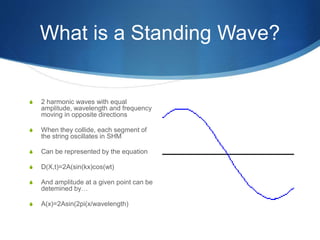
S 2 harmonic waves with equal
amplitude, wavelength and frequency
moving in opposite directions
S When they collide, each segment of
the string oscillates in SHM
S Can be represented by the equation
S D(X,t)=2A(sin(kx)cos(wt)
S And amplitude at a given point can be
detemined by…
S A(x)=2Asin(2pi(x/wavelength)
Parts of a Standing Wave
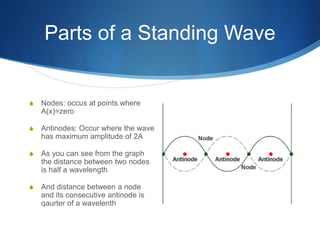
S Nodes: occus at points where
A(x)=zero
S Antinodes: Occur where the wave
has maximum amplitude of 2A
S As you can see from the graph
the distance between two nodes
is half a wavelength
S And distance between a node
and its consecutive antinode is
qaurter of a wavelenth
Fundamental Frequency
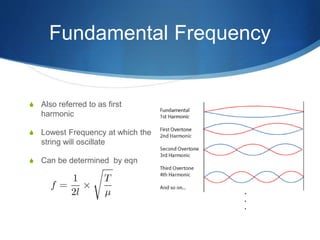
S Also referred to as first
harmonic
S Lowest Frequency at which the
string will oscillate
S Can be determined by eqn
Fundamental Frequency (cont)
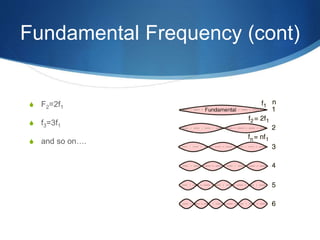
S F2=2f1
S f3=3f1
S and so on….
For an explanation of standing
waves watch from 1:10- 2:00
Standing Waves in
Instruments
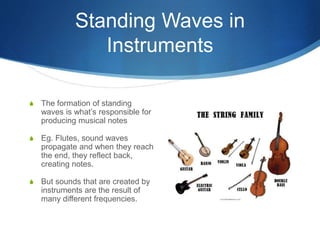
S The formation of standing
waves is what’s responsible for
producing musical notes
S Eg. Flutes, sound waves
propagate and when they reach
the end, they reflect back,
creating notes.
S But sounds that are created by
instruments are the result of
many different frequencies.
Question
S A Guitar String has a linear mass density of 4.5x10⁻⁴ kg/m
and has a tension of 80N. It takes 8.7x10⁻⁴ s for the string
to travel from one end to the other
S What is the wavespeed of the string?
S How long is the string?
S What is the frequency of the first three Harmonic
Solution
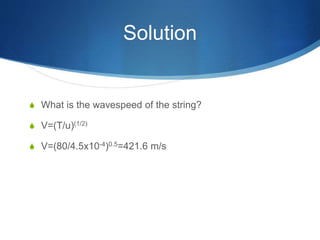
S What is the wavespeed of the string?
S V=(T/u)(1/2)
S V=(80/4.5x10-4)0.5=421.6 m/s
Solution #2
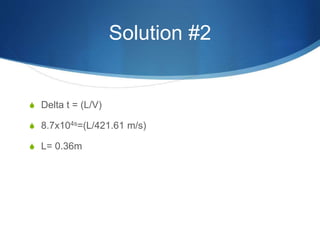
S Delta t = (L/V)
S 8.7x10⁴s=(L/421.61 m/s)
S L= 0.36m
Solution #3
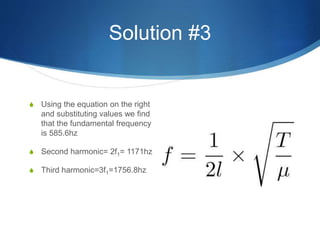
S Using the equation on the right
and substituting values we find
that the fundamental frequency
is 585.6hz
S Second harmonic= 2f1= 1171hz
S Third harmonic=3f1=1756.8hz

Standing waves lo

  • 1.
  • 2.
    What is aStanding Wave? S 2 harmonic waves with equal amplitude, wavelength and frequency moving in opposite directions S When they collide, each segment of the string oscillates in SHM S Can be represented by the equation S D(X,t)=2A(sin(kx)cos(wt) S And amplitude at a given point can be detemined by… S A(x)=2Asin(2pi(x/wavelength)
  • 3.
    Parts of aStanding Wave S Nodes: occus at points where A(x)=zero S Antinodes: Occur where the wave has maximum amplitude of 2A S As you can see from the graph the distance between two nodes is half a wavelength S And distance between a node and its consecutive antinode is qaurter of a wavelenth
  • 4.
    Fundamental Frequency S Alsoreferred to as first harmonic S Lowest Frequency at which the string will oscillate S Can be determined by eqn
  • 5.
    Fundamental Frequency (cont) SF2=2f1 S f3=3f1 S and so on….
  • 6.
    For an explanationof standing waves watch from 1:10- 2:00
  • 7.
    Standing Waves in Instruments SThe formation of standing waves is what’s responsible for producing musical notes S Eg. Flutes, sound waves propagate and when they reach the end, they reflect back, creating notes. S But sounds that are created by instruments are the result of many different frequencies.
  • 8.
    Question S A GuitarString has a linear mass density of 4.5x10⁻⁴ kg/m and has a tension of 80N. It takes 8.7x10⁻⁴ s for the string to travel from one end to the other S What is the wavespeed of the string? S How long is the string? S What is the frequency of the first three Harmonic
  • 9.
    Solution S What isthe wavespeed of the string? S V=(T/u)(1/2) S V=(80/4.5x10-4)0.5=421.6 m/s
  • 10.
    Solution #2 S Deltat = (L/V) S 8.7x10⁴s=(L/421.61 m/s) S L= 0.36m
  • 11.
    Solution #3 S Usingthe equation on the right and substituting values we find that the fundamental frequency is 585.6hz S Second harmonic= 2f1= 1171hz S Third harmonic=3f1=1756.8hz