Learning Objects #2
Standing Waves
Standing Waves
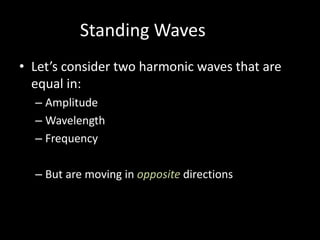
• Let’s consider two harmonic waves that are
equal in:
– Amplitude
– Wavelength
– Frequency
– But are moving in opposite directions
Standing Waves
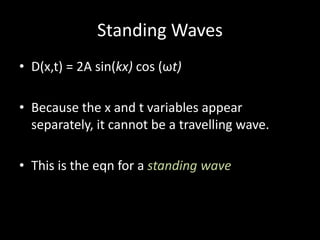
• D(x,t) = 2A sin(kx) cos (ωt)
• Because the x and t variables appear
separately, it cannot be a travelling wave.
• This is the eqn for a standing wave
To the point….
• There is a lot of information in the textbook, so
here are some points that I think are important.
• 1) “When two waves of equal wavelength,
frequency and amplitude (moving in opposite
directions) combine, each segment of the string
oscillates in simple harmonic motion with the
frequency of the individual waves and amplitude
dependent of the location of the segment along
the string.”
To the point…
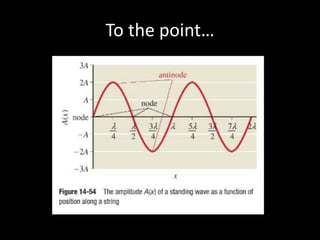
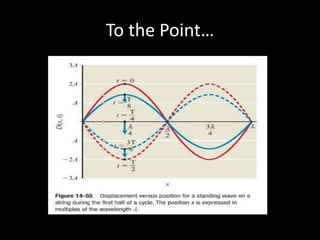
• Nodes:
• Points on the string with zero amplitude.
• Remain at rest at all time
• Antinodes:
– points that move with maximum possible
amplitude of 2A
– All other points have amplitude: 0 < A < 2A
To the point…
To the Point…
• The distance between two consecutive
nodes/antinodes is half a wavelength
• Adjacent node and antinodes are ¼ of a
wavelength apart
• All points between two consecutive nodes
oscillate in phase with each other
To the Point…
To the point…
• Mean speed is greatest at antinode because it
covers the longest distance in one period
• Speed decreases away from the antinode and
is zero at the nodes
For Practical Questions…
• And more Math based equation explanations,
• Refer to section 14-12 Standing Waves in
Physics: for Scientists and Engineers An
Interactive Approach

Physics 101 learning object 2

  • 1.
  • 2.
    Standing Waves • Let’sconsider two harmonic waves that are equal in: – Amplitude – Wavelength – Frequency – But are moving in opposite directions
  • 3.
    Standing Waves • D(x,t)= 2A sin(kx) cos (ωt) • Because the x and t variables appear separately, it cannot be a travelling wave. • This is the eqn for a standing wave
  • 4.
    To the point…. •There is a lot of information in the textbook, so here are some points that I think are important. • 1) “When two waves of equal wavelength, frequency and amplitude (moving in opposite directions) combine, each segment of the string oscillates in simple harmonic motion with the frequency of the individual waves and amplitude dependent of the location of the segment along the string.”
  • 5.
    To the point… •Nodes: • Points on the string with zero amplitude. • Remain at rest at all time • Antinodes: – points that move with maximum possible amplitude of 2A – All other points have amplitude: 0 < A < 2A
  • 6.
  • 7.
    To the Point… •The distance between two consecutive nodes/antinodes is half a wavelength • Adjacent node and antinodes are ¼ of a wavelength apart • All points between two consecutive nodes oscillate in phase with each other
  • 8.
  • 9.
    To the point… •Mean speed is greatest at antinode because it covers the longest distance in one period • Speed decreases away from the antinode and is zero at the nodes
  • 10.
    For Practical Questions… •And more Math based equation explanations, • Refer to section 14-12 Standing Waves in Physics: for Scientists and Engineers An Interactive Approach