BILE
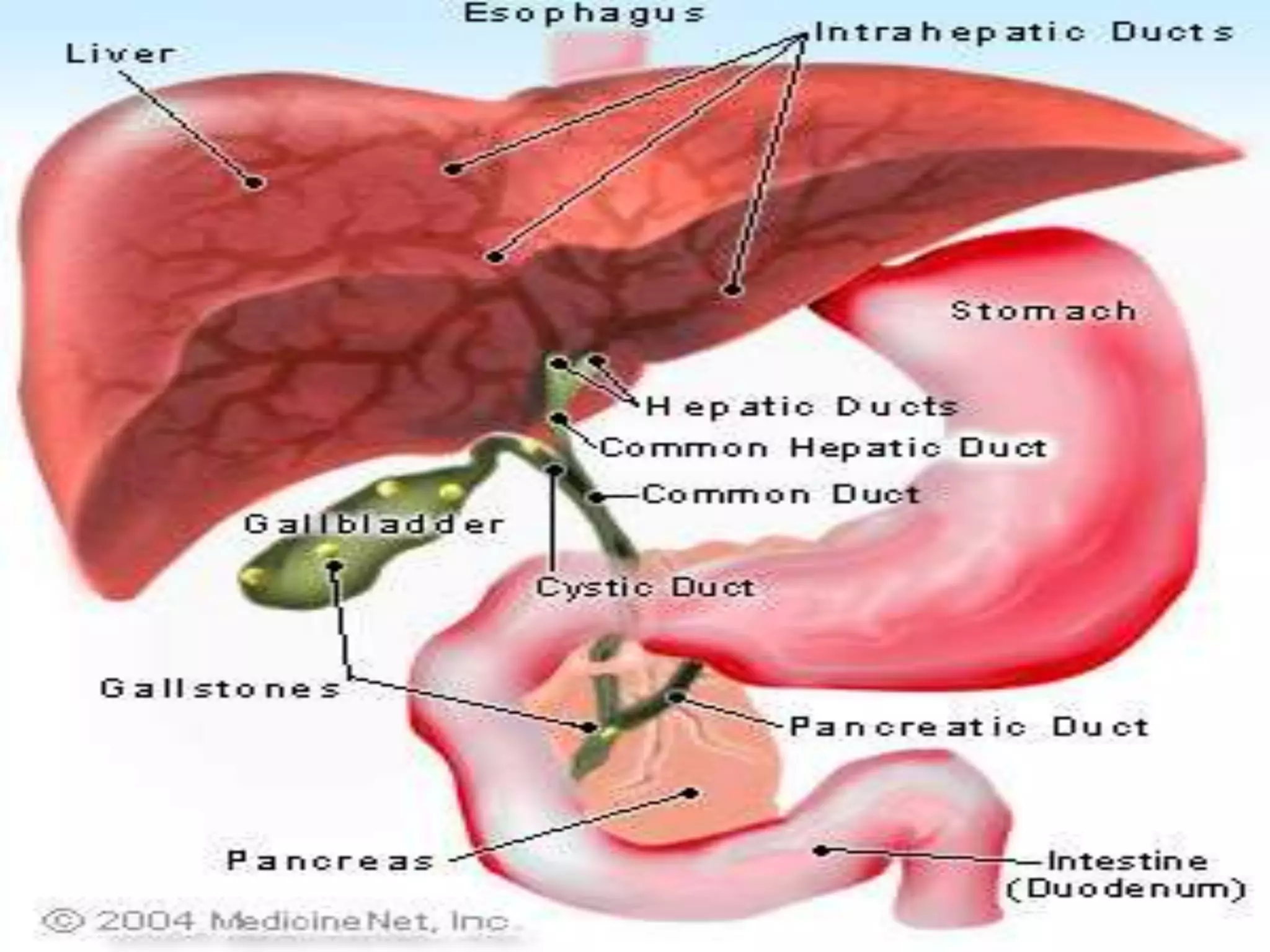
   Bile is a bitter-tasting, dark green to yellowish
    brown fluid, produced by the liver.

   Bile aids the process of digestion of lipids in
    the small intestine.
   bile is stored in the gallbladder and upon
    eating is discharged into the duodenum.
    Bile is a composition of the following
    materials: water (85%), bile salts
    (10%), pigments (3%),
   fats (1%), inorganic salts (0.7%) and
    cholesterol (0.3)
    The secretion of bile can be considered to occur in
     two stages:

1.    Hepatocytes secrete bile into canaliculi, from which
      it flows into bile ducts. This hepatic bile contains
      large quantities of bile acids, cholesterol and other
      organic molecules.
2.    As bile flows through the bile ducts it is modified by
      addition of a watery, bicarbonate-rich secretion from
      ductal epithelial cells.
    The gall bladder stores and concentrates bile.
     bile is concentrated five-fold in the gall bladder by
     absorption of water.
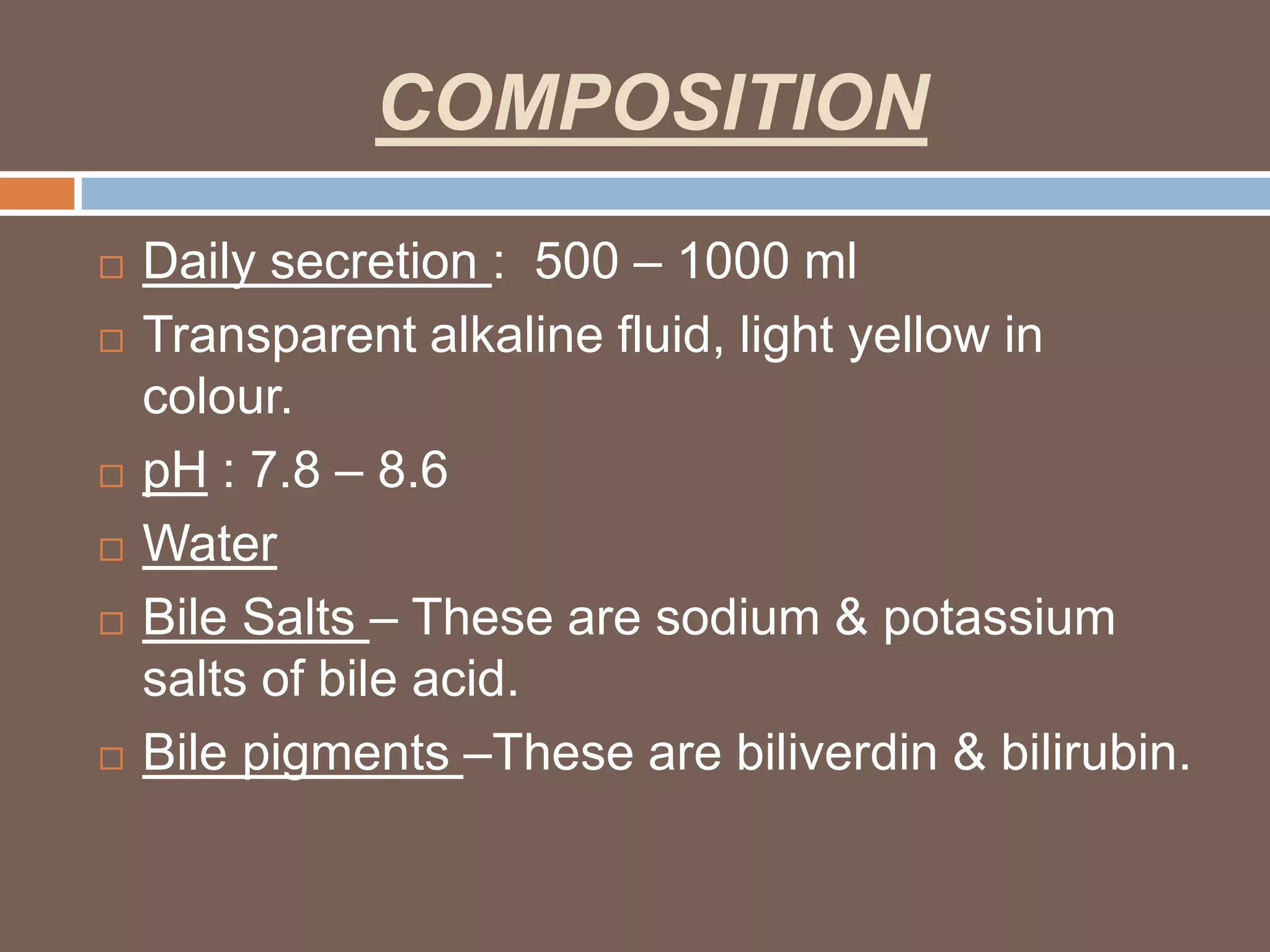
COMPOSITION
   Daily secretion : 500 – 1000 ml
   Transparent alkaline fluid, light yellow in
    colour.
   pH : 7.8 – 8.6
   Water
   Bile Salts – These are sodium & potassium
    salts of bile acid.
   Bile pigments –These are biliverdin & bilirubin.
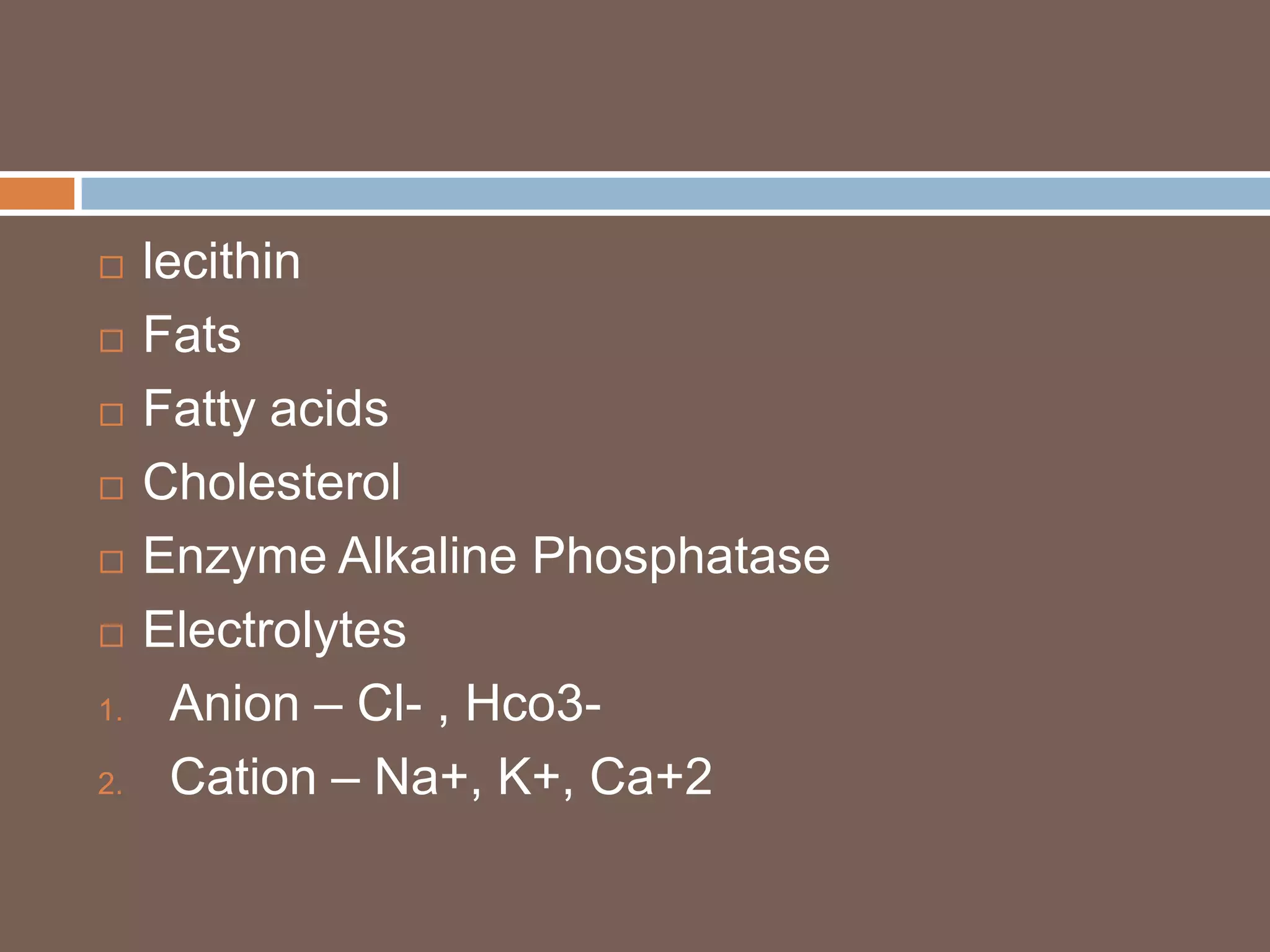
    lecithin
    Fats
    Fatty acids
    Cholesterol
    Enzyme Alkaline Phosphatase
    Electrolytes
1.     Anion – Cl- , Hco3-
2.     Cation – Na+, K+, Ca+2
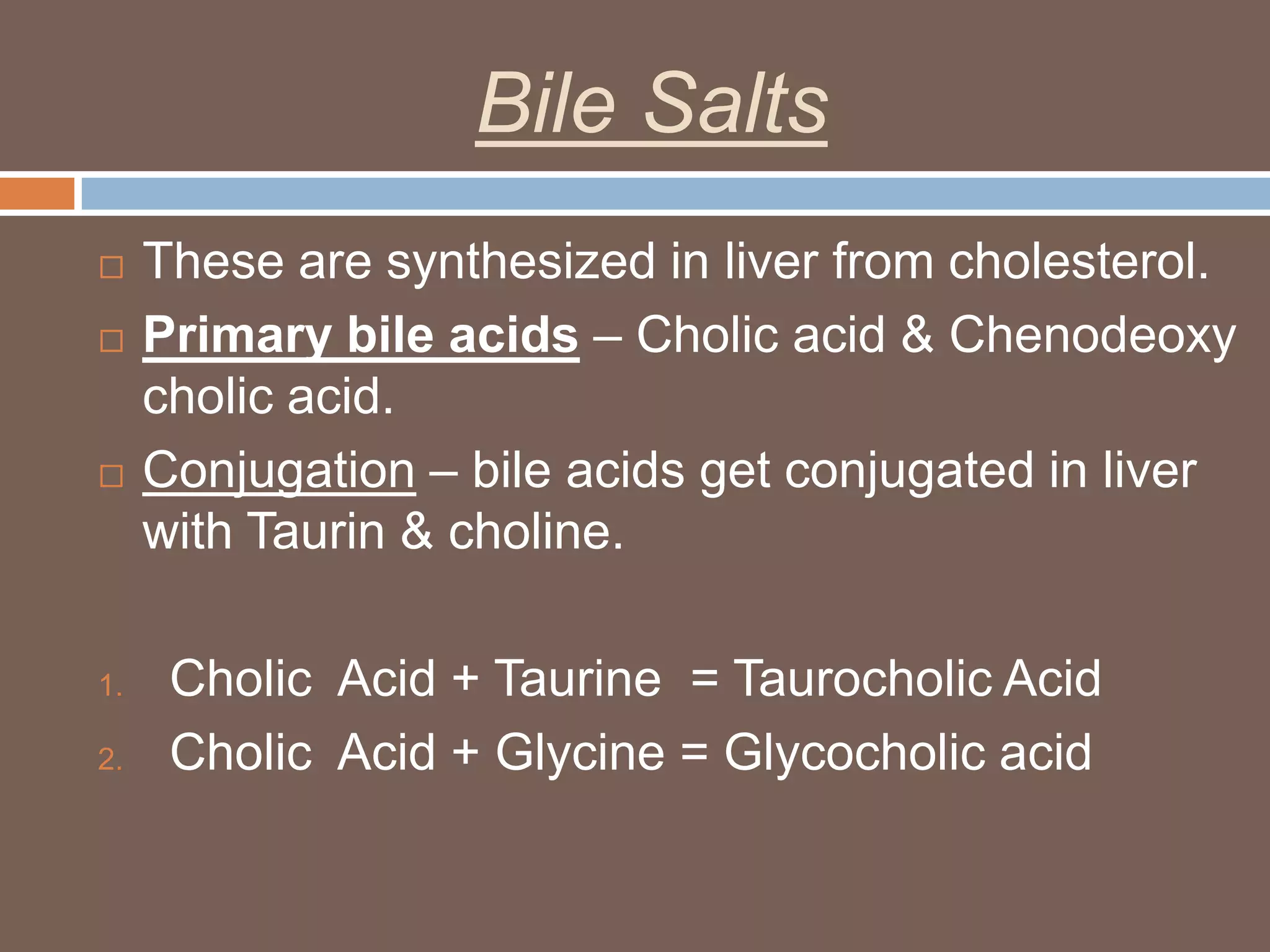
Bile Salts
    These are synthesized in liver from cholesterol.
    Primary bile acids – Cholic acid & Chenodeoxy
     cholic acid.
    Conjugation – bile acids get conjugated in liver
     with Taurin & choline.

1.    Cholic Acid + Taurine = Taurocholic Acid
2.    Cholic Acid + Glycine = Glycocholic acid
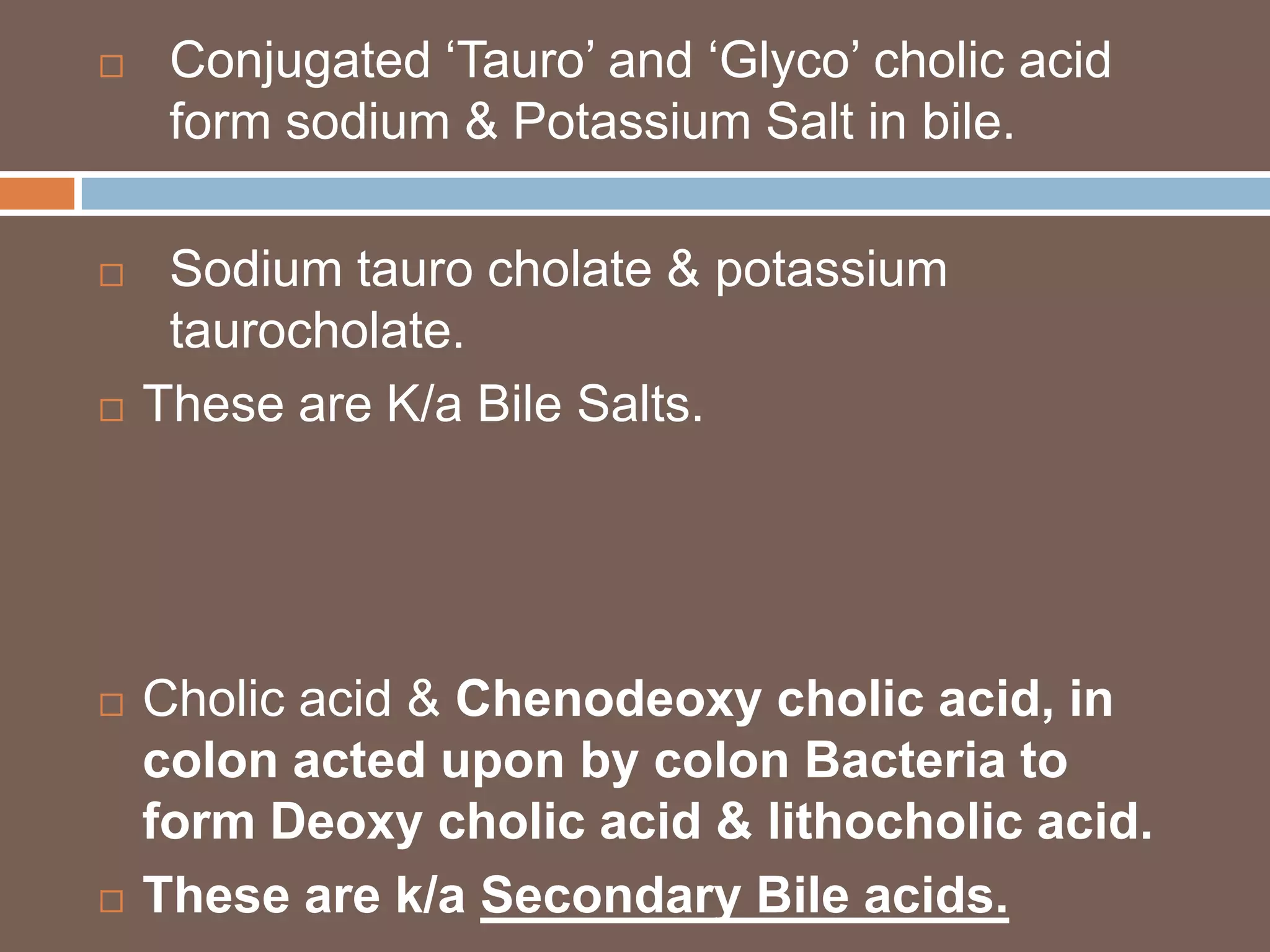
    Conjugated ‘Tauro’ and ‘Glyco’ cholic acid
     form sodium & Potassium Salt in bile.

    Sodium tauro cholate & potassium
     taurocholate.
   These are K/a Bile Salts.


   Cholic acid & Chenodeoxy cholic acid, in
    colon acted upon by colon Bacteria to
    form Deoxy cholic acid & lithocholic acid.
   These are k/a Secondary Bile acids.
Entero Hepatic Circulation of
     Bile salts
   90 – 95 % of Bile salts which enter in to duodenum
    are absorbed back in to Portal Vein.
   Return back to liver.
   This is k/a Entero Hepatic Circulation of Bile salts.


   Remaining 5 – 10 %, enter the colon acted upon by
    colon Bacteria to form Deoxy cholic acid &
    lithocholic acid.
   Total bile salts – 3.5 gms.
   Recycle repeatedly via Entero Hepatic
    Circulation.

   An ordinary meal needs 6 – 8 gm of bile salts
    to digest & absorb fats.
   Total bile salts circulate twice during digestion
    of each meal.
Bile pigment
   Bile pigments are bilirubin & biliverdin.

   These are formed from globin part of
    Haemoglobin (Hb) after destruction of old
    RBCs.

   No functional importance. Excreted in bile.

   Responsible for yellow color of bile.
FUNCTIONS OF BILE
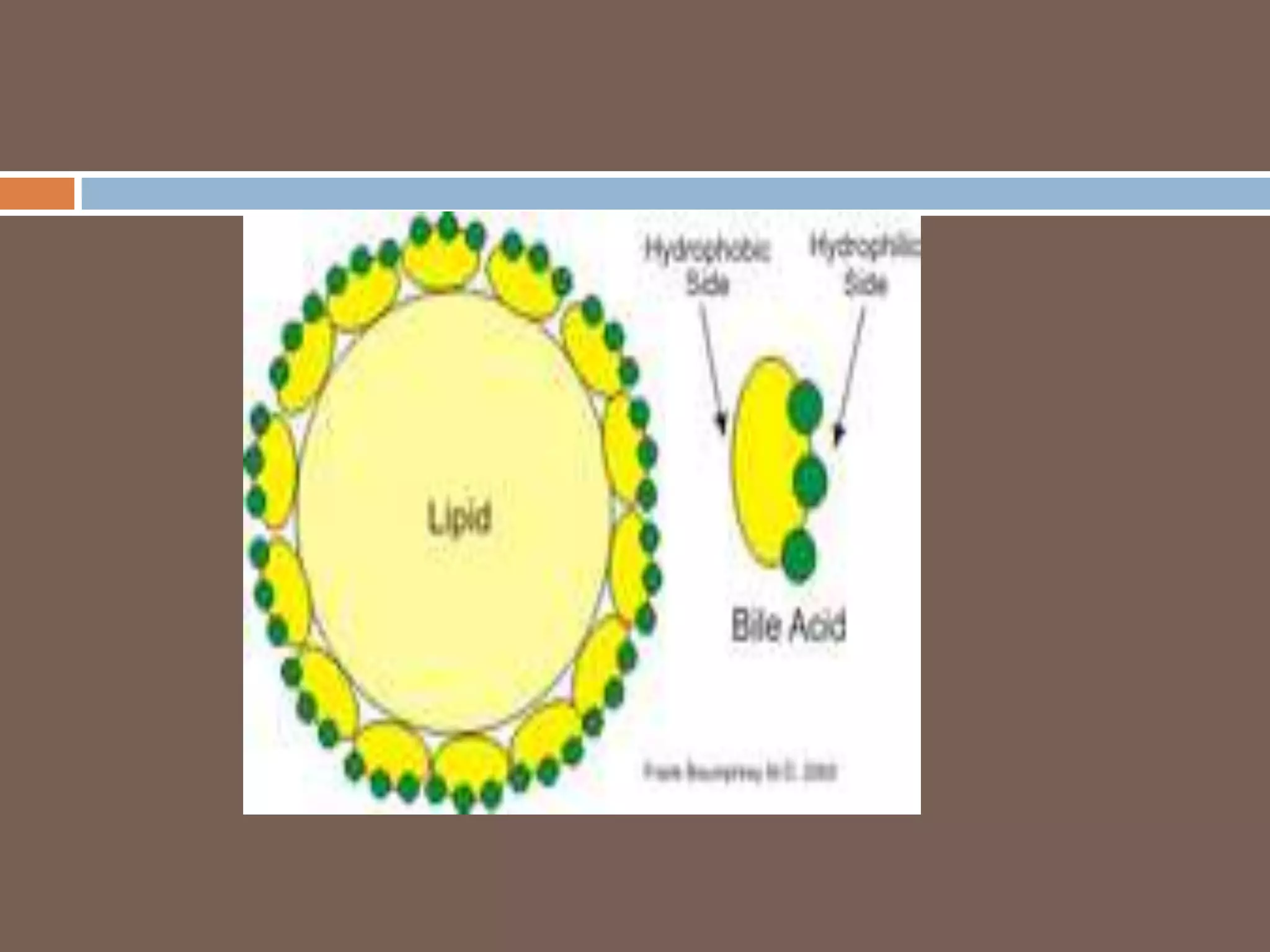
   Bile acids are amphipathic,
   they contain both hydrophobic (lipid soluble)
    and polar (hydrophilic) faces.
   The cholesterol - derived portion of a bile acid
    hydrophobic ; the amino acid derived portion
    and hydrophilic.

   Their amphipathic nature enables bile acids to
    carry out two important functions:
1. Emulsification of lipid
aggregates
   Bile acids have detergent action on particles
    of dietary fat.

   Emulsification causes fat globules to break
    down or be emulsified into minute, microscopic
    droplets.

   Emulsification greatly increases the surface
    area of fat
   make it available for digestion by lipases,
2. Solubilization and transport
of lipids in an aqueous
environment:
   Bile acids are lipid carriers.

   Bile acids are able to solubilize many lipids by
    forming micelles.

   Micelles are aggregates of lipids such as fatty
    acids, cholesterol and monoglycerides - that
    remain suspended in water.

   Bile acids are also critical for transport and
    absorption of the fat-soluble vitamins.
3. Role of Bile Acids in
    Cholesterol metabolism
   Hepatic synthesis of bile acids accounts for the
    majority of cholesterol breakdown in the body.

   In humans, 500 mg of cholesterol are converted to
    bile acids and eliminated in bile every day.

   This route for elimination of excess cholesterol is
    probably important in all animals, but particularly in
    situations of massive cholesterol ingestion
   4. Excretion of bilirubin & biliverdin via Bile.
CONTROL OF BILE
SECRETION
   The flow of bile is lowest during fasting, and is
    diverted into the gallbladder for concentration.

   When chyme enters the small intestine, acid and
    partially digested fats and proteins stimulate
    secretion of cholecystokinin and secretin.

   these enteric hormones are important for secretion
    and flow of bile:
Cholecystokinin
   The name of this hormone describes its effect
    on the biliary system –
   cholecysto = gallbladder and kinin =
    movement.

   The stimulus for release of cholecystokinin is
    the presence of fat in the duodenum.

   It stimulates contractions of the gallbladder
    and common bile duct, resulting in delivery of
Secretin
    This hormone is secreted in response to acid
    in the duodenum.
   Its effect on the biliary system is very similar to
    what was seen in the pancreas –
   it stimulates biliary duct cells to secrete
    bicarbonate and water,
    which expands the volume of bile and
    increases its flow out into the intestine.
APPLIED
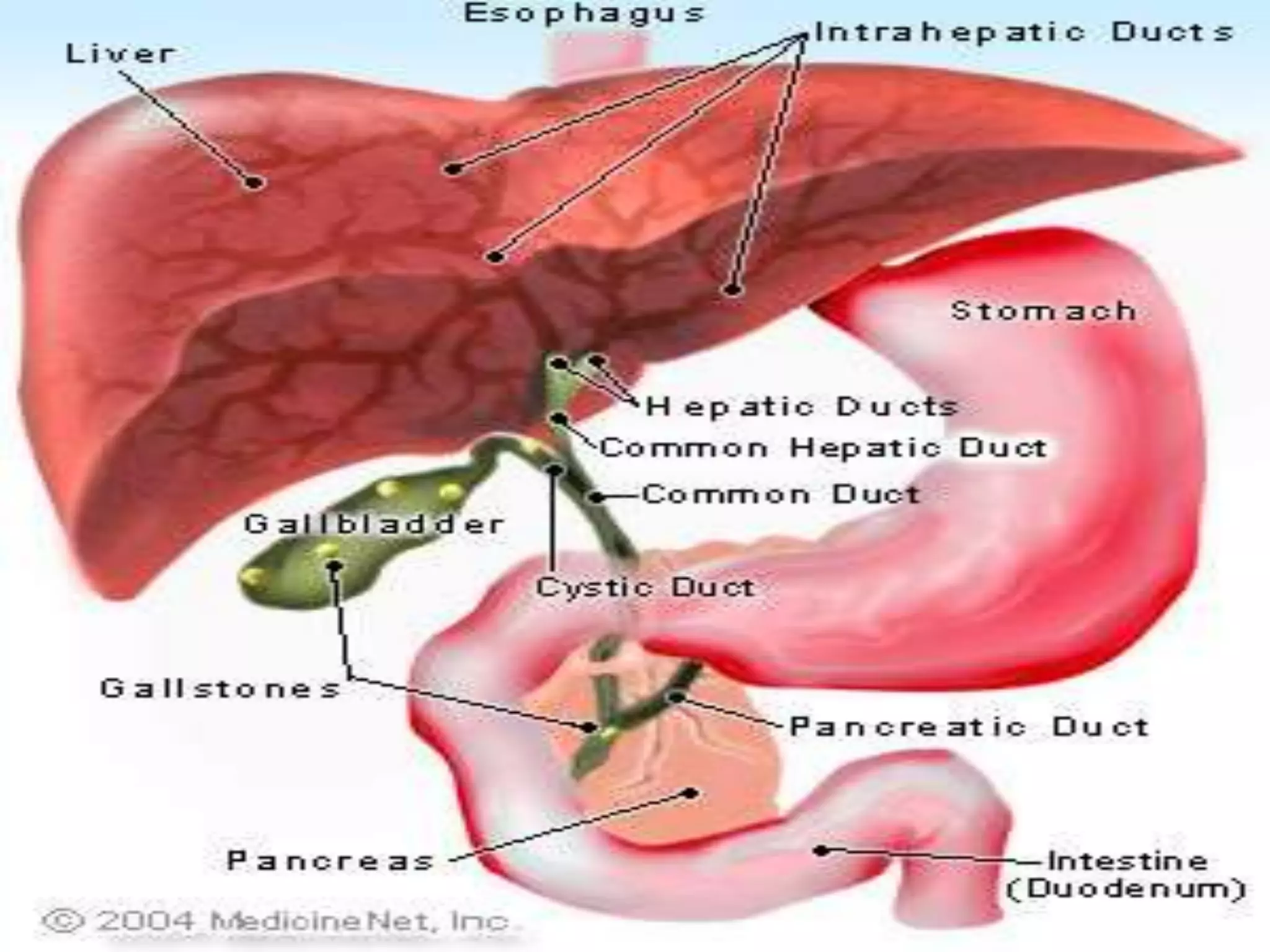
    Gall stones


    An imbalance between these components of
     bile -- cholesterol, bile salts, and bilirubin --
     leads to the formation of gallstones.

    Two types:
1.    Cholesterol stones
2.    Pigment stones
   Cholesterol is normally kept in liquid form by
    the dissolving action of the bile salts.

    increased amount of cholesterol in the bile
    overwhelms the dissolving capacity of the bile
    salts and leads to the formation of cholesterol
    gallstones.

   Similarly, a deficiency of bile salts promotes
    cholesterol gallstone.
   Pigment gallstones

   excessive breakdown of red blood cells

   increased amounts of bilirubin (breakdown
    product of red cells) in the bile,

   thus causing bilirubin gallstone formation
steatorrhea
   In the absence of bile, fats become
    indigestible and are instead excreted in feces,
    a condition called steatorrhea.

   Feces are white or gray, and greasy.


   Steatorrhea can lead to deficiencies in
    essential fatty acids and fat-soluble vitamins.
Bile
Bile

Bile

  • 1.
  • 2.
    Bile is a bitter-tasting, dark green to yellowish brown fluid, produced by the liver.  Bile aids the process of digestion of lipids in the small intestine.  bile is stored in the gallbladder and upon eating is discharged into the duodenum.  Bile is a composition of the following materials: water (85%), bile salts (10%), pigments (3%),  fats (1%), inorganic salts (0.7%) and cholesterol (0.3)
  • 4.
    The secretion of bile can be considered to occur in two stages: 1. Hepatocytes secrete bile into canaliculi, from which it flows into bile ducts. This hepatic bile contains large quantities of bile acids, cholesterol and other organic molecules. 2. As bile flows through the bile ducts it is modified by addition of a watery, bicarbonate-rich secretion from ductal epithelial cells.  The gall bladder stores and concentrates bile. bile is concentrated five-fold in the gall bladder by absorption of water.
  • 5.
    COMPOSITION  Daily secretion : 500 – 1000 ml  Transparent alkaline fluid, light yellow in colour.  pH : 7.8 – 8.6  Water  Bile Salts – These are sodium & potassium salts of bile acid.  Bile pigments –These are biliverdin & bilirubin.
  • 6.
    lecithin  Fats  Fatty acids  Cholesterol  Enzyme Alkaline Phosphatase  Electrolytes 1. Anion – Cl- , Hco3- 2. Cation – Na+, K+, Ca+2
  • 7.
    Bile Salts  These are synthesized in liver from cholesterol.  Primary bile acids – Cholic acid & Chenodeoxy cholic acid.  Conjugation – bile acids get conjugated in liver with Taurin & choline. 1. Cholic Acid + Taurine = Taurocholic Acid 2. Cholic Acid + Glycine = Glycocholic acid
  • 8.
    Conjugated ‘Tauro’ and ‘Glyco’ cholic acid form sodium & Potassium Salt in bile.  Sodium tauro cholate & potassium taurocholate.  These are K/a Bile Salts.  Cholic acid & Chenodeoxy cholic acid, in colon acted upon by colon Bacteria to form Deoxy cholic acid & lithocholic acid.  These are k/a Secondary Bile acids.
  • 9.
    Entero Hepatic Circulationof Bile salts  90 – 95 % of Bile salts which enter in to duodenum are absorbed back in to Portal Vein.  Return back to liver.  This is k/a Entero Hepatic Circulation of Bile salts.  Remaining 5 – 10 %, enter the colon acted upon by colon Bacteria to form Deoxy cholic acid & lithocholic acid.
  • 10.
    Total bile salts – 3.5 gms.  Recycle repeatedly via Entero Hepatic Circulation.  An ordinary meal needs 6 – 8 gm of bile salts to digest & absorb fats.  Total bile salts circulate twice during digestion of each meal.
  • 11.
    Bile pigment  Bile pigments are bilirubin & biliverdin.  These are formed from globin part of Haemoglobin (Hb) after destruction of old RBCs.  No functional importance. Excreted in bile.  Responsible for yellow color of bile.
  • 12.
  • 13.
    Bile acids are amphipathic,  they contain both hydrophobic (lipid soluble) and polar (hydrophilic) faces.  The cholesterol - derived portion of a bile acid hydrophobic ; the amino acid derived portion and hydrophilic.  Their amphipathic nature enables bile acids to carry out two important functions:
  • 15.
    1. Emulsification oflipid aggregates  Bile acids have detergent action on particles of dietary fat.  Emulsification causes fat globules to break down or be emulsified into minute, microscopic droplets.  Emulsification greatly increases the surface area of fat  make it available for digestion by lipases,
  • 16.
    2. Solubilization andtransport of lipids in an aqueous environment:  Bile acids are lipid carriers.  Bile acids are able to solubilize many lipids by forming micelles.  Micelles are aggregates of lipids such as fatty acids, cholesterol and monoglycerides - that remain suspended in water.  Bile acids are also critical for transport and absorption of the fat-soluble vitamins.
  • 17.
    3. Role ofBile Acids in Cholesterol metabolism  Hepatic synthesis of bile acids accounts for the majority of cholesterol breakdown in the body.  In humans, 500 mg of cholesterol are converted to bile acids and eliminated in bile every day.  This route for elimination of excess cholesterol is probably important in all animals, but particularly in situations of massive cholesterol ingestion
  • 18.
    4. Excretion of bilirubin & biliverdin via Bile.
  • 19.
  • 20.
    The flow of bile is lowest during fasting, and is diverted into the gallbladder for concentration.  When chyme enters the small intestine, acid and partially digested fats and proteins stimulate secretion of cholecystokinin and secretin.  these enteric hormones are important for secretion and flow of bile:
  • 21.
    Cholecystokinin  The name of this hormone describes its effect on the biliary system –  cholecysto = gallbladder and kinin = movement.  The stimulus for release of cholecystokinin is the presence of fat in the duodenum.  It stimulates contractions of the gallbladder and common bile duct, resulting in delivery of
  • 22.
    Secretin  This hormone is secreted in response to acid in the duodenum.  Its effect on the biliary system is very similar to what was seen in the pancreas –  it stimulates biliary duct cells to secrete bicarbonate and water,  which expands the volume of bile and increases its flow out into the intestine.
  • 23.
  • 24.
    Gall stones  An imbalance between these components of bile -- cholesterol, bile salts, and bilirubin -- leads to the formation of gallstones.  Two types: 1. Cholesterol stones 2. Pigment stones
  • 26.
    Cholesterol is normally kept in liquid form by the dissolving action of the bile salts.  increased amount of cholesterol in the bile overwhelms the dissolving capacity of the bile salts and leads to the formation of cholesterol gallstones.  Similarly, a deficiency of bile salts promotes cholesterol gallstone.
  • 27.
    Pigment gallstones  excessive breakdown of red blood cells  increased amounts of bilirubin (breakdown product of red cells) in the bile,  thus causing bilirubin gallstone formation
  • 28.
    steatorrhea  In the absence of bile, fats become indigestible and are instead excreted in feces, a condition called steatorrhea.  Feces are white or gray, and greasy.  Steatorrhea can lead to deficiencies in essential fatty acids and fat-soluble vitamins.