LIVER AND BILIARY DISEASES
DR. ABDUL MALIK BAWAH
DEPARTMENT OF NUTRITION AND
DIETETICS
Physiological functions of the liv
er.
• Describe the major functions of the liver wi
th respect to metabolism,detoxification & e
xcretion of hydrophobic substances.
• Describe the formation of bile,its constitent
s & its role in the excretion of cholesterol &
bilirubin.
• Outline the mechanism by which the liver c
ontributes to whole body ammonia.
• homeostasis & the consequences of the fa
ilure of these mechanisms,particularly for
brain function.
• Identify the mechanisms that permit norma
l functioning of the gall bladder & the basis
of gallstone disease.
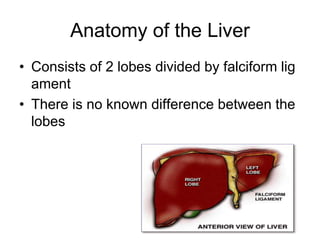
Anatomy of the Liver
• Consists of 2 lobes divided by falciform lig
ament
• There is no known difference between the
lobes
Liver
• Basic structural unit is – lobule, made of ra
mifying columns of hepatic cells.These he
patocytes are tunneled by a communicatin
g system called – blood sinusoids which ar
e lined by fenestrated endothelial cells. Th
e endothelial cells contain Kupffer cells
• Portal vein and hepatic artery both empty i
nto the sinusoids. Sinusoids open into cent
ral vein.
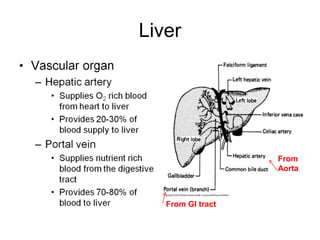
Liver
From
Aorta
From GI tract
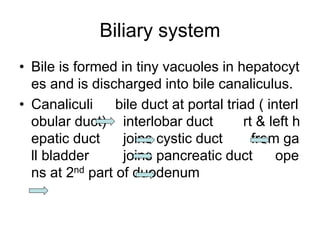
Biliary system
• Bile is formed in tiny vacuoles in hepatocyt
es and is discharged into bile canaliculus.
• Canaliculi bile duct at portal triad ( interl
obular duct) interlobar duct rt & left h
epatic duct joins cystic duct from ga
ll bladder joins pancreatic duct ope
ns at 2nd part of duodenum
Functions of Liver
• Synthetic functions: plasma proteins, clotti
ng factors, enzymes(SGOT,SGPT), urea
• Metabolic functions: Carbohydrates, fats, p
roteins, synthesis of – lipoproteins-HDL,LD
L,VLDL
• Bile secretion: ( bile salts&acids formation)
• Detoxification & protective
• Immunity –kupffer cells,Miscellaneous
Synthesis
• Synthesize many biological compounds
– Carbohydrates
• Metabolism important
– Uses glucose for its own cellular energy
– Circulates glucose to peripheral tissue
– Stores glucose as glycogen
• Major player in maintaining stable glucose concent
ration due to glycogenesis, glycogenolysis and glu
coneogenesis
• Thus synthesis, storage and release of glucose
Synthesis
– Lipids
• Liver gathers free fatty acids from diet and breaks t
hem down to Acetyl- CoA to form( non esterified fa
tty acids-to- esterified FA-to-) triglycerides, phosph
olipids or cholesterol
• Converts insoluble lipids to soluble forms
• 70% of cholesterol produced by the liver
• Thus both degradation and synthesis of fats takes
place in the liver.
• Synthesis of HDL, LDL, VLDL
Proteins
– Proteins
• Almost all proteins made in the liver.
• Synthesis of enzymes and clotting factors
• Exceptions are immunoglobulins and hgb
Bile secretion
• Components of bile- bile salts and bile aci
ds are formed by hepatocytes.
• Conjugation of bilirubin occurs in hepatocy
tes.
Detoxification
• Liver serves as a gatekeeper between the circulation an
d absorbed substances- First
pass: Every substance absorbed in GI tract passes throu
gh liver
• Detoxification includes drugs and poisons, and metabolic
products like ammonia, alcohol, and bilirubin
• 3 mechanisms
– Binds material reversibly to inactivate.
– Chemically modify compound for excretion.
– Drug metaboliser for detoxification of drugs and poiso
ns.
Storage
• Glycogen
• Proteins
• Vitamins- B12 & A
• Iron
• Blood
Others
• Hormonal inactivation: cortisol, aldosteron
e, insulin, glucagon, testosterone.
• Liver is the site for erythropoiesis during fo
etal life.
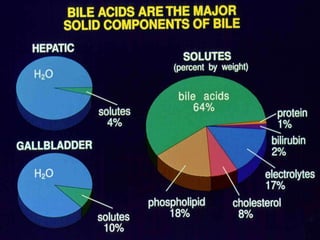
Bile
• Is made up of bile salts, bile pigments and
other substances dissolved in alkaline elec
trolyte solution.
• Bile salts are synthesised by hepatocytes
and bile pigments are picked up from bloo
d sinusoids.
• Daily secretion: 500 ml.
• Colour: Yellow
• Taste: Bitter
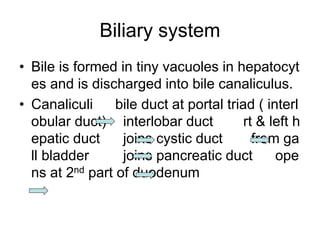
Biliary system
• Bile is formed in tiny vacuoles in hepatocyt
es and is discharged into bile canaliculus.
• Canaliculi bile duct at portal triad ( interl
obular duct) interlobar duct rt & left h
epatic duct joins cystic duct from ga
ll bladder joins pancreatic duct ope
ns at 2nd part of duodenum
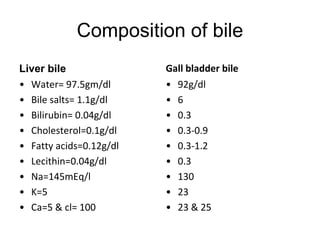
Composition of bile
Liver bile
• Water= 97.5gm/dl
• Bile salts= 1.1g/dl
• Bilirubin= 0.04g/dl
• Cholesterol=0.1g/dl
• Fatty acids=0.12g/dl
• Lecithin=0.04g/dl
• Na=145mEq/l
• K=5
• Ca=5 & cl= 100
Gall bladder bile
• 92g/dl
• 6
• 0.3
• 0.3-0.9
• 0.3-1.2
• 0.3
• 130
• 23
• 23 & 25
Bile acids
• Bile acid :Primary bile acids are produced
by hepatocytes from cholesterol. They are
cholic acid & chenodeoxycholic acid.
• They reach duodenum through bile and in
the small intestine and colon they are conv
erted into secondary bile acids- deoxycholi
c acid and lithocholic acid by bacterial acti
on.
Bile salts
• Bile acids are first conjugated with taurine
and glycine and then they form bile salts in
combination with Na or K= Sodium tauroc
holate & glycocholates and Potassium taur
ocholate and glycocholate.
Functions of bile salts
• Emulsification and digestion of fats.
• Stimulate formation of bile by hepatocytes
=choleretic action
• Stimulate release of bile from gall bladder=
cholegauge action
• Absorption of fats
• Laxative action
• Form route for removal of cholesterol
Bile pigments
• They are excretory products in the bile.
• Formed by breakdown of Hb in RES.
• Bilirubin is transported to liver along with pl
asma proteins(= unconjugated ).
• Protein get separated and bilirubin gets co
njugated with glucuronic acid(= conjugated
).
• In intestine, bacteria act &50%of it is conv
erted to bilinogen.
• Most of bilinogen enters liver through enter
ohepatic circulation and is re-excreted thro
ugh bile. About 5% of urobilinogen is excre
ted by kidney through urine. Some unabso
rbed part is excreted through feces as ster
cobilinogen. This gives yellow color to urin
e and feces.
Functions of BILE
1. Required for digestion and absorption of fats :
A) Emulsification of fat and formation of micelle.
B) Active pancreatic lipase helps in digestion
1. Absorption of fat soluble vitamins
2. Choleretic and cholegauge action
3. Endogenous synthesis of bile salts
4. Bacteriostatic action
5. Major route for loss of cholesterol from body
6. Lubricating function due to mucus
7. Alkaline helps in neutralizing acid chyme.
Enterohepatic circulation
• About 94% of bile salts are reabsorbed int
o the blood from the small intestine( by diff
usion in early part of intestine & by active t
ransport from distal ileum). They then ente
r the portal blood and pass back to the live
r. On reaching the liver, these bile salts ar
e absorbed almost entirely back into the h
epatic cells and are
re excreted into the bile.
In this way about 94% of all bile salts are re
circulated into the bile, so that on the aver
age these salts make the entire circuit som
e 17 times before being carried out in the f
eces. The small quantities of bile salts lost
in to the feces are replaced by new amoun
t formed continuously by liver cells. This re
circulation of bile salts is called enterohep
atic circulation. Necessary because of limit
ed pool of bile salts
Ammonia Metabolism & Excreti
on.
• Ammonia must be carefully controlled bec
ause it is toxic to the CENTRAL NERVOU
S SYSTEM & freely permeable across the
BLOOD BRAIN BARRIER.
• The liver is the only organ in which the co
mplete urea cycle(Kerbs) is expressed.
• Sources-Colon,Kidney,RBC lysis,Muscle
metabolism.
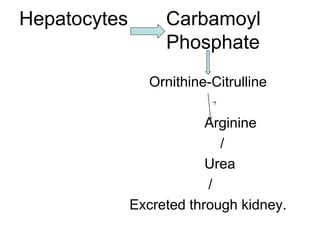
Ornithine-Citrulline
Arginine
/
Urea
/
Excreted through kidney.
Hepatocytes Carbamoyl
Phosphate
Liver Failure.
Ammonia concentration increases leads to
liver encephalopathy.
/
leads to Central Nervous System impair
ment(Confusion,Disorientation,loss of Cog
nition-Memory,COMA.)
Treatment
• Reducing load to liver by feeding non abs
orbable carbohydrate-lactulose it traps lum
inal ammonia.
• Liver transplant.
• Artifical liver assist devices that could clea
n the blood.
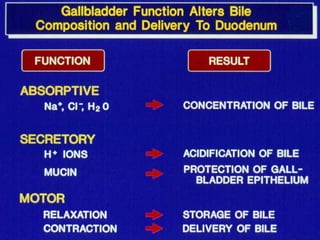
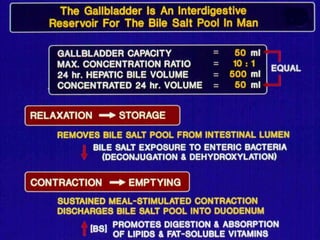
Gall bladder
• It is sac like structure where bile is stored i
n between the meals. Has capacity to abs
orb H2O and HCO3
• Functions: Storage
• Concentration of bile(50times)
• Secretes mucus
• Releases bile into duodenum
at a controlled rate/according to the need.
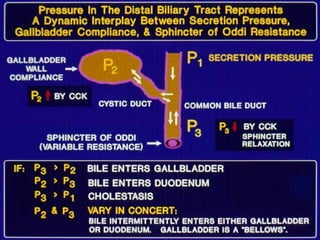
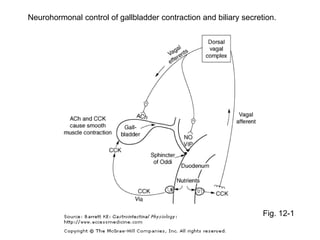
Neurohormonal control of gallbladder contraction and biliary secretion.
Fig. 12-1
Gallstones
• Estimated that 20 million people in USA have gallst
ones.
• Deposition of cholesterol or bilirubin in the gallblad
der or in common biliary duct. Cholesterol stones a
re the common type in Western countries.
• About 1/3 of patients will get episodes of pain in th
e epigastric region.
• Treatment is cholecystectomy (gall bladder remova
l) or sometimes endoscopic approaches to remove
stones from common biliary duct or sphincter of Od
di.
• Consequence of gall baldder removal is inability to
concentrate bile, which affects fat absorption, and f
Summary
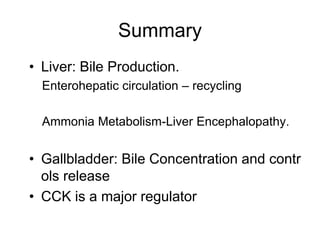
• Liver: Bile Production.
Enterohepatic circulation – recycling
Ammonia Metabolism-Liver Encephalopathy.
• Gallbladder: Bile Concentration and contr
ols release
• CCK is a major regulator
• References:- Guyton & Hall,12th edition.
• Ganong-24th edition.
• Internet.
THANK YOU.

8. LIVER & G.Bladder55 (1).pptxrgtrtteyr

  • 1.
    LIVER AND BILIARYDISEASES DR. ABDUL MALIK BAWAH DEPARTMENT OF NUTRITION AND DIETETICS
  • 2.
    Physiological functions ofthe liv er. • Describe the major functions of the liver wi th respect to metabolism,detoxification & e xcretion of hydrophobic substances. • Describe the formation of bile,its constitent s & its role in the excretion of cholesterol & bilirubin. • Outline the mechanism by which the liver c ontributes to whole body ammonia.
  • 3.
    • homeostasis &the consequences of the fa ilure of these mechanisms,particularly for brain function. • Identify the mechanisms that permit norma l functioning of the gall bladder & the basis of gallstone disease.
  • 4.
    Anatomy of theLiver • Consists of 2 lobes divided by falciform lig ament • There is no known difference between the lobes
  • 5.
    Liver • Basic structuralunit is – lobule, made of ra mifying columns of hepatic cells.These he patocytes are tunneled by a communicatin g system called – blood sinusoids which ar e lined by fenestrated endothelial cells. Th e endothelial cells contain Kupffer cells • Portal vein and hepatic artery both empty i nto the sinusoids. Sinusoids open into cent ral vein.
  • 6.
  • 7.
    Biliary system • Bileis formed in tiny vacuoles in hepatocyt es and is discharged into bile canaliculus. • Canaliculi bile duct at portal triad ( interl obular duct) interlobar duct rt & left h epatic duct joins cystic duct from ga ll bladder joins pancreatic duct ope ns at 2nd part of duodenum
  • 9.
    Functions of Liver •Synthetic functions: plasma proteins, clotti ng factors, enzymes(SGOT,SGPT), urea • Metabolic functions: Carbohydrates, fats, p roteins, synthesis of – lipoproteins-HDL,LD L,VLDL • Bile secretion: ( bile salts&acids formation) • Detoxification & protective • Immunity –kupffer cells,Miscellaneous
  • 10.
    Synthesis • Synthesize manybiological compounds – Carbohydrates • Metabolism important – Uses glucose for its own cellular energy – Circulates glucose to peripheral tissue – Stores glucose as glycogen • Major player in maintaining stable glucose concent ration due to glycogenesis, glycogenolysis and glu coneogenesis • Thus synthesis, storage and release of glucose
  • 11.
    Synthesis – Lipids • Livergathers free fatty acids from diet and breaks t hem down to Acetyl- CoA to form( non esterified fa tty acids-to- esterified FA-to-) triglycerides, phosph olipids or cholesterol • Converts insoluble lipids to soluble forms • 70% of cholesterol produced by the liver • Thus both degradation and synthesis of fats takes place in the liver. • Synthesis of HDL, LDL, VLDL
  • 12.
    Proteins – Proteins • Almostall proteins made in the liver. • Synthesis of enzymes and clotting factors • Exceptions are immunoglobulins and hgb
  • 13.
    Bile secretion • Componentsof bile- bile salts and bile aci ds are formed by hepatocytes. • Conjugation of bilirubin occurs in hepatocy tes.
  • 14.
    Detoxification • Liver servesas a gatekeeper between the circulation an d absorbed substances- First pass: Every substance absorbed in GI tract passes throu gh liver • Detoxification includes drugs and poisons, and metabolic products like ammonia, alcohol, and bilirubin • 3 mechanisms – Binds material reversibly to inactivate. – Chemically modify compound for excretion. – Drug metaboliser for detoxification of drugs and poiso ns.
  • 15.
    Storage • Glycogen • Proteins •Vitamins- B12 & A • Iron • Blood
  • 16.
    Others • Hormonal inactivation:cortisol, aldosteron e, insulin, glucagon, testosterone. • Liver is the site for erythropoiesis during fo etal life.
  • 17.
    Bile • Is madeup of bile salts, bile pigments and other substances dissolved in alkaline elec trolyte solution. • Bile salts are synthesised by hepatocytes and bile pigments are picked up from bloo d sinusoids. • Daily secretion: 500 ml. • Colour: Yellow • Taste: Bitter
  • 18.
    Biliary system • Bileis formed in tiny vacuoles in hepatocyt es and is discharged into bile canaliculus. • Canaliculi bile duct at portal triad ( interl obular duct) interlobar duct rt & left h epatic duct joins cystic duct from ga ll bladder joins pancreatic duct ope ns at 2nd part of duodenum
  • 20.
    Composition of bile Liverbile • Water= 97.5gm/dl • Bile salts= 1.1g/dl • Bilirubin= 0.04g/dl • Cholesterol=0.1g/dl • Fatty acids=0.12g/dl • Lecithin=0.04g/dl • Na=145mEq/l • K=5 • Ca=5 & cl= 100 Gall bladder bile • 92g/dl • 6 • 0.3 • 0.3-0.9 • 0.3-1.2 • 0.3 • 130 • 23 • 23 & 25
  • 21.
    Bile acids • Bileacid :Primary bile acids are produced by hepatocytes from cholesterol. They are cholic acid & chenodeoxycholic acid. • They reach duodenum through bile and in the small intestine and colon they are conv erted into secondary bile acids- deoxycholi c acid and lithocholic acid by bacterial acti on.
  • 22.
    Bile salts • Bileacids are first conjugated with taurine and glycine and then they form bile salts in combination with Na or K= Sodium tauroc holate & glycocholates and Potassium taur ocholate and glycocholate.
  • 23.
    Functions of bilesalts • Emulsification and digestion of fats. • Stimulate formation of bile by hepatocytes =choleretic action • Stimulate release of bile from gall bladder= cholegauge action • Absorption of fats • Laxative action • Form route for removal of cholesterol
  • 24.
    Bile pigments • Theyare excretory products in the bile. • Formed by breakdown of Hb in RES. • Bilirubin is transported to liver along with pl asma proteins(= unconjugated ). • Protein get separated and bilirubin gets co njugated with glucuronic acid(= conjugated ). • In intestine, bacteria act &50%of it is conv erted to bilinogen.
  • 25.
    • Most ofbilinogen enters liver through enter ohepatic circulation and is re-excreted thro ugh bile. About 5% of urobilinogen is excre ted by kidney through urine. Some unabso rbed part is excreted through feces as ster cobilinogen. This gives yellow color to urin e and feces.
  • 26.
    Functions of BILE 1.Required for digestion and absorption of fats : A) Emulsification of fat and formation of micelle. B) Active pancreatic lipase helps in digestion 1. Absorption of fat soluble vitamins 2. Choleretic and cholegauge action 3. Endogenous synthesis of bile salts 4. Bacteriostatic action 5. Major route for loss of cholesterol from body 6. Lubricating function due to mucus 7. Alkaline helps in neutralizing acid chyme.
  • 27.
    Enterohepatic circulation • About94% of bile salts are reabsorbed int o the blood from the small intestine( by diff usion in early part of intestine & by active t ransport from distal ileum). They then ente r the portal blood and pass back to the live r. On reaching the liver, these bile salts ar e absorbed almost entirely back into the h epatic cells and are re excreted into the bile.
  • 28.
    In this wayabout 94% of all bile salts are re circulated into the bile, so that on the aver age these salts make the entire circuit som e 17 times before being carried out in the f eces. The small quantities of bile salts lost in to the feces are replaced by new amoun t formed continuously by liver cells. This re circulation of bile salts is called enterohep atic circulation. Necessary because of limit ed pool of bile salts
  • 29.
    Ammonia Metabolism &Excreti on. • Ammonia must be carefully controlled bec ause it is toxic to the CENTRAL NERVOU S SYSTEM & freely permeable across the BLOOD BRAIN BARRIER. • The liver is the only organ in which the co mplete urea cycle(Kerbs) is expressed. • Sources-Colon,Kidney,RBC lysis,Muscle metabolism.
  • 30.
  • 31.
    Liver Failure. Ammonia concentrationincreases leads to liver encephalopathy. / leads to Central Nervous System impair ment(Confusion,Disorientation,loss of Cog nition-Memory,COMA.)
  • 32.
    Treatment • Reducing loadto liver by feeding non abs orbable carbohydrate-lactulose it traps lum inal ammonia. • Liver transplant. • Artifical liver assist devices that could clea n the blood.
  • 33.
    Gall bladder • Itis sac like structure where bile is stored i n between the meals. Has capacity to abs orb H2O and HCO3 • Functions: Storage • Concentration of bile(50times) • Secretes mucus • Releases bile into duodenum at a controlled rate/according to the need.
  • 37.
    Neurohormonal control ofgallbladder contraction and biliary secretion. Fig. 12-1
  • 38.
    Gallstones • Estimated that20 million people in USA have gallst ones. • Deposition of cholesterol or bilirubin in the gallblad der or in common biliary duct. Cholesterol stones a re the common type in Western countries. • About 1/3 of patients will get episodes of pain in th e epigastric region. • Treatment is cholecystectomy (gall bladder remova l) or sometimes endoscopic approaches to remove stones from common biliary duct or sphincter of Od di. • Consequence of gall baldder removal is inability to concentrate bile, which affects fat absorption, and f
  • 39.
    Summary • Liver: BileProduction. Enterohepatic circulation – recycling Ammonia Metabolism-Liver Encephalopathy. • Gallbladder: Bile Concentration and contr ols release • CCK is a major regulator
  • 40.
    • References:- Guyton& Hall,12th edition. • Ganong-24th edition. • Internet.
  • 41.