No heavy math included Molecular Geometry
Shapes of Molecules Molecular Structure or Molecular Geometry is the three-dimensional arrangement of the atoms that constitute a molecule. It determines several properties of a substance including its reactivity, polarity, phase of matter, color, magnetism, and biological activity. the chemical formula has no direct relationship with the shape of the molecule.
Shapes of Molecules Molecular Structure or Molecular Geometry the three-dimensional shapes of molecules can be predicted by their Lewis structures. Valence-shell electron pair repulsion  ( VSEPR ) model or  electron domain  ( ED ) model: Used in predicting the shapes. The electron pairs occupies a certain domain. They move as far as possible. Lone pairs occupies more domains contributing largely to the repulsion and shape.
Terms and Definition Bonding  Pairs (AX) – electron pairs that are involved in the bonding. Lone Pairs (E) – electrons that are not involved in the bonding. They tend to occupy a larger domain. Electron Domains  – total number of pairs found in the molecule that contribute to its shape.
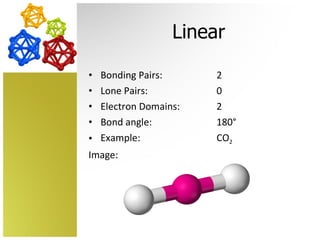
Linear Bonding Pairs:  2 Lone Pairs: 0 Electron Domains: 2 Bond angle: 180° Example: CO 2   Image:
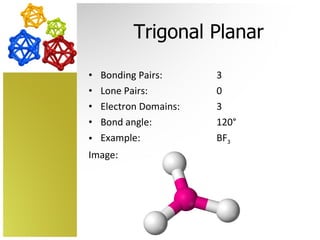
Trigonal Planar Bonding Pairs:  3 Lone Pairs: 0 Electron Domains: 3 Bond angle: 120° Example: BF 3   Image:
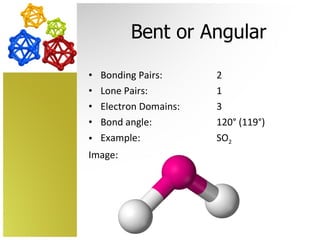
Bent or Angular Bonding Pairs:  2 Lone Pairs: 1 Electron Domains: 3 Bond angle: 120° (119°) Example: SO 2  Image:
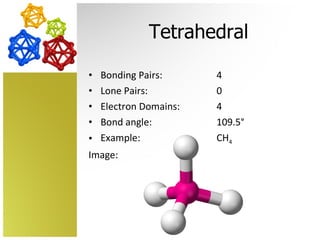
Tetrahedral Bonding Pairs:  4 Lone Pairs: 0 Electron Domains: 4 Bond angle: 109.5° Example: CH 4  Image:
Trigonal Pyramidal Bonding Pairs:  3 Lone Pairs: 1 Electron Domains: 4 Bond angle: 109.5° (107.5°) Example: NH 3 Image:
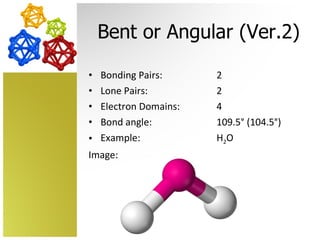
Bent or Angular (Ver.2) Bonding Pairs:  2 Lone Pairs: 2 Electron Domains: 4 Bond angle: 109.5° (104.5°) Example: H 2 O Image:
Trigonal Bipyramidal Bonding Pairs:  5 Lone Pairs: 0 Electron Domains: 5 Bond angle: 90°, 120° Example: PCl 5 Image:
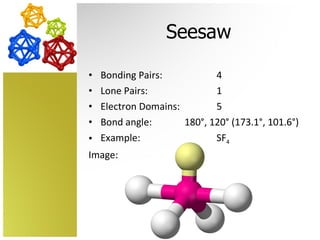
Seesaw Bonding Pairs:  4 Lone Pairs: 1 Electron Domains: 5 Bond angle: 180°, 120° (173.1°, 101.6°) Example: SF 4 Image:
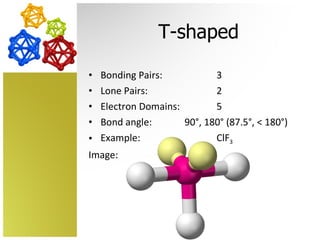
T-shaped Bonding Pairs:  3 Lone Pairs: 2 Electron Domains: 5 Bond angle: 90°, 180° (87.5°, < 180°) Example: ClF 3 Image:
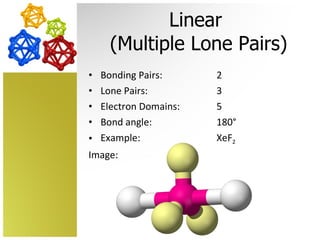
Linear  (Multiple Lone Pairs) Bonding Pairs:  2 Lone Pairs: 3 Electron Domains: 5 Bond angle: 180° Example: XeF 2 Image:
Octahedral Bonding Pairs:  6 Lone Pairs: 0 Electron Domains: 6 Bond angle: 90° Example: SF 6 Image:
Square Pyramidal Bonding Pairs:  5 Lone Pairs: 1 Electron Domains: 6 Bond angle: 90° (84.8°) Example: BrF 5 Image:
Square Planar Bonding Pairs:  5 Lone Pairs: 1 Electron Domains: 6 Bond angle: 90° Example: XeF 4 Image:
Pentagonal Bipyramidal Bonding Pairs:  7 Lone Pairs: 0 Electron Domains: 7 Bond angle: 90°, 72° Example: IF 7 Image:

Molecular geometry

  • 1.
    No heavy mathincluded Molecular Geometry
  • 2.
    Shapes of MoleculesMolecular Structure or Molecular Geometry is the three-dimensional arrangement of the atoms that constitute a molecule. It determines several properties of a substance including its reactivity, polarity, phase of matter, color, magnetism, and biological activity. the chemical formula has no direct relationship with the shape of the molecule.
  • 3.
    Shapes of MoleculesMolecular Structure or Molecular Geometry the three-dimensional shapes of molecules can be predicted by their Lewis structures. Valence-shell electron pair repulsion ( VSEPR ) model or electron domain ( ED ) model: Used in predicting the shapes. The electron pairs occupies a certain domain. They move as far as possible. Lone pairs occupies more domains contributing largely to the repulsion and shape.
  • 4.
    Terms and DefinitionBonding Pairs (AX) – electron pairs that are involved in the bonding. Lone Pairs (E) – electrons that are not involved in the bonding. They tend to occupy a larger domain. Electron Domains – total number of pairs found in the molecule that contribute to its shape.
  • 5.
    Linear Bonding Pairs: 2 Lone Pairs: 0 Electron Domains: 2 Bond angle: 180° Example: CO 2 Image:
  • 6.
    Trigonal Planar BondingPairs: 3 Lone Pairs: 0 Electron Domains: 3 Bond angle: 120° Example: BF 3 Image:
  • 7.
    Bent or AngularBonding Pairs: 2 Lone Pairs: 1 Electron Domains: 3 Bond angle: 120° (119°) Example: SO 2 Image:
  • 8.
    Tetrahedral Bonding Pairs: 4 Lone Pairs: 0 Electron Domains: 4 Bond angle: 109.5° Example: CH 4 Image:
  • 9.
    Trigonal Pyramidal BondingPairs: 3 Lone Pairs: 1 Electron Domains: 4 Bond angle: 109.5° (107.5°) Example: NH 3 Image:
  • 10.
    Bent or Angular(Ver.2) Bonding Pairs: 2 Lone Pairs: 2 Electron Domains: 4 Bond angle: 109.5° (104.5°) Example: H 2 O Image:
  • 11.
    Trigonal Bipyramidal BondingPairs: 5 Lone Pairs: 0 Electron Domains: 5 Bond angle: 90°, 120° Example: PCl 5 Image:
  • 12.
    Seesaw Bonding Pairs: 4 Lone Pairs: 1 Electron Domains: 5 Bond angle: 180°, 120° (173.1°, 101.6°) Example: SF 4 Image:
  • 13.
    T-shaped Bonding Pairs: 3 Lone Pairs: 2 Electron Domains: 5 Bond angle: 90°, 180° (87.5°, < 180°) Example: ClF 3 Image:
  • 14.
    Linear (MultipleLone Pairs) Bonding Pairs: 2 Lone Pairs: 3 Electron Domains: 5 Bond angle: 180° Example: XeF 2 Image:
  • 15.
    Octahedral Bonding Pairs: 6 Lone Pairs: 0 Electron Domains: 6 Bond angle: 90° Example: SF 6 Image:
  • 16.
    Square Pyramidal BondingPairs: 5 Lone Pairs: 1 Electron Domains: 6 Bond angle: 90° (84.8°) Example: BrF 5 Image:
  • 17.
    Square Planar BondingPairs: 5 Lone Pairs: 1 Electron Domains: 6 Bond angle: 90° Example: XeF 4 Image:
  • 18.
    Pentagonal Bipyramidal BondingPairs: 7 Lone Pairs: 0 Electron Domains: 7 Bond angle: 90°, 72° Example: IF 7 Image: