Crop modelling with the DSSAT

                 September 2011
Why model?

• Use for manipulations and experiments that are impractical,
too expensive, too lengthy or impossible (in real-world social
and economic systems)

• Address dynamic complexity (“emergent properties”) of
systems in a way that reductionist science may not be able to
do

• Identify “best management” strategies (through optimization)

• Study the long-term effects of options (predictions,
projections)
Why model? -2-


• Allow the researcher to control environmental and
experimental conditions

• Allow hypothetical and exploratory situations to be
investigated

• Allow insight to be gained into the relative importance of
different system elements

• Assemble and synthesise what is known about particular
processes
                                                        Nicholson (2008)
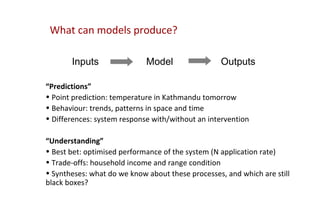
What can models produce?

       Inputs                Model                Outputs

“Predictions”
• Point prediction: temperature in Kathmandu tomorrow
• Behaviour: trends, patterns in space and time
• Differences: system response with/without an intervention

“Understanding”
• Best bet: optimised performance of the system (N application rate)
• Trade-offs: household income and range condition
• Syntheses: what do we know about these processes, and which are still
black boxes?
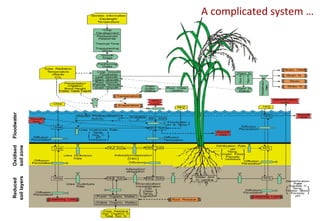
Reduced      Oxidised    Floodwater
soil layers   soil zone
                                       A complicated system …
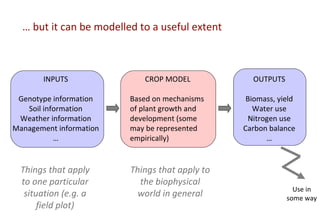
… but it can be modelled to a useful extent


       INPUTS               CROP MODEL            OUTPUTS

 Genotype information    Based on mechanisms     Biomass, yield
   Soil information      of plant growth and       Water use
 Weather information     development (some       Nitrogen use
Management information   may be represented     Carbon balance
           …             empirically)                 …


  Things that apply      Things that apply to
  to one particular        the biophysical
                                                              Use in
   situation (e.g. a       world in general                 some way
       field plot)
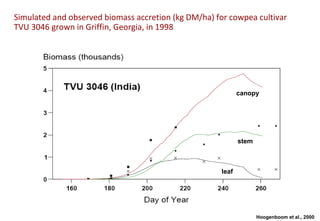
Simulated and observed biomass accretion (kg DM/ha) for cowpea cultivar
TVU 3046 grown in Griffin, Georgia, in 1998


                                                             canopy


                                                             stem


                                                      leaf


                                                                    Hoogenboom et al., 2000
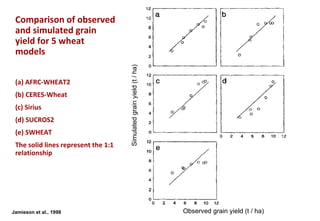
Comparison of observed
 and simulated grain
 yield for 5 wheat
 models


                                     Simulated grain yield (t / ha)
 (a) AFRC-WHEAT2
 (b) CERES-Wheat
 (c) Sirius
 (d) SUCROS2
 (e) SWHEAT
 The solid lines represent the 1:1
 relationship


Jamieson et al., 1998                                                 Observed grain yield (t / ha)
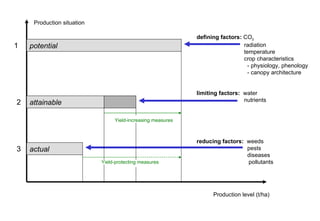
Production situation

                                                             defining factors: CO2
1   potential                                                                  radiation
                                                                               temperature
                                                                               crop characteristics
                                                                                 - physiology, phenology
                                                                                 - canopy architecture


                                                             limiting factors: water
2                                                                              nutrients
    attainable

                                 Yield-increasing measures


                                                             reducing factors: weeds
3   actual                                                                     pests
                                                                               diseases
                            Yield-protecting measures                          pollutants


                                                                   Production level (t/ha)
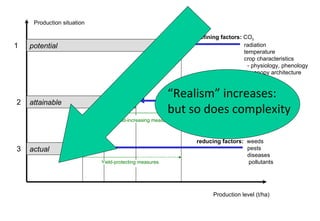
Production situation

                                                              defining factors: CO2
1   potential                                                                   radiation
                                                                                temperature
                                                                                crop characteristics
                                                                                  - physiology, phenology
                                                                                  - canopy architecture


                                                        “Realism”factors: water
                                                             limiting increases:
                                                                          nutrients
2   attainable
                                                        but so does complexity
                                 Yield-increasing measures


                                                              reducing factors: weeds
3   actual                                                                      pests
                                                                                diseases
                            Yield-protecting measures                           pollutants


                                                                    Production level (t/ha)
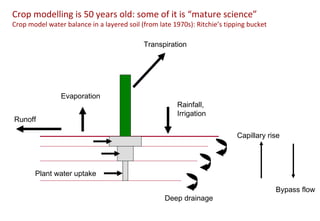
Crop modelling is 50 years old: some of it is “mature science”
Crop model water balance in a layered soil (from late 1970s): Ritchie’s tipping bucket

                                            Transpiration


                Evaporation
                                                       Rainfall,
                                                       Irrigation
Runoff

                                                                           Capillary rise


       Plant water uptake

                                                                                         Bypass flow
                                                   Deep drainage
DSSAT
Decision Support System for
 Agrotechnology Transfer
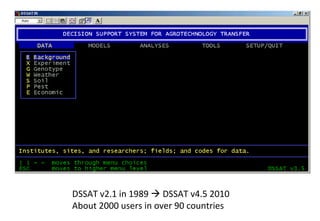
DSSAT v2.1 in 1989  DSSAT v4.5 2010
About 2000 users in over 90 countries
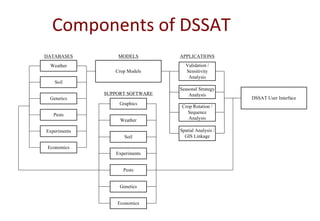
Components of DSSAT
DATABASES         MODELS         APPLICATIONS
  Weather                          Validation /
                 Crop Models       Sensitivity
                                    Analysis
   Soil
                                 Seasonal Strategy
              SUPPORT SOFTWARE       Analysis
 Genetics                                             DSSAT User Interface
                   Graphics
                                  Crop Rotation /
                                    Sequence
   Pests
                   Weather           Analysis

Experiments                      Spatial Analysis /
                     Soil          GIS Linkage

 Economics
                 Experiments


                    Pests


                   Genetics


                  Economics
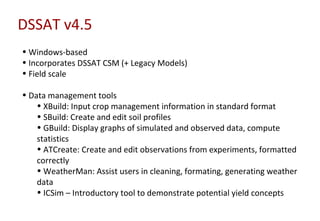
DSSAT v4.5
• Windows-based
• Incorporates DSSAT CSM (+ Legacy Models)
• Field scale

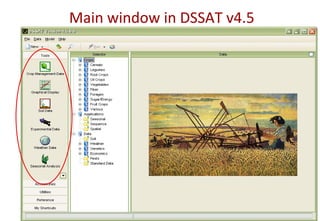
• Data management tools
    • XBuild: Input crop management information in standard format
    • SBuild: Create and edit soil profiles
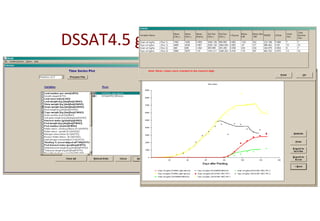
    • GBuild: Display graphs of simulated and observed data, compute
    statistics
    • ATCreate: Create and edit observations from experiments, formatted
    correctly
    • WeatherMan: Assist users in cleaning, formating, generating weather
    data
    • ICSim – Introductory tool to demonstrate potential yield concepts
DSSAT v4.5
 Several different analytical capabilities

 • Sensitivity Analysis: vary soil, weather, management or variety
 characteristics for insight

 • Seasonal Analysis: multiple-year simulations to evaluate uncertainty
 in biophysical and economic responses

 • Rotation/Sequence Analysis: long-term simulations to analyze
 changes in productivity and soil conditions associated with cropping
 systems

 • Spatial Analysis: define spatially variable soil, weather, management
 characteristics across a field or region for analysis
Main window in DSSAT v4.5
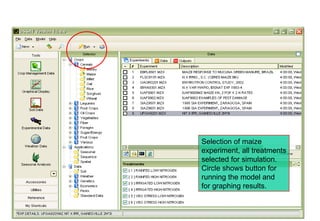
Selection of maize
experiment, all treatments
selected for simulation.
Circle shows button for
running the model and
for graphing results.
DSSAT4.5 graphics screens
Assessing Risk and Ways to Reduce it

 • Crop simulation models integrate the interaction of
   weather, soil, management and genetic factors
 • Use the crop simulation models to run “what if”
   scenarios
 • Develop alternate management practices that will
   benefit the farmer
 • Risk factors: weather and price uncertainty, two of the
   major sources
Context
• Next season’s weather is uncertain

• Variability in historical weather data can be assumed to describe
  uncertainty in next season’s weather

• “Experiment” is run by specifying a possible management system
  over a number of prior years of weather data

• Thus, a distribution of yields (& other outputs) is produced,
  converting uncertainty in weather into uncertainty in yield—for the
  specific management

• Other management “treatments” can be simulated in the
  experiment
Using DSSAT to Analyze Uncertainty


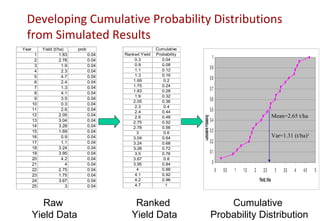
q   Simulate n years of the management being analyzed,
    using historical years of weather data and soil properties
    for the site
q   Each year starts with the same initial soil conditions
q   Each yield value is assumed to have an equal probability
    of happening in the future (assuming future weather
    statistical properties are the same)
q   Create cumulative probability distribution
q   Compute statistical properties (mean, variance, etc.)
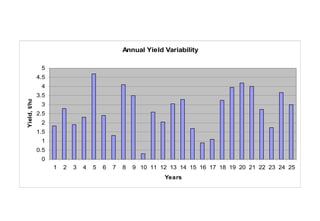
Annual Yield Variability

               5
              4.5
               4
              3.5
Yield, t/ha


               3
              2.5
               2
              1.5
               1
              0.5
               0
                    1   2   3   4   5   6   7   8   9 10 11 12 13 14 15 16 17 18 19 20 21 22 23 24 25
                                                             Years
Developing Cumulative Probability Distributions
  from Simulated Results
Year        Yield (t/ha)     prob                         Cumulative
        1             1.83          0.04   Ranked Yield   Probability
        2             2.78          0.04       0.3           0.04
                                                                                                  1
        3              1.9          0.04       0.9           0.08
                                               1.1           0.12
                                                                                                 0.9
        4              2.3          0.04
        5              4.7          0.04       1.3           0.16
                                              1.69            0.2
                                                                                                 0.8
        6              2.4          0.04
        7              1.3          0.04      1.75           0.24
                                              1.83           0.28                                0.7
        8              4.1          0.04
                                               1.9           0.32
        9              3.5          0.04                                                         0.6
                                              2.05           0.36
       10              0.3          0.04
                                               2.3            0.4
       11              2.6          0.04
                                               2.4           0.44                                0.5
       12             2.05          0.04                                                                                                     Mean=2.65 t/ha
                                               2.6           0.48


                                                                        Cumulative Probability
       13             3.04          0.04      2.75           0.52                                0.4
       14             3.28          0.04      2.78           0.56
       15             1.69          0.04        3             0.6                                0.3
       16              0.9          0.04      3.04           0.64                                                                            Var=1.31 (t/ha)2
       17              1.1          0.04      3.24           0.68                                0.2
       18             3.24          0.04      3.28           0.72
       19             3.95          0.04       3.5           0.76                                0.1
       20              4.2          0.04      3.67            0.8
       21                4          0.04      3.95           0.84                                 0
       22             2.75          0.04        4            0.88                                      0   0.5   1   1.5   2       2.5        3   3.5   4   4.5   5
       23             1.75          0.04       4.1           0.92
       24             3.67          0.04       4.2           0.96                                                              Yield, t/ha
       25                3          0.04       4.7             1


          Raw                                  Ranked                                                Cumulative
       Yield Data                             Yield Data                                         Probability Distribution
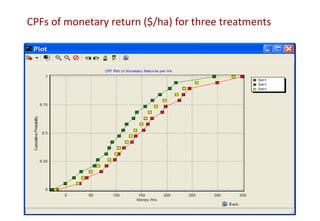
CPFs of monetary return ($/ha) for three treatments
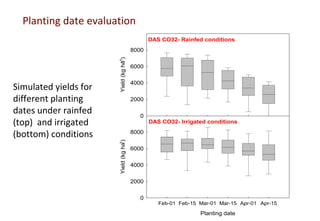
Planting date evaluation
                                                 DAS CO32- Rainfed conditions
                                          8000


                       Yield (kg ha1)
                                  -
                                          6000

                                          4000
Simulated yields for
different planting                        2000

dates under rainfed                         0
(top) and irrigated                              DAS CO32- Irrigated conditions

(bottom) conditions                       8000
                         Yield (kg ha )
                                    -1


                                          6000

                                          4000

                                          2000

                                            0
                                                    Feb-01 Feb-15 Mar-01 Mar-15 Apr-01 Apr-15

                                                                  Planting date
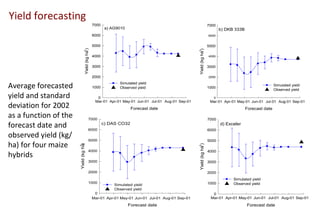
Yield forecasting
                                                 7000                                                                 7000
                                                         a) AG9010                                                           b) DKB 333B
                                                 6000                                                                 6000


                                                 5000                                                                 5000


                                Yield (kg ha )


                                                                                                     Yield (kg ha )
                                           -1


                                                                                                                -1
                                                 4000                                                                 4000


                                                 3000                                                                 3000

                                                 2000                                                                 2000


Average forecasted                               1000
                                                                Simulated yield
                                                                Observed yield                                        1000
                                                                                                                                                           Simulated yield
                                                                                                                                                           Observed yield

yield and standard                                 0                                                                     0
                                                  Mar-01 Apr-01 May-01 Jun-01 Jul-01 Aug-01 Sep-01                     Mar-01 Apr-01 May-01 Jun-01 Jul-01 Aug-01 Sep-01
deviation for 2002                                                    Forecast date                                                        Forecast date
as a function of the                        7000                                                                      7000
forecast date and                           6000
                                                        c) DAS CO32
                                                                                                                      6000
                                                                                                                             d) Exceler

observed yield (kg/                         5000                                                                      5000
ha) for four maize
                       Yield (kg ha)


                                                                                                     Yield (kg ha )
                                  -1


                                                                                                                -1
                                            4000                                                                      4000
hybrids
                                            3000                                                                      3000

                                            2000                                                                      2000
                                                                                                                                   Simulated yield
                                            1000                                                                      1000         Observed yield
                                                             Simulated yield
                                                             Observed yield
                                                  0                                                                     0
                                                 Mar-01 Apr-01 May-01 Jun-01 Jul-01 Aug-01 Sep-01                      Mar-01 Apr-01 May-01 Jun-01 Jul-01 Aug-01 Sep-01

                                                                     Forecast date                                                         Forecast date
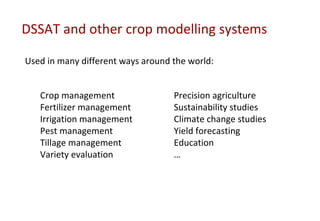
DSSAT and other crop modelling systems

Used in many different ways around the world:


   Crop management                 Precision agriculture
   Fertilizer management           Sustainability studies
   Irrigation management           Climate change studies
   Pest management                 Yield forecasting
   Tillage management              Education
   Variety evaluation              …
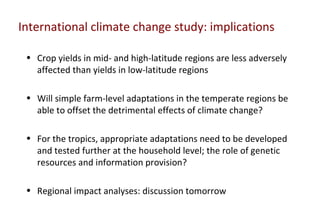
International climate change study: implications

 • Crop yields in mid- and high-latitude regions are less adversely
   affected than yields in low-latitude regions

 • Will simple farm-level adaptations in the temperate regions be
   able to offset the detrimental effects of climate change?

 • For the tropics, appropriate adaptations need to be developed
   and tested further at the household level; the role of genetic
   resources and information provision?

 • Regional impact analyses: discussion tomorrow
DSSAT v4.5 training

• DSSAT training course sponsored by the University of
Florida and ICRISAT, Hyderabad, 5-9 December 2011
(open for applicants)

• Possible: DSSAT training course at CRIDA during the
week of 13-17 February 2012
Prediction of milk production from cows consuming
tropical diets


                                             Herrero (1997)
“All models are wrong, but some are useful”


“… the practical question is, how wrong
do they have to be to not be useful.”

                                    - GEP Box
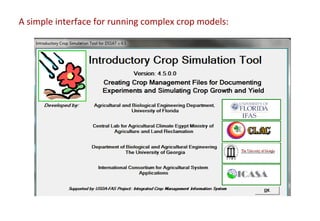
A simple interface for running complex crop models:
Crop modelling with the DSSAT

Crop modelling with the DSSAT

  • 1.
    Crop modelling withthe DSSAT September 2011
  • 2.
    Why model? • Usefor manipulations and experiments that are impractical, too expensive, too lengthy or impossible (in real-world social and economic systems) • Address dynamic complexity (“emergent properties”) of systems in a way that reductionist science may not be able to do • Identify “best management” strategies (through optimization) • Study the long-term effects of options (predictions, projections)
  • 3.
    Why model? -2- •Allow the researcher to control environmental and experimental conditions • Allow hypothetical and exploratory situations to be investigated • Allow insight to be gained into the relative importance of different system elements • Assemble and synthesise what is known about particular processes Nicholson (2008)
  • 4.
    What can modelsproduce? Inputs Model Outputs “Predictions” • Point prediction: temperature in Kathmandu tomorrow • Behaviour: trends, patterns in space and time • Differences: system response with/without an intervention “Understanding” • Best bet: optimised performance of the system (N application rate) • Trade-offs: household income and range condition • Syntheses: what do we know about these processes, and which are still black boxes?
  • 5.
    Reduced Oxidised Floodwater soil layers soil zone A complicated system …
  • 6.
    … but itcan be modelled to a useful extent INPUTS CROP MODEL OUTPUTS Genotype information Based on mechanisms Biomass, yield Soil information of plant growth and Water use Weather information development (some Nitrogen use Management information may be represented Carbon balance … empirically) … Things that apply Things that apply to to one particular the biophysical Use in situation (e.g. a world in general some way field plot)
  • 7.
    Simulated and observedbiomass accretion (kg DM/ha) for cowpea cultivar TVU 3046 grown in Griffin, Georgia, in 1998 canopy stem leaf Hoogenboom et al., 2000
  • 8.
    Comparison of observed and simulated grain yield for 5 wheat models Simulated grain yield (t / ha) (a) AFRC-WHEAT2 (b) CERES-Wheat (c) Sirius (d) SUCROS2 (e) SWHEAT The solid lines represent the 1:1 relationship Jamieson et al., 1998 Observed grain yield (t / ha)
  • 9.
    Production situation defining factors: CO2 1 potential radiation temperature crop characteristics - physiology, phenology - canopy architecture limiting factors: water 2 nutrients attainable Yield-increasing measures reducing factors: weeds 3 actual pests diseases Yield-protecting measures pollutants Production level (t/ha)
  • 10.
    Production situation defining factors: CO2 1 potential radiation temperature crop characteristics - physiology, phenology - canopy architecture “Realism”factors: water limiting increases: nutrients 2 attainable but so does complexity Yield-increasing measures reducing factors: weeds 3 actual pests diseases Yield-protecting measures pollutants Production level (t/ha)
  • 11.
    Crop modelling is50 years old: some of it is “mature science” Crop model water balance in a layered soil (from late 1970s): Ritchie’s tipping bucket Transpiration Evaporation Rainfall, Irrigation Runoff Capillary rise Plant water uptake Bypass flow Deep drainage
  • 12.
    DSSAT Decision Support Systemfor Agrotechnology Transfer
  • 13.
    DSSAT v2.1 in1989  DSSAT v4.5 2010 About 2000 users in over 90 countries
  • 14.
    Components of DSSAT DATABASES MODELS APPLICATIONS Weather Validation / Crop Models Sensitivity Analysis Soil Seasonal Strategy SUPPORT SOFTWARE Analysis Genetics DSSAT User Interface Graphics Crop Rotation / Sequence Pests Weather Analysis Experiments Spatial Analysis / Soil GIS Linkage Economics Experiments Pests Genetics Economics
  • 15.
    DSSAT v4.5 • Windows-based •Incorporates DSSAT CSM (+ Legacy Models) • Field scale • Data management tools • XBuild: Input crop management information in standard format • SBuild: Create and edit soil profiles • GBuild: Display graphs of simulated and observed data, compute statistics • ATCreate: Create and edit observations from experiments, formatted correctly • WeatherMan: Assist users in cleaning, formating, generating weather data • ICSim – Introductory tool to demonstrate potential yield concepts
  • 16.
    DSSAT v4.5 Severaldifferent analytical capabilities • Sensitivity Analysis: vary soil, weather, management or variety characteristics for insight • Seasonal Analysis: multiple-year simulations to evaluate uncertainty in biophysical and economic responses • Rotation/Sequence Analysis: long-term simulations to analyze changes in productivity and soil conditions associated with cropping systems • Spatial Analysis: define spatially variable soil, weather, management characteristics across a field or region for analysis
  • 17.
    Main window inDSSAT v4.5
  • 18.
    Selection of maize experiment,all treatments selected for simulation. Circle shows button for running the model and for graphing results.
  • 19.
  • 20.
    Assessing Risk andWays to Reduce it • Crop simulation models integrate the interaction of weather, soil, management and genetic factors • Use the crop simulation models to run “what if” scenarios • Develop alternate management practices that will benefit the farmer • Risk factors: weather and price uncertainty, two of the major sources
  • 21.
    Context • Next season’sweather is uncertain • Variability in historical weather data can be assumed to describe uncertainty in next season’s weather • “Experiment” is run by specifying a possible management system over a number of prior years of weather data • Thus, a distribution of yields (& other outputs) is produced, converting uncertainty in weather into uncertainty in yield—for the specific management • Other management “treatments” can be simulated in the experiment
  • 22.
    Using DSSAT toAnalyze Uncertainty q Simulate n years of the management being analyzed, using historical years of weather data and soil properties for the site q Each year starts with the same initial soil conditions q Each yield value is assumed to have an equal probability of happening in the future (assuming future weather statistical properties are the same) q Create cumulative probability distribution q Compute statistical properties (mean, variance, etc.)
  • 23.
    Annual Yield Variability 5 4.5 4 3.5 Yield, t/ha 3 2.5 2 1.5 1 0.5 0 1 2 3 4 5 6 7 8 9 10 11 12 13 14 15 16 17 18 19 20 21 22 23 24 25 Years
  • 24.
    Developing Cumulative ProbabilityDistributions from Simulated Results Year Yield (t/ha) prob Cumulative 1 1.83 0.04 Ranked Yield Probability 2 2.78 0.04 0.3 0.04 1 3 1.9 0.04 0.9 0.08 1.1 0.12 0.9 4 2.3 0.04 5 4.7 0.04 1.3 0.16 1.69 0.2 0.8 6 2.4 0.04 7 1.3 0.04 1.75 0.24 1.83 0.28 0.7 8 4.1 0.04 1.9 0.32 9 3.5 0.04 0.6 2.05 0.36 10 0.3 0.04 2.3 0.4 11 2.6 0.04 2.4 0.44 0.5 12 2.05 0.04 Mean=2.65 t/ha 2.6 0.48 Cumulative Probability 13 3.04 0.04 2.75 0.52 0.4 14 3.28 0.04 2.78 0.56 15 1.69 0.04 3 0.6 0.3 16 0.9 0.04 3.04 0.64 Var=1.31 (t/ha)2 17 1.1 0.04 3.24 0.68 0.2 18 3.24 0.04 3.28 0.72 19 3.95 0.04 3.5 0.76 0.1 20 4.2 0.04 3.67 0.8 21 4 0.04 3.95 0.84 0 22 2.75 0.04 4 0.88 0 0.5 1 1.5 2 2.5 3 3.5 4 4.5 5 23 1.75 0.04 4.1 0.92 24 3.67 0.04 4.2 0.96 Yield, t/ha 25 3 0.04 4.7 1 Raw Ranked Cumulative Yield Data Yield Data Probability Distribution
  • 25.
    CPFs of monetaryreturn ($/ha) for three treatments
  • 26.
    Planting date evaluation DAS CO32- Rainfed conditions 8000 Yield (kg ha1) - 6000 4000 Simulated yields for different planting 2000 dates under rainfed 0 (top) and irrigated DAS CO32- Irrigated conditions (bottom) conditions 8000 Yield (kg ha ) -1 6000 4000 2000 0 Feb-01 Feb-15 Mar-01 Mar-15 Apr-01 Apr-15 Planting date
  • 27.
    Yield forecasting 7000 7000 a) AG9010 b) DKB 333B 6000 6000 5000 5000 Yield (kg ha ) Yield (kg ha ) -1 -1 4000 4000 3000 3000 2000 2000 Average forecasted 1000 Simulated yield Observed yield 1000 Simulated yield Observed yield yield and standard 0 0 Mar-01 Apr-01 May-01 Jun-01 Jul-01 Aug-01 Sep-01 Mar-01 Apr-01 May-01 Jun-01 Jul-01 Aug-01 Sep-01 deviation for 2002 Forecast date Forecast date as a function of the 7000 7000 forecast date and 6000 c) DAS CO32 6000 d) Exceler observed yield (kg/ 5000 5000 ha) for four maize Yield (kg ha) Yield (kg ha ) -1 -1 4000 4000 hybrids 3000 3000 2000 2000 Simulated yield 1000 1000 Observed yield Simulated yield Observed yield 0 0 Mar-01 Apr-01 May-01 Jun-01 Jul-01 Aug-01 Sep-01 Mar-01 Apr-01 May-01 Jun-01 Jul-01 Aug-01 Sep-01 Forecast date Forecast date
  • 28.
    DSSAT and othercrop modelling systems Used in many different ways around the world: Crop management Precision agriculture Fertilizer management Sustainability studies Irrigation management Climate change studies Pest management Yield forecasting Tillage management Education Variety evaluation …
  • 29.
    International climate changestudy: implications • Crop yields in mid- and high-latitude regions are less adversely affected than yields in low-latitude regions • Will simple farm-level adaptations in the temperate regions be able to offset the detrimental effects of climate change? • For the tropics, appropriate adaptations need to be developed and tested further at the household level; the role of genetic resources and information provision? • Regional impact analyses: discussion tomorrow
  • 30.
    DSSAT v4.5 training •DSSAT training course sponsored by the University of Florida and ICRISAT, Hyderabad, 5-9 December 2011 (open for applicants) • Possible: DSSAT training course at CRIDA during the week of 13-17 February 2012
  • 31.
    Prediction of milkproduction from cows consuming tropical diets Herrero (1997)
  • 33.
    “All models arewrong, but some are useful” “… the practical question is, how wrong do they have to be to not be useful.” - GEP Box
  • 34.
    A simple interfacefor running complex crop models: