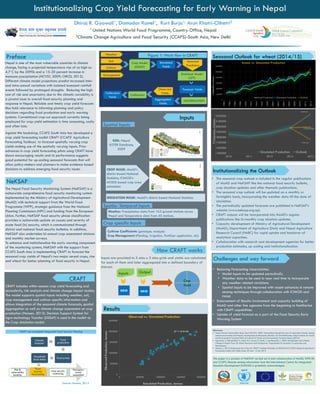
Institutionalizing Crop Yield Forecasting for Early Warning in Nepal
Dhiraj R. Gyawali1, Damodar Kanel1, Kurt Burja1, Arun Khatri-Chhetri2
1 United Nations World Food Programme, Country Office, Nepal
2Climate Change Agriculture and Food Security (CCAFS)-South Asia, New Delhi
Nepal is one of the most vulnerable countries to climate
change, facing a projected temperature rise of as high as
4.7˚C by the 2090s and a 15-20 percent increase in
monsoon precipitation (NCVST, 2009; ORCD, 2013).
Different climate model projections predict increased inter-
and intra-annual variations with isolated incessant rainfall
events followed by prolonged droughts. Reducing the high
cost of risk and uncertainty due to this climatic variability is
a pivotal issue to overall food security planning and
response in Nepal. Reliable and timely crop yield forecasts
thus hold relevance to informing planning and policy
decisions regarding food production and early warning
systems. Conventional crop-cut approach currently being
employed for crop-yield estimation is time consuming, costly
and often late.
Against this backdrop, CCAFS South Asia has developed a
crop yield forecasting toolkit CRAFT (CCAFS’ Agriculture
Forecasting Toolbox) to forecast spatially varying crop
yields making use of the spatially varying inputs. Prior
advances in crop yield forecasting pilots using CRAFT have
shown encouraging results and its performance suggests
good potential for up-scaling seasonal forecasts that will
allow policy-makers and planners to make evidence based
decisions to address emerging food security issues.
Preface
The Nepal Food Security Monitoring System (NeKSAP) is a
nationwide comprehensive food security monitoring system
implemented by the Ministry of Agricultural Development
(MoAD) with technical support from the World Food
Programme (WFP), strategic guidance from the National
Planning Commission (NPC) and funding from the European
Union. Further, NeKSAP food security phase classification
provides a nationwide update on causes and severity of
acute food (in) security, which is communicated through
district and national food security bulletins. In addition,
NeKSAP also undertakes bi-annual crop assessment missions
and monthly market surveys.
To enhance and institutionalize the early warning component
of the monitoring system, NeKSAP with the support from
CCAFS South Asia is implementing CRAFT to forecast the
seasonal crop yields of Nepal’s two major cereal crops, rice
and wheat for better planning of food security in Nepal.
NeKSAP
CRAFT includes within-season crop yield forecasting and
secondarily, risk analysis and climate change impact studies.
The model supports spatial inputs including weather, soil,
crop management and cultivar specific information and
allows integration of the seasonal climate forecasts, spatial
aggregation as well as climate change assessment on crop
production (Hansen, 2013). Decision Support System for
Agro-technology Transfer (DSSAT) is used in the toolkit as
the Crop simulation model.
CRAFT
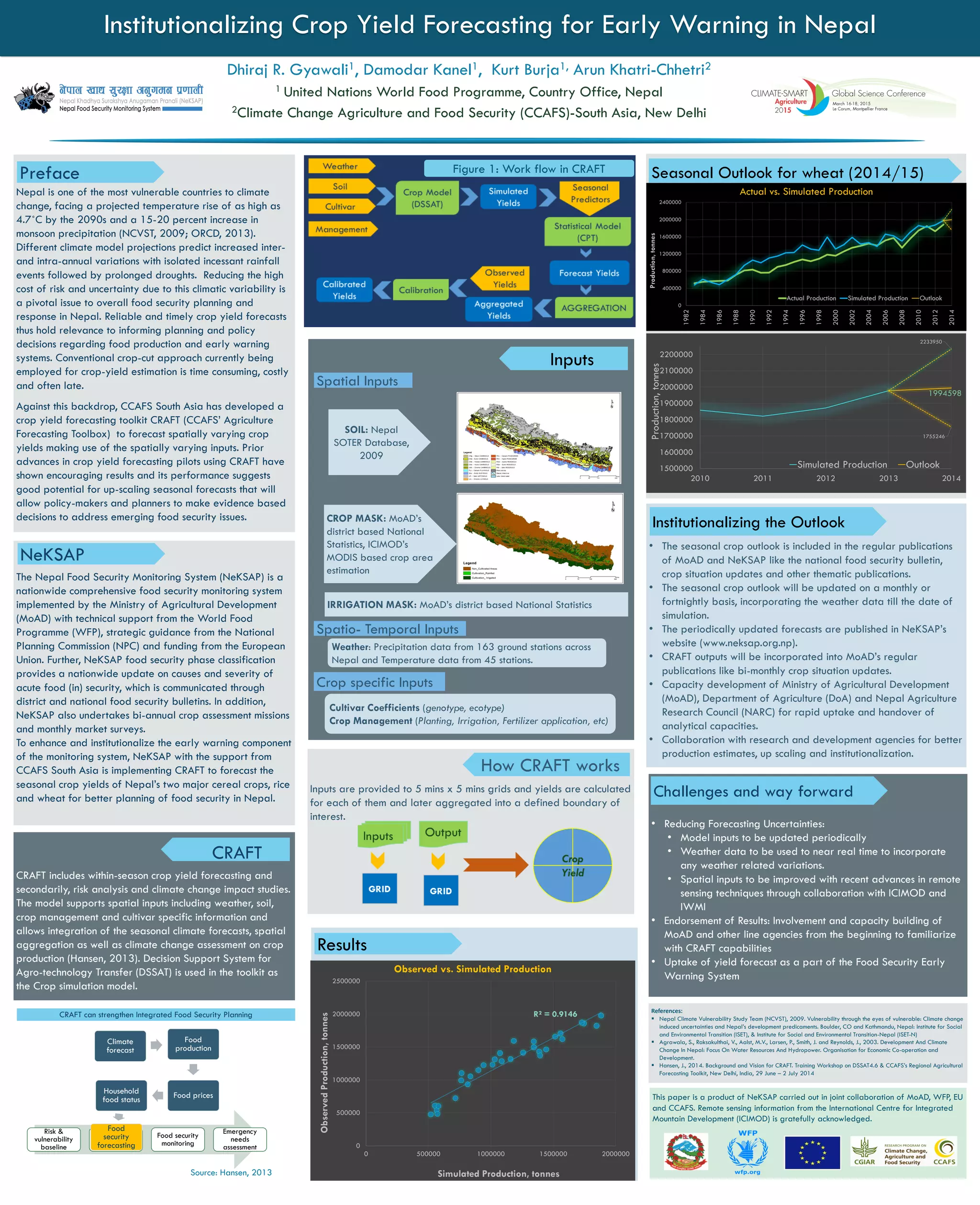
Figure 1: Work flow in CRAFT
Inputs
Spatial Inputs
SOIL: Nepal
SOTER Database,
2009
CROP MASK: MoAD’s
district based National
Statistics, ICIMOD’s
MODIS based crop area
estimation
IRRIGATION MASK: MoAD’s district based National Statistics
Spatio- Temporal Inputs
Weather: Precipitation data from 163 ground stations across
Nepal and Temperature data from 45 stations.
Crop specific Inputs
Cultivar Coefficients (genotype, ecotype)
Crop Management (Planting, Irrigation, Fertilizer application, etc)
Inputs are provided to 5 mins x 5 mins grids and yields are calculated
for each of them and later aggregated into a defined boundary of
interest.
How CRAFT works
Results
Seasonal Outlook for wheat (2014/15)
• The seasonal crop outlook is included in the regular publications
of MoAD and NeKSAP like the national food security bulletin,
crop situation updates and other thematic publications.
• The seasonal crop outlook will be updated on a monthly or
fortnightly basis, incorporating the weather data till the date of
simulation.
• The periodically updated forecasts are published in NeKSAP’s
website (www.neksap.org.np).
• CRAFT outputs will be incorporated into MoAD’s regular
publications like bi-monthly crop situation updates.
• Capacity development of Ministry of Agricultural Development
(MoAD), Department of Agriculture (DoA) and Nepal Agriculture
Research Council (NARC) for rapid uptake and handover of
analytical capacities.
• Collaboration with research and development agencies for better
production estimates, up scaling and institutionalization.
• Reducing Forecasting Uncertainties:
• Model inputs to be updated periodically
• Weather data to be used to near real time to incorporate
any weather related variations.
• Spatial inputs to be improved with recent advances in remote
sensing techniques through collaboration with ICIMOD and
IWMI
• Endorsement of Results: Involvement and capacity building of
MoAD and other line agencies from the beginning to familiarize
with CRAFT capabilities
• Uptake of yield forecast as a part of the Food Security Early
Warning System
Institutionalizing the Outlook
This paper is a product of NeKSAP carried out in joint collaboration of MoAD, WFP, EU
and CCAFS. Remote sensing information from the International Centre for Integrated
Mountain Development (ICIMOD) is gratefully acknowledged.
Challenges and way forward
Risk &
vulnerability
baseline
Food security
monitoring
Emergency
needs
assessment
Climate
forecast
Food
production
Food pricesHousehold
food status
Food
security
forecasting
CRAFT can strengthen Integrated Food Security Planning
Source: Hansen, 2013
References:
 Nepal Climate Vulnerability Study Team (NCVST), 2009. Vulnerability through the eyes of vulnerable: Climate change
induced uncertainties and Nepal’s development predicaments. Boulder, CO and Kathmandu, Nepal: Institute for Social
and Environmental Transition (ISET), & Institute for Social and Environmental Transition-Nepal (ISET-N)
 Agrawala, S., Raksakulthai, V., Aalst, M.V., Larsen, P., Smith, J. and Reynolds, J., 2003. Development And Climate
Change In Nepal: Focus On Water Resources And Hydropower. Organisation for Economic Co-operation and
Development.
 Hansen, J., 2014. Background and Vision for CRAFT. Training Workshop on DSSAT4.6 & CCAFS’s Regional Agricultural
Forecasting Toolkit, New Delhi, India, 29 June – 2 July 2014
R² = 0.9146
0
500000
1000000
1500000
2000000
2500000
0 500000 1000000 1500000 2000000
ObservedProduction,tonnes
Simulated Production, tonnes
Observed vs. Simulated Production
0
400000
800000
1200000
1600000
2000000
2400000
1982
1984
1986
1988
1990
1992
1994
1996
1998
2000
2002
2004
2006
2008
2010
2012
2014
Production,tonnes
Actual vs. Simulated Production
Actual Production Simulated Production Outlook
1994598
2233950
1755246
1500000
1600000
1700000
1800000
1900000
2000000
2100000
2200000
2010 2011 2012 2013 2014
Production,tonnes
Simulated Production Outlook

Institutionalizing Crop Yield Forecasting for Early Warning in Nepal

  • 1.
    Institutionalizing Crop YieldForecasting for Early Warning in Nepal Dhiraj R. Gyawali1, Damodar Kanel1, Kurt Burja1, Arun Khatri-Chhetri2 1 United Nations World Food Programme, Country Office, Nepal 2Climate Change Agriculture and Food Security (CCAFS)-South Asia, New Delhi Nepal is one of the most vulnerable countries to climate change, facing a projected temperature rise of as high as 4.7˚C by the 2090s and a 15-20 percent increase in monsoon precipitation (NCVST, 2009; ORCD, 2013). Different climate model projections predict increased inter- and intra-annual variations with isolated incessant rainfall events followed by prolonged droughts. Reducing the high cost of risk and uncertainty due to this climatic variability is a pivotal issue to overall food security planning and response in Nepal. Reliable and timely crop yield forecasts thus hold relevance to informing planning and policy decisions regarding food production and early warning systems. Conventional crop-cut approach currently being employed for crop-yield estimation is time consuming, costly and often late. Against this backdrop, CCAFS South Asia has developed a crop yield forecasting toolkit CRAFT (CCAFS’ Agriculture Forecasting Toolbox) to forecast spatially varying crop yields making use of the spatially varying inputs. Prior advances in crop yield forecasting pilots using CRAFT have shown encouraging results and its performance suggests good potential for up-scaling seasonal forecasts that will allow policy-makers and planners to make evidence based decisions to address emerging food security issues. Preface The Nepal Food Security Monitoring System (NeKSAP) is a nationwide comprehensive food security monitoring system implemented by the Ministry of Agricultural Development (MoAD) with technical support from the World Food Programme (WFP), strategic guidance from the National Planning Commission (NPC) and funding from the European Union. Further, NeKSAP food security phase classification provides a nationwide update on causes and severity of acute food (in) security, which is communicated through district and national food security bulletins. In addition, NeKSAP also undertakes bi-annual crop assessment missions and monthly market surveys. To enhance and institutionalize the early warning component of the monitoring system, NeKSAP with the support from CCAFS South Asia is implementing CRAFT to forecast the seasonal crop yields of Nepal’s two major cereal crops, rice and wheat for better planning of food security in Nepal. NeKSAP CRAFT includes within-season crop yield forecasting and secondarily, risk analysis and climate change impact studies. The model supports spatial inputs including weather, soil, crop management and cultivar specific information and allows integration of the seasonal climate forecasts, spatial aggregation as well as climate change assessment on crop production (Hansen, 2013). Decision Support System for Agro-technology Transfer (DSSAT) is used in the toolkit as the Crop simulation model. CRAFT Figure 1: Work flow in CRAFT Inputs Spatial Inputs SOIL: Nepal SOTER Database, 2009 CROP MASK: MoAD’s district based National Statistics, ICIMOD’s MODIS based crop area estimation IRRIGATION MASK: MoAD’s district based National Statistics Spatio- Temporal Inputs Weather: Precipitation data from 163 ground stations across Nepal and Temperature data from 45 stations. Crop specific Inputs Cultivar Coefficients (genotype, ecotype) Crop Management (Planting, Irrigation, Fertilizer application, etc) Inputs are provided to 5 mins x 5 mins grids and yields are calculated for each of them and later aggregated into a defined boundary of interest. How CRAFT works Results Seasonal Outlook for wheat (2014/15) • The seasonal crop outlook is included in the regular publications of MoAD and NeKSAP like the national food security bulletin, crop situation updates and other thematic publications. • The seasonal crop outlook will be updated on a monthly or fortnightly basis, incorporating the weather data till the date of simulation. • The periodically updated forecasts are published in NeKSAP’s website (www.neksap.org.np). • CRAFT outputs will be incorporated into MoAD’s regular publications like bi-monthly crop situation updates. • Capacity development of Ministry of Agricultural Development (MoAD), Department of Agriculture (DoA) and Nepal Agriculture Research Council (NARC) for rapid uptake and handover of analytical capacities. • Collaboration with research and development agencies for better production estimates, up scaling and institutionalization. • Reducing Forecasting Uncertainties: • Model inputs to be updated periodically • Weather data to be used to near real time to incorporate any weather related variations. • Spatial inputs to be improved with recent advances in remote sensing techniques through collaboration with ICIMOD and IWMI • Endorsement of Results: Involvement and capacity building of MoAD and other line agencies from the beginning to familiarize with CRAFT capabilities • Uptake of yield forecast as a part of the Food Security Early Warning System Institutionalizing the Outlook This paper is a product of NeKSAP carried out in joint collaboration of MoAD, WFP, EU and CCAFS. Remote sensing information from the International Centre for Integrated Mountain Development (ICIMOD) is gratefully acknowledged. Challenges and way forward Risk & vulnerability baseline Food security monitoring Emergency needs assessment Climate forecast Food production Food pricesHousehold food status Food security forecasting CRAFT can strengthen Integrated Food Security Planning Source: Hansen, 2013 References:  Nepal Climate Vulnerability Study Team (NCVST), 2009. Vulnerability through the eyes of vulnerable: Climate change induced uncertainties and Nepal’s development predicaments. Boulder, CO and Kathmandu, Nepal: Institute for Social and Environmental Transition (ISET), & Institute for Social and Environmental Transition-Nepal (ISET-N)  Agrawala, S., Raksakulthai, V., Aalst, M.V., Larsen, P., Smith, J. and Reynolds, J., 2003. Development And Climate Change In Nepal: Focus On Water Resources And Hydropower. Organisation for Economic Co-operation and Development.  Hansen, J., 2014. Background and Vision for CRAFT. Training Workshop on DSSAT4.6 & CCAFS’s Regional Agricultural Forecasting Toolkit, New Delhi, India, 29 June – 2 July 2014 R² = 0.9146 0 500000 1000000 1500000 2000000 2500000 0 500000 1000000 1500000 2000000 ObservedProduction,tonnes Simulated Production, tonnes Observed vs. Simulated Production 0 400000 800000 1200000 1600000 2000000 2400000 1982 1984 1986 1988 1990 1992 1994 1996 1998 2000 2002 2004 2006 2008 2010 2012 2014 Production,tonnes Actual vs. Simulated Production Actual Production Simulated Production Outlook 1994598 2233950 1755246 1500000 1600000 1700000 1800000 1900000 2000000 2100000 2200000 2010 2011 2012 2013 2014 Production,tonnes Simulated Production Outlook