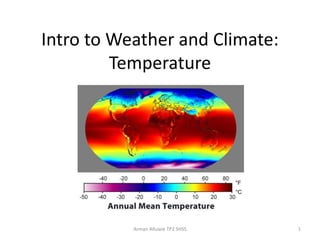

Intro to Weather and Climate:
Temperature
Arman Alluwie TP2 SHSS 1
Lesson objectives
• By the end of the lesson, we will be able to
– differentiate between weather and climate
– describe temperature as an element of weather
– describe the factors affecting temperature
2
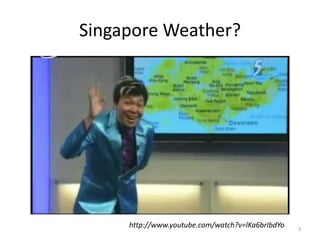
Singapore Weather?
3
http://www.youtube.com/watch?v=lKa6brIbdYo
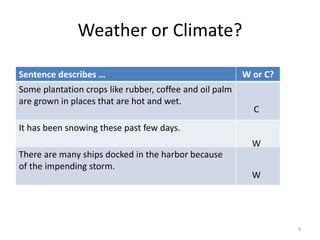
Weather or Climate?
Sentence describes … W or C?
Some plantation crops like rubber, coffee and oil palm
are grown in places that are hot and wet.
It has been snowing these past few days.
There are many ships docked in the harbor because
of the impending storm.
4
C
W
W
Weather or Climate?
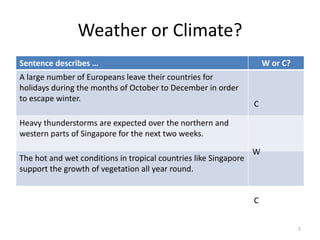
Sentence describes … W or C?
A large number of Europeans leave their countries for
holidays during the months of October to December in order
to escape winter.
Heavy thunderstorms are expected over the northern and
western parts of Singapore for the next two weeks.
The hot and wet conditions in tropical countries like Singapore
support the growth of vegetation all year round.
5
C
C
W
Weather or Climate?
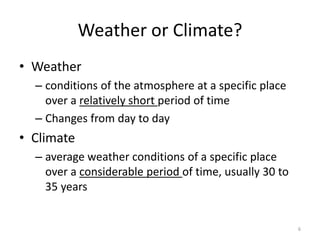
• Weather
– conditions of the atmosphere at a specific place
over a relatively short period of time
– Changes from day to day
• Climate
– average weather conditions of a specific place
over a considerable period of time, usually 30 to
35 years
6
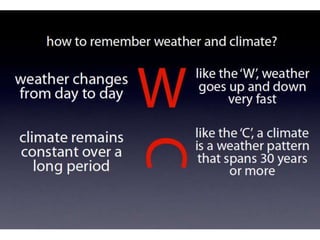
Weather VS Climate
Condition of the
atmosphere at a
particular place
over a short
period of time
Weather
Weather pattern
of a place over a
long period of
time, usually >30
years
Climate
Elements of Weather
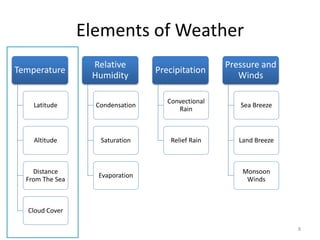
Temperature
Latitude
Altitude
Distance
From The Sea
Cloud Cover
Relative
Humidity
Condensation
Saturation
Evaporation
Precipitation
Convectional
Rain
Relief Rain
Pressure and
Winds
Sea Breeze
Land Breeze
Monsoon
Winds
8
Elements of Weather:
Temperature
• degree of hotness and coldness of a place
• affected by the amount of Sun’s rays that
reaches Earth’s surface
– latitude
– altitude
– distance from the sea
– cloud cover
Arman Alluwie TP2 SHSS 9
Factors Influencing Temperature
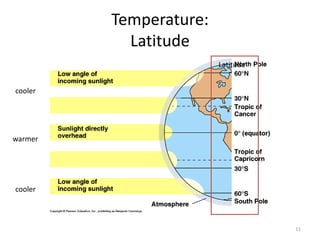
• Latitude: the distance (in degrees) to the north
and south of the Equator
• Q: Why are temperatures at the Poles & Equator
different?
– Hint: It has something to do with the shape of the Earth!
– A: The Sun’s rays travel different distances & strike the
Earth’s surface at different angles.
Temperature:
Latitude
11
Latitude
warmer
cooler
cooler
Temperature:
Latitude
12
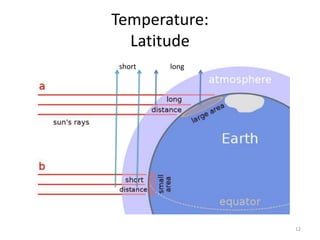
short long
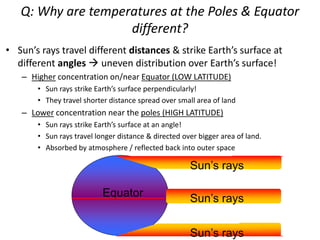
Q: Why are temperatures at the Poles & Equator
different?
• Sun’s rays travel different distances & strike Earth’s surface at
different angles  uneven distribution over Earth’s surface!
– Higher concentration on/near Equator (LOW LATITUDE)
• Sun rays strike Earth’s surface perpendicularly!
• They travel shorter distance spread over small area of land
– Lower concentration near the poles (HIGH LATITUDE)
• Sun rays strike Earth’s surface at an angle!
• Sun rays travel longer distance & directed over bigger area of land.
• Absorbed by atmosphere / reflected back into outer space
Equator Sun’s rays
Sun’s rays
Sun’s rays
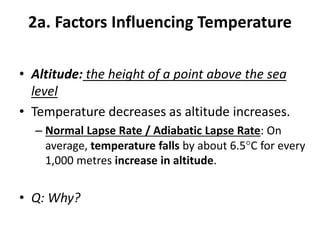
2a. Factors Influencing Temperature
• Altitude: the height of a point above the sea
level
• Temperature decreases as altitude increases.
– Normal Lapse Rate / Adiabatic Lapse Rate: On
average, temperature falls by about 6.5C for every
1,000 metres increase in altitude.
• Q: Why?
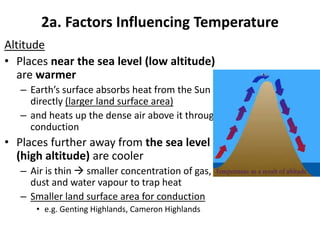
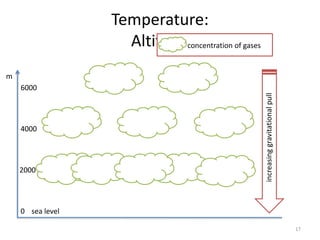
2a. Factors Influencing Temperature
Altitude
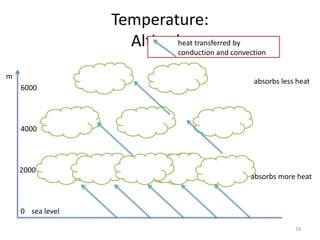
• Places near the sea level (low altitude)
are warmer
– Earth’s surface absorbs heat from the Sun
directly (larger land surface area)
– and heats up the dense air above it through
conduction
• Places further away from the sea level
(high altitude) are cooler
– Air is thin  smaller concentration of gas,
dust and water vapour to trap heat
– Smaller land surface area for conduction
• e.g. Genting Highlands, Cameron Highlands
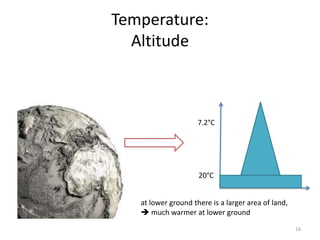
Temperature:
Altitude
16
at lower ground there is a larger area of land,
 much warmer at lower ground
20°C
7.2°C
Temperature:
Altitude
17
6000
0 sea level
2000
4000
concentration of gases
increasinggravitationalpull
m
Temperature:
Altitude
18
6000
0 sea level
2000
4000
absorbs more heat
absorbs less heat
heat transferred by
conduction and convection
m
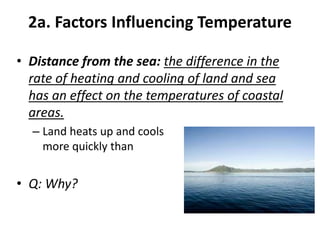
2a. Factors Influencing Temperature
• Distance from the sea: the difference in the
rate of heating and cooling of land and sea
has an effect on the temperatures of coastal
areas.
– Land heats up and cools down
more quickly than the sea.
• Q: Why?
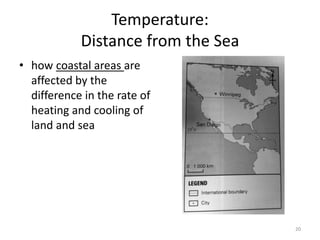
Temperature:
Distance from the Sea
• how coastal areas are
affected by the
difference in the rate of
heating and cooling of
land and sea
20
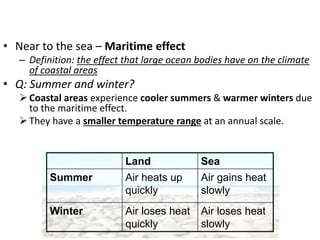
• Near to the sea – Maritime effect
– Definition: the effect that large ocean bodies have on the climate
of coastal areas
• Q: Summer and winter?
Coastal areas experience cooler summers & warmer winters due
to the maritime effect.
They have a smaller temperature range at an annual scale.
Land Sea
Summer Air heats up
quickly
Air gains heat
slowly
Winter Air loses heat
quickly
Air loses heat
slowly
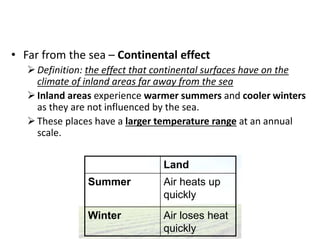
• Far from the sea – Continental effect
Definition: the effect that continental surfaces have on the
climate of inland areas far away from the sea
Inland areas experience warmer summers and cooler winters
as they are not influenced by the sea.
These places have a larger temperature range at an annual
scale.
Land
Summer Air heats up
quickly
Winter Air loses heat
quickly
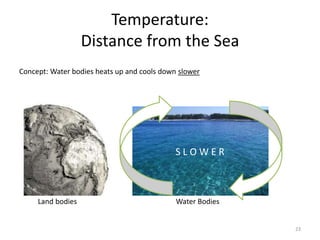
Temperature:
Distance from the Sea
23
Water Bodies
Concept: Water bodies heats up and cools down slower
Land bodies
S L O W E R
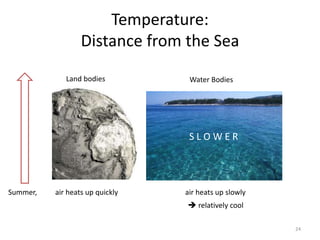
Temperature:
Distance from the Sea
24
Water BodiesLand bodies
S L O W E R
Summer, air heats up quickly air heats up slowly
 relatively cool
Temperature:
Distance from the Sea
25
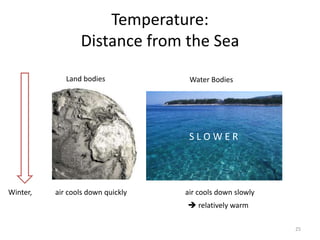
Water BodiesLand bodies
S L O W E R
Winter, air cools down quickly air cools down slowly
 relatively warm
Temperature of Singapore VS
Sahara Desert at night?
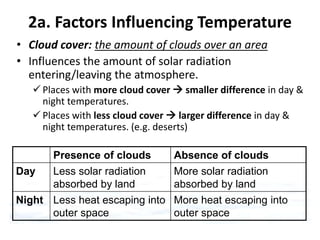
• Cloud cover: the amount of clouds over an area
• Influences the amount of solar radiation
entering/leaving the atmosphere.
 Places with more cloud cover  smaller difference in day &
night temperatures.
 Places with less cloud cover  larger difference in day &
night temperatures. (e.g. deserts)
Presence of clouds Absence of clouds
Day Less solar radiation
absorbed by land
More solar radiation
absorbed by land
Night Less heat escaping into
outer space
More heat escaping into
outer space
2a. Factors Influencing Temperature
You have learnt to:
1. differentiate between weather and climate
2. describe the elements of weather
• temperature
3-2-1!
• 3 things that you learned from this lesson
• 2 things that you are not so sure about
• 1 thing you are still curious about and would
want to know more

Secondary Three Geography: Elements-temperature

  • 1.
    Intro to Weatherand Climate: Temperature Arman Alluwie TP2 SHSS 1
  • 2.
    Lesson objectives • Bythe end of the lesson, we will be able to – differentiate between weather and climate – describe temperature as an element of weather – describe the factors affecting temperature 2
  • 3.
  • 4.
    Weather or Climate? Sentencedescribes … W or C? Some plantation crops like rubber, coffee and oil palm are grown in places that are hot and wet. It has been snowing these past few days. There are many ships docked in the harbor because of the impending storm. 4 C W W
  • 5.
    Weather or Climate? Sentencedescribes … W or C? A large number of Europeans leave their countries for holidays during the months of October to December in order to escape winter. Heavy thunderstorms are expected over the northern and western parts of Singapore for the next two weeks. The hot and wet conditions in tropical countries like Singapore support the growth of vegetation all year round. 5 C C W
  • 6.
    Weather or Climate? •Weather – conditions of the atmosphere at a specific place over a relatively short period of time – Changes from day to day • Climate – average weather conditions of a specific place over a considerable period of time, usually 30 to 35 years 6
  • 7.
    Weather VS Climate Conditionof the atmosphere at a particular place over a short period of time Weather Weather pattern of a place over a long period of time, usually >30 years Climate
  • 8.
    Elements of Weather Temperature Latitude Altitude Distance FromThe Sea Cloud Cover Relative Humidity Condensation Saturation Evaporation Precipitation Convectional Rain Relief Rain Pressure and Winds Sea Breeze Land Breeze Monsoon Winds 8
  • 9.
    Elements of Weather: Temperature •degree of hotness and coldness of a place • affected by the amount of Sun’s rays that reaches Earth’s surface – latitude – altitude – distance from the sea – cloud cover Arman Alluwie TP2 SHSS 9
  • 10.
    Factors Influencing Temperature •Latitude: the distance (in degrees) to the north and south of the Equator • Q: Why are temperatures at the Poles & Equator different? – Hint: It has something to do with the shape of the Earth! – A: The Sun’s rays travel different distances & strike the Earth’s surface at different angles.
  • 11.
  • 12.
  • 13.
    Q: Why aretemperatures at the Poles & Equator different? • Sun’s rays travel different distances & strike Earth’s surface at different angles  uneven distribution over Earth’s surface! – Higher concentration on/near Equator (LOW LATITUDE) • Sun rays strike Earth’s surface perpendicularly! • They travel shorter distance spread over small area of land – Lower concentration near the poles (HIGH LATITUDE) • Sun rays strike Earth’s surface at an angle! • Sun rays travel longer distance & directed over bigger area of land. • Absorbed by atmosphere / reflected back into outer space Equator Sun’s rays Sun’s rays Sun’s rays
  • 14.
    2a. Factors InfluencingTemperature • Altitude: the height of a point above the sea level • Temperature decreases as altitude increases. – Normal Lapse Rate / Adiabatic Lapse Rate: On average, temperature falls by about 6.5C for every 1,000 metres increase in altitude. • Q: Why?
  • 15.
    2a. Factors InfluencingTemperature Altitude • Places near the sea level (low altitude) are warmer – Earth’s surface absorbs heat from the Sun directly (larger land surface area) – and heats up the dense air above it through conduction • Places further away from the sea level (high altitude) are cooler – Air is thin  smaller concentration of gas, dust and water vapour to trap heat – Smaller land surface area for conduction • e.g. Genting Highlands, Cameron Highlands
  • 16.
    Temperature: Altitude 16 at lower groundthere is a larger area of land,  much warmer at lower ground 20°C 7.2°C
  • 17.
  • 18.
    Temperature: Altitude 18 6000 0 sea level 2000 4000 absorbsmore heat absorbs less heat heat transferred by conduction and convection m
  • 19.
    2a. Factors InfluencingTemperature • Distance from the sea: the difference in the rate of heating and cooling of land and sea has an effect on the temperatures of coastal areas. – Land heats up and cools down more quickly than the sea. • Q: Why?
  • 20.
    Temperature: Distance from theSea • how coastal areas are affected by the difference in the rate of heating and cooling of land and sea 20
  • 21.
    • Near tothe sea – Maritime effect – Definition: the effect that large ocean bodies have on the climate of coastal areas • Q: Summer and winter? Coastal areas experience cooler summers & warmer winters due to the maritime effect. They have a smaller temperature range at an annual scale. Land Sea Summer Air heats up quickly Air gains heat slowly Winter Air loses heat quickly Air loses heat slowly
  • 22.
    • Far fromthe sea – Continental effect Definition: the effect that continental surfaces have on the climate of inland areas far away from the sea Inland areas experience warmer summers and cooler winters as they are not influenced by the sea. These places have a larger temperature range at an annual scale. Land Summer Air heats up quickly Winter Air loses heat quickly
  • 23.
    Temperature: Distance from theSea 23 Water Bodies Concept: Water bodies heats up and cools down slower Land bodies S L O W E R
  • 24.
    Temperature: Distance from theSea 24 Water BodiesLand bodies S L O W E R Summer, air heats up quickly air heats up slowly  relatively cool
  • 25.
    Temperature: Distance from theSea 25 Water BodiesLand bodies S L O W E R Winter, air cools down quickly air cools down slowly  relatively warm
  • 26.
    Temperature of SingaporeVS Sahara Desert at night?
  • 27.
    • Cloud cover:the amount of clouds over an area • Influences the amount of solar radiation entering/leaving the atmosphere.  Places with more cloud cover  smaller difference in day & night temperatures.  Places with less cloud cover  larger difference in day & night temperatures. (e.g. deserts) Presence of clouds Absence of clouds Day Less solar radiation absorbed by land More solar radiation absorbed by land Night Less heat escaping into outer space More heat escaping into outer space 2a. Factors Influencing Temperature
  • 28.
    You have learntto: 1. differentiate between weather and climate 2. describe the elements of weather • temperature
  • 29.
    3-2-1! • 3 thingsthat you learned from this lesson • 2 things that you are not so sure about • 1 thing you are still curious about and would want to know more