IGCSE GEOGRAPHY
19. WEATHER & CLIMATE
WEATHER SYSTEMS
A synoptic chart is any map that summarises atmospheric
conditions (temperature, precipitation, wind speed and
direction, atmospheric pressure and cloud coverage) over a
wide area at a given time.
They display an overview of the weather conditions observed
from many different weather stations, aeroplanes, balloons
and satellites.
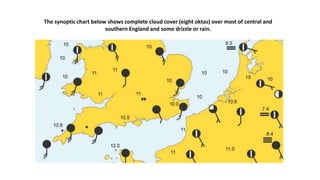
The synoptic chart below shows complete cloud cover (eight oktas) over most of central and
southern England and some drizzle or rain.
By collating the information over a wide area, meteorologists can
observe the behaviour and movement of weather formations that
might affect their local area in the future.
This allows meteorologists to make more accurate weather
forecasts.
Charts are updated at least every six hours.
There are many different types of weather map, all drawn using
internationally agreed standards and using accepted symbols.
Weather symbols can seem confusing until you look for the
patterns.
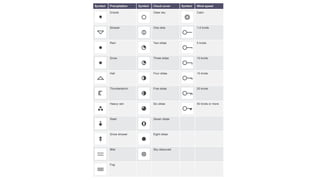
Note how increasing cloud cover is shown by covering more and
more eighths (oktas) of the circle.
More wind speed is shown by adding a little tail for every extra
five knots of wind (just under 5 mph/8 kmh) and a longer tail for
ten knots (just under 10 mph/16 kmh).
Similarly, once you know the symbol for rain is a black ball and
the symbol for snow is a star, then you know sleet will be a ball
plus a star, and two, three or four balls denotes heavier
rainstorms.
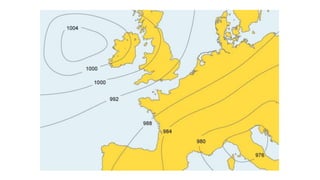
Isobars are lines on a weather map joining together places of
equal atmospheric pressure.
On the map the isobar marked 1004 represents an area of high
pressure, while the isobar marked 976 represents an area of low
pressure.
The numbers measure the atmospheric pressure in millibars.
Usually isobars are drawn at intervals of two or four millibars
(one thousandth of a bar).
The closer the isobars are together, the windier it is.
If the lowest number is in the middle circle, this is a low pressure
or depression. Often low pressures mean wet and windy weather.
If the highest number is in the middle circle, this is a high
pressure or anticyclone. Often high pressures mean dry, sunny
weather.
Air pressure tends to range from 890 mb (a hurricane) to 1060 mb
(an anticyclone).
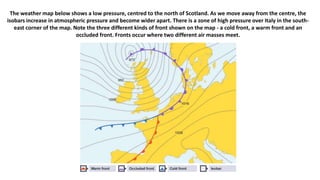
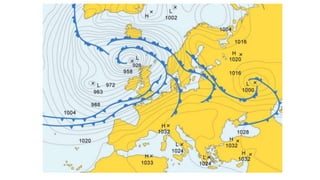
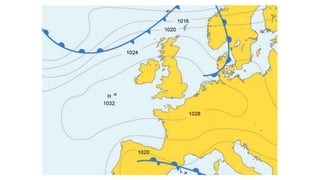
The weather map below shows a low pressure, centred to the north of Scotland. As we move away from the centre, the
isobars increase in atmospheric pressure and become wider apart. There is a zone of high pressure over Italy in the south-
east corner of the map. Note the three different kinds of front shown on the map - a cold front, a warm front and an
occluded front. Fronts occur where two different air masses meet.
These are formed when warm air rises over a mass of cold air.
As the air lifts into regions of lower pressure, it expands, cools
and condenses the water vapour as wide, flat sheets of cloud.
Warm fronts are shown on synoptic charts by a solid line with
semicircles pointing towards the colder air and in the direction of
movement.
On coloured weather maps, a warm front is drawn with a solid
red line with red semicircles.
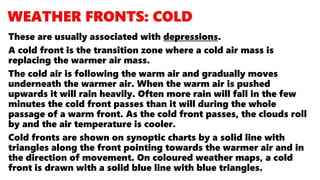
These are usually associated with depressions.
A cold front is the transition zone where a cold air mass is
replacing the warmer air mass.
The cold air is following the warm air and gradually moves
underneath the warmer air. When the warm air is pushed
upwards it will rain heavily. Often more rain will fall in the few
minutes the cold front passes than it will during the whole
passage of a warm front. As the cold front passes, the clouds roll
by and the air temperature is cooler.
Cold fronts are shown on synoptic charts by a solid line with
triangles along the front pointing towards the warmer air and in
the direction of movement. On coloured weather maps, a cold
front is drawn with a solid blue line with blue triangles.
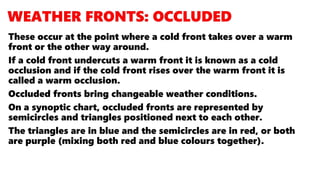
These occur at the point where a cold front takes over a warm
front or the other way around.
If a cold front undercuts a warm front it is known as a cold
occlusion and if the cold front rises over the warm front it is
called a warm occlusion.
Occluded fronts bring changeable weather conditions.
On a synoptic chart, occluded fronts are represented by
semicircles and triangles positioned next to each other.
The triangles are in blue and the semicircles are in red, or both
are purple (mixing both red and blue colours together).
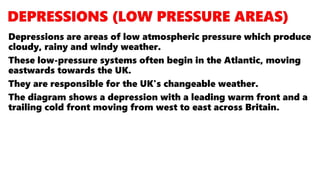
Depressions are areas of low atmospheric pressure which produce
cloudy, rainy and windy weather.
These low-pressure systems often begin in the Atlantic, moving
eastwards towards the UK.
They are responsible for the UK's changeable weather.
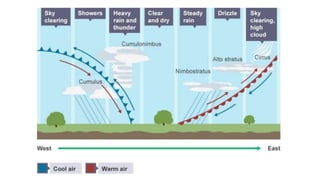
The diagram shows a depression with a leading warm front and a
trailing cold front moving from west to east across Britain.
At the warm front, lighter, warmer air from the South (tropical
maritime air) meets cooler air from the North (polar maritime air)
and rises gradually over it.
As the warm air slowly rises it cools, its water content condenses
and clouds form (nimbostratus then altostratus).
The result is steady rain, later giving way to drizzle and finally
clearer skies with high cirrus clouds.
Behind the warm front is an area of warm, rising air and low
pressure - the centre of the low-pressure system.
As this part of the depression passes over, there may be a short
period of clear, dry weather.
However, at the trailing cold front, heavier, cooler air meets the
warm air at the centre of the depression, undercutting it and
forcing it steeply upwards. Quickly moving air masses produce
high winds and cooler temperatures.
As the rapidly rising warm air cools, its water condenses and
clouds form (cumulonimbus, then cumulus). The result is heavy
rain or thunderstorms, giving way to showers and finally to clear
skies as the cold front moves away eastwards.
Anticyclones are the opposite of depressions - they are an area of
high atmospheric pressure where the air is sinking.
As the air is sinking, not rising, no clouds or rain are formed. This
is because as the air sinks it warms, meaning it can hold more
water.
The absence of fronts means winds may be very light.
Consequently, high-pressure areas are often associated with
settled, dry and bright conditions.
In summer, anticyclones bring dry, hot weather. In winter, clear
skies may bring cold nights and frost.
In cold conditions, anticyclones may also bring fog and mist. This
is because the cold forces moisture in the air to condense at low
altitudes.
GEOGRAPHY IGCSE: WEATHER SYSTEMS

GEOGRAPHY IGCSE: WEATHER SYSTEMS

  • 1.
    IGCSE GEOGRAPHY 19. WEATHER& CLIMATE WEATHER SYSTEMS
  • 2.
    A synoptic chartis any map that summarises atmospheric conditions (temperature, precipitation, wind speed and direction, atmospheric pressure and cloud coverage) over a wide area at a given time. They display an overview of the weather conditions observed from many different weather stations, aeroplanes, balloons and satellites.
  • 3.
    The synoptic chartbelow shows complete cloud cover (eight oktas) over most of central and southern England and some drizzle or rain.
  • 4.
    By collating theinformation over a wide area, meteorologists can observe the behaviour and movement of weather formations that might affect their local area in the future. This allows meteorologists to make more accurate weather forecasts. Charts are updated at least every six hours. There are many different types of weather map, all drawn using internationally agreed standards and using accepted symbols.
  • 5.
    Weather symbols canseem confusing until you look for the patterns. Note how increasing cloud cover is shown by covering more and more eighths (oktas) of the circle. More wind speed is shown by adding a little tail for every extra five knots of wind (just under 5 mph/8 kmh) and a longer tail for ten knots (just under 10 mph/16 kmh). Similarly, once you know the symbol for rain is a black ball and the symbol for snow is a star, then you know sleet will be a ball plus a star, and two, three or four balls denotes heavier rainstorms.
  • 7.
    Isobars are lineson a weather map joining together places of equal atmospheric pressure. On the map the isobar marked 1004 represents an area of high pressure, while the isobar marked 976 represents an area of low pressure.
  • 9.
    The numbers measurethe atmospheric pressure in millibars. Usually isobars are drawn at intervals of two or four millibars (one thousandth of a bar). The closer the isobars are together, the windier it is. If the lowest number is in the middle circle, this is a low pressure or depression. Often low pressures mean wet and windy weather. If the highest number is in the middle circle, this is a high pressure or anticyclone. Often high pressures mean dry, sunny weather. Air pressure tends to range from 890 mb (a hurricane) to 1060 mb (an anticyclone).
  • 10.
    The weather mapbelow shows a low pressure, centred to the north of Scotland. As we move away from the centre, the isobars increase in atmospheric pressure and become wider apart. There is a zone of high pressure over Italy in the south- east corner of the map. Note the three different kinds of front shown on the map - a cold front, a warm front and an occluded front. Fronts occur where two different air masses meet.
  • 11.
    These are formedwhen warm air rises over a mass of cold air. As the air lifts into regions of lower pressure, it expands, cools and condenses the water vapour as wide, flat sheets of cloud. Warm fronts are shown on synoptic charts by a solid line with semicircles pointing towards the colder air and in the direction of movement. On coloured weather maps, a warm front is drawn with a solid red line with red semicircles.
  • 12.
    These are usuallyassociated with depressions. A cold front is the transition zone where a cold air mass is replacing the warmer air mass. The cold air is following the warm air and gradually moves underneath the warmer air. When the warm air is pushed upwards it will rain heavily. Often more rain will fall in the few minutes the cold front passes than it will during the whole passage of a warm front. As the cold front passes, the clouds roll by and the air temperature is cooler. Cold fronts are shown on synoptic charts by a solid line with triangles along the front pointing towards the warmer air and in the direction of movement. On coloured weather maps, a cold front is drawn with a solid blue line with blue triangles.
  • 13.
    These occur atthe point where a cold front takes over a warm front or the other way around. If a cold front undercuts a warm front it is known as a cold occlusion and if the cold front rises over the warm front it is called a warm occlusion. Occluded fronts bring changeable weather conditions. On a synoptic chart, occluded fronts are represented by semicircles and triangles positioned next to each other. The triangles are in blue and the semicircles are in red, or both are purple (mixing both red and blue colours together).
  • 14.
    Depressions are areasof low atmospheric pressure which produce cloudy, rainy and windy weather. These low-pressure systems often begin in the Atlantic, moving eastwards towards the UK. They are responsible for the UK's changeable weather. The diagram shows a depression with a leading warm front and a trailing cold front moving from west to east across Britain.
  • 16.
    At the warmfront, lighter, warmer air from the South (tropical maritime air) meets cooler air from the North (polar maritime air) and rises gradually over it. As the warm air slowly rises it cools, its water content condenses and clouds form (nimbostratus then altostratus). The result is steady rain, later giving way to drizzle and finally clearer skies with high cirrus clouds.
  • 17.
    Behind the warmfront is an area of warm, rising air and low pressure - the centre of the low-pressure system. As this part of the depression passes over, there may be a short period of clear, dry weather. However, at the trailing cold front, heavier, cooler air meets the warm air at the centre of the depression, undercutting it and forcing it steeply upwards. Quickly moving air masses produce high winds and cooler temperatures. As the rapidly rising warm air cools, its water condenses and clouds form (cumulonimbus, then cumulus). The result is heavy rain or thunderstorms, giving way to showers and finally to clear skies as the cold front moves away eastwards.
  • 19.
    Anticyclones are theopposite of depressions - they are an area of high atmospheric pressure where the air is sinking. As the air is sinking, not rising, no clouds or rain are formed. This is because as the air sinks it warms, meaning it can hold more water. The absence of fronts means winds may be very light. Consequently, high-pressure areas are often associated with settled, dry and bright conditions. In summer, anticyclones bring dry, hot weather. In winter, clear skies may bring cold nights and frost. In cold conditions, anticyclones may also bring fog and mist. This is because the cold forces moisture in the air to condense at low altitudes.