What are the
things you
usually consider
whenever you
plan to have a
picnic?
CLIMATE
WEATHER
&
OBJECTIVES
At the end of the lesson, we will be able to;
1. Differentiate climate and weather
2. Explain how different factors affect the climate
of an area.
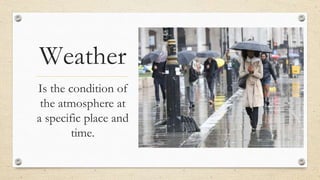
Weather
Is the condition of
the atmosphere at
a specific place and
time.
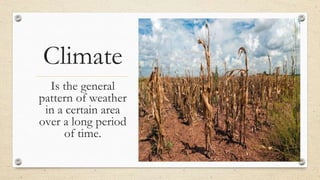
Climate
Is the general
pattern of weather
in a certain area
over a long period
of time.
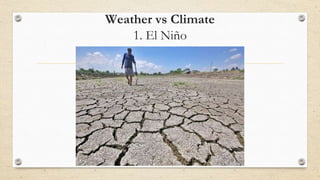
Weather vs Climate
1. El Niño
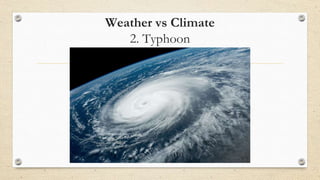
Weather vs Climate
2. Typhoon
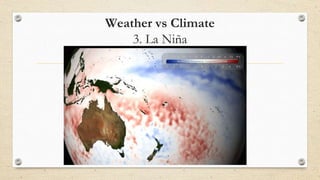
Weather vs Climate
3. La Niña
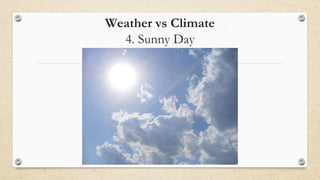
Weather vs Climate
4. Sunny Day
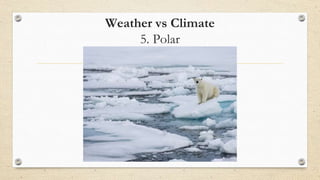
Weather vs Climate
5. Polar
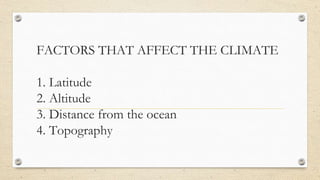
FACTORS THAT AFFECT THE CLIMATE
1. Latitude
2. Altitude
3. Distance from the ocean
4. Topography
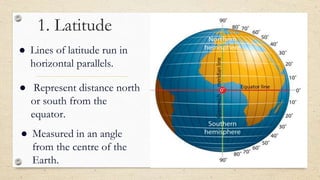
1. Latitude
● Lines of latitude run in
horizontal parallels.
● Represent distance north
or south from the
equator.
● Measured in an angle
from the centre of the
Earth.
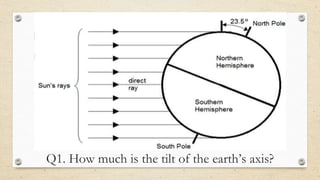
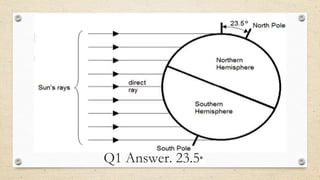
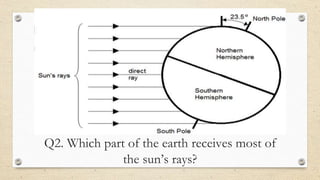
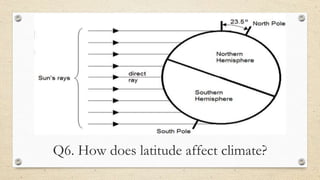
Q1. How much is the tilt of the earth’s axis?
Q1 Answer. 23.5°
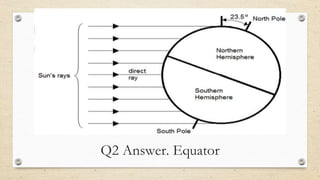
Q2. Which part of the earth receives most of
the sun’s rays?
Q2 Answer. Equator
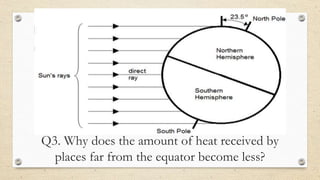
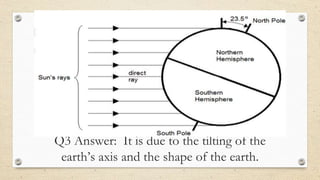
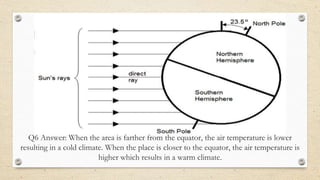
Q3. Why does the amount of heat received by
places far from the equator become less?
Q3 Answer: It is due to the tilting of the
earth’s axis and the shape of the earth.
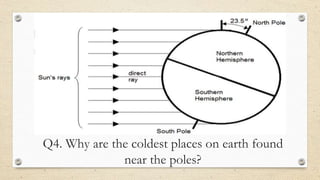
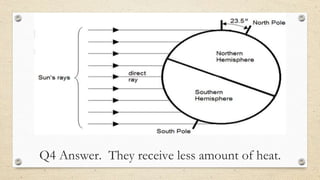
Q4. Why are the coldest places on earth found
near the poles?
Q4 Answer. They receive less amount of heat.
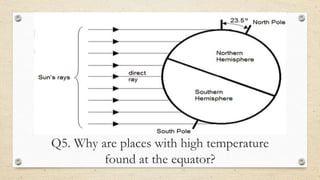
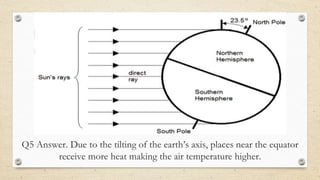
Q5. Why are places with high temperature
found at the equator?
Q5 Answer. Due to the tilting of the earth’s axis, places near the equator
receive more heat making the air temperature higher.
Q6. How does latitude affect climate?
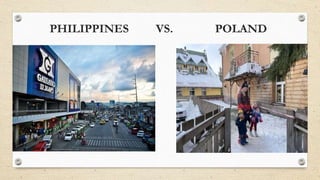
Q6 Answer: When the area is farther from the equator, the air temperature is lower
resulting in a cold climate. When the place is closer to the equator, the air temperature is
higher which results in a warm climate.
PHILIPPINES VS. POLAND
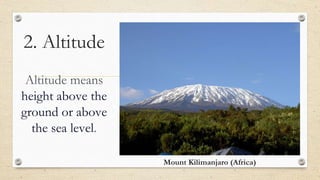
2. Altitude
Altitude means
height above the
ground or above
the sea level.
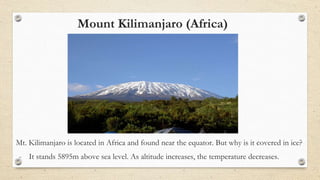
Mount Kilimanjaro (Africa)
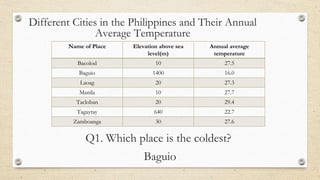
Name of Place Elevation above sea
level(m)
Annual average
temperature
Bacolod 10 27.5
Baguio 1400 16.0
Laoag 20 27.3
Manila 10 27.7
Tacloban 20 29.4
Tagaytay 640 22.7
Zamboanga 30 27.6
Different Cities in the Philippines and Their Annual
Average Temperature
Q1. Which place is the coldest?
Baguio
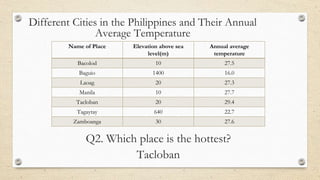
Name of Place Elevation above sea
level(m)
Annual average
temperature
Bacolod 10 27.5
Baguio 1400 16.0
Laoag 20 27.3
Manila 10 27.7
Tacloban 20 29.4
Tagaytay 640 22.7
Zamboanga 30 27.6
Different Cities in the Philippines and Their Annual
Average Temperature
Q2. Which place is the hottest?
Tacloban
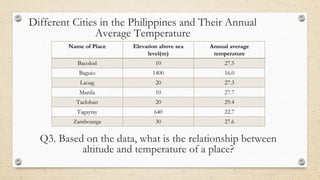
Name of Place Elevation above sea
level(m)
Annual average
temperature
Bacolod 10 27.5
Baguio 1400 16.0
Laoag 20 27.3
Manila 10 27.7
Tacloban 20 29.4
Tagaytay 640 22.7
Zamboanga 30 27.6
Different Cities in the Philippines and Their Annual
Average Temperature
Q3. Based on the data, what is the relationship between
altitude and temperature of a place?
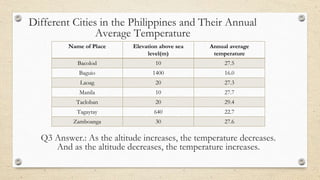
Name of Place Elevation above sea
level(m)
Annual average
temperature
Bacolod 10 27.5
Baguio 1400 16.0
Laoag 20 27.3
Manila 10 27.7
Tacloban 20 29.4
Tagaytay 640 22.7
Zamboanga 30 27.6
Different Cities in the Philippines and Their Annual
Average Temperature
Q3 Answer.: As the altitude increases, the temperature decreases.
And as the altitude decreases, the temperature increases.

Mount Kilimanjaro (Africa)
Mt. Kilimanjaro is located in Africa and found near the equator. But why is it covered in ice?
- It stands 5895m above sea level. As altitude increases, the temperature decreases.
Why is it cold at higher altitude?
● For every 1000 m, there
is a drop of 6.5°C.
● At higher elevations,
there is less air.
● Lighter air cannot
absorb much heat,
making air temperature
lower.
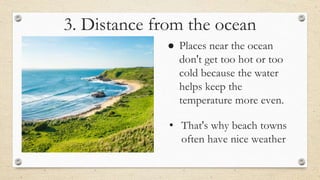
3. Distance from the ocean
● Places near the ocean
don't get too hot or too
cold because the water
helps keep the
temperature more even.
• That's why beach towns
often have nice weather
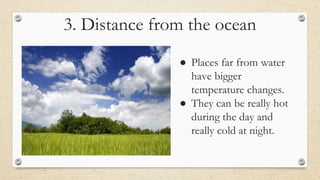
3. Distance from the ocean
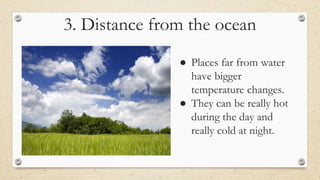
● Places far from water
have bigger
temperature changes.
● They can be really hot
during the day and
really cold at night.
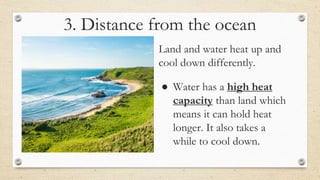
3. Distance from the ocean
● Land and water heat up and
cool down differently.
● Water has a high heat
capacity than land which
means it can hold heat
longer. It also takes a
while to cool down.
3. Distance from the ocean
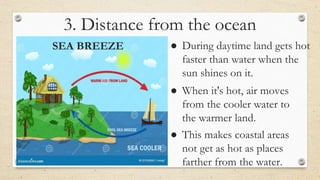
● During daytime land gets hot
faster than water when the
sun shines on it.
SEA BREEZE
● When it's hot, air moves
from the cooler water to
the warmer land.
● This makes coastal areas
not get as hot as places
farther from the water.
3. Distance from the ocean
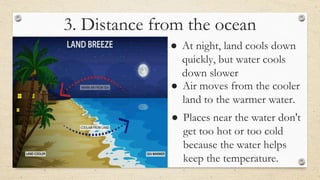
● At night, land cools down
quickly, but water cools
down slower
● Air moves from the cooler
land to the warmer water.
● Places near the water don't
get too hot or too cold
because the water helps
keep the temperature.
3. Distance from the ocean
● Places far from water
have bigger
temperature changes.
● They can be really hot
during the day and
really cold at night.
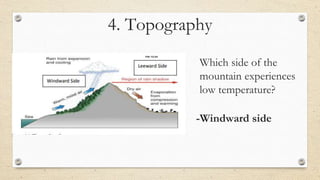
4. Topography
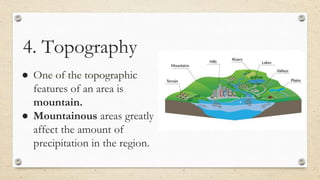
● One of the topographic
features of an area is
mountain.
● Mountainous areas greatly
affect the amount of
precipitation in the region.
4. Topography
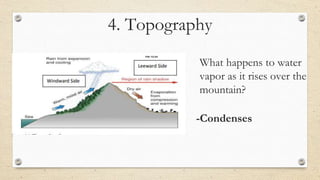
What happens to water
vapor as it rises over the
mountain?
-Condenses
4. Topography
Which side of the
mountain experiences
low temperature?
-Windward side
4. Topography
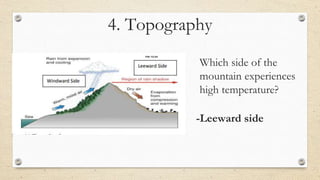
Which side of the
mountain experiences
high temperature?
-Leeward side
4. Topography
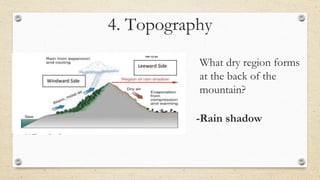
What dry region forms
at the back of the
mountain?
-Rain shadow
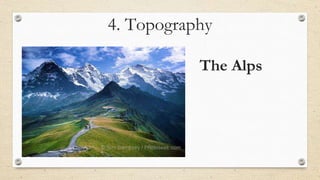
4. Topography
The Alps
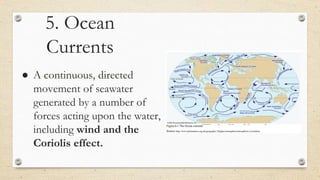
5. Ocean
Currents
● A continuous, directed
movement of seawater
generated by a number of
forces acting upon the water,
including wind and the
Coriolis effect.
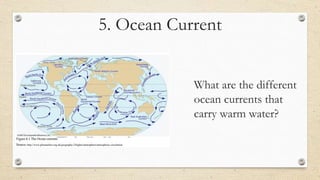
5. Ocean Current
What are the different
ocean currents that
carry warm water?
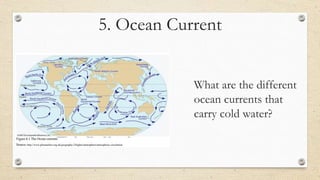
5. Ocean Current
What are the different
ocean currents that
carry cold water?
5. Ocean Current
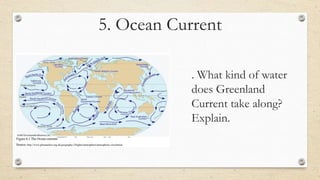
. What kind of water
does Greenland
Current take along?
Explain.
5. Ocean Current
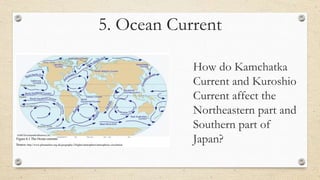
How do Kamchatka
Current and Kuroshio
Current affect the
Northeastern part and
Southern part of
Japan?
5. Ocean Current
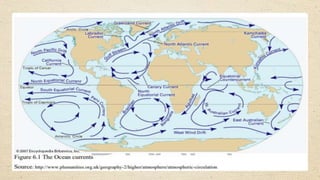
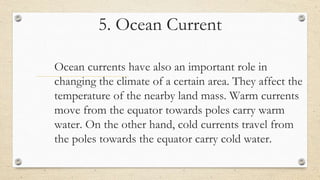
Ocean currents have also an important role in
changing the climate of a certain area. They affect the
temperature of the nearby land mass. Warm currents
move from the equator towards poles carry warm
water. On the other hand, cold currents travel from
the poles towards the equator carry cold water.
03/04/24
Factors Affecting Climate (continuation)
3. Distance from the ocean
4. Topography
5. Ocean Currents - (As an Effect of Coriolis Effect)
QUIZ
03/00/24 - Reporting
CLIMATE CHANGE
GREENHOUSE EFFECT
GLOBAL WARMING
EL NIÑO
LA NIÑA
ACTIVITIES
Climate Vs. Weather continuation (Grade 9).pptx

Climate Vs. Weather continuation (Grade 9).pptx

  • 2.
    What are the thingsyou usually consider whenever you plan to have a picnic?
  • 3.
  • 4.
    OBJECTIVES At the endof the lesson, we will be able to; 1. Differentiate climate and weather 2. Explain how different factors affect the climate of an area.
  • 5.
    Weather Is the conditionof the atmosphere at a specific place and time.
  • 6.
    Climate Is the general patternof weather in a certain area over a long period of time.
  • 7.
  • 8.
  • 9.
  • 10.
  • 11.
  • 12.
    FACTORS THAT AFFECTTHE CLIMATE 1. Latitude 2. Altitude 3. Distance from the ocean 4. Topography
  • 13.
    1. Latitude ● Linesof latitude run in horizontal parallels. ● Represent distance north or south from the equator. ● Measured in an angle from the centre of the Earth.
  • 14.
    Q1. How muchis the tilt of the earth’s axis?
  • 15.
  • 16.
    Q2. Which partof the earth receives most of the sun’s rays?
  • 17.
  • 18.
    Q3. Why doesthe amount of heat received by places far from the equator become less?
  • 19.
    Q3 Answer: Itis due to the tilting of the earth’s axis and the shape of the earth.
  • 20.
    Q4. Why arethe coldest places on earth found near the poles?
  • 21.
    Q4 Answer. Theyreceive less amount of heat.
  • 22.
    Q5. Why areplaces with high temperature found at the equator?
  • 23.
    Q5 Answer. Dueto the tilting of the earth’s axis, places near the equator receive more heat making the air temperature higher.
  • 24.
    Q6. How doeslatitude affect climate?
  • 25.
    Q6 Answer: Whenthe area is farther from the equator, the air temperature is lower resulting in a cold climate. When the place is closer to the equator, the air temperature is higher which results in a warm climate.
  • 26.
  • 27.
    2. Altitude Altitude means heightabove the ground or above the sea level. Mount Kilimanjaro (Africa)
  • 28.
    Name of PlaceElevation above sea level(m) Annual average temperature Bacolod 10 27.5 Baguio 1400 16.0 Laoag 20 27.3 Manila 10 27.7 Tacloban 20 29.4 Tagaytay 640 22.7 Zamboanga 30 27.6 Different Cities in the Philippines and Their Annual Average Temperature Q1. Which place is the coldest? Baguio
  • 29.
    Name of PlaceElevation above sea level(m) Annual average temperature Bacolod 10 27.5 Baguio 1400 16.0 Laoag 20 27.3 Manila 10 27.7 Tacloban 20 29.4 Tagaytay 640 22.7 Zamboanga 30 27.6 Different Cities in the Philippines and Their Annual Average Temperature Q2. Which place is the hottest? Tacloban
  • 30.
    Name of PlaceElevation above sea level(m) Annual average temperature Bacolod 10 27.5 Baguio 1400 16.0 Laoag 20 27.3 Manila 10 27.7 Tacloban 20 29.4 Tagaytay 640 22.7 Zamboanga 30 27.6 Different Cities in the Philippines and Their Annual Average Temperature Q3. Based on the data, what is the relationship between altitude and temperature of a place?
  • 31.
    Name of PlaceElevation above sea level(m) Annual average temperature Bacolod 10 27.5 Baguio 1400 16.0 Laoag 20 27.3 Manila 10 27.7 Tacloban 20 29.4 Tagaytay 640 22.7 Zamboanga 30 27.6 Different Cities in the Philippines and Their Annual Average Temperature Q3 Answer.: As the altitude increases, the temperature decreases. And as the altitude decreases, the temperature increases.
  • 32.
    Mount Kilimanjaro (Africa) Mt.Kilimanjaro is located in Africa and found near the equator. But why is it covered in ice? - It stands 5895m above sea level. As altitude increases, the temperature decreases.
  • 33.
    Why is itcold at higher altitude? ● For every 1000 m, there is a drop of 6.5°C. ● At higher elevations, there is less air. ● Lighter air cannot absorb much heat, making air temperature lower.
  • 35.
    3. Distance fromthe ocean ● Places near the ocean don't get too hot or too cold because the water helps keep the temperature more even. • That's why beach towns often have nice weather
  • 36.
    3. Distance fromthe ocean ● Places far from water have bigger temperature changes. ● They can be really hot during the day and really cold at night.
  • 38.
    3. Distance fromthe ocean ● Land and water heat up and cool down differently. ● Water has a high heat capacity than land which means it can hold heat longer. It also takes a while to cool down.
  • 39.
    3. Distance fromthe ocean ● During daytime land gets hot faster than water when the sun shines on it. SEA BREEZE ● When it's hot, air moves from the cooler water to the warmer land. ● This makes coastal areas not get as hot as places farther from the water.
  • 40.
    3. Distance fromthe ocean ● At night, land cools down quickly, but water cools down slower ● Air moves from the cooler land to the warmer water. ● Places near the water don't get too hot or too cold because the water helps keep the temperature.
  • 41.
    3. Distance fromthe ocean ● Places far from water have bigger temperature changes. ● They can be really hot during the day and really cold at night.
  • 42.
    4. Topography ● Oneof the topographic features of an area is mountain. ● Mountainous areas greatly affect the amount of precipitation in the region.
  • 43.
    4. Topography What happensto water vapor as it rises over the mountain? -Condenses
  • 44.
    4. Topography Which sideof the mountain experiences low temperature? -Windward side
  • 45.
    4. Topography Which sideof the mountain experiences high temperature? -Leeward side
  • 46.
    4. Topography What dryregion forms at the back of the mountain? -Rain shadow
  • 47.
  • 48.
    5. Ocean Currents ● Acontinuous, directed movement of seawater generated by a number of forces acting upon the water, including wind and the Coriolis effect.
  • 50.
    5. Ocean Current Whatare the different ocean currents that carry warm water?
  • 51.
    5. Ocean Current Whatare the different ocean currents that carry cold water?
  • 52.
    5. Ocean Current .What kind of water does Greenland Current take along? Explain.
  • 53.
    5. Ocean Current Howdo Kamchatka Current and Kuroshio Current affect the Northeastern part and Southern part of Japan?
  • 54.
    5. Ocean Current Oceancurrents have also an important role in changing the climate of a certain area. They affect the temperature of the nearby land mass. Warm currents move from the equator towards poles carry warm water. On the other hand, cold currents travel from the poles towards the equator carry cold water.
  • 55.
    03/04/24 Factors Affecting Climate(continuation) 3. Distance from the ocean 4. Topography 5. Ocean Currents - (As an Effect of Coriolis Effect) QUIZ 03/00/24 - Reporting CLIMATE CHANGE GREENHOUSE EFFECT GLOBAL WARMING EL NIÑO LA NIÑA ACTIVITIES