2/18/2015 ANCY I MSc.
NEUROTRANSMITTERS
By Ancy Kurian
I MSc.(N)
2/18/2015 2ANCY KURIAN IMSc. Neurotransmitters
OVERVIEW
• Definition & Life-cycle of a neurotransmitter
• Mechanism of Neurotransmitter Action
• Classification Of Neurotransmitters
• Factors influencing - Deficiency/ imbalance/ Malfunctioning
• Neurotransmitters and probable Implications on Mental
Health
• Diagnosis Of Neurotransmitter imbalance
• PSYCHOPHARMACOLOGY
How does drugs alter Neurotransmission
Mechanism of Action Of Drugs
Drugs interfering with Neurotransmission
Drugs that increase/ decrease /mimic Neurotransmitters.
• NURSES CONCERN IN NEUROTRANSMITTER
IMBALANCE
2/18/2015 3ANCY KURIAN IMSc. Neurotransmitters
DEFINITION
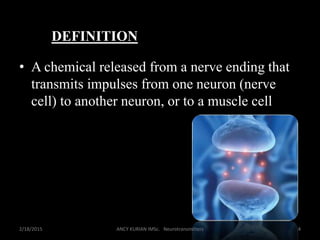
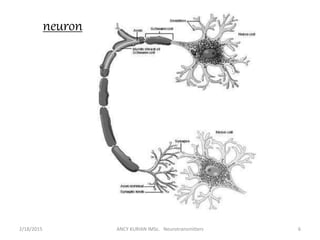
• A chemical released from a nerve ending that
transmits impulses from one neuron (nerve
cell) to another neuron, or to a muscle cell
2/18/2015 4ANCY KURIAN IMSc. Neurotransmitters
Neurotransmitters (contd…)
• Act as both neurotransmitters and hormones
• Most neurons make two or more neurotransmitters
• 50 or more neurotransmitters have been identified.
• 9 low molecular weight amines that serves as neurotransmitters
egs.Glutamate ,the major fast excitatory transmitter in
mammalian CNS ,
Acetycholine- the excitatory transmitter at the vertebral
junction,
GABA and Glycine ,the major fast inhibitory transmitters in
brain & spinal cord.
• Central nervous system, the peripheral nervous system has only
two: acetylcholine and norepinephrine
2/18/2015 5ANCY KURIAN IMSc. Neurotransmitters
neuron
2/18/2015 ANCY KURIAN IMSc. Neurotransmitters 6
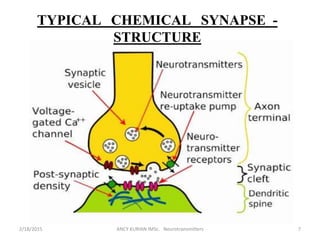
TYPICAL CHEMICAL SYNAPSE -
STRUCTURE
2/18/2015 7ANCY KURIAN IMSc. Neurotransmitters
2/18/2015 ANCY KURIAN IMSc. Neurotransmitters 8
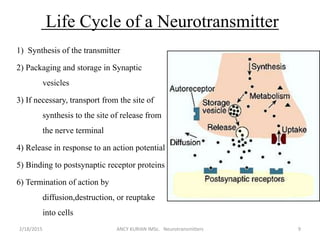
Life Cycle of a Neurotransmitter
1) Synthesis of the transmitter
2) Packaging and storage in Synaptic
vesicles
3) If necessary, transport from the site of
synthesis to the site of release from
the nerve terminal
4) Release in response to an action potential
5) Binding to postsynaptic receptor proteins
6) Termination of action by
diffusion,destruction, or reuptake
into cells
2/18/2015 ANCY KURIAN IMSc. Neurotransmitters 9
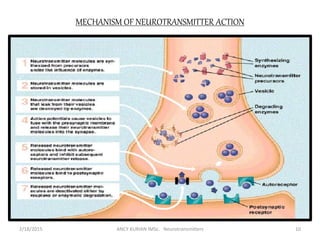
MECHANISM OF NEUROTRANSMITTER ACTION
2/18/2015 ANCY KURIAN IMSc. Neurotransmitters 10
Chemical Classification of Neurotransmitters:
Cholinergics - Acetylcholine
Biogenic Amines (modified amino acids) ,involved in
slow synaptic transmission.
• Catecholamines: Dopamine, Norepinephrine (NE), and
Epinephrine
• Indolamines
• Serotonin and Histamine (5-Hydroxytryptamine or 5-HT)
Amino Acids - involved in fast synaptic transmission
and are inhibitory and excitatory in action.
• GABA—Gamma ()-aminobutyric acid
• Glycine , Aspartate ,Glutamate
2/18/2015 ANCY KURIAN IMSc. Neurotransmitters 11
Chemical Classification of Neurotransmitters:
 Neuropeptides
• formed by short chained peptides , slow acting synaptic
transmitters.
• Egs are Substance P , Endorphins and Enkephalins ,
Somatostatin, gastrin, cholecystokinin, oxytocin, vasopressin,
Leutinizing hormone releasing hormone (LHRH)
 Purines
• Adenosine
• ATP
 Gases and Lipids
• Nitric Oxide (NO)
• Carbonmonooxide (CO)
• Cannabinoids
2/18/2015 ANCY KURIAN IMSc. Neurotransmitters 12
Functional Classification
• Excitatory Neurotransmitter- eg;
Glutamate,Aspartate,Adrenaline and
Noradrenaline,Histamine,Nitric Oxide andAcetycholine
• Inhibitory Neurotransmitter–
eg:GABA,Glycine,Adrenaline and
Noradrenaline,Dopamine and Serotonin.
2/18/2015 ANCY KURIAN IMSc. Neurotransmitters 13
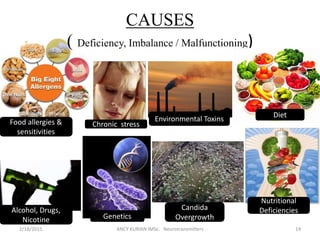
CAUSES
( Deficiency, Imbalance / Malfunctioning)
2/18/2015 ANCY KURIAN IMSc. Neurotransmitters 14
Food allergies &
sensitivities
Chronic stress
Environmental Toxins
Genetics
Candida
Overgrowth
Nutritional
DeficienciesAlcohol, Drugs,
Nicotine
Diet
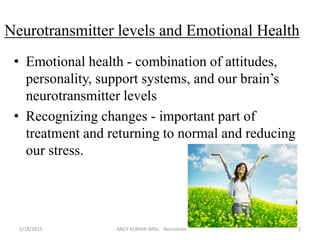
Neurotransmitter levels and Emotional Health
• Emotional health - combination of attitudes,
personality, support systems, and our brain’s
neurotransmitter levels
• Recognizing changes - important part of
treatment and returning to normal and reducing
our stress.
2/18/2015 ANCY KURIAN IMSc. Neurotransmitters 15
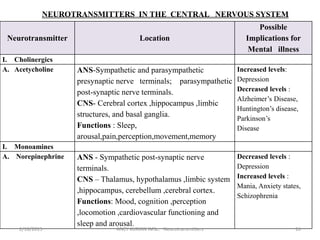
NEUROTRANSMITTERS IN THE CENTRAL NERVOUS SYSTEM
Neurotransmitter Location
Possible
Implications for
Mental illness
I. Cholinergics
A. Acetycholine ANS-Sympathetic and parasympathetic
presynaptic nerve terminals; parasympathetic
post-synaptic nerve terminals.
CNS- Cerebral cortex ,hippocampus ,limbic
structures, and basal ganglia.
Functions : Sleep,
arousal,pain,perception,movement,memory
Increased levels:
Depression
Decreased levels :
Alzheimer’s Disease,
Huntington’s disease,
Parkinson’s
Disease
I. Monoamines
A. Norepinephrine ANS - Sympathetic post-synaptic nerve
terminals.
CNS – Thalamus, hypothalamus ,limbic system
,hippocampus, cerebellum ,cerebral cortex.
Functions: Mood, cognition ,perception
,locomotion ,cardiovascular functioning and
sleep and arousal.
Decreased levels :
Depression
Increased levels :
Mania, Anxiety states,
Schizophrenia
2/18/2015 ANCY KURIAN IMSc. Neurotransmitters 16
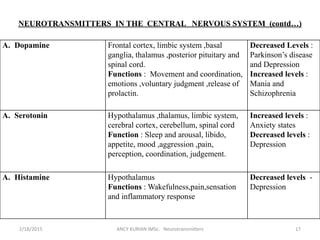
A. Dopamine Frontal cortex, limbic system ,basal
ganglia, thalamus ,posterior pituitary and
spinal cord.
Functions : Movement and coordination,
emotions ,voluntary judgment ,release of
prolactin.
Decreased Levels :
Parkinson’s disease
and Depression
Increased levels :
Mania and
Schizophrenia
A. Serotonin Hypothalamus ,thalamus, limbic system,
cerebral cortex, cerebellum, spinal cord
Function : Sleep and arousal, libido,
appetite, mood ,aggression ,pain,
perception, coordination, judgement.
Increased levels :
Anxiety states
Decreased levels :
Depression
A. Histamine Hypothalamus
Functions : Wakefulness,pain,sensation
and inflammatory response
Decreased levels -
Depression
2/18/2015 ANCY KURIAN IMSc. Neurotransmitters 17
NEUROTRANSMITTERS IN THE CENTRAL NERVOUS SYSTEM (contd…)
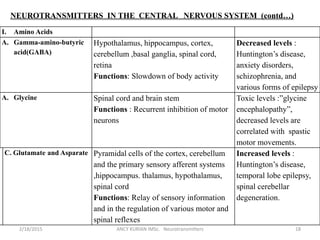
I. Amino Acids
A. Gamma-amino-butyric
acid(GABA)
Hypothalamus, hippocampus, cortex,
cerebellum ,basal ganglia, spinal cord,
retina
Functions: Slowdown of body activity
Decreased levels :
Huntington’s disease,
anxiety disorders,
schizophrenia, and
various forms of epilepsy
A. Glycine Spinal cord and brain stem
Functions : Recurrent inhibition of motor
neurons
Toxic levels :”glycine
encephalopathy”,
decreased levels are
correlated with spastic
motor movements.
C. Glutamate and Asparate Pyramidal cells of the cortex, cerebellum
and the primary sensory afferent systems
,hippocampus. thalamus, hypothalamus,
spinal cord
Functions: Relay of sensory information
and in the regulation of various motor and
spinal reflexes
Increased levels :
Huntington’s disease,
temporal lobe epilepsy,
spinal cerebellar
degeneration.
2/18/2015 ANCY KURIAN IMSc. Neurotransmitters 18
NEUROTRANSMITTERS IN THE CENTRAL NERVOUS SYSTEM (contd…)
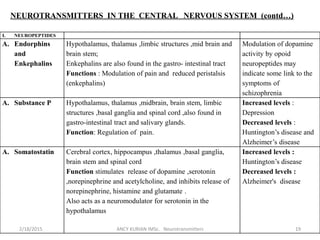
I. NEUROPEPTIDES
A. Endorphins
and
Enkephalins
Hypothalamus, thalamus ,limbic structures ,mid brain and
brain stem;
Enkephalins are also found in the gastro- intestinal tract
Functions : Modulation of pain and reduced peristalsis
(enkephalins)
Modulation of dopamine
activity by opoid
neuropeptides may
indicate some link to the
symptoms of
schizophrenia
A. Substance P Hypothalamus, thalamus ,midbrain, brain stem, limbic
structures ,basal ganglia and spinal cord ,also found in
gastro-intestinal tract and salivary glands.
Function: Regulation of pain.
Increased levels :
Depression
Decreased levels :
Huntington’s disease and
Alzheimer’s disease
A. Somatostatin Cerebral cortex, hippocampus ,thalamus ,basal ganglia,
brain stem and spinal cord
Function stimulates release of dopamine ,serotonin
,norepinephrine and acetylcholine, and inhibits release of
norepinephrine, histamine and glutamate .
Also acts as a neuromodulator for serotonin in the
hypothalamus
Increased levels :
Huntington’s disease
Decreased levels :
Alzheimer's disease
2/18/2015 ANCY KURIAN IMSc. Neurotransmitters 19
NEUROTRANSMITTERS IN THE CENTRAL NERVOUS SYSTEM (contd…)
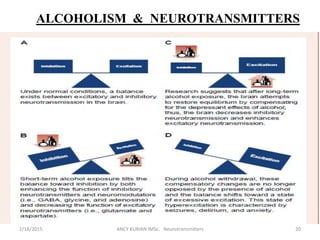
ALCOHOLISM & NEUROTRANSMITTERS
2/18/2015 ANCY KURIAN IMSc. Neurotransmitters 20
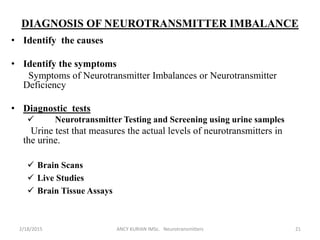
DIAGNOSIS OF NEUROTRANSMITTER IMBALANCE
• Identify the causes
• Identify the symptoms
Symptoms of Neurotransmitter Imbalances or Neurotransmitter
Deficiency
• Diagnostic tests
 Neurotransmitter Testing and Screening using urine samples
Urine test that measures the actual levels of neurotransmitters in
the urine.
 Brain Scans
 Live Studies
 Brain Tissue Assays
2/18/2015 ANCY KURIAN IMSc. Neurotransmitters 21
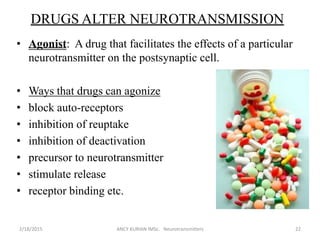
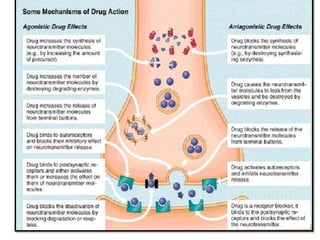
DRUGS ALTER NEUROTRANSMISSION
• Agonist: A drug that facilitates the effects of a particular
neurotransmitter on the postsynaptic cell.
• Ways that drugs can agonize
• block auto-receptors
• inhibition of reuptake
• inhibition of deactivation
• precursor to neurotransmitter
• stimulate release
• receptor binding etc.
2/18/2015 ANCY KURIAN IMSc. Neurotransmitters 22
DRUGS ALTER NEUROTRANSMISSION
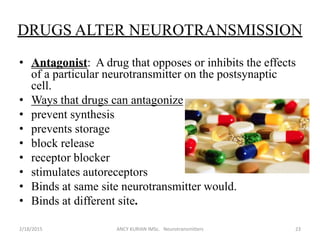
• Antagonist: A drug that opposes or inhibits the effects
of a particular neurotransmitter on the postsynaptic
cell.
• Ways that drugs can antagonize
• prevent synthesis
• prevents storage
• block release
• receptor blocker
• stimulates autoreceptors
• Binds at same site neurotransmitter would.
• Binds at different site.
2/18/2015 ANCY KURIAN IMSc. Neurotransmitters 23
2/18/2015 ANCY KURIAN IMSc. Neurotransmitters 24
(1)DRUGS THAT INTERFER WITH
NEUROTRANSMITTERS (pdf)
(2)DRUGS THAT INCREASE /DECREASE/MIMIC
NEUROTRANSMITTERS (pdf)
2/18/2015 ANCY KURIAN IMSc. Neurotransmitters 25
NURSES’ CONCERN IN NEUROTRANSMITTER
IMBALANCE
• Assessment
• Identify the markers showing adverse effects due to prolonged
use of medications
• Replenishing neurotransmitters
 Diet
 Aminoacid therapy
 Health education
 Rehabilitation
2/18/2015 ANCY KURIAN IMSc. Neurotransmitters 26
NURSING DIAGNOSIS
• Risk for injury related to accelerated motor activity
• Disturbed thought process related to impaired judgement associated with manic
behaviour
• Self-care deficit (unkempt appearance) related to hyperactivity
• Impaired verbal communication –flight of ideas related to accelerated thinking
• Ineffective coping related to elated expressive mood
• Disturbed thought process –grandiosity related to elevated mood
• Ineffective coping related to emotional liability associated with manic behaviour
• Disturbed thought process –related to delusion of grandeur
2/18/2015 ANCY KURIAN IMSc. Neurotransmitters 27
RESEARCH STUDIES
• A 1999 study at Duke University and published in the
Archives of Internal Medicine found that regular
exercise was effective in decreasing symptoms of major
depressive disorder..
• "Journal of Psychiatry & Neuroscience," - exercise also
increases serotonin levels in your brain, leading to
improved mood
• And " exposure to the great outdoors, even on a cloudy
day, can provide enough natural light to raise your
serotonin levels.
2/18/2015 ANCY KURIAN IMSc. Neurotransmitters 28
CONCLUSION
2/18/2015 ANCY KURIAN IMSc. Neurotransmitters 29
THANKYOU
2/18/2015 ANCY KURIAN IMSc. Neurotransmitters 30

Neurotransmitters

  • 1.
  • 2.
    NEUROTRANSMITTERS By Ancy Kurian IMSc.(N) 2/18/2015 2ANCY KURIAN IMSc. Neurotransmitters
  • 3.
    OVERVIEW • Definition &Life-cycle of a neurotransmitter • Mechanism of Neurotransmitter Action • Classification Of Neurotransmitters • Factors influencing - Deficiency/ imbalance/ Malfunctioning • Neurotransmitters and probable Implications on Mental Health • Diagnosis Of Neurotransmitter imbalance • PSYCHOPHARMACOLOGY How does drugs alter Neurotransmission Mechanism of Action Of Drugs Drugs interfering with Neurotransmission Drugs that increase/ decrease /mimic Neurotransmitters. • NURSES CONCERN IN NEUROTRANSMITTER IMBALANCE 2/18/2015 3ANCY KURIAN IMSc. Neurotransmitters
  • 4.
    DEFINITION • A chemicalreleased from a nerve ending that transmits impulses from one neuron (nerve cell) to another neuron, or to a muscle cell 2/18/2015 4ANCY KURIAN IMSc. Neurotransmitters
  • 5.
    Neurotransmitters (contd…) • Actas both neurotransmitters and hormones • Most neurons make two or more neurotransmitters • 50 or more neurotransmitters have been identified. • 9 low molecular weight amines that serves as neurotransmitters egs.Glutamate ,the major fast excitatory transmitter in mammalian CNS , Acetycholine- the excitatory transmitter at the vertebral junction, GABA and Glycine ,the major fast inhibitory transmitters in brain & spinal cord. • Central nervous system, the peripheral nervous system has only two: acetylcholine and norepinephrine 2/18/2015 5ANCY KURIAN IMSc. Neurotransmitters
  • 6.
    neuron 2/18/2015 ANCY KURIANIMSc. Neurotransmitters 6
  • 7.
    TYPICAL CHEMICAL SYNAPSE- STRUCTURE 2/18/2015 7ANCY KURIAN IMSc. Neurotransmitters
  • 8.
    2/18/2015 ANCY KURIANIMSc. Neurotransmitters 8
  • 9.
    Life Cycle ofa Neurotransmitter 1) Synthesis of the transmitter 2) Packaging and storage in Synaptic vesicles 3) If necessary, transport from the site of synthesis to the site of release from the nerve terminal 4) Release in response to an action potential 5) Binding to postsynaptic receptor proteins 6) Termination of action by diffusion,destruction, or reuptake into cells 2/18/2015 ANCY KURIAN IMSc. Neurotransmitters 9
  • 10.
    MECHANISM OF NEUROTRANSMITTERACTION 2/18/2015 ANCY KURIAN IMSc. Neurotransmitters 10
  • 11.
    Chemical Classification ofNeurotransmitters: Cholinergics - Acetylcholine Biogenic Amines (modified amino acids) ,involved in slow synaptic transmission. • Catecholamines: Dopamine, Norepinephrine (NE), and Epinephrine • Indolamines • Serotonin and Histamine (5-Hydroxytryptamine or 5-HT) Amino Acids - involved in fast synaptic transmission and are inhibitory and excitatory in action. • GABA—Gamma ()-aminobutyric acid • Glycine , Aspartate ,Glutamate 2/18/2015 ANCY KURIAN IMSc. Neurotransmitters 11
  • 12.
    Chemical Classification ofNeurotransmitters:  Neuropeptides • formed by short chained peptides , slow acting synaptic transmitters. • Egs are Substance P , Endorphins and Enkephalins , Somatostatin, gastrin, cholecystokinin, oxytocin, vasopressin, Leutinizing hormone releasing hormone (LHRH)  Purines • Adenosine • ATP  Gases and Lipids • Nitric Oxide (NO) • Carbonmonooxide (CO) • Cannabinoids 2/18/2015 ANCY KURIAN IMSc. Neurotransmitters 12
  • 13.
    Functional Classification • ExcitatoryNeurotransmitter- eg; Glutamate,Aspartate,Adrenaline and Noradrenaline,Histamine,Nitric Oxide andAcetycholine • Inhibitory Neurotransmitter– eg:GABA,Glycine,Adrenaline and Noradrenaline,Dopamine and Serotonin. 2/18/2015 ANCY KURIAN IMSc. Neurotransmitters 13
  • 14.
    CAUSES ( Deficiency, Imbalance/ Malfunctioning) 2/18/2015 ANCY KURIAN IMSc. Neurotransmitters 14 Food allergies & sensitivities Chronic stress Environmental Toxins Genetics Candida Overgrowth Nutritional DeficienciesAlcohol, Drugs, Nicotine Diet
  • 15.
    Neurotransmitter levels andEmotional Health • Emotional health - combination of attitudes, personality, support systems, and our brain’s neurotransmitter levels • Recognizing changes - important part of treatment and returning to normal and reducing our stress. 2/18/2015 ANCY KURIAN IMSc. Neurotransmitters 15
  • 16.
    NEUROTRANSMITTERS IN THECENTRAL NERVOUS SYSTEM Neurotransmitter Location Possible Implications for Mental illness I. Cholinergics A. Acetycholine ANS-Sympathetic and parasympathetic presynaptic nerve terminals; parasympathetic post-synaptic nerve terminals. CNS- Cerebral cortex ,hippocampus ,limbic structures, and basal ganglia. Functions : Sleep, arousal,pain,perception,movement,memory Increased levels: Depression Decreased levels : Alzheimer’s Disease, Huntington’s disease, Parkinson’s Disease I. Monoamines A. Norepinephrine ANS - Sympathetic post-synaptic nerve terminals. CNS – Thalamus, hypothalamus ,limbic system ,hippocampus, cerebellum ,cerebral cortex. Functions: Mood, cognition ,perception ,locomotion ,cardiovascular functioning and sleep and arousal. Decreased levels : Depression Increased levels : Mania, Anxiety states, Schizophrenia 2/18/2015 ANCY KURIAN IMSc. Neurotransmitters 16
  • 17.
    A. Dopamine Frontalcortex, limbic system ,basal ganglia, thalamus ,posterior pituitary and spinal cord. Functions : Movement and coordination, emotions ,voluntary judgment ,release of prolactin. Decreased Levels : Parkinson’s disease and Depression Increased levels : Mania and Schizophrenia A. Serotonin Hypothalamus ,thalamus, limbic system, cerebral cortex, cerebellum, spinal cord Function : Sleep and arousal, libido, appetite, mood ,aggression ,pain, perception, coordination, judgement. Increased levels : Anxiety states Decreased levels : Depression A. Histamine Hypothalamus Functions : Wakefulness,pain,sensation and inflammatory response Decreased levels - Depression 2/18/2015 ANCY KURIAN IMSc. Neurotransmitters 17 NEUROTRANSMITTERS IN THE CENTRAL NERVOUS SYSTEM (contd…)
  • 18.
    I. Amino Acids A.Gamma-amino-butyric acid(GABA) Hypothalamus, hippocampus, cortex, cerebellum ,basal ganglia, spinal cord, retina Functions: Slowdown of body activity Decreased levels : Huntington’s disease, anxiety disorders, schizophrenia, and various forms of epilepsy A. Glycine Spinal cord and brain stem Functions : Recurrent inhibition of motor neurons Toxic levels :”glycine encephalopathy”, decreased levels are correlated with spastic motor movements. C. Glutamate and Asparate Pyramidal cells of the cortex, cerebellum and the primary sensory afferent systems ,hippocampus. thalamus, hypothalamus, spinal cord Functions: Relay of sensory information and in the regulation of various motor and spinal reflexes Increased levels : Huntington’s disease, temporal lobe epilepsy, spinal cerebellar degeneration. 2/18/2015 ANCY KURIAN IMSc. Neurotransmitters 18 NEUROTRANSMITTERS IN THE CENTRAL NERVOUS SYSTEM (contd…)
  • 19.
    I. NEUROPEPTIDES A. Endorphins and Enkephalins Hypothalamus,thalamus ,limbic structures ,mid brain and brain stem; Enkephalins are also found in the gastro- intestinal tract Functions : Modulation of pain and reduced peristalsis (enkephalins) Modulation of dopamine activity by opoid neuropeptides may indicate some link to the symptoms of schizophrenia A. Substance P Hypothalamus, thalamus ,midbrain, brain stem, limbic structures ,basal ganglia and spinal cord ,also found in gastro-intestinal tract and salivary glands. Function: Regulation of pain. Increased levels : Depression Decreased levels : Huntington’s disease and Alzheimer’s disease A. Somatostatin Cerebral cortex, hippocampus ,thalamus ,basal ganglia, brain stem and spinal cord Function stimulates release of dopamine ,serotonin ,norepinephrine and acetylcholine, and inhibits release of norepinephrine, histamine and glutamate . Also acts as a neuromodulator for serotonin in the hypothalamus Increased levels : Huntington’s disease Decreased levels : Alzheimer's disease 2/18/2015 ANCY KURIAN IMSc. Neurotransmitters 19 NEUROTRANSMITTERS IN THE CENTRAL NERVOUS SYSTEM (contd…)
  • 20.
    ALCOHOLISM & NEUROTRANSMITTERS 2/18/2015ANCY KURIAN IMSc. Neurotransmitters 20
  • 21.
    DIAGNOSIS OF NEUROTRANSMITTERIMBALANCE • Identify the causes • Identify the symptoms Symptoms of Neurotransmitter Imbalances or Neurotransmitter Deficiency • Diagnostic tests  Neurotransmitter Testing and Screening using urine samples Urine test that measures the actual levels of neurotransmitters in the urine.  Brain Scans  Live Studies  Brain Tissue Assays 2/18/2015 ANCY KURIAN IMSc. Neurotransmitters 21
  • 22.
    DRUGS ALTER NEUROTRANSMISSION •Agonist: A drug that facilitates the effects of a particular neurotransmitter on the postsynaptic cell. • Ways that drugs can agonize • block auto-receptors • inhibition of reuptake • inhibition of deactivation • precursor to neurotransmitter • stimulate release • receptor binding etc. 2/18/2015 ANCY KURIAN IMSc. Neurotransmitters 22
  • 23.
    DRUGS ALTER NEUROTRANSMISSION •Antagonist: A drug that opposes or inhibits the effects of a particular neurotransmitter on the postsynaptic cell. • Ways that drugs can antagonize • prevent synthesis • prevents storage • block release • receptor blocker • stimulates autoreceptors • Binds at same site neurotransmitter would. • Binds at different site. 2/18/2015 ANCY KURIAN IMSc. Neurotransmitters 23
  • 24.
    2/18/2015 ANCY KURIANIMSc. Neurotransmitters 24
  • 25.
    (1)DRUGS THAT INTERFERWITH NEUROTRANSMITTERS (pdf) (2)DRUGS THAT INCREASE /DECREASE/MIMIC NEUROTRANSMITTERS (pdf) 2/18/2015 ANCY KURIAN IMSc. Neurotransmitters 25
  • 26.
    NURSES’ CONCERN INNEUROTRANSMITTER IMBALANCE • Assessment • Identify the markers showing adverse effects due to prolonged use of medications • Replenishing neurotransmitters  Diet  Aminoacid therapy  Health education  Rehabilitation 2/18/2015 ANCY KURIAN IMSc. Neurotransmitters 26
  • 27.
    NURSING DIAGNOSIS • Riskfor injury related to accelerated motor activity • Disturbed thought process related to impaired judgement associated with manic behaviour • Self-care deficit (unkempt appearance) related to hyperactivity • Impaired verbal communication –flight of ideas related to accelerated thinking • Ineffective coping related to elated expressive mood • Disturbed thought process –grandiosity related to elevated mood • Ineffective coping related to emotional liability associated with manic behaviour • Disturbed thought process –related to delusion of grandeur 2/18/2015 ANCY KURIAN IMSc. Neurotransmitters 27
  • 28.
    RESEARCH STUDIES • A1999 study at Duke University and published in the Archives of Internal Medicine found that regular exercise was effective in decreasing symptoms of major depressive disorder.. • "Journal of Psychiatry & Neuroscience," - exercise also increases serotonin levels in your brain, leading to improved mood • And " exposure to the great outdoors, even on a cloudy day, can provide enough natural light to raise your serotonin levels. 2/18/2015 ANCY KURIAN IMSc. Neurotransmitters 28
  • 29.
    CONCLUSION 2/18/2015 ANCY KURIANIMSc. Neurotransmitters 29
  • 30.
    THANKYOU 2/18/2015 ANCY KURIANIMSc. Neurotransmitters 30