Minimization of Boolean Functions
What is Minimization? 
• In mathematics, expressions are simplified for a 
number of reasons, for instance simpler expression 
are easier to understand and easier to write down, 
they are also less prone to error in interpretation 
but, most importantly, simplified expressions are 
usually more efficient and effective when 
implemented in practice. 
• A Boolean expression is composed 
of variables and terms. The simplification of 
Boolean expressions can lead to more effective 
computer programs, algorithms and circuits.
What is Minimization? 
• Minimisation can be achieved by a 
number of methods, three well known 
methods are: 
1. Algebraic Manipulation of Boolean 
Expressions 
2. Tabular Method of Minimization 
3. Karnaugh Maps
4 
Algebraic Manipulation of Boolean Expressions 
• We can now start doing some simplifications 
x’y’ + xyz + x’y 
= x’(y’ + y) + xyz [ Distributive: x’y’ + x’y = x’(y’ + y) ] 
= x’1 + xyz [ complement: x’ + x = 1 ] 
= x’ + xyz [ identity: x’1 = x’ ] 
= (x’ + x)(x’ + yz) [ Distributive ] 
= 1  (x’ + yz) [ complement: x’ + x = 1 ] 
= x’ + yz [ identity]
5 
Algebraic Manipulation of Boolean Expressions 
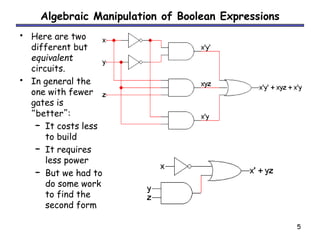
• Here are two 
different but 
equivalent 
circuits. 
• In general the 
one with fewer 
gates is 
“better”: 
– It costs less 
to build 
– It requires 
less power 
– But we had to 
do some work 
to find the 
second form
Tabular Method of Minimization 
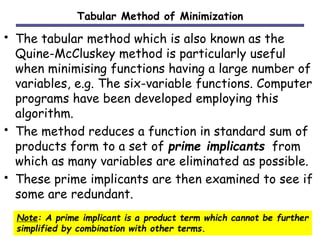
• The tabular method which is also known as the 
Quine-McCluskey method is particularly useful 
when minimising functions having a large number of 
variables, e.g. The six-variable functions. Computer 
programs have been developed employing this 
algorithm. 
• The method reduces a function in standard sum of 
products form to a set of prime implicants from 
which as many variables are eliminated as possible. 
• These prime implicants are then examined to see if 
some are redundant. 
Note: A prime implicant is a product term which cannot be further 
simplified by combination with other terms.
Tabular Method of Minimization 
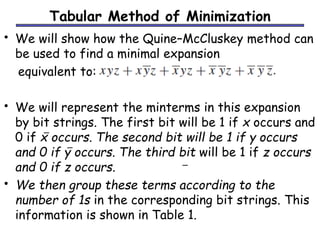
• We will show how the Quine–McCluskey method can 
be used to find a minimal expansion 
equivalent to: 
• We will represent the minterms in this expansion 
by bit strings. The first bit will be 1 if x occurs and 
0 if x occurs. The second bit will be 1 if y occurs 
and 0 if y occurs. The third bit will be 1 if z occurs 
and 0 if z occurs. 
• We then group these terms according to the 
number of 1s in the corresponding bit strings. This 
information is shown in Table 1.
Tabular Method of Minimization
Tabular Method of Minimization 
• Step 1: 
– Minterms that can be combined are those that differ in 
exactly one literal. Hence, two terms that can be 
combined differ by exactly one in the number of 1s in the 
bit strings that represent them. 
– When two minterms are combined into a product, this 
product contains two literals. A product in two literals is 
represented using a dash to denote the variable that 
does not occur. 
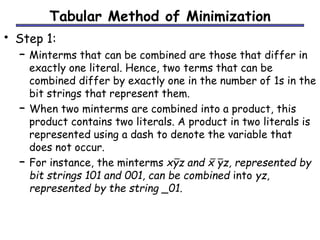
– For instance, the minterms xyz and x yz, represented by 
bit strings 101 and 001, can be combined into yz, 
represented by the string _01.
Tabular Method of Minimization 
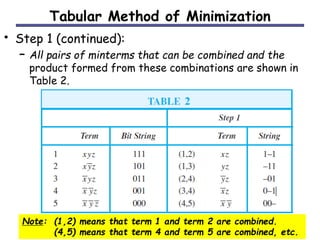
• Step 1 (continued): 
– All pairs of minterms that can be combined and the 
product formed from these combinations are shown in 
Table 2. 
Note: (1,2) means that term 1 and term 2 are combined. 
(4,5) means that term 4 and term 5 are combined, etc.
Tabular Method of Minimization 
• Step 2: 
– Next, all pairs of products of two literals that can be 
combined are combined into one literal. Two such 
products can be combined if they contain literals for the 
same two variables, and literals for only one of the two 
variables differ. 
– In terms of the strings representing the products, these 
strings must have a dash in the same position and must 
differ in exactly one of the other two slots. 
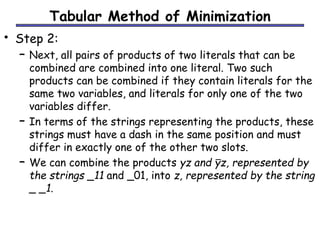
– We can combine the products yz and yz, represented by 
the strings _11 and _01, into z, represented by the string 
_ _1.
Tabular Method of Minimization 
• Step 2 (continued): 
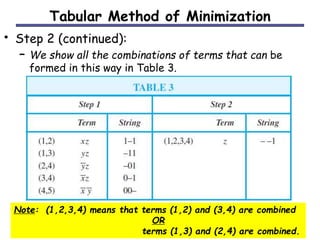
– We show all the combinations of terms that can be 
formed in this way in Table 3. 
Note: (1,2,3,4) means that terms (1,2) and (3,4) are combined 
OR 
terms (1,3) and (2,4) are combined.
Tabular Method of Minimization 
• Step 3: 
– In Table 3 we also indicate which terms have been used 
to form products with fewer literals; these terms will not 
be needed in a minimal expansion. 
– The next step is to identify a minimal set of products 
needed to represent the Boolean function. 
– We begin with all those products that were not used to 
construct products with fewer literals.
Tabular Method of Minimization 
• Step 3: 
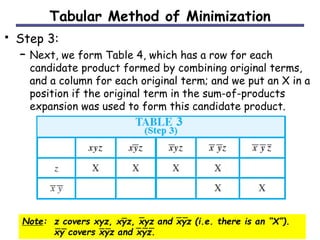
– Next, we form Table 4, which has a row for each 
candidate product formed by combining original terms, 
and a column for each original term; and we put an X in a 
position if the original term in the sum-of-products 
expansion was used to form this candidate product. 
Note: z covers xyz, xyz, xyz and xyz (i.e. there is an “X”). 
xy covers xyz and xyz.
Tabular Method of Minimization 
• Step 3 (continued): 
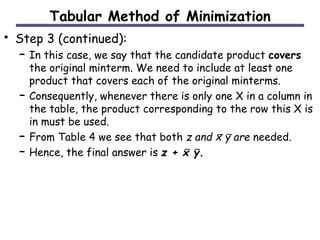
– In this case, we say that the candidate product covers 
the original minterm. We need to include at least one 
product that covers each of the original minterms. 
– Consequently, whenever there is only one X in a column in 
the table, the product corresponding to the row this X is 
in must be used. 
– From Table 4 we see that both z and x y are needed. 
– Hence, the final answer is z + x y.
Karnaugh Maps 
• So far we can see that applying Boolean algebra can 
be awkward in order to simplify expressions. 
• Apart from being laborious (and requiring the 
remembering all the laws) the method can lead to 
solutions which, though they appear minimal, are 
not. 
• The Karnaugh map provides a simple and straight-forward 
method of minimising boolean expressions. 
• With the Karnaugh map Boolean expressions having 
up to four and even six variables can be simplified.
Karnaugh Maps 
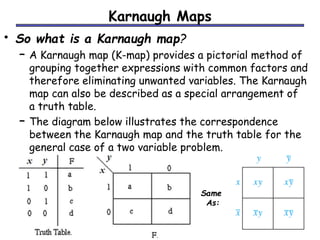
• So what is a Karnaugh map? 
– A Karnaugh map (K-map) provides a pictorial method of 
grouping together expressions with common factors and 
therefore eliminating unwanted variables. The Karnaugh 
map can also be described as a special arrangement of 
a truth table. 
– The diagram below illustrates the correspondence 
between the Karnaugh map and the truth table for the 
general case of a two variable problem. 
Same 
As:
Karnaugh Maps 
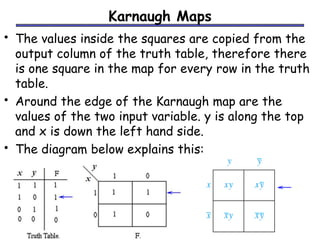
• The values inside the squares are copied from the 
output column of the truth table, therefore there 
is one square in the map for every row in the truth 
table. 
• Around the edge of the Karnaugh map are the 
values of the two input variable. y is along the top 
and x is down the left hand side. 
• The diagram below explains this:
Karnaugh Maps (K-maps) 
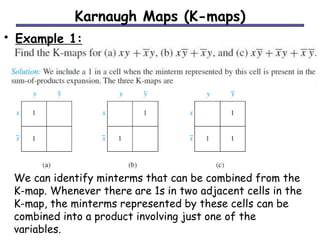
• Example 1: 
We can identify minterms that can be combined from the 
K-map. Whenever there are 1s in two adjacent cells in the 
K-map, the minterms represented by these cells can be 
combined into a product involving just one of the 
variables.
Karnaugh Maps (K-maps) 
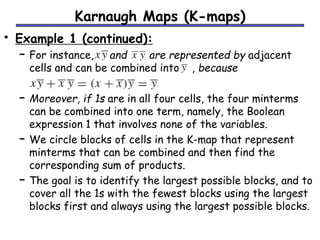
• Example 1 (continued): 
– For instance, and are represented by adjacent 
cells and can be combined into , because 
– Moreover, if 1s are in all four cells, the four minterms 
can be combined into one term, namely, the Boolean 
expression 1 that involves none of the variables. 
– We circle blocks of cells in the K-map that represent 
minterms that can be combined and then find the 
corresponding sum of products. 
– The goal is to identify the largest possible blocks, and to 
cover all the 1s with the fewest blocks using the largest 
blocks first and always using the largest possible blocks.
Karnaugh Maps (K-maps) 
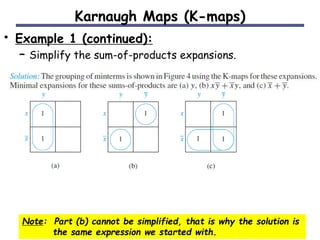
• Example 1 (continued): 
– Simplify the sum-of-products expansions. 
Note: Part (b) cannot be simplified, that is why the solution is 
the same expression we started with.
Karnaugh Maps (K-maps) 
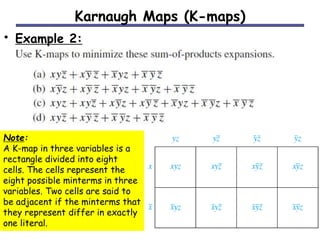
• Example 2: 
Note: 
A K-map in three variables is a 
rectangle divided into eight 
cells. The cells represent the 
eight possible minterms in three 
variables. Two cells are said to 
be adjacent if the minterms that 
they represent differ in exactly 
one literal.
Karnaugh Maps (K-maps) 
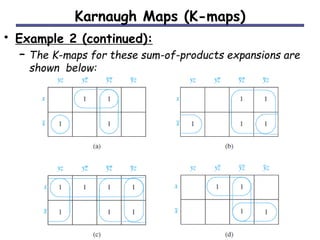
• Example 2 (continued): 
– The K-maps for these sum-of-products expansions are 
shown below:
Karnaugh Maps (K-maps) 
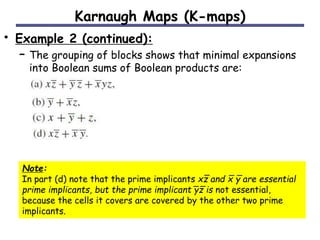
• Example 2 (continued): 
– The grouping of blocks shows that minimal expansions 
into Boolean sums of Boolean products are: 
Note: 
In part (d) note that the prime implicants xz and x y are essential 
prime implicants, but the prime implicant yz is not essential, 
because the cells it covers are covered by the other two prime 
implicants.

Minimization of Boolean Functions

  • 1.
  • 2.
    What is Minimization? • In mathematics, expressions are simplified for a number of reasons, for instance simpler expression are easier to understand and easier to write down, they are also less prone to error in interpretation but, most importantly, simplified expressions are usually more efficient and effective when implemented in practice. • A Boolean expression is composed of variables and terms. The simplification of Boolean expressions can lead to more effective computer programs, algorithms and circuits.
  • 3.
    What is Minimization? • Minimisation can be achieved by a number of methods, three well known methods are: 1. Algebraic Manipulation of Boolean Expressions 2. Tabular Method of Minimization 3. Karnaugh Maps
  • 4.
    4 Algebraic Manipulationof Boolean Expressions • We can now start doing some simplifications x’y’ + xyz + x’y = x’(y’ + y) + xyz [ Distributive: x’y’ + x’y = x’(y’ + y) ] = x’1 + xyz [ complement: x’ + x = 1 ] = x’ + xyz [ identity: x’1 = x’ ] = (x’ + x)(x’ + yz) [ Distributive ] = 1  (x’ + yz) [ complement: x’ + x = 1 ] = x’ + yz [ identity]
  • 5.
    5 Algebraic Manipulationof Boolean Expressions • Here are two different but equivalent circuits. • In general the one with fewer gates is “better”: – It costs less to build – It requires less power – But we had to do some work to find the second form
  • 6.
    Tabular Method ofMinimization • The tabular method which is also known as the Quine-McCluskey method is particularly useful when minimising functions having a large number of variables, e.g. The six-variable functions. Computer programs have been developed employing this algorithm. • The method reduces a function in standard sum of products form to a set of prime implicants from which as many variables are eliminated as possible. • These prime implicants are then examined to see if some are redundant. Note: A prime implicant is a product term which cannot be further simplified by combination with other terms.
  • 7.
    Tabular Method ofMinimization • We will show how the Quine–McCluskey method can be used to find a minimal expansion equivalent to: • We will represent the minterms in this expansion by bit strings. The first bit will be 1 if x occurs and 0 if x occurs. The second bit will be 1 if y occurs and 0 if y occurs. The third bit will be 1 if z occurs and 0 if z occurs. • We then group these terms according to the number of 1s in the corresponding bit strings. This information is shown in Table 1.
  • 8.
    Tabular Method ofMinimization
  • 9.
    Tabular Method ofMinimization • Step 1: – Minterms that can be combined are those that differ in exactly one literal. Hence, two terms that can be combined differ by exactly one in the number of 1s in the bit strings that represent them. – When two minterms are combined into a product, this product contains two literals. A product in two literals is represented using a dash to denote the variable that does not occur. – For instance, the minterms xyz and x yz, represented by bit strings 101 and 001, can be combined into yz, represented by the string _01.
  • 10.
    Tabular Method ofMinimization • Step 1 (continued): – All pairs of minterms that can be combined and the product formed from these combinations are shown in Table 2. Note: (1,2) means that term 1 and term 2 are combined. (4,5) means that term 4 and term 5 are combined, etc.
  • 11.
    Tabular Method ofMinimization • Step 2: – Next, all pairs of products of two literals that can be combined are combined into one literal. Two such products can be combined if they contain literals for the same two variables, and literals for only one of the two variables differ. – In terms of the strings representing the products, these strings must have a dash in the same position and must differ in exactly one of the other two slots. – We can combine the products yz and yz, represented by the strings _11 and _01, into z, represented by the string _ _1.
  • 12.
    Tabular Method ofMinimization • Step 2 (continued): – We show all the combinations of terms that can be formed in this way in Table 3. Note: (1,2,3,4) means that terms (1,2) and (3,4) are combined OR terms (1,3) and (2,4) are combined.
  • 13.
    Tabular Method ofMinimization • Step 3: – In Table 3 we also indicate which terms have been used to form products with fewer literals; these terms will not be needed in a minimal expansion. – The next step is to identify a minimal set of products needed to represent the Boolean function. – We begin with all those products that were not used to construct products with fewer literals.
  • 14.
    Tabular Method ofMinimization • Step 3: – Next, we form Table 4, which has a row for each candidate product formed by combining original terms, and a column for each original term; and we put an X in a position if the original term in the sum-of-products expansion was used to form this candidate product. Note: z covers xyz, xyz, xyz and xyz (i.e. there is an “X”). xy covers xyz and xyz.
  • 15.
    Tabular Method ofMinimization • Step 3 (continued): – In this case, we say that the candidate product covers the original minterm. We need to include at least one product that covers each of the original minterms. – Consequently, whenever there is only one X in a column in the table, the product corresponding to the row this X is in must be used. – From Table 4 we see that both z and x y are needed. – Hence, the final answer is z + x y.
  • 16.
    Karnaugh Maps •So far we can see that applying Boolean algebra can be awkward in order to simplify expressions. • Apart from being laborious (and requiring the remembering all the laws) the method can lead to solutions which, though they appear minimal, are not. • The Karnaugh map provides a simple and straight-forward method of minimising boolean expressions. • With the Karnaugh map Boolean expressions having up to four and even six variables can be simplified.
  • 17.
    Karnaugh Maps •So what is a Karnaugh map? – A Karnaugh map (K-map) provides a pictorial method of grouping together expressions with common factors and therefore eliminating unwanted variables. The Karnaugh map can also be described as a special arrangement of a truth table. – The diagram below illustrates the correspondence between the Karnaugh map and the truth table for the general case of a two variable problem. Same As:
  • 18.
    Karnaugh Maps •The values inside the squares are copied from the output column of the truth table, therefore there is one square in the map for every row in the truth table. • Around the edge of the Karnaugh map are the values of the two input variable. y is along the top and x is down the left hand side. • The diagram below explains this:
  • 19.
    Karnaugh Maps (K-maps) • Example 1: We can identify minterms that can be combined from the K-map. Whenever there are 1s in two adjacent cells in the K-map, the minterms represented by these cells can be combined into a product involving just one of the variables.
  • 20.
    Karnaugh Maps (K-maps) • Example 1 (continued): – For instance, and are represented by adjacent cells and can be combined into , because – Moreover, if 1s are in all four cells, the four minterms can be combined into one term, namely, the Boolean expression 1 that involves none of the variables. – We circle blocks of cells in the K-map that represent minterms that can be combined and then find the corresponding sum of products. – The goal is to identify the largest possible blocks, and to cover all the 1s with the fewest blocks using the largest blocks first and always using the largest possible blocks.
  • 21.
    Karnaugh Maps (K-maps) • Example 1 (continued): – Simplify the sum-of-products expansions. Note: Part (b) cannot be simplified, that is why the solution is the same expression we started with.
  • 22.
    Karnaugh Maps (K-maps) • Example 2: Note: A K-map in three variables is a rectangle divided into eight cells. The cells represent the eight possible minterms in three variables. Two cells are said to be adjacent if the minterms that they represent differ in exactly one literal.
  • 23.
    Karnaugh Maps (K-maps) • Example 2 (continued): – The K-maps for these sum-of-products expansions are shown below:
  • 24.
    Karnaugh Maps (K-maps) • Example 2 (continued): – The grouping of blocks shows that minimal expansions into Boolean sums of Boolean products are: Note: In part (d) note that the prime implicants xz and x y are essential prime implicants, but the prime implicant yz is not essential, because the cells it covers are covered by the other two prime implicants.