By  Ms. Nita Arora, PGT Computer Science Kulachi Hansraj Model  School e -Lesson
Subject  : Computer Science (083)   Unit  : Boolean Algebra Topic  :  Minimization of Boolean  Expressions Using       Karnaugh Maps (K-Maps) Category : Senior Secondary Class  : XII
L earning  O bjectives :  After successfully completing this module students should be able to: Understand the  Need to simplify (minimize)  expressions List Different Methods for Minimization Karnaugh Maps Algebraic method Use Karnaugh Map  method to minimize the Boolean expression
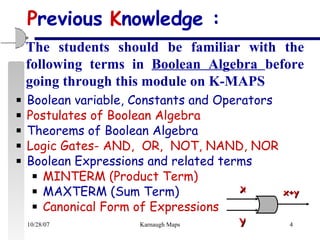
P revious  K nowledge :  The students should be familiar with the following terms in  Boolean Algebra  before going through this module on K-MAPS Boolean variable, Constants and Operators Postulates of Boolean Algebra Theorems of Boolean Algebra Logic Gates- AND,  OR,  NOT, NAND, NOR Boolean Expressions and related terms MINTERM (Product Term) MAXTERM (Sum Term) Canonical Form of Expressions x y x+y
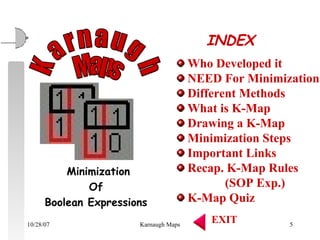
Minimization Of Boolean Expressions Who Developed it  NEED For Minimization Different Methods   What is K-Map   Drawing a K-Map Minimization Steps   Important Links Recap . K-Map Rules (SOP Exp.) K-Map Quiz EXIT Karnaugh Maps INDEX
References  For K-Map Minimizer Download http:// karnaugh.shuriksoft.com Thomas C. Bartee, DIGITAL COMPUTER FUNDAMENTALS,  McGraw Hill International. Computer Science (Class XII) By Sumita Arora http://www.ee.surrey.ac.uk/Projects/Labview/minimisation/karrules.html
The End
Boolean expressions  are practically implemented in the form of GATES (Circuits). A minimized Boolean expression means less number of gates which means  Simplified Circuit M INIMIZATION  OF  B OOLEAN  E XPRESSION WHY   we  Need  to simplify (minimize) expressions?
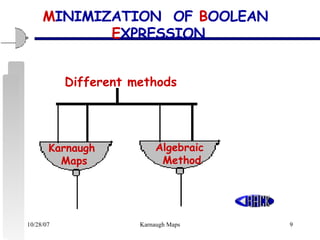
M INIMIZATION  OF  B OOLEAN  E XPRESSION Different methods Karnaugh  Maps Algebraic  Method
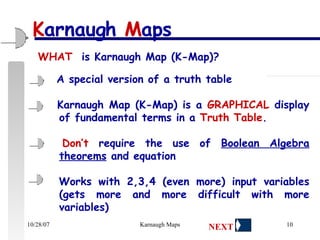
K arnaugh  M aps WHAT  is Karnaugh Map (K-Map)? A special version of a truth table Karnaugh Map (K-Map) is a  GRAPHICAL  display of fundamental terms in a  Truth Table . Don’t  require the use of  Boolean Algebra theorems  and equation Works with 2,3,4 (even more) input variables (gets more and more difficult with more variables) NEXT
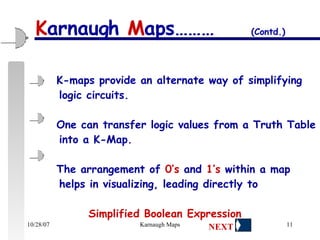
K-maps provide an alternate way of simplifying logic circuits. One can transfer logic values from a Truth Table into a K-Map. The arrangement of  0’s  and  1’s  within a map helps in visualizing, leading directly to    Simplified Boolean Expression K arnaugh  M aps……… (Contd.) NEXT
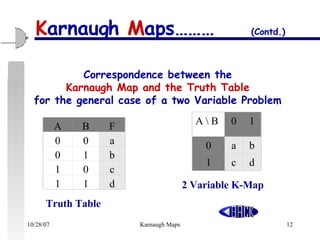
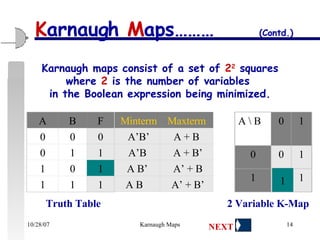
Correspondence between the  Karnaugh Map and the Truth Table   for the general case of a two Variable Problem  Truth Table 2 Variable K-Map K arnaugh  M aps……… (Contd.) A B 0 0 0 1 1 0 1 1 F a b c d A \ B  0 1 0 a b 1 c d The diagram below illustrates the correspondence between the Karnaugh map and the truth table for the general case of a two variable problem.  Truth Table Karnaugh Map A \ B  0 1 0 a b 1 c d
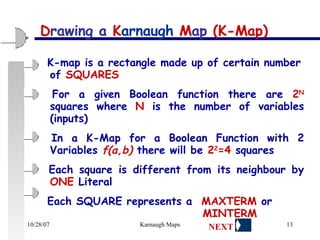
D rawing a  K arnaugh   M ap  (K-Map)   K-map is a rectangle made up of certain number of   SQUARES For a given Boolean function there are  2 N  squares where  N  is the number of variables (inputs)  In a K-Map for a Boolean Function with 2 Variables  f(a,b)   there will be  2 2 =4  squares Each square is different from its neighbour by  ONE  Literal Each SQUARE represents a   MAXTERM   or    MINTERM NEXT
Karnaugh maps consist of a set of  2 2  squares where  2  is the number of variables  in the Boolean expression being minimized. Truth Table 2 Variable K-Map K arnaugh  M aps……… (Contd.) 1 The diagram below illustrates the correspondence between the Karnaugh map and the truth table for the general case of a two variable problem.  Truth Table Karnaugh Map A \ B  0 1 0 0 1 1 1 1 A B F 0 0 0 0 1 1 1 0 1 1 1 1 Minterm A’B’ A’B A B’  A B Maxterm A + B A + B’ A’ + B A’ + B’ NEXT
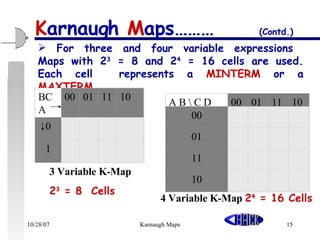
For three and four variable expressions  Maps with 2 3  = 8 and 2 4  = 16 cells are used. Each cell  represents a  MINTERM  or a  MAXTERM   4 Variable K-Map  2 4  = 16 Cells K arnaugh  M aps……… (Contd.) 3 Variable K-Map  2 3  = 8  Cells The diagram below illustrates the correspondence between the Karnaugh map and the truth table for the general case of a two variable problem.  Truth Table Karnaugh Map BC A 00 01 11 10 0 1 A B \ C D  00 01 11 10 00 01 11 10
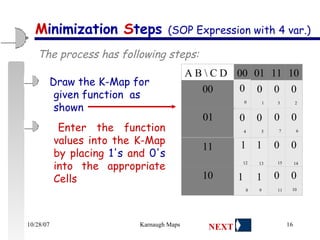
M inimization  S teps  (SOP Expression with 4 var.) The process has following steps:  Draw the K-Map for given function  as shown Enter the function values into the K-Map by placing  1's  and  0's  into the appropriate Cells 1 1 1 1 A B \ C D  00 01 11 10 00 0 0 0 1 0 3 0 2 01 0 0 0 0 11 1 1 0 0 10 1 1 0 0 0 5 0 4 0 7 0 6 0 0 12 13 15 14 8 9 11 10 NEXT
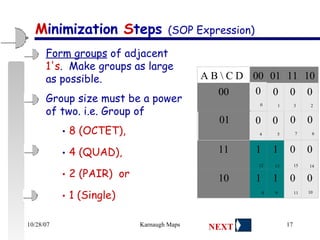
M inimization  S teps  (SOP Expression) Form groups  of adjacent  1's .  Make groups as large as possible. Group size must be a power of two. i.e. Group of  8 (OCTET), 4 (QUAD),    2 (PAIR)  or    1 (Single) NEXT A B \ C D  00 01 11 10 00 0 0 0 1 0 3 0 2 01 0 0 0 0 11 1 1 0 0 10 1 1 0 0 0 5 0 4 0 7 0 6 0 0 12 13 15 14 8 9 11 10
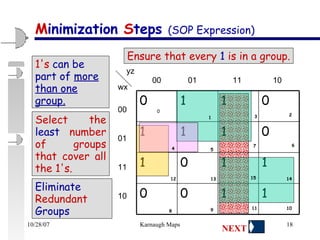
M inimization  S teps  (SOP Expression) Select the  least  number of groups that cover all the 1's.  Ensure that every  1  is in a group. 1's  can be  part of  more than one   group.   Eliminate  Redundant  Groups 1 1 0 0 1 1 0 1 0 1 1 1 0 1 1 0  0 wx yz 00  01  11  10 00 01 11 10 3 2 4 5 7 6 1 12 13 15 14 8 9 11 10 NEXT
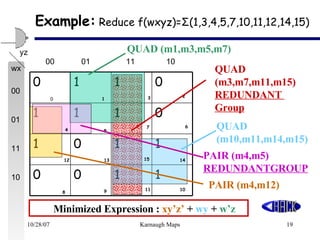
Example:  Reduce f(wxyz)=Σ(1,3,4,5,7,10,11,12,14,15) PAIR (m4,m5) REDUNDANTGROUP 1 1 0 0 1 1 0 1 0 1 1 1 0 1 1 0  0 wx yz 00  01  11  10 00 01 11 10 3 2 4 5 7 6 1 12 13 15 14 8 9 11 10 QUAD (m1,m3,m5,m7) QUAD (m10,m11,m14,m15) QUAD (m3,m7,m11,m15) REDUNDANT  Group PAIR (m4,m12) Minimized Expression :  xy’z’  +   wy  +   w’z
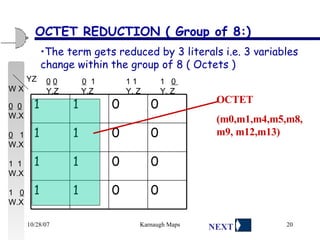
OCTET REDUCTION ( Group of 8:) OCTET (m0,m1,m4,m5,m8, m9, m12,m13) The term gets reduced by 3 literals i.e. 3 variables change within the group of 8 ( Octets ) 0 0 1 1 0 0 1 1 0 0 1 1 0 0 1 1 W X YZ 0   0   0   1   1 1   1  0  Y.Z  Y.Z    Y. Z   Y. Z 0   0 W.X 0   1 W.X 1  1 W.X 1  0 W.X NEXT
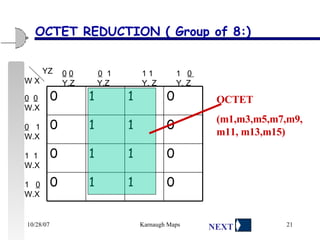
OCTET REDUCTION ( Group of 8:) OCTET (m1,m3,m5,m7,m9, m11, m13,m15) 0 1 1 0 0 1 1 0 0 1 1 0 0 1 1 0 W X YZ 0   0   0   1   1 1   1  0  Y.Z  Y.Z    Y. Z   Y. Z 0   0 W.X 0   1 W.X 1  1 W.X 1  0 W.X NEXT
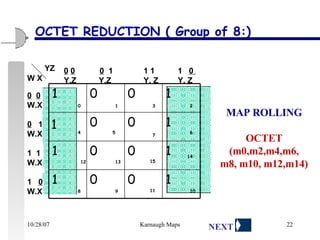
OCTET REDUCTION ( Group of 8:) MAP ROLLING OCTET (m0,m2,m4,m6, m8, m10, m12,m14) 1 0 0 1 1 0 0 1 1 0 0 1 1 0 0 1 W X YZ 0   0   0   1   1 1   1  0  Y.Z  Y.Z    Y. Z   Y. Z 0   0 W.X 0   1 W.X 1  1 W.X 1  0 W.X 0 1 3 2 4 5 7 6 12 13 15 14 8 9 11 10 NEXT
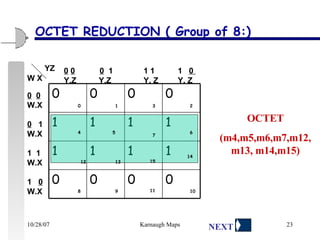
OCTET REDUCTION ( Group of 8:) OCTET (m4,m5,m6,m7,m12, m13, m14,m15) 0 0 0 0 1 1 1 1 1 1 1 1 0 0 0 0 W X YZ 0   0   0   1   1 1   1  0  Y.Z  Y.Z    Y. Z   Y. Z 0   0 W.X 0   1 W.X 1  1 W.X 1  0 W.X 0 1 3 2 4 5 7 6 12 13 15 14 8 9 11 10 NEXT
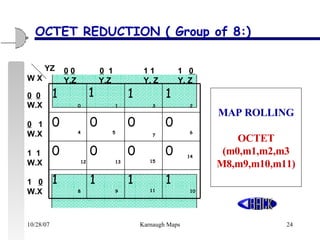
OCTET REDUCTION ( Group of 8:) MAP ROLLING OCTET (m0,m1,m2,m3 M8,m9,m10,m11) 1 1 1 1 0 0 0 0 0 0 0 0 1 1 1 1 W X YZ 0   0   0   1   1 1   1  0  Y.Z  Y.Z    Y. Z   Y. Z 0   0 W.X 0   1 W.X 1  1 W.X 1  0 W.X 0 1 3 2 4 5 7 6 12 13 15 14 8 9 11 10
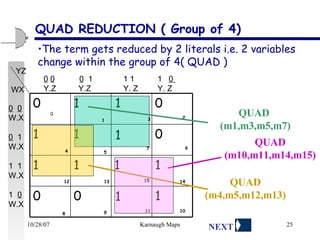
QUAD REDUCTION ( Group of 4) 1 1 0 0 1 1 1 1 0 1 1 1 0 1 1 0  0 WX YZ 3 2 4 5 7 6 1 12 13 15 14 8 9 11 10 QUAD  (m1,m3,m5,m7) QUAD (m10,m11,m14,m15) QUAD (m4,m5,m12,m13) 0   0   0   1   1 1   1  0  Y.Z  Y.Z    Y. Z   Y. Z 0   0 W.X 0   1 W.X 1  1 W.X 1  0 W.X The term gets reduced by 2 literals i.e. 2 variables change within the group of 4( QUAD ) NEXT
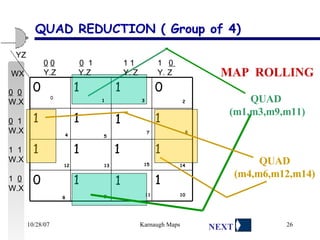
QUAD REDUCTION ( Group of 4) MAP  ROLLING QUAD  (m1,m3,m9,m11) QUAD (m4,m6,m12,m14) 1 1 1 0 1 1 1 1 1 1 1 1 0 1 1 0  0 WX YZ 3 2 4 5 7 6 1 12 13 15 14 8 9 11 10 0   0   0   1   1 1   1  0  Y.Z  Y.Z    Y. Z   Y. Z 0   0 W.X 0   1 W.X 1  1 W.X 1  0 W.X NEXT
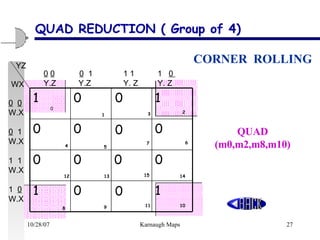
QUAD REDUCTION ( Group of 4) QUAD (m0,m2,m8,m10) CORNER  ROLLING 1 0 0 1 0 0 0 0 0 0 0 0 1 0 0 1  0 WX YZ 3 2 4 5 7 6 1 12 13 15 14 8 9 11 10 0   0   0   1   1 1   1  0  Y.Z  Y.Z    Y. Z   Y. Z 0   0 W.X 0   1 W.X 1  1 W.X 1  0 W.X
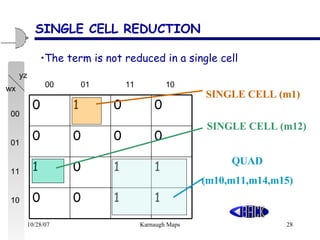
SINGLE CELL REDUCTION  SINGLE CELL (m1) SINGLE CELL (m12) QUAD (m10,m11,m14,m15) The term is not reduced in a single cell 1 1 0 0 1 1 0 1 0 0 0 0 0 0 1 0 wx yz 00  01  11  10 00 01 11 10
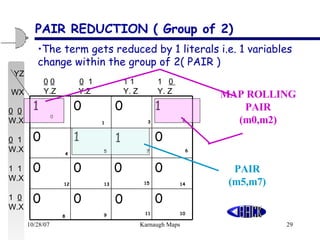
PAIR REDUCTION ( Group of 2) YZ MAP ROLLING PAIR (m0,m2) The term gets reduced by 1 literals i.e. 1 variables change within the group of 2( PAIR ) 0 0 0 0 0 0 0 0 0 1 1 0 1 0 0 1  0 WX 3 2 4 5 7 6 1 12 13 15 14 8 9 11 10 PAIR (m5,m7) 0   0   0   1   1 1   1  0  Y.Z  Y.Z    Y. Z   Y. Z 0   0 W.X 0   1 W.X 1  1 W.X 1  0 W.X
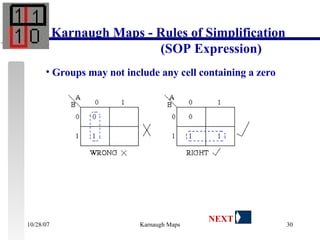
Groups may not include any cell containing a zero                                                                  Karnaugh Maps - Rules of Simplification   (SOP Expression) NEXT
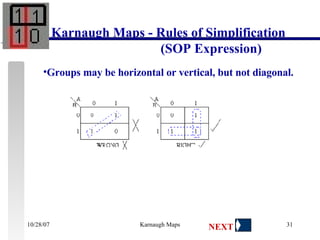
Groups may be horizontal or vertical, but not diagonal.                                       Karnaugh Maps - Rules of Simplification   (SOP Expression) NEXT
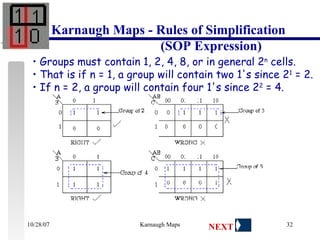
Groups must contain 1, 2, 4, 8, or in general 2 n  cells.  That is if n = 1, a group will contain two 1's since 2 1  = 2. If n = 2, a group will contain four 1's since 2 2  = 4.                                                                                       Karnaugh Maps - Rules of Simplification   (SOP Expression) NEXT
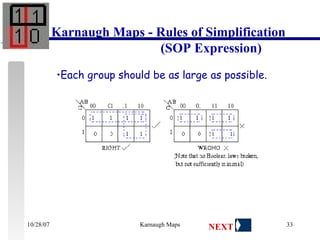
Each group should be as large as possible.                                                                              Karnaugh Maps - Rules of Simplification   (SOP Expression) NEXT
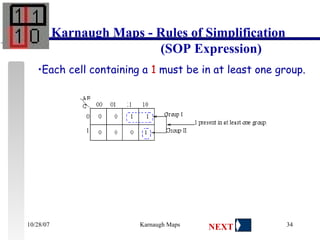
Each cell containing a  1  must be in at least one group.                                                                               Karnaugh Maps - Rules of Simplification   (SOP Expression) NEXT
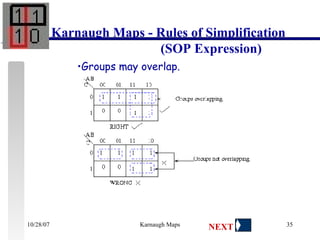
Groups may overlap.                                                                        Karnaugh Maps - Rules of Simplification   (SOP Expression) NEXT
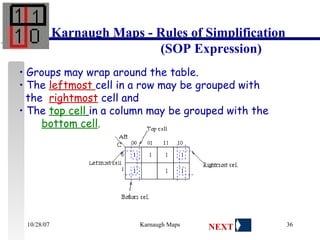
Groups may wrap around the table.  The  leftmost  cell in a row may be grouped with the  rightmost  cell and  The  top cell   in a column may be grouped with the  bottom cell .                                                                Karnaugh Maps - Rules of Simplification   (SOP Expression) NEXT
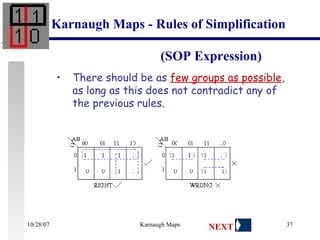
There should be as  few groups as possible , as long as this does not contradict any of the previous rules.                                                                        Karnaugh Maps - Rules of Simplification   (SOP Expression) NEXT
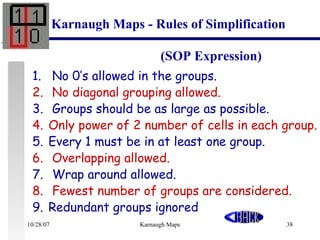
No 0’s allowed in the groups.  No diagonal grouping allowed. Groups should be as large as possible.  Only power of 2 number of cells in each group.  Every 1 must be in at least one group.  Overlapping allowed.  Wrap around allowed.  Fewest number of groups are considered.  Redundant groups ignored Karnaugh Maps - Rules of Simplification   (SOP Expression)
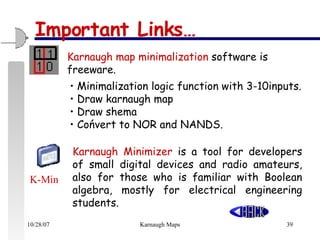
Minimalization logic function with 3-10inputs. Draw karnaugh map Draw shema Cońvert to NOR and NANDS.  Karnaugh map minimalization  software is freeware.  Important Links… K-Min Karnaugh Minimizer  is a tool for developers of small digital devices and radio amateurs, also for those who is familiar with Boolean algebra, mostly for electrical engineering students.
Who Developed K-Maps… Name :  Maurice Karnaugh, a telecommunications engineer at Bell Labs.  While designing digital logic based telephone switching circuits he developed a method for Boolean expression minimization.  Year  :  1950   same year that Charles M. Schulz published his first Peanuts comic.

Kmaps By Ms Nita Arora

  • 1.
    By Ms.Nita Arora, PGT Computer Science Kulachi Hansraj Model School e -Lesson
  • 2.
    Subject :Computer Science (083) Unit : Boolean Algebra Topic : Minimization of Boolean Expressions Using Karnaugh Maps (K-Maps) Category : Senior Secondary Class : XII
  • 3.
    L earning O bjectives : After successfully completing this module students should be able to: Understand the Need to simplify (minimize) expressions List Different Methods for Minimization Karnaugh Maps Algebraic method Use Karnaugh Map method to minimize the Boolean expression
  • 4.
    P revious K nowledge : The students should be familiar with the following terms in Boolean Algebra before going through this module on K-MAPS Boolean variable, Constants and Operators Postulates of Boolean Algebra Theorems of Boolean Algebra Logic Gates- AND, OR, NOT, NAND, NOR Boolean Expressions and related terms MINTERM (Product Term) MAXTERM (Sum Term) Canonical Form of Expressions x y x+y
  • 5.
    Minimization Of BooleanExpressions Who Developed it NEED For Minimization Different Methods What is K-Map Drawing a K-Map Minimization Steps Important Links Recap . K-Map Rules (SOP Exp.) K-Map Quiz EXIT Karnaugh Maps INDEX
  • 6.
    References ForK-Map Minimizer Download http:// karnaugh.shuriksoft.com Thomas C. Bartee, DIGITAL COMPUTER FUNDAMENTALS, McGraw Hill International. Computer Science (Class XII) By Sumita Arora http://www.ee.surrey.ac.uk/Projects/Labview/minimisation/karrules.html
  • 7.
  • 8.
    Boolean expressions are practically implemented in the form of GATES (Circuits). A minimized Boolean expression means less number of gates which means Simplified Circuit M INIMIZATION OF B OOLEAN E XPRESSION WHY we Need to simplify (minimize) expressions?
  • 9.
    M INIMIZATION OF B OOLEAN E XPRESSION Different methods Karnaugh Maps Algebraic Method
  • 10.
    K arnaugh M aps WHAT is Karnaugh Map (K-Map)? A special version of a truth table Karnaugh Map (K-Map) is a GRAPHICAL display of fundamental terms in a Truth Table . Don’t require the use of Boolean Algebra theorems and equation Works with 2,3,4 (even more) input variables (gets more and more difficult with more variables) NEXT
  • 11.
    K-maps provide analternate way of simplifying logic circuits. One can transfer logic values from a Truth Table into a K-Map. The arrangement of 0’s and 1’s within a map helps in visualizing, leading directly to Simplified Boolean Expression K arnaugh M aps……… (Contd.) NEXT
  • 12.
    Correspondence between the Karnaugh Map and the Truth Table for the general case of a two Variable Problem Truth Table 2 Variable K-Map K arnaugh M aps……… (Contd.) A B 0 0 0 1 1 0 1 1 F a b c d A \ B 0 1 0 a b 1 c d The diagram below illustrates the correspondence between the Karnaugh map and the truth table for the general case of a two variable problem. Truth Table Karnaugh Map A \ B 0 1 0 a b 1 c d
  • 13.
    D rawing a K arnaugh M ap (K-Map) K-map is a rectangle made up of certain number of SQUARES For a given Boolean function there are 2 N squares where N is the number of variables (inputs) In a K-Map for a Boolean Function with 2 Variables f(a,b) there will be 2 2 =4 squares Each square is different from its neighbour by ONE Literal Each SQUARE represents a MAXTERM or MINTERM NEXT
  • 14.
    Karnaugh maps consistof a set of 2 2 squares where 2 is the number of variables in the Boolean expression being minimized. Truth Table 2 Variable K-Map K arnaugh M aps……… (Contd.) 1 The diagram below illustrates the correspondence between the Karnaugh map and the truth table for the general case of a two variable problem. Truth Table Karnaugh Map A \ B 0 1 0 0 1 1 1 1 A B F 0 0 0 0 1 1 1 0 1 1 1 1 Minterm A’B’ A’B A B’ A B Maxterm A + B A + B’ A’ + B A’ + B’ NEXT
  • 15.
    For three andfour variable expressions Maps with 2 3 = 8 and 2 4 = 16 cells are used. Each cell represents a MINTERM or a MAXTERM 4 Variable K-Map 2 4 = 16 Cells K arnaugh M aps……… (Contd.) 3 Variable K-Map 2 3 = 8 Cells The diagram below illustrates the correspondence between the Karnaugh map and the truth table for the general case of a two variable problem. Truth Table Karnaugh Map BC A 00 01 11 10 0 1 A B \ C D 00 01 11 10 00 01 11 10
  • 16.
    M inimization S teps (SOP Expression with 4 var.) The process has following steps: Draw the K-Map for given function as shown Enter the function values into the K-Map by placing 1's and 0's into the appropriate Cells 1 1 1 1 A B \ C D 00 01 11 10 00 0 0 0 1 0 3 0 2 01 0 0 0 0 11 1 1 0 0 10 1 1 0 0 0 5 0 4 0 7 0 6 0 0 12 13 15 14 8 9 11 10 NEXT
  • 17.
    M inimization S teps (SOP Expression) Form groups of adjacent 1's . Make groups as large as possible. Group size must be a power of two. i.e. Group of 8 (OCTET), 4 (QUAD), 2 (PAIR) or 1 (Single) NEXT A B \ C D 00 01 11 10 00 0 0 0 1 0 3 0 2 01 0 0 0 0 11 1 1 0 0 10 1 1 0 0 0 5 0 4 0 7 0 6 0 0 12 13 15 14 8 9 11 10
  • 18.
    M inimization S teps (SOP Expression) Select the least number of groups that cover all the 1's. Ensure that every 1 is in a group. 1's can be part of more than one group. Eliminate Redundant Groups 1 1 0 0 1 1 0 1 0 1 1 1 0 1 1 0 0 wx yz 00 01 11 10 00 01 11 10 3 2 4 5 7 6 1 12 13 15 14 8 9 11 10 NEXT
  • 19.
    Example: Reducef(wxyz)=Σ(1,3,4,5,7,10,11,12,14,15) PAIR (m4,m5) REDUNDANTGROUP 1 1 0 0 1 1 0 1 0 1 1 1 0 1 1 0 0 wx yz 00 01 11 10 00 01 11 10 3 2 4 5 7 6 1 12 13 15 14 8 9 11 10 QUAD (m1,m3,m5,m7) QUAD (m10,m11,m14,m15) QUAD (m3,m7,m11,m15) REDUNDANT Group PAIR (m4,m12) Minimized Expression : xy’z’ + wy + w’z
  • 20.
    OCTET REDUCTION (Group of 8:) OCTET (m0,m1,m4,m5,m8, m9, m12,m13) The term gets reduced by 3 literals i.e. 3 variables change within the group of 8 ( Octets ) 0 0 1 1 0 0 1 1 0 0 1 1 0 0 1 1 W X YZ 0 0 0 1 1 1 1 0 Y.Z Y.Z Y. Z Y. Z 0 0 W.X 0 1 W.X 1 1 W.X 1 0 W.X NEXT
  • 21.
    OCTET REDUCTION (Group of 8:) OCTET (m1,m3,m5,m7,m9, m11, m13,m15) 0 1 1 0 0 1 1 0 0 1 1 0 0 1 1 0 W X YZ 0 0 0 1 1 1 1 0 Y.Z Y.Z Y. Z Y. Z 0 0 W.X 0 1 W.X 1 1 W.X 1 0 W.X NEXT
  • 22.
    OCTET REDUCTION (Group of 8:) MAP ROLLING OCTET (m0,m2,m4,m6, m8, m10, m12,m14) 1 0 0 1 1 0 0 1 1 0 0 1 1 0 0 1 W X YZ 0 0 0 1 1 1 1 0 Y.Z Y.Z Y. Z Y. Z 0 0 W.X 0 1 W.X 1 1 W.X 1 0 W.X 0 1 3 2 4 5 7 6 12 13 15 14 8 9 11 10 NEXT
  • 23.
    OCTET REDUCTION (Group of 8:) OCTET (m4,m5,m6,m7,m12, m13, m14,m15) 0 0 0 0 1 1 1 1 1 1 1 1 0 0 0 0 W X YZ 0 0 0 1 1 1 1 0 Y.Z Y.Z Y. Z Y. Z 0 0 W.X 0 1 W.X 1 1 W.X 1 0 W.X 0 1 3 2 4 5 7 6 12 13 15 14 8 9 11 10 NEXT
  • 24.
    OCTET REDUCTION (Group of 8:) MAP ROLLING OCTET (m0,m1,m2,m3 M8,m9,m10,m11) 1 1 1 1 0 0 0 0 0 0 0 0 1 1 1 1 W X YZ 0 0 0 1 1 1 1 0 Y.Z Y.Z Y. Z Y. Z 0 0 W.X 0 1 W.X 1 1 W.X 1 0 W.X 0 1 3 2 4 5 7 6 12 13 15 14 8 9 11 10
  • 25.
    QUAD REDUCTION (Group of 4) 1 1 0 0 1 1 1 1 0 1 1 1 0 1 1 0 0 WX YZ 3 2 4 5 7 6 1 12 13 15 14 8 9 11 10 QUAD (m1,m3,m5,m7) QUAD (m10,m11,m14,m15) QUAD (m4,m5,m12,m13) 0 0 0 1 1 1 1 0 Y.Z Y.Z Y. Z Y. Z 0 0 W.X 0 1 W.X 1 1 W.X 1 0 W.X The term gets reduced by 2 literals i.e. 2 variables change within the group of 4( QUAD ) NEXT
  • 26.
    QUAD REDUCTION (Group of 4) MAP ROLLING QUAD (m1,m3,m9,m11) QUAD (m4,m6,m12,m14) 1 1 1 0 1 1 1 1 1 1 1 1 0 1 1 0 0 WX YZ 3 2 4 5 7 6 1 12 13 15 14 8 9 11 10 0 0 0 1 1 1 1 0 Y.Z Y.Z Y. Z Y. Z 0 0 W.X 0 1 W.X 1 1 W.X 1 0 W.X NEXT
  • 27.
    QUAD REDUCTION (Group of 4) QUAD (m0,m2,m8,m10) CORNER ROLLING 1 0 0 1 0 0 0 0 0 0 0 0 1 0 0 1 0 WX YZ 3 2 4 5 7 6 1 12 13 15 14 8 9 11 10 0 0 0 1 1 1 1 0 Y.Z Y.Z Y. Z Y. Z 0 0 W.X 0 1 W.X 1 1 W.X 1 0 W.X
  • 28.
    SINGLE CELL REDUCTION SINGLE CELL (m1) SINGLE CELL (m12) QUAD (m10,m11,m14,m15) The term is not reduced in a single cell 1 1 0 0 1 1 0 1 0 0 0 0 0 0 1 0 wx yz 00 01 11 10 00 01 11 10
  • 29.
    PAIR REDUCTION (Group of 2) YZ MAP ROLLING PAIR (m0,m2) The term gets reduced by 1 literals i.e. 1 variables change within the group of 2( PAIR ) 0 0 0 0 0 0 0 0 0 1 1 0 1 0 0 1 0 WX 3 2 4 5 7 6 1 12 13 15 14 8 9 11 10 PAIR (m5,m7) 0 0 0 1 1 1 1 0 Y.Z Y.Z Y. Z Y. Z 0 0 W.X 0 1 W.X 1 1 W.X 1 0 W.X
  • 30.
    Groups may notinclude any cell containing a zero                                                              Karnaugh Maps - Rules of Simplification (SOP Expression) NEXT
  • 31.
    Groups may behorizontal or vertical, but not diagonal.                                     Karnaugh Maps - Rules of Simplification (SOP Expression) NEXT
  • 32.
    Groups must contain1, 2, 4, 8, or in general 2 n cells. That is if n = 1, a group will contain two 1's since 2 1 = 2. If n = 2, a group will contain four 1's since 2 2 = 4.                                                                                    Karnaugh Maps - Rules of Simplification (SOP Expression) NEXT
  • 33.
    Each group shouldbe as large as possible.                                                                           Karnaugh Maps - Rules of Simplification (SOP Expression) NEXT
  • 34.
    Each cell containinga 1 must be in at least one group.                                                                            Karnaugh Maps - Rules of Simplification (SOP Expression) NEXT
  • 35.
    Groups may overlap.                                                                     Karnaugh Maps - Rules of Simplification (SOP Expression) NEXT
  • 36.
    Groups may wraparound the table. The leftmost cell in a row may be grouped with the rightmost cell and The top cell in a column may be grouped with the bottom cell .                                                             Karnaugh Maps - Rules of Simplification (SOP Expression) NEXT
  • 37.
    There should beas few groups as possible , as long as this does not contradict any of the previous rules.                                                                    Karnaugh Maps - Rules of Simplification (SOP Expression) NEXT
  • 38.
    No 0’s allowedin the groups. No diagonal grouping allowed. Groups should be as large as possible. Only power of 2 number of cells in each group. Every 1 must be in at least one group. Overlapping allowed. Wrap around allowed. Fewest number of groups are considered. Redundant groups ignored Karnaugh Maps - Rules of Simplification (SOP Expression)
  • 39.
    Minimalization logic functionwith 3-10inputs. Draw karnaugh map Draw shema Cońvert to NOR and NANDS. Karnaugh map minimalization software is freeware. Important Links… K-Min Karnaugh Minimizer is a tool for developers of small digital devices and radio amateurs, also for those who is familiar with Boolean algebra, mostly for electrical engineering students.
  • 40.
    Who Developed K-Maps…Name : Maurice Karnaugh, a telecommunications engineer at Bell Labs. While designing digital logic based telephone switching circuits he developed a method for Boolean expression minimization. Year : 1950 same year that Charles M. Schulz published his first Peanuts comic.

Editor's Notes

  • #2 1 1 The “operator” keyword Overloading Unary operators Overloading Binary operators Constructors as conversion routines Converting between basic and user-defined types LEAD IN: Overloaded Unary Operators