POL / SOC 360-01
Spring 2015
 Definition of Population
 Population should be:
 Carefully and Fully Defined
 Relevant to Research Question
 Remember McDonald and Popkin study?
 How did they define their population?
 Definition of Sample
 Importance of Sample Data
 Quality of Sample Based on:
 Overall Sample Size
 How members chosen to be part of sample
 Advantages of Sample
 Time
 Money
 Disadvantages of Sample
 Less accurate
 Subject to error
 Decision made on practical grounds
 Population Parameter
 Characteristics about population quantified as a
number
▪ Examples: Proportion, Mean/Average, etc.
 Estimator
 Numerically estimates the value of population
characteristic, or population parameter
 Sample Statistic
 An estimator of a population parameter derived from a
population sample
 Element
 Also called a unit of analysis
 A single occurrence, realization, or instance of the
objects or entities being studied
▪ Examples: Individuals, States, Cities, Countries,
Speeches, Wars
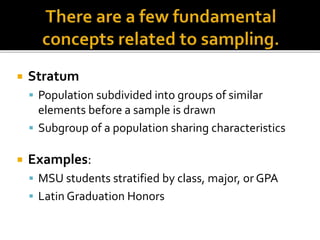
 Stratum
 Population subdivided into groups of similar
elements before a sample is drawn
 Subgroup of a population sharing characteristics
 Examples:
 MSU students stratified by class, major, or GPA
 Latin Graduation Honors
 Sampling Frame
 Particular population from which sample is drawn
 Closer sampling frame is to population of interest or
theoretical population, the better off you are
 Example:The Literary Digest Poll?
 If sampling frame is incomplete or inappropriate, then
sample bias will occur
 Sample will be unrepresentative of the population,
and inaccurate conclusions may result
 Sample bias caused by a biased selection of elements,
even if frame is complete and accurate
 Sampling Unit
 Entity listed in a sampling frame
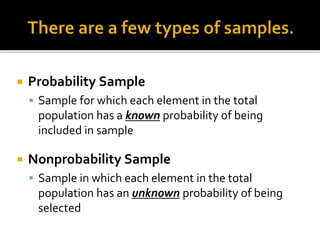
 Probability Sample
 Sample for which each element in the total
population has a known probability of being
included in sample
 Nonprobability Sample
 Sample in which each element in the total
population has an unknown probability of being
selected
 Each element and combination of elements has an
equal chance of being selected
 What has to happen for this to occur?
 Short Class Activity on Random Numbers
 Attempt to make draft process fairer
 How did the lottery process work?
 Selective Service (SS) estimated that anyone
with number higher than 200 would not be
called
 Found negative correlation between day of
birth and lottery number
 Random Numbers Generator
 Elements selected from list at predetermined
intervals (e.g. every Kth element)
 K = Sampling Interval or “skip” between elements
 Computed as Population Size (N) / Sample Size (n)
 Useful when dealing with long list of population
elements (e.g. all SC justices)
 Often used in product testing
 Probability sample where elements sharing
one or more characteristics are grouped
 Two MainTypes:
 Proportionate Sample
 Disproportionate Sample
 Stratified sample were each stratum
represented in proportion to its size in
population
 Example: Congress of the Future
 Sampling Fraction
 Stratified sample where each stratum is NOT
represented in proportion to size in population
 Issue ofWeighting
 Probability sample in which sampling frame
initially consists of clusters of elements
 Groups / clusters of elements are identified and
listed as sampling units
 Within each sampling unit, certain elements are
identified and sampled
 Example: Public Opinion Polling
 Advantages:
 Allows researchers to get around problem of
acquiring list of elements in target population
 Can reduce fieldwork costs
 Disadvantage:
 Greater level of imprecision
 Goal: To study a diverse and usually limited
number of observations
 Researcher exercises considerable discretion
 Example: Fenno and Home Style
 Elements are included because they are
convenient or easy for a researcher to study
 Used for exploratory research or when target
population is impossible to define / locate
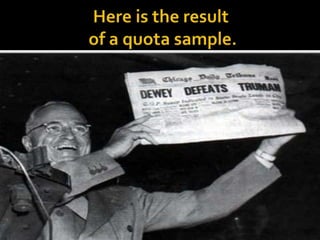
 Sample in which elements are sampled in
proportion to their representation in
population
 Similar to proportionate stratified sampling,
but elements are quota sample are NOT
chosen in reasoned or probabilistic manner
 Initial respondents used to identify others
who might qualify for inclusion in sample
 Useful when trying to study members in
elusive population:
 Draft Dodgers
 Political Protestors
 Drug Users

POL SOC 360 Sampling Generalizability

  • 1.
    POL / SOC360-01 Spring 2015
  • 4.
     Definition ofPopulation  Population should be:  Carefully and Fully Defined  Relevant to Research Question  Remember McDonald and Popkin study?  How did they define their population?
  • 5.
     Definition ofSample  Importance of Sample Data  Quality of Sample Based on:  Overall Sample Size  How members chosen to be part of sample
  • 6.
     Advantages ofSample  Time  Money  Disadvantages of Sample  Less accurate  Subject to error  Decision made on practical grounds
  • 7.
     Population Parameter Characteristics about population quantified as a number ▪ Examples: Proportion, Mean/Average, etc.  Estimator  Numerically estimates the value of population characteristic, or population parameter
  • 8.
     Sample Statistic An estimator of a population parameter derived from a population sample  Element  Also called a unit of analysis  A single occurrence, realization, or instance of the objects or entities being studied ▪ Examples: Individuals, States, Cities, Countries, Speeches, Wars
  • 9.
     Stratum  Populationsubdivided into groups of similar elements before a sample is drawn  Subgroup of a population sharing characteristics  Examples:  MSU students stratified by class, major, or GPA  Latin Graduation Honors
  • 12.
     Sampling Frame Particular population from which sample is drawn  Closer sampling frame is to population of interest or theoretical population, the better off you are  Example:The Literary Digest Poll?
  • 13.
     If samplingframe is incomplete or inappropriate, then sample bias will occur  Sample will be unrepresentative of the population, and inaccurate conclusions may result  Sample bias caused by a biased selection of elements, even if frame is complete and accurate  Sampling Unit  Entity listed in a sampling frame
  • 14.
     Probability Sample Sample for which each element in the total population has a known probability of being included in sample  Nonprobability Sample  Sample in which each element in the total population has an unknown probability of being selected
  • 16.
     Each elementand combination of elements has an equal chance of being selected  What has to happen for this to occur?  Short Class Activity on Random Numbers
  • 17.
     Attempt tomake draft process fairer  How did the lottery process work?  Selective Service (SS) estimated that anyone with number higher than 200 would not be called  Found negative correlation between day of birth and lottery number
  • 18.
  • 19.
     Elements selectedfrom list at predetermined intervals (e.g. every Kth element)  K = Sampling Interval or “skip” between elements  Computed as Population Size (N) / Sample Size (n)  Useful when dealing with long list of population elements (e.g. all SC justices)  Often used in product testing
  • 20.
     Probability samplewhere elements sharing one or more characteristics are grouped  Two MainTypes:  Proportionate Sample  Disproportionate Sample
  • 21.
     Stratified samplewere each stratum represented in proportion to its size in population  Example: Congress of the Future  Sampling Fraction
  • 22.
     Stratified samplewhere each stratum is NOT represented in proportion to size in population  Issue ofWeighting
  • 23.
     Probability samplein which sampling frame initially consists of clusters of elements  Groups / clusters of elements are identified and listed as sampling units  Within each sampling unit, certain elements are identified and sampled  Example: Public Opinion Polling
  • 24.
     Advantages:  Allowsresearchers to get around problem of acquiring list of elements in target population  Can reduce fieldwork costs  Disadvantage:  Greater level of imprecision
  • 26.
     Goal: Tostudy a diverse and usually limited number of observations  Researcher exercises considerable discretion  Example: Fenno and Home Style
  • 27.
     Elements areincluded because they are convenient or easy for a researcher to study  Used for exploratory research or when target population is impossible to define / locate
  • 28.
     Sample inwhich elements are sampled in proportion to their representation in population  Similar to proportionate stratified sampling, but elements are quota sample are NOT chosen in reasoned or probabilistic manner
  • 30.
     Initial respondentsused to identify others who might qualify for inclusion in sample  Useful when trying to study members in elusive population:  Draft Dodgers  Political Protestors  Drug Users