
BMGT 311: Chapter 9
Basic Concepts in Samples and Sampling
Learning Objectives
• To become familiar with sample design terminology

• To understand the differences between probability and non probability
sampling methods

• To learn how to take four types of probability samples: simple random
samples, systematic samples, cluster samples, and stratified samples

• To learn how to take four types of non probability samples: convenience
samples, purposive samples, referral samples, and quota samples

• To acquire the skills to administer different types of samples, including online
samples

• To be able to develop a sample plan
Basic Concepts in
Sampling
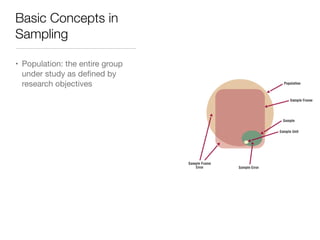
• Population: the entire group
under study as defined by
research objectives
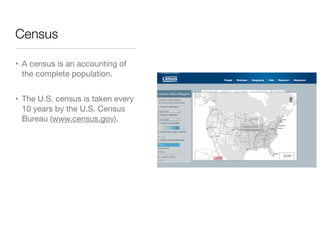
Census
• A census is an accounting of
the complete population. 

• The U.S. census is taken every
10 years by the U.S. Census
Bureau (www.census.gov).
Basic Concepts in
Sampling
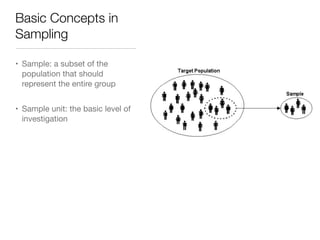
• Sample: a subset of the
population that should
represent the entire group

• Sample unit: the basic level of
investigation
Basic Concepts in Sampling
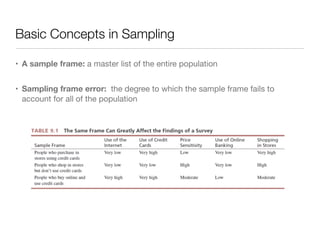
• A sample frame: a master list of the entire population

• Sampling frame error: the degree to which the sample frame fails to
account for all of the population
Basic Concepts in
Sampling
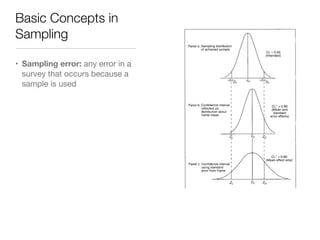
• Sampling error: any error in a
survey that occurs because a
sample is used
Probability samples: ones in which members of the
population have a known chance (probability) of
• Probability samples: ones in which members of the population have a
known chance (probability) of being selected into the sample

• Non probability samples: instances in which the chances (probability) of
selecting members from the population into the sample are unknown
Probability Sampling Methods
• Simple random sampling

• Systematic sampling

• Cluster sampling

• Stratified sampling
Probability Sampling:
• Simple random sampling: the probability of being selected into the sample
is “known” and equal for all members of the population. 

• The random device method involves using an apparatus of some sort to
ensure that every member of the population has the same chance of being
selected into the sample.

• The random numbers method involves small populations that are easily
accommodated by the physical aspects of the device.
Probability Sampling:
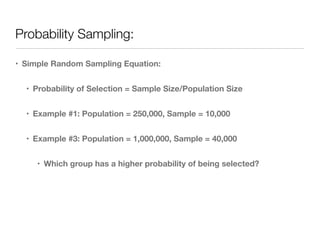
• Simple Random Sampling Equation:
• Probability of Selection = Sample Size/Population Size
• Example #1: Population = 250,000, Sample = 10,000
• Example #3: Population = 1,000,000, Sample = 40,000
• Which group has a higher probability of being selected?
Probability Sampling:
• Simple Random Sampling Equation:
• Probability of Selection = Sample Size/Population Size
• Example #1: Population = 250,000, Sample = 10,000
• Probability of Selection = 1,000/250,000 = 4% (Chance of being
selected)
• Example #3: Population = 1,000,000, Sample = 40,000
• Probability of Selection = 40,000/1,000,000 = 4%
Probability Sampling
• Systematic sampling: way to select a random sample from a directory or list
that is much more efficient than simple random sampling

• To develop the sample, the Skip Interval is used

• Skip Interval = Population List Size/Sample Size
Probability Sampling
• Skip Interval = Population List Size/Sample Size

• Population List Size = 2,000

• Sample Size = 200

• Skip Interval = 2,000/200 = 10

• What does this mean? Every 10th person on the list is chosen for the
sample
Probability Sampling
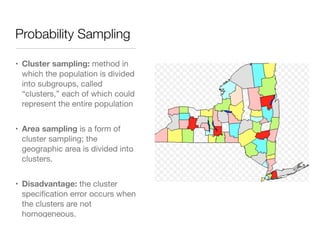
• Cluster sampling: method in
which the population is divided
into subgroups, called
“clusters,” each of which could
represent the entire population

• Area sampling is a form of
cluster sampling; the
geographic area is divided into
clusters.

• Disadvantage: the cluster
specification error occurs when
the clusters are not
homogeneous.
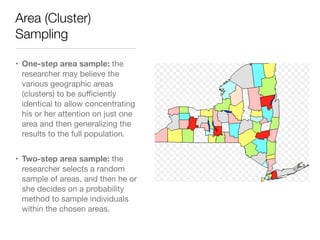
Area (Cluster)
Sampling
• One-step area sample: the
researcher may believe the
various geographic areas
(clusters) to be sufficiently
identical to allow concentrating
his or her attention on just one
area and then generalizing the
results to the full population.

• Two-step area sample: the
researcher selects a random
sample of areas, and then he or
she decides on a probability
method to sample individuals
within the chosen areas.
Probability Sampling
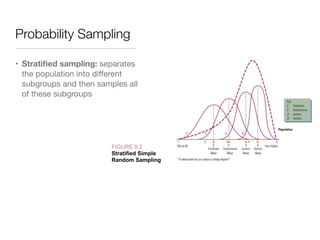
• Stratified sampling: separates
the population into different
subgroups and then samples all
of these subgroups
FIGURE 9.2
Stratified Simple
Random Sampling
Probability Sampling
Videos
• YouTube: Steve Mays Sampling
Non probability Sampling
• With non probability sampling methods selection is not based on fairness,
equity, or equal chance.

• Convenience sampling

• Purposive sampling

• Referral sampling

• Quota sampling
Non probability Sampling
• Convenience samples: samples drawn at the convenience of the interviewer

• Purposive samples: requires a judgment or an “educated guess” as to who
should represent the population

• Referral samples: require respondents to provide the names of prospective
respondents

• Quota samples: specified percentages of the total sample for various types
of individuals to be interviewed
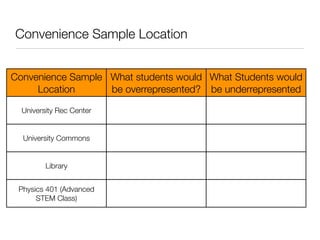
Convenience Sample Location
Convenience Sample
Location
What students would
be overrepresented?
What Students would
be underrepresented
University Rec Center
University Commons
Library
Physics 401 (Advanced
STEM Class)
Online Sampling Techniques
• Online panels: large numbers of individuals who have agreed to participate in
online surveys

• River samples: created via the use of banners, pop-ups, or other online
devices that invite website visitors to take part in the survey

• E-mail list samples: purchased or otherwise procured from someone or
some company that has compiled email addresses of opt-in members of the
population of interest
Why Samples?
• A census is not usually possible

• Think how hard it would be to interview every Point Park Students

• If done correctly (Chapter 10) - the sample using probability sample methods
can be very represented of the overall population

Bmgt 311 chapter_9

  • 1.
    BMGT 311: Chapter9 Basic Concepts in Samples and Sampling
  • 2.
    Learning Objectives • Tobecome familiar with sample design terminology • To understand the differences between probability and non probability sampling methods • To learn how to take four types of probability samples: simple random samples, systematic samples, cluster samples, and stratified samples • To learn how to take four types of non probability samples: convenience samples, purposive samples, referral samples, and quota samples • To acquire the skills to administer different types of samples, including online samples • To be able to develop a sample plan
  • 4.
    Basic Concepts in Sampling •Population: the entire group under study as defined by research objectives
  • 6.
    Census • A censusis an accounting of the complete population. • The U.S. census is taken every 10 years by the U.S. Census Bureau (www.census.gov).
  • 7.
    Basic Concepts in Sampling •Sample: a subset of the population that should represent the entire group • Sample unit: the basic level of investigation
  • 8.
    Basic Concepts inSampling • A sample frame: a master list of the entire population • Sampling frame error: the degree to which the sample frame fails to account for all of the population
  • 9.
    Basic Concepts in Sampling •Sampling error: any error in a survey that occurs because a sample is used
  • 10.
    Probability samples: onesin which members of the population have a known chance (probability) of • Probability samples: ones in which members of the population have a known chance (probability) of being selected into the sample • Non probability samples: instances in which the chances (probability) of selecting members from the population into the sample are unknown
  • 11.
    Probability Sampling Methods •Simple random sampling • Systematic sampling • Cluster sampling • Stratified sampling
  • 12.
    Probability Sampling: • Simplerandom sampling: the probability of being selected into the sample is “known” and equal for all members of the population. • The random device method involves using an apparatus of some sort to ensure that every member of the population has the same chance of being selected into the sample. • The random numbers method involves small populations that are easily accommodated by the physical aspects of the device.
  • 13.
    Probability Sampling: • SimpleRandom Sampling Equation: • Probability of Selection = Sample Size/Population Size • Example #1: Population = 250,000, Sample = 10,000 • Example #3: Population = 1,000,000, Sample = 40,000 • Which group has a higher probability of being selected?
  • 14.
    Probability Sampling: • SimpleRandom Sampling Equation: • Probability of Selection = Sample Size/Population Size • Example #1: Population = 250,000, Sample = 10,000 • Probability of Selection = 1,000/250,000 = 4% (Chance of being selected) • Example #3: Population = 1,000,000, Sample = 40,000 • Probability of Selection = 40,000/1,000,000 = 4%
  • 15.
    Probability Sampling • Systematicsampling: way to select a random sample from a directory or list that is much more efficient than simple random sampling • To develop the sample, the Skip Interval is used • Skip Interval = Population List Size/Sample Size
  • 16.
    Probability Sampling • SkipInterval = Population List Size/Sample Size • Population List Size = 2,000 • Sample Size = 200 • Skip Interval = 2,000/200 = 10 • What does this mean? Every 10th person on the list is chosen for the sample
  • 17.
    Probability Sampling • Clustersampling: method in which the population is divided into subgroups, called “clusters,” each of which could represent the entire population • Area sampling is a form of cluster sampling; the geographic area is divided into clusters. • Disadvantage: the cluster specification error occurs when the clusters are not homogeneous.
  • 18.
    Area (Cluster) Sampling • One-steparea sample: the researcher may believe the various geographic areas (clusters) to be sufficiently identical to allow concentrating his or her attention on just one area and then generalizing the results to the full population. • Two-step area sample: the researcher selects a random sample of areas, and then he or she decides on a probability method to sample individuals within the chosen areas.
  • 19.
    Probability Sampling • Stratifiedsampling: separates the population into different subgroups and then samples all of these subgroups FIGURE 9.2 Stratified Simple Random Sampling
  • 20.
  • 21.
    Non probability Sampling •With non probability sampling methods selection is not based on fairness, equity, or equal chance. • Convenience sampling • Purposive sampling • Referral sampling • Quota sampling
  • 22.
    Non probability Sampling •Convenience samples: samples drawn at the convenience of the interviewer • Purposive samples: requires a judgment or an “educated guess” as to who should represent the population • Referral samples: require respondents to provide the names of prospective respondents • Quota samples: specified percentages of the total sample for various types of individuals to be interviewed
  • 23.
    Convenience Sample Location ConvenienceSample Location What students would be overrepresented? What Students would be underrepresented University Rec Center University Commons Library Physics 401 (Advanced STEM Class)
  • 24.
    Online Sampling Techniques •Online panels: large numbers of individuals who have agreed to participate in online surveys • River samples: created via the use of banners, pop-ups, or other online devices that invite website visitors to take part in the survey • E-mail list samples: purchased or otherwise procured from someone or some company that has compiled email addresses of opt-in members of the population of interest
  • 25.
    Why Samples? • Acensus is not usually possible • Think how hard it would be to interview every Point Park Students • If done correctly (Chapter 10) - the sample using probability sample methods can be very represented of the overall population