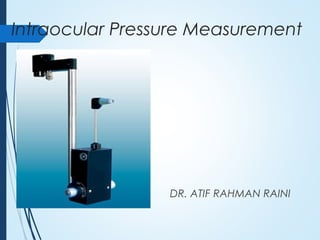
Intraocular Pressure Measurement
DR. ATIF RAHMAN RAINI
INTRODUCTION:
 IOP is one of the major risk factor in:
 Diagnosis
 Prognosis
 Only modifiable risk factor
 Procedure performed to measure IOP - TONOMETRY
History of tonometry
 1826:  Concept started with William Bowman , he used digital
tonometry as a routine examination test.
 1863: Albrecht von Grafe designed the first instrument to attempt
to measure intraocular pressure.
 Further instruments followed, notably by Donders in 1865 and
Preistly-Smith in 1880.
These instruments were all of the indentation type and rested on
the cornea (no anaesthetic was used until 1884).
 1885: Maklakov designed an applanation tonometer. This was
refined in 1892. Used for a number of years in Russia and Eastern
Europe. This was used till 1959.

1905:  Hjalmar Schiotz produced his indentation tonometer. This
made tonometry a simple and routine clinical test.
Donders tonometer
Albrecht von Grafe tonometer
Ideal tonometer
 Should give accurate and reasonable IOP measurement
 Convenient to use
 Simple to calibrate
 Stable for day to day use
 Easier to standardize
 Free of maintenance problems
Types of tonometry
 Direct – manometry
 Indirect - A) Static
B) Dynamic
Static tonometery
 Contact
 Noncontact
 CONTACT:
 INDENTATION: Shiotz tonometry
 APPLANATION:
 Variable force
GAT, Perkins, Mackay marg tonometer,
Tonopen, Pneumotonometer
 Constant force
Maklakov , Glucotest Applanometer
 NON CONTACT – Pulsair
DYNAMIC TONOMETER
 BALLISTIC TONOMETER: Vogelsang 1927 -rebound of a small
metal ball from the eye is measured and this depends to a
large extent on the physical properties of the coats of the eye.
 VIBRATION TONOMETER: Roth & Blake 1963- Vibration tonometer
cause minimal deformation by oscillating force by a probe,
which also functions as a sensor and measures the resonant
frequency of the eye.
MANOMETRY:
 Canula inserted into eye
 Not practical clinically.
 Intraocular pressure is higher than atmospheric pressure;
therefore, if a small hollow needle is inserted into the
anterior chamber, aqueous humor flows out through the
needle.
 If the needle is attached to a
reservoir of fluid that is raised just
high enough to prevent any loss of
aqueous, the height of the column
of fluid, usually calibrated in cm of
water or mm of mercury, reflects
the intraocular pressure
DIGITAL TONOMETRY:
Intraocular pressure (IOP) is estimated by response of eye
to pressure applied by finger pulp.
indents easily – low IOP
Firm to touch – normal IOP
Hard to touch – high IOP
Schiotz tonometry
 Schiotz (1905, Modified 1924/1926)
Parts of schiotz tonometer
Schiotz tonometry-characteristics
The extent to which cornea is indented by
plunger is measured as the distance from the
foot plate curve to the plunger base and a
lever system moves a needle on calibrated
scale.
The indicated scale reading and the plunger
weight are converted to an IOP
measurement.
 More the plunger indents the cornea, higher
the scale reading and lower the IOP
Each scale unit represents 0.05 mm protrusion
of the plunger.
PRINCIPLE
 The weight of tonometer on the eye increases
the actual IOP (Po) to a higher level (Pt).
 The change in pressure from Po to Pt is an
expression of the resistance of the eye (scleral
rigidity) to the displacement of fluid.
 P(t) = P(o) + E
 IOP with Tonometer in position Pt =
 Actual IOP Po + Scleral Rigidity E
 Determination of Po from a scale reading Pt
requires conversion which is done according to
Friedenwald formula
 Friedenwald generated formula for linear relationship
between the log function of IOP and the ocular
distension.
 Pt = log Po + C ΔV
 This formula has ‘C’ a numerical constant, the
coefficient of ocular rigidity which is an expression of
distensibility of eye. Its average value is 0.025
 ΔV is the change in volume
Friedenwald conversion table

 
  Plunger Load
Scale Reading 5.5 g 7.5 g 10 g 15 g
3.0 24.4 35.8 50.6 81.8
3.5 22.4 33.0 46.9 76.2
4.0 20.6 30.4 43.4 71.0
4.5 18.9 28.0 40.2 66.2
5.0 17.3 25.8 37.2 61.8
5.5 15.9 23.8 34.4 57.6
6.0 14.6 21.9 31.8 53.6
6.5 13.4 20.1 29.4 49.9
7.0 12.2 18.5 27.2 46.5
7.5 11.2 17.0 25.1 43.2
8.0 10.2 15.6 23.1 40.2
8.5 9.4 14.3 21.3 38.1
9.0 8.5 13.1 19.6 34.6
9.5 7.8 12.0 18.0 32.0
10.0 7.1 10.9 16.5 29.6
TECHNIQUE
 Patient should be anasthetised with 4%lignocaine
or 0.5% proparacaine
 With the patient in supine position, looking up at a
fixation target while examiner separates the lids
and lowers the tonometer plate to rest on the
anesthetized cornea so that plunger is free to
move vertically .
 Scale reading is measured.
 The 5.5 gm weight is initially used.
 If scale reading is 4 or less, additional weight is
added to plunger.
 Conversion table is used to derive IOP in mm Hg
from scale reading and plunger weight.
SOURCES OF ERROR
 Accuracy is limited as ocular rigidity varies from eye
to eye.
 As conversion tables are based on an average
coefficient of ocular rigidity; eye that varies
significantly from this value gives erroneous IOP.
 Repeated measurements lower IOP.
 steeper or a thicker cornea causes greater
displacement of fluid during tonometry and gives a
falsely high IOP measurement.
 Schiøtz reads lower than GAT
Factors Affecting Scleral Rigidity
 High Scleral Rigidity
 hyperopia
 long standing glaucoma
 ARMD
 vasoconstrictors
Low scleral rigidity
Low Scleral Rigidity
increasing age
 high myopia
miotics
vasodilators
Postoperative after RD surgery (vitrectomy, cryopexy, scleral
band)
intravitreal injection of compressible gas.
keratoconus
Low ocular rigidity ----- falsely high scale reading -----
falsely low IOP.
LIMITATIONS
 Instrumental errors
 Standardisation - testing labs for certification
 Mechanical obstruction to plunger etc.
 Muscular contractions
 Of extra ocular muscles increase IOP
 Accomodation decreases IOP
 Variations in volume of globe
 Microphthalmos
 High Myopia
 Buphthalmos
It can be recorded only in supine position
Advantages of schiotz
tonometer
 Simple technique
 Portable
 No need for SlitLamp or power supply
 Reasonably priced
Calibration
 The instrument should be calibrated before each use by placing
it on a polished metal sphere and checking to be sure that the
scale reading is zero.
 If the reading is not zero, the instrument must be repaired.
Sterilization
 The tonometer is disassembled between each use and the
barrel is cleaned with 2 pipe cleaners, the first soaked in
isopropyl alcohol 70 % or methylated spirit and the second
dry.
 The foot plate is cleaned with alcohol swab.
 All surfaces must be dried before reassembling.
 The instrument can be sterilized with ultraviolet radiation,
steam, ethylene oxide.
 As with other tonometer tips, the Schiotz can be damaged by
some disinfecting solutions such as hydrogen peroxide and
bleach.
GOLDMANN APPLANATION TONOMETER
GOLD STANDARD
Biprism
(measuring prism)
Feeder arm
Housing
Adjusting knob
Connects to the slit
lamp
Control weight insert
PRINCIPLE

Applanation tonometry is based on the Imbert-Fick
principle, which states that the pressure (p) inside an ideal dry,
thin-walled sphere equals the force (F) necessary to flatten its surface
divided by the area of the flattening (A).
P=F/A
 Cornea being aspherical, wet, and slightly
inflexible fails to follow the law.
 Moisture creates surface tension (S) or capillary
attraction of tear film for tonometry head.
 Lack of flexibility requires force to bend the
cornea (B) which is independent of internal
pressure.
 The central thickness of cornea is about 0.55
mm and the outer area of corneal flattening
differs from the inner area of flattening (A1). It is
this inner area which is of importance.
IMBERT FICKS LAW & MODIFIED IMBERT
FICKS LAW
W=PA W+S=PA1+B
 Modified Imbert-Fick Law is
 W + S = PA1 + B
 When A1 = 7.35 mm2
, S balances B and W
balances P.
 This internal area of applanation is achieved
when the diameter of the external area of
corneal applanation is around 3.06 mm.
 Grams of force applied to flatten 3.06
diameter of the cornea multiplied by 10 is
directly converted to mmHg.
cont…..
The two beam-splitting prism within the
applanating unit optically convert the circular
area of corneal contact in to semicircles
cont…. The instrument is mounted
on a standard slit lamp in such
a way that the examiners view
is directed through the centre
of a plastic Biprism.
 Biprism is attached by a rod
to a housing which contains a
coil spring and series of levers
that are used to adjust the
force of the biprism against
the cornea.
Two beam splitting prisms
within applanating unit
optically convert circular area
of corneal contact in 2
semicircles.
procedure
 The patient is asked not to drink alcoholic beverages as
it will lower IOP and not to take large amounts of fluid
(e.g., 500 ml or more) for 2 hours before the test, as it
may raise the IOP.
 The angle between the illumination and the
microscope should be approximately 60°.
 The room illumination is reduced.
 A fixation light may be placed in front of the fellow
eye.
 The tension knob is set at 1 g. If the knob is set at 0, the
prism head may vibrate when it touches the eye and
damage the corneal epithelium.
 The 1 g position is used before each measurement.
Procedure cont..
 The palpebral fissure is a little wider if the patient
looks up. However, the gaze should be no more
than 15° above the horizontal to prevent an
elevation of IOP.
 After instilling topical anaestheia, Edge of corneal
contact is made apparent by instilling fluorescein
while viewing in cobalt blue light.
 The biprism should not touch the lids or lashes
because this stimulates blinking and squeezing.
 The patient should blink the eyes once or twice to
spread the fluorescein-stained tear film over the
cornea, and then should keep the eyes open wide.
Procedure cont..
 In some patients, it is necessary for the examiner to
hold the eyelids open with the thumb and forefinger
of one hand against the orbital ring.
 By manually rotating a dial calibrated in grams, the
force is adjusted by changing the length of a spring
within the device.
 The prisms are calibrated in such a fashion that inner
margin of semicircles touch when 3.06 mm of the
cornea is applanated.
 The Intra ocular pressure is then read directly from a
scale on the tonometry housing.
cont….
The fluorescent semicircles are
viewed through the biprism and the
force against the cornea is adjusted
until the inner edges overlap.
The fluorescein rings should be
approximately 0.25–0.3 mm in thickness – or
about one-tenth the diameter of the flattened
area.
Potential source of error
 Thin cornea
 Thick cornea
 Astigmatism >3dioptre
 Inadequate fluorescein
 Too much fluorescein
 Irregular cornea
 Tonometer out of calibration
 Elevating the eyes >15degree
 Repeated tonometry
 Pressing on the eyelids or globe
 Squeezing of the eyelids
 Observer bias(expectation and even numbers
Effect of central corneal thickness (CCT):
 A thinner cornea may require less force to applanate
it, leading to underestimation of true IOP while a
thicker cornea would need more force to applanate
it, giving an artificially higher IOP.
 The Goldmann applanation tonometer was designed
to give accurate readings when the CCT was 520 μm.
 The deviation of CCT from 520 μm yields a change in
applanation readings of 0.7 mm Hg per 10 μm.
 IOP measurements are also modified after PRK and
LASIK.
 Thinning of the central cornea is gives lower readings
on applanation.
 Wider mires or improper vertical alignment gives higher
IOP readings
 If the two semicircles are not equal in size, IOP is
overestimated.
 For every 3D increase in corneal curvature, IOP raises
about 1 mm Hg as more fluid is displaced under steeper
corneas causing increase in ocular rigidity
 More than 6 D astigmatism produces an elliptical area
on applanation that gives erroneous IOP. 4D with-the-
rule astigmatism underestimate IOP and 4D against-the-
rule astigmatism overestimate IOP.
 Mires may be distorted on applanating on irregular
corneas .
 Elevating the eyes more than 15° above the
horizontal causes an overestimation of IOP.
 Widening the lid fissure excessively causes an
overestimation of IOP
 Repeated tonometry reduces IOP, causing an
underestimation of the true level . This effect is
greatest between the first and second readings,
but the trend continues through a number of
repetitions.
 A natural bias for even numbers may cause slight
errors in reading.
Applanation- Possible Error
 Falsely low IOP
 too little flouroscein
 thin cornea
 corneal edema
 with the rule astigmatism
 1mm Hg per 4 D
 prolonged contact
 Repeated tonometry
 Falsely high IOP
 too much flouroscein
 thick cornea
 steep cornea
 against the rule
astigmatism
 1mm Hg per 3D
 wider meniscus
 Widening the lid fissure
excessively
 Elevating the eyes more
than 15°
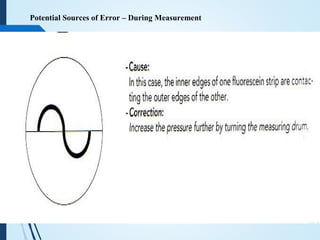
Potential Sources of Error – During Measurement
If the fluorescein rings are too wide, the patient’s eyelids should be blotted
carefully with a tissue, and the front surface of the prism should be dried with
lint-free material.
An excessively wide fluorescein ring can cause IOP to be overestimated
Potential Sources of Error – During Measurement
If the rings are too narrow, the patient should blink two or three times to
replenish the fluorescein; additional fluorescein may be added if necessary.
If the fluorescein rings are too narrow,IOP is underestimated.
Potential Sources of Error – During Measurement
CALIBRATION
 GAT should be calibrated periodically, at least
monthly. If the GAT is not within 0.1 g (1 mmHg)
of the correct calibration, the instrument should
be repaired; however, calibration errors of up to
2.5 mmHg may still be tolerated clinically.
sterilization
 Applanation tip should be soaked for 5-15 min in
diluted sodium hypochlorite, 3% H2O2 or 70%
isopropyl alcohol or by wiping with alcohol, H2O2,
povidone iodine or 1: 1000 merthiolate.
 Other methods of sterilization include: 10 min of
rinsing in running tap water, wash with soap and
water, cover the tip with a disposable film, and
exposure to UV light.
 Disposable tonometer tips may also be used
When using disposable tips, they have a smooth
applanating surface.
 The acrylic disposable tips seem to be somewhat more
accurate than the silicone ones.
 While disposable shields or tips may be safer than
disinfection solutions, they are not 100% protective against
prion disease.
SAFETY REGULATIONS
 No examination should be undertaken in case of
eye infections (or) injured corneas.
 Only clean and disinfected measuring prism should
be used.
 No damaged prisms should be used.
 If the measuring prism come in to contact with
the cornea without the drum having previously
been correctly set, vibration can occur in the
feeler arm, which will produce unpleasant feeling
for the patient.
 The tonometer tips should be examined
periodically under magnification as the antiseptic
solutions and mechanical wiping may cause
irregularities in the surface of the tip that can, in
turn, injure the cornea.
Perkins tonometer
 It uses same prisms as Goldmann
 It is counterbalanced so that tonometry is
performed in any position
 The prism is illuminated by battery powered
bulbs.
 Being portable it is practical when measuring
IOP in infants / children, bed ridden patients
and for use in operating rooms.
Draeger Tonometer
 Draeger tonometer is similar to Perkins
 It has a different set of prisms
 It operates with a motor.
Mackay marg tonometer
Mackay-Marg Tonometer
 This instrument is useful for measuring IOP in eyes
with scarred, irregular, or edematous corneas
because the end point does not depend on the
evaluation of a light reflex sensitive to optical
irregularity, as does the Goldmann tonometer.
 It is accurate when used over therapeutic soft
contact lenses.
Tonopen
Tono pen
 Portable
 battery operated .
 same principle as that of Mackay-Marg tonometer.
 It is particularly useful in community health fairs, on
ward rounds ,children, irregular surfaces, measuring
through an amniotic membrance patch graft, to
read from the sclera .
 Tono-Pen tends to overestimate the IOP in infants so
its usefulness in congenital glaucoma screening and
monitoring is somewhat limited.
 In band keratopathy where the surface of the
pathology is harder than normal cornea, the Tono-
Pen tends to overestimate the IOP
 A disposable latex cover which is discarded after
each use provides infection control.
Pneumatonometer or pneumatic
tonometer :
 It is like Mackay-Marg tonometer.
 The sensor is a air pressure like electronically controlled
plunger in Mackay-Marg tonometer.
 It can also be used for continuous monitoring of IOP.
 It gives significantly higher IOP estimates.
 It has a sensing device that consists of a gas
chamber covered by a polymeric silicone
diaphragm.
 A transducer converts the gas pressure in the
chamber into an electrical signal that is recorded
on a paper strip.
 The gas in the chamber escapes through an
exhaust vent between the diaphragm and the tip of
the support nozzle.
 As the diaphragm touches the cornea, the gas
vent is reduced in size, and the pressure in the
chamber rises.
Maklakov tonometer
•Indentation
•Can be used in
supine position
•wire holder
 Dumb-bell-shaped
metal cylinders with
flat end plates of
polished glass
 Diameter of 10 mm
The surface of the
weight is painted
with a dye, such as
mild silver protein
(Argyrol) mixed
with glycerin.
1 sec contact
imprint on end plate
 IOP = W / π (d/2) 2
 weight (W) diameter of the area of applanation (d)
 Intraocular pressure is measured in grams per square
centimeter and is converted to millimeters of mercury
by dividing by 1.36.
 Widely used in Russia and China
 This instrument displaces a greater volume of
aqueous humor and thus IOP readings are more
influenced by ocular rigidity.
 It does not correct for corneal bending, capillary
attraction, or tear encroachment on the layer of dye.
 Many instruments similar to the Maklakow device have
been described,like the Applanometer, Tonomat,
Halberg tonometer, and GlaucoTest.
The Ocuton tonometer
 The Ocuton™ tonometer
 hand-held tonometer
 works on the applanation principle
 probe is so light that it is barely felt
 needs no anesthetic in most patients.
 It has been marketed in Europe for home tonometry
 useful to get some idea of the relative diurnal variation in IOP if
the patient or spouse (etc.) can learn to use it.
Trans palpebral tonometry
 used in situations where other, more accurate, devices are not practical,
such as in young children, demented patients and severely
developmentally-challenged patients.
In addition to all the problems facing indentation tonometry, such as
scleral rigidity, transpalpebral tonometry adds variables such as the
thickness of the eyelids, orbicularis muscle tone and potential Intra
palpebral scarring.
 Portable so patients can measure their own IOP
at home, DVT.
 It is not accurate always. Inter observer and
intra observer variability was large.subsequent
studies failed to confirm the accuracy of this
device.
Non contact tonometer
 Noncontact tonometer (NCT) was introduced by Grolman.
 Original NCT has 3 subsystems:
 1. Alignment system: It aligns patient’s eye in 3 dimensions.
 2. Optoelectronic applanation monitoring system:
 It comprises transmitter, receiver and detector, and timer.
 a. Transmitter directs a collimated beam of light at corneal
apex.
 b. Receiver and detector accept only parallel coaxial rays
of light reflected from cornea.
 c. Timer measures from an internal reference to the point of
peak light intensity.
 3. Pneumatic system: It generates a puff of room air directed
against cornea
PRINCIPLE
 A puff of room air creates a constant force that
momentarily flattens the cornea. The corneal
apex is deformed by a jet of air
 The force of air jet which is generated by a
solenoid activated piston increases linearly over
time.
 When the reflected light is at peak intensity, the
cornea is presumed to be flattened.
 The time elapsed is directly related to the force
of jet necessary to flatten the cornea and
correspondingly to IOP.
 The time from an internal reference point to the
moment of flattening is measured and
converted to IOP.
 A puff of air of known area is generated against cornea
(B).
 At the moment of corneal applanation,a light (T), which
is usually reflected from the normal cornea into space,
suddenly is reflected (R) into an optical sensor (A).
 When the sensor is activated by the reflected light, the
air generator is switched off. The level of force at which
the generator stops is recorded, and a computer
calculates and displays the intraocular pressure.
 NCT is accurate if IOP is nearly normal, accuracy
decreases with increase in IOP and in eyes with
abnormal cornea or poor fixation.
 It is useful for screening programs because it can be
operated by non-medical personnel
 It does not absolutely require topical anesthesia .
 There is no direct contact between instrument and
the eye.
 The patient should be warned that the air puff can
be startling.
 The non-contact tonometer measures IOP over very
short intervals, so it is important to average a series of
readings.
 New NCT, Pulsair is a portable hand held tonometer.
PULSAIR tonometer
Ocular Response Analyzer
 It is an adaptation of the non-contact tonometer.
 It directs the air jet against the cornea and measures not one
but two pressures at which applanation occurs
1) when the air jet flattens the cornea as the cornea is bent inward
and 2) as the air jet lessens in force and the cornea recovers.
Ocular response analyser
 The first is the resting intraocular pressure.
 The difference between the first and the
second applanation pressure is called
corneal hysteresis
 corneal hysteresis is a measure of the
viscous dampening and, hence, the
biomechanical properties of the cornea.
 The biomechanical properties of the cornea
are related to corneal thickness and
include elastic and viscous dampening
attributes.
 IOP correlate well with Goldmann tonometry
but, on average, measure a few millimeters
higher.
 Further , while IOP varies over the 24-hour day,
hysteresis seems to be stable.
 Congdon et al found that a ‘low’ hysteresis
reading with the ORA correlates with progression
of glaucoma, whereas thin central corneal
thickness correlates with glaucoma damage.
 It has practical value in the management of
glaucoma.
Dynamic contour tonometer
 Introduced by Kanngiesser
 It is based on a totally different concept other than
indentation or applanation tonometry.
 Principle : By surrounding and matching the contour of
a sphere (or a portion thereof ), the pressure on the
outside equals the pressure on the inside.
 The tip of the probe matches the contour of the cornea.
 A pressure transducer built into the center of the probe
measures the outside pressure, which should equal the
inside pressure, and the IOP is recorded digitally on the
liquid crystal display (LCD).
 The concept developed from a previous
contact lens tonometer called the ‘Smart Lens”.
 It superior in accuracy to Goldmann tonometry
and pneumotonometry .
 IOP is not affected by corneal thickness.
 IOP is not altered by corneal refractive surgery
that thins the cornea.
 Because the DCT measures IOP in real time, the
actual measurement, like the IOP, is pulsed. The
internal electronics ‘call’ the IOP as the bottom of
the pulsed curve and indicate it digitally on the
LCD ..
 IOP readings with the DCT are generally lower than
GAT because, when properly done, indicates the
average difference between the maximum and
minimum pressures whereas the DCT reads the
minimum.
Ocular pulse amplitude
 The DCT indicates the magnitude of the difference
between maximum and minimum IOP as the ocular
pulse amplitude.
 OPA may be indicative of the status of ocular blood
flow and be differentially affected in different types
of glaucoma.
 ocular pulse amplitude is
increased over normals in
most forms of glaucoma and
may be related to the level
of IOP.
ICARE tonometer
 It is a new and updated version of an indentation
tonometer
 Portable
 can be used without anesthetizing the eye.
 A very light, disposable, sterile probe is propelled
forward into the cornea .
 The time taken for the probe to return to its resting
position and the characteristics of the rebound motion
are indicative of the IOP.
 The time taken for the probe to return to its resting
position is longer in eyes with lower IOP and faster in
eyes with higher IOP.
 It is comparable to the GAT.
 It correlates with central corneal thickness like the
Goldmann, .
 used in screening situations, when patients are
unable to be seated or measured at the slit lamp,
or when topical anesthetics are not feasible or
usable.
 Not useful in scarred corneas (as does the
Goldmann).
 Can be used with non-compliant patients (e.g.
children and dementia patients).
Continuous monitoring of intraocular pressure
 Applanation instruments inside contact lenses or
suction cups or strain gauges in encircling bands that
resemble scleral buckling elements.
 None of these instruments has achieved widespread
use.
 resonance applanation tonometry measuring the
sonic resonance of the eye when a continuous force
over a fixed area is applied.
 use of infrared spectroscopy to measure IOP.
 To build a miniature pressure sensor that can reside
inside the eye; one such device is part of an
intraocular lens.
Tonometry for Special Clinical Circumstances
 Tonometry on Irregular Corneas
 The accuracy of Goldmann and Tono-Pen
tonometers and the noncontact tonometers is limited
in eyes with irregular corneas.
 The pneumatic tonometer has been shown to be
useful in eyes with diseased or irregular corneas .
 Tonometry over Soft Contact Lenses
 Pneumo tonometry and the Tono-Pen can measure
with reasonable accuracy the IOP through bandage
contact lenses .
 pneumotonometer correlates well with
manometrically determined IOP, whereas the Tono-
Pen consistently underestimates the pressure.
 Tonometry with Gas-Filled Eyes
 Intraocular gas affects scleral rigidity, rendering
indentation tonometry unsatisfactory.
 pneumatic tonometer and Tono-Pen used.
 A pneumatic tonometer underestimates
Goldmann IOP measurements in eyes with
intravitreal gas
 Tono-Pen compares favorably with Goldmann
readings.
 Both instruments significantly underestimated the
IOP at pressures greater than 30 mm Hg .
 Tonometry with Flat Anterior Chamber
 IOP readings from the Goldmann applanation
tonometer, pneumotonometer, and Tono-Pen
do not correlate well with manometrically
determined pressures.
 Tonometry in Eyes with Keratoprostheses
 In patients at high risk for corneal transplant
rejection, implantation of a keratoprosthesis is
now a viable option for vision rehabilitation .
 Most keratoprostheses have a rigid, clear
surface, it is impossible to measure IOP by using
applanation or indentation instruments.
 In such eyes, tactile assessment appears to be
the most widely used method to estimate IOP.
references
1) Shields glaucoma
2)Becker-Shaffers glaucoma
3) Diagnostic Procedures in ophthalmology Nema
THANK YOU……..

Tonometry

  • 1.
  • 2.
    INTRODUCTION:  IOP isone of the major risk factor in:  Diagnosis  Prognosis  Only modifiable risk factor  Procedure performed to measure IOP - TONOMETRY
  • 3.
    History of tonometry 1826:  Concept started with William Bowman , he used digital tonometry as a routine examination test.  1863: Albrecht von Grafe designed the first instrument to attempt to measure intraocular pressure.  Further instruments followed, notably by Donders in 1865 and Preistly-Smith in 1880. These instruments were all of the indentation type and rested on the cornea (no anaesthetic was used until 1884).  1885: Maklakov designed an applanation tonometer. This was refined in 1892. Used for a number of years in Russia and Eastern Europe. This was used till 1959.  1905:  Hjalmar Schiotz produced his indentation tonometer. This made tonometry a simple and routine clinical test.
  • 4.
  • 5.
  • 6.
    Ideal tonometer  Shouldgive accurate and reasonable IOP measurement  Convenient to use  Simple to calibrate  Stable for day to day use  Easier to standardize  Free of maintenance problems
  • 7.
    Types of tonometry Direct – manometry  Indirect - A) Static B) Dynamic
  • 8.
    Static tonometery  Contact Noncontact  CONTACT:  INDENTATION: Shiotz tonometry  APPLANATION:  Variable force GAT, Perkins, Mackay marg tonometer, Tonopen, Pneumotonometer  Constant force Maklakov , Glucotest Applanometer  NON CONTACT – Pulsair
  • 9.
    DYNAMIC TONOMETER  BALLISTICTONOMETER: Vogelsang 1927 -rebound of a small metal ball from the eye is measured and this depends to a large extent on the physical properties of the coats of the eye.  VIBRATION TONOMETER: Roth & Blake 1963- Vibration tonometer cause minimal deformation by oscillating force by a probe, which also functions as a sensor and measures the resonant frequency of the eye.
  • 10.
    MANOMETRY:  Canula insertedinto eye  Not practical clinically.  Intraocular pressure is higher than atmospheric pressure; therefore, if a small hollow needle is inserted into the anterior chamber, aqueous humor flows out through the needle.  If the needle is attached to a reservoir of fluid that is raised just high enough to prevent any loss of aqueous, the height of the column of fluid, usually calibrated in cm of water or mm of mercury, reflects the intraocular pressure
  • 11.
    DIGITAL TONOMETRY: Intraocular pressure(IOP) is estimated by response of eye to pressure applied by finger pulp. indents easily – low IOP Firm to touch – normal IOP Hard to touch – high IOP
  • 12.
    Schiotz tonometry  Schiotz(1905, Modified 1924/1926)
  • 13.
  • 14.
    Schiotz tonometry-characteristics The extentto which cornea is indented by plunger is measured as the distance from the foot plate curve to the plunger base and a lever system moves a needle on calibrated scale. The indicated scale reading and the plunger weight are converted to an IOP measurement.  More the plunger indents the cornea, higher the scale reading and lower the IOP Each scale unit represents 0.05 mm protrusion of the plunger.
  • 15.
    PRINCIPLE  The weightof tonometer on the eye increases the actual IOP (Po) to a higher level (Pt).  The change in pressure from Po to Pt is an expression of the resistance of the eye (scleral rigidity) to the displacement of fluid.  P(t) = P(o) + E  IOP with Tonometer in position Pt =  Actual IOP Po + Scleral Rigidity E  Determination of Po from a scale reading Pt requires conversion which is done according to
  • 16.
    Friedenwald formula  Friedenwaldgenerated formula for linear relationship between the log function of IOP and the ocular distension.  Pt = log Po + C ΔV  This formula has ‘C’ a numerical constant, the coefficient of ocular rigidity which is an expression of distensibility of eye. Its average value is 0.025  ΔV is the change in volume
  • 17.
    Friedenwald conversion table     Plunger Load Scale Reading 5.5 g 7.5 g 10 g 15 g 3.0 24.4 35.8 50.6 81.8 3.5 22.4 33.0 46.9 76.2 4.0 20.6 30.4 43.4 71.0 4.5 18.9 28.0 40.2 66.2 5.0 17.3 25.8 37.2 61.8 5.5 15.9 23.8 34.4 57.6 6.0 14.6 21.9 31.8 53.6 6.5 13.4 20.1 29.4 49.9 7.0 12.2 18.5 27.2 46.5 7.5 11.2 17.0 25.1 43.2 8.0 10.2 15.6 23.1 40.2 8.5 9.4 14.3 21.3 38.1 9.0 8.5 13.1 19.6 34.6 9.5 7.8 12.0 18.0 32.0 10.0 7.1 10.9 16.5 29.6
  • 18.
    TECHNIQUE  Patient shouldbe anasthetised with 4%lignocaine or 0.5% proparacaine  With the patient in supine position, looking up at a fixation target while examiner separates the lids and lowers the tonometer plate to rest on the anesthetized cornea so that plunger is free to move vertically .  Scale reading is measured.  The 5.5 gm weight is initially used.  If scale reading is 4 or less, additional weight is added to plunger.  Conversion table is used to derive IOP in mm Hg from scale reading and plunger weight.
  • 19.
    SOURCES OF ERROR Accuracy is limited as ocular rigidity varies from eye to eye.  As conversion tables are based on an average coefficient of ocular rigidity; eye that varies significantly from this value gives erroneous IOP.  Repeated measurements lower IOP.  steeper or a thicker cornea causes greater displacement of fluid during tonometry and gives a falsely high IOP measurement.  Schiøtz reads lower than GAT
  • 20.
    Factors Affecting ScleralRigidity  High Scleral Rigidity  hyperopia  long standing glaucoma  ARMD  vasoconstrictors
  • 21.
    Low scleral rigidity LowScleral Rigidity increasing age  high myopia miotics vasodilators Postoperative after RD surgery (vitrectomy, cryopexy, scleral band) intravitreal injection of compressible gas. keratoconus Low ocular rigidity ----- falsely high scale reading ----- falsely low IOP.
  • 22.
    LIMITATIONS  Instrumental errors Standardisation - testing labs for certification  Mechanical obstruction to plunger etc.  Muscular contractions  Of extra ocular muscles increase IOP  Accomodation decreases IOP  Variations in volume of globe  Microphthalmos  High Myopia  Buphthalmos It can be recorded only in supine position
  • 23.
    Advantages of schiotz tonometer Simple technique  Portable  No need for SlitLamp or power supply  Reasonably priced
  • 24.
    Calibration  The instrumentshould be calibrated before each use by placing it on a polished metal sphere and checking to be sure that the scale reading is zero.  If the reading is not zero, the instrument must be repaired.
  • 25.
    Sterilization  The tonometeris disassembled between each use and the barrel is cleaned with 2 pipe cleaners, the first soaked in isopropyl alcohol 70 % or methylated spirit and the second dry.  The foot plate is cleaned with alcohol swab.  All surfaces must be dried before reassembling.  The instrument can be sterilized with ultraviolet radiation, steam, ethylene oxide.  As with other tonometer tips, the Schiotz can be damaged by some disinfecting solutions such as hydrogen peroxide and bleach.
  • 26.
    GOLDMANN APPLANATION TONOMETER GOLDSTANDARD Biprism (measuring prism) Feeder arm Housing Adjusting knob Connects to the slit lamp Control weight insert
  • 27.
    PRINCIPLE  Applanation tonometry isbased on the Imbert-Fick principle, which states that the pressure (p) inside an ideal dry, thin-walled sphere equals the force (F) necessary to flatten its surface divided by the area of the flattening (A). P=F/A
  • 28.
     Cornea beingaspherical, wet, and slightly inflexible fails to follow the law.  Moisture creates surface tension (S) or capillary attraction of tear film for tonometry head.  Lack of flexibility requires force to bend the cornea (B) which is independent of internal pressure.  The central thickness of cornea is about 0.55 mm and the outer area of corneal flattening differs from the inner area of flattening (A1). It is this inner area which is of importance.
  • 29.
    IMBERT FICKS LAW& MODIFIED IMBERT FICKS LAW W=PA W+S=PA1+B
  • 30.
     Modified Imbert-FickLaw is  W + S = PA1 + B  When A1 = 7.35 mm2 , S balances B and W balances P.  This internal area of applanation is achieved when the diameter of the external area of corneal applanation is around 3.06 mm.  Grams of force applied to flatten 3.06 diameter of the cornea multiplied by 10 is directly converted to mmHg.
  • 31.
    cont….. The two beam-splittingprism within the applanating unit optically convert the circular area of corneal contact in to semicircles
  • 32.
    cont…. The instrumentis mounted on a standard slit lamp in such a way that the examiners view is directed through the centre of a plastic Biprism.  Biprism is attached by a rod to a housing which contains a coil spring and series of levers that are used to adjust the force of the biprism against the cornea. Two beam splitting prisms within applanating unit optically convert circular area of corneal contact in 2 semicircles.
  • 33.
    procedure  The patientis asked not to drink alcoholic beverages as it will lower IOP and not to take large amounts of fluid (e.g., 500 ml or more) for 2 hours before the test, as it may raise the IOP.  The angle between the illumination and the microscope should be approximately 60°.  The room illumination is reduced.  A fixation light may be placed in front of the fellow eye.  The tension knob is set at 1 g. If the knob is set at 0, the prism head may vibrate when it touches the eye and damage the corneal epithelium.  The 1 g position is used before each measurement.
  • 34.
    Procedure cont..  Thepalpebral fissure is a little wider if the patient looks up. However, the gaze should be no more than 15° above the horizontal to prevent an elevation of IOP.  After instilling topical anaestheia, Edge of corneal contact is made apparent by instilling fluorescein while viewing in cobalt blue light.  The biprism should not touch the lids or lashes because this stimulates blinking and squeezing.  The patient should blink the eyes once or twice to spread the fluorescein-stained tear film over the cornea, and then should keep the eyes open wide.
  • 35.
    Procedure cont..  Insome patients, it is necessary for the examiner to hold the eyelids open with the thumb and forefinger of one hand against the orbital ring.  By manually rotating a dial calibrated in grams, the force is adjusted by changing the length of a spring within the device.  The prisms are calibrated in such a fashion that inner margin of semicircles touch when 3.06 mm of the cornea is applanated.  The Intra ocular pressure is then read directly from a scale on the tonometry housing.
  • 36.
    cont…. The fluorescent semicirclesare viewed through the biprism and the force against the cornea is adjusted until the inner edges overlap. The fluorescein rings should be approximately 0.25–0.3 mm in thickness – or about one-tenth the diameter of the flattened area.
  • 37.
    Potential source oferror  Thin cornea  Thick cornea  Astigmatism >3dioptre  Inadequate fluorescein  Too much fluorescein  Irregular cornea  Tonometer out of calibration  Elevating the eyes >15degree  Repeated tonometry  Pressing on the eyelids or globe  Squeezing of the eyelids  Observer bias(expectation and even numbers
  • 38.
    Effect of centralcorneal thickness (CCT):  A thinner cornea may require less force to applanate it, leading to underestimation of true IOP while a thicker cornea would need more force to applanate it, giving an artificially higher IOP.  The Goldmann applanation tonometer was designed to give accurate readings when the CCT was 520 μm.  The deviation of CCT from 520 μm yields a change in applanation readings of 0.7 mm Hg per 10 μm.  IOP measurements are also modified after PRK and LASIK.  Thinning of the central cornea is gives lower readings on applanation.
  • 39.
     Wider miresor improper vertical alignment gives higher IOP readings  If the two semicircles are not equal in size, IOP is overestimated.  For every 3D increase in corneal curvature, IOP raises about 1 mm Hg as more fluid is displaced under steeper corneas causing increase in ocular rigidity  More than 6 D astigmatism produces an elliptical area on applanation that gives erroneous IOP. 4D with-the- rule astigmatism underestimate IOP and 4D against-the- rule astigmatism overestimate IOP.  Mires may be distorted on applanating on irregular corneas .
  • 40.
     Elevating theeyes more than 15° above the horizontal causes an overestimation of IOP.  Widening the lid fissure excessively causes an overestimation of IOP  Repeated tonometry reduces IOP, causing an underestimation of the true level . This effect is greatest between the first and second readings, but the trend continues through a number of repetitions.  A natural bias for even numbers may cause slight errors in reading.
  • 41.
    Applanation- Possible Error Falsely low IOP  too little flouroscein  thin cornea  corneal edema  with the rule astigmatism  1mm Hg per 4 D  prolonged contact  Repeated tonometry  Falsely high IOP  too much flouroscein  thick cornea  steep cornea  against the rule astigmatism  1mm Hg per 3D  wider meniscus  Widening the lid fissure excessively  Elevating the eyes more than 15°
  • 42.
    Potential Sources ofError – During Measurement If the fluorescein rings are too wide, the patient’s eyelids should be blotted carefully with a tissue, and the front surface of the prism should be dried with lint-free material. An excessively wide fluorescein ring can cause IOP to be overestimated
  • 43.
    Potential Sources ofError – During Measurement If the rings are too narrow, the patient should blink two or three times to replenish the fluorescein; additional fluorescein may be added if necessary. If the fluorescein rings are too narrow,IOP is underestimated.
  • 44.
    Potential Sources ofError – During Measurement
  • 45.
    Potential Sources ofError – During Measurement
  • 46.
    Potential Sources ofError – During Measurement
  • 47.
    Potential Sources ofError – During Measurement
  • 48.
    Potential Sources ofError – During Measurement
  • 49.
    Potential Sources ofError – During Measurement
  • 50.
    Potential Sources ofError – During Measurement
  • 51.
    CALIBRATION  GAT shouldbe calibrated periodically, at least monthly. If the GAT is not within 0.1 g (1 mmHg) of the correct calibration, the instrument should be repaired; however, calibration errors of up to 2.5 mmHg may still be tolerated clinically.
  • 52.
    sterilization  Applanation tipshould be soaked for 5-15 min in diluted sodium hypochlorite, 3% H2O2 or 70% isopropyl alcohol or by wiping with alcohol, H2O2, povidone iodine or 1: 1000 merthiolate.  Other methods of sterilization include: 10 min of rinsing in running tap water, wash with soap and water, cover the tip with a disposable film, and exposure to UV light.  Disposable tonometer tips may also be used
  • 53.
    When using disposabletips, they have a smooth applanating surface.  The acrylic disposable tips seem to be somewhat more accurate than the silicone ones.  While disposable shields or tips may be safer than disinfection solutions, they are not 100% protective against prion disease.
  • 54.
    SAFETY REGULATIONS  Noexamination should be undertaken in case of eye infections (or) injured corneas.  Only clean and disinfected measuring prism should be used.  No damaged prisms should be used.  If the measuring prism come in to contact with the cornea without the drum having previously been correctly set, vibration can occur in the feeler arm, which will produce unpleasant feeling for the patient.  The tonometer tips should be examined periodically under magnification as the antiseptic solutions and mechanical wiping may cause irregularities in the surface of the tip that can, in turn, injure the cornea.
  • 55.
    Perkins tonometer  Ituses same prisms as Goldmann  It is counterbalanced so that tonometry is performed in any position  The prism is illuminated by battery powered bulbs.  Being portable it is practical when measuring IOP in infants / children, bed ridden patients and for use in operating rooms.
  • 57.
    Draeger Tonometer  Draegertonometer is similar to Perkins  It has a different set of prisms  It operates with a motor.
  • 58.
  • 59.
    Mackay-Marg Tonometer  Thisinstrument is useful for measuring IOP in eyes with scarred, irregular, or edematous corneas because the end point does not depend on the evaluation of a light reflex sensitive to optical irregularity, as does the Goldmann tonometer.  It is accurate when used over therapeutic soft contact lenses.
  • 60.
  • 61.
    Tono pen  Portable battery operated .  same principle as that of Mackay-Marg tonometer.  It is particularly useful in community health fairs, on ward rounds ,children, irregular surfaces, measuring through an amniotic membrance patch graft, to read from the sclera .  Tono-Pen tends to overestimate the IOP in infants so its usefulness in congenital glaucoma screening and monitoring is somewhat limited.  In band keratopathy where the surface of the pathology is harder than normal cornea, the Tono- Pen tends to overestimate the IOP  A disposable latex cover which is discarded after each use provides infection control.
  • 62.
    Pneumatonometer or pneumatic tonometer:  It is like Mackay-Marg tonometer.  The sensor is a air pressure like electronically controlled plunger in Mackay-Marg tonometer.  It can also be used for continuous monitoring of IOP.
  • 63.
     It givessignificantly higher IOP estimates.  It has a sensing device that consists of a gas chamber covered by a polymeric silicone diaphragm.  A transducer converts the gas pressure in the chamber into an electrical signal that is recorded on a paper strip.  The gas in the chamber escapes through an exhaust vent between the diaphragm and the tip of the support nozzle.  As the diaphragm touches the cornea, the gas vent is reduced in size, and the pressure in the chamber rises.
  • 64.
    Maklakov tonometer •Indentation •Can beused in supine position •wire holder  Dumb-bell-shaped metal cylinders with flat end plates of polished glass  Diameter of 10 mm The surface of the weight is painted with a dye, such as mild silver protein (Argyrol) mixed with glycerin. 1 sec contact imprint on end plate
  • 65.
     IOP =W / π (d/2) 2  weight (W) diameter of the area of applanation (d)  Intraocular pressure is measured in grams per square centimeter and is converted to millimeters of mercury by dividing by 1.36.  Widely used in Russia and China  This instrument displaces a greater volume of aqueous humor and thus IOP readings are more influenced by ocular rigidity.  It does not correct for corneal bending, capillary attraction, or tear encroachment on the layer of dye.  Many instruments similar to the Maklakow device have been described,like the Applanometer, Tonomat, Halberg tonometer, and GlaucoTest.
  • 66.
    The Ocuton tonometer The Ocuton™ tonometer  hand-held tonometer  works on the applanation principle  probe is so light that it is barely felt  needs no anesthetic in most patients.  It has been marketed in Europe for home tonometry  useful to get some idea of the relative diurnal variation in IOP if the patient or spouse (etc.) can learn to use it.
  • 67.
    Trans palpebral tonometry used in situations where other, more accurate, devices are not practical, such as in young children, demented patients and severely developmentally-challenged patients. In addition to all the problems facing indentation tonometry, such as scleral rigidity, transpalpebral tonometry adds variables such as the thickness of the eyelids, orbicularis muscle tone and potential Intra palpebral scarring.
  • 68.
     Portable sopatients can measure their own IOP at home, DVT.  It is not accurate always. Inter observer and intra observer variability was large.subsequent studies failed to confirm the accuracy of this device.
  • 69.
    Non contact tonometer Noncontact tonometer (NCT) was introduced by Grolman.  Original NCT has 3 subsystems:  1. Alignment system: It aligns patient’s eye in 3 dimensions.  2. Optoelectronic applanation monitoring system:  It comprises transmitter, receiver and detector, and timer.  a. Transmitter directs a collimated beam of light at corneal apex.  b. Receiver and detector accept only parallel coaxial rays of light reflected from cornea.  c. Timer measures from an internal reference to the point of peak light intensity.  3. Pneumatic system: It generates a puff of room air directed against cornea
  • 71.
    PRINCIPLE  A puffof room air creates a constant force that momentarily flattens the cornea. The corneal apex is deformed by a jet of air  The force of air jet which is generated by a solenoid activated piston increases linearly over time.  When the reflected light is at peak intensity, the cornea is presumed to be flattened.  The time elapsed is directly related to the force of jet necessary to flatten the cornea and correspondingly to IOP.  The time from an internal reference point to the moment of flattening is measured and converted to IOP.
  • 72.
     A puffof air of known area is generated against cornea (B).  At the moment of corneal applanation,a light (T), which is usually reflected from the normal cornea into space, suddenly is reflected (R) into an optical sensor (A).  When the sensor is activated by the reflected light, the air generator is switched off. The level of force at which the generator stops is recorded, and a computer calculates and displays the intraocular pressure.
  • 73.
     NCT isaccurate if IOP is nearly normal, accuracy decreases with increase in IOP and in eyes with abnormal cornea or poor fixation.  It is useful for screening programs because it can be operated by non-medical personnel  It does not absolutely require topical anesthesia .  There is no direct contact between instrument and the eye.  The patient should be warned that the air puff can be startling.  The non-contact tonometer measures IOP over very short intervals, so it is important to average a series of readings.  New NCT, Pulsair is a portable hand held tonometer.
  • 74.
  • 75.
    Ocular Response Analyzer It is an adaptation of the non-contact tonometer.  It directs the air jet against the cornea and measures not one but two pressures at which applanation occurs 1) when the air jet flattens the cornea as the cornea is bent inward and 2) as the air jet lessens in force and the cornea recovers.
  • 76.
    Ocular response analyser The first is the resting intraocular pressure.  The difference between the first and the second applanation pressure is called corneal hysteresis  corneal hysteresis is a measure of the viscous dampening and, hence, the biomechanical properties of the cornea.  The biomechanical properties of the cornea are related to corneal thickness and include elastic and viscous dampening attributes.
  • 77.
     IOP correlatewell with Goldmann tonometry but, on average, measure a few millimeters higher.  Further , while IOP varies over the 24-hour day, hysteresis seems to be stable.  Congdon et al found that a ‘low’ hysteresis reading with the ORA correlates with progression of glaucoma, whereas thin central corneal thickness correlates with glaucoma damage.  It has practical value in the management of glaucoma.
  • 78.
  • 79.
     Introduced byKanngiesser  It is based on a totally different concept other than indentation or applanation tonometry.  Principle : By surrounding and matching the contour of a sphere (or a portion thereof ), the pressure on the outside equals the pressure on the inside.  The tip of the probe matches the contour of the cornea.  A pressure transducer built into the center of the probe measures the outside pressure, which should equal the inside pressure, and the IOP is recorded digitally on the liquid crystal display (LCD).
  • 80.
     The conceptdeveloped from a previous contact lens tonometer called the ‘Smart Lens”.  It superior in accuracy to Goldmann tonometry and pneumotonometry .  IOP is not affected by corneal thickness.  IOP is not altered by corneal refractive surgery that thins the cornea.
  • 81.
     Because theDCT measures IOP in real time, the actual measurement, like the IOP, is pulsed. The internal electronics ‘call’ the IOP as the bottom of the pulsed curve and indicate it digitally on the LCD ..  IOP readings with the DCT are generally lower than GAT because, when properly done, indicates the average difference between the maximum and minimum pressures whereas the DCT reads the minimum.
  • 82.
    Ocular pulse amplitude The DCT indicates the magnitude of the difference between maximum and minimum IOP as the ocular pulse amplitude.  OPA may be indicative of the status of ocular blood flow and be differentially affected in different types of glaucoma.  ocular pulse amplitude is increased over normals in most forms of glaucoma and may be related to the level of IOP.
  • 83.
  • 84.
     It isa new and updated version of an indentation tonometer  Portable  can be used without anesthetizing the eye.  A very light, disposable, sterile probe is propelled forward into the cornea .  The time taken for the probe to return to its resting position and the characteristics of the rebound motion are indicative of the IOP.  The time taken for the probe to return to its resting position is longer in eyes with lower IOP and faster in eyes with higher IOP.
  • 85.
     It iscomparable to the GAT.  It correlates with central corneal thickness like the Goldmann, .  used in screening situations, when patients are unable to be seated or measured at the slit lamp, or when topical anesthetics are not feasible or usable.  Not useful in scarred corneas (as does the Goldmann).  Can be used with non-compliant patients (e.g. children and dementia patients).
  • 86.
    Continuous monitoring ofintraocular pressure  Applanation instruments inside contact lenses or suction cups or strain gauges in encircling bands that resemble scleral buckling elements.  None of these instruments has achieved widespread use.  resonance applanation tonometry measuring the sonic resonance of the eye when a continuous force over a fixed area is applied.  use of infrared spectroscopy to measure IOP.  To build a miniature pressure sensor that can reside inside the eye; one such device is part of an intraocular lens.
  • 87.
    Tonometry for SpecialClinical Circumstances  Tonometry on Irregular Corneas  The accuracy of Goldmann and Tono-Pen tonometers and the noncontact tonometers is limited in eyes with irregular corneas.  The pneumatic tonometer has been shown to be useful in eyes with diseased or irregular corneas .  Tonometry over Soft Contact Lenses  Pneumo tonometry and the Tono-Pen can measure with reasonable accuracy the IOP through bandage contact lenses .  pneumotonometer correlates well with manometrically determined IOP, whereas the Tono- Pen consistently underestimates the pressure.
  • 88.
     Tonometry withGas-Filled Eyes  Intraocular gas affects scleral rigidity, rendering indentation tonometry unsatisfactory.  pneumatic tonometer and Tono-Pen used.  A pneumatic tonometer underestimates Goldmann IOP measurements in eyes with intravitreal gas  Tono-Pen compares favorably with Goldmann readings.  Both instruments significantly underestimated the IOP at pressures greater than 30 mm Hg .
  • 89.
     Tonometry withFlat Anterior Chamber  IOP readings from the Goldmann applanation tonometer, pneumotonometer, and Tono-Pen do not correlate well with manometrically determined pressures.  Tonometry in Eyes with Keratoprostheses  In patients at high risk for corneal transplant rejection, implantation of a keratoprosthesis is now a viable option for vision rehabilitation .  Most keratoprostheses have a rigid, clear surface, it is impossible to measure IOP by using applanation or indentation instruments.  In such eyes, tactile assessment appears to be the most widely used method to estimate IOP.
  • 90.
    references 1) Shields glaucoma 2)Becker-Shaffersglaucoma 3) Diagnostic Procedures in ophthalmology Nema
  • 91.