INTERPERSONAL
RELATIONSHIP
Presented by:
Mr. Anslin Sugil Kamesh., M.Sc(N)
HOD of MHN
SACON.
INTRODUCTION
One of the most distinctive aspects of
human beings is that we are social
beings.
Interpersonal relationships are & have
been the core of our social system
since the dawn of civilization.
Nursing is a therapeutic process &
demands an association between the
nurse & the patient.
Interpersonal relationships refer to
reciprocal social & emotional
interactions between two or more
individuals in an environment.
Interpersonal relationship is defined as
a close association between
individuals who share common
interests & goals.
DEFINITION
PURPOSE OF INTERPERSONAL
RELATIONSHIP
I. Interpersonal relationship for an
Individual
Personal growth & development
Source of enjoyment
Sense of security
Context of understanding
Interpersonal needs
Establishing personal identity
CONT…
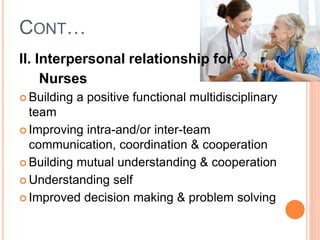
II. Interpersonal relationship for
Nurses
 Building a positive functional multidisciplinary
team
 Improving intra-and/or inter-team
communication, coordination & cooperation
 Building mutual understanding & cooperation
 Understanding self
 Improved decision making & problem solving
CONT…
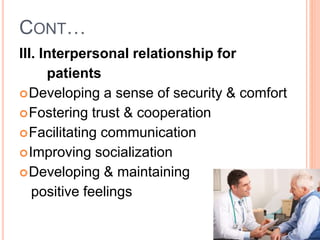
III. Interpersonal relationship for
patients
Developing a sense of security & comfort
Fostering trust & cooperation
Facilitating communication
Improving socialization
Developing & maintaining
positive feelings
TYPES OF INTERPERSONAL
RELATIONSHIP
 Friendship
 Family & kinship
 Love
 Marriage
 Platonic relationship
 Casual relationships
 Brotherhood &
sisterhood
 Acquaintances
 Interpersonal relationships are classified based
on relational contexts of interaction & the types of
mutual expectations between communicators.
Some common types of interpersonal relation are:-
FRIENDSHIP
 Theories of friendship emphasize the concept
as a freely chosen association where
individuals develop a common ground of
thinking & behaving when they enter into the
relationship by including mutual love, trust,
respect & unconditional acceptance for each
other.
 Friendship is a relationship with no formalities &
the individuals enjoy each other’s presence.
FAMILY AND KINSHIP
 Family communication patterns establish
roles & identify & enable personal & social
growth of individuals.
 Family relationships can get distorted if there
is an unresolved conflict between members.
 Most of the time, a significant family member
senses other family members have significant
emotional difficulties but fails to bring them
out unless the physician or nurse enquires .
PROFESSIONAL RELATIONSHIP
Individual working for the same
organization are said to share a
professional relationship & are called
colleagues.
Colleagues may or may not like each
other
LOVE
A informalized intimate relationship
characterized by passion, intimacy, trust
& respect is called love.
Individuals in a romantic relationship are
deeply attached to each other & share a
special bond
MARRIAGE
Marriage is a formalize intimate
relationship or a long-term relationship
where two individuals decide to enter
into wedlock & stay together life-long
after knowing each other well.
PLATONIC RELATIONSHIP
 A relationship between two individuals
without feelings of sexual desire for each
other is called a platonic relationship.
 In such a relationship, a man & a woman
are just friends & do not mix love with
friendship.
 Platonic relationships might end in a
romantic relationship with partners
developing feelings of love for each other.
CASUAL RELATIONSHIPS
 In these relationships, the individuals
usually develop a relationship that
exclusively lacks mutual love & consists of
sexual behaviour only that does not extend
beyond one night.
 These individuals may be known as sexual
partners in a wider sense of friends with
benefits who consider sexual intercourse
only in their relationship.
BROTHERHOOD & SISTERHOOD
Individuals united for a common cause
or a common interest (may involve
formal membership in clubs,
organization, associations, societies,
etc.) may be termed as a brotherhood or
a sisterhood.
In this relationship, individuals are
committed to doing good deeds for
fellow members & people.
ACQUAINTANCES
An acquaintance is a relationship
where someone is simply known to
someone by introduction or by a few
interaction.
There is an absence of close
relationship & the individuals lack in-
depth personal information about other.
This could also be a beginning of a
future close relationship.
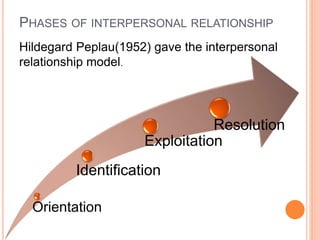
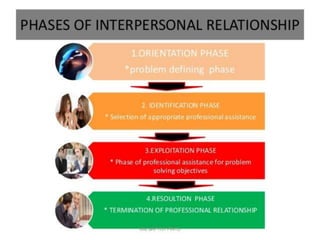
PHASES OF INTERPERSONAL RELATIONSHIP
Orientation
Identification
Exploitation
Resolution
Hildegard Peplau(1952) gave the interpersonal
relationship model.
ORIENTATION
Start with an initial encounter with nurse &
patient
The pact formulation begins between the
nurse & the patient.
The nurse clarifies his or her roles &
responsibilities within the therapeutic
boundary to the patient.
The Nurse identifies the patient’s problem
& settles on the type of nursing services
needed.
CONT…
After developing a trustworthy
relationship, the patients start
clarifying doubts, share perceptions &
convey their needs & expectation to
the nurse.
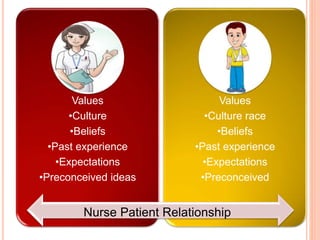
There are several factors that may
affect this phase in a nurse-patient
relationship
Values
•Culture
•Beliefs
•Past experience
•Expectations
•Preconceived ideas
Values
•Culture race
•Beliefs
•Past experience
•Expectations
•Preconceived
Nurse Patient Relationship
IDENTIFICATION
The nurse must approach the patient
with empathic understanding to perceive
the patient’s current feeling.
The nurse must avoid vagueness &
ambiguity by using specific terminology
rather than abstractions in
communication process.
CONT…
The nurse helps the patients identify
their problems in their own context &
use the available resources to solve
the problem.
The patient’s self esteem will be
boosted by having feelings of
belongingness.
EXPLOITATION
 In this phase, the patient are made to
understand the problems by exploring all
available avenues to solve the problem.
 The nurse can help the patient by extending
minimal professional assistance to learn how to
solve the problem.
 The patient starts exploitation all the available
resources in spite of making requests to others
to extend help
 Finally the patient is able to deal adequately
with his or her problems
RESOLUTION
 This is the termination of the professional
relationship that begins with convalesce
&rehabilitation stage of hospitalization.
 The patient’s needs have already been met by the
collaborative efforts of the patient & the nurse in
previous phases.
 If psychological dependence persists between both
of them, it become difficult to resolve the
transferences or counter transferees. A nurse must
aware of the techniques to resolve it.
 The relationship must be terminated by maintaining
a healthier emotional balance by both the parties.
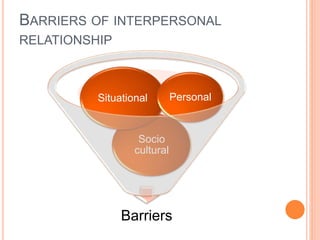
BARRIERS OF INTERPERSONAL
RELATIONSHIP
Barriers
Socio
cultural
Situational Personal
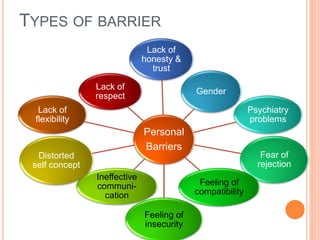
TYPES OF BARRIER
Personal
Barriers
Lack of
honesty &
trust
Gender
Psychiatry
problems
Fear of
rejection
Feeling of
compatibility
Feeling of
insecurity
Ineffective
communi-
cation
Distorted
self concept
Lack of
flexibility
Lack of
respect
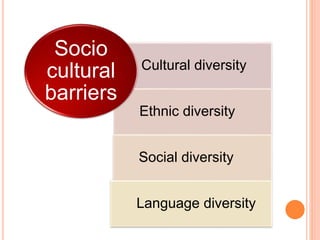
Cultural diversity
Ethnic diversity
Social diversity
Language diversity
Socio
cultural
barriers
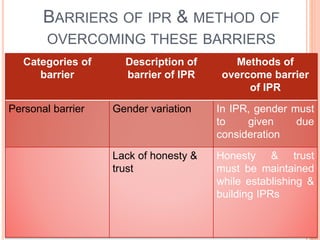
BARRIERS OF IPR & METHOD OF
OVERCOMING THESE BARRIERS
Categories of
barrier
Description of
barrier of IPR
Methods of
overcome barrier
of IPR
Personal barrier Gender variation In IPR, gender must
to given due
consideration
Lack of honesty &
trust
Honesty & trust
must be maintained
while establishing &
building IPRs
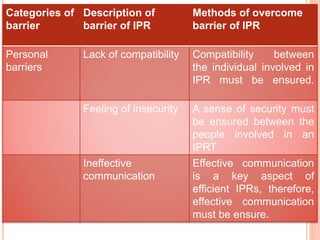
Categories of
barrier
Description of
barrier of IPR
Methods of overcome
barrier of IPR
Personal
barriers
Lack of compatibility Compatibility between
the individual involved in
IPR must be ensured.
Feeling of insecurity A sense of security must
be ensured between the
people involved in an
IPRT
Ineffective
communication
Effective communication
is a key aspect of
efficient IPRs, therefore,
effective communication
must be ensure.
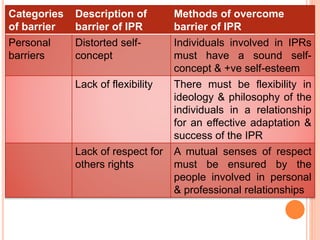
Categories
of barrier
Description of
barrier of IPR
Methods of overcome
barrier of IPR
Personal
barriers
Distorted self-
concept
Individuals involved in IPRs
must have a sound self-
concept & +ve self-esteem
Lack of flexibility There must be flexibility in
ideology & philosophy of the
individuals in a relationship
for an effective adaptation &
success of the IPR
Lack of respect for
others rights
A mutual senses of respect
must be ensured by the
people involved in personal
& professional relationships
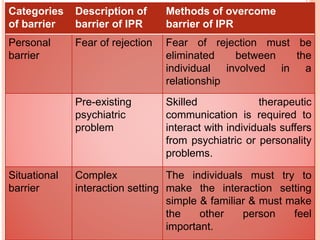
Categories
of barrier
Description of
barrier of IPR
Methods of overcome
barrier of IPR
Personal
barrier
Fear of rejection Fear of rejection must be
eliminated between the
individual involved in a
relationship
Pre-existing
psychiatric
problem
Skilled therapeutic
communication is required to
interact with individuals suffers
from psychiatric or personality
problems.
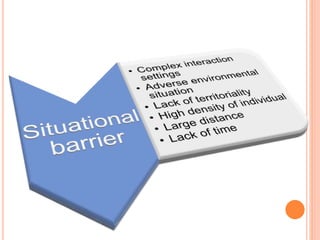
Situational
barrier
Complex
interaction setting
The individuals must try to
make the interaction setting
simple & familiar & must make
the other person feel
important.
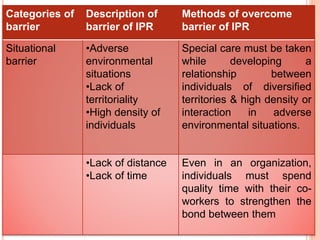
Categories of
barrier
Description of
barrier of IPR
Methods of overcome
barrier of IPR
Situational
barrier
•Adverse
environmental
situations
•Lack of
territoriality
•High density of
individuals
Special care must be taken
while developing a
relationship between
individuals of diversified
territories & high density or
interaction in adverse
environmental situations.
•Lack of distance
•Lack of time
Even in an organization,
individuals must spend
quality time with their co-
workers to strengthen the
bond between them
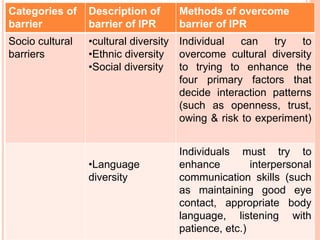
Categories of
barrier
Description of
barrier of IPR
Methods of overcome
barrier of IPR
Socio cultural
barriers
•cultural diversity
•Ethnic diversity
•Social diversity
Individual can try to
overcome cultural diversity
to trying to enhance the
four primary factors that
decide interaction patterns
(such as openness, trust,
owing & risk to experiment)
•Language
diversity
Individuals must try to
enhance interpersonal
communication skills (such
as maintaining good eye
contact, appropriate body
language, listening with
patience, etc.)
JOHARI WINDOW
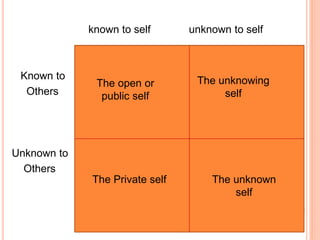
 The johari window model is a simple &
useful tool for illustrating & improving self-
awareness & mutual understanding
between individuals within a group.
 The johari window terminology refers to self
& others.
 Self refers to the person subject to the
Johari window analysis & others refers to
other people in the person’s group or team.
FACTS RELATED TO JOHARI WINDOW
 The johari window model was devised by American
psychologist, Joseph Luft& Harry Ingham, in 1955.
 The model was first published in proceedings of the
Western Training Laboratory in Group Development
by UCLA extension Office in 1955.
 The Johari window model represents self-awareness
of an individual towards himself or herself, & later on
become a widely used model for self-development by
helping the person understand & learn about
improvement of communication skills & IPRs
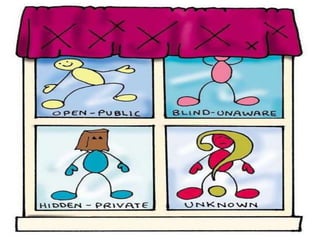
known to self unknown to self
Known to
Others
Unknown to
Others
The open or
public self
The unknowing
self
The Private self The unknown
self
THE OPEN OR PUBLIC SELF
The upper left quadrant of the window
represents the part of the self that is
public; that is, aspect of the self about
which both the individual & others are
aware.
EXAMPLE
 Susan, a nurse who is the adult child of an
alcoholic, has strong feelings about helping
alcoholics to achieve sobriety. She volunteers
her time to be a support person on call to
help recovering alcoholics. She is aware of
her feelings & her desire to help others.
Members of the alcoholics Anonymous group
in which the volunteers her time are also
aware of Susan’s feelings & they feel
comfortable calling her when they need help
refraining from drinking.
THE UNKNOWING SELF
The upper right (blind) quadrant of the
window represents the part of the self
that is known to others but remains
hidden from the awareness of the
individual.
EXAMPLE
When susan takes care of patients in
detox, she does so without emotion,
tending to the technical aspects of the
task in a way that the clients perceive
as cold & judgmental. She is unaware
that she comes across to the clients in
this way.
THE PRIVATE SELF
The lower left quadrant of the
window represents the part of the
self that is known to the individual,
but which the individual
deliberately & consciously
conceals from others.
EXAMPLE
Susan would prefer not to take care of
the client in detox because doing so
provokes painful memories from her
childhood. Because she does not want
the other staff members to known
about these feelings, however, she
volunteers to take care of the detox
client whenever they are assigned to
her unit.
THE UNKNOWN SELF
The lower right quadrant of the
window represent the part of the
self that is unknown to both the
individual & to others.
EXAMPLE
 Susan felt very powerless as a child growing up
with an alcoholic father. She seldom knew in
what condition she would find her father or what
his behaviour would be. She learned over her
life situation, & left home as soon as she
graduated from high school. The need to stay in
control has always been very important to
susan, & she is unaware that working with
recovering alcoholics helps to ful fill this need in
her. The people she is helping are also unaware
that susan is satisfying an unfulfilled personal
need as she provides them with assistance.
FUNCTIONS OF JOHARI WINDOW MODEL
 It has become a widely used model for
understanding & training self-awareness &
personal development & improving
communication, IPRs, group dynamics, team
development & inter-group relationships.
 It puts emphasis on soft skills, behaviour,
empathy, cooperation, inter-group development
& interpersonal development.
 It can also be used to improve an individual’s
relationship with others or a group’s relationship
with other groups.
CONT…
 The model is a simple & useful tool for illustrating &
improving self-awareness & mutual understanding
between individuals in a group.
 The Johari model can also be used to assess &
improving self-awareness & mutual understanding
between individuals in a group.
 The johari window actually represents information –
feelings, experiences, views attitudes, skills,
intentions, motivation, etc. -within or about a person in
relation to their group from four perspectives.
 The johari window provides a useful way to graphically
visualize the process of self-disclosure.
Thank
you

Interpersonal relationship

  • 1.
    INTERPERSONAL RELATIONSHIP Presented by: Mr. AnslinSugil Kamesh., M.Sc(N) HOD of MHN SACON.
  • 2.
    INTRODUCTION One of themost distinctive aspects of human beings is that we are social beings. Interpersonal relationships are & have been the core of our social system since the dawn of civilization. Nursing is a therapeutic process & demands an association between the nurse & the patient.
  • 3.
    Interpersonal relationships referto reciprocal social & emotional interactions between two or more individuals in an environment. Interpersonal relationship is defined as a close association between individuals who share common interests & goals. DEFINITION
  • 4.
    PURPOSE OF INTERPERSONAL RELATIONSHIP I.Interpersonal relationship for an Individual Personal growth & development Source of enjoyment Sense of security Context of understanding Interpersonal needs Establishing personal identity
  • 5.
    CONT… II. Interpersonal relationshipfor Nurses  Building a positive functional multidisciplinary team  Improving intra-and/or inter-team communication, coordination & cooperation  Building mutual understanding & cooperation  Understanding self  Improved decision making & problem solving
  • 6.
    CONT… III. Interpersonal relationshipfor patients Developing a sense of security & comfort Fostering trust & cooperation Facilitating communication Improving socialization Developing & maintaining positive feelings
  • 7.
    TYPES OF INTERPERSONAL RELATIONSHIP Friendship  Family & kinship  Love  Marriage  Platonic relationship  Casual relationships  Brotherhood & sisterhood  Acquaintances  Interpersonal relationships are classified based on relational contexts of interaction & the types of mutual expectations between communicators. Some common types of interpersonal relation are:-
  • 8.
    FRIENDSHIP  Theories offriendship emphasize the concept as a freely chosen association where individuals develop a common ground of thinking & behaving when they enter into the relationship by including mutual love, trust, respect & unconditional acceptance for each other.  Friendship is a relationship with no formalities & the individuals enjoy each other’s presence.
  • 9.
    FAMILY AND KINSHIP Family communication patterns establish roles & identify & enable personal & social growth of individuals.  Family relationships can get distorted if there is an unresolved conflict between members.  Most of the time, a significant family member senses other family members have significant emotional difficulties but fails to bring them out unless the physician or nurse enquires .
  • 10.
    PROFESSIONAL RELATIONSHIP Individual workingfor the same organization are said to share a professional relationship & are called colleagues. Colleagues may or may not like each other
  • 11.
    LOVE A informalized intimaterelationship characterized by passion, intimacy, trust & respect is called love. Individuals in a romantic relationship are deeply attached to each other & share a special bond
  • 12.
    MARRIAGE Marriage is aformalize intimate relationship or a long-term relationship where two individuals decide to enter into wedlock & stay together life-long after knowing each other well.
  • 13.
    PLATONIC RELATIONSHIP  Arelationship between two individuals without feelings of sexual desire for each other is called a platonic relationship.  In such a relationship, a man & a woman are just friends & do not mix love with friendship.  Platonic relationships might end in a romantic relationship with partners developing feelings of love for each other.
  • 14.
    CASUAL RELATIONSHIPS  Inthese relationships, the individuals usually develop a relationship that exclusively lacks mutual love & consists of sexual behaviour only that does not extend beyond one night.  These individuals may be known as sexual partners in a wider sense of friends with benefits who consider sexual intercourse only in their relationship.
  • 15.
    BROTHERHOOD & SISTERHOOD Individualsunited for a common cause or a common interest (may involve formal membership in clubs, organization, associations, societies, etc.) may be termed as a brotherhood or a sisterhood. In this relationship, individuals are committed to doing good deeds for fellow members & people.
  • 16.
    ACQUAINTANCES An acquaintance isa relationship where someone is simply known to someone by introduction or by a few interaction. There is an absence of close relationship & the individuals lack in- depth personal information about other. This could also be a beginning of a future close relationship.
  • 17.
    PHASES OF INTERPERSONALRELATIONSHIP Orientation Identification Exploitation Resolution Hildegard Peplau(1952) gave the interpersonal relationship model.
  • 19.
    ORIENTATION Start with aninitial encounter with nurse & patient The pact formulation begins between the nurse & the patient. The nurse clarifies his or her roles & responsibilities within the therapeutic boundary to the patient. The Nurse identifies the patient’s problem & settles on the type of nursing services needed.
  • 20.
    CONT… After developing atrustworthy relationship, the patients start clarifying doubts, share perceptions & convey their needs & expectation to the nurse. There are several factors that may affect this phase in a nurse-patient relationship
  • 21.
    Values •Culture •Beliefs •Past experience •Expectations •Preconceived ideas Values •Culturerace •Beliefs •Past experience •Expectations •Preconceived Nurse Patient Relationship
  • 22.
    IDENTIFICATION The nurse mustapproach the patient with empathic understanding to perceive the patient’s current feeling. The nurse must avoid vagueness & ambiguity by using specific terminology rather than abstractions in communication process.
  • 23.
    CONT… The nurse helpsthe patients identify their problems in their own context & use the available resources to solve the problem. The patient’s self esteem will be boosted by having feelings of belongingness.
  • 24.
    EXPLOITATION  In thisphase, the patient are made to understand the problems by exploring all available avenues to solve the problem.  The nurse can help the patient by extending minimal professional assistance to learn how to solve the problem.  The patient starts exploitation all the available resources in spite of making requests to others to extend help  Finally the patient is able to deal adequately with his or her problems
  • 25.
    RESOLUTION  This isthe termination of the professional relationship that begins with convalesce &rehabilitation stage of hospitalization.  The patient’s needs have already been met by the collaborative efforts of the patient & the nurse in previous phases.  If psychological dependence persists between both of them, it become difficult to resolve the transferences or counter transferees. A nurse must aware of the techniques to resolve it.  The relationship must be terminated by maintaining a healthier emotional balance by both the parties.
  • 26.
  • 27.
    TYPES OF BARRIER Personal Barriers Lackof honesty & trust Gender Psychiatry problems Fear of rejection Feeling of compatibility Feeling of insecurity Ineffective communi- cation Distorted self concept Lack of flexibility Lack of respect
  • 29.
    Cultural diversity Ethnic diversity Socialdiversity Language diversity Socio cultural barriers
  • 30.
    BARRIERS OF IPR& METHOD OF OVERCOMING THESE BARRIERS Categories of barrier Description of barrier of IPR Methods of overcome barrier of IPR Personal barrier Gender variation In IPR, gender must to given due consideration Lack of honesty & trust Honesty & trust must be maintained while establishing & building IPRs
  • 31.
    Categories of barrier Description of barrierof IPR Methods of overcome barrier of IPR Personal barriers Lack of compatibility Compatibility between the individual involved in IPR must be ensured. Feeling of insecurity A sense of security must be ensured between the people involved in an IPRT Ineffective communication Effective communication is a key aspect of efficient IPRs, therefore, effective communication must be ensure.
  • 32.
    Categories of barrier Description of barrierof IPR Methods of overcome barrier of IPR Personal barriers Distorted self- concept Individuals involved in IPRs must have a sound self- concept & +ve self-esteem Lack of flexibility There must be flexibility in ideology & philosophy of the individuals in a relationship for an effective adaptation & success of the IPR Lack of respect for others rights A mutual senses of respect must be ensured by the people involved in personal & professional relationships
  • 33.
    Categories of barrier Description of barrierof IPR Methods of overcome barrier of IPR Personal barrier Fear of rejection Fear of rejection must be eliminated between the individual involved in a relationship Pre-existing psychiatric problem Skilled therapeutic communication is required to interact with individuals suffers from psychiatric or personality problems. Situational barrier Complex interaction setting The individuals must try to make the interaction setting simple & familiar & must make the other person feel important.
  • 34.
    Categories of barrier Description of barrierof IPR Methods of overcome barrier of IPR Situational barrier •Adverse environmental situations •Lack of territoriality •High density of individuals Special care must be taken while developing a relationship between individuals of diversified territories & high density or interaction in adverse environmental situations. •Lack of distance •Lack of time Even in an organization, individuals must spend quality time with their co- workers to strengthen the bond between them
  • 35.
    Categories of barrier Description of barrierof IPR Methods of overcome barrier of IPR Socio cultural barriers •cultural diversity •Ethnic diversity •Social diversity Individual can try to overcome cultural diversity to trying to enhance the four primary factors that decide interaction patterns (such as openness, trust, owing & risk to experiment) •Language diversity Individuals must try to enhance interpersonal communication skills (such as maintaining good eye contact, appropriate body language, listening with patience, etc.)
  • 36.
    JOHARI WINDOW  Thejohari window model is a simple & useful tool for illustrating & improving self- awareness & mutual understanding between individuals within a group.  The johari window terminology refers to self & others.  Self refers to the person subject to the Johari window analysis & others refers to other people in the person’s group or team.
  • 37.
    FACTS RELATED TOJOHARI WINDOW  The johari window model was devised by American psychologist, Joseph Luft& Harry Ingham, in 1955.  The model was first published in proceedings of the Western Training Laboratory in Group Development by UCLA extension Office in 1955.  The Johari window model represents self-awareness of an individual towards himself or herself, & later on become a widely used model for self-development by helping the person understand & learn about improvement of communication skills & IPRs
  • 39.
    known to selfunknown to self Known to Others Unknown to Others The open or public self The unknowing self The Private self The unknown self
  • 40.
    THE OPEN ORPUBLIC SELF The upper left quadrant of the window represents the part of the self that is public; that is, aspect of the self about which both the individual & others are aware.
  • 41.
    EXAMPLE  Susan, anurse who is the adult child of an alcoholic, has strong feelings about helping alcoholics to achieve sobriety. She volunteers her time to be a support person on call to help recovering alcoholics. She is aware of her feelings & her desire to help others. Members of the alcoholics Anonymous group in which the volunteers her time are also aware of Susan’s feelings & they feel comfortable calling her when they need help refraining from drinking.
  • 42.
    THE UNKNOWING SELF Theupper right (blind) quadrant of the window represents the part of the self that is known to others but remains hidden from the awareness of the individual.
  • 43.
    EXAMPLE When susan takescare of patients in detox, she does so without emotion, tending to the technical aspects of the task in a way that the clients perceive as cold & judgmental. She is unaware that she comes across to the clients in this way.
  • 44.
    THE PRIVATE SELF Thelower left quadrant of the window represents the part of the self that is known to the individual, but which the individual deliberately & consciously conceals from others.
  • 45.
    EXAMPLE Susan would prefernot to take care of the client in detox because doing so provokes painful memories from her childhood. Because she does not want the other staff members to known about these feelings, however, she volunteers to take care of the detox client whenever they are assigned to her unit.
  • 46.
    THE UNKNOWN SELF Thelower right quadrant of the window represent the part of the self that is unknown to both the individual & to others.
  • 47.
    EXAMPLE  Susan feltvery powerless as a child growing up with an alcoholic father. She seldom knew in what condition she would find her father or what his behaviour would be. She learned over her life situation, & left home as soon as she graduated from high school. The need to stay in control has always been very important to susan, & she is unaware that working with recovering alcoholics helps to ful fill this need in her. The people she is helping are also unaware that susan is satisfying an unfulfilled personal need as she provides them with assistance.
  • 48.
    FUNCTIONS OF JOHARIWINDOW MODEL  It has become a widely used model for understanding & training self-awareness & personal development & improving communication, IPRs, group dynamics, team development & inter-group relationships.  It puts emphasis on soft skills, behaviour, empathy, cooperation, inter-group development & interpersonal development.  It can also be used to improve an individual’s relationship with others or a group’s relationship with other groups.
  • 49.
    CONT…  The modelis a simple & useful tool for illustrating & improving self-awareness & mutual understanding between individuals in a group.  The Johari model can also be used to assess & improving self-awareness & mutual understanding between individuals in a group.  The johari window actually represents information – feelings, experiences, views attitudes, skills, intentions, motivation, etc. -within or about a person in relation to their group from four perspectives.  The johari window provides a useful way to graphically visualize the process of self-disclosure.
  • 50.