CLEANING IN HOSPITAL PROTOCOL
FREQUENCY OF CLEANING IN HOSPITAL :
Environmental cleaning and disinfection of the hospital is mainly aimed at
eliminating/reducing/controlling/isolating the reservoirs of organisms in the environment.
Different areas in the hospital can be broadly categorised into:
 General Areas: Such areas in the hospitalwhere only general traffic is present; admitted patients are not
present; patient care activities and procedures are not performed; street clothes and footwear are worn.
Such areas are circulation areas like corridors, open areas like parking spaces,registration area etc.
 Patient Care Areas: All areas in the hospital where patients are admitted and patient care activities and
procedures are performed. These areas include wards, Operation Theatres (OTs), laboratory etc.
FACTORS INFLUENCING THE CLEANING FREQUENCY AND LEVEL OF DISINFECTION
 Potential for Direct Patient Contact : All surfaces in the hospital which can be under direct contact with
patients should be more frequently cleaned with high/low level disinfectants as appropriate for the type of
area. Cleaning and disinfecting such environmental surfaces is fundamental in reducing their potential
contribution to the incidence of hospitalacquired infections (eliminating the reservoirs in the chain of
infection).
 Type of Surface and Orientation (vertical//horizontal) : Dry conditions favour the persistence of gram-
positive cocci (e.g., coagulase-negative Staphylococcus spp.)in dust and on surfaces, whereas moist, soiled
environments additionally favour the growth and persistence of gram-negative bacilli and fungi.Horizontal
surfaces catch more dust and microbes and therefore may require more frequent cleaning.
 Degree and Frequency of Hand Contact
 High Touch Surfaces are those that have frequent contact with hands.Examples include
doorknobs,elevator buttons,telephones,bedrails, light switches,computer keyboards,monitoring
equipment, haemodialysis machines, wall areas around the toilet and edges of curtains in the
patient area. Transmission of microbes from these surfaces to the patient directly or indirectly is
more likely. Such surfaces require more frequent cleaning.
 Low Touch Surfaces are those that have minimal contact with hands.Examples include floors,
walls, ceilings, mirrors and window sills. Potential for infection transmission from these surfaces
is low and they require less frequent cleaning. However, they should be cleaned as soon as
possible when visibly soiled
 Potential for Contamination with Pathogens : Probability of contamination of a surface depends upon the nature
of activity, pathogens involved and the microbial load. Contamination with blood//body fluids is taken as a measure
of this. Based on this, hospital area//surfaces can have:
 Heavy Contamination: Surfaces and/orequipment are exposed to copious amounts of blood or
other body fluids (e.g., OTs, labour room, autopsy room, cardiac catheterisation laboratory, burn
unit, haemodialysis unit, Casualty Department, bathroom if the patient has diarrhoea or is
incontinent).
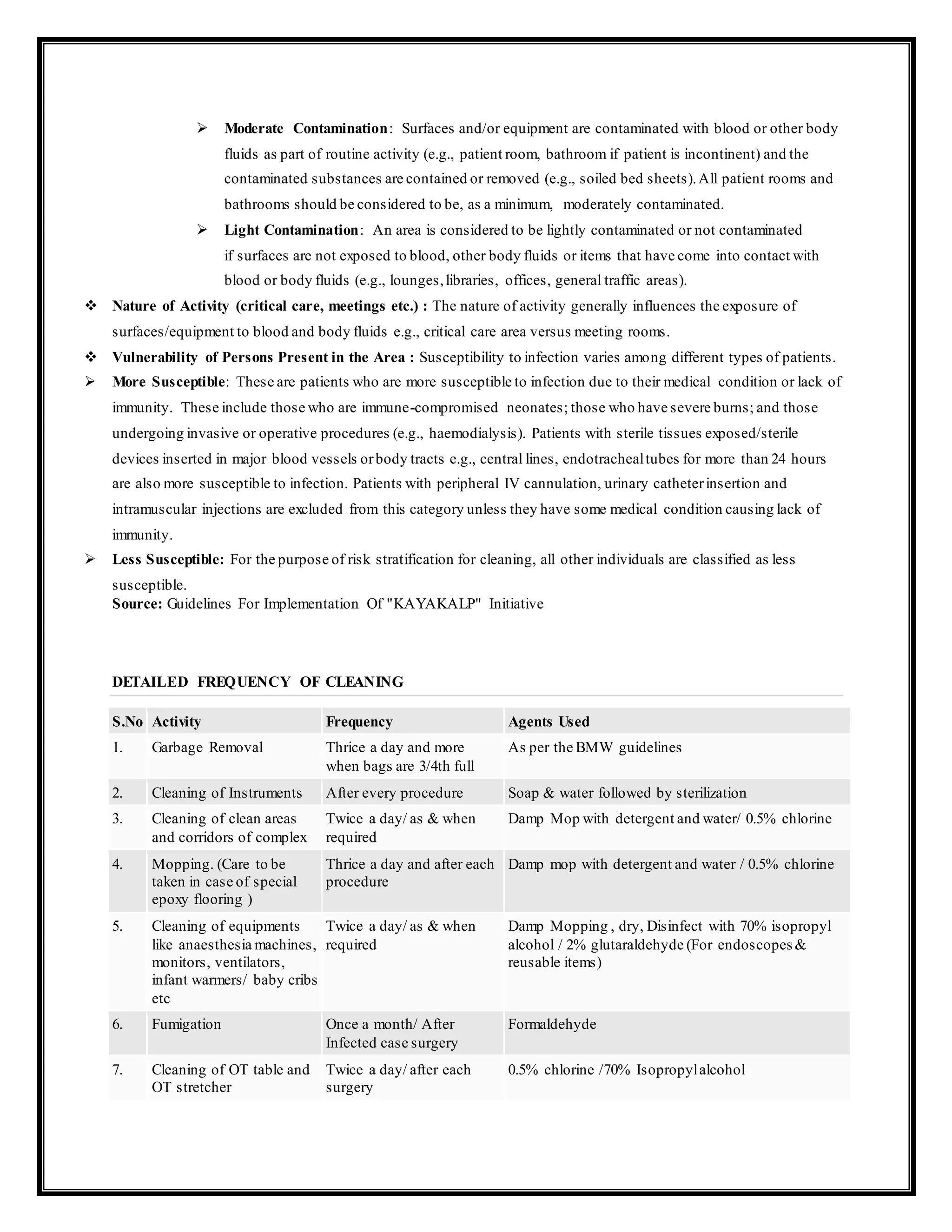
 Moderate Contamination: Surfaces and/or equipment are contaminated with blood or other body
fluids as part of routine activity (e.g., patient room, bathroom if patient is incontinent) and the
contaminated substances are contained or removed (e.g., soiled bed sheets).All patient rooms and
bathrooms should be considered to be, as a minimum, moderately contaminated.
 Light Contamination: An area is considered to be lightly contaminated or not contaminated
if surfaces are not exposed to blood, other body fluids or items that have come into contact with
blood or body fluids (e.g., lounges,libraries, offices, general traffic areas).
 Nature of Activity (critical care, meetings etc.) : The nature of activity generally influences the exposure of
surfaces/equipment to blood and body fluids e.g., critical care area versus meeting rooms.
 Vulnerability of Persons Present in the Area : Susceptibility to infection varies among different types of patients.
 More Susceptible: These are patients who are more susceptible to infection due to their medical condition or lack of
immunity. These include those who are immune-compromised neonates; those who have severe burns; and those
undergoing invasive or operative procedures (e.g., haemodialysis). Patients with sterile tissues exposed/sterile
devices inserted in major blood vessels orbody tracts e.g., central lines, endotrachealtubes for more than 24 hours
are also more susceptible to infection. Patients with peripheral IV cannulation, urinary catheterinsertion and
intramuscular injections are excluded from this category unless they have some medical condition causing lack of
immunity.
 Less Susceptible: For the purpose of risk stratification for cleaning, all other individuals are classified as less
susceptible.
Source: Guidelines For Implementation Of "KAYAKALP" Initiative
DETAILED FREQUENCY OF CLEANING
S.No Activity Frequency Agents Used
1. Garbage Removal Thrice a day and more
when bags are 3/4th full
As per the BMW guidelines
2. Cleaning of Instruments After every procedure Soap & water followed by sterilization
3. Cleaning of clean areas
and corridors of complex
Twice a day/ as & when
required
Damp Mop with detergent and water/ 0.5% chlorine
4. Mopping. (Care to be
taken in case of special
epoxy flooring )
Thrice a day and after each
procedure
Damp mop with detergent and water / 0.5% chlorine
5. Cleaning of equipments
like anaesthesia machines,
monitors, ventilators,
infant warmers/ baby cribs
etc
Twice a day/ as & when
required
Damp Mopping , dry, Disinfect with 70% isopropyl
alcohol / 2% glutaraldehyde (For endoscopes &
reusable items)
6. Fumigation Once a month/ After
Infected case surgery
Formaldehyde
7. Cleaning of OT table and
OT stretcher
Twice a day/ after each
surgery
0.5% chlorine /70% Isopropylalcohol
8. Doctor’s / nurses /
technician room
Twice a day Detergent & water
9. Washroom& wash basins
cleaning
Thrice a day and as &
when required
Wash with Soap & water,then dry, wipe 0.5%
chlorine
10. Washing of slipper once a day and when
required
Soap & water
11. Collection of soiled linen
and sluicing
As and when required Soak in clean water with bleaching powder 0.5% for
30 minutes. Wash again with detergent and water to
remove the Bleach. OR launder in hot water (70- 80
degree C) if possible.
12. Cleaning of Mops After every use Soak in clean water with bleaching powder 0.5% for
30 minutes. Wash again with detergent and water to
remove the bleach
MODERATE RISK AREA WARDS
1. Garbage Removal Thrice a day and more
when bags are 3/4th full
As per the BMW guidelines
2. Mopping of floor Once a day Damp mop with detergent and water
3. Washrooms & Wash
basin
Thrice a day and as &
when required
Wash with Soap & water, then dry, wipe with 0.5% chlorine
4. Dusting / Cleaning of
Equipment
Once a day Damp Mopping , dry, Dis-infect with 70% isopropyl alcohol
5. Collection of soiled
linen and sluicing
As and when required Soak in clean water with bleaching powder 0.5% for 30
minutes. Wash again with detergent and water to remove the
Bleach.
CANTEEN AND KITCHEN
1. Garbage Removal Thrice a day and more when bags
are 3/4th full
As per the BMW guidelines
2. Mopping of floor Once a day Damp mop with detergent and water
3. Washrooms & Wash basin Once a day Wash with Soap & water,then dry, wipe with
0.5% chlorine
4. Dusting / Cleaning of
Equipment
Once a day Duster
PUBLIC AREA WASHROOM
1. Cleaning Every 2nd hourly Damp mop with detergent and water
2. Washrooms & Wash basin Thrice a day Wash with Soap & water,then dry, wipe with 0.5% chlorine.
LOBBY AND OPEN AREA
1. Garbage Removal Thrice a day and more when bags
are 3/4th full
As per the BMW guidelines
2. Mopping of floor Once a day Damp mop with detergent and water
3. Washrooms & Wash basin Once a day Wash with Soap & water,then dry, wipe with
0.5% chlorine
4. Dusting / Cleaning of
Equipment
Once a day Duster
STORES (MEDICAL SURGICAL, NON-MEDICAL)
1. Garbage Removal Thrice a day and more when bags are 3/4th full As per the BMW guidelines
2. Dusting Once a day Duster
3. Mopping of floor Once a day Damp mop with detergent and water
MORTUARY
1. Garbage Removal Thrice a day
and more when
bags are 3/4th
full
As per the
BMW
guidelines
2. Dusting Once a day Duster
3. Mopping of floor Once a day Damp mop
with
detergent
and water
4. Cleaning of autopsy table Once a day and
after every
procedure
0.5%
chlorine /
70%
isopropyl
alcohol
5. Drains Once a day Soap &
Water
ADMINISTRATION RECORD/ENGINEERING OFFICE
1. Garbage Removal Thrice a day and more when bags are
3/4th full
As per the BMW guidelines
2. Dusting Once a day Duster
3. Mopping of floor Once a day Damp mop with detergent and water
4. Dry Mopping Once a day Soft brush
5. Washrooms & Wash
basin
Once a day Wash with Soap & water, then dry, wipe with
0.5% Chlorine
CSSD / LAUNDRY
1. Garbage Removal Thrice a day and more when bags are
3/4th full
As per the BMW guidelines
2. Dusting Once a day Duster
3. Mopping & Washing of
floor
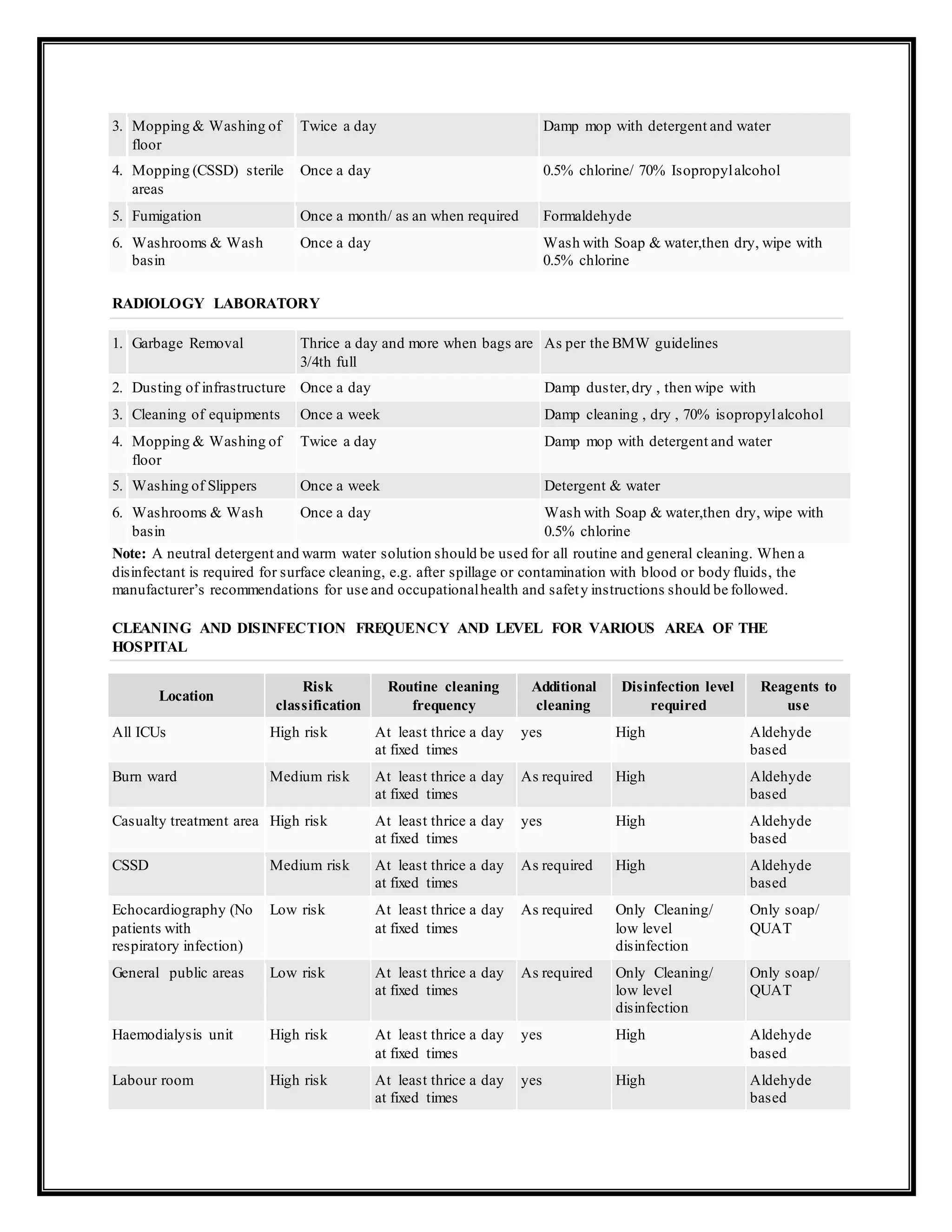
Twice a day Damp mop with detergent and water
4. Mopping (CSSD) sterile
areas
Once a day 0.5% chlorine/ 70% Isopropylalcohol
5. Fumigation Once a month/ as an when required Formaldehyde
6. Washrooms & Wash
basin
Once a day Wash with Soap & water,then dry, wipe with
0.5% chlorine
RADIOLOGY LABORATORY
1. Garbage Removal Thrice a day and more when bags are
3/4th full
As per the BMW guidelines
2. Dusting of infrastructure Once a day Damp duster,dry , then wipe with
3. Cleaning of equipments Once a week Damp cleaning , dry , 70% isopropylalcohol
4. Mopping & Washing of
floor
Twice a day Damp mop with detergent and water
5. Washing of Slippers Once a week Detergent & water
6. Washrooms & Wash
basin
Once a day Wash with Soap & water,then dry, wipe with
0.5% chlorine
Note: A neutral detergent and warm water solution should be used for all routine and general cleaning. When a
disinfectant is required for surface cleaning, e.g. after spillage or contamination with blood or body fluids, the
manufacturer’s recommendations for use and occupationalhealth and safety instructions should be followed.
CLEANING AND DISINFECTION FREQUENCY AND LEVEL FOR VARIOUS AREA OF THE
HOSPITAL
Location
Risk
classification
Routine cleaning
frequency
Additional
cleaning
Disinfection level
required
Reagents to
use
All ICUs High risk At least thrice a day
at fixed times
yes High Aldehyde
based
Burn ward Medium risk At least thrice a day
at fixed times
As required High Aldehyde
based
Casualty treatment area High risk At least thrice a day
at fixed times
yes High Aldehyde
based
CSSD Medium risk At least thrice a day
at fixed times
As required High Aldehyde
based
Echocardiography (No
patients with
respiratory infection)
Low risk At least thrice a day
at fixed times
As required Only Cleaning/
low level
disinfection
Only soap/
QUAT
General public areas Low risk At least thrice a day
at fixed times
As required Only Cleaning/
low level
disinfection
Only soap/
QUAT
Haemodialysis unit High risk At least thrice a day
at fixed times
yes High Aldehyde
based
Labour room High risk At least thrice a day
at fixed times
yes High Aldehyde
based
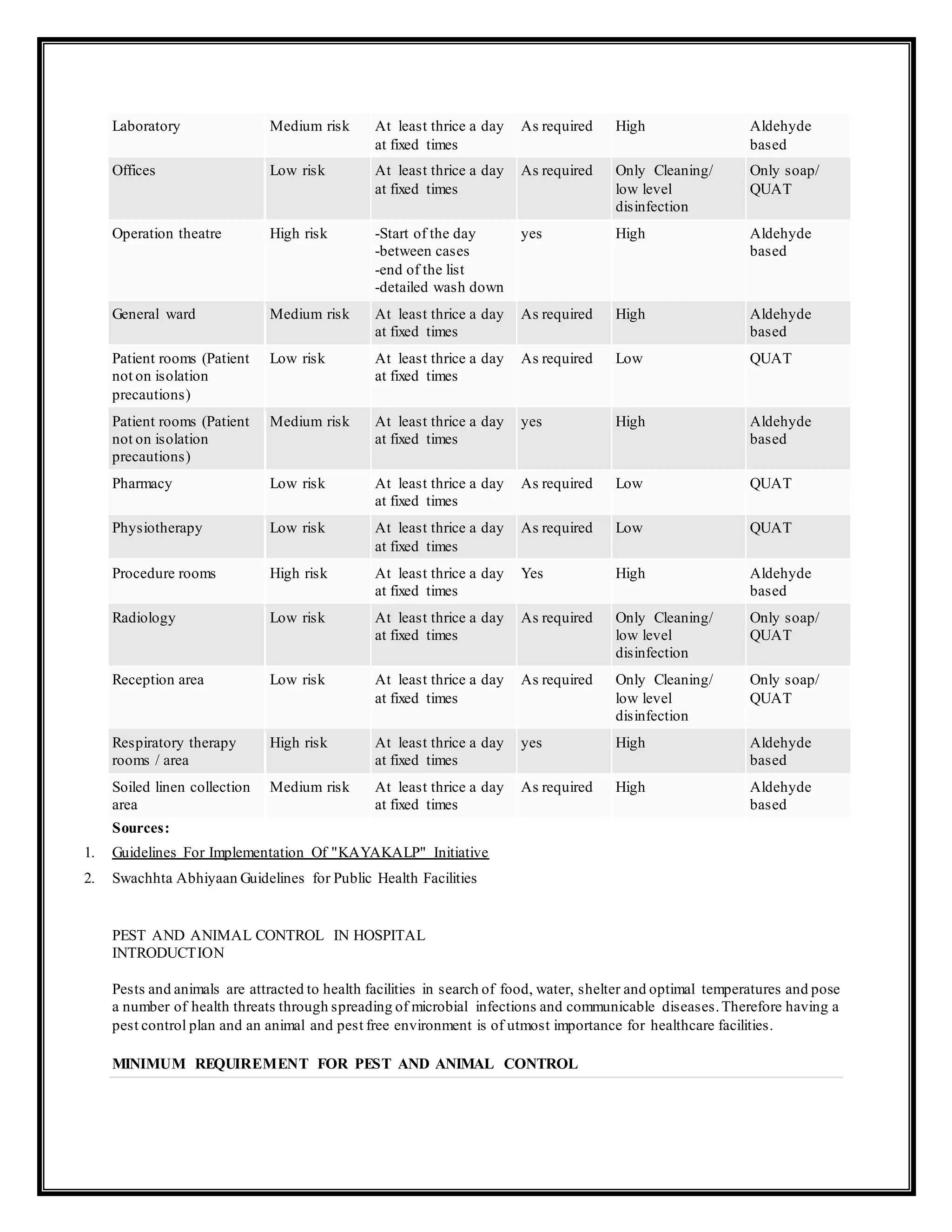
Laboratory Medium risk At least thrice a day
at fixed times
As required High Aldehyde
based
Offices Low risk At least thrice a day
at fixed times
As required Only Cleaning/
low level
disinfection
Only soap/
QUAT
Operation theatre High risk -Start of the day
-between cases
-end of the list
-detailed wash down
yes High Aldehyde
based
General ward Medium risk At least thrice a day
at fixed times
As required High Aldehyde
based
Patient rooms (Patient
not on isolation
precautions)
Low risk At least thrice a day
at fixed times
As required Low QUAT
Patient rooms (Patient
not on isolation
precautions)
Medium risk At least thrice a day
at fixed times
yes High Aldehyde
based
Pharmacy Low risk At least thrice a day
at fixed times
As required Low QUAT
Physiotherapy Low risk At least thrice a day
at fixed times
As required Low QUAT
Procedure rooms High risk At least thrice a day
at fixed times
Yes High Aldehyde
based
Radiology Low risk At least thrice a day
at fixed times
As required Only Cleaning/
low level
disinfection
Only soap/
QUAT
Reception area Low risk At least thrice a day
at fixed times
As required Only Cleaning/
low level
disinfection
Only soap/
QUAT
Respiratory therapy
rooms / area
High risk At least thrice a day
at fixed times
yes High Aldehyde
based
Soiled linen collection
area
Medium risk At least thrice a day
at fixed times
As required High Aldehyde
based
Sources:
1. Guidelines For Implementation Of "KAYAKALP" Initiative
2. Swachhta Abhiyaan Guidelines for Public Health Facilities
PEST AND ANIMAL CONTROL IN HOSPITAL
INTRODUCTION
Pests and animals are attracted to health facilities in search of food, water, shelter and optimal temperatures and pose
a number of health threats through spreading of microbial infections and communicable diseases.Therefore having a
pest control plan and an animal and pest free environment is of utmost importance for healthcare facilities.
MINIMUM REQUIREMENT FOR PEST AND ANIMAL CONTROL
To ensure a pest and animal free environment, health facilities can undertake various activities which in general may
include proper infrastructure maintenance, provisions of physical barriers, having a pest control plan and
engagement of pest control agency. Health facility should ensure that the following requirements are met for pest
and animal control:
 Hospital should engage a pest control agency for carrying out pest control activities including antitermite
treatment for wooden furniture and fixtures. The records of engaging such agency and pest control
activities need to be maintained.
 Hospital boundary wall should be intact (at least 2.5 metres) and cattle traps installed at all entrances and
exits of the hospitalto restrict entry of stray animals.
 Facility windows and doors should be designed in a way to reduce or prevent entry of flying pests.
 Hospital staff should follow and comply with best practices of housekeeping,cleaning and disinfection.
 Hospital staff should follow and comply with the best practices of waste management.
 Periodic maintenance plan needs to be complied with for maintenance of cracks and holes in infrastructure
and for any plumbing faults in utilities and pipes,.fixing of clogs,fastening of floor drains.
 Regular trimming of landscapes,plants,shrubs and trees also to prevent rodents from having easy access to
upper levels, windows and the roof.
 Regularly cleaning of drains and check for any drain clogs • Good storage practices for materials especially
food item storage in kitchens and cafeterias.
 Coordinate with local authorities to prevent accumulation of waste around the premises of the hospitalas it
leads to pest infestation in and around the premises
MEASURES FOR MOSQUITO FREE ENVIRONMENT
As mosquitoes pose a major problem in India, the healthcare establishment should take some extra measures to
ensure that it has a mosquito free environment. The health facility should ensure that the hospitalenvironment is
clean and all the water tanks and containers are covered.
In addition to these basic measures, the following additional measures need to be taken by the hospital to provide
mosquito free environment and for patient safety:
 Eliminate standing water in and around the hospital.
 All the containers like coolers, buckets,planters, flower pots,trash containers should be checked for water
storage and should be cleaned on weekly basis.
 Hospitals can use good quality insect repellents.
 Tightly cover water storage containers (buckets,cisterns, rain barrels).
 For containers without lids, use fine wire mesh.
 All the septic tanks should be checked for cracks or gaps and open vent should be covered with fine wire
mesh.
 Hospitals may use screens on windows and doors.
 Health facilities may also use mosquito nets for patient safety.
PEST CONTROL PLAN
Health facility needs to have an effective pest control plan for ensuring a pest and animal free environment in the
facility. The salient features of pest control plan are :
 Engaging a pest control agency for carrying out pest control activities in the facility.
 Pest control activities should also include anti termite treatment for furniture and fixtures.
 Pest control plan includes the frequency of carrying out the activities related to the pest control.
 Besides normal frequency of carrying out these activities, such plan should also include other indications
for carrying out the activities of pest control for example on incidence of pest presence (e.g., pest sightings,
droppings or pest catches in monitoring traps) and when nonchemical approaches such as vacuuming,
trapping and exclusion (i.e., physically blocking pests’entrance) has been unsuccessfuloris inappropriate.
 Pest control plan should also include routine inspection and monitoring for pest presence.
 Pest control plan should also include storage conditions and methods of different materials especially for
food items.
Source: : Guidelines For Implementation Of "KAYAKALP" Initiative

Cleaning in hospital as per guidelines

  • 1.
    CLEANING IN HOSPITALPROTOCOL FREQUENCY OF CLEANING IN HOSPITAL : Environmental cleaning and disinfection of the hospital is mainly aimed at eliminating/reducing/controlling/isolating the reservoirs of organisms in the environment. Different areas in the hospital can be broadly categorised into:  General Areas: Such areas in the hospitalwhere only general traffic is present; admitted patients are not present; patient care activities and procedures are not performed; street clothes and footwear are worn. Such areas are circulation areas like corridors, open areas like parking spaces,registration area etc.  Patient Care Areas: All areas in the hospital where patients are admitted and patient care activities and procedures are performed. These areas include wards, Operation Theatres (OTs), laboratory etc. FACTORS INFLUENCING THE CLEANING FREQUENCY AND LEVEL OF DISINFECTION  Potential for Direct Patient Contact : All surfaces in the hospital which can be under direct contact with patients should be more frequently cleaned with high/low level disinfectants as appropriate for the type of area. Cleaning and disinfecting such environmental surfaces is fundamental in reducing their potential contribution to the incidence of hospitalacquired infections (eliminating the reservoirs in the chain of infection).  Type of Surface and Orientation (vertical//horizontal) : Dry conditions favour the persistence of gram- positive cocci (e.g., coagulase-negative Staphylococcus spp.)in dust and on surfaces, whereas moist, soiled environments additionally favour the growth and persistence of gram-negative bacilli and fungi.Horizontal surfaces catch more dust and microbes and therefore may require more frequent cleaning.  Degree and Frequency of Hand Contact  High Touch Surfaces are those that have frequent contact with hands.Examples include doorknobs,elevator buttons,telephones,bedrails, light switches,computer keyboards,monitoring equipment, haemodialysis machines, wall areas around the toilet and edges of curtains in the patient area. Transmission of microbes from these surfaces to the patient directly or indirectly is more likely. Such surfaces require more frequent cleaning.  Low Touch Surfaces are those that have minimal contact with hands.Examples include floors, walls, ceilings, mirrors and window sills. Potential for infection transmission from these surfaces is low and they require less frequent cleaning. However, they should be cleaned as soon as possible when visibly soiled  Potential for Contamination with Pathogens : Probability of contamination of a surface depends upon the nature of activity, pathogens involved and the microbial load. Contamination with blood//body fluids is taken as a measure of this. Based on this, hospital area//surfaces can have:  Heavy Contamination: Surfaces and/orequipment are exposed to copious amounts of blood or other body fluids (e.g., OTs, labour room, autopsy room, cardiac catheterisation laboratory, burn unit, haemodialysis unit, Casualty Department, bathroom if the patient has diarrhoea or is incontinent).
  • 2.
     Moderate Contamination:Surfaces and/or equipment are contaminated with blood or other body fluids as part of routine activity (e.g., patient room, bathroom if patient is incontinent) and the contaminated substances are contained or removed (e.g., soiled bed sheets).All patient rooms and bathrooms should be considered to be, as a minimum, moderately contaminated.  Light Contamination: An area is considered to be lightly contaminated or not contaminated if surfaces are not exposed to blood, other body fluids or items that have come into contact with blood or body fluids (e.g., lounges,libraries, offices, general traffic areas).  Nature of Activity (critical care, meetings etc.) : The nature of activity generally influences the exposure of surfaces/equipment to blood and body fluids e.g., critical care area versus meeting rooms.  Vulnerability of Persons Present in the Area : Susceptibility to infection varies among different types of patients.  More Susceptible: These are patients who are more susceptible to infection due to their medical condition or lack of immunity. These include those who are immune-compromised neonates; those who have severe burns; and those undergoing invasive or operative procedures (e.g., haemodialysis). Patients with sterile tissues exposed/sterile devices inserted in major blood vessels orbody tracts e.g., central lines, endotrachealtubes for more than 24 hours are also more susceptible to infection. Patients with peripheral IV cannulation, urinary catheterinsertion and intramuscular injections are excluded from this category unless they have some medical condition causing lack of immunity.  Less Susceptible: For the purpose of risk stratification for cleaning, all other individuals are classified as less susceptible. Source: Guidelines For Implementation Of "KAYAKALP" Initiative DETAILED FREQUENCY OF CLEANING S.No Activity Frequency Agents Used 1. Garbage Removal Thrice a day and more when bags are 3/4th full As per the BMW guidelines 2. Cleaning of Instruments After every procedure Soap & water followed by sterilization 3. Cleaning of clean areas and corridors of complex Twice a day/ as & when required Damp Mop with detergent and water/ 0.5% chlorine 4. Mopping. (Care to be taken in case of special epoxy flooring ) Thrice a day and after each procedure Damp mop with detergent and water / 0.5% chlorine 5. Cleaning of equipments like anaesthesia machines, monitors, ventilators, infant warmers/ baby cribs etc Twice a day/ as & when required Damp Mopping , dry, Disinfect with 70% isopropyl alcohol / 2% glutaraldehyde (For endoscopes & reusable items) 6. Fumigation Once a month/ After Infected case surgery Formaldehyde 7. Cleaning of OT table and OT stretcher Twice a day/ after each surgery 0.5% chlorine /70% Isopropylalcohol
  • 3.
    8. Doctor’s /nurses / technician room Twice a day Detergent & water 9. Washroom& wash basins cleaning Thrice a day and as & when required Wash with Soap & water,then dry, wipe 0.5% chlorine 10. Washing of slipper once a day and when required Soap & water 11. Collection of soiled linen and sluicing As and when required Soak in clean water with bleaching powder 0.5% for 30 minutes. Wash again with detergent and water to remove the Bleach. OR launder in hot water (70- 80 degree C) if possible. 12. Cleaning of Mops After every use Soak in clean water with bleaching powder 0.5% for 30 minutes. Wash again with detergent and water to remove the bleach MODERATE RISK AREA WARDS 1. Garbage Removal Thrice a day and more when bags are 3/4th full As per the BMW guidelines 2. Mopping of floor Once a day Damp mop with detergent and water 3. Washrooms & Wash basin Thrice a day and as & when required Wash with Soap & water, then dry, wipe with 0.5% chlorine 4. Dusting / Cleaning of Equipment Once a day Damp Mopping , dry, Dis-infect with 70% isopropyl alcohol 5. Collection of soiled linen and sluicing As and when required Soak in clean water with bleaching powder 0.5% for 30 minutes. Wash again with detergent and water to remove the Bleach. CANTEEN AND KITCHEN 1. Garbage Removal Thrice a day and more when bags are 3/4th full As per the BMW guidelines 2. Mopping of floor Once a day Damp mop with detergent and water 3. Washrooms & Wash basin Once a day Wash with Soap & water,then dry, wipe with 0.5% chlorine 4. Dusting / Cleaning of Equipment Once a day Duster PUBLIC AREA WASHROOM 1. Cleaning Every 2nd hourly Damp mop with detergent and water 2. Washrooms & Wash basin Thrice a day Wash with Soap & water,then dry, wipe with 0.5% chlorine. LOBBY AND OPEN AREA 1. Garbage Removal Thrice a day and more when bags are 3/4th full As per the BMW guidelines
  • 4.
    2. Mopping offloor Once a day Damp mop with detergent and water 3. Washrooms & Wash basin Once a day Wash with Soap & water,then dry, wipe with 0.5% chlorine 4. Dusting / Cleaning of Equipment Once a day Duster STORES (MEDICAL SURGICAL, NON-MEDICAL) 1. Garbage Removal Thrice a day and more when bags are 3/4th full As per the BMW guidelines 2. Dusting Once a day Duster 3. Mopping of floor Once a day Damp mop with detergent and water MORTUARY 1. Garbage Removal Thrice a day and more when bags are 3/4th full As per the BMW guidelines 2. Dusting Once a day Duster 3. Mopping of floor Once a day Damp mop with detergent and water 4. Cleaning of autopsy table Once a day and after every procedure 0.5% chlorine / 70% isopropyl alcohol 5. Drains Once a day Soap & Water ADMINISTRATION RECORD/ENGINEERING OFFICE 1. Garbage Removal Thrice a day and more when bags are 3/4th full As per the BMW guidelines 2. Dusting Once a day Duster 3. Mopping of floor Once a day Damp mop with detergent and water 4. Dry Mopping Once a day Soft brush 5. Washrooms & Wash basin Once a day Wash with Soap & water, then dry, wipe with 0.5% Chlorine CSSD / LAUNDRY 1. Garbage Removal Thrice a day and more when bags are 3/4th full As per the BMW guidelines 2. Dusting Once a day Duster
  • 5.
    3. Mopping &Washing of floor Twice a day Damp mop with detergent and water 4. Mopping (CSSD) sterile areas Once a day 0.5% chlorine/ 70% Isopropylalcohol 5. Fumigation Once a month/ as an when required Formaldehyde 6. Washrooms & Wash basin Once a day Wash with Soap & water,then dry, wipe with 0.5% chlorine RADIOLOGY LABORATORY 1. Garbage Removal Thrice a day and more when bags are 3/4th full As per the BMW guidelines 2. Dusting of infrastructure Once a day Damp duster,dry , then wipe with 3. Cleaning of equipments Once a week Damp cleaning , dry , 70% isopropylalcohol 4. Mopping & Washing of floor Twice a day Damp mop with detergent and water 5. Washing of Slippers Once a week Detergent & water 6. Washrooms & Wash basin Once a day Wash with Soap & water,then dry, wipe with 0.5% chlorine Note: A neutral detergent and warm water solution should be used for all routine and general cleaning. When a disinfectant is required for surface cleaning, e.g. after spillage or contamination with blood or body fluids, the manufacturer’s recommendations for use and occupationalhealth and safety instructions should be followed. CLEANING AND DISINFECTION FREQUENCY AND LEVEL FOR VARIOUS AREA OF THE HOSPITAL Location Risk classification Routine cleaning frequency Additional cleaning Disinfection level required Reagents to use All ICUs High risk At least thrice a day at fixed times yes High Aldehyde based Burn ward Medium risk At least thrice a day at fixed times As required High Aldehyde based Casualty treatment area High risk At least thrice a day at fixed times yes High Aldehyde based CSSD Medium risk At least thrice a day at fixed times As required High Aldehyde based Echocardiography (No patients with respiratory infection) Low risk At least thrice a day at fixed times As required Only Cleaning/ low level disinfection Only soap/ QUAT General public areas Low risk At least thrice a day at fixed times As required Only Cleaning/ low level disinfection Only soap/ QUAT Haemodialysis unit High risk At least thrice a day at fixed times yes High Aldehyde based Labour room High risk At least thrice a day at fixed times yes High Aldehyde based
  • 6.
    Laboratory Medium riskAt least thrice a day at fixed times As required High Aldehyde based Offices Low risk At least thrice a day at fixed times As required Only Cleaning/ low level disinfection Only soap/ QUAT Operation theatre High risk -Start of the day -between cases -end of the list -detailed wash down yes High Aldehyde based General ward Medium risk At least thrice a day at fixed times As required High Aldehyde based Patient rooms (Patient not on isolation precautions) Low risk At least thrice a day at fixed times As required Low QUAT Patient rooms (Patient not on isolation precautions) Medium risk At least thrice a day at fixed times yes High Aldehyde based Pharmacy Low risk At least thrice a day at fixed times As required Low QUAT Physiotherapy Low risk At least thrice a day at fixed times As required Low QUAT Procedure rooms High risk At least thrice a day at fixed times Yes High Aldehyde based Radiology Low risk At least thrice a day at fixed times As required Only Cleaning/ low level disinfection Only soap/ QUAT Reception area Low risk At least thrice a day at fixed times As required Only Cleaning/ low level disinfection Only soap/ QUAT Respiratory therapy rooms / area High risk At least thrice a day at fixed times yes High Aldehyde based Soiled linen collection area Medium risk At least thrice a day at fixed times As required High Aldehyde based Sources: 1. Guidelines For Implementation Of "KAYAKALP" Initiative 2. Swachhta Abhiyaan Guidelines for Public Health Facilities PEST AND ANIMAL CONTROL IN HOSPITAL INTRODUCTION Pests and animals are attracted to health facilities in search of food, water, shelter and optimal temperatures and pose a number of health threats through spreading of microbial infections and communicable diseases.Therefore having a pest control plan and an animal and pest free environment is of utmost importance for healthcare facilities. MINIMUM REQUIREMENT FOR PEST AND ANIMAL CONTROL
  • 7.
    To ensure apest and animal free environment, health facilities can undertake various activities which in general may include proper infrastructure maintenance, provisions of physical barriers, having a pest control plan and engagement of pest control agency. Health facility should ensure that the following requirements are met for pest and animal control:  Hospital should engage a pest control agency for carrying out pest control activities including antitermite treatment for wooden furniture and fixtures. The records of engaging such agency and pest control activities need to be maintained.  Hospital boundary wall should be intact (at least 2.5 metres) and cattle traps installed at all entrances and exits of the hospitalto restrict entry of stray animals.  Facility windows and doors should be designed in a way to reduce or prevent entry of flying pests.  Hospital staff should follow and comply with best practices of housekeeping,cleaning and disinfection.  Hospital staff should follow and comply with the best practices of waste management.  Periodic maintenance plan needs to be complied with for maintenance of cracks and holes in infrastructure and for any plumbing faults in utilities and pipes,.fixing of clogs,fastening of floor drains.  Regular trimming of landscapes,plants,shrubs and trees also to prevent rodents from having easy access to upper levels, windows and the roof.  Regularly cleaning of drains and check for any drain clogs • Good storage practices for materials especially food item storage in kitchens and cafeterias.  Coordinate with local authorities to prevent accumulation of waste around the premises of the hospitalas it leads to pest infestation in and around the premises MEASURES FOR MOSQUITO FREE ENVIRONMENT As mosquitoes pose a major problem in India, the healthcare establishment should take some extra measures to ensure that it has a mosquito free environment. The health facility should ensure that the hospitalenvironment is clean and all the water tanks and containers are covered. In addition to these basic measures, the following additional measures need to be taken by the hospital to provide mosquito free environment and for patient safety:  Eliminate standing water in and around the hospital.  All the containers like coolers, buckets,planters, flower pots,trash containers should be checked for water storage and should be cleaned on weekly basis.  Hospitals can use good quality insect repellents.  Tightly cover water storage containers (buckets,cisterns, rain barrels).  For containers without lids, use fine wire mesh.  All the septic tanks should be checked for cracks or gaps and open vent should be covered with fine wire mesh.  Hospitals may use screens on windows and doors.  Health facilities may also use mosquito nets for patient safety. PEST CONTROL PLAN Health facility needs to have an effective pest control plan for ensuring a pest and animal free environment in the facility. The salient features of pest control plan are :  Engaging a pest control agency for carrying out pest control activities in the facility.
  • 8.
     Pest controlactivities should also include anti termite treatment for furniture and fixtures.  Pest control plan includes the frequency of carrying out the activities related to the pest control.  Besides normal frequency of carrying out these activities, such plan should also include other indications for carrying out the activities of pest control for example on incidence of pest presence (e.g., pest sightings, droppings or pest catches in monitoring traps) and when nonchemical approaches such as vacuuming, trapping and exclusion (i.e., physically blocking pests’entrance) has been unsuccessfuloris inappropriate.  Pest control plan should also include routine inspection and monitoring for pest presence.  Pest control plan should also include storage conditions and methods of different materials especially for food items. Source: : Guidelines For Implementation Of "KAYAKALP" Initiative