Prepared by
Mr. Khalid Farooq
www.seas9.com
The Central Sterile Supply Department, CSSD,
also called Central Supply Services
Department, SPD, Sterile Processing
Department, is an integrated place in hospital
and other health care facilities that performs
initially cleaning, disinfection,
decontamination and sterilization on RIMD,
reusable invasive medical devices, equipment
and consumable, for subsequent use by
medical team in hospital like operation
theatre, wards, private room, cath labs,
endoscopy section, laboratories, labor room,
minor operation theatre.
www.seas9.com
CSSD area can be a large room, divided into
four well defined areas, different room
separated by doors and counters.
1. DIRTY OR DECONTAMINATION ROOM, AREA
2. CLEAN, PACKAGING AND PREPARATION
ROOM, AREA
3. SURGICAL LINEN PACKAGING ROOM, AREA
4. STERILIZED STORAGE ROOM, AREA
www.seas9.com
 Decontamination is the process of cleansing an
object or substance to remove contaminants
such as micro – organism, hazardous materials,
including blood, secretions, organic matters,
sputum, body fluids, radioactive substances, and
infectious diseases.
 Reception of the soiled instruments, equipment,
and other reusable invasive medical devices from
the consumer departments for initially cleaning,
disinfection by several methods.
 The purpose of decontamination is to prevent
the spread of micro – organism and other
contaminants from RIMD.
www.seas9.com
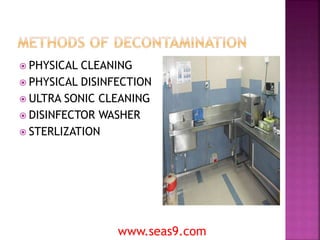
 PHYSICAL CLEANING
 PHYSICAL DISINFECTION
 ULTRA SONIC CLEANING
 DISINFECTOR WASHER
 STERLIZATION
www.seas9.com
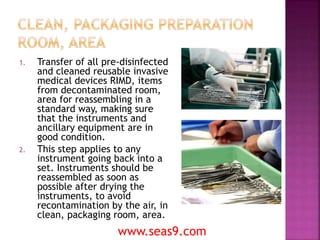
1. Transfer of all pre-disinfected
and cleaned reusable invasive
medical devices RIMD, items
from decontaminated room,
area for reassembling in a
standard way, making sure
that the instruments and
ancillary equipment are in
good condition.
2. This step applies to any
instrument going back into a
set. Instruments should be
reassembled as soon as
possible after drying the
instruments, to avoid
recontamination by the air, in
clean, packaging room, area.
www.seas9.com
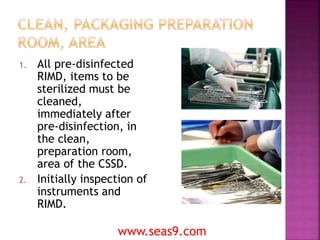
1. All pre-disinfected
RIMD, items to be
sterilized must be
cleaned,
immediately after
pre-disinfection, in
the clean,
preparation room,
area of the CSSD.
2. Initially inspection of
instruments and
RIMD.
www.seas9.com
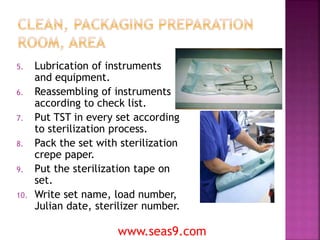
5. Lubrication of instruments
and equipment.
6. Reassembling of instruments
according to check list.
7. Put TST in every set according
to sterilization process.
8. Pack the set with sterilization
crepe paper.
9. Put the sterilization tape on
set.
10. Write set name, load number,
Julian date, sterilizer number.
www.seas9.com
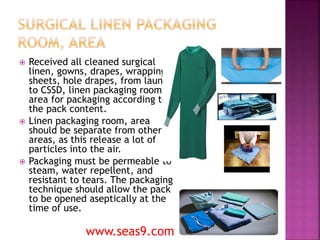
 Received all cleaned surgical
linen, gowns, drapes, wrapping
sheets, hole drapes, from laundry
to CSSD, linen packaging room,
area for packaging according to
the pack content.
 Linen packaging room, area
should be separate from other
areas, as this release a lot of
particles into the air.
 Packaging must be permeable to
steam, water repellent, and
resistant to tears. The packaging
technique should allow the pack
to be opened aseptically at the
time of use.
www.seas9.com
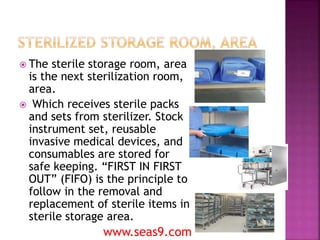
 The sterile storage room, area
is the next sterilization room,
area.
 Which receives sterile packs
and sets from sterilizer. Stock
instrument set, reusable
invasive medical devices, and
consumables are stored for
safe keeping. “FIRST IN FIRST
OUT” (FIFO) is the principle to
follow in the removal and
replacement of sterile items in
sterile storage area.
www.seas9.com
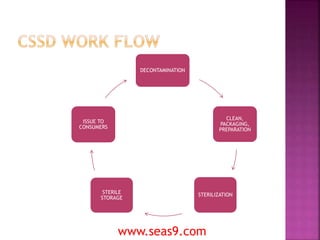
DECONTAMINATION
CLEAN,
PACKAGING,
PREPARATION
STERILIZATIONSTERILE
STORAGE
ISSUE TO
CONSUMERS
www.seas9.com
 Central sterilization supply department is
responsible for the processing of all reusable
invasive medical devices for all the
departments/services of the hospital. This
centralizes the pre-disinfection, cleaning,
packing and sterilization of all items.
 The centralization of procedures implies that
the staff are specifically trained for the job,
the department is correctly equipped and
quality control is ensured.
www.seas9.com
 Improvement in both the practice and
supervision of the entire sterilization process
as it is concentrated in the same location
and executed by a specific team which can “
professionalize” this activity.
 Relives ward staff from this activity, who can
be designated to another tasks.
 Avoids dispersal within the services, multiple
purchasing and wasting of material,
sterilization equipment and fuel.
 Facilitates the management of material and
sterilization equipment.
www.seas9.com
 If sterilization is performed badly, material of
the whole hospital is affected.
 Risk of spreading infectious agents through the
transfer of soiled infected material from its
source (consumer department) to an external
services.
 Risk of losing or mixing of medical devices
between different services.
 Risk of decreased motivation amongst staff in
charge of sterilization, if assigned solely to this
activity. (routine)
 Risk that the remaining staff forget sterilization
procedures which can constitute a problem when
the sterilization staff are absent.
www.seas9.com
www.seas9.com

Hospital CSSD

  • 1.
    Prepared by Mr. KhalidFarooq www.seas9.com
  • 2.
    The Central SterileSupply Department, CSSD, also called Central Supply Services Department, SPD, Sterile Processing Department, is an integrated place in hospital and other health care facilities that performs initially cleaning, disinfection, decontamination and sterilization on RIMD, reusable invasive medical devices, equipment and consumable, for subsequent use by medical team in hospital like operation theatre, wards, private room, cath labs, endoscopy section, laboratories, labor room, minor operation theatre. www.seas9.com
  • 3.
    CSSD area canbe a large room, divided into four well defined areas, different room separated by doors and counters. 1. DIRTY OR DECONTAMINATION ROOM, AREA 2. CLEAN, PACKAGING AND PREPARATION ROOM, AREA 3. SURGICAL LINEN PACKAGING ROOM, AREA 4. STERILIZED STORAGE ROOM, AREA www.seas9.com
  • 4.
     Decontamination isthe process of cleansing an object or substance to remove contaminants such as micro – organism, hazardous materials, including blood, secretions, organic matters, sputum, body fluids, radioactive substances, and infectious diseases.  Reception of the soiled instruments, equipment, and other reusable invasive medical devices from the consumer departments for initially cleaning, disinfection by several methods.  The purpose of decontamination is to prevent the spread of micro – organism and other contaminants from RIMD. www.seas9.com
  • 5.
     PHYSICAL CLEANING PHYSICAL DISINFECTION  ULTRA SONIC CLEANING  DISINFECTOR WASHER  STERLIZATION www.seas9.com
  • 6.
    1. Transfer ofall pre-disinfected and cleaned reusable invasive medical devices RIMD, items from decontaminated room, area for reassembling in a standard way, making sure that the instruments and ancillary equipment are in good condition. 2. This step applies to any instrument going back into a set. Instruments should be reassembled as soon as possible after drying the instruments, to avoid recontamination by the air, in clean, packaging room, area. www.seas9.com
  • 7.
    1. All pre-disinfected RIMD,items to be sterilized must be cleaned, immediately after pre-disinfection, in the clean, preparation room, area of the CSSD. 2. Initially inspection of instruments and RIMD. www.seas9.com
  • 8.
    5. Lubrication ofinstruments and equipment. 6. Reassembling of instruments according to check list. 7. Put TST in every set according to sterilization process. 8. Pack the set with sterilization crepe paper. 9. Put the sterilization tape on set. 10. Write set name, load number, Julian date, sterilizer number. www.seas9.com
  • 9.
     Received allcleaned surgical linen, gowns, drapes, wrapping sheets, hole drapes, from laundry to CSSD, linen packaging room, area for packaging according to the pack content.  Linen packaging room, area should be separate from other areas, as this release a lot of particles into the air.  Packaging must be permeable to steam, water repellent, and resistant to tears. The packaging technique should allow the pack to be opened aseptically at the time of use. www.seas9.com
  • 10.
     The sterilestorage room, area is the next sterilization room, area.  Which receives sterile packs and sets from sterilizer. Stock instrument set, reusable invasive medical devices, and consumables are stored for safe keeping. “FIRST IN FIRST OUT” (FIFO) is the principle to follow in the removal and replacement of sterile items in sterile storage area. www.seas9.com
  • 11.
  • 12.
     Central sterilizationsupply department is responsible for the processing of all reusable invasive medical devices for all the departments/services of the hospital. This centralizes the pre-disinfection, cleaning, packing and sterilization of all items.  The centralization of procedures implies that the staff are specifically trained for the job, the department is correctly equipped and quality control is ensured. www.seas9.com
  • 13.
     Improvement inboth the practice and supervision of the entire sterilization process as it is concentrated in the same location and executed by a specific team which can “ professionalize” this activity.  Relives ward staff from this activity, who can be designated to another tasks.  Avoids dispersal within the services, multiple purchasing and wasting of material, sterilization equipment and fuel.  Facilitates the management of material and sterilization equipment. www.seas9.com
  • 14.
     If sterilizationis performed badly, material of the whole hospital is affected.  Risk of spreading infectious agents through the transfer of soiled infected material from its source (consumer department) to an external services.  Risk of losing or mixing of medical devices between different services.  Risk of decreased motivation amongst staff in charge of sterilization, if assigned solely to this activity. (routine)  Risk that the remaining staff forget sterilization procedures which can constitute a problem when the sterilization staff are absent. www.seas9.com
  • 15.