SEPARATING MIXTURES
By Andrés Arévalo
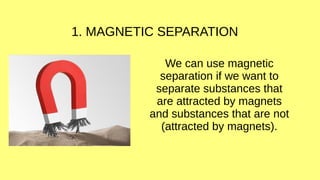
1. MAGNETIC SEPARATION
We can use magnetic
separation if we want to
separate substances that
are attracted by magnets
and substances that are not
(attracted by magnets).
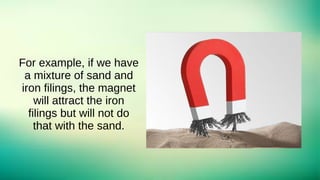
For example, if we have
a mixture of sand and
iron filings, the magnet
will attract the iron
filings but will not do
that with the sand.
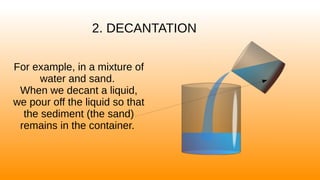
2. DECANTATION
For example, in a mixture of
water and sand.
When we decant a liquid,
we pour off the liquid so that
the sediment (the sand)
remains in the container.
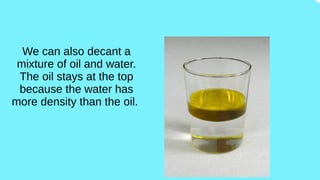
We can also decant a
mixture of oil and water.
The oil stays at the top
because the water has
more density than the oil.
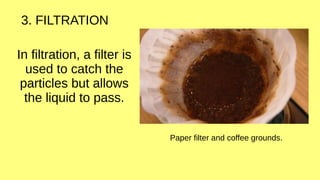
3. FILTRATION
In filtration, a filter is
used to catch the
particles but allows
the liquid to pass.
Paper filter and coffee grounds.
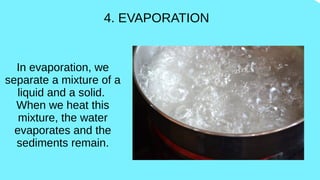
4. EVAPORATION
In evaporation, we
separate a mixture of a
liquid and a solid.
When we heat this
mixture, the water
evaporates and the
sediments remain.
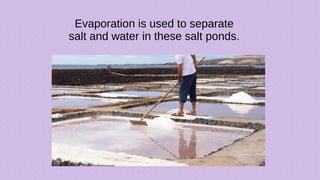
Evaporation is used to separate
salt and water in these salt ponds.
5. DISTILLATION
Liquids evaporate when they boil. This is what we call
boiling point (punto de ebullición). However, some liquids
boil earlier than others.
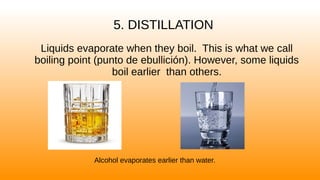
Alcohol evaporates earlier than water.
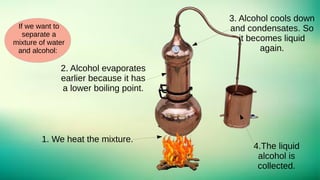
If we want to
separate a
mixture of water
and alcohol:
1. We heat the mixture.
2. Alcohol evaporates
earlier because it has
a lower boiling point.
3. Alcohol cools down
and condensates. So
it becomes liquid
again.
4.The liquid
alcohol is
collected.

Separating mixtures

  • 1.
  • 2.
    1. MAGNETIC SEPARATION Wecan use magnetic separation if we want to separate substances that are attracted by magnets and substances that are not (attracted by magnets).
  • 3.
    For example, ifwe have a mixture of sand and iron filings, the magnet will attract the iron filings but will not do that with the sand.
  • 4.
    2. DECANTATION For example,in a mixture of water and sand. When we decant a liquid, we pour off the liquid so that the sediment (the sand) remains in the container.
  • 5.
    We can alsodecant a mixture of oil and water. The oil stays at the top because the water has more density than the oil.
  • 6.
    3. FILTRATION In filtration,a filter is used to catch the particles but allows the liquid to pass. Paper filter and coffee grounds.
  • 7.
    4. EVAPORATION In evaporation,we separate a mixture of a liquid and a solid. When we heat this mixture, the water evaporates and the sediments remain.
  • 8.
    Evaporation is usedto separate salt and water in these salt ponds.
  • 9.
    5. DISTILLATION Liquids evaporatewhen they boil. This is what we call boiling point (punto de ebullición). However, some liquids boil earlier than others. Alcohol evaporates earlier than water.
  • 10.
    If we wantto separate a mixture of water and alcohol: 1. We heat the mixture. 2. Alcohol evaporates earlier because it has a lower boiling point. 3. Alcohol cools down and condensates. So it becomes liquid again. 4.The liquid alcohol is collected.