Ascending& Descending tracts Dr. Israa M. Sulaiman Department of Anatomy IMS/MSU
The ascending tracts
By the end of the lecture, students should be able to define the ascending tract  enumerate the tracts according to their functional components  explain general outline of neuronal chain of ascending tracts illustrate and trace the neuronal chain of each tract apply anatomical knowledge to correlate with the clinical condition in case of injury to these tracts
contents function of nervous system in general sensory system overview  spinal cord and nerve tracts  ascending tracts organization in general ascending tracts  functional components
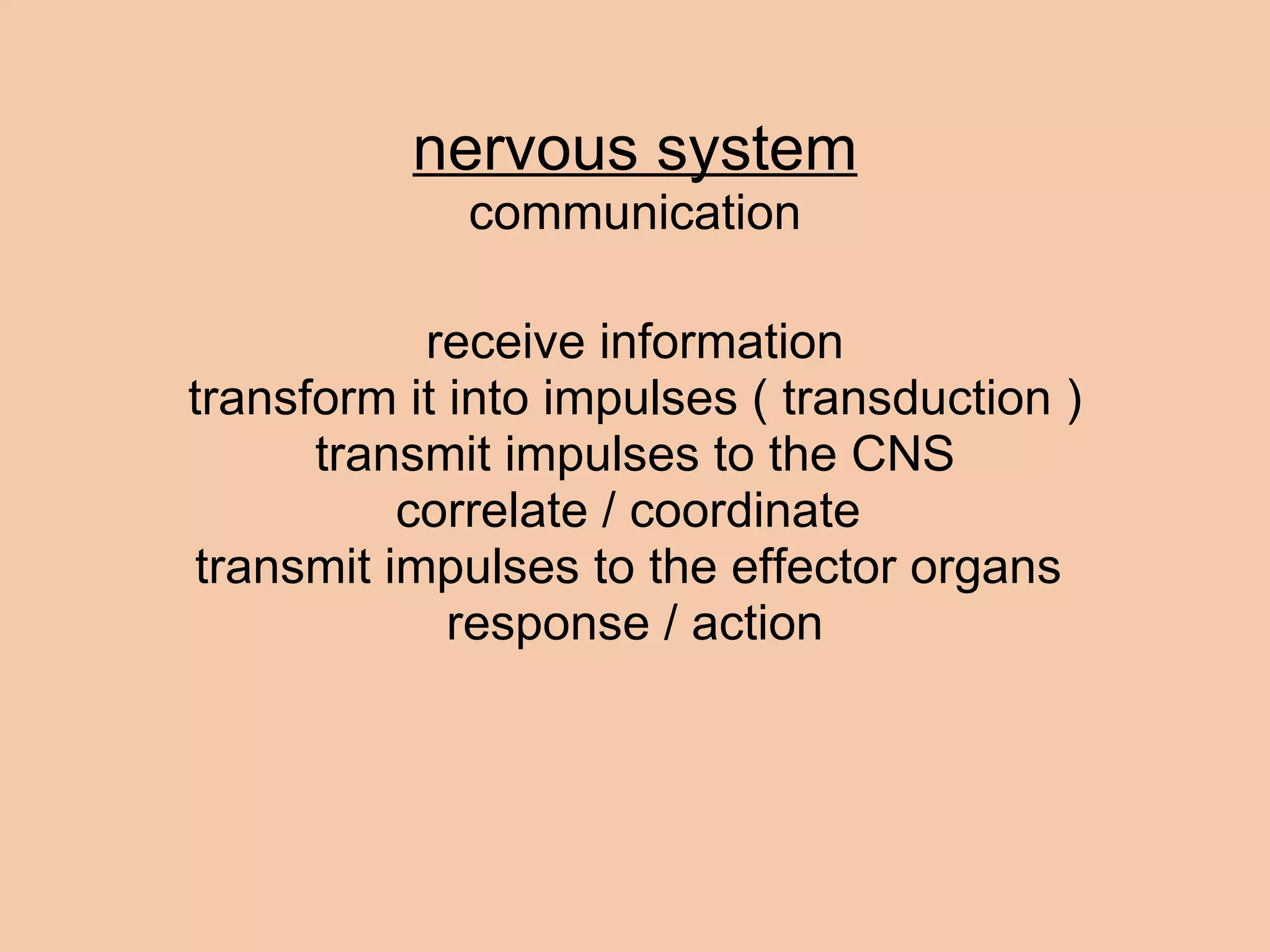
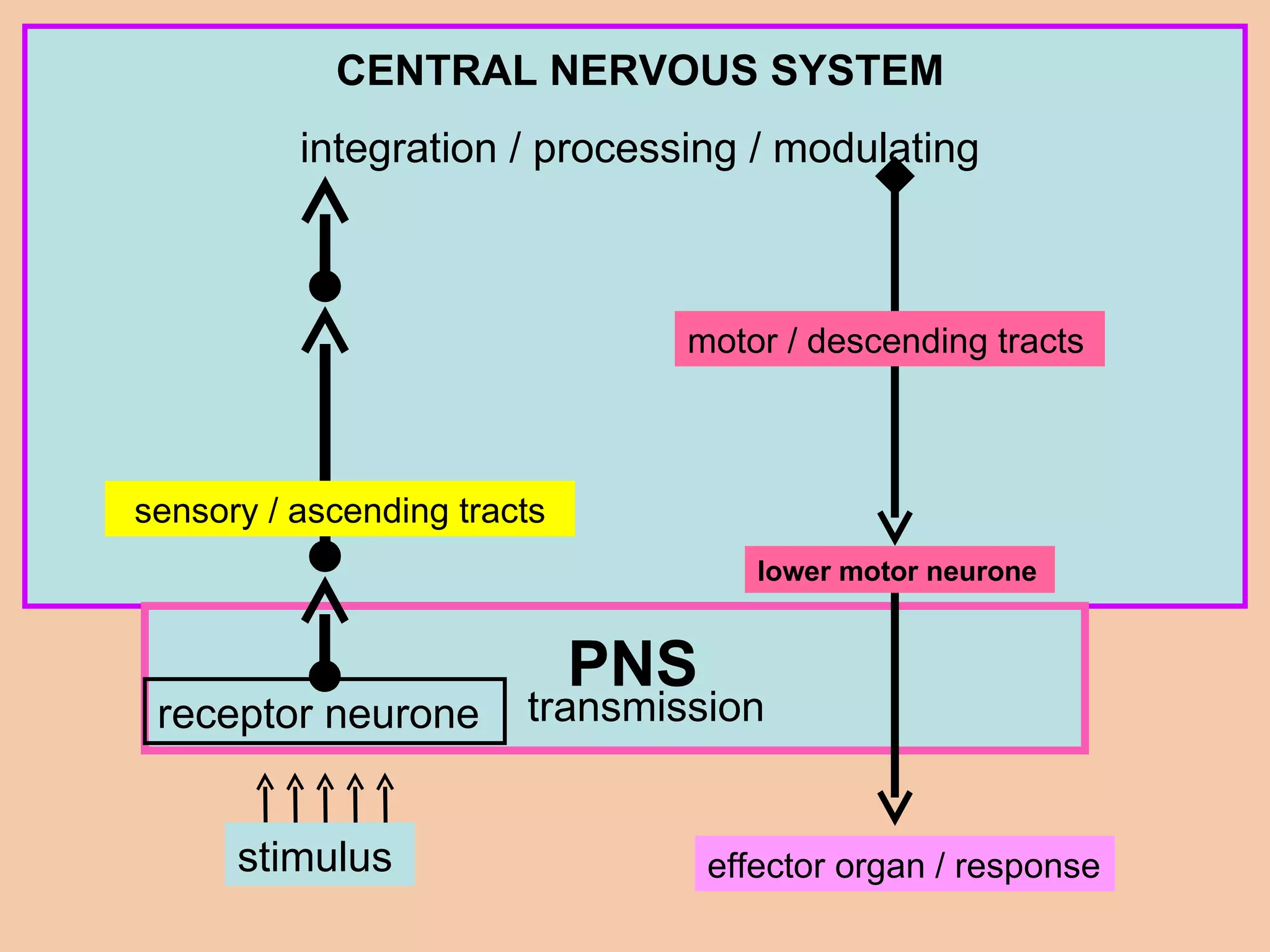
nervous system communication receive information transform it into impulses ( transduction ) transmit impulses to the CNS correlate / coordinate  transmit impulses to the effector organs  response / action
CENTRAL NERVOUS SYSTEM integration / processing / modulating stimulus receptor neurone motor / descending tracts effector organ / response PNS transmission lower motor neurone sensory / ascending tracts
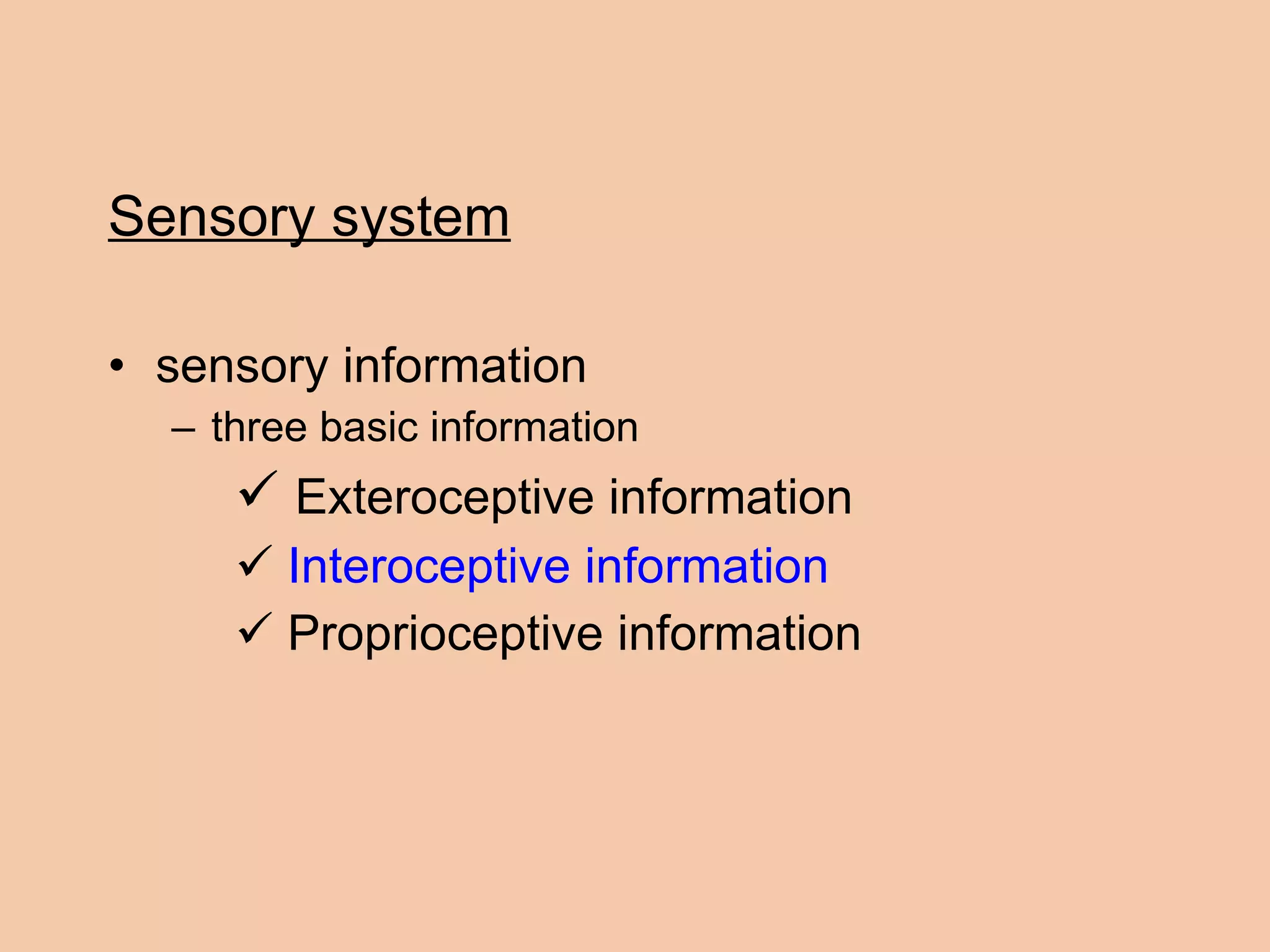
Sensory system sensory information three basic information Exteroceptive information Interoceptive information Proprioceptive information
sensory information   are received and carried by ascending tracts   exteroceptive sensation  origin:-  outside the body  e.g. temp, touch, light, sound, chemicals, mechanical receptors:- surface layer of skin, mucosa proprioceptive sensation  origin:-  within the body  e.g. muscles, joints, tendons receptors – deeper layer of skin, tendons, joints, GTO, muscle    spindles, ligaments
 
sensory   information   from the peripheral sensory endings is conducted through the nervous system  by  a series of neurones
information conscious sensation reach the cerebral cortex unconscious sensation reach to the areas other than cortex
spinal cord Grey matter mostly made up of cell bodies of neurone White matter composed of nerve fibres ( ascending and descending tracts ) embedded in neuroglial cells
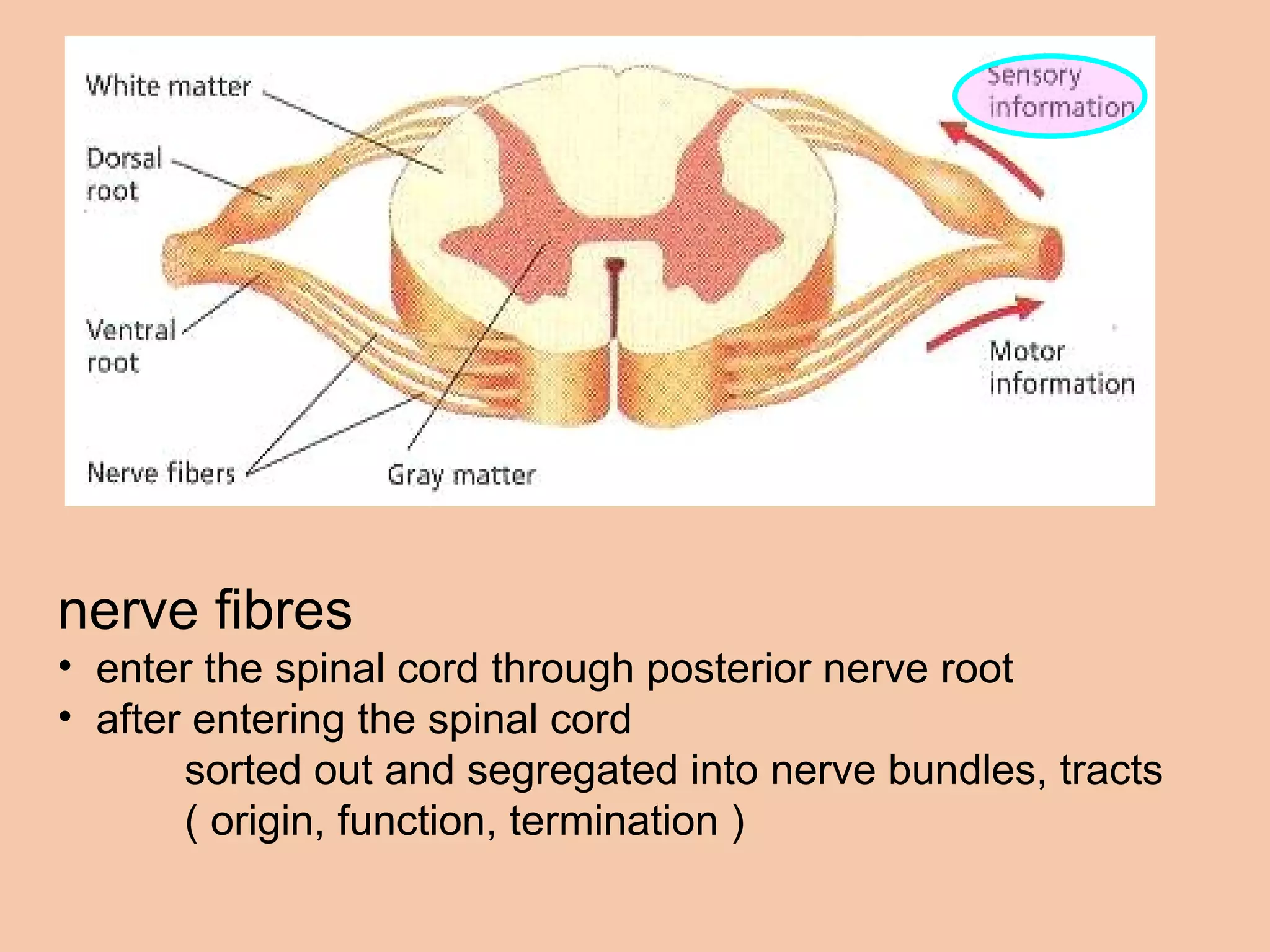
nerve fibres enter the spinal cord through posterior nerve root after entering the spinal cord sorted out and segregated into nerve bundles, tracts ( origin, function, termination )
ascending tracts bundles of nerve fibres  linking spinal cord with higher centres of the brain convey information  from  soma / viscera to higher level of neuraxis
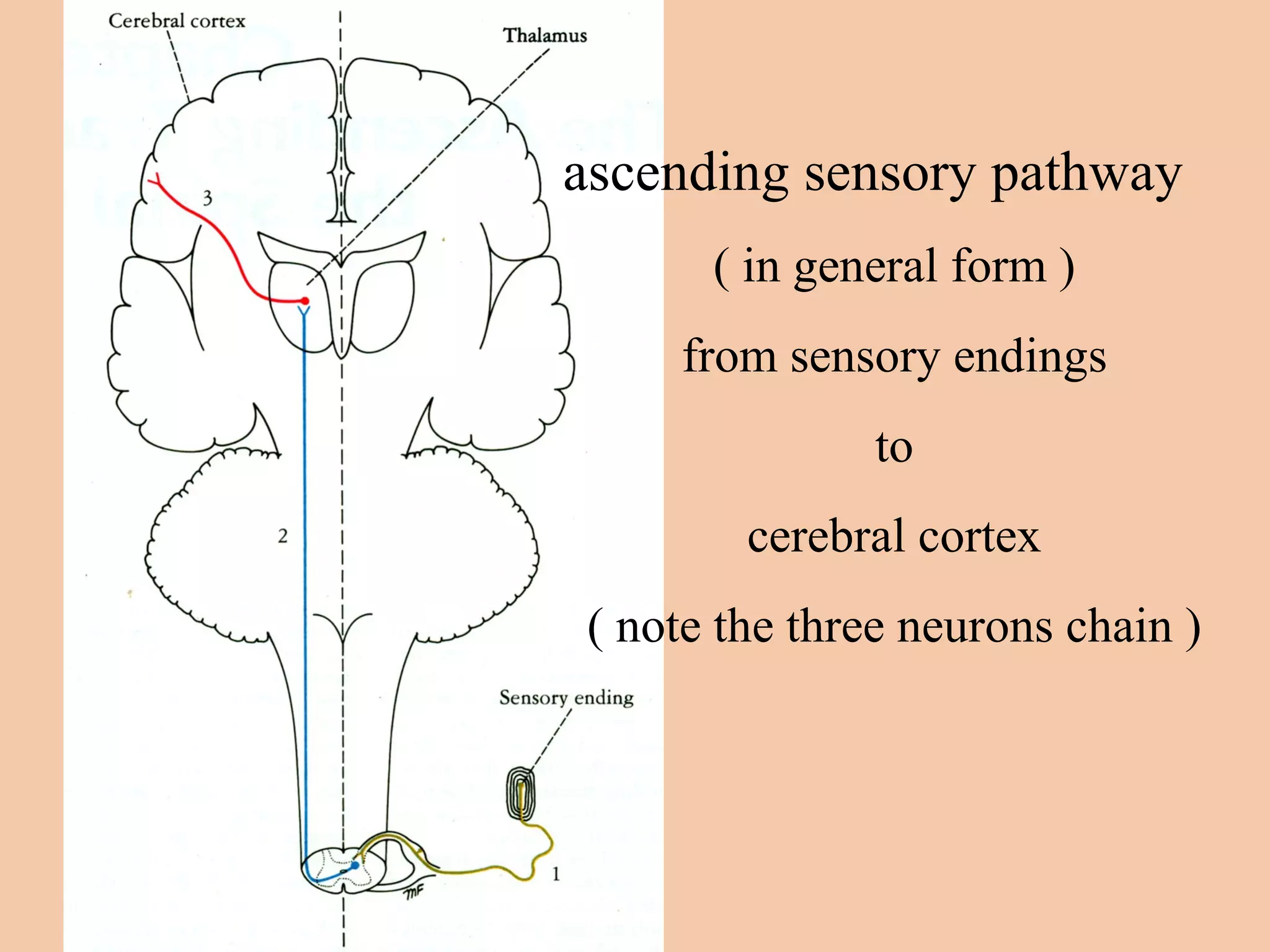
ascending sensory pathway  are organized in three neuronal chain  - First order neurone - Second order neurone  - Third order neurone
First order neurone  cell body in  posterior root ganglion peripheral process connects with sensory receptor ending central process enter the spinal cord through the posterior root synapse with second order neuron in spinal gray matter
dorsal root dorsal root ganglion spinal nerve dorsal horn FIRST ORDER NEURON
Second order neurone cell body in  posterior gray column of spinal cord axon crosses the midline ( decussate ) ascend & synapse with third order neuron in VPL nucleus of thalamus
SECOND ORDER NEURON cross the mid line  in front of central canal VPL 1 st 2 nd
Third order neurone cell body in the  thalamus give rise to projection fibres to the cerebral cortex, postcentral gyrus ( sensory area )
ascending sensory pathway ( in general form ) from sensory endings to  cerebral cortex ( note the three neurons chain )
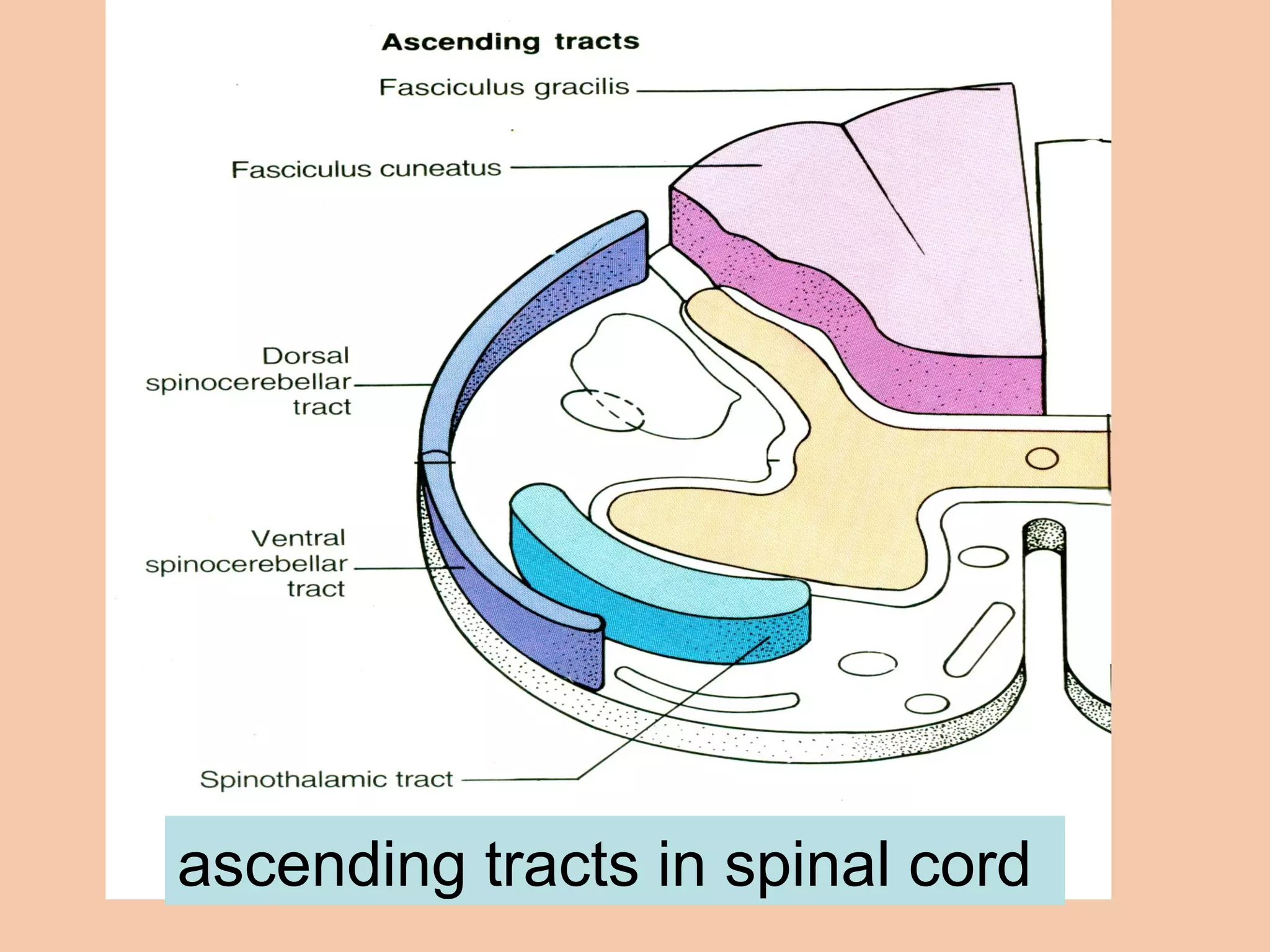
ascending tracts in spinal cord
Tracts & their functional components lateral spinothalamic tract  pain, temperature anterior spinothalamic tract touch, pressure
posterior white column conscious proprioceptive sense, discriminative touch, vibratory sense  spinocerebellar tract / cuneocerebellar tract  unconscious information from muscle, joints, skin, subcutaneous tissues
Main somatosensory pathways sensation receptors pathways destination Pain and temperature Free nerve endings Lateral STT Spinal lemniscus Postcentral gyrus Light touch and pressure Free nerve endings Anterior STT Spinal lemniscus Postcentral gyrus Discriminative touch,  vibratory sense,  conscious muscle joint sense Meissner’s corpuscle, pacinian corpuscles,  muscle spindles,  tendon organs Fasciculus gracilis and cuneatus Medial lemniscus Postcentral gyrus
Lateral spinothalamic tract   pain and thermal impulses  ( input from free nerve endings, thermal receptors  ) transmitted to spinal cord in delta A and C fibres  central process enters the spinal cord through  posterior nerve root , proceed to the tip of the  dorsal gray column
the central process of 1 st  order neuron  synapse with cell body of 2 nd  order neuron  in  substantia gelatinosa  of posterior gray column of the spinal cord
the axon of 2 nd  order neuron  cross to the opposite side   in the anterior gray and white commissure and ascend in  contralateral  white column as lateral spinothalamic tract  end by synapsing with 3 rd  order neuron in the  ventral posterolateral nucleus  of thalamus
axon of the 3 rd   order neuron passes through the  posterior limb of internal capsule  and  corona radiata  to reach the  postcentral gyrus  of cerebral cortex  ( area 3, 1 and 2  )
pain and temperature pathways
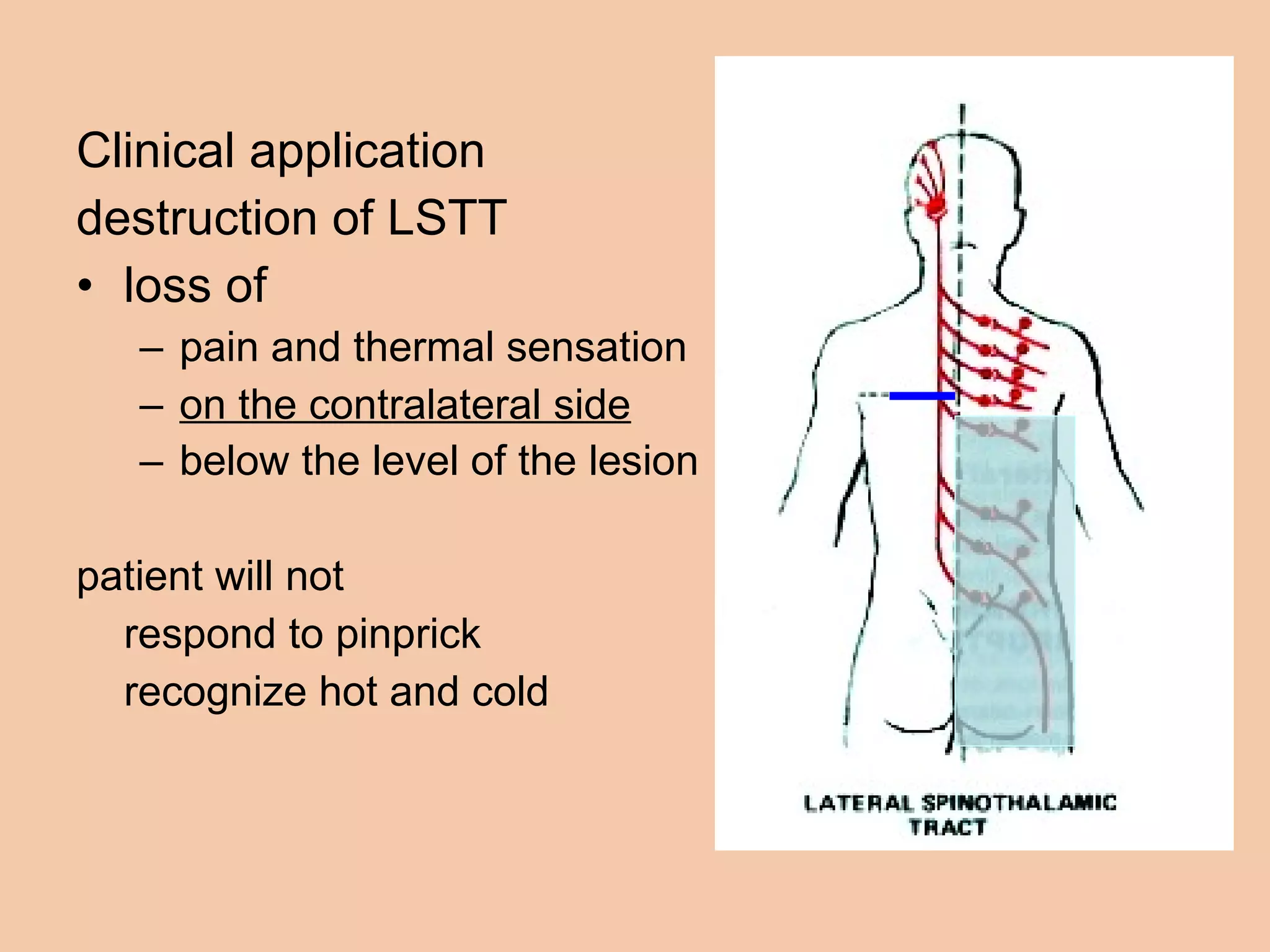
Clinical application  destruction of LSTT loss of  pain and thermal sensation  on the contralateral side below the level of the lesion   patient will not  respond to pinprick  recognize hot and cold
Anterior spinothalamic tract light touch and pressure impulses  ( input from free nerve endings, Merkel’s tactile disks ) First order neuron dorsal root ganglion( all level ) Second order neuron  in the dorsal horn, cross to the opposite side (decussate) ascend in the  contralateral ventral column  as ASTT end in VPL nucleus of thalamus  Third order neuron  in the VPL nucleus of thalamus project to cerebral cortex  ( area 3, 1 and 2 )
touch and pressure pathways
Clinical application destruction of ASTT  loss of touch and pressure sense  below the level of lesion  on the  contralateral side  of the body
Fasciculus gracilis and fasciculus cuneatus discriminative touch, vibratory sense and conscious muscle joint sense  ( inputs from pacinian corpuscles, Messiner’s corpuscles, joint receptors, muscle spindles and Golgi tendon organs ) axon of 1 st  order neuron enter the spinal cord passes directly to the  posterior white column  of the  same side  ( without synapsing )
long ascending fibres travel upward in the posterior column of the same side as fasciculus gracilis and fasciculus cuneatus ( FG – carrying fibres from lower thoracic, lumbar and sacral regions / including lower limbs ) ( FC - only in thoracic and cervical segments / including upper limb fibres )  synapse on the 2 nd  order neuron in the nucleus gracilis and cuneatus of  medulla oblongata  of the same side.
lower 6 thoracic segments lumbar segments sacral segments cervical segments  upper 6 thoracic segments   fasciculus gracilis fasciculus cuneatus [ nucleus G & C ]  in medulla G C
axons of  2 nd  order neuron  “  internal arcuate fibres ”  cross the median plane ( sensory decussation ) ascend as  medial lemniscus   through medulla oblongata, pons, and midbrain synapse on the 3 rd  order neuron in  ventral posteriolateral nucleus  of thalamus axon of 3 rd  order neuron leaves and passes through the internal capsule, corona radiata to reach the postcentral gyrus of cerebral cortex  area 3, 1 and 2 )
pathways for conscious proprioception discriminative touch vibratory sense
Clinical application  destruction of  fasciculus gracilia and cuneatus loss of muscle joint sense, position sense, vibration sense and tactile discrimination  on the same side   below the level of the lesion (extremely rare to have a lesion of the spinal cord to be localized as to affect one sensory tract only )
Posterior & anterior spinocerebellar tract transmit  unconscious  proprioceptive information to the cerebellum  receive input from muscle spindles, GTOs and pressure receptors  involved in coordination of posture and movement of individual muscles of the lower limb
First order neuron in dorsal root ganglion  axons end in  nucleus dorsalis of Clarke   Second order neuron cell body in  nucleus dorsalis of Clarke   give rise to axons ascending to the  cerebellum of the same side  ( anterior – crossed & uncrossed fibres / posterior – uncrossed fibres)
muscle joint sense pathways to cerebellum
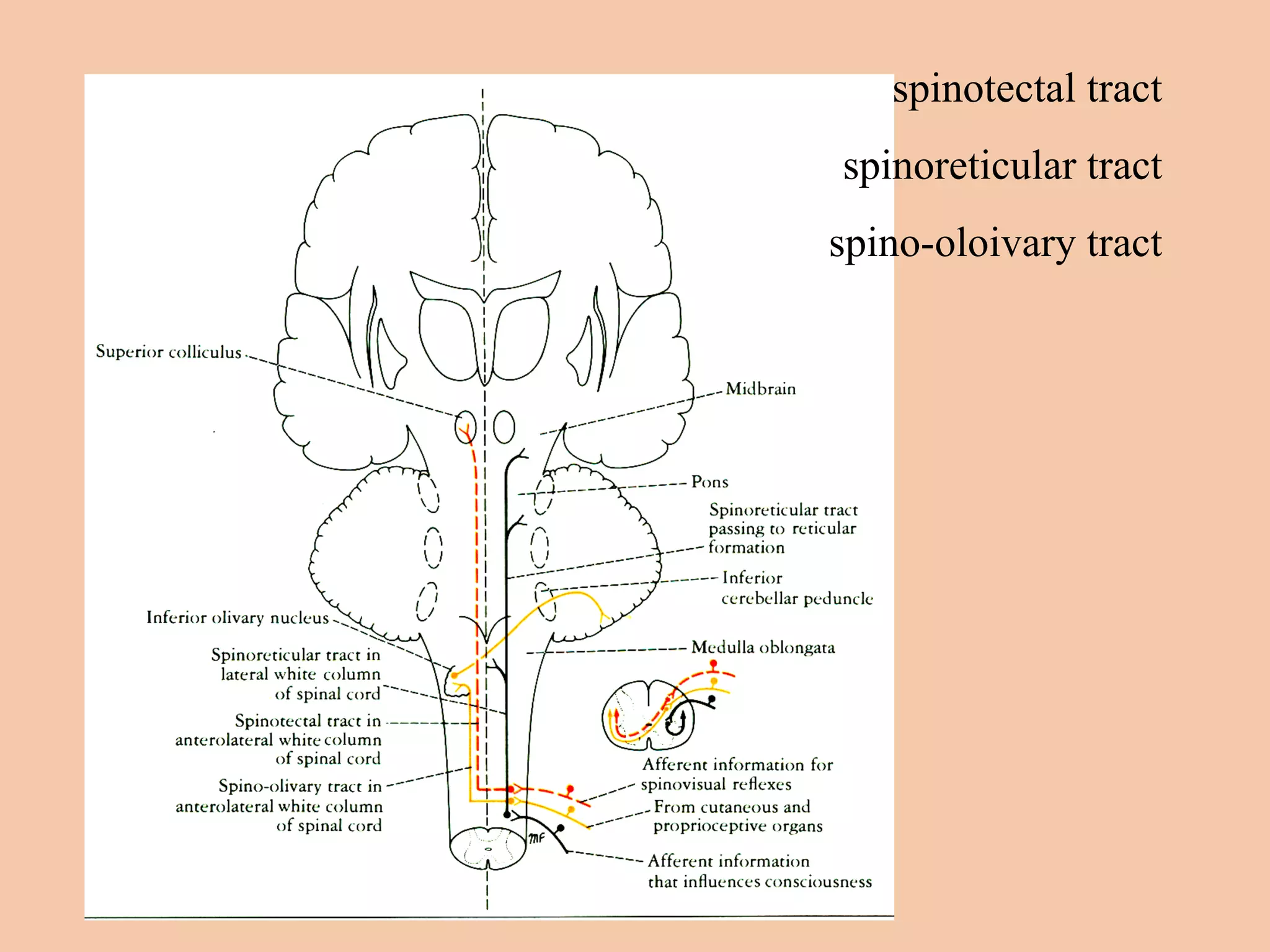
Spinotectal tract passes pain, thermal, tactile information to superior colliculus for  spinovisual reflexes cross the median plane synapse in the superior colliculus   integrate visual and somatic sensory information  ( it brings about the movement of eye and head towards the source of information )  Spinoreticular tract uncrossed fibres, synapse with neurones of reticular formation    (important role in influencing  level of consciousness ) Spino-olivary tract
spinotectal tract spinoreticular tract spino-oloivary tract
clinical application   relief of pain posterior rhizotomy (posterior root)  cordotomy (lateral STT) Injury  hemisection of spinal cord  diseases tabes dorsalis / syringomyelia / vascular
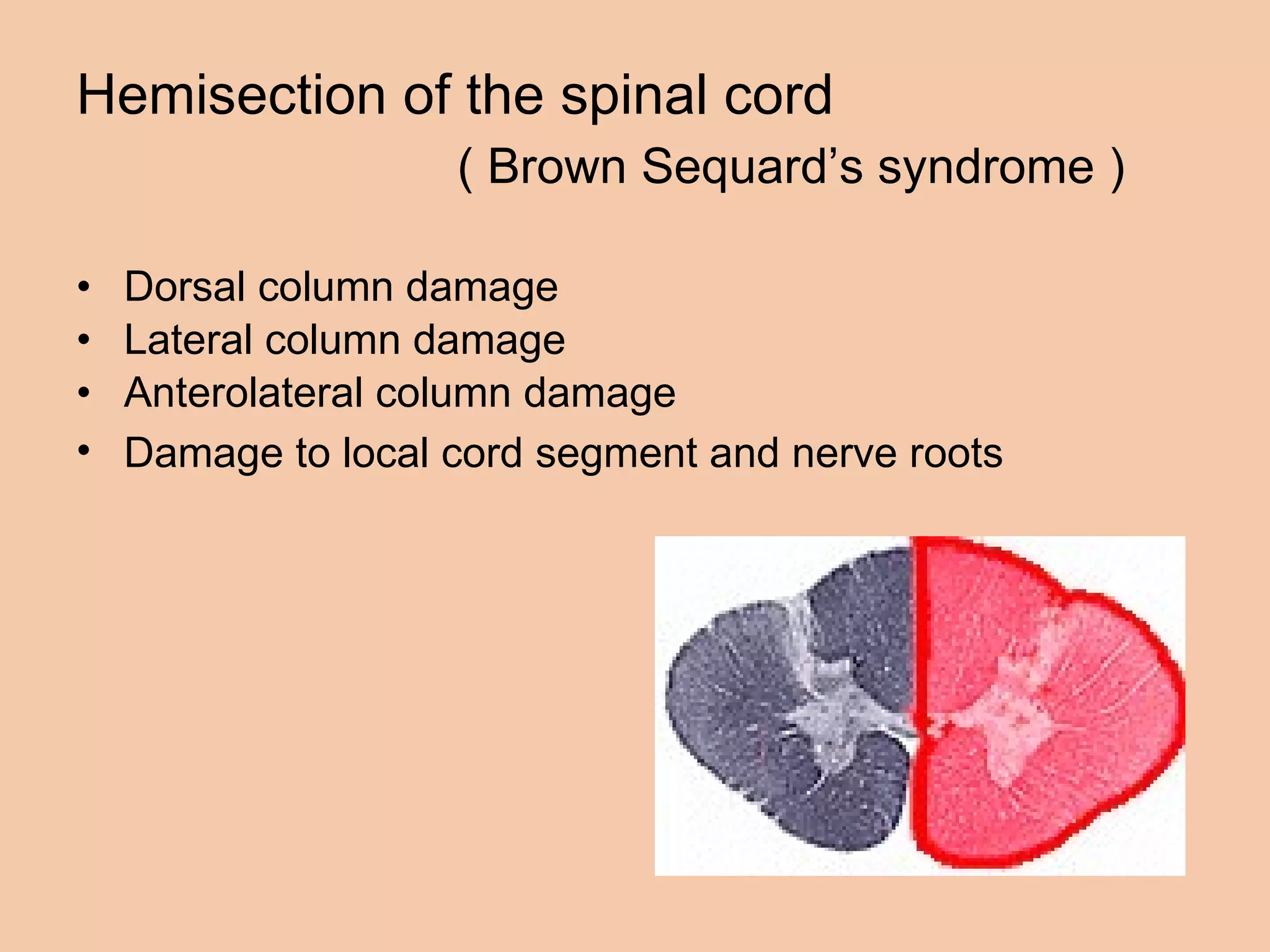
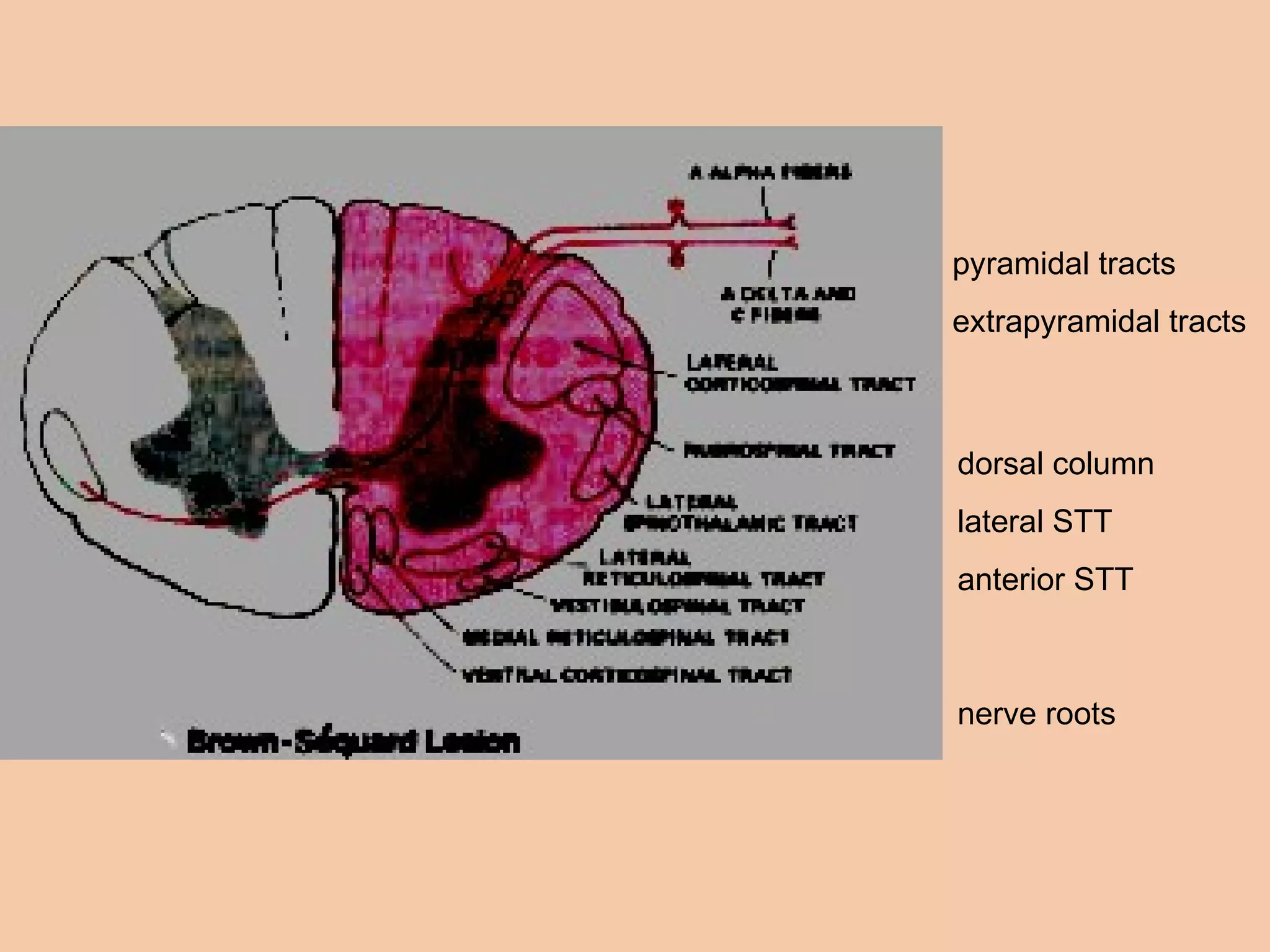
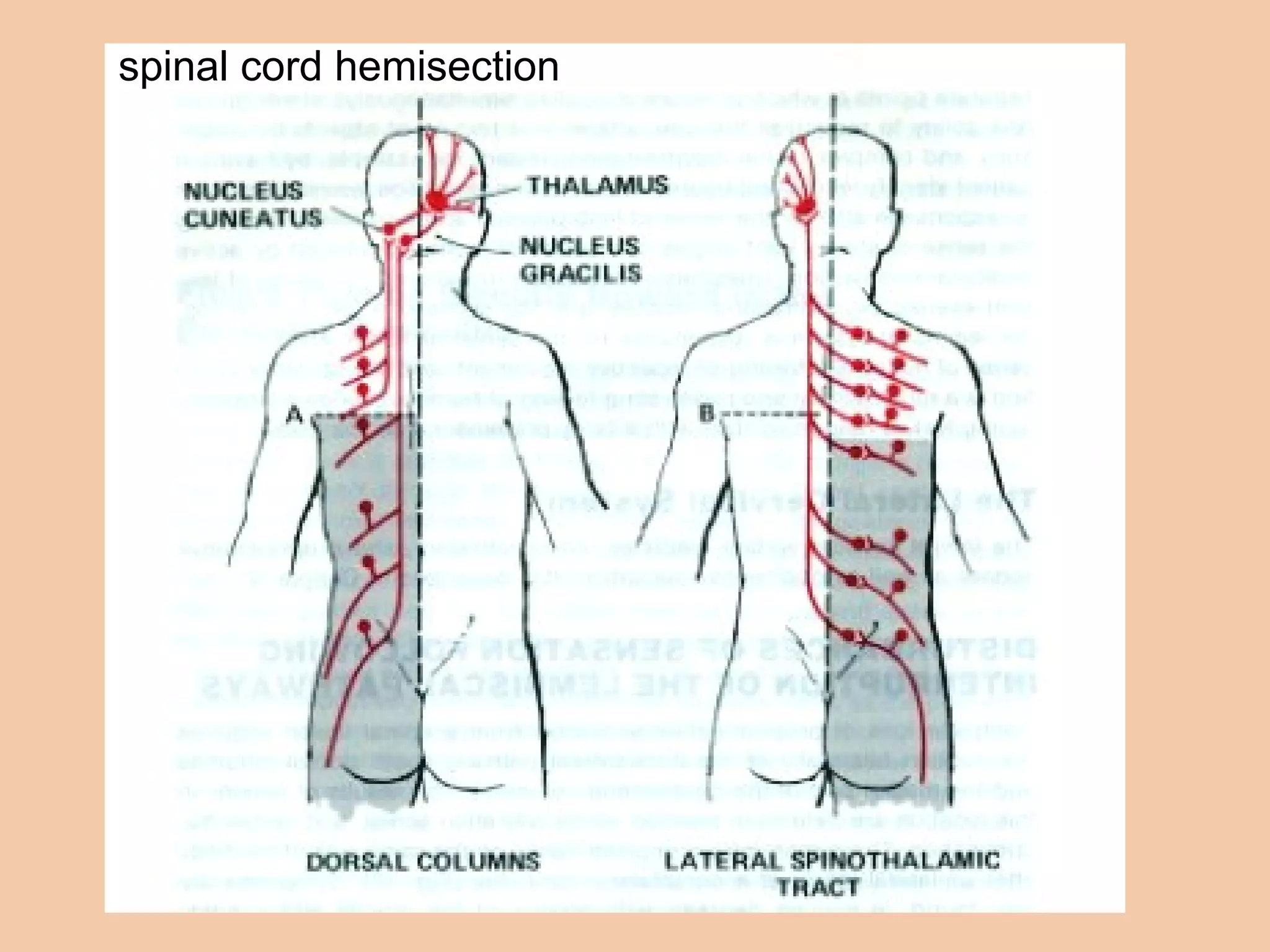
Hemisection of the spinal cord  ( Brown Sequard’s syndrome ) Dorsal column damage  Lateral column damage  Anterolateral column damage Damage to local cord segment and nerve roots
spinal cord hemisection
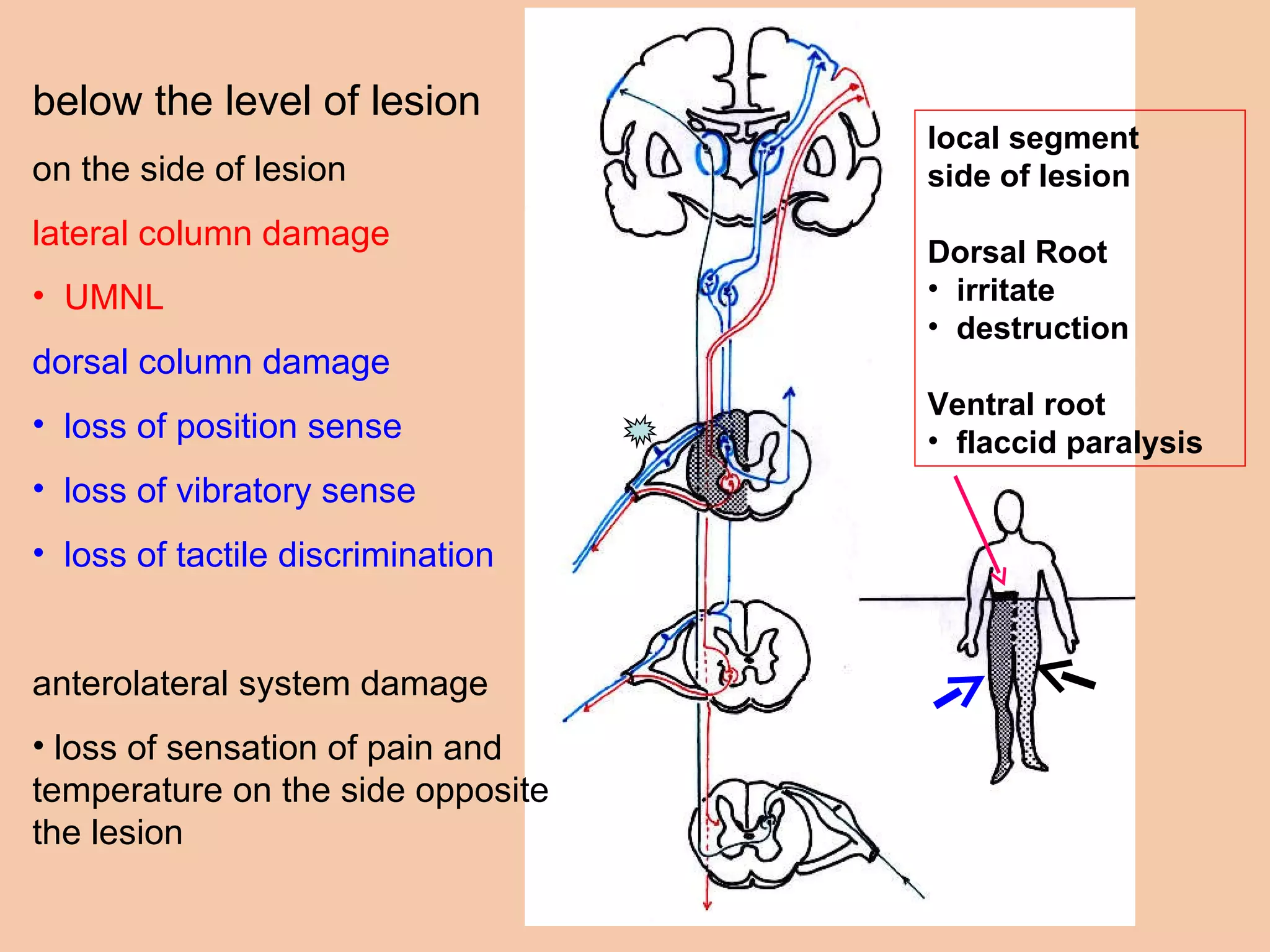
below the level of lesion on the side of lesion lateral column damage UMNL dorsal column damage loss of position sense loss of vibratory sense loss of tactile discrimination anterolateral system damage loss of sensation of pain and temperature on the side opposite the lesion local segment  side of lesion Dorsal Root irritate destruction Ventral root flaccid paralysis
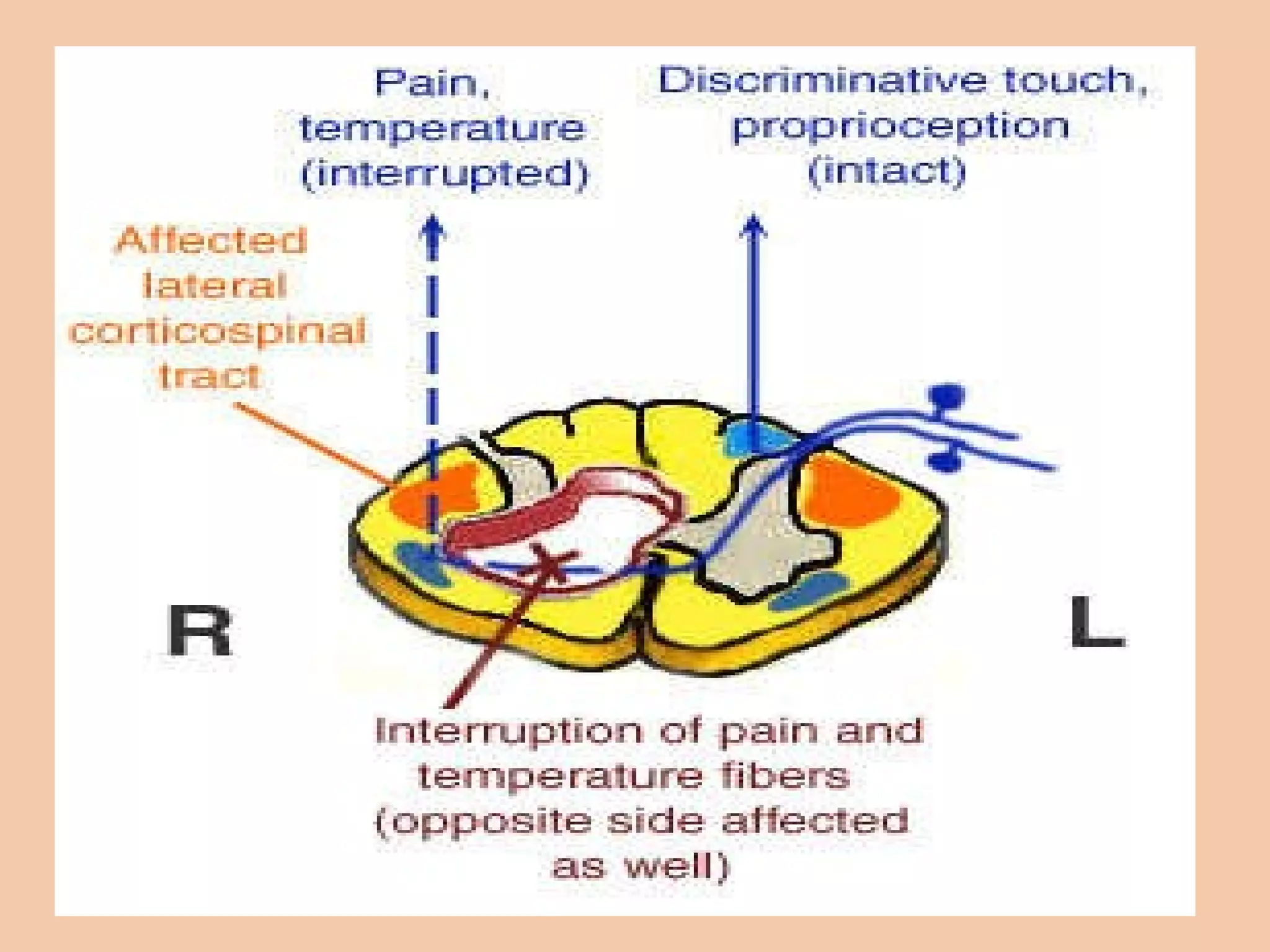
Lesions of central gray matter seen in syringomyelia  ( progressive cavitation around or near the central canal of spinal cord especially in cervical segments )  interrupt fibres of lateral spinothalamic tract that passes in front of the central canal  loss of pain and temperature sensibility on both sides  ( proprioception and light touch is spared )  sensory dissociation
 
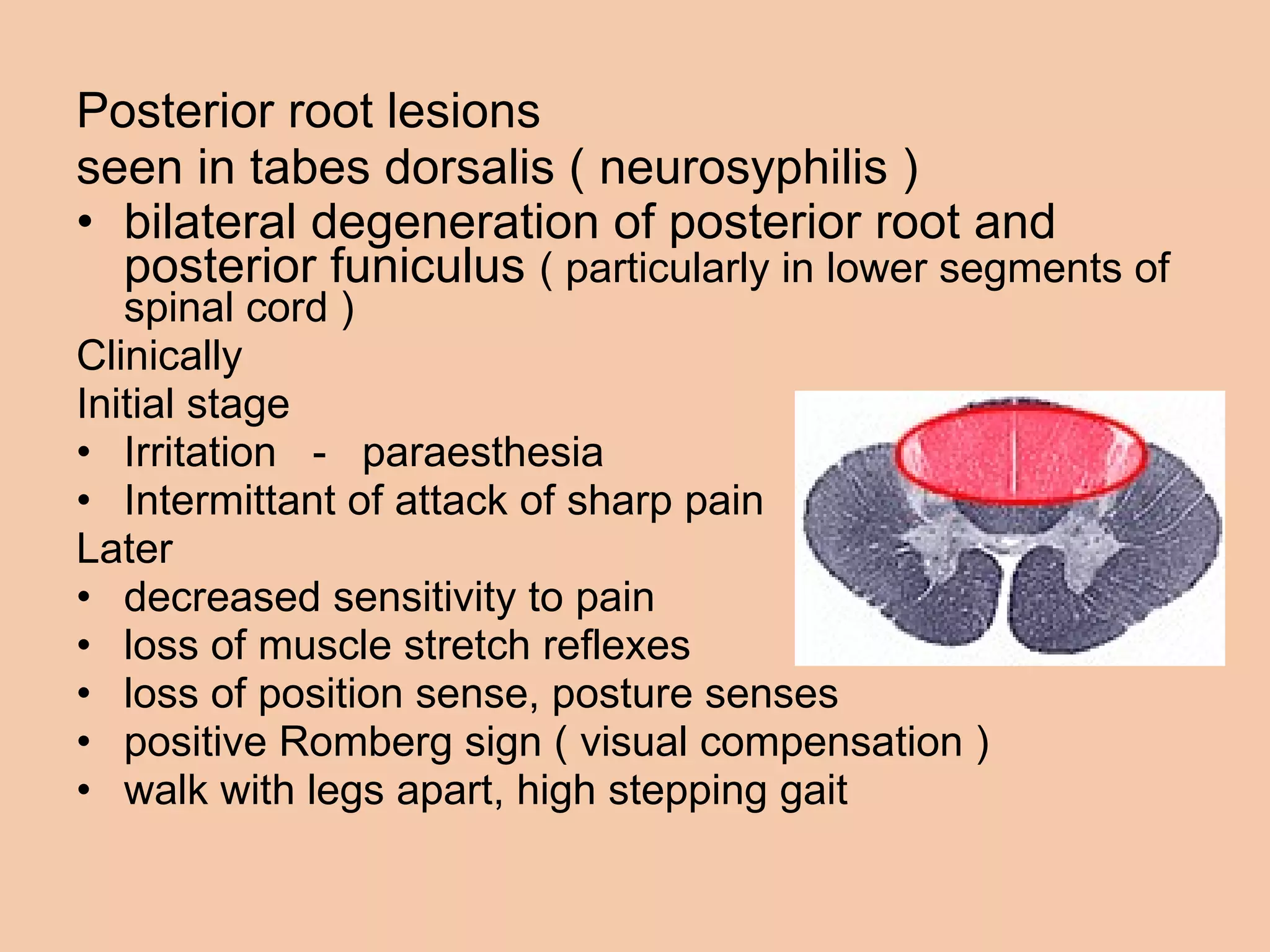
Posterior root lesions seen in tabes dorsalis ( neurosyphilis )  bilateral degeneration of posterior root and posterior funiculus  ( particularly in lower segments of spinal cord ) Clinically Initial stage Irritation  -  paraesthesia Intermittant of attack of sharp pain Later  decreased sensitivity to pain loss of muscle stretch reflexes loss of position sense, posture senses positive Romberg sign ( visual compensation )  walk with legs apart, high stepping gait
blood supply of spinal cord Anterior spinal artery Posterior spinal arteries Segmental spinal arteries - radicular arteries Feeder arteries - Adamkiewicz
posterior 3 rd  of spinal cord dorsal column penetrating branches anterior and part of gray matter circumferential branches anterior white matter
dorsal 1/3 rd   resulting from  occlusion of the posterior spinal artery ventral 2/3 rd   resulting from  occlusion of the anterior spinal artery
Descending tracts By the end of this lecture, students should be able to: define the tract  enumerate the tracts according to their functional components  illustrate and trace the neuronal chain of each tract apply their knowledge of anatomy to correlate with the clinical condition in relation to the injury to these tracts
Motor system areas of the nervous system that are responsible for controlling movements
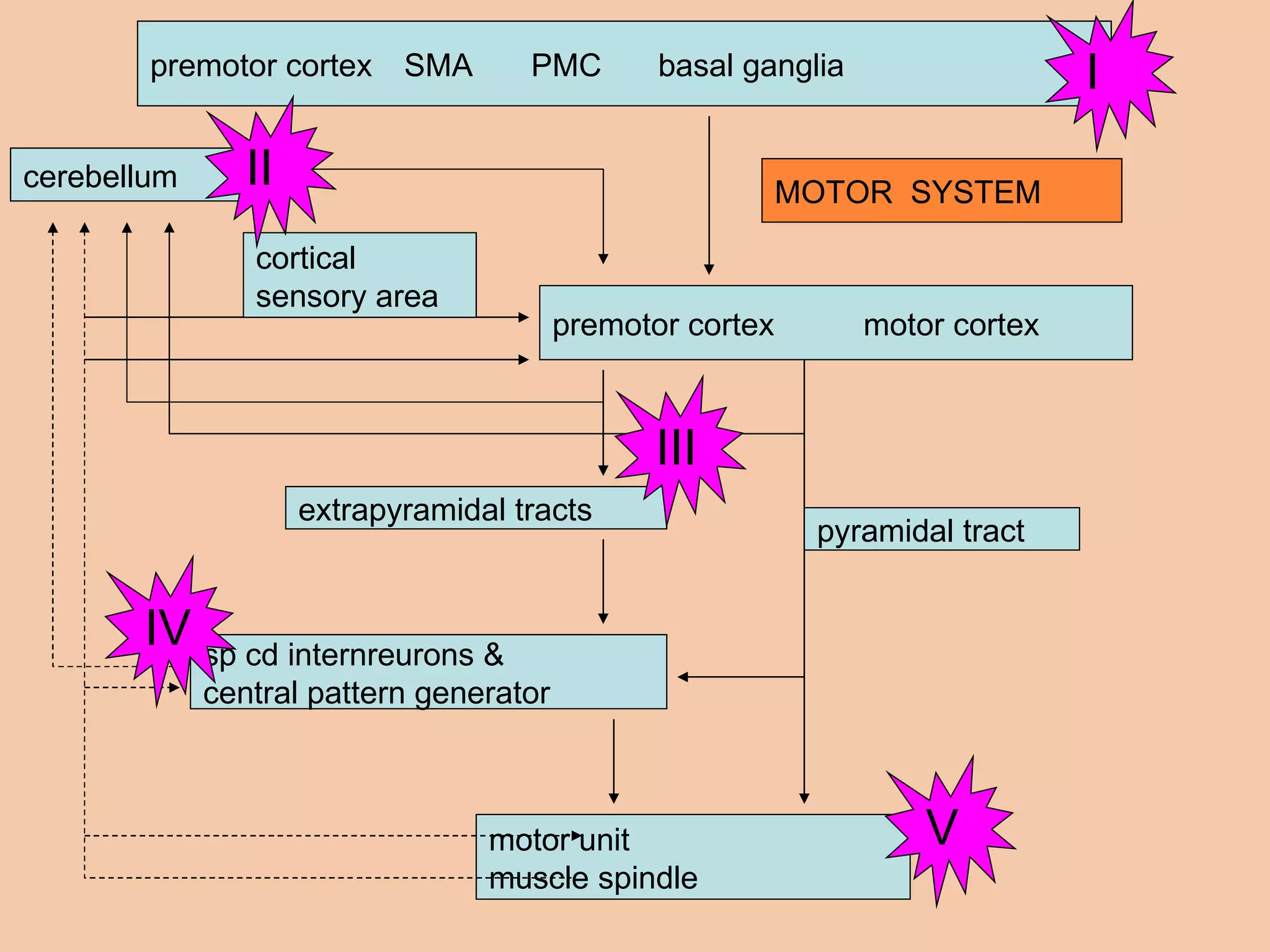
  cerebellum premotor cortex  motor cortex motor unit  muscle spindle pyramidal tract sp cd internreurons &  central pattern generator extrapyramidal tracts premotor cortex SMA PMC basal ganglia cortical  sensory area MOTOR  SYSTEM I II III IV V
Level I initiation, planning, programming of movements in response to desire to move  ( probably originate in the  limbic system and posterior parietal cortex  )   desire is translated into movements (  basal ganglia  and their cortical projections in the frontal lobe-SMA, PMC ) Level II coordination of movements cerebellum ( compare the intended movement / actual movement )
Level III descending pathways pyramidal tract - CoSt originates in the motor, premotor and somatosensory corticies   synapse direclty on MN , IN extrapyramidal tract – VeSt, ReSt, TeSt, RuSt originate from subcortical structures receive inputs from motor cortex complex distribution, synapse on MN, IN
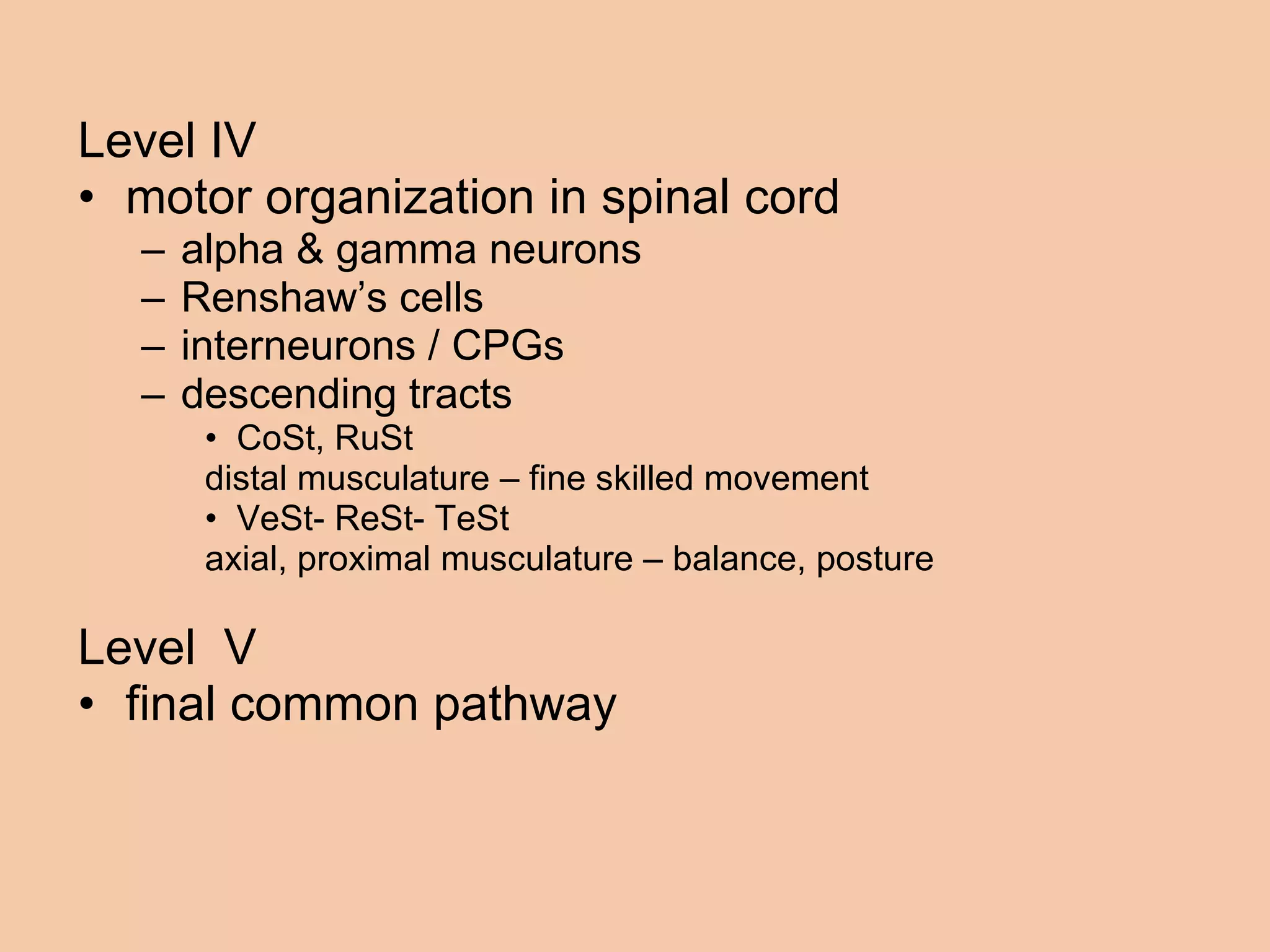
Level IV motor organization in spinal cord alpha & gamma neurons Renshaw’s cells interneurons / CPGs  descending tracts CoSt, RuSt  distal musculature – fine skilled movement VeSt- ReSt- TeSt  axial, proximal musculature – balance, posture Level  V final common pathway
primary structure  responsible for translating  desire into a movement is  the basal ganglia
Introduction brain  exerts powerful and subtle influences   upon the activity of the voluntary musculature  ( modulate, regulate, bias the activities of LMN ) through the descending pathways
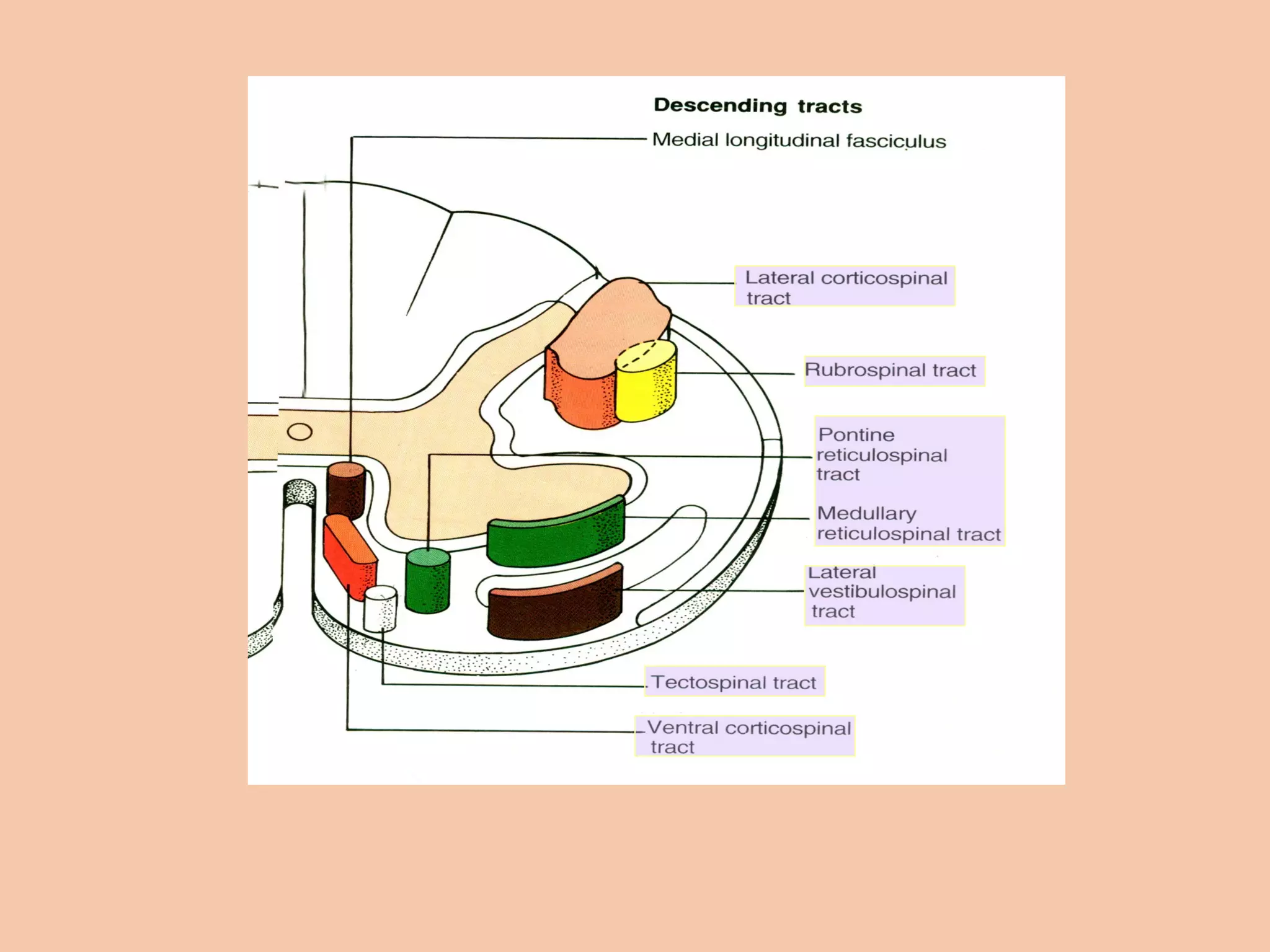
descending tracts segregated bundles of nerve fibres in the white matter of the spinal cord descending from the supraspinal centres referred to as upper motor neurons ( UMN ) are concerned with  somatic and visceral   motor activity cells of origin lie in cerebral cortex and brain stem   regulate the LMN activity
motor homunculus cerebral cortex
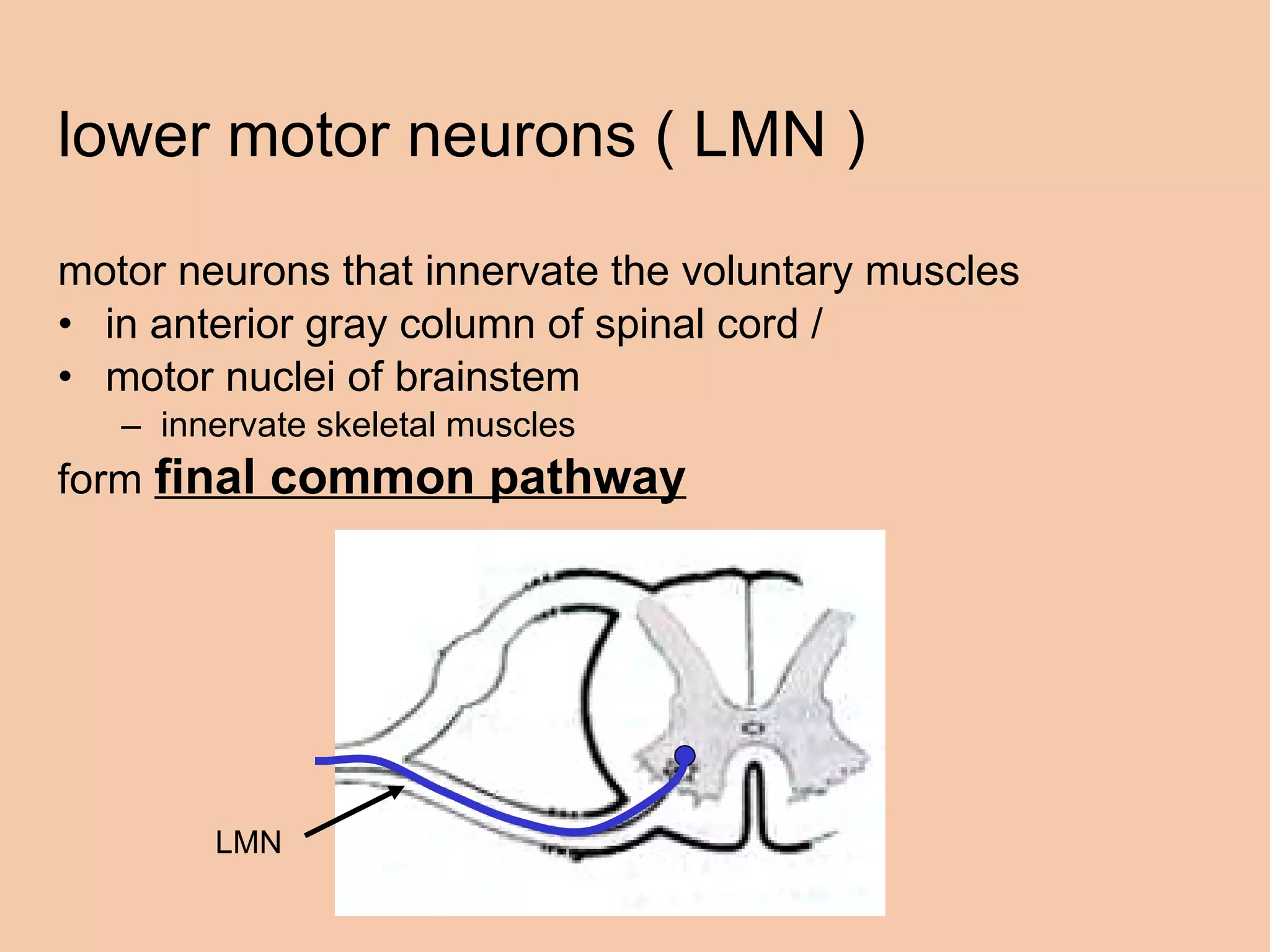
lower motor neurons ( LMN ) motor neurons that innervate the voluntary muscles in anterior gray column of spinal cord /  motor nuclei of brainstem innervate skeletal muscles  form  final common pathway   LMN
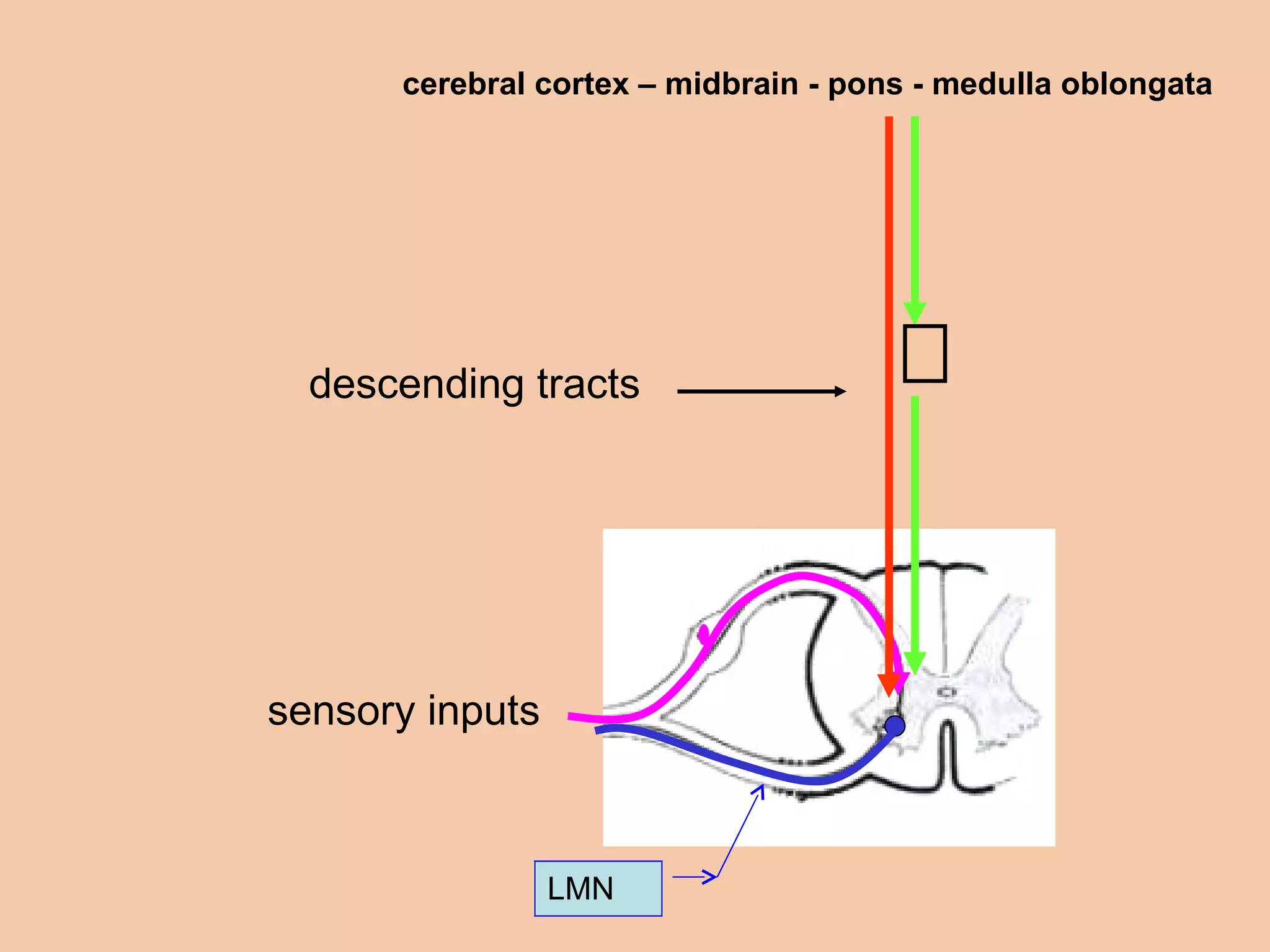
LMN constantly bombarded by  nerve impulses( excitatory or inhibitory ) that descend from  cerebral cortex,  pons,  midbrain and  medulla sensory inputs from the posterior root
upper motor neurons ( UMN ) the descending supraspinal pathways that influence the activity of the LMN  e.g.  CoSt, CoBt , RuSt, TeSt, ReSt, VeSt
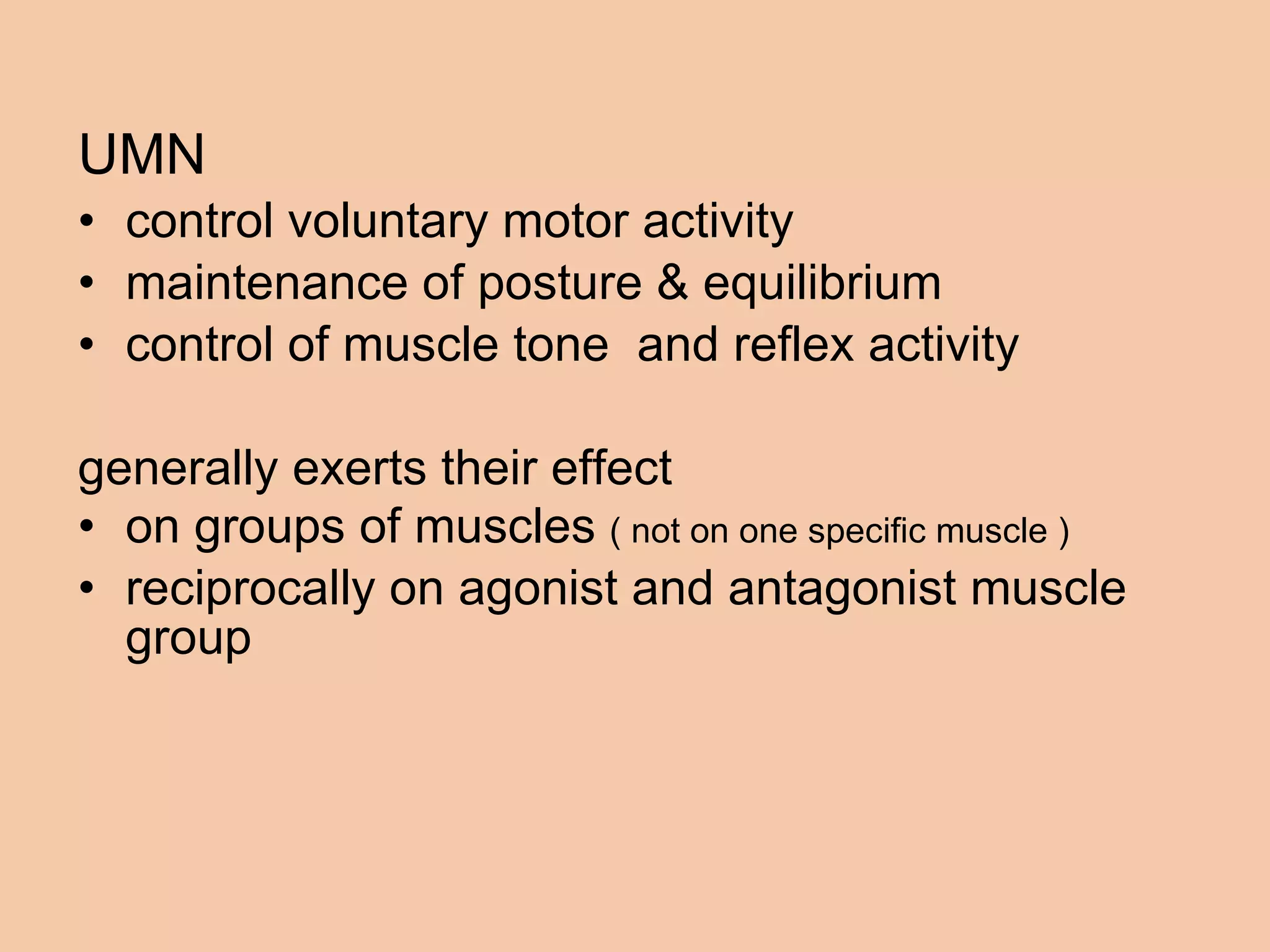
UMN control voluntary motor activity maintenance of posture & equilibrium  control of muscle tone  and reflex activity generally exerts their effect  on groups of muscles  ( not on one specific muscle )  reciprocally on agonist and antagonist muscle group
cerebral cortex – midbrain - pons - medulla oblongata descending tracts LMN sensory inputs
 
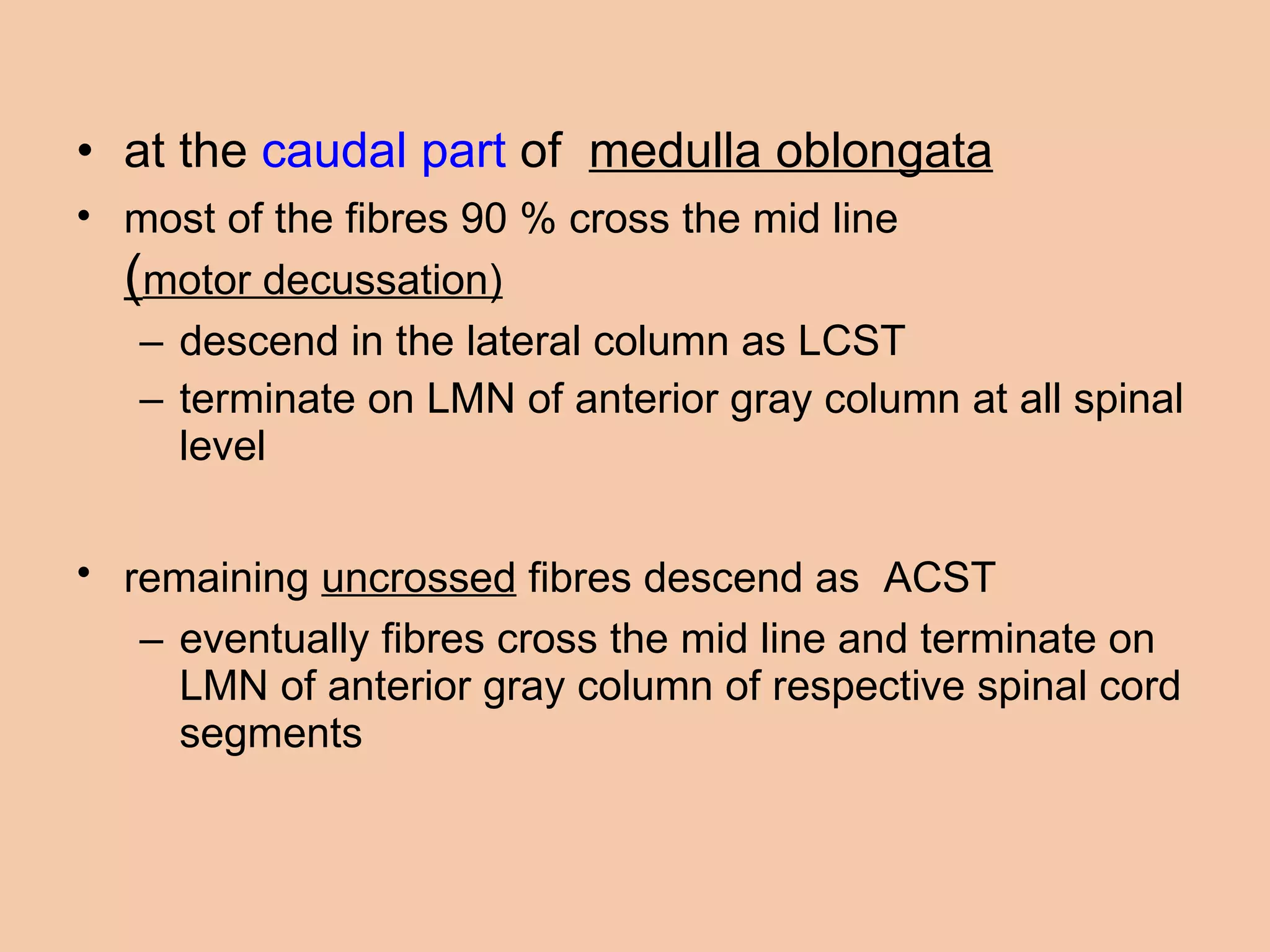
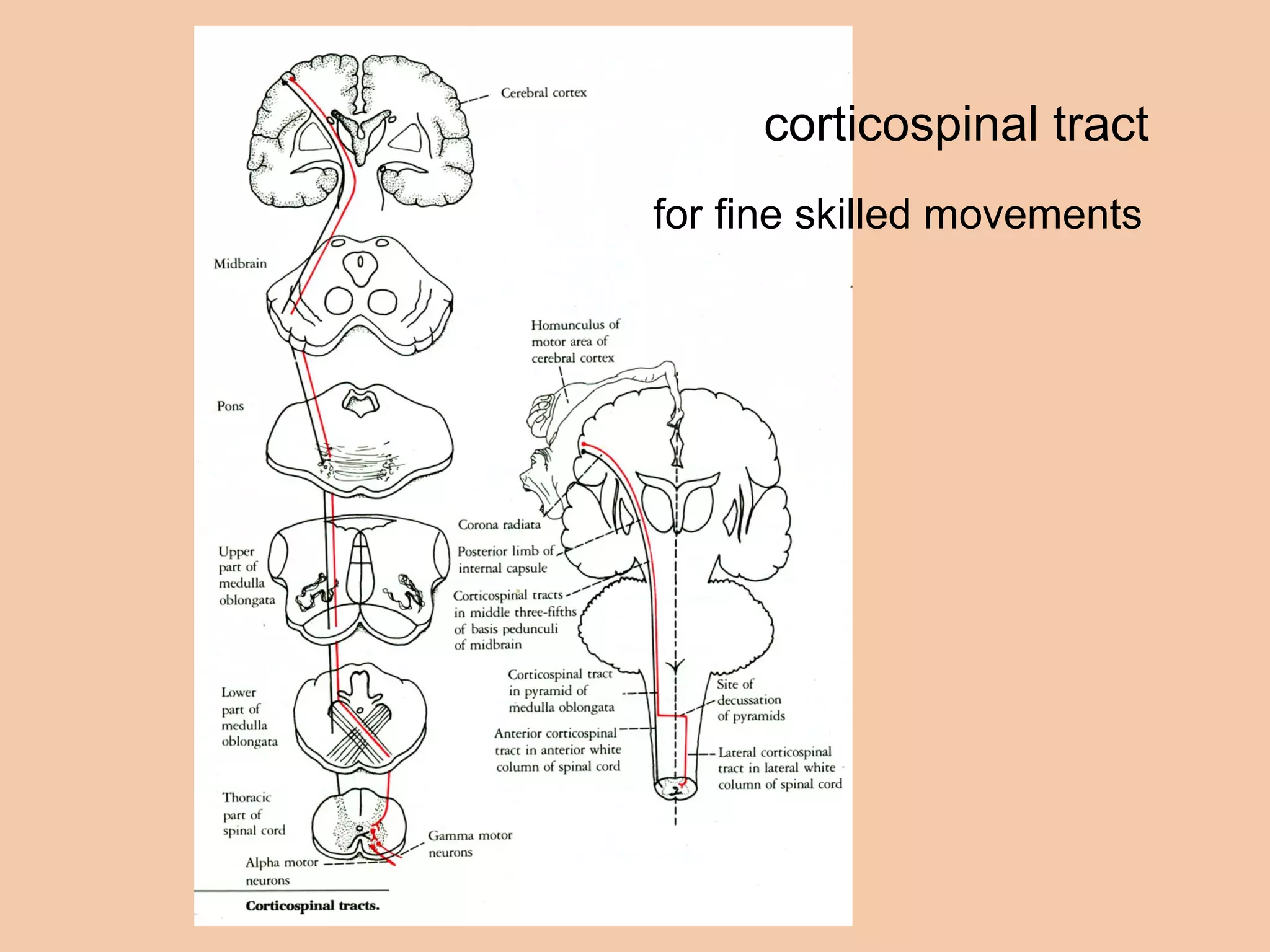
Corticospinal tract arises from the pyramidal cells of cerebral cortex fibres travel through corona radiata posterior limb of the internal capsule  cerebral peduncle  ( middle  3/ 5 th  )  pons  medulla oblongata  ( passed through the pyramids )
at the  caudal part  of  medulla oblongata most of the fibres 90 % cross the mid line   ( motor decussation) descend in the lateral column as LCST terminate on LMN of anterior gray column at all spinal level  remaining  uncrossed  fibres descend as  ACST   eventually fibres cross the mid line and terminate on LMN of anterior gray column of respective spinal cord segments
motor decussation medulla oblongata
corticospinal tract for fine skilled movements
Rubrospinal tract nerve cells in red nucleus   ( tegmentum of midbrain at the level of superior colliculus ) nerve fibres / axons   cross the mid line  descend as rubrospinal tract  through pons and medulla oblongata  terminate anterior gray column of spinal cord   ( facilitate the activity of flexor muscles )
 
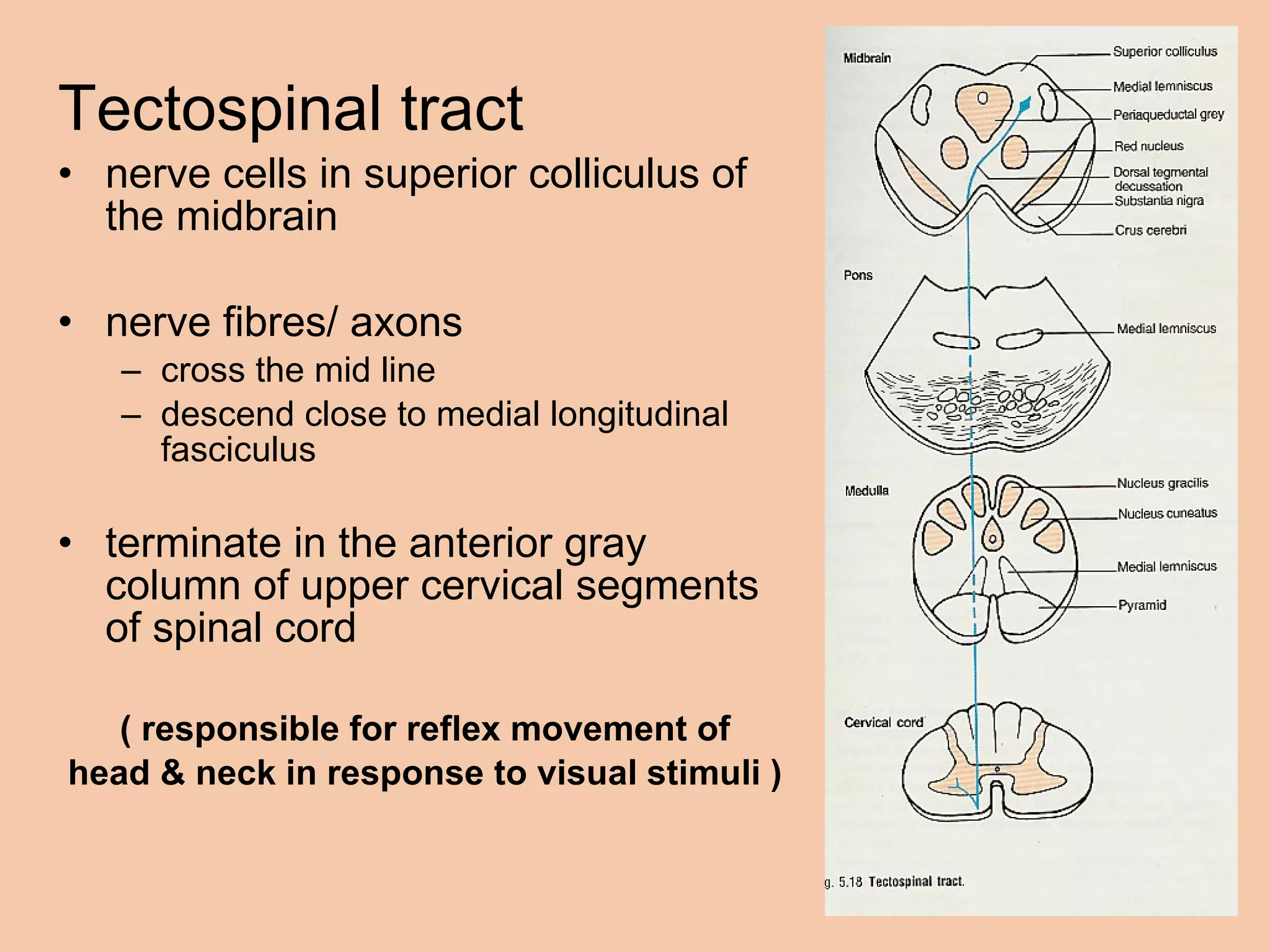
Tectospinal tract nerve cells in superior colliculus of the midbrain  nerve fibres/ axons cross the mid line  descend close to medial longitudinal fasciculus  terminate in the anterior gray column of upper cervical segments of spinal cord  ( responsible for reflex movement of head & neck in response to visual stimuli )
 
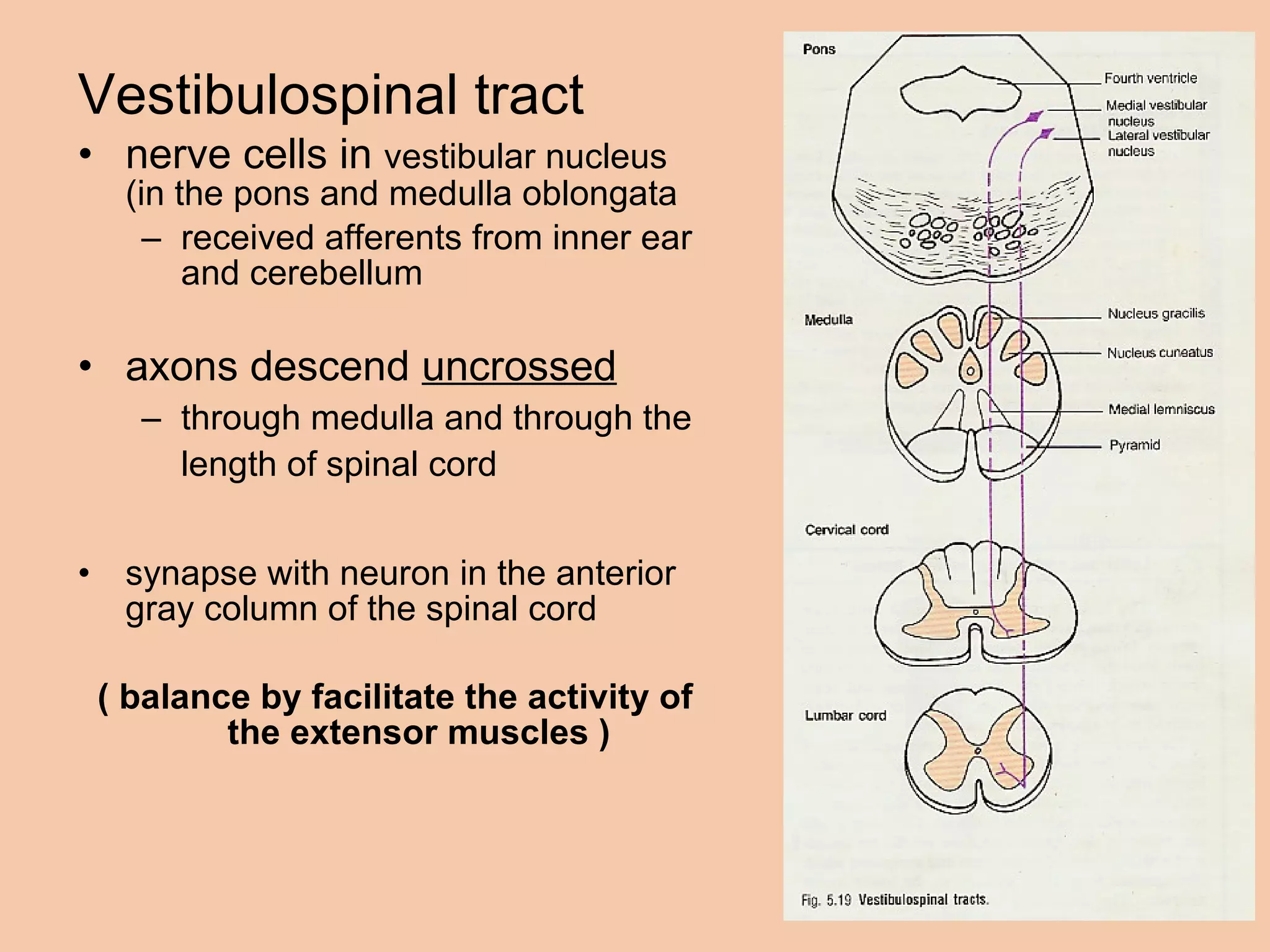
Vestibulospinal tract nerve cells in  vestibular nucleus (in the pons and medulla oblongata received afferents from inner ear and cerebellum  axons descend  uncrossed   through medulla and through the length of spinal cord   synapse with neuron in the anterior gray column of the spinal cord  ( balance by facilitate the activity of the extensor muscles )
 
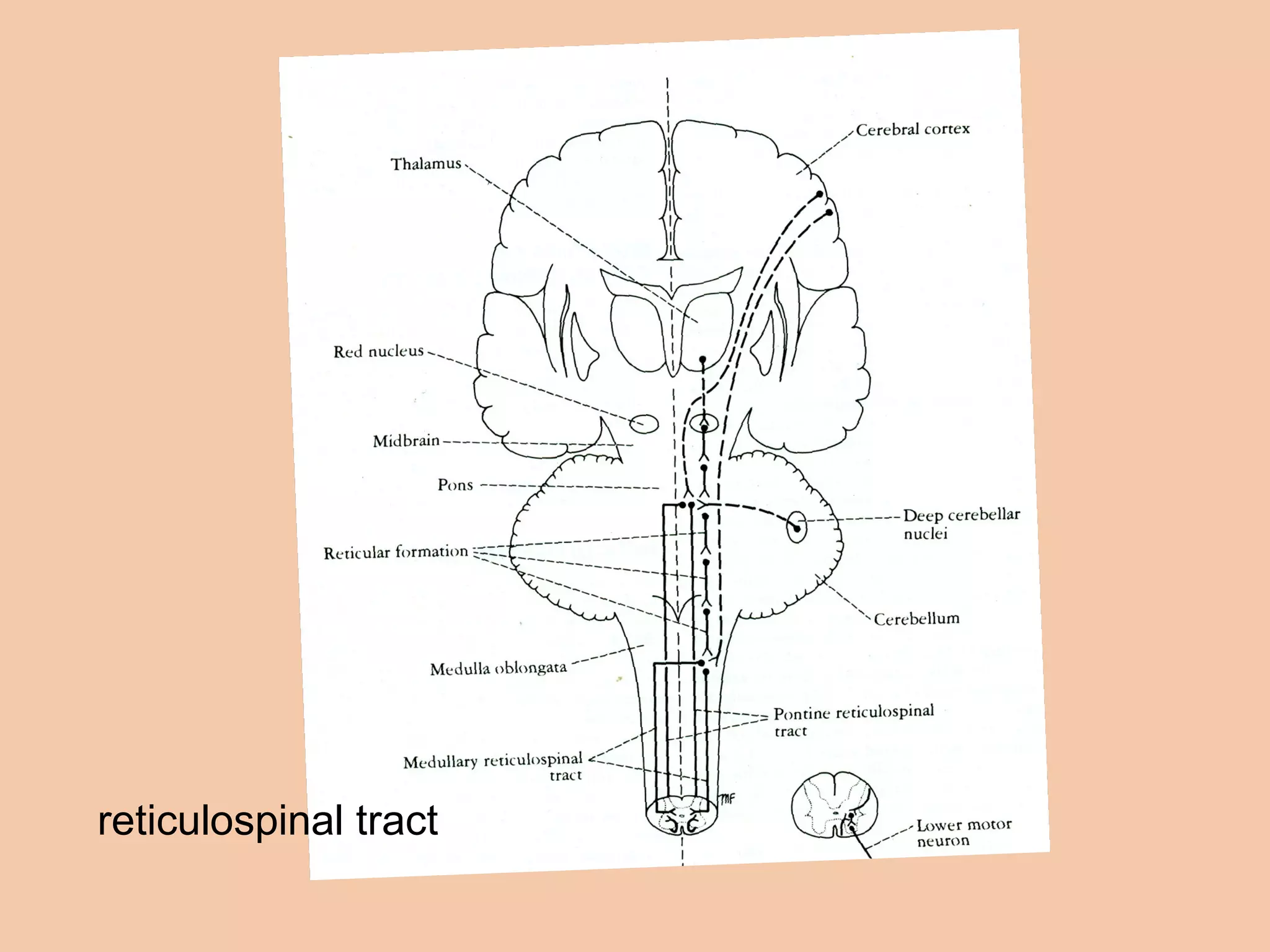
Reticulospinal tract nerve cells in reticular formation   fibres pass through midbrain, pons, and medulla oblongata  end  at the anterior gray column of spinal cord  control activity of motor neurons (influence voluntary movement and reflex activity )
reticulospinal tract
clinical application pyramidal tract refer to corticospinal tracts extrapyramidal tract other than corticospinal tract ( VeSt, ReSt, TeSt, RuSt )
upper motor neuron lesion   Babinski sign ( extensor plantar response ) Superficial abdominal reflexes ( absent ) Cremasteric reflex ( absent ) Loss of performance of fine skilled voluntary movement
lower motor neuron lesion flaccid paralysis atrophy of muscles loss of reflexes muscular fasciculation muscular contracture
extrapyramidal tract lesions severe paralysis with little or no atrophy spasticity or hypertonicity exaggeration of deep muscular reflexes and clonus clasp-knife reaction
These motor pathways are complex and multisynaptic, and regulate: Axial muscles that maintain balance and posture Muscles controlling coarse movements of the proximal portions of limbs Head, neck, and eye movement
dorsal column lateral STT anterior STT pyramidal tracts extrapyramidal tracts nerve roots
spinal cord hemisection
thank you

Anatomy of ascending and descending tracts

  • 1.
    Ascending& Descending tractsDr. Israa M. Sulaiman Department of Anatomy IMS/MSU
  • 2.
  • 3.
    By the endof the lecture, students should be able to define the ascending tract enumerate the tracts according to their functional components explain general outline of neuronal chain of ascending tracts illustrate and trace the neuronal chain of each tract apply anatomical knowledge to correlate with the clinical condition in case of injury to these tracts
  • 4.
    contents function ofnervous system in general sensory system overview spinal cord and nerve tracts ascending tracts organization in general ascending tracts functional components
  • 5.
    nervous system communicationreceive information transform it into impulses ( transduction ) transmit impulses to the CNS correlate / coordinate transmit impulses to the effector organs response / action
  • 6.
    CENTRAL NERVOUS SYSTEMintegration / processing / modulating stimulus receptor neurone motor / descending tracts effector organ / response PNS transmission lower motor neurone sensory / ascending tracts
  • 7.
    Sensory system sensoryinformation three basic information Exteroceptive information Interoceptive information Proprioceptive information
  • 8.
    sensory information are received and carried by ascending tracts exteroceptive sensation origin:- outside the body e.g. temp, touch, light, sound, chemicals, mechanical receptors:- surface layer of skin, mucosa proprioceptive sensation origin:- within the body e.g. muscles, joints, tendons receptors – deeper layer of skin, tendons, joints, GTO, muscle spindles, ligaments
  • 9.
  • 10.
    sensory information from the peripheral sensory endings is conducted through the nervous system by a series of neurones
  • 11.
    information conscious sensationreach the cerebral cortex unconscious sensation reach to the areas other than cortex
  • 12.
    spinal cord Greymatter mostly made up of cell bodies of neurone White matter composed of nerve fibres ( ascending and descending tracts ) embedded in neuroglial cells
  • 13.
    nerve fibres enterthe spinal cord through posterior nerve root after entering the spinal cord sorted out and segregated into nerve bundles, tracts ( origin, function, termination )
  • 14.
    ascending tracts bundlesof nerve fibres linking spinal cord with higher centres of the brain convey information from soma / viscera to higher level of neuraxis
  • 15.
    ascending sensory pathway are organized in three neuronal chain - First order neurone - Second order neurone - Third order neurone
  • 16.
    First order neurone cell body in posterior root ganglion peripheral process connects with sensory receptor ending central process enter the spinal cord through the posterior root synapse with second order neuron in spinal gray matter
  • 17.
    dorsal root dorsalroot ganglion spinal nerve dorsal horn FIRST ORDER NEURON
  • 18.
    Second order neuronecell body in posterior gray column of spinal cord axon crosses the midline ( decussate ) ascend & synapse with third order neuron in VPL nucleus of thalamus
  • 19.
    SECOND ORDER NEURONcross the mid line in front of central canal VPL 1 st 2 nd
  • 20.
    Third order neuronecell body in the thalamus give rise to projection fibres to the cerebral cortex, postcentral gyrus ( sensory area )
  • 21.
    ascending sensory pathway( in general form ) from sensory endings to cerebral cortex ( note the three neurons chain )
  • 22.
  • 23.
    Tracts & theirfunctional components lateral spinothalamic tract pain, temperature anterior spinothalamic tract touch, pressure
  • 24.
    posterior white columnconscious proprioceptive sense, discriminative touch, vibratory sense spinocerebellar tract / cuneocerebellar tract unconscious information from muscle, joints, skin, subcutaneous tissues
  • 25.
    Main somatosensory pathwayssensation receptors pathways destination Pain and temperature Free nerve endings Lateral STT Spinal lemniscus Postcentral gyrus Light touch and pressure Free nerve endings Anterior STT Spinal lemniscus Postcentral gyrus Discriminative touch, vibratory sense, conscious muscle joint sense Meissner’s corpuscle, pacinian corpuscles, muscle spindles, tendon organs Fasciculus gracilis and cuneatus Medial lemniscus Postcentral gyrus
  • 26.
    Lateral spinothalamic tract pain and thermal impulses ( input from free nerve endings, thermal receptors ) transmitted to spinal cord in delta A and C fibres central process enters the spinal cord through posterior nerve root , proceed to the tip of the dorsal gray column
  • 27.
    the central processof 1 st order neuron synapse with cell body of 2 nd order neuron in substantia gelatinosa of posterior gray column of the spinal cord
  • 28.
    the axon of2 nd order neuron cross to the opposite side in the anterior gray and white commissure and ascend in contralateral white column as lateral spinothalamic tract end by synapsing with 3 rd order neuron in the ventral posterolateral nucleus of thalamus
  • 29.
    axon of the3 rd order neuron passes through the posterior limb of internal capsule and corona radiata to reach the postcentral gyrus of cerebral cortex ( area 3, 1 and 2 )
  • 30.
  • 31.
    Clinical application destruction of LSTT loss of pain and thermal sensation on the contralateral side below the level of the lesion patient will not respond to pinprick recognize hot and cold
  • 32.
    Anterior spinothalamic tractlight touch and pressure impulses ( input from free nerve endings, Merkel’s tactile disks ) First order neuron dorsal root ganglion( all level ) Second order neuron in the dorsal horn, cross to the opposite side (decussate) ascend in the contralateral ventral column as ASTT end in VPL nucleus of thalamus Third order neuron in the VPL nucleus of thalamus project to cerebral cortex ( area 3, 1 and 2 )
  • 33.
  • 34.
    Clinical application destructionof ASTT loss of touch and pressure sense below the level of lesion on the contralateral side of the body
  • 35.
    Fasciculus gracilis andfasciculus cuneatus discriminative touch, vibratory sense and conscious muscle joint sense ( inputs from pacinian corpuscles, Messiner’s corpuscles, joint receptors, muscle spindles and Golgi tendon organs ) axon of 1 st order neuron enter the spinal cord passes directly to the posterior white column of the same side ( without synapsing )
  • 36.
    long ascending fibrestravel upward in the posterior column of the same side as fasciculus gracilis and fasciculus cuneatus ( FG – carrying fibres from lower thoracic, lumbar and sacral regions / including lower limbs ) ( FC - only in thoracic and cervical segments / including upper limb fibres ) synapse on the 2 nd order neuron in the nucleus gracilis and cuneatus of medulla oblongata of the same side.
  • 37.
    lower 6 thoracicsegments lumbar segments sacral segments cervical segments upper 6 thoracic segments fasciculus gracilis fasciculus cuneatus [ nucleus G & C ] in medulla G C
  • 38.
    axons of 2 nd order neuron “ internal arcuate fibres ” cross the median plane ( sensory decussation ) ascend as medial lemniscus through medulla oblongata, pons, and midbrain synapse on the 3 rd order neuron in ventral posteriolateral nucleus of thalamus axon of 3 rd order neuron leaves and passes through the internal capsule, corona radiata to reach the postcentral gyrus of cerebral cortex area 3, 1 and 2 )
  • 39.
    pathways for consciousproprioception discriminative touch vibratory sense
  • 40.
    Clinical application destruction of fasciculus gracilia and cuneatus loss of muscle joint sense, position sense, vibration sense and tactile discrimination on the same side below the level of the lesion (extremely rare to have a lesion of the spinal cord to be localized as to affect one sensory tract only )
  • 41.
    Posterior & anteriorspinocerebellar tract transmit unconscious proprioceptive information to the cerebellum receive input from muscle spindles, GTOs and pressure receptors involved in coordination of posture and movement of individual muscles of the lower limb
  • 42.
    First order neuronin dorsal root ganglion axons end in nucleus dorsalis of Clarke Second order neuron cell body in nucleus dorsalis of Clarke give rise to axons ascending to the cerebellum of the same side ( anterior – crossed & uncrossed fibres / posterior – uncrossed fibres)
  • 43.
    muscle joint sensepathways to cerebellum
  • 44.
    Spinotectal tract passespain, thermal, tactile information to superior colliculus for spinovisual reflexes cross the median plane synapse in the superior colliculus integrate visual and somatic sensory information ( it brings about the movement of eye and head towards the source of information ) Spinoreticular tract uncrossed fibres, synapse with neurones of reticular formation (important role in influencing level of consciousness ) Spino-olivary tract
  • 45.
    spinotectal tract spinoreticulartract spino-oloivary tract
  • 46.
    clinical application relief of pain posterior rhizotomy (posterior root) cordotomy (lateral STT) Injury hemisection of spinal cord diseases tabes dorsalis / syringomyelia / vascular
  • 47.
    Hemisection of thespinal cord ( Brown Sequard’s syndrome ) Dorsal column damage Lateral column damage Anterolateral column damage Damage to local cord segment and nerve roots
  • 48.
  • 49.
    below the levelof lesion on the side of lesion lateral column damage UMNL dorsal column damage loss of position sense loss of vibratory sense loss of tactile discrimination anterolateral system damage loss of sensation of pain and temperature on the side opposite the lesion local segment side of lesion Dorsal Root irritate destruction Ventral root flaccid paralysis
  • 50.
    Lesions of centralgray matter seen in syringomyelia ( progressive cavitation around or near the central canal of spinal cord especially in cervical segments ) interrupt fibres of lateral spinothalamic tract that passes in front of the central canal loss of pain and temperature sensibility on both sides ( proprioception and light touch is spared ) sensory dissociation
  • 51.
  • 52.
    Posterior root lesionsseen in tabes dorsalis ( neurosyphilis ) bilateral degeneration of posterior root and posterior funiculus ( particularly in lower segments of spinal cord ) Clinically Initial stage Irritation - paraesthesia Intermittant of attack of sharp pain Later decreased sensitivity to pain loss of muscle stretch reflexes loss of position sense, posture senses positive Romberg sign ( visual compensation ) walk with legs apart, high stepping gait
  • 53.
    blood supply ofspinal cord Anterior spinal artery Posterior spinal arteries Segmental spinal arteries - radicular arteries Feeder arteries - Adamkiewicz
  • 54.
    posterior 3 rd of spinal cord dorsal column penetrating branches anterior and part of gray matter circumferential branches anterior white matter
  • 55.
    dorsal 1/3 rd resulting from occlusion of the posterior spinal artery ventral 2/3 rd resulting from occlusion of the anterior spinal artery
  • 56.
    Descending tracts Bythe end of this lecture, students should be able to: define the tract enumerate the tracts according to their functional components illustrate and trace the neuronal chain of each tract apply their knowledge of anatomy to correlate with the clinical condition in relation to the injury to these tracts
  • 57.
    Motor system areasof the nervous system that are responsible for controlling movements
  • 58.
    cerebellumpremotor cortex motor cortex motor unit muscle spindle pyramidal tract sp cd internreurons & central pattern generator extrapyramidal tracts premotor cortex SMA PMC basal ganglia cortical sensory area MOTOR SYSTEM I II III IV V
  • 59.
    Level I initiation,planning, programming of movements in response to desire to move ( probably originate in the limbic system and posterior parietal cortex ) desire is translated into movements ( basal ganglia and their cortical projections in the frontal lobe-SMA, PMC ) Level II coordination of movements cerebellum ( compare the intended movement / actual movement )
  • 60.
    Level III descendingpathways pyramidal tract - CoSt originates in the motor, premotor and somatosensory corticies synapse direclty on MN , IN extrapyramidal tract – VeSt, ReSt, TeSt, RuSt originate from subcortical structures receive inputs from motor cortex complex distribution, synapse on MN, IN
  • 61.
    Level IV motororganization in spinal cord alpha & gamma neurons Renshaw’s cells interneurons / CPGs descending tracts CoSt, RuSt distal musculature – fine skilled movement VeSt- ReSt- TeSt axial, proximal musculature – balance, posture Level V final common pathway
  • 62.
    primary structure responsible for translating desire into a movement is the basal ganglia
  • 63.
    Introduction brain exerts powerful and subtle influences upon the activity of the voluntary musculature ( modulate, regulate, bias the activities of LMN ) through the descending pathways
  • 64.
    descending tracts segregatedbundles of nerve fibres in the white matter of the spinal cord descending from the supraspinal centres referred to as upper motor neurons ( UMN ) are concerned with somatic and visceral motor activity cells of origin lie in cerebral cortex and brain stem regulate the LMN activity
  • 65.
  • 66.
    lower motor neurons( LMN ) motor neurons that innervate the voluntary muscles in anterior gray column of spinal cord / motor nuclei of brainstem innervate skeletal muscles form final common pathway LMN
  • 67.
    LMN constantly bombardedby nerve impulses( excitatory or inhibitory ) that descend from cerebral cortex, pons, midbrain and medulla sensory inputs from the posterior root
  • 68.
    upper motor neurons( UMN ) the descending supraspinal pathways that influence the activity of the LMN e.g. CoSt, CoBt , RuSt, TeSt, ReSt, VeSt
  • 69.
    UMN control voluntarymotor activity maintenance of posture & equilibrium control of muscle tone and reflex activity generally exerts their effect on groups of muscles ( not on one specific muscle ) reciprocally on agonist and antagonist muscle group
  • 70.
    cerebral cortex –midbrain - pons - medulla oblongata descending tracts LMN sensory inputs
  • 71.
  • 72.
    Corticospinal tract arisesfrom the pyramidal cells of cerebral cortex fibres travel through corona radiata posterior limb of the internal capsule cerebral peduncle ( middle 3/ 5 th ) pons medulla oblongata ( passed through the pyramids )
  • 73.
    at the caudal part of medulla oblongata most of the fibres 90 % cross the mid line ( motor decussation) descend in the lateral column as LCST terminate on LMN of anterior gray column at all spinal level remaining uncrossed fibres descend as ACST eventually fibres cross the mid line and terminate on LMN of anterior gray column of respective spinal cord segments
  • 74.
  • 75.
    corticospinal tract forfine skilled movements
  • 76.
    Rubrospinal tract nervecells in red nucleus ( tegmentum of midbrain at the level of superior colliculus ) nerve fibres / axons cross the mid line descend as rubrospinal tract through pons and medulla oblongata terminate anterior gray column of spinal cord ( facilitate the activity of flexor muscles )
  • 77.
  • 78.
    Tectospinal tract nervecells in superior colliculus of the midbrain nerve fibres/ axons cross the mid line descend close to medial longitudinal fasciculus terminate in the anterior gray column of upper cervical segments of spinal cord ( responsible for reflex movement of head & neck in response to visual stimuli )
  • 79.
  • 80.
    Vestibulospinal tract nervecells in vestibular nucleus (in the pons and medulla oblongata received afferents from inner ear and cerebellum axons descend uncrossed through medulla and through the length of spinal cord synapse with neuron in the anterior gray column of the spinal cord ( balance by facilitate the activity of the extensor muscles )
  • 81.
  • 82.
    Reticulospinal tract nervecells in reticular formation fibres pass through midbrain, pons, and medulla oblongata end at the anterior gray column of spinal cord control activity of motor neurons (influence voluntary movement and reflex activity )
  • 83.
  • 84.
    clinical application pyramidaltract refer to corticospinal tracts extrapyramidal tract other than corticospinal tract ( VeSt, ReSt, TeSt, RuSt )
  • 85.
    upper motor neuronlesion Babinski sign ( extensor plantar response ) Superficial abdominal reflexes ( absent ) Cremasteric reflex ( absent ) Loss of performance of fine skilled voluntary movement
  • 86.
    lower motor neuronlesion flaccid paralysis atrophy of muscles loss of reflexes muscular fasciculation muscular contracture
  • 87.
    extrapyramidal tract lesionssevere paralysis with little or no atrophy spasticity or hypertonicity exaggeration of deep muscular reflexes and clonus clasp-knife reaction
  • 88.
    These motor pathwaysare complex and multisynaptic, and regulate: Axial muscles that maintain balance and posture Muscles controlling coarse movements of the proximal portions of limbs Head, neck, and eye movement
  • 89.
    dorsal column lateralSTT anterior STT pyramidal tracts extrapyramidal tracts nerve roots
  • 90.
  • 91.