Genetic
Disorders
  Inheritance of Genetic Traits
Brief History
 First there was Gregor Mendel, a monk
 who studied inherited characteristics.
 This was followed by Francis crick and
 James Watson who unraveled the DNA
 molecule. This has led us to
 understanding the human genome
 sequence
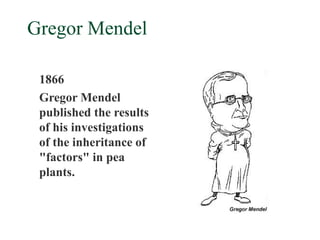
Gregor Mendel

 1866
 Gregor Mendel
 published the results
 of his investigations
 of the inheritance of
 "factors" in pea
 plants.
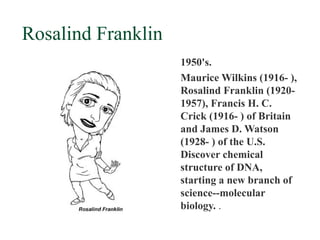
Rosalind Franklin
                    1950's.
                    Maurice Wilkins (1916- ),
                    Rosalind Franklin (1920-
                    1957), Francis H. C.
                    Crick (1916- ) of Britain
                    and James D. Watson
                    (1928- ) of the U.S.
                    Discover chemical
                    structure of DNA,
                    starting a new branch of
                    science--molecular
                    biology. .
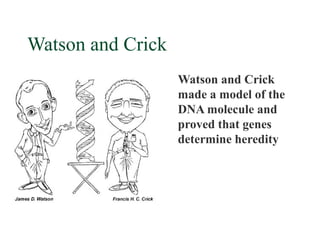
Watson and Crick
                   Watson and Crick
                   made a model of the
                   DNA molecule and
                   proved that genes
                   determine heredity
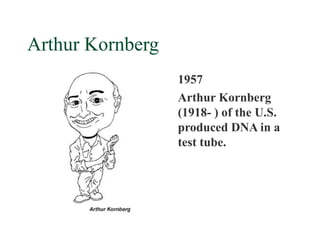
Arthur Kornberg
                  1957
                  Arthur Kornberg
                  (1918- ) of the U.S.
                  produced DNA in a
                  test tube.
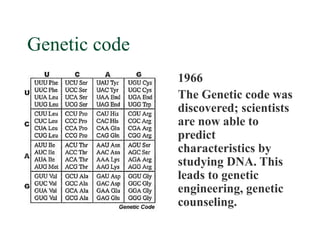
Genetic code
               1966
               The Genetic code was
               discovered; scientists
               are now able to
               predict
               characteristics by
               studying DNA. This
               leads to genetic
               engineering, genetic
               counseling.
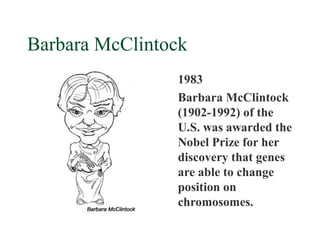
Barbara McClintock
                1983
                Barbara McClintock
                (1902-1992) of the
                U.S. was awarded the
                Nobel Prize for her
                discovery that genes
                are able to change
                position on
                chromosomes.
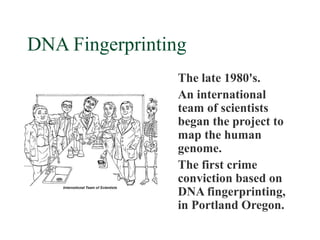
DNA Fingerprinting
                 The late 1980's.
                 An international
                 team of scientists
                 began the project to
                 map the human
                 genome.
                 The first crime
                 conviction based on
                 DNA fingerprinting,
                 in Portland Oregon.
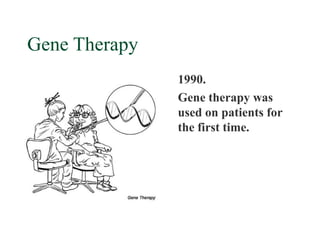
Gene Therapy
               1990.
               Gene therapy was
               used on patients for
               the first time.
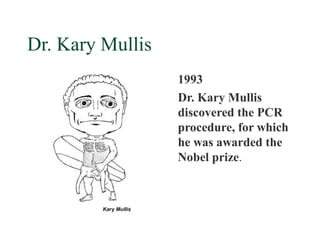
Dr. Kary Mullis
                  1993
                  Dr. Kary Mullis
                  discovered the PCR
                  procedure, for which
                  he was awarded the
                  Nobel prize.
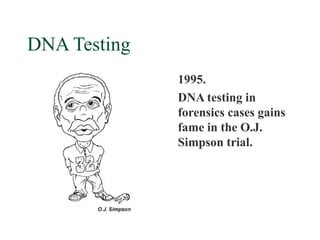
DNA Testing
              1995.
              DNA testing in
              forensics cases gains
              fame in the O.J.
              Simpson trial.
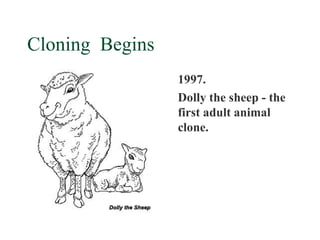
Cloning Begins
                 1997.
                 Dolly the sheep - the
                 first adult animal
                 clone.
Human Genome Project

Imagine a world in which we will be able
to treat diseases by altering our very
genes‚ giving us new ones if ours are non-
functional, changing bad genes for good
ones. For the first time in our existence,
we are closer to understanding just what
we are. We now have the tools to make
the whole world better through science
‚ the science of the human genome.
Genetic Disorders
Mutations
 Gene mutations can be either inherited
 from a parent or acquired. A hereditary
 mutation is a mistake that is present in the
 DNA of virtually all body cells. Hereditary
 mutations are also called germ line
 mutations because the gene change exists
 in the reproductive cells and can be passed
 from generation to generation, from parent
 to newborn. Moreover, the mutation is
 copied every time body cells divide
Mutations occur all the time in every cell in
the body. Each cell, however, has the
remarkable ability to recognize mistakes
and fix them before it passes them along to
its descendants. But a cell's DNA repair
mechanisms can fail, or be overwhelmed, or
become less efficient with age. Over time,
mistakes can accumulate.
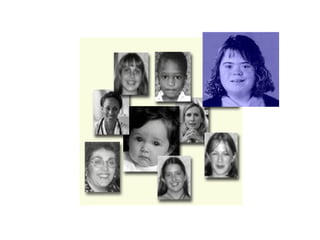
Down’s Syndrome
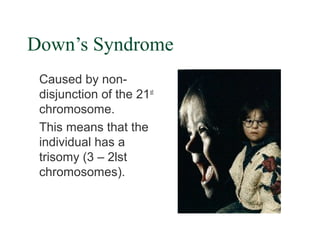
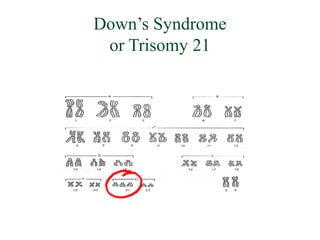
 Caused by non-
 disjunction of the 21st
 chromosome.
 This means that the
 individual has a
 trisomy (3 – 2lst
 chromosomes).
Down’s Syndrome
 or Trisomy 21
Symptoms of Down Syndrome
 Upward slant to eyes.
 Small ears that fold over at the top.
 Small, flattened nose.
 Small mouth, making tongue appear large.
 Short neck.
 Small hands with short fingers.
Symptoms of Down Syndrome
 Low muscle tone.
 Single deep crease across center of palm.
 Looseness of joints.
 Small skin folds at the inner corners of the eyes.
 Excessive space between first and second toe.
 In addition, down syndrome always involves some
 degree of mental retardation, from mild to severe.
 In most cases, the mental retardation is mild to
 moderate.
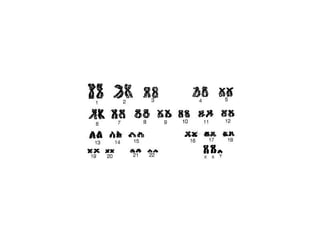
Kleinfelter’s syndrome
(or Klinefleter’s)


  Disorder occurring due to nondisjunction of
  the X chromosome.
  The Sperm containing both X and Y
  combines with an egg containing the X,
  results in a male child.
  The egg may contribute the extra X
  chromosome.
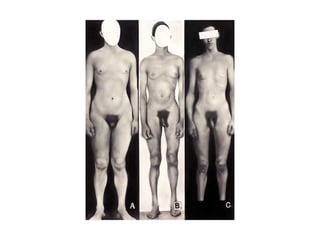
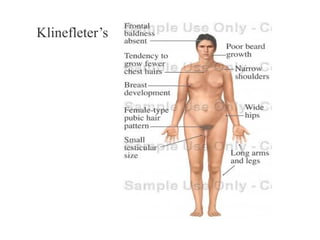
XXY
Males with some development of breast tissue
normally seen in females.
Little body hair is present, and such person are
typically tall, have small testes.
 Infertility results from absent sperm.
Evidence of mental retardation may or may
not be present.
Klinefleter’s
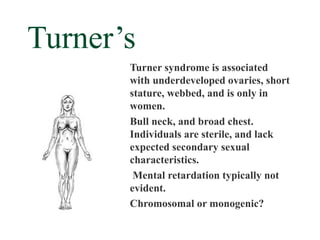
Turner’s
       Turner syndrome is associated
       with underdeveloped ovaries, short
       stature, webbed, and is only in
       women.
       Bull neck, and broad chest.
       Individuals are sterile, and lack
       expected secondary sexual
       characteristics.
        Mental retardation typically not
       evident.
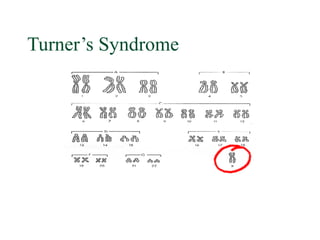
       Chromosomal or monogenic?
Turner’s Syndrome
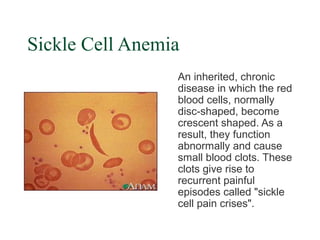
Sickle Cell Anemia
                 An inherited, chronic
                 disease in which the red
                 blood cells, normally
                 disc-shaped, become
                 crescent shaped. As a
                 result, they function
                 abnormally and cause
                 small blood clots. These
                 clots give rise to
                 recurrent painful
                 episodes called "sickle
                 cell pain crises".
Sickle Cell

 Sickle cell disease is most commonly
 found in African American populations.
 This disease was discovered over 80 years
 ago, but has not been given the attention
 it deserves.
Cystic Fibrosis (CF)
 Monogenic
 Cause: deletion of only 3 bases on
 chromosome 7
 Fluid in lungs, potential respiratory failure
 Common among Caucasians…1 in 20 are
 carriers
   Therefore is it dominant or recessive?
Tay-Sachs disease
 Monogenic, autosomal recessive
 Central nervous system degrades, ultimately
 causing death.
 Most common among people of Jewish,
 eastern Europe descent.
Muscular Dystrophy
 What Is Muscular Dystrophy?
 Muscular dystrophy is a disease in which the
 muscles of the body get weaker and weaker and
 slowly stop working because of a lack of a certain
 protein (see the relationship to genetics?)
 Can be passed on by one or both parents,
 depending on the form of MD (therefore is
 autosomal dominant and recessive)
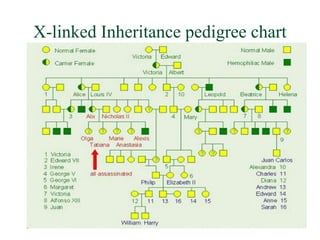
Hemophilia, the royal disease
 Hemophilia is the oldest     The severity of
 known hereditary bleeding    hemophilia is related to
 disorder.                    the amount of the clotting
 Caused by a recessive        factor in the blood. About
 gene on the X                70% of hemophilia
 chromosome.                  patients have less than one
 There are about 20,000       percent of the normal
 hemophilia patients in the   amount and, thus, have
 United States.               severe hemophilia.
 One can bleed to death
 with small cuts.
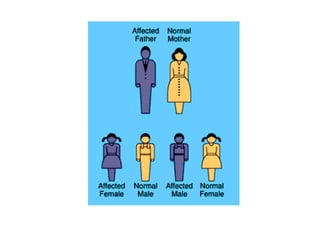
X-linked Inheritance pedigree chart
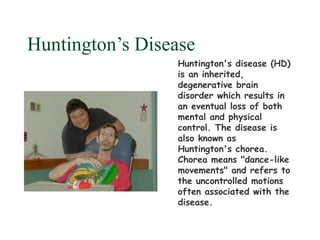
Huntington’s Disease
                 Huntington's disease (HD)
                 is an inherited,
                 degenerative brain
                 disorder which results in
                 an eventual loss of both
                 mental and physical
                 control. The disease is
                 also known as
                 Huntington's chorea.
                 Chorea means "dance-like
                 movements" and refers to
                 the uncontrolled motions
                 often associated with the
                 disease.
Huntington’s
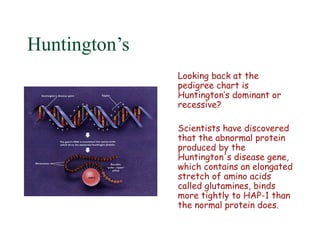
               Looking back at the
               pedigree chart is
               Huntington’s dominant or
               recessive?

               Scientists have discovered
               that the abnormal protein
               produced by the
               Huntington's disease gene,
               which contains an elongated
               stretch of amino acids
               called glutamines, binds
               more tightly to HAP-1 than
               the normal protein does.
Phenylketonuria or PKU
People with PKU cannot consume any product that
  contains aspartame.
PKU is a metabolic disorder that results when the
  PKU gene is inherited from both parents
  (recessive or dominant? Monogenic or
  chromosomal?)
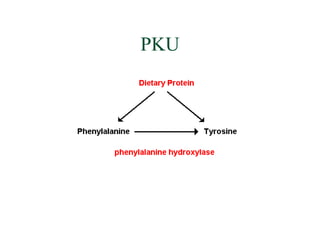
Caused by a deficiency of an enzyme which is
  necessary for proper metabolism of an amino acid
  called phenylalanine.
PKU
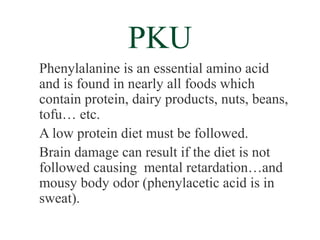
Phenylalanine is an essential amino acid
and is found in nearly all foods which
contain protein, dairy products, nuts, beans,
tofu… etc.
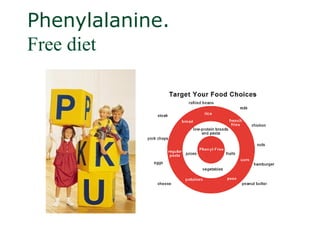
A low protein diet must be followed.
Brain damage can result if the diet is not
followed causing mental retardation…and
mousy body odor (phenylacetic acid is in
sweat).
PKU
Phenylalanine.
Free diet
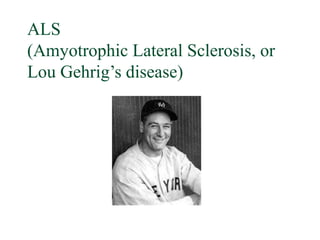
ALS
(Amyotrophic Lateral Sclerosis, or
Lou Gehrig’s disease)
the disease strikes people between the ages
of 40 and 70, and as many as 30,000
Americans have the disease at any given
time
This monogenic mutation is believed to
make a defective protein that is toxic to
motor nerve cells.
A common first symptom is a painless
weakness in a hand, foot, arm or leg, other
early symptoms include speech swallowing
or walking difficulty
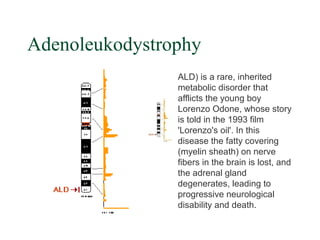
Adenoleukodystrophy
                ALD) is a rare, inherited
                metabolic disorder that
                afflicts the young boy
                Lorenzo Odone, whose story
                is told in the 1993 film
                'Lorenzo's oil'. In this
                disease the fatty covering
                (myelin sheath) on nerve
                fibers in the brain is lost, and
                the adrenal gland
                degenerates, leading to
                progressive neurological
                disability and death.
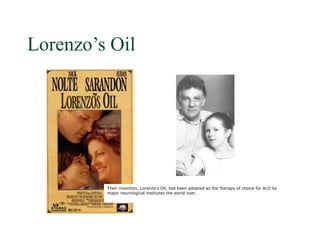
Lorenzo’s Oil


         Their invention, Lorenzo's Oil, has been adopted as the therapy of choice for ALD by
         major neurological institutes the world over.
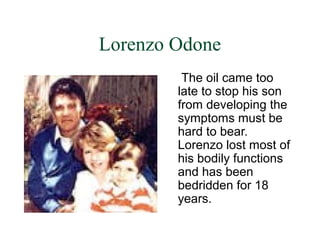
Lorenzo Odone
         The oil came too
        late to stop his son
        from developing the
        symptoms must be
        hard to bear.
        Lorenzo lost most of
        his bodily functions
        and has been
        bedridden for 18
        years.
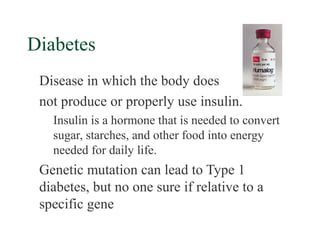
Diabetes
 Disease in which the body does
 not produce or properly use insulin.
   Insulin is a hormone that is needed to convert
   sugar, starches, and other food into energy
   needed for daily life.
 Genetic mutation can lead to Type 1
 diabetes, but no one sure if relative to a
 specific gene
Diabetes
 Type 1 reveals itself in childhood, Type 2 can be made
 worse from excessive lifestyle

 Warning signs
    Extreme thirst
    Blurry vision from time to time
    Frequent urination
    Unusual fatigue or drowsiness
    Unexplained weight loss

    Diabetes is the leading cause of kidney failure,
    blindness, and amputation in adults, and can
    also lead to heart disease.
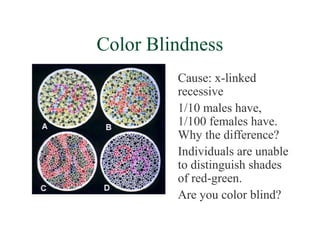
Color Blindness
         Cause: x-linked
         recessive
         1/10 males have,
         1/100 females have.
         Why the difference?
         Individuals are unable
         to distinguish shades
         of red-green.
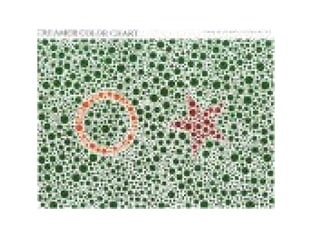
         Are you color blind?
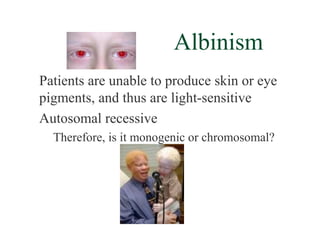
Albinism
Patients are unable to produce skin or eye
pigments, and thus are light-sensitive
Autosomal recessive
  Therefore, is it monogenic or chromosomal?
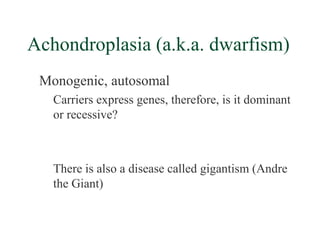
Achondroplasia (a.k.a. dwarfism)
 Monogenic, autosomal
   Carriers express genes, therefore, is it dominant
   or recessive?


   There is also a disease called gigantism (Andre
   the Giant)
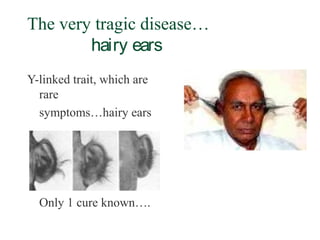
The very tragic disease…
        hairy ears
Y-linked trait, which are
  rare
  symptoms…hairy ears


  Only 1 cure known….
Genetic disorders

Genetic disorders

  • 1.
  • 2.
    Brief History Firstthere was Gregor Mendel, a monk who studied inherited characteristics. This was followed by Francis crick and James Watson who unraveled the DNA molecule. This has led us to understanding the human genome sequence
  • 3.
    Gregor Mendel 1866 Gregor Mendel published the results of his investigations of the inheritance of "factors" in pea plants.
  • 4.
    Rosalind Franklin 1950's. Maurice Wilkins (1916- ), Rosalind Franklin (1920- 1957), Francis H. C. Crick (1916- ) of Britain and James D. Watson (1928- ) of the U.S. Discover chemical structure of DNA, starting a new branch of science--molecular biology. .
  • 5.
    Watson and Crick Watson and Crick made a model of the DNA molecule and proved that genes determine heredity
  • 6.
    Arthur Kornberg 1957 Arthur Kornberg (1918- ) of the U.S. produced DNA in a test tube.
  • 7.
    Genetic code 1966 The Genetic code was discovered; scientists are now able to predict characteristics by studying DNA. This leads to genetic engineering, genetic counseling.
  • 8.
    Barbara McClintock 1983 Barbara McClintock (1902-1992) of the U.S. was awarded the Nobel Prize for her discovery that genes are able to change position on chromosomes.
  • 9.
    DNA Fingerprinting The late 1980's. An international team of scientists began the project to map the human genome. The first crime conviction based on DNA fingerprinting, in Portland Oregon.
  • 10.
    Gene Therapy 1990. Gene therapy was used on patients for the first time.
  • 11.
    Dr. Kary Mullis 1993 Dr. Kary Mullis discovered the PCR procedure, for which he was awarded the Nobel prize.
  • 12.
    DNA Testing 1995. DNA testing in forensics cases gains fame in the O.J. Simpson trial.
  • 13.
    Cloning Begins 1997. Dolly the sheep - the first adult animal clone.
  • 14.
    Human Genome Project Imaginea world in which we will be able to treat diseases by altering our very genes‚ giving us new ones if ours are non- functional, changing bad genes for good ones. For the first time in our existence, we are closer to understanding just what we are. We now have the tools to make the whole world better through science ‚ the science of the human genome.
  • 15.
  • 16.
    Mutations Gene mutationscan be either inherited from a parent or acquired. A hereditary mutation is a mistake that is present in the DNA of virtually all body cells. Hereditary mutations are also called germ line mutations because the gene change exists in the reproductive cells and can be passed from generation to generation, from parent to newborn. Moreover, the mutation is copied every time body cells divide
  • 17.
    Mutations occur allthe time in every cell in the body. Each cell, however, has the remarkable ability to recognize mistakes and fix them before it passes them along to its descendants. But a cell's DNA repair mechanisms can fail, or be overwhelmed, or become less efficient with age. Over time, mistakes can accumulate.
  • 18.
    Down’s Syndrome Causedby non- disjunction of the 21st chromosome. This means that the individual has a trisomy (3 – 2lst chromosomes).
  • 19.
  • 21.
    Symptoms of DownSyndrome Upward slant to eyes. Small ears that fold over at the top. Small, flattened nose. Small mouth, making tongue appear large. Short neck. Small hands with short fingers.
  • 22.
    Symptoms of DownSyndrome Low muscle tone. Single deep crease across center of palm. Looseness of joints. Small skin folds at the inner corners of the eyes. Excessive space between first and second toe. In addition, down syndrome always involves some degree of mental retardation, from mild to severe. In most cases, the mental retardation is mild to moderate.
  • 23.
    Kleinfelter’s syndrome (or Klinefleter’s) Disorder occurring due to nondisjunction of the X chromosome. The Sperm containing both X and Y combines with an egg containing the X, results in a male child. The egg may contribute the extra X chromosome.
  • 24.
    XXY Males with somedevelopment of breast tissue normally seen in females. Little body hair is present, and such person are typically tall, have small testes. Infertility results from absent sperm. Evidence of mental retardation may or may not be present.
  • 27.
  • 28.
    Turner’s Turner syndrome is associated with underdeveloped ovaries, short stature, webbed, and is only in women. Bull neck, and broad chest. Individuals are sterile, and lack expected secondary sexual characteristics. Mental retardation typically not evident. Chromosomal or monogenic?
  • 29.
  • 30.
    Sickle Cell Anemia An inherited, chronic disease in which the red blood cells, normally disc-shaped, become crescent shaped. As a result, they function abnormally and cause small blood clots. These clots give rise to recurrent painful episodes called "sickle cell pain crises".
  • 31.
    Sickle Cell Sicklecell disease is most commonly found in African American populations. This disease was discovered over 80 years ago, but has not been given the attention it deserves.
  • 32.
    Cystic Fibrosis (CF) Monogenic Cause: deletion of only 3 bases on chromosome 7 Fluid in lungs, potential respiratory failure Common among Caucasians…1 in 20 are carriers Therefore is it dominant or recessive?
  • 33.
    Tay-Sachs disease Monogenic,autosomal recessive Central nervous system degrades, ultimately causing death. Most common among people of Jewish, eastern Europe descent.
  • 34.
    Muscular Dystrophy WhatIs Muscular Dystrophy? Muscular dystrophy is a disease in which the muscles of the body get weaker and weaker and slowly stop working because of a lack of a certain protein (see the relationship to genetics?) Can be passed on by one or both parents, depending on the form of MD (therefore is autosomal dominant and recessive)
  • 35.
    Hemophilia, the royaldisease Hemophilia is the oldest The severity of known hereditary bleeding hemophilia is related to disorder. the amount of the clotting Caused by a recessive factor in the blood. About gene on the X 70% of hemophilia chromosome. patients have less than one There are about 20,000 percent of the normal hemophilia patients in the amount and, thus, have United States. severe hemophilia. One can bleed to death with small cuts.
  • 36.
  • 37.
    Huntington’s Disease Huntington's disease (HD) is an inherited, degenerative brain disorder which results in an eventual loss of both mental and physical control. The disease is also known as Huntington's chorea. Chorea means "dance-like movements" and refers to the uncontrolled motions often associated with the disease.
  • 40.
    Huntington’s Looking back at the pedigree chart is Huntington’s dominant or recessive? Scientists have discovered that the abnormal protein produced by the Huntington's disease gene, which contains an elongated stretch of amino acids called glutamines, binds more tightly to HAP-1 than the normal protein does.
  • 42.
    Phenylketonuria or PKU Peoplewith PKU cannot consume any product that contains aspartame. PKU is a metabolic disorder that results when the PKU gene is inherited from both parents (recessive or dominant? Monogenic or chromosomal?) Caused by a deficiency of an enzyme which is necessary for proper metabolism of an amino acid called phenylalanine.
  • 43.
    PKU Phenylalanine is anessential amino acid and is found in nearly all foods which contain protein, dairy products, nuts, beans, tofu… etc. A low protein diet must be followed. Brain damage can result if the diet is not followed causing mental retardation…and mousy body odor (phenylacetic acid is in sweat).
  • 44.
  • 45.
  • 46.
    ALS (Amyotrophic Lateral Sclerosis,or Lou Gehrig’s disease)
  • 47.
    the disease strikespeople between the ages of 40 and 70, and as many as 30,000 Americans have the disease at any given time This monogenic mutation is believed to make a defective protein that is toxic to motor nerve cells. A common first symptom is a painless weakness in a hand, foot, arm or leg, other early symptoms include speech swallowing or walking difficulty
  • 48.
    Adenoleukodystrophy ALD) is a rare, inherited metabolic disorder that afflicts the young boy Lorenzo Odone, whose story is told in the 1993 film 'Lorenzo's oil'. In this disease the fatty covering (myelin sheath) on nerve fibers in the brain is lost, and the adrenal gland degenerates, leading to progressive neurological disability and death.
  • 49.
    Lorenzo’s Oil Their invention, Lorenzo's Oil, has been adopted as the therapy of choice for ALD by major neurological institutes the world over.
  • 50.
    Lorenzo Odone The oil came too late to stop his son from developing the symptoms must be hard to bear. Lorenzo lost most of his bodily functions and has been bedridden for 18 years.
  • 51.
    Diabetes Disease inwhich the body does not produce or properly use insulin. Insulin is a hormone that is needed to convert sugar, starches, and other food into energy needed for daily life. Genetic mutation can lead to Type 1 diabetes, but no one sure if relative to a specific gene
  • 52.
    Diabetes Type 1reveals itself in childhood, Type 2 can be made worse from excessive lifestyle Warning signs Extreme thirst Blurry vision from time to time Frequent urination Unusual fatigue or drowsiness Unexplained weight loss Diabetes is the leading cause of kidney failure, blindness, and amputation in adults, and can also lead to heart disease.
  • 53.
    Color Blindness Cause: x-linked recessive 1/10 males have, 1/100 females have. Why the difference? Individuals are unable to distinguish shades of red-green. Are you color blind?
  • 55.
    Albinism Patients are unableto produce skin or eye pigments, and thus are light-sensitive Autosomal recessive Therefore, is it monogenic or chromosomal?
  • 56.
    Achondroplasia (a.k.a. dwarfism) Monogenic, autosomal Carriers express genes, therefore, is it dominant or recessive? There is also a disease called gigantism (Andre the Giant)
  • 57.
    The very tragicdisease… hairy ears Y-linked trait, which are rare symptoms…hairy ears Only 1 cure known….