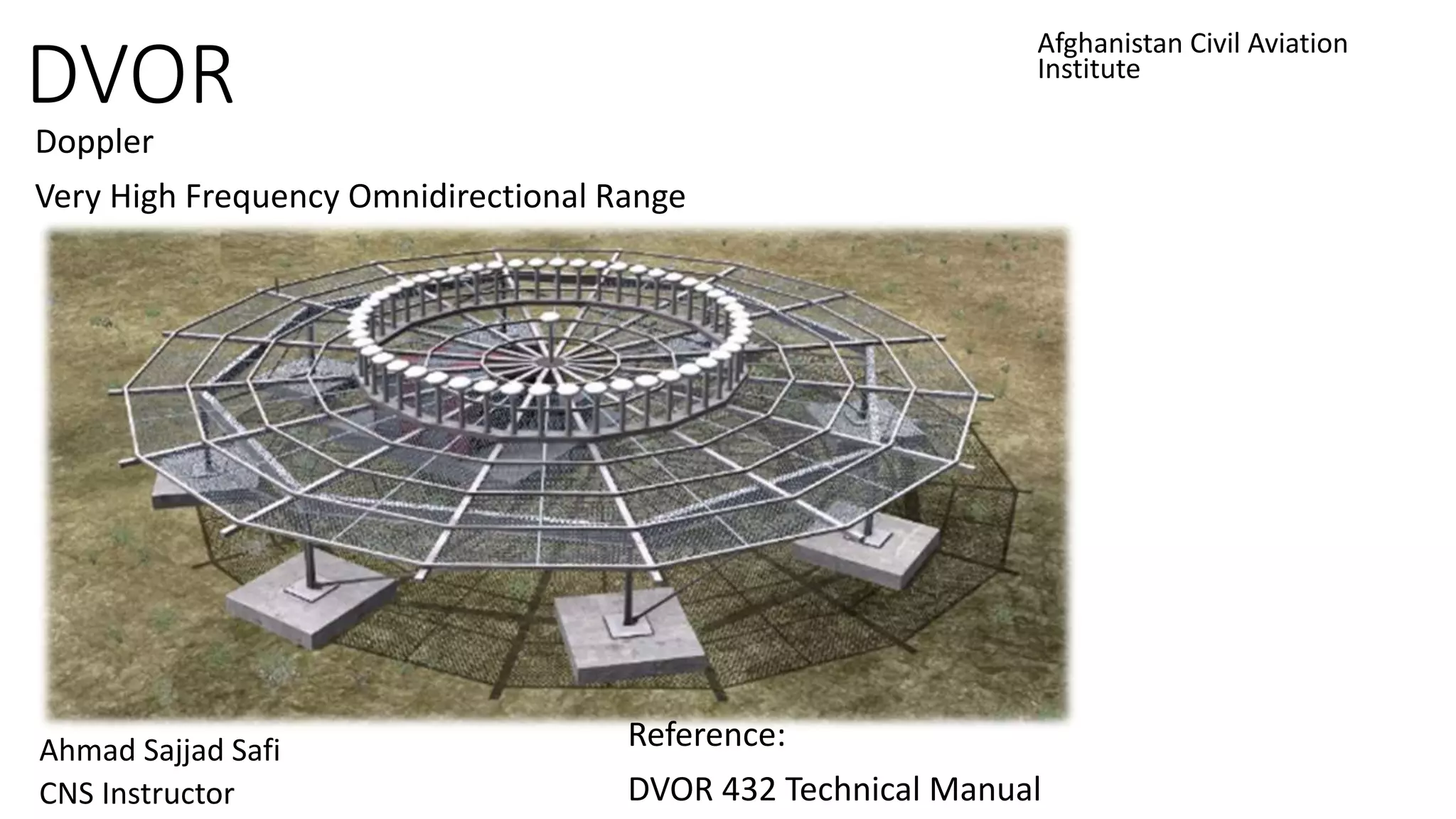
DVOR
Doppler
Very High Frequency Omnidirectional Range
Afghanistan Civil Aviation
Institute
Ahmad Sajjad Safi
CNS Instructor
Reference:
DVOR 432 Technical Manual
Introduction to DVOR
 The DVOR is a radio navigation aid recommended by the ICAO and
introduced internationally for short and medium range aircraft guidance.
 The DVOR radio navigation equipment is a further development of the
conventional VOR.
• Todays airway network is marked by a number of DVOR ground beacons
operating in the 108...118 MHz VHF frequency range and having a
transmission range of 300 km.
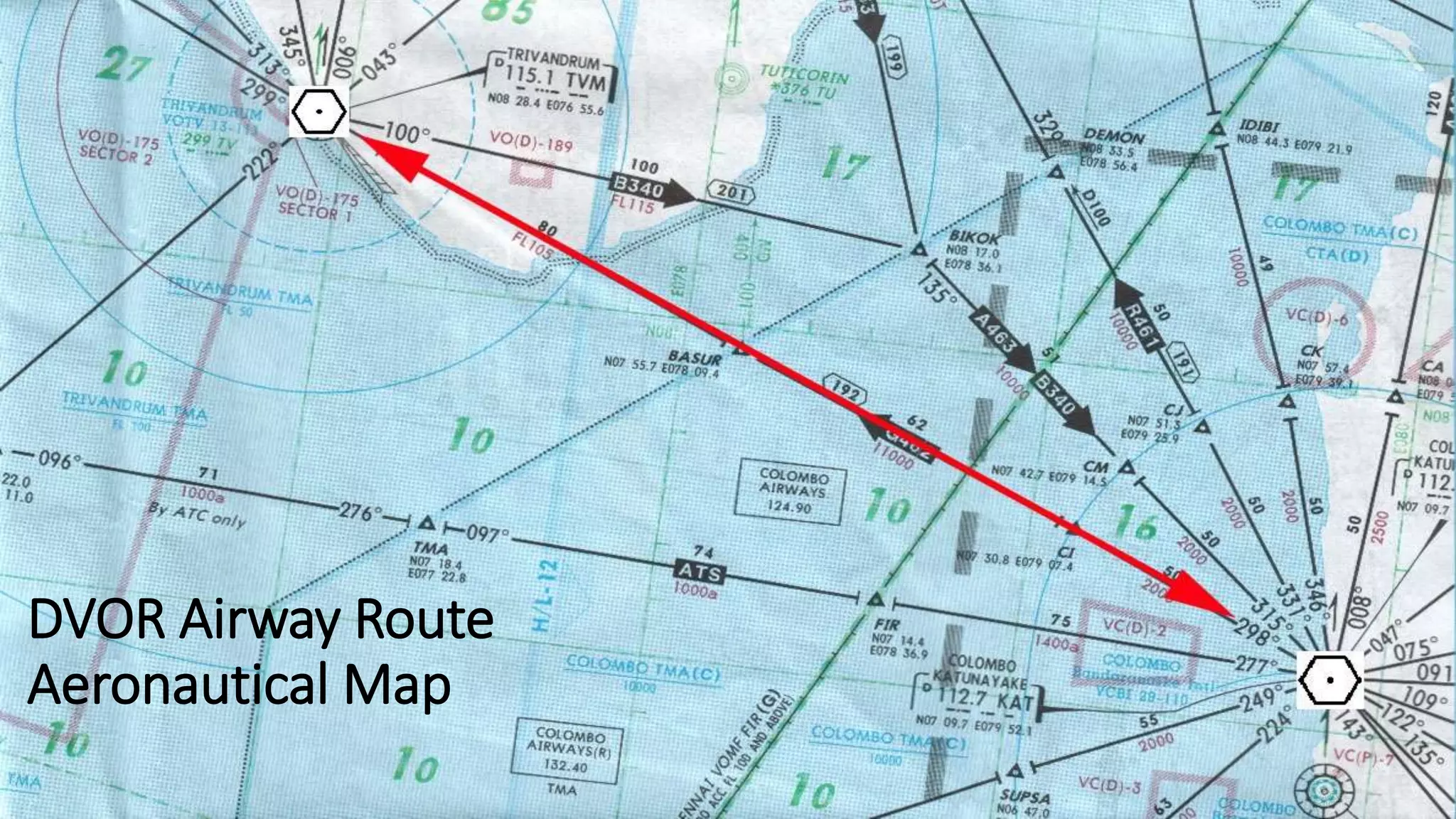
DVOR Airway Route
Aeronautical Map
DVOR Propagated Information
 Using the VOR receiver installed in the aircraft the pilot is able to obtain
the following information from a DVOR radio navigation installation:
- The azimuth indication of the aircraft’s position relative to the ground
beacon, i.e. the angle between magnetic North and the direction ground
beacon to aircraft.
-The bearing which indicates whether the aircraft is flying to the left or right
of the preselected course (position line) or whether it is exactly on it.
-The "from/to" indication which shows whether the aircraft is flying toward
the DVOR beacon or away from it.
DVOR Propagated Information
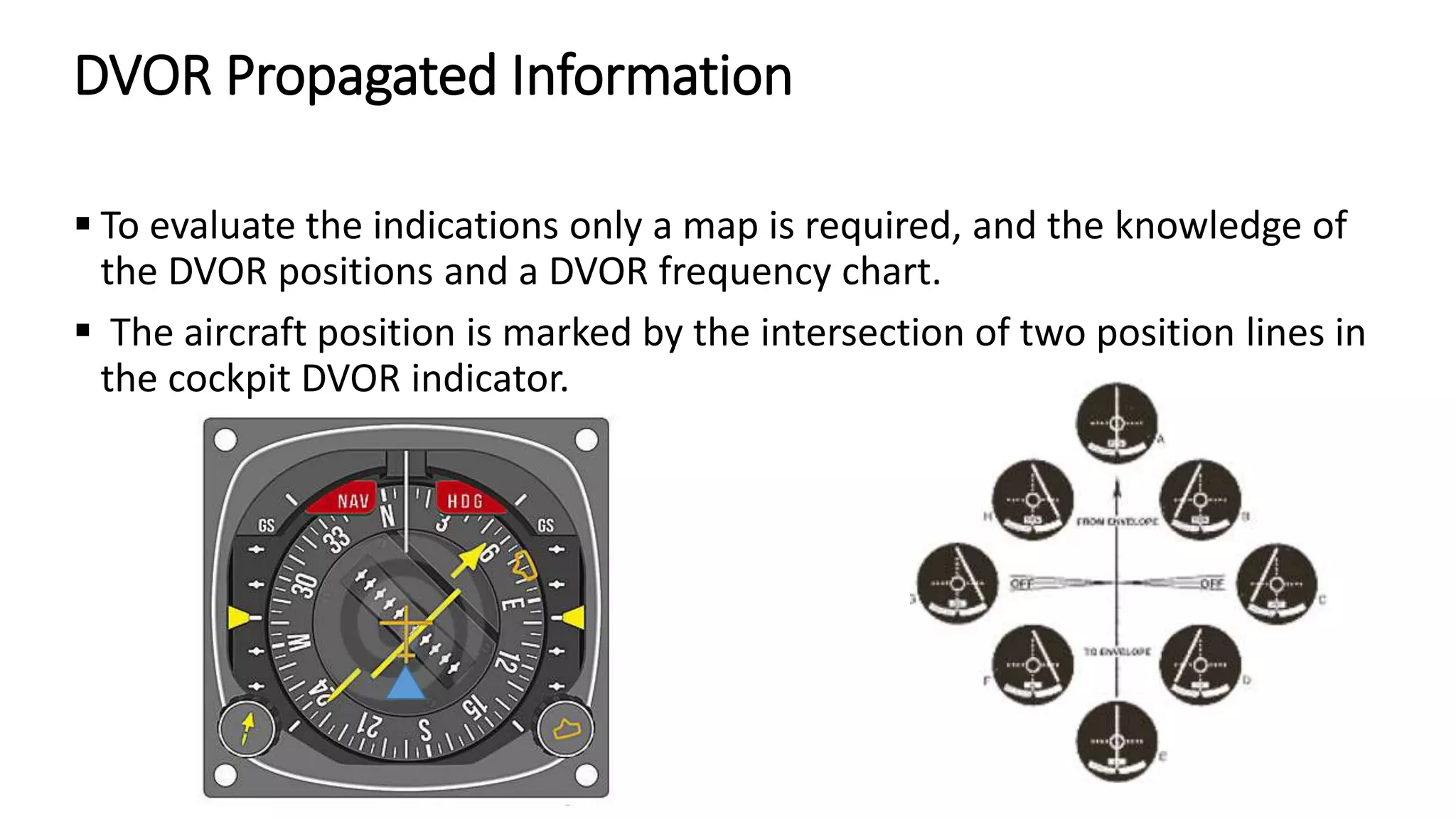
 To evaluate the indications only a map is required, and the knowledge of
the DVOR positions and a DVOR frequency chart.
 The aircraft position is marked by the intersection of two position lines in
the cockpit DVOR indicator.
DVOR Propagated Information
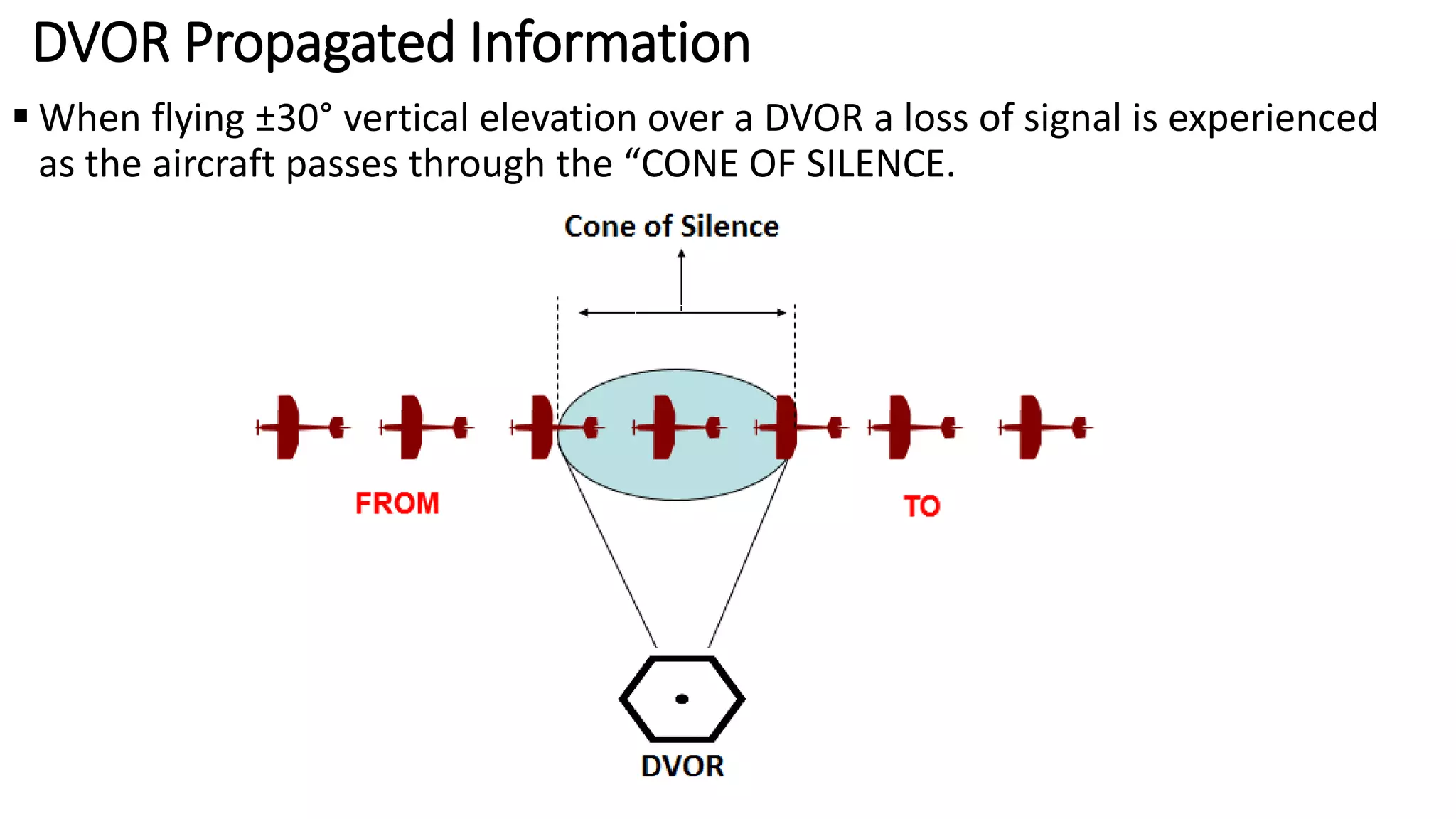
 When flying ±30° vertical elevation over a DVOR a loss of signal is experienced
as the aircraft passes through the “CONE OF SILENCE.
Operational use of DVOR
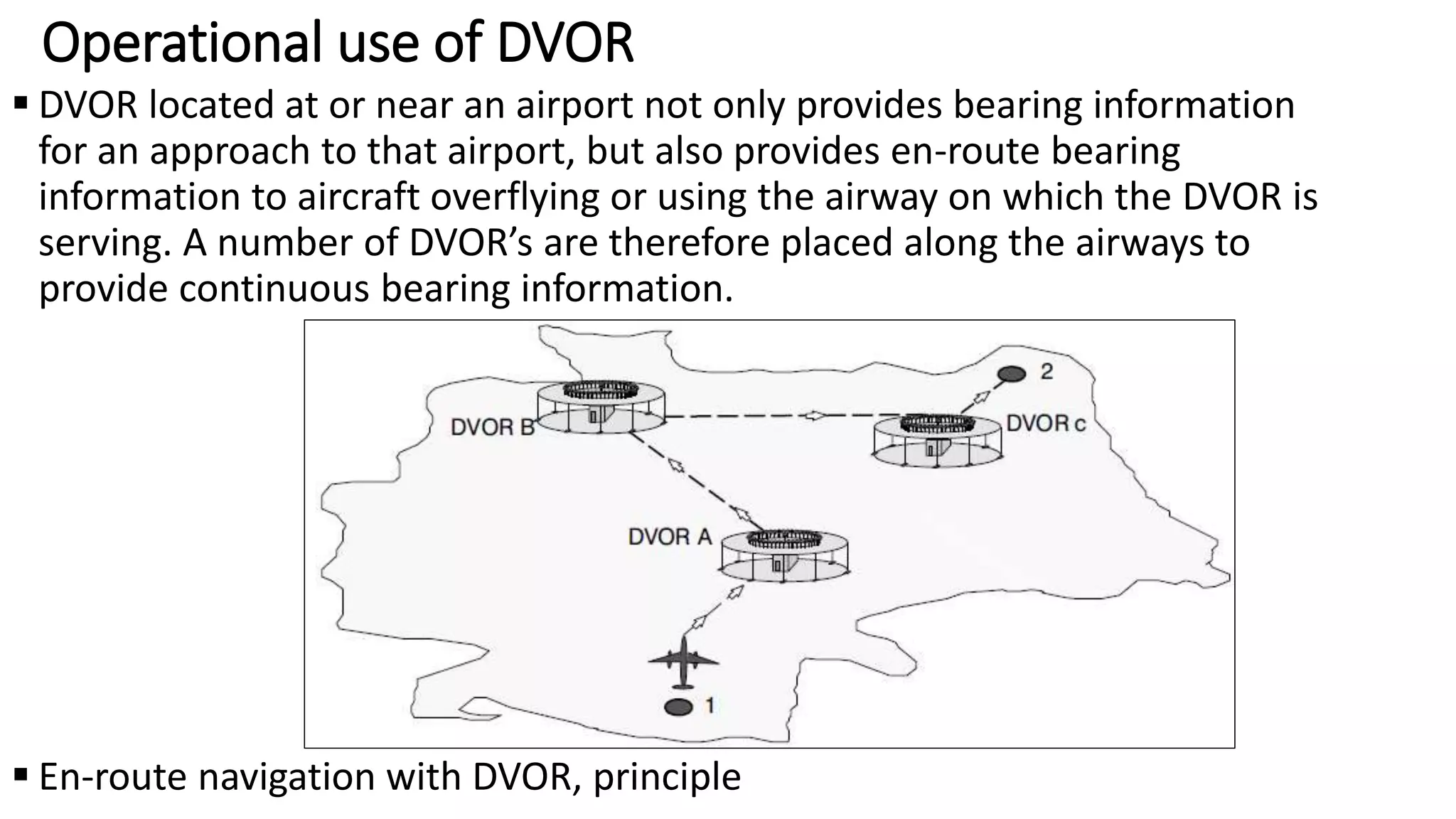
 DVOR located at or near an airport not only provides bearing information
for an approach to that airport, but also provides en-route bearing
information to aircraft overflying or using the airway on which the DVOR is
serving. A number of DVOR’s are therefore placed along the airways to
provide continuous bearing information.
 En-route navigation with DVOR, principle
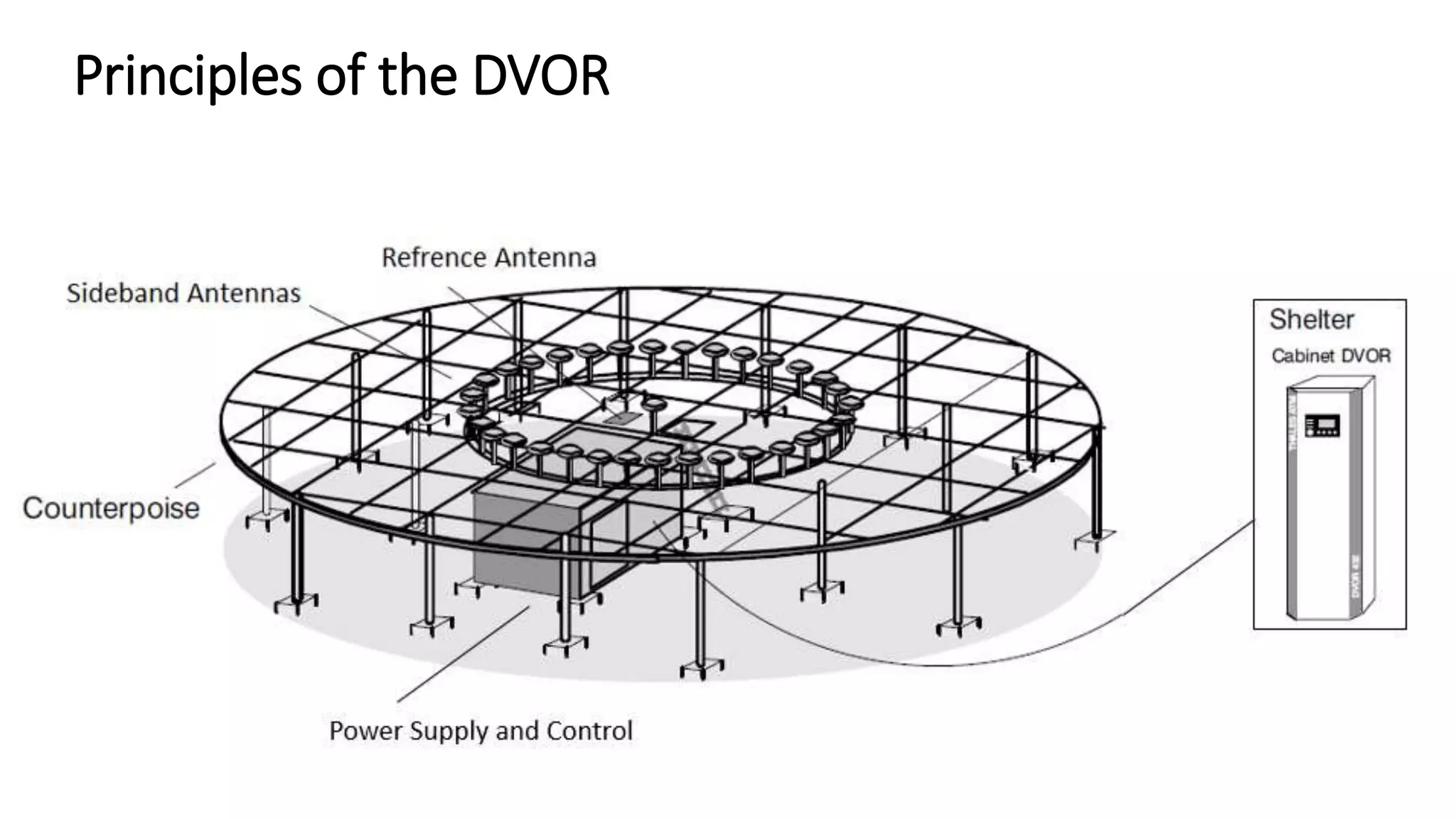
Principles of the DVOR
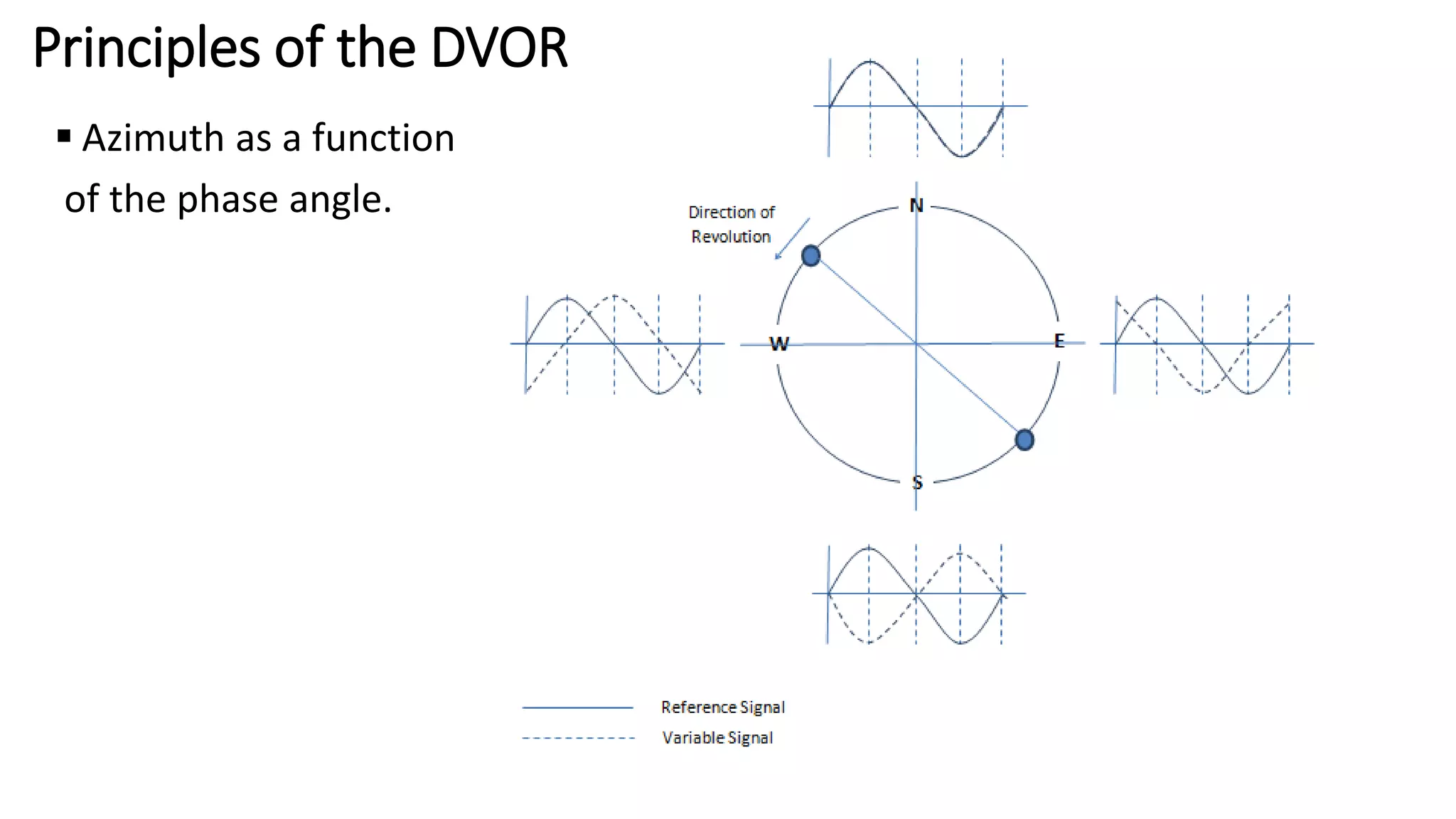
 The principle on which the DVOR operates is based on the measurement
of the phase angle difference of two 30 Hz signals radiated by the station
at the same time.
 One signal (reference signal) is radiated with the same phase in all
directions. For the second 30 Hz signal (variable signal), the phase of signal
is variable.
 The electric phase angle measured in the airborne receiver to identify the
azimuth angle.
 This bearing (azimuth) angle also known as RADIALS will be displayed on
DVOR indicator inside the cockpit.
Principles of the DVOR
 Azimuth as a function
of the phase angle.
Principles of the DVOR
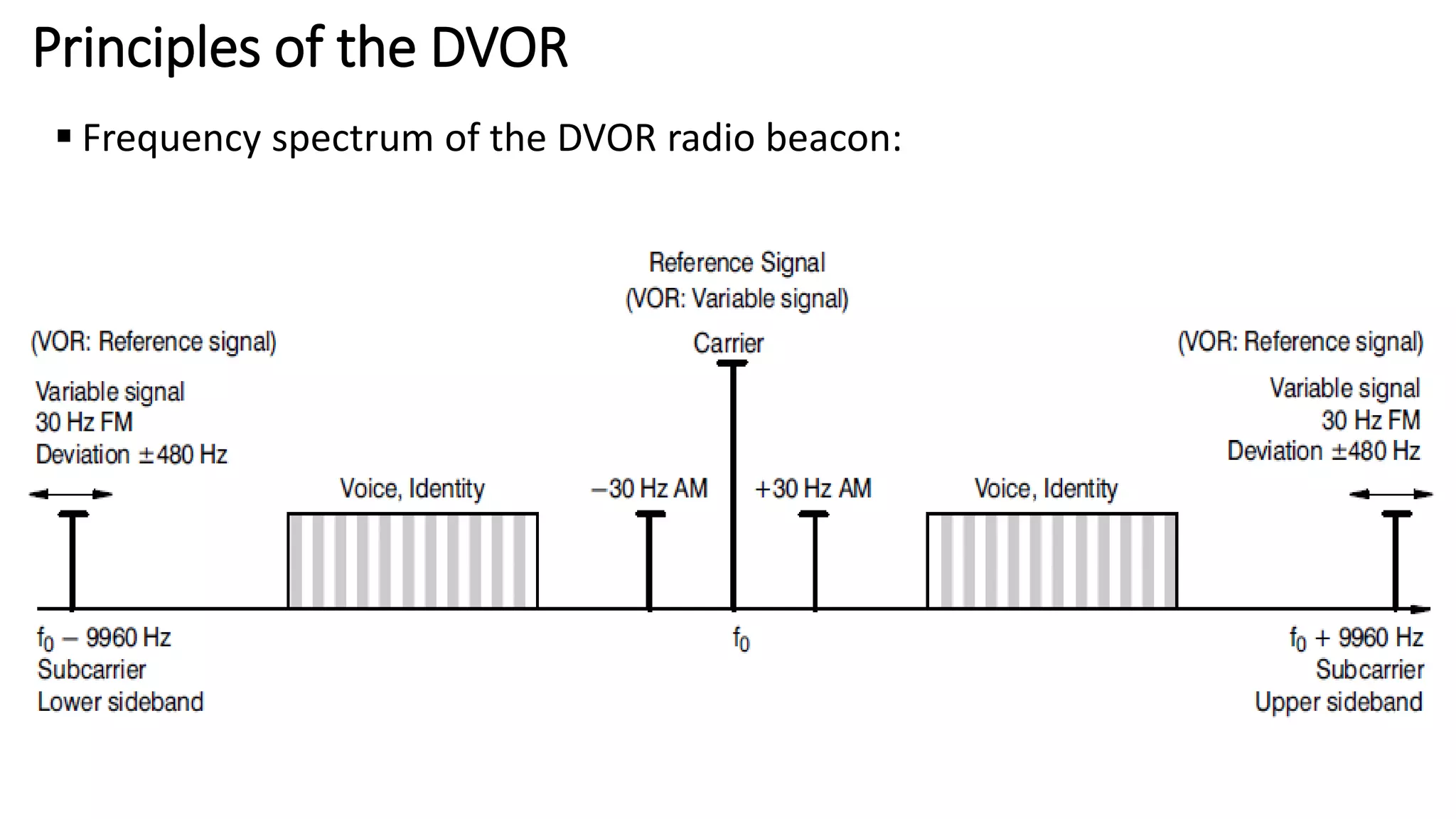
 Reference Signal : the 30 Hz modulation which amplitude−modulates (AM) the
VHF carrier now acts as the reference signal. The modulated carrier signal is
transmitted Omni directionally by a center antenna. It is amplitude−modulated
with the voice (300...3000 Hz) and the identity Morse code in addition to the 30
Hz reference signal.
 Variable Signal: the 30 Hz modulation which frequency−modulated (FM) 30 Hz
modulation (variable signal) is contained in the 9960 Hz subcarrier. The 9960 Hz
subcarrier signal is transmitted directionally by a sideband radiator antenna,
which can be considered to be rotating along a circular path. The radiated
sideband frequency is offset by +9960 Hz or −9960 Hz with respect to the carrier
frequency.
 ICAO stipulated ±480 Hz signal in order to obtain the frequency deviation.
Principles of the DVOR
 Frequency spectrum of the DVOR radio beacon:
General Information of the DVOR
The main features of DVOR 432 is as follows:
 Compliance with ICAO standards.
 Available as single or dual equipment with power up to 50 W or 100 W.
 Microprocessor controlled transmitter and monitoring system.
 Modular design, extensive common use of subassemblies within the Navaids.
 Local LCD display and control panel for system status indication, basic controls
and measurement of data.
 Standard PC used as local or remote interface (via RMMC) between the system
and the operator.
Operational use of DVOR
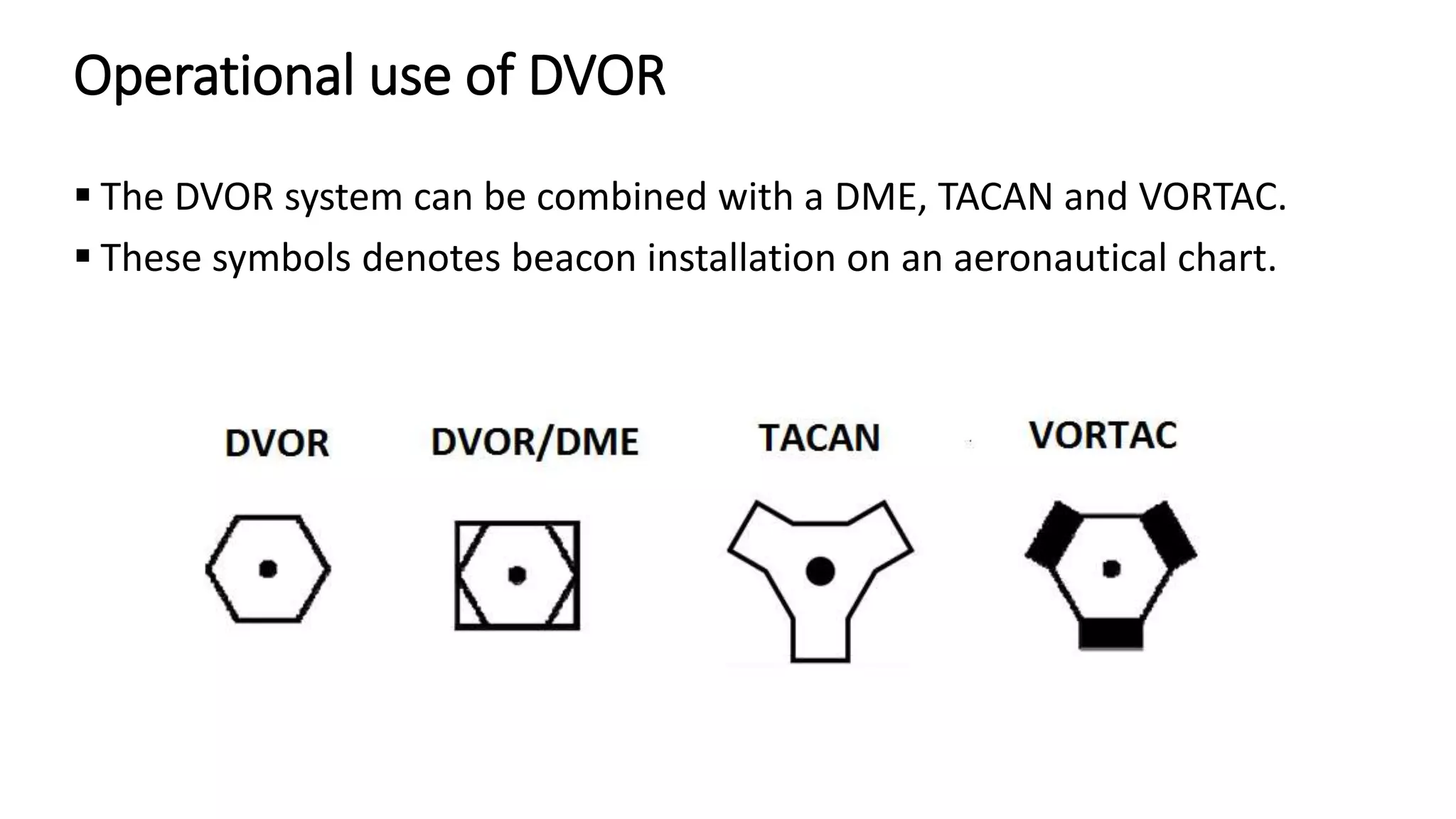
 The DVOR system can be combined with a DME, TACAN and VORTAC.
 These symbols denotes beacon installation on an aeronautical chart.
Operational use of DVOR
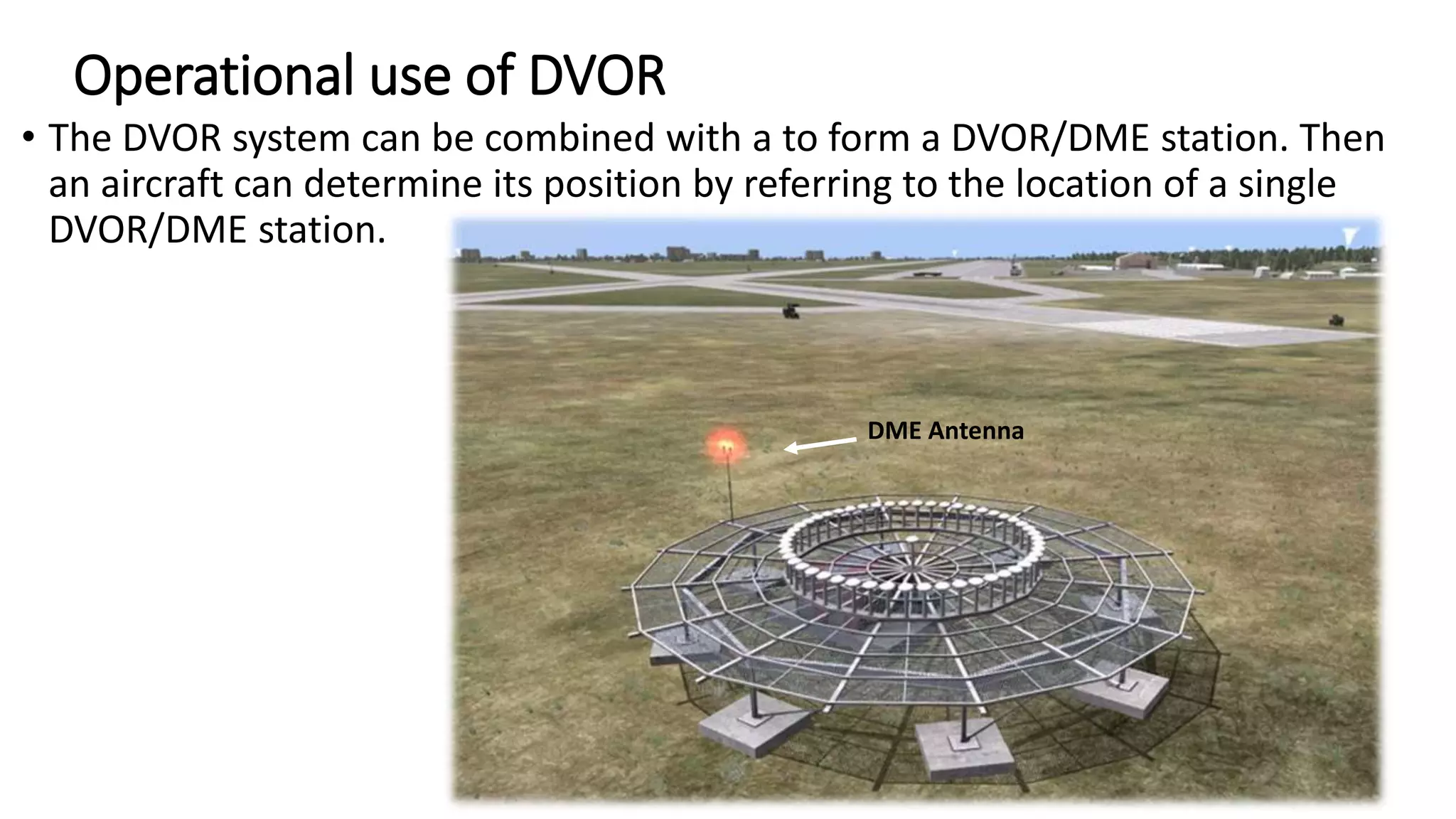
• The DVOR system can be combined with a to form a DVOR/DME station. Then
an aircraft can determine its position by referring to the location of a single
DVOR/DME station.
DME Antenna
Principles of the DVOR

Doppler VHF Omni Directional Range (DVOR)

  • 1.
    DVOR Doppler Very High FrequencyOmnidirectional Range Afghanistan Civil Aviation Institute Ahmad Sajjad Safi CNS Instructor Reference: DVOR 432 Technical Manual
  • 2.
    Introduction to DVOR The DVOR is a radio navigation aid recommended by the ICAO and introduced internationally for short and medium range aircraft guidance.  The DVOR radio navigation equipment is a further development of the conventional VOR. • Todays airway network is marked by a number of DVOR ground beacons operating in the 108...118 MHz VHF frequency range and having a transmission range of 300 km.
  • 3.
  • 4.
    DVOR Propagated Information Using the VOR receiver installed in the aircraft the pilot is able to obtain the following information from a DVOR radio navigation installation: - The azimuth indication of the aircraft’s position relative to the ground beacon, i.e. the angle between magnetic North and the direction ground beacon to aircraft. -The bearing which indicates whether the aircraft is flying to the left or right of the preselected course (position line) or whether it is exactly on it. -The "from/to" indication which shows whether the aircraft is flying toward the DVOR beacon or away from it.
  • 5.
    DVOR Propagated Information To evaluate the indications only a map is required, and the knowledge of the DVOR positions and a DVOR frequency chart.  The aircraft position is marked by the intersection of two position lines in the cockpit DVOR indicator.
  • 6.
    DVOR Propagated Information When flying ±30° vertical elevation over a DVOR a loss of signal is experienced as the aircraft passes through the “CONE OF SILENCE.
  • 7.
    Operational use ofDVOR  DVOR located at or near an airport not only provides bearing information for an approach to that airport, but also provides en-route bearing information to aircraft overflying or using the airway on which the DVOR is serving. A number of DVOR’s are therefore placed along the airways to provide continuous bearing information.  En-route navigation with DVOR, principle
  • 8.
    Principles of theDVOR  The principle on which the DVOR operates is based on the measurement of the phase angle difference of two 30 Hz signals radiated by the station at the same time.  One signal (reference signal) is radiated with the same phase in all directions. For the second 30 Hz signal (variable signal), the phase of signal is variable.  The electric phase angle measured in the airborne receiver to identify the azimuth angle.  This bearing (azimuth) angle also known as RADIALS will be displayed on DVOR indicator inside the cockpit.
  • 9.
    Principles of theDVOR  Azimuth as a function of the phase angle.
  • 10.
    Principles of theDVOR  Reference Signal : the 30 Hz modulation which amplitude−modulates (AM) the VHF carrier now acts as the reference signal. The modulated carrier signal is transmitted Omni directionally by a center antenna. It is amplitude−modulated with the voice (300...3000 Hz) and the identity Morse code in addition to the 30 Hz reference signal.  Variable Signal: the 30 Hz modulation which frequency−modulated (FM) 30 Hz modulation (variable signal) is contained in the 9960 Hz subcarrier. The 9960 Hz subcarrier signal is transmitted directionally by a sideband radiator antenna, which can be considered to be rotating along a circular path. The radiated sideband frequency is offset by +9960 Hz or −9960 Hz with respect to the carrier frequency.  ICAO stipulated ±480 Hz signal in order to obtain the frequency deviation.
  • 11.
    Principles of theDVOR  Frequency spectrum of the DVOR radio beacon:
  • 12.
    General Information ofthe DVOR The main features of DVOR 432 is as follows:  Compliance with ICAO standards.  Available as single or dual equipment with power up to 50 W or 100 W.  Microprocessor controlled transmitter and monitoring system.  Modular design, extensive common use of subassemblies within the Navaids.  Local LCD display and control panel for system status indication, basic controls and measurement of data.  Standard PC used as local or remote interface (via RMMC) between the system and the operator.
  • 13.
    Operational use ofDVOR  The DVOR system can be combined with a DME, TACAN and VORTAC.  These symbols denotes beacon installation on an aeronautical chart.
  • 14.
    Operational use ofDVOR • The DVOR system can be combined with a to form a DVOR/DME station. Then an aircraft can determine its position by referring to the location of a single DVOR/DME station. DME Antenna
  • 15.