Entomology is the study of insects and other
anthropoids.
Medical entomology focuses on the effects of insects
and other arthropods on human health. The study of
insects contributes to the control of insect
populations, the production of health education
programs, and the creation of vaccines and other
medicines.
Before Medical Entomology
 Before the mid-nineteenth century, the
means by which diseases spread were poorly
understood. Nevertheless, insects were
sometimes viewed as potential agents of
disease. An Italian physician wrote in 1577
that, "there can be no doubt that flies,
saturated with the juice of the dead or the
diseased" helped to spread infection.1
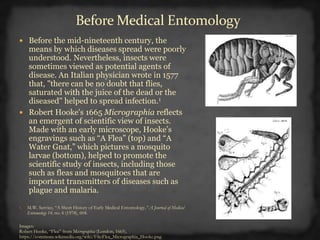
 Robert Hooke's 1665 Micrographia reflects
an emergent of scientific view of insects.
Made with an early microscope, Hooke’s
engravings such as “A Flea” (top) and “A
Water Gnat,” which pictures a mosquito
larvae (bottom), helped to promote the
scientific study of insects, including those
such as fleas and mosquitoes that are
important transmitters of diseases such as
plague and malaria.
1. M.W. Service, “A Short History of Early Medical Entomology,” A Journal of Medical
Entomology 14, no. 6 (1978), 604.
Images:
Robert Hooke, “Flea” from Micrographia (London, 1665),
https://commons.wikimedia.org/wiki/File:Flea_Micrographia_Hooke.png
Before Medical Entomology
Throughout most of the nineteenth century, the
ways in which diseases were transmitted were
unclear. The uncertainty and doubt surrounding
one disease, Malaria, is reflected in the engraving
to the left in the style of Maurice Davedant, which
depicts the ghastly figure of Malaria haunting a
swamp, while figures collapse or flee nearby.
In the nineteenth century, Malaria was a deadly
threat in the United States, as the image from the
1870 census illustrates. Areas in red indicate
regions where the proportions of death due to
Malaria were highest. It was not until the end of the
nineteenth century that the role of Mosquitoes in
spreading Malaria was finally understood. In 1897
the publication of Ronald Ross's observations the
malaria parasite inside mosquitos would began the
era of medical entomology.
Images:
A follower of Maurice Sand, “Allegory of Malaria,” (1920?), Wellcome Images
(V0010519), http://catalogue.wellcomelibrary.org/record=b1168817.
U.S. Census Office, Statistical Atlas of the United States ([New York] J. Bien,
lith., 1874), Pl. 42,. http://hdl.loc.gov/loc.gmd/g3701gm.gct00297.
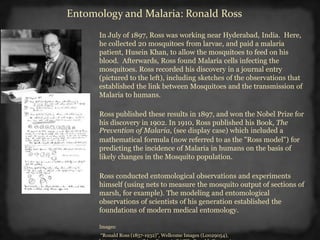
In July of 1897, Ross was working near Hyderabad, India. Here,
he collected 20 mosquitoes from larvae, and paid a malaria
patient, Husein Khan, to allow the mosquitoes to feed on his
blood. Afterwards, Ross found Malaria cells infecting the
mosquitoes. Ross recorded his discovery in a journal entry
(pictured to the left), including sketches of the observations that
established the link between Mosquitoes and the transmission of
Malaria to humans.
Ross published these results in 1897, and won the Nobel Prize for
his discovery in 1902. In 1910, Ross published his Book, The
Prevention of Malaria, (see display case) which included a
mathematical formula (now referred to as the "Ross model") for
predicting the incidence of Malaria in humans on the basis of
likely changes in the Mosquito population.
Ross conducted entomological observations and experiments
himself (using nets to measure the mosquito output of sections of
marsh, for example). The modeling and entomological
observations of scientists of his generation established the
foundations of modern medical entomology.
Images:
“Ronald Ross (1857-1932)”, Wellcome Images (L0029054),
Entomology and Malaria: Ronald Ross
 William Horsfall, a professor of Entomology at the University of
Illinois from 1947 to 1976, argued that the control of Mosquitoes
could best be achieved by understanding the mosquito's relationship
to its environment (its "bionomics").
 Horsfall conducted many collecting expeditions to study the
mosquito life-cycle. This often required collecting mosquitoes,
sometimes using less-than-pleasant methods: One of Horsfall's
colleagues noted: "Bill’s method was to place a screened cage against
his bare chest, whereupon he would instantly be bitten by 200
ravenous, single-minded insects" (Swenson).
 The composite image on the left includes photographs taken using an
electron microscope, and illustrates differences in reticulation and
other features in the eggs of mosquitoes collected in the American
Midwest. Horsfall notes that "many species of Ades [mosquitoes] are
composed of populations recognizable by differences in features of
the eggs."
 Because different populations of mosquitoes respond differently to
environmental conditions, the study of morphology has helped
disease-control experts more effectively manage the impact of
mosquito-borne illnesses, including Malaria.
Images:
William Robert Horsfall (1908-1998) from Journal of the American Mosquito Control
Association, v. 15, 1999 (251-2).; “Psorophora Species,”
Medical Entomology at Illinois: Morphology
 Marilyn O’Hara Ruiz, who joined the faculty of the
University of Illinois in 2001, is the Director of the
University's Geographic Information Science and
Spatial Epidemiology lab, located in the College of
Veterinary Medicine.
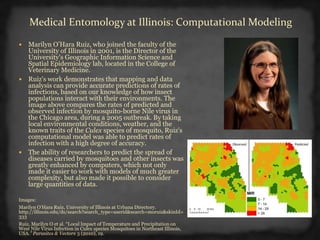
 Ruiz's work demonstrates that mapping and data
analysis can provide accurate predictions of rates of
infections, based on our knowledge of how insect
populations interact with their environments. The
image above compares the rates of predicted and
observed infection by mosquito-borne Nile virus in
the Chicago area, during a 2005 outbreak. By taking
local environmental conditions, weather, and the
known traits of the Culex species of mosquito, Ruiz's
computational model was able to predict rates of
infection with a high degree of accuracy.
 The ability of researchers to predict the spread of
diseases carried by mosquitoes and other insects was
greatly enhanced by computers, which not only
made it easier to work with models of much greater
complexity, but also made it possible to consider
large quantities of data.
Images:
Marilyn O’Hara Ruiz, University of Illinois at Urbana Directory.
http://illinois.edu/ds/search?search_type=userid&search=moruiz&skinId=
333
Ruiz, Marilyn O et al. “Local Impact of Temperature and Precipitation on
West Nile Virus Infection in Culex species Mosquitoes in Northeast Illinois,
USA.” Parasites & Vectors 3 (2010), 19.
Medical Entomology at Illinois: Computational Modeling
 Visit the exhibit in the display case near the
circulation desk in the Funk/ACES Library
 Department of Entomology, School of
Intergrative Medicine
 Department of Pathobiology, College of
Veterinary Medicine
 Medical Entomology program at the University
of Illinois

Medical entomology

  • 2.
    Entomology is thestudy of insects and other anthropoids. Medical entomology focuses on the effects of insects and other arthropods on human health. The study of insects contributes to the control of insect populations, the production of health education programs, and the creation of vaccines and other medicines.
  • 3.
    Before Medical Entomology Before the mid-nineteenth century, the means by which diseases spread were poorly understood. Nevertheless, insects were sometimes viewed as potential agents of disease. An Italian physician wrote in 1577 that, "there can be no doubt that flies, saturated with the juice of the dead or the diseased" helped to spread infection.1  Robert Hooke's 1665 Micrographia reflects an emergent of scientific view of insects. Made with an early microscope, Hooke’s engravings such as “A Flea” (top) and “A Water Gnat,” which pictures a mosquito larvae (bottom), helped to promote the scientific study of insects, including those such as fleas and mosquitoes that are important transmitters of diseases such as plague and malaria. 1. M.W. Service, “A Short History of Early Medical Entomology,” A Journal of Medical Entomology 14, no. 6 (1978), 604. Images: Robert Hooke, “Flea” from Micrographia (London, 1665), https://commons.wikimedia.org/wiki/File:Flea_Micrographia_Hooke.png
  • 4.
    Before Medical Entomology Throughoutmost of the nineteenth century, the ways in which diseases were transmitted were unclear. The uncertainty and doubt surrounding one disease, Malaria, is reflected in the engraving to the left in the style of Maurice Davedant, which depicts the ghastly figure of Malaria haunting a swamp, while figures collapse or flee nearby. In the nineteenth century, Malaria was a deadly threat in the United States, as the image from the 1870 census illustrates. Areas in red indicate regions where the proportions of death due to Malaria were highest. It was not until the end of the nineteenth century that the role of Mosquitoes in spreading Malaria was finally understood. In 1897 the publication of Ronald Ross's observations the malaria parasite inside mosquitos would began the era of medical entomology. Images: A follower of Maurice Sand, “Allegory of Malaria,” (1920?), Wellcome Images (V0010519), http://catalogue.wellcomelibrary.org/record=b1168817. U.S. Census Office, Statistical Atlas of the United States ([New York] J. Bien, lith., 1874), Pl. 42,. http://hdl.loc.gov/loc.gmd/g3701gm.gct00297.
  • 5.
    In July of1897, Ross was working near Hyderabad, India. Here, he collected 20 mosquitoes from larvae, and paid a malaria patient, Husein Khan, to allow the mosquitoes to feed on his blood. Afterwards, Ross found Malaria cells infecting the mosquitoes. Ross recorded his discovery in a journal entry (pictured to the left), including sketches of the observations that established the link between Mosquitoes and the transmission of Malaria to humans. Ross published these results in 1897, and won the Nobel Prize for his discovery in 1902. In 1910, Ross published his Book, The Prevention of Malaria, (see display case) which included a mathematical formula (now referred to as the "Ross model") for predicting the incidence of Malaria in humans on the basis of likely changes in the Mosquito population. Ross conducted entomological observations and experiments himself (using nets to measure the mosquito output of sections of marsh, for example). The modeling and entomological observations of scientists of his generation established the foundations of modern medical entomology. Images: “Ronald Ross (1857-1932)”, Wellcome Images (L0029054), Entomology and Malaria: Ronald Ross
  • 6.
     William Horsfall,a professor of Entomology at the University of Illinois from 1947 to 1976, argued that the control of Mosquitoes could best be achieved by understanding the mosquito's relationship to its environment (its "bionomics").  Horsfall conducted many collecting expeditions to study the mosquito life-cycle. This often required collecting mosquitoes, sometimes using less-than-pleasant methods: One of Horsfall's colleagues noted: "Bill’s method was to place a screened cage against his bare chest, whereupon he would instantly be bitten by 200 ravenous, single-minded insects" (Swenson).  The composite image on the left includes photographs taken using an electron microscope, and illustrates differences in reticulation and other features in the eggs of mosquitoes collected in the American Midwest. Horsfall notes that "many species of Ades [mosquitoes] are composed of populations recognizable by differences in features of the eggs."  Because different populations of mosquitoes respond differently to environmental conditions, the study of morphology has helped disease-control experts more effectively manage the impact of mosquito-borne illnesses, including Malaria. Images: William Robert Horsfall (1908-1998) from Journal of the American Mosquito Control Association, v. 15, 1999 (251-2).; “Psorophora Species,” Medical Entomology at Illinois: Morphology
  • 7.
     Marilyn O’HaraRuiz, who joined the faculty of the University of Illinois in 2001, is the Director of the University's Geographic Information Science and Spatial Epidemiology lab, located in the College of Veterinary Medicine.  Ruiz's work demonstrates that mapping and data analysis can provide accurate predictions of rates of infections, based on our knowledge of how insect populations interact with their environments. The image above compares the rates of predicted and observed infection by mosquito-borne Nile virus in the Chicago area, during a 2005 outbreak. By taking local environmental conditions, weather, and the known traits of the Culex species of mosquito, Ruiz's computational model was able to predict rates of infection with a high degree of accuracy.  The ability of researchers to predict the spread of diseases carried by mosquitoes and other insects was greatly enhanced by computers, which not only made it easier to work with models of much greater complexity, but also made it possible to consider large quantities of data. Images: Marilyn O’Hara Ruiz, University of Illinois at Urbana Directory. http://illinois.edu/ds/search?search_type=userid&search=moruiz&skinId= 333 Ruiz, Marilyn O et al. “Local Impact of Temperature and Precipitation on West Nile Virus Infection in Culex species Mosquitoes in Northeast Illinois, USA.” Parasites & Vectors 3 (2010), 19. Medical Entomology at Illinois: Computational Modeling
  • 8.
     Visit theexhibit in the display case near the circulation desk in the Funk/ACES Library  Department of Entomology, School of Intergrative Medicine  Department of Pathobiology, College of Veterinary Medicine  Medical Entomology program at the University of Illinois