Public Parks
The ACES Funk Library is home to City
Planning and Landscape Architecture
reference and resource materials. Included
in this collection are items related to public
parks. It contains volumes authored by
Frederick Law Olmsted (Central Park, NY)
and Daniel Burnham (Plan of Chicago), two
major figures in urban design and landscape
architecture at the turn of the century. The
items displayed here relate to park planning
and design in the United States at the
beginning of the 20th century.
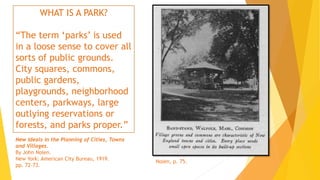
New Ideals in the Planning of Cities, Towns
and Villages.
By John Nolen.
New York: American City Bureau, 1919.
pp. 72-73.
WHAT IS A PARK?
“The term ‘parks’ is used
in a loose sense to cover all
sorts of public grounds.
City squares, commons,
public gardens,
playgrounds, neighborhood
centers, parkways, large
outlying reservations or
forests, and parks proper.”
Nolen, p. 75.
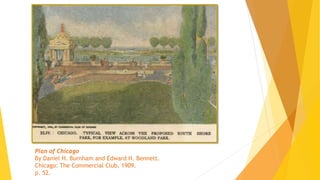
Plan of Chicago
By Daniel H. Burnham and Edward H. Bennett.
Chicago: The Commercial Club, 1909.
p. 52.
“Every city worthy of the name has public
parks of some sort, and they are now
recognized as a necessity of city life, a part of
the city plan, just as streets and schools are.
They contribute to the pleasure and health of
urban populations more than any other
recreative feature, and furnish the most
necessary and valuable antidote to the
artificiality, confusion, and feverishness of life
in cities.”
New Ideals in the Planning of Cities, Towns and
Villages.
By John Nolen.
New York: American City Bureau, 1919.
p. 71.
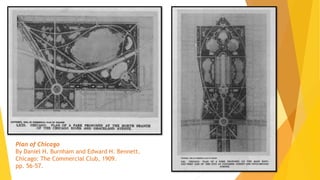
Plan of Chicago
By Daniel H. Burnham and Edward H. Bennett.
Chicago: The Commercial Club, 1909.
pp. 56-57.
“Chicago, on becoming a city, chose for its motto Urbs
in horto – a city set in a garden. Such indeed it then
was, with the opalescent waters of the Lake at its
front, and on its three sides the boundless prairie
carpeted with waving grass bedecked with brilliant
wild flowers. The quick advance of commerce and
manufactures, the rapid building of railroads and
factories, and the hastily constructed homes of
operatives crowded out nature’s parterres of flowers.
Still the motto lingered in the minds of men, and in
1839 the struggle began to secure for the fast-growing
population park spaces which should at least recall the
gardens that of necessity had been sacrificed.”
Plan of Chicago
By Daniel H. Burnham and Edward H. Bennett.
Chicago: The Commercial Club, 1909.
p. 43.
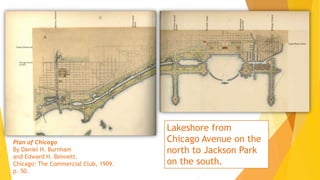
Plan of Chicago
By Daniel H. Burnham
and Edward H. Bennett.
Chicago: The Commercial Club, 1909.
p. 50.
Lakeshore from
Chicago Avenue on the
north to Jackson Park
on the south.
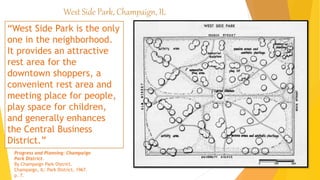
West Side Park, Champaign, IL
“West Side Park is the only
one in the neighborhood.
It provides an attractive
rest area for the
downtown shoppers, a
convenient rest area and
meeting place for people,
play space for children,
and generally enhances
the Central Business
District.”
Progress and Planning: Champaign
Park District.
By Champaign Park District.
Champaign, IL: Park District, 1967.
p. 7.
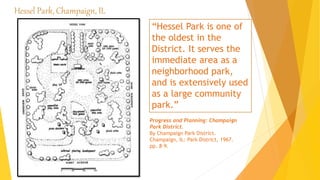
Hessel Park, Champaign, IL
“Hessel Park is one of
the oldest in the
District. It serves the
immediate area as a
neighborhood park,
and is extensively used
as a large community
park.”
Progress and Planning: Champaign
Park District.
By Champaign Park District.
Champaign, IL: Park District, 1967.
pp. 8-9.
For more books and
resources about Public
Parks, visit the Funk
Library!

Public parks

  • 1.
  • 2.
    The ACES FunkLibrary is home to City Planning and Landscape Architecture reference and resource materials. Included in this collection are items related to public parks. It contains volumes authored by Frederick Law Olmsted (Central Park, NY) and Daniel Burnham (Plan of Chicago), two major figures in urban design and landscape architecture at the turn of the century. The items displayed here relate to park planning and design in the United States at the beginning of the 20th century.
  • 3.
    New Ideals inthe Planning of Cities, Towns and Villages. By John Nolen. New York: American City Bureau, 1919. pp. 72-73. WHAT IS A PARK? “The term ‘parks’ is used in a loose sense to cover all sorts of public grounds. City squares, commons, public gardens, playgrounds, neighborhood centers, parkways, large outlying reservations or forests, and parks proper.” Nolen, p. 75.
  • 4.
    Plan of Chicago ByDaniel H. Burnham and Edward H. Bennett. Chicago: The Commercial Club, 1909. p. 52.
  • 5.
    “Every city worthyof the name has public parks of some sort, and they are now recognized as a necessity of city life, a part of the city plan, just as streets and schools are. They contribute to the pleasure and health of urban populations more than any other recreative feature, and furnish the most necessary and valuable antidote to the artificiality, confusion, and feverishness of life in cities.” New Ideals in the Planning of Cities, Towns and Villages. By John Nolen. New York: American City Bureau, 1919. p. 71.
  • 6.
    Plan of Chicago ByDaniel H. Burnham and Edward H. Bennett. Chicago: The Commercial Club, 1909. pp. 56-57.
  • 7.
    “Chicago, on becominga city, chose for its motto Urbs in horto – a city set in a garden. Such indeed it then was, with the opalescent waters of the Lake at its front, and on its three sides the boundless prairie carpeted with waving grass bedecked with brilliant wild flowers. The quick advance of commerce and manufactures, the rapid building of railroads and factories, and the hastily constructed homes of operatives crowded out nature’s parterres of flowers. Still the motto lingered in the minds of men, and in 1839 the struggle began to secure for the fast-growing population park spaces which should at least recall the gardens that of necessity had been sacrificed.” Plan of Chicago By Daniel H. Burnham and Edward H. Bennett. Chicago: The Commercial Club, 1909. p. 43.
  • 8.
    Plan of Chicago ByDaniel H. Burnham and Edward H. Bennett. Chicago: The Commercial Club, 1909. p. 50. Lakeshore from Chicago Avenue on the north to Jackson Park on the south.
  • 9.
    West Side Park,Champaign, IL “West Side Park is the only one in the neighborhood. It provides an attractive rest area for the downtown shoppers, a convenient rest area and meeting place for people, play space for children, and generally enhances the Central Business District.” Progress and Planning: Champaign Park District. By Champaign Park District. Champaign, IL: Park District, 1967. p. 7.
  • 10.
    Hessel Park, Champaign,IL “Hessel Park is one of the oldest in the District. It serves the immediate area as a neighborhood park, and is extensively used as a large community park.” Progress and Planning: Champaign Park District. By Champaign Park District. Champaign, IL: Park District, 1967. pp. 8-9.
  • 11.
    For more booksand resources about Public Parks, visit the Funk Library!