Exotic Plants
The Funk Library collections include a variety of materials
on “exotic” plant life. Exotic species are plants that have
been introduced, by humans, to an area they are not
native to, usually for decorative or ornamental purposes.
Sometimes exotic species can become invasive and disrupt
native plant ecosystems. Most of the following examples
are “exotic” plants for the Funk Library because they are
not native to the United States.
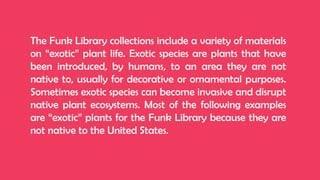
Canna lily, native to Central
& South America, with
some varieties native to the
southern US
Bold and exotic plants
By Noël Kingsbury.
New York: Watson-Guptill, 2000.
Q. 715 K611b
Clockwise, from top left:
Aphelandra aurantiaca,
“fiery spike,” native to
Central & South America
Clerodendrum thomsonae,
“bleeding heart,” native to
West Africa
Neomarica gracilis, native
to Central & South America
Hoya carnosa variegate,
native to India, Burma,
China, & Australia
Exotica: pictorial cyclopedia of exotic plants
By Alfred Byrd Graf.
East Rutherford, New Jersey: Roehrs Co., 1982.
634.35 G757e 1982 v.2 [ACES Reference]
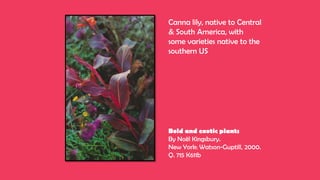
Acanthus mollis latifolius,
native to Southern Europe
& northwestern Africa
The exotic garden
By Myles Challis.
London: Fourth Estate, 1988.
635.952 C352E
Justicia brandegeeana, or
“shrimp plant,” native to
Mexico
Encyclopedia of Exotic plants
for temperate climates
By Will Giles.
Portland: Timber Press, 2007.
Q. 635.903 G391e [ACES Reference]
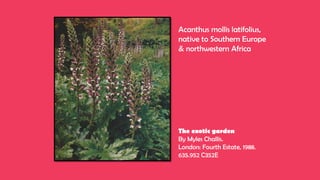
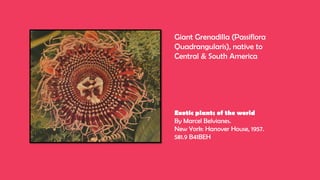
Giant Grenadilla (Passiflora
Quadrangularis), native to
Central & South America
Exotic plants of the world
By Marcel Belvianes.
New York: Hanover House, 1957.
581.9 B41BEH
Examples of Bromeliaceae
(Bromeliads), native to
Central & South America
Exotic plant manual
By Alfred Byrd Graf.
East Rutherford, New
Jersey: Roehrs Co., 1978.
634.35 G757EX1978
[ACES Reference]
For more books and resources
about exotic plant life, visit the
Funk Library!

Exotic Plants

  • 1.
  • 2.
    The Funk Librarycollections include a variety of materials on “exotic” plant life. Exotic species are plants that have been introduced, by humans, to an area they are not native to, usually for decorative or ornamental purposes. Sometimes exotic species can become invasive and disrupt native plant ecosystems. Most of the following examples are “exotic” plants for the Funk Library because they are not native to the United States.
  • 3.
    Canna lily, nativeto Central & South America, with some varieties native to the southern US Bold and exotic plants By Noël Kingsbury. New York: Watson-Guptill, 2000. Q. 715 K611b
  • 4.
    Clockwise, from topleft: Aphelandra aurantiaca, “fiery spike,” native to Central & South America Clerodendrum thomsonae, “bleeding heart,” native to West Africa Neomarica gracilis, native to Central & South America Hoya carnosa variegate, native to India, Burma, China, & Australia Exotica: pictorial cyclopedia of exotic plants By Alfred Byrd Graf. East Rutherford, New Jersey: Roehrs Co., 1982. 634.35 G757e 1982 v.2 [ACES Reference]
  • 5.
    Acanthus mollis latifolius, nativeto Southern Europe & northwestern Africa The exotic garden By Myles Challis. London: Fourth Estate, 1988. 635.952 C352E
  • 6.
    Justicia brandegeeana, or “shrimpplant,” native to Mexico Encyclopedia of Exotic plants for temperate climates By Will Giles. Portland: Timber Press, 2007. Q. 635.903 G391e [ACES Reference]
  • 7.
    Giant Grenadilla (Passiflora Quadrangularis),native to Central & South America Exotic plants of the world By Marcel Belvianes. New York: Hanover House, 1957. 581.9 B41BEH
  • 8.
    Examples of Bromeliaceae (Bromeliads),native to Central & South America Exotic plant manual By Alfred Byrd Graf. East Rutherford, New Jersey: Roehrs Co., 1978. 634.35 G757EX1978 [ACES Reference]
  • 9.
    For more booksand resources about exotic plant life, visit the Funk Library!