METAL SPINNING PROCESS
ME 852 SEMINAR PRESENTATION

Anurag Dey (10/ME/148)
Abhimonyu Dutta (10/ME/152)
Aman Kumar (10/ME/149)
Deepak Nonia (09/ME/00)
Anurag Bhattacharyya (10/ME/150) Sandeep Kumar (08/ME/68)
Sourav Halder (10/ME/151)
OUTLINE













INTRODUCTION.
HISTORY.
CLASSIFICATION OF METAL SPINNING TECHNIQUES.
METAL SPINNING PROCESS.
MECHANICS.
TOOLS AND EQUIPMENTS.
COMPARISON WITH OTHER FORMING PROCESSES.
MERITS.
DE-MERITS.
APPLICATIONS.
CONCLUSION.
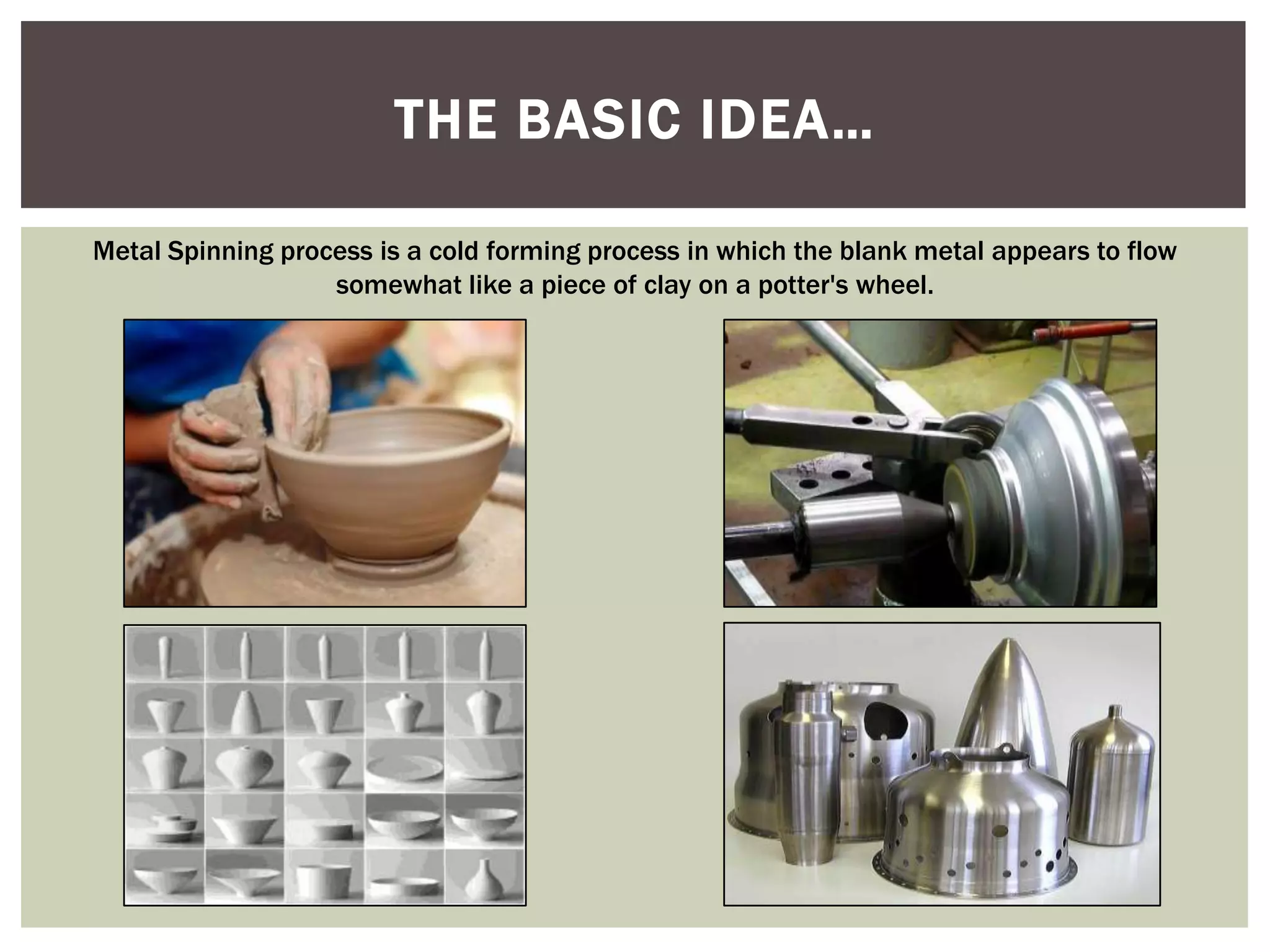
THE BASIC IDEA…
Metal Spinning process is a cold forming process in which the blank metal appears to flow
somewhat like a piece of clay on a potter's wheel.
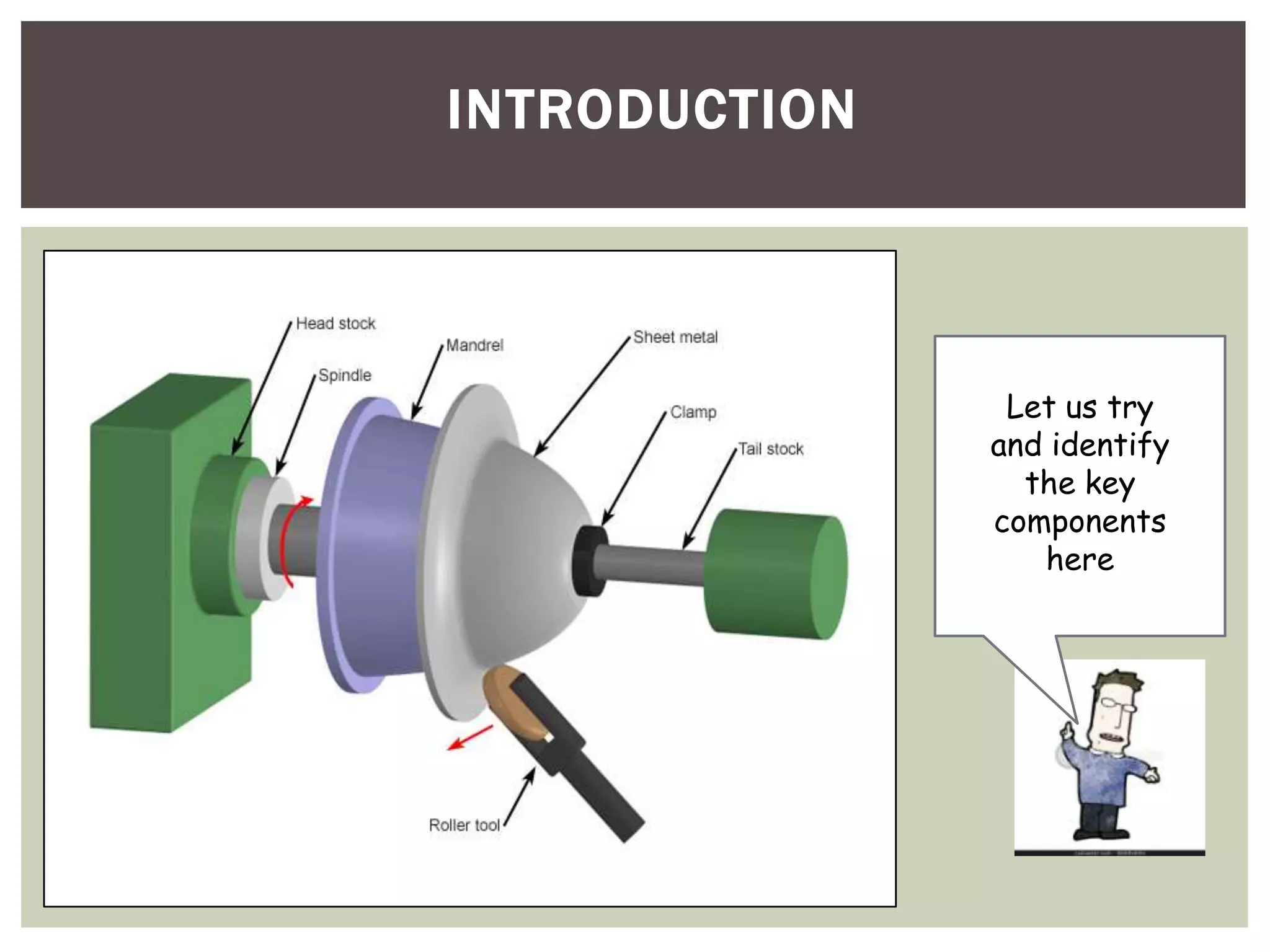
INTRODUCTION

Let us try
and identify
the key
components
here
INTRODUCTION
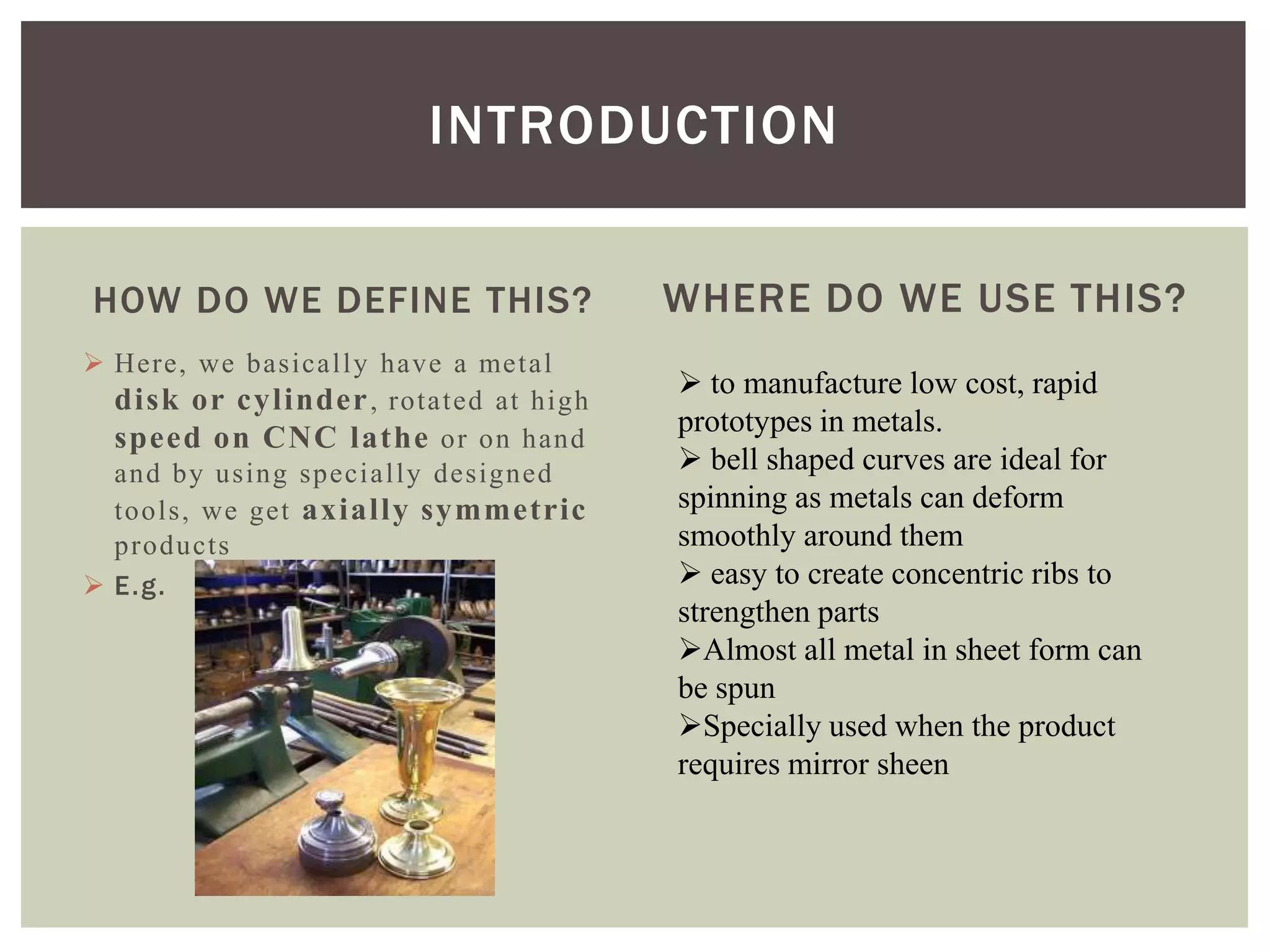
HOW DO WE DEFINE THIS?
 Here, we basically have a metal
disk or cylinder , rotated at high
speed on CNC lathe or on hand
and by using specially designed
tools, we get axially symmetric
products
 E.g.

WHERE DO WE USE THIS?
 to manufacture low cost, rapid
prototypes in metals.
 bell shaped curves are ideal for
spinning as metals can deform
smoothly around them
 easy to create concentric ribs to
strengthen parts
Almost all metal in sheet form can
be spun
Specially used when the product
requires mirror sheen
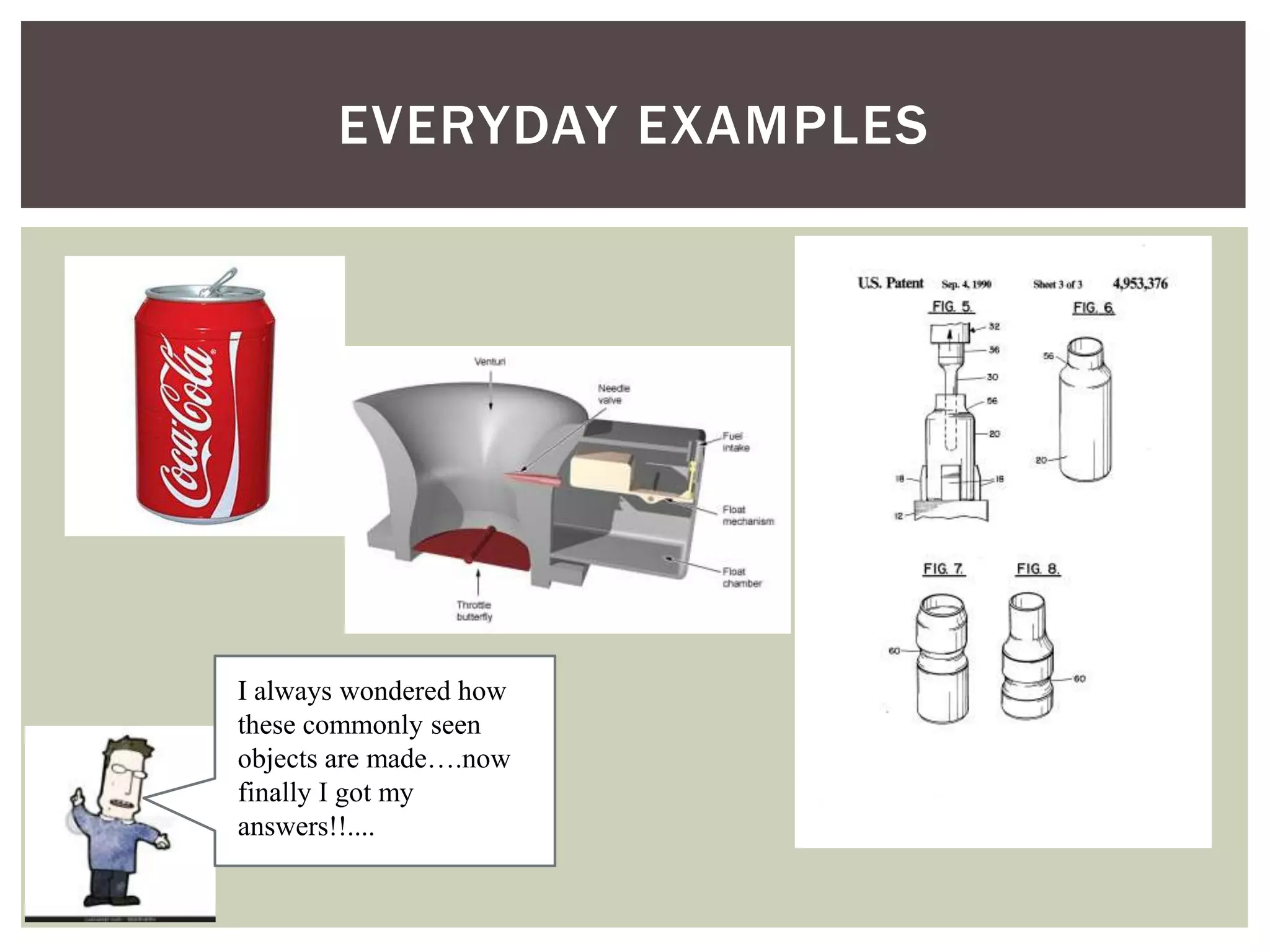
EVERYDAY EXAMPLES

I always wondered how
these commonly seen
objects are made….now
finally I got my
answers!!....
CRITICAL QUESTIONS

1)
2)
3)

WHEN METAL SPINNING PROCESSES?
Is the metal you are working with DUCTILE?
Is the final product AXISYMETRIC?
Is the product to be used for artistic application or commercial
applications like BELL, ROCKET NOSE, COOKING WARE?
4) Is the time you have is less and production
RELAX!!
number is high?
We use metal
spinning
5) Do you need mirror sheen?
processes

YES
HISTORY

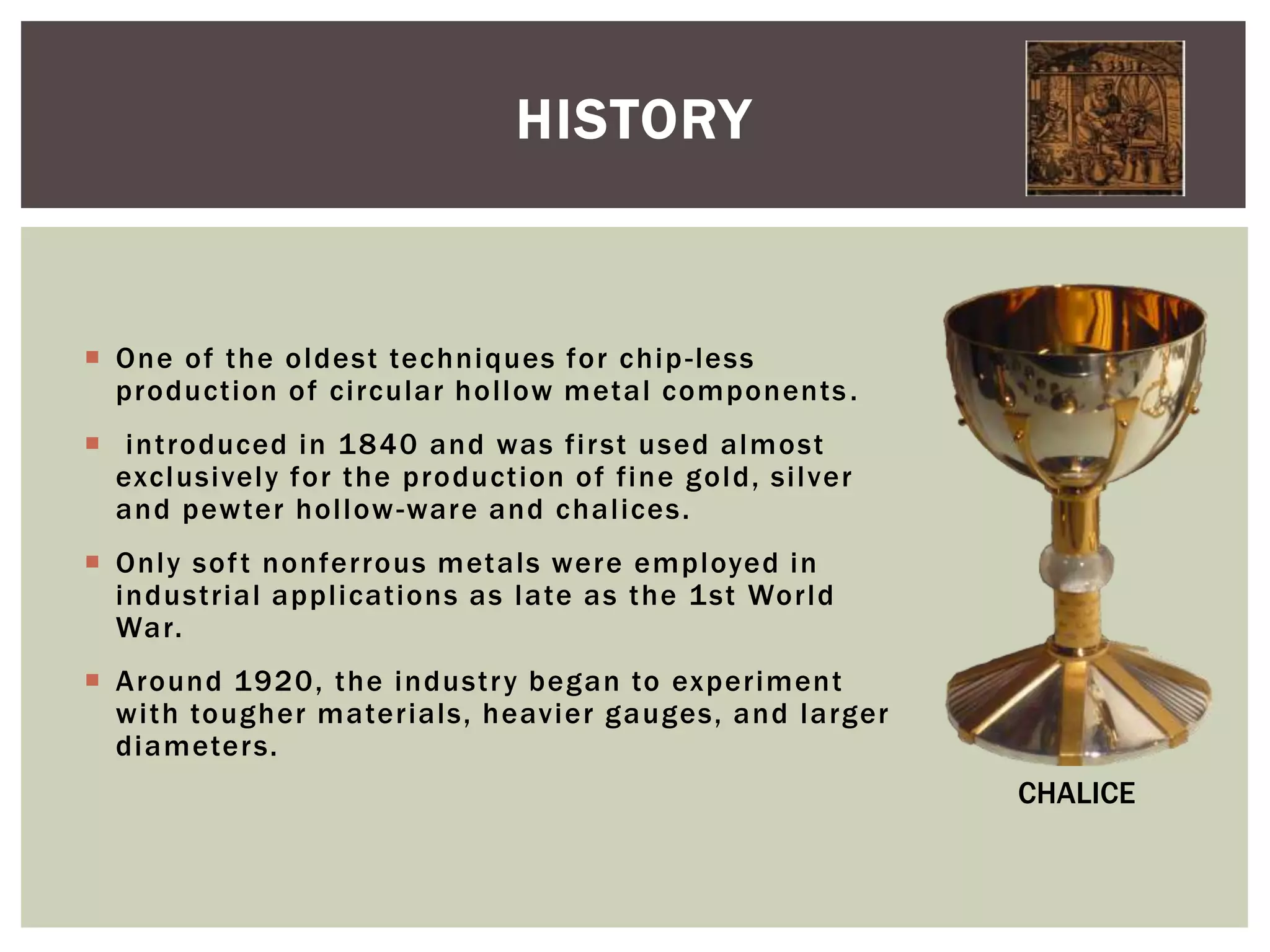
 One of the oldest techniques for chip -less
production of circular hollow metal components .
 introduced in 1 840 and was fir st used almost
exclusively for the production of fine gold, silver
and pewter hollow -ware and chalices.
 Only sof t nonferrous metals were employed in
industrial applications as late as the 1st World
War.
 Around 1920, the industr y began to experiment
with tougher materials, heavier gauges, and larger
diameters.

CHALICE
CLASSIFICATION OF METAL SPINNING
TECHNIQUES
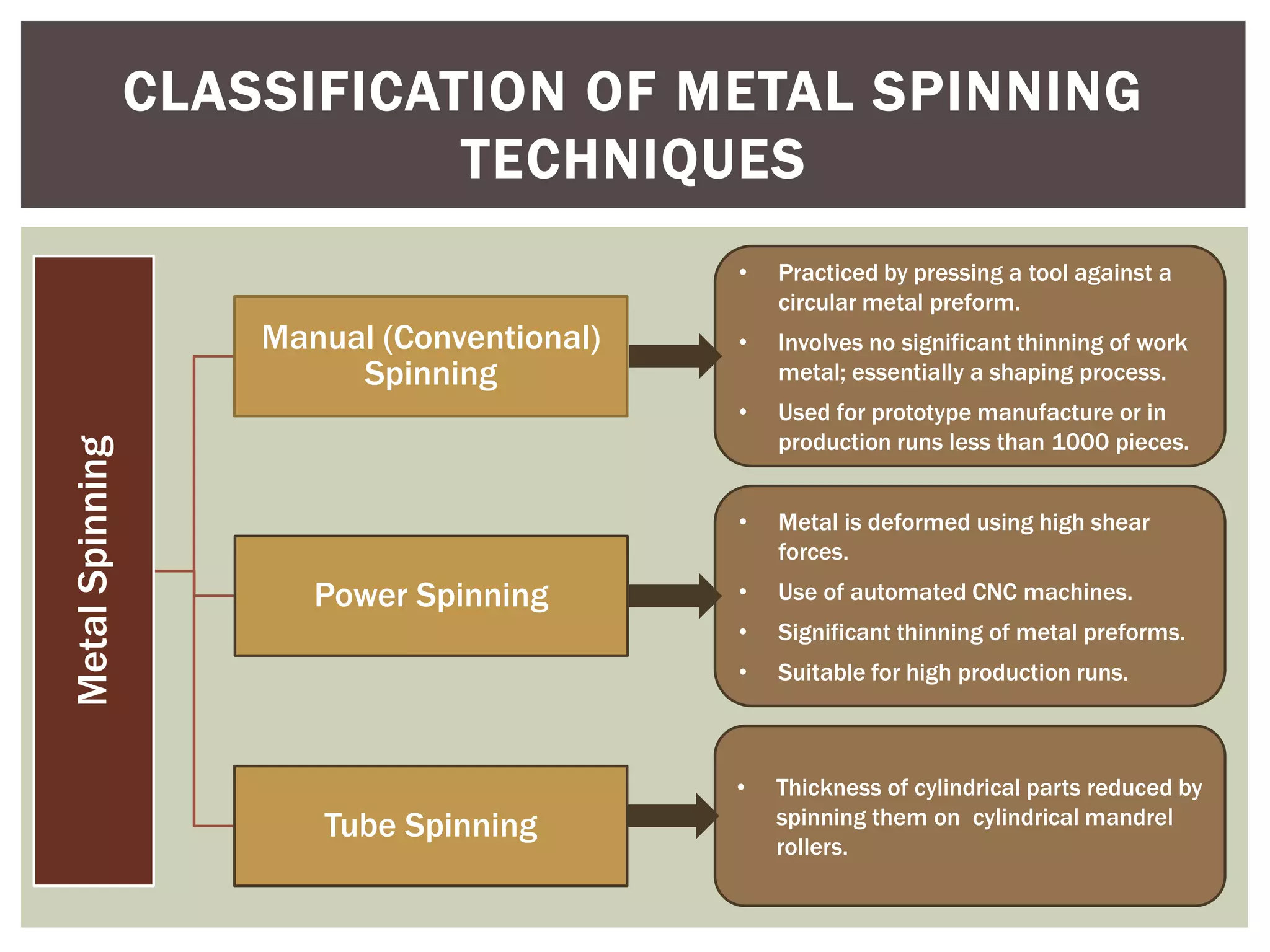
•

Metal Spinning

Used for prototype manufacture or in
production runs less than 1000 pieces.
Metal is deformed using high shear
forces.

•

Use of automated CNC machines.

•

Significant thinning of metal preforms.

•

Suitable for high production runs.

•

Tube Spinning

Involves no significant thinning of work
metal; essentially a shaping process.

•

Power Spinning

•
•

Manual (Conventional)
Spinning

Practiced by pressing a tool against a
circular metal preform.

Thickness of cylindrical parts reduced by
spinning them on cylindrical mandrel
rollers.
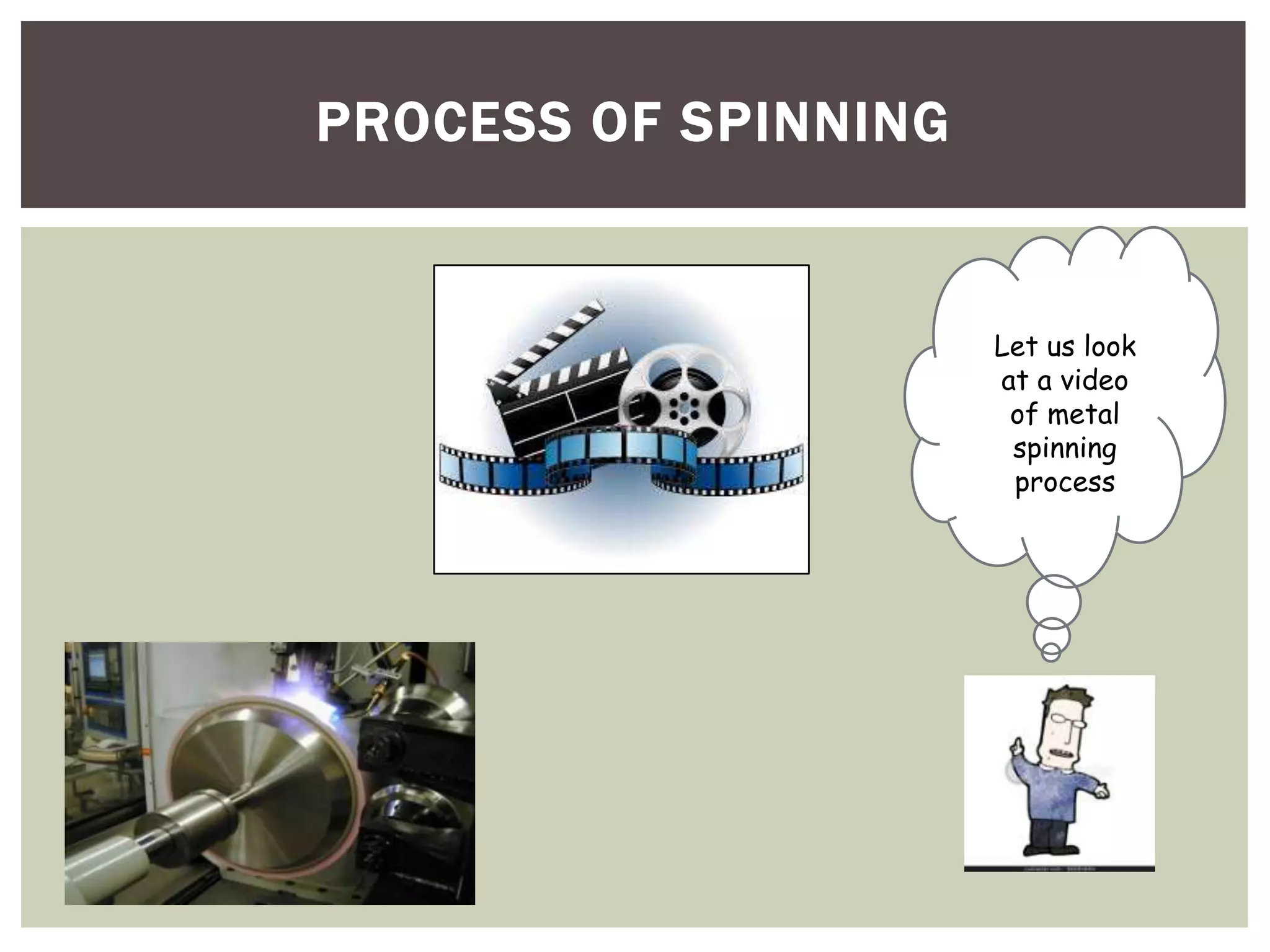
PROCESS OF SPINNING

Let us look
at a video
of metal
spinning
process
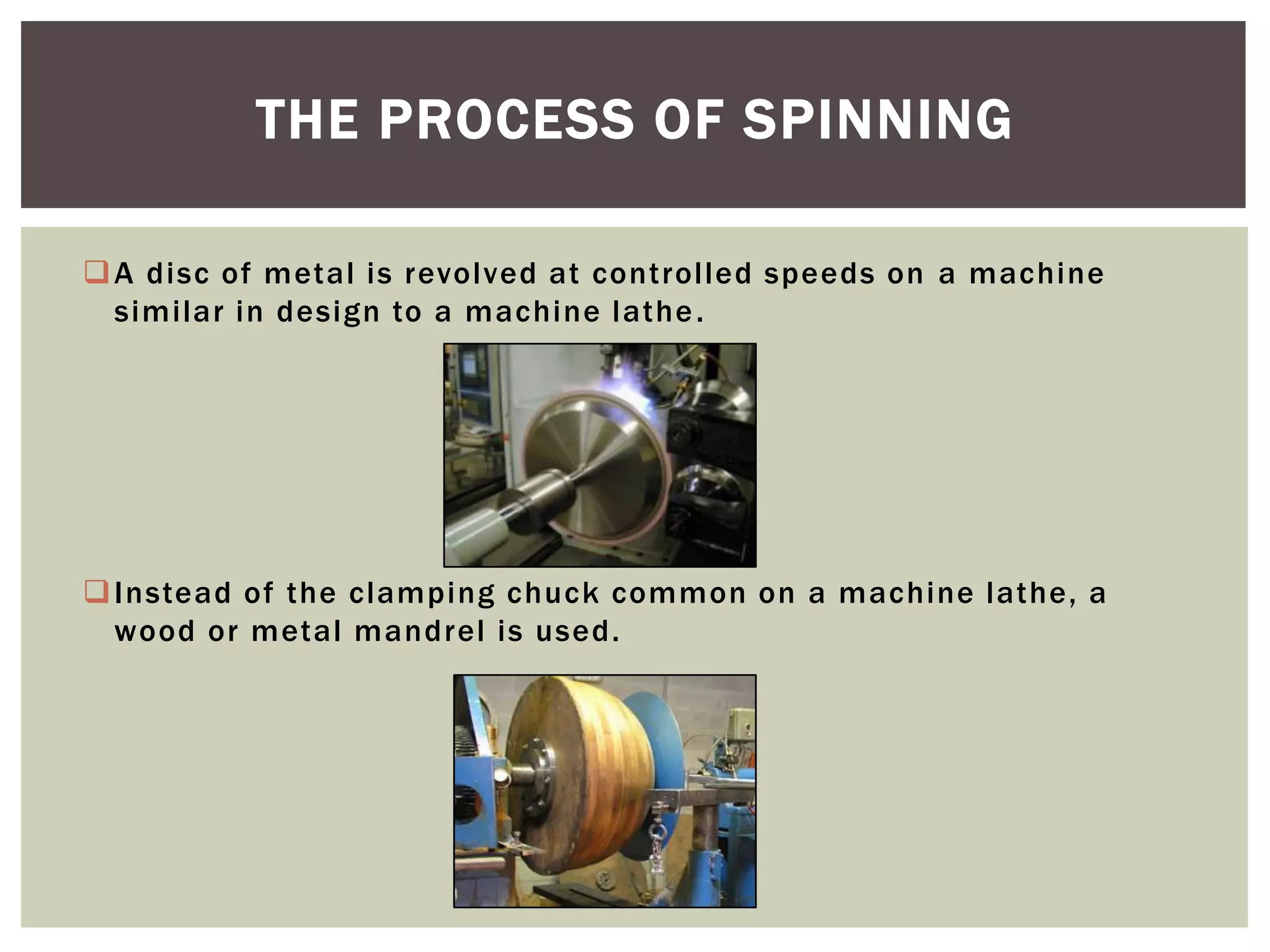
THE PROCESS OF SPINNING
 A disc of metal is revolved at controlled speeds on a machine
similar in design to a machine lathe .

 Instead of the clamping chuck common on a machine lathe, a
wood or metal mandrel is used.
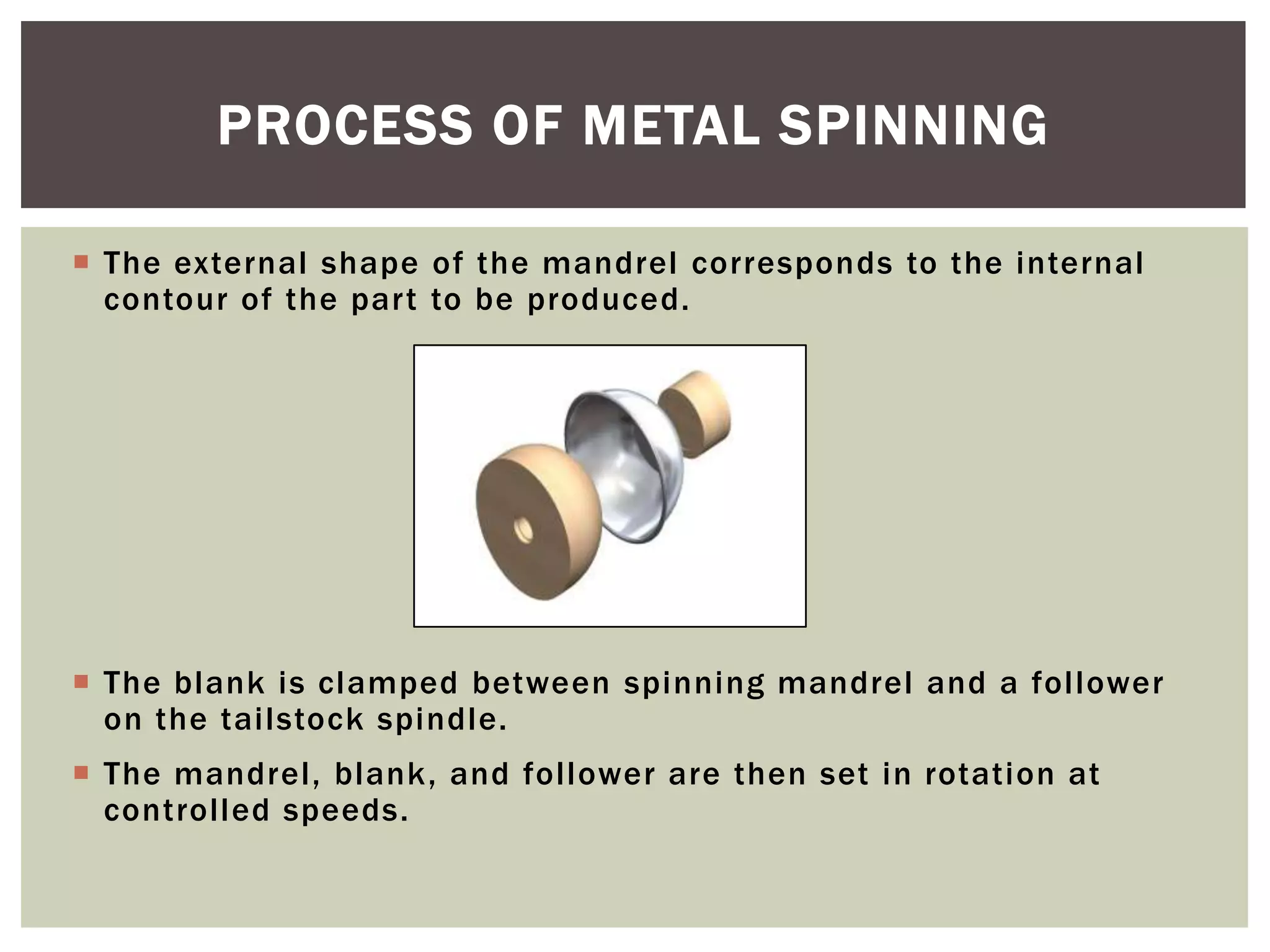
PROCESS OF METAL SPINNING
 The external shape of the mandrel corresponds to the internal
contour of the part to be produced.

 The blank is clamped between spinning mandrel and a follower
on the tailstock spindle.

 The mandrel, blank, and follower are then set in rotation at
controlled speeds.
PROCESS OF METAL SPINNING

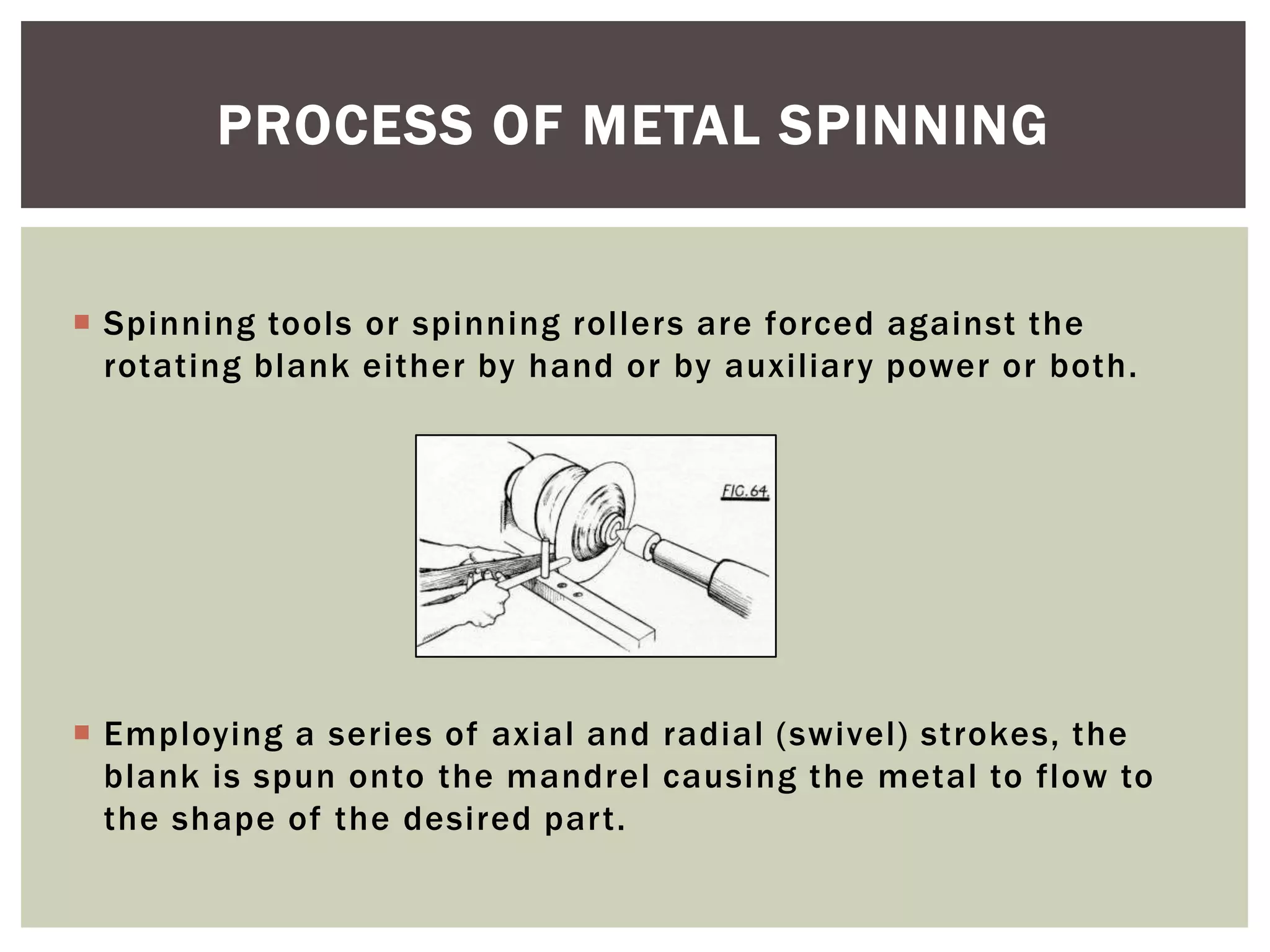
 Spinning tools or spinning rollers are forced against the
rotating blank either by hand or by auxiliary power or both.

 Employing a series of axial and radial (swivel) strokes, the
blank is spun onto the mandrel causing the metal to flow to
the shape of the desired part.
STEPS IN SPINNING PROCESS
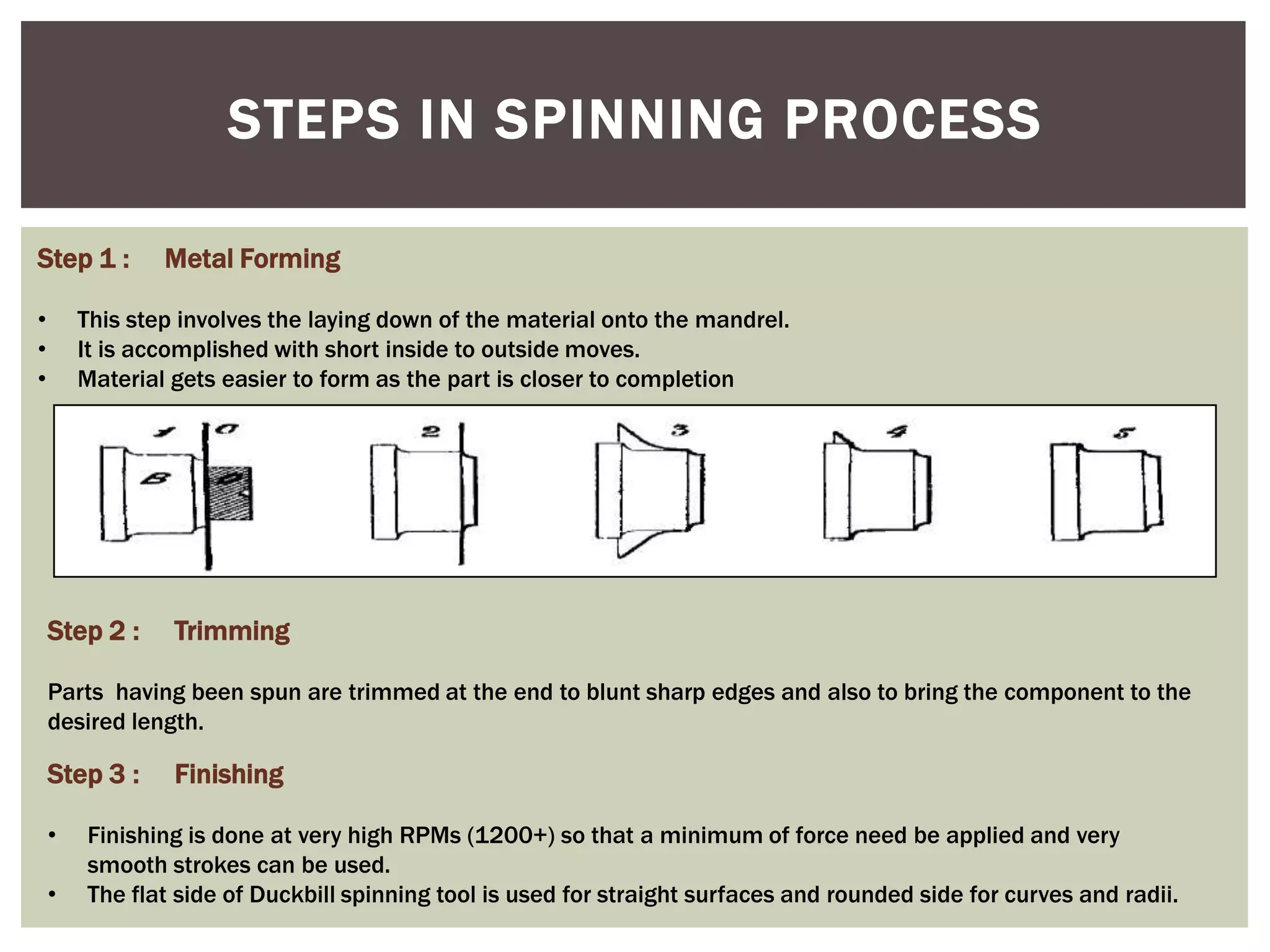
Step 1 :

Metal Forming

This step involves the laying down of the material onto the mandrel.
It is accomplished with short inside to outside moves.
Material gets easier to form as the part is closer to completion

•
•
•

Step 2 :

Trimming

Parts having been spun are trimmed at the end to blunt sharp edges and also to bring the component to the
desired length.

Step 3 :
•
•

Finishing

Finishing is done at very high RPMs (1200+) so that a minimum of force need be applied and very
smooth strokes can be used.
The flat side of Duckbill spinning tool is used for straight surfaces and rounded side for curves and radii.
MECHANICS OF CONE SPINNING
•

The most common application of metal spinning is for conical shapes, in
which the metal is volumetricall y displaced in the axial direction.

•

Metal deformation during spinning occur s in accordance with the sine
law .

•

The sine law relates the wall thickness of the star ting blank , t 1 , and the
wall thickness of the finished product, t 2 , as t 2 = t 1 (sin α ), where α is the
semi-apex angle of the cone.

•

The thickness of the component in axial direction is the same as the
thickness of the star ting blank .

•

When spinning metal cones of smaller apex angles, it is generally
convenient to use multiple spinning passes with dif ferent cone angles for
each pass.

•

Deviations from the sine law that can occur, are usually expressed in
terms of over-reduction or under -reduction .

 In over-reducti on, final thickness of work -piece is lesser than that
indicated by sine law, while in under -reduction the thickness is greater .
SINGLE AND MULTI-PASS SPINNING
OPERATION
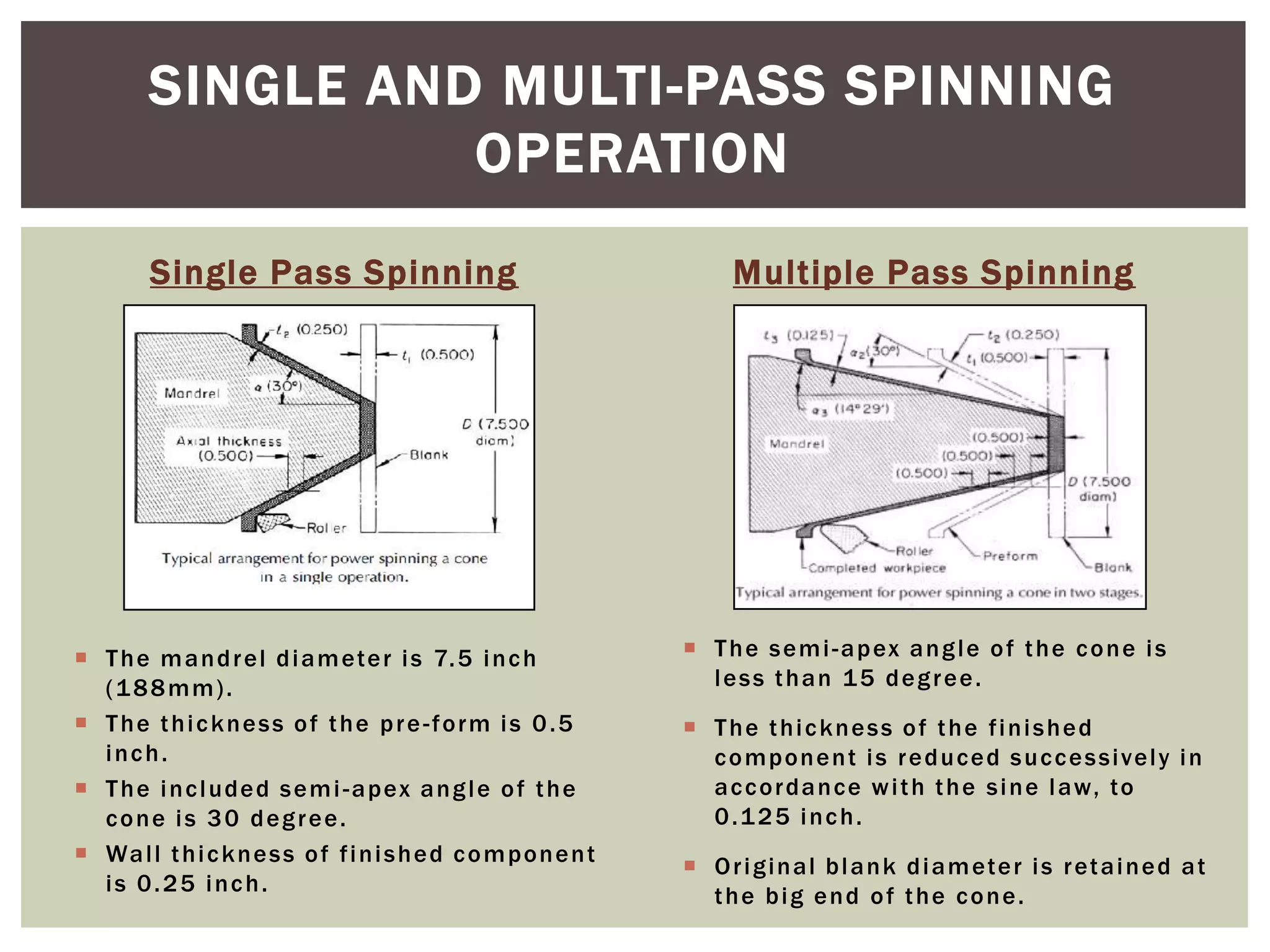
Single Pass Spinning

 T h e m a n d r e l d i a m ete r i s 7. 5 i n c h
(188mm).
 The thickness of the pre -form is 0.5
inch.
 T h e i n c l ud e d s e m i - a p ex a n g l e o f t h e
cone is 30 degree.
 Wa l l t h i c k n e s s o f f i n i s h e d c o m p o n e n t
is 0.25 inch.

Multiple Pass Spinning

 T h e s e m i - a p ex a n g l e o f t h e c o n e i s
less than 15 degree.
 The thickness of the finished
c o m p o n e n t i s r e d u c e d s u c c e s s i ve l y i n
a c c o r d a n c e w i t h t h e s i n e l aw, to
0 .1 2 5 i n c h .
 O r i g i n al b l a n k d i a m ete r i s r et a i n e d a t
the big end of the cone.
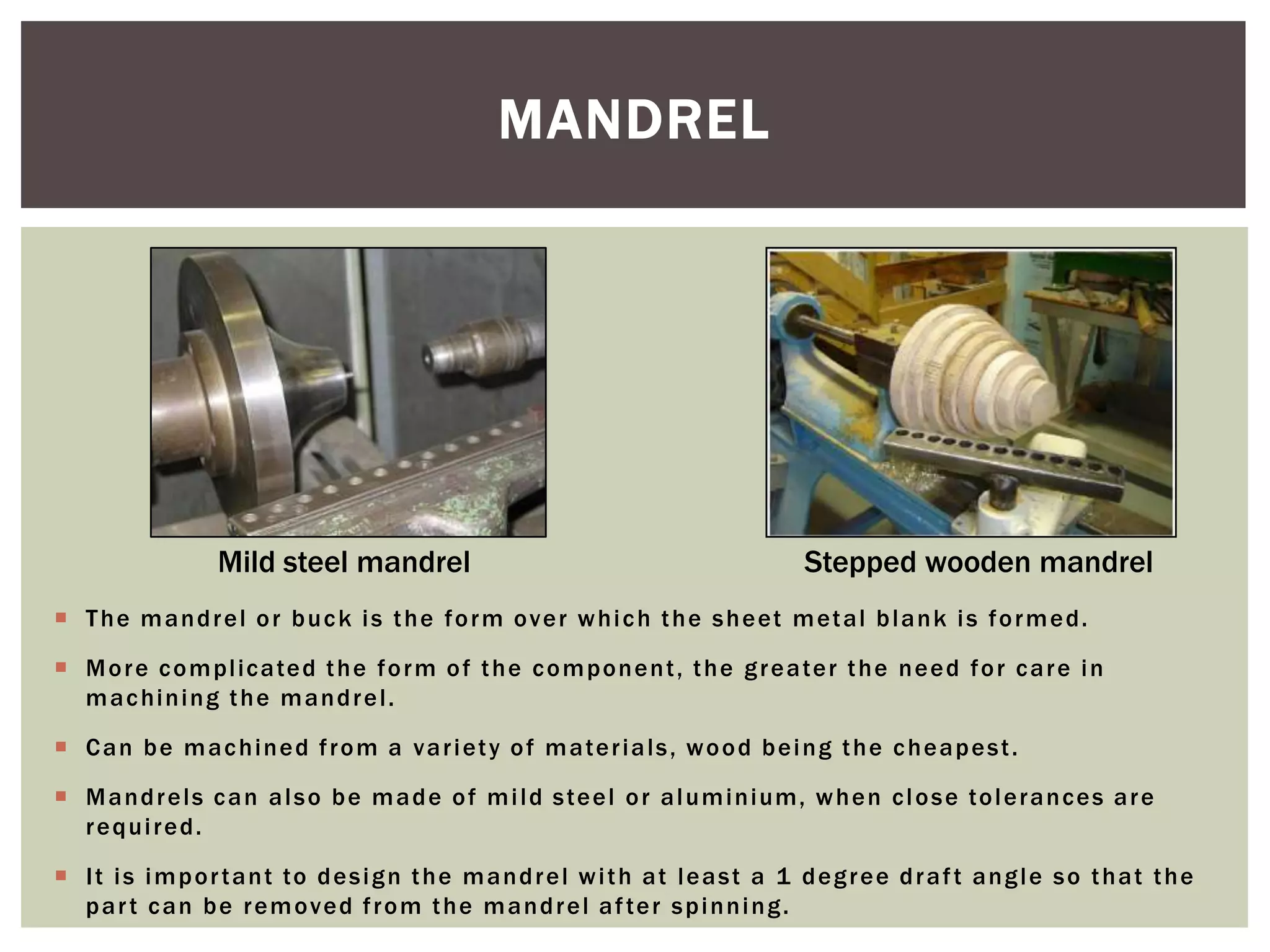
MANDREL

Mild steel mandrel

Stepped wooden mandrel

 T h e m a n d r e l o r b u c k i s t h e f o r m o v e r w h i c h t h e s h e et m et a l b l a n k i s f o r m e d .
 M o r e c o m p l ic a te d t h e f o r m o f t h e c o m p o n e n t , t h e g r e a te r t h e n e e d f o r c a r e i n
m a c hi n i n g t h e m a n d r e l .
 C a n b e m a c h i n e d f r o m a v a r i et y o f m a te r i a l s , w o o d b e i n g t h e c h e a p e s t .
 M a n d r e l s c a n a l s o b e m a d e o f m i l d s te e l o r a l u m i n i um, w h e n c l o s e to l e r a n c e s a r e
required.
 I t i s i m p o r t a n t to d e s i g n t h e m a n d r e l w i t h a t l e a s t a 1 d e g r e e d r a f t a n g l e s o t h a t t h e
p a r t c a n b e r e m o v e d f r o m t h e m a n d r e l a f te r s p i n n i n g .
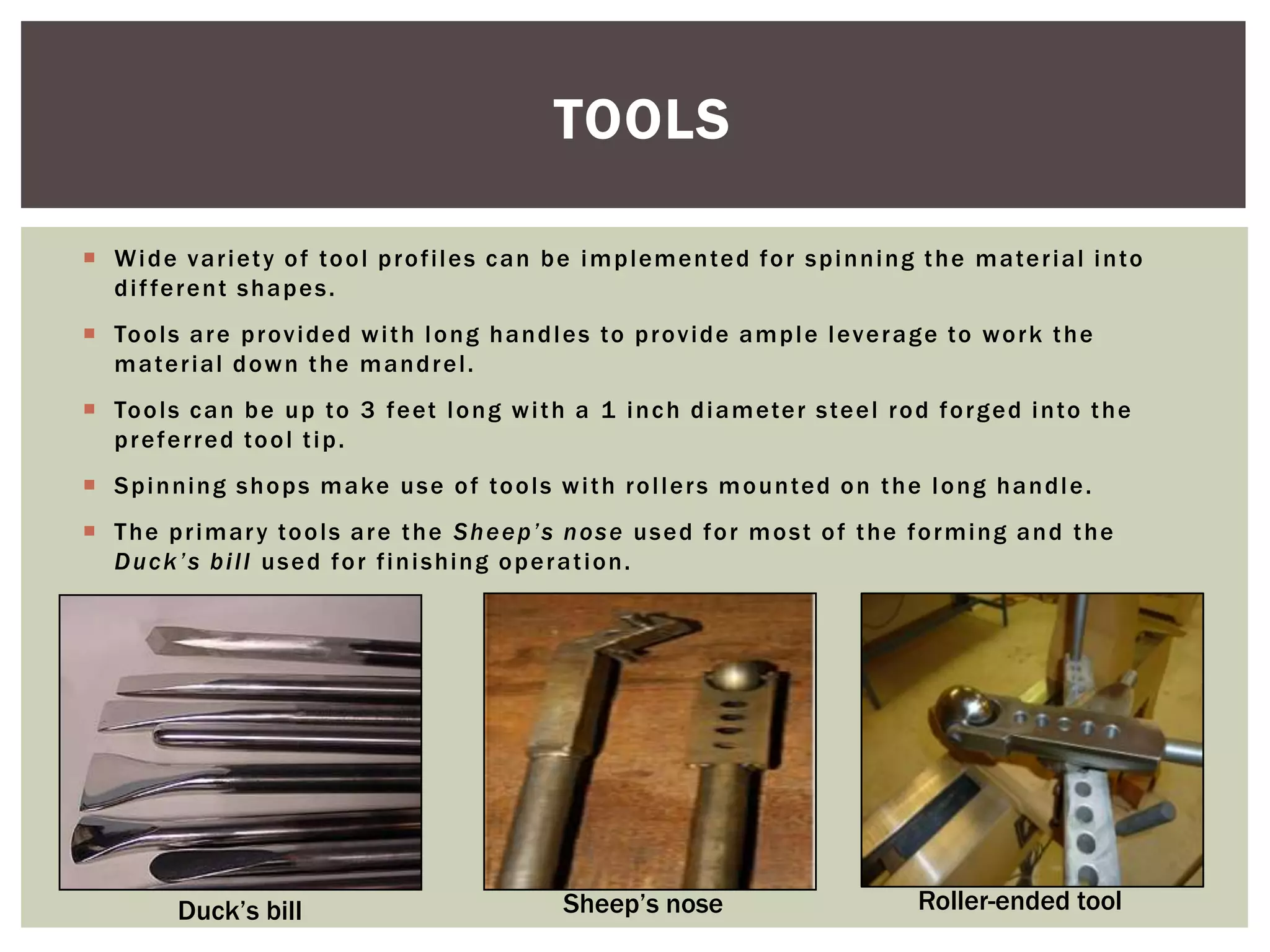
TOOLS
 W i d e v a r i et y o f to o l p r o f i l e s c a n b e i m p l em e n te d f o r s p i n n i n g t h e m a te r i al i n to
d i f fe r e n t s h a p e s .
 To o l s a r e p r o v i d e d w i t h l o n g h a n d l e s to p r o v i d e a m p l e l ev e r a g e to w o r k t h e
m a te r i al d o w n t h e m a n d r e l .
 To o l s c a n b e u p to 3 f e et l o n g w i t h a 1 i n c h d i a m ete r s te e l r o d f o r g e d i n to t h e
p r e f e r r e d to o l t i p .
 S p i n ni n g s h o p s m a ke u s e o f to o l s w i t h r o l l e r s m o u n ted o n t h e l o n g h a n d l e .

 T h e p r i m ar y to o l s a r e t h e S h e e p ’s n o s e u s e d f o r m o s t o f t h e f o r m i n g a n d t h e
D u c k ’ s b i l l u s e d f o r f i n i s hi n g o p e r a t i o n .

Duck’s bill

Sheep’s nose

Roller-ended tool
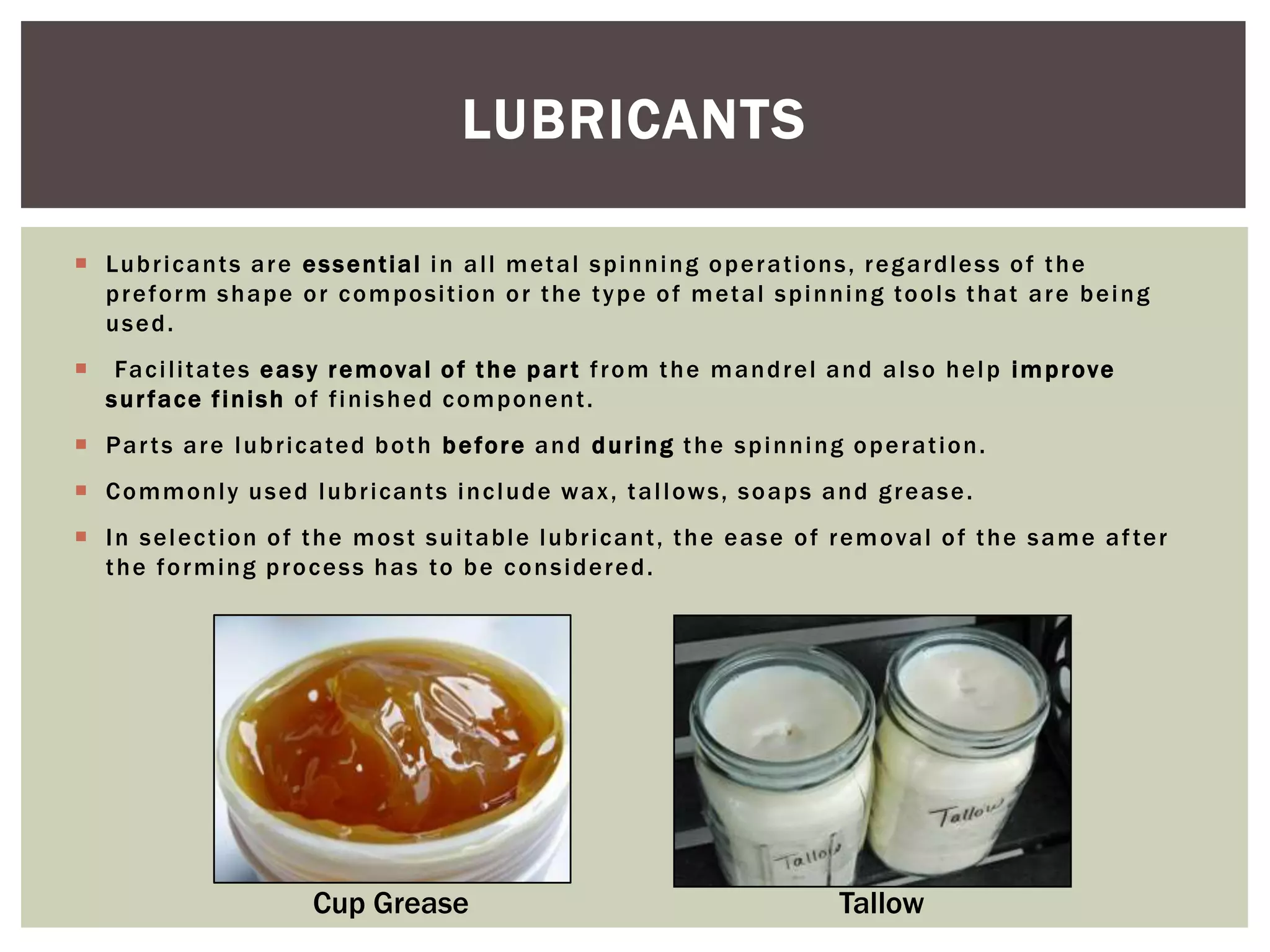
LUBRICANTS
 Lu b r i c a n t s a r e e s s e n t i a l i n a l l m et a l s p i n n i n g o p e r a t i on s , r e g a r d l e s s o f t h e
p r e f o r m s h a p e o r c o m p o s i t i o n o r t h e t y p e o f m et a l s p i n n i n g to o l s t h a t a r e b e i n g
used.


Fa c i l i t a te s e a s y r e m o va l o f t h e p a r t f r o m t h e m a n d r e l a n d a l s o h e l p i m p r ove
surface finish of finished component.

 P a r t s a r e l u b r i c a te d b o t h b e fo r e a n d d u r i n g t h e s p i n n i n g o p e r a t i o n .
 C o m m o n l y u s e d l u b r i ca n t s i n c l ud e w a x , t a l l ow s , s o a p s a n d g r e a s e .
 I n s e l e c t i o n o f t h e m o s t s u i t a b l e l u b r i c a n t , t h e e a s e o f r e m o va l o f t h e s a m e a f te r
t h e f o r m i n g p r o c e s s h a s to b e c o n s i d e r e d .

Cup Grease

Tallow
MACHINES FOR SPINNING
 Machines for spinning are specified by the diameter and length of the
largest component that can be spun.
 They are also specified by the maximum load that can be applied to the
work .
 The capacity of spinning machines ranges from 0.455m in diameter and
0.380m in length to 6m in diameter and 6m in length.
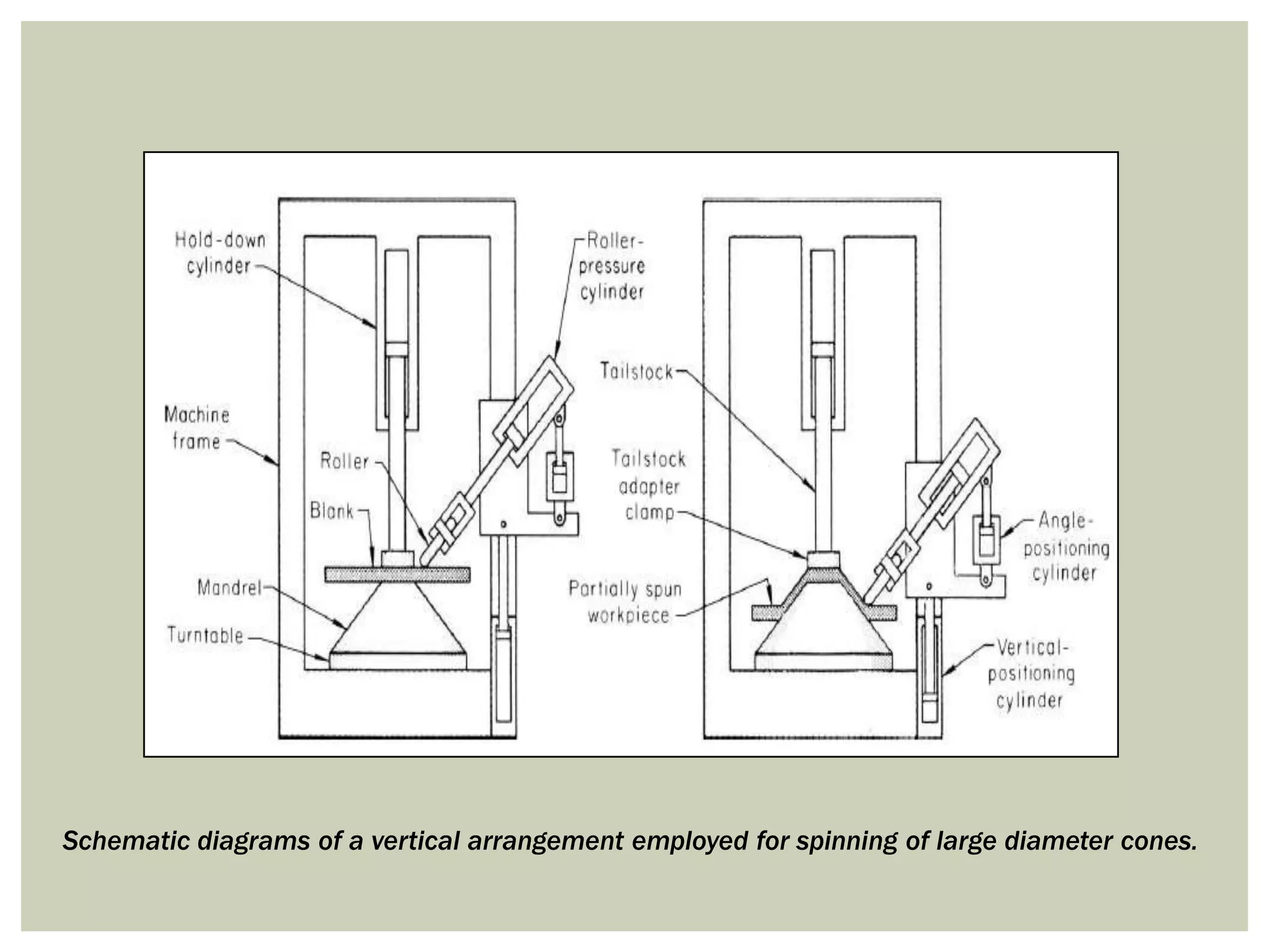
 Metal spinning machines can be both ver tical or horiz ontal .
 Machines used for spinning large diameter s, such as 1 .8m or more are
usually ver tical.
 Mostly lathe based machine tools ( both conventi onal and CNC -based) are
employed for spinning operation.
 Most modern machines used for spinning are at least semi-automated ;
that is, they are loaded and unloaded by the operator, but the entire
spinning cycle is controlled automaticall y.
Schematic diagrams of a vertical arrangement employed for spinning of large diameter cones.
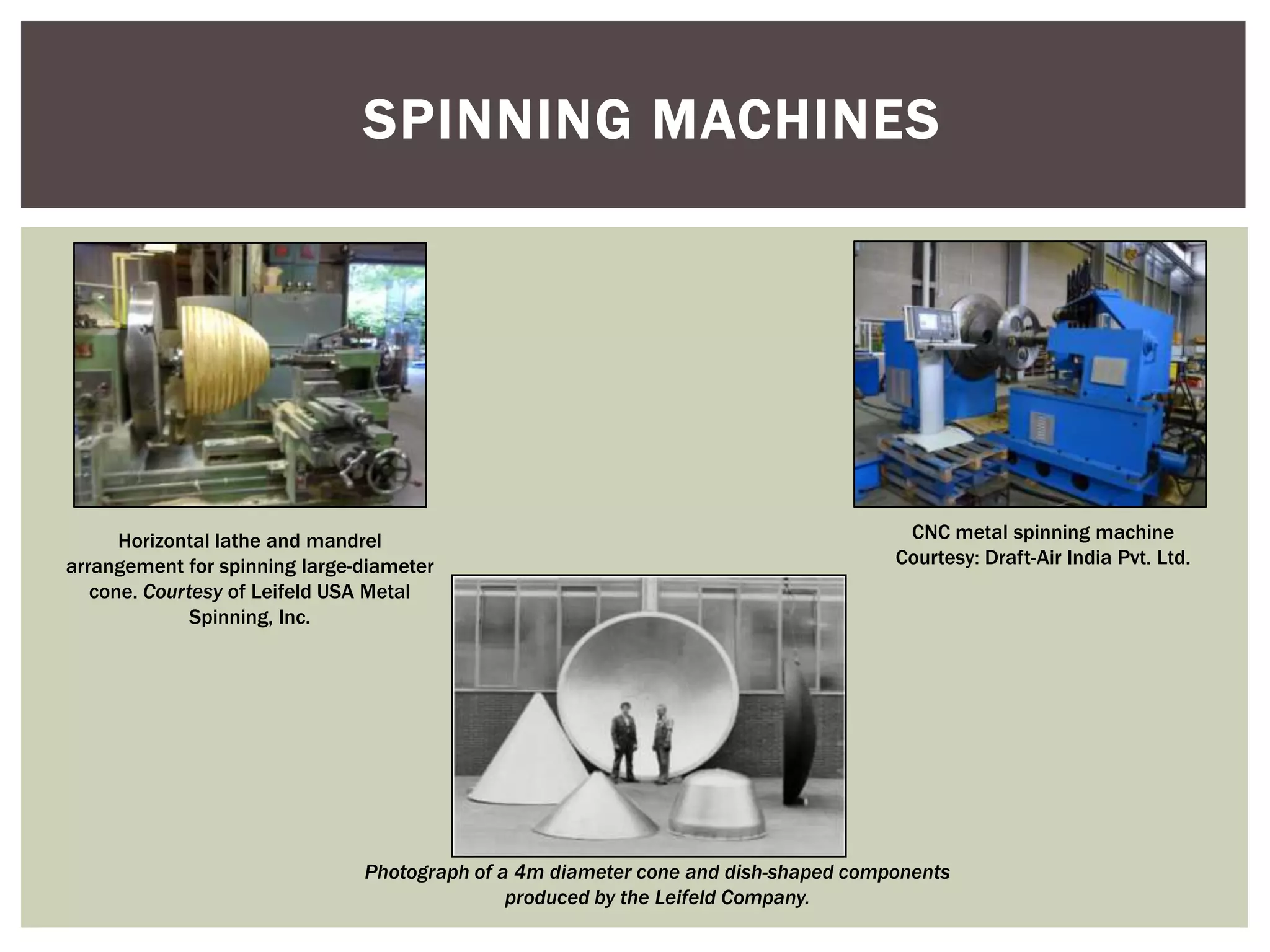
SPINNING MACHINES

Horizontal lathe and mandrel
arrangement for spinning large-diameter
cone. Courtesy of Leifeld USA Metal
Spinning, Inc.

CNC metal spinning machine
Courtesy: Draft-Air India Pvt. Ltd.

Photograph of a 4m diameter cone and dish-shaped components
produced by the Leifeld Company.
COMPARISON WITH OTHER FORMING
PROCESSES

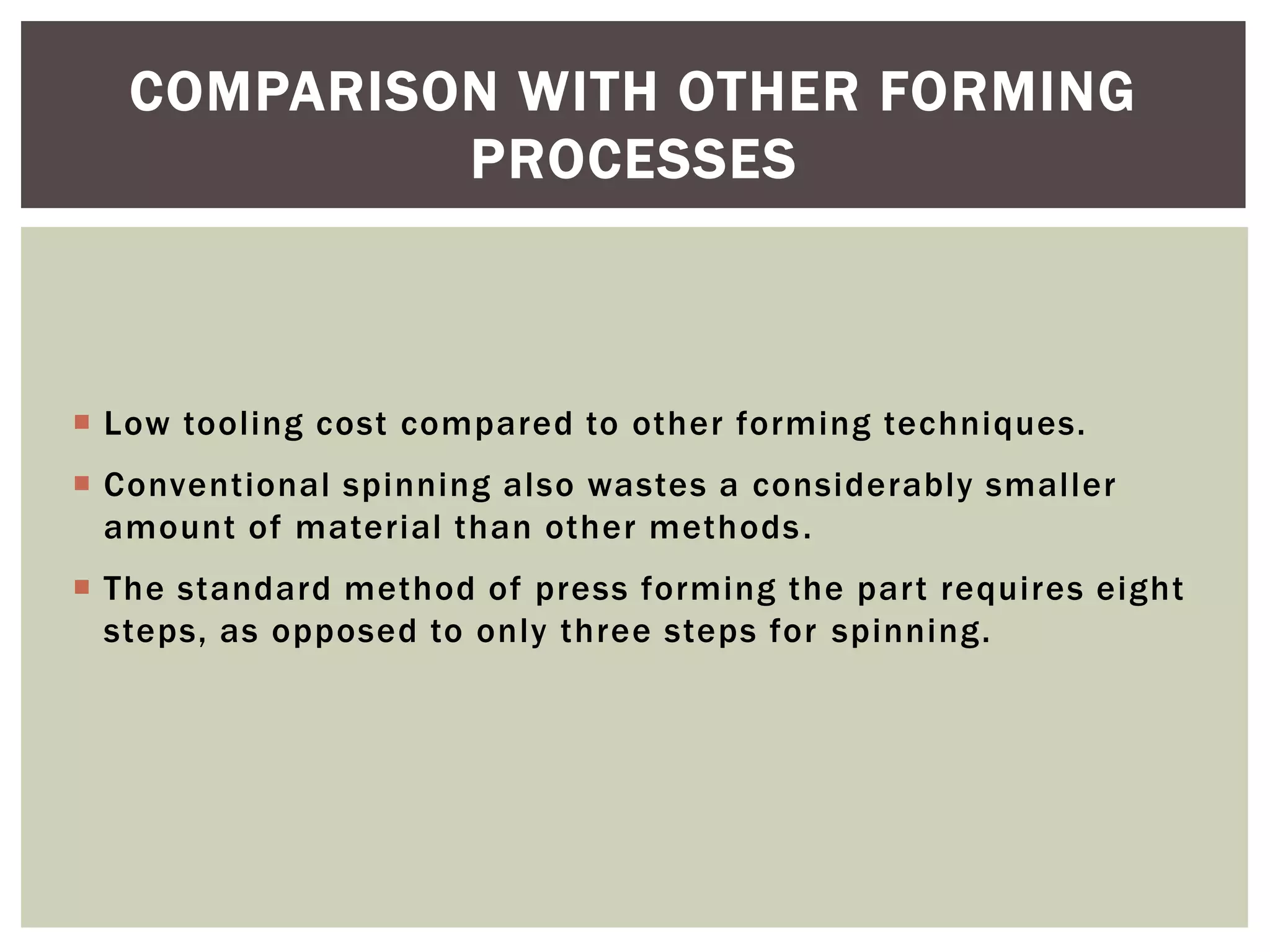
 Low tooling cost compared to other forming techniques.
 Conventional spinning also wastes a considerably smaller
amount of material than other methods .
 The standard method of press forming the part requires eight
steps, as opposed to only three steps for spinning.
MERITS

P r o v i d e s n a t u r a l m et a l l ur g i c al b e n e f i t s , w i t h a r e f i n e d a n d s t r e n g t h e n e d g r a i n
s t r uc t ur e .
C o l d w o r k i n g o f t h e m et a l a l s o i n c r e a s e s te n s i l e p r o p e r t i e s a p p r e c i a b l y.
U n l i ke a c a s t i n g , a s p u n p a r t w i l l n o t b e d i s c a r d e d b y a h i d d e n b l o w h o l e o r i n c l us i o n .
A s p u n s h e l l c o u l d b e m a d e i n h a l v e s a n d w e l d e d to f o r m a s i n g l e u n i t w i t h o ut
c o m p l ex , ex p e n s i ve to o l i n g .
T h e to o l i n g c o s t s a n d c a p i t al i nv e s t m e n t s a r e r e l a t i v el y s m a l l .
T h e s et u p t i m e i s l e s s .
D e s i g n c h a n g e s i n t h e w o r k p i e c e c a n b e a c c o m m o d a te d a t r e l a t i ve l y l o w c o s t s .
C a n b e e a s i l y a u to m a te d a n d i s a n e f f e c t iv e p r o d uc t i o n m et h o d f o r p r o to t yp e s a s
w e l l a s h i g h p r o d uc t io n r u n s .
S i n c e t h e r e i s n o r e m o v al o f m et a l b y f o r m a t i o n o f c h i p s , t h e r e i s n o m a te r i a l
w a s t a g e a n d t h e p r o c e s s i s e c o n o m i c al .
DE-MERITS

Requirement of highly trained operators in manual spinning
process, for, the uniformity of the product depends to a large
degree on the skill of the operator.
Manual metal spinning is usually significantly slower than
press forging.
Deformation loads allowable are much lower in metal
spinning than in press forging.
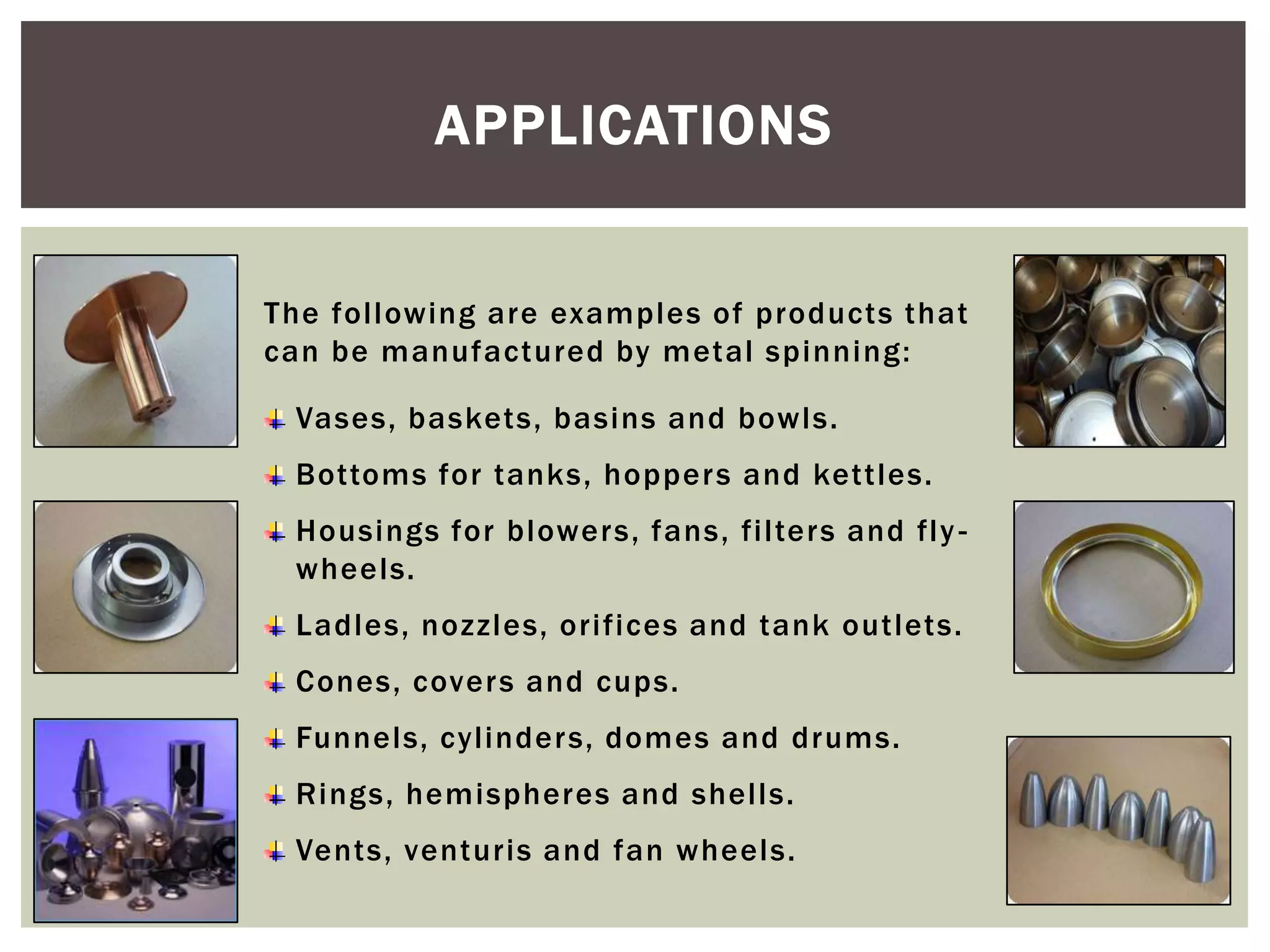
APPLICATIONS
The following are examples of products that
can be manufactured by metal spinning:
Vases, baskets, basins and bowls.

Bottoms for tanks, hoppers and kettles.
Housings for blowers, fans, filters and fly wheels.
Ladles, nozzles, orifices and tank outlets.
Cones, cover s and cups.
Funnels, cylinder s, domes and drums.
Rings, hemispheres and shells.
Vents, venturis and fan wheels.
CONCLUSIONS
 Metal spinning techniques and mechanics have been
presented.
 Equipment for spinning is based on lathe technology.

 Wide range of products can be obtained using this technique.
 Metal Spinning is competitive with other forming processes
such as pressing and deep drawing.
 It is an economical technique to produce both simple and
complicated parts for single application, low -volume
production as well as mass productions.
 Process technology, equipment and tooling for spinning have
been discussed.
Metal spinning Process

Metal spinning Process

  • 1.
    METAL SPINNING PROCESS ME852 SEMINAR PRESENTATION Anurag Dey (10/ME/148) Abhimonyu Dutta (10/ME/152) Aman Kumar (10/ME/149) Deepak Nonia (09/ME/00) Anurag Bhattacharyya (10/ME/150) Sandeep Kumar (08/ME/68) Sourav Halder (10/ME/151)
  • 2.
    OUTLINE            INTRODUCTION. HISTORY. CLASSIFICATION OF METALSPINNING TECHNIQUES. METAL SPINNING PROCESS. MECHANICS. TOOLS AND EQUIPMENTS. COMPARISON WITH OTHER FORMING PROCESSES. MERITS. DE-MERITS. APPLICATIONS. CONCLUSION.
  • 3.
    THE BASIC IDEA… MetalSpinning process is a cold forming process in which the blank metal appears to flow somewhat like a piece of clay on a potter's wheel.
  • 4.
    INTRODUCTION Let us try andidentify the key components here
  • 5.
    INTRODUCTION HOW DO WEDEFINE THIS?  Here, we basically have a metal disk or cylinder , rotated at high speed on CNC lathe or on hand and by using specially designed tools, we get axially symmetric products  E.g. WHERE DO WE USE THIS?  to manufacture low cost, rapid prototypes in metals.  bell shaped curves are ideal for spinning as metals can deform smoothly around them  easy to create concentric ribs to strengthen parts Almost all metal in sheet form can be spun Specially used when the product requires mirror sheen
  • 6.
    EVERYDAY EXAMPLES I alwayswondered how these commonly seen objects are made….now finally I got my answers!!....
  • 7.
    CRITICAL QUESTIONS  1) 2) 3) WHEN METALSPINNING PROCESSES? Is the metal you are working with DUCTILE? Is the final product AXISYMETRIC? Is the product to be used for artistic application or commercial applications like BELL, ROCKET NOSE, COOKING WARE? 4) Is the time you have is less and production RELAX!! number is high? We use metal spinning 5) Do you need mirror sheen? processes YES
  • 8.
    HISTORY  One ofthe oldest techniques for chip -less production of circular hollow metal components .  introduced in 1 840 and was fir st used almost exclusively for the production of fine gold, silver and pewter hollow -ware and chalices.  Only sof t nonferrous metals were employed in industrial applications as late as the 1st World War.  Around 1920, the industr y began to experiment with tougher materials, heavier gauges, and larger diameters. CHALICE
  • 9.
    CLASSIFICATION OF METALSPINNING TECHNIQUES • Metal Spinning Used for prototype manufacture or in production runs less than 1000 pieces. Metal is deformed using high shear forces. • Use of automated CNC machines. • Significant thinning of metal preforms. • Suitable for high production runs. • Tube Spinning Involves no significant thinning of work metal; essentially a shaping process. • Power Spinning • • Manual (Conventional) Spinning Practiced by pressing a tool against a circular metal preform. Thickness of cylindrical parts reduced by spinning them on cylindrical mandrel rollers.
  • 10.
    PROCESS OF SPINNING Letus look at a video of metal spinning process
  • 11.
    THE PROCESS OFSPINNING  A disc of metal is revolved at controlled speeds on a machine similar in design to a machine lathe .  Instead of the clamping chuck common on a machine lathe, a wood or metal mandrel is used.
  • 12.
    PROCESS OF METALSPINNING  The external shape of the mandrel corresponds to the internal contour of the part to be produced.  The blank is clamped between spinning mandrel and a follower on the tailstock spindle.  The mandrel, blank, and follower are then set in rotation at controlled speeds.
  • 13.
    PROCESS OF METALSPINNING  Spinning tools or spinning rollers are forced against the rotating blank either by hand or by auxiliary power or both.  Employing a series of axial and radial (swivel) strokes, the blank is spun onto the mandrel causing the metal to flow to the shape of the desired part.
  • 14.
    STEPS IN SPINNINGPROCESS Step 1 : Metal Forming This step involves the laying down of the material onto the mandrel. It is accomplished with short inside to outside moves. Material gets easier to form as the part is closer to completion • • • Step 2 : Trimming Parts having been spun are trimmed at the end to blunt sharp edges and also to bring the component to the desired length. Step 3 : • • Finishing Finishing is done at very high RPMs (1200+) so that a minimum of force need be applied and very smooth strokes can be used. The flat side of Duckbill spinning tool is used for straight surfaces and rounded side for curves and radii.
  • 15.
    MECHANICS OF CONESPINNING • The most common application of metal spinning is for conical shapes, in which the metal is volumetricall y displaced in the axial direction. • Metal deformation during spinning occur s in accordance with the sine law . • The sine law relates the wall thickness of the star ting blank , t 1 , and the wall thickness of the finished product, t 2 , as t 2 = t 1 (sin α ), where α is the semi-apex angle of the cone. • The thickness of the component in axial direction is the same as the thickness of the star ting blank . • When spinning metal cones of smaller apex angles, it is generally convenient to use multiple spinning passes with dif ferent cone angles for each pass. • Deviations from the sine law that can occur, are usually expressed in terms of over-reduction or under -reduction .  In over-reducti on, final thickness of work -piece is lesser than that indicated by sine law, while in under -reduction the thickness is greater .
  • 16.
    SINGLE AND MULTI-PASSSPINNING OPERATION Single Pass Spinning  T h e m a n d r e l d i a m ete r i s 7. 5 i n c h (188mm).  The thickness of the pre -form is 0.5 inch.  T h e i n c l ud e d s e m i - a p ex a n g l e o f t h e cone is 30 degree.  Wa l l t h i c k n e s s o f f i n i s h e d c o m p o n e n t is 0.25 inch. Multiple Pass Spinning  T h e s e m i - a p ex a n g l e o f t h e c o n e i s less than 15 degree.  The thickness of the finished c o m p o n e n t i s r e d u c e d s u c c e s s i ve l y i n a c c o r d a n c e w i t h t h e s i n e l aw, to 0 .1 2 5 i n c h .  O r i g i n al b l a n k d i a m ete r i s r et a i n e d a t the big end of the cone.
  • 17.
    MANDREL Mild steel mandrel Steppedwooden mandrel  T h e m a n d r e l o r b u c k i s t h e f o r m o v e r w h i c h t h e s h e et m et a l b l a n k i s f o r m e d .  M o r e c o m p l ic a te d t h e f o r m o f t h e c o m p o n e n t , t h e g r e a te r t h e n e e d f o r c a r e i n m a c hi n i n g t h e m a n d r e l .  C a n b e m a c h i n e d f r o m a v a r i et y o f m a te r i a l s , w o o d b e i n g t h e c h e a p e s t .  M a n d r e l s c a n a l s o b e m a d e o f m i l d s te e l o r a l u m i n i um, w h e n c l o s e to l e r a n c e s a r e required.  I t i s i m p o r t a n t to d e s i g n t h e m a n d r e l w i t h a t l e a s t a 1 d e g r e e d r a f t a n g l e s o t h a t t h e p a r t c a n b e r e m o v e d f r o m t h e m a n d r e l a f te r s p i n n i n g .
  • 18.
    TOOLS  W id e v a r i et y o f to o l p r o f i l e s c a n b e i m p l em e n te d f o r s p i n n i n g t h e m a te r i al i n to d i f fe r e n t s h a p e s .  To o l s a r e p r o v i d e d w i t h l o n g h a n d l e s to p r o v i d e a m p l e l ev e r a g e to w o r k t h e m a te r i al d o w n t h e m a n d r e l .  To o l s c a n b e u p to 3 f e et l o n g w i t h a 1 i n c h d i a m ete r s te e l r o d f o r g e d i n to t h e p r e f e r r e d to o l t i p .  S p i n ni n g s h o p s m a ke u s e o f to o l s w i t h r o l l e r s m o u n ted o n t h e l o n g h a n d l e .  T h e p r i m ar y to o l s a r e t h e S h e e p ’s n o s e u s e d f o r m o s t o f t h e f o r m i n g a n d t h e D u c k ’ s b i l l u s e d f o r f i n i s hi n g o p e r a t i o n . Duck’s bill Sheep’s nose Roller-ended tool
  • 19.
    LUBRICANTS  Lu br i c a n t s a r e e s s e n t i a l i n a l l m et a l s p i n n i n g o p e r a t i on s , r e g a r d l e s s o f t h e p r e f o r m s h a p e o r c o m p o s i t i o n o r t h e t y p e o f m et a l s p i n n i n g to o l s t h a t a r e b e i n g used.  Fa c i l i t a te s e a s y r e m o va l o f t h e p a r t f r o m t h e m a n d r e l a n d a l s o h e l p i m p r ove surface finish of finished component.  P a r t s a r e l u b r i c a te d b o t h b e fo r e a n d d u r i n g t h e s p i n n i n g o p e r a t i o n .  C o m m o n l y u s e d l u b r i ca n t s i n c l ud e w a x , t a l l ow s , s o a p s a n d g r e a s e .  I n s e l e c t i o n o f t h e m o s t s u i t a b l e l u b r i c a n t , t h e e a s e o f r e m o va l o f t h e s a m e a f te r t h e f o r m i n g p r o c e s s h a s to b e c o n s i d e r e d . Cup Grease Tallow
  • 20.
    MACHINES FOR SPINNING Machines for spinning are specified by the diameter and length of the largest component that can be spun.  They are also specified by the maximum load that can be applied to the work .  The capacity of spinning machines ranges from 0.455m in diameter and 0.380m in length to 6m in diameter and 6m in length.  Metal spinning machines can be both ver tical or horiz ontal .  Machines used for spinning large diameter s, such as 1 .8m or more are usually ver tical.  Mostly lathe based machine tools ( both conventi onal and CNC -based) are employed for spinning operation.  Most modern machines used for spinning are at least semi-automated ; that is, they are loaded and unloaded by the operator, but the entire spinning cycle is controlled automaticall y.
  • 21.
    Schematic diagrams ofa vertical arrangement employed for spinning of large diameter cones.
  • 22.
    SPINNING MACHINES Horizontal latheand mandrel arrangement for spinning large-diameter cone. Courtesy of Leifeld USA Metal Spinning, Inc. CNC metal spinning machine Courtesy: Draft-Air India Pvt. Ltd. Photograph of a 4m diameter cone and dish-shaped components produced by the Leifeld Company.
  • 23.
    COMPARISON WITH OTHERFORMING PROCESSES  Low tooling cost compared to other forming techniques.  Conventional spinning also wastes a considerably smaller amount of material than other methods .  The standard method of press forming the part requires eight steps, as opposed to only three steps for spinning.
  • 24.
    MERITS P r ov i d e s n a t u r a l m et a l l ur g i c al b e n e f i t s , w i t h a r e f i n e d a n d s t r e n g t h e n e d g r a i n s t r uc t ur e . C o l d w o r k i n g o f t h e m et a l a l s o i n c r e a s e s te n s i l e p r o p e r t i e s a p p r e c i a b l y. U n l i ke a c a s t i n g , a s p u n p a r t w i l l n o t b e d i s c a r d e d b y a h i d d e n b l o w h o l e o r i n c l us i o n . A s p u n s h e l l c o u l d b e m a d e i n h a l v e s a n d w e l d e d to f o r m a s i n g l e u n i t w i t h o ut c o m p l ex , ex p e n s i ve to o l i n g . T h e to o l i n g c o s t s a n d c a p i t al i nv e s t m e n t s a r e r e l a t i v el y s m a l l . T h e s et u p t i m e i s l e s s . D e s i g n c h a n g e s i n t h e w o r k p i e c e c a n b e a c c o m m o d a te d a t r e l a t i ve l y l o w c o s t s . C a n b e e a s i l y a u to m a te d a n d i s a n e f f e c t iv e p r o d uc t i o n m et h o d f o r p r o to t yp e s a s w e l l a s h i g h p r o d uc t io n r u n s . S i n c e t h e r e i s n o r e m o v al o f m et a l b y f o r m a t i o n o f c h i p s , t h e r e i s n o m a te r i a l w a s t a g e a n d t h e p r o c e s s i s e c o n o m i c al .
  • 25.
    DE-MERITS Requirement of highlytrained operators in manual spinning process, for, the uniformity of the product depends to a large degree on the skill of the operator. Manual metal spinning is usually significantly slower than press forging. Deformation loads allowable are much lower in metal spinning than in press forging.
  • 26.
    APPLICATIONS The following areexamples of products that can be manufactured by metal spinning: Vases, baskets, basins and bowls. Bottoms for tanks, hoppers and kettles. Housings for blowers, fans, filters and fly wheels. Ladles, nozzles, orifices and tank outlets. Cones, cover s and cups. Funnels, cylinder s, domes and drums. Rings, hemispheres and shells. Vents, venturis and fan wheels.
  • 27.
    CONCLUSIONS  Metal spinningtechniques and mechanics have been presented.  Equipment for spinning is based on lathe technology.  Wide range of products can be obtained using this technique.  Metal Spinning is competitive with other forming processes such as pressing and deep drawing.  It is an economical technique to produce both simple and complicated parts for single application, low -volume production as well as mass productions.  Process technology, equipment and tooling for spinning have been discussed.