SpinalTrauma
By: Abdullah Mohammad
Shifa College of Medicine
2014-001
Case
ď‚– A19-year-old college student, was rock climbing when
he fell 30 feet to the ground. Paramedics arriving at the
scene found him lying in the supine position, unable to
move any extremities and complaining of neck pain. He
was awake, alert, and oriented to his current location,
the date and day of the week, and the details of his fall.
His responses to questioning were appropriate. He
complained that he could not feel his arms and legs.
His pupils were equal and reactive to light. He showed
no other signs of injury except for several scrapes on his
arms. His vital signs revealed a blood pressure of 110 /
72, heart rate of 82 beats per minute, respirations of 18
per minute.The paramedics applied a cervical collar,
placed him on a back board, immobilized his head, and
transported him to the trauma center by helicopter.
Introduction
ď‚– Traumatic SpinalCord Injury accounts for 15,000 new cases each
year.
ď‚– Mortality/Morbidity
ď‚– 94% of patients survive the initial hospitalization
ď‚– Life Expectancy is greatly reduced.
ď‚– Renal Failure was the leading cause of death in the past.
ď‚– Currently, Pneumonia, Pulmonary Emboli, and septicemia are the
major causes.
 Commonly men 16–30 years old (M:F Ratio 4:1)
ď‚– Mechanism of Injury
ď‚– Vehicle crashes: 48%
ď‚– Falls: 21%
ď‚– Penetrating trauma: 15%
ď‚– Sports injury: 14%
ď‚– 25% of all spinal cord injuries occur from improper handling of the
spine and patient after injury.
Functional
Anatomy of
theSpinalCord
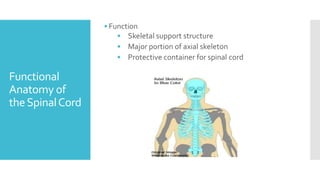
• Function
• Skeletal support structure
• Major portion of axial skeleton
• Protective container for spinal cord
Regional
Variations
ď‚– UpperCervical SpinalAnatomy is designed to facilitate motion.
ď‚– Injury is uncommon and the canal is spacious.
ď‚– Cervicothoracic junction is transitional zone from mobile to fixed
and is prone to injury.
ď‚– Thoracic spine is rigid because of stabilizing influence of the
thorax.
ď‚– Associated vascular and visceral injuries are common but require
major energy transfer.
ď‚– The thoracolumbar junction is another transitional zone and is also
prone to injury.
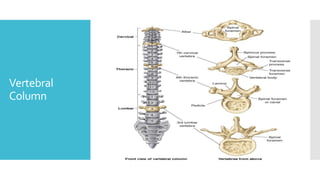
Vertebral
Column
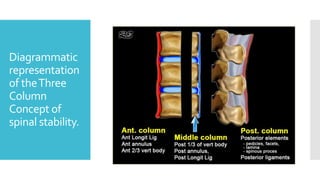
Denis:Three
Column
Concept of
spinal stability.
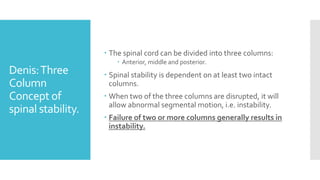
ď‚– The spinal cord can be divided into three columns:
ď‚– Anterior, middle and posterior.
ď‚– Spinal stability is dependent on at least two intact
columns.
ď‚– When two of the three columns are disrupted, it will
allow abnormal segmental motion, i.e. instability.
ď‚– Failure of two or more columns generally results in
instability.
Diagrammatic
representation
of theThree
Column
Concept of
spinal stability.
Stable vs.
Unstable
Injuries
ď‚– Stable Injuries
 Vertebral components won’t be displaced by normal movement.
ď‚– An undamaged spinal cord is not in danger.
ď‚– There is no development of incapacitating deformity or pain.
ď‚– Unstable Injuries
ď‚– Further displacement of the injury may occur.
ď‚– Loss of 50% of vertebral height.
ď‚– Angulation of thoracolumbar junction of > 20 degrees.
 Failure of at least 2 of Denis’s 3 columns.
ď‚– Compression fracture of three sequential vertebrae can lead to post
traumatic kyphosis.
Types ofSpinal
Cord Injury
ď‚– The primary Injury
ď‚– When the skeletal structures fail to dissipate the energy of the
primary mechanical insult.
ď‚– Results in direct energy transfer to neuronal elements.
ď‚– Flexion
ď‚– Extension
ď‚– Axial Loading
ď‚– Rotation or traction
ď‚– Compression of the Cord
ď‚– Secondary Injury
ď‚– Hemorrhage, oedema, and Ischemia secondary to the insult.
ď‚– Therapeutic strategies are directed at reducing secondary injury.
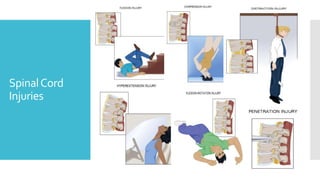
Mechanisms of
Spinal Injury
ď‚– Extremes of Motion
Hyperextension:
ď‚– Common in the neck
ď‚– Anterior ligaments and disc may be damaged.
Hyperflexion:
ď‚– If posterior ligament is intact , wedging of vertebral body
occurs.If torn , may cause subluxation.
Axial compression:
ď‚– Causes burst fractures. Bony fragments may be pushed
into spinal canal.
Flexion with rotation:
ď‚– Causes dislocation with or without fracture.
Flexion with posterior distraction:
ď‚– May disrupt middle and posterior column
Shear
SpinalCord
Injuries
Symptoms
andSigns
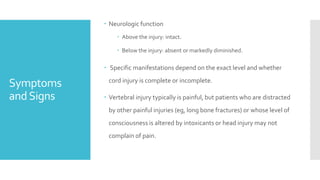
ď‚– Neurologic function
ď‚– Above the injury: intact.
ď‚– Below the injury: absent or markedly diminished.
ď‚– Specific manifestations depend on the exact level and whether
cord injury is complete or incomplete.
ď‚– Vertebral injury typically is painful, but patients who are distracted
by other painful injuries (eg, long bone fractures) or whose level of
consciousness is altered by intoxicants or head injury may not
complain of pain.
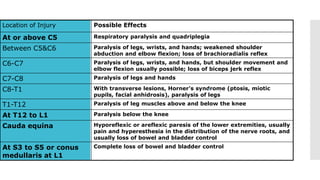
Location of Injury Possible Effects
At or above C5 Respiratory paralysis and quadriplegia
Between C5&C6 Paralysis of legs, wrists, and hands; weakened shoulder
abduction and elbow flexion; loss of brachioradialis reflex
C6-C7 Paralysis of legs, wrists, and hands, but shoulder movement and
elbow flexion usually possible; loss of biceps jerk reflex
C7-C8 Paralysis of legs and hands
C8-T1 With transverse lesions, Horner's syndrome (ptosis, miotic
pupils, facial anhidrosis), paralysis of legs
T1-T12 Paralysis of leg muscles above and below the knee
At T12 to L1 Paralysis below the knee
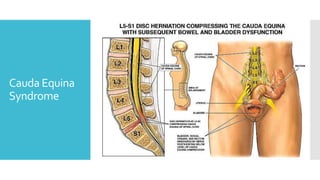
Cauda equina Hyporeflexic or areflexic paresis of the lower extremities, usually
pain and hyperesthesia in the distribution of the nerve roots, and
usually loss of bowel and bladder control
At S3 to S5 or conus
medullaris at L1
Complete loss of bowel and bladder control
ď‚– .
Basic Patient
Assessment
ď‚– Approach every patient in the same manner using Advanced
Trauma Life Support Principles (ATLS).
ď‚– Assume every trauma patient has a spinal injury until proven
otherwise.
ď‚– AllAssessment, Resuscitation and life saving procedures must be
performed with full spinal immobilization.
ď‚– Signs of spinal Injury:
ď‚– Polytrauma patient
ď‚– Neurological Deficit
ď‚– Multiple Injuries
ď‚– Head Injuries
ď‚– Facial Injury
ď‚– High energy Injury
ď‚– Abdominal Bruising from a seatbelt.
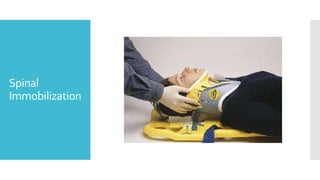
Spinal
Immobilization
Unconscious
and pain-free
patient.
ď‚– The Unconscious patient:
ď‚– FullAssessment of the spine is difficult.
ď‚– Definitive clearance of the spine many not be possible initially.
ď‚– Maintain Spinal Immobilization until MRI rules out injury.
ď‚– The Pain-free patient:
ď‚– There is no pain.
ď‚– Palpation of the spine is non-tender.
ď‚– Neurological examination is normal.
ď‚– There is pain free range of movement.
ď‚– The mechanism and velocity of injury should be determined at an
early stage.
Physical
Examination
ď‚– InitialAssessment
ď‚– Be aware that spinal injury may mask signs of intra-abdominal
injury.
ď‚– Identification of Shock
ď‚– Three types of Shock may occur in spinal trauma:
ď‚– Hypovolaemic Shock: Presents with hypotension, tachycardia, cold
clammy peripheries. Caused by hemorrhage; treated with appropriate
fluid replacement.
ď‚– Neurogenic Shock: Hypotension w/ normal heart rate or bradycardia
and warm peripheries. Caused by unopposed vagal tone resulting from
cervical spinal cord injury above the level of the sympathetic outflow
(C7/T1).
ď‚– Spinal Shock: Characterized by paralysis, hypotonia, and areflexia.
Lasts for only 24 hours. Assess patient neurologically. When it starts to
resolve bulbocavernosus reflex returns.
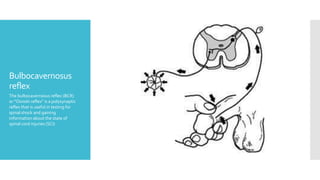
Bulbocavernosus
reflex
The bulbocavernosus reflex (BCR)
or "Osinski reflex" is a polysynaptic
reflex that is useful in testing for
spinal shock and gaining
information about the state of
spinal cord injuries (SCI)
Spinal
Examination
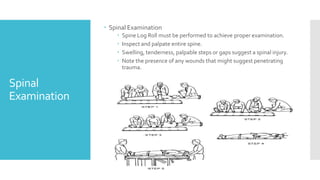
ď‚– Spinal Examination
ď‚– Spine Log Roll must be performed to achieve proper examination.
ď‚– Inspect and palpate entire spine.
ď‚– Swelling, tenderness, palpable steps or gaps suggest a spinal injury.
ď‚– Note the presence of any wounds that might suggest penetrating
trauma.
Neurological
Evaluation
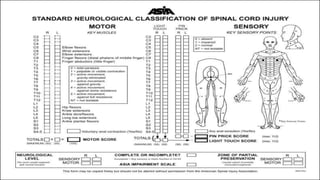
ď‚– American Spinal Injury Association neurological evaluation system
is used.
ď‚– Motor Function assesses key muscle groups. Grade (0-5)
ď‚– Sensory Function assesses dermatomal map. (Pinprick and light
touch) Score: 0-2
ď‚– Rectal examination:
ď‚– Anal tone.
ď‚– Voluntary anal contraction.
ď‚– Perianal sensation.
ď‚– What should be known after complete neurological examination?
ď‚– Presence or absence of neurological injury.
ď‚– Probable level of injury.
ď‚– Injury is complete or incomplete.
ď‚– Level of impairment.
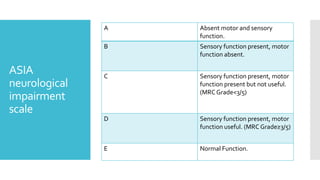
ASIA
neurological
impairment
scale
A Absent motor and sensory
function.
B Sensory function present, motor
function absent.
C Sensory function present, motor
function present but not useful.
(MRCGrade<3/5)
D Sensory function present, motor
function useful. (MRC Grade≥3/5)
E Normal Function.
CompleteCord
Injury
ď‚– Transection leads to immediate, complete, flaccid paralysis (including
loss of anal sphincter tone), loss of all sensation and reflex activity,
and autonomic dysfunction below the level of the injury.
ď‚– High cervical injury (at or above C5) , causing
ď‚– Respiratory insufficiency especially in patients with injuries at or above
C3.
ď‚– Bradycardia and hypotension (neurogenic shock) .
ď‚– Arrhythmias and BP instability may develop.
ď‚– Flaccid paralysis gradually changes over hours or days to spastic
paralysis with increased deep tendon reflexes due to loss of
descending inhibition.
ď‚– Later, if the lumbosacral cord is intact, flexor muscle spasms appear
and autonomic reflexes return.
Incomplete
Cord
Transection
ď‚– Partial motor and sensory loss occurs, and deep tendon reflexes
may be exuberant. Rapid swelling of the cord results in total
neurologic dysfunction resembling complete cord injury (spinal
shock )
ď‚– Central Cord Syndrome
ď‚– Brown-Sequard Syndrome
ď‚– Anterior Spinal syndrome
ď‚– PosteriorCord Syndrom
ď‚– Cauda Equina Syndrome
AnteriorCord
Syndrome
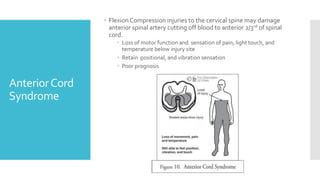
ď‚– Flexion Compression injuries to the cervical spine may damage
anterior spinal artery cutting off blood to anterior 2/3rd of spinal
cord.
ď‚– Loss of motor function and sensation of pain, light touch, and
temperature below injury site
ď‚– Retain positional, and vibration sensation
ď‚– Poor prognosis
CentralCord
Syndrome
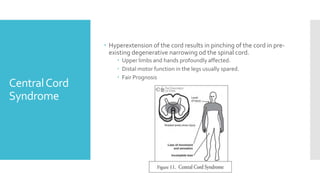
ď‚– Hyperextension of the cord results in pinching of the cord in pre-
existing degenerative narrowing od the spinal cord.
ď‚– Upper limbs and hands profoundly affected.
ď‚– Distal motor function in the legs usually spared.
ď‚– Fair Prognosis
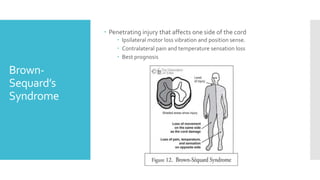
Brown-
Sequard’s
Syndrome
ď‚– Penetrating injury that affects one side of the cord
ď‚– Ipsilateral motor loss vibration and position sense.
ď‚– Contralateral pain and temperature sensation loss
ď‚– Best prognosis
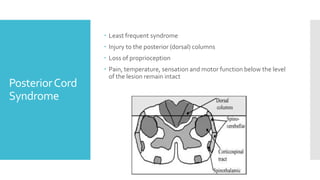
PosteriorCord
Syndrome
ď‚– Least frequent syndrome
ď‚– Injury to the posterior (dorsal) columns
ď‚– Loss of proprioception
ď‚– Pain, temperature, sensation and motor function below the level
of the lesion remain intact
Cauda Equina
Syndrome
Diagnostic
Imaging
ď‚– 85% of significant spinal injuries will be seem on standard lateral
cervical spine.
ď‚– CT Scan should be obtained.
ď‚– Most Sensitive in spinal trauma.
ď‚– Complex patterns and fractures can be understood.
ď‚– MRI
ď‚– Best at visualizing soft-tissue elements of the spine.
ď‚– Possible to view spinal cord hemorrhage, epidural and prevertebral
hematomas.
ď‚– Not good at assessing bony structures.
ď‚– In spinal traumas radiographs and CT scans usually give sufficient
information and MRI is not required.
Management
of the
Spinal Injury
Patient
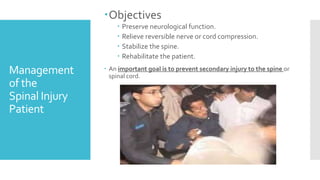
ď‚–Objectives
ď‚– Preserve neurological function.
ď‚– Relieve reversible nerve or cord compression.
ď‚– Stabilize the spine.
ď‚– Rehabilitate the patient.
ď‚– An important goal is to prevent secondary injury to the spine or
spinal cord.
Pre-hospital
care
ď‚– In unstable injuries, flexion or extension of the spine can contuse
or transect the cord.
ď‚– Which can result in paraplegia, quadriplegia, or even death from
spinal injury.
ď‚– Immobilize spine immediately.
ď‚– A rigid collar should be used to immobilize the cervical spine.
ď‚– Patients with thoracic or lumbar spine injuries should be shifted by
logroll technique on a flat ,firm padded back board in supine
position.
ď‚– Transfer to a trauma center Immediately.
ď‚– Pre hospital medical care should be directed at avoiding hypoxia
and hypotension, both of which can further stress the injured cord.
Emergency
Department
Care
1. ABC
2. Intubation if needed.
3. Spinal stabilization.
4. Secondary survey.
5. Logroll – look for bruising , palpate for step and tenderness.
6. Look for associated injuries, such as brain, thoracic, or abdominal injuries.
7. Imaging; X-rays , CT , MRI.
8. Repeated neurologic examination helps determine the presence of deficits
its progression /resolution.
9. Hypotension and bradycardia may indicate neurogenic shock.
10. Maintain the systolic blood pressure at a value of at least 90 mm Hg with a
heart rate of 60-100 beats per minute.
11. Bradycardia may be treated by the use of atropine.
12. Attempt to maintain urine output at a minimum of 30 mL/h. If all of the
above parameters are difficult to maintain, consider support with inotropic
agents.
13. These patients are also at risk for hypothermia and should be warmed to
maintain a core temperature of at least 96°F. Place a Foley catheter to help
with voiding.
Management
With no neurological deficit:
ď‚– If stable-pain relief , collar or brace.
ď‚– If unstable-reduce and hold secure until bone / ligaments
heal with surgery or traction.
With complete sensory or motor loss:
ď‚– Usually an unstable injury
ď‚– Only consider conservative management for high thoracic
injuries.
ď‚– Early operative stabilization to help with nursing , prevent
spinal deformity and pain.
ď‚– Speeds up rehab.
With incomplete neurological loss:
ď‚– Stable injury-conservative bed rest , brace.
ď‚– Unstable injury-early reduction and stabilization.
Surgical
Approach
ď‚– The goals of operative treatment are to
decompress the spinal cord canal and to
stabilize the disrupted vertebral column.
ď‚– Also consider the need for stabilization
procedures.
ď‚– Categories of procedures for spine stabilization
ď‚– The 4 basic types of stabilization procedures are
1. posterior lumbar interspinous fusion,
2. posterior rods
3. cage
4. The Z-plate anterior thoracolumbar plating system.
Each has different advantages and disadvantages.

Spinal Trauma (Spinal Cord Injury)

  • 1.
    SpinalTrauma By: Abdullah Mohammad ShifaCollege of Medicine 2014-001
  • 2.
    Case ď‚– A19-year-old collegestudent, was rock climbing when he fell 30 feet to the ground. Paramedics arriving at the scene found him lying in the supine position, unable to move any extremities and complaining of neck pain. He was awake, alert, and oriented to his current location, the date and day of the week, and the details of his fall. His responses to questioning were appropriate. He complained that he could not feel his arms and legs. His pupils were equal and reactive to light. He showed no other signs of injury except for several scrapes on his arms. His vital signs revealed a blood pressure of 110 / 72, heart rate of 82 beats per minute, respirations of 18 per minute.The paramedics applied a cervical collar, placed him on a back board, immobilized his head, and transported him to the trauma center by helicopter.
  • 3.
    Introduction  Traumatic SpinalCordInjury accounts for 15,000 new cases each year.  Mortality/Morbidity  94% of patients survive the initial hospitalization  Life Expectancy is greatly reduced.  Renal Failure was the leading cause of death in the past.  Currently, Pneumonia, Pulmonary Emboli, and septicemia are the major causes.  Commonly men 16–30 years old (M:F Ratio 4:1)  Mechanism of Injury  Vehicle crashes: 48%  Falls: 21%  Penetrating trauma: 15%  Sports injury: 14%  25% of all spinal cord injuries occur from improper handling of the spine and patient after injury.
  • 4.
    Functional Anatomy of theSpinalCord • Function •Skeletal support structure • Major portion of axial skeleton • Protective container for spinal cord
  • 5.
    Regional Variations ď‚– UpperCervical SpinalAnatomyis designed to facilitate motion. ď‚– Injury is uncommon and the canal is spacious. ď‚– Cervicothoracic junction is transitional zone from mobile to fixed and is prone to injury. ď‚– Thoracic spine is rigid because of stabilizing influence of the thorax. ď‚– Associated vascular and visceral injuries are common but require major energy transfer. ď‚– The thoracolumbar junction is another transitional zone and is also prone to injury.
  • 6.
  • 7.
    Denis:Three Column Concept of spinal stability. ď‚–The spinal cord can be divided into three columns: ď‚– Anterior, middle and posterior. ď‚– Spinal stability is dependent on at least two intact columns. ď‚– When two of the three columns are disrupted, it will allow abnormal segmental motion, i.e. instability. ď‚– Failure of two or more columns generally results in instability.
  • 8.
  • 9.
    Stable vs. Unstable Injuries  StableInjuries  Vertebral components won’t be displaced by normal movement.  An undamaged spinal cord is not in danger.  There is no development of incapacitating deformity or pain.  Unstable Injuries  Further displacement of the injury may occur.  Loss of 50% of vertebral height.  Angulation of thoracolumbar junction of > 20 degrees.  Failure of at least 2 of Denis’s 3 columns.  Compression fracture of three sequential vertebrae can lead to post traumatic kyphosis.
  • 10.
    Types ofSpinal Cord Injury ď‚–The primary Injury ď‚– When the skeletal structures fail to dissipate the energy of the primary mechanical insult. ď‚– Results in direct energy transfer to neuronal elements. ď‚– Flexion ď‚– Extension ď‚– Axial Loading ď‚– Rotation or traction ď‚– Compression of the Cord ď‚– Secondary Injury ď‚– Hemorrhage, oedema, and Ischemia secondary to the insult. ď‚– Therapeutic strategies are directed at reducing secondary injury.
  • 11.
    Mechanisms of Spinal Injury ď‚–Extremes of Motion Hyperextension: ď‚– Common in the neck ď‚– Anterior ligaments and disc may be damaged. Hyperflexion: ď‚– If posterior ligament is intact , wedging of vertebral body occurs.If torn , may cause subluxation. Axial compression: ď‚– Causes burst fractures. Bony fragments may be pushed into spinal canal. Flexion with rotation: ď‚– Causes dislocation with or without fracture. Flexion with posterior distraction: ď‚– May disrupt middle and posterior column Shear
  • 12.
  • 13.
    Symptoms andSigns ď‚– Neurologic function ď‚–Above the injury: intact. ď‚– Below the injury: absent or markedly diminished. ď‚– Specific manifestations depend on the exact level and whether cord injury is complete or incomplete. ď‚– Vertebral injury typically is painful, but patients who are distracted by other painful injuries (eg, long bone fractures) or whose level of consciousness is altered by intoxicants or head injury may not complain of pain.
  • 14.
    Location of InjuryPossible Effects At or above C5 Respiratory paralysis and quadriplegia Between C5&C6 Paralysis of legs, wrists, and hands; weakened shoulder abduction and elbow flexion; loss of brachioradialis reflex C6-C7 Paralysis of legs, wrists, and hands, but shoulder movement and elbow flexion usually possible; loss of biceps jerk reflex C7-C8 Paralysis of legs and hands C8-T1 With transverse lesions, Horner's syndrome (ptosis, miotic pupils, facial anhidrosis), paralysis of legs T1-T12 Paralysis of leg muscles above and below the knee At T12 to L1 Paralysis below the knee Cauda equina Hyporeflexic or areflexic paresis of the lower extremities, usually pain and hyperesthesia in the distribution of the nerve roots, and usually loss of bowel and bladder control At S3 to S5 or conus medullaris at L1 Complete loss of bowel and bladder control ď‚– .
  • 15.
    Basic Patient Assessment ď‚– Approachevery patient in the same manner using Advanced Trauma Life Support Principles (ATLS). ď‚– Assume every trauma patient has a spinal injury until proven otherwise. ď‚– AllAssessment, Resuscitation and life saving procedures must be performed with full spinal immobilization. ď‚– Signs of spinal Injury: ď‚– Polytrauma patient ď‚– Neurological Deficit ď‚– Multiple Injuries ď‚– Head Injuries ď‚– Facial Injury ď‚– High energy Injury ď‚– Abdominal Bruising from a seatbelt.
  • 16.
  • 17.
    Unconscious and pain-free patient. ď‚– TheUnconscious patient: ď‚– FullAssessment of the spine is difficult. ď‚– Definitive clearance of the spine many not be possible initially. ď‚– Maintain Spinal Immobilization until MRI rules out injury. ď‚– The Pain-free patient: ď‚– There is no pain. ď‚– Palpation of the spine is non-tender. ď‚– Neurological examination is normal. ď‚– There is pain free range of movement. ď‚– The mechanism and velocity of injury should be determined at an early stage.
  • 18.
    Physical Examination ď‚– InitialAssessment ď‚– Beaware that spinal injury may mask signs of intra-abdominal injury. ď‚– Identification of Shock ď‚– Three types of Shock may occur in spinal trauma: ď‚– Hypovolaemic Shock: Presents with hypotension, tachycardia, cold clammy peripheries. Caused by hemorrhage; treated with appropriate fluid replacement. ď‚– Neurogenic Shock: Hypotension w/ normal heart rate or bradycardia and warm peripheries. Caused by unopposed vagal tone resulting from cervical spinal cord injury above the level of the sympathetic outflow (C7/T1). ď‚– Spinal Shock: Characterized by paralysis, hypotonia, and areflexia. Lasts for only 24 hours. Assess patient neurologically. When it starts to resolve bulbocavernosus reflex returns.
  • 19.
    Bulbocavernosus reflex The bulbocavernosus reflex(BCR) or "Osinski reflex" is a polysynaptic reflex that is useful in testing for spinal shock and gaining information about the state of spinal cord injuries (SCI)
  • 20.
    Spinal Examination ď‚– Spinal Examination ď‚–Spine Log Roll must be performed to achieve proper examination. ď‚– Inspect and palpate entire spine. ď‚– Swelling, tenderness, palpable steps or gaps suggest a spinal injury. ď‚– Note the presence of any wounds that might suggest penetrating trauma.
  • 21.
    Neurological Evaluation ď‚– American SpinalInjury Association neurological evaluation system is used. ď‚– Motor Function assesses key muscle groups. Grade (0-5) ď‚– Sensory Function assesses dermatomal map. (Pinprick and light touch) Score: 0-2 ď‚– Rectal examination: ď‚– Anal tone. ď‚– Voluntary anal contraction. ď‚– Perianal sensation. ď‚– What should be known after complete neurological examination? ď‚– Presence or absence of neurological injury. ď‚– Probable level of injury. ď‚– Injury is complete or incomplete. ď‚– Level of impairment.
  • 22.
    ASIA neurological impairment scale A Absent motorand sensory function. B Sensory function present, motor function absent. C Sensory function present, motor function present but not useful. (MRCGrade<3/5) D Sensory function present, motor function useful. (MRC Grade≥3/5) E Normal Function.
  • 24.
    CompleteCord Injury ď‚– Transection leadsto immediate, complete, flaccid paralysis (including loss of anal sphincter tone), loss of all sensation and reflex activity, and autonomic dysfunction below the level of the injury. ď‚– High cervical injury (at or above C5) , causing ď‚– Respiratory insufficiency especially in patients with injuries at or above C3. ď‚– Bradycardia and hypotension (neurogenic shock) . ď‚– Arrhythmias and BP instability may develop. ď‚– Flaccid paralysis gradually changes over hours or days to spastic paralysis with increased deep tendon reflexes due to loss of descending inhibition. ď‚– Later, if the lumbosacral cord is intact, flexor muscle spasms appear and autonomic reflexes return.
  • 25.
    Incomplete Cord Transection ď‚– Partial motorand sensory loss occurs, and deep tendon reflexes may be exuberant. Rapid swelling of the cord results in total neurologic dysfunction resembling complete cord injury (spinal shock ) ď‚– Central Cord Syndrome ď‚– Brown-Sequard Syndrome ď‚– Anterior Spinal syndrome ď‚– PosteriorCord Syndrom ď‚– Cauda Equina Syndrome
  • 26.
    AnteriorCord Syndrome ď‚– Flexion Compressioninjuries to the cervical spine may damage anterior spinal artery cutting off blood to anterior 2/3rd of spinal cord. ď‚– Loss of motor function and sensation of pain, light touch, and temperature below injury site ď‚– Retain positional, and vibration sensation ď‚– Poor prognosis
  • 27.
    CentralCord Syndrome ď‚– Hyperextension ofthe cord results in pinching of the cord in pre- existing degenerative narrowing od the spinal cord. ď‚– Upper limbs and hands profoundly affected. ď‚– Distal motor function in the legs usually spared. ď‚– Fair Prognosis
  • 28.
    Brown- Sequard’s Syndrome  Penetrating injurythat affects one side of the cord  Ipsilateral motor loss vibration and position sense.  Contralateral pain and temperature sensation loss  Best prognosis
  • 29.
    PosteriorCord Syndrome ď‚– Least frequentsyndrome ď‚– Injury to the posterior (dorsal) columns ď‚– Loss of proprioception ď‚– Pain, temperature, sensation and motor function below the level of the lesion remain intact
  • 30.
  • 31.
    Diagnostic Imaging ď‚– 85% ofsignificant spinal injuries will be seem on standard lateral cervical spine. ď‚– CT Scan should be obtained. ď‚– Most Sensitive in spinal trauma. ď‚– Complex patterns and fractures can be understood. ď‚– MRI ď‚– Best at visualizing soft-tissue elements of the spine. ď‚– Possible to view spinal cord hemorrhage, epidural and prevertebral hematomas. ď‚– Not good at assessing bony structures. ď‚– In spinal traumas radiographs and CT scans usually give sufficient information and MRI is not required.
  • 32.
    Management of the Spinal Injury Patient ď‚–Objectives ď‚–Preserve neurological function. ď‚– Relieve reversible nerve or cord compression. ď‚– Stabilize the spine. ď‚– Rehabilitate the patient. ď‚– An important goal is to prevent secondary injury to the spine or spinal cord.
  • 33.
    Pre-hospital care ď‚– In unstableinjuries, flexion or extension of the spine can contuse or transect the cord. ď‚– Which can result in paraplegia, quadriplegia, or even death from spinal injury. ď‚– Immobilize spine immediately. ď‚– A rigid collar should be used to immobilize the cervical spine. ď‚– Patients with thoracic or lumbar spine injuries should be shifted by logroll technique on a flat ,firm padded back board in supine position. ď‚– Transfer to a trauma center Immediately. ď‚– Pre hospital medical care should be directed at avoiding hypoxia and hypotension, both of which can further stress the injured cord.
  • 34.
    Emergency Department Care 1. ABC 2. Intubationif needed. 3. Spinal stabilization. 4. Secondary survey. 5. Logroll – look for bruising , palpate for step and tenderness. 6. Look for associated injuries, such as brain, thoracic, or abdominal injuries. 7. Imaging; X-rays , CT , MRI. 8. Repeated neurologic examination helps determine the presence of deficits its progression /resolution. 9. Hypotension and bradycardia may indicate neurogenic shock. 10. Maintain the systolic blood pressure at a value of at least 90 mm Hg with a heart rate of 60-100 beats per minute. 11. Bradycardia may be treated by the use of atropine. 12. Attempt to maintain urine output at a minimum of 30 mL/h. If all of the above parameters are difficult to maintain, consider support with inotropic agents. 13. These patients are also at risk for hypothermia and should be warmed to maintain a core temperature of at least 96°F. Place a Foley catheter to help with voiding.
  • 35.
    Management With no neurologicaldeficit: ď‚– If stable-pain relief , collar or brace. ď‚– If unstable-reduce and hold secure until bone / ligaments heal with surgery or traction. With complete sensory or motor loss: ď‚– Usually an unstable injury ď‚– Only consider conservative management for high thoracic injuries. ď‚– Early operative stabilization to help with nursing , prevent spinal deformity and pain. ď‚– Speeds up rehab. With incomplete neurological loss: ď‚– Stable injury-conservative bed rest , brace. ď‚– Unstable injury-early reduction and stabilization.
  • 36.
    Surgical Approach ď‚– The goalsof operative treatment are to decompress the spinal cord canal and to stabilize the disrupted vertebral column. ď‚– Also consider the need for stabilization procedures. ď‚– Categories of procedures for spine stabilization ď‚– The 4 basic types of stabilization procedures are 1. posterior lumbar interspinous fusion, 2. posterior rods 3. cage 4. The Z-plate anterior thoracolumbar plating system. Each has different advantages and disadvantages.