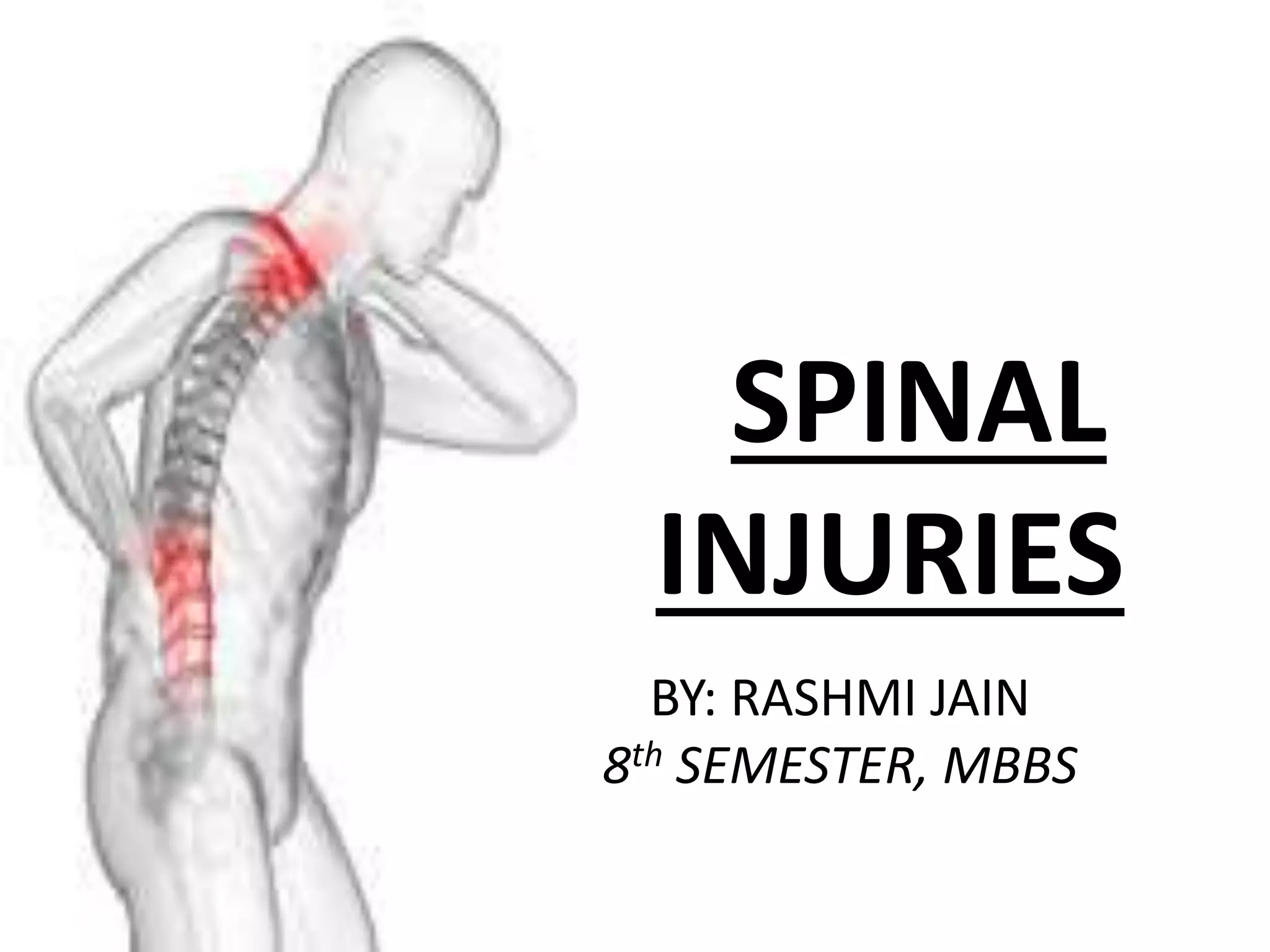
SPINAL
INJURIES
BY: RASHMI JAIN
8th SEMESTER, MBBS
INTRODUCTION
• Spinal injuries carry a double threat: damage to
the vertebral column and damage to the neural
tissues. Thoraco-lumbar segment is the
‘commonest’ site of injury; lower cervical being
the next common.
• About 20% of all spinal injuries result in
neurological deficit in the form of ‘Paraplegia’ in
thoraco-lumbar or ‘Quadriplegia’ in cervical
spinal injuries.
• Commonest mode of spinal injury in –
– Developing country- fall from height
– Developed country- road traffic accident
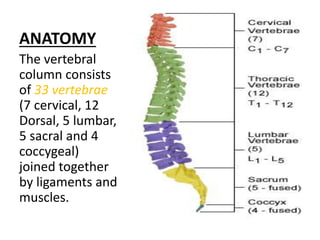
ANATOMY
The vertebral
column consists
of 33 vertebrae
(7 cervical, 12
Dorsal, 5 lumbar,
5 sacral and 4
coccygeal)
joined together
by ligaments and
muscles.
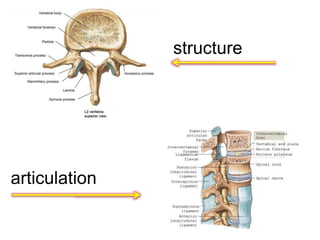
structure
articulation
PATHOPHYSIOLOGY OF SPINE
INJURIES
• Stable injury is one in which the vertebral
column will not be displaced by normal
movements; in a stable injury , if the neural
elements are undamaged there is little risk of
them becoming damage.
• Unstable injury is one in which there is
significant risk of displacement and
consequent damage –or further damage – to
the neural tissues.
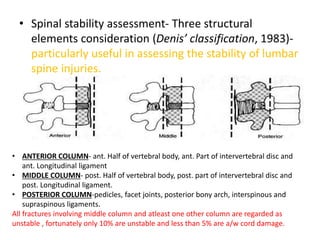
• Spinal stability assessment- Three structural
elements consideration (Denis’ classification, 1983)-
particularly useful in assessing the stability of lumbar
spine injuries.
• ANTERIOR COLUMN- ant. Half of vertebral body, ant. Part of intervertebral disc and
ant. Longitudinal ligament
• MIDDLE COLUMN- post. Half of vertebral body, post. part of intervertebral disc and
post. Longitudinal ligament.
• POSTERIOR COLUMN-pedicles, facet joints, posterior bony arch, interspinous and
supraspinous ligaments.
All fractures involving middle column and atleast one other column are regarded as
unstable , fortunately only 10% are unstable and less than 5% are a/w cord damage.
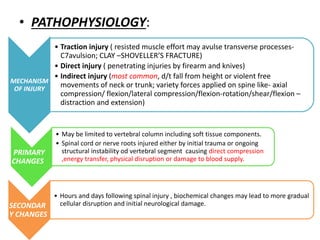
• PATHOPHYSIOLOGY:
MECHANISM
OF INJURY
• Traction injury ( resisted muscle effort may avulse transverse processes-
C7avulsion; CLAY –SHOVELLER’S FRACTURE)
• Direct injury ( penetrating injuries by firearm and knives)
• Indirect injury (most common, d/t fall from height or violent free
movements of neck or trunk; variety forces applied on spine like- axial
compression/ flexion/lateral compression/flexion-rotation/shear/flexion –
distraction and extension)
PRIMARY
CHANGES
• May be limited to vertebral column including soft tissue components.
• Spinal cord or nerve roots injured either by initial trauma or ongoing
structural instability od vertebral segment causing direct compression
,energy transfer, physical disruption or damage to blood supply.
SECONDAR
Y CHANGES
• Hours and days following spinal injury , biochemical changes may lead to more gradual
cellular disruption and initial neurological damage.
CLASSIFICATION
• Flexion injury
• Flexion rotation injury
• Vertical compression injury
• Extension injury
• Flexion distraction injury
• Direct injury
• Indirect injury due to violent muscle
contraction
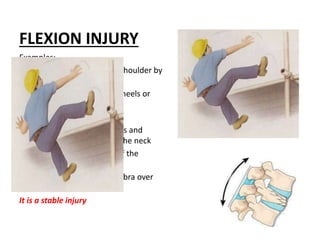
FLEXION INJURY
Examples:
1. Heavy blow across the shoulder by
a heavy object;
2. Fall from height on the heels or
buttocks
Results:
1. A sprain of the ligaments and
muscles of the back of the neck
2. Compression fracture of the
vertebral body, C5 to C7
3. Dislocation of one vertebra over
another.
It is a stable injury
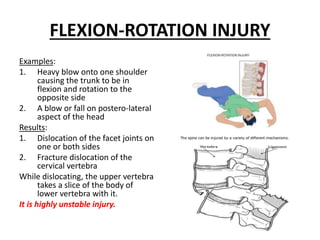
FLEXION-ROTATION INJURY
Examples:
1. Heavy blow onto one shoulder
causing the trunk to be in
flexion and rotation to the
opposite side
2. A blow or fall on postero-lateral
aspect of the head
Results:
1. Dislocation of the facet joints on
one or both sides
2. Fracture dislocation of the
cervical vertebra
While dislocating, the upper vertebra
takes a slice of the body of
lower vertebra with it.
It is highly unstable injury.
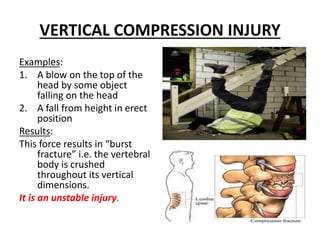
VERTICAL COMPRESSION INJURY
Examples:
1. A blow on the top of the
head by some object
falling on the head
2. A fall from height in erect
position
Results:
This force results in “burst
fracture” i.e. the vertebral
body is crushed
throughout its vertical
dimensions.
It is an unstable injury.
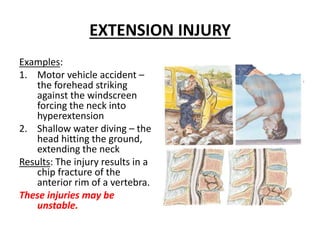
EXTENSION INJURY
Examples:
1. Motor vehicle accident –
the forehead striking
against the windscreen
forcing the neck into
hyperextension
2. Shallow water diving – the
head hitting the ground,
extending the neck
Results: The injury results in a
chip fracture of the
anterior rim of a vertebra.
These injuries may be
unstable.
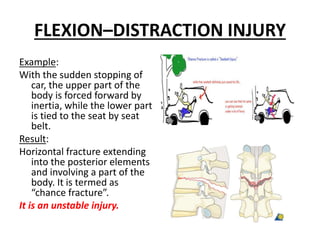
FLEXION–DISTRACTION INJURY
Example:
With the sudden stopping of
car, the upper part of the
body is forced forward by
inertia, while the lower part
is tied to the seat by seat
belt.
Result:
Horizontal fracture extending
into the posterior elements
and involving a part of the
body. It is termed as
“chance fracture”.
It is an unstable injury.
DIRECT INJURY
Examples:
1. Bullet injury
2. A lathi blow hitting the spinous processes of
the cervical vertebrae
Results:
Any part of the vertebra may be smashed by a
bullet, but, a lathi blow generally causes a
fracture of the spinous processes only.
VIOLENT MUSCLE CONTRACTION
Example:
Sudden violent contraction of the psoas.
Result:
Fracture of transverse processes of multiple
lumbar vertebrae. It may be associated with
huge retro-peritoneal haematoma.
CLINICAL FEATURES
• Pain in the back following severe violence to
the spine.
• Neurologic deficit: Sometimes, a patient is
brought to the hospital with complaints of
inability to move the limbs and loss of
sensation. Sometimes, the paralysis may
ensure late, or may extend proximally due to
traumatic intra-spinal haemorrhage.
PRINCIPLES OF DIAGNOSIS AND
INITIAL MANAGEMENT
EARLY MANAGEMENT
• Adherence to resuscitation protocol (ATLS).
• Adequate oxygenation, ventilation and circulation
will minimize secondary spinal cord injury.
• Essential principle: if there is the slightest
possibility of a spinal injury in a trauma patient,
the spine must be immobilized until the patient
has been resuscitated and other life threatening
injuries have been identified and treated.
• Abandoning of immobilization only when spinal
injury has been excluded both by clinical and
radiological assessment.
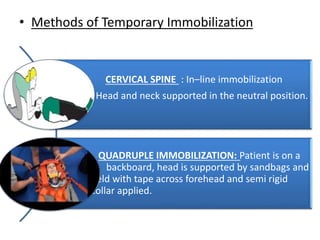
• Methods of Temporary Immobilization
CERVICAL SPINE : In–line immobilization
Head and neck supported in the neutral position.
QUADRUPLE IMMOBILIZATION: Patient is on a
b backboard, head is supported by sandbags and
held with tape across forehead and semi rigid
collar applied.
• The patient should be moved without flexion or
rotation of the thoracolumbar spine. A scoop
stretcher and spinal board are very useful for this.
• Logrolling technique used for:
– Placing patient on spinal board.
– Examining the back of patient.
• Medical therapy:
– Early treatment with high doses of corticosteroids
( methylprednisolone, 30 mg/kg , i.v. ; followed by
maintenance dose of 5.4 mg/kg/hr for 23 hours) may
improve neurological recovery if commenced within 8
hours following the injury; albeit the evidence is limited
and some neurosurgical guidelines do not recommend
their use. [Source- CMDT-2017]
DIAGNOSIS
• HISTORY:
Crucial d/t minimal symptoms and signs.
H/o blunt injury above clavicle, a head injury
or loss of consciousness – cervical injury; until
proven otherwise.
H/o fall from height or high speed deceleration
–thoracolumbar injury; until proven
otherwise.
Hold high index of suspicion; especially lesser
injuries are followed by pain in the neck or
back or neurological symptoms in limbs.
• EXAMINATION:
– GENERAL EXAMINATION:
 ATLS guidelines to take precedence.
Assess whether patient is not developing either of the
following shock which are commonly encountered in
patients having spinal injury.
• Hypovolemic Shock suggested by tachycardia, peripheral
shutdown and in later stages by hypotension.
• Neurogenic Shock- suggested by combination of paralysis,
warm and well- perfused peripheral areas, bradycardia and
hypotension with a low diastolic blood pressure .
• Spinal Shock- occurs when spinal cord fails temporarily
following the injury as the injury mechanism causes the
immediate depolarization of the axonal membranes resulting
in spinal shock.
» All the reflexes are absent during the phase of spinal
shock.
» Typically lasts for 24-48 hrs after the injury.
BULBOCAVERNOUS REFLEX – reflex returning first,
marking end of spinal shock.
– EXAMINATION OF NECK & BACK:
Neck – inspect for deformity/bruising/ penetrating
injury. Bones and soft tissues of neck are gently
palpated for tenderness and areas of bogginess or
increased space b/t the spinous processes( suggesting
instability due to posterior column failure).
Back of the neck should also be examined thoroughly.
Throughout the examination of neck , the cervical
spine must not be moved because of the risk of
injuring the cord in c/o unstable injury.
 Back- logrolled and inspected for
deformity/penetrating injury/ hematoma/ bruising.
Bone and soft tissue structures are palpated.
Haematoma/ a gap/ a step – signs of instability.
– NEUROLOGICAL EXAMINATION:
Full neurological examination carried out in every case,
repeated several times during the first few days where
each dermatome, myotome and reflexes is tested.
The unconscious patient are difficult to examine . A
spinal injury must be assumed until proven otherwise.
Clues to existence of spinal cord lesion are h/o fall from
height/ high speed deceleration/ head injury, flaccid
anal sphincter , hypotension with bradycardia etc.
• INVESTIGATIONS:
– X-RAYS:
Mandatory for:
• all accident victims complaining of pain or stiffness in the neck or
back or peripheral paraesthesia .
• all patients with head injury or severe facial injuries( cervical
spine ).
• patients with rib fractures or severe seat-belt bruising ( thoracic
spine).
• severe pelvic or abdominal injuries (thoracolumbar spine).
Performed during secondary survey.
Should be carried out with a minimum of movements and
manipulations. No attempts should be made to obtain ‘
flexion and extension’ views during initial work up.
Features on plain x-ray-Change in general alignment of
spine /Reduction in height of vertebra/Antero-posterior or
sideways displacement of one vertebra over
another/Fracture Of vertebral body/Fracture of the posterior
elements: pedicle, lamina, transverse process
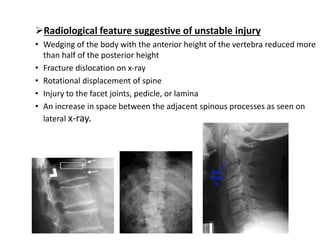
Radiological feature suggestive of unstable injury
• Wedging of the body with the anterior height of the vertebra reduced more
than half of the posterior height
• Fracture dislocation on x-ray
• Rotational displacement of spine
• Injury to the facet joints, pedicle, or lamina
• An increase in space between the adjacent spinous processes as seen on
lateral x-ray.
PITFALLS IN CASE OF CHILDREN :
1. Normal features mistaken as fracture
– Growth plates and synchondroses can be mistaken for
fracture. Normal synchondrosis at the base of the dens has
usually fused by the age of 6 yrs, but it can be mistaken for an
undisplaced fracture.
– The spinous process growth plates also resembles fractures;
and the growth plate at the tip of odontoid can be taken for a
fracture in older children.
2. Spinal cord injury despite normal radiograph
• SCIWORA- Spinal Cord Injury Without Obvious
Radiographic Abnormality; interestingly radiographs
are normal but there is neural deficit.
Occurs d/t lax ligaments permitting traction injury to
cord . Cervical spine is most commonly affected.
– CT –Scan:
Ideal for showing structural damage to individual
vertebrae and displacement of bone fragments into the
vertebral canal.
Screening CT employed routinely in many centres, the
drawback is its high level of radiation exposure.
CT myelography, with the intrathecal introduction of
contrast agent , provides information on the
dimensions of spinal canal , impingement fracture
fragments or intervertebral disc ,and root avulsion .
This investigation is largely replaced by MRI.
– MRI:
 Method of choice for displaying the intervertebral
discs, ligamentum flavum and neural structures .
 Indicated for all the patients with neurological signs
and those who are considered for surgery.
PRINCIPLES OF DEFINITIVE
TREATMENT
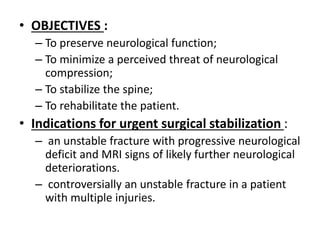
• OBJECTIVES :
– To preserve neurological function;
– To minimize a perceived threat of neurological
compression;
– To stabilize the spine;
– To rehabilitate the patient.
• Indications for urgent surgical stabilization :
– an unstable fracture with progressive neurological
deficit and MRI signs of likely further neurological
deteriorations.
– controversially an unstable fracture in a patient
with multiple injuries.
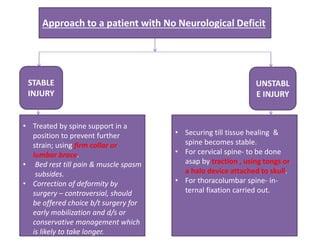
Approach to a patient with No Neurological Deficit
STABLE
INJURY
UNSTABL
E INJURY
• Treated by spine support in a
position to prevent further
strain; using firm collar or
lumbar brace.
• Bed rest till pain & muscle spasm
subsides.
• Correction of deformity by
surgery – controversial, should
be offered choice b/t surgery for
early mobilization and d/s or
conservative management which
is likely to take longer.
• Securing till tissue healing &
spine becomes stable.
• For cervical spine- to be done
asap by traction , using tongs or
a halo device attached to skull.
• For thoracolumbar spine- in-
ternal fixation carried out.
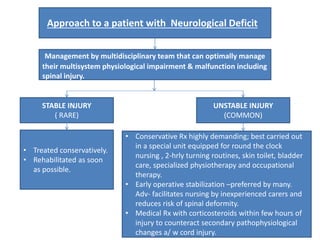
Approach to a patient with Neurological Deficit
Management by multidisciplinary team that can optimally manage
their multisystem physiological impairment & malfunction including
spinal injury.
STABLE INJURY
( RARE)
UNSTABLE INJURY
(COMMON)
• Treated conservatively.
• Rehabilitated as soon
as possible.
• Conservative Rx highly demanding; best carried out
in a special unit equipped for round the clock
nursing , 2-hrly turning routines, skin toilet, bladder
care, specialized physiotherapy and occupational
therapy.
• Early operative stabilization –preferred by many.
Adv- facilitates nursing by inexperienced carers and
reduces risk of spinal deformity.
• Medical Rx with corticosteroids within few hours of
injury to counteract secondary pathophysiological
changes a/ w cord injury.
TREATMENT METHODS
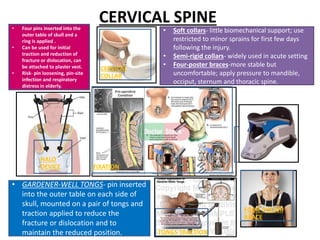
CERVICAL SPINE
FIXATION
CERVICAL
COLLAR
HALO
DEVICE
FOUR-POSTER
BRACE
TONGS TRACTION
• Soft collars- little biomechanical support; use
restricted to minor sprains for first few days
following the injury.
• Semi-rigid collars- widely used in acute setting
• Four-poster braces-more stable but
uncomfortable; apply pressure to mandible,
occiput, sternum and thoracic spine.
• Four pins inserted into the
outer table of skull and a
ring is applied .
• Can be used for initial
traction and reduction of
fracture or dislocation, can
be attached to plaster vest.
• Risk- pin loosening, pin-site
infection and respiratory
distress in elderly.
• GARDENER-WELL TONGS- pin inserted
into the outer table on each side of
skull, mounted on a pair of tongs and
traction applied to reduce the
fracture or dislocation and to
maintain the reduced position.
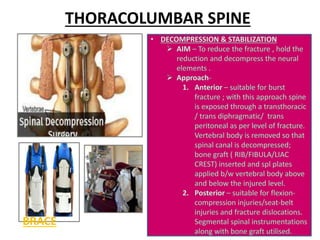
THORACOLUMBAR SPINE
BRACE
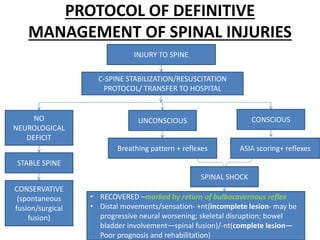
PROTOCOL OF DEFINITIVE
MANAGEMENT OF SPINAL INJURIES
INJURY TO SPINE
C-SPINE STABILIZATION/RESUSCITATION
PROTOCOL/ TRANSFER TO HOSPITAL
NO
NEUROLOGICAL
DEFICIT
UNCONSCIOUS CONSCIOUS
STABLE SPINE
CONSERVATIVE
(spontaneous
fusion/surgical
fusion)
Breathing pattern + reflexes ASIA scoring+ reflexes
SPINAL SHOCK
• RECOVERED –marked by return of bulbocavernous reflex
• Distal movements/sensation- +nt(incomplete lesion- may be
progressive neural worsening; skeletal disruption; bowel
bladder involvement—spinal fusion)/-nt(complete lesion—
Poor prognosis and rehabilitation)
COMPLICATIONS
• Pulmonary complications - Function compromise, Airway
compromise, infection, decreased vital capacity, atelectasis, retention of
secretions, respiratory failure, pulmonary edema.
• Acute respiratory failure is the leading cause of death in high cervical
injuries.
• GI & GU Dysfunction -Assess for bowel distention, ileus or
gastrointestinal bleeding - may require an NGT. During acute injury
phase, the bladder is atonic so the patient is unable to void voluntarily
or spontaneously - also increases risk of UTI. Maintain strict Intake and
Output .Begin bladder training.
• Orthostatic hypotension- venous pooling in the legs and abdomen,
loss the skeletal muscle pump, and impaired sympathetic nervous
system control of BP. It can result in syncope, bradycardia, or asystole.
Treated by quickly returning the patient to a supine position,
administering oxygen, and if necessary, atropine to increase heart rate.
• DVT is extremely high in SCI patients d/t pressure on their calf muscles,
loss of the skeletal muscle pump, and the hypercoagulability of their
blood. Treatment :DVT prophylaxis - pneumatic compression hose, low
dose Heparin, and vena cava filters.
• Skin -Below the level of SCI, the patient cannot sense discomfort from pressure,
skin irritants, or temperature extremes. Patient will remain at high risk for pressure
ulcers, serious skin injury and infection. Special beds to be used to prevent bed
sores.
REHABILITATION
• Mobility - initially may require a brace or halo. Needs to bear weight as
soon as possible because it helps decrease disuse atrophy, decrease the
opportunity for osteoporosis and enhances metabolic processes.
• Exercise - to strengthen unaffected parts and promote self-care.
• Urinary and Bowel training - learn how and when to self-catheterize,
check for retained urine, able to recognize impaction and ileus etc.
• May require long term use of anti spasmodic drugs like baclofen. Spastic
activity may be there for 2 years or so and then minimize thereafter.
• Self-Esteem - May need counseling to deal with changes in self-identity,
sexual function, social and emotional roles. Needs to feel strong, lovable
and loved.
• Psychosocial behaviour- Denial, anger and depression are common
reactions to SCI. The SCI patient will ask the question of walking again.
Often this question cannot be answered in the immediate post-injury
phase. The goals are to provide honest and realistic communication about
the nature of the injury and help the patient develop short-term goals.
Spinal injuries

Spinal injuries

  • 1.
  • 2.
    INTRODUCTION • Spinal injuriescarry a double threat: damage to the vertebral column and damage to the neural tissues. Thoraco-lumbar segment is the ‘commonest’ site of injury; lower cervical being the next common. • About 20% of all spinal injuries result in neurological deficit in the form of ‘Paraplegia’ in thoraco-lumbar or ‘Quadriplegia’ in cervical spinal injuries. • Commonest mode of spinal injury in – – Developing country- fall from height – Developed country- road traffic accident
  • 3.
    ANATOMY The vertebral column consists of33 vertebrae (7 cervical, 12 Dorsal, 5 lumbar, 5 sacral and 4 coccygeal) joined together by ligaments and muscles.
  • 4.
  • 5.
    PATHOPHYSIOLOGY OF SPINE INJURIES •Stable injury is one in which the vertebral column will not be displaced by normal movements; in a stable injury , if the neural elements are undamaged there is little risk of them becoming damage. • Unstable injury is one in which there is significant risk of displacement and consequent damage –or further damage – to the neural tissues.
  • 6.
    • Spinal stabilityassessment- Three structural elements consideration (Denis’ classification, 1983)- particularly useful in assessing the stability of lumbar spine injuries. • ANTERIOR COLUMN- ant. Half of vertebral body, ant. Part of intervertebral disc and ant. Longitudinal ligament • MIDDLE COLUMN- post. Half of vertebral body, post. part of intervertebral disc and post. Longitudinal ligament. • POSTERIOR COLUMN-pedicles, facet joints, posterior bony arch, interspinous and supraspinous ligaments. All fractures involving middle column and atleast one other column are regarded as unstable , fortunately only 10% are unstable and less than 5% are a/w cord damage.
  • 7.
    • PATHOPHYSIOLOGY: MECHANISM OF INJURY •Traction injury ( resisted muscle effort may avulse transverse processes- C7avulsion; CLAY –SHOVELLER’S FRACTURE) • Direct injury ( penetrating injuries by firearm and knives) • Indirect injury (most common, d/t fall from height or violent free movements of neck or trunk; variety forces applied on spine like- axial compression/ flexion/lateral compression/flexion-rotation/shear/flexion – distraction and extension) PRIMARY CHANGES • May be limited to vertebral column including soft tissue components. • Spinal cord or nerve roots injured either by initial trauma or ongoing structural instability od vertebral segment causing direct compression ,energy transfer, physical disruption or damage to blood supply. SECONDAR Y CHANGES • Hours and days following spinal injury , biochemical changes may lead to more gradual cellular disruption and initial neurological damage.
  • 8.
    CLASSIFICATION • Flexion injury •Flexion rotation injury • Vertical compression injury • Extension injury • Flexion distraction injury • Direct injury • Indirect injury due to violent muscle contraction
  • 9.
    FLEXION INJURY Examples: 1. Heavyblow across the shoulder by a heavy object; 2. Fall from height on the heels or buttocks Results: 1. A sprain of the ligaments and muscles of the back of the neck 2. Compression fracture of the vertebral body, C5 to C7 3. Dislocation of one vertebra over another. It is a stable injury
  • 10.
    FLEXION-ROTATION INJURY Examples: 1. Heavyblow onto one shoulder causing the trunk to be in flexion and rotation to the opposite side 2. A blow or fall on postero-lateral aspect of the head Results: 1. Dislocation of the facet joints on one or both sides 2. Fracture dislocation of the cervical vertebra While dislocating, the upper vertebra takes a slice of the body of lower vertebra with it. It is highly unstable injury.
  • 11.
    VERTICAL COMPRESSION INJURY Examples: 1.A blow on the top of the head by some object falling on the head 2. A fall from height in erect position Results: This force results in “burst fracture” i.e. the vertebral body is crushed throughout its vertical dimensions. It is an unstable injury.
  • 12.
    EXTENSION INJURY Examples: 1. Motorvehicle accident – the forehead striking against the windscreen forcing the neck into hyperextension 2. Shallow water diving – the head hitting the ground, extending the neck Results: The injury results in a chip fracture of the anterior rim of a vertebra. These injuries may be unstable.
  • 13.
    FLEXION–DISTRACTION INJURY Example: With thesudden stopping of car, the upper part of the body is forced forward by inertia, while the lower part is tied to the seat by seat belt. Result: Horizontal fracture extending into the posterior elements and involving a part of the body. It is termed as “chance fracture”. It is an unstable injury.
  • 14.
    DIRECT INJURY Examples: 1. Bulletinjury 2. A lathi blow hitting the spinous processes of the cervical vertebrae Results: Any part of the vertebra may be smashed by a bullet, but, a lathi blow generally causes a fracture of the spinous processes only.
  • 15.
    VIOLENT MUSCLE CONTRACTION Example: Suddenviolent contraction of the psoas. Result: Fracture of transverse processes of multiple lumbar vertebrae. It may be associated with huge retro-peritoneal haematoma.
  • 16.
    CLINICAL FEATURES • Painin the back following severe violence to the spine. • Neurologic deficit: Sometimes, a patient is brought to the hospital with complaints of inability to move the limbs and loss of sensation. Sometimes, the paralysis may ensure late, or may extend proximally due to traumatic intra-spinal haemorrhage.
  • 17.
    PRINCIPLES OF DIAGNOSISAND INITIAL MANAGEMENT
  • 18.
    EARLY MANAGEMENT • Adherenceto resuscitation protocol (ATLS). • Adequate oxygenation, ventilation and circulation will minimize secondary spinal cord injury. • Essential principle: if there is the slightest possibility of a spinal injury in a trauma patient, the spine must be immobilized until the patient has been resuscitated and other life threatening injuries have been identified and treated. • Abandoning of immobilization only when spinal injury has been excluded both by clinical and radiological assessment.
  • 19.
    • Methods ofTemporary Immobilization CERVICAL SPINE : In–line immobilization Head and neck supported in the neutral position. QUADRUPLE IMMOBILIZATION: Patient is on a b backboard, head is supported by sandbags and held with tape across forehead and semi rigid collar applied.
  • 20.
    • The patientshould be moved without flexion or rotation of the thoracolumbar spine. A scoop stretcher and spinal board are very useful for this. • Logrolling technique used for: – Placing patient on spinal board. – Examining the back of patient. • Medical therapy: – Early treatment with high doses of corticosteroids ( methylprednisolone, 30 mg/kg , i.v. ; followed by maintenance dose of 5.4 mg/kg/hr for 23 hours) may improve neurological recovery if commenced within 8 hours following the injury; albeit the evidence is limited and some neurosurgical guidelines do not recommend their use. [Source- CMDT-2017]
  • 21.
  • 22.
    • HISTORY: Crucial d/tminimal symptoms and signs. H/o blunt injury above clavicle, a head injury or loss of consciousness – cervical injury; until proven otherwise. H/o fall from height or high speed deceleration –thoracolumbar injury; until proven otherwise. Hold high index of suspicion; especially lesser injuries are followed by pain in the neck or back or neurological symptoms in limbs.
  • 23.
    • EXAMINATION: – GENERALEXAMINATION:  ATLS guidelines to take precedence. Assess whether patient is not developing either of the following shock which are commonly encountered in patients having spinal injury. • Hypovolemic Shock suggested by tachycardia, peripheral shutdown and in later stages by hypotension. • Neurogenic Shock- suggested by combination of paralysis, warm and well- perfused peripheral areas, bradycardia and hypotension with a low diastolic blood pressure . • Spinal Shock- occurs when spinal cord fails temporarily following the injury as the injury mechanism causes the immediate depolarization of the axonal membranes resulting in spinal shock. » All the reflexes are absent during the phase of spinal shock. » Typically lasts for 24-48 hrs after the injury. BULBOCAVERNOUS REFLEX – reflex returning first, marking end of spinal shock.
  • 24.
    – EXAMINATION OFNECK & BACK: Neck – inspect for deformity/bruising/ penetrating injury. Bones and soft tissues of neck are gently palpated for tenderness and areas of bogginess or increased space b/t the spinous processes( suggesting instability due to posterior column failure). Back of the neck should also be examined thoroughly. Throughout the examination of neck , the cervical spine must not be moved because of the risk of injuring the cord in c/o unstable injury.  Back- logrolled and inspected for deformity/penetrating injury/ hematoma/ bruising. Bone and soft tissue structures are palpated. Haematoma/ a gap/ a step – signs of instability.
  • 25.
    – NEUROLOGICAL EXAMINATION: Fullneurological examination carried out in every case, repeated several times during the first few days where each dermatome, myotome and reflexes is tested. The unconscious patient are difficult to examine . A spinal injury must be assumed until proven otherwise. Clues to existence of spinal cord lesion are h/o fall from height/ high speed deceleration/ head injury, flaccid anal sphincter , hypotension with bradycardia etc.
  • 26.
    • INVESTIGATIONS: – X-RAYS: Mandatoryfor: • all accident victims complaining of pain or stiffness in the neck or back or peripheral paraesthesia . • all patients with head injury or severe facial injuries( cervical spine ). • patients with rib fractures or severe seat-belt bruising ( thoracic spine). • severe pelvic or abdominal injuries (thoracolumbar spine). Performed during secondary survey. Should be carried out with a minimum of movements and manipulations. No attempts should be made to obtain ‘ flexion and extension’ views during initial work up. Features on plain x-ray-Change in general alignment of spine /Reduction in height of vertebra/Antero-posterior or sideways displacement of one vertebra over another/Fracture Of vertebral body/Fracture of the posterior elements: pedicle, lamina, transverse process
  • 27.
    Radiological feature suggestiveof unstable injury • Wedging of the body with the anterior height of the vertebra reduced more than half of the posterior height • Fracture dislocation on x-ray • Rotational displacement of spine • Injury to the facet joints, pedicle, or lamina • An increase in space between the adjacent spinous processes as seen on lateral x-ray.
  • 28.
    PITFALLS IN CASEOF CHILDREN : 1. Normal features mistaken as fracture – Growth plates and synchondroses can be mistaken for fracture. Normal synchondrosis at the base of the dens has usually fused by the age of 6 yrs, but it can be mistaken for an undisplaced fracture. – The spinous process growth plates also resembles fractures; and the growth plate at the tip of odontoid can be taken for a fracture in older children. 2. Spinal cord injury despite normal radiograph • SCIWORA- Spinal Cord Injury Without Obvious Radiographic Abnormality; interestingly radiographs are normal but there is neural deficit. Occurs d/t lax ligaments permitting traction injury to cord . Cervical spine is most commonly affected.
  • 29.
    – CT –Scan: Idealfor showing structural damage to individual vertebrae and displacement of bone fragments into the vertebral canal. Screening CT employed routinely in many centres, the drawback is its high level of radiation exposure. CT myelography, with the intrathecal introduction of contrast agent , provides information on the dimensions of spinal canal , impingement fracture fragments or intervertebral disc ,and root avulsion . This investigation is largely replaced by MRI. – MRI:  Method of choice for displaying the intervertebral discs, ligamentum flavum and neural structures .  Indicated for all the patients with neurological signs and those who are considered for surgery.
  • 30.
  • 31.
    • OBJECTIVES : –To preserve neurological function; – To minimize a perceived threat of neurological compression; – To stabilize the spine; – To rehabilitate the patient. • Indications for urgent surgical stabilization : – an unstable fracture with progressive neurological deficit and MRI signs of likely further neurological deteriorations. – controversially an unstable fracture in a patient with multiple injuries.
  • 32.
    Approach to apatient with No Neurological Deficit STABLE INJURY UNSTABL E INJURY • Treated by spine support in a position to prevent further strain; using firm collar or lumbar brace. • Bed rest till pain & muscle spasm subsides. • Correction of deformity by surgery – controversial, should be offered choice b/t surgery for early mobilization and d/s or conservative management which is likely to take longer. • Securing till tissue healing & spine becomes stable. • For cervical spine- to be done asap by traction , using tongs or a halo device attached to skull. • For thoracolumbar spine- in- ternal fixation carried out.
  • 33.
    Approach to apatient with Neurological Deficit Management by multidisciplinary team that can optimally manage their multisystem physiological impairment & malfunction including spinal injury. STABLE INJURY ( RARE) UNSTABLE INJURY (COMMON) • Treated conservatively. • Rehabilitated as soon as possible. • Conservative Rx highly demanding; best carried out in a special unit equipped for round the clock nursing , 2-hrly turning routines, skin toilet, bladder care, specialized physiotherapy and occupational therapy. • Early operative stabilization –preferred by many. Adv- facilitates nursing by inexperienced carers and reduces risk of spinal deformity. • Medical Rx with corticosteroids within few hours of injury to counteract secondary pathophysiological changes a/ w cord injury.
  • 34.
  • 35.
    CERVICAL SPINE FIXATION CERVICAL COLLAR HALO DEVICE FOUR-POSTER BRACE TONGS TRACTION •Soft collars- little biomechanical support; use restricted to minor sprains for first few days following the injury. • Semi-rigid collars- widely used in acute setting • Four-poster braces-more stable but uncomfortable; apply pressure to mandible, occiput, sternum and thoracic spine. • Four pins inserted into the outer table of skull and a ring is applied . • Can be used for initial traction and reduction of fracture or dislocation, can be attached to plaster vest. • Risk- pin loosening, pin-site infection and respiratory distress in elderly. • GARDENER-WELL TONGS- pin inserted into the outer table on each side of skull, mounted on a pair of tongs and traction applied to reduce the fracture or dislocation and to maintain the reduced position.
  • 36.
  • 37.
    PROTOCOL OF DEFINITIVE MANAGEMENTOF SPINAL INJURIES INJURY TO SPINE C-SPINE STABILIZATION/RESUSCITATION PROTOCOL/ TRANSFER TO HOSPITAL NO NEUROLOGICAL DEFICIT UNCONSCIOUS CONSCIOUS STABLE SPINE CONSERVATIVE (spontaneous fusion/surgical fusion) Breathing pattern + reflexes ASIA scoring+ reflexes SPINAL SHOCK • RECOVERED –marked by return of bulbocavernous reflex • Distal movements/sensation- +nt(incomplete lesion- may be progressive neural worsening; skeletal disruption; bowel bladder involvement—spinal fusion)/-nt(complete lesion— Poor prognosis and rehabilitation)
  • 38.
    COMPLICATIONS • Pulmonary complications- Function compromise, Airway compromise, infection, decreased vital capacity, atelectasis, retention of secretions, respiratory failure, pulmonary edema. • Acute respiratory failure is the leading cause of death in high cervical injuries. • GI & GU Dysfunction -Assess for bowel distention, ileus or gastrointestinal bleeding - may require an NGT. During acute injury phase, the bladder is atonic so the patient is unable to void voluntarily or spontaneously - also increases risk of UTI. Maintain strict Intake and Output .Begin bladder training. • Orthostatic hypotension- venous pooling in the legs and abdomen, loss the skeletal muscle pump, and impaired sympathetic nervous system control of BP. It can result in syncope, bradycardia, or asystole. Treated by quickly returning the patient to a supine position, administering oxygen, and if necessary, atropine to increase heart rate. • DVT is extremely high in SCI patients d/t pressure on their calf muscles, loss of the skeletal muscle pump, and the hypercoagulability of their blood. Treatment :DVT prophylaxis - pneumatic compression hose, low dose Heparin, and vena cava filters. • Skin -Below the level of SCI, the patient cannot sense discomfort from pressure, skin irritants, or temperature extremes. Patient will remain at high risk for pressure ulcers, serious skin injury and infection. Special beds to be used to prevent bed sores.
  • 39.
    REHABILITATION • Mobility -initially may require a brace or halo. Needs to bear weight as soon as possible because it helps decrease disuse atrophy, decrease the opportunity for osteoporosis and enhances metabolic processes. • Exercise - to strengthen unaffected parts and promote self-care. • Urinary and Bowel training - learn how and when to self-catheterize, check for retained urine, able to recognize impaction and ileus etc. • May require long term use of anti spasmodic drugs like baclofen. Spastic activity may be there for 2 years or so and then minimize thereafter. • Self-Esteem - May need counseling to deal with changes in self-identity, sexual function, social and emotional roles. Needs to feel strong, lovable and loved. • Psychosocial behaviour- Denial, anger and depression are common reactions to SCI. The SCI patient will ask the question of walking again. Often this question cannot be answered in the immediate post-injury phase. The goals are to provide honest and realistic communication about the nature of the injury and help the patient develop short-term goals.