

Non-delusional Morbid
Jealousy
Postgraduate Seminar
1-8-2019
Presenter: Dr Lim Xue Bin
Supervisor: PM Dr Zahiruddin Othman
Jealousy
• A negative emotional state generated in response to a threatened or
actual loss of a valued relationship due to the presence of a real or
imagined rival.
A complex social emotion (blend of emotions):
- rage or anger over betrayal, fear of abandonment and the associated
pain, insecurity, mistrust and suspicion, feeling hurt and humiliated,
hate and grief.
• Healthy people become jealous only in response to firm evidence, are
prepared to modify their beliefs and reactions as new information
becomes available, perceive a single rival, and transient (only
persisting as long as the partner’s behaviour or infidelity continues).
Morbid Jealousy / Pathological Jealousy
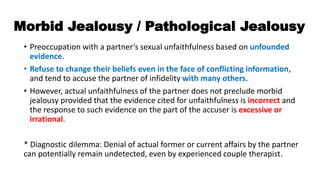
• Preoccupation with a partner’s sexual unfaithfulness based on unfounded
evidence.
• Refuse to change their beliefs even in the face of conflicting information,
and tend to accuse the partner of infidelity with many others.
• However, actual unfaithfulness of the partner does not preclude morbid
jealousy provided that the evidence cited for unfaithfulness is incorrect and
the response to such evidence on the part of the accuser is excessive or
irrational.
* Diagnostic dilemma: Denial of actual former or current affairs by the partner
can potentially remain undetected, even by experienced couple therapist.
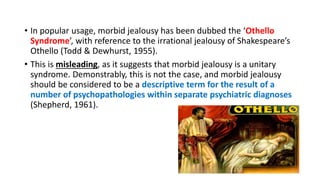
• In popular usage, morbid jealousy has been dubbed the ‘Othello
Syndrome’, with reference to the irrational jealousy of Shakespeare’s
Othello (Todd & Dewhurst, 1955).
• This is misleading, as it suggests that morbid jealousy is a unitary
syndrome. Demonstrably, this is not the case, and morbid jealousy
should be considered to be a descriptive term for the result of a
number of psychopathologies within separate psychiatric diagnoses
(Shepherd, 1961).
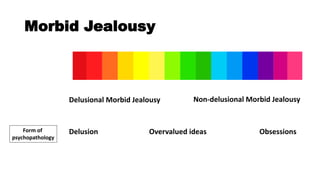
Morbid Jealousy
Delusional Morbid Jealousy Non-delusional Morbid Jealousy
Delusion Overvalued ideas ObsessionsForm of
psychopathology
Epidemiology
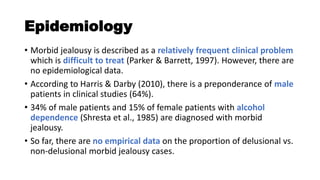
• Morbid jealousy is described as a relatively frequent clinical problem
which is difficult to treat (Parker & Barrett, 1997). However, there are
no epidemiological data.
• According to Harris & Darby (2010), there is a preponderance of male
patients in clinical studies (64%).
• 34% of male patients and 15% of female patients with alcohol
dependence (Shresta et al., 1985) are diagnosed with morbid
jealousy.
• So far, there are no empirical data on the proportion of delusional vs.
non-delusional morbid jealousy cases.
Theories of development MJ
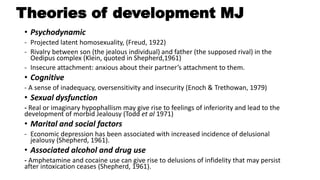
• Psychodynamic
- Projected latent homosexuality, (Freud, 1922)
- Rivalry between son (the jealous individual) and father (the supposed rival) in the
Oedipus complex (Klein, quoted in Shepherd,1961)
- Insecure attachment: anxious about their partner’s attachment to them.
• Cognitive
- A sense of inadequacy, oversensitivity and insecurity (Enoch & Trethowan, 1979)
• Sexual dysfunction
- Real or imaginary hypophallism may give rise to feelings of inferiority and lead to the
development of morbid Jealousy (Todd et al 1971)
• Marital and social factors
- Economic depression has been associated with increased incidence of delusional
jealousy (Shepherd, 1961).
• Associated alcohol and drug use
- Amphetamine and cocaine use can give rise to delusions of infidelity that may persist
after intoxication ceases (Shepherd, 1961).
Delusion
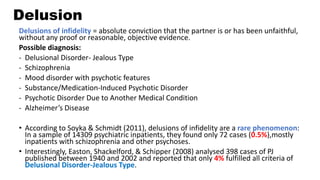
Delusions of infidelity = absolute conviction that the partner is or has been unfaithful,
without any proof or reasonable, objective evidence.
Possible diagnosis:
- Delusional Disorder- Jealous Type
- Schizophrenia
- Mood disorder with psychotic features
- Substance/Medication-Induced Psychotic Disorder
- Psychotic Disorder Due to Another Medical Condition
- Alzheimer’s Disease
• According to Soyka & Schmidt (2011), delusions of infidelity are a rare phenomenon:
In a sample of 14309 psychiatric inpatients, they found only 72 cases (0.5%),mostly
inpatients with schizophrenia and other psychoses.
• Interestingly, Easton, Shackelford, & Schipper (2008) analysed 398 cases of PJ
published between 1940 and 2002 and reported that only 4% fulfilled all criteria of
Delusional Disorder-Jealous Type.
Overvalued ideas
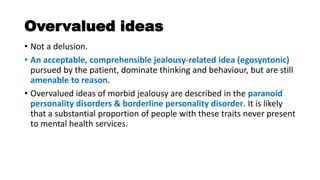
• Not a delusion.
• An acceptable, comprehensible jealousy-related idea (egosyntonic)
pursued by the patient, dominate thinking and behaviour, but are still
amenable to reason.
• Overvalued ideas of morbid jealousy are described in the paranoid
personality disorders & borderline personality disorder. It is likely
that a substantial proportion of people with these traits never present
to mental health services.
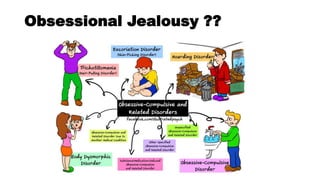
Obsessional Jealousy ??
Obsessional Jealousy
• Jealous intrusions - repetitive obsessions, egodystonic (irrational &
resisted), high degree of doubt and intolerance of uncertainty
• Compulsive rituals - excessive checking and reassurance seeking,
motivated by pervasive, tormenting doubts.
• Avoidance of jealousy-provoking situations - restrictions of the freedom of
the partner who is not allowed to leave the house or contact persons of
the opposite sex.
• Jealous checking and reassurance seeking are maintained by short-term
negative reinforcement (anxiety reduction and relief: short-lived and soon
replaced by re-emerging doubts. ).
• Illusion of control - jealous control behaviours to safeguard love
relationships are analogous to superstitious behaviours on the basis of
magical thinking in OCD.
• Positive effects of SSRIs
Normal vs Obsessional Jealousy
• More time taken up by jealous concerns.
• More distress related to jealous cognitions
• Greater functional impairment of the individual by the jealousy
problem.
• Greater negative impact on the partner (e.g., restriction of freedom
of the partner; aggressive outbursts, excessive checking/reassurance
seeking concerning the partner’s behaviour).
• Irrationality of the infidelity suspicion.
Jealousy after an affair
• Reactions very similar to those typical of morbid jealousy.
• E.g. intrusions with ‘‘visualisation of the imagined intimacies in the
affair’’, ‘‘obsessive rumination and compulsion to know all of the
details of the affair’’, ‘‘indefatigable inquiries concerning the
whereabouts’’ of the partner, hypervigilance ‘‘for continued
betrayal’’, ‘‘rage and clinging behaviours’’
• Affairs are commonly conceptualised ‘‘as a form of interpersonal
trauma’’  post-traumatic symptoms
Clinical Pictures of Obsessional Jealousy
Triggering factors:
- Indicators of the partner’s possible unfaithfulness, lack of interest or neglect
e.g., partner comes home from work late, does not want sex, shows flirtatious
behaviour towards others, talks with colleagues, receives calls, letters or gifts,
brings flowers.
- Events or conditions which threaten self-esteem
e.g. a sexual dysfunction, loss of work, subjectively impaired sexual
attractiveness due to pregnancy, comparison with potential rivals concerning
subjectively relevant features (social competence, wealth, potency, size of the
body or the penis, figure).
- Behaviours of a partner incompatible with the sufferer’s views concerning
exclusivity
e.g. hugging another person, exchanging gifts, compliments or ‘‘platonic’’
friendship.
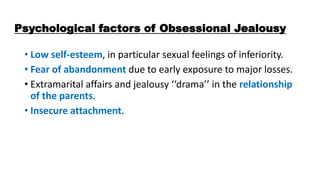
Psychological factors of Obsessional Jealousy
• Low self-esteem, in particular sexual feelings of inferiority.
• Fear of abandonment due to early exposure to major losses.
• Extramarital affairs and jealousy ‘‘drama’’ in the relationship
of the parents.
• Insecure attachment.
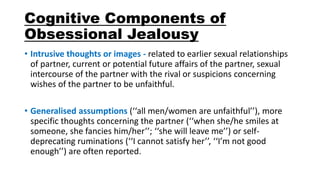
Cognitive Components of
Obsessional Jealousy
• Intrusive thoughts or images - related to earlier sexual relationships
of partner, current or potential future affairs of the partner, sexual
intercourse of the partner with the rival or suspicions concerning
wishes of the partner to be unfaithful.
• Generalised assumptions (‘‘all men/women are unfaithful’’), more
specific thoughts concerning the partner (‘‘when she/he smiles at
someone, she fancies him/her’’; ‘‘she will leave me’’) or self-
deprecating ruminations (‘‘I cannot satisfy her’’, ‘‘I’m not good
enough’’) are often reported.
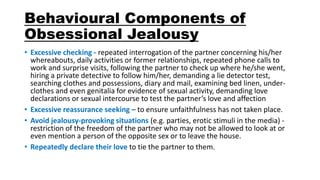
Behavioural Components of
Obsessional Jealousy
• Excessive checking - repeated interrogation of the partner concerning his/her
whereabouts, daily activities or former relationships, repeated phone calls to
work and surprise visits, following the partner to check up where he/she went,
hiring a private detective to follow him/her, demanding a lie detector test,
searching clothes and possessions, diary and mail, examining bed linen, under-
clothes and even genitalia for evidence of sexual activity, demanding love
declarations or sexual intercourse to test the partner’s love and affection
• Excessive reassurance seeking – to ensure unfaithfulness has not taken place.
• Avoid jealousy-provoking situations (e.g. parties, erotic stimuli in the media) -
restriction of the freedom of the partner who may not be allowed to look at or
even mention a person of the opposite sex or to leave the house.
• Repeatedly declare their love to tie the partner to them.
Negative consequences
• Discovery of supposed evidence seemingly confirming the unfaithfulness -
vicious circle, jealousy increases.
• Excessive checking and especially aggressive outbursts are often followed
by intense feelings of shame, remorse and guilt, feelings of inferiority,
depressed mood, suicidal ideation or even suicide attempts and suicides.
• The partner may separate from the sufferer.
• If the couple stays together, the partners tend to socially isolate
themselves to avoid jealousy- provoking situations, or friends are likely to
withdraw to avoid being confronted with the jealousy ‘‘drama’
• Physical violence leads to injury or death of the partner, imprisonment or
even suicide after homicides motivated by jealousy.
Assessment of morbid jealousy
• Full psychiatric history: affective and psychotic disorders,
threatened and perpetrated violence, the quality of the
relationship, family constitution, substance misuse, collateral
and separate history from spouse.
• Mental state examination: the form of morbid jealousy,
associated psychopathology, consideration of organic disorder.
• Risk assessment for both partners: suicide, history of
domestic violence, history of interpersonal violence including
any third party (e.g. suspected rival), risk to children.
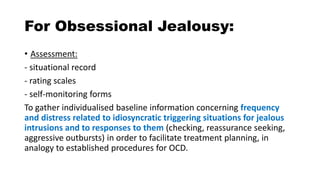
For Obsessional Jealousy:
• Assessment:
- situational record
- rating scales
- self-monitoring forms
To gather individualised baseline information concerning frequency
and distress related to idiosyncratic triggering situations for jealous
intrusions and to responses to them (checking, reassurance seeking,
aggressive outbursts) in order to facilitate treatment planning, in
analogy to established procedures for OCD.
Management of morbid jealousy
• Principles of management:
1. Treat the mental disorder
2. Manage the risk
• Biological options: Antipsychotic medication, Selective serotonin reuptake inhibitors
• Psychosocial options:
- Treatment of any substance misuse
- Cognitive–behavioural therapy : Exposure and response prevention (ERP)
- Couple therapy
- Dynamic psychotherapy
- Child protection proceedings
- Admission to hospital (compulsory detention if necessary)
- Geographical separation of the partners
Exposure and response prevention
(ERP)
• Exposure to external jealousy-provoking stimuli avoided by the patient (e.g.
looking at old photos of his wife with her former boy-friend) and supported him
to resist the urge to ask his wife for reassurance (response prevention) to allow
the associated arousal to dissipate (habituation).
• Pool of possible exposure exercises,(e.g., shopping or even leaving the house at
all without the sufferer, having a chat with a neighbour of the opposite sex over
the garden fence, watching a film together which may contain erotic scenes,
playing volleyball in a mixed-gender team without the sufferer and going for a
drink with the team afterwards, visiting a party together)
• Only mutually agreed items should be incorporated into a graded exposure
hierarchy.
• Response prevention involved instructing the sufferer not to observe the chat. In
addition, both partners were asked not to talk at all about it afterwards for one
week.
• In sufferers with aggressive impulse control problems, it may have to be
supplemented by cognitive anger management techniques.
Imaginal exposure to jealousy
obsessions
• The therapist asks questions like ‘‘What would be the worst about
your partner leaving you?’’ or ‘‘What would be the worst about not
being able to satisfy her as well as your rival?’’ The answers often
reveal problem areas which are functionally relevant to the
maintenance of PJ, e.g. a dependent personality accentuation or
sexual insecurity feelings, which will have to be tackled in therapy
with appropriate additional interventions.
• Alternative method to confront patients with jealous intrusions and
associated anticipated catastrophes is Eye Movement Desensitization
& Reprocessing (EMDR).
Tackling the “illusion of control”
• As soon as patients feel understood and validated concerning the
roots of their heightened need for control (e.g. low self- esteem,
sexual insecurity feelings, fear of abandonment due to early exposure
to major losses, insecure attachment), therapists should start to
challenge patients’ belief that safeguarding love relationships by
control is possible.
• Point out the negative effects of seemingly successful control (partner
only stays because I control him, but not voluntarily and out of love;
stable, but unhappy relationship) as well as of failure of control
(partner leaves).
Benign Alternative Model
• The therapist should offer a benign alternative model which
emphasises that love is a gift. Consequently, we cannot control
relationships, but do not need to either.
• Biographical memories related to a lack of unconditional affection in
terms of ‘‘love as a gift’’ in patients’ life histories may stirred up.
• Frequently, this helps patients to understand much better why
interpersonal uncontrollability is so difficult to tolerate that it has
been easier for them to deceive themselves about it.
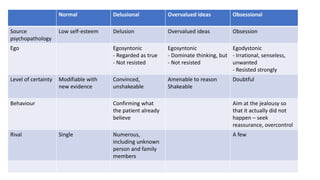
Normal Delusional Overvalued ideas Obsessional
Source
psychopathology
Low self-esteem Delusion Overvalued ideas Obsession
Ego Egosyntonic
- Regarded as true
- Not resisted
Egosyntonic
- Dominate thinking, but
- Not resisted
Egodystonic
- Irrational, senseless,
unwanted
- Resisted strongly
Level of certainty Modifiable with
new evidence
Convinced,
unshakeable
Amenable to reason
Shakeable
Doubtful
Behaviour Confirming what
the patient already
believe
Aim at the jealousy so
that it actually did not
happen – seek
reassurance, overcontrol
Rival Single Numerous,
including unknown
person and family
members
A few
Thank You

Non-delusional Morbid Jealousy [2019]

  • 1.
    Non-delusional Morbid Jealousy Postgraduate Seminar 1-8-2019 Presenter:Dr Lim Xue Bin Supervisor: PM Dr Zahiruddin Othman
  • 2.
    Jealousy • A negativeemotional state generated in response to a threatened or actual loss of a valued relationship due to the presence of a real or imagined rival. A complex social emotion (blend of emotions): - rage or anger over betrayal, fear of abandonment and the associated pain, insecurity, mistrust and suspicion, feeling hurt and humiliated, hate and grief. • Healthy people become jealous only in response to firm evidence, are prepared to modify their beliefs and reactions as new information becomes available, perceive a single rival, and transient (only persisting as long as the partner’s behaviour or infidelity continues).
  • 3.
    Morbid Jealousy /Pathological Jealousy • Preoccupation with a partner’s sexual unfaithfulness based on unfounded evidence. • Refuse to change their beliefs even in the face of conflicting information, and tend to accuse the partner of infidelity with many others. • However, actual unfaithfulness of the partner does not preclude morbid jealousy provided that the evidence cited for unfaithfulness is incorrect and the response to such evidence on the part of the accuser is excessive or irrational. * Diagnostic dilemma: Denial of actual former or current affairs by the partner can potentially remain undetected, even by experienced couple therapist.
  • 4.
    • In popularusage, morbid jealousy has been dubbed the ‘Othello Syndrome’, with reference to the irrational jealousy of Shakespeare’s Othello (Todd & Dewhurst, 1955). • This is misleading, as it suggests that morbid jealousy is a unitary syndrome. Demonstrably, this is not the case, and morbid jealousy should be considered to be a descriptive term for the result of a number of psychopathologies within separate psychiatric diagnoses (Shepherd, 1961).
  • 5.
    Morbid Jealousy Delusional MorbidJealousy Non-delusional Morbid Jealousy Delusion Overvalued ideas ObsessionsForm of psychopathology
  • 6.
    Epidemiology • Morbid jealousyis described as a relatively frequent clinical problem which is difficult to treat (Parker & Barrett, 1997). However, there are no epidemiological data. • According to Harris & Darby (2010), there is a preponderance of male patients in clinical studies (64%). • 34% of male patients and 15% of female patients with alcohol dependence (Shresta et al., 1985) are diagnosed with morbid jealousy. • So far, there are no empirical data on the proportion of delusional vs. non-delusional morbid jealousy cases.
  • 7.
    Theories of developmentMJ • Psychodynamic - Projected latent homosexuality, (Freud, 1922) - Rivalry between son (the jealous individual) and father (the supposed rival) in the Oedipus complex (Klein, quoted in Shepherd,1961) - Insecure attachment: anxious about their partner’s attachment to them. • Cognitive - A sense of inadequacy, oversensitivity and insecurity (Enoch & Trethowan, 1979) • Sexual dysfunction - Real or imaginary hypophallism may give rise to feelings of inferiority and lead to the development of morbid Jealousy (Todd et al 1971) • Marital and social factors - Economic depression has been associated with increased incidence of delusional jealousy (Shepherd, 1961). • Associated alcohol and drug use - Amphetamine and cocaine use can give rise to delusions of infidelity that may persist after intoxication ceases (Shepherd, 1961).
  • 8.
    Delusion Delusions of infidelity= absolute conviction that the partner is or has been unfaithful, without any proof or reasonable, objective evidence. Possible diagnosis: - Delusional Disorder- Jealous Type - Schizophrenia - Mood disorder with psychotic features - Substance/Medication-Induced Psychotic Disorder - Psychotic Disorder Due to Another Medical Condition - Alzheimer’s Disease • According to Soyka & Schmidt (2011), delusions of infidelity are a rare phenomenon: In a sample of 14309 psychiatric inpatients, they found only 72 cases (0.5%),mostly inpatients with schizophrenia and other psychoses. • Interestingly, Easton, Shackelford, & Schipper (2008) analysed 398 cases of PJ published between 1940 and 2002 and reported that only 4% fulfilled all criteria of Delusional Disorder-Jealous Type.
  • 9.
    Overvalued ideas • Nota delusion. • An acceptable, comprehensible jealousy-related idea (egosyntonic) pursued by the patient, dominate thinking and behaviour, but are still amenable to reason. • Overvalued ideas of morbid jealousy are described in the paranoid personality disorders & borderline personality disorder. It is likely that a substantial proportion of people with these traits never present to mental health services.
  • 10.
  • 11.
    Obsessional Jealousy • Jealousintrusions - repetitive obsessions, egodystonic (irrational & resisted), high degree of doubt and intolerance of uncertainty • Compulsive rituals - excessive checking and reassurance seeking, motivated by pervasive, tormenting doubts. • Avoidance of jealousy-provoking situations - restrictions of the freedom of the partner who is not allowed to leave the house or contact persons of the opposite sex. • Jealous checking and reassurance seeking are maintained by short-term negative reinforcement (anxiety reduction and relief: short-lived and soon replaced by re-emerging doubts. ). • Illusion of control - jealous control behaviours to safeguard love relationships are analogous to superstitious behaviours on the basis of magical thinking in OCD. • Positive effects of SSRIs
  • 12.
    Normal vs ObsessionalJealousy • More time taken up by jealous concerns. • More distress related to jealous cognitions • Greater functional impairment of the individual by the jealousy problem. • Greater negative impact on the partner (e.g., restriction of freedom of the partner; aggressive outbursts, excessive checking/reassurance seeking concerning the partner’s behaviour). • Irrationality of the infidelity suspicion.
  • 13.
    Jealousy after anaffair • Reactions very similar to those typical of morbid jealousy. • E.g. intrusions with ‘‘visualisation of the imagined intimacies in the affair’’, ‘‘obsessive rumination and compulsion to know all of the details of the affair’’, ‘‘indefatigable inquiries concerning the whereabouts’’ of the partner, hypervigilance ‘‘for continued betrayal’’, ‘‘rage and clinging behaviours’’ • Affairs are commonly conceptualised ‘‘as a form of interpersonal trauma’’  post-traumatic symptoms
  • 14.
    Clinical Pictures ofObsessional Jealousy Triggering factors: - Indicators of the partner’s possible unfaithfulness, lack of interest or neglect e.g., partner comes home from work late, does not want sex, shows flirtatious behaviour towards others, talks with colleagues, receives calls, letters or gifts, brings flowers. - Events or conditions which threaten self-esteem e.g. a sexual dysfunction, loss of work, subjectively impaired sexual attractiveness due to pregnancy, comparison with potential rivals concerning subjectively relevant features (social competence, wealth, potency, size of the body or the penis, figure). - Behaviours of a partner incompatible with the sufferer’s views concerning exclusivity e.g. hugging another person, exchanging gifts, compliments or ‘‘platonic’’ friendship.
  • 15.
    Psychological factors ofObsessional Jealousy • Low self-esteem, in particular sexual feelings of inferiority. • Fear of abandonment due to early exposure to major losses. • Extramarital affairs and jealousy ‘‘drama’’ in the relationship of the parents. • Insecure attachment.
  • 16.
    Cognitive Components of ObsessionalJealousy • Intrusive thoughts or images - related to earlier sexual relationships of partner, current or potential future affairs of the partner, sexual intercourse of the partner with the rival or suspicions concerning wishes of the partner to be unfaithful. • Generalised assumptions (‘‘all men/women are unfaithful’’), more specific thoughts concerning the partner (‘‘when she/he smiles at someone, she fancies him/her’’; ‘‘she will leave me’’) or self- deprecating ruminations (‘‘I cannot satisfy her’’, ‘‘I’m not good enough’’) are often reported.
  • 17.
    Behavioural Components of ObsessionalJealousy • Excessive checking - repeated interrogation of the partner concerning his/her whereabouts, daily activities or former relationships, repeated phone calls to work and surprise visits, following the partner to check up where he/she went, hiring a private detective to follow him/her, demanding a lie detector test, searching clothes and possessions, diary and mail, examining bed linen, under- clothes and even genitalia for evidence of sexual activity, demanding love declarations or sexual intercourse to test the partner’s love and affection • Excessive reassurance seeking – to ensure unfaithfulness has not taken place. • Avoid jealousy-provoking situations (e.g. parties, erotic stimuli in the media) - restriction of the freedom of the partner who may not be allowed to look at or even mention a person of the opposite sex or to leave the house. • Repeatedly declare their love to tie the partner to them.
  • 18.
    Negative consequences • Discoveryof supposed evidence seemingly confirming the unfaithfulness - vicious circle, jealousy increases. • Excessive checking and especially aggressive outbursts are often followed by intense feelings of shame, remorse and guilt, feelings of inferiority, depressed mood, suicidal ideation or even suicide attempts and suicides. • The partner may separate from the sufferer. • If the couple stays together, the partners tend to socially isolate themselves to avoid jealousy- provoking situations, or friends are likely to withdraw to avoid being confronted with the jealousy ‘‘drama’ • Physical violence leads to injury or death of the partner, imprisonment or even suicide after homicides motivated by jealousy.
  • 20.
    Assessment of morbidjealousy • Full psychiatric history: affective and psychotic disorders, threatened and perpetrated violence, the quality of the relationship, family constitution, substance misuse, collateral and separate history from spouse. • Mental state examination: the form of morbid jealousy, associated psychopathology, consideration of organic disorder. • Risk assessment for both partners: suicide, history of domestic violence, history of interpersonal violence including any third party (e.g. suspected rival), risk to children.
  • 21.
    For Obsessional Jealousy: •Assessment: - situational record - rating scales - self-monitoring forms To gather individualised baseline information concerning frequency and distress related to idiosyncratic triggering situations for jealous intrusions and to responses to them (checking, reassurance seeking, aggressive outbursts) in order to facilitate treatment planning, in analogy to established procedures for OCD.
  • 22.
    Management of morbidjealousy • Principles of management: 1. Treat the mental disorder 2. Manage the risk • Biological options: Antipsychotic medication, Selective serotonin reuptake inhibitors • Psychosocial options: - Treatment of any substance misuse - Cognitive–behavioural therapy : Exposure and response prevention (ERP) - Couple therapy - Dynamic psychotherapy - Child protection proceedings - Admission to hospital (compulsory detention if necessary) - Geographical separation of the partners
  • 23.
    Exposure and responseprevention (ERP) • Exposure to external jealousy-provoking stimuli avoided by the patient (e.g. looking at old photos of his wife with her former boy-friend) and supported him to resist the urge to ask his wife for reassurance (response prevention) to allow the associated arousal to dissipate (habituation). • Pool of possible exposure exercises,(e.g., shopping or even leaving the house at all without the sufferer, having a chat with a neighbour of the opposite sex over the garden fence, watching a film together which may contain erotic scenes, playing volleyball in a mixed-gender team without the sufferer and going for a drink with the team afterwards, visiting a party together) • Only mutually agreed items should be incorporated into a graded exposure hierarchy. • Response prevention involved instructing the sufferer not to observe the chat. In addition, both partners were asked not to talk at all about it afterwards for one week. • In sufferers with aggressive impulse control problems, it may have to be supplemented by cognitive anger management techniques.
  • 24.
    Imaginal exposure tojealousy obsessions • The therapist asks questions like ‘‘What would be the worst about your partner leaving you?’’ or ‘‘What would be the worst about not being able to satisfy her as well as your rival?’’ The answers often reveal problem areas which are functionally relevant to the maintenance of PJ, e.g. a dependent personality accentuation or sexual insecurity feelings, which will have to be tackled in therapy with appropriate additional interventions. • Alternative method to confront patients with jealous intrusions and associated anticipated catastrophes is Eye Movement Desensitization & Reprocessing (EMDR).
  • 25.
    Tackling the “illusionof control” • As soon as patients feel understood and validated concerning the roots of their heightened need for control (e.g. low self- esteem, sexual insecurity feelings, fear of abandonment due to early exposure to major losses, insecure attachment), therapists should start to challenge patients’ belief that safeguarding love relationships by control is possible. • Point out the negative effects of seemingly successful control (partner only stays because I control him, but not voluntarily and out of love; stable, but unhappy relationship) as well as of failure of control (partner leaves).
  • 26.
    Benign Alternative Model •The therapist should offer a benign alternative model which emphasises that love is a gift. Consequently, we cannot control relationships, but do not need to either. • Biographical memories related to a lack of unconditional affection in terms of ‘‘love as a gift’’ in patients’ life histories may stirred up. • Frequently, this helps patients to understand much better why interpersonal uncontrollability is so difficult to tolerate that it has been easier for them to deceive themselves about it.
  • 27.
    Normal Delusional Overvaluedideas Obsessional Source psychopathology Low self-esteem Delusion Overvalued ideas Obsession Ego Egosyntonic - Regarded as true - Not resisted Egosyntonic - Dominate thinking, but - Not resisted Egodystonic - Irrational, senseless, unwanted - Resisted strongly Level of certainty Modifiable with new evidence Convinced, unshakeable Amenable to reason Shakeable Doubtful Behaviour Confirming what the patient already believe Aim at the jealousy so that it actually did not happen – seek reassurance, overcontrol Rival Single Numerous, including unknown person and family members A few
  • 28.