Team – Miracle Workers

Welingkar Institute of Management Development and Research
                      (WE School) Mumbai

Name            Email                       Cell phone #


Lydia Jacob     lydiasarahjacob@gmail.com   09833639212

Vrushali Nayak vrushalinayak@gmail.com      09769763986
Consolidated Drug Distribution
• Refers to the process where pharmaceutical
  manufacturers supply dispensing points directly through a
  limited number of distributors.
• Advantage of this system : The stock is owned by the
  manufacturer who pays a fee to the distributors for their
  service.
• Implications of this system :
  1) Large companies can have end-to-end control of the
  distribution process
  2) Price control at the point of sale.
  3) Reducing the threat of counterfeiting
  4) Realise efficiency improvements in the distribution
  process
Why should MegaIndia –
HealthyUS enter this JV
•   Drug distribution venture will be welcomed by companies
    as it eliminates atleast 1 level in the chain and thus cuts
    down the cost.
•   Boom of medical tourism in India. It has the potential to
    grow into a $2 billion industry by 2012.
•   70% of the Indian population resides in the rural areas
    and there are 593,731 inhabited villages in India which is
    largely untapped market.
•   Organised drug retail can flourish if its backbone i.e. the
    distribution system is in place
•   When M&A takes place in pharma sector, the stockists of
    the two companies add up causing a lot of small
    companies to go out of business. Hence, the one-stop
    distribution model which will cater to all companies will be
    useful to avoid this situation.
Logisitics
•   Tie ups with certain companies :
     1. FastCarry Courier and Cargo Ltd. for its courier
          services.
     2. ACME Cold Chain Solutions Ltd for cold chain
          management. ACME has come up with a
          technology (patented) that enables maintaining
          desired temperatures of cold storages (8-16 h)
          without having any dependence on a Diesel
          Generator (DG) set. This not only saves energy, but
          also the environment from noise and smoke
          generated by the DG sets.
Delivery Process
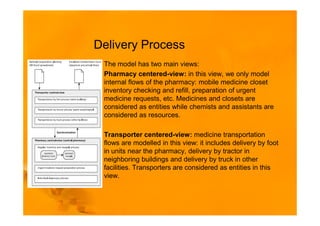
•   The model has two main views:
•   Pharmacy centered-view: in this view, we only model
    internal flows of the pharmacy: mobile medicine closet
    inventory checking and refill, preparation of urgent
    medicine requests, etc. Medicines and closets are
    considered as entities while chemists and assistants are
    considered as resources.

•   Transporter centered-view: medicine transportation
    flows are modelled in this view: it includes delivery by foot
    in units near the pharmacy, delivery by tractor in
    neighboring buildings and delivery by truck in other
    facilities. Transporters are considered as entities in this
    view.
Future path for Logistics
•   The refrigerated (reefer) transport, which forms 12% of
    the cold chain market, is valued at Rs.12 billion and is
    expected to reach Rs.48 billion. In terms of volume,
    current reefer transportation business is about four million
    metric tonnes and is expected to reach 14 million metric
    tonnes within five years. Majority of the demand (62.5%)
    for refrigerated transport is export driven. Hence we can
    venture into cold chain management at a later stage once.
•   Need to use temperature monitoring with automatic
    reporting, suitable alert systems so that appropriate timely
    actions are taken in case of deviations. It is proven that
    such measures improve the quality of cold chain and also
    minimise wastage in long run.
IT Integration
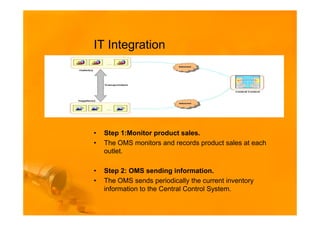
Components for a web based generic SCMS :
  OMS (Outlet Monitor System)
• Actual “point of sale” where the goods sold to the
  customer. The OMS at each outlet keeps track of the
  inventory at a particular outlet.

    SMS (Supplier Management System)
•   A supplier or the provider acts as the source of the raw
    materials. The supplier responds and caters to the
    requests and dispatches new inventory to the outlets on
    demand.

    CCS (Central Control System)
•   The CCS forms the core of the system that monitors,
    controls and manages the OMS and SMS.
IT Integration


•   Step 1:Monitor product sales.
•   The OMS monitors and records product sales at each
    outlet.

•   Step 2: OMS sending information.
•   The OMS sends periodically the current inventory
    information to the Central Control System.
IT Integration (Cont)
•   Step 3: CCS processing information.
•   The CCS processes the incoming information to take
    delivery decisions.

•   Step 4: CCS placing order.
•   The CCS places order to a supplier.

•   Step 5: Servicing product request.
•   The SMS processes the product request submitted by
    the CCS and dispatches the requested quantity of
    products to the corresponding outlet.

•   Step 6: Order receipt acknowledgement.
•   The Outlet intimates the order receipt to the CCS.
Entering rural India
•   Focus should be more on generic drugs. Branded drugs are
    relatively expensive. Brands can later push their products
    when they are ready to pass on the benefits received from the
    reduction in supply chain costs.
•   Distribution in rural markets can be done in two different ways
    on the basis of types of drugs -
    1) Drugs that need temperature controlled environment –
     a. Temperature controlled trucks and vans.
     b. Roads – Trucks, and if narrow roads, AC pushcarts
         (trolleys) by Acme Cold Chain Solutions Ltd for shorter
         distances to reach the retailers.
    2) Drugs that don’t need temperature controlled environment -
    All types of transportation facilities like trucks, vans, rickshaws,
    and even bullock carts if need be.
•   Catering to medical stores, Chaupal Saagars, hospitals,
    melas, haats.
References
•   http://www.expresspharmaonline.com/
•   http://www.indg.gov.in/rural-india/number-of-villages
•   http://www.censusindia.gov.in/Census_Data_2001/Census_data_finder/A_Series/Number_of_Vill
    age.htm
•   http://www.ngpharma.eu.com/article/Consolidated-distribution/
•   http://www.dnaindia.com/india/report_fresh-veggies-to-storm-homes-in-ac-pushcart_1093446
•   Cold Chain Infrastructure for Frozen Food: A Weak Link in Indian Retail Sector. By: Rathore,
    Jitendra; Sharma, Anamika; Saxena, Karunesh. IUP Journal of Supply Chain Management,
    Mar2010, Vol. 7 Issue 1/2, p90-103, 14p
•   Redesigning pharmacy delivery processes of a health care complex Vincent Augusto · Xiaolan
    Xie
•   RFID Adoption by Indian Retailers: An Exploratory Study
    Chandan A Chavadi and Shilpa S Kokatnur
•   Is Web-Based Supply Chain Integration Right for Your Company? by Charles E. Downing
•   Logistics and Supply Chain Practices In India by Samir K. Srivastava

Chain Reaction Drug Distribution System

  • 1.
    Team – MiracleWorkers Welingkar Institute of Management Development and Research (WE School) Mumbai Name Email Cell phone # Lydia Jacob lydiasarahjacob@gmail.com 09833639212 Vrushali Nayak vrushalinayak@gmail.com 09769763986
  • 2.
    Consolidated Drug Distribution •Refers to the process where pharmaceutical manufacturers supply dispensing points directly through a limited number of distributors. • Advantage of this system : The stock is owned by the manufacturer who pays a fee to the distributors for their service. • Implications of this system : 1) Large companies can have end-to-end control of the distribution process 2) Price control at the point of sale. 3) Reducing the threat of counterfeiting 4) Realise efficiency improvements in the distribution process
  • 3.
    Why should MegaIndia– HealthyUS enter this JV • Drug distribution venture will be welcomed by companies as it eliminates atleast 1 level in the chain and thus cuts down the cost. • Boom of medical tourism in India. It has the potential to grow into a $2 billion industry by 2012. • 70% of the Indian population resides in the rural areas and there are 593,731 inhabited villages in India which is largely untapped market. • Organised drug retail can flourish if its backbone i.e. the distribution system is in place • When M&A takes place in pharma sector, the stockists of the two companies add up causing a lot of small companies to go out of business. Hence, the one-stop distribution model which will cater to all companies will be useful to avoid this situation.
  • 4.
    Logisitics • Tie ups with certain companies : 1. FastCarry Courier and Cargo Ltd. for its courier services. 2. ACME Cold Chain Solutions Ltd for cold chain management. ACME has come up with a technology (patented) that enables maintaining desired temperatures of cold storages (8-16 h) without having any dependence on a Diesel Generator (DG) set. This not only saves energy, but also the environment from noise and smoke generated by the DG sets.
  • 5.
    Delivery Process • The model has two main views: • Pharmacy centered-view: in this view, we only model internal flows of the pharmacy: mobile medicine closet inventory checking and refill, preparation of urgent medicine requests, etc. Medicines and closets are considered as entities while chemists and assistants are considered as resources. • Transporter centered-view: medicine transportation flows are modelled in this view: it includes delivery by foot in units near the pharmacy, delivery by tractor in neighboring buildings and delivery by truck in other facilities. Transporters are considered as entities in this view.
  • 6.
    Future path forLogistics • The refrigerated (reefer) transport, which forms 12% of the cold chain market, is valued at Rs.12 billion and is expected to reach Rs.48 billion. In terms of volume, current reefer transportation business is about four million metric tonnes and is expected to reach 14 million metric tonnes within five years. Majority of the demand (62.5%) for refrigerated transport is export driven. Hence we can venture into cold chain management at a later stage once. • Need to use temperature monitoring with automatic reporting, suitable alert systems so that appropriate timely actions are taken in case of deviations. It is proven that such measures improve the quality of cold chain and also minimise wastage in long run.
  • 7.
    IT Integration Components fora web based generic SCMS : OMS (Outlet Monitor System) • Actual “point of sale” where the goods sold to the customer. The OMS at each outlet keeps track of the inventory at a particular outlet. SMS (Supplier Management System) • A supplier or the provider acts as the source of the raw materials. The supplier responds and caters to the requests and dispatches new inventory to the outlets on demand. CCS (Central Control System) • The CCS forms the core of the system that monitors, controls and manages the OMS and SMS.
  • 8.
    IT Integration • Step 1:Monitor product sales. • The OMS monitors and records product sales at each outlet. • Step 2: OMS sending information. • The OMS sends periodically the current inventory information to the Central Control System.
  • 9.
    IT Integration (Cont) • Step 3: CCS processing information. • The CCS processes the incoming information to take delivery decisions. • Step 4: CCS placing order. • The CCS places order to a supplier. • Step 5: Servicing product request. • The SMS processes the product request submitted by the CCS and dispatches the requested quantity of products to the corresponding outlet. • Step 6: Order receipt acknowledgement. • The Outlet intimates the order receipt to the CCS.
  • 10.
    Entering rural India • Focus should be more on generic drugs. Branded drugs are relatively expensive. Brands can later push their products when they are ready to pass on the benefits received from the reduction in supply chain costs. • Distribution in rural markets can be done in two different ways on the basis of types of drugs - 1) Drugs that need temperature controlled environment – a. Temperature controlled trucks and vans. b. Roads – Trucks, and if narrow roads, AC pushcarts (trolleys) by Acme Cold Chain Solutions Ltd for shorter distances to reach the retailers. 2) Drugs that don’t need temperature controlled environment - All types of transportation facilities like trucks, vans, rickshaws, and even bullock carts if need be. • Catering to medical stores, Chaupal Saagars, hospitals, melas, haats.
  • 11.
    References • http://www.expresspharmaonline.com/ • http://www.indg.gov.in/rural-india/number-of-villages • http://www.censusindia.gov.in/Census_Data_2001/Census_data_finder/A_Series/Number_of_Vill age.htm • http://www.ngpharma.eu.com/article/Consolidated-distribution/ • http://www.dnaindia.com/india/report_fresh-veggies-to-storm-homes-in-ac-pushcart_1093446 • Cold Chain Infrastructure for Frozen Food: A Weak Link in Indian Retail Sector. By: Rathore, Jitendra; Sharma, Anamika; Saxena, Karunesh. IUP Journal of Supply Chain Management, Mar2010, Vol. 7 Issue 1/2, p90-103, 14p • Redesigning pharmacy delivery processes of a health care complex Vincent Augusto · Xiaolan Xie • RFID Adoption by Indian Retailers: An Exploratory Study Chandan A Chavadi and Shilpa S Kokatnur • Is Web-Based Supply Chain Integration Right for Your Company? by Charles E. Downing • Logistics and Supply Chain Practices In India by Samir K. Srivastava