Human Drug Distribution
By,
Mr. Gunjan Srivastava,
A.P., Hygia
The sections highlighted in yellow represent the key
organs in our absorption, metabolism, and excretion
models with the rest collectively representing the
distribution or circulatory system. At ,
(1) A given mass of drug enters the stomach interior.
(2) The drug enters the small intestine, becoming absorbed by
the lining of the small intestine into the bloodstream.
(3) Blood moves from the small intestine into the liver, where it
can either be metabolized in the cellular space of the liver.
(4) Goes to the heart, being diluted by joining other veins and
mixing.
(5) Blood moves from the pulmonary system to the entire body
in the red arteries and then
(6) Moves to the capillary system and interacts with the tissue
in various parts of the body. The drug that is transported to
the kidney or liver may be excreted or metabolized.
(7) The blood returns through the blue venous system back to
the heart.
• To understand drug distribution need to discuss,
1. The Heart
2. Blood Transit time
3. Capillary system
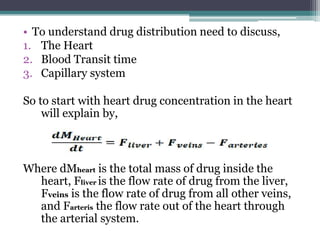
So to start with heart drug concentration in the heart
will explain by,
Where dMheart is the total mass of drug inside the
heart, Fliver is the flow rate of drug from the liver,
Fveins is the flow rate of drug from all other veins,
and Farteris the flow rate out of the heart through
the arterial system.
The change in concentration inside the heart is
simply the sum of the change in concentration
from entrance to exit for each of the capillaries in
the body, divided by the volume of the heart. It
will reduce the concentration of drug explain by,
Where Qi is the flow rate to a given capillary, ΔCapi
is difference in concentration between the
entrance and exit of a given capillary, and Vh is
the volume of the heart.
• The transit time for drug is the movement of
blood from the hepatic portal vein, through the
inferior vena cava, and finally to the heart.
• Generally due to high flow rate and low volume
this transit time will be less then a second.
• Legget et al. done the research on human transit
time and found that,
The transit time from the right heart to the left
heart (about 8 seconds).
Used the estimated transit time to the extremities
as the basis for all our organ systems (about 3
seconds).
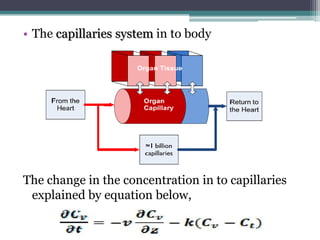
• The capillaries system in to body
The change in the concentration in to capillaries
explained by equation below,
In above equation,
v=Velocity of blood through capillaries
k= Transfer rate constant b/w tissue and capillaries
Ct= Concentration of drug in tissue.
Cv= Concentration in Veins
 The rate of concentration change in tissue (mass
transfer) explained by,
Compartment modeling
1. Method of Line
2. 4th order Runge Kutta Method
Method of Line
4th order Runge Kutta Method
Differential equation for distribution
• Cp=drug concentration in blood plasma (g)
• X=dose of drug in body (mg)
• Vd=volume of distribution of drug (L)
• R=constant(mg/L)
Human drug distribution

Human drug distribution

  • 1.
    Human Drug Distribution By, Mr.Gunjan Srivastava, A.P., Hygia
  • 3.
    The sections highlightedin yellow represent the key organs in our absorption, metabolism, and excretion models with the rest collectively representing the distribution or circulatory system. At , (1) A given mass of drug enters the stomach interior. (2) The drug enters the small intestine, becoming absorbed by the lining of the small intestine into the bloodstream. (3) Blood moves from the small intestine into the liver, where it can either be metabolized in the cellular space of the liver. (4) Goes to the heart, being diluted by joining other veins and mixing. (5) Blood moves from the pulmonary system to the entire body in the red arteries and then (6) Moves to the capillary system and interacts with the tissue in various parts of the body. The drug that is transported to the kidney or liver may be excreted or metabolized. (7) The blood returns through the blue venous system back to the heart.
  • 5.
    • To understanddrug distribution need to discuss, 1. The Heart 2. Blood Transit time 3. Capillary system So to start with heart drug concentration in the heart will explain by, Where dMheart is the total mass of drug inside the heart, Fliver is the flow rate of drug from the liver, Fveins is the flow rate of drug from all other veins, and Farteris the flow rate out of the heart through the arterial system.
  • 6.
    The change inconcentration inside the heart is simply the sum of the change in concentration from entrance to exit for each of the capillaries in the body, divided by the volume of the heart. It will reduce the concentration of drug explain by, Where Qi is the flow rate to a given capillary, ΔCapi is difference in concentration between the entrance and exit of a given capillary, and Vh is the volume of the heart.
  • 7.
    • The transittime for drug is the movement of blood from the hepatic portal vein, through the inferior vena cava, and finally to the heart. • Generally due to high flow rate and low volume this transit time will be less then a second. • Legget et al. done the research on human transit time and found that, The transit time from the right heart to the left heart (about 8 seconds). Used the estimated transit time to the extremities as the basis for all our organ systems (about 3 seconds).
  • 8.
    • The capillariessystem in to body The change in the concentration in to capillaries explained by equation below,
  • 9.
    In above equation, v=Velocityof blood through capillaries k= Transfer rate constant b/w tissue and capillaries Ct= Concentration of drug in tissue. Cv= Concentration in Veins  The rate of concentration change in tissue (mass transfer) explained by,
  • 11.
    Compartment modeling 1. Methodof Line 2. 4th order Runge Kutta Method
  • 12.
  • 13.
    4th order RungeKutta Method
  • 14.
    Differential equation fordistribution • Cp=drug concentration in blood plasma (g) • X=dose of drug in body (mg) • Vd=volume of distribution of drug (L) • R=constant(mg/L)