
Supply Chain Management
Presenter
Mr. Jones H.M -MBA
OVERVIEW OF SUPPLY CHAIN
MANAGEMENT
โ€ข
โ€ข
Prior to the 1980s, business ๏ฌrms were
using terms such as, โ€œlogisticsโ€, and
โ€œoperations managementโ€ instead of
supply Chain Management.
The term was coined by a British
logistician and consultant by the name of,
Keith Oliver in the 1980s.
ย 
OVERVIEW OF SUPPLY CHAIN
MANAGEMENT
โ€ข
โ€ข
The term was ๏ฌrst used in public in an
interview with Arnold Kransdorff of the
Financial Times on 4 June 1982
Theย termย Supplyย Chainย Managementย came
intoย widespreadย useย inย theย 1990s
OVERVIEW OF SUPPLY CHAIN
MANAGEMENT
โ€ข
โ€ข
Continuous evolution of the supply chain
and of the techniques to manage it
effectively were motivated by the
following:
Fierce competition in todayโ€™s global
markets,
Introduction of products with shorter life
cycles
OVERVIEW OF SUPPLY CHAIN
MANAGEMENT
โ€ข
โ€ข
โ€ข
The heightened expectations of
customers,
New rules of competition and the
downward pressure on prices,
Continuing advances in communications
and transportation technologies (e.g.,
mobile communication, Internet, and
overnight delivery),
OVERVIEW OF SUPPLY CHAIN
MANAGEMENT
โ€ข Supply chain management builds upon the
concept of logistics and seeks to achieve
linkage and coordination between the
processes of other entities in the pipeline
( suppliers and customers).
โ€ข
According to the council of Supply Chain
Management Professionals ( CSCMP,2011)
โ€œSupply Chain Management encompasses
the planning and management of all
activities involved in sourcing,
procurement ,and all logistics
management activities
De๏ฌnition of Supply Chain
Management
De๏ฌnition of Logistics
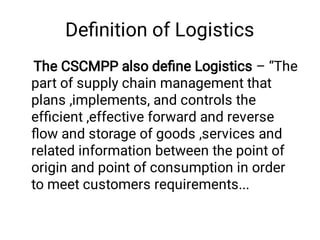
The CSCMPP also de๏ฌne Logistics โ€“ โ€œThe
part of supply chain management that
plans ,implements, and controls the
ef๏ฌcient ,effective forward and reverse
๏ฌ‚ow and storage of goods ,services and
related information between the point of
origin and point of consumption in order
to meet customers requirements...
De๏ฌnition of Logistics
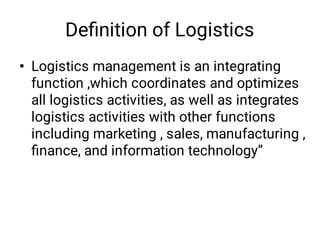
โ€ข Logistics management is an integrating
function ,which coordinates and optimizes
all logistics activities, as well as integrates
logistics activities with other functions
including marketing , sales, manufacturing ,
๏ฌnance, and information technologyโ€
Comparison of logistics and supply
chain management:
โ€ข
โ€ข
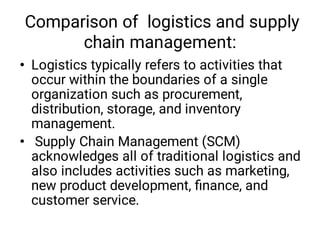
Logistics typically refers to activities that
occur within the boundaries of a single
organization such as procurement,
distribution, storage, and inventory
management.
Supply Chain Management (SCM)
acknowledges all of traditional logistics and
also includes activities such as marketing,
new product development,ย ๏ฌnance, and
customer service.
Comparison of logistics and supply
chain management:
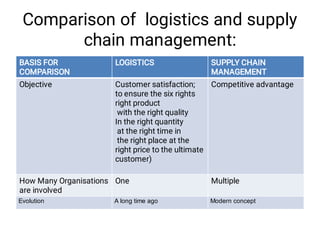
BASIS FOR
COMPARISON
LOGISTICS SUPPLY CHAIN
MANAGEMENT
Objective Customer satisfaction;
to ensure the six rights
right product
with the right quality
In the right quantity
at the right time in
the right place at the
right price to the ultimate
customer)
Competitive advantage
How Many Organisations
are involved
One Multiple
Evolution Aย longย timeย ago Modernย concept
Purpose of Logistics
โ€ข
โ€ข
โ€ข
โ€ข
โ€ข
โ€ข
The purpose of a logistics system is to
ensure the six rights:
The right drugs and medical supplies
in the right quantities
in the right condition
are delivered to the right place
at the right time
for the right price.
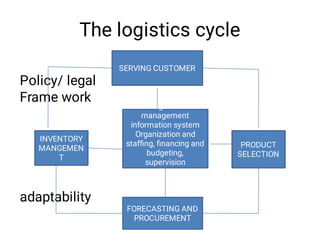
The logistics cycle
Policy/ legal
Frame work
adaptability
SERVING CUSTOMER
PRODUCT
SELECTION
FORECASTING AND
PROCUREMENT
INVENTORY
MANGEMEN
T
Logistics
management
information system
Organization and
staf๏ฌng, ๏ฌnancing and
budgeting,
supervision
evaluation
ย 
Major Activities of the Logistics
Cycle
โ€ข
โ€ข
Serving Customers:Everyone working in
logistics must remember that their job is to
select, procure, store, or distribute products
to meet customer needs
Product selection: In a health logistics
system, a national formulary and
therapeutics committee, pharmaceutical
board, board of physicians, or other
government-appointed group select
products to meet the needs of patients.
Major Activities of the Logistics
Cycle
โ€ข Quanti๏ฌcation :After products are selected,
managers must determine the quantity
needed for each product, for a speci๏ฌc time
periodโ€”this is called quanti๏ฌcation.
Quanti๏ฌcation depends on accurate
forecasting
Procurement: Procurement plans are based
on requirements estimates that are
determined mathematically for each
product.
Major Activities of the Logistics
Cycle
โ€ข Inventory management: A programโ€™s
inventory control strategy speci๏ฌes how
much stock to store and where to store it.
Enough stock should be available to meet
customer needs until a new order is
received; but not so much that stocks
expire or are wasted or that you exceed
storage capacity.
Major Activities of the Logistics
Cycle
โ€ข Quality monitoring:Quality monitoring
appears between each activity of the
logistics cycle and ensures that the quality
of all the activities in the cycle are
monitored. Management Information
Systems: Information drives the logistics
cycle; without it, the logistics system
cannot run smoothly. Managers gather
information about each activity in the
system and then analyze that information
to make decisions.
Major Activities of the Logistics
Cycle
Organization and Staf๏ฌng:A logistics system
can only work when the staff are well-
trained and operate in a supportive
environment. They must have the right tools
to do their jobs, whether they place orders,
coordinate shipments, oversee deliveries, or
keep a warehouse functioning effectively to
ensure that the right product, in the right
quantity, is shipped to the client.
Major Activities of the Logistics
Cycle
Organization and Staf๏ฌng:A logistics system
can only work when the staff are well-
trained and operate in a supportive
environment. They must have the right tools
to do their jobs, whether they place orders,
coordinate shipments, oversee deliveries, or
keep a warehouse functioning effectively to
ensure that the right product, in the right
quantity, is shipped to the client.
Major Activities of the Logistics
Cycle
โ€ข Supervision:If the logistics system is
carefully watched, it will run smoothly and
staff will anticipate any needed changes.
The effective supervision of logistics
activities minimizes problems and/or
resolves them quickly before any one
problem becomes a crisis.
Major Activities of the Logistics
Cycle
โ€ข Budgeting : affects the product selection,
quantity of products procured, amount of
storage space available, transport, and
number of staff working in logistics. To
have the entire system operating
effectively, logistics activities must be
included in operational planning and
receive suf๏ฌcient funds.
Use of standard operating
procedure manual
โ€ข The manual is intended to simplify and
standardise the work required for logistics
management in order to allow health
workers more time for client focused
activities. The manual guides health care
workers in completing the following tasks
with the help of Job aids.
Use of standard operating
procedure manual
โ€ข
โ€ข
โ€ข
โ€ข
โ€ข
Maintaining adequate supplies of
commodities
Reporting essential logistics data and
ordering of commodities from MSl
Receiving and storing
Recording and reporting issues
Monitoring logistics activities throughout
the system
Supply chain pipeline
โ€ข The pipeline includes the entire chain of
storage facilities and transportation links
that move supplies from the manufacturer
to the consumer, including port facilities,
central warehouses, regional warehouses,
district and sub district stores, service
delivery points, and transportation
vehicles.
Supply chain pipeline
โ€ข A supply chain consists of activities and
organisations that materials move through
on their journey from initial suppliers to
the ๏ฌnal customer.
Supply chain pipeline
โ€ข A supply chain consists of activities and
organisations that materials move through
on their journey from initial suppliers to
the ๏ฌnal customer.
Supply chain pipeline
โ€ข The pipeline includes the entire chain of
storage facilities and transportation links
that move supplies from the manufacturer
to the consumer, including port facilities,
central warehouses, regional warehouses,
district and sub district stores, service
delivery points, and transportation
vehicles
Logistics management information
system ( LMIS)
โ€ข The basic purpose of an LMIS is to collect
and report information to other levels in
the system in order to make decisions
regarding the quantity and time to
distribute drugs and medical supplies.
Essential logistics data
โ€ข
โ€ข
โ€ข
STOCK ON HAND: quantity of usable stock at a
particular level of the system at a particular point in
timeย 
CONSUMPTION DATA: quantity of drugs dispensed to
clients during a particular period of timeย 
DATA ON LOSSES AND ADJUSTMENTS : quantity of
drugs no longer available for distribution, which have not
been dispensed, but are damaged or expiredย  are called
losses and additions and subtractions to the available
drug supply, which were not received through the normal
mechanism of receipt are called adjustments. These are
either transfers, drugs loaned to (-)/from (+) another
facility, or drugs โ€œfoundโ€ (+) as a result of a previous
miscount
Records and Reports used in the
management of ARV ,EMLIP and
HIV test kits logistics system
โ€ข
โ€ข
โ€ข
โ€ข
โ€ข
Stock Control Cardย 
Stock Control bookย 
GRNย 
Supply voucherย 
Requisition formย 
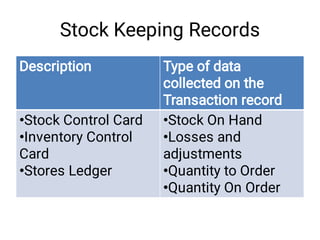
Stock Keeping Records
Description Type of data
collected on the
Transaction record
Stock Control Card
Inventory Control
Card
Stores Ledger
โ€ข
โ€ข
โ€ข
Stock On Hand
Losses and
adjustments
Quantity to Order
Quantity On Order
โ€ข
โ€ข
โ€ข
โ€ข
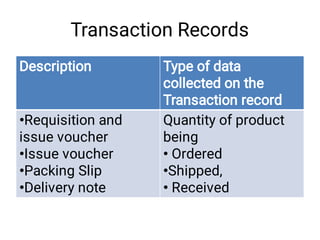
Transaction Records
Description Type of data
collected on the
Transaction record
Requisition and
issue voucher
Issue voucher
Packing Slip
Delivery note
โ€ข
โ€ข
โ€ข
โ€ข
Quantity of product
being
Ordered
Shipped,
Received
โ€ข
โ€ข
โ€ข
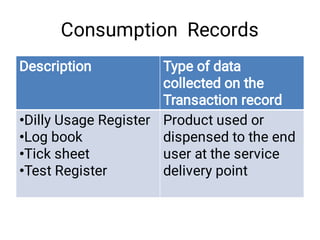
Consumption Records
Description Type of data
collected on the
Transaction record
Dilly Usage Register
Log book
Tick sheet
Test Register
โ€ข
โ€ข
โ€ข
โ€ข
Product used or
dispensed to the end
user at the service
delivery point
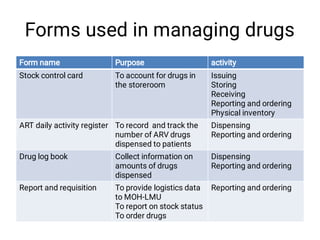
Forms used in managing drugs
Form name Purpose activity
Stock control card To account for drugs in
the storeroom
Issuing
Storing
Receiving
Reporting and ordering
Physical inventory
ART daily activity register To record and track the
number of ARV drugs
dispensed to patients
Dispensing
Reporting and ordering
Drug log book Collect information on
amounts of drugs
dispensed
Dispensing
Reporting and ordering
Report and requisition To provide logistics data
to MOH-LMU
To report on stock status
To order drugs
Reporting and ordering
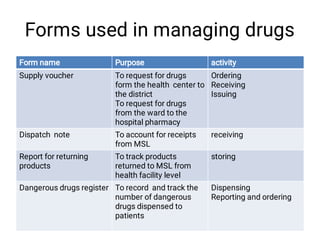
Forms used in managing drugs
Form name Purpose activity
Supply voucher To request for drugs
form the health center to
the district
To request for drugs
from the ward to the
hospital pharmacy
Ordering
Receiving
Issuing
Dispatch note To account for receipts
from MSL
receiving
Report for returning
products
To track products
returned to MSL from
health facility level
storing
Dangerous drugs register To record and track the
number of dangerous
drugs dispensed to
patients
Dispensing
Reporting and ordering
Recording transactions in the stock
control card
โ€ข
โ€ข
โ€ข
โ€ข
Complete one SCC for each product
Enter the code, the name and form of the
drug, unit, strength ,maximum level and
the minimum level
Enter the date of the transaction
Enter the reference number
Recording transactions in the stock
control card
โ€ข
โ€ข
In the remarks column provide a brief
explanation for any loss or adjustment or
add any other comment.
Keep the stock control card close to were
products are being stored and issued in
the pharmacy.
Recording transactions in the stock
control card
โ€ข
๏ƒผ
๏ƒผ
๏ƒผ
๏ƒผ
In the issued to or received from column
enter
Balance brought forward if this is the ๏ฌrst
line of a new stock control
Physical count if you have done a physical
count
MSL or Pharmacy in red if receiving
Loss or adjustment
Recording transactions in the stock
control card
โ€ข
โ€ข
โ€ข
โ€ข
In the received column enter the quantity
received
In the issued column enter the quantity
issued
In the losses and adjustment column enter
the exact amount of the loss or adjustment
In the balance column enter the calculated
balance
Completing the Daily activity register
for HIV Test Kits
โ€ข
โ€ข
โ€ข
โ€ข
โ€ข
โ€ข
โ€ข
The following steps should be followed:
Record the client number and purpose of the test
Record the type of test
Record the quantity of test used
Record the result ( R, NR or IND)
Calculate the total quantity of the tests done at
the end of the day
Summarise the total number of tests done at the
end of the month
Completing the Daily activity register
for ARVs
โ€ข
โ€ข
โ€ข
โ€ข
โ€ข
โ€ข
The following steps should be followed:
Record the client number
Record the type of ARV dispensed
Record the quantity dispensed
Calculate the total quantity dispensed at
the end of the day
Calculate the quantity dispensed at the
end of the month
Ordering Drugs and Medical
supplies
โ€ข
โ€ข
โ€ข
โ€ข
A report and requisition Drugs and
Medical supplies is used (REMMS).
This form is used at the Health Centers and
Hospitals
Health centers send the REMMS to the
District for review by the ๏ฌfth day following
the reporting period.
DHO and Hospitals after reviewing the
REMMS send it MSL according to schedule
Ordering ARVs and Test Kits
โ€ข
โ€ข
โ€ข
โ€ข
A report and requisition is used (R&R).
This form is used at the Health Centers
and Hospitals
Health centers send the R&R to the District
for review by the ๏ฌfth day following the
reporting period.
DHO and Hospitals after reviewing the
R&R send it MSL according to schedule
Ordering ARVs and Test Kits
โ€ข
โ€ข
โ€ข
โ€ข
โ€ข
The following data is reported on the report
section of the R&R:
Beginning Balance in the store room and
dispensary or testing site
Total Quantity Received
Total Quantity Used
Losses and adjustments
Ending Balance
Ordering ARVs and Test Kits
โ€ข
โ€ข
โ€ข
โ€ข
The following data is reported on the
requisition section of the R&R:
Average Monthly Consumption
Maximum Quantity
Order Quantity
How to calculate the order quantity
๏ƒผ
๏ƒผ
๏ƒผ
Calculating the average monthly
consumption
Add the total quantity dispensed for the
current and the last two months
Divide by three
Round to the nearest dispensing unit
How to calculate the order quantity
โ€ข
โ€ข
Calculating the maximum quantity
Multiply the average monthly consumption
by 3
Calculating the order quantity
Subtract the ending balance from the
maximum quantity
Receiving drugs and medical
supplies
โ€ข
โ€ข
โ€ข
โ€ข
โ€ข
โ€ข
Locate the requisition or supply voucher
Conduct a visual inspection
Note discrepancies on the forms
Sign the form
Place and reorganize products according
to FEFO
Enter and update the goods received
note(GRN) and the stock control cards
Storage
โ€ข
โ€ข
The purpose of storage are as follows:
Protect the quality of the product and its
packagingย 
Make product available for use at the right
time
Storage conditions
โ€ข
โ€ข
โ€ข
โ€ข
โ€ข
Put temperature control devices in place
(fan, air conditioner)ย 
Ensure adequate ventilation (forced
ventilation)ย 
Ensure adequate light to facilitate all work-
related activitiesย 
Store products out of direct sunlightย 
Store supplies not for immediate use in
their shipping cartons
Storage conditions
โ€ข
โ€ข
Secure Storeroom from water (check the
roof, walls, ๏ฌ‚oor and windows)
Store all products on pallets at least 10cm
off the ๏ฌ‚oor, 30 cm away from the walls
and other stacks, and not more than 2.5m
high
ย 
Storage conditions
โ€ข
โ€ข
Store chemicals & insecticides separately
to avoid contamination of drugsย 
Display hazardous warning signs for
chemicals and other hazardous material
Storage conditions
โ€ข
โ€ข
โ€ข
โ€ข
Limit access to authorised personnel
Ensure windows, roof, walls and doors are
well securedย 
Ensure that incoming & out going stock
match documentationย 
Verify inventory records monthly through
physical counts
Storage conditions
โ€ข
โ€ข
Clean the store regularly (have cleaning
schedule in place)ย 
Put pest control measures in place
Storage conditions
โ€ข
โ€ข
โ€ข
โ€ข
โ€ข
โ€ข
Arrange products by expiration date (FEFO,
๏ฌrst-expiry, ๏ฌrst out) or by FIFO (only for
products with no expiry date)ย 
Arrange supplies by
โ€“Alphabetical
โ€“Dosage form
โ€“Rate of stock movement
โ€“Therapeutic grouping
Storage conditions
โ€ข
โ€ข
โ€ข
Storage area of adequate size & adequate
sorting and packaging space
Adequate space for products requiring
refrigeration
Store expired or damaged products in a
separate area & approved disposal
procedures in place
ย 
Storage conditions
โ€ข
โ€ข
Secure Storeroom from water (check the
roof, walls, ๏ฌ‚oor and windows)ย 
Store all products on pallets at least 10cm
off the ๏ฌ‚oor, 30 cm away from the walls
and other stacks, and not more than 2.5m
high
ย 
Inventory control System
โ€ข
โ€ข
A system that informs the storekeeper
how much of a commodity to order, when
to order and how to maintain appropriate
stock levels
In Zambia the type of inventory control
system used is the Max-Min inventory
control system
Three types of Max-Min Inventory
Control System
โ€ข
โ€ข
โ€ข
There are three types of Max-Min inventory
control systems
Forced ordering
Continuous review
Standard Max-Min
Forced Ordering
โ€ข At the end of the review period, review all
stock levels and order enough stock to
bring stock levels up to the maximum (
ARVs)
Continuous Review
โ€ข Review the stock level of an item every
time an issue is made. If the stock level is
at or below the minimum level, order
enough to bring to the maximum
Standard Max-Min
โ€ข Review the stock level of all the items at
the end of the review period. For products
that are at or below the minimum level,
order enough to bring to the maximum.
Products above minimum are not ordered.
( essential drugs)
How to maintain appropriate
stocking levels
1.
2.
To maintain appropriate stocking levels, the
following need to be established:
Maximum and Minimum stock levels: (
level above which and below which stock
levels should not be allowed to exceed or
fall)
Emergency order point (level that triggers
an emergency order)
How to maintain appropriate
stocking levels
To maintain appropriate stocking levels, the
following need to be established:
3. Review period:( the routine interval of
time between assessments of stock level
to determine if an order should be placed)
4. Lead time:(the time between when new
stock is ordered and when it is received
and available for use
How to maintain appropriate
stocking levels
โ€ข 5. Safety stock (the buffer/reserve stock
kept to protect against stock-outs caused
by delayed deliveries or unexpected
demand in consumption)
How to maintain appropriate
stocking levels
โ€ข 5. Safety stock (the buffer/reserve stock
kept to protect against stock-outs caused
by delayed deliveries or unexpected
demand in consumption)
How to maintain appropriate
stocking levels
โ€ข 5. Safety stock (the buffer/reserve stock
kept to protect against stock-outs caused
by delayed deliveries or unexpected
demand in consumption)
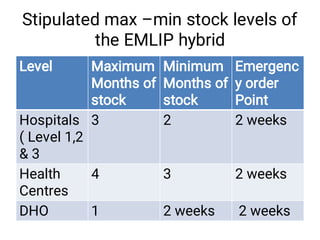
Stipulated max โ€“min stock levels of
the EMLIP hybrid
Level Maximum
Months of
stock
Minimum
Months of
stock
Emergenc
y order
Point
Hospitals
( Level 1,2
& 3
3 2 2 weeks
Health
Centres
4 3 2 weeks
DHO 1 2 weeks 2 weeks
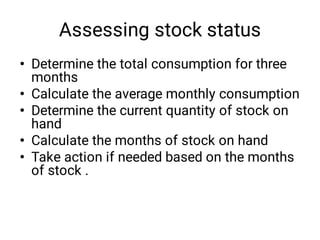
Assessing stock status
โ€ข
โ€ข
โ€ข
โ€ข
โ€ข
Determine the total consumption for three
months
Calculate the average monthly consumption
Determine the current quantity of stock on
hand
Calculate the months of stock on hand
Take action if needed based on the months
of stock .
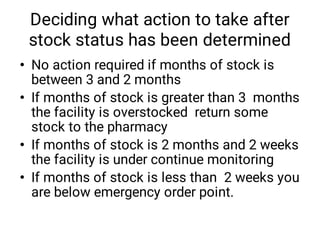
Deciding what action to take after
stock status has been determined
โ€ข
โ€ข
โ€ข
โ€ข
No action required if months of stock is
between 3 and 2 months
If months of stock is greater than 3 months
the facility is overstocked return some
stock to the pharmacy
If months of stock is 2 months and 2 weeks
the facility is under continue monitoring
If months of stock is less than 2 weeks you
are below emergency order point.
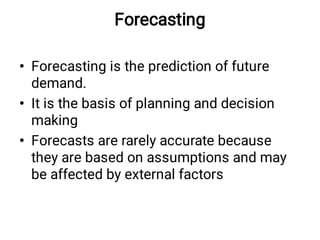
Forecasting
โ€ข
โ€ข
โ€ข
Forecasting is the prediction of future
demand.
It is the basis of planning and decision
making
Forecasts are rarely accurate because
they are based on assumptions and may
be affected by external factors
Forecasting
โ€ข
โ€ข
โ€ข
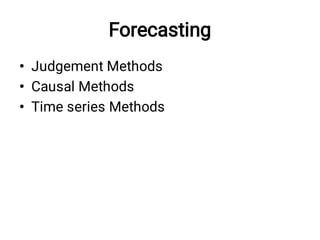
Judgement Methods
Causal Methods
Time series Methods
Forecasting
โ€ข
๏ƒ˜
๏ƒ˜
๏ƒ˜
๏ƒ˜
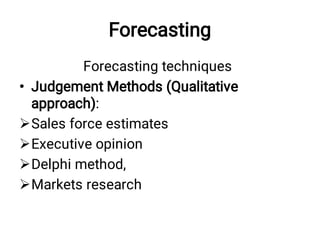
Forecasting techniques
Judgement Methods (Qualitative
approach):
Sales force estimates
Executive opinion
Delphi method,
Markets research
Forecasting
โ€ข
๏ƒ˜
Forecasting techniques
Causal Methods
linear regression
Forecasting
โ€ข
๏ƒ˜
๏ƒ˜
๏ƒ˜
๏ƒ˜
๏ƒ˜
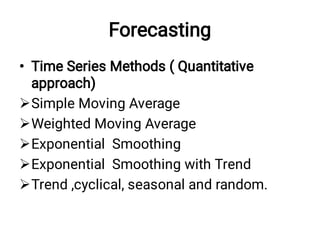
Time Series Methods ( Quantitative
approach)
Simple Moving Average
Weighted Moving Average
Exponential Smoothing
Exponential Smoothing with Trend
Trend ,cyclical, seasonal and random.
Quanti๏ฌcation
โ€ข The process of estimating the total
quantities and the costs of the products
required for a speci๏ฌc health program, for
o future period
Quanti๏ฌcation
โ€ข
โ€ข
โ€ข
โ€ข
Why quantify
To Prevent Shortages of drugs
To avoid wastage
To make best use of available ๏ฌnancial
resources
To facilitate central bulk purchases
Quanti๏ฌcation
๏ƒ˜
๏ƒ˜
Quanti๏ฌcation Methods
Consumption Method: based on record of
past consumption of individual items
Morbidity Method: based on the number of
expected attendance
Quanti๏ฌcation
โ€ข
โ€ข
โ€ข
โ€ข
Information required for quanti๏ฌcation :
Total consumption in a period,
Number of days the product was out of
stock
Number of days the product was available
Adjusted average consumption
Quanti๏ฌcation
โ€ข
โ€ข
Process to determine quantity needed and
๏ฌnancial means required
It involves estimating how much of a
speci๏ฌc item is needed and the ๏ฌnancial
means required
Placing an emergency order
โ€ข
โ€ข
โ€ข
Tick the emergency order box at the top of
the report for essential drugs and medical
supplies
Use a red pen to write emergency order
across the top of each page
Complete the REMMS for all the printed
drugs and medical supplies and send the
form to the DHO
Placing an emergency order
โ€ข
โ€ข
DHO WILL Review and approve the
emergency order and send it the MSL
commodity security center
When the order is ready MSL will inform
you to go and collect the emergency order.
Handling damaged and Expired
Products
โ€ข
โ€ข
โ€ข
Store damaged and expired products
separately from usable stock
Write Damaged or Expired stock on the
box or shelf
Record the quantity and the expiry date
Completing the MSL Returns
Authorisation Form
โ€ข
โ€ข
โ€ข
Write the name of your facility
Write your name, date and sign
For each product being returned ,enter the
MSL code number, description, pack size,
quantity , expiry date and explanation for
why the product is being returned
Completing the Report for Returning
Products
โ€ข
โ€ข
โ€ข
Write the name of your facility
Write your name, date and sign
For each product being returned ,enter the
MSL code number, description, pack size,
quantity , expiry date and explanation for
why the product is being returned
Monitoring and supervision
โ€ข
โ€ข
Monitoring: is the checking on a regular
basis to ensure that assigned activities
are being carried out.
It requires regular checking and recording
of activities taking place in a project or
program
Monitoring and supervision
โ€ข Supervision: the process of ensuring that
personnel have the knowledge and skills
required to carry out their responsibilities
effectively, and to provide immediate on
the Job training ,as needed.
End of presentation

Supply chain management 1

  • 1.
  • 2.
    OVERVIEW OF SUPPLYCHAIN MANAGEMENT โ€ข โ€ข Prior to the 1980s, business ๏ฌrms were using terms such as, โ€œlogisticsโ€, and โ€œoperations managementโ€ instead of supply Chain Management. The term was coined by a British logistician and consultant by the name of, Keith Oliver in the 1980s. ย 
  • 3.
    OVERVIEW OF SUPPLYCHAIN MANAGEMENT โ€ข โ€ข The term was ๏ฌrst used in public in an interview with Arnold Kransdorff of the Financial Times on 4 June 1982 Theย termย Supplyย Chainย Managementย came intoย widespreadย useย inย theย 1990s
  • 4.
    OVERVIEW OF SUPPLYCHAIN MANAGEMENT โ€ข โ€ข Continuous evolution of the supply chain and of the techniques to manage it effectively were motivated by the following: Fierce competition in todayโ€™s global markets, Introduction of products with shorter life cycles
  • 5.
    OVERVIEW OF SUPPLYCHAIN MANAGEMENT โ€ข โ€ข โ€ข The heightened expectations of customers, New rules of competition and the downward pressure on prices, Continuing advances in communications and transportation technologies (e.g., mobile communication, Internet, and overnight delivery),
  • 6.
    OVERVIEW OF SUPPLYCHAIN MANAGEMENT โ€ข Supply chain management builds upon the concept of logistics and seeks to achieve linkage and coordination between the processes of other entities in the pipeline ( suppliers and customers).
  • 7.
    โ€ข According to thecouncil of Supply Chain Management Professionals ( CSCMP,2011) โ€œSupply Chain Management encompasses the planning and management of all activities involved in sourcing, procurement ,and all logistics management activities De๏ฌnition of Supply Chain Management
  • 8.
    De๏ฌnition of Logistics TheCSCMPP also de๏ฌne Logistics โ€“ โ€œThe part of supply chain management that plans ,implements, and controls the ef๏ฌcient ,effective forward and reverse ๏ฌ‚ow and storage of goods ,services and related information between the point of origin and point of consumption in order to meet customers requirements...
  • 9.
    De๏ฌnition of Logistics โ€ขLogistics management is an integrating function ,which coordinates and optimizes all logistics activities, as well as integrates logistics activities with other functions including marketing , sales, manufacturing , ๏ฌnance, and information technologyโ€
  • 10.
    Comparison of logisticsand supply chain management: โ€ข โ€ข Logistics typically refers to activities that occur within the boundaries of a single organization such as procurement, distribution, storage, and inventory management. Supply Chain Management (SCM) acknowledges all of traditional logistics and also includes activities such as marketing, new product development,ย ๏ฌnance, and customer service.
  • 11.
    Comparison of logisticsand supply chain management: BASIS FOR COMPARISON LOGISTICS SUPPLY CHAIN MANAGEMENT Objective Customer satisfaction; to ensure the six rights right product with the right quality In the right quantity at the right time in the right place at the right price to the ultimate customer) Competitive advantage How Many Organisations are involved One Multiple Evolution Aย longย timeย ago Modernย concept
  • 12.
    Purpose of Logistics โ€ข โ€ข โ€ข โ€ข โ€ข โ€ข Thepurpose of a logistics system is to ensure the six rights: The right drugs and medical supplies in the right quantities in the right condition are delivered to the right place at the right time for the right price.
  • 13.
    The logistics cycle Policy/legal Frame work adaptability SERVING CUSTOMER PRODUCT SELECTION FORECASTING AND PROCUREMENT INVENTORY MANGEMEN T Logistics management information system Organization and staf๏ฌng, ๏ฌnancing and budgeting, supervision evaluation
  • 14.
    ย  Major Activities ofthe Logistics Cycle โ€ข โ€ข Serving Customers:Everyone working in logistics must remember that their job is to select, procure, store, or distribute products to meet customer needs Product selection: In a health logistics system, a national formulary and therapeutics committee, pharmaceutical board, board of physicians, or other government-appointed group select products to meet the needs of patients.
  • 15.
    Major Activities ofthe Logistics Cycle โ€ข Quanti๏ฌcation :After products are selected, managers must determine the quantity needed for each product, for a speci๏ฌc time periodโ€”this is called quanti๏ฌcation. Quanti๏ฌcation depends on accurate forecasting Procurement: Procurement plans are based on requirements estimates that are determined mathematically for each product.
  • 16.
    Major Activities ofthe Logistics Cycle โ€ข Inventory management: A programโ€™s inventory control strategy speci๏ฌes how much stock to store and where to store it. Enough stock should be available to meet customer needs until a new order is received; but not so much that stocks expire or are wasted or that you exceed storage capacity.
  • 17.
    Major Activities ofthe Logistics Cycle โ€ข Quality monitoring:Quality monitoring appears between each activity of the logistics cycle and ensures that the quality of all the activities in the cycle are monitored. Management Information Systems: Information drives the logistics cycle; without it, the logistics system cannot run smoothly. Managers gather information about each activity in the system and then analyze that information to make decisions.
  • 18.
    Major Activities ofthe Logistics Cycle Organization and Staf๏ฌng:A logistics system can only work when the staff are well- trained and operate in a supportive environment. They must have the right tools to do their jobs, whether they place orders, coordinate shipments, oversee deliveries, or keep a warehouse functioning effectively to ensure that the right product, in the right quantity, is shipped to the client.
  • 19.
    Major Activities ofthe Logistics Cycle Organization and Staf๏ฌng:A logistics system can only work when the staff are well- trained and operate in a supportive environment. They must have the right tools to do their jobs, whether they place orders, coordinate shipments, oversee deliveries, or keep a warehouse functioning effectively to ensure that the right product, in the right quantity, is shipped to the client.
  • 20.
    Major Activities ofthe Logistics Cycle โ€ข Supervision:If the logistics system is carefully watched, it will run smoothly and staff will anticipate any needed changes. The effective supervision of logistics activities minimizes problems and/or resolves them quickly before any one problem becomes a crisis.
  • 21.
    Major Activities ofthe Logistics Cycle โ€ข Budgeting : affects the product selection, quantity of products procured, amount of storage space available, transport, and number of staff working in logistics. To have the entire system operating effectively, logistics activities must be included in operational planning and receive suf๏ฌcient funds.
  • 23.
    Use of standardoperating procedure manual โ€ข The manual is intended to simplify and standardise the work required for logistics management in order to allow health workers more time for client focused activities. The manual guides health care workers in completing the following tasks with the help of Job aids.
  • 24.
    Use of standardoperating procedure manual โ€ข โ€ข โ€ข โ€ข โ€ข Maintaining adequate supplies of commodities Reporting essential logistics data and ordering of commodities from MSl Receiving and storing Recording and reporting issues Monitoring logistics activities throughout the system
  • 25.
    Supply chain pipeline โ€ขThe pipeline includes the entire chain of storage facilities and transportation links that move supplies from the manufacturer to the consumer, including port facilities, central warehouses, regional warehouses, district and sub district stores, service delivery points, and transportation vehicles.
  • 26.
    Supply chain pipeline โ€ขA supply chain consists of activities and organisations that materials move through on their journey from initial suppliers to the ๏ฌnal customer.
  • 27.
    Supply chain pipeline โ€ขA supply chain consists of activities and organisations that materials move through on their journey from initial suppliers to the ๏ฌnal customer.
  • 28.
    Supply chain pipeline โ€ขThe pipeline includes the entire chain of storage facilities and transportation links that move supplies from the manufacturer to the consumer, including port facilities, central warehouses, regional warehouses, district and sub district stores, service delivery points, and transportation vehicles
  • 29.
    Logistics management information system( LMIS) โ€ข The basic purpose of an LMIS is to collect and report information to other levels in the system in order to make decisions regarding the quantity and time to distribute drugs and medical supplies.
  • 30.
    Essential logistics data โ€ข โ€ข โ€ข STOCKON HAND: quantity of usable stock at a particular level of the system at a particular point in timeย  CONSUMPTION DATA: quantity of drugs dispensed to clients during a particular period of timeย  DATA ON LOSSES AND ADJUSTMENTS : quantity of drugs no longer available for distribution, which have not been dispensed, but are damaged or expiredย  are called losses and additions and subtractions to the available drug supply, which were not received through the normal mechanism of receipt are called adjustments. These are either transfers, drugs loaned to (-)/from (+) another facility, or drugs โ€œfoundโ€ (+) as a result of a previous miscount
  • 31.
    Records and Reportsused in the management of ARV ,EMLIP and HIV test kits logistics system โ€ข โ€ข โ€ข โ€ข โ€ข Stock Control Cardย  Stock Control bookย  GRNย  Supply voucherย  Requisition formย 
  • 32.
    Stock Keeping Records DescriptionType of data collected on the Transaction record Stock Control Card Inventory Control Card Stores Ledger โ€ข โ€ข โ€ข Stock On Hand Losses and adjustments Quantity to Order Quantity On Order โ€ข โ€ข โ€ข โ€ข
  • 33.
    Transaction Records Description Typeof data collected on the Transaction record Requisition and issue voucher Issue voucher Packing Slip Delivery note โ€ข โ€ข โ€ข โ€ข Quantity of product being Ordered Shipped, Received โ€ข โ€ข โ€ข
  • 34.
    Consumption Records Description Typeof data collected on the Transaction record Dilly Usage Register Log book Tick sheet Test Register โ€ข โ€ข โ€ข โ€ข Product used or dispensed to the end user at the service delivery point
  • 35.
    Forms used inmanaging drugs Form name Purpose activity Stock control card To account for drugs in the storeroom Issuing Storing Receiving Reporting and ordering Physical inventory ART daily activity register To record and track the number of ARV drugs dispensed to patients Dispensing Reporting and ordering Drug log book Collect information on amounts of drugs dispensed Dispensing Reporting and ordering Report and requisition To provide logistics data to MOH-LMU To report on stock status To order drugs Reporting and ordering
  • 36.
    Forms used inmanaging drugs Form name Purpose activity Supply voucher To request for drugs form the health center to the district To request for drugs from the ward to the hospital pharmacy Ordering Receiving Issuing Dispatch note To account for receipts from MSL receiving Report for returning products To track products returned to MSL from health facility level storing Dangerous drugs register To record and track the number of dangerous drugs dispensed to patients Dispensing Reporting and ordering
  • 37.
    Recording transactions inthe stock control card โ€ข โ€ข โ€ข โ€ข Complete one SCC for each product Enter the code, the name and form of the drug, unit, strength ,maximum level and the minimum level Enter the date of the transaction Enter the reference number
  • 38.
    Recording transactions inthe stock control card โ€ข โ€ข In the remarks column provide a brief explanation for any loss or adjustment or add any other comment. Keep the stock control card close to were products are being stored and issued in the pharmacy.
  • 39.
    Recording transactions inthe stock control card โ€ข ๏ƒผ ๏ƒผ ๏ƒผ ๏ƒผ In the issued to or received from column enter Balance brought forward if this is the ๏ฌrst line of a new stock control Physical count if you have done a physical count MSL or Pharmacy in red if receiving Loss or adjustment
  • 40.
    Recording transactions inthe stock control card โ€ข โ€ข โ€ข โ€ข In the received column enter the quantity received In the issued column enter the quantity issued In the losses and adjustment column enter the exact amount of the loss or adjustment In the balance column enter the calculated balance
  • 41.
    Completing the Dailyactivity register for HIV Test Kits โ€ข โ€ข โ€ข โ€ข โ€ข โ€ข โ€ข The following steps should be followed: Record the client number and purpose of the test Record the type of test Record the quantity of test used Record the result ( R, NR or IND) Calculate the total quantity of the tests done at the end of the day Summarise the total number of tests done at the end of the month
  • 42.
    Completing the Dailyactivity register for ARVs โ€ข โ€ข โ€ข โ€ข โ€ข โ€ข The following steps should be followed: Record the client number Record the type of ARV dispensed Record the quantity dispensed Calculate the total quantity dispensed at the end of the day Calculate the quantity dispensed at the end of the month
  • 43.
    Ordering Drugs andMedical supplies โ€ข โ€ข โ€ข โ€ข A report and requisition Drugs and Medical supplies is used (REMMS). This form is used at the Health Centers and Hospitals Health centers send the REMMS to the District for review by the ๏ฌfth day following the reporting period. DHO and Hospitals after reviewing the REMMS send it MSL according to schedule
  • 44.
    Ordering ARVs andTest Kits โ€ข โ€ข โ€ข โ€ข A report and requisition is used (R&R). This form is used at the Health Centers and Hospitals Health centers send the R&R to the District for review by the ๏ฌfth day following the reporting period. DHO and Hospitals after reviewing the R&R send it MSL according to schedule
  • 45.
    Ordering ARVs andTest Kits โ€ข โ€ข โ€ข โ€ข โ€ข The following data is reported on the report section of the R&R: Beginning Balance in the store room and dispensary or testing site Total Quantity Received Total Quantity Used Losses and adjustments Ending Balance
  • 46.
    Ordering ARVs andTest Kits โ€ข โ€ข โ€ข โ€ข The following data is reported on the requisition section of the R&R: Average Monthly Consumption Maximum Quantity Order Quantity
  • 47.
    How to calculatethe order quantity ๏ƒผ ๏ƒผ ๏ƒผ Calculating the average monthly consumption Add the total quantity dispensed for the current and the last two months Divide by three Round to the nearest dispensing unit
  • 48.
    How to calculatethe order quantity โ€ข โ€ข Calculating the maximum quantity Multiply the average monthly consumption by 3 Calculating the order quantity Subtract the ending balance from the maximum quantity
  • 49.
    Receiving drugs andmedical supplies โ€ข โ€ข โ€ข โ€ข โ€ข โ€ข Locate the requisition or supply voucher Conduct a visual inspection Note discrepancies on the forms Sign the form Place and reorganize products according to FEFO Enter and update the goods received note(GRN) and the stock control cards
  • 50.
    Storage โ€ข โ€ข The purpose ofstorage are as follows: Protect the quality of the product and its packagingย  Make product available for use at the right time
  • 51.
    Storage conditions โ€ข โ€ข โ€ข โ€ข โ€ข Put temperaturecontrol devices in place (fan, air conditioner)ย  Ensure adequate ventilation (forced ventilation)ย  Ensure adequate light to facilitate all work- related activitiesย  Store products out of direct sunlightย  Store supplies not for immediate use in their shipping cartons
  • 52.
    Storage conditions โ€ข โ€ข Secure Storeroomfrom water (check the roof, walls, ๏ฌ‚oor and windows) Store all products on pallets at least 10cm off the ๏ฌ‚oor, 30 cm away from the walls and other stacks, and not more than 2.5m high ย 
  • 53.
    Storage conditions โ€ข โ€ข Store chemicals& insecticides separately to avoid contamination of drugsย  Display hazardous warning signs for chemicals and other hazardous material
  • 54.
    Storage conditions โ€ข โ€ข โ€ข โ€ข Limit accessto authorised personnel Ensure windows, roof, walls and doors are well securedย  Ensure that incoming & out going stock match documentationย  Verify inventory records monthly through physical counts
  • 55.
    Storage conditions โ€ข โ€ข Clean thestore regularly (have cleaning schedule in place)ย  Put pest control measures in place
  • 56.
    Storage conditions โ€ข โ€ข โ€ข โ€ข โ€ข โ€ข Arrange productsby expiration date (FEFO, ๏ฌrst-expiry, ๏ฌrst out) or by FIFO (only for products with no expiry date)ย  Arrange supplies by โ€“Alphabetical โ€“Dosage form โ€“Rate of stock movement โ€“Therapeutic grouping
  • 57.
    Storage conditions โ€ข โ€ข โ€ข Storage areaof adequate size & adequate sorting and packaging space Adequate space for products requiring refrigeration Store expired or damaged products in a separate area & approved disposal procedures in place ย 
  • 58.
    Storage conditions โ€ข โ€ข Secure Storeroomfrom water (check the roof, walls, ๏ฌ‚oor and windows)ย  Store all products on pallets at least 10cm off the ๏ฌ‚oor, 30 cm away from the walls and other stacks, and not more than 2.5m high ย 
  • 59.
    Inventory control System โ€ข โ€ข Asystem that informs the storekeeper how much of a commodity to order, when to order and how to maintain appropriate stock levels In Zambia the type of inventory control system used is the Max-Min inventory control system
  • 60.
    Three types ofMax-Min Inventory Control System โ€ข โ€ข โ€ข There are three types of Max-Min inventory control systems Forced ordering Continuous review Standard Max-Min
  • 61.
    Forced Ordering โ€ข Atthe end of the review period, review all stock levels and order enough stock to bring stock levels up to the maximum ( ARVs)
  • 62.
    Continuous Review โ€ข Reviewthe stock level of an item every time an issue is made. If the stock level is at or below the minimum level, order enough to bring to the maximum
  • 63.
    Standard Max-Min โ€ข Reviewthe stock level of all the items at the end of the review period. For products that are at or below the minimum level, order enough to bring to the maximum. Products above minimum are not ordered. ( essential drugs)
  • 64.
    How to maintainappropriate stocking levels 1. 2. To maintain appropriate stocking levels, the following need to be established: Maximum and Minimum stock levels: ( level above which and below which stock levels should not be allowed to exceed or fall) Emergency order point (level that triggers an emergency order)
  • 65.
    How to maintainappropriate stocking levels To maintain appropriate stocking levels, the following need to be established: 3. Review period:( the routine interval of time between assessments of stock level to determine if an order should be placed) 4. Lead time:(the time between when new stock is ordered and when it is received and available for use
  • 66.
    How to maintainappropriate stocking levels โ€ข 5. Safety stock (the buffer/reserve stock kept to protect against stock-outs caused by delayed deliveries or unexpected demand in consumption)
  • 67.
    How to maintainappropriate stocking levels โ€ข 5. Safety stock (the buffer/reserve stock kept to protect against stock-outs caused by delayed deliveries or unexpected demand in consumption)
  • 68.
    How to maintainappropriate stocking levels โ€ข 5. Safety stock (the buffer/reserve stock kept to protect against stock-outs caused by delayed deliveries or unexpected demand in consumption)
  • 69.
    Stipulated max โ€“minstock levels of the EMLIP hybrid Level Maximum Months of stock Minimum Months of stock Emergenc y order Point Hospitals ( Level 1,2 & 3 3 2 2 weeks Health Centres 4 3 2 weeks DHO 1 2 weeks 2 weeks
  • 70.
    Assessing stock status โ€ข โ€ข โ€ข โ€ข โ€ข Determinethe total consumption for three months Calculate the average monthly consumption Determine the current quantity of stock on hand Calculate the months of stock on hand Take action if needed based on the months of stock .
  • 71.
    Deciding what actionto take after stock status has been determined โ€ข โ€ข โ€ข โ€ข No action required if months of stock is between 3 and 2 months If months of stock is greater than 3 months the facility is overstocked return some stock to the pharmacy If months of stock is 2 months and 2 weeks the facility is under continue monitoring If months of stock is less than 2 weeks you are below emergency order point.
  • 72.
    Forecasting โ€ข โ€ข โ€ข Forecasting is theprediction of future demand. It is the basis of planning and decision making Forecasts are rarely accurate because they are based on assumptions and may be affected by external factors
  • 73.
  • 74.
    Forecasting โ€ข ๏ƒ˜ ๏ƒ˜ ๏ƒ˜ ๏ƒ˜ Forecasting techniques Judgement Methods(Qualitative approach): Sales force estimates Executive opinion Delphi method, Markets research
  • 75.
  • 76.
    Forecasting โ€ข ๏ƒ˜ ๏ƒ˜ ๏ƒ˜ ๏ƒ˜ ๏ƒ˜ Time Series Methods( Quantitative approach) Simple Moving Average Weighted Moving Average Exponential Smoothing Exponential Smoothing with Trend Trend ,cyclical, seasonal and random.
  • 77.
    Quanti๏ฌcation โ€ข The processof estimating the total quantities and the costs of the products required for a speci๏ฌc health program, for o future period
  • 78.
    Quanti๏ฌcation โ€ข โ€ข โ€ข โ€ข Why quantify To PreventShortages of drugs To avoid wastage To make best use of available ๏ฌnancial resources To facilitate central bulk purchases
  • 79.
    Quanti๏ฌcation ๏ƒ˜ ๏ƒ˜ Quanti๏ฌcation Methods Consumption Method:based on record of past consumption of individual items Morbidity Method: based on the number of expected attendance
  • 80.
    Quanti๏ฌcation โ€ข โ€ข โ€ข โ€ข Information required forquanti๏ฌcation : Total consumption in a period, Number of days the product was out of stock Number of days the product was available Adjusted average consumption
  • 81.
    Quanti๏ฌcation โ€ข โ€ข Process to determinequantity needed and ๏ฌnancial means required It involves estimating how much of a speci๏ฌc item is needed and the ๏ฌnancial means required
  • 82.
    Placing an emergencyorder โ€ข โ€ข โ€ข Tick the emergency order box at the top of the report for essential drugs and medical supplies Use a red pen to write emergency order across the top of each page Complete the REMMS for all the printed drugs and medical supplies and send the form to the DHO
  • 83.
    Placing an emergencyorder โ€ข โ€ข DHO WILL Review and approve the emergency order and send it the MSL commodity security center When the order is ready MSL will inform you to go and collect the emergency order.
  • 84.
    Handling damaged andExpired Products โ€ข โ€ข โ€ข Store damaged and expired products separately from usable stock Write Damaged or Expired stock on the box or shelf Record the quantity and the expiry date
  • 85.
    Completing the MSLReturns Authorisation Form โ€ข โ€ข โ€ข Write the name of your facility Write your name, date and sign For each product being returned ,enter the MSL code number, description, pack size, quantity , expiry date and explanation for why the product is being returned
  • 86.
    Completing the Reportfor Returning Products โ€ข โ€ข โ€ข Write the name of your facility Write your name, date and sign For each product being returned ,enter the MSL code number, description, pack size, quantity , expiry date and explanation for why the product is being returned
  • 87.
    Monitoring and supervision โ€ข โ€ข Monitoring:is the checking on a regular basis to ensure that assigned activities are being carried out. It requires regular checking and recording of activities taking place in a project or program
  • 88.
    Monitoring and supervision โ€ขSupervision: the process of ensuring that personnel have the knowledge and skills required to carry out their responsibilities effectively, and to provide immediate on the Job training ,as needed.
  • 89.