Drug Products through
Transportation
1 Overview
The pharmaceutical industry can be defined as a combination of processes, organizations and
operations involved in the development, design and manufacturing of useful pharmaceutical drugs
(Shah, 2004).The Indian Pharma industry today is in the midst of unprecedentedgrowth with
companies faced with multiple options varying from going for new molecule development,
partnering with innovators for marketing rights to capturing new markets with their own, and
existing formulations. A typical mid- sizedpharma company in India today can aspire for turnovers
ranging from 3000- 4000 cr in topline with a value growth, close to 30% y.o.y. With the West having
wisened in the post recessionary scenario, cost and productivity seemsto be the keydrivers
worldwide , bringing new and enhancedfocus on the Supply chain, forcing it to explore and deliver ,
consistent and never– before efficiencies. Acold chain is a temperature-controlled supply chain.An
unbroken cold chain is an uninterrupted series of storage and distribution activities which maintain a
given temperature range.It is used to help extendand ensure the shelf life of products such as fresh
agricultural produce, seafood, frozen food, photographic film, chemicals,and pharmaceutical drugs.
Suchproducts, during transport and when in transient storage, are called cool cargo. Unlike other
goods or merchandise, cold chain goods are perishable and always en route towards enduse or
destination, evenwhen held temporarily in cold stores and hence commonly referred to as cargo
during its entire logistics cycle.
Utkarsh Verma
114
Indian pharmaceutical industry is on a strong growth path with the total value of Indian Pharma
industry expectedto reachalmost $50 Billion by 2015-2016. Out of this close to 22 billion is expected
to originate from the domestic formulation business. A key issue facedby the industry is
management of the supply chain.Supply chain in India is highly fragmented with more than 550,000
retail pharmacies in the country.
Pharmaceutical Distribution
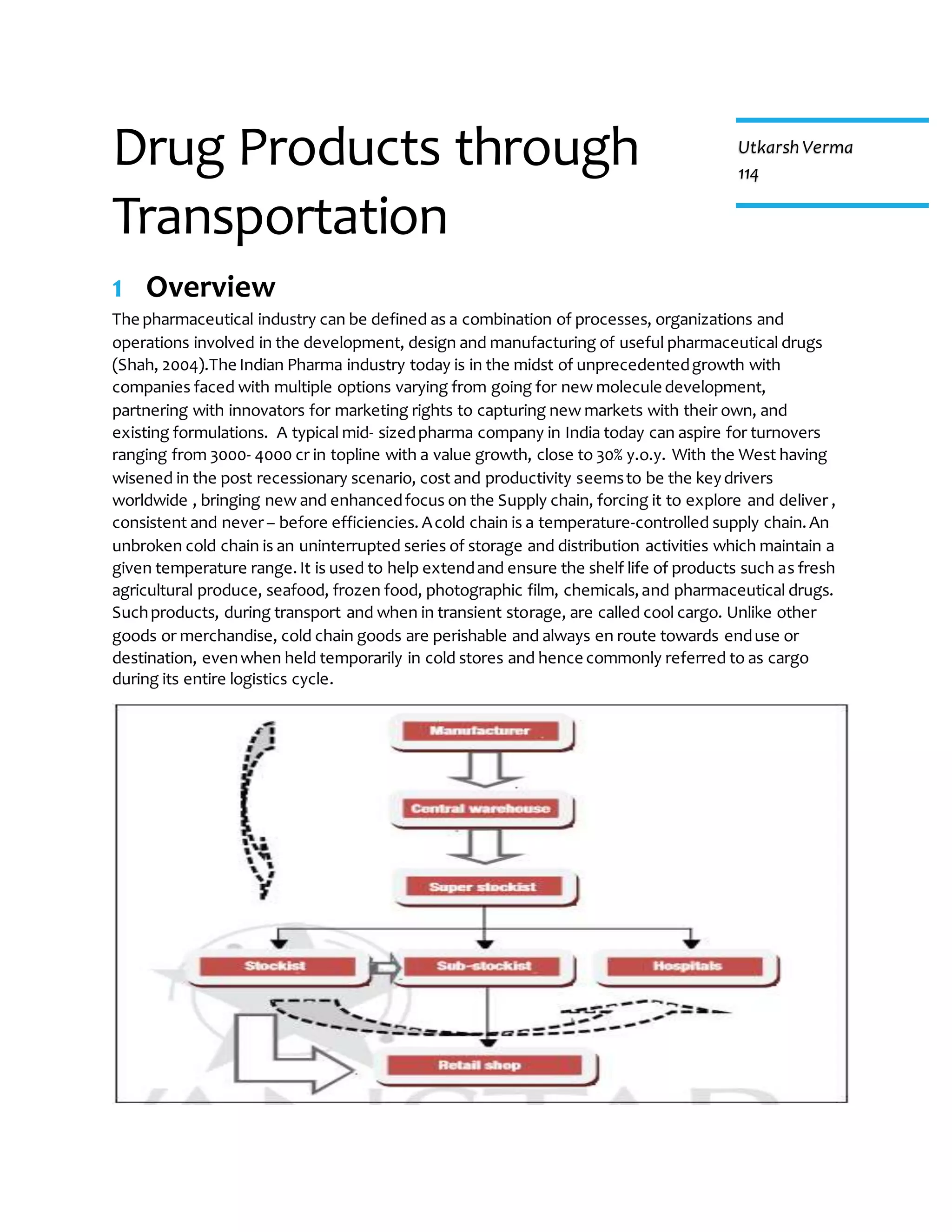
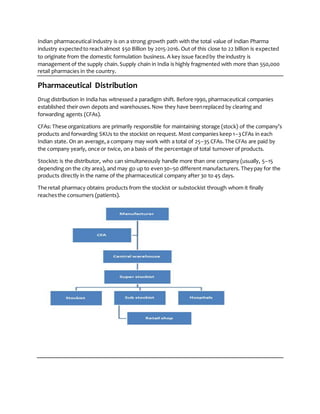
Drug distribution in India has witnessed a paradigm shift. Before 1990, pharmaceutical companies
established their own depots and warehouses.Now they have beenreplaced by clearing and
forwarding agents (CFAs).
CFAs: These organizations are primarily responsible for maintaining storage (stock) of the company’s
products and forwarding SKUs to the stockist on request. Most companies keep 1–3CFAs in each
Indian state. On an average,a company may work with a total of 25–35 CFAs. The CFAs are paid by
the company yearly, once or twice, on a basis of the percentage of total turnover of products.
Stockist: is the distributor, who can simultaneously handle more than one company (usually, 5–15
depending on the city area), and may go up to even30–50 different manufacturers. Theypay for the
products directly in the name of the pharmaceutical company after 30 to 45 days.
The retail pharmacy obtains products from the stockist or substockist through whom it finally
reachesthe consumers (patients).
Typical SupplyChain Structure
Examples of Distribution Structure
ABC Company Supply Chain & Distribution in India
ABC Company Supply Chain Model
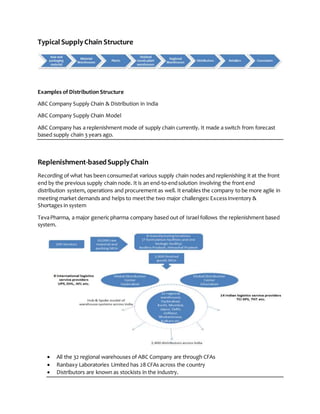
ABC Company has a replenishment mode of supply chain currently. It made a switch from forecast
based supply chain 3 years ago.
Replenishment-basedSupplyChain
Recording of what has been consumedat various supply chain nodes and replenishing it at the front
end by the previous supply chain node. It is an end-to-endsolution involving the front end
distribution system, operations and procurement as well. It enables the company to be more agile in
meeting market demands and helps to meetthe two major challenges:ExcessInventory &
Shortages in system
TevaPharma, a major genericpharma company based out of Israel follows the replenishment based
system.
 All the 32 regional warehouses of ABC Company are through CFAs
 Ranbaxy Laboratories Limited has 28 CFAs across the country
 Distributors are known as stockists in the industry.
CFA Operations
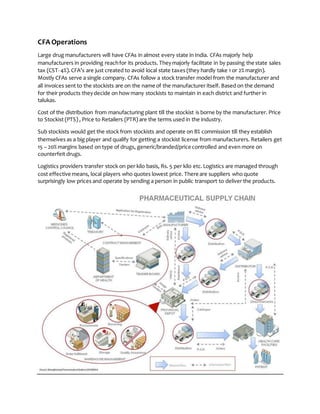
Large drug manufacturers will have CFAs in almost every state in India. CFAs majorly help
manufacturers in providing reachfor its products. Theymajorly facilitate in by passing the state sales
tax (CST- 4%).CFA’s are just created to avoid local state taxes (they hardly take 1 or 2% margin).
Mostly CFAs serve a single company. CFAs follow a stock transfer model from the manufacturer and
all invoices sent to the stockists are on the name of the manufacturer itself. Based on the demand
for their products theydecide on how many stockists to maintain in each district and further in
talukas.
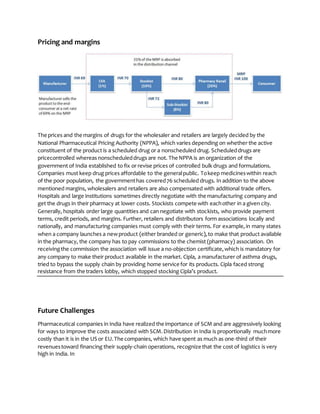
Cost of the distribution from manufacturing plant till the stockist is borne by the manufacturer. Price
to Stockist (PTS) , Price to Retailers (PTR) are the terms used in the industry.
Sub stockists would get the stock from stockists and operate on 8% commission till they establish
themselves as a big player and qualify for getting a stockist license from manufacturers. Retailers get
15 – 20% margins based on type of drugs, generic/branded/price controlled and even more on
counterfeit drugs.
Logistics providers transfer stock on per kilo basis, Rs. 5 per kilo etc.Logistics are managed through
cost effective means, local players who quotes lowest price. There are suppliers who quote
surprisingly low prices and operate by sending a person in public transport to deliver the products.
Pricing and margins
The prices and the margins of drugs for the wholesaler and retailers are largely decided by the
National Pharmaceutical Pricing Authority (NPPA), which varies depending on whether the active
constituent of the product is a scheduled drug or a nonscheduled drug. Scheduleddrugs are
pricecontrolled whereas nonscheduleddrugs are not. The NPPA is an organization of the
government of India established to fix or revise prices of controlled bulk drugs and formulations.
Companies must keep drug prices affordable to the generalpublic. Tokeep medicineswithin reach
of the poor population, the governmenthas covered76 scheduled drugs. In addition to the above
mentioned margins, wholesalers and retailers are also compensated with additional trade offers.
Hospitals and large institutions sometimes directly negotiate with the manufacturing company and
get the drugs in their pharmacy at lower costs. Stockists compete with eachother in a given city.
Generally, hospitals order large quantities and can negotiate with stockists, who provide payment
terms, credit periods, and margins. Further, retailers and distributors form associations locally and
nationally, and manufacturing companies must comply with their terms. For example,in many states
when a company launches a newproduct (either branded or generic),to make that product available
in the pharmacy, the company has to pay commissions to the chemist (pharmacy) association. On
receivingthe commission the association will issue a no-objection certificate,which is mandatory for
any company to make their product available in the market. Cipla, a manufacturer of asthma drugs,
tried to bypass the supply chain by providing home service for its products. Cipla faced strong
resistance from the traders lobby, which stopped stocking Cipla’s product.
Future Challenges
Pharmaceutical companies in India have realized the importance of SCM and are aggressively looking
for ways to improve the costs associated with SCM.Distribution in India is proportionally muchmore
costly than it is in the US or EU.The companies, which have spent as much as one-third of their
revenuestoward financing their supply-chain operations, recognize that the cost of logistics is very
high in India. In
US and EU, the expenditure on SCMalone is perhaps 2%, whereas in India it averages 4–6% of total
sales. According to Gokarn, “It’s mainly because in India the cost of drugs is very low compared to
the developed markets. Taking into consideration the poor infrastructure and extreme geographic
conditions, it is difficult to curtail the cost involved in SCM.”
Long-Channel Inventory Management
The multilayered distribution channeland lobbying at all layers has been successfulat preventing
pharmaceutical companies from bringing in significant reforms toward higher trade margins, and at
bypassing the multiple distribution layers to reachcustomers directly.Because pharmaceutical
companies do not have direct access to retailers’ data on sales (tertiary sales), most pharmaceutical
companies depend on stockists’ sales data to monitor sales (secondary sales). The primary sale
involves transferring stock from the central warehouse to its CFA. The medical representatives are
given predefinedsales targets. To meet these targets they push inventory on the stockist to levels
that exceedthe actual demand. When the nextlevel of sale does not take place, the stockist will
either return goods to the company or the stock expires.
RecallingDrugs
There is no foolproof system for recalling drugs in India. Once a medicine is released into the market,
it becomesa daunting task for a pharmaceutical company to recall because of the highly fragmented
nature of the distribution network. Newertechnologies such as RFID would help in keepingtrack of
products along the entire chain and would limit counterfeit drugs to enterinto the system.
International Competitiveness and Cold-Chain Management
Indian pharmaceutical companies are increasingly seekingopportunities to supply drugs to the world
market. More developed cold-chain managementpractices will be required to achieve this goal. This
is one of the major challengesfaced by the industry if they are to retain product quality during
shipment. Companies like Eli Lilly in India have implementedinitiatives suchas having their own
vehicles equippedwith cold-chain management systems. Other companies suchas World Courier
have developed cold-chain managementmodels to help pharmaceutical companies maintain the
cold chain.
Conclusion
Manufacturers must ensure that their drug reachescustomers with uncompromised quality. In India,
because manufacturers do not retain control over the multilayered distribution system,the cold-
chain management process continues to be difficult and expensive.However,manufacturersare
increasingly realizing the importance of an effective distribution system,all the way to the end-
customer. Coping with the challenges of streamlining the systems in India will ultimately benefit the
patient and the healthcare system.

Drug products through transportation

  • 1.
    Drug Products through Transportation 1Overview The pharmaceutical industry can be defined as a combination of processes, organizations and operations involved in the development, design and manufacturing of useful pharmaceutical drugs (Shah, 2004).The Indian Pharma industry today is in the midst of unprecedentedgrowth with companies faced with multiple options varying from going for new molecule development, partnering with innovators for marketing rights to capturing new markets with their own, and existing formulations. A typical mid- sizedpharma company in India today can aspire for turnovers ranging from 3000- 4000 cr in topline with a value growth, close to 30% y.o.y. With the West having wisened in the post recessionary scenario, cost and productivity seemsto be the keydrivers worldwide , bringing new and enhancedfocus on the Supply chain, forcing it to explore and deliver , consistent and never– before efficiencies. Acold chain is a temperature-controlled supply chain.An unbroken cold chain is an uninterrupted series of storage and distribution activities which maintain a given temperature range.It is used to help extendand ensure the shelf life of products such as fresh agricultural produce, seafood, frozen food, photographic film, chemicals,and pharmaceutical drugs. Suchproducts, during transport and when in transient storage, are called cool cargo. Unlike other goods or merchandise, cold chain goods are perishable and always en route towards enduse or destination, evenwhen held temporarily in cold stores and hence commonly referred to as cargo during its entire logistics cycle. Utkarsh Verma 114
  • 2.
    Indian pharmaceutical industryis on a strong growth path with the total value of Indian Pharma industry expectedto reachalmost $50 Billion by 2015-2016. Out of this close to 22 billion is expected to originate from the domestic formulation business. A key issue facedby the industry is management of the supply chain.Supply chain in India is highly fragmented with more than 550,000 retail pharmacies in the country. Pharmaceutical Distribution Drug distribution in India has witnessed a paradigm shift. Before 1990, pharmaceutical companies established their own depots and warehouses.Now they have beenreplaced by clearing and forwarding agents (CFAs). CFAs: These organizations are primarily responsible for maintaining storage (stock) of the company’s products and forwarding SKUs to the stockist on request. Most companies keep 1–3CFAs in each Indian state. On an average,a company may work with a total of 25–35 CFAs. The CFAs are paid by the company yearly, once or twice, on a basis of the percentage of total turnover of products. Stockist: is the distributor, who can simultaneously handle more than one company (usually, 5–15 depending on the city area), and may go up to even30–50 different manufacturers. Theypay for the products directly in the name of the pharmaceutical company after 30 to 45 days. The retail pharmacy obtains products from the stockist or substockist through whom it finally reachesthe consumers (patients).
  • 3.
    Typical SupplyChain Structure Examplesof Distribution Structure ABC Company Supply Chain & Distribution in India ABC Company Supply Chain Model ABC Company has a replenishment mode of supply chain currently. It made a switch from forecast based supply chain 3 years ago. Replenishment-basedSupplyChain Recording of what has been consumedat various supply chain nodes and replenishing it at the front end by the previous supply chain node. It is an end-to-endsolution involving the front end distribution system, operations and procurement as well. It enables the company to be more agile in meeting market demands and helps to meetthe two major challenges:ExcessInventory & Shortages in system TevaPharma, a major genericpharma company based out of Israel follows the replenishment based system.  All the 32 regional warehouses of ABC Company are through CFAs  Ranbaxy Laboratories Limited has 28 CFAs across the country  Distributors are known as stockists in the industry.
  • 4.
    CFA Operations Large drugmanufacturers will have CFAs in almost every state in India. CFAs majorly help manufacturers in providing reachfor its products. Theymajorly facilitate in by passing the state sales tax (CST- 4%).CFA’s are just created to avoid local state taxes (they hardly take 1 or 2% margin). Mostly CFAs serve a single company. CFAs follow a stock transfer model from the manufacturer and all invoices sent to the stockists are on the name of the manufacturer itself. Based on the demand for their products theydecide on how many stockists to maintain in each district and further in talukas. Cost of the distribution from manufacturing plant till the stockist is borne by the manufacturer. Price to Stockist (PTS) , Price to Retailers (PTR) are the terms used in the industry. Sub stockists would get the stock from stockists and operate on 8% commission till they establish themselves as a big player and qualify for getting a stockist license from manufacturers. Retailers get 15 – 20% margins based on type of drugs, generic/branded/price controlled and even more on counterfeit drugs. Logistics providers transfer stock on per kilo basis, Rs. 5 per kilo etc.Logistics are managed through cost effective means, local players who quotes lowest price. There are suppliers who quote surprisingly low prices and operate by sending a person in public transport to deliver the products.
  • 5.
    Pricing and margins Theprices and the margins of drugs for the wholesaler and retailers are largely decided by the National Pharmaceutical Pricing Authority (NPPA), which varies depending on whether the active constituent of the product is a scheduled drug or a nonscheduled drug. Scheduleddrugs are pricecontrolled whereas nonscheduleddrugs are not. The NPPA is an organization of the government of India established to fix or revise prices of controlled bulk drugs and formulations. Companies must keep drug prices affordable to the generalpublic. Tokeep medicineswithin reach of the poor population, the governmenthas covered76 scheduled drugs. In addition to the above mentioned margins, wholesalers and retailers are also compensated with additional trade offers. Hospitals and large institutions sometimes directly negotiate with the manufacturing company and get the drugs in their pharmacy at lower costs. Stockists compete with eachother in a given city. Generally, hospitals order large quantities and can negotiate with stockists, who provide payment terms, credit periods, and margins. Further, retailers and distributors form associations locally and nationally, and manufacturing companies must comply with their terms. For example,in many states when a company launches a newproduct (either branded or generic),to make that product available in the pharmacy, the company has to pay commissions to the chemist (pharmacy) association. On receivingthe commission the association will issue a no-objection certificate,which is mandatory for any company to make their product available in the market. Cipla, a manufacturer of asthma drugs, tried to bypass the supply chain by providing home service for its products. Cipla faced strong resistance from the traders lobby, which stopped stocking Cipla’s product. Future Challenges Pharmaceutical companies in India have realized the importance of SCM and are aggressively looking for ways to improve the costs associated with SCM.Distribution in India is proportionally muchmore costly than it is in the US or EU.The companies, which have spent as much as one-third of their revenuestoward financing their supply-chain operations, recognize that the cost of logistics is very high in India. In
  • 6.
    US and EU,the expenditure on SCMalone is perhaps 2%, whereas in India it averages 4–6% of total sales. According to Gokarn, “It’s mainly because in India the cost of drugs is very low compared to the developed markets. Taking into consideration the poor infrastructure and extreme geographic conditions, it is difficult to curtail the cost involved in SCM.” Long-Channel Inventory Management The multilayered distribution channeland lobbying at all layers has been successfulat preventing pharmaceutical companies from bringing in significant reforms toward higher trade margins, and at bypassing the multiple distribution layers to reachcustomers directly.Because pharmaceutical companies do not have direct access to retailers’ data on sales (tertiary sales), most pharmaceutical companies depend on stockists’ sales data to monitor sales (secondary sales). The primary sale involves transferring stock from the central warehouse to its CFA. The medical representatives are given predefinedsales targets. To meet these targets they push inventory on the stockist to levels that exceedthe actual demand. When the nextlevel of sale does not take place, the stockist will either return goods to the company or the stock expires. RecallingDrugs There is no foolproof system for recalling drugs in India. Once a medicine is released into the market, it becomesa daunting task for a pharmaceutical company to recall because of the highly fragmented nature of the distribution network. Newertechnologies such as RFID would help in keepingtrack of products along the entire chain and would limit counterfeit drugs to enterinto the system. International Competitiveness and Cold-Chain Management Indian pharmaceutical companies are increasingly seekingopportunities to supply drugs to the world market. More developed cold-chain managementpractices will be required to achieve this goal. This is one of the major challengesfaced by the industry if they are to retain product quality during shipment. Companies like Eli Lilly in India have implementedinitiatives suchas having their own vehicles equippedwith cold-chain management systems. Other companies suchas World Courier have developed cold-chain managementmodels to help pharmaceutical companies maintain the cold chain. Conclusion Manufacturers must ensure that their drug reachescustomers with uncompromised quality. In India, because manufacturers do not retain control over the multilayered distribution system,the cold- chain management process continues to be difficult and expensive.However,manufacturersare increasingly realizing the importance of an effective distribution system,all the way to the end- customer. Coping with the challenges of streamlining the systems in India will ultimately benefit the patient and the healthcare system.