Drug Distribution
By Edao S
Learning objectives
At the end of this session students will be able to
 Drug distribution
 Goals of distribution management
 The distribution cycle
 Distribution system design
2
Introduction
• Is a continuous process of receiving drugs from the suppliers
and moving them safely/ securely expeditiously to the many
point in the health care system at which the drugs will be
dispensed to patients.
• Storage and distribution costs are a significant component of
the health budget
3
• Health programs are frequently managed by well-qualified
personnel who lack logistics experience.
– Logistics is defined as the “science (and art) of getting the
right amounts of the right things to the right places at the
right time”.
• A good distribution system is a cost effective system
4
Goals of distribution management
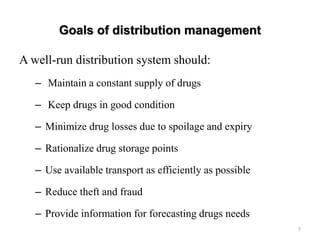
A well-run distribution system should:
– Maintain a constant supply of drugs
– Keep drugs in good condition
– Minimize drug losses due to spoilage and expiry
– Rationalize drug storage points
– Use available transport as efficiently as possible
– Reduce theft and fraud
– Provide information for forecasting drugs needs
5
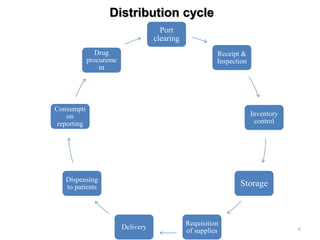
Distribution cycle
Port
clearing
Receipt &
Inspection
Inventory
control
Storage
Requisition
of supplies
Delivery
Dispensing
to patients
Consumpti
on
reporting
Drug
procureme
nt
6
• It begins when drugs are dispatched by manufacturer or
supplier.
• It ends when drug consumption information is reported back
to the procurement office.
• The distribution cycle includes the following steps:
7
1. Port clearing
Involves: -
• Identifying shipments as soon as they arrive in port,
• Processing all importation documents
• Completing any customs requirements
• Storing drugs properly until they leave the port.
• Surveying the shipment for losses and signs of damage, and
collecting the drugs as soon as they have been cleared.
• It may be managed directly or through a separate contract
with port clearing agent
8
2. Receipt and inspection
• When items first delivered from the port or directly from a
supplier to the store room; they must be kept separate from
the other stock until the store staff has performed a complete
formal inspection of the supplies.
• Inspectors should check for damaged and missing items and
for compliance with the contract conditions concerning drug
type, quantity, presentation, packaging labeling and any
special requirements.
9
3. Inventory control
• It is the process of maintaining of stock properly at all levels
and at all times.
• It is the process of assuring that the right volume and
movement are secured in order to ensure that drugs have
reached to the final consumer correcting.
• Is used for requisitioning and issuing drugs. For financial
accounting and for preparing the consumption and stock
balance reports necessary procurement.
10
4. Storage
• Proper location, construction, organization and
maintenance of storage facilities help:-
– maintain drug quality
– minimize theft, and
– maintain regular supply to health facilities
11
5. Requisition of supplies
• The forms and procedures for requisition are a key part of the
inventory control system
• The requisition system may be manual or computerized, but it
should always be designed to simplify distribution by
facilitating inventory control, providing an audit trial for tracing
the flow of drugs, assisting in financial accounting, and listing
drugs issued
12
6. Delivery
• Drugs may be delivered by warehouses or collected by health
facilities
• Transportation methods must be carefully selected and
schedule deliveries realistically and systematically to provide
punctual and economic service
13
7. Dispensing to patients
• The distribution process achieves its purpose when drugs reach
hospital wards, outpatient clinics, health centers, or
community health workers and are appropriately prescribed
and dispensed to patients
14
8. Consumption reporting
• The closing link in the distribution cycle is the flow of
information on consumption and
• Stock balances backs up the distribution system to the
procurement office for use in quantifying procurement needs.
15
Distribution system design
• Designing distribution system requires
– systematic cost effectiveness analysis and
– operational planning
• Once the system is in place, regular performance monitoring it
needed to ensure that the system functions as intended
16
Basic design features include : -
• Its degree of centralization
• The number of levels in the system
• The geographic and population coverage
17
• In a typical central supply system;-
– drug procurement and
– distribution are coordinated at the national level.
• Drugs received at the central medical stores (CMS) are
distributed to lower-level warehouses and onward to the health
facilities.
• In a decentralized system, the districts or regions are
responsible for receiving storing and distributing drugs.
• In some cases, they may also be responsible for procurement.
18
 In designing a distribution system or redesigning an existing
system the following important steps have to be taken: -
A. Determine the member of storage levels in the system.
• Factors to consider in determining the number of storage level
are:
– Geographical factors
– Population, availability of storage space,
– staff, transport facilities, political and other resource
constraints
19
• Determine the location of storage sites
• Decides at which level of the supply system decisions will be
made concerning orders
• Fix resupply interval or frequency of placing orders
• Select method of distributing drugs to uses units
• Select an appropriate method of transport
• Set delivery routes
• Estimate operating costs
20
Push and Pull systems
Pull system: -
• Each level of a system determines
– what types and quantities of drugs are needed and places
orders with the supply source.
• It is sometimes known as independent demand or a
requisition system
21
Conditions favoring a pull system
• Lower-level staff are competent in assessing needs and
managing inventory
• Sufficient supplier are available at supply source to meet all
program needs
• A large range of products is being handled
• Field – Staffs are regularly supervised, and performance is
monitored.
22
Push system:-
• Supply sources at some level in the systems determine what
types and quantities of drugs will be delivered to lower levels.
• This is also known as an allocation or a ration system.
23
Conditions favoring push systems
• Lower levels staff are not competent in inventory control
• A limited number of product is being handled
• Disaster relief needed, or the situation calls for short- term
supply through prepacked kits.
24
Re-supply interval
• Determine whether deliveries are made to user units quarterly,
monthly, weekly or at any other time.
• If deliveries are made weekly, average stock levels will be low
and the likelihood of stock outs will decrease, but transport
costs will be very high.
• If deliveries are made only a year, transport costs will be low,
but the average stocks and storage costs will be high
25
 It is important to consider the following factors before making
in decision:
• Storage capacity at each level of the system
• Availability order size, carrying capacity, & cost of transport
• Seasonal factors that influence transport reliability
• Staffing levels and competence of staff at each level of the
system
• Other factors, such as expiration dates, security
26
Delivery system versus Collection systems
 Basically there are two option to move drugs between
warehouse and receiving facilities:
a. Collection (Pick-up):- the receiving facilities takes on the
responsibility of collecting supply from the warehouse.
b. Delivery:- the warehouse is responsible for delivering supplies
with either in-house transport or a private-sector contract.
27
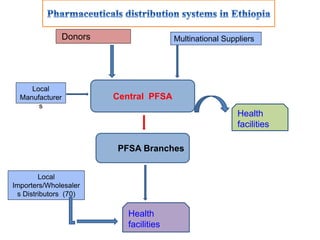
Multinational Suppliers
Donors
Central PFSA
Health
facilities
PFSA Branches
Health
facilities
Local
Manufacturer
s
Local
Importers/Wholesaler
s Distributors (70)
Summary
• Effective drug distribution relies on good system design and
good management
• Designing a distribution system requires systematic cost-
effectiveness analysis and operational planning.
• Operational planning and logistics skills are the key to
developing a cost-effective distribution system.
• It is therefore important to have a logistics team staffed by
qualified people.
29
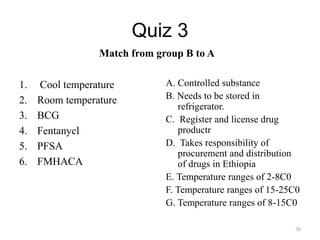
Quiz 3
Match from group B to A
1. Cool temperature
2. Room temperature
3. BCG
4. Fentanycl
5. PFSA
6. FMHACA
A. Controlled substance
B. Needs to be stored in
refrigerator.
C. Register and license drug
productr
D. Takes responsibility of
procurement and distribution
of drugs in Ethiopia
E. Temperature ranges of 2-8C0
F. Temperature ranges of 15-25C0
G. Temperature ranges of 8-15C0
30

Drug Distribution reference for pharmacy.pdf

  • 1.
  • 2.
    Learning objectives At theend of this session students will be able to  Drug distribution  Goals of distribution management  The distribution cycle  Distribution system design 2
  • 3.
    Introduction • Is acontinuous process of receiving drugs from the suppliers and moving them safely/ securely expeditiously to the many point in the health care system at which the drugs will be dispensed to patients. • Storage and distribution costs are a significant component of the health budget 3
  • 4.
    • Health programsare frequently managed by well-qualified personnel who lack logistics experience. – Logistics is defined as the “science (and art) of getting the right amounts of the right things to the right places at the right time”. • A good distribution system is a cost effective system 4
  • 5.
    Goals of distributionmanagement A well-run distribution system should: – Maintain a constant supply of drugs – Keep drugs in good condition – Minimize drug losses due to spoilage and expiry – Rationalize drug storage points – Use available transport as efficiently as possible – Reduce theft and fraud – Provide information for forecasting drugs needs 5
  • 6.
    Distribution cycle Port clearing Receipt & Inspection Inventory control Storage Requisition ofsupplies Delivery Dispensing to patients Consumpti on reporting Drug procureme nt 6
  • 7.
    • It beginswhen drugs are dispatched by manufacturer or supplier. • It ends when drug consumption information is reported back to the procurement office. • The distribution cycle includes the following steps: 7
  • 8.
    1. Port clearing Involves:- • Identifying shipments as soon as they arrive in port, • Processing all importation documents • Completing any customs requirements • Storing drugs properly until they leave the port. • Surveying the shipment for losses and signs of damage, and collecting the drugs as soon as they have been cleared. • It may be managed directly or through a separate contract with port clearing agent 8
  • 9.
    2. Receipt andinspection • When items first delivered from the port or directly from a supplier to the store room; they must be kept separate from the other stock until the store staff has performed a complete formal inspection of the supplies. • Inspectors should check for damaged and missing items and for compliance with the contract conditions concerning drug type, quantity, presentation, packaging labeling and any special requirements. 9
  • 10.
    3. Inventory control •It is the process of maintaining of stock properly at all levels and at all times. • It is the process of assuring that the right volume and movement are secured in order to ensure that drugs have reached to the final consumer correcting. • Is used for requisitioning and issuing drugs. For financial accounting and for preparing the consumption and stock balance reports necessary procurement. 10
  • 11.
    4. Storage • Properlocation, construction, organization and maintenance of storage facilities help:- – maintain drug quality – minimize theft, and – maintain regular supply to health facilities 11
  • 12.
    5. Requisition ofsupplies • The forms and procedures for requisition are a key part of the inventory control system • The requisition system may be manual or computerized, but it should always be designed to simplify distribution by facilitating inventory control, providing an audit trial for tracing the flow of drugs, assisting in financial accounting, and listing drugs issued 12
  • 13.
    6. Delivery • Drugsmay be delivered by warehouses or collected by health facilities • Transportation methods must be carefully selected and schedule deliveries realistically and systematically to provide punctual and economic service 13
  • 14.
    7. Dispensing topatients • The distribution process achieves its purpose when drugs reach hospital wards, outpatient clinics, health centers, or community health workers and are appropriately prescribed and dispensed to patients 14
  • 15.
    8. Consumption reporting •The closing link in the distribution cycle is the flow of information on consumption and • Stock balances backs up the distribution system to the procurement office for use in quantifying procurement needs. 15
  • 16.
    Distribution system design •Designing distribution system requires – systematic cost effectiveness analysis and – operational planning • Once the system is in place, regular performance monitoring it needed to ensure that the system functions as intended 16
  • 17.
    Basic design featuresinclude : - • Its degree of centralization • The number of levels in the system • The geographic and population coverage 17
  • 18.
    • In atypical central supply system;- – drug procurement and – distribution are coordinated at the national level. • Drugs received at the central medical stores (CMS) are distributed to lower-level warehouses and onward to the health facilities. • In a decentralized system, the districts or regions are responsible for receiving storing and distributing drugs. • In some cases, they may also be responsible for procurement. 18
  • 19.
     In designinga distribution system or redesigning an existing system the following important steps have to be taken: - A. Determine the member of storage levels in the system. • Factors to consider in determining the number of storage level are: – Geographical factors – Population, availability of storage space, – staff, transport facilities, political and other resource constraints 19
  • 20.
    • Determine thelocation of storage sites • Decides at which level of the supply system decisions will be made concerning orders • Fix resupply interval or frequency of placing orders • Select method of distributing drugs to uses units • Select an appropriate method of transport • Set delivery routes • Estimate operating costs 20
  • 21.
    Push and Pullsystems Pull system: - • Each level of a system determines – what types and quantities of drugs are needed and places orders with the supply source. • It is sometimes known as independent demand or a requisition system 21
  • 22.
    Conditions favoring apull system • Lower-level staff are competent in assessing needs and managing inventory • Sufficient supplier are available at supply source to meet all program needs • A large range of products is being handled • Field – Staffs are regularly supervised, and performance is monitored. 22
  • 23.
    Push system:- • Supplysources at some level in the systems determine what types and quantities of drugs will be delivered to lower levels. • This is also known as an allocation or a ration system. 23
  • 24.
    Conditions favoring pushsystems • Lower levels staff are not competent in inventory control • A limited number of product is being handled • Disaster relief needed, or the situation calls for short- term supply through prepacked kits. 24
  • 25.
    Re-supply interval • Determinewhether deliveries are made to user units quarterly, monthly, weekly or at any other time. • If deliveries are made weekly, average stock levels will be low and the likelihood of stock outs will decrease, but transport costs will be very high. • If deliveries are made only a year, transport costs will be low, but the average stocks and storage costs will be high 25
  • 26.
     It isimportant to consider the following factors before making in decision: • Storage capacity at each level of the system • Availability order size, carrying capacity, & cost of transport • Seasonal factors that influence transport reliability • Staffing levels and competence of staff at each level of the system • Other factors, such as expiration dates, security 26
  • 27.
    Delivery system versusCollection systems  Basically there are two option to move drugs between warehouse and receiving facilities: a. Collection (Pick-up):- the receiving facilities takes on the responsibility of collecting supply from the warehouse. b. Delivery:- the warehouse is responsible for delivering supplies with either in-house transport or a private-sector contract. 27
  • 28.
    Multinational Suppliers Donors Central PFSA Health facilities PFSABranches Health facilities Local Manufacturer s Local Importers/Wholesaler s Distributors (70)
  • 29.
    Summary • Effective drugdistribution relies on good system design and good management • Designing a distribution system requires systematic cost- effectiveness analysis and operational planning. • Operational planning and logistics skills are the key to developing a cost-effective distribution system. • It is therefore important to have a logistics team staffed by qualified people. 29
  • 30.
    Quiz 3 Match fromgroup B to A 1. Cool temperature 2. Room temperature 3. BCG 4. Fentanycl 5. PFSA 6. FMHACA A. Controlled substance B. Needs to be stored in refrigerator. C. Register and license drug productr D. Takes responsibility of procurement and distribution of drugs in Ethiopia E. Temperature ranges of 2-8C0 F. Temperature ranges of 15-25C0 G. Temperature ranges of 8-15C0 30