Faculty : Yousuf Bhatti
M. Waheed
M Raees
M. Bilal Raza
M. Waheed
Sher Mohommad
Salma
Simran
Rabia
Nazia
Cardiovascular
Assessment
1
1
• Review A&P of Heart
• Explain deferent cardio-dynamics
• Discuss cardiac cycle
2
• Demonstrate different techniques in cardiovascular assessment
• Perform complete history taking prioritizing risk factors
3
• Analyze health status of a cardiac patient and document relevant
data
• Apply collected data in developing a holistic care plan
2
HEART
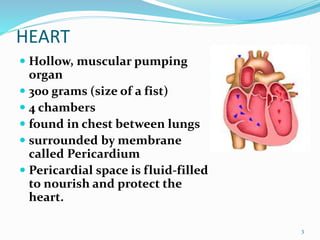
 Hollow, muscular pumping
organ
 300 grams (size of a fist)
 4 chambers
 found in chest between lungs
 surrounded by membrane
called Pericardium
 Pericardial space is fluid-filled
to nourish and protect the
heart.
3
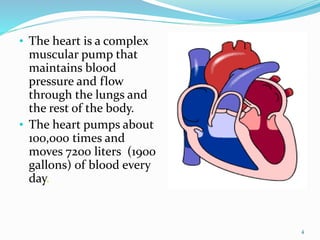
• The heart is a complex
muscular pump that
maintains blood
pressure and flow
through the lungs and
the rest of the body.
• The heart pumps about
100,000 times and
moves 7200 liters (1900
gallons) of blood every
day.
4
Functions of the
Cardiovascular System
To transport materials to and from cells:
 Oxygen and carbon dioxide
 Nutrients
 Hormones
 Immune system components
 Waste products
5
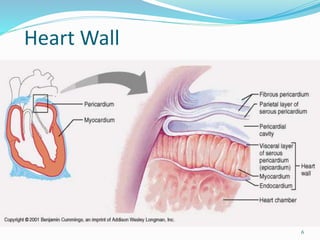
Heart Wall
6
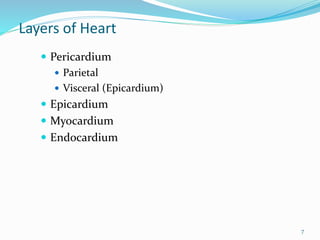
Layers of Heart
 Pericardium
 Parietal
 Visceral (Epicardium)
 Epicardium
 Myocardium
 Endocardium
7
Coronary Arteries
 Two coronary arteries originate from aorta
Right coronary artery (RCA)
 Posterior descending artery (PDA)
Left main (LM) coronary artery
 Left anterior descending (LAD)
 Left Circumflex (LCX)
8
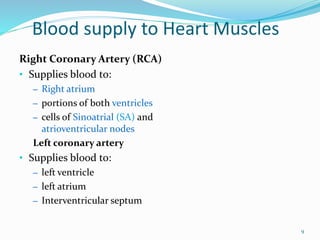
Blood supply to Heart Muscles
Right Coronary Artery (RCA)
• Supplies blood to:
– Right atrium
– portions of both ventricles
– cells of Sinoatrial (SA) and
atrioventricular nodes
Left coronary artery
• Supplies blood to:
– left ventricle
– left atrium
– Interventricular septum
9
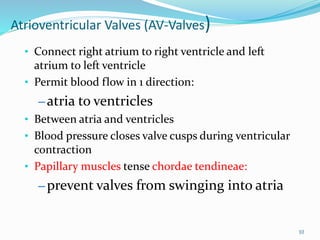
Atrioventricular Valves (AV-Valves)
• Connect right atrium to right ventricle and left
atrium to left ventricle
• Permit blood flow in 1 direction:
– atria to ventricles
• Between atria and ventricles
• Blood pressure closes valve cusps during ventricular
contraction
• Papillary muscles tense chordae tendineae:
– prevent valves from swinging into atria
10
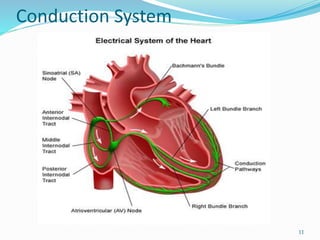
Conduction System
11
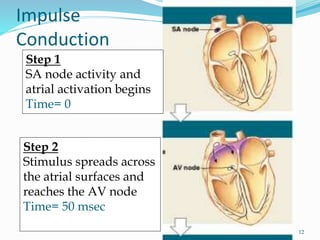
Step 1
SA node activity and
atrial activation begins
Time= 0
Step 2
Stimulus spreads across
the atrial surfaces and
reaches the AV node
Time= 50 msec
Impulse
Conduction
12
Impulse
Conduction
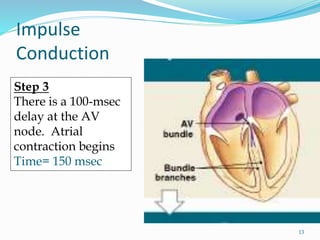
Step 3
There is a 100-msec
delay at the AV
node. Atrial
contraction begins
Time= 150 msec
13
Impulse
Conduction
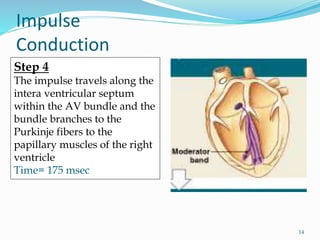
Step 4
The impulse travels along the
intera ventricular septum
within the AV bundle and the
bundle branches to the
Purkinje fibers to the
papillary muscles of the right
ventricle
Time= 175 msec
14
Impulse
Conduction
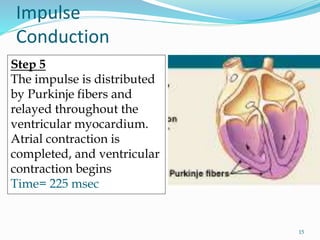
Step 5
The impulse is distributed
by Purkinje fibers and
relayed throughout the
ventricular myocardium.
Atrial contraction is
completed, and ventricular
contraction begins
Time= 225 msec
15
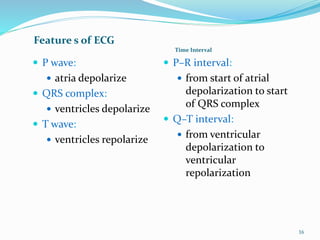
Feature s of ECG
Time Interval
 P wave:
 atria depolarize
 QRS complex:
 ventricles depolarize
 T wave:
 ventricles repolarize
 P–R interval:
 from start of atrial
depolarization to start
of QRS complex
 Q–T interval:
 from ventricular
depolarization to
ventricular
repolarization
16
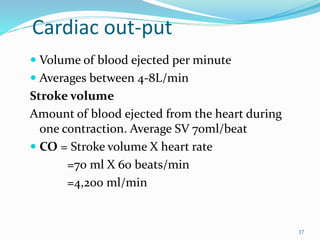
Cardiac out-put
 Volume of blood ejected per minute
 Averages between 4-8L/min
Stroke volume
Amount of blood ejected from the heart during
one contraction. Average SV 70ml/beat
 CO = Stroke volume X heart rate
=70 ml X 60 beats/min
=4,200 ml/min
17
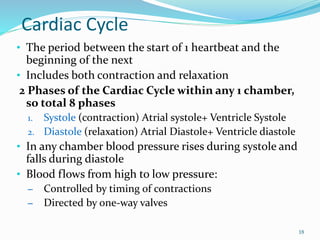
Cardiac Cycle
• The period between the start of 1 heartbeat and the
beginning of the next
• Includes both contraction and relaxation
2 Phases of the Cardiac Cycle within any 1 chamber,
so total 8 phases
1. Systole (contraction) Atrial systole+ Ventricle Systole
2. Diastole (relaxation) Atrial Diastole+ Ventricle diastole
• In any chamber blood pressure rises during systole and
falls during diastole
• Blood flows from high to low pressure:
– Controlled by timing of contractions
– Directed by one-way valves
18
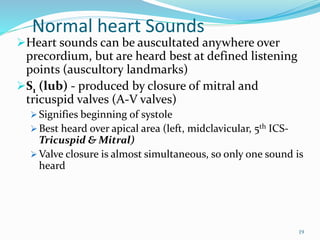
Normal heart Sounds
Heart sounds can be auscultated anywhere over
precordium, but are heard best at defined listening
points (auscultory landmarks)
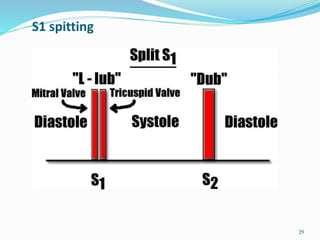
S1 (lub) - produced by closure of mitral and
tricuspid valves (A-V valves)
 Signifies beginning of systole
 Best heard over apical area (left, midclavicular, 5th ICS-
Tricuspid & Mitral)
 Valve closure is almost simultaneous, so only one sound is
heard
19
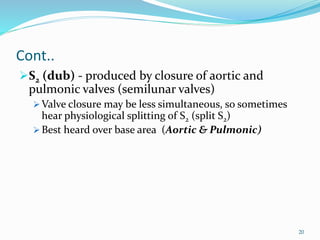
Cont..
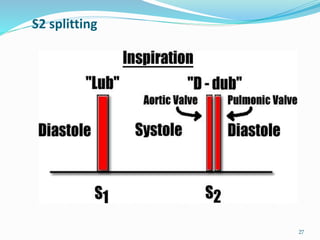
S2 (dub) - produced by closure of aortic and
pulmonic valves (semilunar valves)
 Valve closure may be less simultaneous, so sometimes
hear physiological splitting of S2 (split S2)
 Best heard over base area (Aortic & Pulmonic)
20
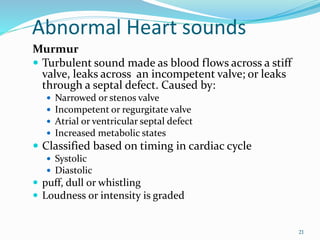
Abnormal Heart sounds
Murmur
 Turbulent sound made as blood flows across a stiff
valve, leaks across an incompetent valve; or leaks
through a septal defect. Caused by:
 Narrowed or stenos valve
 Incompetent or regurgitate valve
 Atrial or ventricular septal defect
 Increased metabolic states
 Classified based on timing in cardiac cycle
 Systolic
 Diastolic
 puff, dull or whistling
 Loudness or intensity is graded
21
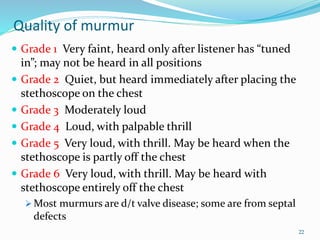
Quality of murmur
 Grade 1 Very faint, heard only after listener has “tuned
in”; may not be heard in all positions
 Grade 2 Quiet, but heard immediately after placing the
stethoscope on the chest
 Grade 3 Moderately loud
 Grade 4 Loud, with palpable thrill
 Grade 5 Very loud, with thrill. May be heard when the
stethoscope is partly off the chest
 Grade 6 Very loud, with thrill. May be heard with
stethoscope entirely off the chest
 Most murmurs are d/t valve disease; some are from septal
defects
22
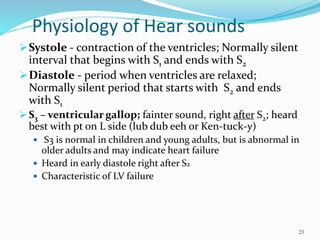
Physiology of Hear sounds
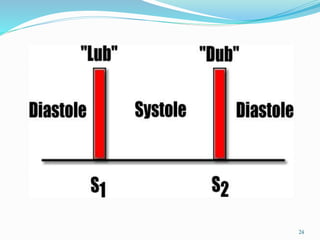
Systole - contraction of the ventricles; Normally silent
interval that begins with S1 and ends with S2
Diastole - period when ventricles are relaxed;
Normally silent period that starts with S2 and ends
with S1
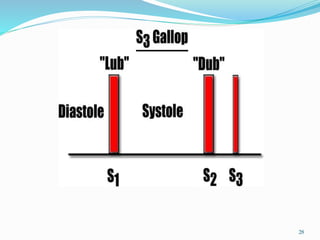
 S3 – ventricular gallop; fainter sound, right after S2; heard
best with pt on L side (lub dub eeh or Ken-tuck-y)
 S3 is normal in children and young adults, but is abnormal in
older adults and may indicate heart failure
 Heard in early diastole right after S2
 Characteristic of LV failure
23
24
Cont…
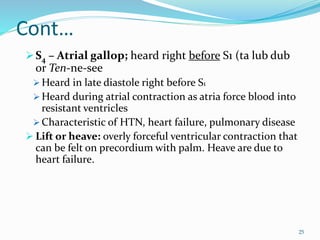
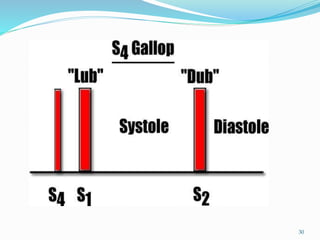
S4 – Atrial gallop; heard right before S1 (ta lub dub
or Ten-ne-see
 Heard in late diastole right before S1
 Heard during atrial contraction as atria force blood into
resistant ventricles
 Characteristic of HTN, heart failure, pulmonary disease
 Lift or heave: overly forceful ventricular contraction that
can be felt on precordium with palm. Heave are due to
heart failure.
25
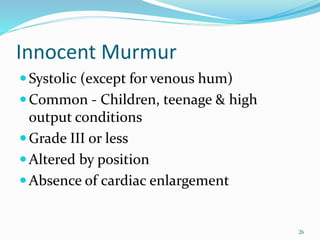
Innocent Murmur
Systolic (except for venous hum)
Common - Children, teenage & high
output conditions
Grade III or less
Altered by position
Absence of cardiac enlargement
26
S2 splitting
27
28
S1 spitting
29
30
 Coronary Artery Disease
 Hypertension
 Rheumatic Heart Disease
 Bacterial Endocarditis
 Congenital Heart Disease
31
Risk Factors (Non correctable)
 Family Hx (BP, stroke, CVD, MI-death <50, DM, hyper
lipids)
 PMH (DM, CAD, CHF, CHD, Rheumatoid Fever, CRF
arrhythmias, CV surg, blood disorders, aneurysms,
emboli, hypo-hyper thyroid)
 Age, Sex (Male)
 Personality type
32
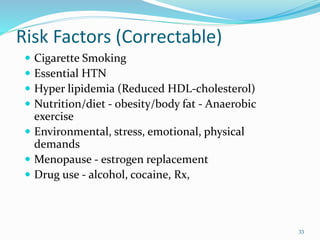
Risk Factors (Correctable)
 Cigarette Smoking
 Essential HTN
 Hyper lipidemia (Reduced HDL-cholesterol)
 Nutrition/diet - obesity/body fat - Anaerobic
exercise
 Environmental, stress, emotional, physical
demands
 Menopause - estrogen replacement
 Drug use - alcohol, cocaine, Rx,
33
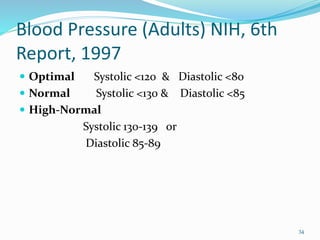
Blood Pressure (Adults) NIH, 6th
Report, 1997
 Optimal Systolic <120 & Diastolic <80
 Normal Systolic <130 & Diastolic <85
 High-Normal
Systolic 130-139 or
Diastolic 85-89
34
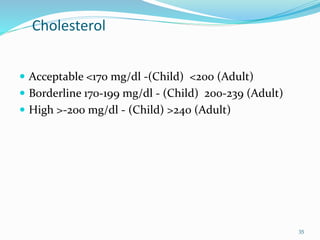
Cholesterol
 Acceptable <170 mg/dl -(Child) <200 (Adult)
 Borderline 170-199 mg/dl - (Child) 200-239 (Adult)
 High >-200 mg/dl - (Child) >240 (Adult)
35
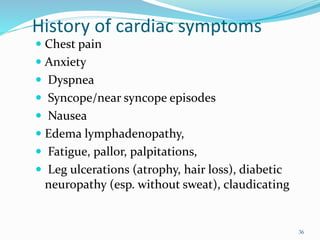
History of cardiac symptoms
 Chest pain
 Anxiety
 Dyspnea
 Syncope/near syncope episodes
 Nausea
 Edema lymphadenopathy,
 Fatigue, pallor, palpitations,
 Leg ulcerations (atrophy, hair loss), diabetic
neuropathy (esp. without sweat), claudicating
36
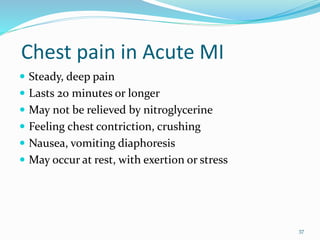
Chest pain in Acute MI
 Steady, deep pain
 Lasts 20 minutes or longer
 May not be relieved by nitroglycerine
 Feeling chest contriction, crushing
 Nausea, vomiting diaphoresis
 May occur at rest, with exertion or stress
37
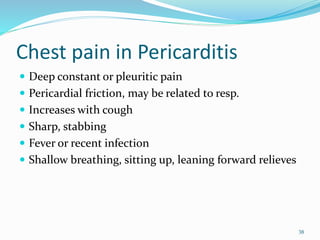
Chest pain in Pericarditis
 Deep constant or pleuritic pain
 Pericardial friction, may be related to resp.
 Increases with cough
 Sharp, stabbing
 Fever or recent infection
 Shallow breathing, sitting up, leaning forward relieves
38
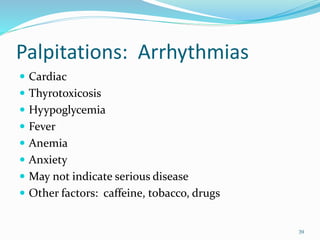
Palpitations: Arrhythmias
 Cardiac
 Thyrotoxicosis
 Hyypoglycemia
 Fever
 Anemia
 Anxiety
 May not indicate serious disease
 Other factors: caffeine, tobacco, drugs
39
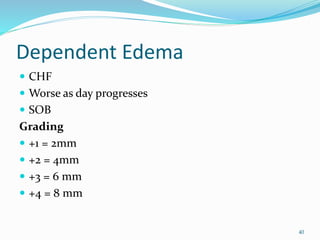
Dependent Edema
 CHF
 Worse as day progresses
 SOB
Grading
 +1 = 2mm
 +2 = 4mm
 +3 = 6 mm
 +4 = 8 mm
40
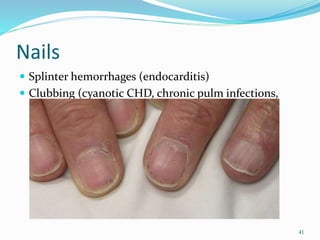
Nails
 Splinter hemorrhages (endocarditis)
 Clubbing (cyanotic CHD, chronic pulm infections,
cirrhosis)
41
Cont…
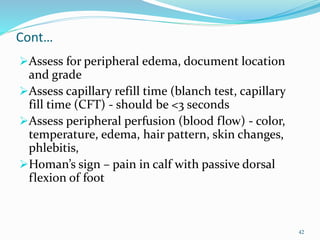
Assess for peripheral edema, document location
and grade
Assess capillary refill time (blanch test, capillary
fill time (CFT) - should be <3 seconds
Assess peripheral perfusion (blood flow) - color,
temperature, edema, hair pattern, skin changes,
phlebitis,
Homan’s sign – pain in calf with passive dorsal
flexion of foot
42
Cont…
 The murmur of aortic stenosis may radiate to the
carotid arteries (especially the right).
 The term bruit is French for “noise” or “sound.” It
refers to an extra or "adventitial" sound of arterial or
venous origin caused by a pathological narrowing of
the blood vessel.
 A carotid artery bruit in an older adult is associated
with atherosclerotic vascular disease and an increased
incidence of both cardiovascular and cerebrovascular
events.
43
The cardiac exam occurs after the chest and breast
exams, with the patient positioned supine and the
examiner on the right. You will also examine the
patient in:
 Partial left lateral decubitus position (rolled over 45°
to the left side)
 PMI felt best
 Mitral stenosis murmur heard best
 S3 and S4 heard best
 Sitting up, leaning forward, with breath briefly held
 Aortic regurgitation murmur heard best
 Cardiac rub heard best
44
 Inspect and then palpate the pericardium for the
point of maximal impulse (PMI), noting its position
and diameter. If you cannot feel the PMI in the supine
position, ask the patient to roll to the partial left
lateral decubitus position, and palpate again.
 Inspect and then palpate the pericardium for
abnormal, sustained outward movement, called a lift
or heave. If a patient has a murmur, palpate for thrills.
45
Cont…
 Gently palpate each carotid artery separately and
assess the strength of the pulse and the briskness of
the carotid artery upstroke.
 The normal PMI (which is palpable in only 30% of
normal adults) is < 2 cm in diameter in the supine
patient, and < 4 cm in the partial left lateral decubitus
position.
46
Heave or Lift
 A heave or lift is a sustained, systolic outward movement
of the precordium, associated with heart failure.
 A right ventricular heave or lift is best palpated at the left sternal
border
 A left ventricular heave or lift is best palpated at the cardiac apex
Thrill
 A thrill is a vibration (like a cat purring) felt when a
cardiac murmur is grade IV-VI / VI.
47
 Listen at four basic locations using the diaphragm and bell of
the stethoscope firmly applied to bare skin in a completely
quiet room:
Position:
 Sitting, leaning forward, supine & left lateral decubitus
position
Area
 Cardiac apex (mitral valve area)
 Tricuspid area (left lower sternal border [LLSB])
 Pulmonic area (left 2nd ICS)
 Aortic area (right 2nd ICS)
48
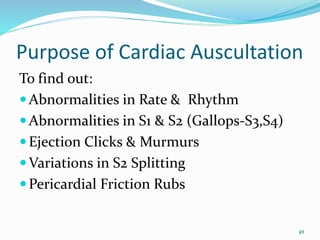
Purpose of Cardiac Auscultation
To find out:
Abnormalities in Rate & Rhythm
Abnormalities in S1 & S2 (Gallops-S3,S4)
Ejection Clicks & Murmurs
Variations in S2 Splitting
Pericardial Friction Rubs
49
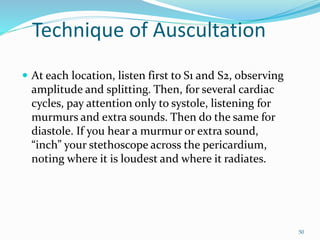
Technique of Auscultation
 At each location, listen first to S1 and S2, observing
amplitude and splitting. Then, for several cardiac
cycles, pay attention only to systole, listening for
murmurs and extra sounds. Then do the same for
diastole. If you hear a murmur or extra sound,
“inch” your stethoscope across the pericardium,
noting where it is loudest and where it radiates.
50
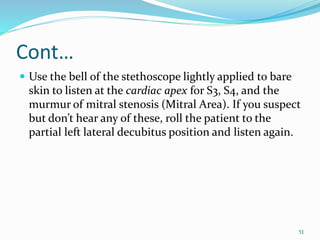
Cont…
 Use the bell of the stethoscope lightly applied to bare
skin to listen at the cardiac apex for S3, S4, and the
murmur of mitral stenosis (Mitral Area). If you suspect
but don’t hear any of these, roll the patient to the
partial left lateral decubitus position and listen again.
51
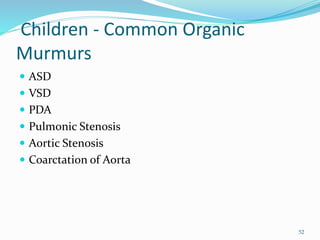
Children - Common Organic
Murmurs
 ASD
 VSD
 PDA
 Pulmonic Stenosis
 Aortic Stenosis
 Coarctation of Aorta
52
References B ickley.L.S (2011) Bates’ guide to physical examination and history
taking (10th ed).Philadelphia: J.B.Lippincott
 Marcus, G. M., J. Cohen, et al. (2007). "The utility of gestures in
patients with chest discomfort." Am J Med 120(1): 83-89.
 World Wide Web Page, Martini, F. H. Fluid and Transport [online]
August2, 2008 [cited 2011 January 19]. Available from: URL:
http://library.med.utah.edu/kw/pharm/
53

cardiac assessment

  • 1.
    Faculty : YousufBhatti M. Waheed M Raees M. Bilal Raza M. Waheed Sher Mohommad Salma Simran Rabia Nazia Cardiovascular Assessment 1
  • 2.
    1 • Review A&Pof Heart • Explain deferent cardio-dynamics • Discuss cardiac cycle 2 • Demonstrate different techniques in cardiovascular assessment • Perform complete history taking prioritizing risk factors 3 • Analyze health status of a cardiac patient and document relevant data • Apply collected data in developing a holistic care plan 2
  • 3.
    HEART  Hollow, muscularpumping organ  300 grams (size of a fist)  4 chambers  found in chest between lungs  surrounded by membrane called Pericardium  Pericardial space is fluid-filled to nourish and protect the heart. 3
  • 4.
    • The heartis a complex muscular pump that maintains blood pressure and flow through the lungs and the rest of the body. • The heart pumps about 100,000 times and moves 7200 liters (1900 gallons) of blood every day. 4
  • 5.
    Functions of the CardiovascularSystem To transport materials to and from cells:  Oxygen and carbon dioxide  Nutrients  Hormones  Immune system components  Waste products 5
  • 6.
  • 7.
    Layers of Heart Pericardium  Parietal  Visceral (Epicardium)  Epicardium  Myocardium  Endocardium 7
  • 8.
    Coronary Arteries  Twocoronary arteries originate from aorta Right coronary artery (RCA)  Posterior descending artery (PDA) Left main (LM) coronary artery  Left anterior descending (LAD)  Left Circumflex (LCX) 8
  • 9.
    Blood supply toHeart Muscles Right Coronary Artery (RCA) • Supplies blood to: – Right atrium – portions of both ventricles – cells of Sinoatrial (SA) and atrioventricular nodes Left coronary artery • Supplies blood to: – left ventricle – left atrium – Interventricular septum 9
  • 10.
    Atrioventricular Valves (AV-Valves) •Connect right atrium to right ventricle and left atrium to left ventricle • Permit blood flow in 1 direction: – atria to ventricles • Between atria and ventricles • Blood pressure closes valve cusps during ventricular contraction • Papillary muscles tense chordae tendineae: – prevent valves from swinging into atria 10
  • 11.
  • 12.
    Step 1 SA nodeactivity and atrial activation begins Time= 0 Step 2 Stimulus spreads across the atrial surfaces and reaches the AV node Time= 50 msec Impulse Conduction 12
  • 13.
    Impulse Conduction Step 3 There isa 100-msec delay at the AV node. Atrial contraction begins Time= 150 msec 13
  • 14.
    Impulse Conduction Step 4 The impulsetravels along the intera ventricular septum within the AV bundle and the bundle branches to the Purkinje fibers to the papillary muscles of the right ventricle Time= 175 msec 14
  • 15.
    Impulse Conduction Step 5 The impulseis distributed by Purkinje fibers and relayed throughout the ventricular myocardium. Atrial contraction is completed, and ventricular contraction begins Time= 225 msec 15
  • 16.
    Feature s ofECG Time Interval  P wave:  atria depolarize  QRS complex:  ventricles depolarize  T wave:  ventricles repolarize  P–R interval:  from start of atrial depolarization to start of QRS complex  Q–T interval:  from ventricular depolarization to ventricular repolarization 16
  • 17.
    Cardiac out-put  Volumeof blood ejected per minute  Averages between 4-8L/min Stroke volume Amount of blood ejected from the heart during one contraction. Average SV 70ml/beat  CO = Stroke volume X heart rate =70 ml X 60 beats/min =4,200 ml/min 17
  • 18.
    Cardiac Cycle • Theperiod between the start of 1 heartbeat and the beginning of the next • Includes both contraction and relaxation 2 Phases of the Cardiac Cycle within any 1 chamber, so total 8 phases 1. Systole (contraction) Atrial systole+ Ventricle Systole 2. Diastole (relaxation) Atrial Diastole+ Ventricle diastole • In any chamber blood pressure rises during systole and falls during diastole • Blood flows from high to low pressure: – Controlled by timing of contractions – Directed by one-way valves 18
  • 19.
    Normal heart Sounds Heartsounds can be auscultated anywhere over precordium, but are heard best at defined listening points (auscultory landmarks) S1 (lub) - produced by closure of mitral and tricuspid valves (A-V valves)  Signifies beginning of systole  Best heard over apical area (left, midclavicular, 5th ICS- Tricuspid & Mitral)  Valve closure is almost simultaneous, so only one sound is heard 19
  • 20.
    Cont.. S2 (dub) -produced by closure of aortic and pulmonic valves (semilunar valves)  Valve closure may be less simultaneous, so sometimes hear physiological splitting of S2 (split S2)  Best heard over base area (Aortic & Pulmonic) 20
  • 21.
    Abnormal Heart sounds Murmur Turbulent sound made as blood flows across a stiff valve, leaks across an incompetent valve; or leaks through a septal defect. Caused by:  Narrowed or stenos valve  Incompetent or regurgitate valve  Atrial or ventricular septal defect  Increased metabolic states  Classified based on timing in cardiac cycle  Systolic  Diastolic  puff, dull or whistling  Loudness or intensity is graded 21
  • 22.
    Quality of murmur Grade 1 Very faint, heard only after listener has “tuned in”; may not be heard in all positions  Grade 2 Quiet, but heard immediately after placing the stethoscope on the chest  Grade 3 Moderately loud  Grade 4 Loud, with palpable thrill  Grade 5 Very loud, with thrill. May be heard when the stethoscope is partly off the chest  Grade 6 Very loud, with thrill. May be heard with stethoscope entirely off the chest  Most murmurs are d/t valve disease; some are from septal defects 22
  • 23.
    Physiology of Hearsounds Systole - contraction of the ventricles; Normally silent interval that begins with S1 and ends with S2 Diastole - period when ventricles are relaxed; Normally silent period that starts with S2 and ends with S1  S3 – ventricular gallop; fainter sound, right after S2; heard best with pt on L side (lub dub eeh or Ken-tuck-y)  S3 is normal in children and young adults, but is abnormal in older adults and may indicate heart failure  Heard in early diastole right after S2  Characteristic of LV failure 23
  • 24.
  • 25.
    Cont… S4 – Atrialgallop; heard right before S1 (ta lub dub or Ten-ne-see  Heard in late diastole right before S1  Heard during atrial contraction as atria force blood into resistant ventricles  Characteristic of HTN, heart failure, pulmonary disease  Lift or heave: overly forceful ventricular contraction that can be felt on precordium with palm. Heave are due to heart failure. 25
  • 26.
    Innocent Murmur Systolic (exceptfor venous hum) Common - Children, teenage & high output conditions Grade III or less Altered by position Absence of cardiac enlargement 26
  • 27.
  • 28.
  • 29.
  • 30.
  • 31.
     Coronary ArteryDisease  Hypertension  Rheumatic Heart Disease  Bacterial Endocarditis  Congenital Heart Disease 31
  • 32.
    Risk Factors (Noncorrectable)  Family Hx (BP, stroke, CVD, MI-death <50, DM, hyper lipids)  PMH (DM, CAD, CHF, CHD, Rheumatoid Fever, CRF arrhythmias, CV surg, blood disorders, aneurysms, emboli, hypo-hyper thyroid)  Age, Sex (Male)  Personality type 32
  • 33.
    Risk Factors (Correctable) Cigarette Smoking  Essential HTN  Hyper lipidemia (Reduced HDL-cholesterol)  Nutrition/diet - obesity/body fat - Anaerobic exercise  Environmental, stress, emotional, physical demands  Menopause - estrogen replacement  Drug use - alcohol, cocaine, Rx, 33
  • 34.
    Blood Pressure (Adults)NIH, 6th Report, 1997  Optimal Systolic <120 & Diastolic <80  Normal Systolic <130 & Diastolic <85  High-Normal Systolic 130-139 or Diastolic 85-89 34
  • 35.
    Cholesterol  Acceptable <170mg/dl -(Child) <200 (Adult)  Borderline 170-199 mg/dl - (Child) 200-239 (Adult)  High >-200 mg/dl - (Child) >240 (Adult) 35
  • 36.
    History of cardiacsymptoms  Chest pain  Anxiety  Dyspnea  Syncope/near syncope episodes  Nausea  Edema lymphadenopathy,  Fatigue, pallor, palpitations,  Leg ulcerations (atrophy, hair loss), diabetic neuropathy (esp. without sweat), claudicating 36
  • 37.
    Chest pain inAcute MI  Steady, deep pain  Lasts 20 minutes or longer  May not be relieved by nitroglycerine  Feeling chest contriction, crushing  Nausea, vomiting diaphoresis  May occur at rest, with exertion or stress 37
  • 38.
    Chest pain inPericarditis  Deep constant or pleuritic pain  Pericardial friction, may be related to resp.  Increases with cough  Sharp, stabbing  Fever or recent infection  Shallow breathing, sitting up, leaning forward relieves 38
  • 39.
    Palpitations: Arrhythmias  Cardiac Thyrotoxicosis  Hyypoglycemia  Fever  Anemia  Anxiety  May not indicate serious disease  Other factors: caffeine, tobacco, drugs 39
  • 40.
    Dependent Edema  CHF Worse as day progresses  SOB Grading  +1 = 2mm  +2 = 4mm  +3 = 6 mm  +4 = 8 mm 40
  • 41.
    Nails  Splinter hemorrhages(endocarditis)  Clubbing (cyanotic CHD, chronic pulm infections, cirrhosis) 41
  • 42.
    Cont… Assess for peripheraledema, document location and grade Assess capillary refill time (blanch test, capillary fill time (CFT) - should be <3 seconds Assess peripheral perfusion (blood flow) - color, temperature, edema, hair pattern, skin changes, phlebitis, Homan’s sign – pain in calf with passive dorsal flexion of foot 42
  • 43.
    Cont…  The murmurof aortic stenosis may radiate to the carotid arteries (especially the right).  The term bruit is French for “noise” or “sound.” It refers to an extra or "adventitial" sound of arterial or venous origin caused by a pathological narrowing of the blood vessel.  A carotid artery bruit in an older adult is associated with atherosclerotic vascular disease and an increased incidence of both cardiovascular and cerebrovascular events. 43
  • 44.
    The cardiac examoccurs after the chest and breast exams, with the patient positioned supine and the examiner on the right. You will also examine the patient in:  Partial left lateral decubitus position (rolled over 45° to the left side)  PMI felt best  Mitral stenosis murmur heard best  S3 and S4 heard best  Sitting up, leaning forward, with breath briefly held  Aortic regurgitation murmur heard best  Cardiac rub heard best 44
  • 45.
     Inspect andthen palpate the pericardium for the point of maximal impulse (PMI), noting its position and diameter. If you cannot feel the PMI in the supine position, ask the patient to roll to the partial left lateral decubitus position, and palpate again.  Inspect and then palpate the pericardium for abnormal, sustained outward movement, called a lift or heave. If a patient has a murmur, palpate for thrills. 45
  • 46.
    Cont…  Gently palpateeach carotid artery separately and assess the strength of the pulse and the briskness of the carotid artery upstroke.  The normal PMI (which is palpable in only 30% of normal adults) is < 2 cm in diameter in the supine patient, and < 4 cm in the partial left lateral decubitus position. 46
  • 47.
    Heave or Lift A heave or lift is a sustained, systolic outward movement of the precordium, associated with heart failure.  A right ventricular heave or lift is best palpated at the left sternal border  A left ventricular heave or lift is best palpated at the cardiac apex Thrill  A thrill is a vibration (like a cat purring) felt when a cardiac murmur is grade IV-VI / VI. 47
  • 48.
     Listen atfour basic locations using the diaphragm and bell of the stethoscope firmly applied to bare skin in a completely quiet room: Position:  Sitting, leaning forward, supine & left lateral decubitus position Area  Cardiac apex (mitral valve area)  Tricuspid area (left lower sternal border [LLSB])  Pulmonic area (left 2nd ICS)  Aortic area (right 2nd ICS) 48
  • 49.
    Purpose of CardiacAuscultation To find out: Abnormalities in Rate & Rhythm Abnormalities in S1 & S2 (Gallops-S3,S4) Ejection Clicks & Murmurs Variations in S2 Splitting Pericardial Friction Rubs 49
  • 50.
    Technique of Auscultation At each location, listen first to S1 and S2, observing amplitude and splitting. Then, for several cardiac cycles, pay attention only to systole, listening for murmurs and extra sounds. Then do the same for diastole. If you hear a murmur or extra sound, “inch” your stethoscope across the pericardium, noting where it is loudest and where it radiates. 50
  • 51.
    Cont…  Use thebell of the stethoscope lightly applied to bare skin to listen at the cardiac apex for S3, S4, and the murmur of mitral stenosis (Mitral Area). If you suspect but don’t hear any of these, roll the patient to the partial left lateral decubitus position and listen again. 51
  • 52.
    Children - CommonOrganic Murmurs  ASD  VSD  PDA  Pulmonic Stenosis  Aortic Stenosis  Coarctation of Aorta 52
  • 53.
    References B ickley.L.S(2011) Bates’ guide to physical examination and history taking (10th ed).Philadelphia: J.B.Lippincott  Marcus, G. M., J. Cohen, et al. (2007). "The utility of gestures in patients with chest discomfort." Am J Med 120(1): 83-89.  World Wide Web Page, Martini, F. H. Fluid and Transport [online] August2, 2008 [cited 2011 January 19]. Available from: URL: http://library.med.utah.edu/kw/pharm/ 53