INTRODUCTION
• Periodontal biotype or phenotype is of fundamental importance to an oral clinician because the
anatomical characteristics of the periodontium, such as gingival thickness, gingival width &
alveolar bone morphology, will determine the behaviour of periodontium when submitted to
physical, chemical or bacterial insult or during therapeutic procedures.
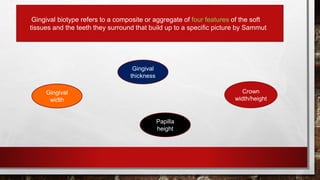
Crown
width/height
Papilla
height
Gingival
thickness
Gingival
width
Gingival biotype refers to a composite or aggregate of four features of the soft
tissues and the teeth they surround that build up to a specific picture by Sammut
To get insight into the association/relation
between gingival biotype and the dentopapillary
complex if any significant determinants can be
objectively defined to classify the biotype.
MATERIALS AND METHODS
50 Subjects were selected from outpatient
• Department Of Periodontology And Oral Implantology, National Dental College And Hospital,
Derabassi
INCLUSION CRITERIA
healthy periodontal
tissues with no loss of
attachment and
presence of all anterior
teeth in both upper and
lower jaw were selected
EXCLUSION CRITERIA
crown restorations or fillings involving the incisal edge on anterior maxillary teeth,
pregnant and lactating females,
subjects taking medications with any known effect on the periodontal soft tissues,
volunteers with clinical signs of periodontal disease defined as having pockets >3 mm
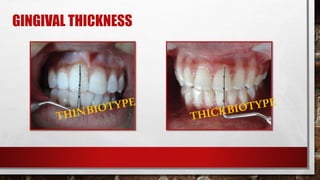
GINGIVAL THICKNESS
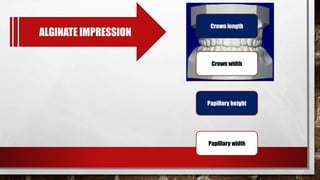
ALGINATE IMPRESSION
Crown length
Crown width
Papillary height
Papillary width
STATISTICAL ANALYSIS
SPSS software.
intra-examiner repeatability evaluated using Pearson’s correlation coefficient.
Mean values and standard deviations were calculated per subject for all
continuous variables.
Significant disparities were assessed using the independent-samples t-test.
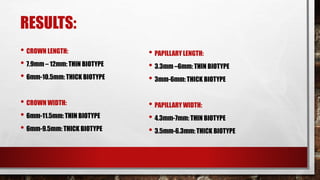
RESULTS:
• CROWN LENGTH:
• 7.9mm – 12mm: THIN BIOTYPE
• 6mm-10.5mm: THICK BIOTYPE
• CROWN WIDTH:
• 6mm-11.5mm: THIN BIOTYPE
• 6mm-9.5mm: THICK BIOTYPE
• PAPILLARY LENGTH:
• 3.3mm –6mm: THIN BIOTYPE
• 3mm-6mm: THICK BIOTYPE
• PAPILLARY WIDTH:
• 4.3mm-7mm: THIN BIOTYPE
• 3.5mm-6.3mm: THICK BIOTYPE
DISCUSSION
In recent years, the dimensions of different parts of the masticatory mucosa, especially gingival
thickness, has become the subject of considerable interest in periodontics from both an epidemiologic
and a therapeutic point of view.
Vandana K Et Al, 2005
The thickness of the gingiva plays a vital role in development of mucogingival problems and in the
success of treatment for recession and wound healing, assessment of gingival thickness is relevant to
clinical periodontics
Although the ultrasonographic method of access in gingival thickness is non-invasive, drawbacks
included the relative unavailability of the instrument, difficulty in maintaining the directionality of the
transducer and non-reliable results when the thickness of gingiva exceeds 2-2.5 mm.
De Rouck et al. (2009), introduced a method to check for the gingival thickness based on the
transparency of the periodontal probe through the gingival margin while probing the sulcus at the
midfacial aspect of incisors.
Maxillary incisors were selected as reference teeth because differences between biotypes are most
explicit for these teeth and because their specific features are easily found in other parts of the
dentition.
Olsson et al, 1993
The results of this discriminant function analysis showed that average crown length was the best single
determinant of biotype and area of papilla was the next best choice.
ANAND ET
AL, 2012
LEE ET AL,
2013
A thorough understanding of the biotype form of the gingival tissue is mandatory, for a
clinician so as to predict the tissue response to various pathologies as well
as before treatment planning, to optimize the final outcome of the periodontal therapy.
•Within the limits of the current investigation, the existence and correlation of different gingival
biotypes and dentopapillary complex dimension was confirmed. the results of discriminant
function analysis showed that average crown length was the best single determinant of biotype
and area of papilla was the next best choice.
• The result of the present study showed that there was highly significant
correlation between gingival biotype and crown length and area of papilla. these findings can
be utilized as objective guidelines for determining the biotype and response of gingiva to many
dental operative procedures
Jc gingival biotype

Jc gingival biotype

  • 2.
    INTRODUCTION • Periodontal biotypeor phenotype is of fundamental importance to an oral clinician because the anatomical characteristics of the periodontium, such as gingival thickness, gingival width & alveolar bone morphology, will determine the behaviour of periodontium when submitted to physical, chemical or bacterial insult or during therapeutic procedures.
  • 3.
    Crown width/height Papilla height Gingival thickness Gingival width Gingival biotype refersto a composite or aggregate of four features of the soft tissues and the teeth they surround that build up to a specific picture by Sammut
  • 4.
    To get insightinto the association/relation between gingival biotype and the dentopapillary complex if any significant determinants can be objectively defined to classify the biotype.
  • 5.
    MATERIALS AND METHODS 50Subjects were selected from outpatient • Department Of Periodontology And Oral Implantology, National Dental College And Hospital, Derabassi
  • 6.
    INCLUSION CRITERIA healthy periodontal tissueswith no loss of attachment and presence of all anterior teeth in both upper and lower jaw were selected
  • 7.
    EXCLUSION CRITERIA crown restorationsor fillings involving the incisal edge on anterior maxillary teeth, pregnant and lactating females, subjects taking medications with any known effect on the periodontal soft tissues, volunteers with clinical signs of periodontal disease defined as having pockets >3 mm
  • 8.
  • 9.
    ALGINATE IMPRESSION Crown length Crownwidth Papillary height Papillary width
  • 10.
    STATISTICAL ANALYSIS SPSS software. intra-examinerrepeatability evaluated using Pearson’s correlation coefficient. Mean values and standard deviations were calculated per subject for all continuous variables. Significant disparities were assessed using the independent-samples t-test.
  • 11.
    RESULTS: • CROWN LENGTH: •7.9mm – 12mm: THIN BIOTYPE • 6mm-10.5mm: THICK BIOTYPE • CROWN WIDTH: • 6mm-11.5mm: THIN BIOTYPE • 6mm-9.5mm: THICK BIOTYPE • PAPILLARY LENGTH: • 3.3mm –6mm: THIN BIOTYPE • 3mm-6mm: THICK BIOTYPE • PAPILLARY WIDTH: • 4.3mm-7mm: THIN BIOTYPE • 3.5mm-6.3mm: THICK BIOTYPE
  • 12.
    DISCUSSION In recent years,the dimensions of different parts of the masticatory mucosa, especially gingival thickness, has become the subject of considerable interest in periodontics from both an epidemiologic and a therapeutic point of view. Vandana K Et Al, 2005 The thickness of the gingiva plays a vital role in development of mucogingival problems and in the success of treatment for recession and wound healing, assessment of gingival thickness is relevant to clinical periodontics Although the ultrasonographic method of access in gingival thickness is non-invasive, drawbacks included the relative unavailability of the instrument, difficulty in maintaining the directionality of the transducer and non-reliable results when the thickness of gingiva exceeds 2-2.5 mm.
  • 13.
    De Rouck etal. (2009), introduced a method to check for the gingival thickness based on the transparency of the periodontal probe through the gingival margin while probing the sulcus at the midfacial aspect of incisors. Maxillary incisors were selected as reference teeth because differences between biotypes are most explicit for these teeth and because their specific features are easily found in other parts of the dentition. Olsson et al, 1993 The results of this discriminant function analysis showed that average crown length was the best single determinant of biotype and area of papilla was the next best choice. ANAND ET AL, 2012 LEE ET AL, 2013
  • 14.
    A thorough understandingof the biotype form of the gingival tissue is mandatory, for a clinician so as to predict the tissue response to various pathologies as well as before treatment planning, to optimize the final outcome of the periodontal therapy.
  • 15.
    •Within the limitsof the current investigation, the existence and correlation of different gingival biotypes and dentopapillary complex dimension was confirmed. the results of discriminant function analysis showed that average crown length was the best single determinant of biotype and area of papilla was the next best choice. • The result of the present study showed that there was highly significant correlation between gingival biotype and crown length and area of papilla. these findings can be utilized as objective guidelines for determining the biotype and response of gingiva to many dental operative procedures