© 2009 McGraw-Hill Higher Education. All rights reserved.
Exercise Testing
Dr.Nidhi Ahya ( Asst Prof)
(Cardio-vascular & Respiratory Therapy)
DVVPF College of Physiotherapy,
Ahmednagar 414111
1/9/2014 1Dr.Nidhi Ahya
© 2009 McGraw-Hill Higher Education. All rights reserved.
Objectives
Definition
Need for exercise testing
VO2 maximum
Exercise Physiology
Types of exercise testing
Bruce Protocol
Shuttle walk test
6 minute walk test
Summary
1/9/2014 2Dr.Nidhi Ahya
© 2009 McGraw-Hill Higher Education. All rights reserved.
Exercise Testing
Exercise testing is a non invasive
procedure that provides diagnostic and
prognostic information and evaluates an
individual’s capacity for dynamic exercises
1/9/2014 3
Dr.Nidhi Ahya
© 2009 McGraw-Hill Higher Education. All rights reserved.
Why do we need to do exercise testing
??
 Exercise is a common physiological stress that
can elicit cardiovascular and respiratory
abnormalities which are not present at rest and it
can be used to determine the adequacy of cardiac
and pulmonary function
 Both the systems are adequately stressed out
during the exercise
4
© 2009 McGraw-Hill Higher Education. All rights reserved.
Body’s Response to Exercise
 During exercise, multiple cardiovascular,
respiratory and metabolic changes occur. These
include-
Increase in Heart Rate
Increase in Systolic Blood Pressure
Diastolic Blood pressure either remains same or
declines slightly
Increase in respiratory rate
 All these responses are an attempt to meet the
increased oxygen demand during exercise
1/9/2014 5Dr.Nidhi Ahya
© 2009 McGraw-Hill Higher Education. All rights reserved.
VO2 max
 It is also called as maximum O2 consumption ,
max O2 uptake , peak O2 uptake or aerobic
capacity
 Definition :
It is the maximum capacity of an individual’s
body to transport and use oxygen during
incremental exercise ,which reflects the physical
fitness of the individual
 It is expressed as-
VO2 max = ……. Litre of O2 / min
= ……. ml of O2 / kg body wt /min1/9/2014 6
© 2009 McGraw-Hill Higher Education. All rights reserved.
1/9/2014 7Dr.Nidhi Ahya
© 2009 McGraw-Hill Higher Education. All rights reserved.
 To measure the VO2 max , individual is involved in
physical effort sufficient in duration and intensity to
fully tax the aerobic energy system
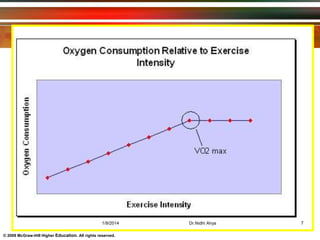
 VO2 max is reached when O2 consumption
remains at steady state despite an increase in the
workload
1/9/2014 8Dr.Nidhi Ahya
© 2009 McGraw-Hill Higher Education. All rights reserved.
Types of exercise testing
 Maximal exercise testing
 Submaximal exercise testing
1/9/2014 9
© 2009 McGraw-Hill Higher Education. All rights reserved.
Maximal exercise testing
 Maximal exercises means an individual works
upto maximum effort of his work capacity
 They are further divided into-
 Field tests
 Laboratory test
 These tests predict or directly measure VO2
max
Cooper 12 min test
Shuttle Walk test Field test
Stepping tests
Treadmill tests Laboratory test
10
© 2009 McGraw-Hill Higher Education. All rights reserved.
Treadmill Tests
 Treadmill Tests involve making the patient walk on
a treadmill in accordance to set protocols that
stress the individual to their maximal exercise
capacity.
 These tests are highly sensitive for clinical
diagnosis of CAD
 The HR and rhythm, BP response, RR and rate of
percived exertion are closely monitored before,
during and after the tests to determine abnormality
1/9/2014 11Dr.Nidhi Ahya
© 2009 McGraw-Hill Higher Education. All rights reserved.
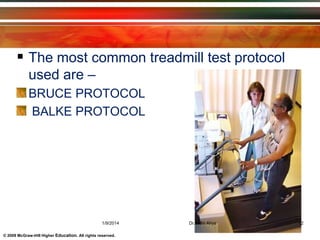
 The most common treadmill test protocol
used are –
BRUCE PROTOCOL
BALKE PROTOCOL
1/9/2014 12Dr.Nidhi Ahya
© 2009 McGraw-Hill Higher Education. All rights reserved.
Bruce Protocol
 The Bruce treadmill test protocol was designed in
by Robert .A. Bruce in 1963
 It is a non-invasive test to assess patients
suspected with heart disease.
 It is also a common method to indirectly estimate
VO2 Max in athletes.
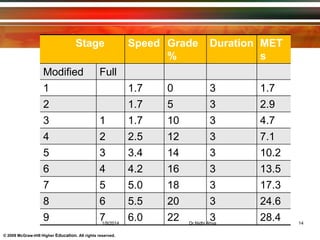
 In this protocol, the individual walks on the treadmill
uptill complete exhaustion as the treadmill speed
and inclination increases every 3 minutes
1/9/2014 13Dr.Nidhi Ahya
© 2009 McGraw-Hill Higher Education. All rights reserved.
Stage Speed Grade
%
Duration MET
s
Modified Full
1 1.7 0 3 1.7
2 1.7 5 3 2.9
3 1 1.7 10 3 4.7
4 2 2.5 12 3 7.1
5 3 3.4 14 3 10.2
6 4 4.2 16 3 13.5
7 5 5.0 18 3 17.3
8 6 5.5 20 3 24.6
9 7 6.0 22 3 28.41/9/2014 14Dr.Nidhi Ahya
© 2009 McGraw-Hill Higher Education. All rights reserved.
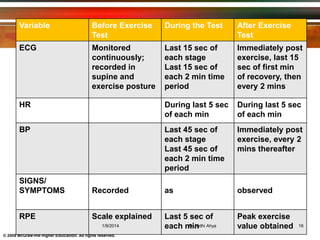
 Assessment Variables:
 Hemodynamics
– Heart Rate
– Systolic/ Diastolic Blood Pressure Responses
 ECG Waveforms
 RPE
 Limiting Clinical Signs & Symptoms
1/9/2014 15Dr.Nidhi Ahya
© 2009 McGraw-Hill Higher Education. All rights reserved.
Variable Before Exercise
Test
During the Test After Exercise
Test
ECG Monitored
continuously;
recorded in
supine and
exercise posture
Last 15 sec of
each stage
Last 15 sec of
each 2 min time
period
Immediately post
exercise, last 15
sec of first min
of recovery, then
every 2 mins
HR During last 5 sec
of each min
During last 5 sec
of each min
BP Last 45 sec of
each stage
Last 45 sec of
each 2 min time
period
Immediately post
exercise, every 2
mins thereafter
SIGNS/
SYMPTOMS Recorded as observed
RPE Scale explained Last 5 sec of
each min
Peak exercise
value obtained1/9/2014 16Dr.Nidhi Ahya
© 2009 McGraw-Hill Higher Education. All rights reserved.
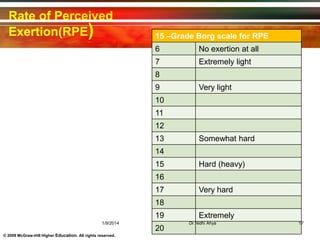
Rate of Perceived
Exertion(RPE) 15 –Grade Borg scale for RPE
6 No exertion at all
7 Extremely light
8
9 Very light
10
11
12
13 Somewhat hard
14
15 Hard (heavy)
16
17 Very hard
18
19 Extremely
20
1/9/2014 17Dr.Nidhi Ahya
© 2009 McGraw-Hill Higher Education. All rights reserved.
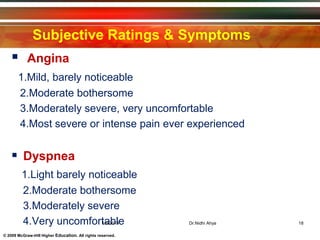
Subjective Ratings & Symptoms
 Angina
1.Mild, barely noticeable
2.Moderate bothersome
3.Moderately severe, very uncomfortable
4.Most severe or intense pain ever experienced
 Dyspnea
1.Light barely noticeable
2.Moderate bothersome
3.Moderately severe
4.Very uncomfortable1/9/2014 18Dr.Nidhi Ahya
© 2009 McGraw-Hill Higher Education. All rights reserved.
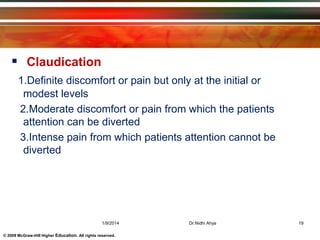
 Claudication
1.Definite discomfort or pain but only at the initial or
modest levels
2.Moderate discomfort or pain from which the patients
attention can be diverted
3.Intense pain from which patients attention cannot be
diverted
1/9/2014 19Dr.Nidhi Ahya
© 2009 McGraw-Hill Higher Education. All rights reserved.
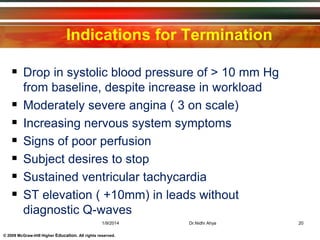
Indications for Termination
 Drop in systolic blood pressure of > 10 mm Hg
from baseline, despite increase in workload
 Moderately severe angina ( 3 on scale)
 Increasing nervous system symptoms
 Signs of poor perfusion
 Subject desires to stop
 Sustained ventricular tachycardia
 ST elevation ( +10mm) in leads without
diagnostic Q-waves
1/9/2014 20Dr.Nidhi Ahya
© 2009 McGraw-Hill Higher Education. All rights reserved.
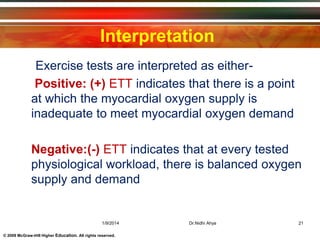
Interpretation
 Exercise tests are interpreted as either-
 Positive: (+) ETT indicates that there is a point
at which the myocardial oxygen supply is
inadequate to meet myocardial oxygen demand
 Negative:(-) ETT indicates that at every tested
physiological workload, there is balanced oxygen
supply and demand
1/9/2014 21Dr.Nidhi Ahya
© 2009 McGraw-Hill Higher Education. All rights reserved.
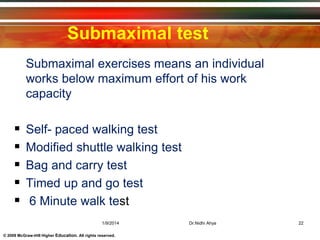
Submaximal test
 Submaximal exercises means an individual
works below maximum effort of his work
capacity
 Self- paced walking test
 Modified shuttle walking test
 Bag and carry test
 Timed up and go test
 6 Minute walk test
1/9/2014 22Dr.Nidhi Ahya
© 2009 McGraw-Hill Higher Education. All rights reserved.
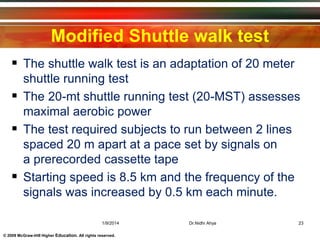
Modified Shuttle walk test
 The shuttle walk test is an adaptation of 20 meter
shuttle running test
 The 20-mt shuttle running test (20-MST) assesses
maximal aerobic power
 The test required subjects to run between 2 lines
spaced 20 m apart at a pace set by signals on
a prerecorded cassette tape
 Starting speed is 8.5 km and the frequency of the
signals was increased by 0.5 km each minute.
1/9/2014 23Dr.Nidhi Ahya
© 2009 McGraw-Hill Higher Education. All rights reserved.
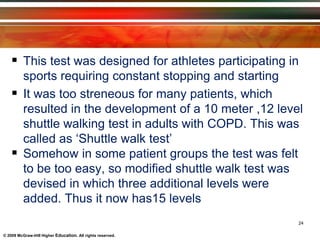
 This test was designed for athletes participating in
sports requiring constant stopping and starting
 It was too streneous for many patients, which
resulted in the development of a 10 meter ,12 level
shuttle walking test in adults with COPD. This was
called as ‘Shuttle walk test’
 Somehow in some patient groups the test was felt
to be too easy, so modified shuttle walk test was
devised in which three additional levels were
added. Thus it now has15 levels
24
© 2009 McGraw-Hill Higher Education. All rights reserved.
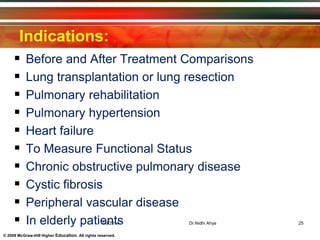
Indications:
 Before and After Treatment Comparisons
 Lung transplantation or lung resection
 Pulmonary rehabilitation
 Pulmonary hypertension
 Heart failure
 To Measure Functional Status
 Chronic obstructive pulmonary disease
 Cystic fibrosis
 Peripheral vascular disease
 In elderly patients1/9/2014 25Dr.Nidhi Ahya
© 2009 McGraw-Hill Higher Education. All rights reserved.
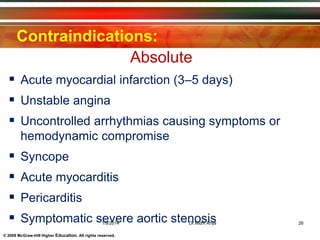
Contraindications:
Absolute
 Acute myocardial infarction (3–5 days)
 Unstable angina
 Uncontrolled arrhythmias causing symptoms or
hemodynamic compromise
 Syncope
 Acute myocarditis
 Pericarditis
 Symptomatic severe aortic stenosis1/9/2014 26Dr.Nidhi Ahya
© 2009 McGraw-Hill Higher Education. All rights reserved.
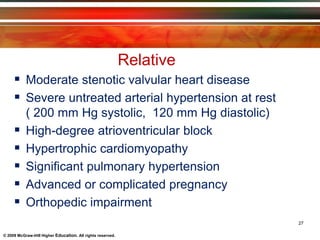
Relative
 Moderate stenotic valvular heart disease
 Severe untreated arterial hypertension at rest
( 200 mm Hg systolic, 120 mm Hg diastolic)
 High-degree atrioventricular block
 Hypertrophic cardiomyopathy
 Significant pulmonary hypertension
 Advanced or complicated pregnancy
 Orthopedic impairment
27
© 2009 McGraw-Hill Higher Education. All rights reserved.
Procedure
 Treatment area that is at least 12 meters in length
and a tape player
 The standard instructions are given on the
audiocassette tape.
 Subjects are required to walk back and forth, turning
around two cones placed 9 meters apart making the
shuttle distance 10 meters long
 The subject must keep pace with the prerecorded
auditory signal such that they complete a turn as
each sound beeps
 Every minute the audio signal sounds at increasingly
shorter intervals
28
© 2009 McGraw-Hill Higher Education. All rights reserved.
 One beep indicates the length of one shuttle and
three beeps indicates an increase in speed
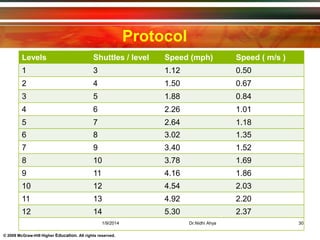
 There are 12 levels of speed beginning at 0.50 m/s
and ending at 2.37m/s.
 The test is measured in meters and no
encouragement is provided
 If the patient chooses to stop or fails to keep up to
auditory signals after one warning the test will end
 The test will also terminate if patient reaches 85% of
their maximal heart rate
29
© 2009 McGraw-Hill Higher Education. All rights reserved.
Protocol
6 8 3.02 1.35
7 9 3.40 1.52
8 10 3.78 1.69
9 11 4.16 1.86
10 12 4.54 2.03
11 13 4.92 2.20
12 14 5.30 2.37
Levels Shuttles / level Speed (mph) Speed ( m/s )
1 3 1.12 0.50
2 4 1.50 0.67
3 5 1.88 0.84
4 6 2.26 1.01
5 7 2.64 1.18
1/9/2014 30Dr.Nidhi Ahya
© 2009 McGraw-Hill Higher Education. All rights reserved.
6 minute walk test
 The 12-MWT was introduced by McGavin and
colleagues to assess the distance covered in 12
minutes in individuals with Chronic Bronchitis
 This test was modified from the 12-MRT described
by Copper for individuals without health problems
 Butland et al reported that similar results could be
obtained in 6 minutes
 Guyatt et al applied the 6-MWT in individuals with
heart failure
1/9/2014 31Dr.Nidhi Ahya
© 2009 McGraw-Hill Higher Education. All rights reserved.
Indications
A) Pre - Post – treatment comparisions
 Lung transplantation
 Lung volume reduction surgery
 Pulmonary rehabilitation
 COPD
 Pulmonary hypertension
 Heart failure
1/9/2014 32Dr.Nidhi Ahya
© 2009 McGraw-Hill Higher Education. All rights reserved.
B) Functional status
 COPD
 Cystic fibrosis
 Heart failure
 Peripheral vascular diseases
 Older patients
C) Predictor of morbidity and mortality
 Heart failure
 COPD
 Primary pulmonary hypertension 33
© 2009 McGraw-Hill Higher Education. All rights reserved.
Contraindications
 Absolute Contraindications
 unstable angina and myocardial infarction during
the previous month
 Relative Contraindications
Resting heart rate of more than 120 beats/min
Systolic blood pressure of more than 180 mm Hg
 Diastolic blood pressure of more than 100 mmHg
1/9/2014 34Dr.Nidhi Ahya
© 2009 McGraw-Hill Higher Education. All rights reserved.
Required Equipments
 Countdown timer (or stopwatch)
 Two small cones to mark the turnaround points
 A chair that can be easily moved along the
walking course
 Worksheets on a clipboard
 A source of oxygen
 Sphygmomanometer
 Telephone
 Automated electronic defibrillator
1/9/2014 35Dr.Nidhi Ahya
© 2009 McGraw-Hill Higher Education. All rights reserved.
Patient Preparation
 Comfortable clothing should be worn.
 Appropriate shoes for walking should be worn.
 Patients should use their usual walking aids during
the test (cane, walker, etc.).
 The patient's usual medical regimen should be
continued.
 A light meal is acceptable before early morning or
early afternoon tests.
 Patients should not have exercised vigorously
within 2 hours of beginning the test.
1/9/2014 36Dr.Nidhi Ahya
© 2009 McGraw-Hill Higher Education. All rights reserved.
 The patient should sit at rest in a chair, located near
the starting position, for at least 10 minutes before
the test starts
 During this time, check for contraindications,
measure pulse and blood pressure, and make sure
that clothing and shoes are appropriate
 Have the patient stand and rate their baseline
dyspnea and overall fatigue using the Borg scale
 Set the lap counter to zero and the timer to 6
minutes. Assemble all necessary equipment
37
© 2009 McGraw-Hill Higher Education. All rights reserved.
Termination of test
 Patients vitals are taken immediately after the
test and then at the end of 2 minutes,5 minutes or
till return to baseline
 Count the number of laps on the worksheet and
calculate the distance covered by the patient
 Refer to worksheet for details
1/9/2014 38Dr.Nidhi Ahya
© 2009 McGraw-Hill Higher Education. All rights reserved.
Summary
Definition
exercise testing
VO2 maximum
Exercise Physiology
Types of exercise testing
Bruce Protocol
Shuttle walk test
6 minute walk test
1/9/2014 Dr.Nidhi Ahya 39
© 2009 McGraw-Hill Higher Education. All rights reserved.
THANK YOU…..
1/9/2014 Dr.Nidhi Ahya 40

Exercise testing

  • 1.
    © 2009 McGraw-HillHigher Education. All rights reserved. Exercise Testing Dr.Nidhi Ahya ( Asst Prof) (Cardio-vascular & Respiratory Therapy) DVVPF College of Physiotherapy, Ahmednagar 414111 1/9/2014 1Dr.Nidhi Ahya
  • 2.
    © 2009 McGraw-HillHigher Education. All rights reserved. Objectives Definition Need for exercise testing VO2 maximum Exercise Physiology Types of exercise testing Bruce Protocol Shuttle walk test 6 minute walk test Summary 1/9/2014 2Dr.Nidhi Ahya
  • 3.
    © 2009 McGraw-HillHigher Education. All rights reserved. Exercise Testing Exercise testing is a non invasive procedure that provides diagnostic and prognostic information and evaluates an individual’s capacity for dynamic exercises 1/9/2014 3 Dr.Nidhi Ahya
  • 4.
    © 2009 McGraw-HillHigher Education. All rights reserved. Why do we need to do exercise testing ??  Exercise is a common physiological stress that can elicit cardiovascular and respiratory abnormalities which are not present at rest and it can be used to determine the adequacy of cardiac and pulmonary function  Both the systems are adequately stressed out during the exercise 4
  • 5.
    © 2009 McGraw-HillHigher Education. All rights reserved. Body’s Response to Exercise  During exercise, multiple cardiovascular, respiratory and metabolic changes occur. These include- Increase in Heart Rate Increase in Systolic Blood Pressure Diastolic Blood pressure either remains same or declines slightly Increase in respiratory rate  All these responses are an attempt to meet the increased oxygen demand during exercise 1/9/2014 5Dr.Nidhi Ahya
  • 6.
    © 2009 McGraw-HillHigher Education. All rights reserved. VO2 max  It is also called as maximum O2 consumption , max O2 uptake , peak O2 uptake or aerobic capacity  Definition : It is the maximum capacity of an individual’s body to transport and use oxygen during incremental exercise ,which reflects the physical fitness of the individual  It is expressed as- VO2 max = ……. Litre of O2 / min = ……. ml of O2 / kg body wt /min1/9/2014 6
  • 7.
    © 2009 McGraw-HillHigher Education. All rights reserved. 1/9/2014 7Dr.Nidhi Ahya
  • 8.
    © 2009 McGraw-HillHigher Education. All rights reserved.  To measure the VO2 max , individual is involved in physical effort sufficient in duration and intensity to fully tax the aerobic energy system  VO2 max is reached when O2 consumption remains at steady state despite an increase in the workload 1/9/2014 8Dr.Nidhi Ahya
  • 9.
    © 2009 McGraw-HillHigher Education. All rights reserved. Types of exercise testing  Maximal exercise testing  Submaximal exercise testing 1/9/2014 9
  • 10.
    © 2009 McGraw-HillHigher Education. All rights reserved. Maximal exercise testing  Maximal exercises means an individual works upto maximum effort of his work capacity  They are further divided into-  Field tests  Laboratory test  These tests predict or directly measure VO2 max Cooper 12 min test Shuttle Walk test Field test Stepping tests Treadmill tests Laboratory test 10
  • 11.
    © 2009 McGraw-HillHigher Education. All rights reserved. Treadmill Tests  Treadmill Tests involve making the patient walk on a treadmill in accordance to set protocols that stress the individual to their maximal exercise capacity.  These tests are highly sensitive for clinical diagnosis of CAD  The HR and rhythm, BP response, RR and rate of percived exertion are closely monitored before, during and after the tests to determine abnormality 1/9/2014 11Dr.Nidhi Ahya
  • 12.
    © 2009 McGraw-HillHigher Education. All rights reserved.  The most common treadmill test protocol used are – BRUCE PROTOCOL BALKE PROTOCOL 1/9/2014 12Dr.Nidhi Ahya
  • 13.
    © 2009 McGraw-HillHigher Education. All rights reserved. Bruce Protocol  The Bruce treadmill test protocol was designed in by Robert .A. Bruce in 1963  It is a non-invasive test to assess patients suspected with heart disease.  It is also a common method to indirectly estimate VO2 Max in athletes.  In this protocol, the individual walks on the treadmill uptill complete exhaustion as the treadmill speed and inclination increases every 3 minutes 1/9/2014 13Dr.Nidhi Ahya
  • 14.
    © 2009 McGraw-HillHigher Education. All rights reserved. Stage Speed Grade % Duration MET s Modified Full 1 1.7 0 3 1.7 2 1.7 5 3 2.9 3 1 1.7 10 3 4.7 4 2 2.5 12 3 7.1 5 3 3.4 14 3 10.2 6 4 4.2 16 3 13.5 7 5 5.0 18 3 17.3 8 6 5.5 20 3 24.6 9 7 6.0 22 3 28.41/9/2014 14Dr.Nidhi Ahya
  • 15.
    © 2009 McGraw-HillHigher Education. All rights reserved.  Assessment Variables:  Hemodynamics – Heart Rate – Systolic/ Diastolic Blood Pressure Responses  ECG Waveforms  RPE  Limiting Clinical Signs & Symptoms 1/9/2014 15Dr.Nidhi Ahya
  • 16.
    © 2009 McGraw-HillHigher Education. All rights reserved. Variable Before Exercise Test During the Test After Exercise Test ECG Monitored continuously; recorded in supine and exercise posture Last 15 sec of each stage Last 15 sec of each 2 min time period Immediately post exercise, last 15 sec of first min of recovery, then every 2 mins HR During last 5 sec of each min During last 5 sec of each min BP Last 45 sec of each stage Last 45 sec of each 2 min time period Immediately post exercise, every 2 mins thereafter SIGNS/ SYMPTOMS Recorded as observed RPE Scale explained Last 5 sec of each min Peak exercise value obtained1/9/2014 16Dr.Nidhi Ahya
  • 17.
    © 2009 McGraw-HillHigher Education. All rights reserved. Rate of Perceived Exertion(RPE) 15 –Grade Borg scale for RPE 6 No exertion at all 7 Extremely light 8 9 Very light 10 11 12 13 Somewhat hard 14 15 Hard (heavy) 16 17 Very hard 18 19 Extremely 20 1/9/2014 17Dr.Nidhi Ahya
  • 18.
    © 2009 McGraw-HillHigher Education. All rights reserved. Subjective Ratings & Symptoms  Angina 1.Mild, barely noticeable 2.Moderate bothersome 3.Moderately severe, very uncomfortable 4.Most severe or intense pain ever experienced  Dyspnea 1.Light barely noticeable 2.Moderate bothersome 3.Moderately severe 4.Very uncomfortable1/9/2014 18Dr.Nidhi Ahya
  • 19.
    © 2009 McGraw-HillHigher Education. All rights reserved.  Claudication 1.Definite discomfort or pain but only at the initial or modest levels 2.Moderate discomfort or pain from which the patients attention can be diverted 3.Intense pain from which patients attention cannot be diverted 1/9/2014 19Dr.Nidhi Ahya
  • 20.
    © 2009 McGraw-HillHigher Education. All rights reserved. Indications for Termination  Drop in systolic blood pressure of > 10 mm Hg from baseline, despite increase in workload  Moderately severe angina ( 3 on scale)  Increasing nervous system symptoms  Signs of poor perfusion  Subject desires to stop  Sustained ventricular tachycardia  ST elevation ( +10mm) in leads without diagnostic Q-waves 1/9/2014 20Dr.Nidhi Ahya
  • 21.
    © 2009 McGraw-HillHigher Education. All rights reserved. Interpretation  Exercise tests are interpreted as either-  Positive: (+) ETT indicates that there is a point at which the myocardial oxygen supply is inadequate to meet myocardial oxygen demand  Negative:(-) ETT indicates that at every tested physiological workload, there is balanced oxygen supply and demand 1/9/2014 21Dr.Nidhi Ahya
  • 22.
    © 2009 McGraw-HillHigher Education. All rights reserved. Submaximal test  Submaximal exercises means an individual works below maximum effort of his work capacity  Self- paced walking test  Modified shuttle walking test  Bag and carry test  Timed up and go test  6 Minute walk test 1/9/2014 22Dr.Nidhi Ahya
  • 23.
    © 2009 McGraw-HillHigher Education. All rights reserved. Modified Shuttle walk test  The shuttle walk test is an adaptation of 20 meter shuttle running test  The 20-mt shuttle running test (20-MST) assesses maximal aerobic power  The test required subjects to run between 2 lines spaced 20 m apart at a pace set by signals on a prerecorded cassette tape  Starting speed is 8.5 km and the frequency of the signals was increased by 0.5 km each minute. 1/9/2014 23Dr.Nidhi Ahya
  • 24.
    © 2009 McGraw-HillHigher Education. All rights reserved.  This test was designed for athletes participating in sports requiring constant stopping and starting  It was too streneous for many patients, which resulted in the development of a 10 meter ,12 level shuttle walking test in adults with COPD. This was called as ‘Shuttle walk test’  Somehow in some patient groups the test was felt to be too easy, so modified shuttle walk test was devised in which three additional levels were added. Thus it now has15 levels 24
  • 25.
    © 2009 McGraw-HillHigher Education. All rights reserved. Indications:  Before and After Treatment Comparisons  Lung transplantation or lung resection  Pulmonary rehabilitation  Pulmonary hypertension  Heart failure  To Measure Functional Status  Chronic obstructive pulmonary disease  Cystic fibrosis  Peripheral vascular disease  In elderly patients1/9/2014 25Dr.Nidhi Ahya
  • 26.
    © 2009 McGraw-HillHigher Education. All rights reserved. Contraindications: Absolute  Acute myocardial infarction (3–5 days)  Unstable angina  Uncontrolled arrhythmias causing symptoms or hemodynamic compromise  Syncope  Acute myocarditis  Pericarditis  Symptomatic severe aortic stenosis1/9/2014 26Dr.Nidhi Ahya
  • 27.
    © 2009 McGraw-HillHigher Education. All rights reserved. Relative  Moderate stenotic valvular heart disease  Severe untreated arterial hypertension at rest ( 200 mm Hg systolic, 120 mm Hg diastolic)  High-degree atrioventricular block  Hypertrophic cardiomyopathy  Significant pulmonary hypertension  Advanced or complicated pregnancy  Orthopedic impairment 27
  • 28.
    © 2009 McGraw-HillHigher Education. All rights reserved. Procedure  Treatment area that is at least 12 meters in length and a tape player  The standard instructions are given on the audiocassette tape.  Subjects are required to walk back and forth, turning around two cones placed 9 meters apart making the shuttle distance 10 meters long  The subject must keep pace with the prerecorded auditory signal such that they complete a turn as each sound beeps  Every minute the audio signal sounds at increasingly shorter intervals 28
  • 29.
    © 2009 McGraw-HillHigher Education. All rights reserved.  One beep indicates the length of one shuttle and three beeps indicates an increase in speed  There are 12 levels of speed beginning at 0.50 m/s and ending at 2.37m/s.  The test is measured in meters and no encouragement is provided  If the patient chooses to stop or fails to keep up to auditory signals after one warning the test will end  The test will also terminate if patient reaches 85% of their maximal heart rate 29
  • 30.
    © 2009 McGraw-HillHigher Education. All rights reserved. Protocol 6 8 3.02 1.35 7 9 3.40 1.52 8 10 3.78 1.69 9 11 4.16 1.86 10 12 4.54 2.03 11 13 4.92 2.20 12 14 5.30 2.37 Levels Shuttles / level Speed (mph) Speed ( m/s ) 1 3 1.12 0.50 2 4 1.50 0.67 3 5 1.88 0.84 4 6 2.26 1.01 5 7 2.64 1.18 1/9/2014 30Dr.Nidhi Ahya
  • 31.
    © 2009 McGraw-HillHigher Education. All rights reserved. 6 minute walk test  The 12-MWT was introduced by McGavin and colleagues to assess the distance covered in 12 minutes in individuals with Chronic Bronchitis  This test was modified from the 12-MRT described by Copper for individuals without health problems  Butland et al reported that similar results could be obtained in 6 minutes  Guyatt et al applied the 6-MWT in individuals with heart failure 1/9/2014 31Dr.Nidhi Ahya
  • 32.
    © 2009 McGraw-HillHigher Education. All rights reserved. Indications A) Pre - Post – treatment comparisions  Lung transplantation  Lung volume reduction surgery  Pulmonary rehabilitation  COPD  Pulmonary hypertension  Heart failure 1/9/2014 32Dr.Nidhi Ahya
  • 33.
    © 2009 McGraw-HillHigher Education. All rights reserved. B) Functional status  COPD  Cystic fibrosis  Heart failure  Peripheral vascular diseases  Older patients C) Predictor of morbidity and mortality  Heart failure  COPD  Primary pulmonary hypertension 33
  • 34.
    © 2009 McGraw-HillHigher Education. All rights reserved. Contraindications  Absolute Contraindications  unstable angina and myocardial infarction during the previous month  Relative Contraindications Resting heart rate of more than 120 beats/min Systolic blood pressure of more than 180 mm Hg  Diastolic blood pressure of more than 100 mmHg 1/9/2014 34Dr.Nidhi Ahya
  • 35.
    © 2009 McGraw-HillHigher Education. All rights reserved. Required Equipments  Countdown timer (or stopwatch)  Two small cones to mark the turnaround points  A chair that can be easily moved along the walking course  Worksheets on a clipboard  A source of oxygen  Sphygmomanometer  Telephone  Automated electronic defibrillator 1/9/2014 35Dr.Nidhi Ahya
  • 36.
    © 2009 McGraw-HillHigher Education. All rights reserved. Patient Preparation  Comfortable clothing should be worn.  Appropriate shoes for walking should be worn.  Patients should use their usual walking aids during the test (cane, walker, etc.).  The patient's usual medical regimen should be continued.  A light meal is acceptable before early morning or early afternoon tests.  Patients should not have exercised vigorously within 2 hours of beginning the test. 1/9/2014 36Dr.Nidhi Ahya
  • 37.
    © 2009 McGraw-HillHigher Education. All rights reserved.  The patient should sit at rest in a chair, located near the starting position, for at least 10 minutes before the test starts  During this time, check for contraindications, measure pulse and blood pressure, and make sure that clothing and shoes are appropriate  Have the patient stand and rate their baseline dyspnea and overall fatigue using the Borg scale  Set the lap counter to zero and the timer to 6 minutes. Assemble all necessary equipment 37
  • 38.
    © 2009 McGraw-HillHigher Education. All rights reserved. Termination of test  Patients vitals are taken immediately after the test and then at the end of 2 minutes,5 minutes or till return to baseline  Count the number of laps on the worksheet and calculate the distance covered by the patient  Refer to worksheet for details 1/9/2014 38Dr.Nidhi Ahya
  • 39.
    © 2009 McGraw-HillHigher Education. All rights reserved. Summary Definition exercise testing VO2 maximum Exercise Physiology Types of exercise testing Bruce Protocol Shuttle walk test 6 minute walk test 1/9/2014 Dr.Nidhi Ahya 39
  • 40.
    © 2009 McGraw-HillHigher Education. All rights reserved. THANK YOU….. 1/9/2014 Dr.Nidhi Ahya 40