Brazing


          1
Introduction

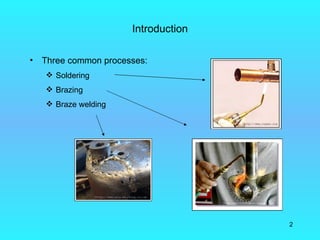
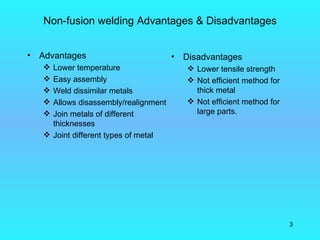
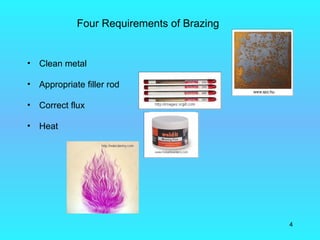
•   Three common processes:
     Soldering
     Brazing
     Braze welding


                                      2
Non-fusion welding Advantages & Disadvantages


•   Advantages                         •   Disadvantages
     Lower temperature                     Lower tensile strength
     Easy assembly                         Not efficient method for
     Weld dissimilar metals                 thick metal
     Allows disassembly/realignment        Not efficient method for
     Join metals of different               large parts.
      thicknesses
     Joint different types of metal


                                                                        3
Four Requirements of Brazing


•   Clean metal

•   Appropriate filler rod

•   Correct flux

•   Heat


                                             4
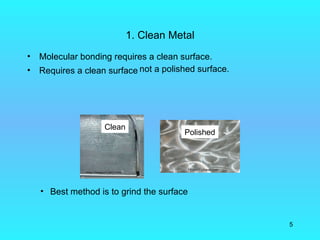
1. Clean Metal
•   Molecular bonding requires a clean surface.
•   Requires a clean surface not a polished surface.


                    Clean
                                        Polished


    • Best method is to grind the surface


                                                       5
2. Appropriate Filler Rod
•   Filler rods are available for many
    non-fusion processes.
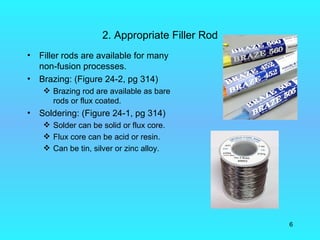
•   Brazing: (Figure 24-2, pg 314)
      Brazing rod are available as bare
       rods or flux coated.
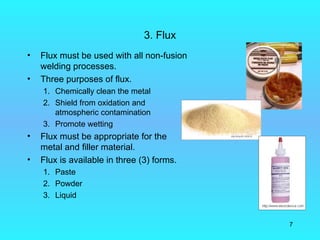
•   Soldering: (Figure 24-1, pg 314)
      Solder can be solid or flux core.
      Flux core can be acid or resin.
      Can be tin, silver or zinc alloy.


                                                 6
3. Flux
•   Flux must be used with all non-fusion
    welding processes.
•   Three purposes of flux.
    1. Chemically clean the metal
    2. Shield from oxidation and
       atmospheric contamination
    3. Promote wetting
•   Flux must be appropriate for the
    metal and filler material.
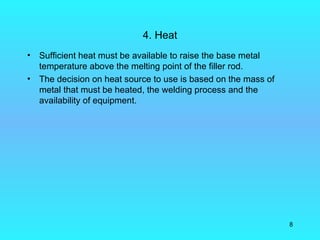
•   Flux is available in three (3) forms.
    1. Paste
    2. Powder
    3. Liquid


                                            7
4. Heat
•   Sufficient heat must be available to raise the base metal
    temperature above the melting point of the filler rod.
•   The decision on heat source to use is based on the mass of
    metal that must be heated, the welding process and the
    availability of equipment.


                                                                 8
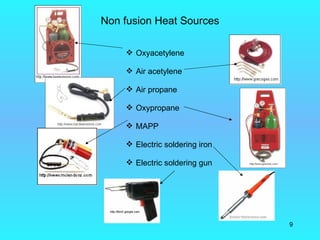
Non fusion Heat Sources

     Oxyacetylene

     Air acetylene

     Air propane

     Oxypropane

     MAPP

     Electric soldering iron

     Electric soldering gun


                                9
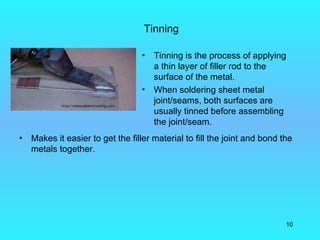
Tinning

                                 •   Tinning is the process of applying
                                     a thin layer of filler rod to the
                                     surface of the metal.
                                 •   When soldering sheet metal
                                     joint/seams, both surfaces are
                                     usually tinned before assembling
                                     the joint/seam.
• Makes it easier to get the filler material to fill the joint and bond the
  metals together.


                                                                         10
Controlling Heat

•   Metals are excellent conductors of heat
      Heat applied to joint moves away from the joint.
      The greater the mass of metal that must be heated--the greater the
       heat requirement.
•   Excessive heat will cause the flux to burn.
      Contaminates the joint.
      Joint must be re cleaned
•   Manipulation of the heat source may necessary to heat both
    pieces evenly.


                                                                       11
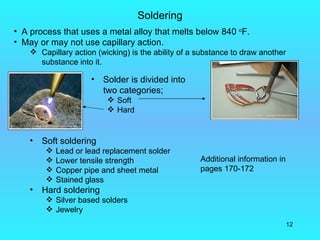
Soldering
• A process that uses a metal alloy that melts below 840 oF.
• May or may not use capillary action.
     Capillary action (wicking) is the ability of a substance to draw another
      substance into it.

                      •   Solder is divided into
                          two categories;
                            Soft
                            Hard


    •   Soft soldering
            Lead or lead replacement solder
            Lower tensile strength                  Additional information in
            Copper pipe and sheet metal             pages 170-172
            Stained glass
    •   Hard soldering
          Silver based solders
          Jewelry
                                                                                 12
13
Brazing

• A process that uses a metal alloy that melts above 840 oF, but
  less than the melting point of the base metal.
• Brazing relies on capillary action to draw the filler metal into the
  joint or to keep it in the joint.
     The capillary effect is a function of the ability of the liquid to wet a
      particular material.
     Requires very small gap between metal surfaces, clean surfaces
      and flux.


                                                                                 14
Brazing Process
1. The joint area is mechanically cleaned and fluxed
     Flux can be applied before the joint is assembled, or during the
      brazing process.
2. The joint is assembled.
     May require clamping.
•   A heat source is used to raise the temperature of the base
    metal above the melting of the filler metal (>840 oF).
     Must insure the joint is not overheated.
     If this occurs the flux will burn and contaminate the joint.
     When the joint becomes contaminated it must be recleaned and
      refluxed before the welding can continue.
4. The filler metal is added to the joint.
5. The filler metal flows into the joint and adheres to the surfaces.
6. The heat source is removed and the filler metal solidifies,
   bonding the surfaces together.


                                                                         15
Brazing Joints
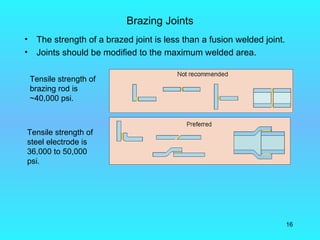
•    The strength of a brazed joint is less than a fusion welded joint.
•    Joints should be modified to the maximum welded area.

    Tensile strength of
    brazing rod is
    ~40,000 psi.


Tensile strength of
steel electrode is
36,000 to 50,000
psi.


                                                                          16
Process:
    Braze welding
                                   1.   The joint area is cleaned and fluxed.
                                   2.   A heat source is used to raise the
•   A process that uses a               temperature of the base metal to the
    metal alloy that melts              melting temperature of the filler
    above 840 oF, but less              metal.
    than the melding point of            If excessive heat is added to the
    the base metal.                            joint, the flux will burn.
•   Braze welding is the                 When this occurs the process
    same process as brazing                    must start over.
    except it does not use
    capillary action and a         3.   The filler metal is added to the joint.
    visible bead is formed.        4.   The filler metal adheres to both
                                        surfaces forming a bead.
                                         The puddle must be heated until
                                               the key hole collapses.
                                   •    The heat source is removed and the
                                        filler metal solidifies, bonding the
                                        surfaces together.

                                                                           17
Braze Welding
                                Key Hole
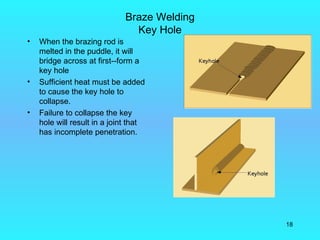
•   When the brazing rod is
    melted in the puddle, it will
    bridge across at first--form a
    key hole
•   Sufficient heat must be added
    to cause the key hole to
    collapse.
•   Failure to collapse the key
    hole will result in a joint that
    has incomplete penetration.


                                              18
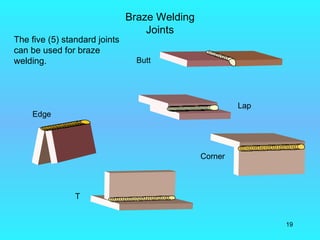
Braze Welding
                                   Joints
The five (5) standard joints
can be used for braze
welding.                         Butt


                                                        Lap
    Edge


                                               Corner


                T


                                                              19
Questions?


             20

Brazing

  • 1.
  • 2.
    Introduction • Three common processes:  Soldering  Brazing  Braze welding 2
  • 3.
    Non-fusion welding Advantages& Disadvantages • Advantages • Disadvantages  Lower temperature  Lower tensile strength  Easy assembly  Not efficient method for  Weld dissimilar metals thick metal  Allows disassembly/realignment  Not efficient method for  Join metals of different large parts. thicknesses  Joint different types of metal 3
  • 4.
    Four Requirements ofBrazing • Clean metal • Appropriate filler rod • Correct flux • Heat 4
  • 5.
    1. Clean Metal • Molecular bonding requires a clean surface. • Requires a clean surface not a polished surface. Clean Polished • Best method is to grind the surface 5
  • 6.
    2. Appropriate FillerRod • Filler rods are available for many non-fusion processes. • Brazing: (Figure 24-2, pg 314)  Brazing rod are available as bare rods or flux coated. • Soldering: (Figure 24-1, pg 314)  Solder can be solid or flux core.  Flux core can be acid or resin.  Can be tin, silver or zinc alloy. 6
  • 7.
    3. Flux • Flux must be used with all non-fusion welding processes. • Three purposes of flux. 1. Chemically clean the metal 2. Shield from oxidation and atmospheric contamination 3. Promote wetting • Flux must be appropriate for the metal and filler material. • Flux is available in three (3) forms. 1. Paste 2. Powder 3. Liquid 7
  • 8.
    4. Heat • Sufficient heat must be available to raise the base metal temperature above the melting point of the filler rod. • The decision on heat source to use is based on the mass of metal that must be heated, the welding process and the availability of equipment. 8
  • 9.
    Non fusion HeatSources  Oxyacetylene  Air acetylene  Air propane  Oxypropane  MAPP  Electric soldering iron  Electric soldering gun 9
  • 10.
    Tinning • Tinning is the process of applying a thin layer of filler rod to the surface of the metal. • When soldering sheet metal joint/seams, both surfaces are usually tinned before assembling the joint/seam. • Makes it easier to get the filler material to fill the joint and bond the metals together. 10
  • 11.
    Controlling Heat • Metals are excellent conductors of heat  Heat applied to joint moves away from the joint.  The greater the mass of metal that must be heated--the greater the heat requirement. • Excessive heat will cause the flux to burn.  Contaminates the joint.  Joint must be re cleaned • Manipulation of the heat source may necessary to heat both pieces evenly. 11
  • 12.
    Soldering • A processthat uses a metal alloy that melts below 840 oF. • May or may not use capillary action.  Capillary action (wicking) is the ability of a substance to draw another substance into it. • Solder is divided into two categories;  Soft  Hard • Soft soldering  Lead or lead replacement solder  Lower tensile strength Additional information in  Copper pipe and sheet metal pages 170-172  Stained glass • Hard soldering  Silver based solders  Jewelry 12
  • 13.
  • 14.
    Brazing • A processthat uses a metal alloy that melts above 840 oF, but less than the melting point of the base metal. • Brazing relies on capillary action to draw the filler metal into the joint or to keep it in the joint.  The capillary effect is a function of the ability of the liquid to wet a particular material.  Requires very small gap between metal surfaces, clean surfaces and flux. 14
  • 15.
    Brazing Process 1. Thejoint area is mechanically cleaned and fluxed  Flux can be applied before the joint is assembled, or during the brazing process. 2. The joint is assembled.  May require clamping. • A heat source is used to raise the temperature of the base metal above the melting of the filler metal (>840 oF).  Must insure the joint is not overheated.  If this occurs the flux will burn and contaminate the joint.  When the joint becomes contaminated it must be recleaned and refluxed before the welding can continue. 4. The filler metal is added to the joint. 5. The filler metal flows into the joint and adheres to the surfaces. 6. The heat source is removed and the filler metal solidifies, bonding the surfaces together. 15
  • 16.
    Brazing Joints • The strength of a brazed joint is less than a fusion welded joint. • Joints should be modified to the maximum welded area. Tensile strength of brazing rod is ~40,000 psi. Tensile strength of steel electrode is 36,000 to 50,000 psi. 16
  • 17.
    Process: Braze welding 1. The joint area is cleaned and fluxed. 2. A heat source is used to raise the • A process that uses a temperature of the base metal to the metal alloy that melts melting temperature of the filler above 840 oF, but less metal. than the melding point of  If excessive heat is added to the the base metal. joint, the flux will burn. • Braze welding is the  When this occurs the process same process as brazing must start over. except it does not use capillary action and a 3. The filler metal is added to the joint. visible bead is formed. 4. The filler metal adheres to both surfaces forming a bead.  The puddle must be heated until the key hole collapses. • The heat source is removed and the filler metal solidifies, bonding the surfaces together. 17
  • 18.
    Braze Welding Key Hole • When the brazing rod is melted in the puddle, it will bridge across at first--form a key hole • Sufficient heat must be added to cause the key hole to collapse. • Failure to collapse the key hole will result in a joint that has incomplete penetration. 18
  • 19.
    Braze Welding Joints The five (5) standard joints can be used for braze welding. Butt Lap Edge Corner T 19
  • 20.