Unit 1
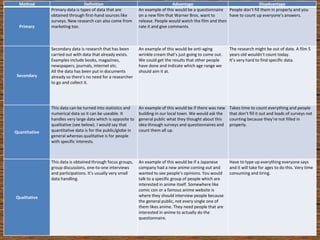
Method Definition Advantage Disadvantage
Primary
Primary data is types of data that are
obtained through first-hand sources like
surveys. New research can also come from
marketing too.
An example of this would be a questionnaire
on a new film that Warner Bros. want to
release. People would watch the film and then
rate it and give comments.
People don’t fill them in properly and you
have to count up everyone’s answers.
Secondary
Secondary data is research that has been
carried out with data that already exists.
Examples include books, magazines,
newspapers, journals, internet etc.
All the data has been put in documents
already so there’s no need for a researcher
to go and collect it.
An example of this would be anti-aging
wrinkle cream that’s just going to come out.
We could get the results that other people
have done and indicate which age range we
should aim it at.
The research might be out of date. A film 5
years old wouldn’t count today.
It’s very hard to find specific data.
Quantitative
This data can be turned into statistics and
numerical data so it can be useable. It
handles very large data which is opposite to
qualitative (see below). I would say that
quantitative data is for the public/globe in
general whereas qualitative is for people
with specific interests.
An example of this would be if there was new
building in our local town. We would ask the
general public what they thought about this
idea through surveys and questionnaires and
count them all up.
Takes time to count everything and people
that don’t fill it out and loads of surveys not
counting because they’re not filled in
properly.
Qualitative
This data is obtained through focus groups,
group discussions, one-to-one interviews
and participations. It’s usually very small
data handling.
An example of this would be if a Japanese
company had a new anime coming out and
wanted to see people’s opinions. You would
talk to a specific group of people which are
interested in anime itself. Somewhere like
comic con or a famous anime website is
where they should interview people because
the general public, not every single one of
them likes anime. They need people that are
interested in anime to actually do the
questionnaire.
Have to type up everything everyone says
and it will take for ages to do this. Very time
consuming and tiring.
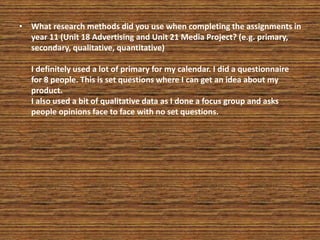
• What research methods did you use when completing the assignments in
year 11 (Unit 18 Advertising and Unit 21 Media Project? (e.g. primary,
secondary, qualitative, quantitative)
I definitely used a lot of primary for my calendar. I did a questionnaire
for 8 people. This is set questions where I can get an idea about my
product.
I also used a bit of qualitative data as I done a focus group and asks
people opinions face to face with no set questions.
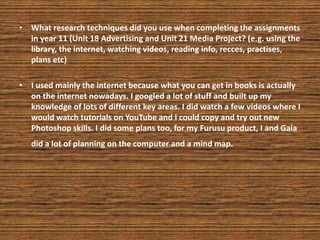
• What research techniques did you use when completing the assignments
in year 11 (Unit 18 Advertising and Unit 21 Media Project? (e.g. using the
library, the internet, watching videos, reading info, recces, practises,
plans etc)
• I used mainly the internet because what you can get in books is actually
on the internet nowadays. I googled a lot of stuff and built up my
knowledge of lots of different key areas. I did watch a few videos where I
would watch tutorials on YouTube and I could copy and try out new
Photoshop skills. I did some plans too, for my Furusu product, I and Gaia
did a lot of planning on the computer and a mind map.
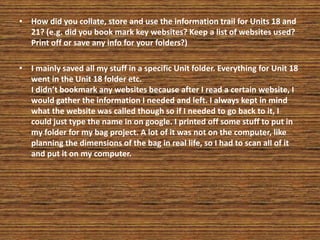
• How did you collate, store and use the information trail for Units 18 and
21? (e.g. did you book mark key websites? Keep a list of websites used?
Print off or save any info for your folders?)
• I mainly saved all my stuff in a specific Unit folder. Everything for Unit 18
went in the Unit 18 folder etc.
I didn’t bookmark any websites because after I read a certain website, I
would gather the information I needed and left. I always kept in mind
what the website was called though so if I needed to go back to it, I
could just type the name in on google. I printed off some stuff to put in
my folder for my bag project. A lot of it was not on the computer, like
planning the dimensions of the bag in real life, so I had to scan all of it
and put it on my computer.
• How and why might you use the four research methods in a real life
situation? For example if you worked for the BBC and were tasked with
creating a new reality TV show how might you use the four research
methods to help?
• For primary, we would use specific surveys to see people’s opinions. “Did
you like it?” “Would you watch this program?”
For secondary, we would see what other reality TV programs do to
attract the public.
For quantitative, we would see how many people would watch the
programs and the ratings and views.
• For qualitative, we would use a focus group to elaborate on their
opinions of our program.

Unit 1

  • 1.
  • 2.
    Method Definition AdvantageDisadvantage Primary Primary data is types of data that are obtained through first-hand sources like surveys. New research can also come from marketing too. An example of this would be a questionnaire on a new film that Warner Bros. want to release. People would watch the film and then rate it and give comments. People don’t fill them in properly and you have to count up everyone’s answers. Secondary Secondary data is research that has been carried out with data that already exists. Examples include books, magazines, newspapers, journals, internet etc. All the data has been put in documents already so there’s no need for a researcher to go and collect it. An example of this would be anti-aging wrinkle cream that’s just going to come out. We could get the results that other people have done and indicate which age range we should aim it at. The research might be out of date. A film 5 years old wouldn’t count today. It’s very hard to find specific data. Quantitative This data can be turned into statistics and numerical data so it can be useable. It handles very large data which is opposite to qualitative (see below). I would say that quantitative data is for the public/globe in general whereas qualitative is for people with specific interests. An example of this would be if there was new building in our local town. We would ask the general public what they thought about this idea through surveys and questionnaires and count them all up. Takes time to count everything and people that don’t fill it out and loads of surveys not counting because they’re not filled in properly. Qualitative This data is obtained through focus groups, group discussions, one-to-one interviews and participations. It’s usually very small data handling. An example of this would be if a Japanese company had a new anime coming out and wanted to see people’s opinions. You would talk to a specific group of people which are interested in anime itself. Somewhere like comic con or a famous anime website is where they should interview people because the general public, not every single one of them likes anime. They need people that are interested in anime to actually do the questionnaire. Have to type up everything everyone says and it will take for ages to do this. Very time consuming and tiring.
  • 3.
    • What researchmethods did you use when completing the assignments in year 11 (Unit 18 Advertising and Unit 21 Media Project? (e.g. primary, secondary, qualitative, quantitative) I definitely used a lot of primary for my calendar. I did a questionnaire for 8 people. This is set questions where I can get an idea about my product. I also used a bit of qualitative data as I done a focus group and asks people opinions face to face with no set questions.
  • 4.
    • What researchtechniques did you use when completing the assignments in year 11 (Unit 18 Advertising and Unit 21 Media Project? (e.g. using the library, the internet, watching videos, reading info, recces, practises, plans etc) • I used mainly the internet because what you can get in books is actually on the internet nowadays. I googled a lot of stuff and built up my knowledge of lots of different key areas. I did watch a few videos where I would watch tutorials on YouTube and I could copy and try out new Photoshop skills. I did some plans too, for my Furusu product, I and Gaia did a lot of planning on the computer and a mind map.
  • 5.
    • How didyou collate, store and use the information trail for Units 18 and 21? (e.g. did you book mark key websites? Keep a list of websites used? Print off or save any info for your folders?) • I mainly saved all my stuff in a specific Unit folder. Everything for Unit 18 went in the Unit 18 folder etc. I didn’t bookmark any websites because after I read a certain website, I would gather the information I needed and left. I always kept in mind what the website was called though so if I needed to go back to it, I could just type the name in on google. I printed off some stuff to put in my folder for my bag project. A lot of it was not on the computer, like planning the dimensions of the bag in real life, so I had to scan all of it and put it on my computer.
  • 6.
    • How andwhy might you use the four research methods in a real life situation? For example if you worked for the BBC and were tasked with creating a new reality TV show how might you use the four research methods to help? • For primary, we would use specific surveys to see people’s opinions. “Did you like it?” “Would you watch this program?” For secondary, we would see what other reality TV programs do to attract the public. For quantitative, we would see how many people would watch the programs and the ratings and views. • For qualitative, we would use a focus group to elaborate on their opinions of our program.