Unit 1: P1, M1, D1
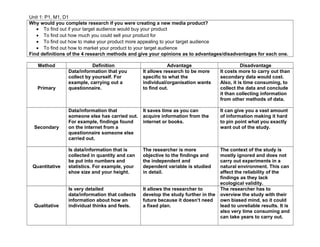
Why would you complete research if you were creating a new media product?
• To find out if your target audience would buy your product
• To find out how much you could sell your product for
• To find out how to make your product more appealing to your target audience
• To find out how to market your product to your target audience
Find definitions of the 4 research methods and give your opinions as to advantages/disadvantages for each one.
Method Definition Advantage Disadvantage
Primary
Data/information that you
collect by yourself. For
example, carrying out a
questionnaire.
It allows research to be more
specific to what the
individual/organisation wants
to find out.
It costs more to carry out than
secondary data would cost.
Also, it is time consuming, to
collect the data and conclude
it than collecting information
from other methods of data.
Secondary
Data/information that
someone else has carried out.
For example, findings found
on the internet from a
questionnaire someone else
carried out.
It saves time as you can
acquire information from the
internet or books.
It can give you a vast amount
of information making it hard
to pin point what you exactly
want out of the study.
Quantitative
Is data/information that is
collected in quantity and can
be put into numbers and
statistics. For example, your
shoe size and your height.
The researcher is more
objective to the findings and
the independent and
dependent variable is studied
in detail.
The context of the study is
mostly ignored and does not
carry out experiments in a
natural environment. This can
affect the reliability of the
findings as they lack
ecological validity.
Qualitative
Is very detailed
data/information that collects
information about how an
individual thinks and feels.
It allows the researcher to
develop the study further in the
future because it doesn’t need
a fixed plan.
The researcher has to
overview the study with their
own biased mind, so it could
lead to unreliable results. It is
also very time consuming and
can take years to carry out.
Unit 1: P1, M1, D1
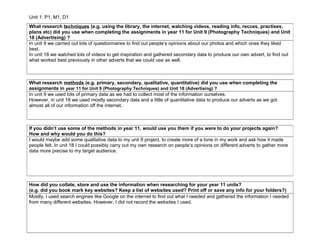
What research methods (e.g. primary, secondary, qualitative, quantitative) did you use when completing the
assignments in year 11 for Unit 9 (Photography Techniques) and Unit 18 (Advertising) ?
In unit 9 we used lots of primary data as we had to collect most of the information ourselves.
However, in unit 18 we used mostly secondary data and a little of quantitative data to produce our adverts as we got
almost all of our information off the internet.
How did you collate, store and use the information when researching for your year 11 units?
(e.g. did you book mark key websites? Keep a list of websites used? Print off or save any info for your folders?)
Mostly, I used search engines like Google on the internet to find out what I needed and gathered the information I needed
from many different websites. However, I did not record the websites I used.
What research techniques (e.g. using the library, the internet, watching videos, reading info, recces, practises,
plans etc) did you use when completing the assignments in year 11 for Unit 9 (Photography Techniques) and Unit
18 (Advertising) ?
In unit 9 we carried out lots of questionnaires to find out people’s opinions about our photos and which ones they liked
best.
In unit 18 we watched lots of videos to get inspiration and gathered secondary data to produce our own advert, to find out
what worked best previously in other adverts that we could use as well.
If you didn’t use some of the methods in year 11, would use you them if you were to do your projects again?
How and why would you do this?
I would maybe add some qualitative data to my unit 9 project, to create more of a tone in my work and ask how it made
people felt. In unit 18 I could possibly carry out my own research on people’s opinions on different adverts to gather more
data more precise to my target audience.
Unit 1: P1, M1, D1

Unit 1 research methods worksheet y11

  • 1.
    Unit 1: P1,M1, D1 Why would you complete research if you were creating a new media product? • To find out if your target audience would buy your product • To find out how much you could sell your product for • To find out how to make your product more appealing to your target audience • To find out how to market your product to your target audience Find definitions of the 4 research methods and give your opinions as to advantages/disadvantages for each one. Method Definition Advantage Disadvantage Primary Data/information that you collect by yourself. For example, carrying out a questionnaire. It allows research to be more specific to what the individual/organisation wants to find out. It costs more to carry out than secondary data would cost. Also, it is time consuming, to collect the data and conclude it than collecting information from other methods of data. Secondary Data/information that someone else has carried out. For example, findings found on the internet from a questionnaire someone else carried out. It saves time as you can acquire information from the internet or books. It can give you a vast amount of information making it hard to pin point what you exactly want out of the study. Quantitative Is data/information that is collected in quantity and can be put into numbers and statistics. For example, your shoe size and your height. The researcher is more objective to the findings and the independent and dependent variable is studied in detail. The context of the study is mostly ignored and does not carry out experiments in a natural environment. This can affect the reliability of the findings as they lack ecological validity. Qualitative Is very detailed data/information that collects information about how an individual thinks and feels. It allows the researcher to develop the study further in the future because it doesn’t need a fixed plan. The researcher has to overview the study with their own biased mind, so it could lead to unreliable results. It is also very time consuming and can take years to carry out.
  • 2.
    Unit 1: P1,M1, D1 What research methods (e.g. primary, secondary, qualitative, quantitative) did you use when completing the assignments in year 11 for Unit 9 (Photography Techniques) and Unit 18 (Advertising) ? In unit 9 we used lots of primary data as we had to collect most of the information ourselves. However, in unit 18 we used mostly secondary data and a little of quantitative data to produce our adverts as we got almost all of our information off the internet. How did you collate, store and use the information when researching for your year 11 units? (e.g. did you book mark key websites? Keep a list of websites used? Print off or save any info for your folders?) Mostly, I used search engines like Google on the internet to find out what I needed and gathered the information I needed from many different websites. However, I did not record the websites I used. What research techniques (e.g. using the library, the internet, watching videos, reading info, recces, practises, plans etc) did you use when completing the assignments in year 11 for Unit 9 (Photography Techniques) and Unit 18 (Advertising) ? In unit 9 we carried out lots of questionnaires to find out people’s opinions about our photos and which ones they liked best. In unit 18 we watched lots of videos to get inspiration and gathered secondary data to produce our own advert, to find out what worked best previously in other adverts that we could use as well. If you didn’t use some of the methods in year 11, would use you them if you were to do your projects again? How and why would you do this? I would maybe add some qualitative data to my unit 9 project, to create more of a tone in my work and ask how it made people felt. In unit 18 I could possibly carry out my own research on people’s opinions on different adverts to gather more data more precise to my target audience.
  • 3.