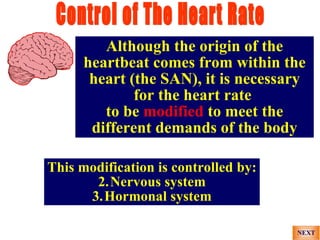
Although the origin of the
      heartbeat comes from within the
       heart (the SAN), it is necessary
              for the heart rate
         to be modified to meet the
       different demands of the body

This modification is controlled by:
       2.Nervous system
      3.Hormonal system
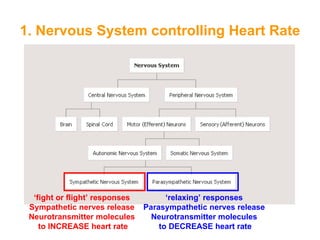
1. Nervous System controlling Heart Rate


  ‘fight or flight’ responses         ‘relaxing’ responses
 Sympathetic nerves release     Parasympathetic nerves release
 Neurotransmitter molecules       Neurotransmitter molecules
    to INCREASE heart rate          to DECREASE heart rate
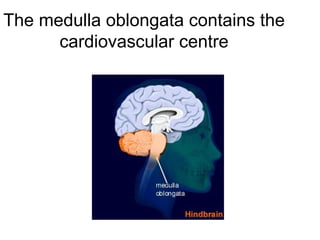
The medulla oblongata contains the
      cardiovascular centre
1. Nervous System controlling Heart Rate
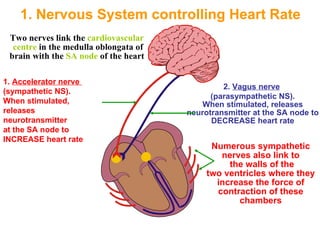
 Two nerves link the cardiovascular
  centre in the medulla oblongata of
 brain with the SA node of the heart

1. Accelerator nerve
                                                2. Vagus nerve
(sympathetic NS).
                                             (parasympathetic NS).
When stimulated,                           When stimulated, releases
releases                               neurotransmitter at the SA node to
neurotransmitter                             DECREASE heart rate
at the SA node to
INCREASE heart rate
                                             Numerous sympathetic
                                               nerves also link to
                                                 the walls of the
                                            two ventricles where they
                                              increase the force of
                                              contraction of these
                                                   chambers
1. Nervous System controlling Heart Rate

The heart rate is therefore determined
by the balance between sympathetic
and parasympathetic nerve activity

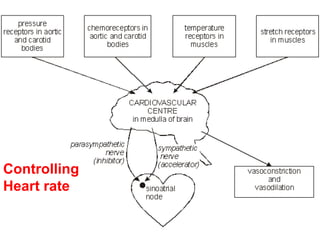
The cardiovascular centre receives
input from 4 main receptor groups,

these inputs are processed and the
sympathetic/ parasympathetic NS is
recruited accordingly.
Receptor groups that send inputs to
    the cardiovascular centre

1. Pressure receptors in heart
2. Chemoreceptors in heart (detects
   CO2 and O2 levels via changes in pH)
3. Thermoreceptors in muscles
4. Stretch receptors in muscles
Controlling
Heart rate
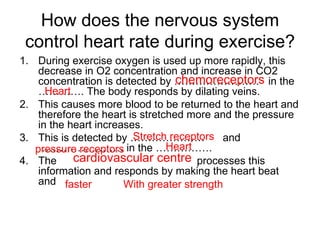
How does the nervous system
 control heart rate during exercise?
1. During exercise oxygen is used up more rapidly, this
    decrease in O2 concentration and increase in CO2
                                   chemoreceptors
    concentration is detected by …………………… in the
      Heart
    …………. The body responds by dilating veins.
2. This causes more blood to be returned to the heart and
    therefore the heart is stretched more and the pressure
    in the heart increases.
                         Stretch receptors and
3. This is detected by …………………
                                 Heart
   pressure receptors in the …………….
    ……………………
4. The      cardiovascular centre processes this
    information and responds by making the heart beat
    and faster         With greater strength
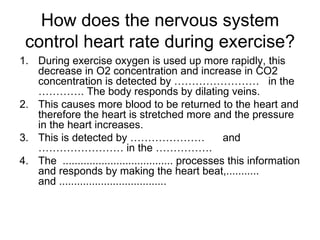
How does the nervous system
 control heart rate during exercise?
1. During exercise oxygen is used up more rapidly, this
   decrease in O2 concentration and increase in CO2
   concentration is detected by …………………… in the
   …………. The body responds by dilating veins.
2. This causes more blood to be returned to the heart and
   therefore the heart is stretched more and the pressure
   in the heart increases.
3. This is detected by …………………                        and
   …………………… in the …………….
4. The ..................................... processes this information
   and responds by making the heart beat,...........
   and ....................................
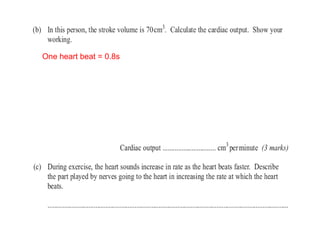
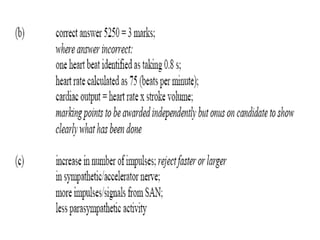
One heart beat = 0.8s
1. Nervous System controlling Heart Rate


When do you think:

c) the Sympathetic NS is most dominant?
d) the Parasympathetic NS is most
  dominant?
1. Nervous System controlling Heart Rate

When do you think:
• the Sympathetic NS is most dominant?
  Stress and excitement
• the Parasympathetic NS is most
  dominant? Rest and sleep
2. Hormonal System controlling Heart Rate

•   The hormone adrenaline is secreted
    from the adrenal glands.
•   Adrenalin increases heart rate by
•   increasing the frequency of impulses
    released from the SAN,
•   increasing the force of contraction

Therefore CO will…….

Control of heart rate

  • 1.
    Although the originof the heartbeat comes from within the heart (the SAN), it is necessary for the heart rate to be modified to meet the different demands of the body This modification is controlled by: 2.Nervous system 3.Hormonal system
  • 2.
    1. Nervous Systemcontrolling Heart Rate ‘fight or flight’ responses ‘relaxing’ responses Sympathetic nerves release Parasympathetic nerves release Neurotransmitter molecules Neurotransmitter molecules to INCREASE heart rate to DECREASE heart rate
  • 3.
    The medulla oblongatacontains the cardiovascular centre
  • 4.
    1. Nervous Systemcontrolling Heart Rate Two nerves link the cardiovascular centre in the medulla oblongata of brain with the SA node of the heart 1. Accelerator nerve 2. Vagus nerve (sympathetic NS). (parasympathetic NS). When stimulated, When stimulated, releases releases neurotransmitter at the SA node to neurotransmitter DECREASE heart rate at the SA node to INCREASE heart rate Numerous sympathetic nerves also link to the walls of the two ventricles where they increase the force of contraction of these chambers
  • 5.
    1. Nervous Systemcontrolling Heart Rate The heart rate is therefore determined by the balance between sympathetic and parasympathetic nerve activity The cardiovascular centre receives input from 4 main receptor groups, these inputs are processed and the sympathetic/ parasympathetic NS is recruited accordingly.
  • 6.
    Receptor groups thatsend inputs to the cardiovascular centre 1. Pressure receptors in heart 2. Chemoreceptors in heart (detects CO2 and O2 levels via changes in pH) 3. Thermoreceptors in muscles 4. Stretch receptors in muscles
  • 7.
  • 8.
    How does thenervous system control heart rate during exercise? 1. During exercise oxygen is used up more rapidly, this decrease in O2 concentration and increase in CO2 chemoreceptors concentration is detected by …………………… in the Heart …………. The body responds by dilating veins. 2. This causes more blood to be returned to the heart and therefore the heart is stretched more and the pressure in the heart increases. Stretch receptors and 3. This is detected by ………………… Heart pressure receptors in the ……………. …………………… 4. The cardiovascular centre processes this information and responds by making the heart beat and faster With greater strength
  • 9.
    How does thenervous system control heart rate during exercise? 1. During exercise oxygen is used up more rapidly, this decrease in O2 concentration and increase in CO2 concentration is detected by …………………… in the …………. The body responds by dilating veins. 2. This causes more blood to be returned to the heart and therefore the heart is stretched more and the pressure in the heart increases. 3. This is detected by ………………… and …………………… in the ……………. 4. The ..................................... processes this information and responds by making the heart beat,........... and ....................................
  • 10.
  • 12.
    1. Nervous Systemcontrolling Heart Rate When do you think: c) the Sympathetic NS is most dominant? d) the Parasympathetic NS is most dominant?
  • 13.
    1. Nervous Systemcontrolling Heart Rate When do you think: • the Sympathetic NS is most dominant? Stress and excitement • the Parasympathetic NS is most dominant? Rest and sleep
  • 14.
    2. Hormonal Systemcontrolling Heart Rate • The hormone adrenaline is secreted from the adrenal glands. • Adrenalin increases heart rate by • increasing the frequency of impulses released from the SAN, • increasing the force of contraction Therefore CO will…….