Kiran Goushika
   Cardiac Electrophysiology
   Cardiac Contractility
The science of elucidating ,diagnosing, and
treating electrical activities of heart.
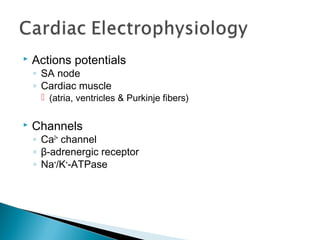
   Actions potentials
    ◦ SA node
    ◦ Cardiac muscle
      (atria, ventricles & Purkinje fibers)

   Channels
    ◦ Ca2+ channel
    ◦ β-adrenergic receptor
    ◦ Na+/K+-ATPase
Phase 0


                                    Phase 3
0 mV


-50 mV

-70 mV             Ca2+


 Phase 4                  Phase 4
 Pacemaker of the heart
 Unstable resting potential

    ◦ Exhibits automaticity
    ◦ AV node & His-Purkinje system are latent pacemakers

   Phase 1 & 2 are not present in pacemaker action
    potentials
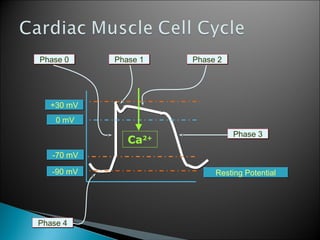
Phase 0     Phase 1      Phase 2


  +30 mV
    0 mV
                                   Phase 3
               Ca   2+

   -70 mV

   -90 mV                     Resting Potential


Phase 4
Voltage dependent
                                    Voltage dependent
                Na channel
                      +
                   channel
                      +             L-type Ca2+ channel
                                    L-type   2+
                                                channel             Na+/K+ ATPase
                                                                    Na+/K+ ATPase
                                                          2K
                                                           +


                                                                         3 Na+
                K+ channel(s)
                 +
                   channel(s)
                                                                                    Ca2+


                                                                          3 Na+
                  β-adrenergic receptor
                  β-adrenergic receptor
                                                                    Na+/Ca2+ exchanger
                                                                    Na+/Ca2+ exchanger
                                                               SR (Mitochondria)


                          Heart muscle
                          Heart muscle      Ryanodine receptor
                                            Ryanodine receptor


Na+/K+ ATPase

Na+/Ca2+ Antiporter         Representative Cardiac Cell
The intrinsic ability of heart to contract
   Intrinsic ability of cardiac muscle

   Also called ‘inotropism’ or ‘inotropy’

   Related to the intracellular [Ca2+]

   Inotropic agents
    ◦ positive: increase contractility
    ◦ negative: decrease contractility
   Chronotropy
    ◦ rate of contraction
    ◦ also affected by intracellular [Ca2+]


   Dromotropy
    ◦ rate of impulse conduction
    ◦ noted particularly at AV node
   Increased intracellular [Ca2+]
    ◦ increased heart rate
    ◦ cardiac glycosides (e.g. digoxin)


   Stimulation of β1-adrenergic receptor
    ◦ sympathomimetic agents
    ◦ catecholamines
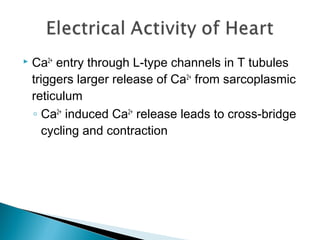
   Ca2+ entry through L-type channels in T tubules
    triggers larger release of Ca2+ from sarcoplasmic
    reticulum
    ◦ Ca2+ induced Ca2+ release leads to cross-bridge
      cycling and contraction
2 K+

Phase 2

                                          3 Na+


                                                    Ca2+


                  Ca2+                     3 Na+

                  Ca2+
           Ca2+                 SR (Mitochondria)
                  Ca
                   2+


           Ca2+ Ca2+
           Ca2+
                Ca2+


          Cell Electrophysiology
   ATRIAL MUSCLE


   VENTRICULAR MUSCLE


   SPECIALISES EXCITATORY &CONDUCTIVE
    MUSCLE FIBERS
 Interconnected by intercalated discs and
 form functional syncytia

 Withinintercalated discs – two kinds of
 membrane junctions
 ◦ Desmosomes
 ◦ Gap junctions
 Exhibit branching
 Adjacent cardiac cells are
  joined end to end by
  specialized structures known
  as intercalated discs
 Within intercalated discs there
  are two types of junctions
   ◦ Desmosomes
   ◦ Gap junctions..allow action
     potential to spread from one
     cell to adjacent cells.
 Heart function as syncytium
  when one cardiac cell
  undergoes an action potential,
  the electrical impulse spreads
  to all other cells that are joined
  by gap junctions so they
  become excited and contract
  as a single functional
  syncytium.
Atrial syncytium and ventricular
  syncytium
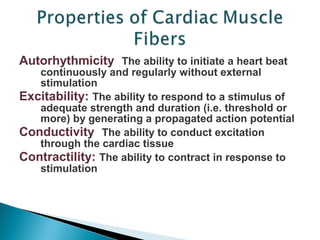
Autorhythmicity: The ability to initiate a heart beat
   continuously and regularly without external
   stimulation
Excitability: The ability to respond to a stimulus of
   adequate strength and duration (i.e. threshold or
   more) by generating a propagated action potential
Conductivity: The ability to conduct excitation
   through the cardiac tissue
Contractility: The ability to contract in response to
   stimulation
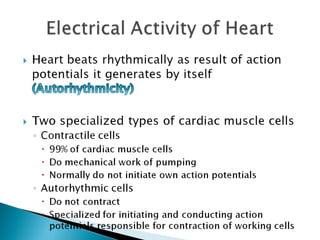
Definition: the ability of the heart to initiate its beat
 continuously and regularly without external
 stimulation
 myogenic (independent of nerve supply)


    due to the specialized excitatory & conductive
    system of the heart
                     ↓
      intrinsic ability of self-excitation
        (waves of depolarization)
                     ↓
       cardiac impulses
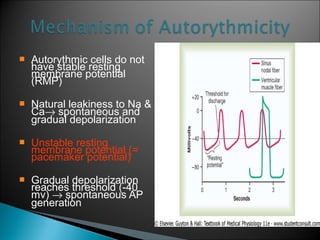
   Autorythmic cells do not
    have stable resting
    membrane potential
    (RMP)

   Natural leakiness to Na &
    Ca→ spontaneous and
    gradual depolarization

   Unstable resting
    membrane potential (=
    pacemaker potential)

   Gradual depolarization
    reaches threshold (-40
    mv) → spontaneous AP
    generation
SITE                       SA node acts as heart
                      RATE(Time/minu pacemaker because it has the
                           te)       fastest rate of generating action
SA Node                    100       potential
                                     Nerve impulses from
AV Node                   40-60
                                     autonomic nervous system and
                                     hormones modify the timing and
                                     strength of each heart beat but do
AV bundle, bundle         20-35      not establish the fundamental
branches,& Purkinje                  rhythm.
fibres
Definition: The ability of cardiac muscle to
 respond to a stimulus of adequate strength &
 duration by generating an AP

    AP initiated by SA node→travels along conductive
     pathway→ excites atrial & ventricular muscle fibres
   Long refractory period (250
    msec) compared to skeletal
    muscle (3msec)
   During this period membrane is
    refractory to further stimulation
    until contraction is over.
   It lasts longer than muscle
    contraction, prevents tetanus
   Gives time to heart to relax after
    each contraction, prevent
    fatigue
   It allows time for the heart
    chambers to fill during diastole
    before next contraction


                                             AP in skeletal muscle : 1-5 msec
                                         AP in cardiac muscle :200 -300 msec
   Definition: ability of cardiac muscle to contract
    in response to stimulation
   Similar to that in
    skeletal muscles
   Definition: property by which excitation is
    conducted through the cardiac tissue
   Cardiac impulse originates at SA node
   Action potential spreads throughout right and left atria
   Impulse passes from atria into ventricles through AV
    node (only point of electrical contact between chambers)
   Action potential briefly delayed at AV node (ensures
    atrial contraction precedes ventricular contraction to
    allow complete ventricular filling)
   Impulse travels rapidly down interventricular septum by
    means of bundle of His
   Impulse rapidly disperses throughout myocardium by
    means of Purkinje fibers
   Rest of ventricular cells activated by cell-to-cell spread of
    impulse through gap junctions
PROFESSOR: Maka

Cardiac contractility

  • 1.
  • 2.
    Cardiac Electrophysiology  Cardiac Contractility
  • 3.
    The science ofelucidating ,diagnosing, and treating electrical activities of heart.
  • 4.
    Actions potentials ◦ SA node ◦ Cardiac muscle  (atria, ventricles & Purkinje fibers)  Channels ◦ Ca2+ channel ◦ β-adrenergic receptor ◦ Na+/K+-ATPase
  • 5.
    Phase 0 Phase 3 0 mV -50 mV -70 mV Ca2+ Phase 4 Phase 4
  • 6.
     Pacemaker ofthe heart  Unstable resting potential ◦ Exhibits automaticity ◦ AV node & His-Purkinje system are latent pacemakers  Phase 1 & 2 are not present in pacemaker action potentials
  • 7.
    Phase 0 Phase 1 Phase 2 +30 mV 0 mV Phase 3 Ca 2+ -70 mV -90 mV Resting Potential Phase 4
  • 8.
    Voltage dependent Voltage dependent Na channel + channel + L-type Ca2+ channel L-type 2+ channel Na+/K+ ATPase Na+/K+ ATPase 2K + 3 Na+ K+ channel(s) + channel(s) Ca2+ 3 Na+ β-adrenergic receptor β-adrenergic receptor Na+/Ca2+ exchanger Na+/Ca2+ exchanger SR (Mitochondria) Heart muscle Heart muscle Ryanodine receptor Ryanodine receptor Na+/K+ ATPase Na+/Ca2+ Antiporter Representative Cardiac Cell
  • 9.
    The intrinsic abilityof heart to contract
  • 10.
    Intrinsic ability of cardiac muscle  Also called ‘inotropism’ or ‘inotropy’  Related to the intracellular [Ca2+]  Inotropic agents ◦ positive: increase contractility ◦ negative: decrease contractility
  • 11.
    Chronotropy ◦ rate of contraction ◦ also affected by intracellular [Ca2+]  Dromotropy ◦ rate of impulse conduction ◦ noted particularly at AV node
  • 12.
    Increased intracellular [Ca2+] ◦ increased heart rate ◦ cardiac glycosides (e.g. digoxin)  Stimulation of β1-adrenergic receptor ◦ sympathomimetic agents ◦ catecholamines
  • 14.
    Ca2+ entry through L-type channels in T tubules triggers larger release of Ca2+ from sarcoplasmic reticulum ◦ Ca2+ induced Ca2+ release leads to cross-bridge cycling and contraction
  • 15.
    2 K+ Phase 2 3 Na+ Ca2+ Ca2+ 3 Na+ Ca2+ Ca2+ SR (Mitochondria) Ca 2+ Ca2+ Ca2+ Ca2+ Ca2+ Cell Electrophysiology
  • 16.
    ATRIAL MUSCLE  VENTRICULAR MUSCLE  SPECIALISES EXCITATORY &CONDUCTIVE MUSCLE FIBERS
  • 18.
     Interconnected byintercalated discs and form functional syncytia  Withinintercalated discs – two kinds of membrane junctions ◦ Desmosomes ◦ Gap junctions
  • 20.
     Exhibit branching Adjacent cardiac cells are joined end to end by specialized structures known as intercalated discs  Within intercalated discs there are two types of junctions ◦ Desmosomes ◦ Gap junctions..allow action potential to spread from one cell to adjacent cells.  Heart function as syncytium when one cardiac cell undergoes an action potential, the electrical impulse spreads to all other cells that are joined by gap junctions so they become excited and contract as a single functional syncytium. Atrial syncytium and ventricular syncytium
  • 21.
    Autorhythmicity: The abilityto initiate a heart beat continuously and regularly without external stimulation Excitability: The ability to respond to a stimulus of adequate strength and duration (i.e. threshold or more) by generating a propagated action potential Conductivity: The ability to conduct excitation through the cardiac tissue Contractility: The ability to contract in response to stimulation
  • 22.
    Definition: the abilityof the heart to initiate its beat continuously and regularly without external stimulation  myogenic (independent of nerve supply)  due to the specialized excitatory & conductive system of the heart ↓ intrinsic ability of self-excitation (waves of depolarization) ↓ cardiac impulses
  • 23.
    Autorythmic cells do not have stable resting membrane potential (RMP)  Natural leakiness to Na & Ca→ spontaneous and gradual depolarization  Unstable resting membrane potential (= pacemaker potential)  Gradual depolarization reaches threshold (-40 mv) → spontaneous AP generation
  • 24.
    SITE SA node acts as heart RATE(Time/minu pacemaker because it has the te) fastest rate of generating action SA Node 100 potential Nerve impulses from AV Node 40-60 autonomic nervous system and hormones modify the timing and strength of each heart beat but do AV bundle, bundle 20-35 not establish the fundamental branches,& Purkinje rhythm. fibres
  • 25.
    Definition: The abilityof cardiac muscle to respond to a stimulus of adequate strength & duration by generating an AP  AP initiated by SA node→travels along conductive pathway→ excites atrial & ventricular muscle fibres
  • 28.
    Long refractory period (250 msec) compared to skeletal muscle (3msec)  During this period membrane is refractory to further stimulation until contraction is over.  It lasts longer than muscle contraction, prevents tetanus  Gives time to heart to relax after each contraction, prevent fatigue  It allows time for the heart chambers to fill during diastole before next contraction AP in skeletal muscle : 1-5 msec AP in cardiac muscle :200 -300 msec
  • 29.
    Definition: ability of cardiac muscle to contract in response to stimulation
  • 30.
    Similar to that in skeletal muscles
  • 31.
    Definition: property by which excitation is conducted through the cardiac tissue
  • 33.
    Cardiac impulse originates at SA node  Action potential spreads throughout right and left atria  Impulse passes from atria into ventricles through AV node (only point of electrical contact between chambers)  Action potential briefly delayed at AV node (ensures atrial contraction precedes ventricular contraction to allow complete ventricular filling)  Impulse travels rapidly down interventricular septum by means of bundle of His  Impulse rapidly disperses throughout myocardium by means of Purkinje fibers  Rest of ventricular cells activated by cell-to-cell spread of impulse through gap junctions
  • 34.

Editor's Notes

  • #14 Therapeutic: Digoxin inhibits Na+/K+ ATPase (exchange pump) Increased intracellular [Na+], and increased extracellular [K+] Leads to decreased Na+/Ca++ exchange Which leads to increased intracellular [Ca++] Leading to increased contractility Toxicologic Excessive intracellular [Ca++] Less negative membrane potential (closer to threshold = depolarization) Increased automaticity Tachydysrhythmias
  • #15 Therapeutic: Digoxin inhibits Na+/K+ ATPase (exchange pump) Increased intracellular [Na+], and increased extracellular [K+] Leads to decreased Na+/Ca++ exchange Which leads to increased intracellular [Ca++] Leading to increased contractility Toxicologic Excessive intracellular [Ca++] Less negative membrane potential (closer to threshold = depolarization) Increased automaticity Tachydysrhythmias
  • #22 Therapeutic: Digoxin inhibits Na+/K+ ATPase (exchange pump) Increased intracellular [Na+], and increased extracellular [K+] Leads to decreased Na+/Ca++ exchange Which leads to increased intracellular [Ca++] Leading to increased contractility Toxicologic Excessive intracellular [Ca++] Less negative membrane potential (closer to threshold = depolarization) Increased automaticity Tachydysrhythmias