1A Market-Focused Paradigm for Public Transit, pt. 3: Smarter Transit Network Design© 1998-2013 by The Mission Group. All rights reserved.
A Market-Focused Paradigm
for Public Transit
THE MISSION GROUP
Part 3—Smarter Transit Network Design
Alan Hoffman ▪ San Diego, California ▪ (619) 232-1776 ▪ info@missionconsult.com
© 2013 by The Mission Group. All Rights Reserved.
PART
3
1A Market-Focused Paradigm for Public Transit, pt. 1: A Smarter Transit Network© 1998-2013 by The Mission Group. All rights reserved.
A Market-Focused Paradigm
for Public Transit
THE MISSION GROUP
Part 3—Smarter Transit Network Design
Alan Hoffman ▪ San Diego, California ▪ (619) 232-1776 ▪ info@missiongrouponline.com
© 2013 by The Mission Group. All Rights Reserved.
PART
3www.missionconsult.com
2A Market-Focused Paradigm for Public Transit, pt. 3: Smarter Transit Network Design© 1998-2013 by The Mission Group. All rights reserved.
In part 2 of this presentation,
we identified the three key strategic
variables that drive modal choice:
Here in part 3, we’ll focus on issues of
network structure—how to configure
more effective transit networks.
Network
Structure
(Connectivity)
System
Performance
(Time)
Customer
Experience
3A Market-Focused Paradigm for Public Transit, pt. 3: Smarter Transit Network Design© 1998-2013 by The Mission Group. All rights reserved.
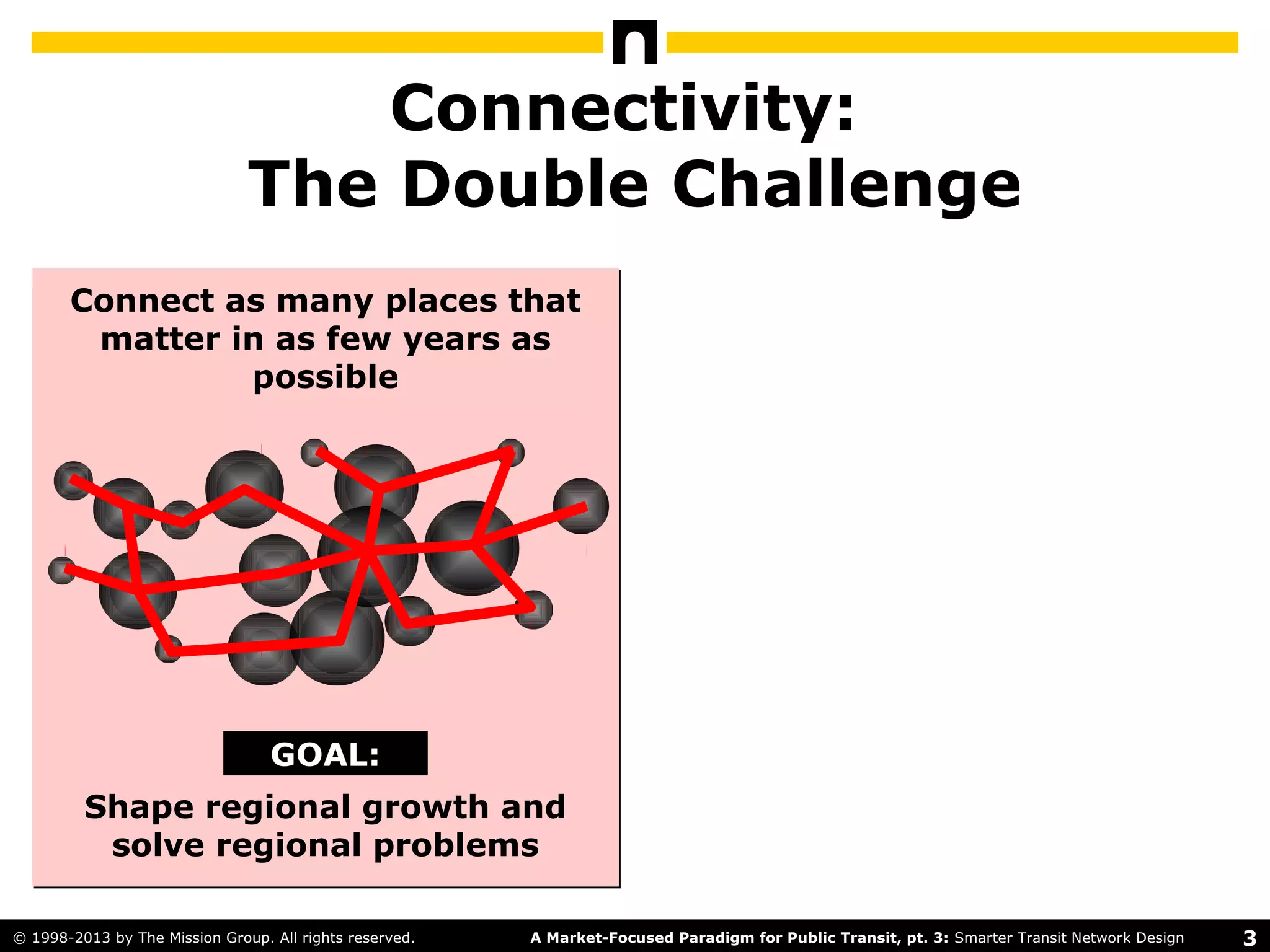
Connectivity:
The Double Challenge
Connect as many places that
matter in as few years as
possible
Shape regional growth and
solve regional problems
GOAL:
4A Market-Focused Paradigm for Public Transit, pt. 3: Smarter Transit Network Design© 1998-2013 by The Mission Group. All rights reserved.
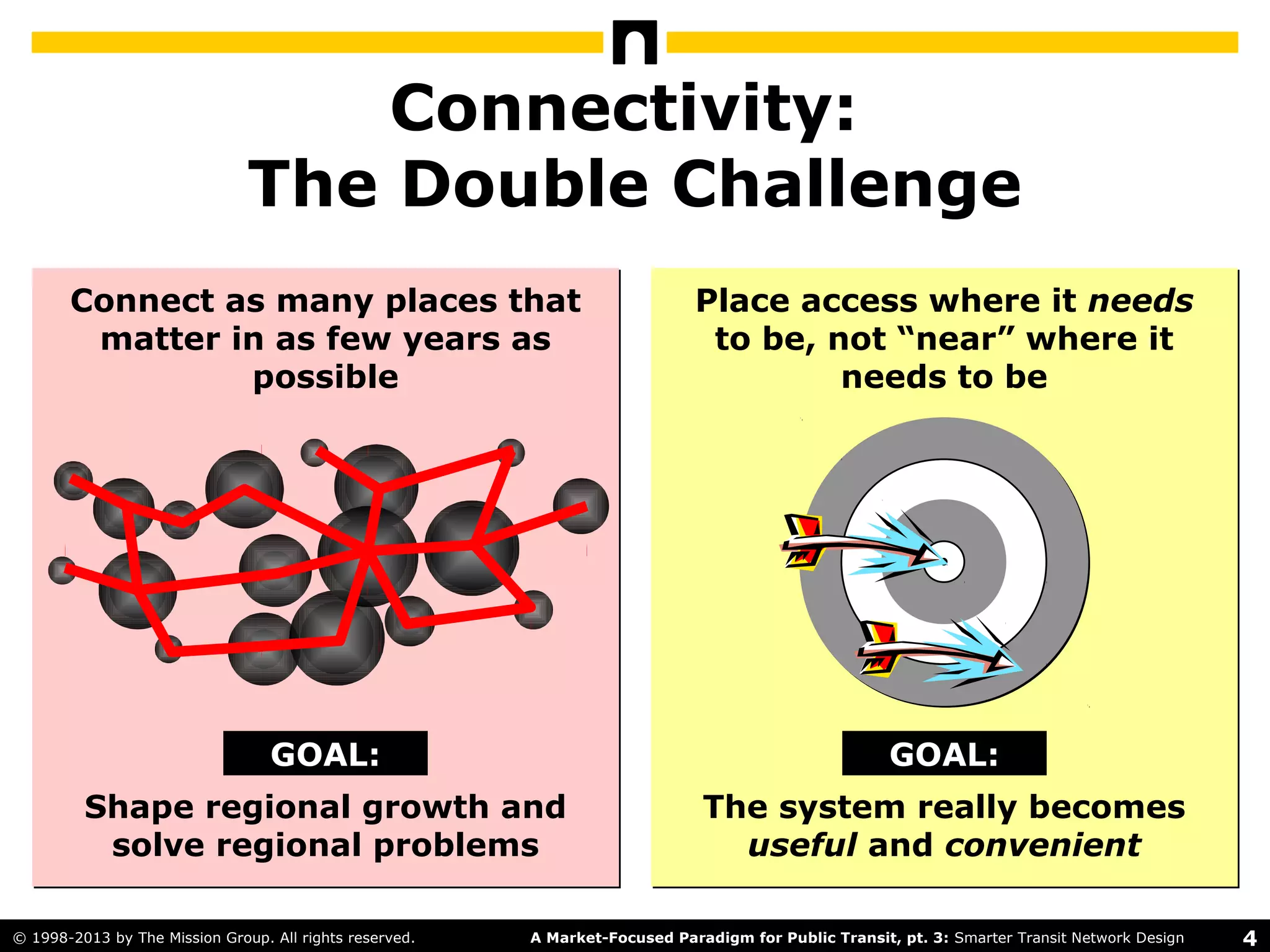
Connectivity:
The Double Challenge
Connect as many places that
matter in as few years as
possible
Place access where it needs
to be, not “near” where it
needs to be
Shape regional growth and
solve regional problems
The system really becomes
useful and convenient
GOAL: GOAL:
Some cities pour their resources
into creating a major investment
in a single transit corridor,
be it light rail or busway.
6A Market-Focused Paradigm for Public Transit, pt. 3: Smarter Transit Network Design© 1998-2013 by The Mission Group. All rights reserved.
Transit & Land Use:
Weak Strategy
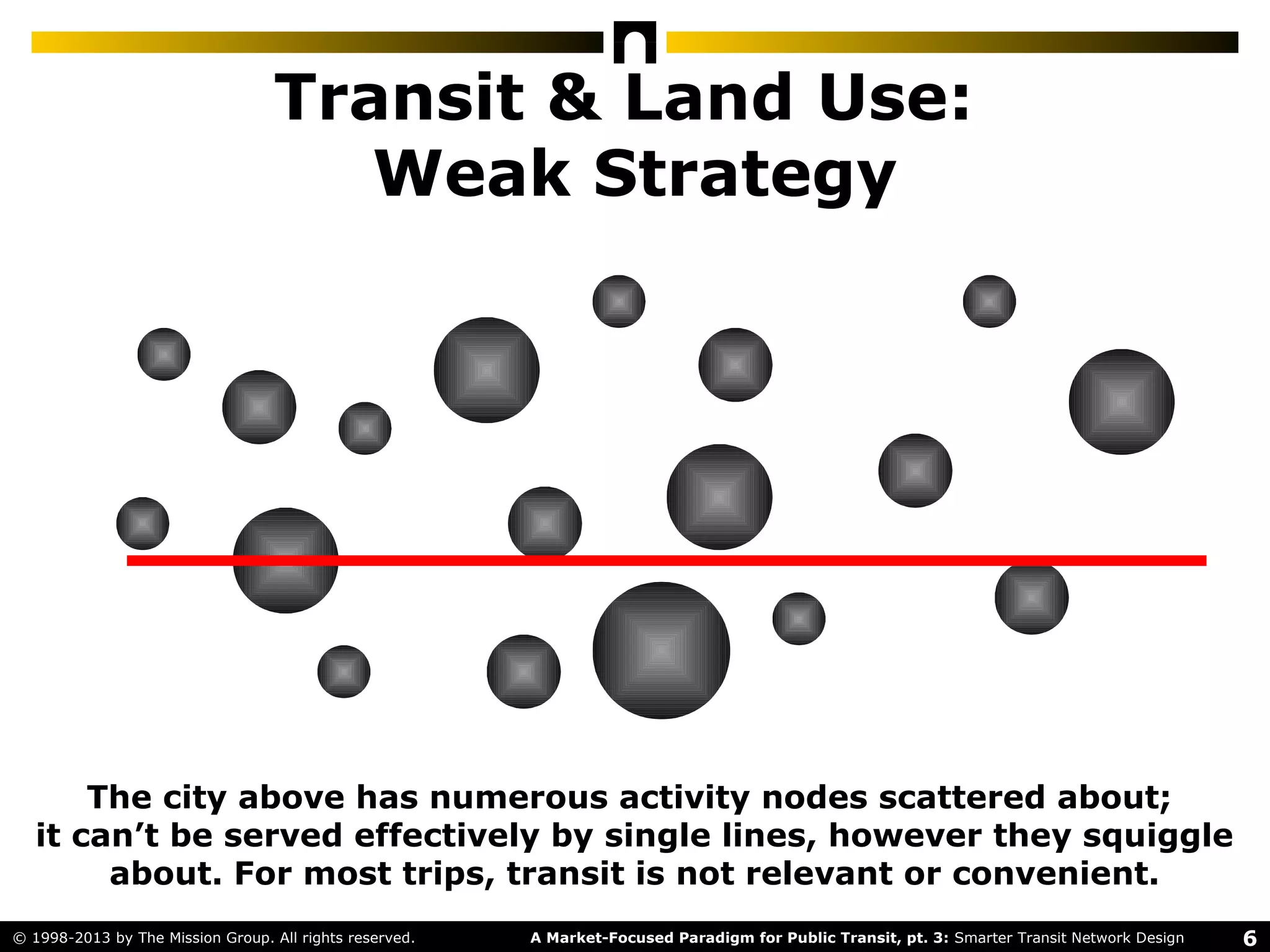
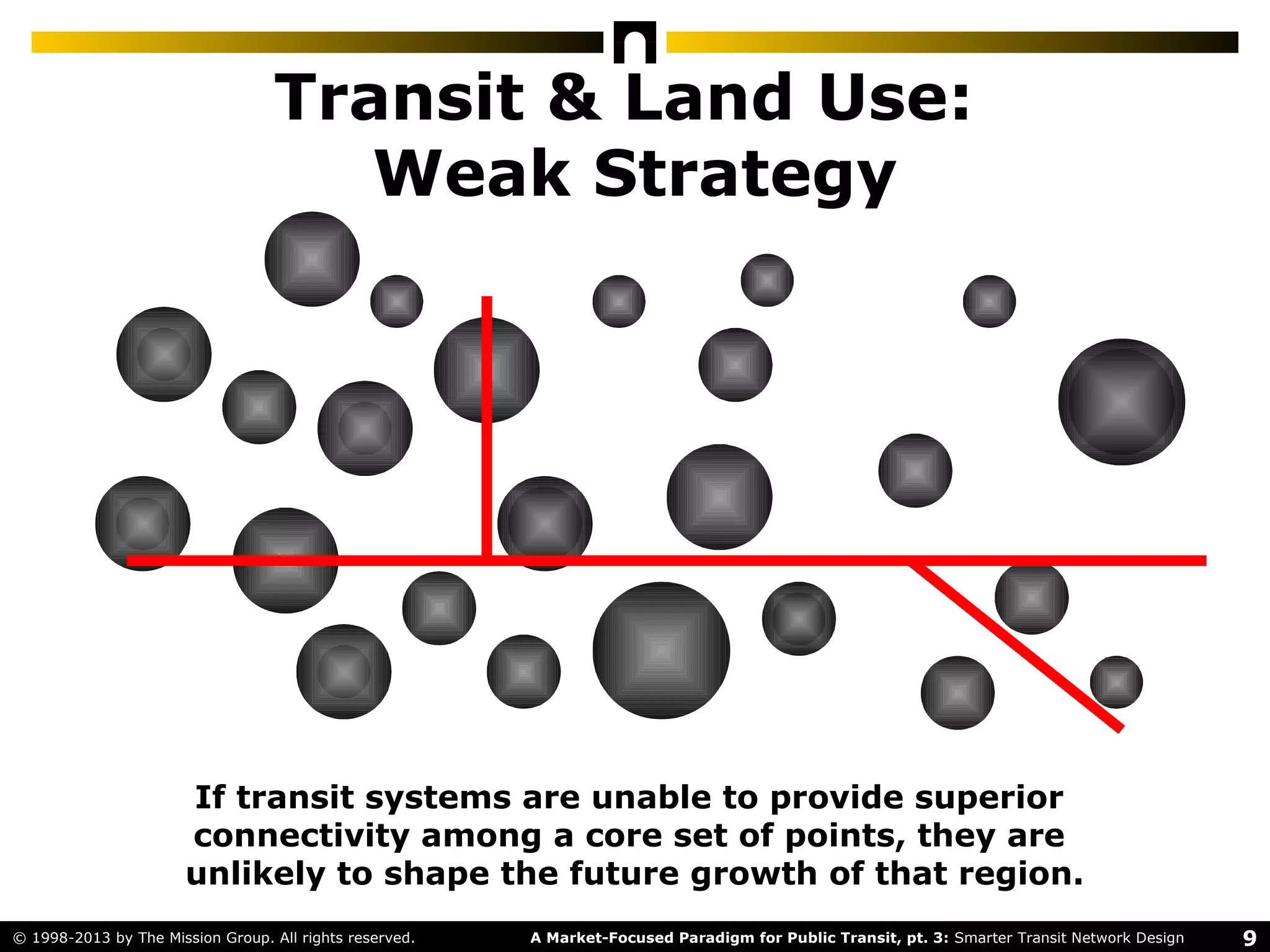
The city above has numerous activity nodes scattered about;
it can’t be served effectively by single lines, however they squiggle
about. For most trips, transit is not relevant or convenient.
7A Market-Focused Paradigm for Public Transit, pt. 3: Smarter Transit Network Design© 1998-2013 by The Mission Group. All rights reserved.
Transit & Land Use:
Weak Strategy
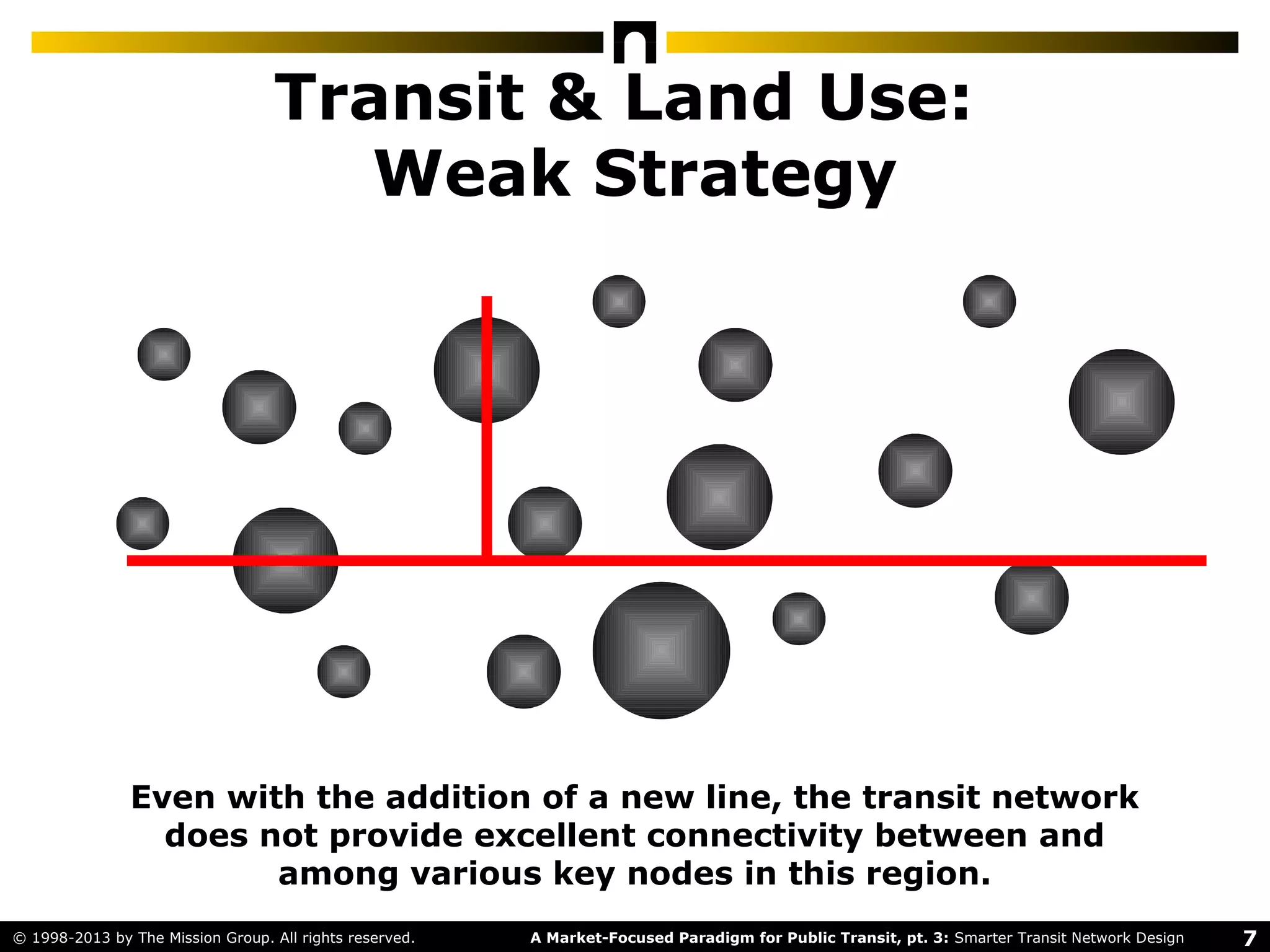
Even with the addition of a new line, the transit network
does not provide excellent connectivity between and
among various key nodes in this region.
8A Market-Focused Paradigm for Public Transit, pt. 3: Smarter Transit Network Design© 1998-2013 by The Mission Group. All rights reserved.
Transit & Land Use:
Weak Strategy
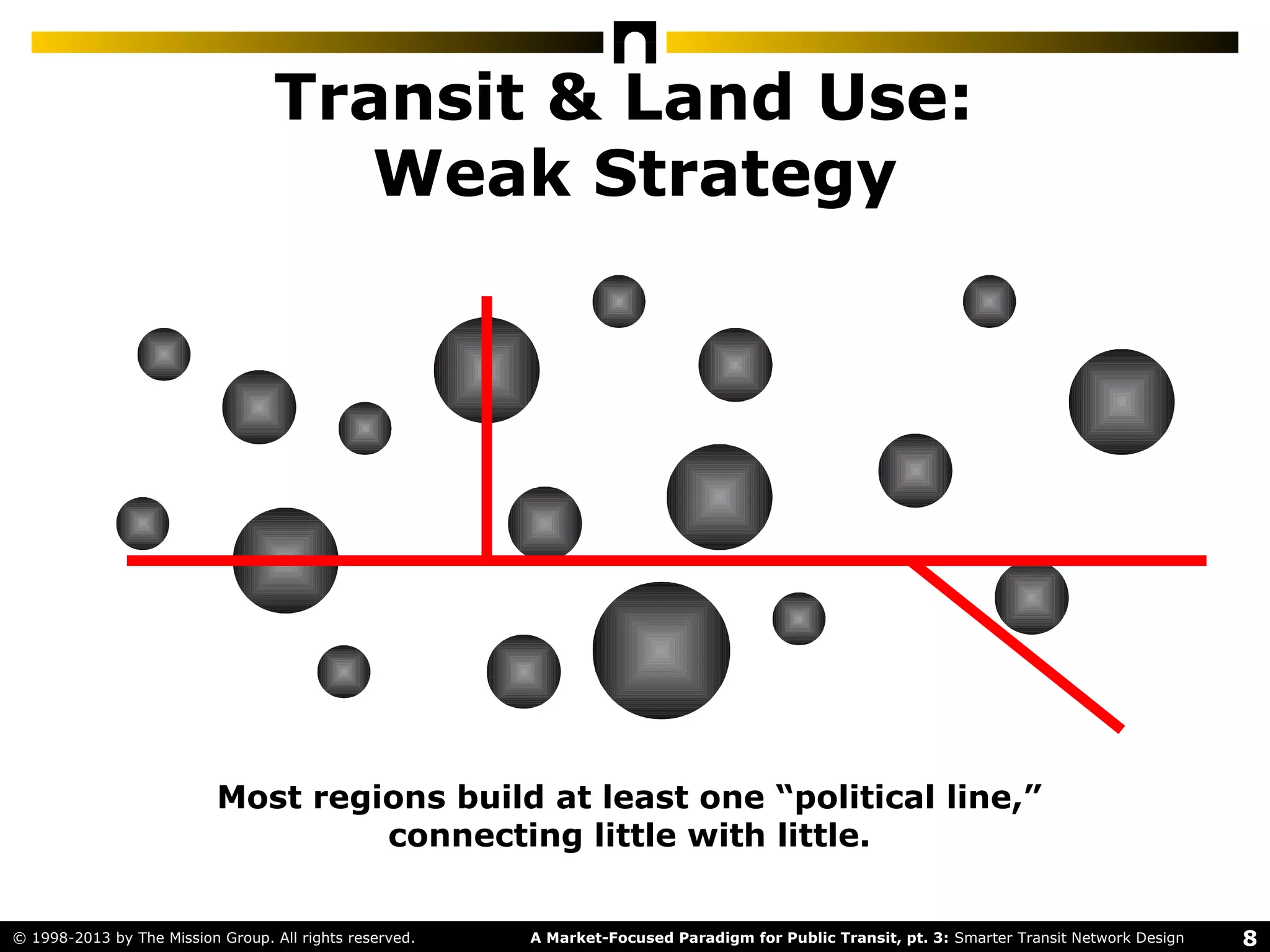
Most regions build at least one “political line,”
connecting little with little.
9A Market-Focused Paradigm for Public Transit, pt. 3: Smarter Transit Network Design© 1998-2013 by The Mission Group. All rights reserved.
Transit & Land Use:
Weak Strategy
If transit systems are unable to provide superior
connectivity among a core set of points, they are
unlikely to shape the future growth of that region.
10A Market-Focused Paradigm for Public Transit, pt. 3: Smarter Transit Network Design© 1998-2013 by The Mission Group. All rights reserved.
Transit & Land Use:
Weak Strategy
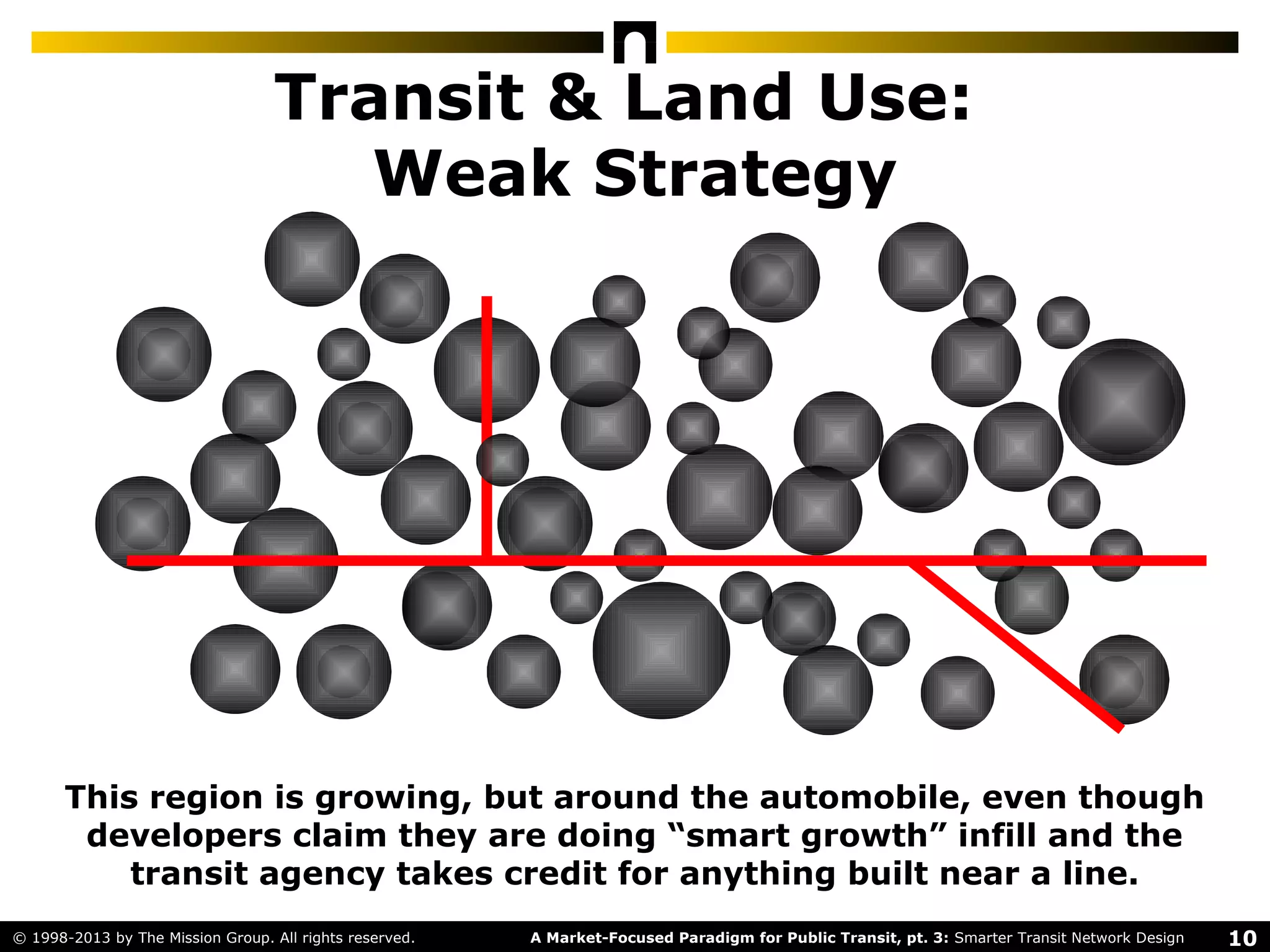
This region is growing, but around the automobile, even though
developers claim they are doing “smart growth” infill and the
transit agency takes credit for anything built near a line.
11A Market-Focused Paradigm for Public Transit, pt. 3: Smarter Transit Network Design© 1998-2013 by The Mission Group. All rights reserved.
Transit & Land Use:
Weak Strategy
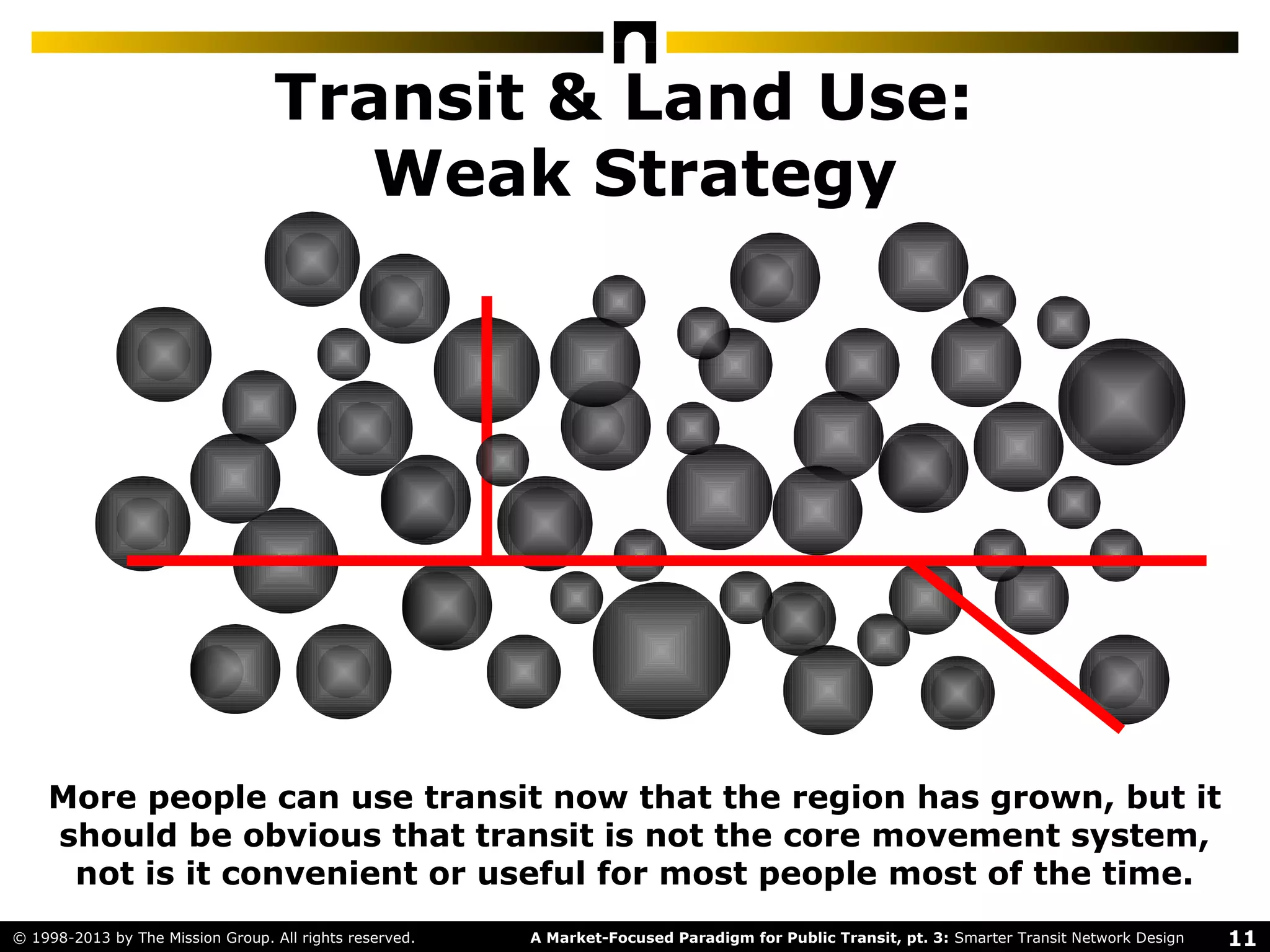
More people can use transit now that the region has grown, but it
should be obvious that transit is not the core movement system,
not is it convenient or useful for most people most of the time.
Other cities figure out how to connect
their principal nodes together as
directly and conveniently as possible,
even if they use rickshaws.
13A Market-Focused Paradigm for Public Transit, pt. 3: Smarter Transit Network Design© 1998-2013 by The Mission Group. All rights reserved.
Transit & Land Use:
Strong Strategy
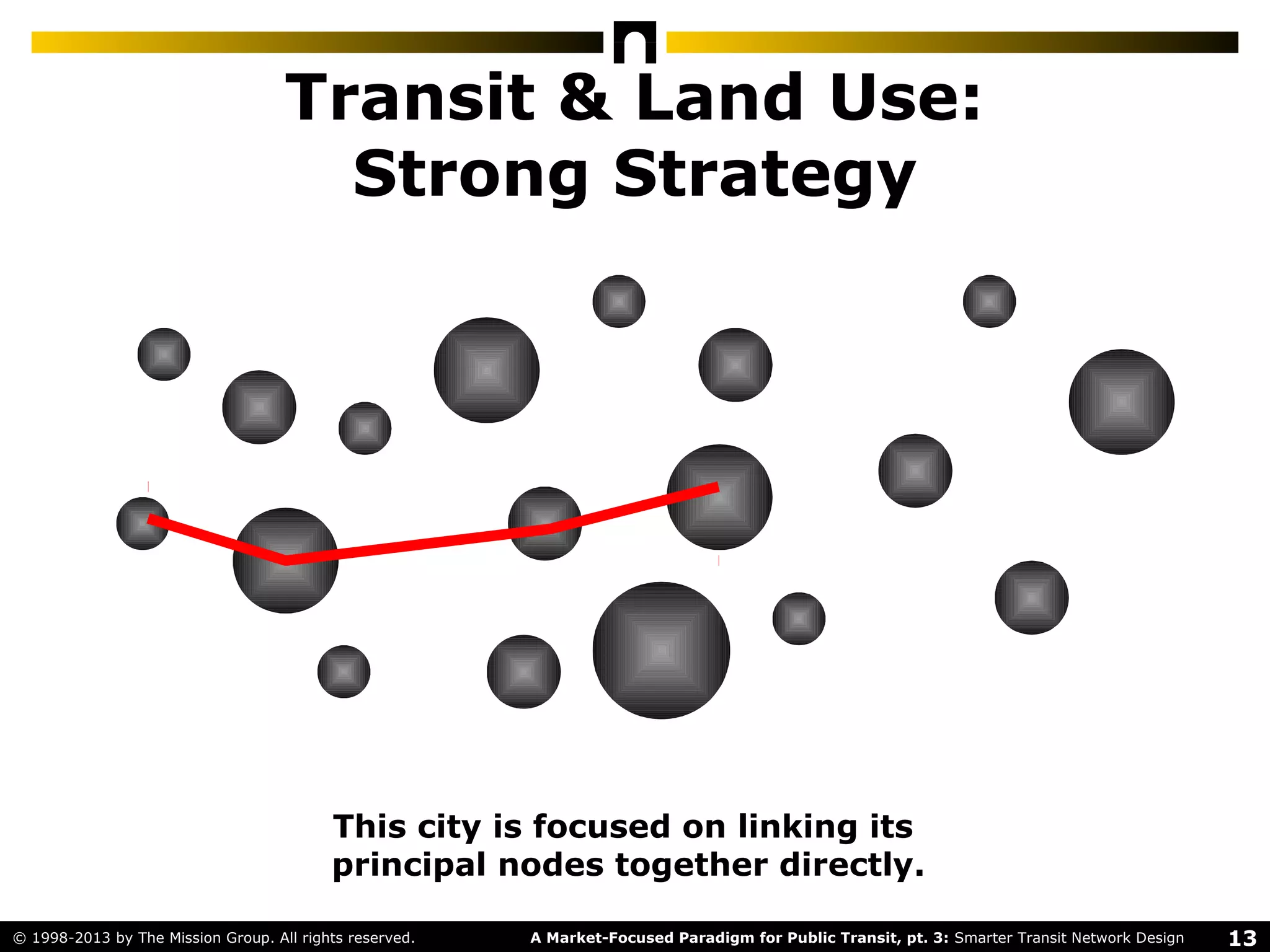
This city is focused on linking its
principal nodes together directly.
14A Market-Focused Paradigm for Public Transit, pt. 3: Smarter Transit Network Design© 1998-2013 by The Mission Group. All rights reserved.
Transit & Land Use:
Strong Strategy
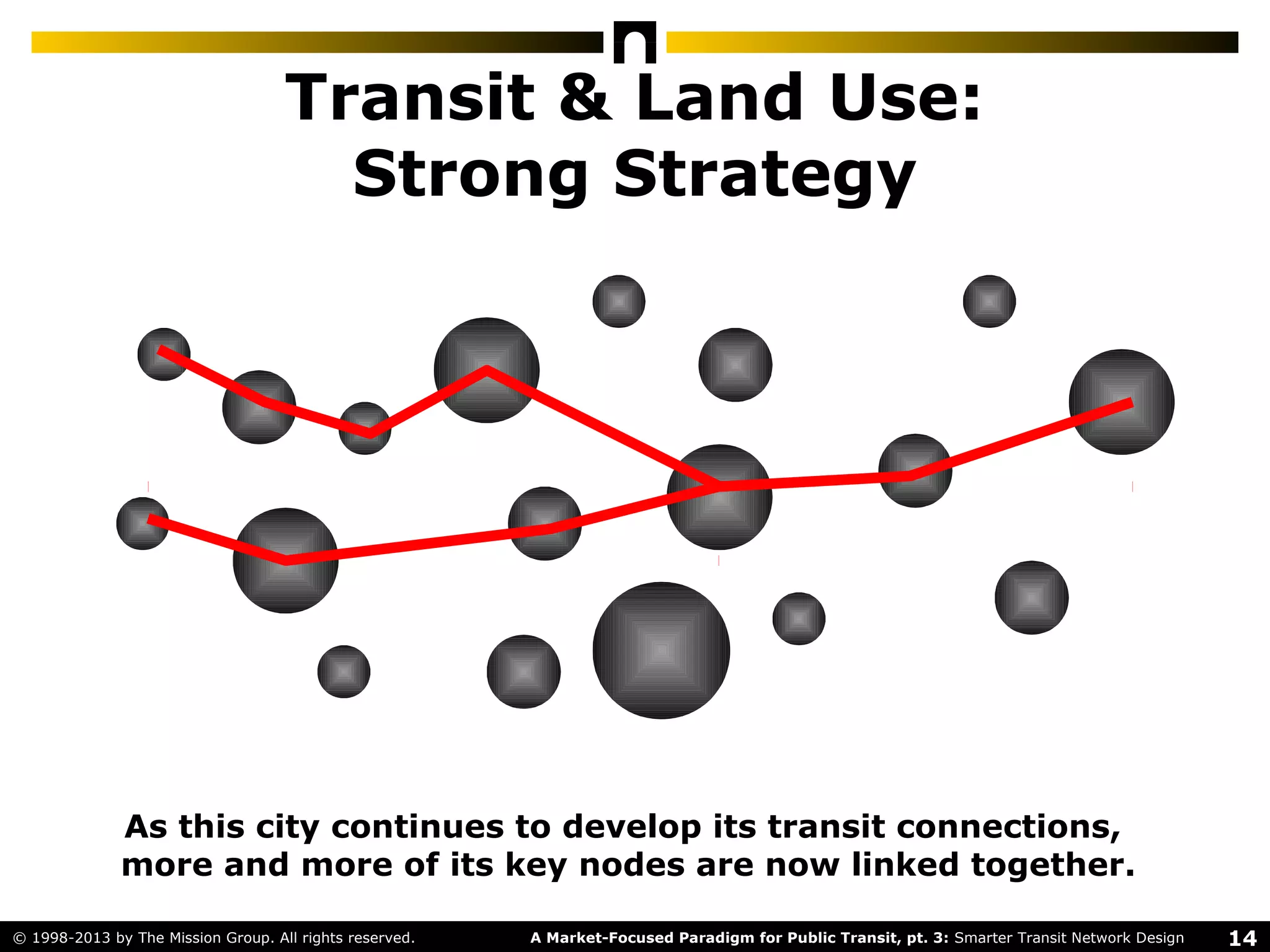
As this city continues to develop its transit connections,
more and more of its key nodes are now linked together.
15A Market-Focused Paradigm for Public Transit, pt. 3: Smarter Transit Network Design© 1998-2013 by The Mission Group. All rights reserved.
Transit & Land Use:
Strong Strategy
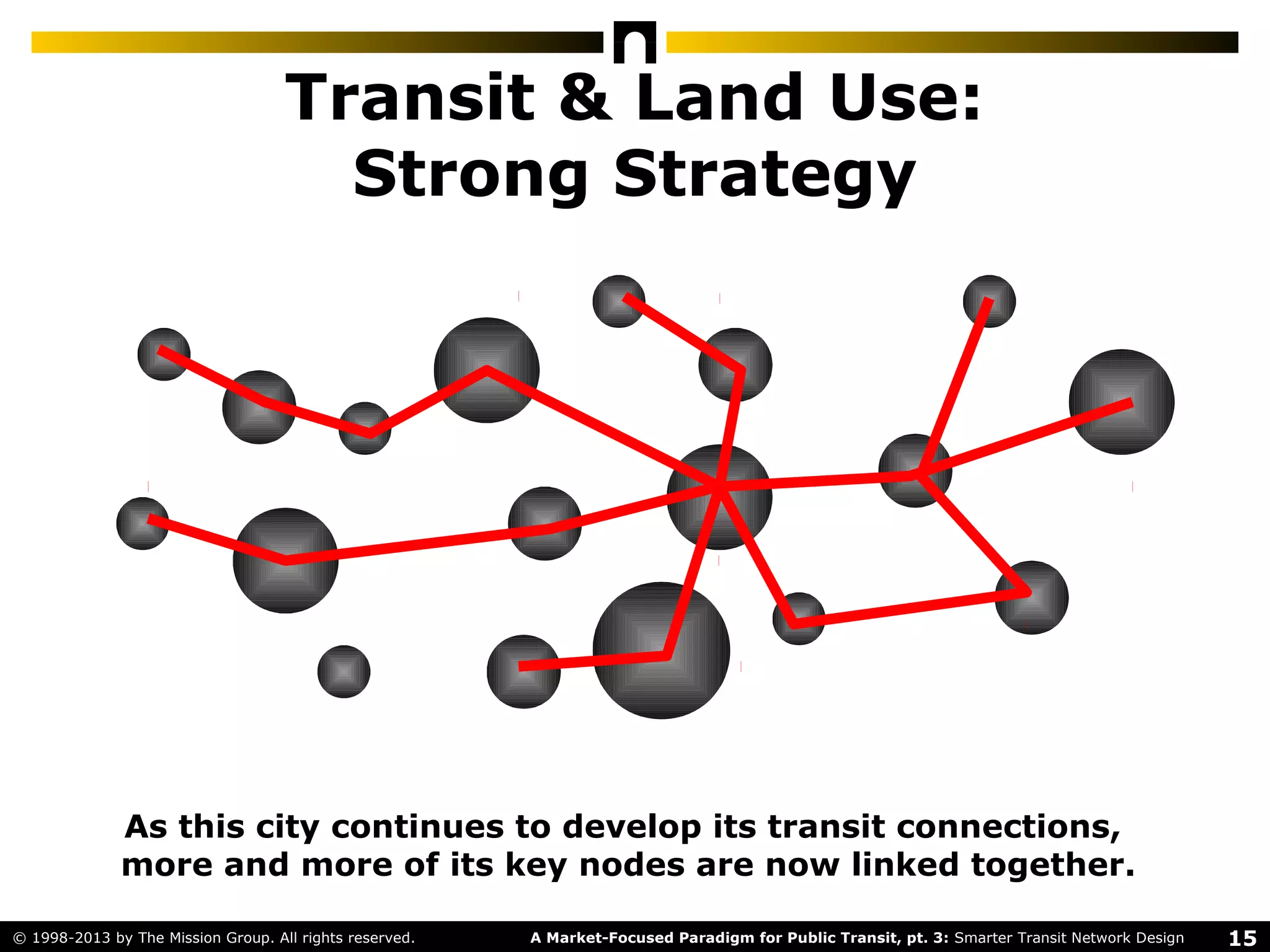
As this city continues to develop its transit connections,
more and more of its key nodes are now linked together.
16A Market-Focused Paradigm for Public Transit, pt. 3: Smarter Transit Network Design© 1998-2013 by The Mission Group. All rights reserved.
Transit & Land Use:
Strong Strategy
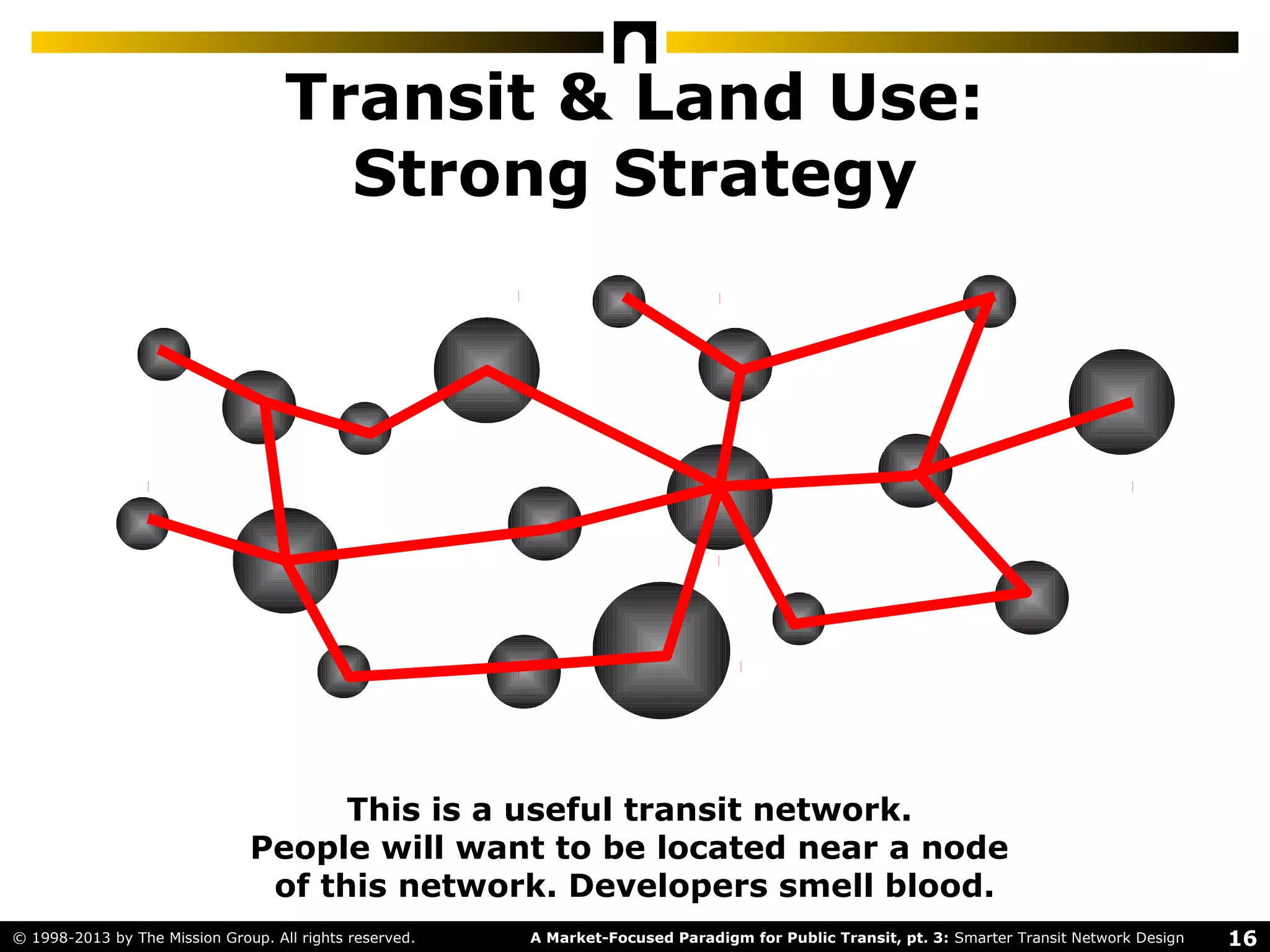
This is a useful transit network.
People will want to be located near a node
of this network. Developers smell blood.
17A Market-Focused Paradigm for Public Transit, pt. 3: Smarter Transit Network Design© 1998-2013 by The Mission Group. All rights reserved.
Transit & Land Use:
Strong Strategy
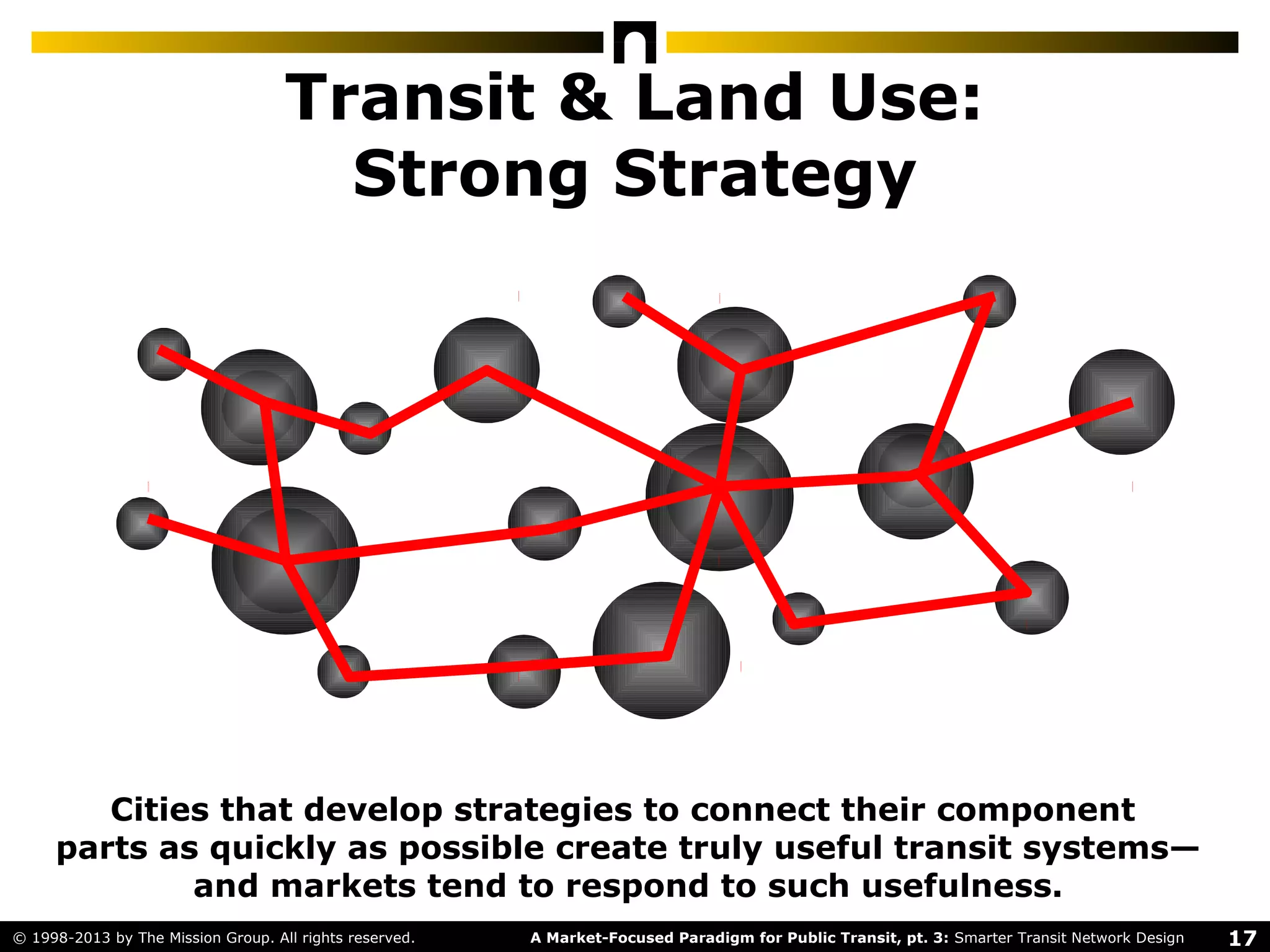
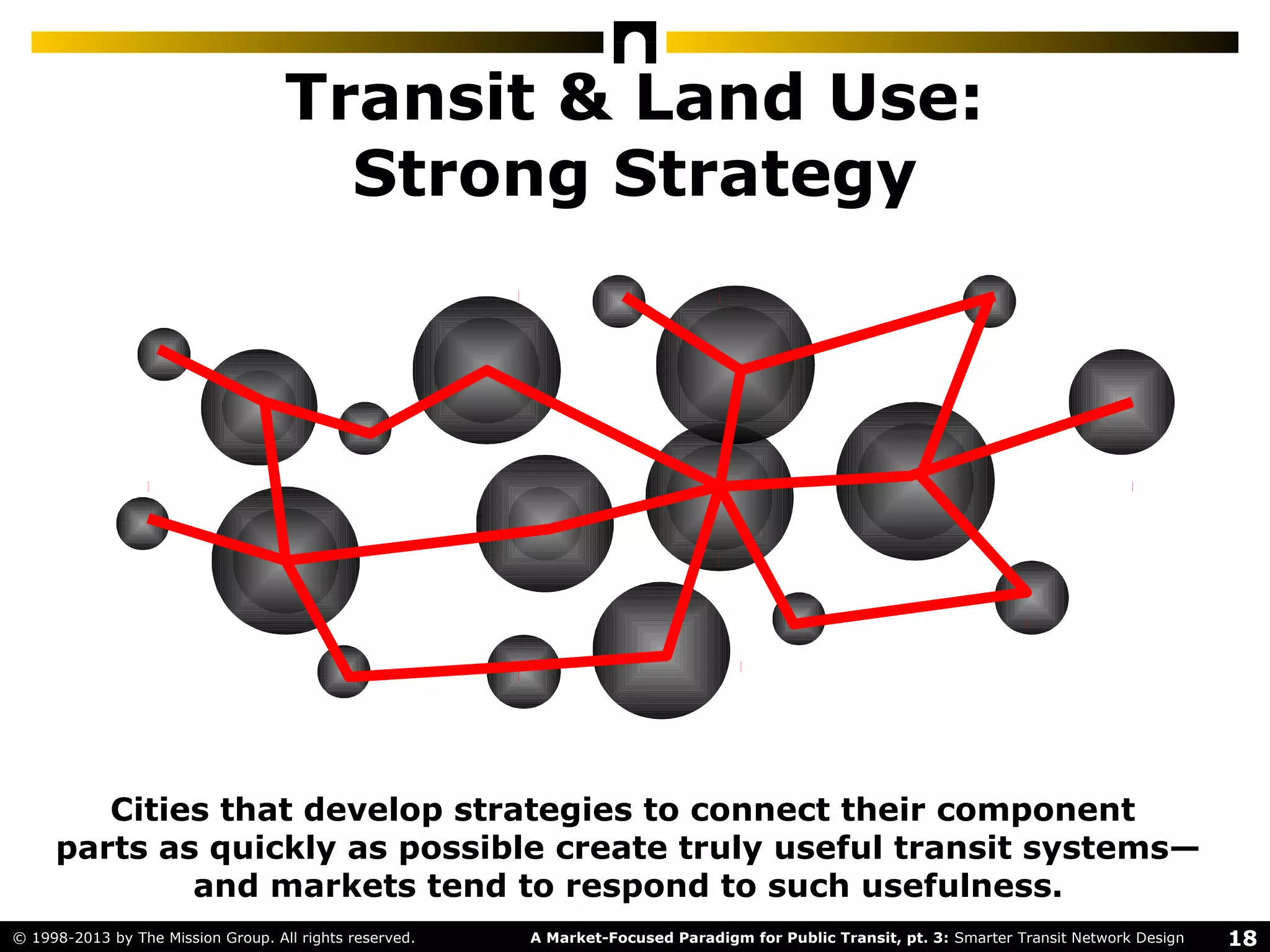
Cities that develop strategies to connect their component
parts as quickly as possible create truly useful transit systems—
and markets tend to respond to such usefulness.
18A Market-Focused Paradigm for Public Transit, pt. 3: Smarter Transit Network Design© 1998-2013 by The Mission Group. All rights reserved.
Transit & Land Use:
Strong Strategy
Cities that develop strategies to connect their component
parts as quickly as possible create truly useful transit systems—
and markets tend to respond to such usefulness.
19A Market-Focused Paradigm for Public Transit, pt. 3: Smarter Transit Network Design© 1998-2013 by The Mission Group. All rights reserved.
Transit & Land Use:
Strong Strategy
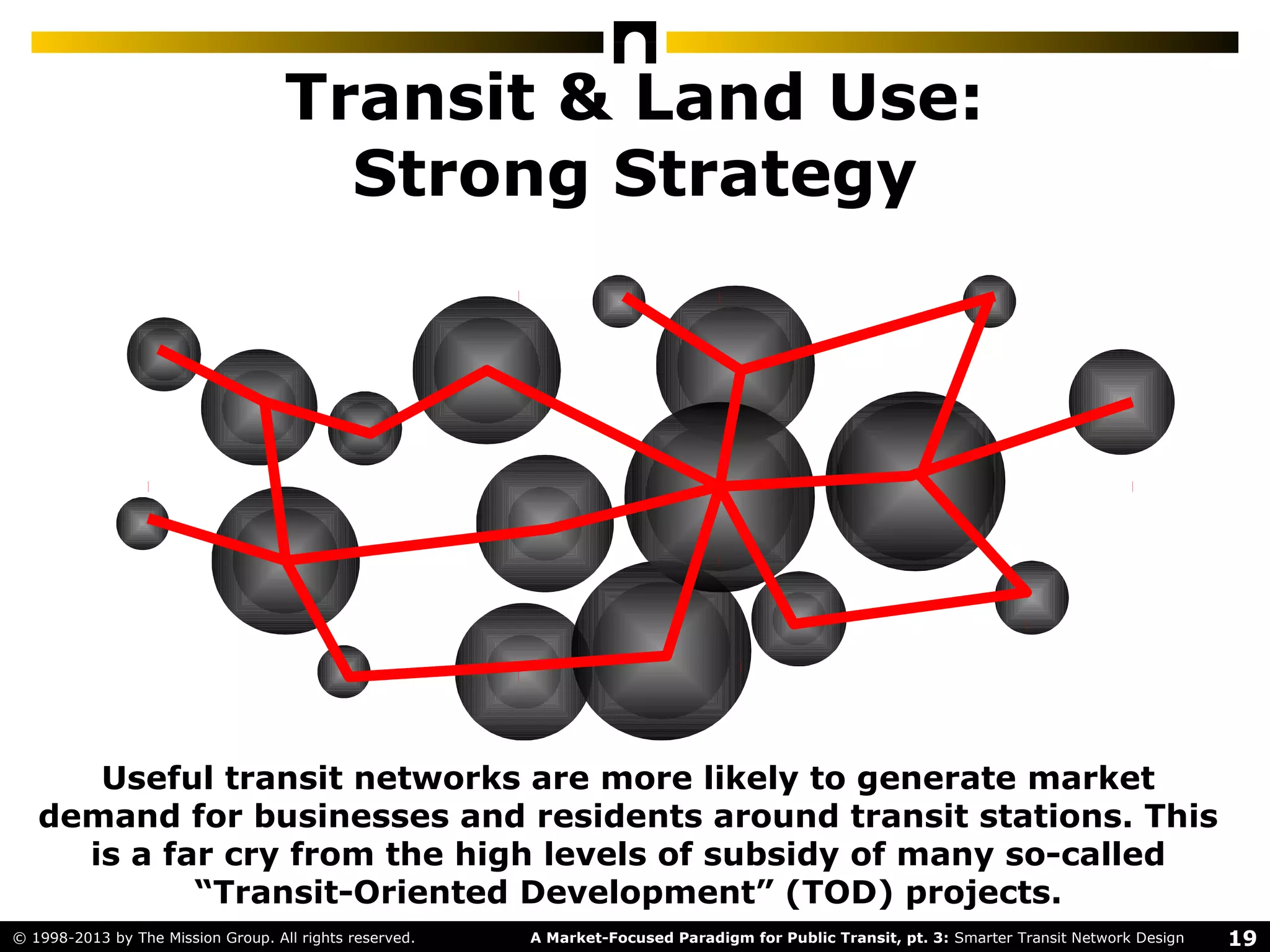
Useful transit networks are more likely to generate market
demand for businesses and residents around transit stations. This
is a far cry from the high levels of subsidy of many so-called
“Transit-Oriented Development” (TOD) projects.
Some cities have been very
innovative in their approach to
creating a pervasive transit network.
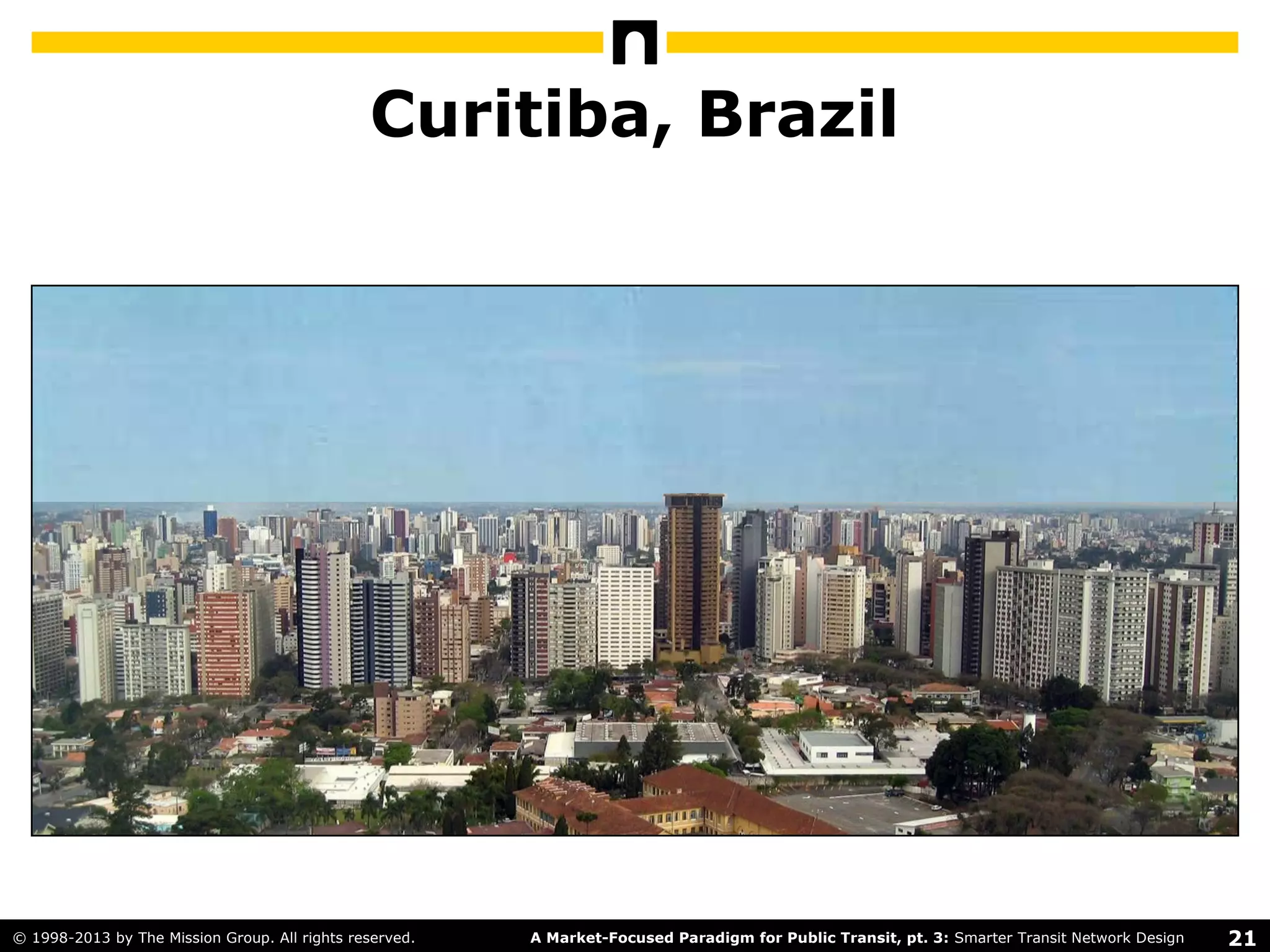
Curitiba, Brazil, practically invented
modern Bus Rapid Transit (BRT) as
a result of their desire to implement
their ideal transit network in as few
years as possible.
21A Market-Focused Paradigm for Public Transit, pt. 3: Smarter Transit Network Design© 1998-2013 by The Mission Group. All rights reserved.
Curitiba, Brazil
22A Market-Focused Paradigm for Public Transit, pt. 3: Smarter Transit Network Design© 1998-2013 by The Mission Group. All rights reserved.
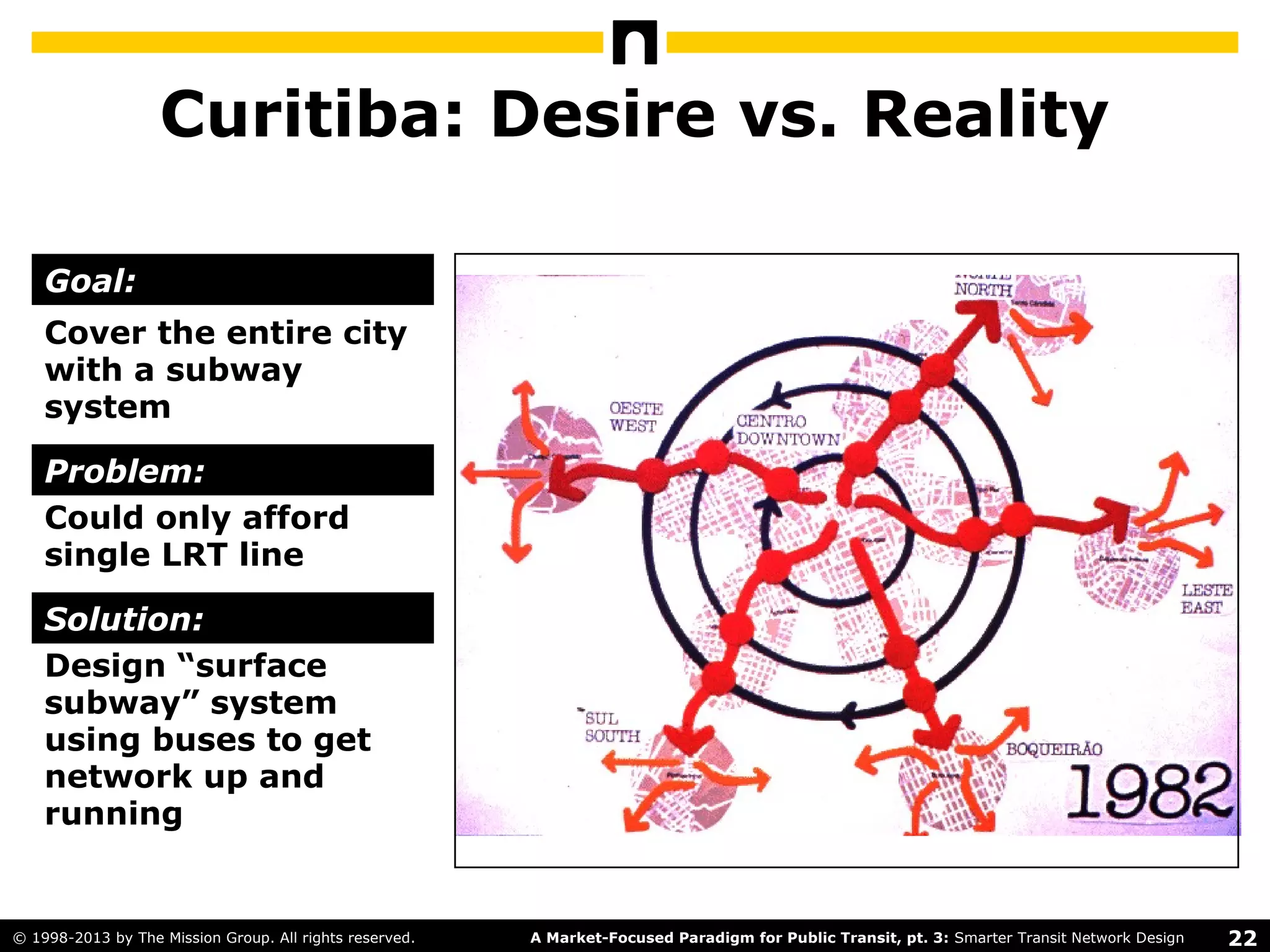
Curitiba: Desire vs. Reality
Cover the entire city
with a subway
system
Goal:
Could only afford
single LRT line
Design “surface
subway” system
using buses to get
network up and
running
Goal:
Problem:
Solution:
23A Market-Focused Paradigm for Public Transit, pt. 3: Smarter Transit Network Design© 1998-2013 by The Mission Group. All rights reserved.
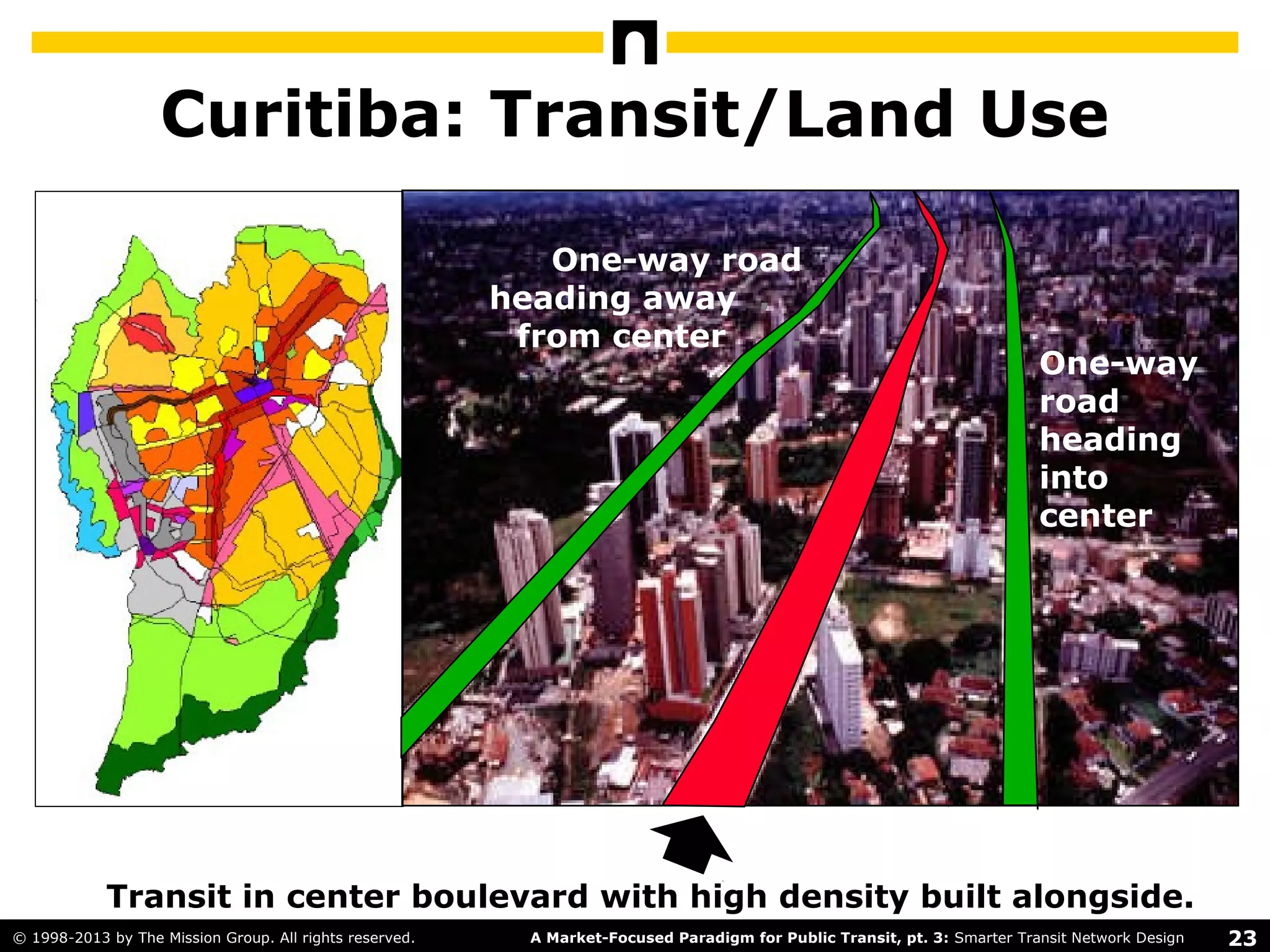
Curitiba: Transit/Land Use
One-way
road
heading
into
center
One-way road
heading away .
from center .
Transit in center boulevard with high density built alongside.
24A Market-Focused Paradigm for Public Transit, pt. 3: Smarter Transit Network Design© 1998-2013 by The Mission Group. All rights reserved.
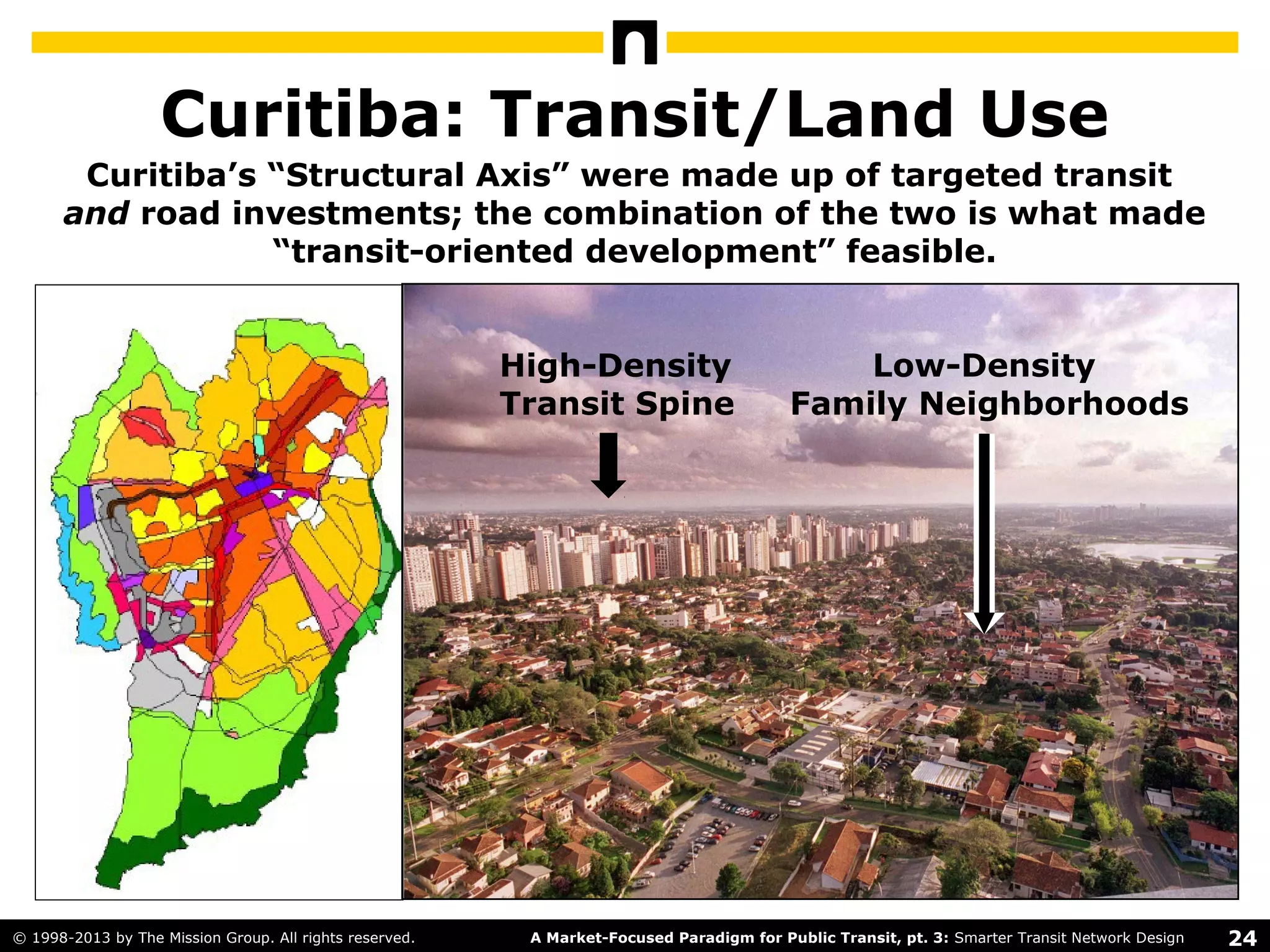
Curitiba: Transit/Land Use
High-Density
Transit Spine
Low-Density
Family Neighborhoods
Curitiba’s “Structural Axis” corridors were made up of targeted
transit and road investments; the combination of the two is what
made “transit-oriented development” feasible.
25A Market-Focused Paradigm for Public Transit, pt. 3: Smarter Transit Network Design© 1998-2013 by The Mission Group. All rights reserved.
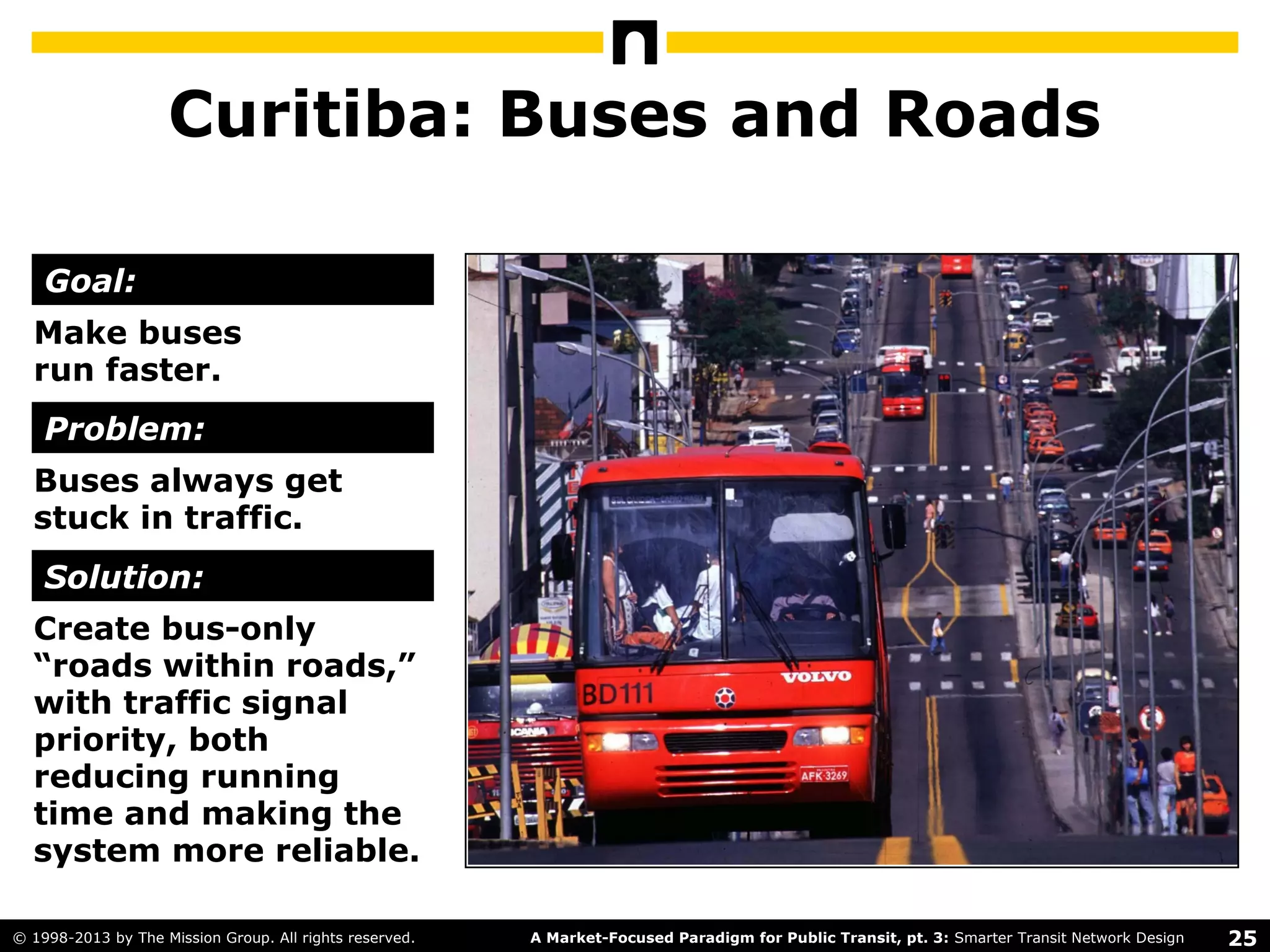
Curitiba: Buses and Roads
Make buses
run faster.
Buses always get
stuck in traffic.
Create bus-only
“roads within roads,”
with traffic signal
priority, both
reducing running
time and making the
system more reliable.
Goal:
Problem:
Solution:
26A Market-Focused Paradigm for Public Transit, pt. 3: Smarter Transit Network Design© 1998-2013 by The Mission Group. All rights reserved.
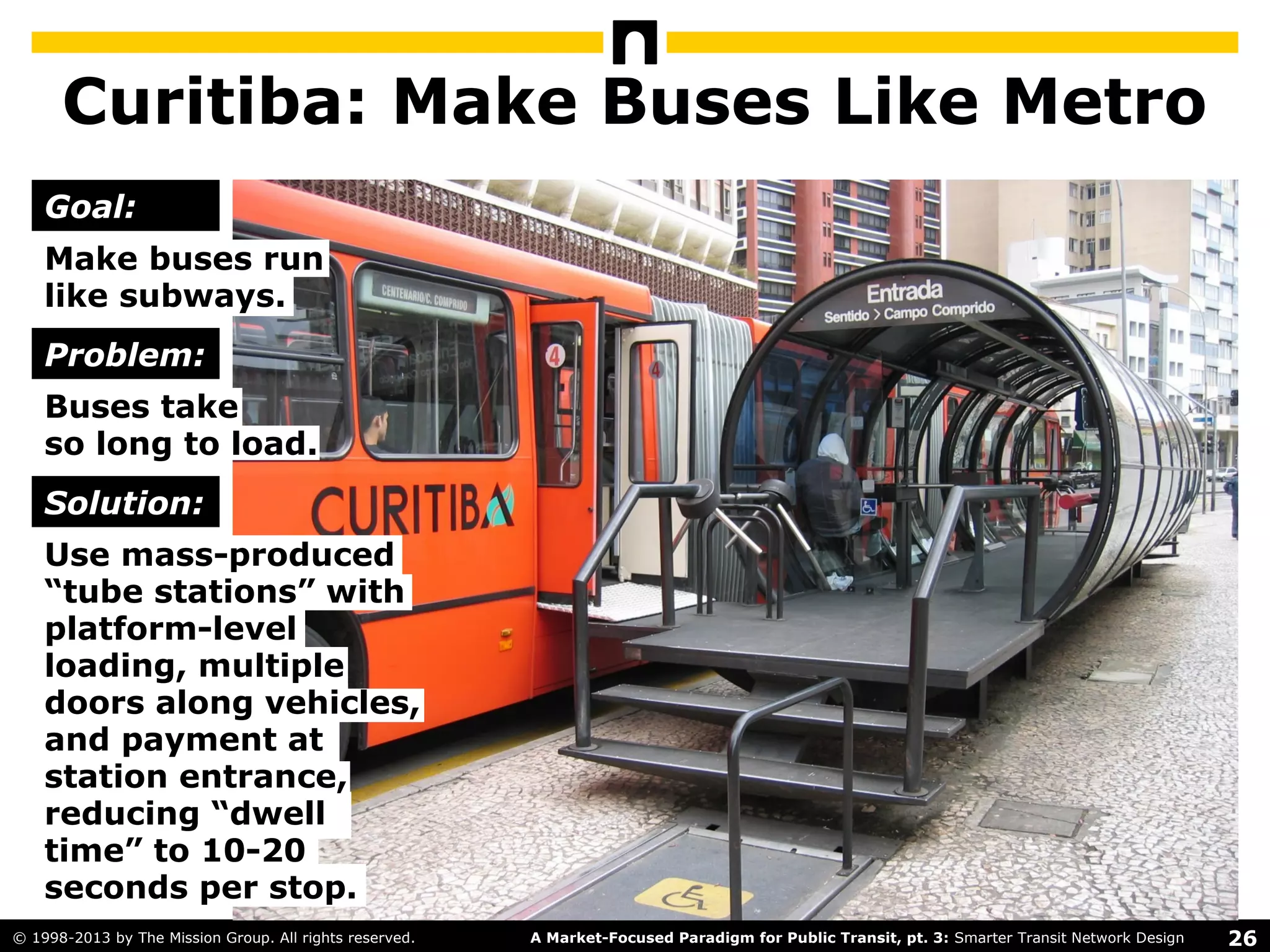
Curitiba: Make Buses Like Metro
Goal:
Problem:
Solution:
Make buses run
like subways.
Buses take
so long to load.
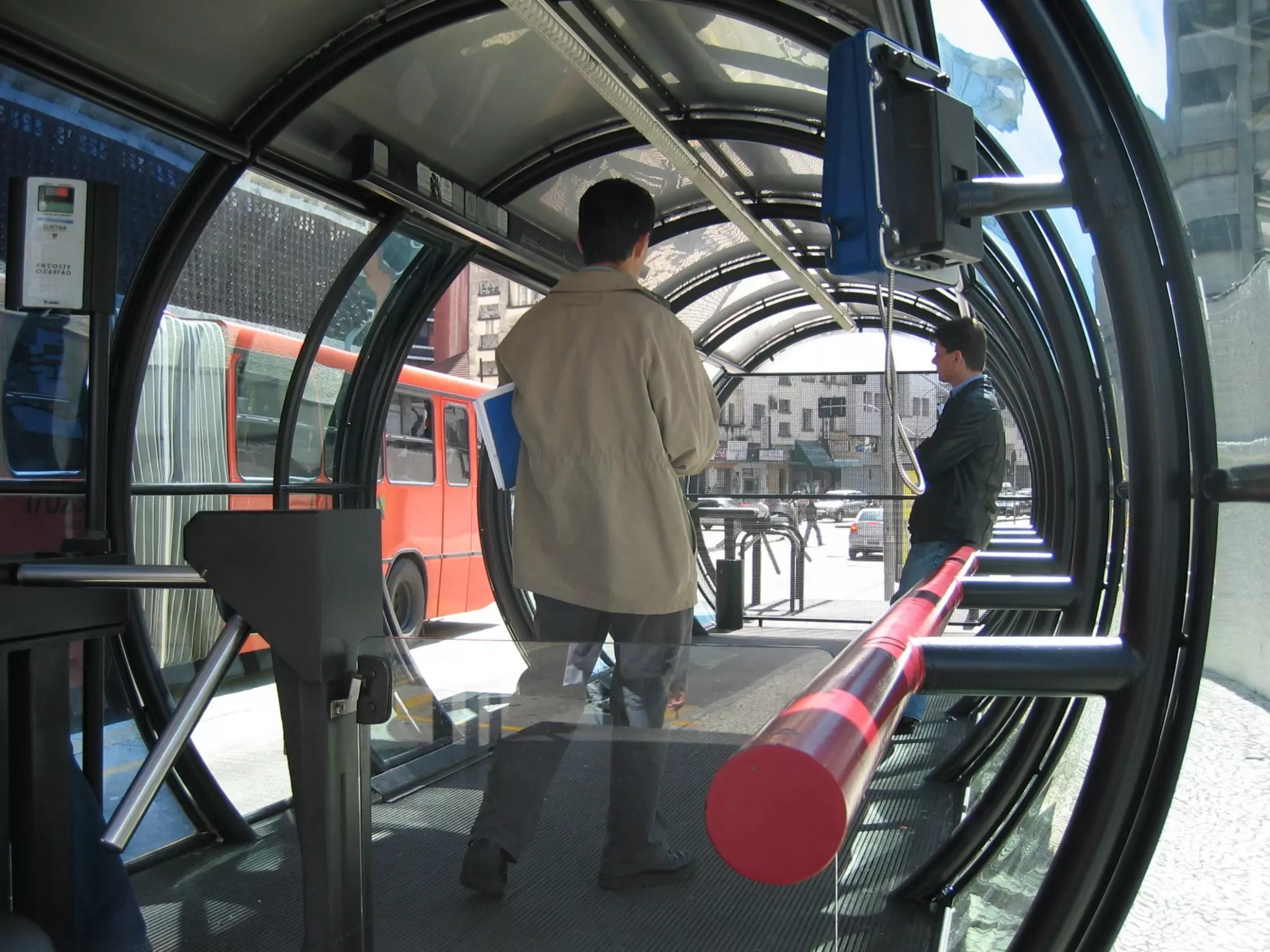
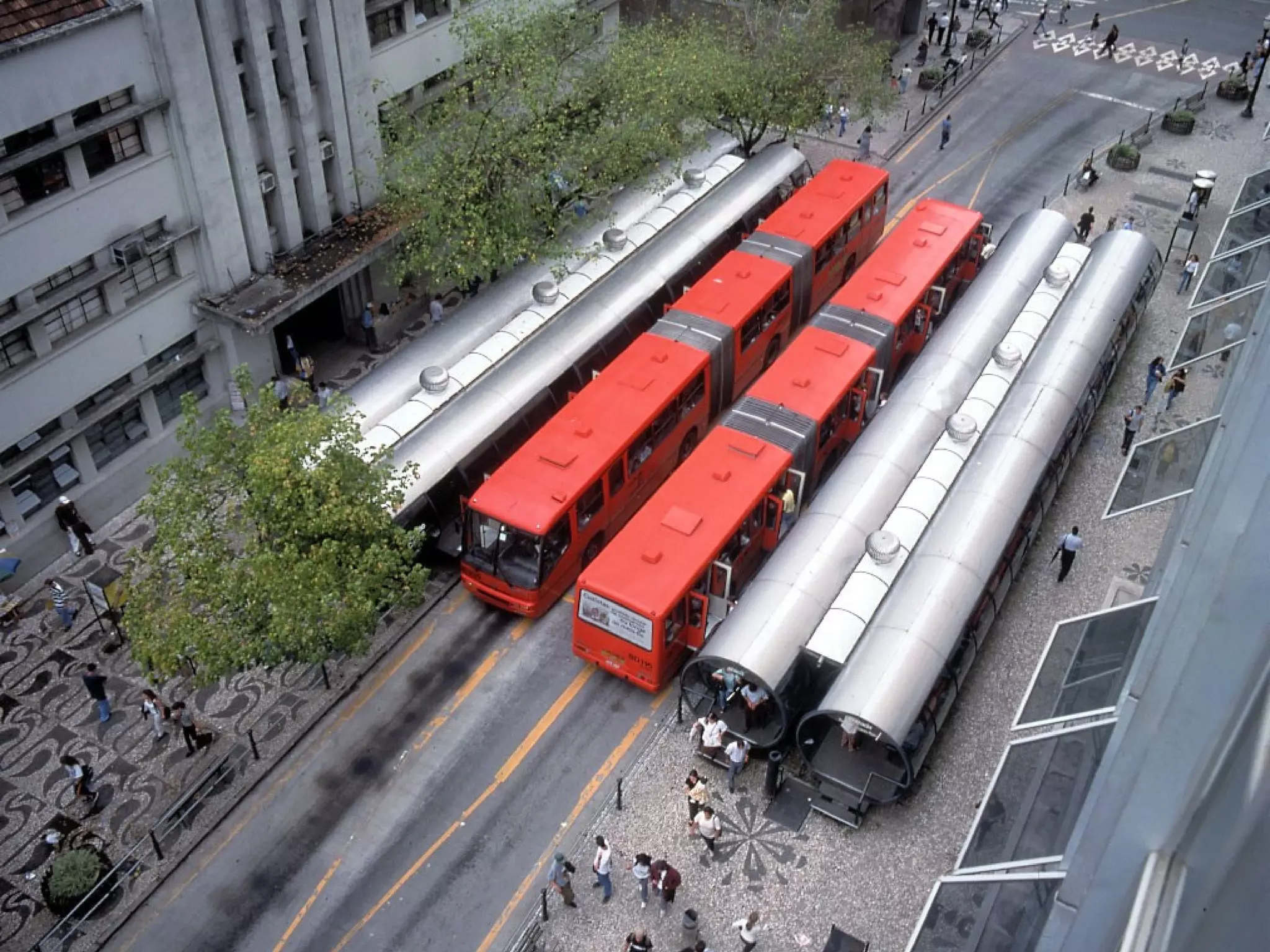
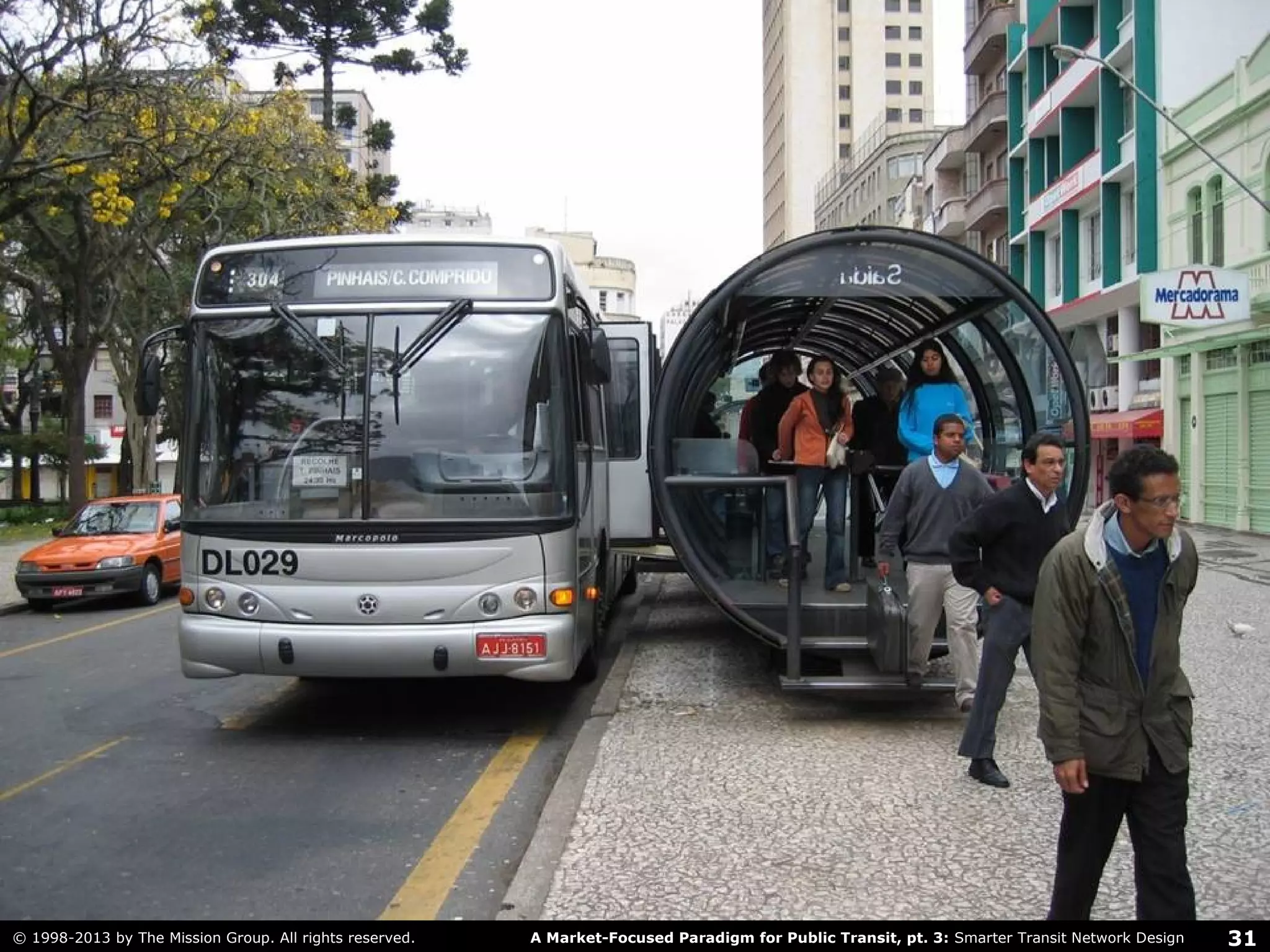
Use mass-produced
“tube stations” with
platform-level
loading, multiple
doors along vehicles,
and payment at
station entrance,
reducing “dwell
time” to 10-20
seconds per stop.
27A Market-Focused Paradigm for Public Transit, pt. 3: Smarter Transit Network Design© 1998-2013 by The Mission Group. All rights reserved.
28A Market-Focused Paradigm for Public Transit, pt. 3: Smarter Transit Network Design© 1998-2013 by The Mission Group. All rights reserved.
29A Market-Focused Paradigm for Public Transit, pt. 3: Smarter Transit Network Design© 1998-2013 by The Mission Group. All rights reserved.
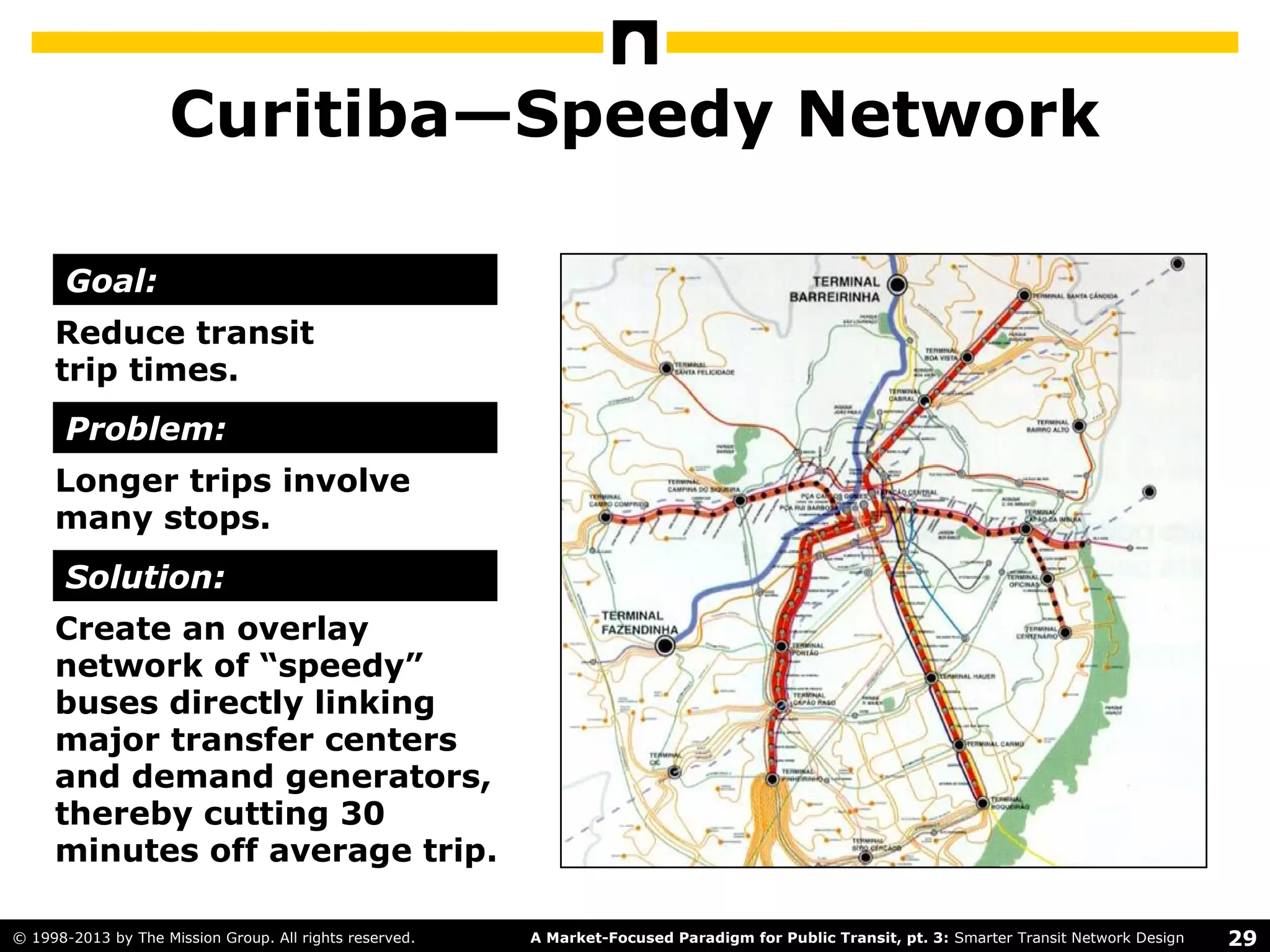
Curitiba—Speedy Network
Reduce transit
trip times.
Longer trips involve
many stops.
Create an overlay
network of “speedy”
buses directly linking
major transfer centers
and demand generators,
thereby cutting 30
minutes off average trip.
Goal:
Problem:
Solution:
30A Market-Focused Paradigm for Public Transit, pt. 3: Smarter Transit Network Design© 1998-2013 by The Mission Group. All rights reserved.
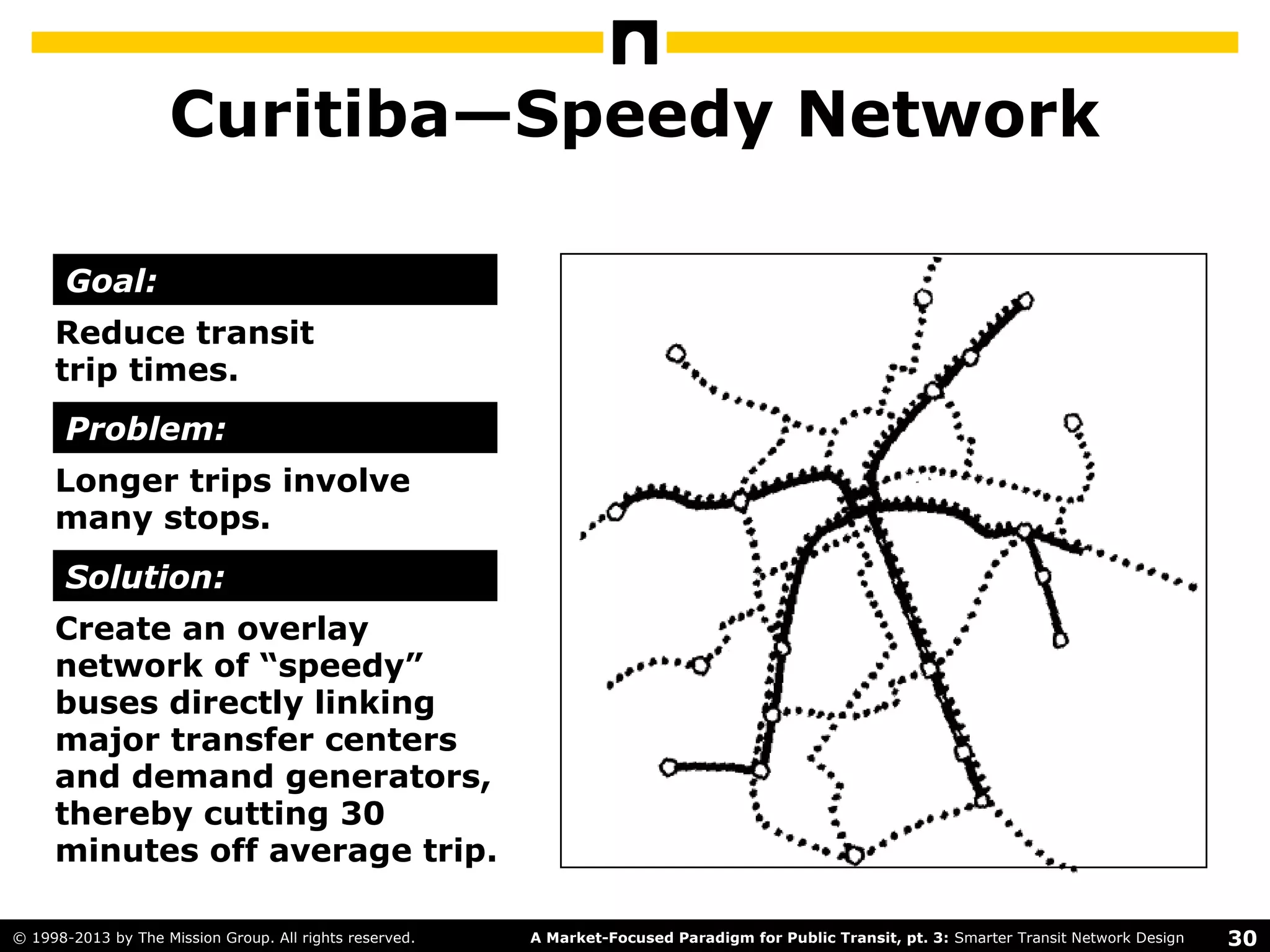
Curitiba—Speedy Network
Reduce transit
trip times.
Longer trips involve
many stops.
Create an overlay
network of “speedy”
buses directly linking
major transfer centers
and demand generators,
thereby cutting 30
minutes off average trip.
Goal:
Problem:
Solution:
31A Market-Focused Paradigm for Public Transit, pt. 3: Smarter Transit Network Design© 1998-2013 by The Mission Group. All rights reserved.
32A Market-Focused Paradigm for Public Transit, pt. 3: Smarter Transit Network Design© 1998-2013 by The Mission Group. All rights reserved.
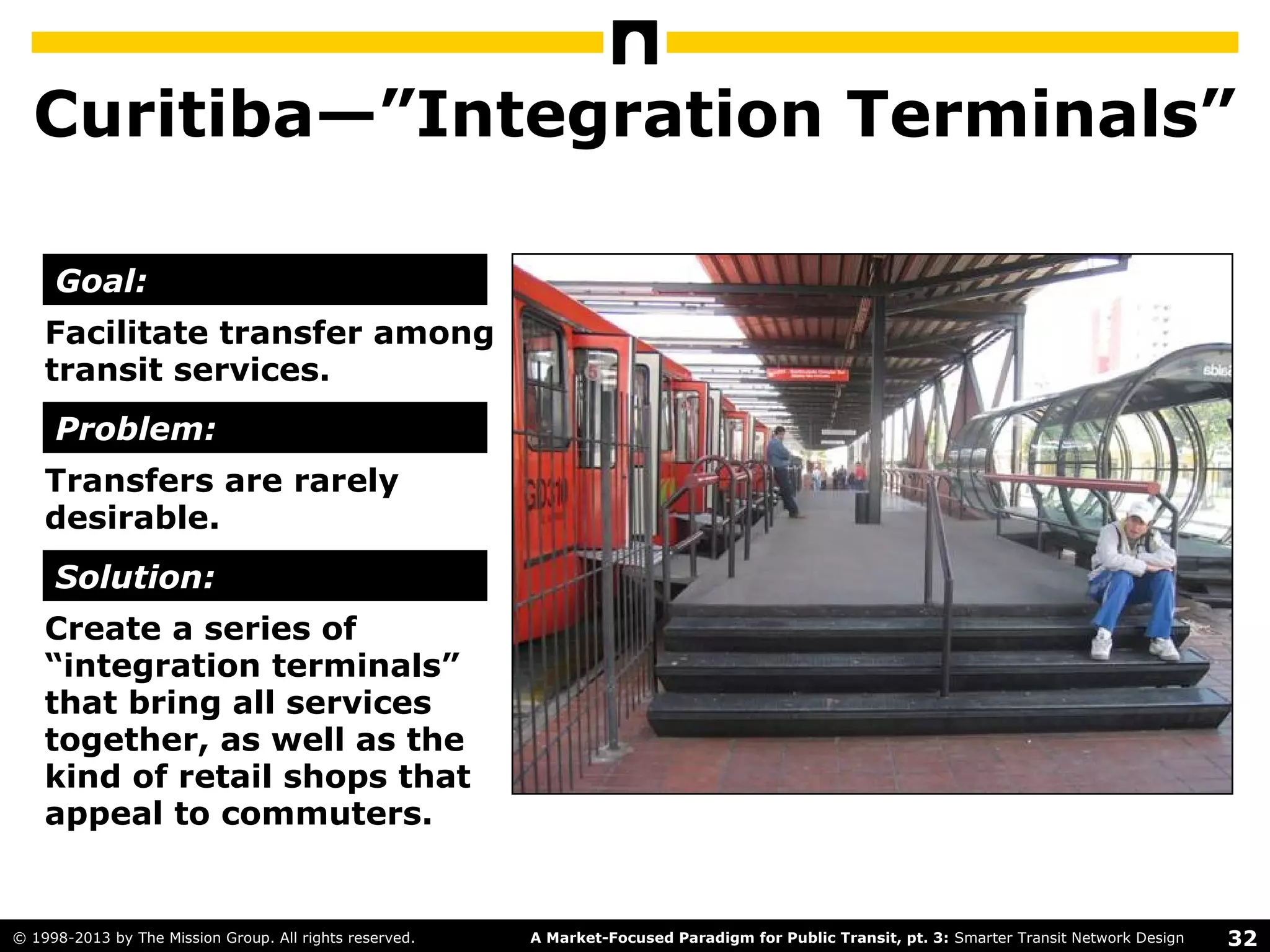
Curitiba—”Integration Terminals”
Facilitate transfer among
transit services.
Transfers are rarely
desirable.
Create a series of
“integration terminals”
that bring all services
together, as well as the
kind of retail shops that
appeal to commuters.
Goal:
Problem:
Solution:
33A Market-Focused Paradigm for Public Transit, pt. 3: Smarter Transit Network Design© 1998-2013 by The Mission Group. All rights reserved.
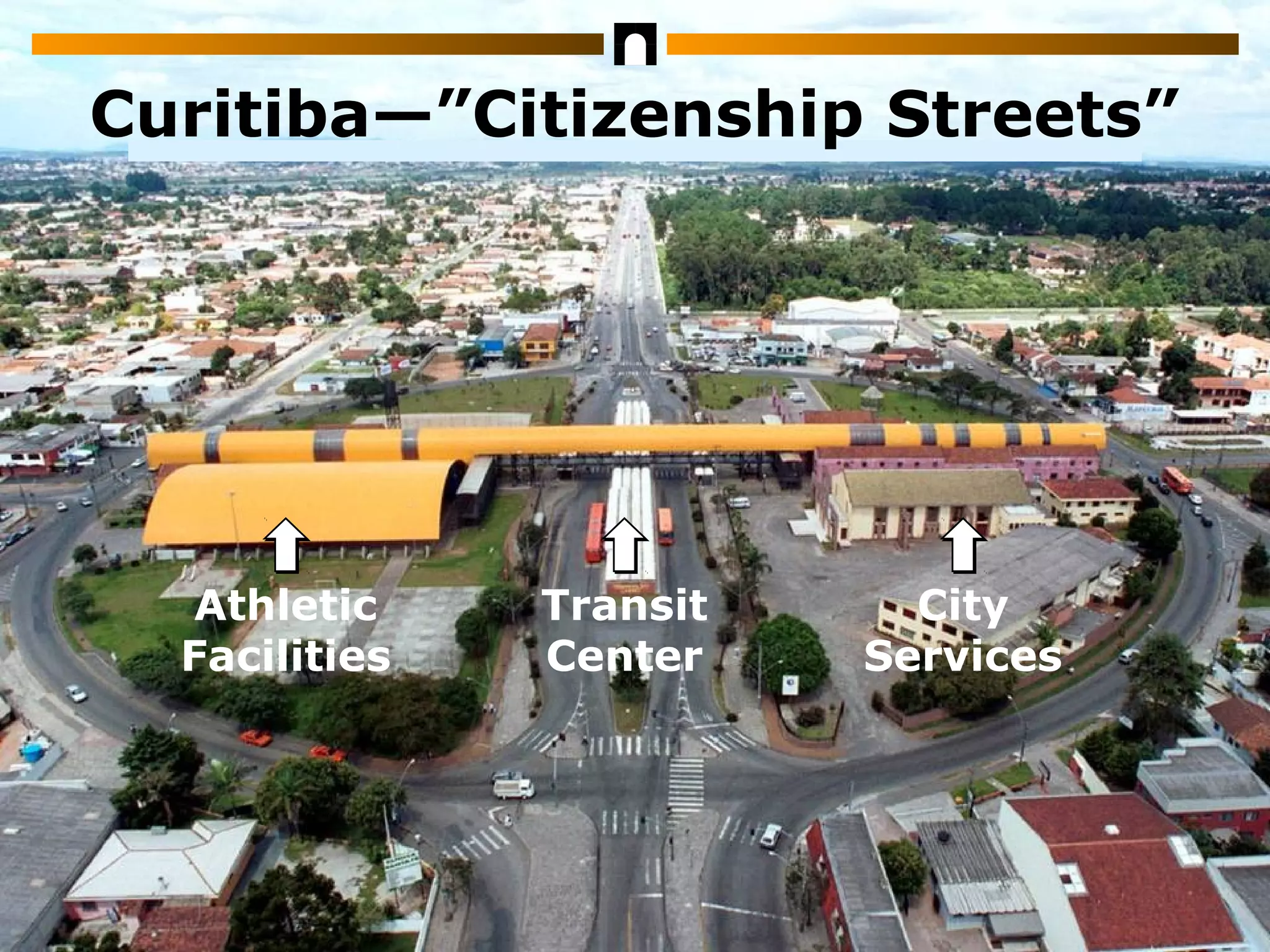
Curitiba—”Citizenship Streets”
Athletic
Facilities
Transit
Center
City
Services
34A Market-Focused Paradigm for Public Transit, pt. 3: Smarter Transit Network Design© 1998-2013 by The Mission Group. All rights reserved.
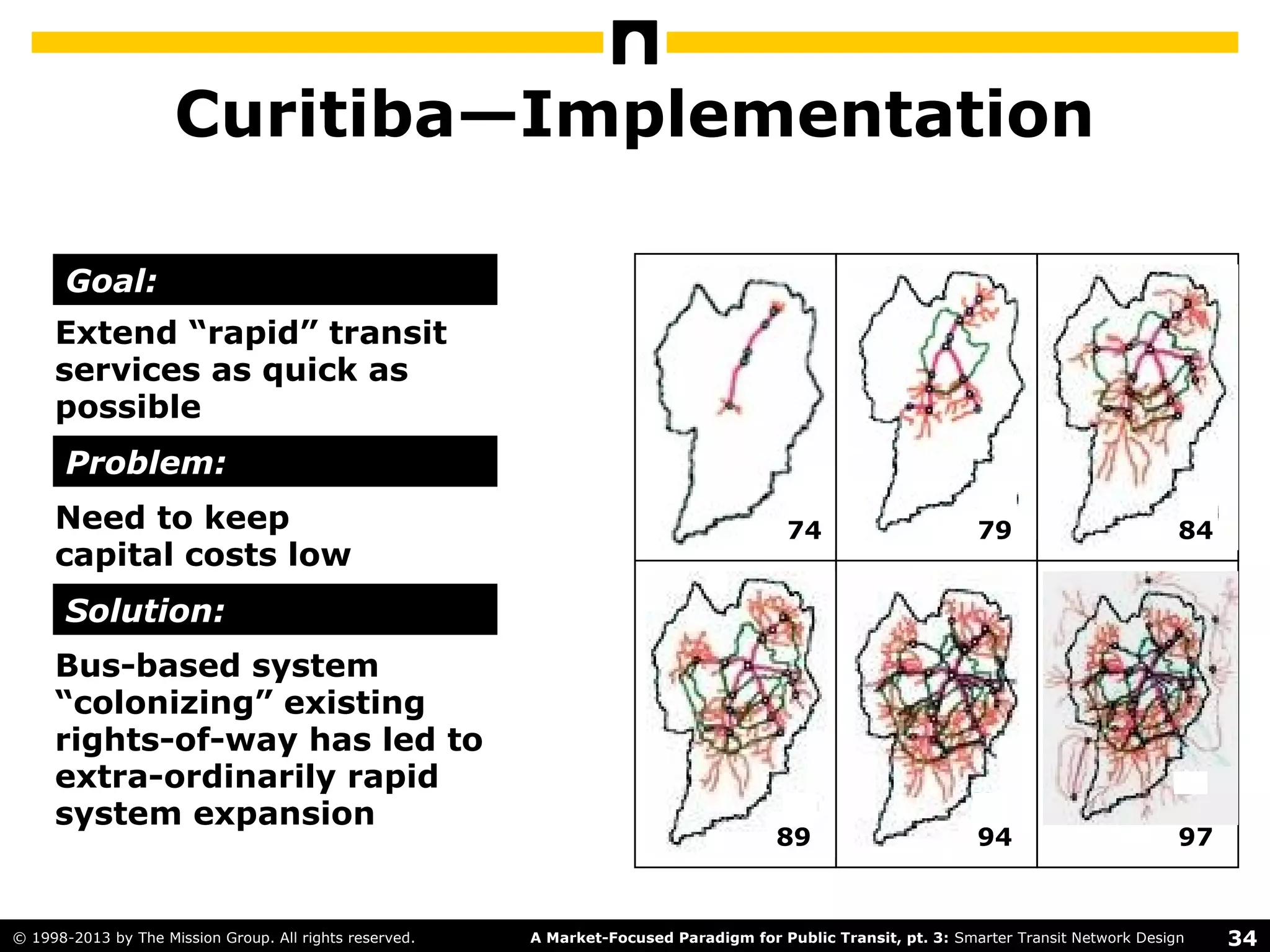
Curitiba—Implementation
Problem:
Solution:
89 94 97
74 79 84
Extend “rapid” transit
services as quick as
possible
Goal:
Need to keep
capital costs low
Bus-based system
“colonizing” existing
rights-of-way has led to
extraordinarily rapid
system expansion
Problem:
Solution:
Goal:
35A Market-Focused Paradigm for Public Transit, pt. 3: Smarter Transit Network Design© 1998-2013 by The Mission Group. All rights reserved.
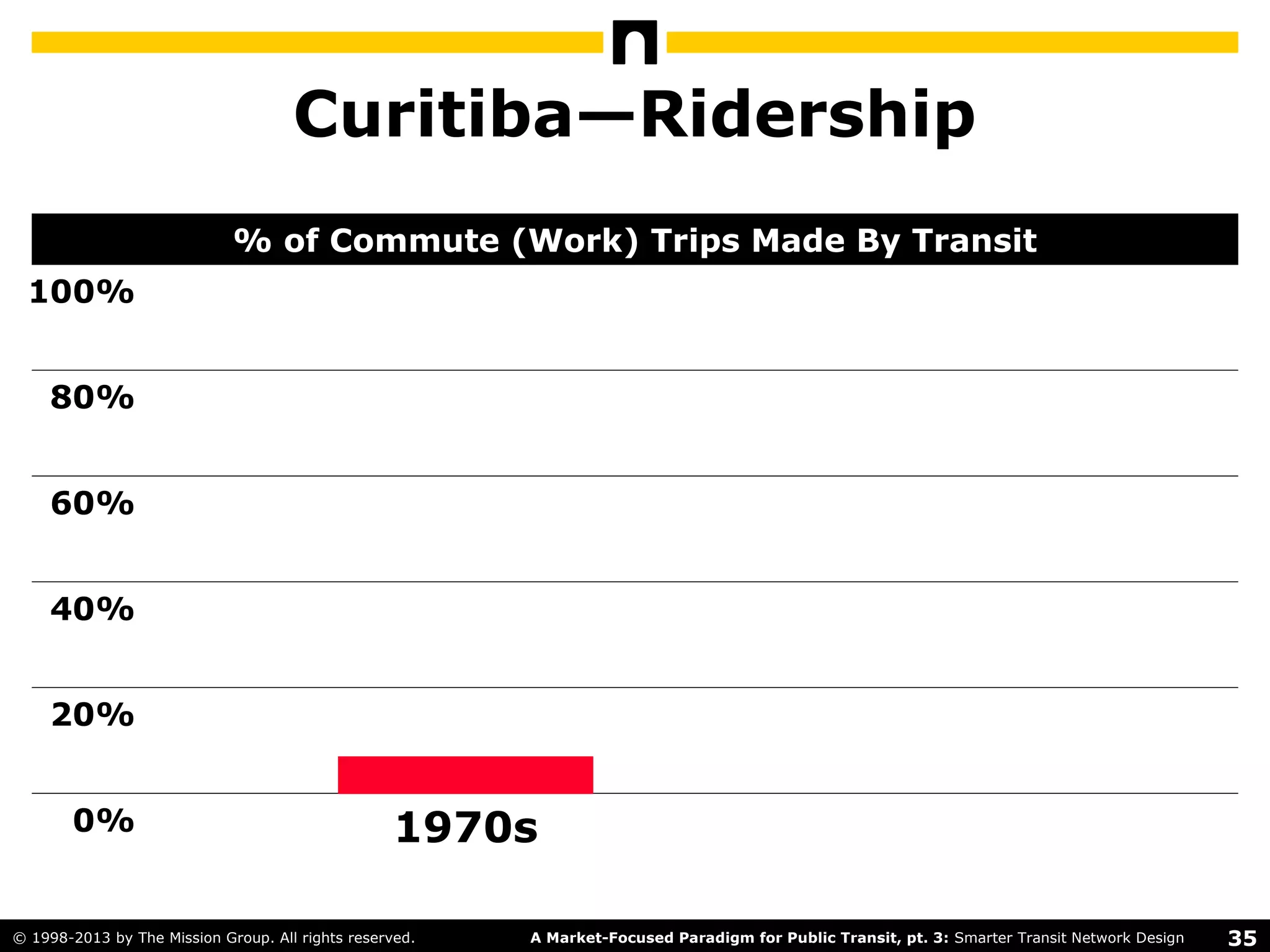
Curitiba—Ridership
100%
80%
60%
40%
20%
0% 1970s
% of Commute (Work) Trips Made By Transit
36A Market-Focused Paradigm for Public Transit, pt. 3: Smarter Transit Network Design© 1998-2013 by The Mission Group. All rights reserved.
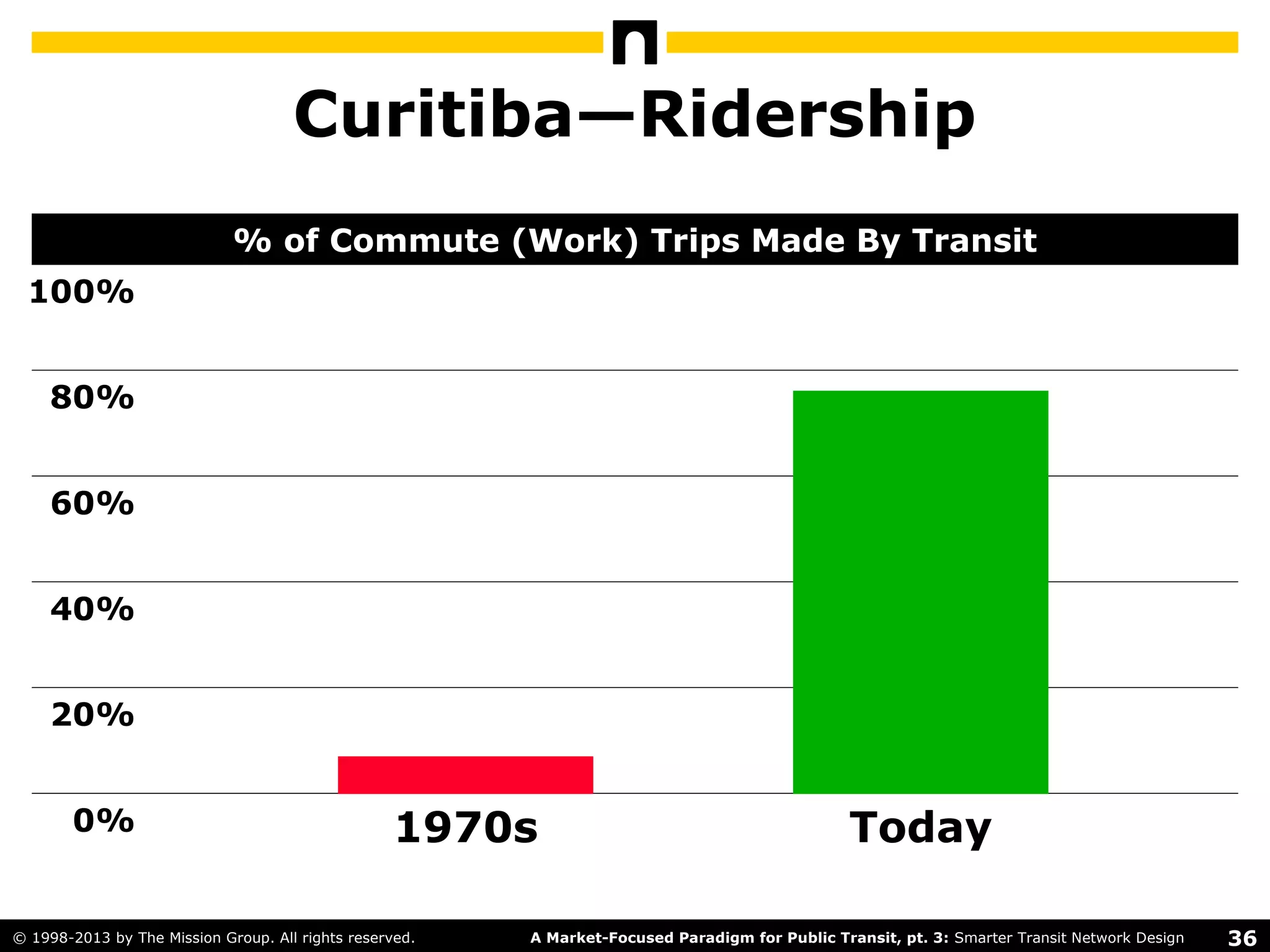
Curitiba—Ridership
100%
80%
60%
40%
20%
0% 1970s Today
% of Commute (Work) Trips Made By Transit
It’s not enough to connect places
at the scale of a regional or city map.
The station’s immediate pedestrian
environment can make a huge
difference in market response.
38A Market-Focused Paradigm for Public Transit, pt. 3: Smarter Transit Network Design© 1998-2013 by The Mission Group. All rights reserved.
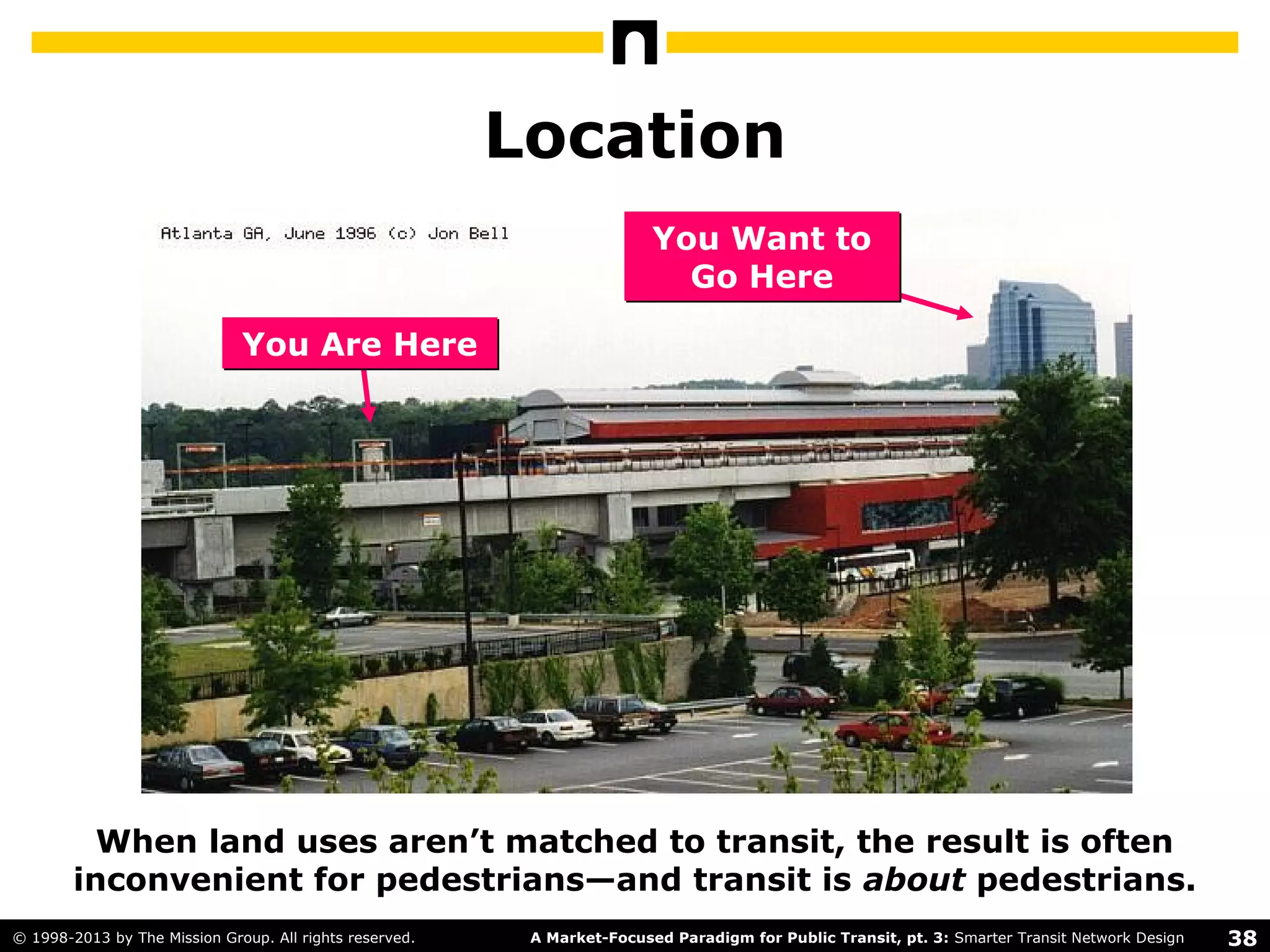
Location
You Are HereYou Are Here
You Want to
Go Here
You Want to
Go Here
When land uses aren’t matched to transit, the result is often
inconvenient for pedestrians—and transit is about pedestrians.
39A Market-Focused Paradigm for Public Transit, pt. 3: Smarter Transit Network Design© 1998-2013 by The Mission Group. All rights reserved.
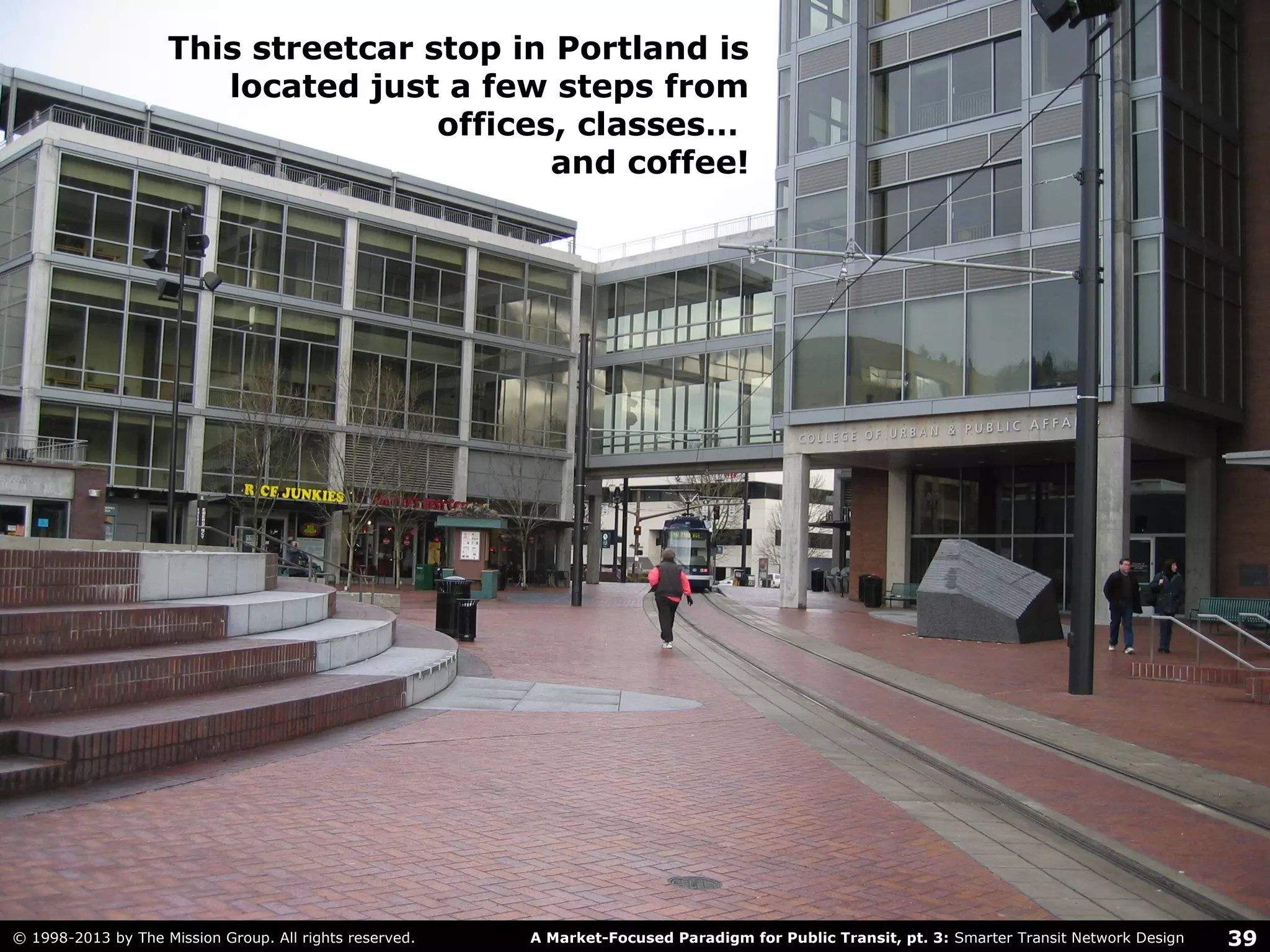
This streetcar stop in Portland is
located just a few steps from
offices, classes…
and coffee!
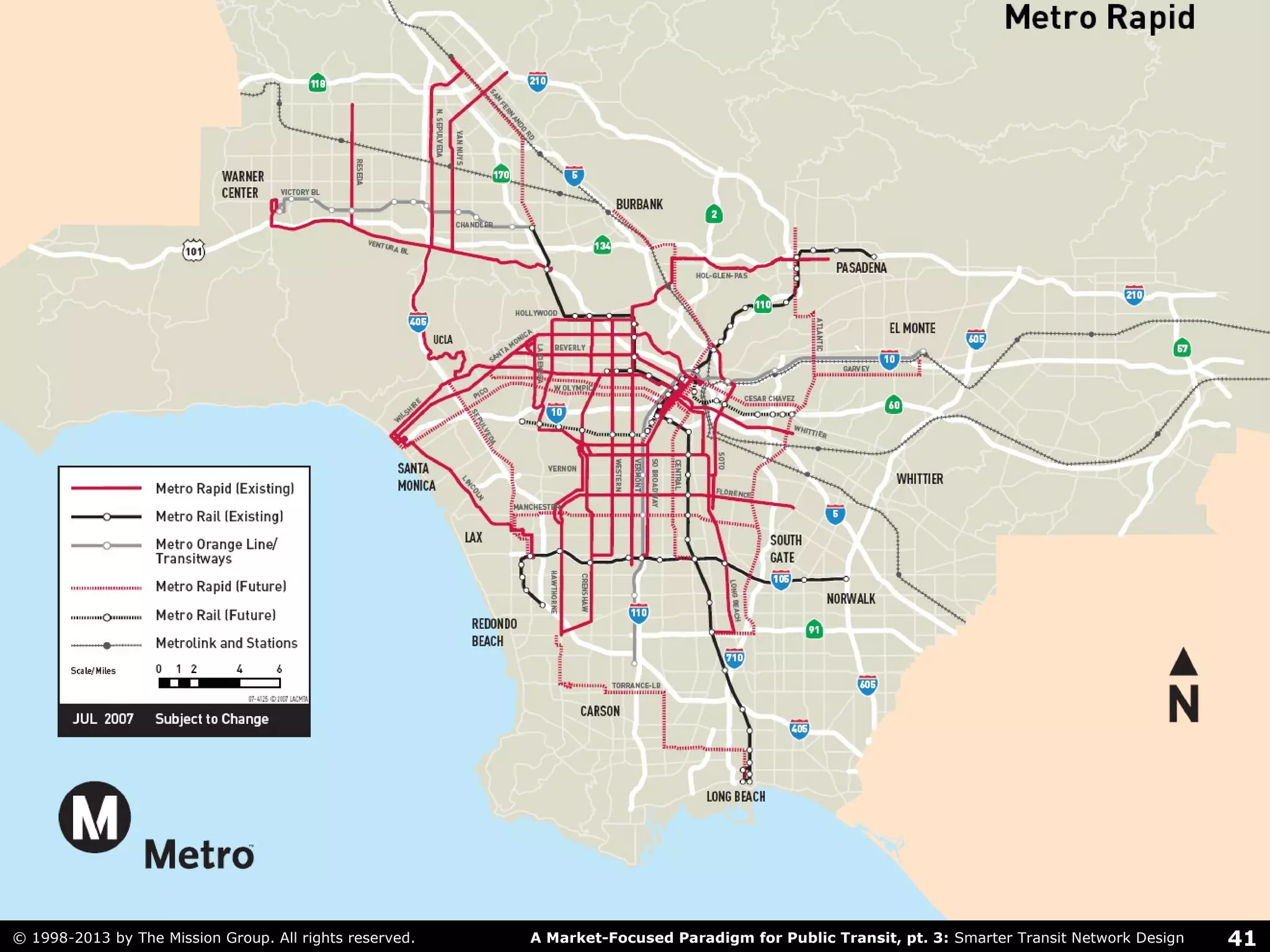
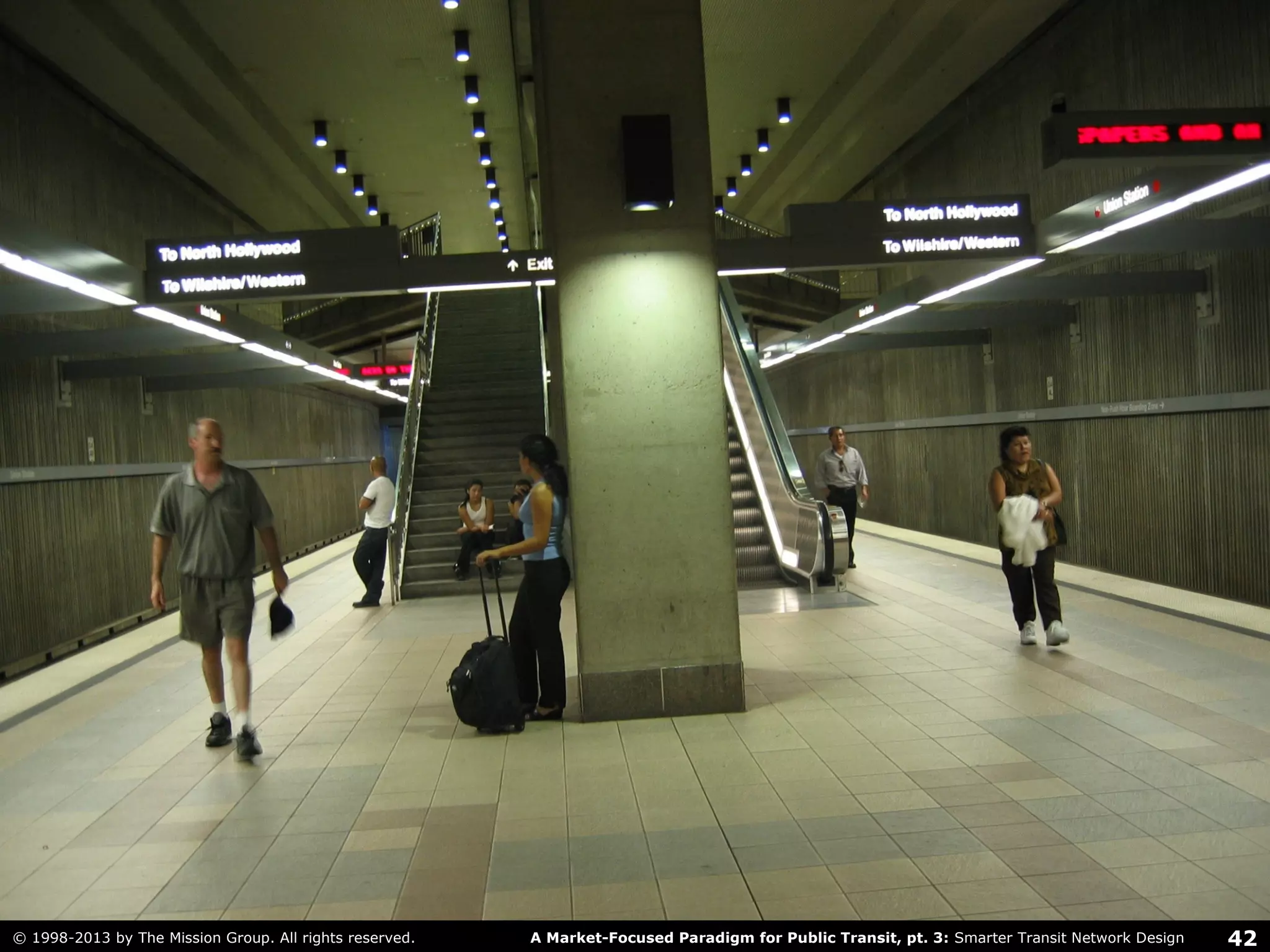
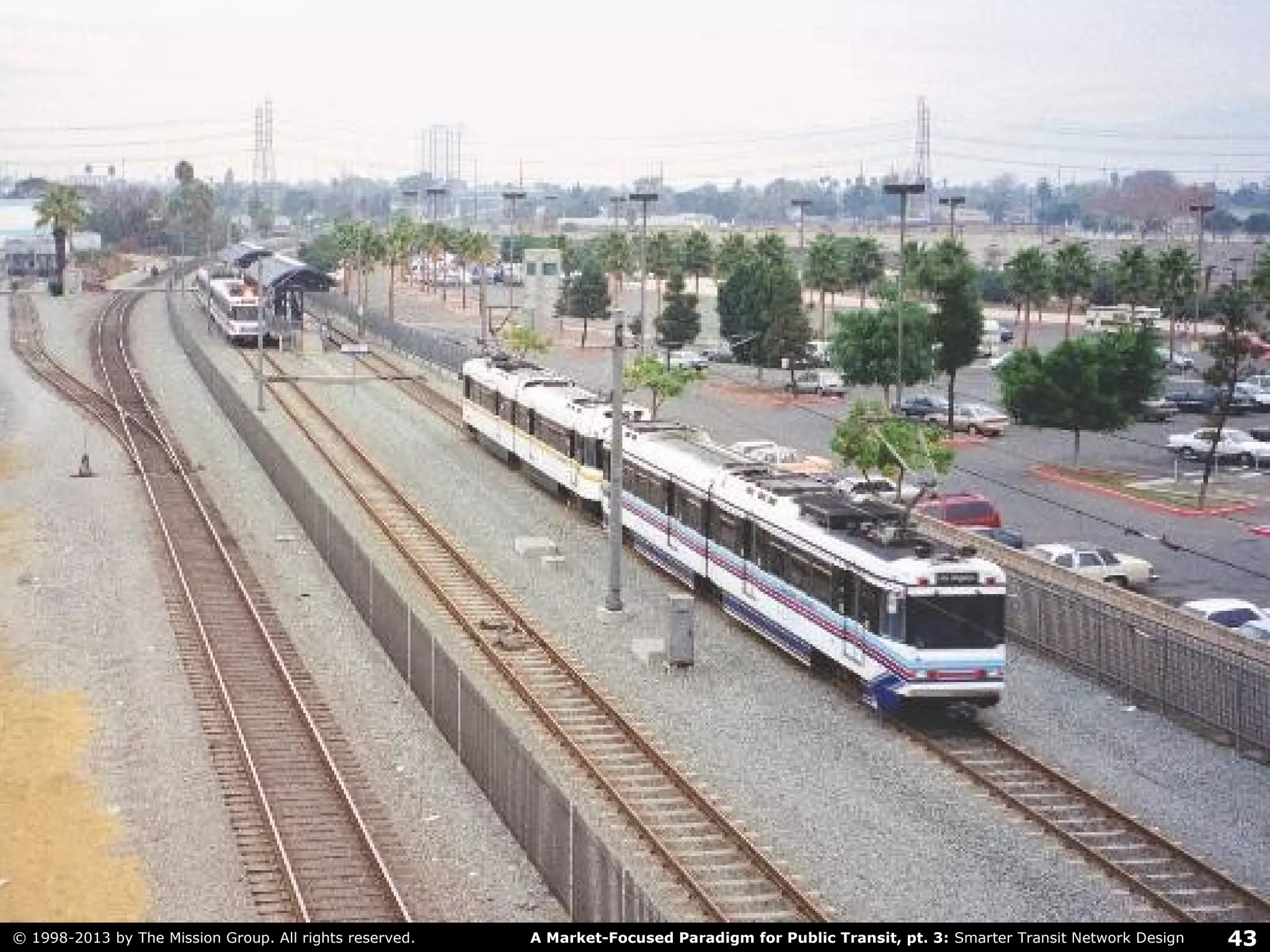
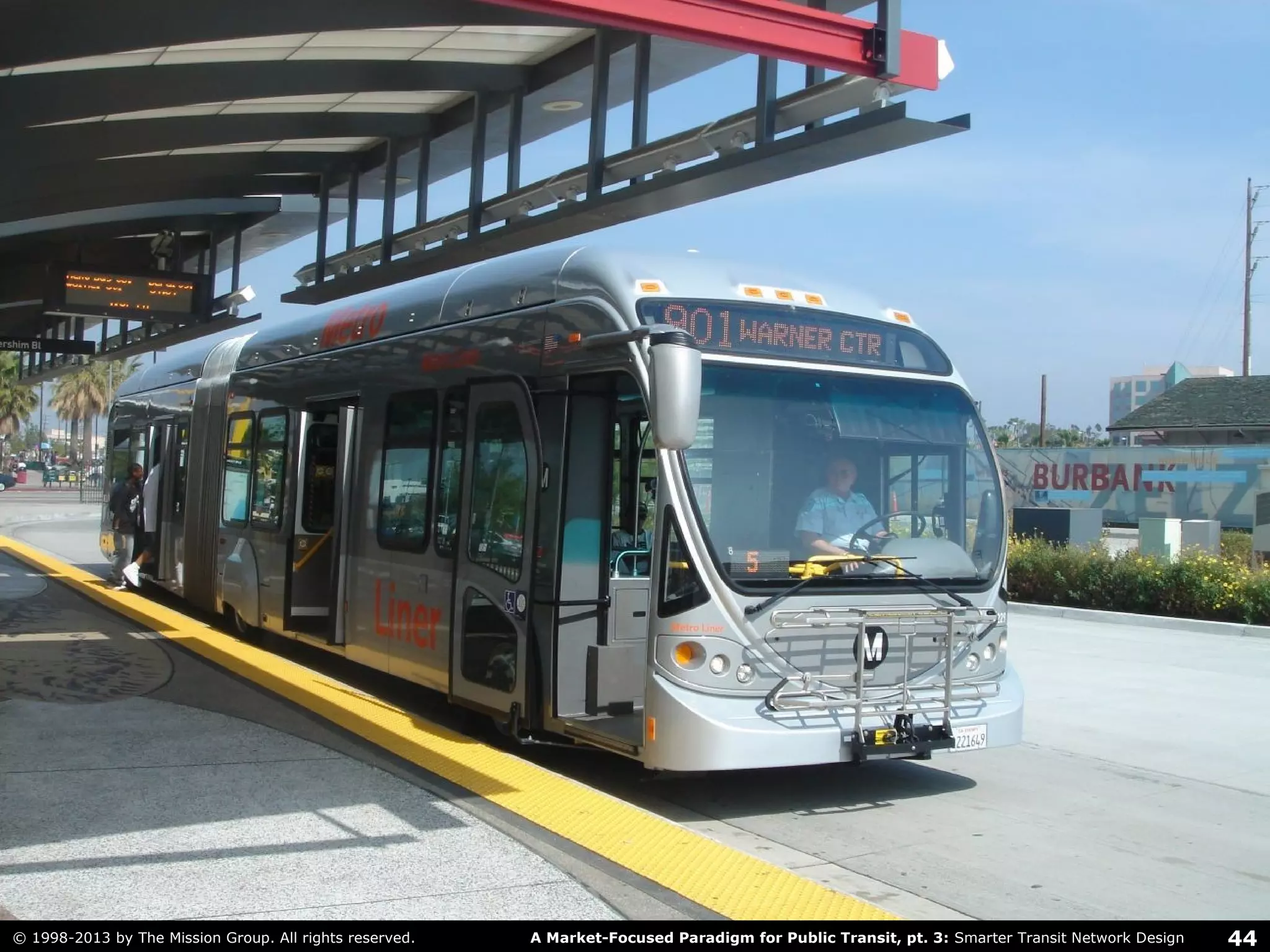
Let’s look at Los Angeles,
which can be considered
a theme park of transit modes.
41A Market-Focused Paradigm for Public Transit, pt. 3: Smarter Transit Network Design© 1998-2013 by The Mission Group. All rights reserved.
42A Market-Focused Paradigm for Public Transit, pt. 3: Smarter Transit Network Design© 1998-2013 by The Mission Group. All rights reserved.
43A Market-Focused Paradigm for Public Transit, pt. 3: Smarter Transit Network Design© 1998-2013 by The Mission Group. All rights reserved.
44A Market-Focused Paradigm for Public Transit, pt. 3: Smarter Transit Network Design© 1998-2013 by The Mission Group. All rights reserved.
45A Market-Focused Paradigm for Public Transit, pt. 3: Smarter Transit Network Design© 1998-2013 by The Mission Group. All rights reserved.
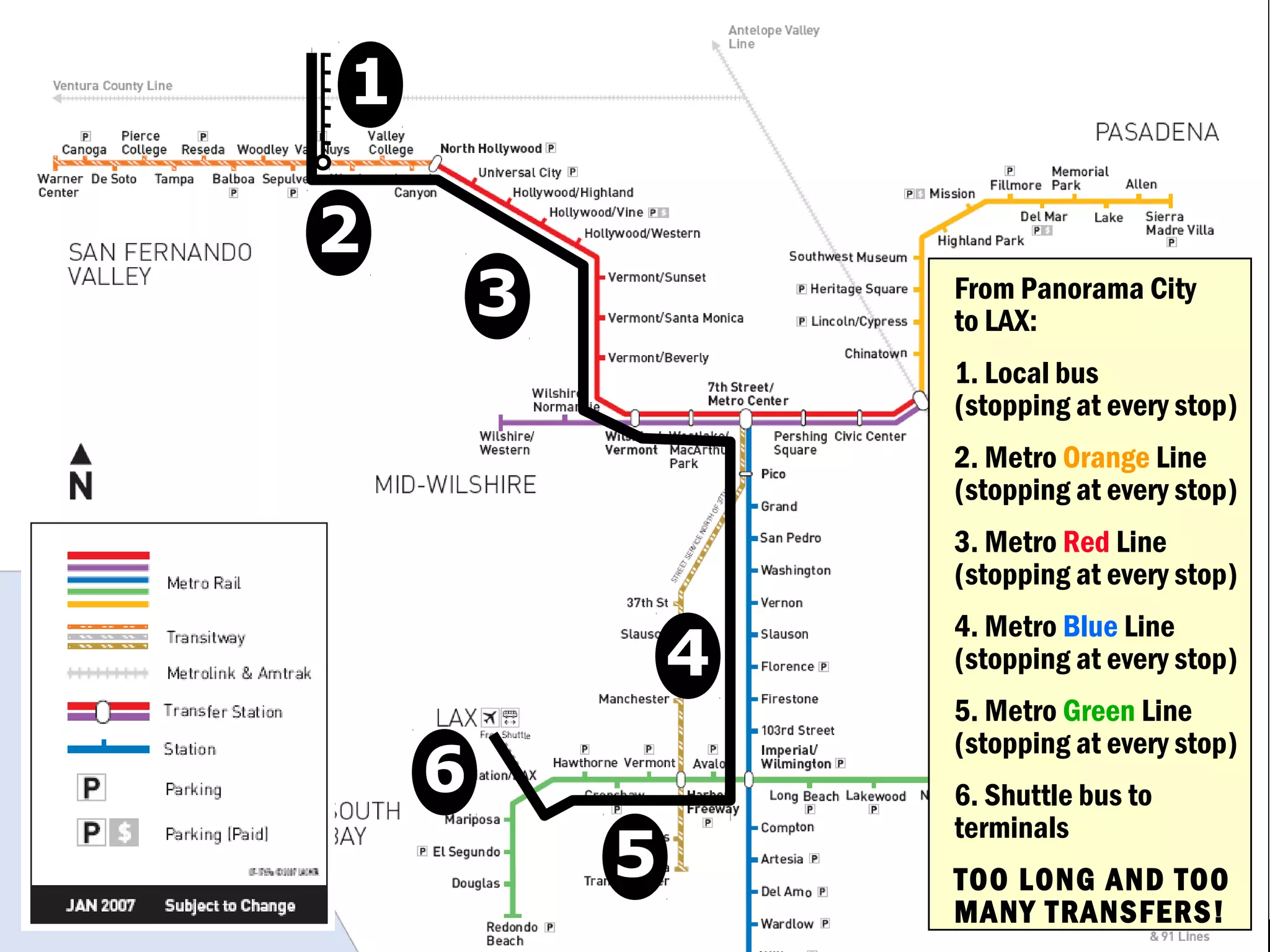
From Panorama City
to LAX:
1. Local bus
(stopping at every stop)
1
46A Market-Focused Paradigm for Public Transit, pt. 3: Smarter Transit Network Design© 1998-2013 by The Mission Group. All rights reserved.
From Panorama City
to LAX:
1. Local bus
(stopping at every stop)
2. Metro Orange Line
(stopping at every stop)
1
2
47A Market-Focused Paradigm for Public Transit, pt. 3: Smarter Transit Network Design© 1998-2013 by The Mission Group. All rights reserved.
From Panorama City
to LAX:
1. Local bus
(stopping at every stop)
2. Metro Orange Line
(stopping at every stop)
3. Metro Red Line
(stopping at every stop)
1
2
3
48A Market-Focused Paradigm for Public Transit, pt. 3: Smarter Transit Network Design© 1998-2013 by The Mission Group. All rights reserved.
From Panorama City
to LAX:
1. Local bus
(stopping at every stop)
2. Metro Orange Line
(stopping at every stop)
3. Metro Red Line
(stopping at every stop)
4. Metro Blue Line
(stopping at every stop)
1
2
4
3
49A Market-Focused Paradigm for Public Transit, pt. 3: Smarter Transit Network Design© 1998-2013 by The Mission Group. All rights reserved.
From Panorama City
to LAX:
1. Local bus
(stopping at every stop)
2. Metro Orange Line
(stopping at every stop)
3. Metro Red Line
(stopping at every stop)
4. Metro Blue Line
(stopping at every stop)
5. Metro Green Line
(stopping at every stop)
1
2
4
3
5
50A Market-Focused Paradigm for Public Transit, pt. 3: Smarter Transit Network Design© 1998-2013 by The Mission Group. All rights reserved.
From Panorama City
to LAX:
1. Local bus
(stopping at every stop)
2. Metro Orange Line
(stopping at every stop)
3. Metro Red Line
(stopping at every stop)
4. Metro Blue Line
(stopping at every stop)
5. Metro Green Line
(stopping at every stop)
6. Shuttle bus to
terminals
1
2
4
3
5
6
51A Market-Focused Paradigm for Public Transit, pt. 3: Smarter Transit Network Design© 1998-2013 by The Mission Group. All rights reserved.
From Panorama City
to LAX:
1. Local bus
(stopping at every stop)
2. Metro Orange Line
(stopping at every stop)
3. Metro Red Line
(stopping at every stop)
4. Metro Blue Line
(stopping at every stop)
5. Metro Green Line
(stopping at every stop)
6. Shuttle bus to
terminals
TOO LONG & TOO
MANY TRANSFERS!
1
2
4
3
5
6
Dispersed metropolitan areas
can’t be effectively served just
by traditional transit networks,
regardless of mode.
People need to leapfrog
about their region.
LA has created a lot of TOD
(“Transit-Oriented Development”)
around its transit stations.
How well has the transit system
served all these new residences?
Has this strategy worked?
54A Market-Focused Paradigm for Public Transit, pt. 3: Smarter Transit Network Design© 1998-2013 by The Mission Group. All rights reserved.
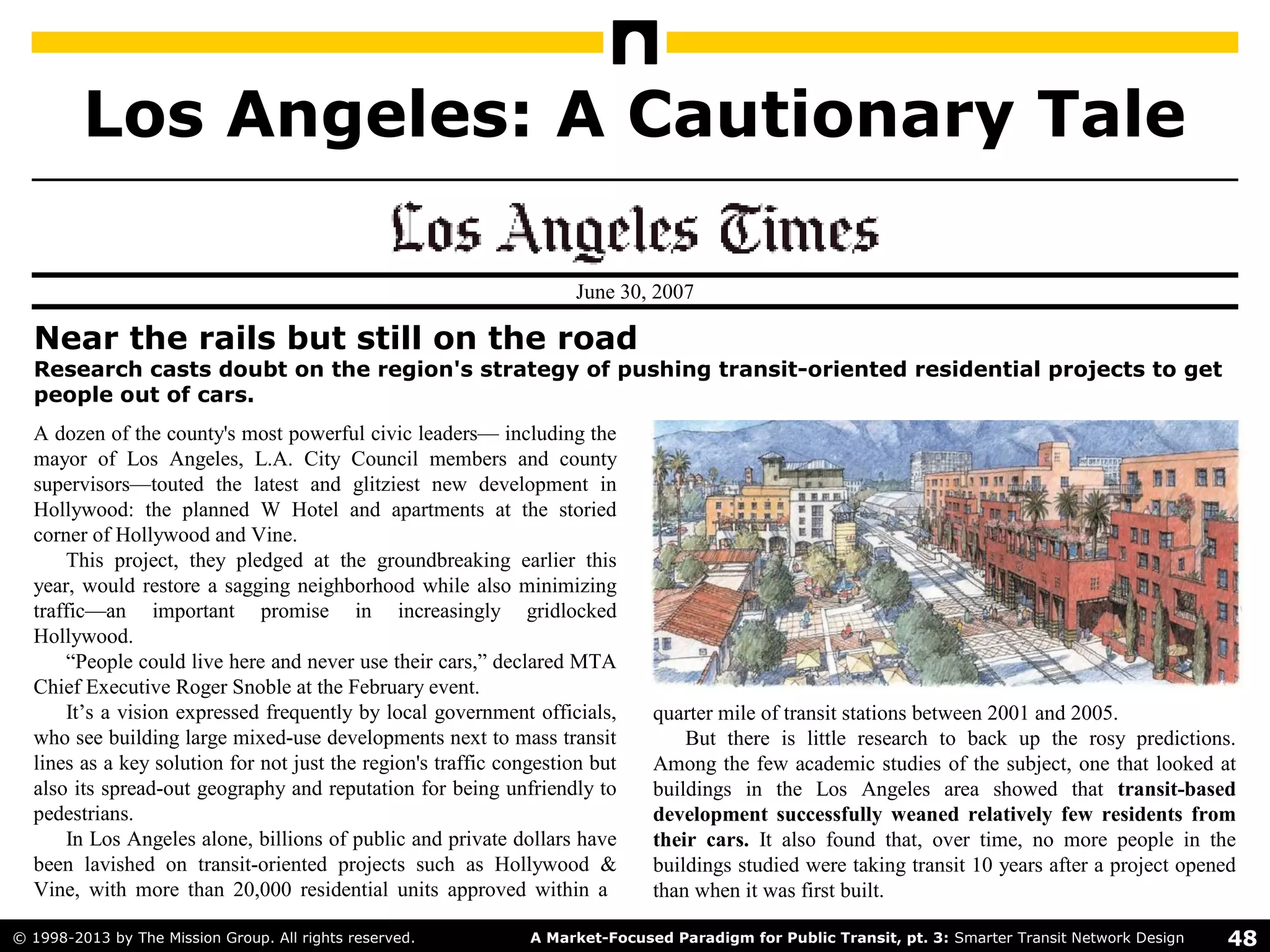
Los Angeles: A Cautionary Tale
A dozen of the county's most powerful civic leaders— including the
mayor of Los Angeles, L.A. City Council members and county
supervisors—touted the latest and glitziest new development in
Hollywood: the planned W Hotel and apartments at the storied
corner of Hollywood and Vine.
This project, they pledged at the groundbreaking earlier this
year, would restore a sagging neighborhood while also minimizing
traffic—an important promise in increasingly gridlocked
Hollywood.
“People could live here and never use their cars,” declared MTA
Chief Executive Roger Snoble at the February event.
It’s a vision expressed frequently by local government officials,
who see building large mixed-use developments next to mass transit
lines as a key solution for not just the region's traffic congestion but
also its spread-out geography and reputation for being unfriendly to
pedestrians.
In Los Angeles alone, billions of public and private dollars have
been lavished on transit-oriented projects such as Hollywood &
Vine, with more than 20,000 residential units approved within a
Near the rails but still on the road
Research casts doubt on the region's strategy of pushing transit-oriented residential projects to get
people out of cars.
quarter mile of transit stations between 2001 and 2005.
But there is little research to back up the rosy predictions.
Among the few academic studies of the subject, one that looked at
buildings in the Los Angeles area showed that transit-based
development successfully weaned relatively few residents from
their cars. It also found that, over time, no more people in the
buildings studied were taking transit 10 years after a project opened
than when it was first built.
June 30, 2007
There’s more to network
structure than the location of routes.
The location of stops and stations
matters, too. How far will people walk?
56A Market-Focused Paradigm for Public Transit, pt. 3: Smarter Transit Network Design© 1998-2013 by The Mission Group. All rights reserved.
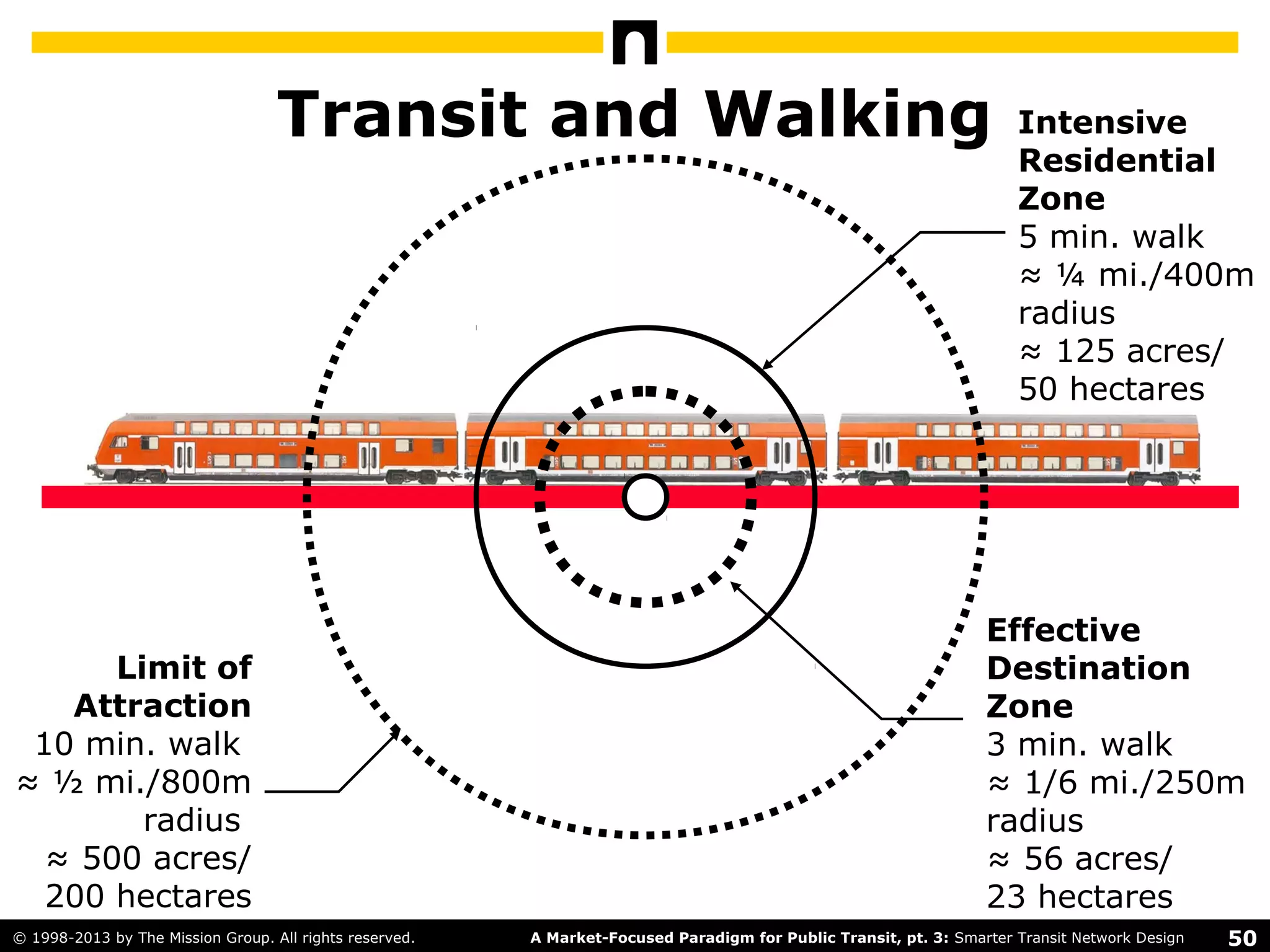
Transit and Walking
Effective
Destination
Zone
3 min. walk
≈ 1/6 mi./250m
radius
≈ 56 acres/
23 hectares
Intensive
Residential
Zone
5 min. walk
≈ ¼ mi./400m
radius
≈ 125 acres/
50 hectares
Limit of
Attraction
10 min. walk
≈ ½ mi./800m
radius
≈ 500 acres/
200 hectares
Walking environment matters, too.
It can make a short walk seem long,
and a long walk seem desirable.
The following are what The Mission
Group has identified as the five
levels of pedestrian orientation.
58A Market-Focused Paradigm for Public Transit, pt. 3: Smarter Transit Network Design© 1998-2013 by The Mission Group. All rights reserved.
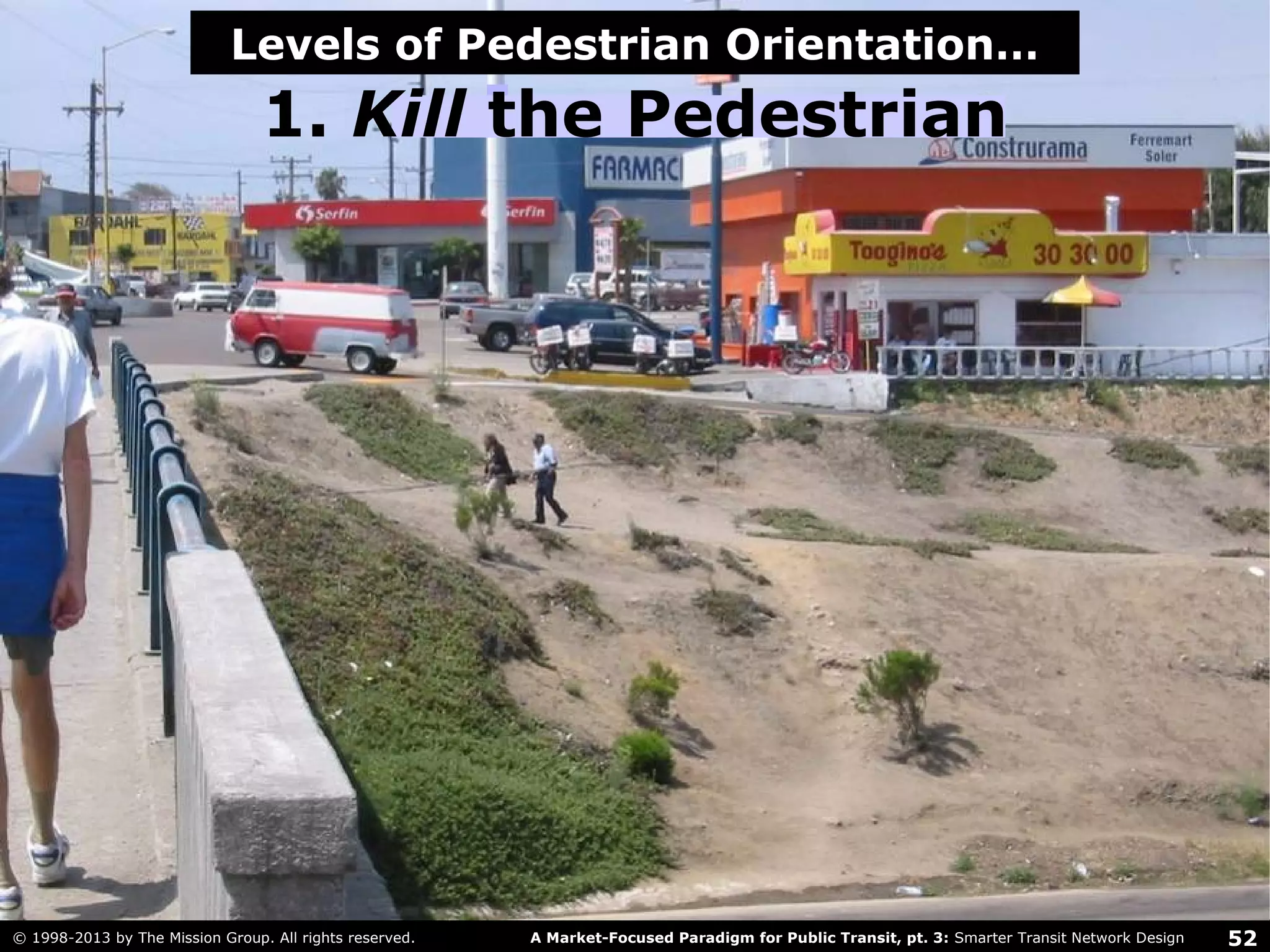
1. Kill the Pedestrian
Levels of Pedestrian Orientation…
59A Market-Focused Paradigm for Public Transit, pt. 3: Smarter Transit Network Design© 1998-2013 by The Mission Group. All rights reserved.
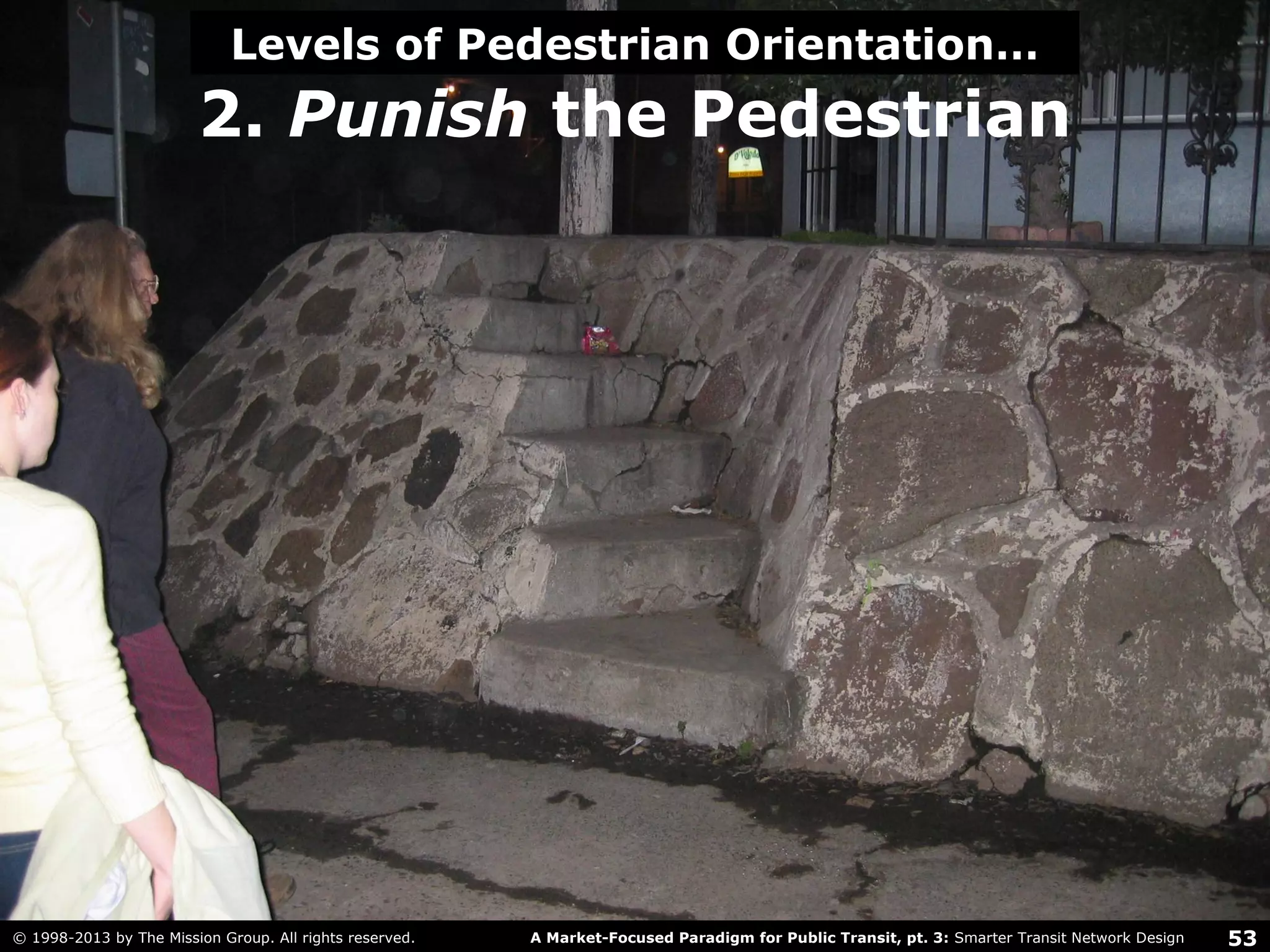
2. Punish the Pedestrian
Levels of Pedestrian Orientation…
60A Market-Focused Paradigm for Public Transit, pt. 3: Smarter Transit Network Design© 1998-2013 by The Mission Group. All rights reserved.
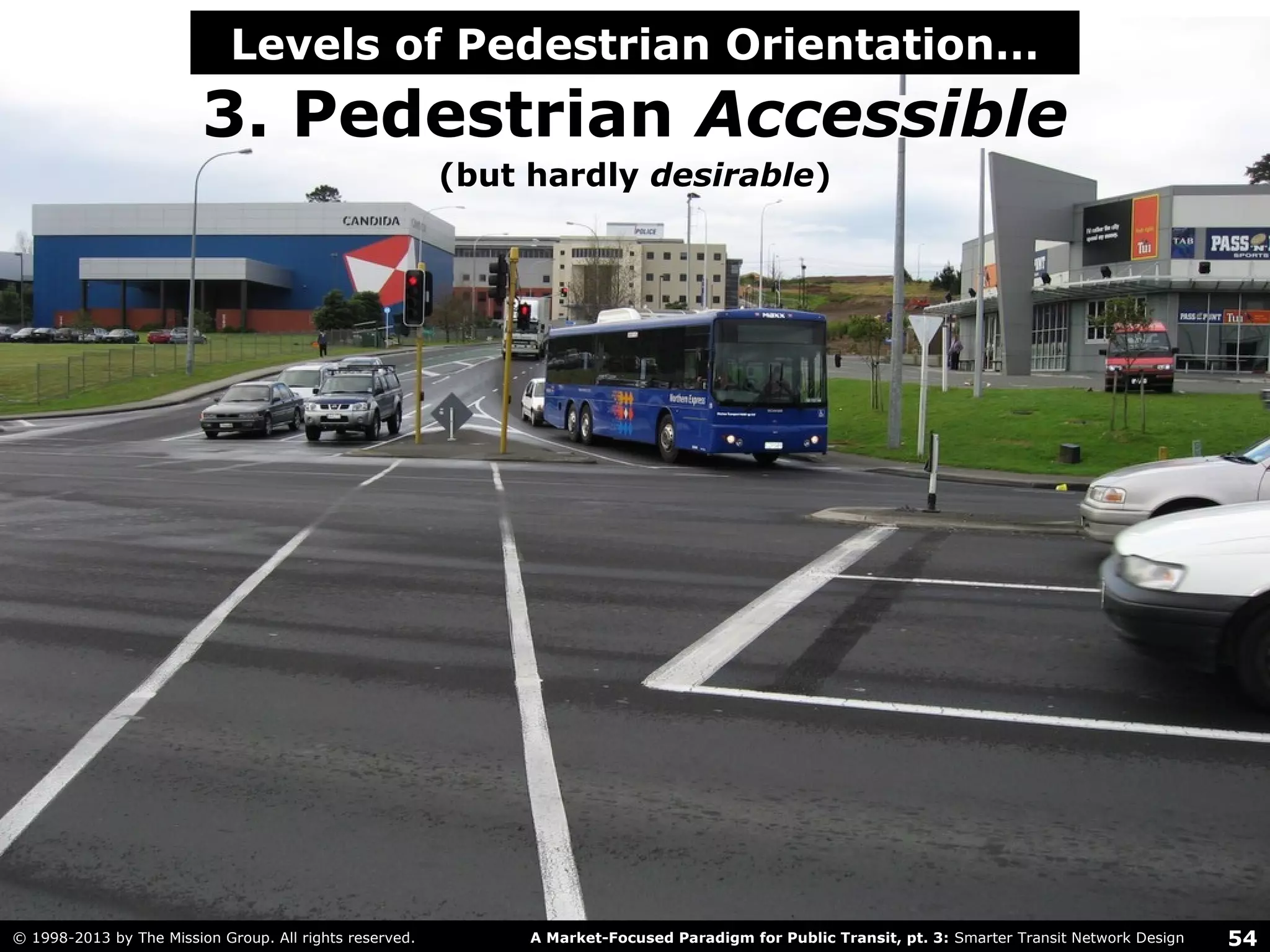
3. Pedestrian Accessible
Levels of Pedestrian Orientation…
(but hardly desirable)
61A Market-Focused Paradigm for Public Transit, pt. 3: Smarter Transit Network Design© 1998-2013 by The Mission Group. All rights reserved.
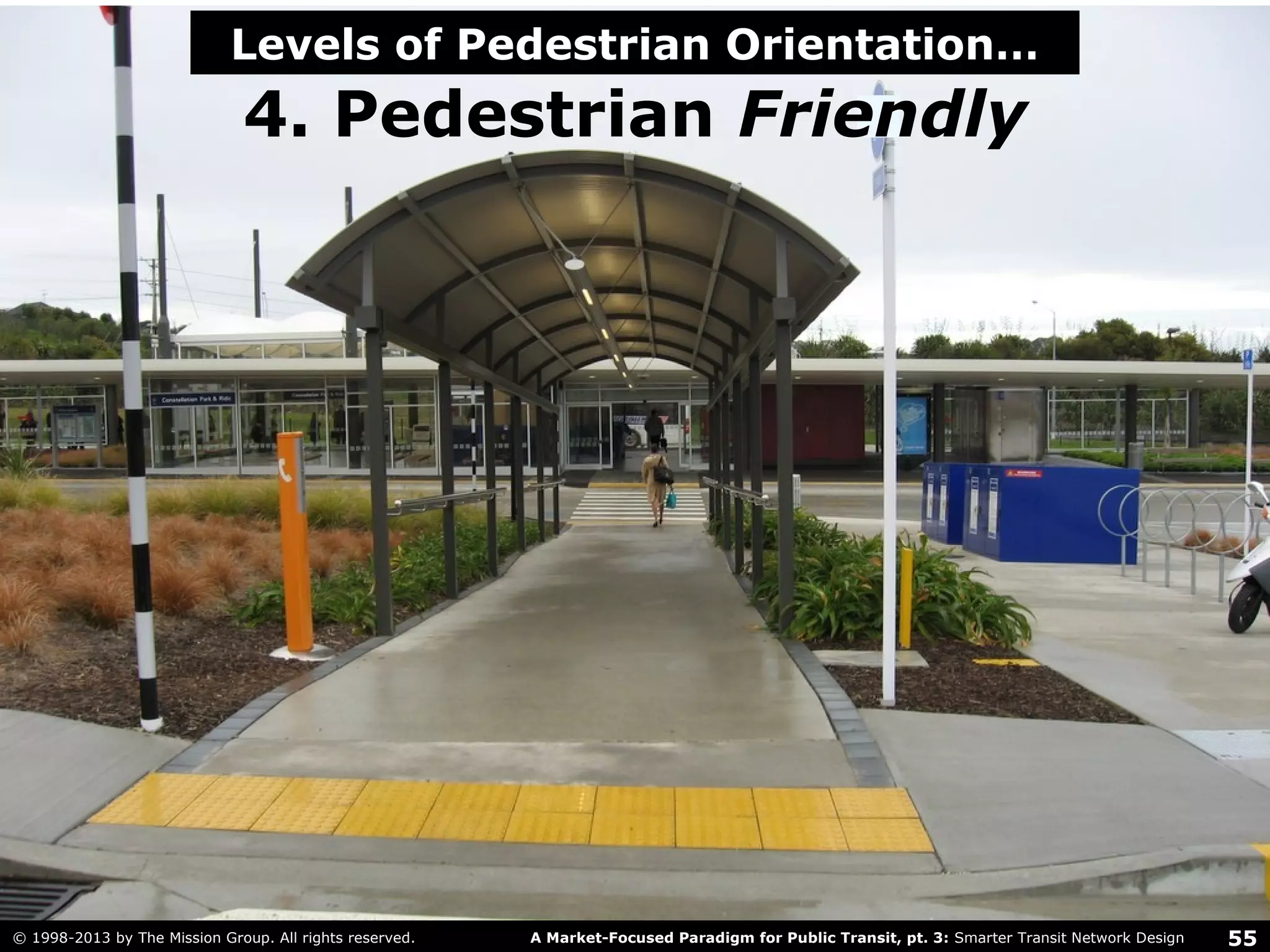
4. Pedestrian Friendly
Levels of Pedestrian Orientation…
62A Market-Focused Paradigm for Public Transit, pt. 3: Smarter Transit Network Design© 1998-2013 by The Mission Group. All rights reserved.
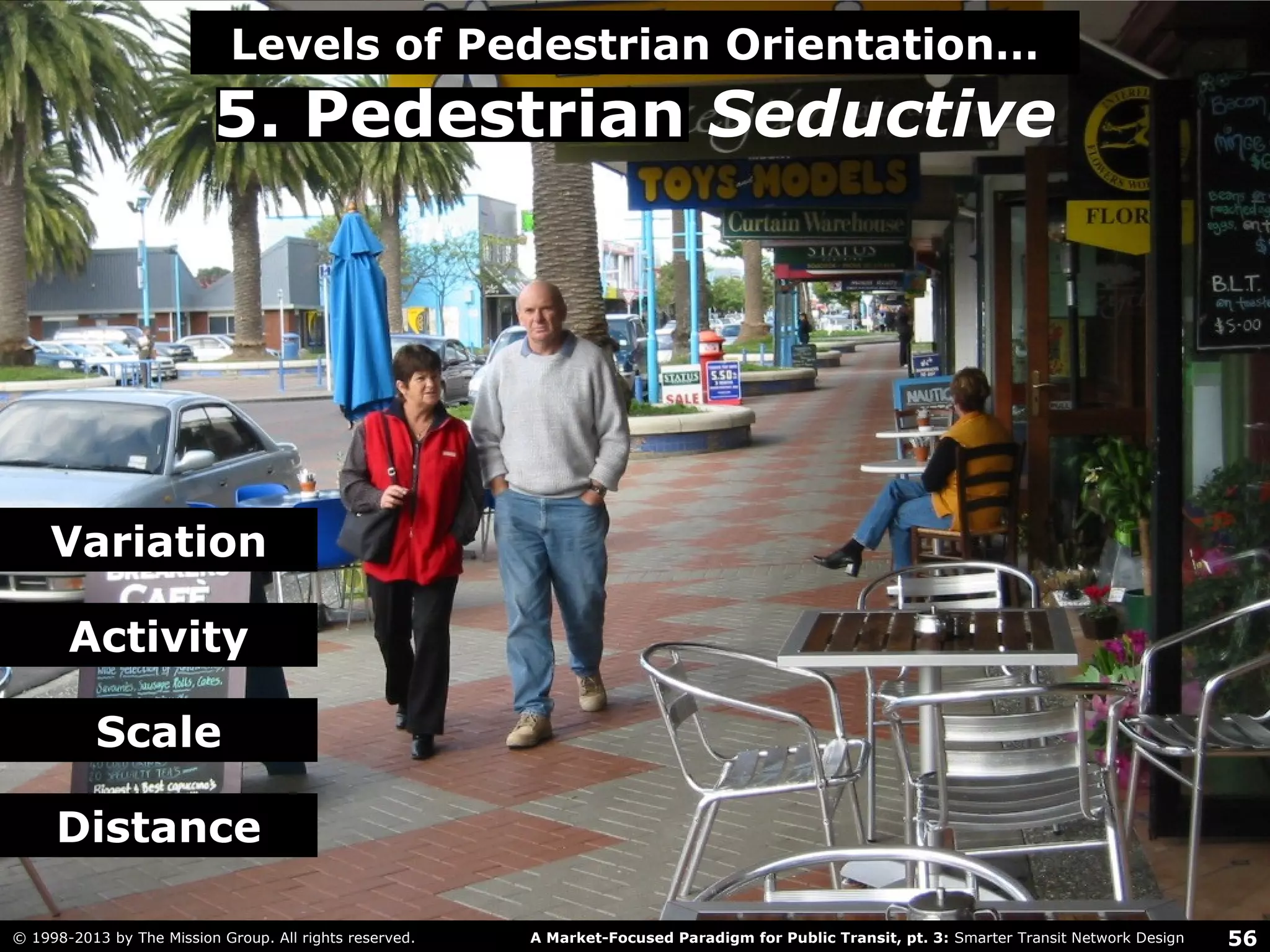
5. Pedestrian Seductive
Distance
Scale
Activity
Variation
Levels of Pedestrian Orientation…
In part 4 of this presentation,
we’ll look at System Performance—
how smart transit network design
can save people time. We’ll also
see some innovations in network
structure that go beyond
traditional network forms.
THE MISSION GROUP
3725 Talbot Street, Suite E • San Diego, California 92106 USA
+1 (619) 232-1776 • info@missionconsult.com
Transit
Network
Reviews
Transit
Planning
Support
Transit Market
& Ridership
Studies
Customer
Experience
Audits
Innovative
Alternatives
Generation
Long-Term
Vision Plans
& Strategies
“Quickway”
Network
Proposals
Presentations
and
White Papers
Workshops
and Seminars
We’re the transit market experts.

Smarter Transit Network Design - pt 3 of "A Market Focused Paradigm for Public Transit"

  • 1.
    1A Market-Focused Paradigmfor Public Transit, pt. 3: Smarter Transit Network Design© 1998-2013 by The Mission Group. All rights reserved. A Market-Focused Paradigm for Public Transit THE MISSION GROUP Part 3—Smarter Transit Network Design Alan Hoffman ▪ San Diego, California ▪ (619) 232-1776 ▪ info@missionconsult.com © 2013 by The Mission Group. All Rights Reserved. PART 3 1A Market-Focused Paradigm for Public Transit, pt. 1: A Smarter Transit Network© 1998-2013 by The Mission Group. All rights reserved. A Market-Focused Paradigm for Public Transit THE MISSION GROUP Part 3—Smarter Transit Network Design Alan Hoffman ▪ San Diego, California ▪ (619) 232-1776 ▪ info@missiongrouponline.com © 2013 by The Mission Group. All Rights Reserved. PART 3www.missionconsult.com
  • 2.
    2A Market-Focused Paradigmfor Public Transit, pt. 3: Smarter Transit Network Design© 1998-2013 by The Mission Group. All rights reserved. In part 2 of this presentation, we identified the three key strategic variables that drive modal choice: Here in part 3, we’ll focus on issues of network structure—how to configure more effective transit networks. Network Structure (Connectivity) System Performance (Time) Customer Experience
  • 3.
    3A Market-Focused Paradigmfor Public Transit, pt. 3: Smarter Transit Network Design© 1998-2013 by The Mission Group. All rights reserved. Connectivity: The Double Challenge Connect as many places that matter in as few years as possible Shape regional growth and solve regional problems GOAL:
  • 4.
    4A Market-Focused Paradigmfor Public Transit, pt. 3: Smarter Transit Network Design© 1998-2013 by The Mission Group. All rights reserved. Connectivity: The Double Challenge Connect as many places that matter in as few years as possible Place access where it needs to be, not “near” where it needs to be Shape regional growth and solve regional problems The system really becomes useful and convenient GOAL: GOAL:
  • 5.
    Some cities pourtheir resources into creating a major investment in a single transit corridor, be it light rail or busway.
  • 6.
    6A Market-Focused Paradigmfor Public Transit, pt. 3: Smarter Transit Network Design© 1998-2013 by The Mission Group. All rights reserved. Transit & Land Use: Weak Strategy The city above has numerous activity nodes scattered about; it can’t be served effectively by single lines, however they squiggle about. For most trips, transit is not relevant or convenient.
  • 7.
    7A Market-Focused Paradigmfor Public Transit, pt. 3: Smarter Transit Network Design© 1998-2013 by The Mission Group. All rights reserved. Transit & Land Use: Weak Strategy Even with the addition of a new line, the transit network does not provide excellent connectivity between and among various key nodes in this region.
  • 8.
    8A Market-Focused Paradigmfor Public Transit, pt. 3: Smarter Transit Network Design© 1998-2013 by The Mission Group. All rights reserved. Transit & Land Use: Weak Strategy Most regions build at least one “political line,” connecting little with little.
  • 9.
    9A Market-Focused Paradigmfor Public Transit, pt. 3: Smarter Transit Network Design© 1998-2013 by The Mission Group. All rights reserved. Transit & Land Use: Weak Strategy If transit systems are unable to provide superior connectivity among a core set of points, they are unlikely to shape the future growth of that region.
  • 10.
    10A Market-Focused Paradigmfor Public Transit, pt. 3: Smarter Transit Network Design© 1998-2013 by The Mission Group. All rights reserved. Transit & Land Use: Weak Strategy This region is growing, but around the automobile, even though developers claim they are doing “smart growth” infill and the transit agency takes credit for anything built near a line.
  • 11.
    11A Market-Focused Paradigmfor Public Transit, pt. 3: Smarter Transit Network Design© 1998-2013 by The Mission Group. All rights reserved. Transit & Land Use: Weak Strategy More people can use transit now that the region has grown, but it should be obvious that transit is not the core movement system, not is it convenient or useful for most people most of the time.
  • 12.
    Other cities figureout how to connect their principal nodes together as directly and conveniently as possible, even if they use rickshaws.
  • 13.
    13A Market-Focused Paradigmfor Public Transit, pt. 3: Smarter Transit Network Design© 1998-2013 by The Mission Group. All rights reserved. Transit & Land Use: Strong Strategy This city is focused on linking its principal nodes together directly.
  • 14.
    14A Market-Focused Paradigmfor Public Transit, pt. 3: Smarter Transit Network Design© 1998-2013 by The Mission Group. All rights reserved. Transit & Land Use: Strong Strategy As this city continues to develop its transit connections, more and more of its key nodes are now linked together.
  • 15.
    15A Market-Focused Paradigmfor Public Transit, pt. 3: Smarter Transit Network Design© 1998-2013 by The Mission Group. All rights reserved. Transit & Land Use: Strong Strategy As this city continues to develop its transit connections, more and more of its key nodes are now linked together.
  • 16.
    16A Market-Focused Paradigmfor Public Transit, pt. 3: Smarter Transit Network Design© 1998-2013 by The Mission Group. All rights reserved. Transit & Land Use: Strong Strategy This is a useful transit network. People will want to be located near a node of this network. Developers smell blood.
  • 17.
    17A Market-Focused Paradigmfor Public Transit, pt. 3: Smarter Transit Network Design© 1998-2013 by The Mission Group. All rights reserved. Transit & Land Use: Strong Strategy Cities that develop strategies to connect their component parts as quickly as possible create truly useful transit systems— and markets tend to respond to such usefulness.
  • 18.
    18A Market-Focused Paradigmfor Public Transit, pt. 3: Smarter Transit Network Design© 1998-2013 by The Mission Group. All rights reserved. Transit & Land Use: Strong Strategy Cities that develop strategies to connect their component parts as quickly as possible create truly useful transit systems— and markets tend to respond to such usefulness.
  • 19.
    19A Market-Focused Paradigmfor Public Transit, pt. 3: Smarter Transit Network Design© 1998-2013 by The Mission Group. All rights reserved. Transit & Land Use: Strong Strategy Useful transit networks are more likely to generate market demand for businesses and residents around transit stations. This is a far cry from the high levels of subsidy of many so-called “Transit-Oriented Development” (TOD) projects.
  • 20.
    Some cities havebeen very innovative in their approach to creating a pervasive transit network. Curitiba, Brazil, practically invented modern Bus Rapid Transit (BRT) as a result of their desire to implement their ideal transit network in as few years as possible.
  • 21.
    21A Market-Focused Paradigmfor Public Transit, pt. 3: Smarter Transit Network Design© 1998-2013 by The Mission Group. All rights reserved. Curitiba, Brazil
  • 22.
    22A Market-Focused Paradigmfor Public Transit, pt. 3: Smarter Transit Network Design© 1998-2013 by The Mission Group. All rights reserved. Curitiba: Desire vs. Reality Cover the entire city with a subway system Goal: Could only afford single LRT line Design “surface subway” system using buses to get network up and running Goal: Problem: Solution:
  • 23.
    23A Market-Focused Paradigmfor Public Transit, pt. 3: Smarter Transit Network Design© 1998-2013 by The Mission Group. All rights reserved. Curitiba: Transit/Land Use One-way road heading into center One-way road heading away . from center . Transit in center boulevard with high density built alongside.
  • 24.
    24A Market-Focused Paradigmfor Public Transit, pt. 3: Smarter Transit Network Design© 1998-2013 by The Mission Group. All rights reserved. Curitiba: Transit/Land Use High-Density Transit Spine Low-Density Family Neighborhoods Curitiba’s “Structural Axis” corridors were made up of targeted transit and road investments; the combination of the two is what made “transit-oriented development” feasible.
  • 25.
    25A Market-Focused Paradigmfor Public Transit, pt. 3: Smarter Transit Network Design© 1998-2013 by The Mission Group. All rights reserved. Curitiba: Buses and Roads Make buses run faster. Buses always get stuck in traffic. Create bus-only “roads within roads,” with traffic signal priority, both reducing running time and making the system more reliable. Goal: Problem: Solution:
  • 26.
    26A Market-Focused Paradigmfor Public Transit, pt. 3: Smarter Transit Network Design© 1998-2013 by The Mission Group. All rights reserved. Curitiba: Make Buses Like Metro Goal: Problem: Solution: Make buses run like subways. Buses take so long to load. Use mass-produced “tube stations” with platform-level loading, multiple doors along vehicles, and payment at station entrance, reducing “dwell time” to 10-20 seconds per stop.
  • 27.
    27A Market-Focused Paradigmfor Public Transit, pt. 3: Smarter Transit Network Design© 1998-2013 by The Mission Group. All rights reserved.
  • 28.
    28A Market-Focused Paradigmfor Public Transit, pt. 3: Smarter Transit Network Design© 1998-2013 by The Mission Group. All rights reserved.
  • 29.
    29A Market-Focused Paradigmfor Public Transit, pt. 3: Smarter Transit Network Design© 1998-2013 by The Mission Group. All rights reserved. Curitiba—Speedy Network Reduce transit trip times. Longer trips involve many stops. Create an overlay network of “speedy” buses directly linking major transfer centers and demand generators, thereby cutting 30 minutes off average trip. Goal: Problem: Solution:
  • 30.
    30A Market-Focused Paradigmfor Public Transit, pt. 3: Smarter Transit Network Design© 1998-2013 by The Mission Group. All rights reserved. Curitiba—Speedy Network Reduce transit trip times. Longer trips involve many stops. Create an overlay network of “speedy” buses directly linking major transfer centers and demand generators, thereby cutting 30 minutes off average trip. Goal: Problem: Solution:
  • 31.
    31A Market-Focused Paradigmfor Public Transit, pt. 3: Smarter Transit Network Design© 1998-2013 by The Mission Group. All rights reserved.
  • 32.
    32A Market-Focused Paradigmfor Public Transit, pt. 3: Smarter Transit Network Design© 1998-2013 by The Mission Group. All rights reserved. Curitiba—”Integration Terminals” Facilitate transfer among transit services. Transfers are rarely desirable. Create a series of “integration terminals” that bring all services together, as well as the kind of retail shops that appeal to commuters. Goal: Problem: Solution:
  • 33.
    33A Market-Focused Paradigmfor Public Transit, pt. 3: Smarter Transit Network Design© 1998-2013 by The Mission Group. All rights reserved. Curitiba—”Citizenship Streets” Athletic Facilities Transit Center City Services
  • 34.
    34A Market-Focused Paradigmfor Public Transit, pt. 3: Smarter Transit Network Design© 1998-2013 by The Mission Group. All rights reserved. Curitiba—Implementation Problem: Solution: 89 94 97 74 79 84 Extend “rapid” transit services as quick as possible Goal: Need to keep capital costs low Bus-based system “colonizing” existing rights-of-way has led to extraordinarily rapid system expansion Problem: Solution: Goal:
  • 35.
    35A Market-Focused Paradigmfor Public Transit, pt. 3: Smarter Transit Network Design© 1998-2013 by The Mission Group. All rights reserved. Curitiba—Ridership 100% 80% 60% 40% 20% 0% 1970s % of Commute (Work) Trips Made By Transit
  • 36.
    36A Market-Focused Paradigmfor Public Transit, pt. 3: Smarter Transit Network Design© 1998-2013 by The Mission Group. All rights reserved. Curitiba—Ridership 100% 80% 60% 40% 20% 0% 1970s Today % of Commute (Work) Trips Made By Transit
  • 37.
    It’s not enoughto connect places at the scale of a regional or city map. The station’s immediate pedestrian environment can make a huge difference in market response.
  • 38.
    38A Market-Focused Paradigmfor Public Transit, pt. 3: Smarter Transit Network Design© 1998-2013 by The Mission Group. All rights reserved. Location You Are HereYou Are Here You Want to Go Here You Want to Go Here When land uses aren’t matched to transit, the result is often inconvenient for pedestrians—and transit is about pedestrians.
  • 39.
    39A Market-Focused Paradigmfor Public Transit, pt. 3: Smarter Transit Network Design© 1998-2013 by The Mission Group. All rights reserved. This streetcar stop in Portland is located just a few steps from offices, classes… and coffee!
  • 40.
    Let’s look atLos Angeles, which can be considered a theme park of transit modes.
  • 41.
    41A Market-Focused Paradigmfor Public Transit, pt. 3: Smarter Transit Network Design© 1998-2013 by The Mission Group. All rights reserved.
  • 42.
    42A Market-Focused Paradigmfor Public Transit, pt. 3: Smarter Transit Network Design© 1998-2013 by The Mission Group. All rights reserved.
  • 43.
    43A Market-Focused Paradigmfor Public Transit, pt. 3: Smarter Transit Network Design© 1998-2013 by The Mission Group. All rights reserved.
  • 44.
    44A Market-Focused Paradigmfor Public Transit, pt. 3: Smarter Transit Network Design© 1998-2013 by The Mission Group. All rights reserved.
  • 45.
    45A Market-Focused Paradigmfor Public Transit, pt. 3: Smarter Transit Network Design© 1998-2013 by The Mission Group. All rights reserved. From Panorama City to LAX: 1. Local bus (stopping at every stop) 1
  • 46.
    46A Market-Focused Paradigmfor Public Transit, pt. 3: Smarter Transit Network Design© 1998-2013 by The Mission Group. All rights reserved. From Panorama City to LAX: 1. Local bus (stopping at every stop) 2. Metro Orange Line (stopping at every stop) 1 2
  • 47.
    47A Market-Focused Paradigmfor Public Transit, pt. 3: Smarter Transit Network Design© 1998-2013 by The Mission Group. All rights reserved. From Panorama City to LAX: 1. Local bus (stopping at every stop) 2. Metro Orange Line (stopping at every stop) 3. Metro Red Line (stopping at every stop) 1 2 3
  • 48.
    48A Market-Focused Paradigmfor Public Transit, pt. 3: Smarter Transit Network Design© 1998-2013 by The Mission Group. All rights reserved. From Panorama City to LAX: 1. Local bus (stopping at every stop) 2. Metro Orange Line (stopping at every stop) 3. Metro Red Line (stopping at every stop) 4. Metro Blue Line (stopping at every stop) 1 2 4 3
  • 49.
    49A Market-Focused Paradigmfor Public Transit, pt. 3: Smarter Transit Network Design© 1998-2013 by The Mission Group. All rights reserved. From Panorama City to LAX: 1. Local bus (stopping at every stop) 2. Metro Orange Line (stopping at every stop) 3. Metro Red Line (stopping at every stop) 4. Metro Blue Line (stopping at every stop) 5. Metro Green Line (stopping at every stop) 1 2 4 3 5
  • 50.
    50A Market-Focused Paradigmfor Public Transit, pt. 3: Smarter Transit Network Design© 1998-2013 by The Mission Group. All rights reserved. From Panorama City to LAX: 1. Local bus (stopping at every stop) 2. Metro Orange Line (stopping at every stop) 3. Metro Red Line (stopping at every stop) 4. Metro Blue Line (stopping at every stop) 5. Metro Green Line (stopping at every stop) 6. Shuttle bus to terminals 1 2 4 3 5 6
  • 51.
    51A Market-Focused Paradigmfor Public Transit, pt. 3: Smarter Transit Network Design© 1998-2013 by The Mission Group. All rights reserved. From Panorama City to LAX: 1. Local bus (stopping at every stop) 2. Metro Orange Line (stopping at every stop) 3. Metro Red Line (stopping at every stop) 4. Metro Blue Line (stopping at every stop) 5. Metro Green Line (stopping at every stop) 6. Shuttle bus to terminals TOO LONG & TOO MANY TRANSFERS! 1 2 4 3 5 6
  • 52.
    Dispersed metropolitan areas can’tbe effectively served just by traditional transit networks, regardless of mode. People need to leapfrog about their region.
  • 53.
    LA has createda lot of TOD (“Transit-Oriented Development”) around its transit stations. How well has the transit system served all these new residences? Has this strategy worked?
  • 54.
    54A Market-Focused Paradigmfor Public Transit, pt. 3: Smarter Transit Network Design© 1998-2013 by The Mission Group. All rights reserved. Los Angeles: A Cautionary Tale A dozen of the county's most powerful civic leaders— including the mayor of Los Angeles, L.A. City Council members and county supervisors—touted the latest and glitziest new development in Hollywood: the planned W Hotel and apartments at the storied corner of Hollywood and Vine. This project, they pledged at the groundbreaking earlier this year, would restore a sagging neighborhood while also minimizing traffic—an important promise in increasingly gridlocked Hollywood. “People could live here and never use their cars,” declared MTA Chief Executive Roger Snoble at the February event. It’s a vision expressed frequently by local government officials, who see building large mixed-use developments next to mass transit lines as a key solution for not just the region's traffic congestion but also its spread-out geography and reputation for being unfriendly to pedestrians. In Los Angeles alone, billions of public and private dollars have been lavished on transit-oriented projects such as Hollywood & Vine, with more than 20,000 residential units approved within a Near the rails but still on the road Research casts doubt on the region's strategy of pushing transit-oriented residential projects to get people out of cars. quarter mile of transit stations between 2001 and 2005. But there is little research to back up the rosy predictions. Among the few academic studies of the subject, one that looked at buildings in the Los Angeles area showed that transit-based development successfully weaned relatively few residents from their cars. It also found that, over time, no more people in the buildings studied were taking transit 10 years after a project opened than when it was first built. June 30, 2007
  • 55.
    There’s more tonetwork structure than the location of routes. The location of stops and stations matters, too. How far will people walk?
  • 56.
    56A Market-Focused Paradigmfor Public Transit, pt. 3: Smarter Transit Network Design© 1998-2013 by The Mission Group. All rights reserved. Transit and Walking Effective Destination Zone 3 min. walk ≈ 1/6 mi./250m radius ≈ 56 acres/ 23 hectares Intensive Residential Zone 5 min. walk ≈ ¼ mi./400m radius ≈ 125 acres/ 50 hectares Limit of Attraction 10 min. walk ≈ ½ mi./800m radius ≈ 500 acres/ 200 hectares
  • 57.
    Walking environment matters,too. It can make a short walk seem long, and a long walk seem desirable. The following are what The Mission Group has identified as the five levels of pedestrian orientation.
  • 58.
    58A Market-Focused Paradigmfor Public Transit, pt. 3: Smarter Transit Network Design© 1998-2013 by The Mission Group. All rights reserved. 1. Kill the Pedestrian Levels of Pedestrian Orientation…
  • 59.
    59A Market-Focused Paradigmfor Public Transit, pt. 3: Smarter Transit Network Design© 1998-2013 by The Mission Group. All rights reserved. 2. Punish the Pedestrian Levels of Pedestrian Orientation…
  • 60.
    60A Market-Focused Paradigmfor Public Transit, pt. 3: Smarter Transit Network Design© 1998-2013 by The Mission Group. All rights reserved. 3. Pedestrian Accessible Levels of Pedestrian Orientation… (but hardly desirable)
  • 61.
    61A Market-Focused Paradigmfor Public Transit, pt. 3: Smarter Transit Network Design© 1998-2013 by The Mission Group. All rights reserved. 4. Pedestrian Friendly Levels of Pedestrian Orientation…
  • 62.
    62A Market-Focused Paradigmfor Public Transit, pt. 3: Smarter Transit Network Design© 1998-2013 by The Mission Group. All rights reserved. 5. Pedestrian Seductive Distance Scale Activity Variation Levels of Pedestrian Orientation…
  • 63.
    In part 4of this presentation, we’ll look at System Performance— how smart transit network design can save people time. We’ll also see some innovations in network structure that go beyond traditional network forms.
  • 64.
    THE MISSION GROUP 3725Talbot Street, Suite E • San Diego, California 92106 USA +1 (619) 232-1776 • info@missionconsult.com Transit Network Reviews Transit Planning Support Transit Market & Ridership Studies Customer Experience Audits Innovative Alternatives Generation Long-Term Vision Plans & Strategies “Quickway” Network Proposals Presentations and White Papers Workshops and Seminars We’re the transit market experts.