1
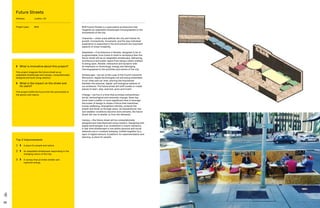
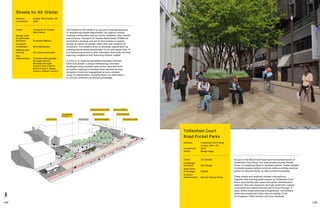
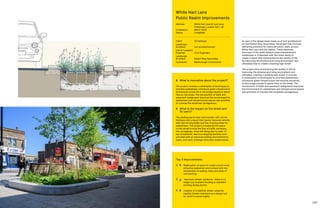
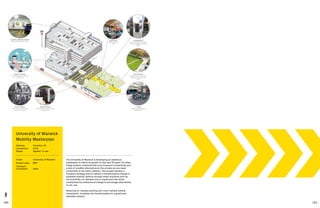
This NLA Research was published by New London Architecture
(NLA) in November 2019. It accompanies the NLA exhibition
and events programme Future Streets taking place from
November 2019, forming part of NLA’s year-round Transport
& Infrastructure programme.
NLA,
The Building Centre,
26 Store Street,
London, WC1E 7BT
nla.london
#NLAFutureStreets
#NLATransport
© New London Architecture (NLA)
ISBN 978-1-9993513-3-5
Programme Champions Programme Supporter
2 3
Contents
04	 	Foreword
06	 	 Definitions & Acronyms
10	 	Introduction
12	 	 The History of London’s Streets
18	 	 The Mobility Landscape
29	 	 Emerging Mobility Technologies
38	 	 Scenario Testing
58	 	Policy, Design and Practice:
Building towards an
Uncertain Future
64	 	 Project Showcase
152	 	Endnotes
153	 	Acknowledgements
154	 	 Profiles
4 5
We are moving quickly towards the next tectonic shift in the
movement infrastructure of London. In the 19th century we
ripped through the fabric of areas like Paddington, King’s
Cross and Waterloo to create the rail network; in the 20th
century we gave over our streets to the motor car; now, in the
21st we have big choices to make—do we use the various
technologies at our disposal to replicate the mistakes of the
past, or can we plan for and deliver a city where streets are for
people, are not life-threatening and provide mobility services
that are efficient and sustainable.
The CREATE study Urban Mobility: Preparing for the Future,
Learning from the Past, (see page 70) studied the experience
of five European capitals: Berlin, Copenhagen, London, Paris
and Vienna and how they are dealing with car use, congestion,
pollution and traffic dominance.
The report set out three phases of change - first, the car-
oriented city, then the sustainable-mobility city and thirdly,
the city of places. The drivers of these changes were seen to
be the oil crisis in the 1970s, followed by growing concerns
about CO2 emissions in the ‘90s. Then came the realisation
that our inactive lifestyle was one of the key reasons for rising
levels of obesity and related health issues. On top of that,
it became clear that if cities like London and Paris were to
remain competitive in a global economy, then quality of the
environment had to be high on the agenda.
London is making progress in delivering the third phase.
The Congestion Charge reduced car usage in central London
(although the space has since been filled up by private hire
vehicles and internet sales delivery vans). Approximately 25
per cent of road space in inner London has been reallocated
to walking, cycling and public transport over the last ten to
15 years. We are seeing major changes to the car-oriented
infrastructure of the 1970s with the central London gyratories
at Piccadilly/Pall Mall, Baker Street/Gloucester Place,
Tottenham Court Road/Gower Street and Aldgate being
removed. The new London Plan aims to substantially increase
the levels of active travel and to deliver healthy streets.
Yet while policies are clear, changes are hard-fought—
inspirational plans like the improvements to Bank Junction
were so contentious that the Chairman of the City Planning
and Transportation Committee required a 24 hour police
protection following threats from the black cab lobby; the
delivery of cycleways is hindered by car driving voters
concerned about minor delays to their journeys; freight
consolidation needs greater political backing if it is to reduce
the number of vehicles on the road. Meanwhile, the Government
fails to make up its mind on Crossrail 2. Such infrastructure
investment is key since the place-oriented city needs
high-frequency and high-quality public transport services on
main corridors while offering sufficient local diversity that
residents can walk or cycle to access daily needs.
There are substantial parts of the community who have not
yet fully bought into the idea of the place-based city. At the
end of this report, we set out the heaven and hell scenarios
for the future. Heaven is where burgeoning technologies and
ideas around mobility as a service help to deliver a city which
celebrates place and its social benefits. Hell is a city where we
end up repeating the mistakes of the 20th century, allowing
technology to determine outcomes for the future of streets in
London and we lose the current determination to make streets
that support a healthy, happy and equitable London.
There is much work to be done to communicate this shift
from a car-oriented city to a city of places. NLA provides a
vital forum where the discussion can involve all those with an
interest in shaping a better city—the politicians, the planners,
the development professionals and the people. This report
provides a basis for that debate and illustrates ideas that can
help deliver heaven rather than hell.
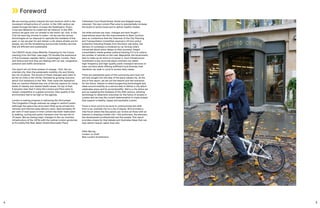
Foreword
Peter Murray
Curator-in-Chief
New London Architecture
6 7
Definitions
AUTONOMOUS VEHICLES
A vehicle that can drive and navigate
without human operation, also known
as driverless car or self-driving car.
BUS RAPID TRANSIT
A bus-based rapid transit system
featuring continuous dedicated lanes,
off bus ticketing and more subway like
stations. This is to improve reliability,
increase capacity and improve
passenger experience.
CAR SHARING
Sometimes referred to as ‘car clubs’,
car sharing is a model where people
can rent cars for short periods of time.
Unlike traditional car rental, cars are
often located at various locations
around the city and can be accessed
with a smart card or phone. Examples
include Zipcar and City Car Club.
CONNECTED AND
AUTONOMOUS VEHICLES
A vehicle that is both digitally connected
and autonomously driven.
CONNECTED VEHICLE
A vehicle that is equipped with the
ability to communicate data about
its characteristics, such as position
and speed, remotely via GPS or
an internet connection. This data
may be sent to the infrastructure,
other vehicles or the regulator.
DEMAND RESPONSIVE
TRANSIT
A form of public transport where
transit vehicles (often minibuses
or vans) alter their route based on
requests from passengers. Passengers
will often request the vehicle via
an app or telephone service.
DOCKLESS BIKESHARE
A bikeshare system that does not
require the use of a fixed docking
station, but instead allows bikes to
be picked up and parked anywhere.
Payment and unlocking is conducted
through an app. Examples in London
include Jump Bikes and Lime Bikes.
E-BIKE
A bicycle with an electric assist motor that
engages when the user pedals the bike.
E-SCOOTER
Electrically powered scooters, often
accessed through an app or online
platform such as Lime or Bird.
E-Scooters are currently illegal for usage
on public roads or footways in the UK.
ELECTRIC VEHICLE
A vehicle that is entirely propelled using
an electrical engine rather than an
internal combustion engine.
HEALTHY STREETS
A policy framework that seeks to
ensure streets are designed in ways
that promote positive health outcomes
for the city.
KERB MANAGEMENT
Policies, enforcement and design
strategies relating to methods of
regulating, managing or pricing the use
of the kerb for activities such as parking,
pickup/drop-off or loading goods.
LEVELS OF AUTONOMOUS
DRIVING
Level 0—complete human control of all
vehicle operations.
Level 1—the vehicle can assist either
steering or acceleration/deceleration,
for example with cruise control.
Level 2—the vehicle can assist with
both steering and acceleration/
deceleration. Examples include Tesla
Autopilot and Lane Assist.
Level 3—all driving can be
performed by the vehicle, but requires
constant driver supervision and
occasional takeover.
Level 4—all driving can be performed
by the vehicle without driver supervision
but only in controlled environments.
Level 5—all driving can be performed
by the vehicle in any environment or
condition without driver supervision.
MOBILITY AS A SERVICE
A term describing a move away from the
private ownership model of transportation
towards platforms that allow mobility to
be consumed as a service. It can take
the form of a single platform through
which users can book multiple different
modes, including bikeshare, ride hailing
and public transport.
MOBILITY DATA
SPECIFICATION
Requirements established for new
mobility services to share specific sets
of anonymised data about their service
with the public sector. For a dockless
bike share operator, this could include
data sets such as average usage of
bikes, the routes taken and parking
locations. This data can be used to
inform policy and regulatory decisions.
MOBILITY HUB
A transportation hub in which people
may interchange between different
modes of transportation including bike
share, ride hailing services and public
transport. Mobility Hubs may also be
integrated with other uses such as
community facilities or retail.
NEW AND FUTURE MOBILITY
New business models, technologies and
platforms within the transportation sector.
OPEN DATA
A policy that requires both public and
private transportation operators to
share various data sets regarding the
use and management of transportation
services. For example, Transport for
London’s open data policy allows for the
sharing of data on ridership and usage
of their services.
PERSONAL MOBILITY DEVICE /
MICRO MOBILITY
A term used to indicate transportation
devices that allow for personalised
mobility, as opposed to transport services
on a schedule or a fixed route. Often
used in reference to technologies such
as dockless bikeshare and e-scooters.
RIDE HAILING
Ride hailing services are app-based
platforms that allow customers to
connect to drivers using their personal
vehicles to offer taxi-style transportation.
Drivers are not technically employed by
the ride hailing company, but are
classified as self-employed drivers
accessing work via the platform.
Examples include Uber and Lyft.
RIDE POOLING
A synonym for ridesharing.
RIDESHARE
Often as a part of a ride hailing service,
users may decide to share their ride
with other users who are travelling
a similar route in order to receive a
reduced fare or other incentive.
SHARED MOBILITY
Concept indicating the move away from
the private ownership of mobility assets,
like cars, towards accessing transportation
through shared assets services such as
car share and bike share.
TRANSPORTATION NETWORK
COMPANY
A company that provides transportation
services, often using an app-based
platform to connect customers with
drivers whom use their own vehicle to
deliver the service.
ACRONYMS
AV
Autonomous Vehicle
CCAV
The Centre for Connected and
Autonomous Vehicles
CAV
Connected and Autonomous
Vehicles
DRT
Demand Responsive Transport
EV
Electric Vehicle
HS2
High-Speed Two
MTS
Mayor’s Transport Strategy
MaaS
Mobility as a Service
PMD
Personal Mobility Device
TfL
Transport for London
TNC
Transportation Network
Company
ULEZ
Ultra-Low Emission Zone
VED
Vehicle Excise Duty
VMT
Vehicle Miles Travelled
8 9
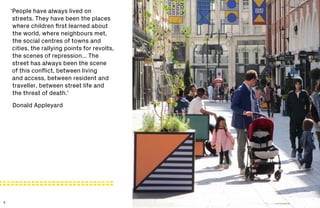
‘People have always lived on
streets. They have been the places
where children first learned about
the world, where neighbours met,
the social centres of towns and
cities, the rallying points for revolts,
the scenes of repression... The
street has always been the scene
of this conflict, between living
and access, between resident and
traveller, between street life and
the threat of death.’
Donald Appleyard
10 11
Throughout the history of city building, transportation
technologies have driven the urban form—the historical
dense urban core of most European cities emerged with a
pedestrian’s walkshed in mind, while the suburbanisation of
the 19th and 20th centuries was precipitated first by the tram
and rail network, and subsequently by the mass adoption of
the motorcar.
In the past, designers and planners have worked on the
assumption that ‘more mobility’ was always preferable, and
that new mobility technologies should be accommodated
with little regard as to the externalities they might bring. The
consequences of the mass motorisation of society are more
acute now than ever as we assess 60 years of car-centric
planning. It is clear that the environmental cost, the social
isolation, the crisis of inactivity and physical disconnection
motoritsation has brought does not correlate with the cities
we want to build and inhabit.
Today, as a new set of mobility technologies are emerging, it
is crucial to understand these new technologies as a means to
achieving human-centric principles, rather than allowing new
technology to be the determining factor in patterns of urban
development and questions of city design.
The primary space in which debates about the future of
our cities will take place is the humble street and as such,
the street should receive primary consideration from all
disciplines concerned with the built environment—from
architects and urban planners to technologists and
sociologists. We must not underestimate the power and
ability for streets to transform society both for the better,
and worse. Streets are, after all, the primary public spaces
in which ‘society happens’—streets are the places where
the state of a nation can be seen. They are one of the final
places where the rich must still meet the poor, and where
homelessness or addiction are laid bare. The place in which
great shows of political manifestation can take place, and
where the diversity of races, religions and ages may be seen
side by side. Streets tell us who we are as a society, they
tell us what we value and, ultimately, where we are going.
Given this central, yet often obscured role that streets play
in society, it is no exaggeration to say that ‘when we change
the street, we change the world’, to use the words of Janette
Sadik-Khan, Chair of the North American National Association
of Transportation Officials (NACTO).
Introduction Key Findings
1
Technology is not a goal in and of
itself. New mobility technologies
must be understood as ways to
enable broader societal goals such
as health, social cohesion, equity
and environmental sustainability.
2
Designers and policy makers must be
proactive in shaping and determining
how to implement new technologies.
Mitigating the worst effects of
unchecked technological determinism
should not however deter technology
that may aid in achieving societal goals.
3
Looking at the historical evolution
of streets is crucial to plan for the
future. It is important to acknowledge
how in the past streets have
progressively lost their function
as places to accommodate new
mobility technologies, which have,
in turn, inadvertently reduced
the quality of life in cities.
4
Investing in streets and public transport
now should be prioritised, despite fears
that it will be redundant in 50 years.
Human centric design that ameliorates
quality of life implemented now will
continue to be ‘good’ design regardless
of technological changes.
5
Flexibility must be built into design, yet
the core principles and visions of what
the city should be need to remain strong.
6
Streets will be the principle ‘arena’
in which new mobility technologies
will precipitate—design and
regulation must consciously
address broader principles.
7
The societal externalities of the
transportation choices must be
reflected in price and in how these
are prioritised on the street and, more
generally, in the built environment.
8
The period of mobility ‘interregnum’,
during which new technologies emerge
and the status quo is challenged, is
crucial in shaping how technology will
affect society in the future.
9
Greater integration of technologists and
urbanists is essential in order to achieve
positive outcomes. Greater disciplinary
integration is needed.
10
Positive change requires public support.
Streets are the most fundamental unit
of public space and are tied closely to
our homes, our livelihoods and where we
work. The public, including people of all
ages and sectors of society, should play
a large role in shaping the streets of the
future and the role of new mobility.
Right: Strand/Aldwych illustrative plan © LDA Design
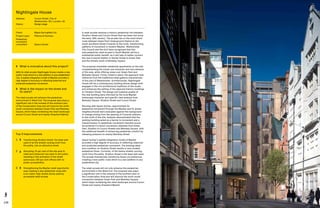
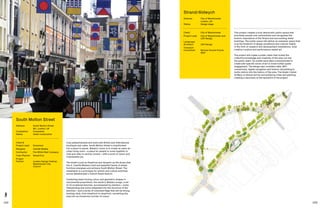
Previous page: South Molton Street in Mayfair, London © Grosvenor
12 13
	 Placing the Street in History
‘In transportation, we do very little studies about the past,
but anyone who is concerned about the future must have an
understanding of where we came from. If we are doing work
about the future, we need to be aware of what is changing. If
we are not aware of it, how can we possibly understand the
full picture?’
Matthew Clark, associate, Steer
In the current atmosphere of febrile futurism and
technological determinism, it is necessary to situate our
understanding of where we currently are, and where we
are going, in the context of the history of the street. The
history of the street is, after all, almost as long as the
history of human kind as a whole. At its core the street is,
as architectural historian Joseph Rykwert put it, ‘Human
Movement Institutionalised’.1
If someone walks through a
landscape, this act does not in and of itself constitute the
creation of a path or a street, but when multiple people
travel the same route repeatedly, a path or street is formed.
Unlike the building of a private dwelling or an enclosure of
land for farming, streets as a built form are inherently socially
produced, used and inhabited from their very inception.
The notion of a common route for movement through the
landscape is older than the notion of a fixed settlement itself.
‘Routeways’ (set paths commonly travelled by humans) in the
United Kingdom can be dated as far back as paleolithic times
(10,000 BC), relating to hunter gatherer migration patterns.
These common pathways through the landscape subsequently
became the basis for the first non-nomadic fixed Neolithic
settlements in the British Isles.2
Following this, the arrival of
the Roman Empire lead to the institution of the first paved
routes in Britain—what we current know as streets and roads
were born. The alignments of many Roman roads still mark
some of the most important streets in the country—notably,
Oxford Street in London can trace its particular alignment to
the Roman Empire.
Throughout this long history, streets have served a dual
purpose. Firstly, their movement function has allowed the
exchange of goods, tools and services, and served as the
infrastructure that allowed towns and cities to form in
an ever increasingly interconnected network across the
British Isles. Secondly, and equally importantly, the street
has consistently served a ‘place’ function in the form of
public space. In medieval market towns, the street was the
primary public space in which goods were traded and thus
essential for the economic vitality of the town. In the Georgian
crescents of the 18th century, the street was the place to
be seen promenading as a way to exhibit one’s social status
and sartorial taste. In the Victorian terraces of 19th century
industrial Britain, the street became a locus of social life,
gossip, a place to informally meet neighbours and for children
to play when parks and other more deliberate forms of public
space were in short supply.
Predating the relatively recent urban innovations such as
the park, the square or the plaza, the street has consistently
remained as the most ubiquitous and for many (particularly the
poorest), the only public space truly accessible on a daily basis.
This abridged history of the street is to place the ‘street’ or
‘road’ as we currently conceive it within its much longer and
historically contingent context. What is evident is that the
street has always performed a dual function serving as both
space for movement and place. As this chapter will explore,
the contemporary conception of the street since 1945 and
the mass motorisation of society has been largely devoid of
historicity in relation to the function of streets. As a society,
our connection to our streets is deeply engrained and historic.
This connection should be held in high regard as we make
plans and envision how the streets of the future will look.
	 The History of London’s Streets
The history of the London street network can be closely
linked to its iterative emergence as an urban region. The
street patterns, street designs, widths and relation to the
urban form can be linked to both the values of the epoch in
which they were built, but equally importantly, street pattern
and street geometry have been determined by the dominant
transportation technology of the time.
The oldest streets in London, including Oxford Street, can be
traced to Roman times in which roads were primarily used for
the movement of troops and supplies. As the city expanded
in the medieval era, a highly dense network of streets and
buildings, particularly visible in the City of London, emerged.
This resulted from a lack of comprehensive planning or land
use controls at the time. Additionally, with walking as the
primary mode of transportation, the need arose to cluster
businesses and homes together in great density, resulting in
a dense patchwork of buildings, streets and alleyways. The
widths of streets in these areas are of a human scale given the
predominance of walking.
Despite the Great Fire of London largely levelling the city in
1666, plans hatched by Sir Christopher Wren to rebuild the
city’s road network in a rationalised manner never came to
fruition, as the majority of rebuilding simply followed the
haphazard and labyrinthine patterns that predated the fire.
In the early 1700s, great expansions of the city took place,
constituting the first examples of master planned and
designed street networks in London. In the West End, private
landowners built great plazas such as Hanover Square and
Cavendish Square. These were entirely privately driven housing
developments, with the streets and public spaces designed in
ostentatious proportions in an effort to drive land values up.
In the later Georgian period, additional urban extensions were
built including housing and road network around Regent’s
Park. More centrally, Regent’s Street exhibited the Georgian
penchant for the crescent. Unlike the medieval period, streets
were built wider to allow for separate pedestrian footways
and carriageways in which horse drawn carts could move.
Georgian extensions also deviated from the haphazard
medieval street network, often following a grid structure
and exhibiting perfect geometrical form resulting from the
Enlightenment desire to impose rationality and order onto
The History of London’s Streets
the perceived chaos of the city. While the Georgians had built
great new extensions to the city, density and sprawl had still
been constrained by the transportation technologies of the
time which were primarily the horse and cart.
In the mid-19th century however, the emergence of railways,
and eventually the Underground in 1863, opened the door for
the first wave of suburbanisation in London. New suburban
housing developments followed almost immediately after the
construction of each new rail line. The development of the
transportation network by private operators was as much an
act of connecting existing destinations as it was a means
to open new areas for real estate speculation. While the rail
network did allow for the outward sprawling of London, it did
not fundamentally change the use of streets. In fact, once
one reached a train station, walking was still the primary
means of reaching a final destination. Even as trams began to
emerge onto streets, their low speeds meant that they mixed
comfortably with foot and horse traffic.
While London’s street network transformed immeasurably over
the period examined, the balance between a street’s function
both for movement and as public space remained. Similarly,
a high density of land use remained the norm over the period
as density was still determined by the walking distance
of a human, even if trains did allow for longer commutes.
Moreover, despite changes in transportation technology,
the mixing of streetcars, horse carts and pedestrians on the
streets remained a relatively equal affair with limited speed
differential between different users meaning that negotiations
over space could take place, rather than having a mode of
transport dominating. The street still retained a multiplicity of
uses—from protest to play, from trade to gathering.
This status quo of negotiation and multiple uses of the
street was to change fundamentally with the emergence of
the motorcar and the motorisation of British society in the
early to mid-20th century. The balance of movement and
place that had characterised London’s streets for centuries
was to be undone.
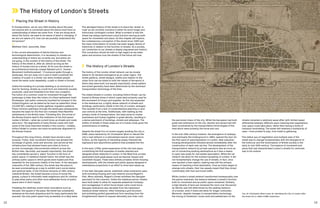
Top: Sir Christopher Wren’s plan for rebuilding the City of London after
the Great Fire in 1666 © RIBA Collections.
14 15
	Modernism and the Re-invention of the Street
The emergence of the motorcar and its mass adoption into
society began to affect the use of streets and planning of
London in the 1920s. As cars became more widespread on
London’s streets, plans were drawn up for new infrastructure
to accommodate them. In 1918, The London Society
developed the ‘Development Plan of Greater London’
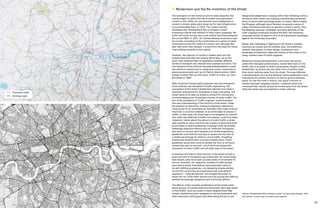
proposing a whole new network of main roads, bypasses, the
north and south circular and a new orbital road that prefigures
the current M25. In 1937, Sir Charles Bressey proposed a plan
for London consisting in the construction of a series of radial
motorways around the centre of London, and, although this
plan was never fully realised, it would form the basis for future
road building schemes in the capital.
However, the majority of London’s streets were not fully
transformed until after the Second World War. Up to this
point, they remained sites of negotiation between different
modes of transport and retained their multiple functions. The
true influence of the motorcar became institutionalised in post-
war efforts to rebuild and to modernise London, enshrined in
planning documents such as Sir Patrick Abercrombie’s 1944
Greater London Plan and the book ‘Traffic in Towns’ by Colin
Buchanan in 1963.
With modernist transportation planners and the emergence
of the entirely new discipline of traffic engineering, the
conception of the street transformed radically from what it
had been understood for thousands of years preceding. The
street came to be seen as simply a conduit for moving and
accommodating ever increasing volumes of motor traffic. The
rise of the profession of ‘traffic engineer’ institutionalised
this new understanding of the function of the street. Under
the premise of objectivity, transport engineers referenced
rising levels of car ownership as indication that roads must be
improved, in practice widened, to accommodate increases in
traffic. In their eyes, the street had to be designed by ‘experts’
who, with new methods of traffic forecasting, could now make
‘objective’ claims about the amount of motor traffic a street
was required to carry, and thus the number of lanes that must
be provided or where pedestrian crossings could be located.
Seemingly objective metrics such as ‘vehicular throughput’
and ‘level of service’ were adopted into street engineering
guidelines such that the only way to assess the success of
a street was through its ability to move traffic, forgetting
entirely the multiple other functions streets serve. These
guidelines would then come to dictate the form of all future
streets that were to be built—all of which prioritised the
movement of motor traffic over all other uses of the street.
In essence, the historic dual function of the street as both a
place and site of movement was overturned, the result being
that streets came to be seen as sites solely of movement for
the car. Ironically, the ‘objective’ models of traffic growth
upon which street motorisation was predicated came to
be self-fulfilling prophecies—by designing streets entirely
around the car and the accompanying vast road network
expansion—‘induced demand’ encouraged the public to
adopt the car, while other options such as cycling and walking
became increasingly dangerous and uninviting options.
The effects of this societal recalibration of the street came
about quickly. On streets that had historically seen high levels
of foot traffic, such as London’s many neighborhood high
streets, pedestrians were relegated to narrow pavements and
often hemmed in with guard rails while being forced to use
designated pedestrians crossing rather than following century
old desire lines. Great road building schemes were proposed,
many of which destroyed large areas of London. Most notably
the Ringway, although never finished, proposed a series of
urban motorways that were to ensnare London’s centre. Only
the Westway was ever completed, and while elements of the
outer ringways eventually became the M25, the remaining
proposals quietly dropped in face of strong protest campaigns
against the motorway proposals.
Rather than defending or fighting for the street’s multiple
functions as a place and its multiple uses, the traditional
urbanist disciplines of urban design, architecture and
landscape architecture ceded the domain of the street to the
newly created class of traffic engineer.
Modernist housing developments in the post-war period,
unlike their Georgian predecessors, turned their back on the
street, and to as great an extent as possible, sought to keep
pedestrians, bicyclists and any other form of activity other
than motor vehicles away from the street. This was reflected
in developments such as the Barbican where pedestrians were
intended to be entirely moved to an above-ground elevated
plane. For the first time in history, the ‘place’ function of
streets had been relegated entirely—urbanists were now
convinced that ‘places’ should be moved away from the street,
while the street was surrendered to motor vehicles.
Left top: ‘Development Plan of Greater London’ by The London Society, 1918
Left bottom: Current map of London road network
Proposed roads
Existing roads
16 17
	An Inherited Infrastructure
It was only after the full effects of road building began to be
felt that questions over the street and its function began to
come back into focus. Public opinion began to turn against
the rampant accommodation of the motorcar at all costs as
the impact of projects such as the Westway become more
clearly visible. Additionally, the growth of the environmental
movement, instituted with the inaugural Earth Day in 1970
and the oil crisis of 1973 played into a reduced appetite for
motorcar accommodation. Perhaps most importantly, the
political will and finances began to dry up for large road
building schemes.
In the field of urban design, work by scholars such as Donald
Appleyard called for a reinvigorated attention to the street
and its importance for the health of neighbourhood; socially,
economically and environmentally.3
Of particular note, his
work sought to quantify how levels of traffic affected people’s
relationships with their neighbours, proving that greater levels
of traffic reduced the number of friends and acquaintance
resulting from their inability to easily cross the road.
Another key milestone in the rediscovery of the role of the
street as a place has been the seminal work of Jan Gehl with
his first publication ‘Life Between Buildings’ published in 1971
and translated in English in 1987. Gehl has focused his whole
career advocating for designing urban spaces at human scale,
shifting the attention to the role that public spaces play in the
urban life, and reclaiming the role of streets for pedestrians
and cyclists as opposed to cars.
In the US, Jane Jacob’s canonical book ‘The Death and Life
of Great American Cities’ made the case against modernist
planning ideology, arguing for a refocused attention on the
worth of a vibrant and active street life in the ecology of a
city.4
At the time, this viewpoint flew in the face of all planning
and design orthodoxy which had, as noted, entirely turned its
back on the street.
In London, the failures of modernist approaches to the street
could be seen playing out in developments such as the
Barbican. Despite being hailed as a landmark architectural
piece, the elevated network of pedestrian walkways was
not as successful as predicted, quickly falling into disuse.5
Inhabitants of the City of London far preferred the ancient
network of streets—seemingly incomprehensible and
irrational by the planners of the time, the century old network
allowed for direct and convenient movement between
destinations, in stark contrast with the elevated pedway
system that people found to be unintuitive and confusing to
navigate. People quite literally voted with their feet—shops
on the elevated system struggled from a lack of passing trade,
while ground level businesses on the street continued to
prosper in the City of London as it had done so for thousands
of years previously.
Undoing a society that was now simultaneously dependent
and addicted to the automobile proved a slow and difficult
task. The institutionalisation of the logic of automobile
supremacy was embedded so much in society to the point
that unpicking such a status quo in order to design for human
considerations would require both great political capital
and a change of mindsets within the public, professionals,
academics and institutions.
	Looking Back to Look Forward:
The Future of the Street
Over the past 20 years, a fundamental shift towards
rebalancing streets to give priority for public transportation,
pedestrians and bicycles, alongside their function as public
spaces, has been taking place in London. Progress has been
slow, but steady in terms of concrete built projects. Perhaps
most importantly, mindsets within city governance, Transport
for London (TfL) and the public have begun to shift. Yet, at this
moment in time, new questions are emerging as to how new
development in mobility technologies will impact the city form
in the future. There is a danger that, as with previous mobility
technologies, urban form and street design simply adapt to
accommodate new technologies without scrutiny as to the
societal consequences. Such a technologically determinist
approach to the future of streets would potentially be
detrimental for the quality of life in cities. Works such as this
book will help to foster such conversations about the future of
our most important of public spaces; our streets.
By examining the history of streets, both specifically in
London and more broadly, we can understand two key
lessons as we enter this new period of change. Firstly, that
our current conception of the street as a place primarily for
the movement of large volumes of motor traffic as being a
highly temporally specific conception, one that is largely the
invention of the last 60 years and is a departure from the
vast majority of human history that has consistently seen the
street as a space for innumerable activities. Secondly, that
allowing technological developments to drive the way in which
we design and build streets will likely lead to negative and
unforeseen consequences that will not best serve the health
and vitality of cities. The environmental ruin and road deaths
that society uncritically accepts as the price we must pay, in
addition to the loss of the street as a public space in service
to the automobile, is the biggest living testament against
technological determinist planning.
With the emergence of new technologies, we now have the
chance to make pragmatic steps from both these learnings.
Firstly, we can once again reorient streets to become places
that foster movement as well as a broad range of other social
and environmental functions. Secondly, we can use new
technologies to enable this vision, but historicity tells us that
we must incorporate these new technologies in a critical and
deliberate manner, rather than letting them drive how we
design and plan our cities. Works such as this book will help
to foster such conversations about the future of our most
important of public spaces; our streets.
‘We, as a society, must have a broad
conversation about what kind city we want
to inhabit, and how technology might help us
realise that.’
Lucy Saunders, director, Healthy Streets
18 19
The Mobility Landscape
	Transportation Trends in London
Transport policy in London has shifted markedly in the last
30 years. Emerging from the post-war period in which the
accommodation of motor traffic was seen as its primary
concern, policy coming from both the Mayor and local
boroughs has generally moved towards prioritising the
efficient movement of people via public transport and active
travel over that of private vehicle access. While traffic
domination still blights most areas of London to varying
degrees, some large steps have been made in terms of
rebalancing streets towards people and more efficient modes
of transport. Notable policies include the congestion charge,
introduced in 2003 in central London and which reduced
traffic by approximately 25 per cent, and strong improvements
to the bus and rail networks. Much of the space freed up by
reduced traffic volumes has been reclaimed as pedestrian
space and reallocated for protected cycling routes as a part of
the Cycleway (formerly Cycle Superhighway) network.
According to research initiative CREATE6
which looked at
the broader trajectory of European city transport policies
in relation to congestion and transportation over the past
40 years, London has added over one million residents in the
last 20 years, and yet traffic congestion has remained largely
static, indicating that the general shift in transport policy is
moving greater numbers of people more efficiently.
A clear indicator of this broader shift in policy can be found
in the Mayor’s recent transport strategy, setting out in no
uncertain terms the city’s stance on streets: ‘London’s Streets
should be for active travel and social interaction, but too often
they are places for cars, not people’.7
While this broadly positive trend in policy and design has
made progress in reclaiming streets for more human centric
uses and has begun to rebalance streets as both movement
and place functions, the emergence of future technologies
could become a potential distraction in this policy endeavour,
or at worst, a major hindrance in achieving the goals of a
more human centric transport system. Policy making and
design relating to transportation and streets in London must
remain resolute in this vision as we enter a period of feverous
technological change in the mobility sector, this chapter
explores the state of current policy and how it currently
responds to new mobility technologies.
	Policy
TFL AND THE MAYOR’S TRANSPORT STRATEGY
The Mayor’s Transport Strategy (MTS) is the main policy
document which sets out the current administration’s policy
goals for transport strategy in London. Underpinning the
strategy are the growth predictions that estimate London’s
population will grow from 8.7 million to 10.8 million by 2041,
resulting in an increase from 26.7 million daily trips made in
London today to around 33 million daily trips in 2041. In order
to accommodate this growth, TfL sets the target of increasing
trips made via walking, cycling or public transport from the
current level of 63 per cent to 80 per cent by 2041. In fact,
from a purely efficiency standpoint, maintaining the
current modal would lead to increasing congestion causing a
decline in economic competitiveness, along with spiralling
healthcare costs of an ageing and increasingly physically
inactive population.
While largescale investment in heavy rail transport projects
such as The Elizabeth Line and the Northern Line extension
do play a part in moving towards this target, the principle
realm in which this goal will be achieved is on the streets of
London. Already, eight out of ten daily trips in London are
made on the road and almost all rail-based trips involve a
movement to and from the station, which requires use of the
street. TfL estimates around five million daily car trips could
feasibly be walked or cycled. As such, the MTS focusses on
moving people on streets more efficiently by rebalancing
the allocation of space on streets towards active modes.
Additionally, it seeks to reorient streets towards their function
as ‘places’ rather than simply transportation corridors.
Central to this vision is the adoption of the ‘Healthy Streets’
approach. This approach is based on the understanding that
the design of a street should not simply be to prioritise the
moving of as many motor vehicles through a space as quickly
as possible, but rather to recognise the importance of streets
in determining a whole host of societal outcomes, and thus
designing them accordingly. At the core is the idea that in
order to address the growing crisis of inactivity, it is necessary
to build activity into people’s daily routines and the best way
of doing so is to build streets which allow people to safely
walk and cycle as daily activities. Healthy Streets recognises
the need to address other healthy indicators in tandem—for
example, the need to reduce people’s exposure to traffic
pollution; the need for easily accessible public spaces to
improve mental health and the need to reduce traffic injuries
and deaths on the roads. This approach mandates that all of
these outcomes must be considered when designing a street,
and that they can only be addressed together.
As a policy framework, Healthy Streets seeks to
institutionalise a new way of conceptualising what functions
a street should serve and a way to affect long term culture
change with regard to how TfL and governance across
London view the function of streets. While in the past
the transformation of streets towards more sustainable
and human-oriented design would require the work of a
particularly driven individual, or the alignment of particular
political interests, the Healthy Streets framework seeks
to institutionalise a new understanding of how we should
conceptualise the purpose of streets at all levels of
governance, design and engineering.
‘Healthy Streets as the policy framework gives people the
agency to ask the questions and to do things differently than
they have been done before’
Lucy Saunders
In addition to the Healthy Streets approach, since 2014, TfL
has adopted the ‘Street Types for London’ framework8
as a
means of understanding and classifying a street based on
5 miles
5 km
0
0
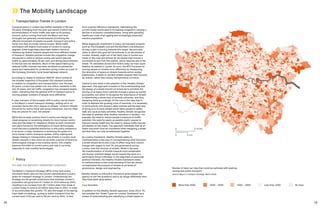
Number of daily car trips that could be switched with walking,
cycling and public transport
Source: Mayor’s Transport Strategy, March 2018
More than 3000 2000 – 3000 1000 – 2000 Less than 1000 No trips
20 21
its importance as a movement corridor, and as a place. The
use of this approach helps to reconceptualise the broader
understanding of streets not only as having a movement
function, but also their function as places. The use of the
Street Types matrix can help to understand a street in terms
of its function within a broader network of streets and the
transportation system as a whole. The Healthy Streets
approach, used in tandem with the Street Types matrix,
ensures that whatever the form and function of individual
streets, the policies and practices implemented are serving to
improve the 10 Healthy Streets Indicators.
The Healthy Streets approach also forms the principle
framework by which the MTS sets out its response to the
emergence of future technologies. While relatively limited
in detail, the MTS states that all new mobility technologies
will be assessed against the criteria of Healthy Streets. For
example, it is stated that while ridesharing may provide
benefits over traditional single occupancy vehicle trips,
ridesharing should not be allowed to become a more
attractive option than the lowest impact modes of walking,
cycling or public transport.
‘It is not yet clear which precise measures will be needed to do
this over the full course of this strategy to 2041. The Mayor’s
approach to developing these measures will be based on a set
of principles derived from the Healthy Streets Approach, set
out in Policy 23.
TfL will monitor changes to any transport services or
technology that could affect how Londoners get around or
experience London’s streets.’9
In this sense, it is encouraging to see that TfL clearly supports
the broad idea that the implementation of new mobility
technology should not be seen as a goal in and of itself,
but rather that new technologies should be appraised and
implemented only in support of existing goals to improve the
quality of life and the vitality of streets in London. However,
this policy response has received critique on two fronts. Firstly,
it is almost an entirely reactive approach to the regulation
of new mobility technologies. The first wave of ‘disrupting’
mobility technologies, such as ridesharing services like Uber,
have shown that reactive regulation is much more difficult
to implement than proactive regulation and can often come
too late to prevent the worst negative effects of ‘disruptive’
mobility services. Secondly, as Peter Jones, Professor of
transport and sustainable development, University College
London argues, simply assessing new mobility technologies
on the Healthy Streets approach is too limited in that it
does not necessarily consider the wider transport ‘network
implications’ that a new mobility technology may have. A
new mobility technology at ‘street scale’ may be seen as
relatively harmless, but when considered within the context
of the broader transport network, it may have an overall
net-negative impact on meeting transport objectives.
LOCAL COUNCIL POLICY
While the Mayor and TfL are key in setting the broader
strategy and direction that London as a whole may be heading
to, the implementation of such grand strategies relies heavily
on the cooperation and coordination of policy with local
boroughs. TfL controls only five per cent of all streets in
London, with local borough councils having jurisdiction over
the remaining 95 per cent. For this reason, it is essential to
understand how different councils’ streets and transport
policies have developed. The sheer size and diversity of
urban conditions in different boroughs necessitates looking
at two main typologies of council—that of inner London,
characterised by a higher density and better public transport;
and outer London, characterised by a lower density and a
higher car dependence.
INNER LONDON: THE CITY OF LONDON
The City of London exemplifies perhaps the most extreme
example of transportation planning shifting away from the
automobile towards more human centric street design and
sustainable transportation. As noted earlier, the post-war
period sees the adoption of a policy to build a comprehensive
network of elevated pedestrian paths, while space is made for
the construction of high capacity dual carriageways, including
Lower Thames Street and London Wall. At a diametric
opposite, the recently completed City of London Transport
Strategy10
puts at its centre the theme of creating one of the
largest areas of pedestrian priority in the country. It aims to
have at least 50 per cent of all streets within the Square Mile
as pedestrian priority or entirely pedestrianised by 2044. Key
projects to constrain vehicular access have progressed in
the last decade including the replacement of an arm of the
Aldgate Gyratory with Aldgate Square and the recent closure
of Bank junction to all vehicles except buses and cyclists.
In relation to future mobility technologies, the Transport
Strategy sets out a desire to work with technology developers
to ensure that new mobility technologies help to meet existing
policy goals set out within the strategy. In addition to using
the Healthy Streets metrics to assess new technologies
as they emerge, the document also sets a series of hard
principles, with notably strong wording regarding the impact
of autonomous vehicles (AVs) on street design:
‘Autonomous vehicles must not require any changes or
infrastructure that have a negative impact on our streets,
such as bollards or barriers.’11
The City of London proposes to establish a ‘Future Mobility
Advisory Board’ comprised of technology experts, policy
makers and industry members to help advise proactive
policy-making in light of rapid change. This combination of
measures will help to ensure that the benefits of new mobility
technologies are integrated into the broader policy goals.
‘If someone has a mobility technology that will help us deliver
our transport strategy, we are happy to work with them.
However, we don’t want to get distracted by autonomous
vehicles that may be some way off or by future mobility
technologies that detract from delivering the priorities of our
transport strategy.’
Bruce McVean, acting assistant director – City transportation,
City of London Corporation
INNER LONDON: WESTMINSTER
The City of Westminster is another central London borough,
characterised by a high level of public transport options with
a high density of underground stations and bus stops. Plans
for the ‘Oxford Street District’ are now being carried forward
by the council in favour of a more ‘balanced’ neighbourhood-
wide approach to public realm, despite a previous proposal
to fully pedestrianise Oxford Street being refused planning
permission. Oppositions from local residents also made
Healthy Streets framework
Source: Lucy Saunders
Street Types Matrix, 2015
Source: TfL
22 23
difficult to implement other transport projects such as the
Cycle Superhighway 11 which had been withdrawn. While TfL
and the Mayor set a vision for London that moves away from
the use of cars, the political complexity and context-specific
dynamics of the capital may result in the implementation of
policies that differ even from neighbouring local authorities.
OUTER LONDON: WALTHAM FOREST
Waltham Forest transport policies demonstrate that the
autonomy of local authorities in London can provide the
opportunity for accelerating positive change. Having won
funding from TfL’s Mini-Hollands Scheme in 2015, the
borough has rapidly implemented a network of protected
cycleways, removed through-traffic from many residential
streets, and enacted numerous pedestrian safety
improvements. Waltham Forest presents a case study for
how highly targeted funding in geographically contained
areas combined with political will can enact rapid and
transformative improvements. This approach also illustrates
how different solutions are needed in different areas of
London, depending on the urban form and local context.
Unlike central London, in Waltham Forest density is much
lower, public transport is less extensive and car dependence
is much higher. Whereas a focus on pedestrianisation can
serve higher density areas such the City of London, Waltham
Forest has focused on enabling short to medium-distance
trips to be made by bicycle through the creation of a high-
quality protected network. This network starts at people’s
homes with the removal of through-traffic on residential
streets which then link directly into protected cycleways on
main routes, creating continuous and connected routes to job
centres and commercial areas. Cycling and ‘personal mobility
devices’ will be essential in creating more liveable and healthy
communities in outer London where neither the density nor
capital exists for heavy investment in public transport.
NATIONAL POLICY
While transport policy in London has been progressive in
terms of its stance towards the need for more sustainable
transportation and the reallocation of space on streets,
investment from central government has not always been
aligned with this vision. In central government’s orthodoxy,
road building and increasing capacity for vehicles is closely
correlated with economic development strategies—a view
that has remained steadfast despite other policies that
may champion the merits of sustainable transportation or
commitments to reducing vehicular usage. This mindset is
reflected in the level of budget allocated for active travel
improvements which have been set at around £400 million per
year,12
a figure dwarfed by the £30 billion road building plan
announced in 2018.13
This reflects a disconnect between how
central government understands the role of streets and the
vision that planners and designers have for streets at a local
level. This disparity between central government priorities for
streets and local priorities is no more evident than in London
itself where new road building is not an option on the table.
In terms of future mobility, central government’s most notable
move has been the creation of The Centre for Connected and
Autonomous Vehicles (CCAV), a body established to ‘support
the market for connected and automated vehicles’ with the
aim of ‘making the UK a premier development location for
connected and automated vehicles’.14
The remit of CCAV has
up to this point been very much focused on positioning the
UK to harness the economic potential of becoming a hotbed
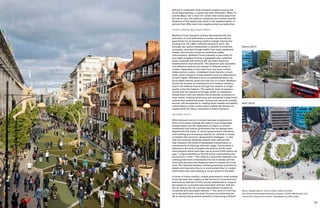
Above: Aldgate Square, City of London, before and after
Left: Oxford Street pedestrianisation proposal, © WSP, Westminster City
Council and Transport for London. Visualisation by AVR London
Before (2017)
After (2019)
24 25
for Connected and Autonomous Vehicles (CAV) research and
development by establishing the legal and policy framework
to allow developers to begin manufacturing and testing their
products in the UK.
‘The UK is the most advanced country in the world in terms of
its governmental and policy framework as it relates to AVs’
Michael Steinberg, head of strategy, programme and
communications, CCAV
More recently, CCAV has begun to take a leadership role in
setting a vision for how such technologies must be applied
as they become commonplace. The ‘Future of Mobility: Urban
Strategy’ published in March 2019 sets out the potential
risks and benefits of CAVs, before establishing a set of
nine principles by which the greatest positive outcomes
can be achieved. Most notably, the principles clearly set
out that future mobility technologies must not undermine
public transport or inhibit cycling and walking. This principle
aligns with the idea that future mobility technologies must
be supplementary to existing public transport and active
transport efforts, rather than a replacement. While these
principles appear positive, there is a danger that they may
conflict with the competing pressure to bring products to
market as quickly as possible in order for the UK to remain
a competitive bed for innovation globally in this sector.
Furthermore, there exists little policy guidance from CCAV
on concrete steps that are being taken in terms of legislation
to ensure that these principles are acted upon or enforced.
At the moment, they exist more as a ‘wishlist’ rather than
concrete policy, and could be subject to overturn if a different
government takes office, or the economic climate changes.
	Infrastructure
Beyond policy, the delivery and design of transportation
infrastructure has changed drastically over the last 30 years
in London.
STREETS
The last 20 years have seen an almost complete realigning
of how street design is approached in London. The era of
the ‘predict and provide’ approach to street design and
road building began to end in the 1990s as it became clear
that for London to support its growth, a move towards
the prioritisation of public transport and active travel was
necessary, and that this could only be facilitated through the
reallocation of street space.
The first major step change in the allocation of street space
happened under the Mayor Ken Livingstone in which the
BusPlus scheme implemented hundreds of new bus priority
lanes throughout London. The creation of new bus lanes
peaked in 2003, a year in which 146 new bus lanes were
inaugurated in London.15
This growth in bus priority was
correlated with a huge increase in the total number of bus km
operated, which grew by 35 per cent between 2001 and 2015.16
After the election of Boris Johnson as Mayor in 2008, the
focus of street improvements shifted towards enabling
cycling. The second generation of Cycle Superhighways,
which began construction in 2014, were a step change
in the delivery of cycle infrastructure in London, for the
first time providing high-quality separated cycle lanes in
central London. In the same way that bus use grew with
the implementation of bus lanes, so too cycling has grown
in correlation with the reallocation of street space—2018
recorded the highest growth in km cycled in London on record.17
Street infrastructural changes have not been limited to a
rebalancing of transport space allocation, but also there has
been a marked cultural shift to focus on a street’s function as
a place of equal importance. With the two previous mayors,
there was a prioritisation of singular modes (the bus and
‘I’m surprised at how little money is spent on
street improvements in the national budget
given how important streets are for the broader
wellbeing of people. They should get a larger
piece of the pie. Streets are really under
invested and not valued for what they are really
bringing to society.’
Lucy Saunders
bicycle respectively), and Professor Peter Jones believes that
we are now moving to a third position, where we achieve a
more balanced approach to street design and the competing
demands on street space, including accommodating non-
transportation, place-based functions.
‘10–20 years ago, the big focus was on putting in bus lanes,
at the expense of other things. That was replaced by a
concern to provide for safe fast cycling at the expense of
other things. It’s only relatively recently that TfL has begun
to realise that we can’t just design for one mode at the
expense of others, but instead that we’ve got to look at the
street comprehensively and find a balance between all of the
competing demands.’
Professor Peter Jones
LDA Design’s director and landscape architect Sophie
Thompson attests that transport engineers are now much
more willing to prioritise placemaking as a part of street
design, rather than rejecting it on the basis of a necessity
to accommodate specific traffic volumes or because of a set
of fixed highway rules. This new approach is clearly visible
in the proposals of schemes such as Strand-Aldwych by LDA
Design which seeks to create large areas of new public space
around St Mary Le Strand church while also balancing this
with the need to maintain bus efficiency and cycle safety.
PUBLIC TRANSPORT
The largest investment in London’s public transport
network in recent years has been the construction of The
Elizabeth Line, set to open in 2020, which will constitute the
first new major rail line addition to the capital’s network in
30 years. However, taking decades to plan, fund and deliver,
it is likely that London’s future transportation targets cannot
be met relying solely on big infrastructure projects such
as this if the growth in population is to be accommodated.
Much more cost effective and rapid improvements of
public transportation can be found on the streets as noted
previously in relation to the creation of bus priority and safe
bicycle infrastructure.
Moreover, the new mobility technologies that may support
or compete with public transport will emerge predominantly
on the street given that it is an open environment unlike the
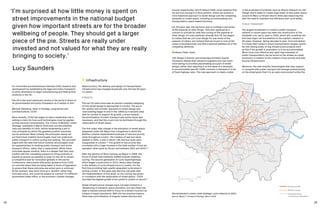
Recommended London-wide strategic cycle network to 2041
Source: Mayor’s Transport Strategy, March 2018
5 mile
5 km
0
0
Stratfor d
Walthamstow
Chiswick
Kilburn
Camde n
To wn
Le wisham
Cat ford
Fulham
Cit y
Hounslow
Richmond
Wood
Green
Har ro w
Wemble y
Edgware
Finchley
Barnet
Uxbridge
Ealing
Kingston
Wimbledon
Sutton
C roy don
Streatham
Brix ton
Purley
Bromle y
Orpington
Eltham
Bexleyheath
Woolwich
Ilford
Barking
Romfor d
Upminster
Heathr ow
s
26 27
rail network. As such, while it is likely that the rail network
will remain at the heart of London’s transportation network,
future public transport efforts will more likely revolve around
connecting people to existing rail lines rather than widespread
construction of new rail, particularly in outer London where
density is too low to support rail investment. Projects such as
High-Speed Two (HS2) and its uncertain future illustrate that
the delivery of largescale infrastructure megaprojects relates
too closely to political cycles to be relied upon when planning
for the future of transportation in London. Large scale
transportation infrastructure projects such as this must be
seen more as macro-economic projects with goals of national
economic growth, rather than the kind of day-to-day project
that will truly improve the quality of life and urban experience
in London. The projects that will achieve these ends shall be
enacted on the streets rather than on the rails.
SOFT INFRASTRUCTURE
The suitability of investment in hard physical infrastructure
at this point in time has been questioned more broadly.
Chris Birch, director of sustainability at Hilson-Moran poses
the question in relation to the money spent on rolling out
physical fibre optic cables, that will now potentially be made
obsolete by the 5G network. We are currently unsure as to the
infrastructural requirements that future mobility technologies
will have, and therefore it may be unwise to invest in hard
infrastructure that will in the future become redundant as
mobility technologies change. It could be suggested that
rather than hard infrastructure, London should focus on the
provision of soft infrastructure, such as the 5G network, data
platforms and improved digital communication between
existing infrastructure (such as traffic lights) and vehicles.
Conversely, it can be argued that uncertainty about future
technologies should not be driving hard infrastructure
investment at all and thus uncertainty about the future is
irrelevant when considering street investments. There will be
a need for high-quality human focused public realm in the
future regardless of any future mobility technologies, and
thus now is a good time for invest in such improvements.
One area of ‘soft infrastructure’ that TfL has been ahead of the
curve in, has been data sharing. TfL’s ‘Open Data Platform’ allows
anyone to access feeds of data regarding passenger ridership
patterns and live tracking data of all vehicles and trains in the
TfL network. This data sharing platform has been an enormous
success in some ways, allowing for the private development of
many transport apps (including City Mapper) that have helped
encourage transport ridership. However, criticism of the lack of
reciprocity has been levelled at the policy—while TfL shares
its data, those that use it are under no obligation to share back
with TfL to help improve service. TfL currently has limited data
collection policies which may restrict the ability to which it can
control and regulate future mobility services.
	 Density, Housing and Land Use
London’s projected increase in population of over one
million in the next 20 years will place even greater pressure
on the already strained housing market. A key element of
accommodating the new population will be to integrate the
building of new residential areas with transport policy to
ensure that new residents have little to no need to use a car.
Policy 1.2.4: ‘Making the best use of land means directing
growth towards the most accessible and well-connected
places, making the most efficient use of the existing and
future public transport, walking and cycling networks.
Integrating land use and transport in this way is essential
not only to achieving the Mayor’s target for 80 per cent of all
journeys to be made by walking, cycling and public transport,
but also to creating vibrant and active places and ensuring a
compact and well-functioning city.’18
In practice, this means locating new density adjacent
to existing public transportation links, enforcing strong
limitations on levels of parking provided as a part of new
developments, and co-locating housing with commercial
and other uses as a part of ‘mixed-use’ developments. The
London Plan also stipulates that the Healthy Streets approach
must be applied when reviewing development applications to
ensure that the physical design and location of developments
meets those principles.
One of the biggest owners of land adjacent to transportation
links is in fact TfL itself. As such, in the last few years TfL has
been developing these sites in order to repurpose them as
housing and mixed-use developments. All developments will
feature at least 50 per cent affordable units and many are
proposed to be located on car parks around stations in lower
density outer London suburbs, such as Harrow. The emergence
of TfL as an integral part of delivering new housing marks a
broader shift in terms of the integration of land use planning,
housing policy and transportation through an understanding
that these areas cannot be addressed individually.
‘The role of transport operators is changing—we are one of
the biggest owners of transport accessible land in London, it
makes sense that we get the highest and best public use of
this land’
Stuart Robinson, strategic planning adviser,
property development, TfL
While building new density adjacent to existing transport
links is essential in order to create low-car communities—the
amount of land that meets these requirements is relatively
limited and as such these stringent requirements may reduce
the rate at which new housing is delivered to meet population
growth. Paul Curtis, associate director at Vectos suggests
that new mobility technologies provide the opportunity to
open up new development sites that do not currently sit close
enough to public transportation. He suggests that a series of
measures including the implementation of mobility hubs and
car sharing agreements, might accelerate the development
of suitable sites that currently do not meet the London Plan’s
requirement for proximity to transport.
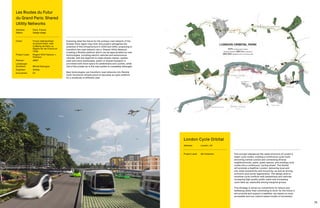
Image on page 28: Les routes du futur du Grand Paris: shared utility
networks, visualisation of Boulevard Peripherique-2050
© Rogers Stirk Harbour + Partners
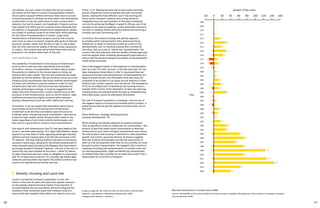
Number of Bus Lanes
Year
Bus lane introduction in London since 1968.
Source: The benefits of bus priority within the central London congestion charging zone. Association for European Transport
and contributors, 2006
28 29
The Emergence of New Mobility Technologies
	Introduction
Despite often being referred to as ‘future’ mobility
technologies, many of the technologies in question have
already been rolled out onto the roads of London either as
limited test applications, or as full commercial operations.
Unlike some cities, London has been relatively strong willed
in its regulation and control of private enterprise’s ability to
launch new mobility products and services onto the streets
without first establishing partnerships with local authorities
and TfL. Additionally, quirks of the UK vehicle licensing
system have meant that electric scooters have yet to see a
widespread launch in the UK. As such, compared to countries
such as the US, where regulation is less stringent and there
is a greater culture of free market enterprise, London has not
yet seen its transportation and streets disrupted to the same
extent as other cities worldwide.
However, by examining how regulation has, or has not worked,
as well as the emergent problems in terms of street design
that new technologies are already posing, it is possible to
make better and more informed decisions about how to
respond as new technologies continue to emerge, some
of which may spur more fundamental transformations in
transportation patterns.
It is important to understand the timeframe and general
roadmap that new technologies may emerge onto our streets.
The period of ‘mobility interregnum’ that we are now entering
in which the transportation status quo of the last 60 years is
being challenged by new technologies and new ideas, will be
key in shaping what kind of streets, what kind of cities and
what kind of society emerges from this period of immense
change. The pro-active policies and design responses that are
implemented during this period will be essential in ensuring
that new mobility technologies support the vision for healthier
and more liveable streets, rather than distracting or negatively
impacting this vision.
	 Emerging Mobility Technologies
Private investment in ‘new mobility technologies’ has rapidly
increased since 2010, with McKinsey estimating that worldwide,
around $110b of private capital has been invested into
businesses that relate to future mobility technologies.19
The
early examples of technologies we currently see on the streets
of London are only the tip of the iceberg in terms of what
investors are expecting to see in the longer term. Understanding
how these early iterations play out will be key in informing what
the longer term and more profound effects will be, and how
policy and design must respond to ensure positive outcomes.
RIDESHARE
The rise of ‘ridesharing’ is perhaps the first great disruptor
to arrive on London’s streets. Uber is thus far the only
Transportation Network Company (TNC) to achieve a significant
market share and has seen rapid growth in the capital. Launching
in London in 2012, the service has quickly grown to around
50,000 drivers and around 3.5 million active users in London.
The emergence of Uber has affected London on multiple
fronts. The working conditions of drivers and operating
practices have been strongly disputed by TfL, leading to
the revocation of its permanent license as a private hire
operator in 2017. Recently, it has once again been issued a
temporary license to operate as TfL continues to investigate
its employment practices.
Perhaps the most concerning threat Uber poses is its
potential to undercut public transport in London. Some
early research from the US suggests that TNCs are moving
trips away from public transport, walking and cycling to
rideshare services.20
However, another study conducted in
London showed that Uber was actually complementing the
introduction of the Night Tube. This was on the basis that
more Uber trips were being taken from tube stations during
‘Night Tube’ hours, indicating that instead of taking a cab
home the whole way, people were now using the Night Tube
for most of the journey, and then transferring to an Uber for
the last mile.21
However, the recent IPO released by Uber states in no
uncertain terms that they see public transport as a key
competitor and that public transport riders are a key part of
the market they seek to win over.22
Greg Lindsay, director of
applied research, NewCities, argues that this should come as
no surprise, given that TNCs such as Uber are only profitable
in highly dense urban contexts such as central London. He
argues that in lower density areas Uber still has to highly
subsidise all journeys.
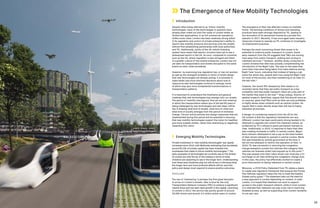
A danger of considering research from the US for the
UK context is that the regulatory frameworks are very
different. London has been particularly strong handed in its
attempts to regulate and control the rideshare market, as
evidenced by TfL’s refusal to grant permanent licenses to
Uber. Additionally, in 2015, in response to fears that Uber
was creating increases in traffic in central London, Mayor
Boris Johnson attempted to set a cap on the total number
of Uber drivers allowed to operate in central London. While
this was thwarted by central government at the time, it
did not end attempts to restrict the operation of Uber. In
2019, TfL was successful in removing the congestion
charge exemption private hire vehicles (the category Uber
vehicles are licensed under) had enjoyed up to this point.23
This was passed onto Uber riders whom now must pay a £1
surcharge on all rides entering the congestion charge zone.
In this case, the policy has effectively worked to create a
price disincentive to taking rideshare in central London.
Moreover, a 2019 Policy Statement from TfL states a desire
to create new regulatory framework that ensures the Private
Hire Vehicles regulation helps the city to meet the Healthy
Streets policy goals.24
The statement sets out the need for
a dual approach in London depending on context. In outer
London, it is hoped that rideshare can work to support
access to the public transport network, while in inner London
it is intended that rideshare can play a key role in improving
disabled access, as well as supporting inner London residents
to not own cars.
30 31
Regulation of rideshare is of particular importance, as it is
likely that many of the rideshare operators will, as technology
develops, transition onto the use of autonomous vehicles.
As such, ensuring that rideshare is achieving its purported
benefits—that of reducing car ownership, supporting public
transport, increasing shared rides and increasing disabled
access—at early implementation stage, so that as AVs
emerge, these beneficial outcomes may be elevated.
PERSONAL MOBILITY DEVICES
Other than the rise of rideshare, perhaps the most evident
form of new mobility technologies on the streets of London
has been that of dockless ‘personal mobility devices’.
Beginning in around 2017, a series of dockless bike schemes
began to emerge. Without the regulatory framework in place
for councils to license these schemes, private operators were
free to simply launch services without prior consultations
with local authorities or TfL. This resulted in large numbers of
bikes being dropped onto ill-prepared streets, often resulting
in blocked pavements and clogging up what limited cycle
parking was available.
In response to this, local authorities used legislation designed
to prevent fly tipping on streets with the purpose of clearing
nuisance dockless bikes from the pavement and streets.25
TfL
has since implemented a ‘Code of Practice’26
which sets out
the expectations for dockless bikeshare providers. It requires
that new operators engage with TfL and the different local
authorities within which they seek to operate. Additionally, it
sets minimum standards for parking (i.e. bikes must not be
parked on a footway), and data sharing requirements. While
this code of practice is not binding, for the most part operators
have been willing to abide with it to ensure their bikes are not
marked as ‘nuisances’ and removed from the streets.
A new by-law proposed by TfL, yet to be implemented, would
make it a legal obligation for operators to seek the approval
of both the local authority in which they wish to operate as
well as TfL. However, in the meantime, local authorities such
as LB Camden and RB Kensington and Chelsea are already
proposing local by-laws which would do the same thing, just
at a local rather than city-wide scale.
While it is evident that legislation must catch up with
technology, the patchwork of different boroughs regulatory
approaches means that bikeshare schemes are often
restricted to seemingly arbitrary borough boundaries. This
reduces the quality of the service provided, and currently
hinder the possibility for dockless bikes to become a reliable
part of people’s transportation habits. On the flipside, local
control over schemes is necessary as the street conditions
and transport infrastructure of each borough varies wildly,
so allowing for local discretion over bikeshare is important
for ensuring schemes are appropriate to their context. A
regulatory mid-point must be found between the need for
local considerations and the need for joined up city wide
coverage and access.
‘The patchwork of boroughs approaches to regulation makes
operating these services very difficult and reduces quality
for end user in terms of reliability and usability. However,
local conditions must influence how shared systems operate,
for example, in terms of parking restrictions. London has a
chance to improve significantly on the current situation if
the mooted byelaw comes to pass and be implemented in
ways that bring greater consistency from local authorities
while also better addressing local needs. This is far from
certain at the moment, but it is possible and would be a big
step forwards for London’s cycling offer, health benefits, air
quality and decarbonisation needs.’
Richard Dilks, chief executive, CoMoUK
While e-scooters and their (lack of) regulation has caused
them to be the subject of great public attention worldwide,
London has remained relatively untouched by their presence.
This is due to antiquated legislation that requires all electric
driven ‘vehicles’ to have full insurance and registration. As
such, no e-scooter sharing systems have had widespread
launch in London to date. A recent trial of e-scooters in the
Olympic Park on a fixed course has proved to be a success,
but their full roll out is still a number of years away.
London’s experience with the regulation of personal mobility
devices (PMDs) has been characterised by proactivity
and willingness to reach out to, build and maintain close
relationships with the operators. TfL’s Commercial Innovation
Unit is tasked specifically with building relations with
developers as a means to ensuring their products assist in
achieving the Mayor’s Transport Priorities.
‘Our role is to ensure that all these technological advances
can be brought into TfL, supporting and complementing
what we are trying to do with the Mayor’s Transport Strategy
and at the same time making sure we avoid things that may
negatively impact.
We are working with the dockless providers and boroughs
to say—there is demand for your product, but if you are
deploying it on our streets, let’s make sure it’s safe, let’s
make sure it’s secure. By creating that partnership and
engagement, we are hoping to create an ecosystem of public
private operators doing right for the city.’
Rikesh Shah, head of commercial innovation, TfL
E-scooters and dockless bikes have presented differing
challenges regarding regulation, but in both cases the
problem stems from the same base issue: new technologies
do not readily fit into historic mobility categories or regimes
of regulation. As such, regulation is somewhat club handed—
either overly stymieing the potentials of the technology
to benefit (as has been the case with e-scooters), or the
requisite powers to effectively regulate have not been in place
(dockless bikes). This exemplifies the need for legislation to
be proactive in terms of new classifications of vehicles so as
to prevent mis-implementation of such technologies.
AUTONOMOUS VEHICLES
While the dream of automated vehicles playing a central
role in London’s transportation mix is still somewhat distant,
recent years have begun to see the first applications of
autonomous technology in London.
In 2017, the ‘GATEway Project’ launched a trial autonomous
shuttle service in the Greenwich Peninsula on a fixed off-road
route. More recently, the ‘Connected and Autonomous POD
on-Road Implementation’ (CAPRI), advanced the Gateway
project technology, launching an off-road route in the Olympic
Park, shared with pedestrians and cyclists. The CAPRI project
seeks to eventually launch onto the mixed traffic streets
within the Olympic Park with the intention of proving the
potential applicability of autonomous technology in certain
semi closed environments such as ‘airports, hospitals,
business parks, shopping and tourist centres.’
George Lunt, technical director, AECOM notes that the
intention of the project is not to necessarily push towards
the rapid launch of a commercial service, but rather to help
develop both the technological side of AVs, including the
control systems and fleet management, and to help advance
the vehicle regulation that governs AVs. At the moment, as
with e-scooters, there is no vehicle classification to allow
the CAV pods to be used on the road, and so trials like CAPRI
are essential in the government establishing standards that
can be required of all new CAV technologies. The project is
supported by funding from CCAV and is being done in close
collaboration with TfL and central government.
This more collaborative approach, bringing together multiple
public and private stakeholders is in contrast with the
approach seen in the North American context where an
effective ‘race to bottom’ has emerged in terms of de-
regulation as a means to encouraging CAV developers to test
their products on the streets as quickly as possible with a
view to launching commercial services. Competition between
CAV developers has led to high levels of secrecy about the
technologies being implemented in some trials in the US. It is
arguable that this looser regulation, and competitive rather
than collaborative approach was one of the factors that led to
the tragedy in Tempe, Arizona where a pedestrian was killed
by Uber’s autonomous vehicle pilot.27
The CAPRI application of the technology represents
relatively closely what AECOM views as the roadmap for
implementation—it is unlikely that AVs will launch as
commercial services on trafficked streets any time soon,
but we will most likely see them emerging in semi-closed
environments such as campuses and hospitals. As such, this
trial gives us a view into the short-medium term prospects for
autonomous technologies in London.
Dockless Jump bike on a London street
32 33
‘There is an argument going on as to who should
be the integrator of different mobility services.
In order for MaaS to work, you need a good
public transport network and then new mobility
services to fill in the gaps where the public
transport network doesn’t work. Who is in the
best position to do that? Arguably TfL, which
has the policy objectives to allow the public
transport network to be the backbone while
also incorporating what the private sector has
to offer in a way that supports, rather than
undermines.’
Matthew Clark
ELECTRIC VEHICLES
The most imminent effect on transportation in London is
the emergence of electric vehicles (EV) onto the streets of
the capital. While there are still only 12,000 licensed EVs in
London, there are two key points that we can begin to infer
from their roll out so far.
Firstly, the way in which electric charging infrastructure is
installed may give us a good indication as to more broadly
the way in which new technologies will be accommodated
on streets. In some areas, electric charging points have
been installed on pavements in ways that obstruct the use
of the pavement for pedestrians, especially mobility and
sight impaired people.28
This implementation contradicts
the MTS policy that states that all technologies will only be
implemented if they support the Healthy Streets approach. In
this case, street design is being determined by the perceived
need to accommodate the new technology of EVs, rather
than prioritising the quality of the pedestrian environment
as the Healthy Streets approach mandates. This indicates
a difference between the stated policy, and how new
technologies will actually be implemented.
‘It’s important to question how these new technologies
start to incrementally shape streets. There is a danger
with things such as charging points that you will get these
incremental changes, and before you know it, you end up
with the street you didn’t want because you’ve been asked
to do lots of little things.’
Bruce McVean
Secondly, the congestion charge and many borough parking
permits do not charge electric vehicles as fees are based on
emissions. There is the need to encourage the uptake of electric
vehicles to reduce emissions and using a price incentive is
an effective way to do this. However, this approach implicitly
assumes that the only negative impacts of vehicle usage is
the emissions that they create. We must eventually move to a
model that reduces vehicle usage entirely—given the numerous
other negative externalities beyond emissions that vehicles
have on the quality of streets and public health. Moreover, as
more vehicles become EVs, the amount of tax raised from
vehicle excise duty and parking will continue to decrease if EVs
remain excluded. Thus, there will have to be a tipping point
when road pricing is not determined by emissions levels, but
rather by another metric, such as distance travelled or average
passenger occupancy.
DEMAND RESPONSIVE TRANSIT
The promises of Demand Responsive Transport (DRT) are
great, but so far, successful applications of the technology are
limited, in part due to restrictive regulation. Citymapper tried
to launch a variable route bus which could re-route based on
demand and people hailing it through the app.29
However, the
current legislation in London that requires all bus routes to
be consulted on made such a service difficult to implement.
This shows again how existing legislation is not prepared
to deal with new types of transportation and services that
are emergent. In this case, as with e-scooters, outdated
regulation is potentially holding back the biggest benefits that
new transport technologies could bring.
More recently, a TfL backed DRT service called ‘GoSutton’
has been launched in LB Sutton. The trial is a collaboration
between TfL, the local bus operator, and private ridesharing
technology supplier Via, who specialise in shared ride
vehicles. It is too early to assess the success of the service,
but much has been made of the potential for DRT services to
fill in gaps in the network where density is too low to support
high-quality public transport. Andres Sevtsuk, associate
professor of urban science and planning at the department of
urban studies and planning, MIT, casts doubt on this however,
asserting that any area that does not have enough density to
support high-frequency public transport will be unlikely to be
able to support a high-quality DRT service without large public
subsidy. So in effect, the subsidy just moves from a traditional
bus service to a smaller privately operated DRT service.
MOBILITY AS A SERVICE
The potential of mobility as a service (MaaS) is that it would
allow people to make decisions for each trip on one integrated
platform, so that they can choose the most appropriate mode
depending on the trip—be it public transport, bike share or
rideshare. This will allow people to live car-free more easily,
as they will have a plethora of different transport options for
each trip, without need to own a car.
TfL already has achieved a MaaS model in some senses—
using a contactless bank card one can access almost all TfL
services (except for Santander Bike share). However, new
shared mobility start-ups tend to have their own proprietary
apps (for example JUMP bike and Lime bike) that are not cross
compatible, meaning that new ones launching in London are
not being integrated onto one platform. Uber has integrated
public transport30
into their app and in some regions they
have also incorporated JUMP Bike share. However, there is
a danger that multiple, incompatible ‘walled-gardens’ are
emerging that are not cross compatible and thus reduce the
quality of service to users, or the ability to encourage users
to choose the most appropriate and sustainable mode of
transport. Matthew Clarke suggests that TfL are well placed to
take the initiative and try to integrate these multiple operators
and modes onto one platform, to ensure that new mobility
services are complementary to the existing public transport
network, and can enable more people to take public transport
by providing last mile connections and live car-free.
‘There is an argument going on as to who should be the
integrator of different mobility services. In order for MaaS
to work, you need a good public transport network and then
new mobility services to fill in the gaps where the public
transport network doesn’t work. Who’s in the best position
to do that? Arguably TfL, which has the policy objectives to
allow the public transport network to be the backbone while
also incorporating what the private sector has to offer in way
a that supports, rather than undermines.’
Matthew Clark
A further danger is that MaaS services are privately launched
with the intention of deliberately moving people towards
privately operated modes. The Citymapper Pass offers users
the chance to pay a single monthly fee that grants them full
access to TfL services, as well as a set credit for taxi rides and
use of dockless bikes share services. However, the TfL passes
are being sold at below cost price with the intention of getting
TfL users locked into their MaaS system, with the ultimate
intention of moving them away from public transport and into
more profitable private mobility services.
34 35
	Roadmaps and Timeframes
While some new mobility technologies have already begun
to impact upon streets and London’s transportation patterns,
most of the technologies slated to have the biggest disruptive
impact on streets and transport are still at inchoate stages.
This is particularly true of autonomous vehicles for which
numerous supposed deadlines for launches have been missed
by a range of developers. Given this confused landscape of
adoption of technologies, it is essential to lay out a broad
framework as to expected stages of implementation in
order to enact effective policy and design responses to the
emerging technologies.
With regards to CAV implementation, AECOM sets out
that there are two factors that will influence the iterative
roll out: firstly, the technical challenge, and secondly, the
business model. Using this model, it is clear that autonomous
technology implemented in closed environments (lower
technical challenge) already exists, where a non-autonomous
service was extant (for example tram services or internal
airport shuttles). These environments are the most closed
and often run on separate tracks as is the case with the
Heathrow self-driving pods. The next logical step is to apply
autonomous technologies in slightly less constrained sites
such as business parks or hospitals where there is currently
no such service provided. This road map for implementation
offers policy makers and designers a clearer understanding of
what are likely to be the first instances of the technology. As
CAV technologies are implemented in closed environments
such as business parks and hospitals, the effects CAV
technologies have on mobility within these environments
can be tracked. These limited scope applications of the
technology can act as petri dishes in which urbanists can
evaluate the wider impacts these technologies may have on
cities. It is essential that during these closed environment
tests, we begin to hypothesise about what the broader
implications for the city will be.
One example of learning from closed environment tests could
be taken from the GATEway autonomous pod trial in Greenwich
where a former bicycle lane was replaced with a dedicated
lane for the exclusive use of the pod. Despite being only a trial,
we can see that a human centric space such as a cycle lane
has been reallocated for use by automated vehicles. It may be
possible to learn from other such closed trials that if continued
in the wider city, this approach would lead to a net negative
quality of urban environment. Moreover, if the standards for
AVs are developed based on these closed environment trials,
we must ensure that the standards are rigorous enough to
deal with not just closed settings, but rather are attuned to the
complexity of dense urban centres too.
The AECOM roadmap lays out two clear questions that
remain unanswered. Firstly, in places where an existing
business case does not exist with human operated vehicles
(for example demand responsive transport in rural areas),
will AVs significantly affect this and create a viable business
model? Even if the technology is advanced enough to deal
with operating an autonomous DRT service in a rural area as
last mile connector, if the business case never materialises, it
is unlikely CAV technology will ever actually be implemented
in this use case.
Secondly, it is unclear whether the technology will ever
develop to the point at which is useable in an ‘unconstrained
site’. The increase in technical complexity from a constrained
site to an unconstrained site is many magnitudes. Some,
including Andrew Roughan, managing director, Plexal, believe
that this period of crossover in which autonomous services
are launched in unconstrained sites will ultimately prove
too difficult in terms of the multitude of regulatory and
technical hurdles to clear, such that the dream of full CAV
implementation will never be realised.
While the AECOM roadmap sets out a probable timeline for
implementation of AV, the Zenzic roadmap seeks to establish
a timeline for the policy response that needs to take place
to enable this. The Zenzic Roadmap is a collaborative effort
of over 250 private and public stakeholders to establish a
shared framework for the implementation of connected and
autonomous vehicle technologies. The roadmap sets out
key milestones, regulatory and policy changes that need to
happen to ensure the implementation of CAV technologies
in the UK in a ‘safe, rapid and competitive’ manner.31
The
timeframe for implementation set out is highly ambitious and
potentially overly optimistic. It aims for commercial trials
for automated mobility services by 2024 with the intention
that CAV services become more attractive propositions than
their human operated counterparts by 2029. Thus central
government envisions the widespread adoption of CAV
services by 2029. This is an incredibly short span of time in
which policy makers and designers must respond to ensure
that the way in which these services emerge is in a societally
beneficial manner. While the roadmap sets out key milestones
for adoption of CAV technologies, it does not specify the
manner in which CAV technologies should be applied. The
macro-economic and national competitiveness impacts
are prioritized, central government intends that we adopt
such technologies as quickly as possible. Thus this report
reinforces the paramount importance that urban policy makers,
designers and planners are quick and efficient in setting the
policy and design framework such that when CAV technologies
land, they land in such a way that supports the principles of a
healthier, more liveable and sustainable city are realised.
Vehicle Approvals
Licencing and Use
Legislation and Insurance
Public Desirability
Investment
Skills
Automated Driving System
Connectivity
Ergonomics and Design
Sensors
Communications
Digital
Roads
Intelligent Network Management
Test and Development
Personal Mobility
Freight and Logistics
Inclusive Transport
NOW 2021 2022 2023 2024 2025 2026 2027 2028 2029 2030STREAMTHEME
SocietyandPeopleVehiclesInfrastructureServices
The Golden Thread sections of this report
include;
Contributing themes – articulate how many
Milestones from each Theme contribute to the
Golden Thread.
Major deliverables – the culmination of long
strands of interdependent Milestones –
typically important final deliverables.
Key enablers – the start of Strands that
unlock many other Milestones. Typically they
are the first step in achieving a significant
number of other Milestones.
Critical waypoints – Milestones which sit in
the middle of long Strands. Often they are
pinch-points with many preceding Milestones
enabling them and many deliverables unlocked
by them.
These sections are supported by Golden
Thread diagrams and deep dives. The
diagrams and supporting keys help to visualise
the Milestones and Interdependencies
within each Golden Thread. The keys feature
Milestone IDs which are unique to each
Milestone. The deep dives explore the most
important elements of each Golden Thread.
For more detail on Golden Threads or to
TRIALS, DEVELOPMENT
AND ENABLING
TRANSITION
PHASE
SCALE-UP AND
REALISATION OF BENEFITS
UK Connected and Automated Mobility Roadmap to 2030 / Zenzic
Roadmap for the implementation of new mobility technology
Source: AECOM
Connected and Automated Mobility Roadmap to 2030
Source: Zenzic
36 37
	 Theory of Change
As we begin to understand these more concrete estimations
as to implementation timelines for new mobility technologies,
it is also necessary to place them within the context of what is
known as Gartner’s ‘hype cycle’ which estimates the general
trajectory for the emergence of new technologies. With
regards to new mobility technologies, we are still emerging
out of the period of ‘inflated expectations’. The marketing
materials and artistic visions of a futuristic city in which
new mobility tech has solved all problems of congestion
are beginning to be replaced with a more sceptical public
discourse about what impact new mobility technologies
will have. This new merging set of discourses is emergent
from the realities that can begin to be seen on the streets—
dockless bikes blocking sidewalks, e-scooters being ridden
on the footway and the notable death caused by the Uber CAV
testing program in Arizona to name a few examples. Moreover,
urbanists have begun to theorise in more detail concerns
that new mobility technology may drive a whole new wave of
motorisation, undercutting public transport and ultimately
having a net negative impact on the built environment.
Given that we are now at a point in which greater
understanding of the potential dangers of the technology,
it is the ideal time to begin making proactive design and
policy decisions so as to ensure that as we enter the ‘Slope
of Enlightenment’ and mass adoption takes hold, we are
prepared to ensure that the outcomes of this adoption are
positive. The worst takeaway from this ‘period’ of ‘trough
of disillusionment’ would to be to take away a false belief
that the technology will never be realised or adopted. It
may be easy to mistake the trough of disillusionment for
the impossibility of the technologies. Such belief that these
technologies are merely in the realm of science fiction may
prevent proactive work to prepare for their eventual mass
adoption, which according to the Gartner Hype cycle, is almost
inevitable. Moreover, it is likely that this mass adoption will be
slower and gradual, rather than a ‘mobility revolution’ as many
have characterized it. Thus we must be aware of insidious and
undirected adoption of technology. The example presented in
the previous section regarding the placement of EV charging
points is a pertinent example of not proactively shaping how
the technology is implemented, but rather succumbing to a
gradual insidious creep of technological determinism.
CAPRI, autonomous pod trial at the Queen Elizabeth Olympic Park
Hype Cycle showing the stage of CAV technologies in 2019 using the Gartner’s framework of emerging technologies
Source: Gartner
38 39
Scenario Testing
Having established the history of streets in London and how
that has shaped the present, it is necessary to also look
further into the future to understand the full possibilities and
risks that future technologies present for London.
Given the sheer complexity of the emergence of new mobility
technologies and the sheer number of variables that will affect
how the future of mobility unfolds, the final chapters of this
report seek to investigate two distinct scenarios that can be
imagined for the future of streets in London. The approach of
scenario testing is one advocated for by Prof. Andres Sevtsuk
who argues that it is only by testing out different scenarios
that urban planners, designers and policy makers, can make
sense of a highly contested and uncertain future. His research
initiative ‘The Future of Streets’, run as a part of the CityForm
Lab at MIT and formerly Harvard, has adopted such an
approach in relation to its work looking at the future of streets
in North America.32
‘Heaven’ and ‘hell’ scenarios are presented – one in which
technology is used to enhance the quality of life and meet
policy objectives, the other in which a technologically driven
dystopia emerges, regressing advances made in the livability
and street design over the last 20 years. These scenarios not
only illuminate possible outcomes, but also can be used to
infer how policy making and design should respond so as to
ensure technology is controlled and encouraged in ways that
meet broader societal and urbanistic ideals.
‘We mustn’t start with how good
the technology is. We must be tech
agnostic. We must start with the desire
outcomes, and then, if there is new
technology that can help achieve these
outcomes, we should consider how to
use it to do good for the city. We need
to ask: what does London look like
in 2041? And if we set out a series of
indicators for what we want our city to
look like, we can ensure that whatever
technologies we bring in, these are
aligned to those outcomes.’
Rikesh Shah, head of commercial
innovation, Transport for London
40 41
	Introduction
The ‘heaven’ scenario envisions how the current trajectory
of reorienting streets towards human uses and their function
in supporting a healthy city can be continued. This scenario
examines how new mobility technologies might be used to
enhance and support existing efforts to design and plan for a
more human centric city, that moves away from 20th century
technologies. It suggests some of the policies and design
principles that will need to be employed in order to reach
this outcome.
In broad terms, the heaven scenario harnesses emerging
technologies that reduce the need for private vehicle
ownership and the number of single occupancy vehicles
through a greater emphasis on ‘shared mobility’, in turn
reallocating streets as public space and for active transport
modes. Continued investment in a strong public transport
network and increasing housing density in areas closed to
public transport will see a more liveable London emerge,
aligned with the Mayor’s vision for a healthier and more
equitable city.
‘I like to imagine a future where shared mobility models
and self-driving cars reduce the number of vehicles on the
road, freeing up parking spaces that can then be reclaimed
and transformed into public spaces that serve different
social functions.’
Carlo Ratti, founder, Senseable City Laboratory,
Massachusetts Institute of Technology [MIT]
	Automobiles
Alongside the safety benefits of CAVs, the heaven scenario
envisions that cars in the traditional sense cease to exist, and
are replaced entirely by shared electric vehicles operated
in fleets. The ultimate goal of policy and design responses
to automobiles in the future must be to mitigate against the
worst impacts they have created in the 21st century and
ensure they play a sustainable role within a multi-modal
system. Automobiles in this future are seen as simply one
option among a plethora of mobility services available via
a Mobility as a Service (MaaS) platform. Road pricing will
discourage short journeys made by private cars, while the
use of shared vehicles to connect to public transport is
encouraged. The following principles establish how cars
could fit into this vision of the future.
AUTONOMOUS FOR SAFETY
The safety benefits of all vehicles being autonomous are
undeniable. The National Highway Traffic Safety Administration
[NHTSA] crash analysis indicates that around 94 per cent of
all crashes are the result of human error, usually on the part
of the driver.33
In 2018, 58 pedestrians and 12 cyclists were
killed on the streets of London accounting for 62 per cent
of all road deaths in the capital.34
The adoption of level five
fully autonomous vehicles on the streets of London would
potentially lead to a complete elimination of such deaths,
allowing London to achieve its Vision Zero targets.35
For this to be a reality, it must be accompanied by continued
street redesign improvements that give greater space to
pedestrians and cyclists. It must be ensured that autonomous
vehicles always follow a hierarchy of street users and always
give right of way to the most vulnerable road users; namely
pedestrians, cyclists and other non-motorised mobility modes.
This guarantee of ceding the right of way must not come at
the cost of the pedestrian’s ability to cross the street as they
please. CAV technologies must not negatively impact upon
the way in which streets are designed—most pertinently,
pedestrians must not be restricted from their right to cross the
street freely. Moreover, as will be explored, the potentials for
reduced lane widths, reduced street clutter and generally less
auto-centric streets can be realised with complete automation.
To maximise the greatest potential safety benefits of AVs as
quickly as possible, Matthew Clarke proposes that highly dense
areas such as central London (in which the greatest safety
benefit from fully automated vehicles could be achieved) may
ultimately become ‘autonomous-only zones’ in which only
automated vehicles are allowed to enter on the grounds of
improved safety. Conversely, Andrew Roughan argues that
the complexities of getting an autonomous vehicle to function
safely in a dense urban context such as central London may
be too great, and that they are more suited to inter-urban and
sub-urban contexts. As such, central London areas may require
vehicles to be at least human supervised, killing the dream
of full autonomy. However, even human supervised vehicles
may still be equipped with much greater automatic breaking,
sensing capabilities and remote speed limitation, meaning that
the same safety benefits of full autonomy can still be realised.
In the same way that the Ultra-Low Emission Zone (ULEZ)36
zone has been implemented, Central London should become a
zone in which progressively more stringent vehicle autonomy
safety requirements are implemented, given that private car
usage is already very low. This could mean either requiring
Los Angeles’s Vermont/Santa Monica intersection – ‘best case’
scenario, developed by Professor Andres Sevtsuk, director,
MIT City Form Lab.
Heaven Scenario
42 43
AV to enter the zone, or simply requiring greater autonomous
assistance, such as automated breaking and speed control.
CONNECTED FOR EFFICIENCY
Many of the greatest benefits of autonomy can already be
realised with implementation of greater connectivity between
vehicles and road infrastructure. It is envisioned that all
road infrastructure will be able to connect and communicate
with all vehicles on the road, be they autonomous or not.
This would allow for dynamic re-routing of traffic based on
road closures or to balance traffic volumes across different
streets. Antonio Balboa, vice president, sales and application
for powertrain solutions at Bosch, imagines that connecting
vehicles to traffic control devices such as traffic lights could
massively increase the efficiency of junctions by allowing for
dynamic signal re-timing based on traffic volumes.
Furthermore, if vehicles are fully connected to infrastructure,
it will reduce the need for physical signage and traffic
devices such as speed humps to control speed. Banned
turns or speed limits could be enforced digitally, yielding
great benefits in terms of reduced requirements within street
design. Perhaps most importantly, fully connected vehicles
will open up much greater possibility for effective and highly
targeted road pricing mechanisms. Currently, road pricing
(such as the congestion charge) are implemented by relatively
unsophisticated methods such as number plate recognition
cordons. The ability to use GPS tracking presents a much more
efficient means by which road pricing can be implemented
dynamically based on real time demand or levels of pollution.
SHARED AND FLEET-BASED
While the safety benefits of autonomy are well trumpeted by
auto manufacturers. In order to reduce the total number of
miles travelled by cars, increase public transport ridership
and active travel, and reduce surface parking, it is essential
that London moves towards a shared and fleet-based model
of car usage. In fact, the benefits of shared and fleet-based
automobiles are not even dependent on the adoption of
autonomous technologies, many of these outcomes could be
just as well achieved with non-autonomous vehicles.
Matthew Clarke argues that the single most effective
way to reduce car use is to reduce rates of car
ownership. This can be achieved moving towards
shared mobility and fleet-based models.
‘The average Londoner’s car is an incredibly badly used asset.
It sits on the road outside people’s houses for most of the time.
We can use existing technologies including car clubs, things
like Uber and Lyft to reduce the need to own a car. If you don’t
own a car, evidence from CoMoUK shows you use a car less.’
Matthew Clarke
Adopting a fleet-based model also allows for the reduction of
single occupancy vehicle trips by increasing the rate at which
people share vehicles for trips. To reduce the total number
of vehicle miles travelled, it is essential that low-occupancy
vehicle trips are reduced. Currently in London, 60 per cent of
all vehicle trips are single occupancy.37
Fleet-based services
such as Uber Pool allow users travelling in a similar direction
to be picked up and dropped off on route, thus increasing
the average occupancy of the vehicle and sharing the cost
of the journey. Thus, it is important that as AVs become
commonplace, they are not privately owned, but become
part of fleets, either cooperatively or privately operated.
The principle policies underpinning this move to shared and
fleet-based automobiles is dependent on two key policies.
Firstly, the use of dynamic road pricing and secondly, the
integration of all shared vehicle services into a multi-modal
MaaS platform.
Mobility as a Service integration is necessary to allow people
to switch from ownership model where, once purchased, the
car becomes the default mode for all trips, towards a model
where the car can fill in gaps of the public transport network
and act as a last mile connector. It is essential that TfL or a
public agency becomes the principle MaaS platform, such
that it can regulate shared ride services on the platform
to ensure a diversity of operators, and to ensure rideshare
services are primarily used to connect to transport services
over the last mile, rather than being used for complete trips in
highly congested areas.
MaaS must be implemented in combination with an effective
road pricing scheme that regulates the price of trips based
on a number of factors. Rides that are shared with greater
numbers of other passengers should be incentivised, as
should rides that allow users to connect to public transport
services. This will be particularly important in outer London
where shared rides offer the opportunity to act as an effective
last mile solution in lower density areas. Moreover, road
pricing should be used to ensure that shared ride services do
not compete with public transport on price and thus reduce
its ridership. Additionally, the implementation of a system to
fine or ban the operation of zero occupancy vehicles must be
instituted. Without such a ban, the spectre of ‘zombie’ cars
running without any occupants becomes a real possibility.
This shared and fleet-based model has already begun to be
adopted with services such as Uber Pool and carshare clubs
such as Zipcar. However, with the right policy incentives and
MaaS platform, the move towards completely shared and
fleet models of ownership that supports public transport
can be accelerated.
ELECTRIC AS STANDARD
For urban environments to fully realise the benefits of future
mobility technologies, all cars must be entirely electric. As
part of this transition, electric charging facilities should
be accommodated in ways that don’t reduce the quality of
the street environment. The City of London’s policy that all
charging points should either be installed in the carriageway, or
on existing off-street parking garages should be adopted and
enforced across London. Additionally, correct application of the
healthy streets approach will prevent EV charging points from
being installed in obstructing places. Finally, the switch to EVs
must be accompanied by the increased usage of road pricing
as aforementioned. The loss in revenue from Vehicle Excise
Duty (VED) that a move away from petrol-cars will generate
must be made up through alternative methods of taxation.
VEHICLES DESIGNED TO BE SHARED
Vehicle design must adapt if sharing is going to become a
new norm and attractive to all populations. In an autonomous
future, the removal of the driver would remove the third
party that currently mediates passenger interaction
within a shared ride. For some populations, without this
mediator, the idea of a shared ride becomes a potentially
dangerous and unappealing one. New typologies of vehicle
must emerge that enable people to comfortably share
a vehicle without the driver to mediate interactions.
	 The Design of Streets
The approach to designing streets should not fundamentally
shift away from the current paradigm that seeks to limit the
negative impacts of cars while repurposing space within
the street as public space, prioritising public transport and
creating safe space for active travel. The emergence of future
mobility technologies will however open up new possibilities
in terms of the quality and possibilities for street design.
A REDUCED NEED TO MITIGATE AGAINST CARS
‘Our approach to road safety for the last 60 years has been
about how cars can move through as quickly as possible
while mitigating their dangers, rather than how we can create
an environment that is genuinely safe and comfortable for
people walking and cycling. We must go back to the absolute
beginning and ask—what is this space really for? When you
question all of the assumptions about what a street is for, you
end up with a better outcome.’
Lucy Saunders
Many of the choices made in designing our streets are
based on the need to mitigate against the worst effects of
human operated automobiles. Even something as mundane
as a kerb of a footway only exists in order to prevent cars
from entering pedestrian space. The current drive to create
‘protected’ bike lanes stems from the fact that mixing with
cars can be so dangerous, that for someone to safely cycle,
they must have physical protection between them and the
car. Moreover, vertical defection (speed humps) will no
longer be required as speed will be controlled remotely.
Full adoption of autonomy may push this even further to
the point at which kerbs are no longer needed to delineate
different parts of the roads, with pedestrians given full right
of way no matter where they are in the street. Without the
requirements that a human operated vehicle places on the
street, much more experimental designs can be enacted
that prioritise other uses of the street without compromising
the safety or comfort of pedestrians and bicyclists.
STREET DESIGN APPROPRIATE FOR CONTEXT
Different approaches to street design will still be required in
different areas of the city and on different typologies of street.
In dense central London contexts, such as the City of
London, the need to mitigate against human driving error
will be removed entirely with CAVs, allowing street design
to focus entirely on creating an environment that is catered
towards seamless cycling and walking. This could involve
the complete removal of kerbs and use of shared surfaces
to remove any impediment on pedestrian movement through
the street. CAVs would be restricted to very slow speeds, and
only vehicles with a specific requirement for access would be
permitted to enter, such as those carrying disabled people or
performing specific delivery duties.
In more suburban contexts in outer London, the need for
delineated sidewalks, bicycle lanes and traffic lanes may
remain more necessary with higher use of ridesharing services
and lower pedestrian volumes. Manuals such as the NACTO
Blue Print for Autonomous Urbanism38
begin to document
in more detail the potential design guidance that could be
incrementally adopted into street design guidance in London,
depending on context.
44 45
REMOVE CLUTTER
Additionally, many of the things that clutter streets and often
reduce the mobility of pedestrians and disabled people will
no longer be required. Sophie Thompson attests that many
of the most obstructing features of a street that prevent the
provision of a high-quality pedestrian environment come from
the need to convey messages to drivers—artefacts such as
speed limits signs, directions and parking restrictions. These
are often oversized in order to allow people travelling at
high speeds to read and understand the information. If such
messages are communicated digitally to cars, the need for
large physical signs would be removed entirely.
BUILD FLEXIBILITY INTO STREETS
It is important to note that the benefits that an entirely CAV
fleet of vehicles could bring to streets will not be realised
immediately. Instead, there will be a relatively long period in
which both human and CAV operated vehicles will coexist on
streets. During this period of change, efforts must continue
to improve streets based on the Healthy Streets principles
and effectively balance the place and movement function of
a street as per existing TfL policy. It is important that during
this period of rapidly changing technologies, too little money
is invested in specific infrastructure that will quickly become
redundant (for example car parking), but also, changing
technologies should not be used as an argument against
investing in high quality street designs on the basis that they
will be redundant as technology changes. A street design that
prioritises vulnerable street users and is effective at renewing
the sense of place in a street will be ‘good’ design regardless
of the changing technologies. In this sense, human-centric
street design should not be flexible to changing technology.
However, it is essential that the way we design streets now
does not inhibit positive change in the future. Phil Berczuk,
director and head of design at Steer, notes that the greatest
cost in redesigning a street is often the pipes and drainage
realignment works that must accompany surface level
changes. He argues that all projects that involve drainage
realignment should be implemented such that kerb lines
can easily be moved in the future, to give more space to
pedestrians or bicyclists.
‘Design the infrastructure that supports the function
of the street so that it doesn’t inhibit change in the
future. The superficial surface works on a street are
not that costly, realigning drainage and services are
the costliest part. If we are doing street redesigns, they
should so far as possible try to anticipate a different
future and should be designed structurally so that they
can be remodelled without changing the services.’
Phil Berczuk
DYNAMIC STREETS
The use of continuous shared surfaces without distinct kerb
lines presents the opportunity to reallocate street space
throughout the day to different uses. Currently, the allocation
of street space is inflexible—the number of lanes allocated to
cars is generally based on peak usage requirements meaning
that during off-peak hours, large amounts of extraneous
space is still dedicated to cars even though there is no need
for it. With infrastructure connected to vehicles, streets could
be dynamically closed, opened or restricted throughout the
day. For example, if a street has many bars on it, it may be
appropriate to ban vehicular traffic during the busy evening
hours or set restrictions that prevent loading at certain times
of day. While the connectivity between infrastructure and
vehicles opens up great possibility for dynamically changing
streets, it is essential that a standard is set to ensure a base
level of quality, including safe space for cycling and ample
pedestrian space at all times. The dynamic realignment of
street space should be additional to this base level of quality,
not in place of it.
	 Public Space
THE STREET AS PUBLIC SPACE IN THE PUBLIC IMAGINATION
Society’s conception of the street as a public space has
been eroded consistently over the last 60 years. The future
of mobility offers the chance to reclaim this part of the city
as public space. The redesign of streets to prioritise human
activity and non-motorised forms of transport will spur a re-
imagining of the public’s right to inhabit the street. This may
include revisions to the Highway Code or a transformation
in the way in which children are taught about the street. No
longer should pedestrians be taught that they are guests in
the street, that they must always cede to vehicles or that they
must fear for their lives when crossing the street. Instead, a
new public consciousness of their right to ‘inhabit the street’
and conduct activities that were previously restricted to
designated public space (like parks) can return. These could
range from children playing in the street, to trading goods, to
social gatherings.
RECLAIM PARKING AS PUBLIC SPACE
One of the biggest claims to public space is from car parking.
Cars are parked for 95 per cent of their lives and thus, if car
ownership dies as a model, large amounts of street space
would be opened up for other use.39
Land used for parking is
ostensibly under public ownership currently, however, it is
rented out for private use (the storing of vehicles) for prices
incredibly below the worth of the land—both in terms of real
estate value and the potential public benefit other uses of
the land could bring. The reclamation of on-street parking
for alternative uses could generate huge amounts of new
public land. However, this transfer of parking to other uses is
dependent on the model of private car ownership phasing out
in favour of shared and fleet-based vehicles.
Starling Crossing is an interactive pedestrian crossing, developed by
Umbrellium, using LEDs to paint the road with markings that adapt to
traffic circumstances and pedestrian requirements. This prototype was
temporarily installed in south London in 2017.
46 47
	 Active Travel
NORMALISING CYCLING FOR SHORT TO MEDIUM
DISTANCE JOURNEYS
The improvements in street design and increased safety
afforded by CAVs should contribute to making cycling
a normal and safe choice for short to medium distance
journeys in everyday life. We cannot simply rely on
the improved safety of AVs however, enabling cycling
relies on people perceiving roads as safe and thus
as a part of all street improvements, designated and
physical separated space for cycling must be created.
Cycling holds particular potential in outer London where
density is lower and there are fewer public transport links.
Even if new mobility services such as DRT or ridesharing prove
to be unsuccessful, these areas could see a cycling revolution
that is not dependent on new technologies. Following the
model of Waltham Forest Mini-Holland, targeted investment
in outer boroughs could generate rapid improvement. The
growing popularity of eBikes could prove to be key in enabling
a broader segment of the population to try cycling and take it
up for medium distance three to five mile journeys.
‘Cycling and e-bikes are the biggest potential for low density
land use areas. eBikes mean that a wide range of people can
cover huge distances, but If we want people to use bikes, we
need to change how streets are designed.’
Lucy Saunders
INTEGRATION OF CYCLING INTO THE PUBLIC
TRANSPORT NETWORK
The incorporation of dockless and docked bikeshare services
into a MaaS platform would greatly increase the possibility
for people to use cycling for the first and last mile at the
end or start of a journey on the transport network. Presently,
integration is somewhat haphazard—there is no guarantee
that a dockless bike will be waiting at the end of your
journey, and payment for different bikeshare services are
not integrated with public transport. A fully integrated MaaS
platform would allow for the seamless booking and transfer
between public transport and dockless or docked bicycles, as
well as providing a service that people could rely on, rather
than opportunistically use as is the case currently.
	 Public Transport
PUBLIC TRANSPORT REMAINS CENTRAL
Regardless of advances in mobility technology, it is essential
that public transport remains the backbone of the transport
system in London. Even with the increased efficiency that
CAVs or ridesharing may bring, the physics of trying to move
large numbers of people through limited street space means
that larger, higher capacity vehicles and trains will continue
to be the backbone of the mobility system in London. As
such, it is essential that heavy investment in public transport
continues regardless of external shifts in mobility technology.
In the US, some have claimed that investing in public transport
is a waste of money at this time as new mobility technologies
will solve all of the issues that public transport claims to fix.40
This however is a fallacy given that in dense urban contexts,
no amount of efficiency improvements yielded can resolve
the physical constraints of moving large volumes of people.
In outer, less dense areas, where public transport ridership is
lower, investment should continue with new services seen as
ways to improve ridership, rather than as full replacement.
NEW BUSINESS MODELS
If new mobility services are to be supportive of the public
transport network, they must be integrated onto the same MaaS
platform. The purchasing of tickets should be integrated with
other services, such as bikeshare or DRT, so that customers can
experience seamless transfers to last mile mobility solutions.
Integration onto a MaaS platform may also allow for new
business models for public transport to be developed. For
example, if someone is taking a rideshare to the station, it may
be possible that this part of the journey is priced such that
the subsidy from it pays for the public transport portion of
the journey entirely. In this way, public transport could move
to an entirely free at point of access model. Andrew Roughan
further suggests that Transport for London should investigate
how targeted advertising on its network might be tailored to
users based on their preferences. Revenues from targeted
advertising could then be used to subsidy the cost of travel,
helping to make the system free to use at point of service.
Moreover, moving to a free at point of access system may become
more politically feasible as public consciousness of the societal
benefits of the transport system become more widespread.
NEW FORMS OF PUBLIC TRANSPORT
AECOM’s roadmap for the implementation of autonomous
technologies cites fixed route, closed environments as some
of the first places in which CAV technology may be applied. In
this sense, public transport makes sense as a realm in which
CAV technology could be first implemented within London.
Already the Docklands Light Railway is fully automated. It is
possible that bus services running exclusively in bus lanes
could become automated as the technology progresses. This
would allow for reduced running costs which could then lead
to higher levels of service and increased hours of operation.
Similarly, DRT services could be launched in outer London
in support of the existing bus and rail network. DRT could
provide door to door service that allows the disabled and
elderly to reach existing fixed transport routes, and, in areas
where level of service is low it may incentivise modal shift
away from the private car if it is priced appropriately.
	 Density and Urban Development
NEW DENSITY IN PUBLIC TRANSPORT RICH AREAS
Walkability and the use of public transport are in large part
determined by the density of the built environment. London
must continue to densify and create mixed-use developments
in areas adjacent to existing public transport lines. The
expansion of largescale rail lines is likely to be slow, and thus
efforts to provide additional housing should be focused on
areas that are already well connected. TfL’s recent work to
develop the land next to station sites should be expanded.
Furthermore, new development in already dense areas
must be tied to the redesigning of street spaces. By using
mechanisms such as S10641
, private developments should
help to pay for the street improvements in locations adjacent
to them. Developers must be educated to understand that the
value of their development and land increases in relation to
improve streetscapes, and that it is therefore in their interest
to contribute towards improvements as much as possible.
‘The local authorities are going to struggle to invest into
streets as they lose revenue from parking, so where are they
going to find the money? It comes down to developers making
a long-term investment in to streets and understand the added
value they can provide to the development.’
Riccardo Bobisse, associate, Steer
MINIMISE THE IMPACT OF NEW HOUSING DEVELOPMENT
In more suburban areas of London where public transport
is not as ubiquitous, the danger of urban sprawl induced
by CAV technologies must be mitigated through strict
applications of local plans requiring new developments to
be located near to existing public transport while using
the Healthy Streets approach to assess all new proposed
developments. Additionally, all new developments should
incorporate forward thinking strategies to prevent high car
use by future residents. This includes the development of
‘mobility hubs’ as central points to all large developments.
Mobility hubs would allow people to interchange between
traditional modes (bus, train etc) and new mobility forms such
as dockless bikes, car sharing services and DRT. These hubs
could incorporate community focused facilities and become
a central part of new housing developments. Additionally,
there must be a focus on reducing the need to travel from
new developments in the first place—through the integration
of co-working spaces with high speed internet, the number
of commuting trips from new developments can be reduced.
‘In a traditional transport interchange, you can change from a
train to a bus, sometimes you can even change from a train
or bus to a bike. But the mobility hub is taking it to the next
level, integrating all forms of micromobility. Having bikeshare
(including ebikes), car club, DRT, the mobility hub is not just
about transport options but having other amenities there—
a cafe, a gym, a delivery consolidation point, a community
centre, a coworking space.’
Paul Curtis
	Accessibility
The principle benefit for those with disabilities in terms
of street design will be the removal of car-mitigating
infrastructure on streets—including kerbs and signage that
currently make the street difficult to navigate. Shared space
schemes are often criticised by the disabled community
for making street environs that are impossible to navigate,
especially for the visually impaired given that they remove
physical notifications, such as kerbs, that they use to help
navigate and avoid traffic. As part of all the new street design
schemes, visually impaired navigation must be considered as
an integral part of the design process. This may be a set of
physical design features such as tactile paving, but it may also
be as a part of a digital platform that allows visually impaired
people to receive auditory guidance via their smart device.
	 Data Sharing
DATA SHARING FOR ENFORCEMENT AND
KNOWLEDGE BUILDING
London should follow the lead of Los Angeles who have
established a ‘Mobility Data Specification’42
that requires
all new mobility services to share specific sets of data
with the City. For scooters, this can include anonymised
trip data, average usage of vehicles and other data
points. The benefit of requiring this data to be shared
means that TfL or the local authority can effectively
regulate and ensure that operators are not contravening
parking regulations or other operational activities.
The mass collection of anonymised data can aid in
managing how new mobility services are effecting the
overall transportation network and inform both design and
planning decisions in response. For example, if a particular
route is receiving large numbers of trips via ridesharing
services, it would be possible for TfL to infer that it may be
worth providing some form of fixed bus route. Additionally,
data points such as incidents of hard breaking on bikeshare
bikes would be useful for identifying locations in which
streetscape safety improvements need to be made.
48 49
	Outcomes
The outcomes of the ‘heaven’ scenario envisage a situation
where new technologies enable a reconfiguration of streets
in which they enable active mobility and are reconceived as
public spaces for public use. Regulatory measures, MaaS
and pricing mechanisms ensure that new CAV technologies
support rather than undercutting the public transport network,
which remains the focus around which new high density
developments are built.
	A strengthened public transport
network, supplemented by new
last-mile connections integrated
via a MaaS platform.
	A greater mix of accessible mobility
options to allow people to choose
the mode of transport appropriate
for each journey and thus live car-
lite lifestyles.
	New radical human centric street
designs enabled by greater external
control of cars and CAVs.
	A continued focus on enabling active
transport through investment in safe
cycling and walking infrastructure.
	Renewed high streets supported by
a reconceptualisation of streets as
public spaces.
	 An efficient and appropriate
system of urban freight movement
in central London.
	 Freight Deliveries and the High Street
URBAN FREIGHT MOVEMENT
The rise in online shopping and food delivery services (eg.
Deliveroo) has generated huge increases in the numbers of
‘last-mile’ deliveries being made to residential addresses. The
Department for Transport reports this sector is growing at
around 5 per cent annually43
with the vast majority of these
deliveries being carried out by van or car. The City of London’s
transport strategy sets out a clear and desirable vision for
how to approach deliveries in the City in the future.
AV trucks would be ideally suited to the movement of goods
between urban conurbations. When such automated trucks
reach the edge of London, the goods would be unloaded at a
freight consolidation hub and distributed via a smaller vehicle
to specific neighbourhoods. At the neighbourhood level,
deliveries would once again be sorted at a ‘Last Mile Delivery
Hub’ whereby they could be moved onto smaller, more urban
appropriate modes of transportation suitable for door to door
deliveries. Electric assist cargo-bikes in particular would be
suitable for many dense urban contexts in London given that
they require little space to stop for loading and the speed with
which an operator can exit to make a delivery. This chain of
sorting and consolidation of freight would entirely remove large
trucks from the urban area of London, instead replacing it with
smaller vehicles and bicycles, more appropriate to the dense
urban context.
A NEW MULTI-PURPOSE HIGH STREET
Related to the rise in online shopping and increasing numbers
of delivery vehicles, there is growing concern about the future
of the high street and physical retail stores. While London has
some of the lowest rates of unoccupied commercial space in
the country, at just 7.4 per cent,44
there are signs that London
is being hit by a struggling retail sector, with around 14 shops
closing per day in 2018.45
It is essential that the function of
London’s high streets begins to adjust based on these trends. The
vitality of a street is in large part determined by the uses that front
onto it, so for an active and healthy street life, it is essential that
new models are found to keep high streets filled with active uses.
Sophie Thompson posits that high streets must fundamentally
change their function away from traditional retail towards
more service-oriented businesses, community-focused hubs
and infrastructure. She argues that this new function of the
high street can be driven by concurrent design efforts to make
shopping streets better public spaces. The design of the street,
instead of simply being based on the model of allowing for as
much parking as possible for potential customers, could become
a destination in its own right in terms of its programming—
pocket parks and playgrounds are examples of uses on the street
that could turn the street itself into a destination public space,
that in turn supports more community-focussed businesses and
organisations that operate in the buildings fronting the street.
More innovative ways of using single shops must be explored
as well—the possibility for co-locating multiple businesses
within single units based on different temporal opening hours
is a possibility—a café by day may become a yoga studio by
night. The future of the high street will be determined in part by
changes in consumer behaviour, but its survival is dependent
on leveraging the benefits that new ways of designing streets
and placemaking can bring in order to make it an attractive
destination regardless of the health of traditional retailing.
Re-imagining London’s Inner Ring Road, Kennington Lane
(see more at page 142) © LDA Design
2018
2020
2041
50 51
	Introduction
The emergence of a ‘hell’ scenario results from a failure
to learn from the mistakes of the 20th century in which
automobiles have been allowed to colonise city streets. It
imagines a situation where the need to accommodate and
implement new mobility technologies results in a series
of policy and design decisions that end up prioritising
new mobility technologies over all other concerns. The
infrastructural requirements of the technologies override the
principles of healthy streets, resulting in street designs that
have no consideration for active transport or non-movement
uses of the street. This transition will likely happen insidiously
and as the result of many small decisions which alone seem
innocuous, but that together, result in an overall reduction in
quality of life in the city.
Private sector-driven ridesharing services undercut and
cannibalise public transport services, without effective
pricing systems that reflect their true societal cost and the
externalities the automobiles create. In outer London, car
dependent sprawl and building typologies proliferate in
response to increased demand for CAV accessible businesses
and growth of jobs in this market. In central London,
pressure to accommodate CAV technologies on key red
routes controlled by TfL result in a shift in focus away from
redesigning streets for active travel and public transport
towards the accommodation of CAV technologies.
In the ‘hell’ scenario, we end up repeating the mistakes of the
20th century, allowing technology to determine outcomes
for the future of streets in London and slowly lose the current
determination to make streets that support a healthy, happy
and equitable London.
	Cars
IMPLEMENTATION OF CAVS
Just as electric vehicles have been given incentives such
as reduced parking permit costs and omission from the
Congestion Charge, it is possible that as CAVs become more
prevalent, they will receive similar incentives for adoption
on the basis that they provide much greater levels of safety,
as well as being entirely electrified to meet emissions
requirements. This dual need to incentivise adoption on
the basis of safety requirements as well as emissions, may
lead to a tipping point at which AVs are rapidly adopted and
become the norm. This would correlate with Zenzic’s roadmap
that states it intends for CAV policy in the UK to make them
preferable to traditional vehicles by the year 2026.
This presents a Catch 22 situation. If you implement stricter
road pricing only on CAVs as they emerge, it is likely that
full CAV adoption will never happen. But if you exempt CAVs
from road pricing in order to incentivise adoption, it will be
incredibly difficult to implement road pricing retroactively
once people have adopted the technology and are used to it.
The emergence of CAVs does not actually change the fact
that at some point, someone will have to expend the political
capital and face the difficult task of implementing road pricing
on vehicles, autonomous or not. Professor Peter Jones argues
that it will be very difficult to politically implement such
charges, regardless of what the technology is in question.
Thus, CAVs become common place in this scenario, replacing
cars on a like for like basis, still without any effective road
pricing mechanisms in place. This results in not only the same
problems as before, but actually results in huge increases
in vehicle miles travelled. In this situation, whether CAVs
are privately owned or operated in a fleet-based model, the
outcome is negative.
REDUCE COST PER MILE—FLEET-BASED MODEL
Without such road pricing mechanisms in place, CAVs would
be quickly adopted by ridesharing services such as Uber who
can now offer rides at incredibly low prices given that they no
longer have to pay a driver. The salary of the driver in an Uber
vehicle currently accounts for around 60 to 70 per cent of the
total cost of the ride—with the driver removed, this will slash
the cost of taking a ride hailing service. Ridesharing services
are now the same price or cheaper than public transport.
This reduce in cost will potentially generate a huge uptake in
the number of miles travelled as there is little price incentive
to take public transport. In outer London, instead of AVs
acting as a last mile solution, many will instead choose to use
the CAV services for the entirety of the journey all the way to
central London, being dropped at their workplace.
‘The assumption is that people will be happy to share once
we switch to autonomous vehicles. I don’t understand why
sharing would become more attractive with autonomy. It will
become less attractive if anything. At the moment, sharing an
uber pool means a reduced cost compared to travelling alone.
With AVs, the cost differential will be smaller so there will be
less incentive to share.’
Professor Peter Jones
Los Angeles’s Vermont/Santa Monica intersection – ‘worse case’
scenario, developed by Professor Andres Sevtsuk, director,
MIT City Form Lab.
Hell Scenario
52 53
Without an effective road pricing mechanism to make sharing
a much cheaper option, it will likely not be adopted in any
great numbers so as to offset the increase in vehicle miles
travelled (VMT) generated as a whole by CAV services.
REDUCED COST PER MILE—PRIVATE OWNERSHIP MODEL
‘Most of those who desire and can afford to own cars now will
likely do so in the future.’
Professor Peter Jones
The negative outcomes of even a fleet-based model of CAV
adoption would be compounded further if the model of private
ownership continues. There is little to suggest that it will not.
For the incorporation of Tesla’s ‘Autopilot’ mode, one currently
only has to pay an additional $5,000 on top of the base price
of the car. Thus, without effective regulation to discourage
private ownership, it is entirely possible that AVs will be sold
directly to consumers thus losing even the potential of shared
rides or any reduction in required car parking.
In the private ownership mode, not only do AVs reduce the
cost per mile of travelling but they also reduce the opportunity
cost of driving—no concentration is required, thus the barrier
to commuting huge distances in a car are removed. AVs will
allow people to work or do other things while they travel.
Furthermore, it presents the possibility of driverless ‘ghost
cars’ with zero proliferating as people who use their private
CAV to reach a destination send their CAV away to either
circle the block or find cheap parking. Therefore, the total
number of vehicles on the roads increases exponentially as
zero occupancy vehicles roam the streets.
	Street Design
INSIDIOUS CREEP
The effect that such a shift towards an increasingly
CAV dependent society has on streets is reciprocal. The
requirements of CAV technologies will change the way in
which streets are designed, and conversely, the way streets
design will adapt to facilitate the mass adoption of CAVs.
Already the rush to install EV chargers on streets is having a
negative impact upon the quality of pedestrian environment
in streets. Similar insidious reallocation of street space for
cars could take place with things such as allowing EVs/CAVs
to be driven in bus lanes as incentive for their adoption, as
was the case in Norway.46
The desire to realise the benefits of
EV/CAVs and thus incentivise their adoption may present a
distraction from the Healthy Streets vision for streets. In this
case, technology is driving how streets are designed rather
than being used to support good design practices.
THE RESTRICTION OF PEOPLE’S RIGHT TO THE STREET
This insidious impact on street design may gain pace and
become more totalising as CAV adoption becomes more
widespread. If CAVs bring the safety benefits they claim,
including the complete elimination of pedestrian and bicyclist
collisions, this may ironically lead to a whole host of negative,
unforeseen consequences.
If we suppose that pedestrians can guarantee that walking
into the carriageway will stop traffic and allow them to cross,
it will not be long before pedestrians reclaim their right to
the street and stop using designated crossings, but move
through the street as they please and so halting traffic
regularly in dense urban contexts. This in many senses sounds
like a ‘heaven’ outcome. However, if AVs end up being too
cautious and too slow in dense urban contexts, it may lead to
a call from CAV users and manufactures for the restriction of
pedestrians to allow their vehicles to be used at full speed.
If we look at the history of the illegalisation of jaywalking
in the United States, we see that a very similar battle took
place in the 1920s, the result of which was the restriction
of pedestrians to sidewalks in order to allow for the free
passage of automobiles.47
Given the shear amount of capital
that has been invested into bringing CAVs to market, and
the government’s intention that the UK be a supportive
environment for their use, the pressure on TfL and the Mayor
to restrict errant pedestrians and allow for the free flow of
CAVs may become too heavy to resist.
In a worst-case scenario this sees a complete regression to
design principles of the post-war period in which physical
barriers are erected beside streets in order to prevent
pedestrians from entering the streets. Alternative methods of
coercion could include the use of facial recognition software
to identify and fine pedestrians for indiscretions.
The very safety features that are supposedly the main
benefit of CAVs could either turn out to be what makes them
a useless technology in dense urban contexts, or worse,
the cautiousness of CAVs could result in a series of design
measures that degrade the street environment for all but the
vehicles themselves. On one hand, this overturning of the
expectation that a pedestrian must fear for their life when
crossing the street is the heaven scenario come true, on the
other, the societal expectation that a car has right of way and
	Public Space
THE LOSS OF BALANCE BETWEEN PLACE AND MOVEMENT
This movement towards designing streets to restrict
pedestrian access in favour of prioritising the movement
of vehicles would reverse the recent trend of attempting
to balance a street’s place and movement functions more
equally. A new, hyper mobile society, in which the expectation
is not to spend time or inhabit streets, but simply to
experience them through the medium of a CAV may emerge.
The technical requirements of the new technology are at
odds with that of placemaking—the street comes to be seen
merely for its worth within a network of routes through which
to channel vehicles in the most efficient way possible.
	Active Travel
‘Human beings have evolved in a very different environment to
the one we inhabit today. We have two things we are driven to
do: one is to sit down and rest whenever possible. The other
is to eat high energy food. We have designed an environment
that meets both of these needs without any effort. We will do
this even more if it is the easiest option available to us. The
reason why people walk in London is because it is a necessity,
but if someone offered you an automated car that would drive
you anywhere you want to go for next to nothing, as a normal
human being, the temptation to do it will be enormous. Unless
we put policies in place that prevent this from happening.’
Lucy Saunders
Human nature, as Lucy Saunders argues, means that we will
by default take the mode of transport that requires the least
expenditure of effort unless there is incentive to do otherwise.
The ease and low cost of unregulated CAV travel will mean most
will quickly adopt it as their principle and only means of travel
if it is not restricted. As is already the case, short journeys that
would be easily completed on foot or by bike will be taken by
CAV services leading to massive increases in inactivity.
Furthermore, even for those that do wish to travel actively,
these ‘hell’ changes in street design to accommodate CAVs
systematically exclude pedestrians and bicyclists from
access to the street. In the same way that the changes to
adapt our cities for automobiles in the post-war period did
not necessarily make walking dangerous, they rendered
it a second-class mode of transport compared to the car.
The hallmarks of this second-class status of walking was
instituted with short light cycles at junctions, the use of
pedestrian guardrails to force pedestrians on certain routes,
long overpasses and circuitous underpasses. These hallmarks
of bad pedestrian design are once again instituted as CAVs
are heralded as the most important mode of transport.
that this is the natural order of things is so deep-rooted that
any challenge to this may be quickly closed down and result in
a streetscape far worse than we have now.
THE PRIVATISATION OF THE STREET
Even if road pricing is effectively implemented for CAVs, Greg
Lindsay argues that it potentially puts in motion a dangerous
precedent in which every inch of street space is progressively
adopted into a market system for the pricing of its use. It is
contended that such a model may lead to the unintended
consequences of the complete privatisation of all street space
in the city. This would contradict the idea that the street is the
most radically democratic of all spaces in the city. Moreover,
Greg Lindsay notes that it may lead to situations where only
companies with greater purchasing power are able to afford
the cost of operating on the streets, thus creating a monopoly
of service. This might mean that one ridesharing company
becomes entirely dominant and therefore able to set the price
of rides as they wish.
54 55
	 Public Transport
CAV SERVICES ARE CHEAPER TRANSPORT
The trend of ridesharing services moving ridership away
from transport continues. With the removal of the driver,
the cost of ridesharing services reduces greatly and the
door to door level of service encourages many to abandon
bus and rail services. This problem will be particularly acute
in lower density suburban areas where the quality of bus
services is poorer and access to rail is much more limited.
Reduced farebox recovery due to decreasing ridership,
combined with a loss of public revenue from parking fees
and congestion charging mean there is less money to invest
in traditional public transport. In outer London, bus services
fall into complete disuse, replaced by privately operated CAV
services with passengers receiving subsidy to ride them.
MAAS DOES NOT SUPPORT BUT UNDERCUTS TRANSPORT
Rather than MaaS platforms being designed with the intention
of supporting and improving the quality of access to existing
public transport, MaaS platforms may become a series of
‘vertical walled gardens’ which are not cross compatible with
each other. Consumers are forced to use only one particular
operator which may not have full geographic coverage or
choice of modes. Some of the MaaS platforms may not
integrate at all with public transport, thus encouraging people
to use entirely private and single occupancy services for all
trips, rather than using them as first and last mile means.
	Accessibility
While the prospect of fully accessible CAV services may
present great improvements in accessibility for disabled
people, the prospect of a more segregated and inaccessible
street design reduces the accessibility of the street and thus
the city in general. Furthermore, it is incorrect to say that
disabled communities do not want to use active transport
modes, in fact 12 per cent of disabled people already
cycle regularly,48
a relatively high figure in spite of the fact
that cycling infrastructure is incredibly underdeveloped
presently. Changes in street design in response to CAVs could
further stymy disabled people’s access to other forms of
transportation such as cycling.
	 Density and Urban Development
AREAS SUPPORTING AUTONOMY BOOM, AREAS THAT
DON’T DECLINE
In the 20th century, containerisation lead to the
suburbanisation of the economy and labour market as the
facilities and urban form required to handle large container
ships and trucks was more easily realised in suburban areas.
In the same way, the use of autonomous transport for freight
may spur a similar process in London for a second time.
The biggest danger of the emergence of autonomous
freight deliveries is that they contribute to an increasingly
suburbanised economy and dispersal of population and jobs.
Prof. Sevtsuk argues that suburban areas will likely be those
most suited to the early adoption of AVs for two reasons.
Firstly, because the street environment in suburban areas is
simpler and less complex for an CAV to operate in, suburban
areas will likely be the first places that can successfully
receive CAV driven freight. Secondly, because suburban areas
have more land and are less densely built, they will be able to
accommodate new building typologies that respond directly
to the requirements of autonomy. It is possible that new
warehouse models which involve vehicles driving directly into
the building will emerge and the easiest place to implement
such new typologies will be in existing suburbs.
As such, suburban areas will likely be the first areas to
accommodate largescale use of CAV for freight movement.
This competitive advantage will likely yield an economic and
efficiency advantage over other areas, such as central London,
that take much longer to adapt and permit CAV technologies
due to their complexity and density. The new efficiency of
suburbs will stimulate the biggest job and economic growth
to happen in these areas, all of which are sparsely served by
transport options. This perfect storm of a large increase in
economic activity combined with low density and poor public
transport will create a whole new demand for either suburban
housing to access the jobs, or in large numbers of people now
commuting out of the city to access the economic growth in
the suburbs. Either way, the ambition of building high density,
livable environments is lost as the new autonomously driven
economy of the suburbs booms.
WELL-INTENTIONED BUT MISINFORMED PLANNING
REGULATION LEADS TO SPRAWL
It is not just CAV driven freight that may spur increasing
low density suburbanisation. In efforts to open up new
areas for development that currently do not meet the
London Plan requirements for proximity to existing fixed
transport services, some have argued that new mobilities
services (such as DRT) will remove the need for new housing
development to be located in proximity to traditional
transport. However, if local planning guidance is loosened to
allow for housing development in outer London further from
public transportation, it is possible that these will simply
become entirely CAV dependent. Rather than new mobility
technologies allowing for people in new developments to
connect to existing transport services, residents may simply
become dependent on CAV services for all trips, both leisure
and commuting. This would be exacerbated by the move of
economic activity and jobs into suburban areas that are not
easily accessible and are too far to walk or cycle to.
	 Data Access
Without adequate requirements in place to mandate data
sharing from operators to the public sector, when new
mobility services launch it will become incredibly difficult to
understand the impact they are having on existing transport
networks and travel patterns. This was the case with the
launch of services such as Uber which only recently begun to
share selected sets of data with TfL (as a bargaining tool).49
Even now, large amounts of potentially important data are not
accessible to the public sector. Once data becomes walled
from public access, it then becomes incredibly difficult to
understand the true impact that new services are having. This
is exemplified in the ongoing competing claims about whether
ridesharing services are supporting or undercutting public
transport services, with limited data meaning that getting a
clear and full picture of the impact is incredibly fraught.
Without accurate data, even if TfL intends to assess all
services based on their support of the overall goals of the
MTS, it may be impossible to accurately decide whether they
are supporting or subtracting from the policy goals.
	 Freight and the High Street
The survival of the high street is dependent on its adaptation
into a place worth spending time. If future mobility technologies
fail to yield improvements in the quality of streets, high
streets will not prosper. Furthermore, many high streets are
supported by their proximity to existing transport hubs such
as stations or busy bus corridors that create large amounts of
foot traffic. If public transport services are undercut and play
a reduced importance in cities, many high streets that are
supported by high pedestrian footfalls may begin to fail.
Evidence shows that pedestrians and cyclists tend to spend
more in shopping areas than those driving. This trend is likely to
be exacerbated by AVs for whom passengers are likely to spend
very little on the streets they pass through. A CAV by nature
reduces the chance of stopping off to visit a store—once a
destination is programmed, it is likely this will not be changed.
Automated delivery services provide a great opportunity
for improved efficiency. However, if the primary places in
which autonomous technologies can be applied is suburban
contexts, many of the benefits of autonomous freight delivery
may not be realised in dense urban contexts where better and
more suitable alternatives already exist.
	Outcomes
The outcomes of the ‘hell’ scenario envisage a situation where
the rush to adopt and facilitate new mobility technologies
leads to an undercutting of existing efforts to promote public
transport and active transportation. In an insidious process,
the street is slowly reshaped in response to the ‘need’ to
accommodate CAVs. As a part of this process, non-motorised
forms of transport are progressively excluded from the street
resulting in an increasingly isolated and fragmented society.
	Failure to implement an
effective road pricing mechanism
leads to huge increase in use of
private vehicles.
	Complete cannibalisation of
public transport services by
private CAV services.
	Increased social isolation
and inactivity resultant from
a shift towards autonomous
private transportation.
	Conceptions of the street as
public space are lost entirely.
	London sprawls with low density
CAV-oriented commercial and
residential development.
56 57
	 Failure to implement effective road pricing to prevent huge increase in vehicular travel.
	 Street design determined by the need to accommodate technology rather than human and public space considerations.
	 Land use planning fails to control sprawl induced by new transportation technologies.
	 Public transport does not receive enough investment and loses competitiveness in favour of new private mobility services.
	 Failure to implement effective data sharing requirements.
	New mobility technologies compete with public transport, rather than complementing it as last mile solutions.
Heaven Hell
	 Road pricing and restriction of private car usage.
	 Continued investment in public transport.
	 Reallocation of street space towards active modes and public space.
	 High density walkable growth.
	 Mobility data sharing requirements.
	 Engagement and partnership with private sector mobility companies.
	 A strengthened public transport network, supplemented by new last-mile connections integrated via a MaaS platform.
	A greater mix of accessible mobility options to allow people to choose the mode of transport appropriate for each journey,
reducing in turn car-dependence.
	 New radical human centric street designs enabled by greater external control of cars and CAVs.
	 A continued focus on enabling active transport through investment in safe cycling and walking infrastructure.
	 Renewed high streets supported by a reconceptualisation of streets as public spaces.
	 An efficient and appropriate system of urban freight movement in central London.
	Failure to implement effective road pricing mechanism leads to a further increase in the number of cars on the road and
miles travelled in vehicles.
	Public transport services are undercut and undermined by private autonomous ride hail services.
	Increased social isolation and inactivity resultant from a shift towards autonomous private cars.
	Conceptions of the street as public space are lost entirely and access to the street is restricted for pedestrians and cyclists.
	London sprawls with low density autonomous vehicle oriented commercial and residential development in Outer London.
	Increase in negative public health outcomes resultant from increased inactivity.
CARS
Private car ownership ends and
is replaced by shared, electric,
autonomous, higher occupancy vehicles
which support the public transport
network as last-mile connectors.
CARS
Private ownership of cars continues
creating zero occupancy ‘zombie car’
trips. Traffic on the road is increased
due to convenient pricing as oppose to
other active travel options.
ACTIVE TRAVEL
Cycling is normalised as a mode of
transport for short to medium distance
journeys, with eBikes used for longer
distances. Dockless bikes are integrated
into the public transport network.
ACTIVE TRAVEL
Walking and cycling decline due to a
lack of improvement in active travel
infrastructure as well as the low cost
of CAVs, which in turn become more
convenient even for short journeys.
ACCESSIBILITY
Street design is improved to reduce
clutter and increase step free access.
Access to new on-demand accessible
transport services supplements the
public transport network.
ACCESSIBILITY
The street becomes an increasingly
difficult space for disabled
people due to new pedestrian
barriers and restrictions.
DATA ACCESS
All new mobility services are required
to share data on usage with Transport
for London for regulation.
DATA ACCESS
A lack of data sharing requirement
for new mobility operators means it
becomes difficult to track the impact
of new mobility services and to
effectively regulate them.
FREIGHT  THE HIGH STREET
Freights are consolidated and smaller
last-mile delivery vehicles, including
cargo bikes and automated small
vehicles are used. The high street
reinvents itself with community
focused functions.
FREIGHT  THE HIGH STREET
Lack of consolidation of deliveries
leads to large numbers of vehicles
making multiple trips to the same
destinations. The high street fails to
adapt to changing consumer behaviour.
PUBLIC TRANSPORT
Public transport remains the central
form of transportation in London and
integrates all forms of last-mile mobility
on a ‘Mobility as a Service’ platform.
PUBLIC TRANSPORT
Public transport is cut in lower density
areas due to competition of ride hailing
services. Mobility as a Service platforms
fail to integrate with public transport.
DENSITY
Density is increased next to public
transport nodes, and new housing
developments include access to a broad
range of mobility options to reduce car
ownership among new residents.
DENSITY
Increased CAV technologies in low
density, out of town areas leads to
urban sprawl.
STREET DESIGN
Streets are designed to be flexible,
pedestrian-oriented, and to prioritise
active travel. Signage, kerbs, parking
meters and other clutter is removed as
obsolete for CAVs.
STREET DESIGN
Streets are filled with clutter to support
CAVs, including electric charging points
and barriers that reduce access to
pedestrians. New lanes are built to
accommodate increased traffic.
PUBLIC SPACE
Underused parking is reclaimed as
public space, and diverse uses are
included—from playground to space
of trade and commerce.
PUBLIC SPACE
The street loses its function as
public space and it is used entirely
for movement.
POLICIES
POLICIES
OUTCOMES
OUTCOMES
SUMMARY
SUMMARY
58 59
Policy, Design and Practice:
Building for an Uncertain Future
	 Planning for an Uncertain Future
The set of outcomes that comprise the ‘heaven scenario’
are contingent on a medium-long term with a set of policy
and design decisions that must be taken consciously and
followed through. The greatest danger is that the future of
streets is determined not through active decision making
towards specific outcomes, but that technology is adopted
without criticality or consideration as to whether it will help
us realise the city we want to see. Agnosticism towards new
technologies could lead to undesired outcomes.
The difficulty with making policy and design decisions about
the future is that there are an infinite number of variables,
pathways and factors that could change or influence the final
outcome. Using scenario testing in this context can be useful
to reveal what we as a society consider to be desirable or
undesirable outcomes. Based on this, we can then establish
principles as to the kind of city we want to realise and thus
make policy and design decisions based on this.
We are already beginning to learn from what is working and
what has not worked. Since the first ‘disruptive’ technologies
hit the streets, policy and design responses have quickly
developed, showing how we can learn from past mistakes
through sharing knowledge of best practices between the
many cities that are facing the same challenges. Since Jane
Jacobs in the 1960s, urbanists have been in the process of
setting a clear vision for making our cities more human centric
and how to address the mistakes of post-war car centric
planning. Today, a clear vision of how new technologies can
be mobilised in service of this vision must be articulated.
These principles must be set in the way we design our cities,
in the way we make policy and in the way the we practice
urbanism and technology.
	Design
DESIGN FROM A HISTORICALLY SITUATED CONCEPTION OF
THE STREET
The way in which we approach the design of streets must
be historically situated. The design of streets must continue
to move away from the post-war conception of a street that
understood it as solely a place for the movement of traffic. The
historically diverse set of users, mobilities and activities that
took place in the street must again be considered as integral
to designing a street. They should be considered as important
to designing a street as the throughput of traffic has been
for the last 60 years. Integral to this is the integration of the
design disciplines back into every street design project. While
transport engineers will still play an important role, those who
are trained in the practice of placemaking, such as landscape
architects, urban designers, must become integral in the
process of designing a street to be a place.
DESIGN FOR PEOPLE, NOT TECHNOLOGIES
The design of streets must be focused on the people who will
inhabit, travel through, and experience a street on a daily
basis. A street that is designed in such a way that creates
a sense of place, encourages people to walk and cycle and
meets the needs of human life now, will continue to do so for
the next hundred years, regardless of any external changes in
technologies. The most loved places within our cities are public
spaces that stand the test of time and whose success is not
predicated on a specific technology.
When the incorporation of movement is concerned, designers
must design to move people, rather than vehicles. These two
metrics of movement are not always correlated. Rather than
assessing a design on its ability to move a set number of
vehicles, we must assess a street on its ability to move people.
In this sense, walking, cycling and public transport will always
be able to move people more efficiently than even the most
advanced autonomous vehicle.
We must also design to give the greatest priority and safety
to the most vulnerable road users. At the top of this hierarchy
of priority are children, the elderly and disabled people. The
principle of ‘universal design’ states that by designing for
these groups, we can ensure that the design will benefit
everyone in society in ways we might not expect.
It must be noted that when pursuing this human centric
approach to the design of streets, new technologies should be
considered as external supplements that may allow for more
radical and human focused designs. The success of designing
a street should never rely on emerging technologies for it to
function to a high standard for humans.
‘Changes to the street in the City will not be driven by tech,
they will be driven by the need to facilitate the distinctly
low tech mode of travel that is walking. We will try to deliver
the changes to the street network that will allow a growing
population to move more efficiently, and if technology can
help us in the endeavor we will consider it.’
Bruce McVean
BUILD FOR DENSITY AND DIVERSITY OF USES
At a broader scale, urban design and planning must retain a
focus on creating the essential building blocks of a walkable
city—that of density of people and diversity of uses. These
key components of a walkable and livable environment are
related to transportation, but are not determined by it. In
fact, building at a high density with a diversity of uses with
limited parking is the best way to ensure a place is walkable,
regardless of the design of the street. In London, in spite of
streets being dominated by cars, people still walk in great
numbers as it remains the most convenient and efficient
mode of transport for moving between destinations and from
public transit hubs.
As much as policy and street design responses to future
technologies are important, perhaps the most effective way Bank Junction © City of London Corporation
60 61
‘Physical infrastructure is designed
to last 50 or 100 years. But digital
infrastructure can change in 5 or 10.
What is important then is to future-
proof our designs—and build in them
the flexibility to be compatible with
different futures.’
Carlo Ratti
to future proof the city and ensure London meets its goal of
80 per cent of trips being made by sustainable modes is to
continue to focus on building high density and mixed use.
Even if new mobility technologies promise to make suburban
sites accessible and thus more developable, the primary focus
for adding new housing should still be in high density areas.
DESIGN FOR FLEXIBILITY
With an uncertain future, it is essential that current modes
of designing streets and urban space do not preclude
improvements in the future as well as allowing for flexible
use of the street in the present. This mode of thinking can be
applied to both streets and buildings.
In the short term, a flexible street design may use a
continuous pavement across the entire street and remove the
kerbs such that the function of the street can change through
the day seamlessly. This is in rejection of old street design
approaches that allocated space based on peak time traffic
demand which resulted in large amounts of wasted street
space during off-peak times.
On a longer term scale, street design should be flexible
so that it does not preclude improvements to the physical
allocation of space—for example, expanded footways or bike
lanes. Moreover, long term flexible street design does not
always have to be radical in its approach—the simple act of
building a bike lane could be considered a ‘flexible’ design
in that in the future it will likely be used by a broader range
of micro-mobility modes beyond just bikes. However, the
concept of flexibility should not be allowed to co-opted in
order to effect regressive change in the future.
DESIGN FOR CONTEXT, BUT WITH UNIVERSAL
OUTCOMES IN MIND
The impact of emerging mobility technologies will not be felt
in the same way across London given the huge diversity of
contexts in terms of density, land use and existing transport
patterns. Design responses should be responsive to context
of urban form and transportation patterns.
For example, lower density suburban areas, such as in outer
London, should prioritise medium distance journeys to be
made by sustainable travel modes such as cycling, as well
as improving last-mile connections to public transport
stations. In contrast, inner London boroughs characterised
by very high density of active ground floor uses may focus
more on the need for streets to become public spaces, by
providing greater opportunities for stopping and lingering.
This is also true in terms of design responses to new mobility
technologies. Inner boroughs have had to respond more
quickly to the emergence of dockless bikeshare schemes in
terms of allocating streetspace for their parking while outer
London boroughs may find that a different approach to their
regulation and accommodation in streets is appropriate.
However, even if different design approaches are applied in
different contexts, they must be in support of a universal set
of outcomes and policy goals such as those established in the
Healthy Streets approach.
	Policy
PROACTIVELY REDUCE AND CONTROL CAR USE, CAV OR NOT
There is a need to reduce the usage of cars whether they are
autonomous and electric or neither. The talk of moving to a
more comprehensive road pricing system is often posited in
relation to the emergence of autonomous vehicles. However,
as Professor Peter Jones argues, it will be no more politically
feasible to implement road pricing with CAVs as it will in the
current situation. Thus, the move to restrict cars must not
be conditional on the emergence of new CAV technologies,
such an approach simply kicks the politically difficult task of
restricting car use down the road, and in actual fact, makes it
no more likely that it will ever happen. Implementing politically
difficult policies such as road pricing and gradually reducing
road and parking space allocated for cars will not only yield
benefits in the short term, but it will also ensure that as AVs
emerge, policy will already be in place to prevent the worst
case scenarios outlines in the ‘hell scenario’.
Policy should continue to seek to disincentivise the usage
of cars and promote the use of active transport and public
transit regardless of the technologies at play. Measures such
as the Ultra Low Emissions Zones (ULEZ) should be expanded.
However, policy must also be aware of the possible conflicting
outcomes. Currently there is a need to incentivise the adoption
of electric vehicles through exclusion of EVs from VED and the
congestion fee, but as EVs become more commonplace, the
lost revenue from VED and congestion fee must be replaced
with something else. This will likely have to come in the form of
a more comprehensive road pricing scheme.
Many of the benefits that autonomy will purportedly bring
can already be realised through the use of the ‘connected’
element of cars, and simply require political will to
implement. Most cars are already GPS equipped and thus
speed could be remotely controlled, as a forthcoming
edict from the EU will mandate.50
Policy should look to
control the worst effects of automobiles through the
use of the existing connected technology rather than
waiting for CAVs to implement such restrictions.
WORK WITH INNOVATORS, NOT AGAINST THEM
‘We are engaging with businesses at a much earlier stage,
resulting in a more collaborative approach and a better
understanding of city priorities. Companies that collaborate
with city stakeholders, even when they aren’t legally required
to do so, are realising that this ends up serving their business
much better in the long run. Both public and private sector have
learned from past experiences.’
Lucette Demets, head of urban, London  Partners
‘We should open the city for experimentation—but at the
same time allow for people (and government) to reach
quickly to change. We need to tolerate mistakes—as always
in innovation ecosystems—but correct them at fast speed.
Unfortunately, City governments are often slow when dealing
with the tech disruptors and wake up too late.’
Carlo Ratti
London should continue in its approach of fostering
partnerships with the private sector. This approach allows
the public sector to actively work with innovators as a meansImage: New Deal Paris, Habiter les Lateralite © Carlo Ratti
62 63
to ensuring that their products and services are in line with
broader policy goals surrounding transportation. There is a
growing evidence that it is beneficial for private operators
to work closely and in collaboration with the public sector,
rather than in opposition to them. Furthermore, when the
public sector has a good relationship with the private sector,
it reduces the chance of ‘disruptive’ technologies taking the
city by surprise as was the case with Uber. Collaboration
at an early stage allows the public sector to educate the
private sector on the policy goals in documents such as the
MTS, as well as playing an active role in shaping the nature
of the product so that it supports the existing transit network
as best as possible. However, in the future it may not be
sufficient to rely on the good will of private operators to work
with TfL. Policy making should seek to find the optimum level
of regulation that still allows for companies to innovate, but
that also requires at least some level of engagement with TfL
and local authorities.
One approach to ensure that new mobility services are
supplementing and supporting the MTS would be for TfL to
launch its own proprietary ‘Mobility as a Service’ platform and
then require the integration of all new mobility services onto
the platform. This would serve a dual purpose. Firstly it would
improve the mobility options for the public, allowing them to
access a wider range of sustainable transportation options,
such as dockless bikes. Secondly, it would allow TfL to ensure
new services were being integrated into the existing network
in a way that supports the public transport network, rather
than undermining it.
‘No one wants an approach where someone is launching
and then just defending. It is not in the private operators’
interest and it’s not in the city’s interest. Having that early
engagement while they are still shaping their strategy, it
makes much more sense for the end user and for the city.’
Rikesh Shah
Local authorities should also seek to adopt this collaborative
approach by sharing knowledge between themselves
as a means to better preparing and responding to new
technologies. The recent work of the London Councils to share
knowledge and collaboratively make policy regarding the
implementation of dockless bikes should be used as a model.51
Additionally, local authorities should seek to gain expert
knowledge and industry advice regarding the emergence of
new technologies and potential policy responses.
BUILD A RESILIENT AND INSTITUTIONALISED
POLICY FRAMEWORK
‘London’s current strategies on environment and transport look
20-25 years into the future and set out ambitious targets. We
need to make sure we work together and continue to focus on
these through any changes in the political landscape.’
Lucette Demets
While the current strategy regarding the future of streets
in London is clear, changes in governance and political
cycles could in theory endanger this vision, given that the
long term vision will be realised over many decades. It is
essential that policy makers instil a framework that allows
a continued focus on a clear set of goals so that the longer
term vision of a more livable city is not subject to the whims
of the political cycle. The creation of policy frameworks such
as the Healthy Streets approach exemplifies an attempt
to institutionalise a consistent way of assessing emerging
technologies that should be resistant to political changes.
Just as in the post-war period a logic of car supremacy was
institutionalised across political lines, so too a new logic of
human-centric design must be institutionalised across all
levels of governance in this period of change so that focus on
longer term ambitions for the city can remain.
	Practice
INTEGRATE URBANISM  TECHNOLOGY
Efforts must continue to integrate the disciplines of
technology and urbanism. It is evident that technology will not
produce the best outcomes for the city unless it is shaped and
informed by the knowledge body that the urbanist discipines
have been building for the last centuries. Conversely, the
real benefits that technology can bring to help create a
healthier, happier and more prosperous city risk not being
realised unless urbanists are informed by technologists as
to the potentials and new possibilities that are opened up.
Consistently, practitioners from both sides express frustration
at the lack of opportunities to communicate between the two
disciplinary sides. It is this lack of communication that almost
always leads to the worst outcomes for both parties and the
public as a whole. The two disciplines must work to create
both common spaces, common languages and common
methodologies to improve the level of collaboration between
the two disciplines. Examples such as the partnership
between Bosch (technologist) and TfL (transport agency)
begin to get towards this more joined up and integrated
approach to city design and technology.
MAINTAIN AND INCREASE FOCUS ON THE STREET
WITHIN URBANISM
Disciplinary attention and focus on the street as key urban
space has increased in direct correlation with increased
public consciousness surrounding the emergence of future
of mobility technologies. This attention from urbanist
disciplines must remain, even if the public’s interest in the
headline grabbing CAVs or e-Scooters wanes. The traditional
design disciplines turned their back to the street for much
of the 20th century, ceding it as a space to be engineered
by traffic professionals. With the emergence of new mobility
technologies and a renewed focus on asking the question as
to what purpose on a fundamental level our streets should
serve, it is essential that all disciplines with urbanism intensify
their focus on shaping the design of our streets.
The street is the arena in which the future of cities will
be determined and requires the specialist knowledge of
all disciplines.
Architecture must seek to understand how buildings relate
to the street, how new typologies might emerge in response
to changing transport technologies and how built form can
support the vision of livable and healthy streets.
Urban planning and design must seek to better understand how
the design of streets interacts with transportation choices and
patterns, as well as seeing the street in its wider context as a
part of a transport network, how a streets performance relates
to adjacent uses and density, and fundamentally how we can
influence any of these factors to produce a better outcome.
Landscape architecture must proffer visions for how
streets can be designed better as places to illicit a sense of
ownership, to better facilitate human interaction and to serve
a climate resiliency function.
Our understanding of the street and its potentials is centuries
old, yet in this period of technological change, we must once
again learn how to design streets that meet the most basic of
human needs. A cross disciplinary attention to the street and
its potentials must be forged for this is the site in which the
future of the city will be decided.
BUILD PUBLIC CONSENSUS AND SUPPORT
‘I think at the moment the public don’t think about this on a
day to day basis, and there isn’t a public conversation about
the future of streets. Unless people start getting their heads
around these kind of issues, we are not going to get public
support for the kind of changes that need to happen. It will
be that things just kind of happen, and then once people are
used to it, it will feel like something is being taken away.’
Lucy Saunders
Whatever future technologies emerge, or whatever visions for
the future of street present themselves, it must be remembered
that at their core, streets are the most fundamentally
democratic of public spaces in a city. People have a unique and
personal connection to ‘their’ street. We will often talk about
streets in terms of ownership in a way that we rarely do about
other public spaces such as a park or public square.
Expressions such as ‘meet me on my street’ or ‘you can’t
park on our street’, speak to the sense of ownership and
connection that people feel towards their streets, even
if unknowingly. As such, the future of streets must be
determined by those that inhabit them. The conversation of
who gets to decide the future of streets must be broadened
beyond the traditional constituency of vested interests that
will usually be quickest and loudest to voice their opinions.
The needs of children, older people, disabled people, of
those who cannot afford cars, of those that cycle and of
homeless people must be considered if we are to achieve truly
democratic and liveable outcomes for streets in the future. A
broader conversation of what function we want our streets to
play in society must be started if we are to shape emergent
technologies in ways that supports this democratic vision.
Just as philosopher and urban theorist Henri Lefebvre called
for an assertion of the ‘right to the city’ in his 1968 book ‘Le
Droit à la ville’, so too in the 21st century, we as a society
must fight for, and establish, a ‘right to the street’.
‘Question: How do we ensure the cities of the future are
determined by human considerations, not just technology?
Carlo Ratti: By involving citizens. Our cities have always been
the result of both top-down and bottom-up, collaborative
processes. Urban development should be the result of
thousands of nested feedback loops, which can take multiple
forms–from public protests to civic activism.’
64 65
SystemsProject Showcase
The projects shown in the following pages present a collection
of street improvement projects, transport strategies, new
transport technologies, pilot schemes and future scenarios
that respond to emerging trends in street-based mobility.
They provide a snapshot of current practices of street design,
mobility systems, products and regulation that address the
implications of spatial demands on the streets and more
widely on the city as a whole.
66 67
Bikes for Business
Address:	London Bridge,
LB Southwark, London, UK
Completion: 	 2019
Status: 	Applied / in use
Project Lead: 	 Team London Bridge
Transport
Consultant: 	 MP Smarter Travel
Match Funding:	 TfL
Capri
Address:	London and West of
England, UK
Completion: 	 September 2019 (first
public trial)
Status: 	Tested
Lead Partner: 	 AECOM
Partners:	Aimsun, AXA UK,
Conigital, Dynniq,
Heathrow, London
Legacy Development
Corporation,
Loughborough
University, Nexor, South
Gloucestershire Council,
University of Warwick,
University of Bristol,
TVS, University of
the West of England,
Westfield Technology
Group and YTL
Developments
Supporting
Legal Partner:	 Burges Salmon
Bikes for Business is significantly increasing the number of
business deliveries by bicycle in London Bridge. The project is
part of a commitment to embrace clean forms of transport and
traffic reduction and create a quieter, safer, less polluted, more
welcoming, and more inclusive business district. Businesses
can choose from a directory of goods and services that can be
transported by bike including blood samples, legal documents,
groceries and dog walking. 60 businesses are expected to make
the switch, a process supported by a subsidy and expertise.
The project replaces polluting vehicles with zero emission
cargo bikes, just outside one of London’s busiest transport
interchanges. Operators must sign a Code of Conduct, which
will ensure a commitment to rider training and safe cycling,
overcoming some negative perceptions about cycle deliveries.
Focusing on trips of up to five miles to connect people to
places, Capri is developing the next generation of autonomous
pods, as well as the systems and technologies that will
allow the vehicles to navigate safely and seamlessly in both
pedestrian and road environments. A key aim of the project is
to develop a business model blueprint to help site owners of
large and diverse estates, like Queen Elizabeth Olympic Park,
assess whether driverless shuttles will be viable at their site,
and how best to invest in this emerging technology.
Underpinned by practical testing with the public, the
project researches all requirements for an integrated future
mobility solution including technical, regulatory, passenger
and market requirements.
68 69
BVN Future Streets is a speculative architecture that
imagines an adaptable streetscape choreographed to the
movements of the city.
Character—urban scale defines the city and frames its
growth. Connectivity, movement, and the way individual
experience is supported in the environment are important
aspects of urban liveability.
Adaptable—if architecture is flexible, designed to be re-
programmable, from home to hotel to workplace then the
future street will be an adaptable streetscape. Reframing
architecture and public space from being a static artefact
to being open, flexible, interactive and dynamic with
an emphasis on technology, energy and belonging.
Choreographed to the activities and events of the city.
Streetscape—we are at the cusp of the Fourth Industrial
Revolution, digital technologies are becoming embedded
in our cities and our lives, blurring the boundaries
between the physical, digital, and biological spheres of
our existence. The future street will shift modes to create
places to learn, play, exercise, grow and invent.
Change—we live in a time that promises extraordinary
social, technological and economic change, there has
never been a better or more significant time to leverage
the power of design to shape a future that maximises
human wellbeing, strengthens identity, protects the
planet and binds us through place. As temperatures rise
and weather conditions become more extreme, the future
street will rise to shelter us from the elements.
Canopy—the future street will be computationally
designed and manufactured using robotics. Designing with
digital technologies is an investment in future resilience.
A real-time streetscape is one where physical and social
networks are in constant interplay, knitted together by a
layer of digital sensors. A platform for experimentation and
learning. A place for people.
Top 3 Improvements
1	 	A place for people and nature.
2	 	An adaptable streetscape responding to the
changing nature of the city.
3	 	A canopy that provides shelter and
captures energy.
	What is innovative about this project?
This project imagines the future street as an
adaptable streetscape and canopy, computationally
designed and built using robotics.
	What is the impact on the street and
its users?
This project shifts the focus from the automobile to
the person and nature.
Future Streets
Address:	London, UK
Project Lead: 	BVN
70 71
This study assessed how car clubs can help meet the
Mayor’s Transport Strategy objectives. Through analysis
of TfL’s London Travel Demand Survey the study evaluated
households with scope to move from private car ownership
to car clubs. Using evidence from CoMoUK’s Annual Survey,
the work demonstrated the potential reduction in private car
ownership and use at borough level. Subsequently, it was
recommended to support the 2021 Ultra-Low-Emission-Zone
(ULEZ) extension, the electrification of vehicles and extending
the benefits of car clubs to outer London.
With greater supply of car club vehicles, the benefits of reducing
space for parking can be achieved, with car club members in
London selling 42,000 private cars since joining a car club.
Driving London
Forward: How Car
Clubs Support the
Mayor’s Transport
Strategy
Address:	London, UK
Completion: 	 Autumn 2019
Status: 	Design stage
Client: 	 CoMoUK
Project Lead 
Transport
Consultant:	Steer
Through the EU’s Horizon 2020 programme, CREATE
analysed 50 years of transport planning policy in London,
Berlin, Copenhagen, Paris and Vienna. Vectos developed the
CREATE guidelines which present city measures contributing
to the decrease in car use whilst accommodating a growing
population. This information offers planners and decision-
makers the evidence they need to justify investing in these
measures which include: reallocating road space from car to
active modes and public transport, reducing speed limits,
investing in cycling infrastructure, managed parking, shared
space and mixed-use developments including homes,
businesses, schools and community spaces to reduce the
need to travel.
Research shows approximately 25 per cent of road space in
inner London has been reallocated to walking, cycling and
public transport over the last ten to 15 years. The guidelines
enable other cities to understand the reasons for this and
implement similar policies to reach the same goals.
CREATE
Address:	London, UK; Berlin,
Germany; Paris, France;
Copenhagen, Denmark;
Vienna, Austria
Completion: 	 May 2018
Client: 	 The European
Commission
Project
Coordinator:	University College
London
Deputy
Project
Coordinator:	Vectos
Guideline
Production
Lead:	Vectos, European
Integrated Projects
Project
Contributor:	 City of Skopje, City of Tallinn,
Adana Metropolitan Municipality,
Senate Department for Urban
Development and Environment –
Berlin, Greater Amman Municipality,
Bucharest Municipality, City
of Copenhagen, Transport for
London, Institute of Urban
Planning and Development of
Paris IIe-de-France Region, BOKU
Vienna, Dresden University of
Technology, COWI, Dresden
University of Technology,
EUROCITIES, Sciences Po, EIP
TALLINN:
since 2013,
residents from the Estonian
capital can travel for free
COPENHAGEN:
cycling
represents 25% of all
commuter trips
LONDON:
26.1 million
journeys per day
PARIS-ILE-DE-FRANCE:
walking represents 39% of
modal share
Free public transport for residents
City of cyclists
The ever-growing and moving city
The arsharing capital
Pedestrians first!
Wide bus-operated public
transport network
Towards more sustainable
modes of transport
Towards more metro
Extreme traffic challenges
Exemplary levels of public
transport usage in Europe
BUCHAREST:
the public
transport system is one
of the largest in Europe
SKOPJE:
walking and public
transport are almost equal
in modal share
ADANA:
the second metro
line is under construction
AMMAN:
the population
will double by 2025
VIENNA:
the capital city
with transport system is
one of the largest in Europe
BERLIN:
almost 3.000
carsharing vehicles,
including more than 400
electric vehicles are used
72 73
IUMO (Integrated Urban Mobility) is an automated and
electric vehicle (AEV) designed to initially take over the
role of shared vehicle rentals to eventually become an
integral part of the current transport network. IUMO
vehicles are part of a wider public system and users are
sorted by destination, increasing average speed and
capacity. As vehicles are networked together, different
manufacturers and operators can still exist in the same
space, driving forward new technologies and approaches.
IUMO can use existing roads and reserved bus lanes, but in
the long term most of the infrastructure would be constructed
or repurposed below ground forming an alternative public
transport system. This would free up urban streetscapes to be
reimagined as alternative uses. Streets and roads, currently
snarled and congested, could become wonderful public realm.
The proposal, designed for London, is an idea that can be
applied to cities worldwide.
IUMO
Address:	London, UK
Completion: 	 June 2018
Status: 	Design stage
Client: 	 Vinnova
Architect:	PLP Labs for PLP
Architecture
Partner:	RISE (Research
Institutes Sweden)
The future of ‘The Last Mile’ in London is a thorough piece
of research that proposes a new vision for the movement of
personal goods in London, seeking to develop strategies
for improvements.
By identifying two key strands of immediate improvement—
the relationship between personal deliveries and public
realm—the proposal explores provocations on the potential
future of The Last Mile in London. The project suggests steps
that can be taken to ensure that the future of The Last Mile
has an inclusive, holistic vision for everyone.
The Future of
London’s Deliveries
Address:	London, UK
Status: 	 Design stage
Project Lead: 	 HawkinsBrown
Educational
Body:	London School of
Architecture
74 75
The concept rebalances the radial structure of London’s
major cycle routes, creating a continuous cycle route
encircling central London and connecting diverse
neighbourhoods, parks, green spaces, and existing cycle
routes into a continuous ‘cycling street’. The Orbital
will promote a healthier London, delivering local and
city-wide connectivity and inclusivity, as well as driving
economic and social regeneration. The design aims to
minimise cycle conflicts with pedestrians and vehicles,
increasing high quality public realm and increasing
cycle take-up, especially among marginal groups.
This strategy is driven by connectivity for leisure and
wellbeing rather than commuting to work; for the future it
will promote and support a healthier city based on more
accessible and non-carbon based modes of movement.
London Cycle Orbital
Address:	 London, UK
Project Lead:	 AR Urbanism
Exploring what the future for the primary road network of the
Greater Paris region may hold, this project reimagines the
potential of this infrastructure in 2030 and 2050, proposing to
transform the road network into a ‘Shared Utility Network’.
Creating a flexible platform which can be appropriated by new
technologies, including electric vehicles and autonomous
vehicles, with the objective to make streets cleaner, quieter,
safer and more sustainable, public or shared transport is
prioritised with more space for pedestrians and cyclists, while
role of the private car in this new system is completely rethought.
New technologies can transform road networks into flexible
multi-functional infrastructure to becomes an open platform
for a multitude of different uses.
Les Routes du Futur
du Grand Paris: Shared
Utility Networks
Address:	Paris, France
Status: 	Design stage
Client:	 Forum métropolitain
du Grand Paris, with
la Mairie de Paris, la
Région Île-de-France et
l’Etat
Project Lead:	Rogers Stirk Harbour +
Partners
Planner:	AREP
Landscape
Architect:	 Michel Desvigne
Engineer:	Artelia
Economist:	EY
76 77
London RoadLab was delivered by Transport for London
(TfL) and Plexal with support from some of the country’s
largest utilities companies focusing on reducing
the adverse impact of roadworks. It was a 10-week
programme aimed at sourcing new, previously untested,
technology solutions which reduce the negative impact
of roadworks. The solutions had to make roadworks safer,
smarter or more inclusive. It was funded through the Lane
Rental Scheme and led by TfL.
TfL commissioned the programme and worked with Plexal
to deliver the programme, specifically providing data,
access to pilot sites, expert guidance and funding.
Partners provided feedback and advice to the suppliers to
help develop their solutions, partners included: Thames
Water, London Councils, Virgin Media, Openreach, SGN,
UKPN, and Cadent.
The project team delivered a marketing campaign to
encourage entries from companies who may not have
been using their technology in a roadworks or transport
setting previously, engaging partners who were involved
in roadworks interventions. This provided a cohort of
members with valuable insights into real-world challenges
as well as in-programme feedback to help them shape
their minimum viable products (MVP).
The project provided mentorship and coaching for
the participants of the programme, designed a bespoke
curriculum, provided funding, and unlocked pilot
sites throughout London so MVPs could be tested in
real-world environments.
The provision of access to TfL data sets and data mentors
and connecting cohort members with TfL accessibility
experts and people with first-hand accessibility
challenges, ensured solutions were user-centric during the
development phase.
Top 3 Improvements
1	 	8 pilot sites unlocked across London.
2	 	65 devices installed on vehicles,
including Dial-a-Ride, Arriva Busses and
TfL Fleet Vehicles.
3	 	The lessons learned from using the
innovation partnership procedure with
London RoadLab can now be applied not just
in a roadworks environment but across large
organisations, local councils and public-sector
bodies across Europe.
	 What is innovative about this project?
London RoadLab was an example of an
open innovation programme where the
public sector knew the challenge but didn’t
know the solution it needed. This is a new,
groundbreaking procurement approach marking
a totally new way for TfL to engage with its
supply chain in a less prescriptive way.
	What is the impact on the street and
its users?
The key outcome is to create greater safety at
roadwork sites and reduce congestion and pollution.
London RoadLab
Address:	London, UK
Project Lead: 	Transport for London (TfL)
Main Project
Partner:	Plexal
Project Partner:	Thames Water, London Councils,
Virgin Media, Openreach, SGN,
UKPN and Cadent.
78 79
The proposal reconsiders the relationship between London’s
streets and its subsurface rail network. With lower traffic
volume, the vehicle zone at street level can reduce giving
the opportunity for dispersed vertical connections to the
sub-surface stations below. A gateline-free revenue system
can allow direct and efficient interchange between street
and platform and between different modes of transport. The
street and the railway that supports it can become a single
piece of multimodal transport infrastructure with an improved
environment both above and below ground.
Innovative in the way existing infrastructure would be used to
increase the capacity and connectivity of sustainable transport,
the proposal seeks to achieve an improved and safer
environment with quicker interchanges using sub-surface rail.
A mobility hub (or mobi-hub) is a street design concept which
places connected public and shared transport modes alongside
each other and complementary services to facilitate seamless
travel by modes other than the private car. Reallocating space
from the private car to mobi-hubs promotes sustainable travel
modes, makes them readily findable, more comfortable, safer
and connected. This unlocks wide-ranging benefits for urban
realm, urban development, health and the viability of services.
CoMoUK is publishing UK guidance which takes best practice
from EU project partners to be applied in the UK.
Mobi-hubs contribute to making streets more sustainable,
liveable and equitable places, providing one tool to reduce
the dominance of the private car on London’s streets. They
can be developed alongside complementary strategies such
as densification of new development, EV infrastructure, cycle
infrastructure, and Ultra Clean Air Zones to address issues of
congestion, pollution and quality of UK city streets.
Metropolitan
Connection
Address:	London, UK
Project Lead: 	 Above Ground
Street Design:	 Streetspace
Mobi-Hubs
Address:	London, UK
Completion: 	Guidance to be
published end of
September. First live
Mobi-Hubs in UK 2020.
Status: 	Design stage
Project Lead
and Transport
Consultant:	CoMoUK
Project
Partner:	SHARE_North,
Autodelen.net, Taxistop,
City of Bremen,
City of Bergen
80 81
The Restorative Revolution proposes a new way of thinking,
living and occupying space in order to facilitate better
connectivity, based on the circular economy principles. The
concept looks at South London railway arches and proposes
small interventions, which translate into medium and larger
scale schemes, demonstrated through the lens of food and
drink production. It starts with a new continuous route and
wayfinding aimed at encouraging an increase in biodiversity,
greening and flood alleviation while supporting a new cycle
and pedestrian route. The resulting increase in footfall attracts
new business in the area which in turn create economic
exchange leading to the creation of social living rooms.
The Restorative
Revolution
Address:	London, UK
Completion: 	 2020
Status: 	Design stage
Project Lead:	 Scott Brownrigg
The Mobility Innovation Living Lab (MILL) is Dundee’s global
test bed for mobility innovations. Projects include smart
parking sensors, free-floating car sharing, community
minibuses and eBike sharing. As part of The MILL, Ride On are
launching Scotland’s first large-scale ebike sharing scheme
in Dundee. 350 eBikes will be deployed across the city, with
more planned as demand grows. Users will benefit from
integrated software that connects Ride On’s eBikes with its
website, smartphone app and recharging stations.
eBike sharing discourages short car trips, reducing car
dependency. Fewer car trips means lower demand for city-
centre parking allowing space to be repurposed for people.
Mobility Innovation
Living Lab:
eBike sharing
Address:	Dundee, UK
Completion: 	 Autumn 2019
Status: 	Design stage
Client: 	 Dundee City Council
Project Lead:	 Ride On
Transport
Consultant:	Steer
82 83
Top 3 Improvements
1	 	Encouraging more cycle trips through
growing the provision of dockless bike share.

2	 	Formalising the parking of dockless bikes as
an integrated part of the street.
3	 	Reducing the number of bikes parked as
obstructions and in dangerous locations.
	 What is innovative about this project?
Repurposing car parking for cycle parking
on a city-wide basis is a progressive way to
encourage more cycle trips through unlocking
cycle parking space for dockless bike share.
	What is the impact on the street and
its users?
Implementing dockless bike share parking in car
parking spaces will legitimise dockless bike share
parking as an integral part of the street, rather than
a haphazard after-thought.
Prioritising Street Space:
Making Dockless Bike Share
Work for London
Address:	London, UK
Completion: 	 Concept
Status: 	Design stage
Project lead: 	 Steer Increasing the number of people who travel by bike in
urban areas is recognised across the world as a key
opportunity to reduce car travel. Cycle hire schemes
facilitate this by providing access to bikes for last-mile
journeys and for people who don’t own a bike.
London’s first public bike share, the TfL operated
Santander Cycles, provides a reliable, accessible,
organised and well-maintained fleet of bikes secured in
fixed docking stations located on the pavement or road,
although only in more central parts of London. The TfL-led
scheme has grown cycle use in the capital with a daily
average of up to 37,000 trips.
The subsequent emergence of disruptive dockless bike
share technology has seen operators introduce bikes on
a borough by borough basis including in Outer London, in
some cases without engaging with the relevant London
borough. While this led to increased bike availability,
there were no agreements regarding where bikes could
be parked or the need for redistribution, which in turn has
led to bikes being left in inaccessible, obstructive and at
times dangerous locations. The need to balance access
to bikes while maintaining an ordered and attractive
public realm is starting to be addressed in the latest
wave of dockless bike share, including electric bikes.
Boroughs and operators are formalising their approach
to challenges in anticipation of a new London byelaw due
to be implemented in 2020, which harks back to a similar
challenge with the private car, that led to the widespread
introduction of yellow lines, parking charges and controlled
parking zones to formalise car parking behaviour.
As with other mobility innovations, the benefits of dockless
bike share need to be balanced with an equitable use of
our streets. One solution currently being piloted by the
City of London is for a network of mandatory geofenced
bike hubs on pavements and roads, where dockless bikes
must be parked or risk fines for users and operators. This
concept has its merits in dense central London where there
is a need to manage real conflict in high footfall zones but
requires a high density of bike hubs to be attractive for the
user. However, a more pragmatic approach may need to be
adopted in suburban areas, with for example, designated
bike hubs in areas of high demand such as town centres
and transport hubs, and a more flexible approach in
residential areas including reallocating existing car parking
bays for bikes on street corners as demand requires.
Consideration also needs to be given to the design
of infrastructure such as cycle lanes, where e-bikes,
e-scooters and cargo bikes are becoming commonplace
alongside traditional non-powered bikes adding to
demand for already heavily used street space.
84 85
This study provides a succinct design toolkit that helps
urban designers, architects, engineers, planners and
policymakers transform London into a thriving, safe and
inclusive city. Co-funded by the Royal Commission for the
Exhibition of 1851 and Transport for London (TfL), this
study was produced to build on initiatives such as TfL’s
‘Healthy Streets for London’ guidelines, creating a healthy
city by prioritising walking, cycling and public transport.
While having well-documented health, environmental and
social benefits, cycling is seen to cause huge conflict on
our roads—particularly evident at junctions where cyclists
cross paths with multiple modes of transport. Much of our
current roads are designed for cars, reflecting modernist
aspirations of speed, segregation and efficiency. Making
better spaces for cyclists is a challenge. London’s scale and
varying characteristics dictate that it is nearly impossible
to duplicate the strategies of cyclist-friendly European
cities such as Copenhagen or Amsterdam—the centre
of Copenhagen, for example, is only the size of London’s
West End. London’s cycle journeys tend to be much longer,
frequently passing through a range of streets, with many
of them being narrow and curved where segregated cycle
routes would be impossible to implement. This lack of
available space, particularly in Central London, often results
in cyclists being forced to avoid key nodes and well-known
landmarks that they might use to navigate the city.
This innovative toolkit includes a Cycling Behaviour Matrix
and Spatial Strategies Toolkit, which aid designers and policy
makers to: appraise existing schemes to reveal strengths
and weaknesses; design new proposals, incorporating the
cyclist’s view, or ‘saddle perspective’, as well as views of
other users such as pedestrians, café-users spilling out
onto the pavement, car drivers and people with disabilities;
and monitor a site after implementation to understand how
the space is used to build a body of knowledge for future
improvement. While some of these tools are already widely
used, this study attempts to formalise these into an easy-
to-use structure promoting a balanced understanding of the
public realm in terms of place, time and movement.
A invaluable insight from this study is about the mapping of
urban cycling stress points indicating how the environment
influences the behaviour of cyclists. Mapping stress
points have already proved beneficial in encouraging
mutual understanding and constructive dialogue between
road-users during public consultations, where opposing
needs and opinions need to be recognised. Old Street
roundabout, for instance, is a well-recognised stress point
with many documented cyclist fatalities and associated
with aggressive road-user behaviour. Conversely, nearby
Leonard Circus is busy yet calm, used by respectful
road-users which means behaviour of a cyclist coming
from one to the other can lead to conflict due to the
distinct behaviours needing to be mediated by good
design. This study will aid designers and policymakers
in shaping safer streets for cyclists and pedestrians,
improving Londoners’ health and enjoyment of the city.
Top 3 Improvements
1	 	Helping designers and policymakers
understand and evaluate the varying
behaviours and needs of cyclists to create
well-designed public spaces that also
residents and visitors can enjoy.
2	 	Enabling different road users to become
more aware of each other and their
challenges, identifying stress points and
conflict areas for cyclists and pedestrians.
3	 	Encouraging wider accessibility of cycling.
	 What is innovative about this project?
A key outcome of the study is the cyclist character
matrix, which identifies archetypal nine cycle
characters, such as ‘Lycra Warrior’ or ‘Pedalling
Parent’, with comments on their behavioural
patterns that form their varying cycling speeds.
	What is the impact on the street and
its users?
The toolkit has been tested with a series of case
studies of different scales and types in London.
These include trialling proposals of an alternative
vision for the reconfiguration of Oxford Street and
Leicester Square. Designs produced using this
methodology will help to make London’s streets
healthier and more enjoyable.
The Shared Beautiful Journey
Address:	London, UK
Completion: 	 2018
Status: 	Applied / in use
Client: 	The Royal Commission for the
Great Exhibition of 1851 and
Transport for London
Project Lead:	 DSDHA
86 87
SMLL taps into the benefits of co-creation to develop more
intelligent, safer and joined up transport systems in London.
Through its real-world connected environments in RB
Greenwich and Queen Elizabeth Olympic Park, SMLL tests
Connected and Autonomous Vehicles (CAVs) and the
surrounding infrastructure, technology and business models
that will make the future of transport possible. The uniquely
complex urban setting means SMLL will play a crucial role in
helping to inform regulation and evaluate the performance,
safety and benefits.
Creating a real-life environment for trialling CAVs in an urban
context, the project provides an understanding of what
infrastructure is required to support the deployment of CAVs to
help shape and inform future urban planning. SMLL provides a
robust testing environment for new technologies that will make
roads safer and provide mobility alternatives for the public.
Smart Mobility Living
Lab: London
Address:	London, UK
Completion: 	 April 2020
Status: 	Design stage
Lead Partner: 	 TRL
Partner:	Cisco, DG Cities,
London Legacy
Development
Corporation, Cubic,
Loughborough University,
Transport for London
Steer was commissioned by JUMP to understand the potential
for shared eBikes in London and New York. The analysis
considered the potential for trips to switch to shared eBikes and
the benefits of reducing car trips, emissions and congestion.
The study calculated that between 81,000 and 163,000 shared
eBikes in London would provide the potential for 230,000 fewer
daily car trips, 1,051,000 fewer daily vehicle kilometres and
184 fewer daily metric tonnes of CO2 emissions would result
in a shared ebike mode share of 4.7 per cent. As a comparison
Copenhagen achieves a cycle mode share of 29 per cent.
With a greater supply of shared eBikes in London and mode
shift from private car trips, congestion can be reduced by
21,100 fewer hours of vehicle delays per day.
Shared eBike
Potential: London and
New York
Address:	London, UK
Completion:	 Summer 2019
Status: 	Applied / in use
Client:	 JUMP/Uber
Project Lead
 Transport
Consultant:	Steer
88 89
The Electric Vehicle Strategy for Sutton’s town centre has
been commissioned as part of the air quality funding for the
town centre. The objectives were to recommend the location
and type of charging infrastructure within the study area, with
a particular focus on lamp column charging to serve current
and expected future demand. To enable the planning to be
rolled out borough-wide the analysis has been shared with
the borough through the ArcGIS software package, allowing
officers to extend the analysis and planning for EV charging
infrastructure as demand and funding allows.
The project developed an innovative data based framework
to spatially assess how the underlying potential for use of EV
charging infrastructure differed across the town centre.
Sutton Town Centre
Electric Vehicle
Strategy
Address:	LB Sutton, SM1,
London, UK
Completion: 	 2019
Status: 	Applied / in use
Client:	 LB Sutton
Project Lead
 Transport
Consultant:	Steer
Advances in Mobility as a Service (MaaS) transportation,
multi-modal transport and autonomous vehicle technologies
means that streetscapes need to be more flexible, while big
data emphasises personalised, experience-led economies and
on-demand services.
Smart Tactiles is an innovative public information tool that is
reflective of modern-day behaviours by adapting real-time
environmental and user needs. It is a system of responsive
LED modules which digitise the landscape, revolutionising
existing streetscapes by being more flexible and navigable.
Smart Tactiles create configurable urban environments by
providing ‘people activated’ light-up information, easily
retrofitted within the fabric of cityscapes. This allows planners
to create flexible, adaptable and responsive environments,
improving the quality of life within our future cities.
Smart Tactiles:
People Activated
Responsive
Environments
Address:	London, UK
Completion: 	 2020
Status: 	Design stage
Project Lead
 Designer: 	 Maynard Design
Consultancy
90 91
‘The streets we choose’ is a concept aimed at liberating
the spaces between buildings. In this vision, this space
belongs to all and responds via an app to the needs and
wishes of those around it, creating flexible streets 24/7.
Traffic is increasingly reliant on apps which guide it.
Autonomous vehicles and technology will not only
reduce the amount of space for vehicles—liberating it
for alternative uses—but also allow to manage minute-
by-minute the street space and movement capacity,
enabling fluid use of unused road space across the
network. Imagine children playing in the middle of Euston
Road, New York’s Fifth Avenue or Paris’s Champs-Élysées.
Imagine the complete lack of any vehicles, even on
the busiest roads. The very same roads where people
could practice yoga in the morning, have lunch on green
meadows at noon and watch a movie in movable pods
at night. Imagine that our congested streets become
nomadic landscapes responding to our continuously
changing needs.
In a smart city, streets and public spaces will be fluid,
transformable and pollution free. AVs will give us the
opportunity to change our streetscapes and rebalance
amenity. Transitions between the phases will be smooth,
responsive, and as frequent as we want, controlling
the vehicular movement, collectively re-shaping the
nature of the streets through an app with a voting
system. Local communities can decide what they need,
for example what time of the day they want their street
closed to traffic. Suddenly, every house has a park
address for a period. Social infrastructure will be made
more accessible and citizen-led initiatives can request
for mobile wellbeing and healthcare facility, a library or
even a mobile play area. In this democratic society, we
will be enabled to make our own choices for our outside
space. During the night, streets could become surface
AV parks, situated close to the morning users thereby
minimising AV travel time. AV pods could also be used
as sleep cabins, nomadic hotels or offices; more of a
social space and not only as a means of transport.
This adaptive and people-centric streetscape will, with
time, establish efficient patterns of redistribution of assets
to where they are needed. The new street mobility will
bring opportunities in suitable business models for streets
and public spaces, maintenance and governance. The
vision is for all our streets and public spaces to be shaped
by citizens. People will retake possession of the streets,
using a bottom-up approach, the opposite of the current
top-down decision model applied by governments and
transport organisations. With the best use of technology
to reclaim our streets, the new urban dynamic should
create a society celebrating human interaction and
responding to the needs of the local community,
reclaiming our streets as people places.
Top 3 Improvements
1	 	Flexible, democratically decided public realm,
promoting a stronger sense of community.
2	 	Increased road safety for public use and
Healthy Streets.
3	 	Significant decrease in pollution.
	 What is innovative about this project?
The project is based around the development of AV
technologies and re-use of current technologies
and apps such as Google Maps, Navmii, CoPilot
and Citymapper to manage the street space and
movement capacity. It explores the future of urban
living and the future of our streets. It provides a fully
flexible, modular cityscape where each community
has their unique, changing requirements met.
	What is the impact on the street and
its users?
The project could have a profound impact on the
streets and its users by allowing communities to
take control of their local public realm. This ensures
that communities have their desired and necessary
spaces to improve quality and ease of life.
The Streets we Choose
Address:	Euston Road, London, UK
Status: 	Design stage
Project Lead: 	Farrells
92 93
5
m
inute walk
ChingLn
GrandOperaLn
O’KeefeLnStEnochsSq
JordanSt
Melinda St
Pearl St
Lombard StTemperance St
JamesSt
SheppardSt
Albert St
Shuter St
Richmond St ERichmond St W
Adelaide St W Adelaide St E
YorkSt
VictoriaStVictoriaSt
YONGESTYONGEST
QUEEN ST W QUEEN ST W QUEEN ST E
KING ST W KING ST E
BAYST
BAYST
KING
QUEEN
483
220
122
75
2
27
40
105
106
264
171
1 3
2
199
5
123
100 78
180
55
392
359
146
37 1
40 4
129
78
6 20
15
30
211
2 10
12
69
2
18
251
89
36
33
31
34
40 2
132
333
94 76
5563
330366
6573
130
100
133 121 85
70 56
14
165
160
78
150
141
145
120
109
130
100
2
11
121
21
21
20
401
176
20
2
208230
160
15
1
125
199
44
303
55
37
100
100
77
302
60 50
Trinity Square
and Labyrinth
Cloud
Gardens
Nathan Phillips Square
Sheraton Centre
One Queen
Street East
City Hall
Library
Dundee
Place
Sun Life
Centre East
Exchange
Tower
Richmond
Tower
Oxford
Tower
Richmond
Adelaide
Centre
Bay
Adelaide
Centre
Trump International
Hotel  Tower
Toronto
Bell Trinity
Square
Yonge
Richmond
Centre
Commerce
Court West
1 King
West
Commerce
Court North
Scotia
Plaza
Design
Massey
Hall
Elgin and Winter
Garden Theatre
Centre
Toronto Eaton Centre
Hudson’s Bay
Four Seasons
Centre for the
Performing Arts
Osgoode Hall
Omni King
Edward Hotel
Toronto Courthouse
TD North
Tower
First
Canadian
Place
Old City Hall
Toronto
City Hall
FINANCIAL
DISTRICT
Delivering universally accessible wayfinding is a frequently
encountered challenge, driven largely by the lack of available
data on features such as dropped kerbs, steps and gradients.
Working with the City of Toronto and local stakeholders,
this project determines an inclusive map-data specification
to support the navigational needs of the city’s visually and
physically impaired communities. Underpinning the system is a
digital map-asset that integrates data from a range of sources
to support delivery of pedestrian scale navigational information.
The project determines the information and data requirements
necessary to facilitate the production of tools that will support
universal access to the city’s streets and places.
Toronto TO360
Wayfinding
Address:	Toronto, Canada
Completion: 	 2015
Status: 	Design stage
Client:	 City of Toronto
Project Lead:	 Steer
Unhindered:
the Future of our
Public Realm
Address:	London, UK
Completion: 	 July 2017
Client:	 LB Croydon
Project
Lead:	Atkins
Are we dreaming big enough? Unhindered envisions our
streets as a ‘blank canvas’—free from fixed elements. Using a
cocktail of existing technologies to anticipate and intuitively
prioritize user needs. The proposals look to rethink the street’s
physical elements with adaptive and cognitive technologies to
create compelling future scenarios that stimulate, inspire and
most importantly, get people talking. How can we improve the
streets of today and shape those of the future?
A street that is responsive to the users and the external
environment will deliver a safe, efficient, lively and
comfortable public environment. What if a street could
discourage vehicular movement if it sensed that pollution
levels have exceeded safe limits? What if a street could be
made safer without the need for physical barriers? Unhindered
attempts to answer these and more.
94 95
According to the latest industry predictions, Connected
Autonomous Vehicles (CAVs) are expected to become a
reality within the next decade. This shift has the potential
to change the faces of our cities. This manifesto considers
the impact of new urban mobility and technology on our
cities, and in particular, the ways to deliver a smooth
transition to new technology without compromising the
potential benefits of CAVs through the ever-pressing
necessities of the current car-centric system.
In cities such as London, the positive benefits of CAVs
in terms of saving road space can only be achieved if
policy and regulation mandates shared use. In this case,
parking requirements could shrink by up to 40%, and the
disappearance of on-site parking could lead to denser
urban blocks. At the same time, this would add pressure
to the use of kerb space which would see a substantial
increase in demand in relation to pick up/drop-off and
charging facilities, while space for service vehicles will
continue to be required. If not planned and managed,
these competing demands for limited kerb space could
result in a deterioration of the quality and availability of
pedestrian space.
The responses to managing these challenges could
include charging for use of kerb space, the creation
of dedicated off-street CAVs hubs, carefully designed
streets that ensure clutter is kept to a minimum, and a
frequency of drop-off points that avoids the creation of
new pedestrian barriers and does not undermine cyclist
safety. Adaptable use of spaces through geofenced and
temporal restrictions would ensure availability of spaces
for registered delivery/servicing vehicle usage. Only then
it would be possible to deliver the greening and public
realm improvements needed to create a green network
that would radically change the ecological performance of
our neighbourhoods in terms of drainage, landscape, air
quality, amenity and biodiversity.
The UK population is expected to reach 73 million by the
early 2040s. At the same time, urban development globally
remains heavily automobile dependant. Formulating a
pragmatic vision on CAVs and urban design therefore
seems more relevant than ever. With supportive policy and
considered management and planning, CAVs could be a
sustainable answer to urban transportation, opening up
to a new post-private car world paradigm, and creating
opportunities for resilience and climate adaption owing to
the changes they can bring to the physical fabric of cities.
Top 3 Improvements
1	 	Promoting walking and cycling.
2	 	Enhancing greening and climate
change resilience.
3	 	Decluttering the streets.
	 What is innovative about this project?
The report focuses on urban design opportunities
that could be released by CAVs in urban centres
in terms of street layout and redistribution
of space; on the interface between buildings
and streets; on possible ways to re-organise
the movement network; on environmental
sustainability; and on new building typologies.
	What is the impact on the street and
its users?
Any approach to identify new configurations, or
re-configurations, that the CAVs evolution may bring
to our streets should follow these seven principles:
design streets not roads; keep it legible; share CAVs
not streets, reallocate space, phase out private cars,
enable new architecture; make it resilient.
Who’s Driving: a Manifesto
for City Centres in the Age
of Driverless Cars
Address:	London, UK
Completion: 	 Summer 2018
Status: 	Design stage
Porject Lead: 	Steer
96 97
Products
Walkable London is a full-scale network of pedestrian routes
which will create corridors of activation across the capital.
Transforming just a few streets will hardly make a big
difference in terms of congestion, pollution, safety, public
health, economic benefits and social capital. To encourage
walking as part of a more widespread daily routine, a full
pedestrian network is required as an integral part of the city’s
transport infrastructure.
As London increases in density, a network of pedestrianized
routes would help relieve the load on the transport
infrastructure and facilitate the provision of cleaner air while
promoting health and well being. The project encourages
active travel and establishes healthier streets across the city.
Walkable London
Address:	London, UK
Completion: 	 2017
Status: 	Design stage
Project Lead:	 Zaha Hadid Architects
Contributor:	Habidatum
98 99
ep Studio
The A12 Acoustic Barrier is one of several ‘greening’ projects
identified in the A12 Green Mile Report. The purpose of this
project is to complete the design of a prototype acoustic
barrier, incorporating a new noise absorbent material ‘Silk
Metal’—an innovative, self-coloured metal ‘fabric’—to
manufacture and install this barrier; and to test and monitor
the efficiency of how this innovative design solution can
mitigate noise pollution and enhance the environment.
A major benefit of the A12 Acoustic Barrier is the resulting
reduction in noise, particularly on busy street edges. Equally,
the use of a new and innovative material with original design
opportunities is pioneering.
A12 Acoustic Barrier
(Green Mile)
Address:	Bromley-by-Bow,
LB Tower Hamlets, London,
E3, UK
Completion: 	 Spring 2020
Status: 	Design stage
Client: 	 Transport for London, LB
Tower Hamlets, Poplar
HARCA
Project Lead:	 Poplar HARCA
Architect:	 Beep Studios
Manufacturing
Consultant:	 Cake Industries
Scientific
Assessor:	University of East
London
Acoustic
Advisor:	 Echo Barrier
Structural
Engineer:	 Expedition Engineering
Grosvenor vision is to be the ‘greenest’ area in central
London. Grosvenor have recently retrofitted six lamp posts
along Ebury Street with green columns incorporating
a range of vegetation able to promote biodiversity and
improve air quality. The environmental impact of the
lamp posts will be assessed through a recently installed
air quality monitor on the street as part of the London
Air Quality Network, run by King’s College London.
The pilot scheme—which comprises six lamp posts in Ebury
Street, Belgravia—is believed to be the world’s first greening
scheme to use street lighting. The lamp posts have been
retro-fitted with columns incorporating a range of vegetation
in an example of what’s termed ‘vertical greening’. It can be
easily installed to existing lamp posts without damaging them,
and recirculates water, reducing waste. A high water retention
fabric is used to maximise water use.
Ebury Street Green
Lamp Posts
Address:	Ebury Street, City of
Westminster, London,
SW1, UK
Completion: 	 July 2019
Status: 	Applied / in use
Project Lead: 	 Grosvenor
Landscape
Architect:	Scotscape
Project
Partner:	Westminster City
Council
100 101
As the first of its kind in London, the City of London
lighting strategy aims to deliver a holistic, creative,
smart and sustainable approach to lighting by using
high quality, energy-saving and cost-efficient LED.
Through effective controls to balance light and darkness,
it aims to strengthen and enhance the character and
feel of the Square Mile and enrich people’s experience
at night. The strategy provides vision, methodology
and standards for public lighting in a coordinated
manner throughout the City, setting clear guidelines for
delivery of a functional and aesthetic lighting design.
The strategy, developed with lighting designer Speirs
and Major, provides guidance and recommendations at
both strategic and practical levels. It encourages the
use of smart technologies and innovative approaches
by proposing specific colour temperatures and levels of
lighting for different types of streets. The approach is
sympathetic to the existing lighting from the buildings
to create a legible environment at night and suggests
how these can be adapted depending on times and uses,
utilising the flexibility offered by smart control system.
The upgrade of all City lanterns with new LED fittings,
together with the installation of a new Control
Management System (CMS) allows the dynamic real
time management of street lighting throughout the City
of London. Lighting levels can be adjusted and lighting
profiles can follow peak and off-peak hours or other needs.
This also ensure greater efficiency, by offering the option
of lowering light levels, and in turn reducing the City’s
overall carbon footprint and maintenance requirements.
The document recognises lighting as a powerful tool
and considers its economic, environmental and social
impact. It suggests how lighting can play a key role in
supporting the growth of the night time economy and the
wider cultural development of the City. Cultural quarters,
such as Culture Mile, can be enhanced after dark through
lighting installations, both temporary and permanent, and
identifiable wayfinding through light. Socially, lighting can
improve communication and interaction between people
but also affect their wellbeing through light spills and
trespass that can impact sleeping patterns. The strategy
also seeks to embed lighting within the planning system
as a fundamental function and design element of the
built environment. It identifies unique character areas of
the City and make distinct proposals for lighting, which
respects and enhances their characteristic features.
Finally, the strategy recommends the use of improved
design approaches to reduce light pollution.
Top 3 Improvements
1	 	Replacement of 100 per cent of existing
light fittings with LED fittings with the
exception of existing historical gas lights
that will be kept.
2	 	Energy consumption down 40 per cent.
Further reductions will be achieved by
dimming light levels where appropriate.
3	 	Reduction of 40 per cent in hours worked
due to new longer lasting LED fittings and
efficient way of reporting faults via the
Control Management System.
	 What is innovative about this project?
The strategy is innovative as it provides one vision
for the whole of the City of London, and considers
the social, economic, environmental and technical
aspects of lighting. It encourages the use of smart
technologies and innovative approaches through
the management of all light fittings via a new smart
control management system that can operate
each light fitting remotely and adapt the level of
light depending on the areas and the needs.
	What is the impact on the street and
its users?
The Strategy provides clear guidance on how to
improve the look and feel of the City streets at night.
To achieve this, the mounting height of lighting
equipment is sympathetic to the height and width of
a street or open area such that it either responds to
the architecture or human scale.
City Lighting Strategy
Address:	City of London, UK
Completion: 	October 2018
Client: 	 City of London Corporation
Lighting
Designer:	 Speirs and Major
Construction: 	City of London Term Contractor
(JB Riney)
102 103
This project has been developed as part of a Green Paper
which reimagines the electric vehicle charging point as
an iconic piece of street furniture which will adapt as the
new technology develops. The charging point is conceived
as modest and timeless, designed to adapt to the rapid
evolution of charging technology and to different rural
and suburban environments. It can incrementally expand
its offer from kerbside to Society Service Station where
people transact at local amenity and retail outlets.
The supply and installation will be based on modular offsite
fabrication, ensuring high quality rapid deployment with
minimal site-related work and low-impact installation. The
approach also removes all the impending risks of on-street
clutter of many of the existing approaches to EV charging.
Electric Vehicle
Charging
Infrastructure
Address:	London, UK
Completion: 	Green Paper published
in 2019
Status: 	Design stage
Project Lead:	 Rogers Stirk Harbour +
Partners
Engineering
consultant:	Peter Brett Associates,
(PBA), part of Stantec
ESPRIT
Address:	Glasgow, UK; Lyon,
France; L’Hospitalet,
Spain
Completion: 	 September 2019
Client:	The European
Commission
Project Lead:	 CEA
Transport
Consultant:	Vectos
Research:	University of Aberdeen,
Atomic and Alternative
Energy Council, Italian
National Research
Council, VEDECOM,
ARTTIC
Risk
Management:	Luxcontro
Design:	 Lyon Smart Design
Manufacturer:	Leadec Engineering,
Far-UK, Technical Studio
EV Charging:	 Flash Battery
Transportation
Provider:	 First, Keolis
Government:	L’Ajuntament de
l’Hospitalet
Transport
Modelling:	Peter Davidson
Consultancy
Transport
Consultant:	TEAM RED Deutschland
GmbH
Carsharing:	CITIZ
Vectos has been part of the team developing and
commercialising ESPRIT stackable electric vehicles, under the
EU’s Horizon 2020 programme. Designed for short journeys
with a top speed of 50 km/h, the vehicle provides on-
demand ‘first and last mile’ travel solutions, filling gaps in the
public transport network, reducing private car use, tackling
congestion and improving connectivity to residential and
commercial hubs.
As an innovative product of the shared economy, the vehicles
also stack together like a shopping trolley to save road space
and so that they can be efficiently redistributed in a road train
by one driver. Its versatility means it can improve accessibility
to business parks, residential areas as well as city centres, or
wherever public transport services are less economically viable.
104 105
The GrowPod parklets are an actionable response to dropping
demand for parking spaces in London. While the city’s
population is estimated to swell over the next 30 years,
changing transport demands mean that parking spaces
will continue to be available for re-purposing in the future.
Replacing parking spaces with GrowPods will have a range of
benefits to any street. Democratising the technology employed
by innovative vertical farms, GrowPods will provide a high
yield whilst occupying only a small but efficient plot of land.
These spaces will also increase the biodiversity in every street
and encourage community interaction  self-sufficiency.
Because they will attract both growers picking up their
harvest, as well as the general public taking respite, GrowPod
spaces will become a source of social engagement, and a way
for different communities to interact who might not normally.
FlexKerbs could transform fixed kerbsides into dynamic,
technologically sophisticated spaces that change function
throughout the day and week in response to local policy and
user demand. They would directly support the introduction of
Connected and Autonomous Vehicles (CAVs) onto the road
networks by maintaining an optimal supply of kerb space
for the loading and unloading of people and goods, while
prioritising the human scale and placemaking function of city
streets. It could function as an extra-wide cycle lane in the
morning, a pedestrian plaza at lunchtime, a CAV rank in the
evening. Innovatively, the proposal would introduce dynamic
variability which could be triggered by factors such as usage
and air quality—unlocking the potential streets have to
become great hubs and nodes of activity.
FlexKerbs
Address:	London, UK
Completion:	 September 2018
Client:	 National Infrastructure
Commission
Project Lead:	 Arup
GrowPod Parklets
Address:	London, UK
Completion: 	 Spring 2020
Project Lead: 	 AllotMe (RD in Urban
Agriculture)
Architect:	 Metropolitan Workshop
106 107
Every street, park and space within London has a story to tell.
Key to the City will unlock these hidden layers of information
to open up a network of interactive spaces across London.
It will provide a unique augmented experience of places,
connecting people with history, culture and heritage.
By using augmented reality and GPS positioning, Key to the
City provides a new form of interactive education about the
environment and the space, encouraging people to explore,
socialise and be more active within their cities.
Key to the City
Address:	City of London, UK
Project Lead:	 Atkins
Old Street Circus was a competition entry for the re-imagining
of Old Street Roundabout. The project facilitates the transition
from a physical, vehicular gyratory to a digital, non-physical,
data-driven gyratory reflecting the site specific location of Old
Street as the centre of London’s digital hub.
In the future, life in London will rely less on the physical world
for work, life and play and will increasingly move to the digital
dimension. The implication for Old Street is that it will have
vast amounts of data flowing through, much like cars, buses
and trains do today. Removing the current density of foot and
vehicular traffic creates an opportunity for re-thinking the
streets for their recreational, social and ecological functions
as opposed to the current one-dimensional function of high
speed transition.
Old Street Circus
Address:	Old Street, LB Islington,
London, EC1, UK
Completion: 	 2020
Status: 	Design stage
Client:	 LB Islington
Project Lead,
Landscape
Architect and
Transport
Consultant: :	 Dar
Architect:	Perkins+Will
Wayfinding
 Branding:	 Portland Design
Mechanical 
Electrical
Engineer and
Lighting:	 Elementa Consulting
Cost
Consultant:	 Currie  Brown
Civil 
Structural
Engineer:	 Maffeis Engineering
108 109
Pulse Smart Hub is a smart street furniture. It offers councils
the opportunity to consolidate multiple functions onto a
single digital platform, simultaneously enhancing and adding
capabilities to deliver services whilst de-cluttering the public
realm. Aside from the technical innovation in delivering digital
connectivity, digital wayfinding, the provision of a public
access defibrillator, the provision of an IoT platform for air
monitoring and other functions, the commercial model is
also innovative as there is zero cost to the public purse and
to users, provided through the leveraging of advertising.
The design can also be adapted and tailored to the needs of
different localities.
Configured to meet hyperlocal needs, it promotes the vitality
of cities and the well-being of residents, businesses and
visitors in those locations. A network of Hubs has been
designed and configured for deployment across Southwark in
collaboration with the council and other stakeholders.
Pulse Southwark
Address:	LB Southwark, London,
UK
Completion: 	 April 2020
Status: 	Design stage
Client:	 LB Southwark
Supplier:	The Urban Innovation
Company Limited
ReCharge Parklets
Address:	Fitzroy Street, London,
W1, UK
Completion: 	 June 2018
Design team:	 Arup A ReCharge Parklet transforms a standard parking bay into
an electric vehicle recharging infrastructure, to save such
infrastructure going on the footway and causing obstruction.
It provides charging for electric bikes and e-cargo bikes,
cycle parking (perhaps with an in-built toolkit), mobile phone
charging and wifi, seating and planting. The concept is of a
modular design, so the components can vary according to the
location and changes over time.
This project is innovative as it includes recharging
infrastructure without disrupting the city pavement, making
use of the energy supply for other streets users such as
cyclists and pedestrians. As the design is modular, it can
evolve over time. For example, more e-bike charging can be
added if there is demand.
Transforming a single parking space
110 111
Street Creatures are site-specific pieces of sculptural
architecture with a function. They vary from
temporary pop-up spaces like newspaper stands,
market stalls or installation pieces for exhibitions,
to permanent additions to the environment—like
Neuron Pod at Queen Mary University London.
Changes in the way we move around cities in the coming
years, such as automation and electrification, are likely to not
only require new forms of infrastructure but also allow large
portions of our streets to be reclaimed. Street Creatures act
as tool for rediscovering the potential of the street, allowing
for the provision of infrastructure and also a method of testing
ideas for the new public spaces that will become available.
Street Creatures
Address:	London, UK
Project Lead:	 aLL Design
Places
112 113
Creating a new park in one of the busiest parts of London is
key to reducing air pollution and improving wellbeing. Alfred
Place shifts the balance from cars to people, making the street
cleaner, greener and safer.
As part of the West End Project, a radical £35m overhaul
of traffic and public realm in central London, Alfred Place
removes through traffic and parking creating the first new
park in this area in 100 years.
Alfred Place has been designed to encourage socialising
with different types of seating and lounging lawns, clear and
inviting entrances, functional and feature lighting, playful
planting and climbing structures designed for incidental play
in a safe and well-overlooked environment.
Alfred Place
Address:	Alfred Place, LB Camden,
London, WC1, UK
Completion: 	 2020
Status: 	Design stage
Client:	 LB Camden
Project Lead
 Landscape
Architect:	 LDA Design
Area Wide
Strategy 
Vision:	DSDHA
Engineer:	 Arcadis and LB Camden
Quantity
Surveyor 
Contract
Administrator:	 Norman Rourke Prime
This project consists of public realm improvements delivered
to strengthen Mayfair’s distinctiveness, attractiveness and
heritage while also making the square an accessible, open and
welcoming environment for all. The improvements will bring
wider footpaths, safer road crossing, public art installations,
better lighting, more trees, digital connectivity and high-
quality surface finishes.
Mayfair was built at a time when there was a better balance
between a street’s social context and its role as a place for
vehicles. It was also built at a time when vehicles were much
slower, less polluting, fewer in number and did not require the
quantity of signage and controlling infrastructure that is found
today. The improvements to Berkeley Square reallocate space
to give pedestrians greater priority.
Berkeley Square
Address:	Berkeley Square, City
of Westminster, W1,
London, UK
Completion: 	 December 2019
Status: 	Under construction
Project Lead:	 Grosvenor
Landscape
Architect:	 BDP and WSP
Transport
Consultant:	 Urban Flow and NRP
Project
Management 
Quantity
Surveyor:	 Gardiner  Theobald
Project
Partner:	Westminster City
Council
114 115
Baton Rouge, the state capital of Louisiana, is a city at the
front line of the climate emergency. Like many similar
mid-size American cities it suffers from a lack of
competitive opportunities in harnessing potential from
emerging technologies. At the same time, the very real
impacts of climate change are evident and pressing. Being
further upriver and on a relative plain, it is anticipated that
some of up to two million people from the wider region will
relocate to Baton Rouge to escape the coastal flooding
typified by the impact on New Orleans by Hurricane
Katrina. In a city predominantly designed for the car, the
challenges to sustainable approaches are significant, and
yet the urgency is real.
‘5 Steps Forwards’ explores a series of growth scenarios
over a projected 30-year period to test the phased
implementation of the recognised five automation levels of
autonomous vehicles. Uniquely these are tested in tandem
with recognised best practice phased strategies towards
sustainable flood resilient development. This captures the
potential improvements from autonomous vehicles such as:
ride sharing, narrower lanes, loss of parking lots, and more
street space for people and bikes, to drive forward opportunity
through sustainable and equitable changes, with streets as
active green corridors delivering benefits to all.
In tandem with flood resilient design, infill and
densification, the phased removal of parking lots can
effectively turn roads back into streets and ‘bring the
garden back into the city’. The impact on the street and its
users is transformative, by also extending it beyond the
street to the plot.
‘5 steps Backwards’, on the opposite, identifies the
impacts and opportunities lost if it is left solely to the
market to decide. It shows how fully autonomous streets,
if not carefully managed, can lead to decentralisation,
falling land values, empty centres, and an inequitable and
unsustainable model.
The Future Visioning Initiative is led by Build Baton Rouge,
the city’s development authority, and supported by the
Louisana’s Centre for Planning Excellence. This work will be
shared at the highest political level to inform future policy,
towards a phased shift towards a more sustainable future.
While the process of the study is applicable, the end
result for London would look very different. This study
shows the power of streets as drivers for positive change
in the context of autonomous vehicles. This can only be
fully realised if the opportunities can be captured and
not left solely to the market, aligning with other relevant
current policy issues such as housing shortages and the
environment. It reaffirms the powerful correlation between
streets and development and demonstrates how the staged
appraisal format could be transferable to sustainable
suburban densification in parallel with smart streets.
Top 3 Improvements
1	 	The integration of the positive impacts
of autonomous vehicles to solve wider
urban issues.
2	 	Joined up design thinking for an integrated
and sustainable future.
3	 	Mitigation and management of risks for the
worst impacts of autonomous vehicles.

	What is innovative about this project?
It shows how to maximise the co-benefits of
sustainable development and new mobility to create
a new model for the future.
	What is the impact on the street and
its users?
This study shows how streets can be the drivers
to develop a new sustainable urban vision, while
retaining the character of Baton Rouge. As a
result of increased automation to the street and
with elements of flood resilient design, infill and
densification and the phased removal of parking
lots, it has the potential of ‘bring the garden back
into the city.’
Baton Rouge
Future Visioning
Address:	Baton Rouge, Louisiana, USA
Completion: 	 2020
Status: 	Design stage
Client and lead:	 Build Baton Rouge
Emergent
Method: 	 LDA Design
Flood resilient
design  coastal
resettlement:	Louisiana’s Center for Planning
Excellence (CPEX)
Landscape
Strategy:	 University of Louisiana
Urban Strategy
 Visual
Production:	MICA
116 117
The City of London Transport Strategy sets out how the
Square Mile’s streets will be designed and managed over
the next 25 years. The strategy includes proposals to ensure
that transport innovation helps deliver the City of London
Corporation’s vision of streets that inspire and delight,
world-class connections and a Square Mile that is accessible
to all. Through its Future City Streets programme the City
Corporation will identify and support innovations that help
make streets safe, accessible and attractive places for people
to walk, cycle and spend time; and that help reduce traffic.
The strategy prioritises the needs of people walking and
includes measures to improve the experience of cycling and
spending time on the City’s streets. It aims to significantly
reduce motor traffic, including freight vehicles, and accelerate
the use of zero emission capable vehicles.
© Jason Hawkes
City of London
Transport Strategy
Address:	City of London, UK
Completion: 	 May 2019
Project Lead:	 City of London
Corporation
Duke’s Yard
Address:	Duke’s Yard, City of
Westminster, W1,
London, UK
Completion: 	 Summer 2020
Status: 	Design stage
Project Lead:	 Grosvenor
Project Partner:	Westminster City
Council
Westminster City Council’s Oxford Street District proposals
identify an opportunity for pedestrianisation at Duke’s Yard
while allowing access for cyclists. Grosvenor is partnering
with Westminster City Council to reimagine Duke’s Yard as an
urban oasis in Mayfair. Filled with wild West End plant species,
a reimagined Duke’s Yard would sit within the Duke Street
‘string of pearls’ which links Grosvenor Square, Duke’s Yard,
Brownhart Gardens, Selfridges, Manchester Square and The
Wallace Collection.
A new green pocket park for the west end, the project will
prioritise pedestrians and cyclists. It will be ‘greening-led’ in
that planting will be a sustainable driver in the attractiveness
of the space.
© WATG
118 119
Earlham Street West is an important seventeenth century street
radiating from the landmark Sundial Pillar in Seven Dials, that
provides pedestrian connection between Soho and Covent
Garden. Previously dominated by vehicular and motorcycle
parking, clutter and degraded market stalls, the street has
undergone a simple and elegant transformation to rebalance
place and movement. A new improved configuration of the
street market, high-quality materials and broader pavements
provide spaces for pop-up events, seating and planting.
Through the curation of free space for passive exchange the
street now has a community and social life. The transformation
has made the street more sociable and flexible, as well as
safer and calmer. Retailers have reported an improved sense
of community and an increase in footfall and dwell time, thus
supporting the economic prospects of the street.
Earlham Street West
Address:	Seven Dials, LB Camden,
London, WC2, UK
Completion: 	 January 2018
Status: 	Completed
Client:	 LB Camden and
Shaftesbury PLC
Project Lead 
Landscape
Architect:	 LDA Design
Transport
Consultant:	 LB Camden
Historic
Advisor:	 Robert Bevan
Community
Stakeholders:	The Seven Dials Trust
and The Covent Garden
Area Action Group
Edinburgh’s City Centre Transformation strategy creates a city
centre for people to live, work, visit and play. A place that is
at the heart of Edinburgh’s communities, its cultural life, the
focal point for its economy and one of Scotland’s most iconic
and important locations.
The strategy delivers a walkable city centre with a pedestrian
priority zone and a network of connected, high-quality
car-free streets and public spaces. A connected network of
new segregated and safe cycle routes provides a new walking
and cycling bridge, connecting the Old Town and the New
Town. Improving public transport journey times, a free city
centre hopper bus and public transport interchanges promote
active travel between rail, bus, tram, taxi, bike and walking
routes. A significant reduction of on-street parking generates an
accessible city centre where people of all ages and abilities
can explore with lifts, shop mobility and wayfinding.
Edinburgh City Centre
Transformation
Address:	Edinburgh, UK
Completion: 	 September 2019
Status: 	 Design stage
Client:	 Edinburgh City Council
Project Lead
and Transport
Consultant: 	 Jacobs
Landscape
Architect:	Open
First New Town Strategic Plan Key Princi
Impro
pedest
LothianRoad
Princes StreetGeorge Street
Queen Street
CastleStreet
FrederickStreet
HanoverStreet
Herlot Row
Grassmarket
Scottish National
Gallery
Castle
Charlotte
Square
St Andrew
Square
Cycling/Walking Route
Meadows to George Street
Cycling/Walking Route
Meadows to George Street
Implementation of
National Galleries
Masterplan
Rationalisation of
services and bus stops
Community Spaces
Biodiversity
Existing Tram
Connection to Airport
Future Lane Reduction
CCWEL
George Street - First
Town redesign
Coordination
with Quaich
Project
Residential Mix Uses
© Crown Copyright and database right 2019. All rights reserved. Ordnance Survey Licence number 100023420.
Boulevard Street
Active Travel Route
Improved Accessibility
Existing Tram Route
Community Space
Public Realm Improvement
Planned Development
Key Building
Community Space
Strategy
Existing
Location: Castle S
improved pedestri
cycling experie
parklet  seating
opportunities
George Street and F
Town redesig
on - street park
120 121
Technology changes the way we consume products and hence
demands on our streets. At the heart of dense urban areas,
streets provide the ideal platform for servicing ‘in-home’
demand, becoming hubs for production and distribution
by autonomous and low carbon means. This underpins
commercial viability, creating opportunities for diversification
and locally distinct offers.
Responding to shifting trends in street-based activity, the
proposal plans the streetscape to enable increased traffic
(albeit in a different form) to properly incorporate higher
levels of deliveries and distribution—ensuring that economic
functionality is at the heart of design. The street becomes
calmer, albeit busier, encouraging usage and dwell time
which in turn supports commercial viability. By addressing
issues of servicing of commercial activity it enables a greater
array of business activity, enabling businesses to find more
appropriate and cheaper workspace.
From Attractor to
Distributor
Address:	London, UK
Idea lead:	 Avison Young
The Forumtorget bench is a homelier and more welcoming
version of traditional outdoor furniture that bolsters a sense
of community by creating increased opportunities for social
interaction. It has been conceived as part of a competition
proposal for Uppsala’s town square and a new public sofa
with varying seat heights. The result is an enhanced public
realm that revitalizes the town centre. The design of the bench
gradually transforms along its stretch, allowing for varying
seating heights, where everyone can find their favourite spot.
As day shifts to night, the bench takes on a new character
emitting a warm soft glow, providing a better illuminated and
safer environment.
The Forumtorget project is an example of how one can
revitalize a historic city centre with socially inclusive space for
a diverse range of people and needs.
Forumtorget
Address:	Forumtorget, Uppsala,
Sweden
Completion: 	 2018
Status: 	Completed
Client:	 Uppsala Municipality
Project Lead:	 White Arkitekter
Collaborator:	Art House, LYX,
Rosskopf + Partners,
Design Top Production
Community Space
M A K E  S E L L
VIRTUAL
REALITY
Community Space
ECO DELIVERY
Cafe
ROBOT
DE LIVE RY
FOOD
Deli very
De
livery
De
livery
Community Space
VIRTUAL
REALITY
Community Space
ECO DELIVERY
Cafe
ROBOT
DEL IVERY
F O O D
Deli very
Community Space
VIRTUAL
REALITY
Community Space
ECO DELIVERY
Cafe
ROBOT
DEL IVERY
FOOD
Deli very
CommunitySpace
MAKESELL
VIRTUAL
REALITY
CommunitySpace
ECODELIVERY
Cafe
ROBOT
DELIVERY
FOOD
Delivery
Delivery
Delivery
Community Space
VIRTUAL
REALITY
Community Space
ECO DELIVERY
Cafe
ROBOT
DELIVERY
FOOD
Deli very
MAKESELL
Community Space
M A K E  S E L L
VIRTUAL
REALITY
Community Space
ECO DELIVERY
Cafe
ROBOT
DE LIVE RY
FOOD
Deli very
De
livery
De
livery
mproved provision for new modes, separating
and downgrading large vehicle space
A balanced offer that meets the commercial,
eisure and community needs of residents
A new micro-manufacturing hub and a
distributor of goods to a dense, local area
• Flexibility of buildings, leases and public realm
to allow the mix to respond to change
• Locally specific offer that meets needs that
can’t be met online
• A more personalised mix of independent
markets, pubs and places to meet
people and distribute products
to local neighbourhoods
4 Adaptability – buildings
and public spaces enable an array
of activity
transport to allow people to
enjoy the street
8 Moving goods – diversified
activity creates increased
movement of materials  goods
via multiple modes
1
2 3
5
4
6
7 8
8
CommunitySpace
MAKESELL
CINE
MA
CommunitySpace
ECODELIVERY
Cafe
FOOD
ROBOT
DELIVERY
CommunitySpace
MAKESELL
CINE
MA
CommunitySpace
ECODELIVERY
Cafe
FOOD
ROBOT
DELIVERY
Community Space
M A K E  S E L L
VIRTUAL
REALITY
Community Space
ECO DELIVERY
Cafe
R OBOT
DELIV ERY
FOOD
Deli very
De
livery
De
livery
Community Space
VIRTUAL
REALITY
Community Space
ECO DELIVERY
Cafe
ROBOT
DELIVERY
FOOD
Deli very
Community Space
VIRTUAL
REALITY
Community Space
ECO DELIVERY
Cafe
ROBOT
DELIVERY
F OOD
Deli very
CommunitySpace
MAKESELL
VIRTUAL
REALITY
CommunitySpace
ECODELIVERY
Cafe
ROBOT
DELIVERY
FOOD
Delivery
Delivery
Delivery
Community Space
VIRTUAL
REALITY
Community Space
ECO DELIVERY
Cafe
ROBOT
DELIVERY
FOO D
Deli very
MAKESELL
Community Space
M A K E  S E L L
VIRTUAL
REALITY
Community Space
ECO DELIVERY
Cafe
R OBOT
DELIV ERY
FOOD
Deli very
De
livery
De
livery
Technologyischangingthewayweinteractwithourstreets,increasinglyturningthemintoadistributor
swellasanattractor.Additivemanufacturingsupportssmallbatchproduction,fooddeliveryapps
upportincreasedhomedelivery,consolidationpointscreatefinalmilehubs.Thisintensifiesstreetbased
ctivity,encouragingusefromanarrayofvehiclesasgoodsaredistributedandpeoplevisit.
treets are at the heart of our neighbourhoods, playing a role as destination, thoroughfare and community asset.
As our lives change so does their character – adapting to new uses, modes of transport and technology as form
ollows function.
uture Streets combine production, retail, leisure and community spaces with a movement hierarchy that creates
pace for increased personalised and autonomous vehicles, delivering a distinctive environment that creates:
Improved provision for new modes, separating
and downgrading large vehicle space
A balanced offer that meets the commercial,
leisure and community needs of residents
A new micro-manufacturing hub and a
distributor of goods to a dense, local area
• Flexibility of buildings, leases and public realm
to allow the mix to respond to change
• Locally specific offer that meets needs that
can’t be met online
• A more personalised mix of independent
markets, pubs and places to meet
1 Housing – a population
who can sleep, eat, work and
play locally
2 Maker-sellers – demand
for bespoke and personalised
product creates mixed
production  retail activity
3 Places to eat – attract
people and distribute products
to local neighbourhoods
4 Adaptability – buildings
and public spaces enable an array
of activity
5 Active public realm –
enabled to host events and
manage climate risk
6 Activity space – informal
play attracts visitors and creates
dwell time
7 Moving people – less
space for cars, more‘slow’
transport to allow people to
enjoy the street
8 Moving goods – diversified
activity creates increased
movement of materials  goods
via multiple modes
1
2 3
5
4
6
7 8
8
CommunitySpace
MAKESELL
CINE
MA
CommunitySpace
ECODELIVERY
Cafe
FOOD
ROBOT
DELIVERY
CommunitySpace
MAKESELL
CINE
MA
CommunitySpace
ECODELIVERY
Cafe
FOOD
ROBOT
DELIVERY
© Rikard Sjöberg
122 123
Glasgow Avenues is a project funded by the Glasgow Region
City Deal that seeks to improve the quality of the city centre
environment putting people at its heart. The scheme is also
known as Enabling Infrastructure Integrated Public Realm
(EIIPR) project.
Block A of the EIIPR focusses on the redesign of seven key
city-centre thoroughfares; Argyle Street west, Argyle Street
east, St Enoch’s Square, the Underline (a pedestrian and
cycle route linking Great Western Road with the city centre),
Sauchiehall Precinct, Cathedral Street and North Hanover
Street. The aim is to improve connectivity, introduce
sustainable green infrastructure through attractive
streetscapes and enhancing biodiversity, protect space for
cyclists and pedestrians, improve the way public transport
is accommodated and transform the perceptions of the
Glasgow city centre for all those who live, work and visit.
Green Infrastructure is incorporated in the following
ways: rain gardens, segregated cycle paths (also acting
as surface water storage), cycling infrastructure and tree
planting. A crucial element is also being able to measure
and demonstrate the social, economic, health and
environmental benefits of the introduction of the scheme.
The extensive use of sustainable drainage systems
(SuDS) and green infrastructure throughout the project is
innovative and also ensures the city is more resilient against
the effects of climate change. The design looks at wholly
integrated water, landscape and movement treatment on
a very large scale. Scotland now widely implements SuDS
in new developments, but these are generally restricted
to ponds and swales and have little to complement the
aesthetics of the scheme. Rain gardens are attractive in
terms of arresting the flow of surface water. They also
create an attractive environment for residents, businesses
and visitors to the area, as well as those passing through.
The green infrastructure is used to structure and order
the street, changing the behaviour of motorists and
prioritising pedestrians, whilst also providing habitat for
biodiversity. It incorporates SuDS for climate resilience,
using a combination of materials to combine and meet
the technical requirements of water management and
control, while creating space for cyclists and space for
ground floor businesses to colonise and positively occupy
the street. For example, on Argyle Street, sustainable
urban drainage infrastructure is being hard wired into the
streetscape allowing the street to receive, attenuate and
slowly discharge surface water into the wider surface water
network in a gentle and sensitive way, reducing the stress
on the existing network, while also proving soft planting
and trees into an otherwise hard and heavily engineered
environment. By extension, these qualities also enhance
the human experience of these spaces, providing authentic,
meaningful contact with nature, which in turn will be
colonised and populated with a variety of biodiversity that
does not exist in the streets of Glasgow.
Top 3 Improvements
1	 	Improving connectivity across the city,
establishing a network of healthy streets that
will change the culture of the whole city.
2	 	Providing for climate resilience and
adaptation, mitigating against the effects of
climate change.
3	 	Increasing economic and social vitality
and public health benefits through the
transformation of the streetscape.
	 What is innovative about the project?
The Avenues seeks to fundamentally change
the transport and movement paradigm for the
city of Glasgow. Green infrastructure is used to
structure and order the street as well as change the
behaviour of motorists and prioritise pedestrians,
whilst also providing habitat for biodiversity. It
incorporates SuDS for climate resilience, while
creating space for cyclists and pedestrians.
	What is the impact on the street and
its users?
Restructuring the core streets and reallocating
space away from the motor vehicular highway create
the opportunity for comfortable and safe cycle ways
and pavements. Softening the landscape using
green infrastructure provides greater confidence
to cyclists and pedestrians to use the network,
broadening out the cohort of users. This is a critical
measure to encourage a much better gender, age
and ability balance, improve health outcomes and
reduce health inequalities.
Glasgow Avenues
Address:	Glasgow City Centre, Glasgow,
G1 UK
Completion: 	2025
Status: 	Design stage
Client:	 Glasgow City Council
Project
Manager 
Civil Engineer:	 Civic Engineers
Transport
Engineering:	 Urban Movement
Landscape
Architect:	Urban Movement, TGP, Benton
Scott Simmon
Lighting Design:	 Nick Smith
Public
Consultation:	 Nick Wright
124 125
Grosvenor’s London estate is a mix of freehold residential,
retail and office properties in Mayfair and Belgravia. As
long term place stewards, Grosvenor places as much
value on the spaces between its buildings as it does on
the buildings themselves. Streets and squares are in
the DNA of the estate because they were first elements
designed and laid out, prior to any building activity. Today,
54 hectares of streets sit alongside Grosvenor freehold
properties—with this, the importance of high quality
public spaces continues to be championed.
Grosvenor has long understood the value of investment
where high quality public spaces deliver social,
environmental and commercial benefit. The estate’s
focus for the next ten years is on delivering better
streets, greener spaces, improved air quality and
reduced traffic while providing the backdrop for fun,
human-centred, and experience-led districts.
Top 3 Improvements
1	 	106 per cent increase in pedestrian
pavements at Berkeley Square North
(by repurposing former carriageway space).
2	 	78 per cent of Motcomb Street is now
pedestrianised (between the hours of midday
and midnight, seven days a week).
3	 	43 per cent of Grosvenor Hill is now a shared
space prioritising pedestrians.
	What is innovative about this project?
The programme is a form of public-private
partnership. Individual projects are co-created with
Grosvenor, the City Council and the community.
It is a process of incremental improvement with
many activities happening at the same time.
	What is the impact on the street and
its users?
Over 50 per cent of the area of Mayfair and Belgravia
is made up of streets and squares. The public
spaces programme delivers better streets with less
traffic, better access for cyclists and pedestrians,
and world class public spaces. The sheer quantity
of open space means that if we create great streets,
we’ll create a great estate.
The Grosvenor Estate Public
Spaces Programme
Address:	RB Kensington and Chelsea,
London, UK
Status: 	Ongoing
Local Authority: 	 Westminster City Council
126 127
This scheme upgrades public space outside the train station
in Kingston and improves connections for pedestrians and
cyclists, linking routes into the medieval town centre, and
connecting a new linear park to the River Thames. The new
Cycle Bridge and River Link combine a number of technical
and land use innovations to provide a much-needed improved
cycling infrastructure in the region. The Cycle Bridge is the
centre piece of the scheme, and is the first of three new
structures, the other two being a wayfinding beacon and a
new Cycle Hub building with capacity for up to 750 cycles.
Transforming the derelict landscape adjacent to the rail tracks
into a usable public amenity will provide a pleasant cycling
and walking experience for commuters and residents.
Go Cycle: Kingston
Station
Address:	Wood Street, RB
Kingston upon Thames,
London, KT1, UK
Completion: 	 September 2020
Status: 	Under construction
Client:	 RB Kingston upon
Thames
Project
Management,
Civil Engineer
 Building
Engineer:	BuroHappold
Engineering
Architect:	Sarah Wigglesworth
Architects
Landscape
Architecture:	OKRA Landscape
Architects
Design,
Communication
 Stakeholder
Engagement:	Tomato
Grosvenor vision is to become the ‘greenest’ area in central
London. Potted plants are common feature of iconic London
mews streets. However, potted plants on forecourts are
less obvious along our high streets in central London. Part
of Grosvenor’s ‘greening’ strategy is to install planting on
forecourts in front of shops and homes where occupiers
support the initiative. The project is being designed to enable
‘rapid greening’ of the estate and part of a range of measures to
improve the air we breathe and improve the aesthetic of streets.
Green Forecourts,
Green Streets
Initiative
Address:	Mayfair and Belgravia,
City of Westminster, W1,
London, UK
Completion: 	 Spring 2020
Status: 	Design stage
Project Lead:	 Grosvenor
128 129
Grosvenor Hill
Address:	Grosvenor Hill, City of
Westminster, London,
W1, UK
Completion: 	 January 2016
Status: 	Completed
Project Lead:	 Grosvenor
Project
Partner:	Westminster City
Council
Landscape
Architect:	BDP
Transport
Consultant:	 Urban Flow
Project
Management 
Quantity
Surveyor:	 Gardiner  Theobald
At Grosvenor Hill, the vision was to transform a quiet and
neglected backwater to a reimagined creative district.
Grosvenor Hill was formerly characterised by relatively poor
public realm which prioritised cars, some underwhelming
architecture and low footfall. Today, Grosvenor Hill is
transformed, providing a high-quality place for people. The
project delivers our vision to re-establish a creative district, fit
for the twenty first century and beyond. We delivered 1,700m
of new shared space, new high quality surface finishes, new
and decorative public lighting, seating and new infrastructure
for surface water drainage.
The Living High Street
Address:	The Town Centre,
Letchworth Garden City,
Hertfordshire, UK
Status: 	Design stage
Project Lead:	 Hutchinson  Partners
Landscape
Architect:	Planit-IE
This project seeks to provide a comprehensive and sustainable
approach to housing delivery, town centre regeneration and
the reduction of dependency on non-sustainable modes of
transport. The proposal uses Letchworth Garden City as a
test case to show how the introduction of new homes on car
parks, service yards and underdeveloped sites, could provide
a population that would perpetuate demand for shops, leisure
and entertainment in a walkable city with excellent public
transport links into London.
Increasing awareness of the impact of climate change,
together with new technologies transforming travel and
delivery modes, mean that vehicle use is no longer as central
as it once was. Without the need for space for cars and heavy
goods vehicles, town centres have the opportunity to reclaim
this underutilised space for communities, providing new
homes, energised high streets and create healthier unpolluted
walkable streets.
130 131
Lyon’s Place is a future-proofed housing development,
aiming to be the first housing in London to accept delivery of
packages by drone. The 76-home development incorporate
a landing area for drone deliveries, with landing platforms
situated in the centre of the roof of the main housing block. By
the click of a finger, residents will be able to order items from
the comfort of their homes, which is then delivered by a drone
landing on the roof.
Lyon’s Place provides the precedent for future developments
that wish to future-proof housing schemes, while encouraging
the laws around drone flights in London to be re-evaluated.
Drone deliveries would not only provide the residents of their
housing schemes with very convenient and efficient deliveries,
but it would also decongest valuable road space within the city.
Lyon’s Place Drone
Landing
Address:	Edgware Road and
Westminster, London, UK
Completion: 	 2019
Status: 	Under construction
Client:	 Almacantar
Project Lead:	 Farrells
Landscape
Architect:	 Exterior Architecture
Transport
Consultant:	Steer
Contractor:	 GallifordTry Partnership
Grosvenor has been working in partnership with Westminster
City Council on the Oxford Street District project. An
opportunity has been identified to create a ‘superblock’ bound
by Oxford Street, Duke Street, South Molton Street and Brook
Street. The Mayfair North superblock will be a new model of
urban mobility that retains access for residents, servicing and
deliveries, but restricts through-traffic and reprioritises the
street for pedestrians and cyclists. The superblocks aim to
reduce vehicle-related issues of pollution, noise and
congestion while creating an environment that supports the
communities within. By discouraging through-traffic, the
scheme creates an environment where more space is made
available for pedestrians and cyclists.
Mayfair North
Superblocks
Address:	Mayfair, City of
Westminster, London,
W1, UK
Completion: 	 2020-21
Status: 	Design stage
Project Lead:	 Grosvenor
Project
Partner:	Westminster City
Council
132 133
Milton Park is a 9,000-employee business park with high
private vehicle use. The vision is to establish a multi-modal
Mobility as a Service (MaaS) offer using a range of connected
and automated vehicles, seamlessly integrated into a MaaS
system for first- and last-mile travel.
Commuters will connect with the self-driving pods from local
transport services, while booking and paying for their trip
in one process. Connection with existing regional transport
infrastructure will give commuters a real alternative to driving
themselves to work. This project is expected to be the first use
of fully connected and autonomous vehicles on public roads.
Initially it will be trialled on the private roads in the park until
policy allows for the vehicles to be utilised on public roads.
Milton Park Business
Park
Address:	Didcot, UK
Completion: 	 Trials begin Spring 2020
Client:	 MEPC
Project Lead:	 FirstGroup
Provider of
Infrastructure
in Business
Park:	 Milton Park
Funding
Provider:	 Innovate UK
Transport
Operator:	FirstGroup
Transport 
Behavioural
Change
Consultant:	Vectos
MaaS System
Developers:	Zipabout
Autonomous
Transport
Consultants:	 Nova Modus
User
Evaluation:	University of the West of
England
Local
Transport
Authority:	Oxfordshire County
Council
Local
Planning
Authority:	Vale of White Horse
District Council, South
Oxfordshire District
Council
The architectural beauty of Mount Street was open to
improvement by upgrading the streetscape in terms of layout,
surfacing and quality of street elements. Grosvenor’s public
realm proposals have revived the grandeur of this beautiful
street through improving the pedestrian experience, putting
in place high quality surfacing materials with impeccable
craftsmanship, strengthening the physical and visual links to
surrounding green spaces and improving the environment at
Carlos Place.
The regeneration of Mount Street has delivered a range of
public realm, tenant engagement and profile improvements
which have transformed the street into one of the world’s
most prestigious luxury brand addresses.
Mount Street
Address:	Mount Street, City of
Westminster, London,
W1, UK
Completion: 	 June 2011
Status: 	Completed
Project Lead:	 Grosvenor
Landscape
Architect:	BDP
Transport
Consultant:	 Urban Flow
Project
Management 
Quantity
Surveyor:	 Gardiner  Theobald
Project
Partner:	Westminster City
Council
134 135
New Park Road was a typical London commuter route
populated with numerous vehicles. Home to Richard Atkins
Primary School, the street environment created issues due to
high traffic volumes and speeds. This proposal transformed
the car dominated environment into a street for people, using
unconventional methods of traffic calming and placemaking.
The new street environment creates space for dwelling,
making it easy for parents and for people to walk and cycle.
Now decorated with trees and colour, the design breathes
new life into the street putting people as the priority.
The playful and informal design allows the school environment
to spill into the street, while retaining vehicle access. It creates
a strong pedestrian friendly environment for parents, residents
and pupils encouraging vehicles to behave as guests.
New Park Road
Address:	New Park Road,
LB Lambeth, London,
SW2, UK
Completion: 	 March 2017
Status: 	Completed
Client 
Project Lead: 	 LB Lambeth
Designer 
Transport
Consultant:	Sustrans
Contractor:	Conways
The recently completed extension to the 1930s central
boulevard forms the spine of Tirana’s northern extension, and
the backbone of Grimshaw’s master plan for Albania’s capital.
The new boulevard is structured around a sequence of open,
green spaces that are conceived as ‘urban living rooms’. The
projects subverts the traditional allocation of space between
cars and pedestrians, turning the boulevard into a urban
parkland where citizens can roam freely.
The design has sought to prioritise the pedestrian experience,
with over 65 per cent of the 126,000 sqm new boulevard
dedicated to pedestrians and cyclists. Delivering this
transformation in a challenging environment with deregulated
streets, high traffic use and economic constraints gives
Grimshaw confidence that this approach can be replicated in
any other location.
New Tirana Boulevard
Address:	Bulevardi i Ri, Tirana,
Albania
Completion: 	 June 2019
Status: 	Completed
Client:	 City of Tirana
Project Lead:	 Grimshaw
Landscape
Architect:	Grimshaw/Turkington
Martin
Transport
Consultant:	 Mobility in Chain
Civil
Engineering 
Infrastructure
Design:	Tecnic
Urban
Governance:	Symbiotica
Local
Consultant:	Infroplan
Economic
Studies:	Deliotte
136 137
A retail arcade restores a historic pedestrian link between
Stratton Street and Curzon Street that has been lost since
the early 18th century. The arcade lies on the most direct
route between Green Park Underground Station to the
south and Bond Street Crossrail to the north, transforming
patterns of movement in modern Mayfair. Westminster
City Council and the GLA have recognised that this
new pedestrian retail arcade in South Mayfair will be a
substantial public benefit, as it will help to better connect
the new Crossrail Station in Davies Street to Green Park
and the streets south of Berkeley Square.
The proposal reinstates residential apartments on the site
complementing the mixed-use character and very essence
of the area, while offering views over Green Park and
Berkeley Square. Firmly rooted in place, the approach took
reference from the traditional retail galleria characteristic
of this part of Westminster. Architecturally, Nightingale
House will be a contemporary building whose design both
engages in the rich architectural traditions of the locale
and enhances the setting of the adjacent historic buildings
on Stratton Street. The design and material quality of
the new building were informed by the local Mayfair
townscape character and specific view analysis from
Berkeley Square, Stratton Street and Curzon Street.
Working with Space Syntax, opportunities for
pedestrian movement through the Mayfair and St James
neighbourhoods were evaluated against the background
of change arising from the opening of Crossrail stations
to the north of the site. Analysis demonstrated that the
existing building acted as a barrier to movement and a
transformation in pedestrian movement intensity would
be achieved if a direct connection obtained from Green
Park, Stratton to Curzon Streets and Berkeley Square, with
the additional benefit of enhancing pedestrian comfort by
releasing pressure on nearby Berkeley Street.
Space Syntax’s spatial integration model of Mayfair
provided a high degree of accuracy in reflecting observed
and predicted pedestrian movement. The existing dead-
end condition on Stratton Street results in very modest
pedestrian flows. Currently, of the twelve streets running
north from Piccadilly, Stratton Street is the least well used.
The arcade dramatically transforms these circumstances
creating a new public route which is a rare addition in any
established city.
The retail arcade will not only enhance the pedestrian
environment in the West End. The proposal also plays
a significant role in the renewal of the southern part of
the Conservation Area and will improve the north-south
connection between Green Park and Berkeley Square,
which helps revitalising the retail landscape around Curzon
Street and nearby Shepherd Market.
	 What is innovative about this project?
With its retail arcade, Nightingale House creates a new
public route which is a rare addition in any established
city. A spatial integration model of Mayfair provided a
high degree of accuracy in reflecting observed and
predicted pedestrian movement.
	What is the impact on the street and
its users?
The retail arcade will enhance the pedestrian
environment in West End. The proposal also plays a
significant role in the renewal of the southern part
of the Conservation Area and will improve the north-
south connection between Green Park and Berkeley
Square, which helps revitalising the retail landscape
around Curzon Street and nearby Shepherd Market.
Nightingale House
Address:	Curzon Street, City of
Westminster, W1, London, UK
Status: 	Design stage
Client: 	 Maple Springfield Ltd
Project Lead: 	 Pilbrow  Partners
Pedestrian
movement
consultant:	 Space Syntax
Top 3 Improvements
1	 	Transforming Stratton Street, the least well-
used of all the streets running north from
Piccadilly, into an attractive street.
2	 	Allocating 15 per cent of the site area to
retail and restaurant use open to the public,
resulting in the activation of the street
(previously 100 per cent offices with no
public accessibility).
3	 	Strengthening the Mayfair retail opportunity
area creating a new pedestrian route with
a six-meter-high double storey publicly
accessible retail arcade.
138 139
Pavilion Road, London’s longest mews running parallel to
Sloane Street, has been transformed over the last two years.
Formerly Victorian stable bocks, it is now a picturesque haven
for independent artisans and provides a ‘village hub’ in
response to a local consultation.
To celebrate the road’s completion in August 2019, central
London’s first ‘Edible Trail’ was planted, encouraging residents
and visitors alike to forage and experience sustainably grown
produce, as well as inspiring people to ‘grow their own’. The
scheme demonstrates successful use of shared surface
between motorists and pedestrians, while allowing for
plentiful attractive planting and seating. The introduction of a
‘community hub’ where none existed previously strengthens
and adds vitality to the surrounding neighbourhood.
The Northbank BID secured funding from the GLA to set up a
Business Low Emission Neighbourhood (BLEN) to improve the
area for businesses, workers, residents and visitors. The BLEN
aims to improve air quality, make it more attractive to walk
and cycle and help businesses to reduce their emissions. The
project is built around two fundamental elements: on street
enhancements and encouraging behaviour change.
The initiatives were bought together with visual identity
that promoted the benefits of small actions making a
positive impact.
The Northbank BID is one of the first Business Low Emission
Neighbourhoods in London. Together with Westminster City
Council and local businesses, the BLEN street interventions are
providing greener zones and cleaner, more inviting walking and
cycling routes for the 30m people who visit the area annually.
Northbank Business
Low Emission
Neighbourhood
Address:	Northbank, London,
WC2, UK
Completion: 	 October 2019
Client and
Project Lead:	 The Northbank BID
Designer:	Groundwork London
Partners:	Westminster City
Council, TfL
Pavilion Road
Address:	Pavilion Road, Chelsea,
London SW1, UK
Completion: 	 August 2019
Client:	 Cadogan
Architect:	 Stiff + Trevillion/RSA
Structural
Engineer:	 AKT II, Civic
Services/
Sustainability
Engineer:	 Hoare Lea, Hitek
Landscape
Architect:	 Bradley-Hole Schoenaich
Stonemasonry:	 Richard Kindersley
Main
Contractor:	 Mace, Phelans
Quantity
Surveyor:	The Trevor Patrick
Partnership
Project
Manager:	 Capital  Provincial Ltd
Building
Control:	 RB Kensington  Chelsea
140 141
£40m is invested to elevate Sloane Street’s public realm—
transforming the iconic street and securing its future as a
vibrant residential area and one of the world’s most beautiful
luxury shopping destinations. Improvements include
resurfacing and widening pavements, ‘greening’ the street
with significant planting, new street furniture and improved
lighting to complement the distinctive architecture. Quality
materials, including traditional Yorkstone, form a consistent
palette and further enrich the Street’s unique character.
Traffic calming measures and increased crossing points will
reduce high speeds, while in-depth traffic modelling has
ensured that vehicular flow is not impacted.
The priority and safety of pedestrians has been emphasized
by ‘designing in’ improved connectivity and enhanced security
measures to benefit wider community. Through a public/
private partnership, Cadogan and RBKC have been able to
implement and maintain a public highway.
For the Architecture Design and Urbanism Panel established
by GLA and TfL, LDA Design re-imagined London’s Inner Ring
Road as part of an integrated plan for a productive city,
transforming the current network of utilitarian A-roads into a
‘place’. Taking two different scenarios and moments in time,
the proposal illustrates how to restore civic pride at Euston
Road and a sense of community at Kennington Lane by
embracing new technologies.
The Healthy Streets approach, alongside advances
in technology, provide the opportunity for one of the
most ambitious transformations of public space and
quality of life in the city. It offers the chance to reassign
space efficiently, move people and goods, support
the local economy and promote liveability. As traffic
is reduced and slowed, communities, decision-makers
and designers can come together to restore an inclusive
neighbourhood reconnecting people to place.
Re-imagining
London’s Inner Ring
Road
Address:	The Inner Ring Road,
London, UK
Status: 	Design stage
Project Lead:	 LDA Design
Sloane Street
Address:	Sloane Street,
RB Kensington  Chelsea,
SW1, London, UK
Completion: 	 2022
Client:	 Cadogan and
RB Kensington 
Chelsea
Contractor:	 FM Conway
Masterplanner
 Landscape
Architect:	John McAslan and
Partners
Planting
Designer:	 Andy Sturgeon Design
Transport
Consultant:	 WSP Economic
Impact
Consultant:	Quod
142 143
Fully pedestrianised and lined with British and international
boutiques and cafes, South Molton Street is transformed
into a place to pause. Walala’s vision is to create an open-air
urban living room—a place for people to come together to
chat and relax in central London—with a burst of colour and
irrepressible joy.
The street is just as theatrical and dynamic as the shops that
line it. Camille Walala’s bold and beautiful family of street
furniture energises and enlivens South Molton Street. The
installation is a prototype for artistic and culture activities
across Westminster’s Oxford Street District.
Combining head-turning colour and geometric shapes in
monumental proportions, the result is Walala Lounge, a set
of 10 sculptural benches, accompanied by planters—some
freestanding and some integrated into the structure of the
benches—and a series of oversized flags that will be strung,
bunting-style, from shopfront to shopfront, converting the
area into an immersive corridor of colour.
South Molton Street
Address:	South Molton Street,
W1, London, UK
Completion: 	 Completed
Status: 	Under construction
Client 
Project Lead:	 Grosvenor
Designer:	 Camille Walala
Contractor:	 The White Wall Company
Town Planner:	 Gerald Eve
Project
Partner:	London Design Festival,
Westminster City
Council
This project creates a truly democratic public space that
prioritises people over automobiles and recognises the
historic importance of the Strand and surrounding listed
buildings. The public space will deliver an exemplar space that
is at the forefront of design excellence and cultural vitality
in the form of research and development installations, local
creative curation and performance-based art.
The project will create a public realm that invites the
collective knowledge and creativity of the area out into
the public realm. Six artists have been commissioned to
create site-specific works of art to invite further public
engagement. The design also considers data, WiFi
connectivity, digital navigation and historic storytelling to
invite visitors into the history of the area. The Grade I-listed
St Mary Le Strand will be surrounded by trees and planting,
creating a sanctuary at the epicentre of the project.
Strand/Aldwych
Address:	City of Westminster,
London, UK
Status: 	Design stage
Client:	 City of Westminster
Project Lead:	City of Westminster and
LDA Design
Landscape
Architect:	 LDA Design
Transport
Consultant:	Norman Rourke Pryme,
WSP
144 145
The Streets for All initiative is a ground-breaking approach
to rebalancing Greater Manchester city region’s streets,
creating communities that are active, walkable, safe, healthy
and inclusive. Transport for Greater Manchester (TfGM) are
promoting a strategy and set of pilot studies to explore
streets as places for people rather than just conduits for
movement. The initiative aims to stimulate regeneration by
creating places where people want to live and spend time, in
turn enhancing access to jobs, education and public services,
reducing congestion and improving citizens’ health.
In a bid to re-examine the balance between vehicles,
bikes and people, a unique methodology has been
developed using multiple open source data sets from
air quality mapping to existing travel demand surveys
alongside immersive engagement across a diverse
range of stakeholders, including those not often heard,
to uncover authentic contextual knowledge.
Streets for All: Orbital
Address:	Greater Manchester, UK
Completion: 	 2020
Client:	 Transport for Greater
Manchester
Design Lead
 Landscape
Architect:	 Broadway Malyan
Transport
Consultant:	 Mott MacDonald
Walking and
Cycling:	 Phil Jones Associates
Key
Stakeholdere:	Tameside Metropolitan
Borough Council,
Rochdale Borough
Council, Bury Council,
Bolton Council, Wigan
Council, Oldham Council
As part of the West End Project and the transformation of
Tottenham Court Road, four side streets become Pocket
Parks, re-imagining these in-between spaces. These valuable
incidental spaces reclaim junctions while providing precious
places to stop and dwell, as well as improving safety.
These simple and relatively modest interventions,
together with existing green spaces on Tottenham Court
Road, improve the open space and green infrastructure
network. They also transform the high street into a space
to socialise and spend time not just to move through. A
place where simple planting arrangements, comfortable
seats and occasional kiosks improve quality of life
for shoppers, office workers and local residents.
Tottenham Court
Road Pocket Parks
Address:	Tottenham Court Road,
London, WC1, UK
Completion: 	 2019
Status: 	 Design stage
Client:	 LB Camden
Landscape
Architect:	 LDA Design
Area Vision
 Strategy:	 DSDHA
Contract
Administrator:	 Norman Rourke Prime
146 147
As part of the design team made up of muf architecture/
art and Robert Bray Associates, the project has involved
delivering solutions for improved public realm around
White Hart Lane and the station. These elements
were part of the wider stadium area redevelopment
masterplan in Tottenham with the vision being to
create a space that would enhance the quality of life
by improving the physical and living environment and
ultimately help to create a bustling high street.
The project aims at enhancing the quality of life by
improving the physical and living environment and
ultimately creating a bustling high street. It involves
a combination of techniques to prioritise pedestrians,
introduces green infrastructure and ensures inclusivity
to encourage people to spend time on the street. The
introduction of SuDS and pavement realignment improved
the environment for pedestrians and allowed social spaces
and activities to colonise the reclaimed carriageways.
Top 3 Improvements
1	 	Reallocation of space to create a much more
attractive pedestrian environment with the
introduction of seating, trees and areas of
soft planting.
2	 	Improved climate resilience—there is no
longer any localised flooding or extended
ponding during storms.
3	 	Creation of a healthier street, using the
Healthy Streets Indicators as a design tool
for which it scored highly.
	 What is innovative about the project?
The project involves a combination of techniques to
prioritise pedestrians, introduces green infrastructure
and ensures inclusivity to encourage people to spend
time on the street. The introduction of SuDS and
pavement realignment improved the environment for
pedestrians and allowed social spaces and activities
to colonise the reclaimed carriageways.
	 What is the impact on the street and
its users?
The existing layout was overcrowded, with narrow
footways and a layout that heavily favoured vehicles
with fast moving traffic and few crossing areas for
pedestrians. This project re-balanced the space
on the street to slow the flow of traffic narrowing
the carriageway, while still being able to cater for
bus movements. New bus stopping facilities were
provided with an improved waiting environment for
users, and more crossings have been implemented.
White Hart Lane
Public Realm Improvements
Address:	White Hart Lane  Love Lane,
Tottenham, London, N17, UK
Completion: 	 March 2019
Status: 	 Completed
Client: 	 LB Haringey
Landscape
Architect: 	 muf architecture/art
Civil  Transport
Engineer: 	 Civic Engineers
Landscape
Architect:	 Robert Bray Associates
Contractor:	 Marlborough Construction
148 149
This study carried out by Perkins+Will and NelsonNygaard
for Lyft, looked at the potential impacts that a shared AV
mobility environment could have upon a major arterial
boulevard located in the Los Angeles metropolitan area.
The location chosen for study was Wilshire Boulevard at
Veteran Avenue which is a major east-west arterial
boulevard, adjacent to the University of California’s Los
Angeles campus, that connects Beverley Hills and West
Hollywood to the east with Santa Monica to the west. This
specific location was chosen as it has both high-density
mixed-use development potential on its northeast corner
and is adjacent to the walkable Westwood Village on the
south side of the UCLA campus.
The study used the capacity figures for both the current
condition as well as for a future shared AV environment,
as specified by the National Association of City
Transportation Officials in their ‘Blueprint for Autonomous
Urbanism’. Following this numbers, it was felt that in
order to properly reflect the benefits of a shared mobility
environment, the capacity metrics needed to be changed
to reflect people-per-hour throughput instead of the
more traditional vehicles-per-hour throughput—the latter
privileging single occupant vehicles at the expense of
higher capacity shared vehicles or bus rapid transit.
For 2035 the modality-split for Wilshire Boulevard is based on
the assumption that there will be high-capacity AV bus rapid
transit, up to 50 per cent shared TNC, dedicated and protected
bike lanes with an enhanced sidewalk public realm that
encourages bike and pedestrian traffic. Using these modality
split data, and performance metrics which focuses on people
per hour instead of vehicles, the nominal Wilshire Boulevard
throughputs were 29,600 people-per-hour (pph) for its current
configuration and 77,000 pph for its 2035 and beyond.
We see a significant reallocation of space from an auto-
centric modality to transit and active- or micro-mobility.
Whereas currently Wilshire Boulevard has an overall
potential throughput of 29,000 pph, dedicating 88 per
cent of its right-of-way to automobiles and buses, the
shared autonomous high-capacity BRT scenario with a
potential throughput of 77,000 pph, dedicates 51.2 per
cent of its right-of-way to powered vehicles. This returns
36.8 per cent of the street’s curb-to-curb cross section
to active- or micro-mobility with dedicated and protected
lanes, wider more attractive sidewalks and storm-water
filtration gardens, enhancing the experiential appeal of what
currently could be characterized as a ‘traffic sewer’.
Ultimately this project re-examines the potential capacity
and efficiency of a street when analysed using capacity
measured as people-per-hour and not vehicles-per-hour
thus removing the inherent current bias against multi-
occupancy vehicles. This reconceptualizes the street to
reflect the evolving shared and autonomous trends in urban
mobility, shifting 37 per cent of the street right-of-way from
the current powered vehicle use to active transportation
(cycling and walking) and enhanced public realm uses.
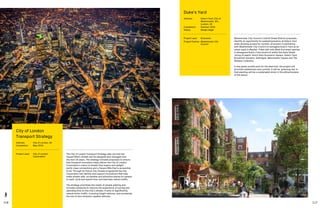
Top 3 Improvements
1	 	Increase in throughput efficiency as
measured in people-per-hour (pph) from
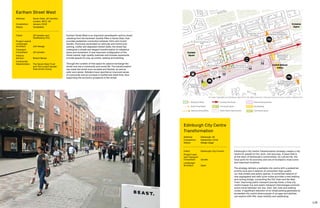
29,000 pph to 77,000 pph (= 266 per cent
increase in efficiency).
2	 	Reclaims up to 37 per cent of the public
right-of-way from automobiles and
powered vehicles.
3	 	Provides for an enhanced, safer and more
sustainable public realm though wider
sidewalks, protected bike lanes and
stormwater run-off filtration beds.
	 What is innovative about this project?
It re-examines the potential capacity and
efficiency of a street when analysed using
capacity measured as people-per-hour and not
vehicles-per-hour thus removing the inherent
current bias against multi-occupancy vehicles. It
reconceptualises the street to reflect the evolving
shared and autonomous trends in urban mobility.
	What is the impact on the street and
its users?
37 per cent of the street right-of-way is shifted
from the current powered vehicle use to active
transportation, such as cycling and walking, and
enhanced public realm uses.
Wilshire Boulevard Study
Address:	Wilshire Boulevard, Los Angeles, USA
Status: 	Design stage
Client:	Lyft
Project Lead
and Landscape
Architect:	 Perkins+Will [Mobility Lab]
Transport
Consultant:	NelsonNygaard
150 151
The University of Warwick is developing an ambitious
masterplan to inform its growth for the next 30 years. An urban
fringe location combined with poor transport connectivity and
a lack of credible alternatives to the private car are major
constraints to the plan’s delivery. This project develop a
transport strategy aims to deliver a transformative change in
available mobility options through smart solutions such as
micromobility, on-demand micro-transit and ride-share
underpinned by behavioural change to encourage alternatives
to car-use.
Reducing on-campus parking and cross-campus vehicle
movements, it enables the transformation to a green and
walkable campus.
University of Warwick
Mobility Masterplan
Address:	Coventry, UK
Completion: 	 2019
Status: 	Applied / in use
Client:	 University of Warwick
Project Lead:	 BDP
Transport
Consultant:	Steer
Acknowledgements
NLA would like to thank our Programme Champions, Supporters
and contributors whose support made this study possible.
Special thanks to the following people for sharing their time,
expertise and insights, and their own research, via interviews,
discussions and/or participation in NLA workshops:
Antonio Balboa,
Vice President, Sales and Application,
Powertrain Solutions, Bosch
Phil Berczuk,
Director, Head of Design, Steer
Chris Birch,
Director of Sustainability, Hilson Moran
Riccardo Bobisse,
Associate, Steer
Matthew Clark,
Associate, Steer
Paul Curtis,
Associate Director, Vectos
Lucette Demets,
Head of Urban, London  Partners
David Dew-Veal,
Strategy Consultant, KPMG
Richard Dilks,
Chief Executive, CoMoUK
Nicky Gavron,
Assembly Member, City Hall
Michael Hurwitz,
Director of Transport Innovation, Transport for London
Peter Jones,
Professor of Transport and Sustainable Development,
University College London
David Leopold,
Director, City Solutions, City Tech Collaborative
Greg Lindsay,
Director, Applied Research,
NewCities and Director of Strategy, CoMotion
George Lunt,
Technical Director, AECOM
Laura Mack-Titelius,
Head of London Connectory,
Urban Mobility Innovation Manager, Bosch
Eman Martin-Vignerte,
External Affairs, Governmental and Political Relations, Bosch
Danielle McGrellis,
Project Manager, UK Autodrive, Arup
Gavin Miller,
Director, MICA
Euan Mills,
Head of Digital Planning, Connected Places Catapult
Bruce McVean,
Acting Assistant Director, City Transportation,
City of London Corporation
Carlo Ratti,
Founder, Senseable City Laboratory,
Massachusetts Institute of Technology [MIT]
Stuart Robinson,
Strategic Planning Adviser, Transport for London
Andrew Roughan,
Managing Director, Plexal
Lucy Saunders,
Director, Healthy Streets
Andres Sevtsuk,
Associate Professor of Urban Science and Planning,
Massachusetts Institute of Technology [MIT] and Director,
City Form Lab
Rikesh Shah,
Head of Commercial Innovation, Transport for London
Michael Steinberg,
Head of Strategy, Programme and Communications,
Centre for Connected and Autonomous Vehicles (CCAV)
Sophie Thompson,
Director, LDA Design
Special thanks to Solomon Green-Eames, researcher
152 153
1	 Joseph Rykwert, 1978. The Street: The Use of Its History
2	 Robert Peberdy, n.d. Paths and Tracks. Victoria County History.
3	 Appleyard, Donald. 1981 Livable Streets.
4	Jacobs, Jane. 1961. The Death and Life of Great American Cities.
5	Hebbert, M. 1993. The City of London walkway experiment. American
Planning Association, 59(4), 433-450.
6	 Create Mobility Project. 2019.
7	 Mayor’s Transport strategy. 2018.
8	 Transport for London. 2019. Street Types for London.
9	 Mayor’s Transport Strategy. 2018. pp.270.
10	City of London. 2019. Transport Strategy.
11	 City of London. 2019. Transport Strategy pp.95
12	Parliament. 2019. The Government’s Cycling and Walking
Investment Strategy.
13	Dalton, Jane. 2018. Budget 2018: Environmental groups attack
government’s £30bn road spending plan. The Independent.
14	Centre for Connected and Autonomous Vehilces.
15	Gardner, Kevin., Melhuish, Tim., Mckenna, David and Rice, Thomas.
2006. The Benefits of bus priority within the central London
Congestion Charging Zone.
16	 London Assmebly. 2017. London’s Bus Network.
17	Topham, Gwyn. 2019. London records biggest rise in cycling
journeys in 2018. The Guardian.
18	 Mayor of London. 2019. Draft London Plan 2019.
19	McKinsey  Company. 2018. Reserve a seat—the future of mobility
is arriving early.
20	Hall, Jonathon; Palsson, Craig and Price, Joseph. 2018. Is Uber a
substitute or complement for public transit?
21	Rao, Santosh. 2016. London’s new late night alternative: The Night
Tube + Uber. Medium and Uber Under The Hood.
22	 Kim, Tammy. 2019. How Uber Hopes to Profit From Public Transit.
The New York Times.
23	 Transport for London. 2019. PHVs and the Congestion Charge.
24	Transport for London. 2018. Private Hire Policy Statement.
25	SteerGroup. 2019. Dockless bike share: a regulatory grey area.
26	Transport for London. 2018. Dockless bike share code of practice for
operators in London.
27	Wakabayashi, Daisuke. 2018. Self-Driving Uber Car Kills Pedestrian
in Arizona, Where Robots Roam. The New York Times
28	Laker, Laura. 2018. Highly charged: complaints as electric car points
block city pavements. The Guardian.
29	Vincent, James. 2019. Transport app Citymapper gives up on
reinventing the bus. The Verge
30	 Digit, 2019. Uber Chief Eyes Public Transport.
31	 Zenzic. 2019. UK Connected and Automated Mobility
Roadmap to 2030.
32	Sevtsuk, Andres. 2019. The Future of Streets: Los Angeles. MIT City
Form Lab.
33	 National Highway Traffic Safety Administration. 2015. National
Motor Vehicle Crash Causation Survey.
34	Vision Zero London. 2019. Latest Pedestrians And Cyclists
Deaths In London.
35	Transport For London. N.d. Who travels by car in London and for
what purpose? Roads Task Force.
36	 Transport for London. 2019. Ultra-Low Emission Zone
37	Transport for London. Roads Task Force – Technical Note 14. Who
travels by car in London and for what purpose?
38	 National Association for City Transportation Officials. 2019.
Blueprint for Autonomous Urbanism: Second Edition.
39	Morris, David. 2016. Today’s Cars Are Parked 95% of the Time.
Fortune.
40	Schmitt, Angie. 2019. Phoenix Rail Plan in Danger as Council Swipe
Cash. Streetsblog USA.
41	Section 106—An agreement whereby the planning applicant is
required to pay for off-site improvements to mitigate the impact of
the development.
42	Los Angeles Department of Transportation. 2019. Mobility Data
Standard.
43	Cherett, Tom.  Allen, Julian. 2019. Last mile urban freight in the UK:
how and why is it changing? Government Office for Science.
44	McCarthy, Sebastian. 2019. London high streets beat UK vacancy
rates despite pressure from rising rents. CityAM
45	Onita, Laura. 2018. High Streets in London are worst hit for closures.
The Evening Standard.
46	 Browning, Simon. 2019. I Drive in the Bus Lane. BBC News
47	 Norton, Peter. 2011. Fighting Traffic: The Dawn of the Motor Age in
the American City. MIT Press
48	 Wheels for Wellbeing. 2019. Guide to Inclusive Cycling.
49	Topham, Gwyn. 2018. Uber offers to share journey data with London
city planners. The Guardian.
50	Topham, Gwyn. 2019. All new UK cars to have speed limiters by
2022 under EU plans. The Guardian.
51	Forster, Andrew. 2018. London-wide byelaw explored to regulate
dockless bike hire. TransportXrta.
Endnotes
Profiles
Programme Champions
Programme Supporter
London  Partners is the Mayor of London’s official promotional agency. We support
the Mayor’s priorities by promoting London internationally as a leading world city in
which to invest, work, study and visit.
We tell London’s story brilliantly to an international audience in partnership with
organisations and people who have a stake in London’s promotion.
We promote London across the world; attract overseas organisations, events,
students and visitors to the capital; and help to retain and grow London companies.
Our work helps achieve good growth for London and Londoners, as outlined in the
Mayor’s economic development strategy.
Steer was established in London in 1978 and is now a global consulting firm
spanning 20 offices across four continents. At Steer, we understand the social,
economic and environmental drivers of urban transformation and work closely with
city authorities, planners and businesses to create the urban policies, plans and
strategies necessary for a sustainable urban future.
We have a long history of pioneering new and different ways of thinking and
continue to apply this to solve new challenges. We look at every city differently—its
people, value, uniqueness and character—and the integrated networks, ecosystems
and structures necessary to underpin its future success. Our expertise in new
mobility embraces new opportunities to enhance our cities while mindful to mitigate
potential negative outcomes.
As an independent business, we are proud of our unparalleled record providing
objective, and value-added advice to clients through understanding and meeting
their needs—unconstrained by a need or desire to promote specific engineering
or financial solutions. This philosophy is central to the way in which the firm
undertakes its work.
Part of the Greater London Authority family led by Mayor of London Sadiq Khan,
TfL is the integrated transport authority responsible for delivering the Mayor’s
aims for transport.
Supporting the delivery of high-density, mixed-use developments that are planned
around active and sustainable travel will ensure that London’s growth is good
growth. TfL uses its own land to provide thousands of new affordable homes and its
own supply chain creates tens of thousands of jobs and apprenticeships across the
country. TfL has a key role in shaping what life is like in London, helping to realise
the Mayor’s vision for a ‘City for All Londoners’. TfL is committed to creating a fairer,
greener, healthier and more prosperous city.
MICA is an award winning architectural practice formed by Gavin Miller and
Stuart
Cade based in London, Oxford and Edinburgh. The team works across multiple
sectors at a range of scales while maintaining the same attention to
detail
throughout. An analytical approach is applied to all projects, from strategic
masterplans and landscape planning to individual buildings, conservation
architecture, interiors and furniture. Through creative problem solving, engaging
with stakeholders and the local community, MICA is able to solve complex problems
and present solutions that appear simple in their elegance.
London  Partners
2 More London Riverside
London SE1 2RR
londonandpartners.com
+44 (0)20 7234 5800
@londonpartners
Transport for London
Palestra, 197 Blackfriars Road
London SE1 8NJ
tfl.gov.uk
@TfL
Steer
28–32 Upper Ground
London SE1 9PD
steergroup.com
+44 (0)20 7910 5000
@Steer_Group
MICA Architects Ltd
123 Camden High Street
London NW1 7JR
micaarchitects.com
+44 (0)207 284 1727
@micaarchitects
154 155
This research paper was published by New London
Architecture (NLA) in November 2019. The research
investigates how the current landscape of emerging
mobility technologies, transport policies and urban
planning approaches might affect the streets of the
future. It accompanies the NLA exhibition and events
programme Future Streets, taking place from November
2019 to January 2020 and forming part of NLA’s year-
round Transport  Infrastructure programme which
discusses the future of movement in London.
NLA is the independent centre for London’s built
environment, where professionals, politicians and the
public can meet, learn and have a voice on the future
shape of London.
Our activity involves research, events, exhibitions
and workshops that bring together our broad network
to discuss and action issues affecting London’s
built environment.
We’re London’s greatest advocates, sharing our
passion and knowledge about the capital and working
tirelessly—and often collaboratively—to deliver to
the highest quality. The breadth of our network and
the extent of our reach means we can respond quickly
to the needs of the built environment professions and
the city as they evolve. We are based in The Building
Centre, WC1, where our giant interactive model of
central London is free to visit six days a week.
Other NLA Research Papers include:
Principal Partners
nla.london
0207 636 4044 
info@newlondonarchitecture.org
twitter: @nlalondon
instagram: @nlalondon
BUILDINGS PLACES CITIES
S H A P I N G T H E
P O L Y C E N T R I C
C I T Y
156 157
Future Streets

Future Streets

  • 2.
    1 This NLA Researchwas published by New London Architecture (NLA) in November 2019. It accompanies the NLA exhibition and events programme Future Streets taking place from November 2019, forming part of NLA’s year-round Transport & Infrastructure programme. NLA, The Building Centre, 26 Store Street, London, WC1E 7BT nla.london #NLAFutureStreets #NLATransport © New London Architecture (NLA) ISBN 978-1-9993513-3-5 Programme Champions Programme Supporter
  • 3.
    2 3 Contents 04 Foreword 06 Definitions & Acronyms 10 Introduction 12 The History of London’s Streets 18 The Mobility Landscape 29 Emerging Mobility Technologies 38 Scenario Testing 58 Policy, Design and Practice: Building towards an Uncertain Future 64 Project Showcase 152 Endnotes 153 Acknowledgements 154 Profiles
  • 4.
    4 5 We aremoving quickly towards the next tectonic shift in the movement infrastructure of London. In the 19th century we ripped through the fabric of areas like Paddington, King’s Cross and Waterloo to create the rail network; in the 20th century we gave over our streets to the motor car; now, in the 21st we have big choices to make—do we use the various technologies at our disposal to replicate the mistakes of the past, or can we plan for and deliver a city where streets are for people, are not life-threatening and provide mobility services that are efficient and sustainable. The CREATE study Urban Mobility: Preparing for the Future, Learning from the Past, (see page 70) studied the experience of five European capitals: Berlin, Copenhagen, London, Paris and Vienna and how they are dealing with car use, congestion, pollution and traffic dominance. The report set out three phases of change - first, the car- oriented city, then the sustainable-mobility city and thirdly, the city of places. The drivers of these changes were seen to be the oil crisis in the 1970s, followed by growing concerns about CO2 emissions in the ‘90s. Then came the realisation that our inactive lifestyle was one of the key reasons for rising levels of obesity and related health issues. On top of that, it became clear that if cities like London and Paris were to remain competitive in a global economy, then quality of the environment had to be high on the agenda. London is making progress in delivering the third phase. The Congestion Charge reduced car usage in central London (although the space has since been filled up by private hire vehicles and internet sales delivery vans). Approximately 25 per cent of road space in inner London has been reallocated to walking, cycling and public transport over the last ten to 15 years. We are seeing major changes to the car-oriented infrastructure of the 1970s with the central London gyratories at Piccadilly/Pall Mall, Baker Street/Gloucester Place, Tottenham Court Road/Gower Street and Aldgate being removed. The new London Plan aims to substantially increase the levels of active travel and to deliver healthy streets. Yet while policies are clear, changes are hard-fought— inspirational plans like the improvements to Bank Junction were so contentious that the Chairman of the City Planning and Transportation Committee required a 24 hour police protection following threats from the black cab lobby; the delivery of cycleways is hindered by car driving voters concerned about minor delays to their journeys; freight consolidation needs greater political backing if it is to reduce the number of vehicles on the road. Meanwhile, the Government fails to make up its mind on Crossrail 2. Such infrastructure investment is key since the place-oriented city needs high-frequency and high-quality public transport services on main corridors while offering sufficient local diversity that residents can walk or cycle to access daily needs. There are substantial parts of the community who have not yet fully bought into the idea of the place-based city. At the end of this report, we set out the heaven and hell scenarios for the future. Heaven is where burgeoning technologies and ideas around mobility as a service help to deliver a city which celebrates place and its social benefits. Hell is a city where we end up repeating the mistakes of the 20th century, allowing technology to determine outcomes for the future of streets in London and we lose the current determination to make streets that support a healthy, happy and equitable London. There is much work to be done to communicate this shift from a car-oriented city to a city of places. NLA provides a vital forum where the discussion can involve all those with an interest in shaping a better city—the politicians, the planners, the development professionals and the people. This report provides a basis for that debate and illustrates ideas that can help deliver heaven rather than hell. Foreword Peter Murray Curator-in-Chief New London Architecture
  • 5.
    6 7 Definitions AUTONOMOUS VEHICLES Avehicle that can drive and navigate without human operation, also known as driverless car or self-driving car. BUS RAPID TRANSIT A bus-based rapid transit system featuring continuous dedicated lanes, off bus ticketing and more subway like stations. This is to improve reliability, increase capacity and improve passenger experience. CAR SHARING Sometimes referred to as ‘car clubs’, car sharing is a model where people can rent cars for short periods of time. Unlike traditional car rental, cars are often located at various locations around the city and can be accessed with a smart card or phone. Examples include Zipcar and City Car Club. CONNECTED AND AUTONOMOUS VEHICLES A vehicle that is both digitally connected and autonomously driven. CONNECTED VEHICLE A vehicle that is equipped with the ability to communicate data about its characteristics, such as position and speed, remotely via GPS or an internet connection. This data may be sent to the infrastructure, other vehicles or the regulator. DEMAND RESPONSIVE TRANSIT A form of public transport where transit vehicles (often minibuses or vans) alter their route based on requests from passengers. Passengers will often request the vehicle via an app or telephone service. DOCKLESS BIKESHARE A bikeshare system that does not require the use of a fixed docking station, but instead allows bikes to be picked up and parked anywhere. Payment and unlocking is conducted through an app. Examples in London include Jump Bikes and Lime Bikes. E-BIKE A bicycle with an electric assist motor that engages when the user pedals the bike. E-SCOOTER Electrically powered scooters, often accessed through an app or online platform such as Lime or Bird. E-Scooters are currently illegal for usage on public roads or footways in the UK. ELECTRIC VEHICLE A vehicle that is entirely propelled using an electrical engine rather than an internal combustion engine. HEALTHY STREETS A policy framework that seeks to ensure streets are designed in ways that promote positive health outcomes for the city. KERB MANAGEMENT Policies, enforcement and design strategies relating to methods of regulating, managing or pricing the use of the kerb for activities such as parking, pickup/drop-off or loading goods. LEVELS OF AUTONOMOUS DRIVING Level 0—complete human control of all vehicle operations. Level 1—the vehicle can assist either steering or acceleration/deceleration, for example with cruise control. Level 2—the vehicle can assist with both steering and acceleration/ deceleration. Examples include Tesla Autopilot and Lane Assist. Level 3—all driving can be performed by the vehicle, but requires constant driver supervision and occasional takeover. Level 4—all driving can be performed by the vehicle without driver supervision but only in controlled environments. Level 5—all driving can be performed by the vehicle in any environment or condition without driver supervision. MOBILITY AS A SERVICE A term describing a move away from the private ownership model of transportation towards platforms that allow mobility to be consumed as a service. It can take the form of a single platform through which users can book multiple different modes, including bikeshare, ride hailing and public transport. MOBILITY DATA SPECIFICATION Requirements established for new mobility services to share specific sets of anonymised data about their service with the public sector. For a dockless bike share operator, this could include data sets such as average usage of bikes, the routes taken and parking locations. This data can be used to inform policy and regulatory decisions. MOBILITY HUB A transportation hub in which people may interchange between different modes of transportation including bike share, ride hailing services and public transport. Mobility Hubs may also be integrated with other uses such as community facilities or retail. NEW AND FUTURE MOBILITY New business models, technologies and platforms within the transportation sector. OPEN DATA A policy that requires both public and private transportation operators to share various data sets regarding the use and management of transportation services. For example, Transport for London’s open data policy allows for the sharing of data on ridership and usage of their services. PERSONAL MOBILITY DEVICE / MICRO MOBILITY A term used to indicate transportation devices that allow for personalised mobility, as opposed to transport services on a schedule or a fixed route. Often used in reference to technologies such as dockless bikeshare and e-scooters. RIDE HAILING Ride hailing services are app-based platforms that allow customers to connect to drivers using their personal vehicles to offer taxi-style transportation. Drivers are not technically employed by the ride hailing company, but are classified as self-employed drivers accessing work via the platform. Examples include Uber and Lyft. RIDE POOLING A synonym for ridesharing. RIDESHARE Often as a part of a ride hailing service, users may decide to share their ride with other users who are travelling a similar route in order to receive a reduced fare or other incentive. SHARED MOBILITY Concept indicating the move away from the private ownership of mobility assets, like cars, towards accessing transportation through shared assets services such as car share and bike share. TRANSPORTATION NETWORK COMPANY A company that provides transportation services, often using an app-based platform to connect customers with drivers whom use their own vehicle to deliver the service. ACRONYMS AV Autonomous Vehicle CCAV The Centre for Connected and Autonomous Vehicles CAV Connected and Autonomous Vehicles DRT Demand Responsive Transport EV Electric Vehicle HS2 High-Speed Two MTS Mayor’s Transport Strategy MaaS Mobility as a Service PMD Personal Mobility Device TfL Transport for London TNC Transportation Network Company ULEZ Ultra-Low Emission Zone VED Vehicle Excise Duty VMT Vehicle Miles Travelled
  • 6.
    8 9 ‘People havealways lived on streets. They have been the places where children first learned about the world, where neighbours met, the social centres of towns and cities, the rallying points for revolts, the scenes of repression... The street has always been the scene of this conflict, between living and access, between resident and traveller, between street life and the threat of death.’ Donald Appleyard
  • 7.
    10 11 Throughout thehistory of city building, transportation technologies have driven the urban form—the historical dense urban core of most European cities emerged with a pedestrian’s walkshed in mind, while the suburbanisation of the 19th and 20th centuries was precipitated first by the tram and rail network, and subsequently by the mass adoption of the motorcar. In the past, designers and planners have worked on the assumption that ‘more mobility’ was always preferable, and that new mobility technologies should be accommodated with little regard as to the externalities they might bring. The consequences of the mass motorisation of society are more acute now than ever as we assess 60 years of car-centric planning. It is clear that the environmental cost, the social isolation, the crisis of inactivity and physical disconnection motoritsation has brought does not correlate with the cities we want to build and inhabit. Today, as a new set of mobility technologies are emerging, it is crucial to understand these new technologies as a means to achieving human-centric principles, rather than allowing new technology to be the determining factor in patterns of urban development and questions of city design. The primary space in which debates about the future of our cities will take place is the humble street and as such, the street should receive primary consideration from all disciplines concerned with the built environment—from architects and urban planners to technologists and sociologists. We must not underestimate the power and ability for streets to transform society both for the better, and worse. Streets are, after all, the primary public spaces in which ‘society happens’—streets are the places where the state of a nation can be seen. They are one of the final places where the rich must still meet the poor, and where homelessness or addiction are laid bare. The place in which great shows of political manifestation can take place, and where the diversity of races, religions and ages may be seen side by side. Streets tell us who we are as a society, they tell us what we value and, ultimately, where we are going. Given this central, yet often obscured role that streets play in society, it is no exaggeration to say that ‘when we change the street, we change the world’, to use the words of Janette Sadik-Khan, Chair of the North American National Association of Transportation Officials (NACTO). Introduction Key Findings 1 Technology is not a goal in and of itself. New mobility technologies must be understood as ways to enable broader societal goals such as health, social cohesion, equity and environmental sustainability. 2 Designers and policy makers must be proactive in shaping and determining how to implement new technologies. Mitigating the worst effects of unchecked technological determinism should not however deter technology that may aid in achieving societal goals. 3 Looking at the historical evolution of streets is crucial to plan for the future. It is important to acknowledge how in the past streets have progressively lost their function as places to accommodate new mobility technologies, which have, in turn, inadvertently reduced the quality of life in cities. 4 Investing in streets and public transport now should be prioritised, despite fears that it will be redundant in 50 years. Human centric design that ameliorates quality of life implemented now will continue to be ‘good’ design regardless of technological changes. 5 Flexibility must be built into design, yet the core principles and visions of what the city should be need to remain strong. 6 Streets will be the principle ‘arena’ in which new mobility technologies will precipitate—design and regulation must consciously address broader principles. 7 The societal externalities of the transportation choices must be reflected in price and in how these are prioritised on the street and, more generally, in the built environment. 8 The period of mobility ‘interregnum’, during which new technologies emerge and the status quo is challenged, is crucial in shaping how technology will affect society in the future. 9 Greater integration of technologists and urbanists is essential in order to achieve positive outcomes. Greater disciplinary integration is needed. 10 Positive change requires public support. Streets are the most fundamental unit of public space and are tied closely to our homes, our livelihoods and where we work. The public, including people of all ages and sectors of society, should play a large role in shaping the streets of the future and the role of new mobility. Right: Strand/Aldwych illustrative plan © LDA Design Previous page: South Molton Street in Mayfair, London © Grosvenor
  • 8.
    12 13 Placingthe Street in History ‘In transportation, we do very little studies about the past, but anyone who is concerned about the future must have an understanding of where we came from. If we are doing work about the future, we need to be aware of what is changing. If we are not aware of it, how can we possibly understand the full picture?’ Matthew Clark, associate, Steer In the current atmosphere of febrile futurism and technological determinism, it is necessary to situate our understanding of where we currently are, and where we are going, in the context of the history of the street. The history of the street is, after all, almost as long as the history of human kind as a whole. At its core the street is, as architectural historian Joseph Rykwert put it, ‘Human Movement Institutionalised’.1 If someone walks through a landscape, this act does not in and of itself constitute the creation of a path or a street, but when multiple people travel the same route repeatedly, a path or street is formed. Unlike the building of a private dwelling or an enclosure of land for farming, streets as a built form are inherently socially produced, used and inhabited from their very inception. The notion of a common route for movement through the landscape is older than the notion of a fixed settlement itself. ‘Routeways’ (set paths commonly travelled by humans) in the United Kingdom can be dated as far back as paleolithic times (10,000 BC), relating to hunter gatherer migration patterns. These common pathways through the landscape subsequently became the basis for the first non-nomadic fixed Neolithic settlements in the British Isles.2 Following this, the arrival of the Roman Empire lead to the institution of the first paved routes in Britain—what we current know as streets and roads were born. The alignments of many Roman roads still mark some of the most important streets in the country—notably, Oxford Street in London can trace its particular alignment to the Roman Empire. Throughout this long history, streets have served a dual purpose. Firstly, their movement function has allowed the exchange of goods, tools and services, and served as the infrastructure that allowed towns and cities to form in an ever increasingly interconnected network across the British Isles. Secondly, and equally importantly, the street has consistently served a ‘place’ function in the form of public space. In medieval market towns, the street was the primary public space in which goods were traded and thus essential for the economic vitality of the town. In the Georgian crescents of the 18th century, the street was the place to be seen promenading as a way to exhibit one’s social status and sartorial taste. In the Victorian terraces of 19th century industrial Britain, the street became a locus of social life, gossip, a place to informally meet neighbours and for children to play when parks and other more deliberate forms of public space were in short supply. Predating the relatively recent urban innovations such as the park, the square or the plaza, the street has consistently remained as the most ubiquitous and for many (particularly the poorest), the only public space truly accessible on a daily basis. This abridged history of the street is to place the ‘street’ or ‘road’ as we currently conceive it within its much longer and historically contingent context. What is evident is that the street has always performed a dual function serving as both space for movement and place. As this chapter will explore, the contemporary conception of the street since 1945 and the mass motorisation of society has been largely devoid of historicity in relation to the function of streets. As a society, our connection to our streets is deeply engrained and historic. This connection should be held in high regard as we make plans and envision how the streets of the future will look. The History of London’s Streets The history of the London street network can be closely linked to its iterative emergence as an urban region. The street patterns, street designs, widths and relation to the urban form can be linked to both the values of the epoch in which they were built, but equally importantly, street pattern and street geometry have been determined by the dominant transportation technology of the time. The oldest streets in London, including Oxford Street, can be traced to Roman times in which roads were primarily used for the movement of troops and supplies. As the city expanded in the medieval era, a highly dense network of streets and buildings, particularly visible in the City of London, emerged. This resulted from a lack of comprehensive planning or land use controls at the time. Additionally, with walking as the primary mode of transportation, the need arose to cluster businesses and homes together in great density, resulting in a dense patchwork of buildings, streets and alleyways. The widths of streets in these areas are of a human scale given the predominance of walking. Despite the Great Fire of London largely levelling the city in 1666, plans hatched by Sir Christopher Wren to rebuild the city’s road network in a rationalised manner never came to fruition, as the majority of rebuilding simply followed the haphazard and labyrinthine patterns that predated the fire. In the early 1700s, great expansions of the city took place, constituting the first examples of master planned and designed street networks in London. In the West End, private landowners built great plazas such as Hanover Square and Cavendish Square. These were entirely privately driven housing developments, with the streets and public spaces designed in ostentatious proportions in an effort to drive land values up. In the later Georgian period, additional urban extensions were built including housing and road network around Regent’s Park. More centrally, Regent’s Street exhibited the Georgian penchant for the crescent. Unlike the medieval period, streets were built wider to allow for separate pedestrian footways and carriageways in which horse drawn carts could move. Georgian extensions also deviated from the haphazard medieval street network, often following a grid structure and exhibiting perfect geometrical form resulting from the Enlightenment desire to impose rationality and order onto The History of London’s Streets the perceived chaos of the city. While the Georgians had built great new extensions to the city, density and sprawl had still been constrained by the transportation technologies of the time which were primarily the horse and cart. In the mid-19th century however, the emergence of railways, and eventually the Underground in 1863, opened the door for the first wave of suburbanisation in London. New suburban housing developments followed almost immediately after the construction of each new rail line. The development of the transportation network by private operators was as much an act of connecting existing destinations as it was a means to open new areas for real estate speculation. While the rail network did allow for the outward sprawling of London, it did not fundamentally change the use of streets. In fact, once one reached a train station, walking was still the primary means of reaching a final destination. Even as trams began to emerge onto streets, their low speeds meant that they mixed comfortably with foot and horse traffic. While London’s street network transformed immeasurably over the period examined, the balance between a street’s function both for movement and as public space remained. Similarly, a high density of land use remained the norm over the period as density was still determined by the walking distance of a human, even if trains did allow for longer commutes. Moreover, despite changes in transportation technology, the mixing of streetcars, horse carts and pedestrians on the streets remained a relatively equal affair with limited speed differential between different users meaning that negotiations over space could take place, rather than having a mode of transport dominating. The street still retained a multiplicity of uses—from protest to play, from trade to gathering. This status quo of negotiation and multiple uses of the street was to change fundamentally with the emergence of the motorcar and the motorisation of British society in the early to mid-20th century. The balance of movement and place that had characterised London’s streets for centuries was to be undone. Top: Sir Christopher Wren’s plan for rebuilding the City of London after the Great Fire in 1666 © RIBA Collections.
  • 9.
    14 15 Modernism andthe Re-invention of the Street The emergence of the motorcar and its mass adoption into society began to affect the use of streets and planning of London in the 1920s. As cars became more widespread on London’s streets, plans were drawn up for new infrastructure to accommodate them. In 1918, The London Society developed the ‘Development Plan of Greater London’ proposing a whole new network of main roads, bypasses, the north and south circular and a new orbital road that prefigures the current M25. In 1937, Sir Charles Bressey proposed a plan for London consisting in the construction of a series of radial motorways around the centre of London, and, although this plan was never fully realised, it would form the basis for future road building schemes in the capital. However, the majority of London’s streets were not fully transformed until after the Second World War. Up to this point, they remained sites of negotiation between different modes of transport and retained their multiple functions. The true influence of the motorcar became institutionalised in post- war efforts to rebuild and to modernise London, enshrined in planning documents such as Sir Patrick Abercrombie’s 1944 Greater London Plan and the book ‘Traffic in Towns’ by Colin Buchanan in 1963. With modernist transportation planners and the emergence of the entirely new discipline of traffic engineering, the conception of the street transformed radically from what it had been understood for thousands of years preceding. The street came to be seen as simply a conduit for moving and accommodating ever increasing volumes of motor traffic. The rise of the profession of ‘traffic engineer’ institutionalised this new understanding of the function of the street. Under the premise of objectivity, transport engineers referenced rising levels of car ownership as indication that roads must be improved, in practice widened, to accommodate increases in traffic. In their eyes, the street had to be designed by ‘experts’ who, with new methods of traffic forecasting, could now make ‘objective’ claims about the amount of motor traffic a street was required to carry, and thus the number of lanes that must be provided or where pedestrian crossings could be located. Seemingly objective metrics such as ‘vehicular throughput’ and ‘level of service’ were adopted into street engineering guidelines such that the only way to assess the success of a street was through its ability to move traffic, forgetting entirely the multiple other functions streets serve. These guidelines would then come to dictate the form of all future streets that were to be built—all of which prioritised the movement of motor traffic over all other uses of the street. In essence, the historic dual function of the street as both a place and site of movement was overturned, the result being that streets came to be seen as sites solely of movement for the car. Ironically, the ‘objective’ models of traffic growth upon which street motorisation was predicated came to be self-fulfilling prophecies—by designing streets entirely around the car and the accompanying vast road network expansion—‘induced demand’ encouraged the public to adopt the car, while other options such as cycling and walking became increasingly dangerous and uninviting options. The effects of this societal recalibration of the street came about quickly. On streets that had historically seen high levels of foot traffic, such as London’s many neighborhood high streets, pedestrians were relegated to narrow pavements and often hemmed in with guard rails while being forced to use designated pedestrians crossing rather than following century old desire lines. Great road building schemes were proposed, many of which destroyed large areas of London. Most notably the Ringway, although never finished, proposed a series of urban motorways that were to ensnare London’s centre. Only the Westway was ever completed, and while elements of the outer ringways eventually became the M25, the remaining proposals quietly dropped in face of strong protest campaigns against the motorway proposals. Rather than defending or fighting for the street’s multiple functions as a place and its multiple uses, the traditional urbanist disciplines of urban design, architecture and landscape architecture ceded the domain of the street to the newly created class of traffic engineer. Modernist housing developments in the post-war period, unlike their Georgian predecessors, turned their back on the street, and to as great an extent as possible, sought to keep pedestrians, bicyclists and any other form of activity other than motor vehicles away from the street. This was reflected in developments such as the Barbican where pedestrians were intended to be entirely moved to an above-ground elevated plane. For the first time in history, the ‘place’ function of streets had been relegated entirely—urbanists were now convinced that ‘places’ should be moved away from the street, while the street was surrendered to motor vehicles. Left top: ‘Development Plan of Greater London’ by The London Society, 1918 Left bottom: Current map of London road network Proposed roads Existing roads
  • 10.
    16 17 An InheritedInfrastructure It was only after the full effects of road building began to be felt that questions over the street and its function began to come back into focus. Public opinion began to turn against the rampant accommodation of the motorcar at all costs as the impact of projects such as the Westway become more clearly visible. Additionally, the growth of the environmental movement, instituted with the inaugural Earth Day in 1970 and the oil crisis of 1973 played into a reduced appetite for motorcar accommodation. Perhaps most importantly, the political will and finances began to dry up for large road building schemes. In the field of urban design, work by scholars such as Donald Appleyard called for a reinvigorated attention to the street and its importance for the health of neighbourhood; socially, economically and environmentally.3 Of particular note, his work sought to quantify how levels of traffic affected people’s relationships with their neighbours, proving that greater levels of traffic reduced the number of friends and acquaintance resulting from their inability to easily cross the road. Another key milestone in the rediscovery of the role of the street as a place has been the seminal work of Jan Gehl with his first publication ‘Life Between Buildings’ published in 1971 and translated in English in 1987. Gehl has focused his whole career advocating for designing urban spaces at human scale, shifting the attention to the role that public spaces play in the urban life, and reclaiming the role of streets for pedestrians and cyclists as opposed to cars. In the US, Jane Jacob’s canonical book ‘The Death and Life of Great American Cities’ made the case against modernist planning ideology, arguing for a refocused attention on the worth of a vibrant and active street life in the ecology of a city.4 At the time, this viewpoint flew in the face of all planning and design orthodoxy which had, as noted, entirely turned its back on the street. In London, the failures of modernist approaches to the street could be seen playing out in developments such as the Barbican. Despite being hailed as a landmark architectural piece, the elevated network of pedestrian walkways was not as successful as predicted, quickly falling into disuse.5 Inhabitants of the City of London far preferred the ancient network of streets—seemingly incomprehensible and irrational by the planners of the time, the century old network allowed for direct and convenient movement between destinations, in stark contrast with the elevated pedway system that people found to be unintuitive and confusing to navigate. People quite literally voted with their feet—shops on the elevated system struggled from a lack of passing trade, while ground level businesses on the street continued to prosper in the City of London as it had done so for thousands of years previously. Undoing a society that was now simultaneously dependent and addicted to the automobile proved a slow and difficult task. The institutionalisation of the logic of automobile supremacy was embedded so much in society to the point that unpicking such a status quo in order to design for human considerations would require both great political capital and a change of mindsets within the public, professionals, academics and institutions. Looking Back to Look Forward: The Future of the Street Over the past 20 years, a fundamental shift towards rebalancing streets to give priority for public transportation, pedestrians and bicycles, alongside their function as public spaces, has been taking place in London. Progress has been slow, but steady in terms of concrete built projects. Perhaps most importantly, mindsets within city governance, Transport for London (TfL) and the public have begun to shift. Yet, at this moment in time, new questions are emerging as to how new development in mobility technologies will impact the city form in the future. There is a danger that, as with previous mobility technologies, urban form and street design simply adapt to accommodate new technologies without scrutiny as to the societal consequences. Such a technologically determinist approach to the future of streets would potentially be detrimental for the quality of life in cities. Works such as this book will help to foster such conversations about the future of our most important of public spaces; our streets. By examining the history of streets, both specifically in London and more broadly, we can understand two key lessons as we enter this new period of change. Firstly, that our current conception of the street as a place primarily for the movement of large volumes of motor traffic as being a highly temporally specific conception, one that is largely the invention of the last 60 years and is a departure from the vast majority of human history that has consistently seen the street as a space for innumerable activities. Secondly, that allowing technological developments to drive the way in which we design and build streets will likely lead to negative and unforeseen consequences that will not best serve the health and vitality of cities. The environmental ruin and road deaths that society uncritically accepts as the price we must pay, in addition to the loss of the street as a public space in service to the automobile, is the biggest living testament against technological determinist planning. With the emergence of new technologies, we now have the chance to make pragmatic steps from both these learnings. Firstly, we can once again reorient streets to become places that foster movement as well as a broad range of other social and environmental functions. Secondly, we can use new technologies to enable this vision, but historicity tells us that we must incorporate these new technologies in a critical and deliberate manner, rather than letting them drive how we design and plan our cities. Works such as this book will help to foster such conversations about the future of our most important of public spaces; our streets. ‘We, as a society, must have a broad conversation about what kind city we want to inhabit, and how technology might help us realise that.’ Lucy Saunders, director, Healthy Streets
  • 11.
    18 19 The MobilityLandscape Transportation Trends in London Transport policy in London has shifted markedly in the last 30 years. Emerging from the post-war period in which the accommodation of motor traffic was seen as its primary concern, policy coming from both the Mayor and local boroughs has generally moved towards prioritising the efficient movement of people via public transport and active travel over that of private vehicle access. While traffic domination still blights most areas of London to varying degrees, some large steps have been made in terms of rebalancing streets towards people and more efficient modes of transport. Notable policies include the congestion charge, introduced in 2003 in central London and which reduced traffic by approximately 25 per cent, and strong improvements to the bus and rail networks. Much of the space freed up by reduced traffic volumes has been reclaimed as pedestrian space and reallocated for protected cycling routes as a part of the Cycleway (formerly Cycle Superhighway) network. According to research initiative CREATE6 which looked at the broader trajectory of European city transport policies in relation to congestion and transportation over the past 40 years, London has added over one million residents in the last 20 years, and yet traffic congestion has remained largely static, indicating that the general shift in transport policy is moving greater numbers of people more efficiently. A clear indicator of this broader shift in policy can be found in the Mayor’s recent transport strategy, setting out in no uncertain terms the city’s stance on streets: ‘London’s Streets should be for active travel and social interaction, but too often they are places for cars, not people’.7 While this broadly positive trend in policy and design has made progress in reclaiming streets for more human centric uses and has begun to rebalance streets as both movement and place functions, the emergence of future technologies could become a potential distraction in this policy endeavour, or at worst, a major hindrance in achieving the goals of a more human centric transport system. Policy making and design relating to transportation and streets in London must remain resolute in this vision as we enter a period of feverous technological change in the mobility sector, this chapter explores the state of current policy and how it currently responds to new mobility technologies. Policy TFL AND THE MAYOR’S TRANSPORT STRATEGY The Mayor’s Transport Strategy (MTS) is the main policy document which sets out the current administration’s policy goals for transport strategy in London. Underpinning the strategy are the growth predictions that estimate London’s population will grow from 8.7 million to 10.8 million by 2041, resulting in an increase from 26.7 million daily trips made in London today to around 33 million daily trips in 2041. In order to accommodate this growth, TfL sets the target of increasing trips made via walking, cycling or public transport from the current level of 63 per cent to 80 per cent by 2041. In fact, from a purely efficiency standpoint, maintaining the current modal would lead to increasing congestion causing a decline in economic competitiveness, along with spiralling healthcare costs of an ageing and increasingly physically inactive population. While largescale investment in heavy rail transport projects such as The Elizabeth Line and the Northern Line extension do play a part in moving towards this target, the principle realm in which this goal will be achieved is on the streets of London. Already, eight out of ten daily trips in London are made on the road and almost all rail-based trips involve a movement to and from the station, which requires use of the street. TfL estimates around five million daily car trips could feasibly be walked or cycled. As such, the MTS focusses on moving people on streets more efficiently by rebalancing the allocation of space on streets towards active modes. Additionally, it seeks to reorient streets towards their function as ‘places’ rather than simply transportation corridors. Central to this vision is the adoption of the ‘Healthy Streets’ approach. This approach is based on the understanding that the design of a street should not simply be to prioritise the moving of as many motor vehicles through a space as quickly as possible, but rather to recognise the importance of streets in determining a whole host of societal outcomes, and thus designing them accordingly. At the core is the idea that in order to address the growing crisis of inactivity, it is necessary to build activity into people’s daily routines and the best way of doing so is to build streets which allow people to safely walk and cycle as daily activities. Healthy Streets recognises the need to address other healthy indicators in tandem—for example, the need to reduce people’s exposure to traffic pollution; the need for easily accessible public spaces to improve mental health and the need to reduce traffic injuries and deaths on the roads. This approach mandates that all of these outcomes must be considered when designing a street, and that they can only be addressed together. As a policy framework, Healthy Streets seeks to institutionalise a new way of conceptualising what functions a street should serve and a way to affect long term culture change with regard to how TfL and governance across London view the function of streets. While in the past the transformation of streets towards more sustainable and human-oriented design would require the work of a particularly driven individual, or the alignment of particular political interests, the Healthy Streets framework seeks to institutionalise a new understanding of how we should conceptualise the purpose of streets at all levels of governance, design and engineering. ‘Healthy Streets as the policy framework gives people the agency to ask the questions and to do things differently than they have been done before’ Lucy Saunders In addition to the Healthy Streets approach, since 2014, TfL has adopted the ‘Street Types for London’ framework8 as a means of understanding and classifying a street based on 5 miles 5 km 0 0 Number of daily car trips that could be switched with walking, cycling and public transport Source: Mayor’s Transport Strategy, March 2018 More than 3000 2000 – 3000 1000 – 2000 Less than 1000 No trips
  • 12.
    20 21 its importanceas a movement corridor, and as a place. The use of this approach helps to reconceptualise the broader understanding of streets not only as having a movement function, but also their function as places. The use of the Street Types matrix can help to understand a street in terms of its function within a broader network of streets and the transportation system as a whole. The Healthy Streets approach, used in tandem with the Street Types matrix, ensures that whatever the form and function of individual streets, the policies and practices implemented are serving to improve the 10 Healthy Streets Indicators. The Healthy Streets approach also forms the principle framework by which the MTS sets out its response to the emergence of future technologies. While relatively limited in detail, the MTS states that all new mobility technologies will be assessed against the criteria of Healthy Streets. For example, it is stated that while ridesharing may provide benefits over traditional single occupancy vehicle trips, ridesharing should not be allowed to become a more attractive option than the lowest impact modes of walking, cycling or public transport. ‘It is not yet clear which precise measures will be needed to do this over the full course of this strategy to 2041. The Mayor’s approach to developing these measures will be based on a set of principles derived from the Healthy Streets Approach, set out in Policy 23. TfL will monitor changes to any transport services or technology that could affect how Londoners get around or experience London’s streets.’9 In this sense, it is encouraging to see that TfL clearly supports the broad idea that the implementation of new mobility technology should not be seen as a goal in and of itself, but rather that new technologies should be appraised and implemented only in support of existing goals to improve the quality of life and the vitality of streets in London. However, this policy response has received critique on two fronts. Firstly, it is almost an entirely reactive approach to the regulation of new mobility technologies. The first wave of ‘disrupting’ mobility technologies, such as ridesharing services like Uber, have shown that reactive regulation is much more difficult to implement than proactive regulation and can often come too late to prevent the worst negative effects of ‘disruptive’ mobility services. Secondly, as Peter Jones, Professor of transport and sustainable development, University College London argues, simply assessing new mobility technologies on the Healthy Streets approach is too limited in that it does not necessarily consider the wider transport ‘network implications’ that a new mobility technology may have. A new mobility technology at ‘street scale’ may be seen as relatively harmless, but when considered within the context of the broader transport network, it may have an overall net-negative impact on meeting transport objectives. LOCAL COUNCIL POLICY While the Mayor and TfL are key in setting the broader strategy and direction that London as a whole may be heading to, the implementation of such grand strategies relies heavily on the cooperation and coordination of policy with local boroughs. TfL controls only five per cent of all streets in London, with local borough councils having jurisdiction over the remaining 95 per cent. For this reason, it is essential to understand how different councils’ streets and transport policies have developed. The sheer size and diversity of urban conditions in different boroughs necessitates looking at two main typologies of council—that of inner London, characterised by a higher density and better public transport; and outer London, characterised by a lower density and a higher car dependence. INNER LONDON: THE CITY OF LONDON The City of London exemplifies perhaps the most extreme example of transportation planning shifting away from the automobile towards more human centric street design and sustainable transportation. As noted earlier, the post-war period sees the adoption of a policy to build a comprehensive network of elevated pedestrian paths, while space is made for the construction of high capacity dual carriageways, including Lower Thames Street and London Wall. At a diametric opposite, the recently completed City of London Transport Strategy10 puts at its centre the theme of creating one of the largest areas of pedestrian priority in the country. It aims to have at least 50 per cent of all streets within the Square Mile as pedestrian priority or entirely pedestrianised by 2044. Key projects to constrain vehicular access have progressed in the last decade including the replacement of an arm of the Aldgate Gyratory with Aldgate Square and the recent closure of Bank junction to all vehicles except buses and cyclists. In relation to future mobility technologies, the Transport Strategy sets out a desire to work with technology developers to ensure that new mobility technologies help to meet existing policy goals set out within the strategy. In addition to using the Healthy Streets metrics to assess new technologies as they emerge, the document also sets a series of hard principles, with notably strong wording regarding the impact of autonomous vehicles (AVs) on street design: ‘Autonomous vehicles must not require any changes or infrastructure that have a negative impact on our streets, such as bollards or barriers.’11 The City of London proposes to establish a ‘Future Mobility Advisory Board’ comprised of technology experts, policy makers and industry members to help advise proactive policy-making in light of rapid change. This combination of measures will help to ensure that the benefits of new mobility technologies are integrated into the broader policy goals. ‘If someone has a mobility technology that will help us deliver our transport strategy, we are happy to work with them. However, we don’t want to get distracted by autonomous vehicles that may be some way off or by future mobility technologies that detract from delivering the priorities of our transport strategy.’ Bruce McVean, acting assistant director – City transportation, City of London Corporation INNER LONDON: WESTMINSTER The City of Westminster is another central London borough, characterised by a high level of public transport options with a high density of underground stations and bus stops. Plans for the ‘Oxford Street District’ are now being carried forward by the council in favour of a more ‘balanced’ neighbourhood- wide approach to public realm, despite a previous proposal to fully pedestrianise Oxford Street being refused planning permission. Oppositions from local residents also made Healthy Streets framework Source: Lucy Saunders Street Types Matrix, 2015 Source: TfL
  • 13.
    22 23 difficult toimplement other transport projects such as the Cycle Superhighway 11 which had been withdrawn. While TfL and the Mayor set a vision for London that moves away from the use of cars, the political complexity and context-specific dynamics of the capital may result in the implementation of policies that differ even from neighbouring local authorities. OUTER LONDON: WALTHAM FOREST Waltham Forest transport policies demonstrate that the autonomy of local authorities in London can provide the opportunity for accelerating positive change. Having won funding from TfL’s Mini-Hollands Scheme in 2015, the borough has rapidly implemented a network of protected cycleways, removed through-traffic from many residential streets, and enacted numerous pedestrian safety improvements. Waltham Forest presents a case study for how highly targeted funding in geographically contained areas combined with political will can enact rapid and transformative improvements. This approach also illustrates how different solutions are needed in different areas of London, depending on the urban form and local context. Unlike central London, in Waltham Forest density is much lower, public transport is less extensive and car dependence is much higher. Whereas a focus on pedestrianisation can serve higher density areas such the City of London, Waltham Forest has focused on enabling short to medium-distance trips to be made by bicycle through the creation of a high- quality protected network. This network starts at people’s homes with the removal of through-traffic on residential streets which then link directly into protected cycleways on main routes, creating continuous and connected routes to job centres and commercial areas. Cycling and ‘personal mobility devices’ will be essential in creating more liveable and healthy communities in outer London where neither the density nor capital exists for heavy investment in public transport. NATIONAL POLICY While transport policy in London has been progressive in terms of its stance towards the need for more sustainable transportation and the reallocation of space on streets, investment from central government has not always been aligned with this vision. In central government’s orthodoxy, road building and increasing capacity for vehicles is closely correlated with economic development strategies—a view that has remained steadfast despite other policies that may champion the merits of sustainable transportation or commitments to reducing vehicular usage. This mindset is reflected in the level of budget allocated for active travel improvements which have been set at around £400 million per year,12 a figure dwarfed by the £30 billion road building plan announced in 2018.13 This reflects a disconnect between how central government understands the role of streets and the vision that planners and designers have for streets at a local level. This disparity between central government priorities for streets and local priorities is no more evident than in London itself where new road building is not an option on the table. In terms of future mobility, central government’s most notable move has been the creation of The Centre for Connected and Autonomous Vehicles (CCAV), a body established to ‘support the market for connected and automated vehicles’ with the aim of ‘making the UK a premier development location for connected and automated vehicles’.14 The remit of CCAV has up to this point been very much focused on positioning the UK to harness the economic potential of becoming a hotbed Above: Aldgate Square, City of London, before and after Left: Oxford Street pedestrianisation proposal, © WSP, Westminster City Council and Transport for London. Visualisation by AVR London Before (2017) After (2019)
  • 14.
    24 25 for Connectedand Autonomous Vehicles (CAV) research and development by establishing the legal and policy framework to allow developers to begin manufacturing and testing their products in the UK. ‘The UK is the most advanced country in the world in terms of its governmental and policy framework as it relates to AVs’ Michael Steinberg, head of strategy, programme and communications, CCAV More recently, CCAV has begun to take a leadership role in setting a vision for how such technologies must be applied as they become commonplace. The ‘Future of Mobility: Urban Strategy’ published in March 2019 sets out the potential risks and benefits of CAVs, before establishing a set of nine principles by which the greatest positive outcomes can be achieved. Most notably, the principles clearly set out that future mobility technologies must not undermine public transport or inhibit cycling and walking. This principle aligns with the idea that future mobility technologies must be supplementary to existing public transport and active transport efforts, rather than a replacement. While these principles appear positive, there is a danger that they may conflict with the competing pressure to bring products to market as quickly as possible in order for the UK to remain a competitive bed for innovation globally in this sector. Furthermore, there exists little policy guidance from CCAV on concrete steps that are being taken in terms of legislation to ensure that these principles are acted upon or enforced. At the moment, they exist more as a ‘wishlist’ rather than concrete policy, and could be subject to overturn if a different government takes office, or the economic climate changes. Infrastructure Beyond policy, the delivery and design of transportation infrastructure has changed drastically over the last 30 years in London. STREETS The last 20 years have seen an almost complete realigning of how street design is approached in London. The era of the ‘predict and provide’ approach to street design and road building began to end in the 1990s as it became clear that for London to support its growth, a move towards the prioritisation of public transport and active travel was necessary, and that this could only be facilitated through the reallocation of street space. The first major step change in the allocation of street space happened under the Mayor Ken Livingstone in which the BusPlus scheme implemented hundreds of new bus priority lanes throughout London. The creation of new bus lanes peaked in 2003, a year in which 146 new bus lanes were inaugurated in London.15 This growth in bus priority was correlated with a huge increase in the total number of bus km operated, which grew by 35 per cent between 2001 and 2015.16 After the election of Boris Johnson as Mayor in 2008, the focus of street improvements shifted towards enabling cycling. The second generation of Cycle Superhighways, which began construction in 2014, were a step change in the delivery of cycle infrastructure in London, for the first time providing high-quality separated cycle lanes in central London. In the same way that bus use grew with the implementation of bus lanes, so too cycling has grown in correlation with the reallocation of street space—2018 recorded the highest growth in km cycled in London on record.17 Street infrastructural changes have not been limited to a rebalancing of transport space allocation, but also there has been a marked cultural shift to focus on a street’s function as a place of equal importance. With the two previous mayors, there was a prioritisation of singular modes (the bus and ‘I’m surprised at how little money is spent on street improvements in the national budget given how important streets are for the broader wellbeing of people. They should get a larger piece of the pie. Streets are really under invested and not valued for what they are really bringing to society.’ Lucy Saunders bicycle respectively), and Professor Peter Jones believes that we are now moving to a third position, where we achieve a more balanced approach to street design and the competing demands on street space, including accommodating non- transportation, place-based functions. ‘10–20 years ago, the big focus was on putting in bus lanes, at the expense of other things. That was replaced by a concern to provide for safe fast cycling at the expense of other things. It’s only relatively recently that TfL has begun to realise that we can’t just design for one mode at the expense of others, but instead that we’ve got to look at the street comprehensively and find a balance between all of the competing demands.’ Professor Peter Jones LDA Design’s director and landscape architect Sophie Thompson attests that transport engineers are now much more willing to prioritise placemaking as a part of street design, rather than rejecting it on the basis of a necessity to accommodate specific traffic volumes or because of a set of fixed highway rules. This new approach is clearly visible in the proposals of schemes such as Strand-Aldwych by LDA Design which seeks to create large areas of new public space around St Mary Le Strand church while also balancing this with the need to maintain bus efficiency and cycle safety. PUBLIC TRANSPORT The largest investment in London’s public transport network in recent years has been the construction of The Elizabeth Line, set to open in 2020, which will constitute the first new major rail line addition to the capital’s network in 30 years. However, taking decades to plan, fund and deliver, it is likely that London’s future transportation targets cannot be met relying solely on big infrastructure projects such as this if the growth in population is to be accommodated. Much more cost effective and rapid improvements of public transportation can be found on the streets as noted previously in relation to the creation of bus priority and safe bicycle infrastructure. Moreover, the new mobility technologies that may support or compete with public transport will emerge predominantly on the street given that it is an open environment unlike the Recommended London-wide strategic cycle network to 2041 Source: Mayor’s Transport Strategy, March 2018 5 mile 5 km 0 0 Stratfor d Walthamstow Chiswick Kilburn Camde n To wn Le wisham Cat ford Fulham Cit y Hounslow Richmond Wood Green Har ro w Wemble y Edgware Finchley Barnet Uxbridge Ealing Kingston Wimbledon Sutton C roy don Streatham Brix ton Purley Bromle y Orpington Eltham Bexleyheath Woolwich Ilford Barking Romfor d Upminster Heathr ow s
  • 15.
    26 27 rail network.As such, while it is likely that the rail network will remain at the heart of London’s transportation network, future public transport efforts will more likely revolve around connecting people to existing rail lines rather than widespread construction of new rail, particularly in outer London where density is too low to support rail investment. Projects such as High-Speed Two (HS2) and its uncertain future illustrate that the delivery of largescale infrastructure megaprojects relates too closely to political cycles to be relied upon when planning for the future of transportation in London. Large scale transportation infrastructure projects such as this must be seen more as macro-economic projects with goals of national economic growth, rather than the kind of day-to-day project that will truly improve the quality of life and urban experience in London. The projects that will achieve these ends shall be enacted on the streets rather than on the rails. SOFT INFRASTRUCTURE The suitability of investment in hard physical infrastructure at this point in time has been questioned more broadly. Chris Birch, director of sustainability at Hilson-Moran poses the question in relation to the money spent on rolling out physical fibre optic cables, that will now potentially be made obsolete by the 5G network. We are currently unsure as to the infrastructural requirements that future mobility technologies will have, and therefore it may be unwise to invest in hard infrastructure that will in the future become redundant as mobility technologies change. It could be suggested that rather than hard infrastructure, London should focus on the provision of soft infrastructure, such as the 5G network, data platforms and improved digital communication between existing infrastructure (such as traffic lights) and vehicles. Conversely, it can be argued that uncertainty about future technologies should not be driving hard infrastructure investment at all and thus uncertainty about the future is irrelevant when considering street investments. There will be a need for high-quality human focused public realm in the future regardless of any future mobility technologies, and thus now is a good time for invest in such improvements. One area of ‘soft infrastructure’ that TfL has been ahead of the curve in, has been data sharing. TfL’s ‘Open Data Platform’ allows anyone to access feeds of data regarding passenger ridership patterns and live tracking data of all vehicles and trains in the TfL network. This data sharing platform has been an enormous success in some ways, allowing for the private development of many transport apps (including City Mapper) that have helped encourage transport ridership. However, criticism of the lack of reciprocity has been levelled at the policy—while TfL shares its data, those that use it are under no obligation to share back with TfL to help improve service. TfL currently has limited data collection policies which may restrict the ability to which it can control and regulate future mobility services. Density, Housing and Land Use London’s projected increase in population of over one million in the next 20 years will place even greater pressure on the already strained housing market. A key element of accommodating the new population will be to integrate the building of new residential areas with transport policy to ensure that new residents have little to no need to use a car. Policy 1.2.4: ‘Making the best use of land means directing growth towards the most accessible and well-connected places, making the most efficient use of the existing and future public transport, walking and cycling networks. Integrating land use and transport in this way is essential not only to achieving the Mayor’s target for 80 per cent of all journeys to be made by walking, cycling and public transport, but also to creating vibrant and active places and ensuring a compact and well-functioning city.’18 In practice, this means locating new density adjacent to existing public transportation links, enforcing strong limitations on levels of parking provided as a part of new developments, and co-locating housing with commercial and other uses as a part of ‘mixed-use’ developments. The London Plan also stipulates that the Healthy Streets approach must be applied when reviewing development applications to ensure that the physical design and location of developments meets those principles. One of the biggest owners of land adjacent to transportation links is in fact TfL itself. As such, in the last few years TfL has been developing these sites in order to repurpose them as housing and mixed-use developments. All developments will feature at least 50 per cent affordable units and many are proposed to be located on car parks around stations in lower density outer London suburbs, such as Harrow. The emergence of TfL as an integral part of delivering new housing marks a broader shift in terms of the integration of land use planning, housing policy and transportation through an understanding that these areas cannot be addressed individually. ‘The role of transport operators is changing—we are one of the biggest owners of transport accessible land in London, it makes sense that we get the highest and best public use of this land’ Stuart Robinson, strategic planning adviser, property development, TfL While building new density adjacent to existing transport links is essential in order to create low-car communities—the amount of land that meets these requirements is relatively limited and as such these stringent requirements may reduce the rate at which new housing is delivered to meet population growth. Paul Curtis, associate director at Vectos suggests that new mobility technologies provide the opportunity to open up new development sites that do not currently sit close enough to public transportation. He suggests that a series of measures including the implementation of mobility hubs and car sharing agreements, might accelerate the development of suitable sites that currently do not meet the London Plan’s requirement for proximity to transport. Image on page 28: Les routes du futur du Grand Paris: shared utility networks, visualisation of Boulevard Peripherique-2050 © Rogers Stirk Harbour + Partners Number of Bus Lanes Year Bus lane introduction in London since 1968. Source: The benefits of bus priority within the central London congestion charging zone. Association for European Transport and contributors, 2006
  • 16.
    28 29 The Emergenceof New Mobility Technologies Introduction Despite often being referred to as ‘future’ mobility technologies, many of the technologies in question have already been rolled out onto the roads of London either as limited test applications, or as full commercial operations. Unlike some cities, London has been relatively strong willed in its regulation and control of private enterprise’s ability to launch new mobility products and services onto the streets without first establishing partnerships with local authorities and TfL. Additionally, quirks of the UK vehicle licensing system have meant that electric scooters have yet to see a widespread launch in the UK. As such, compared to countries such as the US, where regulation is less stringent and there is a greater culture of free market enterprise, London has not yet seen its transportation and streets disrupted to the same extent as other cities worldwide. However, by examining how regulation has, or has not worked, as well as the emergent problems in terms of street design that new technologies are already posing, it is possible to make better and more informed decisions about how to respond as new technologies continue to emerge, some of which may spur more fundamental transformations in transportation patterns. It is important to understand the timeframe and general roadmap that new technologies may emerge onto our streets. The period of ‘mobility interregnum’ that we are now entering in which the transportation status quo of the last 60 years is being challenged by new technologies and new ideas, will be key in shaping what kind of streets, what kind of cities and what kind of society emerges from this period of immense change. The pro-active policies and design responses that are implemented during this period will be essential in ensuring that new mobility technologies support the vision for healthier and more liveable streets, rather than distracting or negatively impacting this vision. Emerging Mobility Technologies Private investment in ‘new mobility technologies’ has rapidly increased since 2010, with McKinsey estimating that worldwide, around $110b of private capital has been invested into businesses that relate to future mobility technologies.19 The early examples of technologies we currently see on the streets of London are only the tip of the iceberg in terms of what investors are expecting to see in the longer term. Understanding how these early iterations play out will be key in informing what the longer term and more profound effects will be, and how policy and design must respond to ensure positive outcomes. RIDESHARE The rise of ‘ridesharing’ is perhaps the first great disruptor to arrive on London’s streets. Uber is thus far the only Transportation Network Company (TNC) to achieve a significant market share and has seen rapid growth in the capital. Launching in London in 2012, the service has quickly grown to around 50,000 drivers and around 3.5 million active users in London. The emergence of Uber has affected London on multiple fronts. The working conditions of drivers and operating practices have been strongly disputed by TfL, leading to the revocation of its permanent license as a private hire operator in 2017. Recently, it has once again been issued a temporary license to operate as TfL continues to investigate its employment practices. Perhaps the most concerning threat Uber poses is its potential to undercut public transport in London. Some early research from the US suggests that TNCs are moving trips away from public transport, walking and cycling to rideshare services.20 However, another study conducted in London showed that Uber was actually complementing the introduction of the Night Tube. This was on the basis that more Uber trips were being taken from tube stations during ‘Night Tube’ hours, indicating that instead of taking a cab home the whole way, people were now using the Night Tube for most of the journey, and then transferring to an Uber for the last mile.21 However, the recent IPO released by Uber states in no uncertain terms that they see public transport as a key competitor and that public transport riders are a key part of the market they seek to win over.22 Greg Lindsay, director of applied research, NewCities, argues that this should come as no surprise, given that TNCs such as Uber are only profitable in highly dense urban contexts such as central London. He argues that in lower density areas Uber still has to highly subsidise all journeys. A danger of considering research from the US for the UK context is that the regulatory frameworks are very different. London has been particularly strong handed in its attempts to regulate and control the rideshare market, as evidenced by TfL’s refusal to grant permanent licenses to Uber. Additionally, in 2015, in response to fears that Uber was creating increases in traffic in central London, Mayor Boris Johnson attempted to set a cap on the total number of Uber drivers allowed to operate in central London. While this was thwarted by central government at the time, it did not end attempts to restrict the operation of Uber. In 2019, TfL was successful in removing the congestion charge exemption private hire vehicles (the category Uber vehicles are licensed under) had enjoyed up to this point.23 This was passed onto Uber riders whom now must pay a £1 surcharge on all rides entering the congestion charge zone. In this case, the policy has effectively worked to create a price disincentive to taking rideshare in central London. Moreover, a 2019 Policy Statement from TfL states a desire to create new regulatory framework that ensures the Private Hire Vehicles regulation helps the city to meet the Healthy Streets policy goals.24 The statement sets out the need for a dual approach in London depending on context. In outer London, it is hoped that rideshare can work to support access to the public transport network, while in inner London it is intended that rideshare can play a key role in improving disabled access, as well as supporting inner London residents to not own cars.
  • 17.
    30 31 Regulation ofrideshare is of particular importance, as it is likely that many of the rideshare operators will, as technology develops, transition onto the use of autonomous vehicles. As such, ensuring that rideshare is achieving its purported benefits—that of reducing car ownership, supporting public transport, increasing shared rides and increasing disabled access—at early implementation stage, so that as AVs emerge, these beneficial outcomes may be elevated. PERSONAL MOBILITY DEVICES Other than the rise of rideshare, perhaps the most evident form of new mobility technologies on the streets of London has been that of dockless ‘personal mobility devices’. Beginning in around 2017, a series of dockless bike schemes began to emerge. Without the regulatory framework in place for councils to license these schemes, private operators were free to simply launch services without prior consultations with local authorities or TfL. This resulted in large numbers of bikes being dropped onto ill-prepared streets, often resulting in blocked pavements and clogging up what limited cycle parking was available. In response to this, local authorities used legislation designed to prevent fly tipping on streets with the purpose of clearing nuisance dockless bikes from the pavement and streets.25 TfL has since implemented a ‘Code of Practice’26 which sets out the expectations for dockless bikeshare providers. It requires that new operators engage with TfL and the different local authorities within which they seek to operate. Additionally, it sets minimum standards for parking (i.e. bikes must not be parked on a footway), and data sharing requirements. While this code of practice is not binding, for the most part operators have been willing to abide with it to ensure their bikes are not marked as ‘nuisances’ and removed from the streets. A new by-law proposed by TfL, yet to be implemented, would make it a legal obligation for operators to seek the approval of both the local authority in which they wish to operate as well as TfL. However, in the meantime, local authorities such as LB Camden and RB Kensington and Chelsea are already proposing local by-laws which would do the same thing, just at a local rather than city-wide scale. While it is evident that legislation must catch up with technology, the patchwork of different boroughs regulatory approaches means that bikeshare schemes are often restricted to seemingly arbitrary borough boundaries. This reduces the quality of the service provided, and currently hinder the possibility for dockless bikes to become a reliable part of people’s transportation habits. On the flipside, local control over schemes is necessary as the street conditions and transport infrastructure of each borough varies wildly, so allowing for local discretion over bikeshare is important for ensuring schemes are appropriate to their context. A regulatory mid-point must be found between the need for local considerations and the need for joined up city wide coverage and access. ‘The patchwork of boroughs approaches to regulation makes operating these services very difficult and reduces quality for end user in terms of reliability and usability. However, local conditions must influence how shared systems operate, for example, in terms of parking restrictions. London has a chance to improve significantly on the current situation if the mooted byelaw comes to pass and be implemented in ways that bring greater consistency from local authorities while also better addressing local needs. This is far from certain at the moment, but it is possible and would be a big step forwards for London’s cycling offer, health benefits, air quality and decarbonisation needs.’ Richard Dilks, chief executive, CoMoUK While e-scooters and their (lack of) regulation has caused them to be the subject of great public attention worldwide, London has remained relatively untouched by their presence. This is due to antiquated legislation that requires all electric driven ‘vehicles’ to have full insurance and registration. As such, no e-scooter sharing systems have had widespread launch in London to date. A recent trial of e-scooters in the Olympic Park on a fixed course has proved to be a success, but their full roll out is still a number of years away. London’s experience with the regulation of personal mobility devices (PMDs) has been characterised by proactivity and willingness to reach out to, build and maintain close relationships with the operators. TfL’s Commercial Innovation Unit is tasked specifically with building relations with developers as a means to ensuring their products assist in achieving the Mayor’s Transport Priorities. ‘Our role is to ensure that all these technological advances can be brought into TfL, supporting and complementing what we are trying to do with the Mayor’s Transport Strategy and at the same time making sure we avoid things that may negatively impact. We are working with the dockless providers and boroughs to say—there is demand for your product, but if you are deploying it on our streets, let’s make sure it’s safe, let’s make sure it’s secure. By creating that partnership and engagement, we are hoping to create an ecosystem of public private operators doing right for the city.’ Rikesh Shah, head of commercial innovation, TfL E-scooters and dockless bikes have presented differing challenges regarding regulation, but in both cases the problem stems from the same base issue: new technologies do not readily fit into historic mobility categories or regimes of regulation. As such, regulation is somewhat club handed— either overly stymieing the potentials of the technology to benefit (as has been the case with e-scooters), or the requisite powers to effectively regulate have not been in place (dockless bikes). This exemplifies the need for legislation to be proactive in terms of new classifications of vehicles so as to prevent mis-implementation of such technologies. AUTONOMOUS VEHICLES While the dream of automated vehicles playing a central role in London’s transportation mix is still somewhat distant, recent years have begun to see the first applications of autonomous technology in London. In 2017, the ‘GATEway Project’ launched a trial autonomous shuttle service in the Greenwich Peninsula on a fixed off-road route. More recently, the ‘Connected and Autonomous POD on-Road Implementation’ (CAPRI), advanced the Gateway project technology, launching an off-road route in the Olympic Park, shared with pedestrians and cyclists. The CAPRI project seeks to eventually launch onto the mixed traffic streets within the Olympic Park with the intention of proving the potential applicability of autonomous technology in certain semi closed environments such as ‘airports, hospitals, business parks, shopping and tourist centres.’ George Lunt, technical director, AECOM notes that the intention of the project is not to necessarily push towards the rapid launch of a commercial service, but rather to help develop both the technological side of AVs, including the control systems and fleet management, and to help advance the vehicle regulation that governs AVs. At the moment, as with e-scooters, there is no vehicle classification to allow the CAV pods to be used on the road, and so trials like CAPRI are essential in the government establishing standards that can be required of all new CAV technologies. The project is supported by funding from CCAV and is being done in close collaboration with TfL and central government. This more collaborative approach, bringing together multiple public and private stakeholders is in contrast with the approach seen in the North American context where an effective ‘race to bottom’ has emerged in terms of de- regulation as a means to encouraging CAV developers to test their products on the streets as quickly as possible with a view to launching commercial services. Competition between CAV developers has led to high levels of secrecy about the technologies being implemented in some trials in the US. It is arguable that this looser regulation, and competitive rather than collaborative approach was one of the factors that led to the tragedy in Tempe, Arizona where a pedestrian was killed by Uber’s autonomous vehicle pilot.27 The CAPRI application of the technology represents relatively closely what AECOM views as the roadmap for implementation—it is unlikely that AVs will launch as commercial services on trafficked streets any time soon, but we will most likely see them emerging in semi-closed environments such as campuses and hospitals. As such, this trial gives us a view into the short-medium term prospects for autonomous technologies in London. Dockless Jump bike on a London street
  • 18.
    32 33 ‘There isan argument going on as to who should be the integrator of different mobility services. In order for MaaS to work, you need a good public transport network and then new mobility services to fill in the gaps where the public transport network doesn’t work. Who is in the best position to do that? Arguably TfL, which has the policy objectives to allow the public transport network to be the backbone while also incorporating what the private sector has to offer in a way that supports, rather than undermines.’ Matthew Clark ELECTRIC VEHICLES The most imminent effect on transportation in London is the emergence of electric vehicles (EV) onto the streets of the capital. While there are still only 12,000 licensed EVs in London, there are two key points that we can begin to infer from their roll out so far. Firstly, the way in which electric charging infrastructure is installed may give us a good indication as to more broadly the way in which new technologies will be accommodated on streets. In some areas, electric charging points have been installed on pavements in ways that obstruct the use of the pavement for pedestrians, especially mobility and sight impaired people.28 This implementation contradicts the MTS policy that states that all technologies will only be implemented if they support the Healthy Streets approach. In this case, street design is being determined by the perceived need to accommodate the new technology of EVs, rather than prioritising the quality of the pedestrian environment as the Healthy Streets approach mandates. This indicates a difference between the stated policy, and how new technologies will actually be implemented. ‘It’s important to question how these new technologies start to incrementally shape streets. There is a danger with things such as charging points that you will get these incremental changes, and before you know it, you end up with the street you didn’t want because you’ve been asked to do lots of little things.’ Bruce McVean Secondly, the congestion charge and many borough parking permits do not charge electric vehicles as fees are based on emissions. There is the need to encourage the uptake of electric vehicles to reduce emissions and using a price incentive is an effective way to do this. However, this approach implicitly assumes that the only negative impacts of vehicle usage is the emissions that they create. We must eventually move to a model that reduces vehicle usage entirely—given the numerous other negative externalities beyond emissions that vehicles have on the quality of streets and public health. Moreover, as more vehicles become EVs, the amount of tax raised from vehicle excise duty and parking will continue to decrease if EVs remain excluded. Thus, there will have to be a tipping point when road pricing is not determined by emissions levels, but rather by another metric, such as distance travelled or average passenger occupancy. DEMAND RESPONSIVE TRANSIT The promises of Demand Responsive Transport (DRT) are great, but so far, successful applications of the technology are limited, in part due to restrictive regulation. Citymapper tried to launch a variable route bus which could re-route based on demand and people hailing it through the app.29 However, the current legislation in London that requires all bus routes to be consulted on made such a service difficult to implement. This shows again how existing legislation is not prepared to deal with new types of transportation and services that are emergent. In this case, as with e-scooters, outdated regulation is potentially holding back the biggest benefits that new transport technologies could bring. More recently, a TfL backed DRT service called ‘GoSutton’ has been launched in LB Sutton. The trial is a collaboration between TfL, the local bus operator, and private ridesharing technology supplier Via, who specialise in shared ride vehicles. It is too early to assess the success of the service, but much has been made of the potential for DRT services to fill in gaps in the network where density is too low to support high-quality public transport. Andres Sevtsuk, associate professor of urban science and planning at the department of urban studies and planning, MIT, casts doubt on this however, asserting that any area that does not have enough density to support high-frequency public transport will be unlikely to be able to support a high-quality DRT service without large public subsidy. So in effect, the subsidy just moves from a traditional bus service to a smaller privately operated DRT service. MOBILITY AS A SERVICE The potential of mobility as a service (MaaS) is that it would allow people to make decisions for each trip on one integrated platform, so that they can choose the most appropriate mode depending on the trip—be it public transport, bike share or rideshare. This will allow people to live car-free more easily, as they will have a plethora of different transport options for each trip, without need to own a car. TfL already has achieved a MaaS model in some senses— using a contactless bank card one can access almost all TfL services (except for Santander Bike share). However, new shared mobility start-ups tend to have their own proprietary apps (for example JUMP bike and Lime bike) that are not cross compatible, meaning that new ones launching in London are not being integrated onto one platform. Uber has integrated public transport30 into their app and in some regions they have also incorporated JUMP Bike share. However, there is a danger that multiple, incompatible ‘walled-gardens’ are emerging that are not cross compatible and thus reduce the quality of service to users, or the ability to encourage users to choose the most appropriate and sustainable mode of transport. Matthew Clarke suggests that TfL are well placed to take the initiative and try to integrate these multiple operators and modes onto one platform, to ensure that new mobility services are complementary to the existing public transport network, and can enable more people to take public transport by providing last mile connections and live car-free. ‘There is an argument going on as to who should be the integrator of different mobility services. In order for MaaS to work, you need a good public transport network and then new mobility services to fill in the gaps where the public transport network doesn’t work. Who’s in the best position to do that? Arguably TfL, which has the policy objectives to allow the public transport network to be the backbone while also incorporating what the private sector has to offer in way a that supports, rather than undermines.’ Matthew Clark A further danger is that MaaS services are privately launched with the intention of deliberately moving people towards privately operated modes. The Citymapper Pass offers users the chance to pay a single monthly fee that grants them full access to TfL services, as well as a set credit for taxi rides and use of dockless bikes share services. However, the TfL passes are being sold at below cost price with the intention of getting TfL users locked into their MaaS system, with the ultimate intention of moving them away from public transport and into more profitable private mobility services.
  • 19.
    34 35 Roadmaps andTimeframes While some new mobility technologies have already begun to impact upon streets and London’s transportation patterns, most of the technologies slated to have the biggest disruptive impact on streets and transport are still at inchoate stages. This is particularly true of autonomous vehicles for which numerous supposed deadlines for launches have been missed by a range of developers. Given this confused landscape of adoption of technologies, it is essential to lay out a broad framework as to expected stages of implementation in order to enact effective policy and design responses to the emerging technologies. With regards to CAV implementation, AECOM sets out that there are two factors that will influence the iterative roll out: firstly, the technical challenge, and secondly, the business model. Using this model, it is clear that autonomous technology implemented in closed environments (lower technical challenge) already exists, where a non-autonomous service was extant (for example tram services or internal airport shuttles). These environments are the most closed and often run on separate tracks as is the case with the Heathrow self-driving pods. The next logical step is to apply autonomous technologies in slightly less constrained sites such as business parks or hospitals where there is currently no such service provided. This road map for implementation offers policy makers and designers a clearer understanding of what are likely to be the first instances of the technology. As CAV technologies are implemented in closed environments such as business parks and hospitals, the effects CAV technologies have on mobility within these environments can be tracked. These limited scope applications of the technology can act as petri dishes in which urbanists can evaluate the wider impacts these technologies may have on cities. It is essential that during these closed environment tests, we begin to hypothesise about what the broader implications for the city will be. One example of learning from closed environment tests could be taken from the GATEway autonomous pod trial in Greenwich where a former bicycle lane was replaced with a dedicated lane for the exclusive use of the pod. Despite being only a trial, we can see that a human centric space such as a cycle lane has been reallocated for use by automated vehicles. It may be possible to learn from other such closed trials that if continued in the wider city, this approach would lead to a net negative quality of urban environment. Moreover, if the standards for AVs are developed based on these closed environment trials, we must ensure that the standards are rigorous enough to deal with not just closed settings, but rather are attuned to the complexity of dense urban centres too. The AECOM roadmap lays out two clear questions that remain unanswered. Firstly, in places where an existing business case does not exist with human operated vehicles (for example demand responsive transport in rural areas), will AVs significantly affect this and create a viable business model? Even if the technology is advanced enough to deal with operating an autonomous DRT service in a rural area as last mile connector, if the business case never materialises, it is unlikely CAV technology will ever actually be implemented in this use case. Secondly, it is unclear whether the technology will ever develop to the point at which is useable in an ‘unconstrained site’. The increase in technical complexity from a constrained site to an unconstrained site is many magnitudes. Some, including Andrew Roughan, managing director, Plexal, believe that this period of crossover in which autonomous services are launched in unconstrained sites will ultimately prove too difficult in terms of the multitude of regulatory and technical hurdles to clear, such that the dream of full CAV implementation will never be realised. While the AECOM roadmap sets out a probable timeline for implementation of AV, the Zenzic roadmap seeks to establish a timeline for the policy response that needs to take place to enable this. The Zenzic Roadmap is a collaborative effort of over 250 private and public stakeholders to establish a shared framework for the implementation of connected and autonomous vehicle technologies. The roadmap sets out key milestones, regulatory and policy changes that need to happen to ensure the implementation of CAV technologies in the UK in a ‘safe, rapid and competitive’ manner.31 The timeframe for implementation set out is highly ambitious and potentially overly optimistic. It aims for commercial trials for automated mobility services by 2024 with the intention that CAV services become more attractive propositions than their human operated counterparts by 2029. Thus central government envisions the widespread adoption of CAV services by 2029. This is an incredibly short span of time in which policy makers and designers must respond to ensure that the way in which these services emerge is in a societally beneficial manner. While the roadmap sets out key milestones for adoption of CAV technologies, it does not specify the manner in which CAV technologies should be applied. The macro-economic and national competitiveness impacts are prioritized, central government intends that we adopt such technologies as quickly as possible. Thus this report reinforces the paramount importance that urban policy makers, designers and planners are quick and efficient in setting the policy and design framework such that when CAV technologies land, they land in such a way that supports the principles of a healthier, more liveable and sustainable city are realised. Vehicle Approvals Licencing and Use Legislation and Insurance Public Desirability Investment Skills Automated Driving System Connectivity Ergonomics and Design Sensors Communications Digital Roads Intelligent Network Management Test and Development Personal Mobility Freight and Logistics Inclusive Transport NOW 2021 2022 2023 2024 2025 2026 2027 2028 2029 2030STREAMTHEME SocietyandPeopleVehiclesInfrastructureServices The Golden Thread sections of this report include; Contributing themes – articulate how many Milestones from each Theme contribute to the Golden Thread. Major deliverables – the culmination of long strands of interdependent Milestones – typically important final deliverables. Key enablers – the start of Strands that unlock many other Milestones. Typically they are the first step in achieving a significant number of other Milestones. Critical waypoints – Milestones which sit in the middle of long Strands. Often they are pinch-points with many preceding Milestones enabling them and many deliverables unlocked by them. These sections are supported by Golden Thread diagrams and deep dives. The diagrams and supporting keys help to visualise the Milestones and Interdependencies within each Golden Thread. The keys feature Milestone IDs which are unique to each Milestone. The deep dives explore the most important elements of each Golden Thread. For more detail on Golden Threads or to TRIALS, DEVELOPMENT AND ENABLING TRANSITION PHASE SCALE-UP AND REALISATION OF BENEFITS UK Connected and Automated Mobility Roadmap to 2030 / Zenzic Roadmap for the implementation of new mobility technology Source: AECOM Connected and Automated Mobility Roadmap to 2030 Source: Zenzic
  • 20.
    36 37 Theoryof Change As we begin to understand these more concrete estimations as to implementation timelines for new mobility technologies, it is also necessary to place them within the context of what is known as Gartner’s ‘hype cycle’ which estimates the general trajectory for the emergence of new technologies. With regards to new mobility technologies, we are still emerging out of the period of ‘inflated expectations’. The marketing materials and artistic visions of a futuristic city in which new mobility tech has solved all problems of congestion are beginning to be replaced with a more sceptical public discourse about what impact new mobility technologies will have. This new merging set of discourses is emergent from the realities that can begin to be seen on the streets— dockless bikes blocking sidewalks, e-scooters being ridden on the footway and the notable death caused by the Uber CAV testing program in Arizona to name a few examples. Moreover, urbanists have begun to theorise in more detail concerns that new mobility technology may drive a whole new wave of motorisation, undercutting public transport and ultimately having a net negative impact on the built environment. Given that we are now at a point in which greater understanding of the potential dangers of the technology, it is the ideal time to begin making proactive design and policy decisions so as to ensure that as we enter the ‘Slope of Enlightenment’ and mass adoption takes hold, we are prepared to ensure that the outcomes of this adoption are positive. The worst takeaway from this ‘period’ of ‘trough of disillusionment’ would to be to take away a false belief that the technology will never be realised or adopted. It may be easy to mistake the trough of disillusionment for the impossibility of the technologies. Such belief that these technologies are merely in the realm of science fiction may prevent proactive work to prepare for their eventual mass adoption, which according to the Gartner Hype cycle, is almost inevitable. Moreover, it is likely that this mass adoption will be slower and gradual, rather than a ‘mobility revolution’ as many have characterized it. Thus we must be aware of insidious and undirected adoption of technology. The example presented in the previous section regarding the placement of EV charging points is a pertinent example of not proactively shaping how the technology is implemented, but rather succumbing to a gradual insidious creep of technological determinism. CAPRI, autonomous pod trial at the Queen Elizabeth Olympic Park Hype Cycle showing the stage of CAV technologies in 2019 using the Gartner’s framework of emerging technologies Source: Gartner
  • 21.
    38 39 Scenario Testing Havingestablished the history of streets in London and how that has shaped the present, it is necessary to also look further into the future to understand the full possibilities and risks that future technologies present for London. Given the sheer complexity of the emergence of new mobility technologies and the sheer number of variables that will affect how the future of mobility unfolds, the final chapters of this report seek to investigate two distinct scenarios that can be imagined for the future of streets in London. The approach of scenario testing is one advocated for by Prof. Andres Sevtsuk who argues that it is only by testing out different scenarios that urban planners, designers and policy makers, can make sense of a highly contested and uncertain future. His research initiative ‘The Future of Streets’, run as a part of the CityForm Lab at MIT and formerly Harvard, has adopted such an approach in relation to its work looking at the future of streets in North America.32 ‘Heaven’ and ‘hell’ scenarios are presented – one in which technology is used to enhance the quality of life and meet policy objectives, the other in which a technologically driven dystopia emerges, regressing advances made in the livability and street design over the last 20 years. These scenarios not only illuminate possible outcomes, but also can be used to infer how policy making and design should respond so as to ensure technology is controlled and encouraged in ways that meet broader societal and urbanistic ideals. ‘We mustn’t start with how good the technology is. We must be tech agnostic. We must start with the desire outcomes, and then, if there is new technology that can help achieve these outcomes, we should consider how to use it to do good for the city. We need to ask: what does London look like in 2041? And if we set out a series of indicators for what we want our city to look like, we can ensure that whatever technologies we bring in, these are aligned to those outcomes.’ Rikesh Shah, head of commercial innovation, Transport for London
  • 22.
    40 41 Introduction The ‘heaven’scenario envisions how the current trajectory of reorienting streets towards human uses and their function in supporting a healthy city can be continued. This scenario examines how new mobility technologies might be used to enhance and support existing efforts to design and plan for a more human centric city, that moves away from 20th century technologies. It suggests some of the policies and design principles that will need to be employed in order to reach this outcome. In broad terms, the heaven scenario harnesses emerging technologies that reduce the need for private vehicle ownership and the number of single occupancy vehicles through a greater emphasis on ‘shared mobility’, in turn reallocating streets as public space and for active transport modes. Continued investment in a strong public transport network and increasing housing density in areas closed to public transport will see a more liveable London emerge, aligned with the Mayor’s vision for a healthier and more equitable city. ‘I like to imagine a future where shared mobility models and self-driving cars reduce the number of vehicles on the road, freeing up parking spaces that can then be reclaimed and transformed into public spaces that serve different social functions.’ Carlo Ratti, founder, Senseable City Laboratory, Massachusetts Institute of Technology [MIT] Automobiles Alongside the safety benefits of CAVs, the heaven scenario envisions that cars in the traditional sense cease to exist, and are replaced entirely by shared electric vehicles operated in fleets. The ultimate goal of policy and design responses to automobiles in the future must be to mitigate against the worst impacts they have created in the 21st century and ensure they play a sustainable role within a multi-modal system. Automobiles in this future are seen as simply one option among a plethora of mobility services available via a Mobility as a Service (MaaS) platform. Road pricing will discourage short journeys made by private cars, while the use of shared vehicles to connect to public transport is encouraged. The following principles establish how cars could fit into this vision of the future. AUTONOMOUS FOR SAFETY The safety benefits of all vehicles being autonomous are undeniable. The National Highway Traffic Safety Administration [NHTSA] crash analysis indicates that around 94 per cent of all crashes are the result of human error, usually on the part of the driver.33 In 2018, 58 pedestrians and 12 cyclists were killed on the streets of London accounting for 62 per cent of all road deaths in the capital.34 The adoption of level five fully autonomous vehicles on the streets of London would potentially lead to a complete elimination of such deaths, allowing London to achieve its Vision Zero targets.35 For this to be a reality, it must be accompanied by continued street redesign improvements that give greater space to pedestrians and cyclists. It must be ensured that autonomous vehicles always follow a hierarchy of street users and always give right of way to the most vulnerable road users; namely pedestrians, cyclists and other non-motorised mobility modes. This guarantee of ceding the right of way must not come at the cost of the pedestrian’s ability to cross the street as they please. CAV technologies must not negatively impact upon the way in which streets are designed—most pertinently, pedestrians must not be restricted from their right to cross the street freely. Moreover, as will be explored, the potentials for reduced lane widths, reduced street clutter and generally less auto-centric streets can be realised with complete automation. To maximise the greatest potential safety benefits of AVs as quickly as possible, Matthew Clarke proposes that highly dense areas such as central London (in which the greatest safety benefit from fully automated vehicles could be achieved) may ultimately become ‘autonomous-only zones’ in which only automated vehicles are allowed to enter on the grounds of improved safety. Conversely, Andrew Roughan argues that the complexities of getting an autonomous vehicle to function safely in a dense urban context such as central London may be too great, and that they are more suited to inter-urban and sub-urban contexts. As such, central London areas may require vehicles to be at least human supervised, killing the dream of full autonomy. However, even human supervised vehicles may still be equipped with much greater automatic breaking, sensing capabilities and remote speed limitation, meaning that the same safety benefits of full autonomy can still be realised. In the same way that the Ultra-Low Emission Zone (ULEZ)36 zone has been implemented, Central London should become a zone in which progressively more stringent vehicle autonomy safety requirements are implemented, given that private car usage is already very low. This could mean either requiring Los Angeles’s Vermont/Santa Monica intersection – ‘best case’ scenario, developed by Professor Andres Sevtsuk, director, MIT City Form Lab. Heaven Scenario
  • 23.
    42 43 AV toenter the zone, or simply requiring greater autonomous assistance, such as automated breaking and speed control. CONNECTED FOR EFFICIENCY Many of the greatest benefits of autonomy can already be realised with implementation of greater connectivity between vehicles and road infrastructure. It is envisioned that all road infrastructure will be able to connect and communicate with all vehicles on the road, be they autonomous or not. This would allow for dynamic re-routing of traffic based on road closures or to balance traffic volumes across different streets. Antonio Balboa, vice president, sales and application for powertrain solutions at Bosch, imagines that connecting vehicles to traffic control devices such as traffic lights could massively increase the efficiency of junctions by allowing for dynamic signal re-timing based on traffic volumes. Furthermore, if vehicles are fully connected to infrastructure, it will reduce the need for physical signage and traffic devices such as speed humps to control speed. Banned turns or speed limits could be enforced digitally, yielding great benefits in terms of reduced requirements within street design. Perhaps most importantly, fully connected vehicles will open up much greater possibility for effective and highly targeted road pricing mechanisms. Currently, road pricing (such as the congestion charge) are implemented by relatively unsophisticated methods such as number plate recognition cordons. The ability to use GPS tracking presents a much more efficient means by which road pricing can be implemented dynamically based on real time demand or levels of pollution. SHARED AND FLEET-BASED While the safety benefits of autonomy are well trumpeted by auto manufacturers. In order to reduce the total number of miles travelled by cars, increase public transport ridership and active travel, and reduce surface parking, it is essential that London moves towards a shared and fleet-based model of car usage. In fact, the benefits of shared and fleet-based automobiles are not even dependent on the adoption of autonomous technologies, many of these outcomes could be just as well achieved with non-autonomous vehicles. Matthew Clarke argues that the single most effective way to reduce car use is to reduce rates of car ownership. This can be achieved moving towards shared mobility and fleet-based models. ‘The average Londoner’s car is an incredibly badly used asset. It sits on the road outside people’s houses for most of the time. We can use existing technologies including car clubs, things like Uber and Lyft to reduce the need to own a car. If you don’t own a car, evidence from CoMoUK shows you use a car less.’ Matthew Clarke Adopting a fleet-based model also allows for the reduction of single occupancy vehicle trips by increasing the rate at which people share vehicles for trips. To reduce the total number of vehicle miles travelled, it is essential that low-occupancy vehicle trips are reduced. Currently in London, 60 per cent of all vehicle trips are single occupancy.37 Fleet-based services such as Uber Pool allow users travelling in a similar direction to be picked up and dropped off on route, thus increasing the average occupancy of the vehicle and sharing the cost of the journey. Thus, it is important that as AVs become commonplace, they are not privately owned, but become part of fleets, either cooperatively or privately operated. The principle policies underpinning this move to shared and fleet-based automobiles is dependent on two key policies. Firstly, the use of dynamic road pricing and secondly, the integration of all shared vehicle services into a multi-modal MaaS platform. Mobility as a Service integration is necessary to allow people to switch from ownership model where, once purchased, the car becomes the default mode for all trips, towards a model where the car can fill in gaps of the public transport network and act as a last mile connector. It is essential that TfL or a public agency becomes the principle MaaS platform, such that it can regulate shared ride services on the platform to ensure a diversity of operators, and to ensure rideshare services are primarily used to connect to transport services over the last mile, rather than being used for complete trips in highly congested areas. MaaS must be implemented in combination with an effective road pricing scheme that regulates the price of trips based on a number of factors. Rides that are shared with greater numbers of other passengers should be incentivised, as should rides that allow users to connect to public transport services. This will be particularly important in outer London where shared rides offer the opportunity to act as an effective last mile solution in lower density areas. Moreover, road pricing should be used to ensure that shared ride services do not compete with public transport on price and thus reduce its ridership. Additionally, the implementation of a system to fine or ban the operation of zero occupancy vehicles must be instituted. Without such a ban, the spectre of ‘zombie’ cars running without any occupants becomes a real possibility. This shared and fleet-based model has already begun to be adopted with services such as Uber Pool and carshare clubs such as Zipcar. However, with the right policy incentives and MaaS platform, the move towards completely shared and fleet models of ownership that supports public transport can be accelerated. ELECTRIC AS STANDARD For urban environments to fully realise the benefits of future mobility technologies, all cars must be entirely electric. As part of this transition, electric charging facilities should be accommodated in ways that don’t reduce the quality of the street environment. The City of London’s policy that all charging points should either be installed in the carriageway, or on existing off-street parking garages should be adopted and enforced across London. Additionally, correct application of the healthy streets approach will prevent EV charging points from being installed in obstructing places. Finally, the switch to EVs must be accompanied by the increased usage of road pricing as aforementioned. The loss in revenue from Vehicle Excise Duty (VED) that a move away from petrol-cars will generate must be made up through alternative methods of taxation. VEHICLES DESIGNED TO BE SHARED Vehicle design must adapt if sharing is going to become a new norm and attractive to all populations. In an autonomous future, the removal of the driver would remove the third party that currently mediates passenger interaction within a shared ride. For some populations, without this mediator, the idea of a shared ride becomes a potentially dangerous and unappealing one. New typologies of vehicle must emerge that enable people to comfortably share a vehicle without the driver to mediate interactions. The Design of Streets The approach to designing streets should not fundamentally shift away from the current paradigm that seeks to limit the negative impacts of cars while repurposing space within the street as public space, prioritising public transport and creating safe space for active travel. The emergence of future mobility technologies will however open up new possibilities in terms of the quality and possibilities for street design. A REDUCED NEED TO MITIGATE AGAINST CARS ‘Our approach to road safety for the last 60 years has been about how cars can move through as quickly as possible while mitigating their dangers, rather than how we can create an environment that is genuinely safe and comfortable for people walking and cycling. We must go back to the absolute beginning and ask—what is this space really for? When you question all of the assumptions about what a street is for, you end up with a better outcome.’ Lucy Saunders Many of the choices made in designing our streets are based on the need to mitigate against the worst effects of human operated automobiles. Even something as mundane as a kerb of a footway only exists in order to prevent cars from entering pedestrian space. The current drive to create ‘protected’ bike lanes stems from the fact that mixing with cars can be so dangerous, that for someone to safely cycle, they must have physical protection between them and the car. Moreover, vertical defection (speed humps) will no longer be required as speed will be controlled remotely. Full adoption of autonomy may push this even further to the point at which kerbs are no longer needed to delineate different parts of the roads, with pedestrians given full right of way no matter where they are in the street. Without the requirements that a human operated vehicle places on the street, much more experimental designs can be enacted that prioritise other uses of the street without compromising the safety or comfort of pedestrians and bicyclists. STREET DESIGN APPROPRIATE FOR CONTEXT Different approaches to street design will still be required in different areas of the city and on different typologies of street. In dense central London contexts, such as the City of London, the need to mitigate against human driving error will be removed entirely with CAVs, allowing street design to focus entirely on creating an environment that is catered towards seamless cycling and walking. This could involve the complete removal of kerbs and use of shared surfaces to remove any impediment on pedestrian movement through the street. CAVs would be restricted to very slow speeds, and only vehicles with a specific requirement for access would be permitted to enter, such as those carrying disabled people or performing specific delivery duties. In more suburban contexts in outer London, the need for delineated sidewalks, bicycle lanes and traffic lanes may remain more necessary with higher use of ridesharing services and lower pedestrian volumes. Manuals such as the NACTO Blue Print for Autonomous Urbanism38 begin to document in more detail the potential design guidance that could be incrementally adopted into street design guidance in London, depending on context.
  • 24.
    44 45 REMOVE CLUTTER Additionally,many of the things that clutter streets and often reduce the mobility of pedestrians and disabled people will no longer be required. Sophie Thompson attests that many of the most obstructing features of a street that prevent the provision of a high-quality pedestrian environment come from the need to convey messages to drivers—artefacts such as speed limits signs, directions and parking restrictions. These are often oversized in order to allow people travelling at high speeds to read and understand the information. If such messages are communicated digitally to cars, the need for large physical signs would be removed entirely. BUILD FLEXIBILITY INTO STREETS It is important to note that the benefits that an entirely CAV fleet of vehicles could bring to streets will not be realised immediately. Instead, there will be a relatively long period in which both human and CAV operated vehicles will coexist on streets. During this period of change, efforts must continue to improve streets based on the Healthy Streets principles and effectively balance the place and movement function of a street as per existing TfL policy. It is important that during this period of rapidly changing technologies, too little money is invested in specific infrastructure that will quickly become redundant (for example car parking), but also, changing technologies should not be used as an argument against investing in high quality street designs on the basis that they will be redundant as technology changes. A street design that prioritises vulnerable street users and is effective at renewing the sense of place in a street will be ‘good’ design regardless of the changing technologies. In this sense, human-centric street design should not be flexible to changing technology. However, it is essential that the way we design streets now does not inhibit positive change in the future. Phil Berczuk, director and head of design at Steer, notes that the greatest cost in redesigning a street is often the pipes and drainage realignment works that must accompany surface level changes. He argues that all projects that involve drainage realignment should be implemented such that kerb lines can easily be moved in the future, to give more space to pedestrians or bicyclists. ‘Design the infrastructure that supports the function of the street so that it doesn’t inhibit change in the future. The superficial surface works on a street are not that costly, realigning drainage and services are the costliest part. If we are doing street redesigns, they should so far as possible try to anticipate a different future and should be designed structurally so that they can be remodelled without changing the services.’ Phil Berczuk DYNAMIC STREETS The use of continuous shared surfaces without distinct kerb lines presents the opportunity to reallocate street space throughout the day to different uses. Currently, the allocation of street space is inflexible—the number of lanes allocated to cars is generally based on peak usage requirements meaning that during off-peak hours, large amounts of extraneous space is still dedicated to cars even though there is no need for it. With infrastructure connected to vehicles, streets could be dynamically closed, opened or restricted throughout the day. For example, if a street has many bars on it, it may be appropriate to ban vehicular traffic during the busy evening hours or set restrictions that prevent loading at certain times of day. While the connectivity between infrastructure and vehicles opens up great possibility for dynamically changing streets, it is essential that a standard is set to ensure a base level of quality, including safe space for cycling and ample pedestrian space at all times. The dynamic realignment of street space should be additional to this base level of quality, not in place of it. Public Space THE STREET AS PUBLIC SPACE IN THE PUBLIC IMAGINATION Society’s conception of the street as a public space has been eroded consistently over the last 60 years. The future of mobility offers the chance to reclaim this part of the city as public space. The redesign of streets to prioritise human activity and non-motorised forms of transport will spur a re- imagining of the public’s right to inhabit the street. This may include revisions to the Highway Code or a transformation in the way in which children are taught about the street. No longer should pedestrians be taught that they are guests in the street, that they must always cede to vehicles or that they must fear for their lives when crossing the street. Instead, a new public consciousness of their right to ‘inhabit the street’ and conduct activities that were previously restricted to designated public space (like parks) can return. These could range from children playing in the street, to trading goods, to social gatherings. RECLAIM PARKING AS PUBLIC SPACE One of the biggest claims to public space is from car parking. Cars are parked for 95 per cent of their lives and thus, if car ownership dies as a model, large amounts of street space would be opened up for other use.39 Land used for parking is ostensibly under public ownership currently, however, it is rented out for private use (the storing of vehicles) for prices incredibly below the worth of the land—both in terms of real estate value and the potential public benefit other uses of the land could bring. The reclamation of on-street parking for alternative uses could generate huge amounts of new public land. However, this transfer of parking to other uses is dependent on the model of private car ownership phasing out in favour of shared and fleet-based vehicles. Starling Crossing is an interactive pedestrian crossing, developed by Umbrellium, using LEDs to paint the road with markings that adapt to traffic circumstances and pedestrian requirements. This prototype was temporarily installed in south London in 2017.
  • 25.
    46 47 ActiveTravel NORMALISING CYCLING FOR SHORT TO MEDIUM DISTANCE JOURNEYS The improvements in street design and increased safety afforded by CAVs should contribute to making cycling a normal and safe choice for short to medium distance journeys in everyday life. We cannot simply rely on the improved safety of AVs however, enabling cycling relies on people perceiving roads as safe and thus as a part of all street improvements, designated and physical separated space for cycling must be created. Cycling holds particular potential in outer London where density is lower and there are fewer public transport links. Even if new mobility services such as DRT or ridesharing prove to be unsuccessful, these areas could see a cycling revolution that is not dependent on new technologies. Following the model of Waltham Forest Mini-Holland, targeted investment in outer boroughs could generate rapid improvement. The growing popularity of eBikes could prove to be key in enabling a broader segment of the population to try cycling and take it up for medium distance three to five mile journeys. ‘Cycling and e-bikes are the biggest potential for low density land use areas. eBikes mean that a wide range of people can cover huge distances, but If we want people to use bikes, we need to change how streets are designed.’ Lucy Saunders INTEGRATION OF CYCLING INTO THE PUBLIC TRANSPORT NETWORK The incorporation of dockless and docked bikeshare services into a MaaS platform would greatly increase the possibility for people to use cycling for the first and last mile at the end or start of a journey on the transport network. Presently, integration is somewhat haphazard—there is no guarantee that a dockless bike will be waiting at the end of your journey, and payment for different bikeshare services are not integrated with public transport. A fully integrated MaaS platform would allow for the seamless booking and transfer between public transport and dockless or docked bicycles, as well as providing a service that people could rely on, rather than opportunistically use as is the case currently. Public Transport PUBLIC TRANSPORT REMAINS CENTRAL Regardless of advances in mobility technology, it is essential that public transport remains the backbone of the transport system in London. Even with the increased efficiency that CAVs or ridesharing may bring, the physics of trying to move large numbers of people through limited street space means that larger, higher capacity vehicles and trains will continue to be the backbone of the mobility system in London. As such, it is essential that heavy investment in public transport continues regardless of external shifts in mobility technology. In the US, some have claimed that investing in public transport is a waste of money at this time as new mobility technologies will solve all of the issues that public transport claims to fix.40 This however is a fallacy given that in dense urban contexts, no amount of efficiency improvements yielded can resolve the physical constraints of moving large volumes of people. In outer, less dense areas, where public transport ridership is lower, investment should continue with new services seen as ways to improve ridership, rather than as full replacement. NEW BUSINESS MODELS If new mobility services are to be supportive of the public transport network, they must be integrated onto the same MaaS platform. The purchasing of tickets should be integrated with other services, such as bikeshare or DRT, so that customers can experience seamless transfers to last mile mobility solutions. Integration onto a MaaS platform may also allow for new business models for public transport to be developed. For example, if someone is taking a rideshare to the station, it may be possible that this part of the journey is priced such that the subsidy from it pays for the public transport portion of the journey entirely. In this way, public transport could move to an entirely free at point of access model. Andrew Roughan further suggests that Transport for London should investigate how targeted advertising on its network might be tailored to users based on their preferences. Revenues from targeted advertising could then be used to subsidy the cost of travel, helping to make the system free to use at point of service. Moreover, moving to a free at point of access system may become more politically feasible as public consciousness of the societal benefits of the transport system become more widespread. NEW FORMS OF PUBLIC TRANSPORT AECOM’s roadmap for the implementation of autonomous technologies cites fixed route, closed environments as some of the first places in which CAV technology may be applied. In this sense, public transport makes sense as a realm in which CAV technology could be first implemented within London. Already the Docklands Light Railway is fully automated. It is possible that bus services running exclusively in bus lanes could become automated as the technology progresses. This would allow for reduced running costs which could then lead to higher levels of service and increased hours of operation. Similarly, DRT services could be launched in outer London in support of the existing bus and rail network. DRT could provide door to door service that allows the disabled and elderly to reach existing fixed transport routes, and, in areas where level of service is low it may incentivise modal shift away from the private car if it is priced appropriately. Density and Urban Development NEW DENSITY IN PUBLIC TRANSPORT RICH AREAS Walkability and the use of public transport are in large part determined by the density of the built environment. London must continue to densify and create mixed-use developments in areas adjacent to existing public transport lines. The expansion of largescale rail lines is likely to be slow, and thus efforts to provide additional housing should be focused on areas that are already well connected. TfL’s recent work to develop the land next to station sites should be expanded. Furthermore, new development in already dense areas must be tied to the redesigning of street spaces. By using mechanisms such as S10641 , private developments should help to pay for the street improvements in locations adjacent to them. Developers must be educated to understand that the value of their development and land increases in relation to improve streetscapes, and that it is therefore in their interest to contribute towards improvements as much as possible. ‘The local authorities are going to struggle to invest into streets as they lose revenue from parking, so where are they going to find the money? It comes down to developers making a long-term investment in to streets and understand the added value they can provide to the development.’ Riccardo Bobisse, associate, Steer MINIMISE THE IMPACT OF NEW HOUSING DEVELOPMENT In more suburban areas of London where public transport is not as ubiquitous, the danger of urban sprawl induced by CAV technologies must be mitigated through strict applications of local plans requiring new developments to be located near to existing public transport while using the Healthy Streets approach to assess all new proposed developments. Additionally, all new developments should incorporate forward thinking strategies to prevent high car use by future residents. This includes the development of ‘mobility hubs’ as central points to all large developments. Mobility hubs would allow people to interchange between traditional modes (bus, train etc) and new mobility forms such as dockless bikes, car sharing services and DRT. These hubs could incorporate community focused facilities and become a central part of new housing developments. Additionally, there must be a focus on reducing the need to travel from new developments in the first place—through the integration of co-working spaces with high speed internet, the number of commuting trips from new developments can be reduced. ‘In a traditional transport interchange, you can change from a train to a bus, sometimes you can even change from a train or bus to a bike. But the mobility hub is taking it to the next level, integrating all forms of micromobility. Having bikeshare (including ebikes), car club, DRT, the mobility hub is not just about transport options but having other amenities there— a cafe, a gym, a delivery consolidation point, a community centre, a coworking space.’ Paul Curtis Accessibility The principle benefit for those with disabilities in terms of street design will be the removal of car-mitigating infrastructure on streets—including kerbs and signage that currently make the street difficult to navigate. Shared space schemes are often criticised by the disabled community for making street environs that are impossible to navigate, especially for the visually impaired given that they remove physical notifications, such as kerbs, that they use to help navigate and avoid traffic. As part of all the new street design schemes, visually impaired navigation must be considered as an integral part of the design process. This may be a set of physical design features such as tactile paving, but it may also be as a part of a digital platform that allows visually impaired people to receive auditory guidance via their smart device. Data Sharing DATA SHARING FOR ENFORCEMENT AND KNOWLEDGE BUILDING London should follow the lead of Los Angeles who have established a ‘Mobility Data Specification’42 that requires all new mobility services to share specific sets of data with the City. For scooters, this can include anonymised trip data, average usage of vehicles and other data points. The benefit of requiring this data to be shared means that TfL or the local authority can effectively regulate and ensure that operators are not contravening parking regulations or other operational activities. The mass collection of anonymised data can aid in managing how new mobility services are effecting the overall transportation network and inform both design and planning decisions in response. For example, if a particular route is receiving large numbers of trips via ridesharing services, it would be possible for TfL to infer that it may be worth providing some form of fixed bus route. Additionally, data points such as incidents of hard breaking on bikeshare bikes would be useful for identifying locations in which streetscape safety improvements need to be made.
  • 26.
    48 49 Outcomes The outcomesof the ‘heaven’ scenario envisage a situation where new technologies enable a reconfiguration of streets in which they enable active mobility and are reconceived as public spaces for public use. Regulatory measures, MaaS and pricing mechanisms ensure that new CAV technologies support rather than undercutting the public transport network, which remains the focus around which new high density developments are built. A strengthened public transport network, supplemented by new last-mile connections integrated via a MaaS platform. A greater mix of accessible mobility options to allow people to choose the mode of transport appropriate for each journey and thus live car- lite lifestyles. New radical human centric street designs enabled by greater external control of cars and CAVs. A continued focus on enabling active transport through investment in safe cycling and walking infrastructure. Renewed high streets supported by a reconceptualisation of streets as public spaces. An efficient and appropriate system of urban freight movement in central London. Freight Deliveries and the High Street URBAN FREIGHT MOVEMENT The rise in online shopping and food delivery services (eg. Deliveroo) has generated huge increases in the numbers of ‘last-mile’ deliveries being made to residential addresses. The Department for Transport reports this sector is growing at around 5 per cent annually43 with the vast majority of these deliveries being carried out by van or car. The City of London’s transport strategy sets out a clear and desirable vision for how to approach deliveries in the City in the future. AV trucks would be ideally suited to the movement of goods between urban conurbations. When such automated trucks reach the edge of London, the goods would be unloaded at a freight consolidation hub and distributed via a smaller vehicle to specific neighbourhoods. At the neighbourhood level, deliveries would once again be sorted at a ‘Last Mile Delivery Hub’ whereby they could be moved onto smaller, more urban appropriate modes of transportation suitable for door to door deliveries. Electric assist cargo-bikes in particular would be suitable for many dense urban contexts in London given that they require little space to stop for loading and the speed with which an operator can exit to make a delivery. This chain of sorting and consolidation of freight would entirely remove large trucks from the urban area of London, instead replacing it with smaller vehicles and bicycles, more appropriate to the dense urban context. A NEW MULTI-PURPOSE HIGH STREET Related to the rise in online shopping and increasing numbers of delivery vehicles, there is growing concern about the future of the high street and physical retail stores. While London has some of the lowest rates of unoccupied commercial space in the country, at just 7.4 per cent,44 there are signs that London is being hit by a struggling retail sector, with around 14 shops closing per day in 2018.45 It is essential that the function of London’s high streets begins to adjust based on these trends. The vitality of a street is in large part determined by the uses that front onto it, so for an active and healthy street life, it is essential that new models are found to keep high streets filled with active uses. Sophie Thompson posits that high streets must fundamentally change their function away from traditional retail towards more service-oriented businesses, community-focused hubs and infrastructure. She argues that this new function of the high street can be driven by concurrent design efforts to make shopping streets better public spaces. The design of the street, instead of simply being based on the model of allowing for as much parking as possible for potential customers, could become a destination in its own right in terms of its programming— pocket parks and playgrounds are examples of uses on the street that could turn the street itself into a destination public space, that in turn supports more community-focussed businesses and organisations that operate in the buildings fronting the street. More innovative ways of using single shops must be explored as well—the possibility for co-locating multiple businesses within single units based on different temporal opening hours is a possibility—a café by day may become a yoga studio by night. The future of the high street will be determined in part by changes in consumer behaviour, but its survival is dependent on leveraging the benefits that new ways of designing streets and placemaking can bring in order to make it an attractive destination regardless of the health of traditional retailing. Re-imagining London’s Inner Ring Road, Kennington Lane (see more at page 142) © LDA Design 2018 2020 2041
  • 27.
    50 51 Introduction The emergenceof a ‘hell’ scenario results from a failure to learn from the mistakes of the 20th century in which automobiles have been allowed to colonise city streets. It imagines a situation where the need to accommodate and implement new mobility technologies results in a series of policy and design decisions that end up prioritising new mobility technologies over all other concerns. The infrastructural requirements of the technologies override the principles of healthy streets, resulting in street designs that have no consideration for active transport or non-movement uses of the street. This transition will likely happen insidiously and as the result of many small decisions which alone seem innocuous, but that together, result in an overall reduction in quality of life in the city. Private sector-driven ridesharing services undercut and cannibalise public transport services, without effective pricing systems that reflect their true societal cost and the externalities the automobiles create. In outer London, car dependent sprawl and building typologies proliferate in response to increased demand for CAV accessible businesses and growth of jobs in this market. In central London, pressure to accommodate CAV technologies on key red routes controlled by TfL result in a shift in focus away from redesigning streets for active travel and public transport towards the accommodation of CAV technologies. In the ‘hell’ scenario, we end up repeating the mistakes of the 20th century, allowing technology to determine outcomes for the future of streets in London and slowly lose the current determination to make streets that support a healthy, happy and equitable London. Cars IMPLEMENTATION OF CAVS Just as electric vehicles have been given incentives such as reduced parking permit costs and omission from the Congestion Charge, it is possible that as CAVs become more prevalent, they will receive similar incentives for adoption on the basis that they provide much greater levels of safety, as well as being entirely electrified to meet emissions requirements. This dual need to incentivise adoption on the basis of safety requirements as well as emissions, may lead to a tipping point at which AVs are rapidly adopted and become the norm. This would correlate with Zenzic’s roadmap that states it intends for CAV policy in the UK to make them preferable to traditional vehicles by the year 2026. This presents a Catch 22 situation. If you implement stricter road pricing only on CAVs as they emerge, it is likely that full CAV adoption will never happen. But if you exempt CAVs from road pricing in order to incentivise adoption, it will be incredibly difficult to implement road pricing retroactively once people have adopted the technology and are used to it. The emergence of CAVs does not actually change the fact that at some point, someone will have to expend the political capital and face the difficult task of implementing road pricing on vehicles, autonomous or not. Professor Peter Jones argues that it will be very difficult to politically implement such charges, regardless of what the technology is in question. Thus, CAVs become common place in this scenario, replacing cars on a like for like basis, still without any effective road pricing mechanisms in place. This results in not only the same problems as before, but actually results in huge increases in vehicle miles travelled. In this situation, whether CAVs are privately owned or operated in a fleet-based model, the outcome is negative. REDUCE COST PER MILE—FLEET-BASED MODEL Without such road pricing mechanisms in place, CAVs would be quickly adopted by ridesharing services such as Uber who can now offer rides at incredibly low prices given that they no longer have to pay a driver. The salary of the driver in an Uber vehicle currently accounts for around 60 to 70 per cent of the total cost of the ride—with the driver removed, this will slash the cost of taking a ride hailing service. Ridesharing services are now the same price or cheaper than public transport. This reduce in cost will potentially generate a huge uptake in the number of miles travelled as there is little price incentive to take public transport. In outer London, instead of AVs acting as a last mile solution, many will instead choose to use the CAV services for the entirety of the journey all the way to central London, being dropped at their workplace. ‘The assumption is that people will be happy to share once we switch to autonomous vehicles. I don’t understand why sharing would become more attractive with autonomy. It will become less attractive if anything. At the moment, sharing an uber pool means a reduced cost compared to travelling alone. With AVs, the cost differential will be smaller so there will be less incentive to share.’ Professor Peter Jones Los Angeles’s Vermont/Santa Monica intersection – ‘worse case’ scenario, developed by Professor Andres Sevtsuk, director, MIT City Form Lab. Hell Scenario
  • 28.
    52 53 Without aneffective road pricing mechanism to make sharing a much cheaper option, it will likely not be adopted in any great numbers so as to offset the increase in vehicle miles travelled (VMT) generated as a whole by CAV services. REDUCED COST PER MILE—PRIVATE OWNERSHIP MODEL ‘Most of those who desire and can afford to own cars now will likely do so in the future.’ Professor Peter Jones The negative outcomes of even a fleet-based model of CAV adoption would be compounded further if the model of private ownership continues. There is little to suggest that it will not. For the incorporation of Tesla’s ‘Autopilot’ mode, one currently only has to pay an additional $5,000 on top of the base price of the car. Thus, without effective regulation to discourage private ownership, it is entirely possible that AVs will be sold directly to consumers thus losing even the potential of shared rides or any reduction in required car parking. In the private ownership mode, not only do AVs reduce the cost per mile of travelling but they also reduce the opportunity cost of driving—no concentration is required, thus the barrier to commuting huge distances in a car are removed. AVs will allow people to work or do other things while they travel. Furthermore, it presents the possibility of driverless ‘ghost cars’ with zero proliferating as people who use their private CAV to reach a destination send their CAV away to either circle the block or find cheap parking. Therefore, the total number of vehicles on the roads increases exponentially as zero occupancy vehicles roam the streets. Street Design INSIDIOUS CREEP The effect that such a shift towards an increasingly CAV dependent society has on streets is reciprocal. The requirements of CAV technologies will change the way in which streets are designed, and conversely, the way streets design will adapt to facilitate the mass adoption of CAVs. Already the rush to install EV chargers on streets is having a negative impact upon the quality of pedestrian environment in streets. Similar insidious reallocation of street space for cars could take place with things such as allowing EVs/CAVs to be driven in bus lanes as incentive for their adoption, as was the case in Norway.46 The desire to realise the benefits of EV/CAVs and thus incentivise their adoption may present a distraction from the Healthy Streets vision for streets. In this case, technology is driving how streets are designed rather than being used to support good design practices. THE RESTRICTION OF PEOPLE’S RIGHT TO THE STREET This insidious impact on street design may gain pace and become more totalising as CAV adoption becomes more widespread. If CAVs bring the safety benefits they claim, including the complete elimination of pedestrian and bicyclist collisions, this may ironically lead to a whole host of negative, unforeseen consequences. If we suppose that pedestrians can guarantee that walking into the carriageway will stop traffic and allow them to cross, it will not be long before pedestrians reclaim their right to the street and stop using designated crossings, but move through the street as they please and so halting traffic regularly in dense urban contexts. This in many senses sounds like a ‘heaven’ outcome. However, if AVs end up being too cautious and too slow in dense urban contexts, it may lead to a call from CAV users and manufactures for the restriction of pedestrians to allow their vehicles to be used at full speed. If we look at the history of the illegalisation of jaywalking in the United States, we see that a very similar battle took place in the 1920s, the result of which was the restriction of pedestrians to sidewalks in order to allow for the free passage of automobiles.47 Given the shear amount of capital that has been invested into bringing CAVs to market, and the government’s intention that the UK be a supportive environment for their use, the pressure on TfL and the Mayor to restrict errant pedestrians and allow for the free flow of CAVs may become too heavy to resist. In a worst-case scenario this sees a complete regression to design principles of the post-war period in which physical barriers are erected beside streets in order to prevent pedestrians from entering the streets. Alternative methods of coercion could include the use of facial recognition software to identify and fine pedestrians for indiscretions. The very safety features that are supposedly the main benefit of CAVs could either turn out to be what makes them a useless technology in dense urban contexts, or worse, the cautiousness of CAVs could result in a series of design measures that degrade the street environment for all but the vehicles themselves. On one hand, this overturning of the expectation that a pedestrian must fear for their life when crossing the street is the heaven scenario come true, on the other, the societal expectation that a car has right of way and Public Space THE LOSS OF BALANCE BETWEEN PLACE AND MOVEMENT This movement towards designing streets to restrict pedestrian access in favour of prioritising the movement of vehicles would reverse the recent trend of attempting to balance a street’s place and movement functions more equally. A new, hyper mobile society, in which the expectation is not to spend time or inhabit streets, but simply to experience them through the medium of a CAV may emerge. The technical requirements of the new technology are at odds with that of placemaking—the street comes to be seen merely for its worth within a network of routes through which to channel vehicles in the most efficient way possible. Active Travel ‘Human beings have evolved in a very different environment to the one we inhabit today. We have two things we are driven to do: one is to sit down and rest whenever possible. The other is to eat high energy food. We have designed an environment that meets both of these needs without any effort. We will do this even more if it is the easiest option available to us. The reason why people walk in London is because it is a necessity, but if someone offered you an automated car that would drive you anywhere you want to go for next to nothing, as a normal human being, the temptation to do it will be enormous. Unless we put policies in place that prevent this from happening.’ Lucy Saunders Human nature, as Lucy Saunders argues, means that we will by default take the mode of transport that requires the least expenditure of effort unless there is incentive to do otherwise. The ease and low cost of unregulated CAV travel will mean most will quickly adopt it as their principle and only means of travel if it is not restricted. As is already the case, short journeys that would be easily completed on foot or by bike will be taken by CAV services leading to massive increases in inactivity. Furthermore, even for those that do wish to travel actively, these ‘hell’ changes in street design to accommodate CAVs systematically exclude pedestrians and bicyclists from access to the street. In the same way that the changes to adapt our cities for automobiles in the post-war period did not necessarily make walking dangerous, they rendered it a second-class mode of transport compared to the car. The hallmarks of this second-class status of walking was instituted with short light cycles at junctions, the use of pedestrian guardrails to force pedestrians on certain routes, long overpasses and circuitous underpasses. These hallmarks of bad pedestrian design are once again instituted as CAVs are heralded as the most important mode of transport. that this is the natural order of things is so deep-rooted that any challenge to this may be quickly closed down and result in a streetscape far worse than we have now. THE PRIVATISATION OF THE STREET Even if road pricing is effectively implemented for CAVs, Greg Lindsay argues that it potentially puts in motion a dangerous precedent in which every inch of street space is progressively adopted into a market system for the pricing of its use. It is contended that such a model may lead to the unintended consequences of the complete privatisation of all street space in the city. This would contradict the idea that the street is the most radically democratic of all spaces in the city. Moreover, Greg Lindsay notes that it may lead to situations where only companies with greater purchasing power are able to afford the cost of operating on the streets, thus creating a monopoly of service. This might mean that one ridesharing company becomes entirely dominant and therefore able to set the price of rides as they wish.
  • 29.
    54 55 PublicTransport CAV SERVICES ARE CHEAPER TRANSPORT The trend of ridesharing services moving ridership away from transport continues. With the removal of the driver, the cost of ridesharing services reduces greatly and the door to door level of service encourages many to abandon bus and rail services. This problem will be particularly acute in lower density suburban areas where the quality of bus services is poorer and access to rail is much more limited. Reduced farebox recovery due to decreasing ridership, combined with a loss of public revenue from parking fees and congestion charging mean there is less money to invest in traditional public transport. In outer London, bus services fall into complete disuse, replaced by privately operated CAV services with passengers receiving subsidy to ride them. MAAS DOES NOT SUPPORT BUT UNDERCUTS TRANSPORT Rather than MaaS platforms being designed with the intention of supporting and improving the quality of access to existing public transport, MaaS platforms may become a series of ‘vertical walled gardens’ which are not cross compatible with each other. Consumers are forced to use only one particular operator which may not have full geographic coverage or choice of modes. Some of the MaaS platforms may not integrate at all with public transport, thus encouraging people to use entirely private and single occupancy services for all trips, rather than using them as first and last mile means. Accessibility While the prospect of fully accessible CAV services may present great improvements in accessibility for disabled people, the prospect of a more segregated and inaccessible street design reduces the accessibility of the street and thus the city in general. Furthermore, it is incorrect to say that disabled communities do not want to use active transport modes, in fact 12 per cent of disabled people already cycle regularly,48 a relatively high figure in spite of the fact that cycling infrastructure is incredibly underdeveloped presently. Changes in street design in response to CAVs could further stymy disabled people’s access to other forms of transportation such as cycling. Density and Urban Development AREAS SUPPORTING AUTONOMY BOOM, AREAS THAT DON’T DECLINE In the 20th century, containerisation lead to the suburbanisation of the economy and labour market as the facilities and urban form required to handle large container ships and trucks was more easily realised in suburban areas. In the same way, the use of autonomous transport for freight may spur a similar process in London for a second time. The biggest danger of the emergence of autonomous freight deliveries is that they contribute to an increasingly suburbanised economy and dispersal of population and jobs. Prof. Sevtsuk argues that suburban areas will likely be those most suited to the early adoption of AVs for two reasons. Firstly, because the street environment in suburban areas is simpler and less complex for an CAV to operate in, suburban areas will likely be the first places that can successfully receive CAV driven freight. Secondly, because suburban areas have more land and are less densely built, they will be able to accommodate new building typologies that respond directly to the requirements of autonomy. It is possible that new warehouse models which involve vehicles driving directly into the building will emerge and the easiest place to implement such new typologies will be in existing suburbs. As such, suburban areas will likely be the first areas to accommodate largescale use of CAV for freight movement. This competitive advantage will likely yield an economic and efficiency advantage over other areas, such as central London, that take much longer to adapt and permit CAV technologies due to their complexity and density. The new efficiency of suburbs will stimulate the biggest job and economic growth to happen in these areas, all of which are sparsely served by transport options. This perfect storm of a large increase in economic activity combined with low density and poor public transport will create a whole new demand for either suburban housing to access the jobs, or in large numbers of people now commuting out of the city to access the economic growth in the suburbs. Either way, the ambition of building high density, livable environments is lost as the new autonomously driven economy of the suburbs booms. WELL-INTENTIONED BUT MISINFORMED PLANNING REGULATION LEADS TO SPRAWL It is not just CAV driven freight that may spur increasing low density suburbanisation. In efforts to open up new areas for development that currently do not meet the London Plan requirements for proximity to existing fixed transport services, some have argued that new mobilities services (such as DRT) will remove the need for new housing development to be located in proximity to traditional transport. However, if local planning guidance is loosened to allow for housing development in outer London further from public transportation, it is possible that these will simply become entirely CAV dependent. Rather than new mobility technologies allowing for people in new developments to connect to existing transport services, residents may simply become dependent on CAV services for all trips, both leisure and commuting. This would be exacerbated by the move of economic activity and jobs into suburban areas that are not easily accessible and are too far to walk or cycle to. Data Access Without adequate requirements in place to mandate data sharing from operators to the public sector, when new mobility services launch it will become incredibly difficult to understand the impact they are having on existing transport networks and travel patterns. This was the case with the launch of services such as Uber which only recently begun to share selected sets of data with TfL (as a bargaining tool).49 Even now, large amounts of potentially important data are not accessible to the public sector. Once data becomes walled from public access, it then becomes incredibly difficult to understand the true impact that new services are having. This is exemplified in the ongoing competing claims about whether ridesharing services are supporting or undercutting public transport services, with limited data meaning that getting a clear and full picture of the impact is incredibly fraught. Without accurate data, even if TfL intends to assess all services based on their support of the overall goals of the MTS, it may be impossible to accurately decide whether they are supporting or subtracting from the policy goals. Freight and the High Street The survival of the high street is dependent on its adaptation into a place worth spending time. If future mobility technologies fail to yield improvements in the quality of streets, high streets will not prosper. Furthermore, many high streets are supported by their proximity to existing transport hubs such as stations or busy bus corridors that create large amounts of foot traffic. If public transport services are undercut and play a reduced importance in cities, many high streets that are supported by high pedestrian footfalls may begin to fail. Evidence shows that pedestrians and cyclists tend to spend more in shopping areas than those driving. This trend is likely to be exacerbated by AVs for whom passengers are likely to spend very little on the streets they pass through. A CAV by nature reduces the chance of stopping off to visit a store—once a destination is programmed, it is likely this will not be changed. Automated delivery services provide a great opportunity for improved efficiency. However, if the primary places in which autonomous technologies can be applied is suburban contexts, many of the benefits of autonomous freight delivery may not be realised in dense urban contexts where better and more suitable alternatives already exist. Outcomes The outcomes of the ‘hell’ scenario envisage a situation where the rush to adopt and facilitate new mobility technologies leads to an undercutting of existing efforts to promote public transport and active transportation. In an insidious process, the street is slowly reshaped in response to the ‘need’ to accommodate CAVs. As a part of this process, non-motorised forms of transport are progressively excluded from the street resulting in an increasingly isolated and fragmented society. Failure to implement an effective road pricing mechanism leads to huge increase in use of private vehicles. Complete cannibalisation of public transport services by private CAV services. Increased social isolation and inactivity resultant from a shift towards autonomous private transportation. Conceptions of the street as public space are lost entirely. London sprawls with low density CAV-oriented commercial and residential development.
  • 30.
    56 57 Failureto implement effective road pricing to prevent huge increase in vehicular travel. Street design determined by the need to accommodate technology rather than human and public space considerations. Land use planning fails to control sprawl induced by new transportation technologies. Public transport does not receive enough investment and loses competitiveness in favour of new private mobility services. Failure to implement effective data sharing requirements. New mobility technologies compete with public transport, rather than complementing it as last mile solutions. Heaven Hell Road pricing and restriction of private car usage. Continued investment in public transport. Reallocation of street space towards active modes and public space. High density walkable growth. Mobility data sharing requirements. Engagement and partnership with private sector mobility companies. A strengthened public transport network, supplemented by new last-mile connections integrated via a MaaS platform. A greater mix of accessible mobility options to allow people to choose the mode of transport appropriate for each journey, reducing in turn car-dependence. New radical human centric street designs enabled by greater external control of cars and CAVs. A continued focus on enabling active transport through investment in safe cycling and walking infrastructure. Renewed high streets supported by a reconceptualisation of streets as public spaces. An efficient and appropriate system of urban freight movement in central London. Failure to implement effective road pricing mechanism leads to a further increase in the number of cars on the road and miles travelled in vehicles. Public transport services are undercut and undermined by private autonomous ride hail services. Increased social isolation and inactivity resultant from a shift towards autonomous private cars. Conceptions of the street as public space are lost entirely and access to the street is restricted for pedestrians and cyclists. London sprawls with low density autonomous vehicle oriented commercial and residential development in Outer London. Increase in negative public health outcomes resultant from increased inactivity. CARS Private car ownership ends and is replaced by shared, electric, autonomous, higher occupancy vehicles which support the public transport network as last-mile connectors. CARS Private ownership of cars continues creating zero occupancy ‘zombie car’ trips. Traffic on the road is increased due to convenient pricing as oppose to other active travel options. ACTIVE TRAVEL Cycling is normalised as a mode of transport for short to medium distance journeys, with eBikes used for longer distances. Dockless bikes are integrated into the public transport network. ACTIVE TRAVEL Walking and cycling decline due to a lack of improvement in active travel infrastructure as well as the low cost of CAVs, which in turn become more convenient even for short journeys. ACCESSIBILITY Street design is improved to reduce clutter and increase step free access. Access to new on-demand accessible transport services supplements the public transport network. ACCESSIBILITY The street becomes an increasingly difficult space for disabled people due to new pedestrian barriers and restrictions. DATA ACCESS All new mobility services are required to share data on usage with Transport for London for regulation. DATA ACCESS A lack of data sharing requirement for new mobility operators means it becomes difficult to track the impact of new mobility services and to effectively regulate them. FREIGHT THE HIGH STREET Freights are consolidated and smaller last-mile delivery vehicles, including cargo bikes and automated small vehicles are used. The high street reinvents itself with community focused functions. FREIGHT THE HIGH STREET Lack of consolidation of deliveries leads to large numbers of vehicles making multiple trips to the same destinations. The high street fails to adapt to changing consumer behaviour. PUBLIC TRANSPORT Public transport remains the central form of transportation in London and integrates all forms of last-mile mobility on a ‘Mobility as a Service’ platform. PUBLIC TRANSPORT Public transport is cut in lower density areas due to competition of ride hailing services. Mobility as a Service platforms fail to integrate with public transport. DENSITY Density is increased next to public transport nodes, and new housing developments include access to a broad range of mobility options to reduce car ownership among new residents. DENSITY Increased CAV technologies in low density, out of town areas leads to urban sprawl. STREET DESIGN Streets are designed to be flexible, pedestrian-oriented, and to prioritise active travel. Signage, kerbs, parking meters and other clutter is removed as obsolete for CAVs. STREET DESIGN Streets are filled with clutter to support CAVs, including electric charging points and barriers that reduce access to pedestrians. New lanes are built to accommodate increased traffic. PUBLIC SPACE Underused parking is reclaimed as public space, and diverse uses are included—from playground to space of trade and commerce. PUBLIC SPACE The street loses its function as public space and it is used entirely for movement. POLICIES POLICIES OUTCOMES OUTCOMES SUMMARY SUMMARY
  • 31.
    58 59 Policy, Designand Practice: Building for an Uncertain Future Planning for an Uncertain Future The set of outcomes that comprise the ‘heaven scenario’ are contingent on a medium-long term with a set of policy and design decisions that must be taken consciously and followed through. The greatest danger is that the future of streets is determined not through active decision making towards specific outcomes, but that technology is adopted without criticality or consideration as to whether it will help us realise the city we want to see. Agnosticism towards new technologies could lead to undesired outcomes. The difficulty with making policy and design decisions about the future is that there are an infinite number of variables, pathways and factors that could change or influence the final outcome. Using scenario testing in this context can be useful to reveal what we as a society consider to be desirable or undesirable outcomes. Based on this, we can then establish principles as to the kind of city we want to realise and thus make policy and design decisions based on this. We are already beginning to learn from what is working and what has not worked. Since the first ‘disruptive’ technologies hit the streets, policy and design responses have quickly developed, showing how we can learn from past mistakes through sharing knowledge of best practices between the many cities that are facing the same challenges. Since Jane Jacobs in the 1960s, urbanists have been in the process of setting a clear vision for making our cities more human centric and how to address the mistakes of post-war car centric planning. Today, a clear vision of how new technologies can be mobilised in service of this vision must be articulated. These principles must be set in the way we design our cities, in the way we make policy and in the way the we practice urbanism and technology. Design DESIGN FROM A HISTORICALLY SITUATED CONCEPTION OF THE STREET The way in which we approach the design of streets must be historically situated. The design of streets must continue to move away from the post-war conception of a street that understood it as solely a place for the movement of traffic. The historically diverse set of users, mobilities and activities that took place in the street must again be considered as integral to designing a street. They should be considered as important to designing a street as the throughput of traffic has been for the last 60 years. Integral to this is the integration of the design disciplines back into every street design project. While transport engineers will still play an important role, those who are trained in the practice of placemaking, such as landscape architects, urban designers, must become integral in the process of designing a street to be a place. DESIGN FOR PEOPLE, NOT TECHNOLOGIES The design of streets must be focused on the people who will inhabit, travel through, and experience a street on a daily basis. A street that is designed in such a way that creates a sense of place, encourages people to walk and cycle and meets the needs of human life now, will continue to do so for the next hundred years, regardless of any external changes in technologies. The most loved places within our cities are public spaces that stand the test of time and whose success is not predicated on a specific technology. When the incorporation of movement is concerned, designers must design to move people, rather than vehicles. These two metrics of movement are not always correlated. Rather than assessing a design on its ability to move a set number of vehicles, we must assess a street on its ability to move people. In this sense, walking, cycling and public transport will always be able to move people more efficiently than even the most advanced autonomous vehicle. We must also design to give the greatest priority and safety to the most vulnerable road users. At the top of this hierarchy of priority are children, the elderly and disabled people. The principle of ‘universal design’ states that by designing for these groups, we can ensure that the design will benefit everyone in society in ways we might not expect. It must be noted that when pursuing this human centric approach to the design of streets, new technologies should be considered as external supplements that may allow for more radical and human focused designs. The success of designing a street should never rely on emerging technologies for it to function to a high standard for humans. ‘Changes to the street in the City will not be driven by tech, they will be driven by the need to facilitate the distinctly low tech mode of travel that is walking. We will try to deliver the changes to the street network that will allow a growing population to move more efficiently, and if technology can help us in the endeavor we will consider it.’ Bruce McVean BUILD FOR DENSITY AND DIVERSITY OF USES At a broader scale, urban design and planning must retain a focus on creating the essential building blocks of a walkable city—that of density of people and diversity of uses. These key components of a walkable and livable environment are related to transportation, but are not determined by it. In fact, building at a high density with a diversity of uses with limited parking is the best way to ensure a place is walkable, regardless of the design of the street. In London, in spite of streets being dominated by cars, people still walk in great numbers as it remains the most convenient and efficient mode of transport for moving between destinations and from public transit hubs. As much as policy and street design responses to future technologies are important, perhaps the most effective way Bank Junction © City of London Corporation
  • 32.
    60 61 ‘Physical infrastructureis designed to last 50 or 100 years. But digital infrastructure can change in 5 or 10. What is important then is to future- proof our designs—and build in them the flexibility to be compatible with different futures.’ Carlo Ratti to future proof the city and ensure London meets its goal of 80 per cent of trips being made by sustainable modes is to continue to focus on building high density and mixed use. Even if new mobility technologies promise to make suburban sites accessible and thus more developable, the primary focus for adding new housing should still be in high density areas. DESIGN FOR FLEXIBILITY With an uncertain future, it is essential that current modes of designing streets and urban space do not preclude improvements in the future as well as allowing for flexible use of the street in the present. This mode of thinking can be applied to both streets and buildings. In the short term, a flexible street design may use a continuous pavement across the entire street and remove the kerbs such that the function of the street can change through the day seamlessly. This is in rejection of old street design approaches that allocated space based on peak time traffic demand which resulted in large amounts of wasted street space during off-peak times. On a longer term scale, street design should be flexible so that it does not preclude improvements to the physical allocation of space—for example, expanded footways or bike lanes. Moreover, long term flexible street design does not always have to be radical in its approach—the simple act of building a bike lane could be considered a ‘flexible’ design in that in the future it will likely be used by a broader range of micro-mobility modes beyond just bikes. However, the concept of flexibility should not be allowed to co-opted in order to effect regressive change in the future. DESIGN FOR CONTEXT, BUT WITH UNIVERSAL OUTCOMES IN MIND The impact of emerging mobility technologies will not be felt in the same way across London given the huge diversity of contexts in terms of density, land use and existing transport patterns. Design responses should be responsive to context of urban form and transportation patterns. For example, lower density suburban areas, such as in outer London, should prioritise medium distance journeys to be made by sustainable travel modes such as cycling, as well as improving last-mile connections to public transport stations. In contrast, inner London boroughs characterised by very high density of active ground floor uses may focus more on the need for streets to become public spaces, by providing greater opportunities for stopping and lingering. This is also true in terms of design responses to new mobility technologies. Inner boroughs have had to respond more quickly to the emergence of dockless bikeshare schemes in terms of allocating streetspace for their parking while outer London boroughs may find that a different approach to their regulation and accommodation in streets is appropriate. However, even if different design approaches are applied in different contexts, they must be in support of a universal set of outcomes and policy goals such as those established in the Healthy Streets approach. Policy PROACTIVELY REDUCE AND CONTROL CAR USE, CAV OR NOT There is a need to reduce the usage of cars whether they are autonomous and electric or neither. The talk of moving to a more comprehensive road pricing system is often posited in relation to the emergence of autonomous vehicles. However, as Professor Peter Jones argues, it will be no more politically feasible to implement road pricing with CAVs as it will in the current situation. Thus, the move to restrict cars must not be conditional on the emergence of new CAV technologies, such an approach simply kicks the politically difficult task of restricting car use down the road, and in actual fact, makes it no more likely that it will ever happen. Implementing politically difficult policies such as road pricing and gradually reducing road and parking space allocated for cars will not only yield benefits in the short term, but it will also ensure that as AVs emerge, policy will already be in place to prevent the worst case scenarios outlines in the ‘hell scenario’. Policy should continue to seek to disincentivise the usage of cars and promote the use of active transport and public transit regardless of the technologies at play. Measures such as the Ultra Low Emissions Zones (ULEZ) should be expanded. However, policy must also be aware of the possible conflicting outcomes. Currently there is a need to incentivise the adoption of electric vehicles through exclusion of EVs from VED and the congestion fee, but as EVs become more commonplace, the lost revenue from VED and congestion fee must be replaced with something else. This will likely have to come in the form of a more comprehensive road pricing scheme. Many of the benefits that autonomy will purportedly bring can already be realised through the use of the ‘connected’ element of cars, and simply require political will to implement. Most cars are already GPS equipped and thus speed could be remotely controlled, as a forthcoming edict from the EU will mandate.50 Policy should look to control the worst effects of automobiles through the use of the existing connected technology rather than waiting for CAVs to implement such restrictions. WORK WITH INNOVATORS, NOT AGAINST THEM ‘We are engaging with businesses at a much earlier stage, resulting in a more collaborative approach and a better understanding of city priorities. Companies that collaborate with city stakeholders, even when they aren’t legally required to do so, are realising that this ends up serving their business much better in the long run. Both public and private sector have learned from past experiences.’ Lucette Demets, head of urban, London Partners ‘We should open the city for experimentation—but at the same time allow for people (and government) to reach quickly to change. We need to tolerate mistakes—as always in innovation ecosystems—but correct them at fast speed. Unfortunately, City governments are often slow when dealing with the tech disruptors and wake up too late.’ Carlo Ratti London should continue in its approach of fostering partnerships with the private sector. This approach allows the public sector to actively work with innovators as a meansImage: New Deal Paris, Habiter les Lateralite © Carlo Ratti
  • 33.
    62 63 to ensuringthat their products and services are in line with broader policy goals surrounding transportation. There is a growing evidence that it is beneficial for private operators to work closely and in collaboration with the public sector, rather than in opposition to them. Furthermore, when the public sector has a good relationship with the private sector, it reduces the chance of ‘disruptive’ technologies taking the city by surprise as was the case with Uber. Collaboration at an early stage allows the public sector to educate the private sector on the policy goals in documents such as the MTS, as well as playing an active role in shaping the nature of the product so that it supports the existing transit network as best as possible. However, in the future it may not be sufficient to rely on the good will of private operators to work with TfL. Policy making should seek to find the optimum level of regulation that still allows for companies to innovate, but that also requires at least some level of engagement with TfL and local authorities. One approach to ensure that new mobility services are supplementing and supporting the MTS would be for TfL to launch its own proprietary ‘Mobility as a Service’ platform and then require the integration of all new mobility services onto the platform. This would serve a dual purpose. Firstly it would improve the mobility options for the public, allowing them to access a wider range of sustainable transportation options, such as dockless bikes. Secondly, it would allow TfL to ensure new services were being integrated into the existing network in a way that supports the public transport network, rather than undermining it. ‘No one wants an approach where someone is launching and then just defending. It is not in the private operators’ interest and it’s not in the city’s interest. Having that early engagement while they are still shaping their strategy, it makes much more sense for the end user and for the city.’ Rikesh Shah Local authorities should also seek to adopt this collaborative approach by sharing knowledge between themselves as a means to better preparing and responding to new technologies. The recent work of the London Councils to share knowledge and collaboratively make policy regarding the implementation of dockless bikes should be used as a model.51 Additionally, local authorities should seek to gain expert knowledge and industry advice regarding the emergence of new technologies and potential policy responses. BUILD A RESILIENT AND INSTITUTIONALISED POLICY FRAMEWORK ‘London’s current strategies on environment and transport look 20-25 years into the future and set out ambitious targets. We need to make sure we work together and continue to focus on these through any changes in the political landscape.’ Lucette Demets While the current strategy regarding the future of streets in London is clear, changes in governance and political cycles could in theory endanger this vision, given that the long term vision will be realised over many decades. It is essential that policy makers instil a framework that allows a continued focus on a clear set of goals so that the longer term vision of a more livable city is not subject to the whims of the political cycle. The creation of policy frameworks such as the Healthy Streets approach exemplifies an attempt to institutionalise a consistent way of assessing emerging technologies that should be resistant to political changes. Just as in the post-war period a logic of car supremacy was institutionalised across political lines, so too a new logic of human-centric design must be institutionalised across all levels of governance in this period of change so that focus on longer term ambitions for the city can remain. Practice INTEGRATE URBANISM TECHNOLOGY Efforts must continue to integrate the disciplines of technology and urbanism. It is evident that technology will not produce the best outcomes for the city unless it is shaped and informed by the knowledge body that the urbanist discipines have been building for the last centuries. Conversely, the real benefits that technology can bring to help create a healthier, happier and more prosperous city risk not being realised unless urbanists are informed by technologists as to the potentials and new possibilities that are opened up. Consistently, practitioners from both sides express frustration at the lack of opportunities to communicate between the two disciplinary sides. It is this lack of communication that almost always leads to the worst outcomes for both parties and the public as a whole. The two disciplines must work to create both common spaces, common languages and common methodologies to improve the level of collaboration between the two disciplines. Examples such as the partnership between Bosch (technologist) and TfL (transport agency) begin to get towards this more joined up and integrated approach to city design and technology. MAINTAIN AND INCREASE FOCUS ON THE STREET WITHIN URBANISM Disciplinary attention and focus on the street as key urban space has increased in direct correlation with increased public consciousness surrounding the emergence of future of mobility technologies. This attention from urbanist disciplines must remain, even if the public’s interest in the headline grabbing CAVs or e-Scooters wanes. The traditional design disciplines turned their back to the street for much of the 20th century, ceding it as a space to be engineered by traffic professionals. With the emergence of new mobility technologies and a renewed focus on asking the question as to what purpose on a fundamental level our streets should serve, it is essential that all disciplines with urbanism intensify their focus on shaping the design of our streets. The street is the arena in which the future of cities will be determined and requires the specialist knowledge of all disciplines. Architecture must seek to understand how buildings relate to the street, how new typologies might emerge in response to changing transport technologies and how built form can support the vision of livable and healthy streets. Urban planning and design must seek to better understand how the design of streets interacts with transportation choices and patterns, as well as seeing the street in its wider context as a part of a transport network, how a streets performance relates to adjacent uses and density, and fundamentally how we can influence any of these factors to produce a better outcome. Landscape architecture must proffer visions for how streets can be designed better as places to illicit a sense of ownership, to better facilitate human interaction and to serve a climate resiliency function. Our understanding of the street and its potentials is centuries old, yet in this period of technological change, we must once again learn how to design streets that meet the most basic of human needs. A cross disciplinary attention to the street and its potentials must be forged for this is the site in which the future of the city will be decided. BUILD PUBLIC CONSENSUS AND SUPPORT ‘I think at the moment the public don’t think about this on a day to day basis, and there isn’t a public conversation about the future of streets. Unless people start getting their heads around these kind of issues, we are not going to get public support for the kind of changes that need to happen. It will be that things just kind of happen, and then once people are used to it, it will feel like something is being taken away.’ Lucy Saunders Whatever future technologies emerge, or whatever visions for the future of street present themselves, it must be remembered that at their core, streets are the most fundamentally democratic of public spaces in a city. People have a unique and personal connection to ‘their’ street. We will often talk about streets in terms of ownership in a way that we rarely do about other public spaces such as a park or public square. Expressions such as ‘meet me on my street’ or ‘you can’t park on our street’, speak to the sense of ownership and connection that people feel towards their streets, even if unknowingly. As such, the future of streets must be determined by those that inhabit them. The conversation of who gets to decide the future of streets must be broadened beyond the traditional constituency of vested interests that will usually be quickest and loudest to voice their opinions. The needs of children, older people, disabled people, of those who cannot afford cars, of those that cycle and of homeless people must be considered if we are to achieve truly democratic and liveable outcomes for streets in the future. A broader conversation of what function we want our streets to play in society must be started if we are to shape emergent technologies in ways that supports this democratic vision. Just as philosopher and urban theorist Henri Lefebvre called for an assertion of the ‘right to the city’ in his 1968 book ‘Le Droit à la ville’, so too in the 21st century, we as a society must fight for, and establish, a ‘right to the street’. ‘Question: How do we ensure the cities of the future are determined by human considerations, not just technology? Carlo Ratti: By involving citizens. Our cities have always been the result of both top-down and bottom-up, collaborative processes. Urban development should be the result of thousands of nested feedback loops, which can take multiple forms–from public protests to civic activism.’
  • 34.
    64 65 SystemsProject Showcase Theprojects shown in the following pages present a collection of street improvement projects, transport strategies, new transport technologies, pilot schemes and future scenarios that respond to emerging trends in street-based mobility. They provide a snapshot of current practices of street design, mobility systems, products and regulation that address the implications of spatial demands on the streets and more widely on the city as a whole.
  • 35.
    66 67 Bikes forBusiness Address: London Bridge, LB Southwark, London, UK Completion: 2019 Status: Applied / in use Project Lead: Team London Bridge Transport Consultant: MP Smarter Travel Match Funding: TfL Capri Address: London and West of England, UK Completion: September 2019 (first public trial) Status: Tested Lead Partner: AECOM Partners: Aimsun, AXA UK, Conigital, Dynniq, Heathrow, London Legacy Development Corporation, Loughborough University, Nexor, South Gloucestershire Council, University of Warwick, University of Bristol, TVS, University of the West of England, Westfield Technology Group and YTL Developments Supporting Legal Partner: Burges Salmon Bikes for Business is significantly increasing the number of business deliveries by bicycle in London Bridge. The project is part of a commitment to embrace clean forms of transport and traffic reduction and create a quieter, safer, less polluted, more welcoming, and more inclusive business district. Businesses can choose from a directory of goods and services that can be transported by bike including blood samples, legal documents, groceries and dog walking. 60 businesses are expected to make the switch, a process supported by a subsidy and expertise. The project replaces polluting vehicles with zero emission cargo bikes, just outside one of London’s busiest transport interchanges. Operators must sign a Code of Conduct, which will ensure a commitment to rider training and safe cycling, overcoming some negative perceptions about cycle deliveries. Focusing on trips of up to five miles to connect people to places, Capri is developing the next generation of autonomous pods, as well as the systems and technologies that will allow the vehicles to navigate safely and seamlessly in both pedestrian and road environments. A key aim of the project is to develop a business model blueprint to help site owners of large and diverse estates, like Queen Elizabeth Olympic Park, assess whether driverless shuttles will be viable at their site, and how best to invest in this emerging technology. Underpinned by practical testing with the public, the project researches all requirements for an integrated future mobility solution including technical, regulatory, passenger and market requirements.
  • 36.
    68 69 BVN FutureStreets is a speculative architecture that imagines an adaptable streetscape choreographed to the movements of the city. Character—urban scale defines the city and frames its growth. Connectivity, movement, and the way individual experience is supported in the environment are important aspects of urban liveability. Adaptable—if architecture is flexible, designed to be re- programmable, from home to hotel to workplace then the future street will be an adaptable streetscape. Reframing architecture and public space from being a static artefact to being open, flexible, interactive and dynamic with an emphasis on technology, energy and belonging. Choreographed to the activities and events of the city. Streetscape—we are at the cusp of the Fourth Industrial Revolution, digital technologies are becoming embedded in our cities and our lives, blurring the boundaries between the physical, digital, and biological spheres of our existence. The future street will shift modes to create places to learn, play, exercise, grow and invent. Change—we live in a time that promises extraordinary social, technological and economic change, there has never been a better or more significant time to leverage the power of design to shape a future that maximises human wellbeing, strengthens identity, protects the planet and binds us through place. As temperatures rise and weather conditions become more extreme, the future street will rise to shelter us from the elements. Canopy—the future street will be computationally designed and manufactured using robotics. Designing with digital technologies is an investment in future resilience. A real-time streetscape is one where physical and social networks are in constant interplay, knitted together by a layer of digital sensors. A platform for experimentation and learning. A place for people. Top 3 Improvements 1 A place for people and nature. 2 An adaptable streetscape responding to the changing nature of the city. 3 A canopy that provides shelter and captures energy. What is innovative about this project? This project imagines the future street as an adaptable streetscape and canopy, computationally designed and built using robotics. What is the impact on the street and its users? This project shifts the focus from the automobile to the person and nature. Future Streets Address: London, UK Project Lead: BVN
  • 37.
    70 71 This studyassessed how car clubs can help meet the Mayor’s Transport Strategy objectives. Through analysis of TfL’s London Travel Demand Survey the study evaluated households with scope to move from private car ownership to car clubs. Using evidence from CoMoUK’s Annual Survey, the work demonstrated the potential reduction in private car ownership and use at borough level. Subsequently, it was recommended to support the 2021 Ultra-Low-Emission-Zone (ULEZ) extension, the electrification of vehicles and extending the benefits of car clubs to outer London. With greater supply of car club vehicles, the benefits of reducing space for parking can be achieved, with car club members in London selling 42,000 private cars since joining a car club. Driving London Forward: How Car Clubs Support the Mayor’s Transport Strategy Address: London, UK Completion: Autumn 2019 Status: Design stage Client: CoMoUK Project Lead Transport Consultant: Steer Through the EU’s Horizon 2020 programme, CREATE analysed 50 years of transport planning policy in London, Berlin, Copenhagen, Paris and Vienna. Vectos developed the CREATE guidelines which present city measures contributing to the decrease in car use whilst accommodating a growing population. This information offers planners and decision- makers the evidence they need to justify investing in these measures which include: reallocating road space from car to active modes and public transport, reducing speed limits, investing in cycling infrastructure, managed parking, shared space and mixed-use developments including homes, businesses, schools and community spaces to reduce the need to travel. Research shows approximately 25 per cent of road space in inner London has been reallocated to walking, cycling and public transport over the last ten to 15 years. The guidelines enable other cities to understand the reasons for this and implement similar policies to reach the same goals. CREATE Address: London, UK; Berlin, Germany; Paris, France; Copenhagen, Denmark; Vienna, Austria Completion: May 2018 Client: The European Commission Project Coordinator: University College London Deputy Project Coordinator: Vectos Guideline Production Lead: Vectos, European Integrated Projects Project Contributor: City of Skopje, City of Tallinn, Adana Metropolitan Municipality, Senate Department for Urban Development and Environment – Berlin, Greater Amman Municipality, Bucharest Municipality, City of Copenhagen, Transport for London, Institute of Urban Planning and Development of Paris IIe-de-France Region, BOKU Vienna, Dresden University of Technology, COWI, Dresden University of Technology, EUROCITIES, Sciences Po, EIP TALLINN: since 2013, residents from the Estonian capital can travel for free COPENHAGEN: cycling represents 25% of all commuter trips LONDON: 26.1 million journeys per day PARIS-ILE-DE-FRANCE: walking represents 39% of modal share Free public transport for residents City of cyclists The ever-growing and moving city The arsharing capital Pedestrians first! Wide bus-operated public transport network Towards more sustainable modes of transport Towards more metro Extreme traffic challenges Exemplary levels of public transport usage in Europe BUCHAREST: the public transport system is one of the largest in Europe SKOPJE: walking and public transport are almost equal in modal share ADANA: the second metro line is under construction AMMAN: the population will double by 2025 VIENNA: the capital city with transport system is one of the largest in Europe BERLIN: almost 3.000 carsharing vehicles, including more than 400 electric vehicles are used
  • 38.
    72 73 IUMO (IntegratedUrban Mobility) is an automated and electric vehicle (AEV) designed to initially take over the role of shared vehicle rentals to eventually become an integral part of the current transport network. IUMO vehicles are part of a wider public system and users are sorted by destination, increasing average speed and capacity. As vehicles are networked together, different manufacturers and operators can still exist in the same space, driving forward new technologies and approaches. IUMO can use existing roads and reserved bus lanes, but in the long term most of the infrastructure would be constructed or repurposed below ground forming an alternative public transport system. This would free up urban streetscapes to be reimagined as alternative uses. Streets and roads, currently snarled and congested, could become wonderful public realm. The proposal, designed for London, is an idea that can be applied to cities worldwide. IUMO Address: London, UK Completion: June 2018 Status: Design stage Client: Vinnova Architect: PLP Labs for PLP Architecture Partner: RISE (Research Institutes Sweden) The future of ‘The Last Mile’ in London is a thorough piece of research that proposes a new vision for the movement of personal goods in London, seeking to develop strategies for improvements. By identifying two key strands of immediate improvement— the relationship between personal deliveries and public realm—the proposal explores provocations on the potential future of The Last Mile in London. The project suggests steps that can be taken to ensure that the future of The Last Mile has an inclusive, holistic vision for everyone. The Future of London’s Deliveries Address: London, UK Status: Design stage Project Lead: HawkinsBrown Educational Body: London School of Architecture
  • 39.
    74 75 The conceptrebalances the radial structure of London’s major cycle routes, creating a continuous cycle route encircling central London and connecting diverse neighbourhoods, parks, green spaces, and existing cycle routes into a continuous ‘cycling street’. The Orbital will promote a healthier London, delivering local and city-wide connectivity and inclusivity, as well as driving economic and social regeneration. The design aims to minimise cycle conflicts with pedestrians and vehicles, increasing high quality public realm and increasing cycle take-up, especially among marginal groups. This strategy is driven by connectivity for leisure and wellbeing rather than commuting to work; for the future it will promote and support a healthier city based on more accessible and non-carbon based modes of movement. London Cycle Orbital Address: London, UK Project Lead: AR Urbanism Exploring what the future for the primary road network of the Greater Paris region may hold, this project reimagines the potential of this infrastructure in 2030 and 2050, proposing to transform the road network into a ‘Shared Utility Network’. Creating a flexible platform which can be appropriated by new technologies, including electric vehicles and autonomous vehicles, with the objective to make streets cleaner, quieter, safer and more sustainable, public or shared transport is prioritised with more space for pedestrians and cyclists, while role of the private car in this new system is completely rethought. New technologies can transform road networks into flexible multi-functional infrastructure to becomes an open platform for a multitude of different uses. Les Routes du Futur du Grand Paris: Shared Utility Networks Address: Paris, France Status: Design stage Client: Forum métropolitain du Grand Paris, with la Mairie de Paris, la Région Île-de-France et l’Etat Project Lead: Rogers Stirk Harbour + Partners Planner: AREP Landscape Architect: Michel Desvigne Engineer: Artelia Economist: EY
  • 40.
    76 77 London RoadLabwas delivered by Transport for London (TfL) and Plexal with support from some of the country’s largest utilities companies focusing on reducing the adverse impact of roadworks. It was a 10-week programme aimed at sourcing new, previously untested, technology solutions which reduce the negative impact of roadworks. The solutions had to make roadworks safer, smarter or more inclusive. It was funded through the Lane Rental Scheme and led by TfL. TfL commissioned the programme and worked with Plexal to deliver the programme, specifically providing data, access to pilot sites, expert guidance and funding. Partners provided feedback and advice to the suppliers to help develop their solutions, partners included: Thames Water, London Councils, Virgin Media, Openreach, SGN, UKPN, and Cadent. The project team delivered a marketing campaign to encourage entries from companies who may not have been using their technology in a roadworks or transport setting previously, engaging partners who were involved in roadworks interventions. This provided a cohort of members with valuable insights into real-world challenges as well as in-programme feedback to help them shape their minimum viable products (MVP). The project provided mentorship and coaching for the participants of the programme, designed a bespoke curriculum, provided funding, and unlocked pilot sites throughout London so MVPs could be tested in real-world environments. The provision of access to TfL data sets and data mentors and connecting cohort members with TfL accessibility experts and people with first-hand accessibility challenges, ensured solutions were user-centric during the development phase. Top 3 Improvements 1 8 pilot sites unlocked across London. 2 65 devices installed on vehicles, including Dial-a-Ride, Arriva Busses and TfL Fleet Vehicles. 3 The lessons learned from using the innovation partnership procedure with London RoadLab can now be applied not just in a roadworks environment but across large organisations, local councils and public-sector bodies across Europe. What is innovative about this project? London RoadLab was an example of an open innovation programme where the public sector knew the challenge but didn’t know the solution it needed. This is a new, groundbreaking procurement approach marking a totally new way for TfL to engage with its supply chain in a less prescriptive way. What is the impact on the street and its users? The key outcome is to create greater safety at roadwork sites and reduce congestion and pollution. London RoadLab Address: London, UK Project Lead: Transport for London (TfL) Main Project Partner: Plexal Project Partner: Thames Water, London Councils, Virgin Media, Openreach, SGN, UKPN and Cadent.
  • 41.
    78 79 The proposalreconsiders the relationship between London’s streets and its subsurface rail network. With lower traffic volume, the vehicle zone at street level can reduce giving the opportunity for dispersed vertical connections to the sub-surface stations below. A gateline-free revenue system can allow direct and efficient interchange between street and platform and between different modes of transport. The street and the railway that supports it can become a single piece of multimodal transport infrastructure with an improved environment both above and below ground. Innovative in the way existing infrastructure would be used to increase the capacity and connectivity of sustainable transport, the proposal seeks to achieve an improved and safer environment with quicker interchanges using sub-surface rail. A mobility hub (or mobi-hub) is a street design concept which places connected public and shared transport modes alongside each other and complementary services to facilitate seamless travel by modes other than the private car. Reallocating space from the private car to mobi-hubs promotes sustainable travel modes, makes them readily findable, more comfortable, safer and connected. This unlocks wide-ranging benefits for urban realm, urban development, health and the viability of services. CoMoUK is publishing UK guidance which takes best practice from EU project partners to be applied in the UK. Mobi-hubs contribute to making streets more sustainable, liveable and equitable places, providing one tool to reduce the dominance of the private car on London’s streets. They can be developed alongside complementary strategies such as densification of new development, EV infrastructure, cycle infrastructure, and Ultra Clean Air Zones to address issues of congestion, pollution and quality of UK city streets. Metropolitan Connection Address: London, UK Project Lead: Above Ground Street Design: Streetspace Mobi-Hubs Address: London, UK Completion: Guidance to be published end of September. First live Mobi-Hubs in UK 2020. Status: Design stage Project Lead and Transport Consultant: CoMoUK Project Partner: SHARE_North, Autodelen.net, Taxistop, City of Bremen, City of Bergen
  • 42.
    80 81 The RestorativeRevolution proposes a new way of thinking, living and occupying space in order to facilitate better connectivity, based on the circular economy principles. The concept looks at South London railway arches and proposes small interventions, which translate into medium and larger scale schemes, demonstrated through the lens of food and drink production. It starts with a new continuous route and wayfinding aimed at encouraging an increase in biodiversity, greening and flood alleviation while supporting a new cycle and pedestrian route. The resulting increase in footfall attracts new business in the area which in turn create economic exchange leading to the creation of social living rooms. The Restorative Revolution Address: London, UK Completion: 2020 Status: Design stage Project Lead: Scott Brownrigg The Mobility Innovation Living Lab (MILL) is Dundee’s global test bed for mobility innovations. Projects include smart parking sensors, free-floating car sharing, community minibuses and eBike sharing. As part of The MILL, Ride On are launching Scotland’s first large-scale ebike sharing scheme in Dundee. 350 eBikes will be deployed across the city, with more planned as demand grows. Users will benefit from integrated software that connects Ride On’s eBikes with its website, smartphone app and recharging stations. eBike sharing discourages short car trips, reducing car dependency. Fewer car trips means lower demand for city- centre parking allowing space to be repurposed for people. Mobility Innovation Living Lab: eBike sharing Address: Dundee, UK Completion: Autumn 2019 Status: Design stage Client: Dundee City Council Project Lead: Ride On Transport Consultant: Steer
  • 43.
    82 83 Top 3Improvements 1 Encouraging more cycle trips through growing the provision of dockless bike share.
 2 Formalising the parking of dockless bikes as an integrated part of the street. 3 Reducing the number of bikes parked as obstructions and in dangerous locations. What is innovative about this project? Repurposing car parking for cycle parking on a city-wide basis is a progressive way to encourage more cycle trips through unlocking cycle parking space for dockless bike share. What is the impact on the street and its users? Implementing dockless bike share parking in car parking spaces will legitimise dockless bike share parking as an integral part of the street, rather than a haphazard after-thought. Prioritising Street Space: Making Dockless Bike Share Work for London Address: London, UK Completion: Concept Status: Design stage Project lead: Steer Increasing the number of people who travel by bike in urban areas is recognised across the world as a key opportunity to reduce car travel. Cycle hire schemes facilitate this by providing access to bikes for last-mile journeys and for people who don’t own a bike. London’s first public bike share, the TfL operated Santander Cycles, provides a reliable, accessible, organised and well-maintained fleet of bikes secured in fixed docking stations located on the pavement or road, although only in more central parts of London. The TfL-led scheme has grown cycle use in the capital with a daily average of up to 37,000 trips. The subsequent emergence of disruptive dockless bike share technology has seen operators introduce bikes on a borough by borough basis including in Outer London, in some cases without engaging with the relevant London borough. While this led to increased bike availability, there were no agreements regarding where bikes could be parked or the need for redistribution, which in turn has led to bikes being left in inaccessible, obstructive and at times dangerous locations. The need to balance access to bikes while maintaining an ordered and attractive public realm is starting to be addressed in the latest wave of dockless bike share, including electric bikes. Boroughs and operators are formalising their approach to challenges in anticipation of a new London byelaw due to be implemented in 2020, which harks back to a similar challenge with the private car, that led to the widespread introduction of yellow lines, parking charges and controlled parking zones to formalise car parking behaviour. As with other mobility innovations, the benefits of dockless bike share need to be balanced with an equitable use of our streets. One solution currently being piloted by the City of London is for a network of mandatory geofenced bike hubs on pavements and roads, where dockless bikes must be parked or risk fines for users and operators. This concept has its merits in dense central London where there is a need to manage real conflict in high footfall zones but requires a high density of bike hubs to be attractive for the user. However, a more pragmatic approach may need to be adopted in suburban areas, with for example, designated bike hubs in areas of high demand such as town centres and transport hubs, and a more flexible approach in residential areas including reallocating existing car parking bays for bikes on street corners as demand requires. Consideration also needs to be given to the design of infrastructure such as cycle lanes, where e-bikes, e-scooters and cargo bikes are becoming commonplace alongside traditional non-powered bikes adding to demand for already heavily used street space.
  • 44.
    84 85 This studyprovides a succinct design toolkit that helps urban designers, architects, engineers, planners and policymakers transform London into a thriving, safe and inclusive city. Co-funded by the Royal Commission for the Exhibition of 1851 and Transport for London (TfL), this study was produced to build on initiatives such as TfL’s ‘Healthy Streets for London’ guidelines, creating a healthy city by prioritising walking, cycling and public transport. While having well-documented health, environmental and social benefits, cycling is seen to cause huge conflict on our roads—particularly evident at junctions where cyclists cross paths with multiple modes of transport. Much of our current roads are designed for cars, reflecting modernist aspirations of speed, segregation and efficiency. Making better spaces for cyclists is a challenge. London’s scale and varying characteristics dictate that it is nearly impossible to duplicate the strategies of cyclist-friendly European cities such as Copenhagen or Amsterdam—the centre of Copenhagen, for example, is only the size of London’s West End. London’s cycle journeys tend to be much longer, frequently passing through a range of streets, with many of them being narrow and curved where segregated cycle routes would be impossible to implement. This lack of available space, particularly in Central London, often results in cyclists being forced to avoid key nodes and well-known landmarks that they might use to navigate the city. This innovative toolkit includes a Cycling Behaviour Matrix and Spatial Strategies Toolkit, which aid designers and policy makers to: appraise existing schemes to reveal strengths and weaknesses; design new proposals, incorporating the cyclist’s view, or ‘saddle perspective’, as well as views of other users such as pedestrians, café-users spilling out onto the pavement, car drivers and people with disabilities; and monitor a site after implementation to understand how the space is used to build a body of knowledge for future improvement. While some of these tools are already widely used, this study attempts to formalise these into an easy- to-use structure promoting a balanced understanding of the public realm in terms of place, time and movement. A invaluable insight from this study is about the mapping of urban cycling stress points indicating how the environment influences the behaviour of cyclists. Mapping stress points have already proved beneficial in encouraging mutual understanding and constructive dialogue between road-users during public consultations, where opposing needs and opinions need to be recognised. Old Street roundabout, for instance, is a well-recognised stress point with many documented cyclist fatalities and associated with aggressive road-user behaviour. Conversely, nearby Leonard Circus is busy yet calm, used by respectful road-users which means behaviour of a cyclist coming from one to the other can lead to conflict due to the distinct behaviours needing to be mediated by good design. This study will aid designers and policymakers in shaping safer streets for cyclists and pedestrians, improving Londoners’ health and enjoyment of the city. Top 3 Improvements 1 Helping designers and policymakers understand and evaluate the varying behaviours and needs of cyclists to create well-designed public spaces that also residents and visitors can enjoy. 2 Enabling different road users to become more aware of each other and their challenges, identifying stress points and conflict areas for cyclists and pedestrians. 3 Encouraging wider accessibility of cycling. What is innovative about this project? A key outcome of the study is the cyclist character matrix, which identifies archetypal nine cycle characters, such as ‘Lycra Warrior’ or ‘Pedalling Parent’, with comments on their behavioural patterns that form their varying cycling speeds. What is the impact on the street and its users? The toolkit has been tested with a series of case studies of different scales and types in London. These include trialling proposals of an alternative vision for the reconfiguration of Oxford Street and Leicester Square. Designs produced using this methodology will help to make London’s streets healthier and more enjoyable. The Shared Beautiful Journey Address: London, UK Completion: 2018 Status: Applied / in use Client: The Royal Commission for the Great Exhibition of 1851 and Transport for London Project Lead: DSDHA
  • 45.
    86 87 SMLL tapsinto the benefits of co-creation to develop more intelligent, safer and joined up transport systems in London. Through its real-world connected environments in RB Greenwich and Queen Elizabeth Olympic Park, SMLL tests Connected and Autonomous Vehicles (CAVs) and the surrounding infrastructure, technology and business models that will make the future of transport possible. The uniquely complex urban setting means SMLL will play a crucial role in helping to inform regulation and evaluate the performance, safety and benefits. Creating a real-life environment for trialling CAVs in an urban context, the project provides an understanding of what infrastructure is required to support the deployment of CAVs to help shape and inform future urban planning. SMLL provides a robust testing environment for new technologies that will make roads safer and provide mobility alternatives for the public. Smart Mobility Living Lab: London Address: London, UK Completion: April 2020 Status: Design stage Lead Partner: TRL Partner: Cisco, DG Cities, London Legacy Development Corporation, Cubic, Loughborough University, Transport for London Steer was commissioned by JUMP to understand the potential for shared eBikes in London and New York. The analysis considered the potential for trips to switch to shared eBikes and the benefits of reducing car trips, emissions and congestion. The study calculated that between 81,000 and 163,000 shared eBikes in London would provide the potential for 230,000 fewer daily car trips, 1,051,000 fewer daily vehicle kilometres and 184 fewer daily metric tonnes of CO2 emissions would result in a shared ebike mode share of 4.7 per cent. As a comparison Copenhagen achieves a cycle mode share of 29 per cent. With a greater supply of shared eBikes in London and mode shift from private car trips, congestion can be reduced by 21,100 fewer hours of vehicle delays per day. Shared eBike Potential: London and New York Address: London, UK Completion: Summer 2019 Status: Applied / in use Client: JUMP/Uber Project Lead Transport Consultant: Steer
  • 46.
    88 89 The ElectricVehicle Strategy for Sutton’s town centre has been commissioned as part of the air quality funding for the town centre. The objectives were to recommend the location and type of charging infrastructure within the study area, with a particular focus on lamp column charging to serve current and expected future demand. To enable the planning to be rolled out borough-wide the analysis has been shared with the borough through the ArcGIS software package, allowing officers to extend the analysis and planning for EV charging infrastructure as demand and funding allows. The project developed an innovative data based framework to spatially assess how the underlying potential for use of EV charging infrastructure differed across the town centre. Sutton Town Centre Electric Vehicle Strategy Address: LB Sutton, SM1, London, UK Completion: 2019 Status: Applied / in use Client: LB Sutton Project Lead Transport Consultant: Steer Advances in Mobility as a Service (MaaS) transportation, multi-modal transport and autonomous vehicle technologies means that streetscapes need to be more flexible, while big data emphasises personalised, experience-led economies and on-demand services. Smart Tactiles is an innovative public information tool that is reflective of modern-day behaviours by adapting real-time environmental and user needs. It is a system of responsive LED modules which digitise the landscape, revolutionising existing streetscapes by being more flexible and navigable. Smart Tactiles create configurable urban environments by providing ‘people activated’ light-up information, easily retrofitted within the fabric of cityscapes. This allows planners to create flexible, adaptable and responsive environments, improving the quality of life within our future cities. Smart Tactiles: People Activated Responsive Environments Address: London, UK Completion: 2020 Status: Design stage Project Lead Designer: Maynard Design Consultancy
  • 47.
    90 91 ‘The streetswe choose’ is a concept aimed at liberating the spaces between buildings. In this vision, this space belongs to all and responds via an app to the needs and wishes of those around it, creating flexible streets 24/7. Traffic is increasingly reliant on apps which guide it. Autonomous vehicles and technology will not only reduce the amount of space for vehicles—liberating it for alternative uses—but also allow to manage minute- by-minute the street space and movement capacity, enabling fluid use of unused road space across the network. Imagine children playing in the middle of Euston Road, New York’s Fifth Avenue or Paris’s Champs-Élysées. Imagine the complete lack of any vehicles, even on the busiest roads. The very same roads where people could practice yoga in the morning, have lunch on green meadows at noon and watch a movie in movable pods at night. Imagine that our congested streets become nomadic landscapes responding to our continuously changing needs. In a smart city, streets and public spaces will be fluid, transformable and pollution free. AVs will give us the opportunity to change our streetscapes and rebalance amenity. Transitions between the phases will be smooth, responsive, and as frequent as we want, controlling the vehicular movement, collectively re-shaping the nature of the streets through an app with a voting system. Local communities can decide what they need, for example what time of the day they want their street closed to traffic. Suddenly, every house has a park address for a period. Social infrastructure will be made more accessible and citizen-led initiatives can request for mobile wellbeing and healthcare facility, a library or even a mobile play area. In this democratic society, we will be enabled to make our own choices for our outside space. During the night, streets could become surface AV parks, situated close to the morning users thereby minimising AV travel time. AV pods could also be used as sleep cabins, nomadic hotels or offices; more of a social space and not only as a means of transport. This adaptive and people-centric streetscape will, with time, establish efficient patterns of redistribution of assets to where they are needed. The new street mobility will bring opportunities in suitable business models for streets and public spaces, maintenance and governance. The vision is for all our streets and public spaces to be shaped by citizens. People will retake possession of the streets, using a bottom-up approach, the opposite of the current top-down decision model applied by governments and transport organisations. With the best use of technology to reclaim our streets, the new urban dynamic should create a society celebrating human interaction and responding to the needs of the local community, reclaiming our streets as people places. Top 3 Improvements 1 Flexible, democratically decided public realm, promoting a stronger sense of community. 2 Increased road safety for public use and Healthy Streets. 3 Significant decrease in pollution. What is innovative about this project? The project is based around the development of AV technologies and re-use of current technologies and apps such as Google Maps, Navmii, CoPilot and Citymapper to manage the street space and movement capacity. It explores the future of urban living and the future of our streets. It provides a fully flexible, modular cityscape where each community has their unique, changing requirements met. What is the impact on the street and its users? The project could have a profound impact on the streets and its users by allowing communities to take control of their local public realm. This ensures that communities have their desired and necessary spaces to improve quality and ease of life. The Streets we Choose Address: Euston Road, London, UK Status: Design stage Project Lead: Farrells
  • 48.
    92 93 5 m inute walk ChingLn GrandOperaLn O’KeefeLnStEnochsSq JordanSt MelindaSt Pearl St Lombard StTemperance St JamesSt SheppardSt Albert St Shuter St Richmond St ERichmond St W Adelaide St W Adelaide St E YorkSt VictoriaStVictoriaSt YONGESTYONGEST QUEEN ST W QUEEN ST W QUEEN ST E KING ST W KING ST E BAYST BAYST KING QUEEN 483 220 122 75 2 27 40 105 106 264 171 1 3 2 199 5 123 100 78 180 55 392 359 146 37 1 40 4 129 78 6 20 15 30 211 2 10 12 69 2 18 251 89 36 33 31 34 40 2 132 333 94 76 5563 330366 6573 130 100 133 121 85 70 56 14 165 160 78 150 141 145 120 109 130 100 2 11 121 21 21 20 401 176 20 2 208230 160 15 1 125 199 44 303 55 37 100 100 77 302 60 50 Trinity Square and Labyrinth Cloud Gardens Nathan Phillips Square Sheraton Centre One Queen Street East City Hall Library Dundee Place Sun Life Centre East Exchange Tower Richmond Tower Oxford Tower Richmond Adelaide Centre Bay Adelaide Centre Trump International Hotel Tower Toronto Bell Trinity Square Yonge Richmond Centre Commerce Court West 1 King West Commerce Court North Scotia Plaza Design Massey Hall Elgin and Winter Garden Theatre Centre Toronto Eaton Centre Hudson’s Bay Four Seasons Centre for the Performing Arts Osgoode Hall Omni King Edward Hotel Toronto Courthouse TD North Tower First Canadian Place Old City Hall Toronto City Hall FINANCIAL DISTRICT Delivering universally accessible wayfinding is a frequently encountered challenge, driven largely by the lack of available data on features such as dropped kerbs, steps and gradients. Working with the City of Toronto and local stakeholders, this project determines an inclusive map-data specification to support the navigational needs of the city’s visually and physically impaired communities. Underpinning the system is a digital map-asset that integrates data from a range of sources to support delivery of pedestrian scale navigational information. The project determines the information and data requirements necessary to facilitate the production of tools that will support universal access to the city’s streets and places. Toronto TO360 Wayfinding Address: Toronto, Canada Completion: 2015 Status: Design stage Client: City of Toronto Project Lead: Steer Unhindered: the Future of our Public Realm Address: London, UK Completion: July 2017 Client: LB Croydon Project Lead: Atkins Are we dreaming big enough? Unhindered envisions our streets as a ‘blank canvas’—free from fixed elements. Using a cocktail of existing technologies to anticipate and intuitively prioritize user needs. The proposals look to rethink the street’s physical elements with adaptive and cognitive technologies to create compelling future scenarios that stimulate, inspire and most importantly, get people talking. How can we improve the streets of today and shape those of the future? A street that is responsive to the users and the external environment will deliver a safe, efficient, lively and comfortable public environment. What if a street could discourage vehicular movement if it sensed that pollution levels have exceeded safe limits? What if a street could be made safer without the need for physical barriers? Unhindered attempts to answer these and more.
  • 49.
    94 95 According tothe latest industry predictions, Connected Autonomous Vehicles (CAVs) are expected to become a reality within the next decade. This shift has the potential to change the faces of our cities. This manifesto considers the impact of new urban mobility and technology on our cities, and in particular, the ways to deliver a smooth transition to new technology without compromising the potential benefits of CAVs through the ever-pressing necessities of the current car-centric system. In cities such as London, the positive benefits of CAVs in terms of saving road space can only be achieved if policy and regulation mandates shared use. In this case, parking requirements could shrink by up to 40%, and the disappearance of on-site parking could lead to denser urban blocks. At the same time, this would add pressure to the use of kerb space which would see a substantial increase in demand in relation to pick up/drop-off and charging facilities, while space for service vehicles will continue to be required. If not planned and managed, these competing demands for limited kerb space could result in a deterioration of the quality and availability of pedestrian space. The responses to managing these challenges could include charging for use of kerb space, the creation of dedicated off-street CAVs hubs, carefully designed streets that ensure clutter is kept to a minimum, and a frequency of drop-off points that avoids the creation of new pedestrian barriers and does not undermine cyclist safety. Adaptable use of spaces through geofenced and temporal restrictions would ensure availability of spaces for registered delivery/servicing vehicle usage. Only then it would be possible to deliver the greening and public realm improvements needed to create a green network that would radically change the ecological performance of our neighbourhoods in terms of drainage, landscape, air quality, amenity and biodiversity. The UK population is expected to reach 73 million by the early 2040s. At the same time, urban development globally remains heavily automobile dependant. Formulating a pragmatic vision on CAVs and urban design therefore seems more relevant than ever. With supportive policy and considered management and planning, CAVs could be a sustainable answer to urban transportation, opening up to a new post-private car world paradigm, and creating opportunities for resilience and climate adaption owing to the changes they can bring to the physical fabric of cities. Top 3 Improvements 1 Promoting walking and cycling. 2 Enhancing greening and climate change resilience. 3 Decluttering the streets. What is innovative about this project? The report focuses on urban design opportunities that could be released by CAVs in urban centres in terms of street layout and redistribution of space; on the interface between buildings and streets; on possible ways to re-organise the movement network; on environmental sustainability; and on new building typologies. What is the impact on the street and its users? Any approach to identify new configurations, or re-configurations, that the CAVs evolution may bring to our streets should follow these seven principles: design streets not roads; keep it legible; share CAVs not streets, reallocate space, phase out private cars, enable new architecture; make it resilient. Who’s Driving: a Manifesto for City Centres in the Age of Driverless Cars Address: London, UK Completion: Summer 2018 Status: Design stage Porject Lead: Steer
  • 50.
    96 97 Products Walkable Londonis a full-scale network of pedestrian routes which will create corridors of activation across the capital. Transforming just a few streets will hardly make a big difference in terms of congestion, pollution, safety, public health, economic benefits and social capital. To encourage walking as part of a more widespread daily routine, a full pedestrian network is required as an integral part of the city’s transport infrastructure. As London increases in density, a network of pedestrianized routes would help relieve the load on the transport infrastructure and facilitate the provision of cleaner air while promoting health and well being. The project encourages active travel and establishes healthier streets across the city. Walkable London Address: London, UK Completion: 2017 Status: Design stage Project Lead: Zaha Hadid Architects Contributor: Habidatum
  • 51.
    98 99 ep Studio TheA12 Acoustic Barrier is one of several ‘greening’ projects identified in the A12 Green Mile Report. The purpose of this project is to complete the design of a prototype acoustic barrier, incorporating a new noise absorbent material ‘Silk Metal’—an innovative, self-coloured metal ‘fabric’—to manufacture and install this barrier; and to test and monitor the efficiency of how this innovative design solution can mitigate noise pollution and enhance the environment. A major benefit of the A12 Acoustic Barrier is the resulting reduction in noise, particularly on busy street edges. Equally, the use of a new and innovative material with original design opportunities is pioneering. A12 Acoustic Barrier (Green Mile) Address: Bromley-by-Bow, LB Tower Hamlets, London, E3, UK Completion: Spring 2020 Status: Design stage Client: Transport for London, LB Tower Hamlets, Poplar HARCA Project Lead: Poplar HARCA Architect: Beep Studios Manufacturing Consultant: Cake Industries Scientific Assessor: University of East London Acoustic Advisor: Echo Barrier Structural Engineer: Expedition Engineering Grosvenor vision is to be the ‘greenest’ area in central London. Grosvenor have recently retrofitted six lamp posts along Ebury Street with green columns incorporating a range of vegetation able to promote biodiversity and improve air quality. The environmental impact of the lamp posts will be assessed through a recently installed air quality monitor on the street as part of the London Air Quality Network, run by King’s College London. The pilot scheme—which comprises six lamp posts in Ebury Street, Belgravia—is believed to be the world’s first greening scheme to use street lighting. The lamp posts have been retro-fitted with columns incorporating a range of vegetation in an example of what’s termed ‘vertical greening’. It can be easily installed to existing lamp posts without damaging them, and recirculates water, reducing waste. A high water retention fabric is used to maximise water use. Ebury Street Green Lamp Posts Address: Ebury Street, City of Westminster, London, SW1, UK Completion: July 2019 Status: Applied / in use Project Lead: Grosvenor Landscape Architect: Scotscape Project Partner: Westminster City Council
  • 52.
    100 101 As thefirst of its kind in London, the City of London lighting strategy aims to deliver a holistic, creative, smart and sustainable approach to lighting by using high quality, energy-saving and cost-efficient LED. Through effective controls to balance light and darkness, it aims to strengthen and enhance the character and feel of the Square Mile and enrich people’s experience at night. The strategy provides vision, methodology and standards for public lighting in a coordinated manner throughout the City, setting clear guidelines for delivery of a functional and aesthetic lighting design. The strategy, developed with lighting designer Speirs and Major, provides guidance and recommendations at both strategic and practical levels. It encourages the use of smart technologies and innovative approaches by proposing specific colour temperatures and levels of lighting for different types of streets. The approach is sympathetic to the existing lighting from the buildings to create a legible environment at night and suggests how these can be adapted depending on times and uses, utilising the flexibility offered by smart control system. The upgrade of all City lanterns with new LED fittings, together with the installation of a new Control Management System (CMS) allows the dynamic real time management of street lighting throughout the City of London. Lighting levels can be adjusted and lighting profiles can follow peak and off-peak hours or other needs. This also ensure greater efficiency, by offering the option of lowering light levels, and in turn reducing the City’s overall carbon footprint and maintenance requirements. The document recognises lighting as a powerful tool and considers its economic, environmental and social impact. It suggests how lighting can play a key role in supporting the growth of the night time economy and the wider cultural development of the City. Cultural quarters, such as Culture Mile, can be enhanced after dark through lighting installations, both temporary and permanent, and identifiable wayfinding through light. Socially, lighting can improve communication and interaction between people but also affect their wellbeing through light spills and trespass that can impact sleeping patterns. The strategy also seeks to embed lighting within the planning system as a fundamental function and design element of the built environment. It identifies unique character areas of the City and make distinct proposals for lighting, which respects and enhances their characteristic features. Finally, the strategy recommends the use of improved design approaches to reduce light pollution. Top 3 Improvements 1 Replacement of 100 per cent of existing light fittings with LED fittings with the exception of existing historical gas lights that will be kept. 2 Energy consumption down 40 per cent. Further reductions will be achieved by dimming light levels where appropriate. 3 Reduction of 40 per cent in hours worked due to new longer lasting LED fittings and efficient way of reporting faults via the Control Management System. What is innovative about this project? The strategy is innovative as it provides one vision for the whole of the City of London, and considers the social, economic, environmental and technical aspects of lighting. It encourages the use of smart technologies and innovative approaches through the management of all light fittings via a new smart control management system that can operate each light fitting remotely and adapt the level of light depending on the areas and the needs. What is the impact on the street and its users? The Strategy provides clear guidance on how to improve the look and feel of the City streets at night. To achieve this, the mounting height of lighting equipment is sympathetic to the height and width of a street or open area such that it either responds to the architecture or human scale. City Lighting Strategy Address: City of London, UK Completion: October 2018 Client: City of London Corporation Lighting Designer: Speirs and Major Construction: City of London Term Contractor (JB Riney)
  • 53.
    102 103 This projecthas been developed as part of a Green Paper which reimagines the electric vehicle charging point as an iconic piece of street furniture which will adapt as the new technology develops. The charging point is conceived as modest and timeless, designed to adapt to the rapid evolution of charging technology and to different rural and suburban environments. It can incrementally expand its offer from kerbside to Society Service Station where people transact at local amenity and retail outlets. The supply and installation will be based on modular offsite fabrication, ensuring high quality rapid deployment with minimal site-related work and low-impact installation. The approach also removes all the impending risks of on-street clutter of many of the existing approaches to EV charging. Electric Vehicle Charging Infrastructure Address: London, UK Completion: Green Paper published in 2019 Status: Design stage Project Lead: Rogers Stirk Harbour + Partners Engineering consultant: Peter Brett Associates, (PBA), part of Stantec ESPRIT Address: Glasgow, UK; Lyon, France; L’Hospitalet, Spain Completion: September 2019 Client: The European Commission Project Lead: CEA Transport Consultant: Vectos Research: University of Aberdeen, Atomic and Alternative Energy Council, Italian National Research Council, VEDECOM, ARTTIC Risk Management: Luxcontro Design: Lyon Smart Design Manufacturer: Leadec Engineering, Far-UK, Technical Studio EV Charging: Flash Battery Transportation Provider: First, Keolis Government: L’Ajuntament de l’Hospitalet Transport Modelling: Peter Davidson Consultancy Transport Consultant: TEAM RED Deutschland GmbH Carsharing: CITIZ Vectos has been part of the team developing and commercialising ESPRIT stackable electric vehicles, under the EU’s Horizon 2020 programme. Designed for short journeys with a top speed of 50 km/h, the vehicle provides on- demand ‘first and last mile’ travel solutions, filling gaps in the public transport network, reducing private car use, tackling congestion and improving connectivity to residential and commercial hubs. As an innovative product of the shared economy, the vehicles also stack together like a shopping trolley to save road space and so that they can be efficiently redistributed in a road train by one driver. Its versatility means it can improve accessibility to business parks, residential areas as well as city centres, or wherever public transport services are less economically viable.
  • 54.
    104 105 The GrowPodparklets are an actionable response to dropping demand for parking spaces in London. While the city’s population is estimated to swell over the next 30 years, changing transport demands mean that parking spaces will continue to be available for re-purposing in the future. Replacing parking spaces with GrowPods will have a range of benefits to any street. Democratising the technology employed by innovative vertical farms, GrowPods will provide a high yield whilst occupying only a small but efficient plot of land. These spaces will also increase the biodiversity in every street and encourage community interaction self-sufficiency. Because they will attract both growers picking up their harvest, as well as the general public taking respite, GrowPod spaces will become a source of social engagement, and a way for different communities to interact who might not normally. FlexKerbs could transform fixed kerbsides into dynamic, technologically sophisticated spaces that change function throughout the day and week in response to local policy and user demand. They would directly support the introduction of Connected and Autonomous Vehicles (CAVs) onto the road networks by maintaining an optimal supply of kerb space for the loading and unloading of people and goods, while prioritising the human scale and placemaking function of city streets. It could function as an extra-wide cycle lane in the morning, a pedestrian plaza at lunchtime, a CAV rank in the evening. Innovatively, the proposal would introduce dynamic variability which could be triggered by factors such as usage and air quality—unlocking the potential streets have to become great hubs and nodes of activity. FlexKerbs Address: London, UK Completion: September 2018 Client: National Infrastructure Commission Project Lead: Arup GrowPod Parklets Address: London, UK Completion: Spring 2020 Project Lead: AllotMe (RD in Urban Agriculture) Architect: Metropolitan Workshop
  • 55.
    106 107 Every street,park and space within London has a story to tell. Key to the City will unlock these hidden layers of information to open up a network of interactive spaces across London. It will provide a unique augmented experience of places, connecting people with history, culture and heritage. By using augmented reality and GPS positioning, Key to the City provides a new form of interactive education about the environment and the space, encouraging people to explore, socialise and be more active within their cities. Key to the City Address: City of London, UK Project Lead: Atkins Old Street Circus was a competition entry for the re-imagining of Old Street Roundabout. The project facilitates the transition from a physical, vehicular gyratory to a digital, non-physical, data-driven gyratory reflecting the site specific location of Old Street as the centre of London’s digital hub. In the future, life in London will rely less on the physical world for work, life and play and will increasingly move to the digital dimension. The implication for Old Street is that it will have vast amounts of data flowing through, much like cars, buses and trains do today. Removing the current density of foot and vehicular traffic creates an opportunity for re-thinking the streets for their recreational, social and ecological functions as opposed to the current one-dimensional function of high speed transition. Old Street Circus Address: Old Street, LB Islington, London, EC1, UK Completion: 2020 Status: Design stage Client: LB Islington Project Lead, Landscape Architect and Transport Consultant: : Dar Architect: Perkins+Will Wayfinding Branding: Portland Design Mechanical Electrical Engineer and Lighting: Elementa Consulting Cost Consultant: Currie Brown Civil Structural Engineer: Maffeis Engineering
  • 56.
    108 109 Pulse SmartHub is a smart street furniture. It offers councils the opportunity to consolidate multiple functions onto a single digital platform, simultaneously enhancing and adding capabilities to deliver services whilst de-cluttering the public realm. Aside from the technical innovation in delivering digital connectivity, digital wayfinding, the provision of a public access defibrillator, the provision of an IoT platform for air monitoring and other functions, the commercial model is also innovative as there is zero cost to the public purse and to users, provided through the leveraging of advertising. The design can also be adapted and tailored to the needs of different localities. Configured to meet hyperlocal needs, it promotes the vitality of cities and the well-being of residents, businesses and visitors in those locations. A network of Hubs has been designed and configured for deployment across Southwark in collaboration with the council and other stakeholders. Pulse Southwark Address: LB Southwark, London, UK Completion: April 2020 Status: Design stage Client: LB Southwark Supplier: The Urban Innovation Company Limited ReCharge Parklets Address: Fitzroy Street, London, W1, UK Completion: June 2018 Design team: Arup A ReCharge Parklet transforms a standard parking bay into an electric vehicle recharging infrastructure, to save such infrastructure going on the footway and causing obstruction. It provides charging for electric bikes and e-cargo bikes, cycle parking (perhaps with an in-built toolkit), mobile phone charging and wifi, seating and planting. The concept is of a modular design, so the components can vary according to the location and changes over time. This project is innovative as it includes recharging infrastructure without disrupting the city pavement, making use of the energy supply for other streets users such as cyclists and pedestrians. As the design is modular, it can evolve over time. For example, more e-bike charging can be added if there is demand. Transforming a single parking space
  • 57.
    110 111 Street Creaturesare site-specific pieces of sculptural architecture with a function. They vary from temporary pop-up spaces like newspaper stands, market stalls or installation pieces for exhibitions, to permanent additions to the environment—like Neuron Pod at Queen Mary University London. Changes in the way we move around cities in the coming years, such as automation and electrification, are likely to not only require new forms of infrastructure but also allow large portions of our streets to be reclaimed. Street Creatures act as tool for rediscovering the potential of the street, allowing for the provision of infrastructure and also a method of testing ideas for the new public spaces that will become available. Street Creatures Address: London, UK Project Lead: aLL Design Places
  • 58.
    112 113 Creating anew park in one of the busiest parts of London is key to reducing air pollution and improving wellbeing. Alfred Place shifts the balance from cars to people, making the street cleaner, greener and safer. As part of the West End Project, a radical £35m overhaul of traffic and public realm in central London, Alfred Place removes through traffic and parking creating the first new park in this area in 100 years. Alfred Place has been designed to encourage socialising with different types of seating and lounging lawns, clear and inviting entrances, functional and feature lighting, playful planting and climbing structures designed for incidental play in a safe and well-overlooked environment. Alfred Place Address: Alfred Place, LB Camden, London, WC1, UK Completion: 2020 Status: Design stage Client: LB Camden Project Lead Landscape Architect: LDA Design Area Wide Strategy Vision: DSDHA Engineer: Arcadis and LB Camden Quantity Surveyor Contract Administrator: Norman Rourke Prime This project consists of public realm improvements delivered to strengthen Mayfair’s distinctiveness, attractiveness and heritage while also making the square an accessible, open and welcoming environment for all. The improvements will bring wider footpaths, safer road crossing, public art installations, better lighting, more trees, digital connectivity and high- quality surface finishes. Mayfair was built at a time when there was a better balance between a street’s social context and its role as a place for vehicles. It was also built at a time when vehicles were much slower, less polluting, fewer in number and did not require the quantity of signage and controlling infrastructure that is found today. The improvements to Berkeley Square reallocate space to give pedestrians greater priority. Berkeley Square Address: Berkeley Square, City of Westminster, W1, London, UK Completion: December 2019 Status: Under construction Project Lead: Grosvenor Landscape Architect: BDP and WSP Transport Consultant: Urban Flow and NRP Project Management Quantity Surveyor: Gardiner Theobald Project Partner: Westminster City Council
  • 59.
    114 115 Baton Rouge,the state capital of Louisiana, is a city at the front line of the climate emergency. Like many similar mid-size American cities it suffers from a lack of competitive opportunities in harnessing potential from emerging technologies. At the same time, the very real impacts of climate change are evident and pressing. Being further upriver and on a relative plain, it is anticipated that some of up to two million people from the wider region will relocate to Baton Rouge to escape the coastal flooding typified by the impact on New Orleans by Hurricane Katrina. In a city predominantly designed for the car, the challenges to sustainable approaches are significant, and yet the urgency is real. ‘5 Steps Forwards’ explores a series of growth scenarios over a projected 30-year period to test the phased implementation of the recognised five automation levels of autonomous vehicles. Uniquely these are tested in tandem with recognised best practice phased strategies towards sustainable flood resilient development. This captures the potential improvements from autonomous vehicles such as: ride sharing, narrower lanes, loss of parking lots, and more street space for people and bikes, to drive forward opportunity through sustainable and equitable changes, with streets as active green corridors delivering benefits to all. In tandem with flood resilient design, infill and densification, the phased removal of parking lots can effectively turn roads back into streets and ‘bring the garden back into the city’. The impact on the street and its users is transformative, by also extending it beyond the street to the plot. ‘5 steps Backwards’, on the opposite, identifies the impacts and opportunities lost if it is left solely to the market to decide. It shows how fully autonomous streets, if not carefully managed, can lead to decentralisation, falling land values, empty centres, and an inequitable and unsustainable model. The Future Visioning Initiative is led by Build Baton Rouge, the city’s development authority, and supported by the Louisana’s Centre for Planning Excellence. This work will be shared at the highest political level to inform future policy, towards a phased shift towards a more sustainable future. While the process of the study is applicable, the end result for London would look very different. This study shows the power of streets as drivers for positive change in the context of autonomous vehicles. This can only be fully realised if the opportunities can be captured and not left solely to the market, aligning with other relevant current policy issues such as housing shortages and the environment. It reaffirms the powerful correlation between streets and development and demonstrates how the staged appraisal format could be transferable to sustainable suburban densification in parallel with smart streets. Top 3 Improvements 1 The integration of the positive impacts of autonomous vehicles to solve wider urban issues. 2 Joined up design thinking for an integrated and sustainable future. 3 Mitigation and management of risks for the worst impacts of autonomous vehicles.
 What is innovative about this project? It shows how to maximise the co-benefits of sustainable development and new mobility to create a new model for the future. What is the impact on the street and its users? This study shows how streets can be the drivers to develop a new sustainable urban vision, while retaining the character of Baton Rouge. As a result of increased automation to the street and with elements of flood resilient design, infill and densification and the phased removal of parking lots, it has the potential of ‘bring the garden back into the city.’ Baton Rouge Future Visioning Address: Baton Rouge, Louisiana, USA Completion: 2020 Status: Design stage Client and lead: Build Baton Rouge Emergent Method: LDA Design Flood resilient design coastal resettlement: Louisiana’s Center for Planning Excellence (CPEX) Landscape Strategy: University of Louisiana Urban Strategy Visual Production: MICA
  • 60.
    116 117 The Cityof London Transport Strategy sets out how the Square Mile’s streets will be designed and managed over the next 25 years. The strategy includes proposals to ensure that transport innovation helps deliver the City of London Corporation’s vision of streets that inspire and delight, world-class connections and a Square Mile that is accessible to all. Through its Future City Streets programme the City Corporation will identify and support innovations that help make streets safe, accessible and attractive places for people to walk, cycle and spend time; and that help reduce traffic. The strategy prioritises the needs of people walking and includes measures to improve the experience of cycling and spending time on the City’s streets. It aims to significantly reduce motor traffic, including freight vehicles, and accelerate the use of zero emission capable vehicles. © Jason Hawkes City of London Transport Strategy Address: City of London, UK Completion: May 2019 Project Lead: City of London Corporation Duke’s Yard Address: Duke’s Yard, City of Westminster, W1, London, UK Completion: Summer 2020 Status: Design stage Project Lead: Grosvenor Project Partner: Westminster City Council Westminster City Council’s Oxford Street District proposals identify an opportunity for pedestrianisation at Duke’s Yard while allowing access for cyclists. Grosvenor is partnering with Westminster City Council to reimagine Duke’s Yard as an urban oasis in Mayfair. Filled with wild West End plant species, a reimagined Duke’s Yard would sit within the Duke Street ‘string of pearls’ which links Grosvenor Square, Duke’s Yard, Brownhart Gardens, Selfridges, Manchester Square and The Wallace Collection. A new green pocket park for the west end, the project will prioritise pedestrians and cyclists. It will be ‘greening-led’ in that planting will be a sustainable driver in the attractiveness of the space. © WATG
  • 61.
    118 119 Earlham StreetWest is an important seventeenth century street radiating from the landmark Sundial Pillar in Seven Dials, that provides pedestrian connection between Soho and Covent Garden. Previously dominated by vehicular and motorcycle parking, clutter and degraded market stalls, the street has undergone a simple and elegant transformation to rebalance place and movement. A new improved configuration of the street market, high-quality materials and broader pavements provide spaces for pop-up events, seating and planting. Through the curation of free space for passive exchange the street now has a community and social life. The transformation has made the street more sociable and flexible, as well as safer and calmer. Retailers have reported an improved sense of community and an increase in footfall and dwell time, thus supporting the economic prospects of the street. Earlham Street West Address: Seven Dials, LB Camden, London, WC2, UK Completion: January 2018 Status: Completed Client: LB Camden and Shaftesbury PLC Project Lead Landscape Architect: LDA Design Transport Consultant: LB Camden Historic Advisor: Robert Bevan Community Stakeholders: The Seven Dials Trust and The Covent Garden Area Action Group Edinburgh’s City Centre Transformation strategy creates a city centre for people to live, work, visit and play. A place that is at the heart of Edinburgh’s communities, its cultural life, the focal point for its economy and one of Scotland’s most iconic and important locations. The strategy delivers a walkable city centre with a pedestrian priority zone and a network of connected, high-quality car-free streets and public spaces. A connected network of new segregated and safe cycle routes provides a new walking and cycling bridge, connecting the Old Town and the New Town. Improving public transport journey times, a free city centre hopper bus and public transport interchanges promote active travel between rail, bus, tram, taxi, bike and walking routes. A significant reduction of on-street parking generates an accessible city centre where people of all ages and abilities can explore with lifts, shop mobility and wayfinding. Edinburgh City Centre Transformation Address: Edinburgh, UK Completion: September 2019 Status: Design stage Client: Edinburgh City Council Project Lead and Transport Consultant: Jacobs Landscape Architect: Open First New Town Strategic Plan Key Princi Impro pedest LothianRoad Princes StreetGeorge Street Queen Street CastleStreet FrederickStreet HanoverStreet Herlot Row Grassmarket Scottish National Gallery Castle Charlotte Square St Andrew Square Cycling/Walking Route Meadows to George Street Cycling/Walking Route Meadows to George Street Implementation of National Galleries Masterplan Rationalisation of services and bus stops Community Spaces Biodiversity Existing Tram Connection to Airport Future Lane Reduction CCWEL George Street - First Town redesign Coordination with Quaich Project Residential Mix Uses © Crown Copyright and database right 2019. All rights reserved. Ordnance Survey Licence number 100023420. Boulevard Street Active Travel Route Improved Accessibility Existing Tram Route Community Space Public Realm Improvement Planned Development Key Building Community Space Strategy Existing Location: Castle S improved pedestri cycling experie parklet seating opportunities George Street and F Town redesig on - street park
  • 62.
    120 121 Technology changesthe way we consume products and hence demands on our streets. At the heart of dense urban areas, streets provide the ideal platform for servicing ‘in-home’ demand, becoming hubs for production and distribution by autonomous and low carbon means. This underpins commercial viability, creating opportunities for diversification and locally distinct offers. Responding to shifting trends in street-based activity, the proposal plans the streetscape to enable increased traffic (albeit in a different form) to properly incorporate higher levels of deliveries and distribution—ensuring that economic functionality is at the heart of design. The street becomes calmer, albeit busier, encouraging usage and dwell time which in turn supports commercial viability. By addressing issues of servicing of commercial activity it enables a greater array of business activity, enabling businesses to find more appropriate and cheaper workspace. From Attractor to Distributor Address: London, UK Idea lead: Avison Young The Forumtorget bench is a homelier and more welcoming version of traditional outdoor furniture that bolsters a sense of community by creating increased opportunities for social interaction. It has been conceived as part of a competition proposal for Uppsala’s town square and a new public sofa with varying seat heights. The result is an enhanced public realm that revitalizes the town centre. The design of the bench gradually transforms along its stretch, allowing for varying seating heights, where everyone can find their favourite spot. As day shifts to night, the bench takes on a new character emitting a warm soft glow, providing a better illuminated and safer environment. The Forumtorget project is an example of how one can revitalize a historic city centre with socially inclusive space for a diverse range of people and needs. Forumtorget Address: Forumtorget, Uppsala, Sweden Completion: 2018 Status: Completed Client: Uppsala Municipality Project Lead: White Arkitekter Collaborator: Art House, LYX, Rosskopf + Partners, Design Top Production Community Space M A K E S E L L VIRTUAL REALITY Community Space ECO DELIVERY Cafe ROBOT DE LIVE RY FOOD Deli very De livery De livery Community Space VIRTUAL REALITY Community Space ECO DELIVERY Cafe ROBOT DEL IVERY F O O D Deli very Community Space VIRTUAL REALITY Community Space ECO DELIVERY Cafe ROBOT DEL IVERY FOOD Deli very CommunitySpace MAKESELL VIRTUAL REALITY CommunitySpace ECODELIVERY Cafe ROBOT DELIVERY FOOD Delivery Delivery Delivery Community Space VIRTUAL REALITY Community Space ECO DELIVERY Cafe ROBOT DELIVERY FOOD Deli very MAKESELL Community Space M A K E S E L L VIRTUAL REALITY Community Space ECO DELIVERY Cafe ROBOT DE LIVE RY FOOD Deli very De livery De livery mproved provision for new modes, separating and downgrading large vehicle space A balanced offer that meets the commercial, eisure and community needs of residents A new micro-manufacturing hub and a distributor of goods to a dense, local area • Flexibility of buildings, leases and public realm to allow the mix to respond to change • Locally specific offer that meets needs that can’t be met online • A more personalised mix of independent markets, pubs and places to meet people and distribute products to local neighbourhoods 4 Adaptability – buildings and public spaces enable an array of activity transport to allow people to enjoy the street 8 Moving goods – diversified activity creates increased movement of materials goods via multiple modes 1 2 3 5 4 6 7 8 8 CommunitySpace MAKESELL CINE MA CommunitySpace ECODELIVERY Cafe FOOD ROBOT DELIVERY CommunitySpace MAKESELL CINE MA CommunitySpace ECODELIVERY Cafe FOOD ROBOT DELIVERY Community Space M A K E S E L L VIRTUAL REALITY Community Space ECO DELIVERY Cafe R OBOT DELIV ERY FOOD Deli very De livery De livery Community Space VIRTUAL REALITY Community Space ECO DELIVERY Cafe ROBOT DELIVERY FOOD Deli very Community Space VIRTUAL REALITY Community Space ECO DELIVERY Cafe ROBOT DELIVERY F OOD Deli very CommunitySpace MAKESELL VIRTUAL REALITY CommunitySpace ECODELIVERY Cafe ROBOT DELIVERY FOOD Delivery Delivery Delivery Community Space VIRTUAL REALITY Community Space ECO DELIVERY Cafe ROBOT DELIVERY FOO D Deli very MAKESELL Community Space M A K E S E L L VIRTUAL REALITY Community Space ECO DELIVERY Cafe R OBOT DELIV ERY FOOD Deli very De livery De livery Technologyischangingthewayweinteractwithourstreets,increasinglyturningthemintoadistributor swellasanattractor.Additivemanufacturingsupportssmallbatchproduction,fooddeliveryapps upportincreasedhomedelivery,consolidationpointscreatefinalmilehubs.Thisintensifiesstreetbased ctivity,encouragingusefromanarrayofvehiclesasgoodsaredistributedandpeoplevisit. treets are at the heart of our neighbourhoods, playing a role as destination, thoroughfare and community asset. As our lives change so does their character – adapting to new uses, modes of transport and technology as form ollows function. uture Streets combine production, retail, leisure and community spaces with a movement hierarchy that creates pace for increased personalised and autonomous vehicles, delivering a distinctive environment that creates: Improved provision for new modes, separating and downgrading large vehicle space A balanced offer that meets the commercial, leisure and community needs of residents A new micro-manufacturing hub and a distributor of goods to a dense, local area • Flexibility of buildings, leases and public realm to allow the mix to respond to change • Locally specific offer that meets needs that can’t be met online • A more personalised mix of independent markets, pubs and places to meet 1 Housing – a population who can sleep, eat, work and play locally 2 Maker-sellers – demand for bespoke and personalised product creates mixed production retail activity 3 Places to eat – attract people and distribute products to local neighbourhoods 4 Adaptability – buildings and public spaces enable an array of activity 5 Active public realm – enabled to host events and manage climate risk 6 Activity space – informal play attracts visitors and creates dwell time 7 Moving people – less space for cars, more‘slow’ transport to allow people to enjoy the street 8 Moving goods – diversified activity creates increased movement of materials goods via multiple modes 1 2 3 5 4 6 7 8 8 CommunitySpace MAKESELL CINE MA CommunitySpace ECODELIVERY Cafe FOOD ROBOT DELIVERY CommunitySpace MAKESELL CINE MA CommunitySpace ECODELIVERY Cafe FOOD ROBOT DELIVERY © Rikard Sjöberg
  • 63.
    122 123 Glasgow Avenuesis a project funded by the Glasgow Region City Deal that seeks to improve the quality of the city centre environment putting people at its heart. The scheme is also known as Enabling Infrastructure Integrated Public Realm (EIIPR) project. Block A of the EIIPR focusses on the redesign of seven key city-centre thoroughfares; Argyle Street west, Argyle Street east, St Enoch’s Square, the Underline (a pedestrian and cycle route linking Great Western Road with the city centre), Sauchiehall Precinct, Cathedral Street and North Hanover Street. The aim is to improve connectivity, introduce sustainable green infrastructure through attractive streetscapes and enhancing biodiversity, protect space for cyclists and pedestrians, improve the way public transport is accommodated and transform the perceptions of the Glasgow city centre for all those who live, work and visit. Green Infrastructure is incorporated in the following ways: rain gardens, segregated cycle paths (also acting as surface water storage), cycling infrastructure and tree planting. A crucial element is also being able to measure and demonstrate the social, economic, health and environmental benefits of the introduction of the scheme. The extensive use of sustainable drainage systems (SuDS) and green infrastructure throughout the project is innovative and also ensures the city is more resilient against the effects of climate change. The design looks at wholly integrated water, landscape and movement treatment on a very large scale. Scotland now widely implements SuDS in new developments, but these are generally restricted to ponds and swales and have little to complement the aesthetics of the scheme. Rain gardens are attractive in terms of arresting the flow of surface water. They also create an attractive environment for residents, businesses and visitors to the area, as well as those passing through. The green infrastructure is used to structure and order the street, changing the behaviour of motorists and prioritising pedestrians, whilst also providing habitat for biodiversity. It incorporates SuDS for climate resilience, using a combination of materials to combine and meet the technical requirements of water management and control, while creating space for cyclists and space for ground floor businesses to colonise and positively occupy the street. For example, on Argyle Street, sustainable urban drainage infrastructure is being hard wired into the streetscape allowing the street to receive, attenuate and slowly discharge surface water into the wider surface water network in a gentle and sensitive way, reducing the stress on the existing network, while also proving soft planting and trees into an otherwise hard and heavily engineered environment. By extension, these qualities also enhance the human experience of these spaces, providing authentic, meaningful contact with nature, which in turn will be colonised and populated with a variety of biodiversity that does not exist in the streets of Glasgow. Top 3 Improvements 1 Improving connectivity across the city, establishing a network of healthy streets that will change the culture of the whole city. 2 Providing for climate resilience and adaptation, mitigating against the effects of climate change. 3 Increasing economic and social vitality and public health benefits through the transformation of the streetscape. What is innovative about the project? The Avenues seeks to fundamentally change the transport and movement paradigm for the city of Glasgow. Green infrastructure is used to structure and order the street as well as change the behaviour of motorists and prioritise pedestrians, whilst also providing habitat for biodiversity. It incorporates SuDS for climate resilience, while creating space for cyclists and pedestrians. What is the impact on the street and its users? Restructuring the core streets and reallocating space away from the motor vehicular highway create the opportunity for comfortable and safe cycle ways and pavements. Softening the landscape using green infrastructure provides greater confidence to cyclists and pedestrians to use the network, broadening out the cohort of users. This is a critical measure to encourage a much better gender, age and ability balance, improve health outcomes and reduce health inequalities. Glasgow Avenues Address: Glasgow City Centre, Glasgow, G1 UK Completion: 2025 Status: Design stage Client: Glasgow City Council Project Manager Civil Engineer: Civic Engineers Transport Engineering: Urban Movement Landscape Architect: Urban Movement, TGP, Benton Scott Simmon Lighting Design: Nick Smith Public Consultation: Nick Wright
  • 64.
    124 125 Grosvenor’s Londonestate is a mix of freehold residential, retail and office properties in Mayfair and Belgravia. As long term place stewards, Grosvenor places as much value on the spaces between its buildings as it does on the buildings themselves. Streets and squares are in the DNA of the estate because they were first elements designed and laid out, prior to any building activity. Today, 54 hectares of streets sit alongside Grosvenor freehold properties—with this, the importance of high quality public spaces continues to be championed. Grosvenor has long understood the value of investment where high quality public spaces deliver social, environmental and commercial benefit. The estate’s focus for the next ten years is on delivering better streets, greener spaces, improved air quality and reduced traffic while providing the backdrop for fun, human-centred, and experience-led districts. Top 3 Improvements 1 106 per cent increase in pedestrian pavements at Berkeley Square North (by repurposing former carriageway space). 2 78 per cent of Motcomb Street is now pedestrianised (between the hours of midday and midnight, seven days a week). 3 43 per cent of Grosvenor Hill is now a shared space prioritising pedestrians. What is innovative about this project? The programme is a form of public-private partnership. Individual projects are co-created with Grosvenor, the City Council and the community. It is a process of incremental improvement with many activities happening at the same time. What is the impact on the street and its users? Over 50 per cent of the area of Mayfair and Belgravia is made up of streets and squares. The public spaces programme delivers better streets with less traffic, better access for cyclists and pedestrians, and world class public spaces. The sheer quantity of open space means that if we create great streets, we’ll create a great estate. The Grosvenor Estate Public Spaces Programme Address: RB Kensington and Chelsea, London, UK Status: Ongoing Local Authority: Westminster City Council
  • 65.
    126 127 This schemeupgrades public space outside the train station in Kingston and improves connections for pedestrians and cyclists, linking routes into the medieval town centre, and connecting a new linear park to the River Thames. The new Cycle Bridge and River Link combine a number of technical and land use innovations to provide a much-needed improved cycling infrastructure in the region. The Cycle Bridge is the centre piece of the scheme, and is the first of three new structures, the other two being a wayfinding beacon and a new Cycle Hub building with capacity for up to 750 cycles. Transforming the derelict landscape adjacent to the rail tracks into a usable public amenity will provide a pleasant cycling and walking experience for commuters and residents. Go Cycle: Kingston Station Address: Wood Street, RB Kingston upon Thames, London, KT1, UK Completion: September 2020 Status: Under construction Client: RB Kingston upon Thames Project Management, Civil Engineer Building Engineer: BuroHappold Engineering Architect: Sarah Wigglesworth Architects Landscape Architecture: OKRA Landscape Architects Design, Communication Stakeholder Engagement: Tomato Grosvenor vision is to become the ‘greenest’ area in central London. Potted plants are common feature of iconic London mews streets. However, potted plants on forecourts are less obvious along our high streets in central London. Part of Grosvenor’s ‘greening’ strategy is to install planting on forecourts in front of shops and homes where occupiers support the initiative. The project is being designed to enable ‘rapid greening’ of the estate and part of a range of measures to improve the air we breathe and improve the aesthetic of streets. Green Forecourts, Green Streets Initiative Address: Mayfair and Belgravia, City of Westminster, W1, London, UK Completion: Spring 2020 Status: Design stage Project Lead: Grosvenor
  • 66.
    128 129 Grosvenor Hill Address: GrosvenorHill, City of Westminster, London, W1, UK Completion: January 2016 Status: Completed Project Lead: Grosvenor Project Partner: Westminster City Council Landscape Architect: BDP Transport Consultant: Urban Flow Project Management Quantity Surveyor: Gardiner Theobald At Grosvenor Hill, the vision was to transform a quiet and neglected backwater to a reimagined creative district. Grosvenor Hill was formerly characterised by relatively poor public realm which prioritised cars, some underwhelming architecture and low footfall. Today, Grosvenor Hill is transformed, providing a high-quality place for people. The project delivers our vision to re-establish a creative district, fit for the twenty first century and beyond. We delivered 1,700m of new shared space, new high quality surface finishes, new and decorative public lighting, seating and new infrastructure for surface water drainage. The Living High Street Address: The Town Centre, Letchworth Garden City, Hertfordshire, UK Status: Design stage Project Lead: Hutchinson Partners Landscape Architect: Planit-IE This project seeks to provide a comprehensive and sustainable approach to housing delivery, town centre regeneration and the reduction of dependency on non-sustainable modes of transport. The proposal uses Letchworth Garden City as a test case to show how the introduction of new homes on car parks, service yards and underdeveloped sites, could provide a population that would perpetuate demand for shops, leisure and entertainment in a walkable city with excellent public transport links into London. Increasing awareness of the impact of climate change, together with new technologies transforming travel and delivery modes, mean that vehicle use is no longer as central as it once was. Without the need for space for cars and heavy goods vehicles, town centres have the opportunity to reclaim this underutilised space for communities, providing new homes, energised high streets and create healthier unpolluted walkable streets.
  • 67.
    130 131 Lyon’s Placeis a future-proofed housing development, aiming to be the first housing in London to accept delivery of packages by drone. The 76-home development incorporate a landing area for drone deliveries, with landing platforms situated in the centre of the roof of the main housing block. By the click of a finger, residents will be able to order items from the comfort of their homes, which is then delivered by a drone landing on the roof. Lyon’s Place provides the precedent for future developments that wish to future-proof housing schemes, while encouraging the laws around drone flights in London to be re-evaluated. Drone deliveries would not only provide the residents of their housing schemes with very convenient and efficient deliveries, but it would also decongest valuable road space within the city. Lyon’s Place Drone Landing Address: Edgware Road and Westminster, London, UK Completion: 2019 Status: Under construction Client: Almacantar Project Lead: Farrells Landscape Architect: Exterior Architecture Transport Consultant: Steer Contractor: GallifordTry Partnership Grosvenor has been working in partnership with Westminster City Council on the Oxford Street District project. An opportunity has been identified to create a ‘superblock’ bound by Oxford Street, Duke Street, South Molton Street and Brook Street. The Mayfair North superblock will be a new model of urban mobility that retains access for residents, servicing and deliveries, but restricts through-traffic and reprioritises the street for pedestrians and cyclists. The superblocks aim to reduce vehicle-related issues of pollution, noise and congestion while creating an environment that supports the communities within. By discouraging through-traffic, the scheme creates an environment where more space is made available for pedestrians and cyclists. Mayfair North Superblocks Address: Mayfair, City of Westminster, London, W1, UK Completion: 2020-21 Status: Design stage Project Lead: Grosvenor Project Partner: Westminster City Council
  • 68.
    132 133 Milton Parkis a 9,000-employee business park with high private vehicle use. The vision is to establish a multi-modal Mobility as a Service (MaaS) offer using a range of connected and automated vehicles, seamlessly integrated into a MaaS system for first- and last-mile travel. Commuters will connect with the self-driving pods from local transport services, while booking and paying for their trip in one process. Connection with existing regional transport infrastructure will give commuters a real alternative to driving themselves to work. This project is expected to be the first use of fully connected and autonomous vehicles on public roads. Initially it will be trialled on the private roads in the park until policy allows for the vehicles to be utilised on public roads. Milton Park Business Park Address: Didcot, UK Completion: Trials begin Spring 2020 Client: MEPC Project Lead: FirstGroup Provider of Infrastructure in Business Park: Milton Park Funding Provider: Innovate UK Transport Operator: FirstGroup Transport Behavioural Change Consultant: Vectos MaaS System Developers: Zipabout Autonomous Transport Consultants: Nova Modus User Evaluation: University of the West of England Local Transport Authority: Oxfordshire County Council Local Planning Authority: Vale of White Horse District Council, South Oxfordshire District Council The architectural beauty of Mount Street was open to improvement by upgrading the streetscape in terms of layout, surfacing and quality of street elements. Grosvenor’s public realm proposals have revived the grandeur of this beautiful street through improving the pedestrian experience, putting in place high quality surfacing materials with impeccable craftsmanship, strengthening the physical and visual links to surrounding green spaces and improving the environment at Carlos Place. The regeneration of Mount Street has delivered a range of public realm, tenant engagement and profile improvements which have transformed the street into one of the world’s most prestigious luxury brand addresses. Mount Street Address: Mount Street, City of Westminster, London, W1, UK Completion: June 2011 Status: Completed Project Lead: Grosvenor Landscape Architect: BDP Transport Consultant: Urban Flow Project Management Quantity Surveyor: Gardiner Theobald Project Partner: Westminster City Council
  • 69.
    134 135 New ParkRoad was a typical London commuter route populated with numerous vehicles. Home to Richard Atkins Primary School, the street environment created issues due to high traffic volumes and speeds. This proposal transformed the car dominated environment into a street for people, using unconventional methods of traffic calming and placemaking. The new street environment creates space for dwelling, making it easy for parents and for people to walk and cycle. Now decorated with trees and colour, the design breathes new life into the street putting people as the priority. The playful and informal design allows the school environment to spill into the street, while retaining vehicle access. It creates a strong pedestrian friendly environment for parents, residents and pupils encouraging vehicles to behave as guests. New Park Road Address: New Park Road, LB Lambeth, London, SW2, UK Completion: March 2017 Status: Completed Client Project Lead: LB Lambeth Designer Transport Consultant: Sustrans Contractor: Conways The recently completed extension to the 1930s central boulevard forms the spine of Tirana’s northern extension, and the backbone of Grimshaw’s master plan for Albania’s capital. The new boulevard is structured around a sequence of open, green spaces that are conceived as ‘urban living rooms’. The projects subverts the traditional allocation of space between cars and pedestrians, turning the boulevard into a urban parkland where citizens can roam freely. The design has sought to prioritise the pedestrian experience, with over 65 per cent of the 126,000 sqm new boulevard dedicated to pedestrians and cyclists. Delivering this transformation in a challenging environment with deregulated streets, high traffic use and economic constraints gives Grimshaw confidence that this approach can be replicated in any other location. New Tirana Boulevard Address: Bulevardi i Ri, Tirana, Albania Completion: June 2019 Status: Completed Client: City of Tirana Project Lead: Grimshaw Landscape Architect: Grimshaw/Turkington Martin Transport Consultant: Mobility in Chain Civil Engineering Infrastructure Design: Tecnic Urban Governance: Symbiotica Local Consultant: Infroplan Economic Studies: Deliotte
  • 70.
    136 137 A retailarcade restores a historic pedestrian link between Stratton Street and Curzon Street that has been lost since the early 18th century. The arcade lies on the most direct route between Green Park Underground Station to the south and Bond Street Crossrail to the north, transforming patterns of movement in modern Mayfair. Westminster City Council and the GLA have recognised that this new pedestrian retail arcade in South Mayfair will be a substantial public benefit, as it will help to better connect the new Crossrail Station in Davies Street to Green Park and the streets south of Berkeley Square. The proposal reinstates residential apartments on the site complementing the mixed-use character and very essence of the area, while offering views over Green Park and Berkeley Square. Firmly rooted in place, the approach took reference from the traditional retail galleria characteristic of this part of Westminster. Architecturally, Nightingale House will be a contemporary building whose design both engages in the rich architectural traditions of the locale and enhances the setting of the adjacent historic buildings on Stratton Street. The design and material quality of the new building were informed by the local Mayfair townscape character and specific view analysis from Berkeley Square, Stratton Street and Curzon Street. Working with Space Syntax, opportunities for pedestrian movement through the Mayfair and St James neighbourhoods were evaluated against the background of change arising from the opening of Crossrail stations to the north of the site. Analysis demonstrated that the existing building acted as a barrier to movement and a transformation in pedestrian movement intensity would be achieved if a direct connection obtained from Green Park, Stratton to Curzon Streets and Berkeley Square, with the additional benefit of enhancing pedestrian comfort by releasing pressure on nearby Berkeley Street. Space Syntax’s spatial integration model of Mayfair provided a high degree of accuracy in reflecting observed and predicted pedestrian movement. The existing dead- end condition on Stratton Street results in very modest pedestrian flows. Currently, of the twelve streets running north from Piccadilly, Stratton Street is the least well used. The arcade dramatically transforms these circumstances creating a new public route which is a rare addition in any established city. The retail arcade will not only enhance the pedestrian environment in the West End. The proposal also plays a significant role in the renewal of the southern part of the Conservation Area and will improve the north-south connection between Green Park and Berkeley Square, which helps revitalising the retail landscape around Curzon Street and nearby Shepherd Market. What is innovative about this project? With its retail arcade, Nightingale House creates a new public route which is a rare addition in any established city. A spatial integration model of Mayfair provided a high degree of accuracy in reflecting observed and predicted pedestrian movement. What is the impact on the street and its users? The retail arcade will enhance the pedestrian environment in West End. The proposal also plays a significant role in the renewal of the southern part of the Conservation Area and will improve the north- south connection between Green Park and Berkeley Square, which helps revitalising the retail landscape around Curzon Street and nearby Shepherd Market. Nightingale House Address: Curzon Street, City of Westminster, W1, London, UK Status: Design stage Client: Maple Springfield Ltd Project Lead: Pilbrow Partners Pedestrian movement consultant: Space Syntax Top 3 Improvements 1 Transforming Stratton Street, the least well- used of all the streets running north from Piccadilly, into an attractive street. 2 Allocating 15 per cent of the site area to retail and restaurant use open to the public, resulting in the activation of the street (previously 100 per cent offices with no public accessibility). 3 Strengthening the Mayfair retail opportunity area creating a new pedestrian route with a six-meter-high double storey publicly accessible retail arcade.
  • 71.
    138 139 Pavilion Road,London’s longest mews running parallel to Sloane Street, has been transformed over the last two years. Formerly Victorian stable bocks, it is now a picturesque haven for independent artisans and provides a ‘village hub’ in response to a local consultation. To celebrate the road’s completion in August 2019, central London’s first ‘Edible Trail’ was planted, encouraging residents and visitors alike to forage and experience sustainably grown produce, as well as inspiring people to ‘grow their own’. The scheme demonstrates successful use of shared surface between motorists and pedestrians, while allowing for plentiful attractive planting and seating. The introduction of a ‘community hub’ where none existed previously strengthens and adds vitality to the surrounding neighbourhood. The Northbank BID secured funding from the GLA to set up a Business Low Emission Neighbourhood (BLEN) to improve the area for businesses, workers, residents and visitors. The BLEN aims to improve air quality, make it more attractive to walk and cycle and help businesses to reduce their emissions. The project is built around two fundamental elements: on street enhancements and encouraging behaviour change. The initiatives were bought together with visual identity that promoted the benefits of small actions making a positive impact. The Northbank BID is one of the first Business Low Emission Neighbourhoods in London. Together with Westminster City Council and local businesses, the BLEN street interventions are providing greener zones and cleaner, more inviting walking and cycling routes for the 30m people who visit the area annually. Northbank Business Low Emission Neighbourhood Address: Northbank, London, WC2, UK Completion: October 2019 Client and Project Lead: The Northbank BID Designer: Groundwork London Partners: Westminster City Council, TfL Pavilion Road Address: Pavilion Road, Chelsea, London SW1, UK Completion: August 2019 Client: Cadogan Architect: Stiff + Trevillion/RSA Structural Engineer: AKT II, Civic Services/ Sustainability Engineer: Hoare Lea, Hitek Landscape Architect: Bradley-Hole Schoenaich Stonemasonry: Richard Kindersley Main Contractor: Mace, Phelans Quantity Surveyor: The Trevor Patrick Partnership Project Manager: Capital Provincial Ltd Building Control: RB Kensington Chelsea
  • 72.
    140 141 £40m isinvested to elevate Sloane Street’s public realm— transforming the iconic street and securing its future as a vibrant residential area and one of the world’s most beautiful luxury shopping destinations. Improvements include resurfacing and widening pavements, ‘greening’ the street with significant planting, new street furniture and improved lighting to complement the distinctive architecture. Quality materials, including traditional Yorkstone, form a consistent palette and further enrich the Street’s unique character. Traffic calming measures and increased crossing points will reduce high speeds, while in-depth traffic modelling has ensured that vehicular flow is not impacted. The priority and safety of pedestrians has been emphasized by ‘designing in’ improved connectivity and enhanced security measures to benefit wider community. Through a public/ private partnership, Cadogan and RBKC have been able to implement and maintain a public highway. For the Architecture Design and Urbanism Panel established by GLA and TfL, LDA Design re-imagined London’s Inner Ring Road as part of an integrated plan for a productive city, transforming the current network of utilitarian A-roads into a ‘place’. Taking two different scenarios and moments in time, the proposal illustrates how to restore civic pride at Euston Road and a sense of community at Kennington Lane by embracing new technologies. The Healthy Streets approach, alongside advances in technology, provide the opportunity for one of the most ambitious transformations of public space and quality of life in the city. It offers the chance to reassign space efficiently, move people and goods, support the local economy and promote liveability. As traffic is reduced and slowed, communities, decision-makers and designers can come together to restore an inclusive neighbourhood reconnecting people to place. Re-imagining London’s Inner Ring Road Address: The Inner Ring Road, London, UK Status: Design stage Project Lead: LDA Design Sloane Street Address: Sloane Street, RB Kensington Chelsea, SW1, London, UK Completion: 2022 Client: Cadogan and RB Kensington Chelsea Contractor: FM Conway Masterplanner Landscape Architect: John McAslan and Partners Planting Designer: Andy Sturgeon Design Transport Consultant: WSP Economic Impact Consultant: Quod
  • 73.
    142 143 Fully pedestrianisedand lined with British and international boutiques and cafes, South Molton Street is transformed into a place to pause. Walala’s vision is to create an open-air urban living room—a place for people to come together to chat and relax in central London—with a burst of colour and irrepressible joy. The street is just as theatrical and dynamic as the shops that line it. Camille Walala’s bold and beautiful family of street furniture energises and enlivens South Molton Street. The installation is a prototype for artistic and culture activities across Westminster’s Oxford Street District. Combining head-turning colour and geometric shapes in monumental proportions, the result is Walala Lounge, a set of 10 sculptural benches, accompanied by planters—some freestanding and some integrated into the structure of the benches—and a series of oversized flags that will be strung, bunting-style, from shopfront to shopfront, converting the area into an immersive corridor of colour. South Molton Street Address: South Molton Street, W1, London, UK Completion: Completed Status: Under construction Client Project Lead: Grosvenor Designer: Camille Walala Contractor: The White Wall Company Town Planner: Gerald Eve Project Partner: London Design Festival, Westminster City Council This project creates a truly democratic public space that prioritises people over automobiles and recognises the historic importance of the Strand and surrounding listed buildings. The public space will deliver an exemplar space that is at the forefront of design excellence and cultural vitality in the form of research and development installations, local creative curation and performance-based art. The project will create a public realm that invites the collective knowledge and creativity of the area out into the public realm. Six artists have been commissioned to create site-specific works of art to invite further public engagement. The design also considers data, WiFi connectivity, digital navigation and historic storytelling to invite visitors into the history of the area. The Grade I-listed St Mary Le Strand will be surrounded by trees and planting, creating a sanctuary at the epicentre of the project. Strand/Aldwych Address: City of Westminster, London, UK Status: Design stage Client: City of Westminster Project Lead: City of Westminster and LDA Design Landscape Architect: LDA Design Transport Consultant: Norman Rourke Pryme, WSP
  • 74.
    144 145 The Streetsfor All initiative is a ground-breaking approach to rebalancing Greater Manchester city region’s streets, creating communities that are active, walkable, safe, healthy and inclusive. Transport for Greater Manchester (TfGM) are promoting a strategy and set of pilot studies to explore streets as places for people rather than just conduits for movement. The initiative aims to stimulate regeneration by creating places where people want to live and spend time, in turn enhancing access to jobs, education and public services, reducing congestion and improving citizens’ health. In a bid to re-examine the balance between vehicles, bikes and people, a unique methodology has been developed using multiple open source data sets from air quality mapping to existing travel demand surveys alongside immersive engagement across a diverse range of stakeholders, including those not often heard, to uncover authentic contextual knowledge. Streets for All: Orbital Address: Greater Manchester, UK Completion: 2020 Client: Transport for Greater Manchester Design Lead Landscape Architect: Broadway Malyan Transport Consultant: Mott MacDonald Walking and Cycling: Phil Jones Associates Key Stakeholdere: Tameside Metropolitan Borough Council, Rochdale Borough Council, Bury Council, Bolton Council, Wigan Council, Oldham Council As part of the West End Project and the transformation of Tottenham Court Road, four side streets become Pocket Parks, re-imagining these in-between spaces. These valuable incidental spaces reclaim junctions while providing precious places to stop and dwell, as well as improving safety. These simple and relatively modest interventions, together with existing green spaces on Tottenham Court Road, improve the open space and green infrastructure network. They also transform the high street into a space to socialise and spend time not just to move through. A place where simple planting arrangements, comfortable seats and occasional kiosks improve quality of life for shoppers, office workers and local residents. Tottenham Court Road Pocket Parks Address: Tottenham Court Road, London, WC1, UK Completion: 2019 Status: Design stage Client: LB Camden Landscape Architect: LDA Design Area Vision Strategy: DSDHA Contract Administrator: Norman Rourke Prime
  • 75.
    146 147 As partof the design team made up of muf architecture/ art and Robert Bray Associates, the project has involved delivering solutions for improved public realm around White Hart Lane and the station. These elements were part of the wider stadium area redevelopment masterplan in Tottenham with the vision being to create a space that would enhance the quality of life by improving the physical and living environment and ultimately help to create a bustling high street. The project aims at enhancing the quality of life by improving the physical and living environment and ultimately creating a bustling high street. It involves a combination of techniques to prioritise pedestrians, introduces green infrastructure and ensures inclusivity to encourage people to spend time on the street. The introduction of SuDS and pavement realignment improved the environment for pedestrians and allowed social spaces and activities to colonise the reclaimed carriageways. Top 3 Improvements 1 Reallocation of space to create a much more attractive pedestrian environment with the introduction of seating, trees and areas of soft planting. 2 Improved climate resilience—there is no longer any localised flooding or extended ponding during storms. 3 Creation of a healthier street, using the Healthy Streets Indicators as a design tool for which it scored highly. What is innovative about the project? The project involves a combination of techniques to prioritise pedestrians, introduces green infrastructure and ensures inclusivity to encourage people to spend time on the street. The introduction of SuDS and pavement realignment improved the environment for pedestrians and allowed social spaces and activities to colonise the reclaimed carriageways. What is the impact on the street and its users? The existing layout was overcrowded, with narrow footways and a layout that heavily favoured vehicles with fast moving traffic and few crossing areas for pedestrians. This project re-balanced the space on the street to slow the flow of traffic narrowing the carriageway, while still being able to cater for bus movements. New bus stopping facilities were provided with an improved waiting environment for users, and more crossings have been implemented. White Hart Lane Public Realm Improvements Address: White Hart Lane Love Lane, Tottenham, London, N17, UK Completion: March 2019 Status: Completed Client: LB Haringey Landscape Architect: muf architecture/art Civil Transport Engineer: Civic Engineers Landscape Architect: Robert Bray Associates Contractor: Marlborough Construction
  • 76.
    148 149 This studycarried out by Perkins+Will and NelsonNygaard for Lyft, looked at the potential impacts that a shared AV mobility environment could have upon a major arterial boulevard located in the Los Angeles metropolitan area. The location chosen for study was Wilshire Boulevard at Veteran Avenue which is a major east-west arterial boulevard, adjacent to the University of California’s Los Angeles campus, that connects Beverley Hills and West Hollywood to the east with Santa Monica to the west. This specific location was chosen as it has both high-density mixed-use development potential on its northeast corner and is adjacent to the walkable Westwood Village on the south side of the UCLA campus. The study used the capacity figures for both the current condition as well as for a future shared AV environment, as specified by the National Association of City Transportation Officials in their ‘Blueprint for Autonomous Urbanism’. Following this numbers, it was felt that in order to properly reflect the benefits of a shared mobility environment, the capacity metrics needed to be changed to reflect people-per-hour throughput instead of the more traditional vehicles-per-hour throughput—the latter privileging single occupant vehicles at the expense of higher capacity shared vehicles or bus rapid transit. For 2035 the modality-split for Wilshire Boulevard is based on the assumption that there will be high-capacity AV bus rapid transit, up to 50 per cent shared TNC, dedicated and protected bike lanes with an enhanced sidewalk public realm that encourages bike and pedestrian traffic. Using these modality split data, and performance metrics which focuses on people per hour instead of vehicles, the nominal Wilshire Boulevard throughputs were 29,600 people-per-hour (pph) for its current configuration and 77,000 pph for its 2035 and beyond. We see a significant reallocation of space from an auto- centric modality to transit and active- or micro-mobility. Whereas currently Wilshire Boulevard has an overall potential throughput of 29,000 pph, dedicating 88 per cent of its right-of-way to automobiles and buses, the shared autonomous high-capacity BRT scenario with a potential throughput of 77,000 pph, dedicates 51.2 per cent of its right-of-way to powered vehicles. This returns 36.8 per cent of the street’s curb-to-curb cross section to active- or micro-mobility with dedicated and protected lanes, wider more attractive sidewalks and storm-water filtration gardens, enhancing the experiential appeal of what currently could be characterized as a ‘traffic sewer’. Ultimately this project re-examines the potential capacity and efficiency of a street when analysed using capacity measured as people-per-hour and not vehicles-per-hour thus removing the inherent current bias against multi- occupancy vehicles. This reconceptualizes the street to reflect the evolving shared and autonomous trends in urban mobility, shifting 37 per cent of the street right-of-way from the current powered vehicle use to active transportation (cycling and walking) and enhanced public realm uses. Top 3 Improvements 1 Increase in throughput efficiency as measured in people-per-hour (pph) from 29,000 pph to 77,000 pph (= 266 per cent increase in efficiency). 2 Reclaims up to 37 per cent of the public right-of-way from automobiles and powered vehicles. 3 Provides for an enhanced, safer and more sustainable public realm though wider sidewalks, protected bike lanes and stormwater run-off filtration beds. What is innovative about this project? It re-examines the potential capacity and efficiency of a street when analysed using capacity measured as people-per-hour and not vehicles-per-hour thus removing the inherent current bias against multi-occupancy vehicles. It reconceptualises the street to reflect the evolving shared and autonomous trends in urban mobility. What is the impact on the street and its users? 37 per cent of the street right-of-way is shifted from the current powered vehicle use to active transportation, such as cycling and walking, and enhanced public realm uses. Wilshire Boulevard Study Address: Wilshire Boulevard, Los Angeles, USA Status: Design stage Client: Lyft Project Lead and Landscape Architect: Perkins+Will [Mobility Lab] Transport Consultant: NelsonNygaard
  • 77.
    150 151 The Universityof Warwick is developing an ambitious masterplan to inform its growth for the next 30 years. An urban fringe location combined with poor transport connectivity and a lack of credible alternatives to the private car are major constraints to the plan’s delivery. This project develop a transport strategy aims to deliver a transformative change in available mobility options through smart solutions such as micromobility, on-demand micro-transit and ride-share underpinned by behavioural change to encourage alternatives to car-use. Reducing on-campus parking and cross-campus vehicle movements, it enables the transformation to a green and walkable campus. University of Warwick Mobility Masterplan Address: Coventry, UK Completion: 2019 Status: Applied / in use Client: University of Warwick Project Lead: BDP Transport Consultant: Steer
  • 78.
    Acknowledgements NLA would liketo thank our Programme Champions, Supporters and contributors whose support made this study possible. Special thanks to the following people for sharing their time, expertise and insights, and their own research, via interviews, discussions and/or participation in NLA workshops: Antonio Balboa, Vice President, Sales and Application, Powertrain Solutions, Bosch Phil Berczuk, Director, Head of Design, Steer Chris Birch, Director of Sustainability, Hilson Moran Riccardo Bobisse, Associate, Steer Matthew Clark, Associate, Steer Paul Curtis, Associate Director, Vectos Lucette Demets, Head of Urban, London Partners David Dew-Veal, Strategy Consultant, KPMG Richard Dilks, Chief Executive, CoMoUK Nicky Gavron, Assembly Member, City Hall Michael Hurwitz, Director of Transport Innovation, Transport for London Peter Jones, Professor of Transport and Sustainable Development, University College London David Leopold, Director, City Solutions, City Tech Collaborative Greg Lindsay, Director, Applied Research, NewCities and Director of Strategy, CoMotion George Lunt, Technical Director, AECOM Laura Mack-Titelius, Head of London Connectory, Urban Mobility Innovation Manager, Bosch Eman Martin-Vignerte, External Affairs, Governmental and Political Relations, Bosch Danielle McGrellis, Project Manager, UK Autodrive, Arup Gavin Miller, Director, MICA Euan Mills, Head of Digital Planning, Connected Places Catapult Bruce McVean, Acting Assistant Director, City Transportation, City of London Corporation Carlo Ratti, Founder, Senseable City Laboratory, Massachusetts Institute of Technology [MIT] Stuart Robinson, Strategic Planning Adviser, Transport for London Andrew Roughan, Managing Director, Plexal Lucy Saunders, Director, Healthy Streets Andres Sevtsuk, Associate Professor of Urban Science and Planning, Massachusetts Institute of Technology [MIT] and Director, City Form Lab Rikesh Shah, Head of Commercial Innovation, Transport for London Michael Steinberg, Head of Strategy, Programme and Communications, Centre for Connected and Autonomous Vehicles (CCAV) Sophie Thompson, Director, LDA Design Special thanks to Solomon Green-Eames, researcher 152 153 1 Joseph Rykwert, 1978. The Street: The Use of Its History 2 Robert Peberdy, n.d. Paths and Tracks. Victoria County History. 3 Appleyard, Donald. 1981 Livable Streets. 4 Jacobs, Jane. 1961. The Death and Life of Great American Cities. 5 Hebbert, M. 1993. The City of London walkway experiment. American Planning Association, 59(4), 433-450. 6 Create Mobility Project. 2019. 7 Mayor’s Transport strategy. 2018. 8 Transport for London. 2019. Street Types for London. 9 Mayor’s Transport Strategy. 2018. pp.270. 10 City of London. 2019. Transport Strategy. 11 City of London. 2019. Transport Strategy pp.95 12 Parliament. 2019. The Government’s Cycling and Walking Investment Strategy. 13 Dalton, Jane. 2018. Budget 2018: Environmental groups attack government’s £30bn road spending plan. The Independent. 14 Centre for Connected and Autonomous Vehilces. 15 Gardner, Kevin., Melhuish, Tim., Mckenna, David and Rice, Thomas. 2006. The Benefits of bus priority within the central London Congestion Charging Zone. 16 London Assmebly. 2017. London’s Bus Network. 17 Topham, Gwyn. 2019. London records biggest rise in cycling journeys in 2018. The Guardian. 18 Mayor of London. 2019. Draft London Plan 2019. 19 McKinsey Company. 2018. Reserve a seat—the future of mobility is arriving early. 20 Hall, Jonathon; Palsson, Craig and Price, Joseph. 2018. Is Uber a substitute or complement for public transit? 21 Rao, Santosh. 2016. London’s new late night alternative: The Night Tube + Uber. Medium and Uber Under The Hood. 22 Kim, Tammy. 2019. How Uber Hopes to Profit From Public Transit. The New York Times. 23 Transport for London. 2019. PHVs and the Congestion Charge. 24 Transport for London. 2018. Private Hire Policy Statement. 25 SteerGroup. 2019. Dockless bike share: a regulatory grey area. 26 Transport for London. 2018. Dockless bike share code of practice for operators in London. 27 Wakabayashi, Daisuke. 2018. Self-Driving Uber Car Kills Pedestrian in Arizona, Where Robots Roam. The New York Times 28 Laker, Laura. 2018. Highly charged: complaints as electric car points block city pavements. The Guardian. 29 Vincent, James. 2019. Transport app Citymapper gives up on reinventing the bus. The Verge 30 Digit, 2019. Uber Chief Eyes Public Transport. 31 Zenzic. 2019. UK Connected and Automated Mobility Roadmap to 2030. 32 Sevtsuk, Andres. 2019. The Future of Streets: Los Angeles. MIT City Form Lab. 33 National Highway Traffic Safety Administration. 2015. National Motor Vehicle Crash Causation Survey. 34 Vision Zero London. 2019. Latest Pedestrians And Cyclists Deaths In London. 35 Transport For London. N.d. Who travels by car in London and for what purpose? Roads Task Force. 36 Transport for London. 2019. Ultra-Low Emission Zone 37 Transport for London. Roads Task Force – Technical Note 14. Who travels by car in London and for what purpose? 38 National Association for City Transportation Officials. 2019. Blueprint for Autonomous Urbanism: Second Edition. 39 Morris, David. 2016. Today’s Cars Are Parked 95% of the Time. Fortune. 40 Schmitt, Angie. 2019. Phoenix Rail Plan in Danger as Council Swipe Cash. Streetsblog USA. 41 Section 106—An agreement whereby the planning applicant is required to pay for off-site improvements to mitigate the impact of the development. 42 Los Angeles Department of Transportation. 2019. Mobility Data Standard. 43 Cherett, Tom. Allen, Julian. 2019. Last mile urban freight in the UK: how and why is it changing? Government Office for Science. 44 McCarthy, Sebastian. 2019. London high streets beat UK vacancy rates despite pressure from rising rents. CityAM 45 Onita, Laura. 2018. High Streets in London are worst hit for closures. The Evening Standard. 46 Browning, Simon. 2019. I Drive in the Bus Lane. BBC News 47 Norton, Peter. 2011. Fighting Traffic: The Dawn of the Motor Age in the American City. MIT Press 48 Wheels for Wellbeing. 2019. Guide to Inclusive Cycling. 49 Topham, Gwyn. 2018. Uber offers to share journey data with London city planners. The Guardian. 50 Topham, Gwyn. 2019. All new UK cars to have speed limiters by 2022 under EU plans. The Guardian. 51 Forster, Andrew. 2018. London-wide byelaw explored to regulate dockless bike hire. TransportXrta. Endnotes
  • 79.
    Profiles Programme Champions Programme Supporter London Partners is the Mayor of London’s official promotional agency. We support the Mayor’s priorities by promoting London internationally as a leading world city in which to invest, work, study and visit. We tell London’s story brilliantly to an international audience in partnership with organisations and people who have a stake in London’s promotion. We promote London across the world; attract overseas organisations, events, students and visitors to the capital; and help to retain and grow London companies. Our work helps achieve good growth for London and Londoners, as outlined in the Mayor’s economic development strategy. Steer was established in London in 1978 and is now a global consulting firm spanning 20 offices across four continents. At Steer, we understand the social, economic and environmental drivers of urban transformation and work closely with city authorities, planners and businesses to create the urban policies, plans and strategies necessary for a sustainable urban future. We have a long history of pioneering new and different ways of thinking and continue to apply this to solve new challenges. We look at every city differently—its people, value, uniqueness and character—and the integrated networks, ecosystems and structures necessary to underpin its future success. Our expertise in new mobility embraces new opportunities to enhance our cities while mindful to mitigate potential negative outcomes. As an independent business, we are proud of our unparalleled record providing objective, and value-added advice to clients through understanding and meeting their needs—unconstrained by a need or desire to promote specific engineering or financial solutions. This philosophy is central to the way in which the firm undertakes its work. Part of the Greater London Authority family led by Mayor of London Sadiq Khan, TfL is the integrated transport authority responsible for delivering the Mayor’s aims for transport. Supporting the delivery of high-density, mixed-use developments that are planned around active and sustainable travel will ensure that London’s growth is good growth. TfL uses its own land to provide thousands of new affordable homes and its own supply chain creates tens of thousands of jobs and apprenticeships across the country. TfL has a key role in shaping what life is like in London, helping to realise the Mayor’s vision for a ‘City for All Londoners’. TfL is committed to creating a fairer, greener, healthier and more prosperous city. MICA is an award winning architectural practice formed by Gavin Miller and
Stuart Cade based in London, Oxford and Edinburgh. The team works across multiple sectors at a range of scales while maintaining the same attention to
detail throughout. An analytical approach is applied to all projects, from strategic masterplans and landscape planning to individual buildings, conservation architecture, interiors and furniture. Through creative problem solving, engaging with stakeholders and the local community, MICA is able to solve complex problems and present solutions that appear simple in their elegance. London Partners 2 More London Riverside London SE1 2RR londonandpartners.com +44 (0)20 7234 5800 @londonpartners Transport for London Palestra, 197 Blackfriars Road London SE1 8NJ tfl.gov.uk @TfL Steer 28–32 Upper Ground London SE1 9PD steergroup.com +44 (0)20 7910 5000 @Steer_Group MICA Architects Ltd 123 Camden High Street London NW1 7JR micaarchitects.com +44 (0)207 284 1727 @micaarchitects 154 155
  • 80.
    This research paperwas published by New London Architecture (NLA) in November 2019. The research investigates how the current landscape of emerging mobility technologies, transport policies and urban planning approaches might affect the streets of the future. It accompanies the NLA exhibition and events programme Future Streets, taking place from November 2019 to January 2020 and forming part of NLA’s year- round Transport Infrastructure programme which discusses the future of movement in London. NLA is the independent centre for London’s built environment, where professionals, politicians and the public can meet, learn and have a voice on the future shape of London. Our activity involves research, events, exhibitions and workshops that bring together our broad network to discuss and action issues affecting London’s built environment. We’re London’s greatest advocates, sharing our passion and knowledge about the capital and working tirelessly—and often collaboratively—to deliver to the highest quality. The breadth of our network and the extent of our reach means we can respond quickly to the needs of the built environment professions and the city as they evolve. We are based in The Building Centre, WC1, where our giant interactive model of central London is free to visit six days a week. Other NLA Research Papers include: Principal Partners nla.london 0207 636 4044  info@newlondonarchitecture.org twitter: @nlalondon instagram: @nlalondon BUILDINGS PLACES CITIES S H A P I N G T H E P O L Y C E N T R I C C I T Y 156 157