Beacons and platforms:
Lessons learnt from integrating mobility
services from various operators
Steffen Schaefer, Jan Helebrant
Senior Principal Mobility IT Solutions
Siemens AG
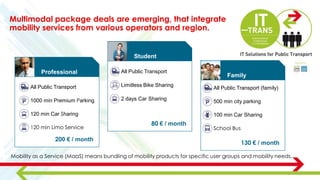
200 € / month
Professional
All Public Transport
1000 min Premium Parking
120 min Car Sharing
120 min Limo Service
80 € / month
Student
All Public Transport
Limitless Bike Sharing
2 days Car Sharing
130 € / month
Family
All Public Transport (family)
500 min city parking
100 min Car Sharing
School Bus
Multimodal package deals are emerging, that integrate
mobility services from various operators and region.
Mobility as a Service (MaaS) means bundling of mobility products for specific user groups and mobility needs.
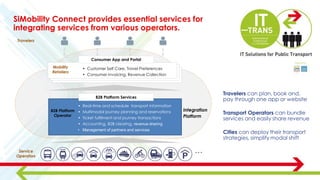
B2B Platform Services
Consumer App and Portal
• Real-time and schedule transport information
• Multimodal journey planning and reservations
• Ticket fulfilment and journey transactions
• Accounting, B2B clearing, revenue sharing
• Management of partners and services
• Customer Self Care, Travel Preferences
• Consumer Invoicing, Revenue Collection
Mobility
Retailers
B2B Platform
Operator
Service
Operators
Travelers
…
Integration
Platform
SiMobility Connect provides essential services for
integrating services from various operators.
Travelers can plan, book and,
pay through one app or website
Transport Operators can bundle
services and easily share revenue
Cities can deploy their transport
strategies, simplify modal shift
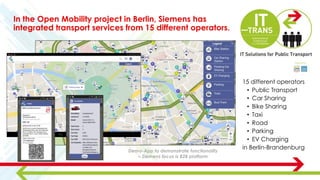
In the Open Mobility project in Berlin, Siemens has
integrated transport services from 15 different operators.
15 different operators
• Public Transport
• Car Sharing
• Bike Sharing
• Taxi
• Road
• Parking
• EV Charging
in Berlin-BrandenburgDemo-App to demonstrate functionality
– Siemens focus is B2B platform
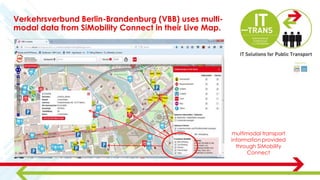
Verkehrsverbund Berlin-Brandenburg (VBB) uses multi-
modal data from SiMobility Connect in their Live Map.
multimodal transport
information provided
through SiMobility
Connect
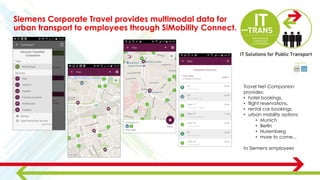
Siemens Corporate Travel provides multimodal data for
urban transport to employees through SiMobility Connect.
Travel Net Companion
provides:
• hotel bookings,
• flight reservations,
• rental car bookings,
• urban mobility options
• Munich
• Berlin
• Nuremberg
• more to come...
to Siemens employees
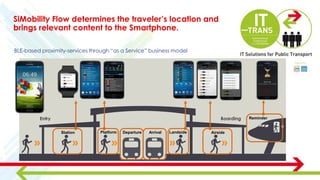
Boarding
Station Platform
Entry
Landside AirsideDeparture Arrival
Reminder
SiMobility Flow determines the traveler’s location and
brings relevant content to the Smartphone.
BLE-based proximity-services through “as a Service” business model
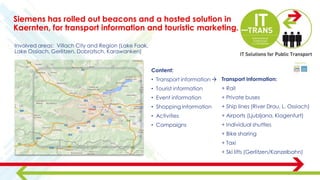
Involved areas: Villach City and Region (Lake Faak,
Lake Ossiach, Gerlitzen, Dobratsch, Karawanken)
Content:
• Transport information 
• Tourist information
• Event information
• Shopping information
• Activities
• Campaigns
Siemens has rolled out beacons and a hosted solution in
Kaernten, for transport information and touristic marketing.
Transport information:
+ Rail
+ Private buses
+ Ship lines (River Drau, L. Ossiach)
+ Airports (Ljubljana, Klagenfurt)
+ Individual shuttles
+ Bike sharing
+ Taxi
+ Ski lifts (Gerlitzen/Kanzelbahn)
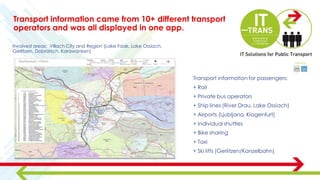
Transport information for passengers:
+ Rail
+ Private bus operators
+ Ship lines (River Drau, Lake Ossiach)
+ Airports (Ljubljana, Klagenfurt)
+ Individual shuttles
+ Bike sharing
+ Taxi
+ Ski lifts (Gerlitzen/Kanzelbahn)
Involved areas: Villach City and Region (Lake Faak, Lake Ossiach,
Gerlitzen, Dobratsch, Karawanken)
Transport information came from 10+ different transport
operators and was all displayed in one app.
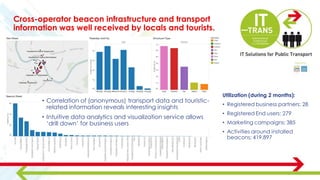
Utilization (during 2 months):
• Registered business partners: 28
• Registered End users: 279
• Marketing campaigns: 385
• Activities around installed
beacons: 419.897
Cross-operator beacon infrastructure and transport
information was well received by locals and tourists.
• Correlation of (anonymous) transport data and touristic-
related information reveals interesting insights
• Intuitive data analytics and visualization service allows
‘drill down’ for business users
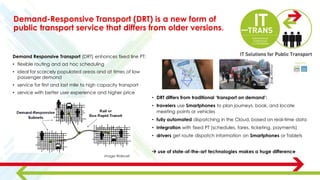
• DRT differs from traditional ‘transport on demand’:
• travelers use Smartphones to plan journeys, book, and locate
meeting points or vehicles
• fully automated dispatching in the Cloud, based on real-time data
• integration with fixed PT (schedules, fares, ticketing, payments)
• drivers get route dispatch information on Smartphones or Tablets
 use of state-of-the-art technologies makes a huge difference
Demand Responsive Transport (DRT) enhances fixed line PT:
• flexible routing and ad hoc scheduling
• ideal for scarcely populated areas and at times of low
passenger demand
• service for first and last mile to high capacity transport
• service with better user experience and higher price
image:Bridj
image: Ridecell
Demand-Responsive Transport (DRT) is a new form of
public transport service that differs from older versions.
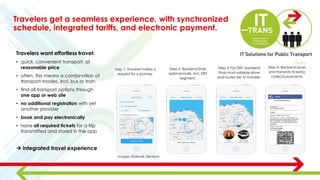
Step 1: Traveler makes a
request for a journey.
Step 4: Backend issues
and transmits ticket(s),
collects payments.
Step 3: For DRT, backend
finds most suitable driver
and routes her to traveler.
Travelers want effortless travel:
• quick, convenient transport, at
reasonable price
• often, this means a combination of
transport modes, incl. bus or train
• find all transport options through
one app or web site
• no additional registration with yet
another provider
• book and pay electronically
• have all required tickets for a trip
transmitted and stored in the app
 integrated travel experience
Step 2: Backend finds
optimal route, incl. DRT
segment.
images: Ridecell, Siemens
Travelers get a seamless experience, with synchronized
schedule, integrated tariffs, and electronic payment.
• Siemens has successfully deployed multi-operator platform services
providing context relevant information and services
• Integration of services avoid installation of many apps and
registration with many different providers and thus greatly improve
the passenger’s experience
• Context-relevant information is state of the art, booking and
payments are the next frontier
• Providing proximity-based services gives invaluable insights for
mobility providers, businesses, and city marketing
• However, integration of information and services from different
operators comes with its own set of challenges....
...leading transportation companies focus on business issues
and delegate technical implementation
Siemens is your reliable technology partner
Lessons learnt.
Thank you for your attention
Steffen Schaefer
steffen.schaefer@siemens.com
Mobile: +49 174 177 0667

Mobility Platforms: Lessons learnt from integrating mobility services from various operators

  • 1.
    Beacons and platforms: Lessonslearnt from integrating mobility services from various operators Steffen Schaefer, Jan Helebrant Senior Principal Mobility IT Solutions Siemens AG
  • 2.
    200 € /month Professional All Public Transport 1000 min Premium Parking 120 min Car Sharing 120 min Limo Service 80 € / month Student All Public Transport Limitless Bike Sharing 2 days Car Sharing 130 € / month Family All Public Transport (family) 500 min city parking 100 min Car Sharing School Bus Multimodal package deals are emerging, that integrate mobility services from various operators and region. Mobility as a Service (MaaS) means bundling of mobility products for specific user groups and mobility needs.
  • 3.
    B2B Platform Services ConsumerApp and Portal • Real-time and schedule transport information • Multimodal journey planning and reservations • Ticket fulfilment and journey transactions • Accounting, B2B clearing, revenue sharing • Management of partners and services • Customer Self Care, Travel Preferences • Consumer Invoicing, Revenue Collection Mobility Retailers B2B Platform Operator Service Operators Travelers … Integration Platform SiMobility Connect provides essential services for integrating services from various operators. Travelers can plan, book and, pay through one app or website Transport Operators can bundle services and easily share revenue Cities can deploy their transport strategies, simplify modal shift
  • 4.
    In the OpenMobility project in Berlin, Siemens has integrated transport services from 15 different operators. 15 different operators • Public Transport • Car Sharing • Bike Sharing • Taxi • Road • Parking • EV Charging in Berlin-BrandenburgDemo-App to demonstrate functionality – Siemens focus is B2B platform
  • 5.
    Verkehrsverbund Berlin-Brandenburg (VBB)uses multi- modal data from SiMobility Connect in their Live Map. multimodal transport information provided through SiMobility Connect
  • 6.
    Siemens Corporate Travelprovides multimodal data for urban transport to employees through SiMobility Connect. Travel Net Companion provides: • hotel bookings, • flight reservations, • rental car bookings, • urban mobility options • Munich • Berlin • Nuremberg • more to come... to Siemens employees
  • 7.
    Boarding Station Platform Entry Landside AirsideDepartureArrival Reminder SiMobility Flow determines the traveler’s location and brings relevant content to the Smartphone. BLE-based proximity-services through “as a Service” business model
  • 8.
    Involved areas: VillachCity and Region (Lake Faak, Lake Ossiach, Gerlitzen, Dobratsch, Karawanken) Content: • Transport information  • Tourist information • Event information • Shopping information • Activities • Campaigns Siemens has rolled out beacons and a hosted solution in Kaernten, for transport information and touristic marketing. Transport information: + Rail + Private buses + Ship lines (River Drau, L. Ossiach) + Airports (Ljubljana, Klagenfurt) + Individual shuttles + Bike sharing + Taxi + Ski lifts (Gerlitzen/Kanzelbahn)
  • 9.
    Transport information forpassengers: + Rail + Private bus operators + Ship lines (River Drau, Lake Ossiach) + Airports (Ljubljana, Klagenfurt) + Individual shuttles + Bike sharing + Taxi + Ski lifts (Gerlitzen/Kanzelbahn) Involved areas: Villach City and Region (Lake Faak, Lake Ossiach, Gerlitzen, Dobratsch, Karawanken) Transport information came from 10+ different transport operators and was all displayed in one app.
  • 10.
    Utilization (during 2months): • Registered business partners: 28 • Registered End users: 279 • Marketing campaigns: 385 • Activities around installed beacons: 419.897 Cross-operator beacon infrastructure and transport information was well received by locals and tourists. • Correlation of (anonymous) transport data and touristic- related information reveals interesting insights • Intuitive data analytics and visualization service allows ‘drill down’ for business users
  • 11.
    • DRT differsfrom traditional ‘transport on demand’: • travelers use Smartphones to plan journeys, book, and locate meeting points or vehicles • fully automated dispatching in the Cloud, based on real-time data • integration with fixed PT (schedules, fares, ticketing, payments) • drivers get route dispatch information on Smartphones or Tablets  use of state-of-the-art technologies makes a huge difference Demand Responsive Transport (DRT) enhances fixed line PT: • flexible routing and ad hoc scheduling • ideal for scarcely populated areas and at times of low passenger demand • service for first and last mile to high capacity transport • service with better user experience and higher price image:Bridj image: Ridecell Demand-Responsive Transport (DRT) is a new form of public transport service that differs from older versions.
  • 12.
    Step 1: Travelermakes a request for a journey. Step 4: Backend issues and transmits ticket(s), collects payments. Step 3: For DRT, backend finds most suitable driver and routes her to traveler. Travelers want effortless travel: • quick, convenient transport, at reasonable price • often, this means a combination of transport modes, incl. bus or train • find all transport options through one app or web site • no additional registration with yet another provider • book and pay electronically • have all required tickets for a trip transmitted and stored in the app  integrated travel experience Step 2: Backend finds optimal route, incl. DRT segment. images: Ridecell, Siemens Travelers get a seamless experience, with synchronized schedule, integrated tariffs, and electronic payment.
  • 13.
    • Siemens hassuccessfully deployed multi-operator platform services providing context relevant information and services • Integration of services avoid installation of many apps and registration with many different providers and thus greatly improve the passenger’s experience • Context-relevant information is state of the art, booking and payments are the next frontier • Providing proximity-based services gives invaluable insights for mobility providers, businesses, and city marketing • However, integration of information and services from different operators comes with its own set of challenges.... ...leading transportation companies focus on business issues and delegate technical implementation Siemens is your reliable technology partner Lessons learnt.
  • 14.
    Thank you foryour attention Steffen Schaefer steffen.schaefer@siemens.com Mobile: +49 174 177 0667