ANYTHING BUT TRAINS? A comparative analysis of alternatives proposed for the Sonoma-Marin Area Rail Transit Project (SMART)  Jack C. Swearengen, Ph.D.  and Friends of SMART
Objections to SMART Costs too much Not enough people will ride it Trains are noisy and polluting It will promote growth and sprawl It doesn’t cross the Bay Safety hazard at grade crossings Traffic delays at grade crossings Railroads are nineteenth century technology
Some nineteenth century technologies Telephone and telegraph Chemical fertilizer Radio Paper Printing press X rays Gunpowder Rifled cannon Compass Optical Lenses Microscope and telescope batteries Incandescent lamps Diode Milking machine photography computer clock Electric motor Cast iron plow Seed drill Threshing machine Mechanical reaper and binder
A Look at the Options AutoTram Personal Rapid Transit Automated Transit Monorail MagLev BART Extension Dual Mode Vehicle Bus Rapid Transit Diesel Multiple Units (DMUs) Keep driving This presentation will look at the pros and cons of  various options proposed for the SMART Right of Way  (ROW) including: Less realistic  More realistic
Goals for Transportation in Marin Provide an alternative to driving For those who choose not to drive For those who can’t drive Reduce Vehicle Miles Traveled Reduce greenhouse gas emissions Reduce congestion on highway and city streets Provide interconnectivity through multimodal transportation system Use the most energy-efficient solution Stay within current cost levels ($5.5 million/mile)
Multimodal Transit in The Netherlands
SHARED RIGHT OF WAY  Light Rail Terminal at Sandy, Utah  Caltrain Common Corridor, Mountain View, CA
Less realistic options AutoTram Personal Rapid Transit Automated Direct Transit Monorail MagLev BART Extension
AUTOTRAM What is it? Large articulated bus which uses rubber tires and a hybrid engine Intended for city streets ●  One or two cars, bi-directional Why? Hybrid engine will be energy-efficient when it becomes available Why not? Would have to pave ROW, making freight    and connecting rail service impossible Lower top speeds More drivers required
PERSONAL RAPID TRANSIT (PRT)  Standard Rail Monorail PRT What is it? A system of small vehicles under independent or semi-independent automatic control, running on fixed guideways in grids or networks
Grid/networks for PRT Small [PRT] networks for local circulator transit, congestion relief, or in anticipation of future density  Transit service to and from rail stations  Circulators linked together, forming a citywide network
PERSONAL RAPID TRANSIT (PRT)  Why? Designed to provide the security and privacy not found in larger more common transit vehicles Lightweight cars are inexpensive Why not? Demonstration projects have cost $100 million per mile Ineffective until regional grid established  Unknown public acceptance means high risk No O&M data from operating system Overhead guideways will be visually obtrusive Projected congestion at stations / on lines Small vehicles claustrophobic for longer trips Emergency exit concerns For more, see Wikipedia, PRT entry
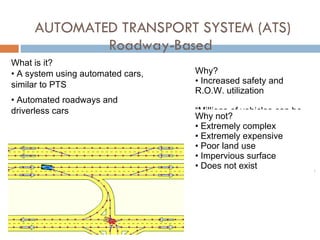
AUTOMATED TRANSPORT SYSTEM (ATS) Roadway-Based  What is it? A system using automated cars, similar to PTS Automated roadways and driverless cars Why?  Increased safety and  R.O.W. utilization “ Millions of vehicles can be optimally, simultaneously and automatically "driven" over a virtually unlimited geographic region, including whole continents, while at the same time, the requirements of each individual vehicle and its passengers attended to. “ www.globaltransportation.com Why not?  Extremely complex Extremely expensive Poor land use Impervious surface Does not exist
AUTOMATED TRANSPORT SYSTEM (ATS) Rail-Based  ADT advocates seem to believe that sidings are a new concept! To reflect reality I have added a rail siding to their top figure.
MONORAIL Why? Minimal space, vertically and    horizontally Quiet Up and out of traffic Not physically capable of derailing What is it? A single rail serving as a track for a wheeled vehicle; also, a vehicle traveling on such a track.
MONORAIL *  http://www.planetizen.com/node/70  and http://www.lightrailnow.org/facts/fa_monorail.htm  Why not?  Cannot be built at grade,    making exit in an emergency    problematic Very expensive    (~$80-300 million /mile) * Heavy and clumsy crossover mechanism requires double track Incompatible with any other type or rail; makes shared track impossible Has never advanced past novelty stage
MAGNETIC LEVITATION (MAGLEV)  What is it? Form of transportation that suspends, guides and propels trains using electromagnetic force; uses track similar to monorail Why? Low friction translates to high speeds, especially over long distances Electric operation New and sexy Shanghai maglev
MAGLEV Why not? Extremely expensive — average cost, 2002 dollars, 7 systems: $138 million per mile* Monorail-like superstructure required — crossover problems Questionable in start-stop operations Steel wheel on steel rail technology has essentially matched maglev's   potential operating speed Incompatible with any other rail operations or connections Very noisy at high speed Negligible energy savings * Sources: Capital Metro, Rapid Transit Project, Draft B Milestone 2 Executive Summary: Urban Transit Vehicles@, 1 October 2001; Steve Arrington, Jacksonville Transportation Authority, 12 October 2001; Leroy Demery, Jr., May 2002; Monorail Malaysia, news release, 23 April 2001; Jacob Snow, The Las Vegas Monorail@, Monorail Society website, 2002/11/02. Calculations by Light Rail Progress]
BART Extension Why? Connect with the rest BART system Established transit system Known technology Why not? Non-standard rail   SMART tracks would have to be completely replaced Would make SMART ROW unusable for freight Would make connection to standard gauge rail systems impossible Extremely expensive SFO extension: 8.7 miles, 4 stations = $1.5 Billion or $170 million/mile 16.1-mile BART extension from Fremont to Santa Clara: $4.7 billion
More realistic options Bus Rapid Transit Dual Mode Vehicle Diesel Multiple Units (DMUs) Keep driving
BUS RAPID TRANSIT (BRT)  What is it? High speed bus system operated within an  exclusive right-of-way Incorporates exclusive transitways, modern  stations, on-board fare collection, high-tech  vehicles and frequent service.  Why? Might eliminate one mode change for passengers (rather than train+bus) Why not? Requires paving over the tracks, eliminating their use for freight Would not promote TOD land-use pattern Retains rolling resistance of rubber tires Travel experience not good enough to compete with autos
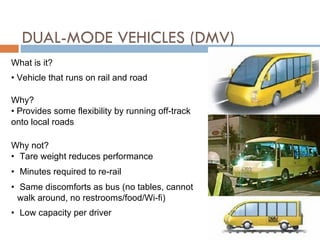
DUAL-MODE VEHICLES (DMV)  What is it? Vehicle that runs on rail and road Why? Provides some flexibility by running off-track onto local roads Why not? Tare weight reduces performance Minutes required to re-rail Same discomforts as bus (no tables, cannot walk around, no restrooms/food/Wi-fi) Low capacity per driver
SELF-POWERED MULTIPLE UNITS What is it? Rail passenger vehicle with diesel-hydraulic drive train. Can be operated singularly, or with multiple units coupled together and controlled by a single operator.  Why? Runs on standard-gauge rails Allows extra passenger capacity to be added/reduced as needed Modern FRA-compliant filters mean very low particulate emissions Can run on bio-diesel; hybrid vehicles under development Lowest rolling resistance Can be operational two years from go-ahead Already in commercial service
SELF-POWERED MULTIPLE UNITS Why not? Still requires foreign oil Must carry fuel on board (thus heavier than electric railcars) Shorter engine life than electric motors Why? (continued) System is less vulnerable to outages because each unit propels itself    and can pull others No overhead structures or electrified track Can serve as stepping stone toward electrified system
KEEP DRIVING “ More than 90% of those responding to a recent survey agree that traffic congestion in Marin County is a moderate or major problem. “  TAM Communications Plan, 4/06 Time: Travel time to work and lost opportunity costs Social equity: provide transportation for those who    cannot drive Environmental: over 60% of Marin-Sonoma GHG  emissions  come from motor vehicles Safety:  Car  crashes kill an estimated 1.2 million people   worldwide each year, and injure about forty times this number  (WHO, 2004)
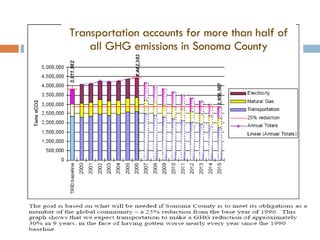
Transportation accounts for more than half of all GHG emissions in Sonoma County
Energy Consumption Transportation’s share of US energy use is growing…
But a shift to rail would make a major impact
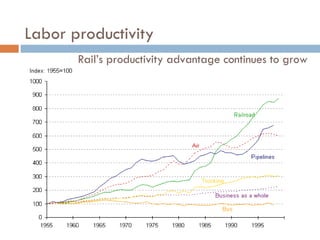
Labor productivity Rail’s productivity advantage continues to grow
Criteria for comparing alternatives Environmental No new ROW required Compatible with bike-ped path Facilitates Transit-oriented development Reduces greenhouse gas emissions No impermeable surface Reduces VMT and VHT Economic FRA compliant Saves commute time Capital cost under $6M/mile Uses existing infrastructure Doesn’t preclude other options Social Provides choices Operational by 2010 Reduces petroleum imports Permits multi-tasking by riders Fits MTC Regional Plan Geographically flexible Aesthetic No overhead structures Minimal land use Reduces smog Quiet Competes favorably with auto    in terms of comfort and speed
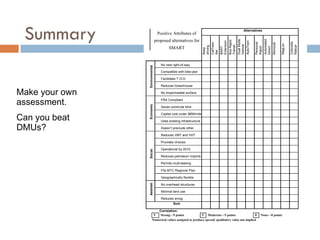
Comparing alternatives Dual mode vehicles Economic Personal Rapid Transit AutoTram BART Bus Rapid Transit Keep driving EMU Electrification Environmental Automated direct transit Monorail MagLev DMU Environmental Economic 9 0 0 0 0 0 9 0 0 5 0 Doesn’t preclude other options 9 0 0 0 0 0 9 5 0 5 5 Uses existing infrastructure 9 0 0 0 0 0 9 0 0 0 0 Capital cost under $6M/mile 9 9 9 5 5 5 9 9 9 9 0 Saves commute time 9 0 5 9 9 9 0 0 5 9 9 FRA Compliant 9 0 5 5 5 5 5 0 9 9 0 No impermeable surface 5 9 5 5 5 5 5 5 5 5 0 Reduces Greenhouse gases 9 9 9 0 0 0 0 0 9 9 0 Facilitates T-O-D 9 0 5 9 9 9 5 0 0 9 5 Compatible with bike-ped path 9 0 5 0 0 0 9 5 5 5 0 No new right-of-way required Alternatives Why and why not?  Positive attributes of proposed alternatives
Comparing alternatives, cont’d Numerical values assigned to produce spread/ qualitative value not implied Social Aesthetic 163 72 93 78 78 78 108 85 97 129 38 Sum 9 9 9 9 9 9 5 5 5 5 0 Reduces smog 9 5 5 0 0 0 5 5 9 9 0 Minimal land use 9 0 0 0 0 0 0 9 0 0 5 No overhead structures 0 0 0 0 0 0 5 5 0 0 9 Geographically flexible 9 0 0 0 0 0 0 0 5 9 0 Fits MTC Regional Plan 9 9 9 9 9 9 9 9 9 9 0 Permits multitasking 5 9 9 9 9 9 5 5 9 9 0 Reduces petroleum imports 9 0 0 0 0 0 9 9 0 5 5 Operational by 2010 9 9 9 9 9 9 5 9 9 9 0 Provides choices 9 9 9 9 9 9 5 5 9 9 0 Reduces VMT and VHT Weak or none—0 points 0 Moderate—5 points 5 Major—9 points 9   Strength of Contribution:
Summary Make your own assessment. Can you beat DMUs?

Swearengen 7437

  • 1.
    ANYTHING BUT TRAINS?A comparative analysis of alternatives proposed for the Sonoma-Marin Area Rail Transit Project (SMART) Jack C. Swearengen, Ph.D. and Friends of SMART
  • 2.
    Objections to SMARTCosts too much Not enough people will ride it Trains are noisy and polluting It will promote growth and sprawl It doesn’t cross the Bay Safety hazard at grade crossings Traffic delays at grade crossings Railroads are nineteenth century technology
  • 3.
    Some nineteenth centurytechnologies Telephone and telegraph Chemical fertilizer Radio Paper Printing press X rays Gunpowder Rifled cannon Compass Optical Lenses Microscope and telescope batteries Incandescent lamps Diode Milking machine photography computer clock Electric motor Cast iron plow Seed drill Threshing machine Mechanical reaper and binder
  • 4.
    A Look atthe Options AutoTram Personal Rapid Transit Automated Transit Monorail MagLev BART Extension Dual Mode Vehicle Bus Rapid Transit Diesel Multiple Units (DMUs) Keep driving This presentation will look at the pros and cons of various options proposed for the SMART Right of Way (ROW) including: Less realistic More realistic
  • 5.
    Goals for Transportationin Marin Provide an alternative to driving For those who choose not to drive For those who can’t drive Reduce Vehicle Miles Traveled Reduce greenhouse gas emissions Reduce congestion on highway and city streets Provide interconnectivity through multimodal transportation system Use the most energy-efficient solution Stay within current cost levels ($5.5 million/mile)
  • 6.
    Multimodal Transit inThe Netherlands
  • 7.
    SHARED RIGHT OFWAY Light Rail Terminal at Sandy, Utah Caltrain Common Corridor, Mountain View, CA
  • 8.
    Less realistic optionsAutoTram Personal Rapid Transit Automated Direct Transit Monorail MagLev BART Extension
  • 9.
    AUTOTRAM What isit? Large articulated bus which uses rubber tires and a hybrid engine Intended for city streets ● One or two cars, bi-directional Why? Hybrid engine will be energy-efficient when it becomes available Why not? Would have to pave ROW, making freight and connecting rail service impossible Lower top speeds More drivers required
  • 10.
    PERSONAL RAPID TRANSIT(PRT) Standard Rail Monorail PRT What is it? A system of small vehicles under independent or semi-independent automatic control, running on fixed guideways in grids or networks
  • 11.
    Grid/networks for PRTSmall [PRT] networks for local circulator transit, congestion relief, or in anticipation of future density Transit service to and from rail stations Circulators linked together, forming a citywide network
  • 12.
    PERSONAL RAPID TRANSIT(PRT) Why? Designed to provide the security and privacy not found in larger more common transit vehicles Lightweight cars are inexpensive Why not? Demonstration projects have cost $100 million per mile Ineffective until regional grid established Unknown public acceptance means high risk No O&M data from operating system Overhead guideways will be visually obtrusive Projected congestion at stations / on lines Small vehicles claustrophobic for longer trips Emergency exit concerns For more, see Wikipedia, PRT entry
  • 13.
    AUTOMATED TRANSPORT SYSTEM(ATS) Roadway-Based What is it? A system using automated cars, similar to PTS Automated roadways and driverless cars Why? Increased safety and R.O.W. utilization “ Millions of vehicles can be optimally, simultaneously and automatically "driven" over a virtually unlimited geographic region, including whole continents, while at the same time, the requirements of each individual vehicle and its passengers attended to. “ www.globaltransportation.com Why not? Extremely complex Extremely expensive Poor land use Impervious surface Does not exist
  • 14.
    AUTOMATED TRANSPORT SYSTEM(ATS) Rail-Based ADT advocates seem to believe that sidings are a new concept! To reflect reality I have added a rail siding to their top figure.
  • 15.
    MONORAIL Why? Minimalspace, vertically and horizontally Quiet Up and out of traffic Not physically capable of derailing What is it? A single rail serving as a track for a wheeled vehicle; also, a vehicle traveling on such a track.
  • 16.
    MONORAIL * http://www.planetizen.com/node/70 and http://www.lightrailnow.org/facts/fa_monorail.htm Why not? Cannot be built at grade, making exit in an emergency problematic Very expensive (~$80-300 million /mile) * Heavy and clumsy crossover mechanism requires double track Incompatible with any other type or rail; makes shared track impossible Has never advanced past novelty stage
  • 17.
    MAGNETIC LEVITATION (MAGLEV) What is it? Form of transportation that suspends, guides and propels trains using electromagnetic force; uses track similar to monorail Why? Low friction translates to high speeds, especially over long distances Electric operation New and sexy Shanghai maglev
  • 18.
    MAGLEV Why not?Extremely expensive — average cost, 2002 dollars, 7 systems: $138 million per mile* Monorail-like superstructure required — crossover problems Questionable in start-stop operations Steel wheel on steel rail technology has essentially matched maglev's potential operating speed Incompatible with any other rail operations or connections Very noisy at high speed Negligible energy savings * Sources: Capital Metro, Rapid Transit Project, Draft B Milestone 2 Executive Summary: Urban Transit Vehicles@, 1 October 2001; Steve Arrington, Jacksonville Transportation Authority, 12 October 2001; Leroy Demery, Jr., May 2002; Monorail Malaysia, news release, 23 April 2001; Jacob Snow, The Las Vegas Monorail@, Monorail Society website, 2002/11/02. Calculations by Light Rail Progress]
  • 19.
    BART Extension Why?Connect with the rest BART system Established transit system Known technology Why not? Non-standard rail SMART tracks would have to be completely replaced Would make SMART ROW unusable for freight Would make connection to standard gauge rail systems impossible Extremely expensive SFO extension: 8.7 miles, 4 stations = $1.5 Billion or $170 million/mile 16.1-mile BART extension from Fremont to Santa Clara: $4.7 billion
  • 20.
    More realistic optionsBus Rapid Transit Dual Mode Vehicle Diesel Multiple Units (DMUs) Keep driving
  • 21.
    BUS RAPID TRANSIT(BRT) What is it? High speed bus system operated within an exclusive right-of-way Incorporates exclusive transitways, modern stations, on-board fare collection, high-tech vehicles and frequent service. Why? Might eliminate one mode change for passengers (rather than train+bus) Why not? Requires paving over the tracks, eliminating their use for freight Would not promote TOD land-use pattern Retains rolling resistance of rubber tires Travel experience not good enough to compete with autos
  • 22.
    DUAL-MODE VEHICLES (DMV) What is it? Vehicle that runs on rail and road Why? Provides some flexibility by running off-track onto local roads Why not? Tare weight reduces performance Minutes required to re-rail Same discomforts as bus (no tables, cannot walk around, no restrooms/food/Wi-fi) Low capacity per driver
  • 23.
    SELF-POWERED MULTIPLE UNITSWhat is it? Rail passenger vehicle with diesel-hydraulic drive train. Can be operated singularly, or with multiple units coupled together and controlled by a single operator. Why? Runs on standard-gauge rails Allows extra passenger capacity to be added/reduced as needed Modern FRA-compliant filters mean very low particulate emissions Can run on bio-diesel; hybrid vehicles under development Lowest rolling resistance Can be operational two years from go-ahead Already in commercial service
  • 24.
    SELF-POWERED MULTIPLE UNITSWhy not? Still requires foreign oil Must carry fuel on board (thus heavier than electric railcars) Shorter engine life than electric motors Why? (continued) System is less vulnerable to outages because each unit propels itself and can pull others No overhead structures or electrified track Can serve as stepping stone toward electrified system
  • 25.
    KEEP DRIVING “More than 90% of those responding to a recent survey agree that traffic congestion in Marin County is a moderate or major problem. “ TAM Communications Plan, 4/06 Time: Travel time to work and lost opportunity costs Social equity: provide transportation for those who cannot drive Environmental: over 60% of Marin-Sonoma GHG emissions come from motor vehicles Safety: Car crashes kill an estimated 1.2 million people worldwide each year, and injure about forty times this number (WHO, 2004)
  • 26.
    Transportation accounts formore than half of all GHG emissions in Sonoma County
  • 27.
    Energy Consumption Transportation’sshare of US energy use is growing…
  • 28.
    But a shiftto rail would make a major impact
  • 29.
    Labor productivity Rail’sproductivity advantage continues to grow
  • 30.
    Criteria for comparingalternatives Environmental No new ROW required Compatible with bike-ped path Facilitates Transit-oriented development Reduces greenhouse gas emissions No impermeable surface Reduces VMT and VHT Economic FRA compliant Saves commute time Capital cost under $6M/mile Uses existing infrastructure Doesn’t preclude other options Social Provides choices Operational by 2010 Reduces petroleum imports Permits multi-tasking by riders Fits MTC Regional Plan Geographically flexible Aesthetic No overhead structures Minimal land use Reduces smog Quiet Competes favorably with auto in terms of comfort and speed
  • 31.
    Comparing alternatives Dualmode vehicles Economic Personal Rapid Transit AutoTram BART Bus Rapid Transit Keep driving EMU Electrification Environmental Automated direct transit Monorail MagLev DMU Environmental Economic 9 0 0 0 0 0 9 0 0 5 0 Doesn’t preclude other options 9 0 0 0 0 0 9 5 0 5 5 Uses existing infrastructure 9 0 0 0 0 0 9 0 0 0 0 Capital cost under $6M/mile 9 9 9 5 5 5 9 9 9 9 0 Saves commute time 9 0 5 9 9 9 0 0 5 9 9 FRA Compliant 9 0 5 5 5 5 5 0 9 9 0 No impermeable surface 5 9 5 5 5 5 5 5 5 5 0 Reduces Greenhouse gases 9 9 9 0 0 0 0 0 9 9 0 Facilitates T-O-D 9 0 5 9 9 9 5 0 0 9 5 Compatible with bike-ped path 9 0 5 0 0 0 9 5 5 5 0 No new right-of-way required Alternatives Why and why not? Positive attributes of proposed alternatives
  • 32.
    Comparing alternatives, cont’dNumerical values assigned to produce spread/ qualitative value not implied Social Aesthetic 163 72 93 78 78 78 108 85 97 129 38 Sum 9 9 9 9 9 9 5 5 5 5 0 Reduces smog 9 5 5 0 0 0 5 5 9 9 0 Minimal land use 9 0 0 0 0 0 0 9 0 0 5 No overhead structures 0 0 0 0 0 0 5 5 0 0 9 Geographically flexible 9 0 0 0 0 0 0 0 5 9 0 Fits MTC Regional Plan 9 9 9 9 9 9 9 9 9 9 0 Permits multitasking 5 9 9 9 9 9 5 5 9 9 0 Reduces petroleum imports 9 0 0 0 0 0 9 9 0 5 5 Operational by 2010 9 9 9 9 9 9 5 9 9 9 0 Provides choices 9 9 9 9 9 9 5 5 9 9 0 Reduces VMT and VHT Weak or none—0 points 0 Moderate—5 points 5 Major—9 points 9   Strength of Contribution:
  • 33.
    Summary Make yourown assessment. Can you beat DMUs?